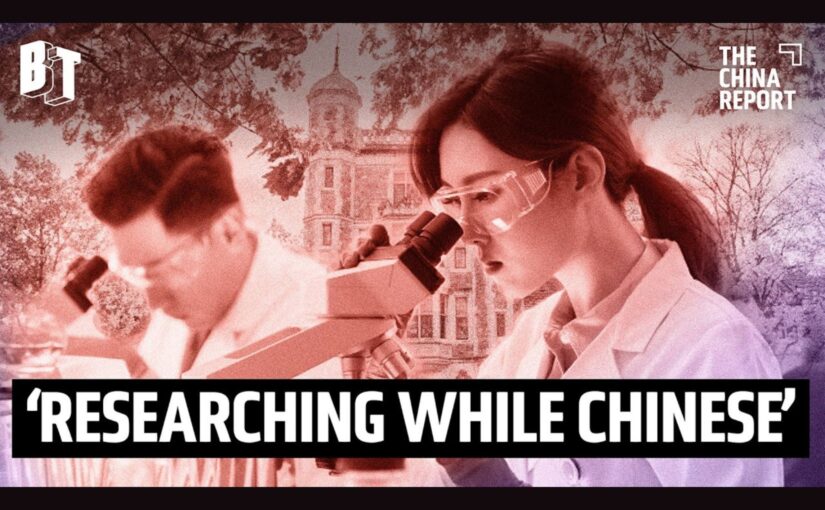
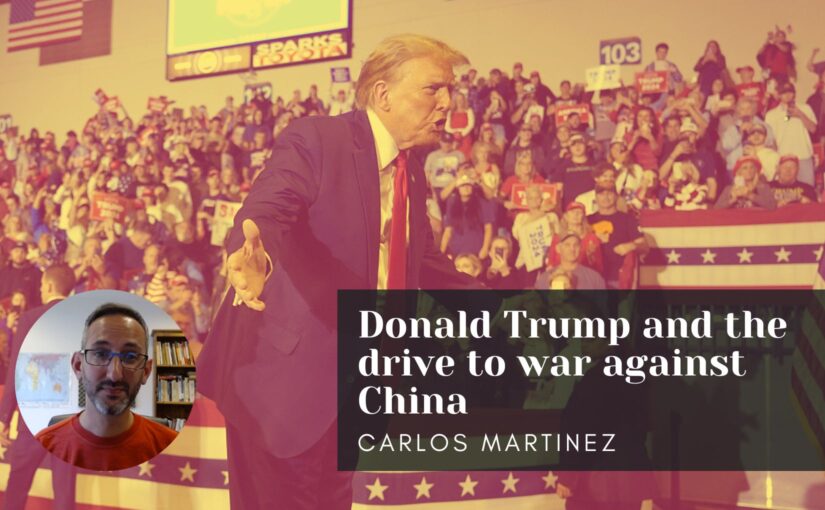
This episode of The China Report, hosted by KJ Noh in collaboration with Pivot to Peace, focuses on the recent arrest of two Chinese researchers from the University of Michigan on US federal charges of ‘agroterrorism’. The scientists, Yunqing Jian and Chengxuan Han, are accused of smuggling biological materials into the country – fusarium graminearum, a plant fungus – without permits. Prosecutors allege these could pose a grave threat to US crops, but plant pathology experts say the fungus is already widespread in the United States, is not on any official list of dangerous pathogens, and that the researchers’ work aimed to mitigate its effects, not cause harm.
The discussion brings together three guests: Linda Wan, a University of Michigan alumna and Code Pink organiser; Julie Tang, retired judge and co-founder of Pivot to Peace; and Bob McMurray, local resident and Michigan graduate. Linda Wan, who has been helping to organise protests and petitions in defence of the scientists, frames the case as part of a broader pattern of fear-mongering and xenophobia toward China and Chinese people.
Julie Tang calls the prosecution a clear case of overcharging – padding the main allegation with lesser counts to pressure a plea deal – and situates it within the racist McCarthyite China Initiative, introduced under the first Trump presidency, which investigated hundreds of Chinese scientists in order to whip up anti-China hysteria.
Bob McMurray notes that this case follows a standard playbook for manufacturing consent for both cold and hot wars. The arrests are part of an escalating pattern of propaganda, legal overreach and racial tropes aimed at building public support for confrontation with China. This is damaging to US-China relations, to the Asian-American community, to scientific progress, and to the prospects for peace.
Alex Tyrell, leader of the Parti Vert du Québec (Green Party of Quebec) in Canada paid a visit to China in late April on invitation. On June 9, he gave a detailed report back to a public webinar hosted by the Hamilton Coalition to Stop the War and endorsed by the Canada-Wide Peace and Justice Network.
The Quebec Green Party notes: “Tyrrell’s visit came amidst rising tensions between Canada and China, including unproven allegations of election interference, confrontational military posturing in the Taiwan Strait, and the passage of Canada’s Foreign Agents Registry Act, which Tyrrell described as ‘the modern Exclusion Act’ targeting Chinese Canadians. ‘This hysteria,’ he argued, ‘is building animosity towards China and preparing Canadians for conflict.’”
The party also noted that Tyrrell, who has led the PVQ since 2013, situated his visit within his party’s eco-socialist and anti-imperialist framework. “Canada has nothing to gain from provoking a war with China,” he said, adding that the PVQ supports diplomacy and cooperation over confrontation and sanctions. He sharply criticised the Green Party of Canada’s shift toward militarism. He also contrasted Canada’s aggressive posture with China’s record: “China hasn’t been involved in a military conflict for over 45 years,” he said, adding that its international development strategy – particularly in Africa – relies on shared infrastructure ownership, not regime change or military force.
Tyrrell’s trip spanned Beijing, Hangzhou, Ningbo, and Shanghai, including meetings with foreign ministry officials, artists, journalists, and students. While political conversations dominated his first days in Beijing, he also emphasised China’s extraordinary achievements in infrastructure and technology. Among the highlights here were:
Fully automated shipping ports in Ningbo.
Small affordable electric vehicles, some under $20,000.
Wide bike lanes and massive fleets of public-use electric bikes and scooters.
The world’s fastest commercial train – the Maglev – operating at 300 km/h.
Refrigerator tech that quadruples produce shelf life via vacuum-sealed drawers.
He praised these advancements as models for Canada’s green transition, particularly criticising Ottawa’s 100% tariffs on Chinese EVs and solar panels: “Canada is slowing down the energy transition for political reasons.”
Tyrrell did not shy away from addressing controversial topics but emphasised that many accusations – such as so-called “Chinese police stations” in Canada – are based on leaks rather than evidence. While refraining from taking a definitive stance on every issue, he expressed scepticism toward narratives pushed by Canadian media and intelligence agencies. He encouraged Canadians to question the double standards – particularly on genocide designations in Xinjiang versus Gaza. On Taiwan, he reiterated his party’s support for Canada’s official One China policy, warning that military provocations near the island could spark catastrophic conflict.
Asked what role the Green movement could play in improving Canada-China relations, Tyrrell drew a sharp contrast between his Quebec party and the federal Greens under Elizabeth May. “They’re echoing the politics of fear, militarism, and empire,” he said. “We need a complete 180 – and that includes replacing the current leadership… Right now, the Green Party of Canada is a huge embarrassment to the peace movement.”
Just prior to his visit, Tyrell was interviewed by prominent Canadian anti-imperialist Yves Engler on his Talking Foreign Policy podcast. He said that:
“The mainstream media has been continuously vilifying Chinese Canadians, the Chinese Communist Party, and the Chinese government. It’s important to push back on this anti-China narrative. Canada has gone from having a very pro-China policy to a very, very negative relationship with the People’s Republic of China.”
Tyrrell referenced his recent interview with Senator Yuen Pau Woo, who cautioned that the foreign agent registry law could have a chilling effect on Chinese Canadian political participation. Tyrrell called the bill “preoccupying” and noted that it “could potentially go as far as jailing people in Canada for participating in elections” due to vague language about associations with foreign entities.
The following article by W. T. Whitney Jr, originally published in People’s World, connects the Trump administration’s hostility towards China back to the US-led campaign of containment and encirclement starting in 1949 with the proclamation of the People’s Republic.
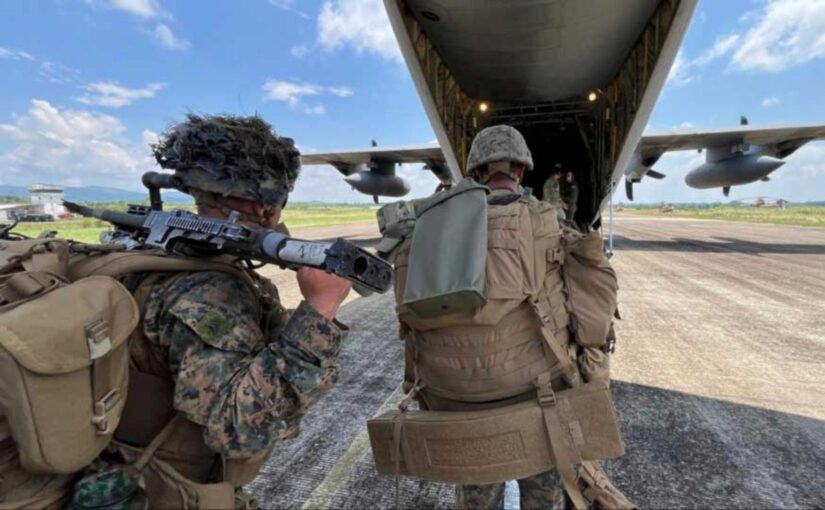
While the current state of relations between the two countries is often described as a New Cold War, Whitney points out that it has a significant military component, with 400 US bases surrounding China with ships, missiles and troops. Furthermore, “US allies in the Western Pacific—Japan and South Korea in the North, Australia and Indonesia in the South, and The Philippines and various islands in between—have long hosted U.S. military installations and/or troop deployments. Nuclear-capable planes and vessels are at the ready. US Navy and Air Force units regularly carry out joint training exercises with the militaries of other nations.”
Vast investment is being ploughed into weapons development in the US, and Trump-supporting producers of advanced modern weaponry (such as Peter Thiel) “exert sufficient influence over government decision-making to ensure happy times for the new breed of weapon producers”.
The article concludes with a call for the anti-war movement in the West to step up in its opposition to war on China, and its efforts to build stronger people-to-people links between the West and China:
Will resistance to war against China end up stronger and more effective than earlier anti-war mobilizations in the post-Vietnam War era? A first step toward resisting would be to build awareness of the reality that war with China may come soon. General knowledge of relevant history should be broadened, with emphasis on how U.S. imperialism works and on its capitalist origins. Anyone standing up for peace and no war ought to be reaching out in solidarity with socialist China.
Despite all the hype about a possible “breakthrough” in the U.S.’ trade war with China due to Trump’s tariff retreats, the reality is that the movement toward an actual war with China accelerates.
The public, focused on troubles currently upending U.S. politics, does not pay much attention to a war that has actually been on the way for decades.
The watershed moment of course came all the way back in 1949 with the victory of China’s socialist revolution. Amid resurgent anti-communism in the United States, accusations flourished of “who ‘lost’ China.”
Loss in U.S. eyes happened in China with the dawning of national independence and promise of social change. In 1946, a year after the Japanese war ended, U.S. Marines, allied with Chinese Nationalist forces, the Kuomintang, were fighting the People’s Liberation Army in Northeast China.
The U.S. government that year was delaying the return home of troops who fought against Japan. Soldier Erwin Marquit, participant in “mutinies” opposing the delay, explained that the U.S. wanted to “keep open the option of intervention by U.S. troops … [to support] the determination of imperialist powers to hold on to their colonies and neocolonies,” China being one of these.
The ruling Liberal Party won 169 seats, up by 17, and leaving it just short of the 172 seats needed for a majority. The Conservatives won 144 seats, an increase of 24, but their leader Pierre Poilevre, who before ‘Hurricane Trump’ struck Canada could have pretty confidently looked forward to leading the next government, lost his seat.
The nationalist Bloc Québécois took 33 seats, a loss of 11. The social democratic New Democratic Party (NDP) won just seven seats, a loss of 17, with party leader Jagmeet Singh not only losing his seat but coming third in his riding (as electoral districts are termed in Canada). The Greens lost one of their two seats, with co-leader Jonathan Pedneault becoming the third party leader to lose his place in the federal parliament.
The Marxist-Leninist Party of Canada (MLPC) fielded 35 candidates and the Communist Party of Canada (CPC) fielded 24. MLPC is the registered name for electoral purposes of the Communist Party of Canada (Marxist-Leninist) (CPCML). No other left parties stood candidates.
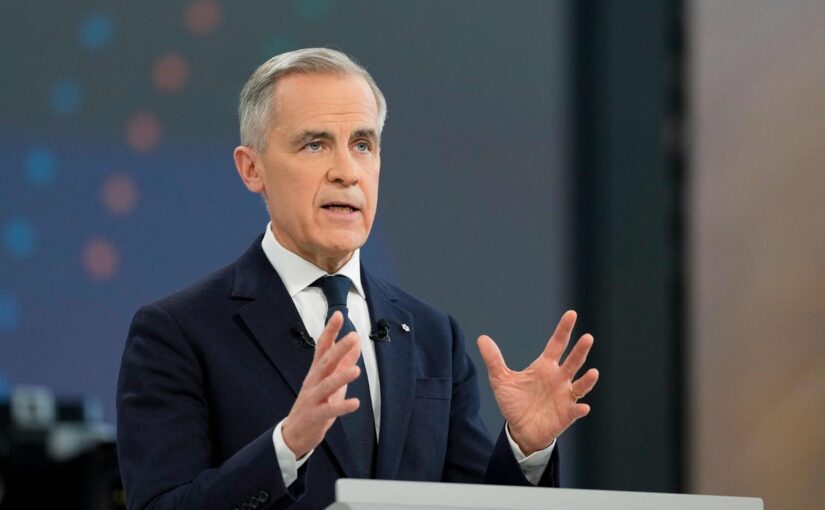
As a result of this election, Mark Carney has now received his own mandate to serve as Prime Minister. The former Goldman Sachs banker, who went on to become Governor of the Reserve Bank of Canada and then the Bank of England, but who was completely lacking in previous political experience, was shoe-horned into the leadership of the Liberal Party, and hence the office of Prime Minister, after the unpopular and arrogant Justin Trudeau was forced to resign.
As indicated above, the fortunes of the Liberal Party had reached a nadir, leaving the Conservatives confident of a return to office. The Liberals’ change in fortunes came in part from the transition from Trudeau to Carney, but more especially from Donald Trump’s punitive ‘tariff wars’ and his insulting, boorish and aggressive threats to annex Canada, which have stirred a patriotic reaction from the ice hockey rink to the ballot box.
Carney skillfully rode this patriotic wave, with strong rhetoric that appeared to stand up to Trump, whilst Poilevre struggled in vain to shed his previous whole-hearted embrace of MAGA and of his own designation as the ‘Canadian Trump’. It was also this political polarisation and perceived national crisis that squeezed the votes of smaller parties, with many Bloc Québécois, NDP and Green voters doubtless holding their noses while they lent their vote to the Liberals.
Asked to comment on the result at the Chinese Foreign Ministry’s regular Beijing press conference the next day, spokesperson Guo Jiakun said that China is willing to develop its relations with Canada based on mutual respect, equality and mutual benefits. Asked to comment on Carney’s victory and bilateral relations, he said that China has noted relevant reports, and that China’s position on its relations with Canada has been consistent and clear.
The perfunctory tone of Guo’s remarks, devoid of even the most formal diplomatic expression of congratulations, indicates that the once relatively warm relations between Ottawa and Beijing, for now at least, remain decidedly chilly. This is consistent with Carney’s continued hostile rhetoric towards China, even as he strikes a pose of defending Canadian sovereignty from US threats. At the same time, Guo makes clear that China is open to better relations, but that the ball is firmly in Canada’s court.
In the build up to the elections, TML In The News, an online publication of CPC(ML), carried an article by Peggy Morton, “setting the record straight about Canada’s trading relations with China” and citing it as an “example of how a Carney government will manage the economy”.
Peggy begins by explaining that, “Following the lead of then-US President Joe Biden’s administration which imposed 100 per cent tariffs on Chinese electric vehicles in August 2024, the federal government under Justin Trudeau announced in September 2024 that the following month it would impose an import tax of 100 per cent on electric vehicles (EVs) produced in China… Note that Donald Trump had yet to enter the picture with his tariff wars. Nonetheless, paying no attention to World Trade Organisation (WTO) rules which govern the trading relations between trading nations around the world, Canada accused China of ‘distorting global trade’ by exporting EVs at ‘unfairly low prices’ and imposed its draconian tariffs.”
China did not respond with tariffs of its own until March 2025, when, following an investigation, it announced that it would impose a 100 per cent tariff on Canadian canola oil and canola meal and peas, along with 25 per cent tariffs on pork, fish and seafood, as of March 20.
Prime Minister Carney responded that: “The Government of Canada is deeply disappointed by this decision, which will hurt Canadian farmers, harvesters and businesses, and will raise prices and diminish choice for Chinese customers, as well as in the agriculture, fish and seafood, retail, restaurant, and food-preparation industries.”
China has launched a sharp attack on the role of the United States in creating and perpetuating the political chaos and humanitarian disaster gripping the Caribbean state of Haiti and in the immiseration of its people.
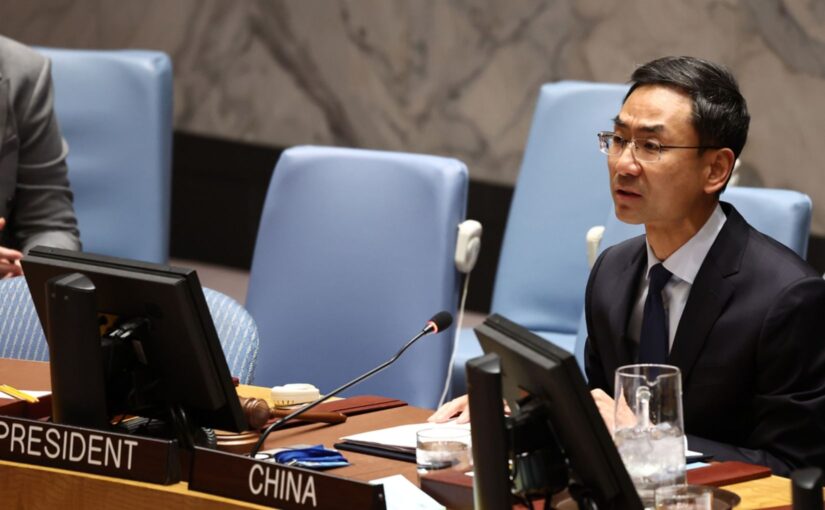
Addressing a meeting of the United Nations Security Council in New York, called to hear briefings on the work of BINUH (the United Nations Integrated Office in Haiti) on April 21, Chinese Ambassador Geng Shuang made three points:
First, Haiti must shoulder its own responsibility. As a sovereign state, Haiti bears the primary responsibility of governance. “We call on all parties in Haiti to prioritise the interest of the nation and its people, enhance dialogue and consultation, demonstrate flexibility, and work together to advance a political process that is Haitian-led and Haitian-owned, with the goal of establishing a legitimate, effective, and responsible government at an early date.”
Second, external support must be effective. “On the political process, we need to support CARICOM [the Caribbean Community] and BINUH in continuing their good offices to accelerate the implementation of a transitional arrangement that is aligned with the realities of Haiti and is widely recognised… On humanitarian assistance, it is necessary to mobilise the resources of the international community and encourage all parties to continue to provide more assistance to the Haitian people to alleviate their sufferings.”
However, by far his strongest and most substantive comments addressed the role and responsibility of the United States:
“Third, the instigator of the crisis must shoulder its responsibility. Haiti was the first Latin American country to declare independence. However, it has then suffered many hardships due to a long period of military occupation, external interference, and economic exploitation. Throughout this process, the United States has been the greatest external factor affecting Haiti’s security, stability, and development.
“The US has always been the mastermind behind the political landscape in Haiti. For over a century, it has blatantly deployed troops, installed puppet governments, and manipulated Haiti’s constitution, entrenching itself in Haiti’s political affairs.”
He went on to say that the United States has always been a major source of interference in Haiti’s development. While it claims to support the Haitian people, it has significantly cut foreign aid and continued deporting Haitian immigrants on the pretext of national priorities precisely when Haiti is in dire need of support. What is even more shocking is that not long ago, while the US defied world opinion by imposing sweeping tariffs on all trade partners, it also extended its so-called baseline tariff of 10% to Haiti, one of the world’s least developed countries as defined by the UN. This display of unilateralism, protectionism, and economic bullying is not just aimed at the so-called competitors like China. It has also inflicted damage on a nation teetering on the edge of collapse, such as a fragile country like Haiti, where the people are in dire straits. This is not only cruel and absurd, but also profoundly heartbreaking.
“We hope that the US will reflect on all of the above. Haiti’s future should not be sacrificed to the US pursuit of its own strategic interests, nor should ‘being too close to the US’ become a curse for Haiti.”
Reporting on the meeting, Peoples Dispatch quoted Maria Isabel Salvador, Special Representative of the United Nations Secretary General for Haiti and Head of BINUH, as saying that, in February and March alone, 1,086 people were killed, 383 were injured, and more than 60,000 were forcibly displaced. Since December of last year, one million people have been displaced.
“The humanitarian crisis in Haiti has reached critical levels… Cholera outbreaks and gender-based violence – especially in places of displacement – are widespread; insecurity has closed 39 health facilities and more than 900 schools in [the capital] Port-au-Prince,” she told the meeting.
Haiti has yet to establish diplomatic relations with the People’s Republic of China. However, the two countries maintain representative and trade offices in their respective capitals.
Remarks on BINUH by Ambassador Geng Shuang at the UN Security Council Briefing
President,
I thank Special Representative Maria Isabel Salvador and National Security Advisor Monica Juma for their briefings. I welcome the representatives of Haiti and the Dominican Republic at today’s meeting. I have also listened carefully to the statement made by the civil society representative.
We are pleased to republish the following article by Sara Flounders, analysing the Trump administration’s proposed strategy to reindustrialise the US. Sara notes that Trump is not the first president to talk about the need for reindustrialisation; “Reindustrialisation was a huge promise of the Jimmy Carter and Ronald Reagan administrations in the 1970s and 1980s… Trump promised this eight years ago during his first term and former President Joe Biden promised a vast program to ‘Build Back Better’ and reindustrialise the US economy and modernise infrastructure.”
Action has never lived up to rhetoric, and US manufacturing continues its protracted decline. Trump’s tactic is to essentially pin the blame on China, imposing tariffs as a means of reordering the international economic system and forcing manufacturing to return to the US. “This is wishful or magical thinking”, writes Sara.
“The US, as a capitalist country, really can’t and won’t reindustrialise, because that is a fabulously expensive process involving many years of investment of the capitalists’ own money… Corporate CEOs know they will only survive by maximising profits and guaranteeing hefty returns every quarter. Any attempt to reindustrialise requires a rethinking of, and massive investments in, infrastructure and education needed for such an economy. This takes decades of investments.”
In reality, domestic investment in the US is directed to where private companies can make a quick buck: the military-industrial complex. “Investment money gravitates relentlessly to the highest guaranteed profits, and that is usually the military budget with its huge, guaranteed, multibillion-dollar annual subsidy”. Hence Donald Trump’s record-breaking trillion-dollar Pentagon budget.
China, by contrast, “has a socially planned economy where the greatest sources of wealth in society are owned by the whole nation”. As such, economic strategy and investment policy are controlled by the people, led by the Communist Party. Socialist economic policies and reorganisation of society “have ended dire poverty for 800 million people and transformed one of the poorest countries on the planet into today’s modern marvel”.
Sara concludes:
The interests of workers and oppressed people in the US are bound up with the development of the people of the whole world. Only through increased cooperation and solidarity will our class here develop the ability to solve the enormous global problems.
The ability to rationally plan and invest socially created wealth into rapidly improving technology and infrastructure is decisive. This requires socialism.
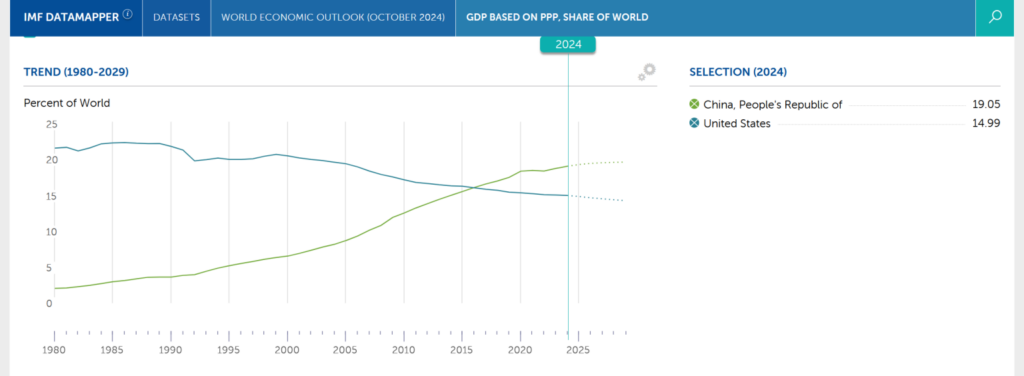
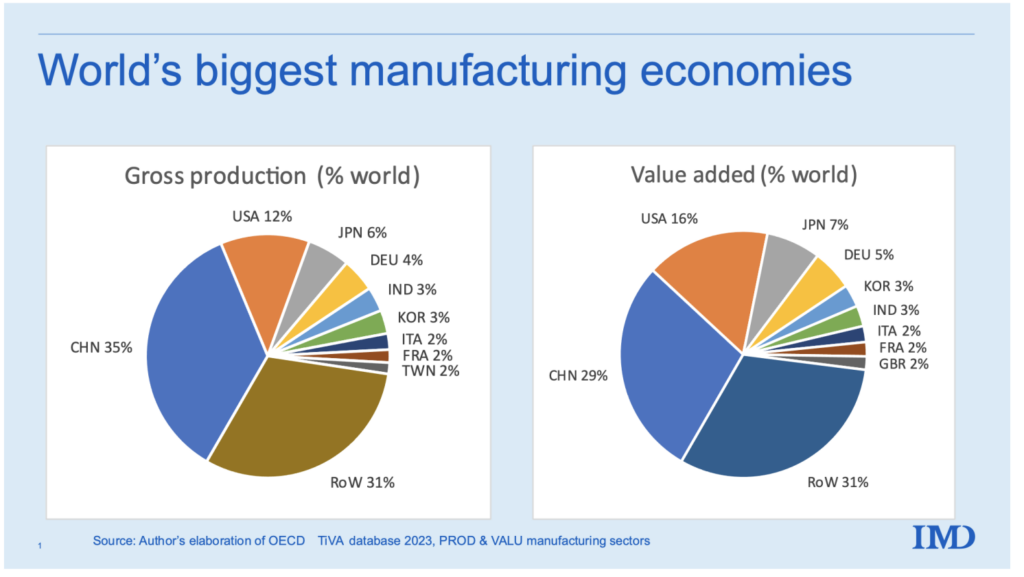
In the 1950s, when Japan and much of Europe was in ruins, the U.S. accounted for 50% of the world’s global production. By the 1960s, this was 35%, declining to 25% by the 1980s. By 2025, the U.S. share of global production had fallen to 12% as production grew elsewhere. (itif.org, Feb. 18)
The capitalist class in the U.S. has grown frantic about this reversal. Its focus is on China, and it blames China for its spectacular level of modern industrial development. In advanced technology manufacturing the future is clear: China holds 45% of the global share to 11% for the U.S.
Higher levels of production need a high-tech infrastructure to move what is produced to global markets. China dominates the global commercial shipbuilding market, producing over 50% of the world’s new ship orders, while the U.S. share has dwindled to less than 1%. China’s shipbuilding industry is backed by a vast industrial base with government support, allowing it to compete on a larger scale than the U.S.
China’s high-speed railroads connect 500 cities and reach through Central Asia into Europe. Meanwhile in the U.S., freight and passenger railroads are in decline.
Can this precipitous decline of U.S. capitalist hegemony be stopped? Can it be reversed? President Donald Trump would have us believe so, but evidence points to a negative answer. The corporate media presents the competition between the U.S. and China as a contention between two nation states, falsely accusing the Chinese government of not playing fair. In reality, China’s advantage arises from the sharp difference in two wholly different forms of organizing society.
Fears of global financial collapse haunt capitalists
The head of the world’s largest hedge fund, billionaire investor Ray Dalio of Bridgewater Associates, recently warned of a global financial system collapse. Trump’s aggressive and erratic tariff policies and ballooning debt could trigger a breakdown of the global financial system. “I’m worried about something worse than a recession if this isn’t handled well,” Dalio said on Meet the Press on April 13.
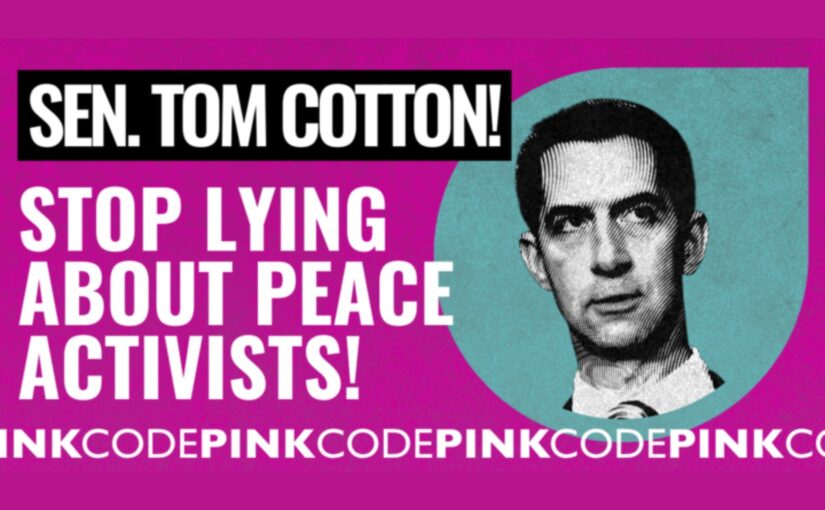
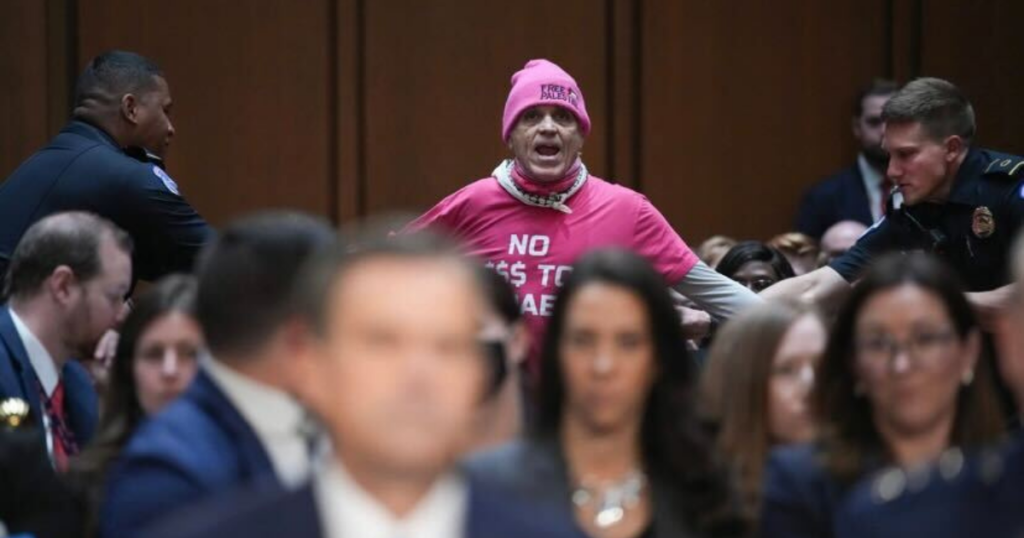
On 25 March 2025, at a US Senate Intelligence Committee hearing on global threats, CODEPINK activist Tighe Barry stood up and called on the US government to stop funding Israel’s genocide in Gaza. Fanatical China hawk Senator Tom Cotton responded by labelling Barry as a “CODEPINK lunatic that was funded by the Communist Party of China”. Retired Colonel Ann Wright stood up and shouted “I’m a retired Army Colonel and former diplomat. I work with CODEPINK and it is not funded by Communist China.”
Both activists were ejected from the room and arrested. Cotton meanwhile proceeded with his McCarthyite diatribe: “The fact that Communist China funds CODEPINK, which interrupts a hearing about Israel illustrates Director Gabbard’s point that China, Russia, Iran and North Korea are working together in greater concert than they ever had before.”
The purpose of this narrative is to portray any opposition to US hegemonism and imperialism as being funded and fomented by foreign powers – just as in the 1950s and 60s, working class, progressive and anti-war activists were portrayed as Soviet agents.
Senate Intelligence Committee Hearing Turns Ugly with McCarthy-Style Lies About CODEPINK: Women for Peace
On March 25, at the U.S. Senate Intelligence Committee hearing on global threats with the five heads of intelligence agencies of the U.S. government, Senator Tom Cotton, accused on national TV a group I have worked with for over 20 years, CODEPINK: Women for Peace, of being funded by the Communist Party of China.
During the hearing CODEPINK activist Tighe Barry stood up following the presentation of the Director of National Security Tulsi Gabbard’s lengthy statement about global threats to U.S. national security and yelled “Stop Funding Israel.”
This was because neither Intelligence Committee Chair Tom Cotton and Vice Chair Mark Warner had mentioned Israel in their opening statement nor had Gabbard mentioned the Israeli genocide of Palestinians in Gaza in her statement either.
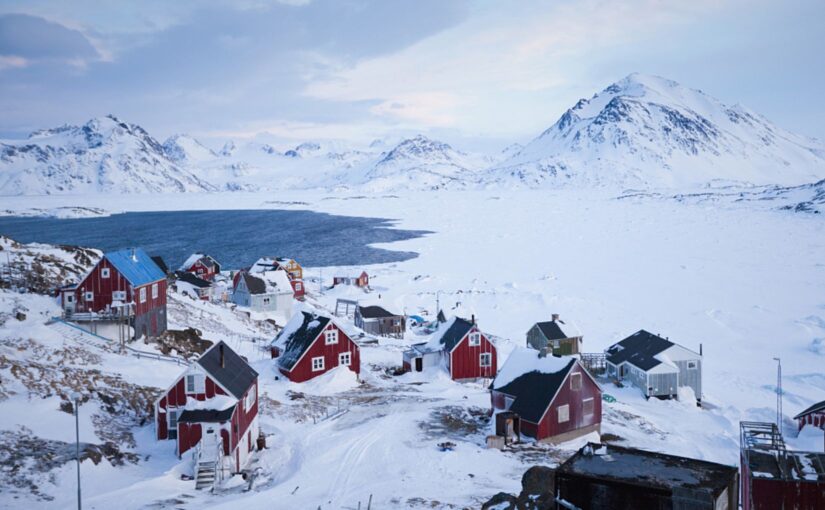
With the eyes of the world focused on Greenland as the Trump administration continues with its aggressive and bullying campaign – including such high-profile stunts as the recent visit by Vice President Vance to a US base on the island after local people made it quite clear that his wife was not welcome at a traditional dog sled race – aimed at replacing Danish rule with US annexation, overriding the people’s desire for independence, leading Greenlandic politicians have expressed their wish to develop greater cooperation with China.
Reporting from the capital Nuuk on March 28, the Xinhua News Agency said that they expressed interest in deepening cooperation with China in areas such as trade, fisheries, and sustainable development while highlighting the potential for a free trade agreement between the two sides.
Vivian Motzfeldt, the incoming foreign minister of Greenland’s new autonomous government, told Xinhua that strengthening ties with China will be one of her priorities. “My trip to China in 2023 was memorable,” she said, noting that China is one of Greenland’s largest seafood markets. “China is very important to us, and we are eager to strengthen our cooperation.”
Following a general election on March 11, taking into account the critical situation facing their country, four of the five political parties that secured seats agreed to form a unity government on March 28. Together, Demokraatit, Siumut, Inuit Ataqatigiit (IA), and Atassut hold 23 out of 31 seats in the Inatsisartut, Greenland’s parliament.
“‘That day, the entire city of Nuuk stood united!’ said Gustav Petersen, a member of Naleraq, the second-largest party in Greenland’s parliament, referring to the anti-US protest held on March 15. [Naleraq won the second largest number of seats in the election but was the only party that has declined to join the new government.]
“According to local media, more than 1,000 people participated in the protest – an impressive turnout for Nuuk, a city with a population of just 15,000. Carrying banners reading ‘We are not for sale,’ ‘Greenland for Greenlanders,’ and ‘Make America Go Away,’ demonstrators marched from the city centre to the US Consulate in Nuuk, sending a clear message of opposition to Washington’s ambitions.
“Petersen said although Greenlanders had varying political preferences during the March 11 parliamentary elections, there was one point of unanimous agreement: ‘We don’t want to be Americans! The United States cannot treat Greenland as a commodity to be bought at will.’
“The US Consulate in Nuuk… remained shuttered when Xinhua reporters visited. ‘On the day of our protest, it was the same – completely deserted,’ Petersen said.
“Standing outside the consulate, Nuuk resident Nikolaj Davidson, who works at a slaughterhouse, voiced his opposition to Trump’s proposal. ‘I don’t want to be American, and neither do my family nor friends,’ he said. ‘Almost everyone in my family disagrees with Trump. From what I know, the vast majority of Greenlanders do not want Greenland to become part of the United States. The American healthcare and welfare systems are not appealing to us.’
“Davidson said that Trump’s main motivation is Greenland’s rich natural resources. ‘Just like the US government has done before, Trump might look for various pretexts to legitimise the takeover of Greenland,’ he warned.”
The following article was originally published by the Xinhua News Agency. We also embed the video of a speech on the current situation regarding Greenland by Lotte Rørtoft Madsen, the President of Denmark’s Communist Party (KP – Kommunistisk Partis). Lotte was speaking in a March 30 webinar entitled ‘Trump’s Aggression in the Americas – the return of the Monroe Doctrine?’ organised by the International Manifesto Group. You can watch the entire discussion at https://youtube.com/live/cKdBHeyBtZU.
Greenlandic political leaders looks to enhance cooperation with China
NUUK, Greenland, March 28 (Xinhua) — Greenland’s political leaders on Friday expressed interest in deepening cooperation with China in areas such as trade, fisheries, and sustainable development while highlighting the potential for a free trade agreement between the two sides.
Vivian Motzfeldt, the incoming foreign minister of Greenland’s new autonomous government, told Xinhua that strengthening ties with China will be one of her priorities.
“My trip to China in 2023 was memorable,” she said, noting that China is one of Greenland’s largest seafood markets. “China is very important to us, and we are eager to strengthen our cooperation.”
Motzfeldt said her tasks include boosting exports, enhancing cooperation in the fisheries sector, and pursuing a free trade agreement with China.
Aqqalu Jerimiassen, chairman of the Atassut party and a member of the Greenlandic Parliament, shared similar views based on his visit to China in 2018.
“I’ve been to Beijing, Guangzhou and several other cities,” he told Xinhua. “I was very impressed during my visit to China. I was particularly interested in how we can build good cooperation with Chinese enterprises and authorities.”
On Friday, Greenland announced the formation of a new autonomous government in Nuuk, the capital. At a ceremony held at the Katuaq Cultural Center, four political parties, representing 23 of the 31 seats in Greenland’s parliament, signed a coalition agreement to establish the new autonomous government.
Greenland was a Danish colony until 1953 when it became an integral part of the Kingdom of Denmark. In 1979, it gained home rule, expanding its autonomy, while Denmark retained control over foreign affairs and defense policy.
The following article by Tasfia Jahangir and Miles Wetherington, originally published in Liberation News, describes the rising McCarthyism in the US, in particular the red-scare narrative around Chinese students and scientists.
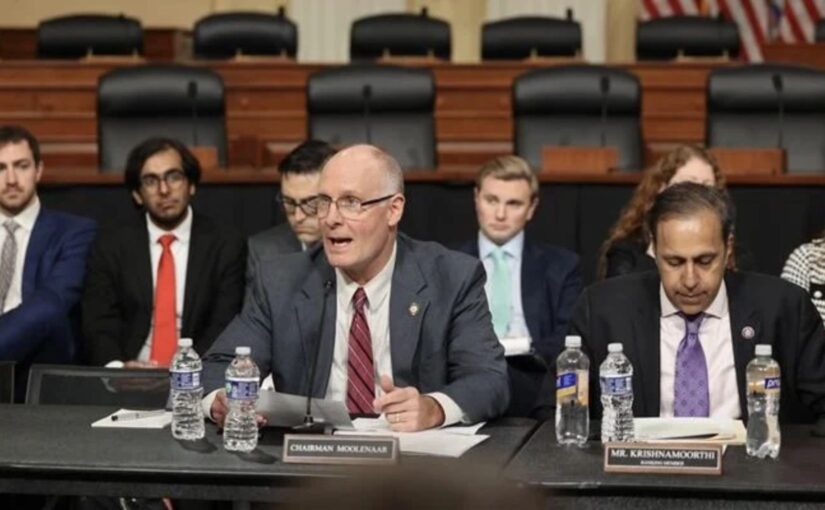
The authors note that John Moolenaar, a Michigan Republican who chairs the House Select Committee on the CPC, has sent letters to six US universities, including Stanford, demanding that they provide detailed information about their entire Chinese student populations, saying that the student visa system has become a “Trojan horse” and implying that “any Chinese national studying in a STEM field — especially those working in key research areas like AI, semiconductors, or aerospace — is potentially a spy”. At the same time, lawmakers have introduced a “Stop Chinese Communist Visas Act”, seeking to block visas for Chinese students studying in the US, on supposed national security grounds.
Hostility towards Chinese students and scientists is bipartisan, and has been trending upwards for years, under both the Trump and Biden administrations. The authors note that this escalation “also fits into a broader pattern of repression targeting international students. Indian students — the largest international group — have been told to ‘self-deport’ for campus activism, while students like Mahmoud Khalil, Rumeysa Ozturk and Momodou Taal have faced repression for opposing the genocide in Palestine.”
The focus on Chinese academics in particular is “part of the US strategy of containment, encirclement and suppression on China”. The US ruling class seeks to win public support for the New Cold War, painting China as a threat to the US and the world. Such a portrayal is becoming increasing untenable:
US officials try to demonise China as if it is on the warpath, but it is the United States that poses the greatest threat to world peace. In the last 30 years alone, the United States has launched 251 military interventions across the globe. In stark contrast, China has eradicated extreme poverty for more than 850 million people, and managed to overcome the legacy of colonialism and underdevelopment by reaching a level of moderate prosperity all while upholding the Five Principles of Peaceful Coexistence.
Ultimately this revival of reds-under-the-bed hysteria will only serve to fuel racism and xenophobia, and to further poison US-China relations. What’s more, it “actively sabotages the kind of international cooperation needed to confront global crises”. Ironically, it will also provide a boost for China’s domestic innovation, as top Chinese students will opt to study at home rather than face an increasingly hostile and dangerous environment in the US.
The authors conclude:
Collaboration between the US and China — two of the largest research and innovation hubs in the world — could offer humanity an opportunity to solve the pressing crises of our time: pandemics, climate change, AI ethics and more. But to those in power, shared progress is a threat. It undermines the need for endless militarisation, sanctions and rivalry. It challenges the US ruling class’ worldview based on zero-sum competition and global hegemony.
On March 19, U.S. Representative John Moolenaar, Chairman of the House Select Committee on the Chinese Communist Party, sent a letter to six American universities demanding that they provide detailed personal, academic, and financial information about Chinese international students in STEM fields. Disguised as a routine inquiry into national security, the letter levies sweeping accusations. It claims that Chinese students “jeopardize” U.S. technological leadership, and labels the American student visa system as a “Trojan horse” for these students to steal intellectual property on behalf of the Chinese government. On top of this, the House also recently introduced the STOP CCP VISAs Act, a bill that, if passed, would ban student visas for all Chinese national students.
We must oppose this vilification of Chinese students and recognize it for what it is — an attack on global science.
The war on Chinese students is a war on global science
The Select Committee on the CCP letter and STOP CCP VISAs Act are part of a decade-long bipartisan campaign to surveil, vilify and push out Chinese researchers and students from American institutions. Under both Trump and Biden administrations, we’ve witnessed countless attacks on Chinese scholars and scientists based solely on their national origin — federal investigations with no evidence, layoffs, cancelled visas, and partnerships dismantled under political pressure.
Moolenaar’s letter escalates this campaign by implying that any Chinese national studying in a STEM field — especially those working in key research areas like AI, semiconductors, or aerospace — is potentially a spy. It makes absurd and xenophobic claims, such as the idea that the mere act of returning to China after graduation should be treated with suspicion. This logic dehumanizes thousands of students as geopolitical pawns rather than what they are: workers, researchers and colleagues striving to build a better future.
In the following article, that was originally published on his Substack, Geopolitical Economy, Ben Norton draws attention to a recent speech by US Vice President JD Vance on globalisation that made it clear that Washington’s goal is to keep formerly colonised countries in the Global South trapped at the bottom of the global value chain.
Ben outlines how Vance acknowledged that the US-led West wants to maintain a strict international division of labour, in which poor countries in the periphery produce low value-added goods while the rich nations in the core extract exorbitant monopoly rents. Vance made these remarks at a gathering, called the American Dynamism Summit, that was organised by the Silicon Valley venture capital firm Andreessen Horowitz.
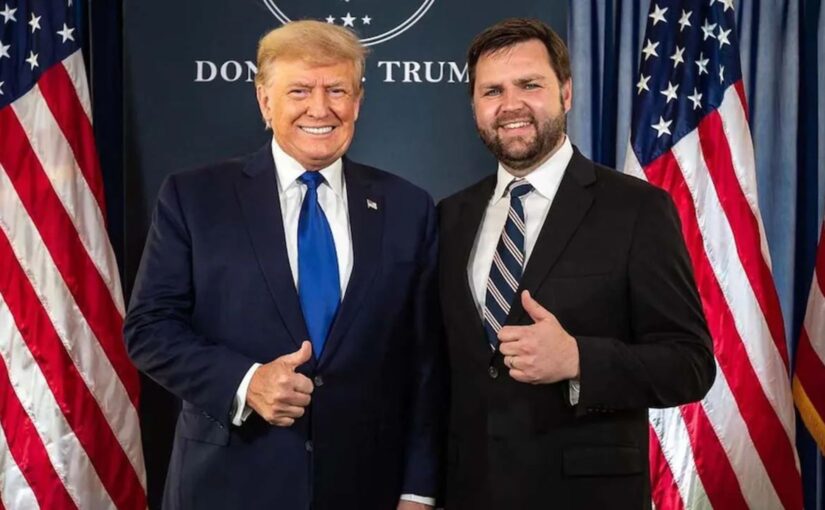
Ben goes on to note that Vance is a China hawk who has scapegoated Beijing for the many economic problems in the US, demonising it as “the biggest threat to our country”. After Donald Trump selected Vance to be his running mate in the 2024 presidential election campaign, Vance pledged that they would end the war in Ukraine, not because they wanted peace for peace’s sake, but rather to prioritise containing China.
In his speech at the American Dynamism Summit, Vance said that: “The idea of globalisation was that rich countries would move further up the value chain, while the poor countries made the simpler things.”
Having referenced the Chinese city of Shenzhen, he continued: “But I think we got it wrong. It turns out that the geographies that do the manufacturing get awfully good at the designing of things.
As Ben notes, in these comments, the US vice president inadvertently acknowledged that the fundamental thesis of the dependency theorists in the 1960s was indeed correct. “The rich countries in the core of the world-system (mostly in the Global North) seek to trap the poor, formerly colonised nations in the periphery (mostly in the Global South) in a cycle of dependency on the core’s high value-added products, through monopolistic control of advanced technologies.”
US Vice President JD Vance gave a speech about globalization that made it clear that Washington’s goal is to keep formerly colonized countries in the Global South trapped at the bottom of the global value chain.
Vance acknowledged that the US-led West wants to maintain a strict international division of labor, in which poor countries in the periphery produce low value-added goods (with lots of competition and therefore low profits), whereas the rich nations in the core extract exorbitant monopoly rents through their control over high value-added technologies (with little to no competition, reinforced by strict intellectual property rights).
Silicon Valley prepares for war with China
The US vice president made these remarks at a summit that was organized by the Silicon Valley venture capital firm Andreessen Horowitz. This annual meeting in Washington, DC is called the American Dynamism Summit, and it brings together corporate executives and US government officials to facilitate contracts.
One of their main priorities is preparing for war with China. Andreessen Horowitz promotes 50 US companies that it says are “shaping the fight of the future”, outlining a scenario of a hypothetical 2027 war with China over Taiwan.
Vance is a China hawk who has scapegoated Beijing for the many economic problems in the US, demonizing it as “the biggest threat to our country”.
After Donald Trump selected Vance to be his running mate in the 2024 campaign, Vance pledged that they would end the war in Ukraine, not because they wanted peace for peace’s sake, but rather to prioritize containing China. The US will “bring this thing to a rapid close so America can focus on the real issue, which is China”, Vance told Fox News, claiming, “That’s the biggest threat to our country and we are completely distracted from it”.
In the following article on Geopolitical Economy, Ben Norton exposes the extreme anti-China views of US Defense Secretary Pete Hegseth.
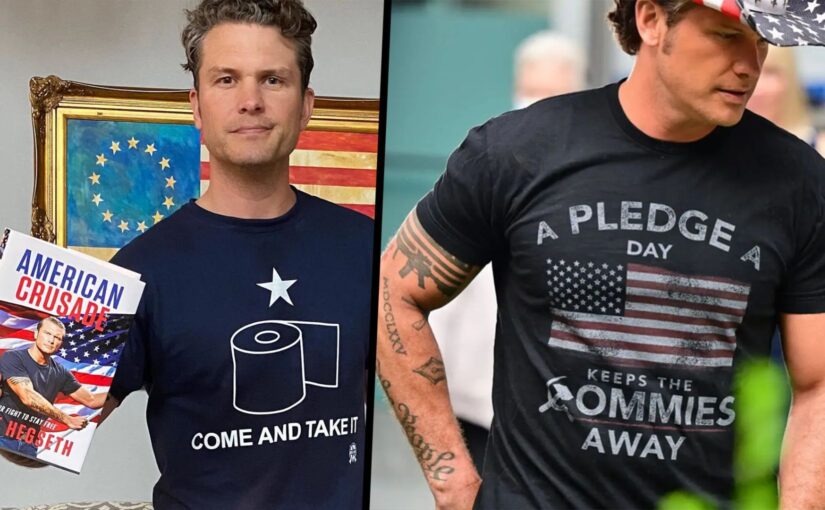
Ben notes that, in his 2020 book American Crusade: Our Fight to Stay Free, Hegseth describes the Chinese as “literally the villains of our generation” and warns: “If we don’t stand up to communist China now, we will be standing for the Chinese anthem someday”.
This anti-China sentiment is not restricted to the past. “As defense secretary, Pete Hegseth has pushed for extremely aggressive policies against Beijing”, commenting just this month on Fox News that the United States is prepared to go to war with China. He calls for the US to stop trading with China and to do everything within its power to stop China’s rise.
These alarming views are combined with flagrant islamophobia, misogyny and homophobia.
Hegseth is not the only China hawk in Trump’s cabinet. As we have noted previously, “Marco Rubio is an anti-China fanatic, who stands for more tariffs, more sanctions, more slander, more support for Taiwanese separatism, more provocations in the South China Sea, and more destabilisation in Hong Kong and Xinjiang. Mike Waltz has long pushed for closer military cooperation with India, Japan, Australia and other countries in the region in preparation for war against China.”
Increasingly, there is consensus within US policy circles in favour of an escalation of the campaign to encircle and contain China. Progressive and anti-war movements in the West must resist this dangerous trajectory.
US Defense Secretary Pete Hegseth is a self-declared “crusader” who believes the United States is in a “holy war” against the left, China, and Islam.
In his 2020 book American Crusade: Our Fight to Stay Free, Hegseth vowed that, if Trump could return to the White House and Republicans could take power, “Communist China will fall—and lick its wounds for another two hundred years”.
Hegseth declared that the Chinese “are literally the villains of our generation”, and warned, “If we don’t stand up to communist China now, we will be standing for the Chinese anthem someday”.
In Hegseth’s conspiratorial worldview, Chinese communists and the international left are conspiring with Islamists against the United States and Israel, which are sacred countries blessed by God.
Under Trump’s leadership, Hegseth promised, “Israel and America will form an even tighter bond, fighting the scourge of Islamism and international leftism that will never fully abate”.
“Islamists will never get a nuclear weapon but will be preemptively bombed back to the 700s when they try”, he added.
In the book, Hegseth heaped praise upon the medieval Crusaders, and he argued that Western conservatives in the 21st century should continue the holy war they started a millennium ago.
One of his chapters is titled “Make the Crusade Great Again”.
On the first page of the book, Hegseth proudly said his “American crusade” is a “holy war”, and he insisted that leftists are not “mere political opponents. We are foes. Either we win, or they win—we agree on nothing else”.
Hegseth also stated with certainty that there will soon be a civil war in the United States, between the right and left.
The following statement has been issued by the Friends of Socialist China US Committee in response to the Trump administration’s announcement of new tariffs on Chinese imports.
The Trump administration’s decision to slap additional tariffs on the People’s Republic of China is something that should be condemned by every person who cares about peace and progress. These moves are making the world a more dangerous place and are part of a larger anti-China policy being pursued by the Trump administration – a policy begun under the Obama administration and deepened during the Biden administration.
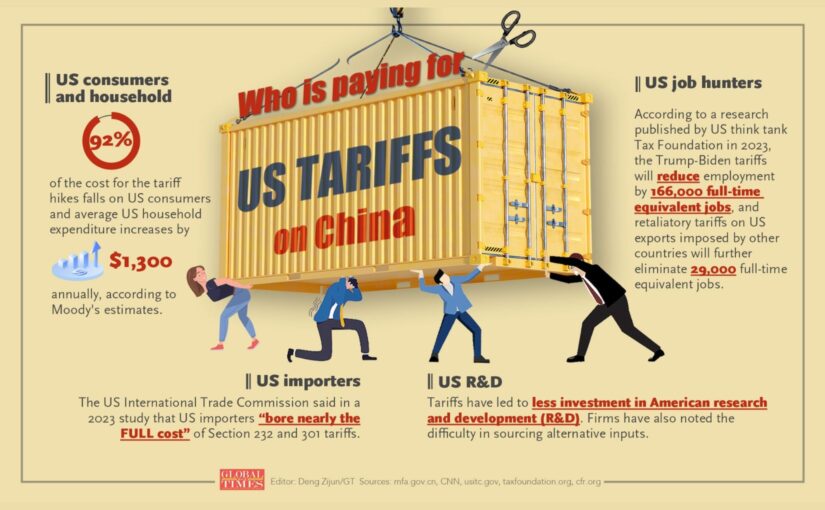
These tariffs are in effect a tax on working people here in the United States and will result in rising prices for our necessities and wants. They will have no impact whatsoever on the lifestyles of the billionaires. Indeed, the money raised from increased prices will be used to fund the Trump regime’s tax cuts for the super-rich. Furthermore, these tariffs will harm the U.S. economy more than China’s. People’s China has a more diversified economy, more trading partners, and a greater share of world trade.
To quote Mao Zedong, “Lifting a rock only to drop it on one’s own feet is a Chinese folk saying to describe the behavior of certain fools.” This certainly applies to Trump and his wealthy backers.
The tariffs against China exist in a larger context. The U.S. empire is in a state of stagnation and decline, while People’s China is developing at an incredible speed. Wall Street and the Pentagon are working to “contain” and encircle China. They are increasing the spending for war preparations, attempting to draw countries in the region into hostile alliances aimed at China, and encouraging separatist forces in Taiwan, Tibet and Xinjiang. The tariffs supplement the hundreds of U.S. sanctions against China in textiles, solar energy, computers and more.
For the past decade, U.S. policy makers have talked about “decoupling” the U.S. economy from that of China. Washington DC’s trade war is a part of that process, and it cannot be separated from preparations for other kinds of war in the Pacific, including those fought by military means.
Socialist China has made incredible achievements. China has waged a real war on poverty, while the U.S. government is waging a war on working people. China is by far the world leader in renewable energy production, electric transport, biodiversity protection and afforestation. China takes public health seriously. That’s why its life expectancy consistently goes up. Here in the U.S., we have measles outbreaks, and vaccine “skeptics” running the show. China wants peace. No serious person can say that about the U.S. today.
We demand that the tariffs directed at China be rolled back. We oppose the Trump administration’s anti-China policy, including any and all preparations for war. And we stand in solidarity with socialist China as it heads into a bright future.
Amidst the tsunami of proto-fascist measures unleashed by the Trump-Vance-Musk regime’s ‘carnival of reaction’, a central place is taken by the threats to deport millions of migrant workers and their families – a threat that has already become grim reality for thousands arrested, terrorised, humiliated, and flown, shackled and handcuffed, in military planes to their countries of origin. This obscene spectacle of performative sadism has also already been aped in Britain by the Starmer ‘Labour’ government.
Trailing this policy during the election campaign, Trump claimed that tens of thousands of undocumented Chinese migrants had recently entered the US, warning his audience that “they’re all military age and they are mostly men.” Trump accused these immigrants of “trying to build a little army in our country.”
In a historical essay, published by the World Socialist Website eight days before Trump’s inauguration, and which we reprint below, Paul Montgomery notes:
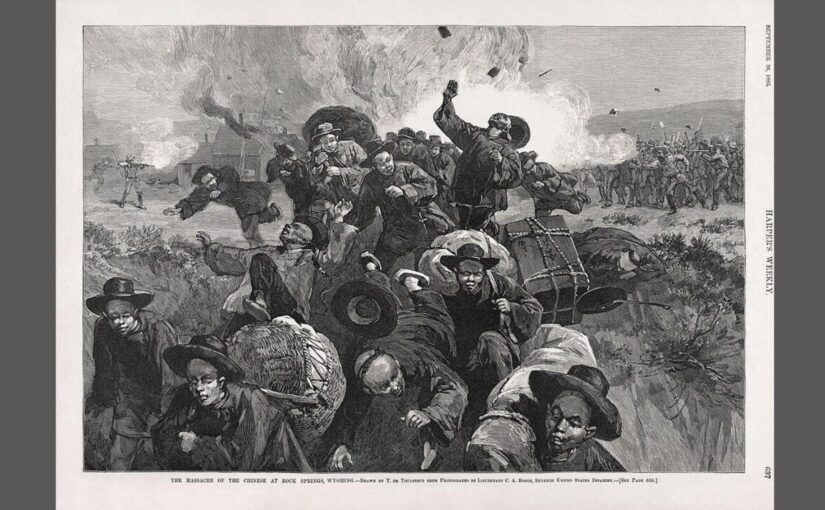
“In portraying Chinese immigrants as an invading army, Trump and [his ‘border czar’ Tom] Homan echo the worst rhetoric of the Yellow Peril and Chinese Exclusion era of the late nineteenth and early twentieth centuries. It is an escalation of the anti-Chinese rhetoric Trump used throughout the COVID-19 pandemic, and it seeks to place the US ever more openly on a war footing against China.”
Drawing critically, in the first instance, on recent material produced by the National Public Radio (NPR), the author outlines the history of the Chinese Exclusion era, which lasted from the passage of the Chinese Exclusion Act in 1882 to its repeal in 1943. During this period, federal law prevented Chinese immigrants from entering the United States.
However, he correctly points out that: “To understand Chinese Exclusion, it must be placed in the context of the development of capitalism in the United States and the early development of US imperialism in the Pacific and East Asia.” And goes on to quote Karl Marx writing to Friedrich Engels in 1858:
“The real task of bourgeois society is the creation, at least in outline, of a world market, and of a type of production resting on this basis. Since the world is round, this task seems to have been brought to a conclusion with the colonisation of California and Australia and the inclusion of China and Japan.”
Montgomery quotes the late Asian-American historian Ronald Takaki: “Capital used Chinese laborers as a transnational industrial reserve army to weigh down white workers during periods of economic expansion and to hold white labor in check during periods of overproduction.” By recruiting Chinese laborers, employers could “boost the supply of labor and drive down the wages of both Chinese and white workers. The resulting racial antagonism generated between the two groups helped to ensure a divided working class and a dominant employer class.”
And most important of all! Every industrial and commercial centre in England now possesses a working class divided into two hostile camps, English proletarians and Irish proletarians. The ordinary English worker hates the Irish worker as a competitor who lowers his standard of life. In relation to the Irish worker, he regards himself as a member of the ruling nation and consequently he becomes a tool of the English aristocrats and capitalists against Ireland, thus strengthening their domination over himself. He cherishes religious, social, and national prejudices against the Irish worker. His attitude towards him is much the same as that of the ‘poor whites’ to the Negroes in the former slave states of the USA. The Irishman pays him back with interest in his own money. He sees in the English worker both the accomplice and the stupid tool of the English rulers in Ireland.
This antagonism is artificially kept alive and intensified by the press, the pulpit, the comic papers, in short, by all the means at the disposal of the ruling classes. This antagonism is the secret of the impotence of the English working class, despite its organisation. It is the secret by which the capitalist class maintains its power. And the latter is quite aware of this.
In this regard, the article highlights the reactionary role of the early labour aristocratic trade union movement in fuelling and perpetuating anti-Chinese racism:
“Leading labor organizations of this period, formed by craft unions and claiming hundreds of thousands of members, also directed workers toward the anti-Chinese position. The American Federation of Labor (AFL) and the Knights of Labor both called for the exclusion of Chinese workers. At its founding conference in Pittsburgh in 1881, the AFL, then known as the Federation of Organized Trades and Labor Unions, adopted a resolution that declared ‘the presence of Chinese, and their competition with free white labor’ to be ‘one of the greatest evils with which any country can be afflicted.’ The AFL pledged to use its ‘best efforts to get rid of this monstrous evil.’”
One important criticism made by Montgomery of the NPR material is its ignoring of the anti-Chinese and racist positions taken by the Democratic Party in California in the period under review.
He writes: “Absent from NPR’s analysis is the Democratic Party, which championed anti-Chinese policies from the moment California became a state. Portraying the apparent cowardice of the Republican Party before anti-Chinese mobs while ignoring the reactionary politics of the Democratic Party is more convenient for the political aims and assumptions of NPR writers and podcasters. But the Republican Party of the 1870s and 1880s was only adapting itself to positions held by the Democratic Party since the 1850s.”
Drawing on the work of a respected Chinese American historian, he continues: “The Chinese Question, writes historian Mae Ngai, ‘became a bedrock principle of the Democratic Party in California.’ Among the major early advocates for exclusion was Democrat John Bigler, an attorney whose political ambitions led him to become California’s third governor. In an 1852 address to the California legislature, Bigler called for ‘measures to be adopted’ that would halt the ‘tide of Asiatic immigration.’ Insisting that the ‘Chinese Question’ required a national solution, Bigler called on the United States Congress to use its power to ‘entirely exclude this class of Asiatic immigrants.’”
The article concludes:
The anti-Chinese positions now expressed by Donald Trump and Tom Homan, like those of the exclusion era, are clearly racist and xenophobic. But that is not all they are. They come in the midst of growing class struggles and in the context of escalating conflict between US imperialism and the Chinese state. That Trump now claims a Chinese threat lurks behind the Panama Canal, which he proposes to annex by force, if necessary, is enough to demonstrate that the anti-Chinese rhetoric of his past and future administration, just as in the exclusion era, is significant for reasons that extend far beyond the question of racism in the United States. The attempt to portray Chinese immigrants, once again, as an invading army is the domestic expression of the Trump administration’s drive to reassert US global hegemony through a direct confrontation with China.
The incoming Trump administration is preparing to initiate a program of mass deportations and attacks against the rights of immigrants. There are growing indications that Chinese immigrants will be among the first targeted.
In the following article, which was originally published on TomDispatch, Joshua Frank dissects the reasons behind US President Donald Trump’s repeated threats to seize, possibly by armed force, the Danish colony of Greenland.
Frank looks in some detail at the influence of military bases and strategy, fossil fuels, and minerals, particularly those needed in green technologies, on Trump’s calculations and designs, but his essential conclusion is that, “it’s all about China”:
He wants to boost US mining of critical minerals because he knows that China, his archnemesis, is leading the global charge for their acquisition. [Note: This is one of a couple of places in the article where we believe the argument could have been better phrased. This, however, does not negate its essential validity or importance.] Trump doesn’t seem to understand that it’s hard to stimulate investment in critical minerals if the future appetite for the technologies they support remains uncertain. As a result of his battle against electric vehicles, manufacturing expectations are already being slashed.
While he may not comprehend how contradictory that is or even care, he certainly understands that the US depends on China for many of the critical minerals it consumes. Around 60% of the metals required for renewable technologies come directly from China or Chinese companies. Trump’s tariffs on China have even worried his buddy (and electric car producer) Elon Musk, who’s been working behind the scenes to block additional tariffs on graphite imports. Chinese graphite, an essential component of the lithium-ion batteries in his Teslas, may face new tariffs of as high as – and no, this is not a misprint – 920%. Such pandemonium around imports of critical minerals from China may be the true factor driving Trump’s impetus to steal Greenland from the clutches of Denmark.
Explaining Greenland’s colonial history and status, Frank writes: “Greenland’s Indigenous Inuit people, the Kalaallit, account for 88% of that island’s population of 56,000. They have endured vicious forms of colonisation for centuries. In the 12th century, Norwegians first landed in Greenland and built early colonies that lasted 200 years before they retreated to Iceland. By the 1700s, they returned to take ownership of that vast island, a territory that would be transferred to Denmark in 1814.
“In 1953, the Kalaallit were granted Danish citizenship, which involved a process of forced assimilation in which they were removed from their homes and sent to Demark for reeducation. Recently uncovered documents show that, in the 1960s, Danish authorities forcibly inserted intrauterine devices (IUDs) in Kalaallit women, including children, which post-colonial scholars describe as a ‘silent genocide’.
“In other words, the colonisation of Greenland, like that of the United States, was rooted in violence and still thrives today through ongoing systemic oppression. The Kalaallit want out. In 2016, 68% of Greenlanders supported independence from Denmark, and today, 85% oppose Trump’s neocolonial efforts to steal the territory.”
He quotes the island’s autonomous prime minister, Múte Egede, who leads the democratic socialist Inuit Ataqatigiit party, as saying, “Greenland is ours. We are not for sale and will never be for sale.” [Note: The article mistakenly states that Inuit Ataqatigiit won 80% of the votes in Greenland’s last general election. In fact, whilst pro-independence parties, did win 80% backing, the support for Inuit Ataqatigiit was 36.6%. Siumut, like Inuit Ataqatigiit a left-wing pro-independence party, won 29.4%. Another pro-independence party, Naleraq, came third with 12.0% of the votes. Nunatta Qitornai, which advocates a more rapid transition to independence, won 2.4% of the votes but lost its sole parliamentary representative. These results gave pro-independence parties 26 parliamentary seats against five for the unionist parties. A detailed account of the outcome of the April 2021 election can be found here.]
So, for Frank, Egede’s statement “brings us back to what this imperialist struggle is all about. The island is loaded with critical minerals, including rare earth minerals, lithium, graphite, copper, nickel, zinc, and other materials used in green technologies. Some estimates suggest that Greenland has six million tons of graphite, 106 kilotons of copper, and 235 kilotons of lithium. It holds 25 of the 34 minerals in the European Union’s official list of critical raw materials, all of which exist along its rocky coastline, generally accessible for mining operations.”
He concludes: “Greenland and its resources are merely the latest potential casualty of Trump’s quest for global domination and his fear of China’s economic power. His interest in the green energy sector does not signify a change of heart regarding the dangers of climate chaos or the value of renewables but rather a drive for global financial supremacy. Like the billionaires around him, he desires it all – the oil, the gas, and the critical minerals essential for the global energy transition, while China is pushed aside. Regarding the Kalaallits and their aspirations, he could care less.”
In early January, Donald Trump Jr.’s private plane landed on a snowy airfield in Greenland. There was little fanfare upon his arrival, but his 14 million social-media fans were certainly tagging along.
“Greenland coming in hot…well, actually really really cold!!!” President Trump’s eldest son captioned a video he posted on X. It was shot from the cockpit of the plane, where a “Trumpinator” bobblehead (a figurine of his father as the Terminator) rattled on the aircraft’s dashboard as it descended over icy blue seas.
It was a stunt of MAGA proportions. Don Jr. was arriving in Greenland on behalf of his father who, along with his new buddy Elon Musk, had announced a desire to seize that vast Arctic landmass from Denmark through strong will or even, potentially, by force. There’s been plenty of speculation as to why Trump wants to make Greenland, the largest island on this planet, a new territory of the United States. And yes, his inflated ego is undoubtedly part of the reason, but an urge for geopolitical dominance also drives Trump’s ambitions.
His fascination with Greenland can be traced back to his first administration when, in late 2019, he signed the 2020 National Defense Authorization Act establishing the U.S. Space Force. “There are grave threats to our national security,” he said shortly after signing the bill. “American superiority in space is absolutely vital. The Space Force will help us deter aggression and control the ultimate high ground.”
A historic leader of the multinational US proletariat, and student of Mao Zedong, José Jiménez, popularly known as Cha Cha, passed away in Chicago on January 10, 2025. He was 75 according to the Freedom Road Socialist Organisation (FRSO) and 76 according to the New York Times.
Jiménez was the Chairman of the Young Lords Organisation, a youth organisation of the Puerto Rican national minority in the United States, who took up revolutionary organising and the study of Marxism-Leninism and who supported and forged links with socialist China.
Extending condolences to his family, friends and comrades, FRSO wrote:
All those who knew him appreciated Jiménez’s determination and his ability to motivate others to action, all the while teaching about the need for revolution and socialism. A revolutionary to the end, he often quoted Mao Zedong on the united front strategy, ‘Unite the many to defeat the few!’
The Young Lords Organisation was founded… in 1968 in the Lincoln Park neighbourhood of Chicago. Puerto Ricans and other working people were being forced out of the now wealthy neighbourhood by big financiers and real estate firms working with Mayor Richard Daley’s Democrat political machine.
At that time, Jiménez turned a street gang into one of the most successful political movements of its day, resisting community displacement and opposing the US war in Vietnam. Their militant tactics attracted masses of people to protest for better housing, education, childcare and health care in Chicago. The Young Lords spread to New York and many other cities, inspiring Puerto Rican people who were forced to move from the island by US domination and exploitation.
FRSO’s article, published on January 17, also details how the Young Lords under Jiménez’s leadership, forged links with and learned from the Black Panther Party, especially Fred Hampton, as well as a number of other organisations, particularly the Brown Berets, who were fighting for Chicano self-determination, and the Young Patriots, a youth group of poor whites from Appalachia. Together they formed the original Rainbow Coalition.
A July 2019 interview with Jiménez’s conducted by FRSO’s Fight Back News! is full of fascinating and important details of those times, which remain rich in lessons for revolutionary and progressive struggles in the United States and elsewhere. Towards the end he manages to conflate two of Mao Zedong’s most famous and important sayings into a single short sentence:
“We must be clear on who are our enemies and who are our friends so that we can unite with the many to defeat the few.”
And added: “Ours is not about individuals but a people’s struggle led by the common folk. Ours is a protracted struggle that will take years and we must prepare ourselves for the long run via structured community programs specific to the revolution. We stand for Puerto Rico, all Latin American nations and oppressed nations of the world, against colonialisms and for self-determination and neighbourhood empowerment.”
The New York Times published a detailed obituary of Jiménez on January 22, which even quoted from the FRSO interview.
The Young Lords Speak: From the Streets of Chicago to Revolutionary Organization – Edited by Jacqueline Lazú and with a foreword by José Jiménez, written just before his passing, is due to be published by Haymarket in August.
The Freedom Road Socialist Organization shares its condolences with the family, friends and comrades of Jose “Cha Cha” Jimenez, chairman of the Young Lords Organization. He died on January 10, 2025, at the age of 75 in Chicago.
All those who knew him appreciated Jimenez’s determination and his ability to motivate others to action, all the while teaching about the need for revolution and socialism. A revolutionary to the end, he often quoted Mao Tse Tung on the united front strategy, “Unite the many to defeat the few!”
In the opinion piece below, Yuan Sha, a special commentator on current affairs for CGTN, reports on Donald Trump’s outlandish threat to “take back” the Panama Canal. She notes that the threat “reveals Trump’s hidden agenda to resurrect the infamous Monroe Doctrine” and that, “eying the geostrategic importance of the canal, Trump wants to renege on the agreements and regain US control of the canal”.
Trump and his cronies have justified their increasingly aggressive comments by claiming that China is “operating the canal” and that this compromises US national security. While China is the second largest user of the canal, Yuan Sha points out that “China does not participate in the management and operation of the canal and has never interfered in its affairs”.
Wielding the threat to “take back” the canal – that is, to invade a sovereign country – is a clear violation of international law. Unfortunately it seems this threat has already extracted a concession from the Panamanian government, which has announced its intention to withdraw from the Belt and Road Initiative.
As the author notes, “Trump’s bullying rhetoric on Panama has sent shockwaves across the world, revealing the administration’s penchant to revive the Monroe Doctrine which once provided the pretext for prolonged U.S. military, diplomatic and economic interventions. This is bound to cause more tensions in the region and beyond, eventually disrupting the international order.”
Since returning to the White House, U.S. President Donald Trump has repeatedly threatened to “take back” the Panama Canal, alleging – falsely – that it is operated by China. The outlandish threat actually reveals Trump’s hidden agenda to resurrect the infamous Monroe Doctrine, articulated in 1823 to curb Europe’s expansion and promote America’s commercial and security interests, as a pathway to achieve the “Golden Age of America.”
As the new U.S. Secretary of State Marco Rubio begins his first official trip abroad to Central America, including a stop in Panama, there is worldwide concern about Trump’s end goal, what coercive tactics he might use, and whether he would succeed in bullying the region into giving him what he wants. These questions are critical in assessing the nature of Trump 2.0 foreign policy and its challenges to the international order.
Trump’s outlandish claims
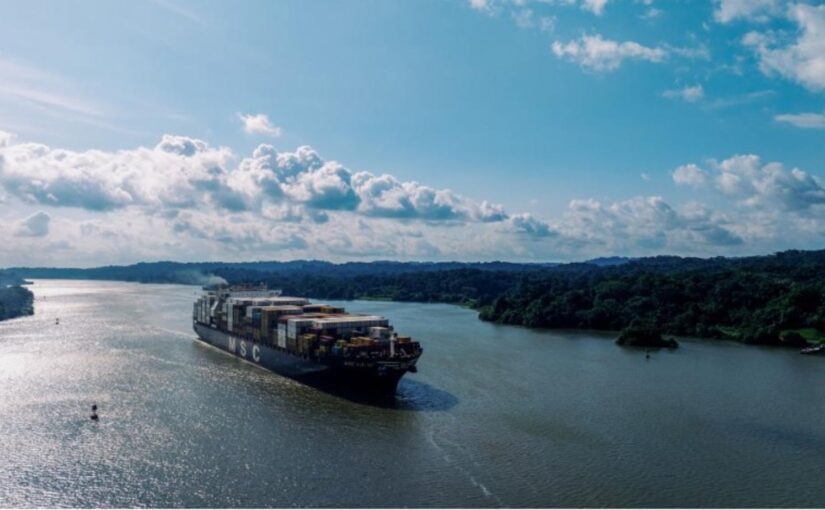
The Panama Canal is a key strategic waterway in Central America linking the Pacific and Atlantic oceans. Up to 14,000 ships pass through the canal each year, accounting for around five percent of global maritime trade.
The U.S. used to control the canal from the early 20th century until the end of 1999, after which it handed over control of the canal to the Panama government in accordance with the treaties signed between the Carter administration and Panama in the 1970s. But now, eying the geostrategic importance of the canal, Trump wants to renege on the agreements and regain U.S. control of the canal.
To justify this, he has lambasted the canal being “foolishly given to Panama,” accusing Panama of charging U.S. ships “exorbitant” fees to use the waterway. He is also falsely claiming that China is “operating the canal,” and cites national security as the necessity for an American takeover.
Trump’s assertion to “take back” the Panama Canal is effectively an infringement on Panama’s sovereignty and goes against international law. Panama has owned and administered the canal since 1999. Panamanian President Jose Raul Mulino has rejected Trump’s claim as “nonsense,” saying the canal “was not a gift” from the U.S.
Trump’s claim about China is also outright disinformation. China undoubtedly is the second largest user of the canal, following the U.S., and a major investor in infrastructure in Panama as Panama is the first Latin American country to join the Belt and Road Initiative. But as the Panama government and China’s Ministry of Foreign Affairs have clarified, China does not participate in the management and operation of the canal and has never interfered in its affairs.
Trump’s outlandish claims actually reflect his heightened concern over China’s growing investment in Panama. As the Trump 2.0 administration is ready to escalate the “great power competition” with China around the globe, the Panama Canal, not surprisingly, has become a new flashpoint.
What could Trump do?
The question is how serious Trump’s bombastic rhetoric to regain control of the canal is and what he might do to achieve that end.
Trump has hinted at taking it back by force. He could cite the 1977 Neutrality Treaty with Panama which stipulates that the U.S. shall remain permanently neutral, but it reserves the right to defend any threat to the canal’s neutrality by using military force. This outright threat to use military force is regarded as bluff to exact concessions from Panama.
Trump is also likely to use tariffs as a coercive tool. He might repeat the successful maneuver in pressuring Colombia to accept the flights carrying Colombians deported from the U.S. by threatening to impose 25 percent tariff. Trump’s goal is to force the Panama government to curb its engagements with China as well as regain U.S. control over Panama.
Trump has the support of the Republican-controlled Congress. Republican senators recently introduced a resolution, calling on the government of Panama to cut its political and economic ties with China and Chinese businesses. Republican representatives have also introduced a bill in the House to authorize the president to enter into negotiations to acquire the canal from Panama. These legislative moves will further empower Trump’s brazen actions on this matter.
Trump’s new Monroe Doctrine
Trump’s bullying rhetoric on Panama has sent shockwaves across the world, revealing the administration’s penchant to revive the Monroe Doctrine which once provided the pretext for prolonged U.S. military, diplomatic and economic interventions.
In fact, Trump wanted to resuscitate the doctrine in his first administration itself. In September 2018, he declared in the United Nations General Assembly, “It has been the formal policy of our country since President Monroe that we reject the interference of foreign nations in this hemisphere and in our own affairs.” He also expressed his admiration for President Theodore Roosevelt, who seized the Panama Canal and added the famous “Roosevelt Corollary” to the Monroe Doctrine, stating that the U.S. had the right to intervene in Latin American domestic affairs.
The Trump 2.0 administration seems to be all out to revive this doctrine, along with the bluster to force Denmark to sell Greenland to the U.S., make Canada the 51st state of the U.S., and change the name of the Gulf of Mexico to the “Gulf of America.” Trump has also made startling proclamations in his inaugural address such as the U.S. needs to “expand our territory” and “carry our flag into new and beautiful horizons.” He has made no secret of his intention to reinstate U.S. control over the Western Hemisphere.
However, the Monroe Doctrine is dead and anachronistic and Trump’s bullying has already triggered pushbacks. Panama has made a formal complaint to the United Nations, emphasizing that the UN Charter precludes “the threat or use of force” against territorial integrity. Denmark, Canada and Mexico have also rejected Trump’s outrageous claims.
But it is disconcerting that with a unified Congress, a loyal cabinet and the strong Make America Great Again movement, as well as the obsession with competition with China, Trump might face little constraint in practicing an expansionist foreign policy agenda. This is bound to cause more tensions in the region and beyond, eventually disrupting the international order.
The London Region of the Campaign for Nuclear Disarmament (CND) held its 2025 Annual Conference online on Sunday 12 January.
Friends of Socialist China co-editor Keith Bennett was among the speakers in a session entitled, NATO, war, nukes: Outlook for 2025, where he was joined by CND General Secretary Sophie Bolt; Jess Barnard, a member of the Labour Party’s National Executive Committee (NEC); Carol Turner, Chair of London CND and a Vice Chair of national CND; and Vijay Prashad, Director of the Tricontinental Institute for Social Research. The session was chaired by Christine Shawcroft, a Vice Chair of London CND and editor of Labour Briefing.
A keynote opening speech on Prospects for Peace and Justice was given by Jeremy Corbyn, former Leader of the Labour Party and now the Independent Member of Parliament (MP) for Islington North, introduced by Murad Qureshi, a Vice President of London CND and a former Chair of the Stop the War Coalition.
Further discussions focused on Ukraine and the Middle East as testing grounds for new tech weapons, with expert input from Peter Burt, a researcher for Drone Wars UK; and Dave Webb, Convenor of the Global Network Against Weapons and Nuclear Power in Space; chaired by former MP Emma Dent-Coad; and a final session on Peace Movement Priorities, with Baroness Jenny Jones from the Green Party; Tony Staunton, a Vice Chair of CND; and Angie Zelter, a founder of Lakenheath Action for Peace; chaired by Hannah Kemp-Welch, a Vice Chair of London CND.
Keith’s speech focused on the prospects for relations between China and the United States during Donald Trump’s second presidency. We reprint it below.
An edited version was also carried by Labour Outlook. The full conference proceedings can be viewed on the YouTube channel of London CND.
Thank you to London Region CND for the invitation to take part in this distinguished panel.
With war raging in Ukraine for nearly three years and with the unrelenting genocide in Gaza, now well into its second year, both naturally forming the main day-to-day focus of most peace campaigners, is it self-indulgence or overreach to also turn our attention to the Asia Pacific region?
I would argue that it is not. No analogy is ever exact, but a clear parallel can be drawn with events in the 1930s. Local conflicts, in Spain, Ethiopia and, indeed China, were the proverbial canaries in the mine, which presaged the global conflagration of World War II.
Today, no bilateral relationship is more important, more strategic and more fraught than that between the United States and China. On the potentially positive side, the world needs these two powers to work together constructively if humanity is to meet an existential threat like climate change. Unfortunately, despite the best efforts of China, and of a couple of US politicians, there is little sign of this happening. Something that will most likely be exacerbated when Trump quits the Paris Climate Change Accord. Again.
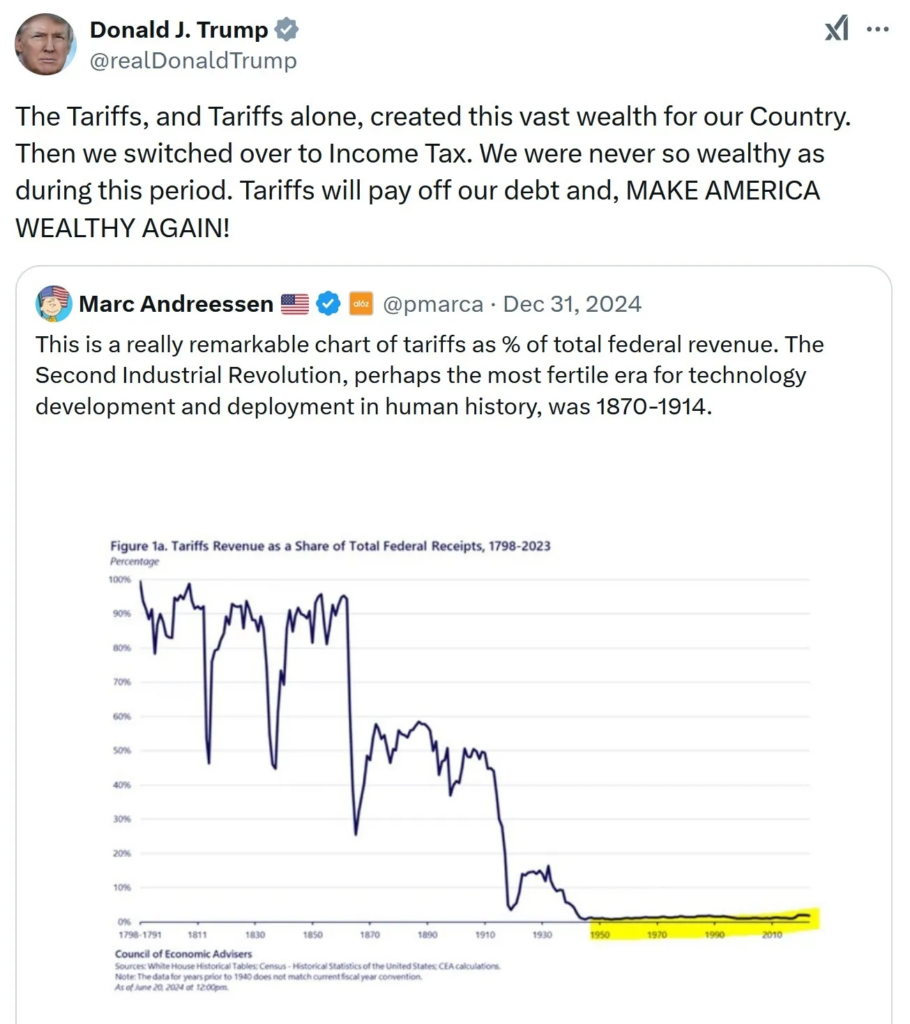
US president-elect Donald Trump has been touting tariffs as a means to reduce both income taxes and the national debt, which currently exceeds 120 percent of GDP. In the article below, Ben Norton describes these claims as “utterly false, and mathematically absurd”.
Ben notes that, during Trump’s first term, significant tax cuts were enacted, primarily benefiting the wealthiest Americans. These cuts resulted in the richest billionaire families paying a lower effective tax rate than the bottom half of US households. Consequently, federal deficits increased from 3.4 percent of GDP in 2017 to 4.6 percent in 2019, prior to the pandemic-induced surge to 14.7 percent in 2020.
The article observes that “every advanced economy got its start through protectionism”, but that the US from the 1940s has been preaching (and sometimes violently imposing) free trade as a means of opening up markets for its exports. “However, something happened in the 21st century that changed everything: the People’s Republic of China carried out the most remarkable campaign of economic development in history.”
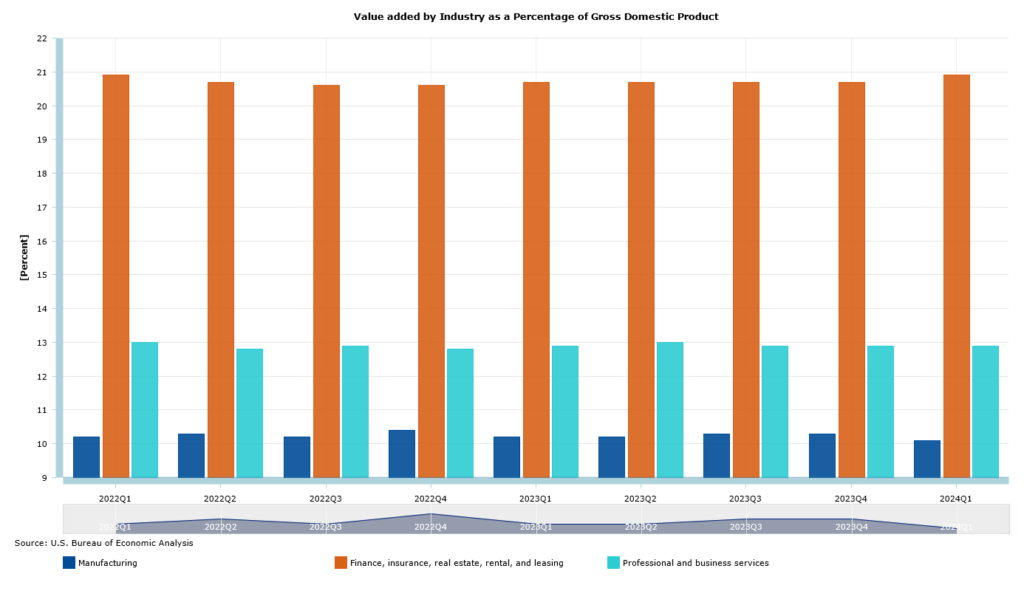
China’s extraordinary rise has taken place in parallel with a sharp decline in US manufacturing and an increasing financialisation of the US economy. “The US capitalist class decided it would much rather be the banker of the world rather than the factory of the world, because creating parasitic financial and tech oligopolies that use monopolistic market control and intellectual property to extract rents is much more profitable than actually making things.”
Trump’s proposed tariffs will not help the US to re-industrialise – such a project would require massive long-term investment in infrastructure, education, and research and development. In reality, tariffs will be used “to justify cutting taxes even further on the rich” and, further, “to escalate the new cold war on China, which is a bipartisan gift to the Military-Industrial Complex that will only distract from the domestic problems caused by the US ruling class and externalise the blame”.
Donald Trump cited billionaire egghead venture capitalist Marc Andreessen to advocate for high tariffs. Trump argued that tariffs will magically replace the income tax and pay off US public debt (which is more than 120% of GDP). This is utterly false, and mathematically absurd.
For Trump, tariffs are just another convenient excuse to cut taxes on the rich — which will in fact increase the US deficit, and therefore public debt.
Thanks to Trump’s tax cuts during his first term, the richest billionaire families in the US paid a lower effective tax rate than the bottom half of households in the country. Meanwhile, US federal deficits increased from 3.4% of GDP in 2017 to 4.6% of GDP in 2019 (before the deficit blew out to 14.7% of GDP in 2020, due to the necessary stimulus measures during the pandemic).
As Trump continues to reduce taxes on fellow oligarchs, tariffs will decidedly not make up for the lost revenue. A study by the Wharton School, the elite business school of the University of Pennsylvania, estimated that Trump’s economic policies will increase the US deficit by $5.8 trillion over the next decade.
Nevertheless, the sudden interest in tariffs shown by US billionaires is about much more than just taxes; what it is really about is industrial hegemony and economic dominance.
Here is the actual history, which oligarchs like Trump and Andreessen don’t know:
In the 19th and early 20th centuries, the United States used tariffs as a form of infant industry protection, to build up its domestic manufacturing capabilities, following the dirigiste ideas of Alexander Hamilton.
Every advanced economy got its start through protectionism (including Great Britain, France, Japan, South Korea, etc.). The state needed to protect infant industries during the initial industrial “catch-up” period, because it is very difficult for a developing economy to compete with a dominant economic power that already has an established industrial base that benefits from economies of scale.
By the 1940s, the US became the dominant industrial power on Earth, especially after World War Two destroyed its competitors in Europe. In 1946, US net exports were 3.2% of GDP; then, in 1947, they were 4.3% of GDP. This was a peak the US would never see again. (US net exports have been negative without exception since 1976, as the US has run the largest consistent current account deficits ever seen in history, which have only been possible to balance due to the fact that the US prints the global reserve currency, and can thus sell more and more Treasury securities and other financial assets to foreign holders of dollars.)
In the 1940s, US industry no longer had significant competition, so Washington lifted tariffs and began to preach “free trade”. This benefited the US, because at that time it had a large surplus, and insufficient domestic demand, so by imposing “free trade” (often forcibly), it could open new markets for its exports.
The US wasn’t concerned about losing local market share to a foreign manufacturer, because there weren’t any left at the top of the value chain. So US companies could dominate both foreign and domestic markets.
What the United States did was not unique; the British empire did the exact same thing in the mid 19th century. After the UK established industrial dominance, it repealed the Corn Laws in 1846, moved away from strict protectionism, and began to impose “free trade” on its colonies. (This history was detailed by economist Ha-Joon Chang in his groundbreaking book Kicking Away the Ladder.)
However, something happened in the 21st century that changed everything: the People’s Republic of China carried out the most remarkable campaign of economic development in history.
By 2016, China overtook the United States as the largest economy on Earth (when GDP is measured at purchasing power parity, according to IMF data).
Meanwhile, the US lost its industrial hegemony, due to the deindustrialization and financialization of its economy in the neoliberal era. The US capitalist class decided it would much rather be the banker of the world rather than the factory of the world, because creating parasitic financial and tech oligopolies that use monopolistic market control and intellectual property to extract rents is much more profitable than actually making things.
Just 10% of US GDP consists of manufacturing. More than double, 21%, is made up by the FIRE sector: finance, insurance, and real estate.
Today, US companies can no longer compete with Chinese firms. So what is the response of the US government, which is the representative of US monopoly capital? It has abandoned the “free trade” ideology it had spent decades imposing on the world, and has instead returned to its old strident protectionism.
During his first administration, Trump launched a trade war on China. But this is totally bipartisan (as is the case with almost all US wars). Joe Biden has continued Trump’s trade and tech war on China, imposing even more tariffs.
Demagogues such as Trump like to scapegoat China for the problems that were caused by US oligarchs like him and Andreessen, who got much, much, much richer thanks to the deindustrialization and correspondent financialization of the US economy.
Now they think tariffs are the panacea that will fix everything. But they won’t, because the US industrial base has seriously eroded, and that can’t be rebuilt quickly; it takes many years.
Even more importantly, billionaire oligarchs on Wall Street — who are close friends and allies of Trump, Andreessen, Vivek Ramaswamy, and Elon Musk — will fight tooth and nail against a significant devaluation of the dollar, which would be needed to re-industrialize, reduce production costs, and disincentive imports. Financial speculators want a strong dollar, to keep inflating the biggest bubble in the history of US capital markets.
So the logical result of this is that Trump will use tariffs not truly to re-industrialize, but rather for two main reasons: one, to justify cutting taxes even further on the rich (thereby increasing US public debt, which will be pointed to to demand neoliberal austerity and slashes to social spending); and two, to escalate the new cold war on China, which is a bipartisan gift to the Military-Industrial Complex that will only distract from the domestic problems caused by the US ruling class and externalize the blame.
In the following commentary, which was originally published by Global Times, the Canadian writer and anti-imperialist activist Arnold August addresses the Canadian government’s slanderous attacks on China’s human rights record, especially in Xinjiang and Xizang (Tibet), and contrasts this to Canada’s own lamentable record.
Arnold notes that: “As part of this disinformation campaign, Canadian authorities, Western ‘Tibetan’ advocacy groups and corporate press refer to the ‘suppression of Tibetans’. They point to boarding schools or ‘camps’ in Xizang and neighbouring Qinghai Province, where approximately one-fifth of the population is Tibetan. In a baseless charge made on December 10, Ottawa claimed that Tibetans held in ‘camps’ faced ‘psychological, physical, or sexual violence’ and lacked ‘freedom of religion and expression.’”
He continues: “The following is a testimony of a youth in a boarding school, also known as a residential school: The authorities constantly berated him, beat him, barred him from speaking his language and practicing his culture, and sexually assaulted him. Did this incident occur in China? No, it happened in Canada. Moreover, multiply this by hundreds of thousands.
“It has been revealed that in Canada, more than 150,000 Indigenous children were forced to attend residential schools and an estimated 6,000 children died in these institutions. However, experts suggest the number based on unmarked graves could be higher.”
He also draws attention to the National Inquiry into Missing and Murdered Indigenous Women and Girls, commissioned by the [outgoing] Trudeau government itself, which issued its report in 2019. “It concluded that violence experienced by thousands of Indigenous women and girls is part of a ‘genocide.’ The Canadian government formally received it but did not act on it.”
This, Arnold notes, prompted a Member of Parliament from the New Democratic Party (NDP – Canada’s main social democratic party) to table a bill to end ‘residential school denialism’ by making it a criminal offence. “Yet, this was also ignored.”
Further noting the contamination by mercury of the water used by the people of the Asubpeeschoseewagong (also known as Grassy Narrows) First Nation, in Northern Ontario, which is still leading to fatalities after three generations, Albert contrasts it to the cafeteria in a boarding school he visited in a Tibetan minority area of Qinghai Province, adding that, “the quality and variety of the food and beverages available… would be the envy of many Canadian students from working-class families.”
Canada, he concludes, should focus on the well-being of its own people, who would benefit from further development of economic ties with China.
China has decided to impose countermeasures against two Canadian organizations as well as 20 personnel from these organizations in accordance with the Anti-Foreign Sanctions Law. The decision took effect on December 21, 2024.
China’s measures responded to the Canadian government’s Human Rights Day announcement on December 10. On a day devoted to honoring human rights, rather than examining Canada’s human rights records, the Justin Trudeau government imposed sanctions on Chinese officials for the so-called violation of human rights in Xinjiang and Xizang. The slanders against China regarding Xinjiang and the Uygurs have been widely debunked, including by countless visitors there.
As part of this disinformation campaign, Canadian authorities, Western “Tibetan” advocacy groups and corporate press refer to the “suppression of Tibetans.” They point to boarding schools or “camps” in Xizang and neighboring Qinghai Province, where approximately one-fifth of the population is Tibetan. In a baseless charge made on December 10, Ottawa claimed that Tibetans held in “camps” faced “psychological, physical, or sexual violence” and lacked “freedom of religion and expression.”
In the following article, which first appeared in slightly shorter form in Labour Outlook, Carlos Martinez assesses the prospects for the US-led New Cold War against China under a second Trump presidency, and the possibility of military conflict between the world’s two largest economies.
The article begins by noting that US policy towards China has been relatively consistent for over a decade, starting with the Obama-Clinton ‘Pivot to Asia’ in 2011, followed by the Trump administration’s trade war, and then the Biden administration’s sanctions, tariffs, semiconductor war, military provocations and the creation of AUKUS.
What will change under Trump? Carlos notes that “a deepening of economic confrontation seems more than likely”, given Trump’s repeated promises to impose unprecedented tariffs on Chinese goods. And while Trump made noises during his election campaign about wanting to end the US’s “forever wars”, “the appointment of inveterate China hawks Marco Rubio and Michael Waltz as secretary of state and national security adviser sends a clear signal that Trump is planning to escalate hostilities”.
Marco Rubio is an anti-China fanatic, who stands for more tariffs, more sanctions, more slander, more support for Taiwanese separatism, more provocations in the South China Sea, and more destabilisation in Hong Kong and Xinjiang. Mike Waltz has long pushed for closer military cooperation with India, Japan, Australia and other countries in the region in preparation for war against China.
The article notes that China’s consistent offer to the West is based on working together “to tackle the urgent issues facing humanity, including climate change, pandemics, peace, nuclear proliferation, food security and development”. However, it is clear that only mass movements will force Western governments to take up such an offer.
Although the Pivot to Asia was initiated by the Obama administration – when then-Secretary of State Hillary Clinton was tasked with developing a strategy for “America’s Pacific Century” – it was the Trump presidency from 2017-21 that really turned up the dial in terms of US anti-China hostility.
Donald Trump campaigned in 2016 on a promise to protect jobs by addressing the US’s trade deficit with China: “We can’t continue to allow China to rape our country and that’s what they’re doing. It’s the greatest theft in the history of the world.”
In power, the Trump administration launched a full-scale trade war, imposing enormous tariffs on hundreds of billions of dollars of Chinese imports. This was combined with a systematic attack on Chinese technology companies, removing Huawei from US telecoms infrastructure and attempting to prevent TikTok and WeChat from operating in the US.
Militarily, Trump ramped up the US’s presence in the South China Sea and sought to revitalise the Quad group (US, Japan, India and Australia), working towards a broad regional alliance against China.
The State Department oversaw a crackdown on Chinese students and researchers, and, with the arrival of the Covid-19 pandemic, Trump resorted to flagrant racism, talking repeatedly about the “kung flu” and the “China virus” – all of which fed in to a horrifying rise in hate crimes against people of East Asian descent.
As such, many breathed a sigh of relief when Joe Biden was elected four years ago. Unfortunately, however, Biden has essentially maintained the anti-China strategic orientation of his predecessor, albeit without the crassly confrontational rhetoric and overt racism. Biden in many ways has been more systematic in pursuit of military and economic containment of China, particularly when it comes to building an international coalition around US strategic interests.
In September 2021, the US, Britain and Australia announced the launch of AUKUS – a nuclear pact, manifestly contravening the Non-Proliferation Treaty, and evidently designed to counter China.
Biden has hosted numerous Quad summit meetings, at which the member states have reiterated their “steadfast commitment to a free and open Indo-Pacific” – that is, to preserving a status quo in which the US maintains over 300 military bases in the region, along with tens of thousands of troops, nuclear-enabled warplanes, aircraft carriers, and missile defence systems aimed at establishing nuclear first-strike capability.
The combination of the Quad and AUKUS looks suspiciously like an attempt to create an Asian NATO. Meanwhile Nancy Pelosi’s 2022 trip to Taiwan Province was the highest-level US visit to the island in quarter of a century. In 2023, Biden signed off on direct US military aid to Taiwan for the first time; a BBC headline from November 2023 noted that “the US is quietly arming Taiwan to the teeth”. This undermines the Three Joint Communiqués – which form the bedrock for US-China diplomatic relations – and is clearly aimed at inflaming tensions across the Taiwan Strait and setting up a potential hot war with China over Taiwan. A recently-leaked memo from four-star general Mike Minihan predicted war over Taiwan in 2025: “My gut tells me we will fight in 2025”.
The Biden administration has expanded Trump-era restrictions against China’s technology industry, in particular by launching a ‘chip war’ to slow down China’s progress in semiconductor production, artificial intelligence, mobile phones and more. And while the US government under Biden has set several ambitious climate goals, it has also introduced sweeping sanctions on Chinese solar materials and imposed huge tariffs on Chinese electric vehicles.
The unfortunate truth is that there is a consensus among Democrats and Republicans. In Biden’s words, “we’re in a competition with China to win the 21st century” – and the US must win this competition at all costs.
To what extent can we expect the situation to change under a second Trump presidency?