We are pleased to republish this article from the Tortilla con Sal website, consisting of the speeches given on March 8, International Women’s Day, at the latest ceremony to mark the handover of buses as part of the comradely support of the People’s Republic of China to the Sandinista revolution in Nicaragua.
Speaking first, Santi Zhou, representative of the Yutong Company, the bus manufacturer, said:
“Since the start of our collaboration, we have introduced several batches of buses, with a total of 2,000 units in Nicaragua. Yutong accompanies Nicaraguans in their development.
“We thank Compañero Comandante Daniel Ortega and Compañera Rosario Murillo for the opportunity to contribute to the modernisation of Nicaraguan public transport, which is now not only present in Managua… but also expanding to other territories.
“It gives us pride to strengthen the bonds of friendship between our peoples, expanding new horizons for the growth of transport and the important tourism industry, promoting access to the beautiful landscapes of Bluefields and Bilwi… Our team is committed, living and working here, to provide the greatest possible support to the Nicaraguan people.”
Fátima del Carmen German, a transport worker, said: “On this special day, March 8th when we celebrate this important date, we commemorate the struggle that women waged for equal rights; and likewise, we celebrate the strength, resilience and passion of every woman… On behalf of all these strong, brave, hardworking and empowered women, we reiterate our gratitude to our good government and our brothers and sisters in China for having confidence in us.”
China’s Ambassador to Nicaragua Chen Xi noted that this was the fifth time that he has participated in the handover of Chinese vehicles to Nicaragua.
“I wanted to salute the Nicaraguan people for the recent publication of the Constitution of the Republic of Nicaragua, unanimously approved by the Legislators of the National Assembly of Nicaragua. A revolutionary and democratic constitution, a constitution that strengthens and further consolidates the rights of education, health, security, wellbeing and all the rights that assist the honourable Nicaraguan people.
“I also want to salute Co-President Daniel Ortega, Co-President Rosario Murillo, for their great responsibility and commitment, their determination to lead the Nicaraguan people to a brighter future.
“Of course, I also cannot fail to salute you, the Nicaraguan transport workers, for the successes you have been able to achieve, to improve the means of transport, supported by the Sandinista government led by your Co-Presidents, so that you can, with all your goodwill, with all your professionalism, improve the transport service to the Nicaraguan people, so that the Nicaraguan people can enjoy better bus services, which have been a very important means of transport for the country and the people, to achieve a better development.
Noting that due to its special geographical and climatic situation, Nicaragua is particularly susceptible to national disasters and the effects of climate change, the Ambassador said that:
“But really human beings now do not have to face this with just their bare hands, we can now resort to technology, and China is an immense country but also vulnerable to natural disasters, we too face typhoons, earthquakes, floods, and so on but thanks to the leadership of the Communist Party of China, the Chinese government, and the efforts of the Chinese people, of the technicians, we have been able to develop some experiences, some very efficient, advanced technologies, to face all those emergency situations.
“And we have wanted to share those experiences, those Chinese technologies, with the Nicaraguan people, so that we can fight together against all those emergency situations, all those natural disasters; so that our peoples can enjoy life in tranquility, in security, more and more every day… And to sum up, China is willing to work together with our Nicaraguan brothers and sisters to develop many other projects, especially projects dedicated to the social sector, so that the Nicaraguan people can enjoy the benefits of our friendship, of our brother and sisterhood.”
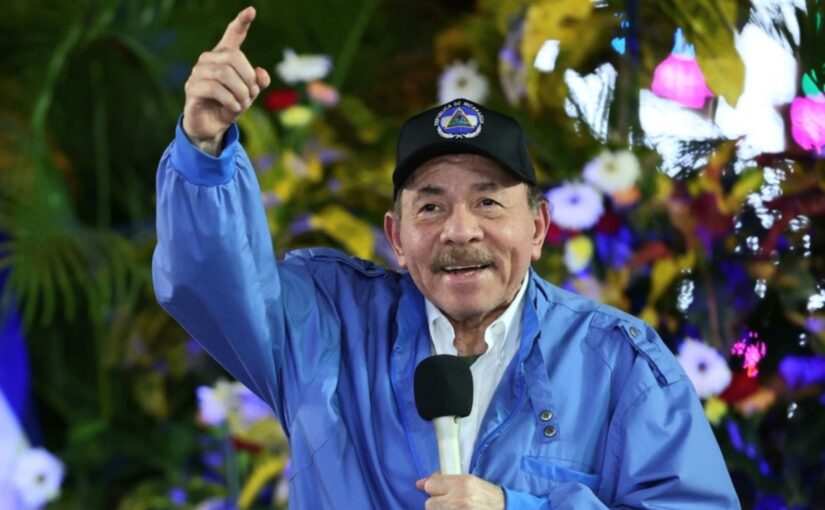
Co-President Daniel Ortega began his speech by noting that March 8 was International Women’s Day. Noting its history, he said it was, “Clara Zetkin, who in 1910 at a Conference of Socialist Women, in Copenhagen, proposed and approved the celebration of Working Women’s Day, because it was mainly working women who were marginalised and exploited. And very soon, the following year, in the month of March, the first commemoration took place.
He went on to say that this is a “struggle that we have been waging here in Nicaragua as well, to defeat and eliminate, to extirpate, from our nation, the manifestations of machismo, which in some cases result in causing pain, even tragedy in some families.
“And there, fighting for the peace and security of the Nicaraguan people, the right of women was incorporated, and has also been enshrined in the laws, that when aggression and crimes are committed against working women, Self-sacrificing Women, then the maximum penalty goes to those who commit this type of crimes.”
Ortega pointed out that the ceremony was taking place at the Comandante Hugo Rafael Chávez Frías Roundabout and highlighted the role that the late Venezuelan revolutionary leader had played in the resumption of diplomatic relations between Nicaragua and China:
“A few days ago, on March 5th, we commemorated the 12th Anniversary of his Departure on the Journey to Immortality, but he is present here with us and we remember him well for how he connected with the Nicaraguan people.
“And I remember, dear Ambassador, that on the occasions when I would talk with Comandante Hugo Chávez, he would say to me: Well, and when…? The brothers of the People’s Republic of China are waiting for us. And he loved the People’s Republic of China, like the love we have too have for China.
“But, unfortunately, when the neoliberal governments arrived, they broke our relations with the People’s Republic of China, and three neoliberal Governments passed. And we had to return to the government and achieve a majority in Congress, in the National Assembly, to finally make Comandante Chávez’s dream come true.
“And we can tell you: Here we are, united as brothers and sisters, with the People’s Republic of China, with the Chinese people, with the Chinese Communist Party, and we are proud of that unity, which is a unity in which, we well know, the heroic people of China made an extraordinary revolution led by Mao Zedong, one to which President Xi Jinping has come giving it continuity and new brilliance.
“That is, the revolution in China has not stopped, the revolution in China continues, and now offers itself to the world as a revolution bringing peace, bringing wellbeing, bringing solidarity to the peoples. It does not carry sanctions, nor does it carry threats, nor does it carry wars. It is a revolution of peace, the revolution led by the Chinese Communist Party.”
The final speaker was Co-President Rosario Murillo, who said:
“While Comandante Daniel was talking about that plague, the plague of machismo, which is still something in our culture that we have to combat and overcome, I was remembering how we always thought and said that without revolution it is difficult to achieve women’s rights. And 45 years after the triumph of the revolution, 45 years later, what do we see? That it has been possible to achieve justice for us women, from us as women, because we have a revolution, a revolution in which we all participate with our strength, with our work, with our pride, with our sense of national dignity…
“For years immemorial, the years of the guerrilla Sandinista struggles, women have been there… But now women are in power! At that time, women were combatants, guerrillas, fighters, warriors, and we have always been warriors, fighters and combatants, but now we also constitute power, institutional power.”