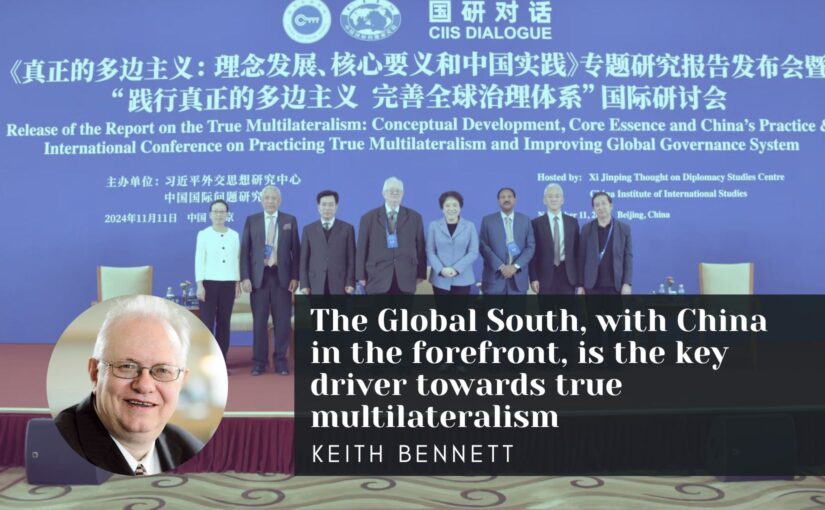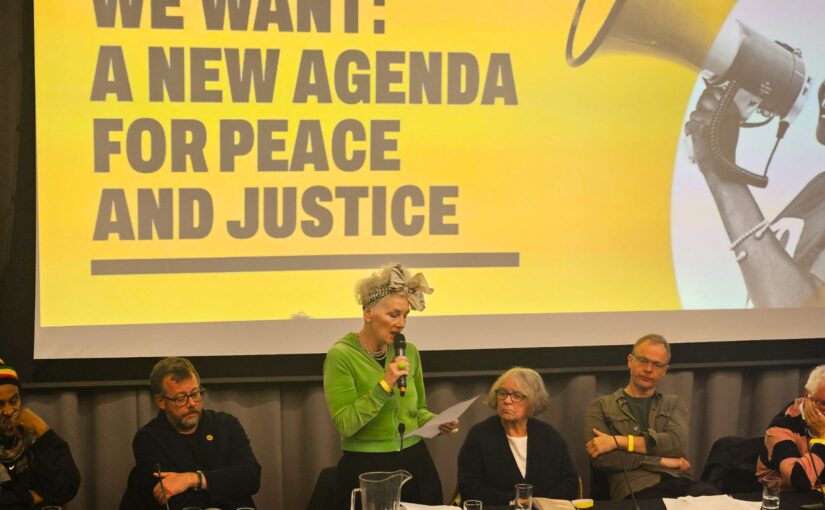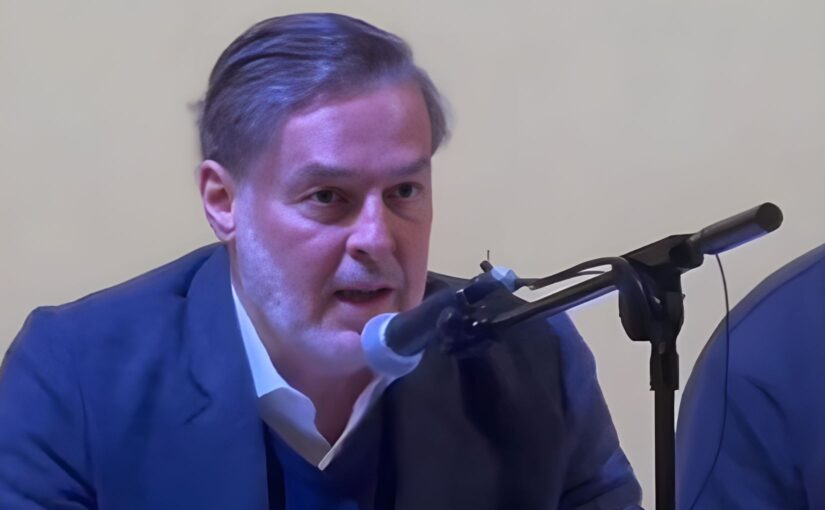
On Saturday October 26, the Newport and Gwent Valleys [South Wales] branch of the Communist Party of Britain (CPB) organized a very successful fund-raising social to celebrate the anniversary of the 1917 October Socialist Revolution. It was attended by members and supporters of the CPB, the Young Communist League and the Communist Party of India (Marxist), along with other friends from the labour, trade union and progressive movements. The more formal part of the afternoon was chaired and introduced by CPB General Secretary Robert Griffiths. Short videos were shown of the 1945 victory parade in Moscow marking the triumph over Nazi fascism and of the famed African-American artist and revolutionary Paul Robeson singing the Soviet national anthem. Following this, Robert introduced the guest speaker, Keith Bennett from Friends of Socialist China.
We publish below the main body of Keith’s talk.
The October Revolution was a truly great event in world history – one that remains worthy of celebration. The account given by the US communist journalist John Reed has a highly apposite title – ‘Ten Days that Shook the World’.
Indeed, this was a revolution that not only shook but changed the world forever. Even though the Soviet Union itself tragically no longer exists, after the October Revolution nothing was ever the same again or could ever be the same again.
The Soviet Union represented the first sustained attempt by working people to hold and maintain power. Throughout its lifetime there were both great achievements as well as some significant mistakes.
But whatever the mistakes or shortcomings, the Soviet Union was the first country to legislate for the equality of women and men. The first to guarantee universal and free education and health care. The first to ensure full employment and the right to paid annual holidays for all workers and farmers.
Entire nationalities were provided with a written script for the first time. Visiting Soviet Uzbekistan in the 1980s, I learned how that vast republic went from some two percent literacy to universal literacy in barely a couple of decades.
Above all, the Soviet Union bore the brunt of the World Anti-Fascist War in Europe, sacrificing the lives of 27 million of its citizens to defeat Nazism.
Support from the Soviet Union played a vital role in the dismantling of the old colonial empires and the victory of the national liberation movements.
And the threat of the Soviet example played a significant role in forcing the ruling class in this and other major capitalist countries to make concessions to the working class in the form of the ‘welfare state’.
Some years ago, when Gordon Brown was Prime Minister, the Tories, who, of course had bitterly opposed the creation of the NHS, took to deriding it as “Stalinist”. On first consideration, this might seem to be a risible and ridiculous claim. Nevertheless, it expresses a certain truth that such gains for working people did indeed flow in no small measure from the fear of the ruling class that their populations might follow the Soviet road.
That mistakes were made, and even crimes committed, in the course of building socialism in the USSR is undeniable. But, whilst detailed assessment of these is not possible today, what we really must do is place them in a context where the imperialist ruling class was never reconciled to the existence of the Soviet Union and the threat it posed. Not the military threat claimed by the cold warriors, but the threat of a good example. In that sense, it is reasonable to conclude that, throughout its entire history, the Soviet Union never enjoyed even a single day of true peace.
We were, however, told that, with the collapse of the Soviet Union there would at last be a ‘peace dividend’. No more wars.
Instead, we got the exact opposite. No peace dividend but rather austerity and the rolling back of the welfare state. And above all, we entered a period of constant and endless wars. In former Yugoslavia, Iraq, Afghanistan, Syria, Libya, Lebanon, Yemen, Somalia, and elsewhere. Through to today’s appalling genocide in Palestine, and the spiraling conflict throughout the region, as well as NATO’s proxy war in Ukraine.
And this brings me to the question of China.
The October Revolution was by no means a simple national phenomenon. Rather it inaugurated an entirely new period of world history – that of the long transition (with all its victories and setbacks) from capitalism to socialism on a worldwide scale.
In his last published article, ‘Better Fewer But Better’, Lenin turned to consideration as to whether the Soviet state could survive – a matter about which he was never sanguine. But he concluded on a note of revolutionary optimism that:
“In the last analysis, the outcome of the struggle will be determined by the fact that Russia, India, China, etc., account for the overwhelming majority of the population of the globe. And during the past few years it is this majority that has been drawn into the struggle for emancipation with extraordinary rapidity, so that in this respect there cannot be the slightest doubt what the final outcome of the world struggle will be. In this sense, the complete victory of socialism is fully and absolutely assured.”
In a very real sense, therefore, the liberation of China, and the founding of the People’s Republic, whose 75th anniversary we have just celebrated, arose from the October Revolution. In his 1949 article, ‘On the People’s Democratic Dictatorship’, Mao Zedong explained:
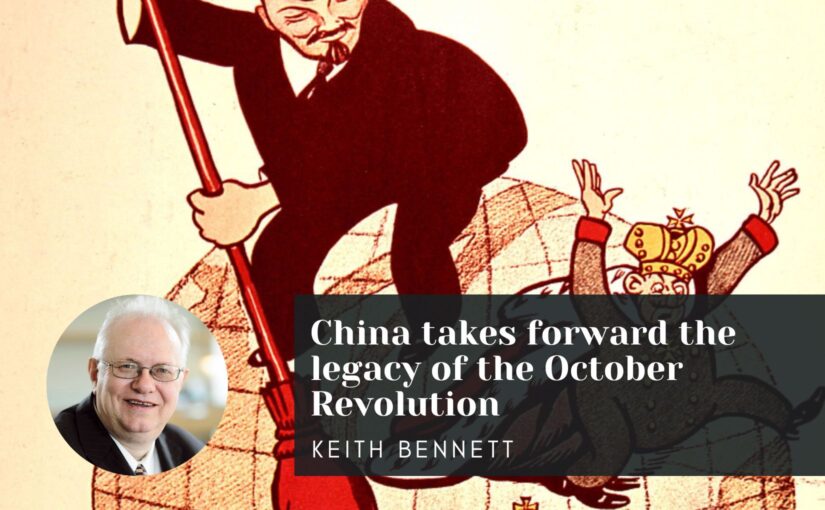
Continue reading China takes forward the legacy of the October Revolution