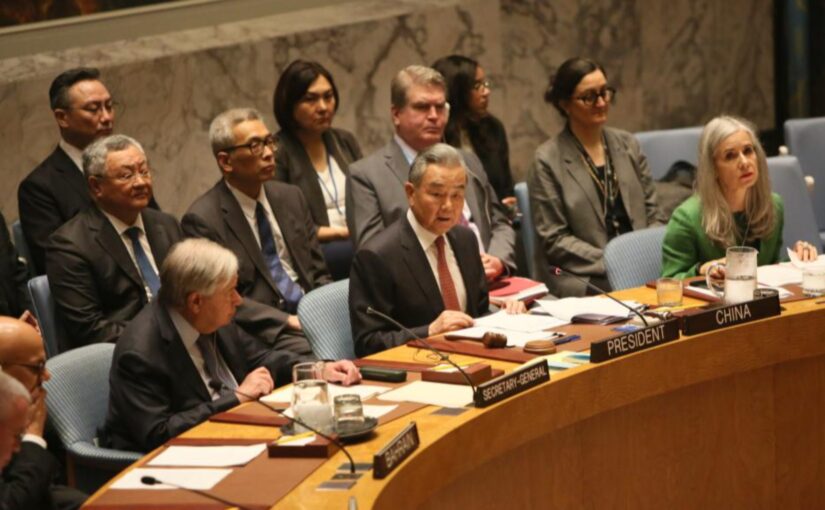
China held the rotating presidency of the United Nations Security Council in May, 2026. In that capacity, it called a high-level meeting on May 26. The theme of this meeting was ‘Upholding the Purposes and Principles of the UN Charter and Strengthening the UN-centred International System’. Chinese Foreign Minister Wang Yi, who is also a member of the Political Bureau of the Communist Party of China’s Central Committee, travelled to New York to chair the meeting. He also attended the meeting of the Group of Friends of Global Governance at the UN headquarters in New York on May 28 and held a considerable number of bilateral meetings, particularly with his counterparts who had also travelled to New York to attend the meetings. Prior to returning home, Wang also visited Canada, May 28-30.
In his remarks to the high-level meeting held on May 26, Wang Yi said that the international situation is undergoing the most complex and profound changes since the end of World War II. The giant ship of human civilisation is sailing into dangerous waters, and world peace and development are at a crossroads. The challenges confronting us are testing the international community’s commitment to safeguarding peace, its resolve to stand up for justice, and its courage to make bold reforms. Members must stand united and act together to defend, revitalise and strengthen the UN.
He advanced a number of proposals in this regard:
- Reinvigorating the UN Charter for stronger leadership. The root cause of the chaos in today’s world is not that the Charter’s spirit is outdated, but that the international order and the basic norms governing international relations, both set out in the Charter, are not being effectively upheld and observed. Members must uphold sovereign equality, oppose interference in internal affairs; uphold the peaceful settlement of disputes, oppose the use of force; uphold the victorious outcomes of World War II, oppose glorifying the history of aggression. Major countries, in particular, have the responsibility to lead by example in following the rule of law and the right path, and should not practice double standards, exceptionalism or selective application.
- Reinvigorating the authority of the Security Council for greater ability to act. What comes with Security Council membership is not privileges, but responsibilities. Members should rise above the narrow national interests and use international public goods responsibly. Any unilateral military action that circumvents the Council’s mandate is unacceptable, and any unilateral sanction that exceeds the Council’s resolutions lacks legitimacy.
- Reinvigorating global development cooperation for stronger mobilisation. As the implementation of the Sustainable Development Goals is woefully behind schedule, the UN needs to vigorously coordinate global actions and fully mobilise global resources. It is important to solidify the pillar of development, strengthen the development system, provide countries of the Global South with more funding, technological and intellectual support in key areas such as poverty reduction, and urge developed countries to deliver on their development financing pledges. It is imperative to earnestly increase the representation and say of developing countries at the IMF and the World Bank. China supports the UN in strengthening dialogue with BRICS countries, the G20, the New Development Bank and the Asian Infrastructure Investment Bank, for a universally beneficial and balanced global economic and financial governance system.
- Reinvigorating the global governance platform for stronger execution capacity. Faced with emerging threats and challenges, no country can stay unaffected. A united response is the only way forward. Members should strengthen the sense of a community with a shared future for humanity, replace coercion with consultation, zero-sum with win-win, and small circles with greater unity.
- Reinvigorating the effectiveness of the UN system for stronger vitality. Member states should fulfill their financial obligations with real actions, support the UN in performing its mandate, and steadily contribute to the cause of the UN, rather than willfully withdraw from treaties and organisations, still less establish alternatives.
Wang Yi stressed that this year marks the 55th anniversary of the restoration of the lawful seat of the People’s Republic of China in the UN. For 55 years, as a permanent member of the Security Council, China has taken an active part in the UN cause. From this historic point onward, China will continue to uphold principles and follow the path of justice. Together with all countries, China will pursue greater unity under the banner of multilateralism, promote a more just and equitable global governance system, and move toward the goal of building a community with a shared future for humanity.
Following the meeting Wang Yi briefed the press.
He explained that the meeting was proposed by China in its capacity as the rotating President of the Security Council. He pointed out that in recent times, the purposes of the UN Charter have been disregarded, the basic norms governing international relations have been undermined, and world peace and security are in jeopardy. At this critical juncture, the Security Council must step forward and shoulder its responsibilities.
It was widely agreed that the UN Charter has not become outdated and remains the cornerstone of the international order. The centrality of the UN must be strengthened, not weakened. As none of us wants to see international relations slide back to the law of the jungle, we need to uphold the same system, the U.N.-centered international system, and observe the same set of rules – the basic norms governing international relations based on the Charter.
It was also widely agreed that the trend toward a multipolar world is unstoppable, and that the domination of international affairs by one or a few countries no longer corresponds to the trend of the times. We should firmly follow the path of multilateralism, do our utmost to safeguard unity, oppose division, seek cooperation, reject confrontation, and jointly inject much-needed stability and certainty into the world.
The view that current global governance has visibly fallen behind and needs to be reformed and improved in keeping with the times was also widely shared. Global governance should reflect the aspirations of all countries in a more balanced way and ensure equal participation and shared benefits for all. In particular, it is important to increase the representation and voice of the Global South and jointly build a more just and equitable global governance system.
Wang also pointed out that to reinvigorate the UN, the Security Council must first be reinvigorated. To achieve this goal, he stressed the following:
- All Security Council members must regard the maintenance of peace as their shared responsibility, observe the Charter, uphold justice, refrain from pursuing narrow self-interest, and avoid bloc confrontation.
- The representation and voice of developing countries and small and medium-sized states should be increased through reform, in particular by addressing the historical injustice faced by Africa.
- The objectivity, fairness, and inclusiveness of Security Council proposals should be enhanced, and the five permanent members, in particular, should play an exemplary role in this regard.
- The international community should jointly oppose all unilateral acts that bypass the Security Council, so that unilateral bullying finds no support and no legitimacy.
In his keynote speech to the May 28 meeting of the Group of Friends of Global Governance, Wang Yi said that the current international situation is marked by intertwined changes and turbulence. Countries are calling for fairness and justice, longing for solidarity and cooperation, and aspiring to peace and stability. Against this backdrop, President Xi Jinping solemnly put forward the Global Governance Initiative last September, emphasising five core concepts: sovereign equality, international rule of law, multilateralism, people-centred approach, and real actions. In less than a year, the initiative has received support and response from nearly 160 countries and international organisations. The Group of Friends of Global Governance has been successively established in New York, Geneva and Vienna, with membership reaching over 60 countries. Guided by the spirit of equality and mutual respect, members have held extensive discussions and reached consensus on five key points including advancing greater democracy in international relations, upholding the purposes and principles of the UN Charter, safeguarding the central role of the United Nations, narrowing the North-South divide, and addressing the most pressing challenges.
He stressed that reforming and improving global governance is a historic mission for this generation and said that China proposes the following nine reform directions:
- Promoting UN reform for greater efficiency. The purpose of reform is to enhance the United Nations, not weaken it. UN reform should be led by member states and carried out in a fair, inclusive and transparent manner. Member states should be urged to fulfill their financial obligations, and budget management and fiscal accountability should be strengthened.
- Enhancing the authority and capacity of the Security Council. The voice of developing countries and the vast number of small and medium-sized countries should be strengthened, and the historical injustice faced by Africa should be addressed as a priority. Unilateral actions and sanctions that bypass the Security Council should be opposed.
- Adapting peacekeeping operations to the demands of the times. The three principles of peacekeeping should be upheld and improved, and peacekeeping operations should be better mandated and empowered. The United Nations should be supported in strengthening coordination with regional organisations such as the African Union and the League of Arab States, so as to build a combined force for mediation on regional hotspot issues.
- Building international consensus on accelerating development. Development should be pushed back to the centre of the UN agenda, and the post-2030 development agenda should be planned ahead. Developed countries should fulfill their commitments on development financing. The principle of common but differentiated responsibilities should be upheld, and a fair, reasonable and win-win global climate governance system should be built.
- Steering global human rights governance in the right direction. The one-sided approach of placing human rights above sovereignty should be abandoned, and it should be made clear that it is the people of each country who judge and improve their own human rights.
- Deepening reform of the economic and financial system. The shareholding review of the World Bank should be accelerated, and a meaningful adjustment of IMF quota shares should be achieved as soon as possible. The dispute settlement mechanism should be restored to normal operation, and World Trade Organisation (WTO) rules should be updated to keep pace with the times.
- Establishing rules for artificial intelligence (AI) governance. A people-centred and AI-for-good approach should be upheld, and the United Nations should be supported in playing its role as the main channel. The digital divide should be prevented from widening, and guardrails should be set for military applications and governance of AI.
- Strengthening governance in emerging domains such as cyberspace and outer space. The four principles of respecting cyber sovereignty, maintaining peace and security, promoting open cooperation and building good order should be upheld, and the United Nations should be supported in advancing global cyberspace and digital governance. Outer space should be used for peaceful purposes.
- Promoting exchanges among civilisations and achieving inclusive mutual learning.
The meeting reached consensus on five key points:
- All members support the democratisation of international relations. All countries, regardless of size, strength or wealth, have the right to choose their own social systems and development paths, and to participate, decide and benefit equally in global governance.
- All members call for upholding the purposes and principles of the UN Charter, ensuring the equal application of international law and international rules, and opposing double standards and coercion.
- All members support safeguarding the central role of the United Nations, practicing multilateralism, strengthening multilateral mechanisms, and opposing unilateralism and power politics.
- All members support reforming and improving global governance and narrowing the North-South divide to ensure that all countries share the benefits of development and that no country is left behind.
- All members call for addressing the most pressing challenges facing the international community through concrete actions and practical results to ensure global governance meets the needs of the times and the people.