Chen Weihua: China’s peaceful rise is a miracle unprecedented in human history

We are pleased to reprint below the speech delivered by Chen Weihua to our September 28 conference celebrating the 75th anniversary of the founding of the People’s Republic of China.

Chen describes the founding of the People’s Republic as a turning point in Chinese history: “Chairman Mao’s declaration 75 years ago that the Chinese people have stood up made Chinese extremely proud of being Chinese, after the nation had suffered a century of humiliation inflicted upon by imperial and colonial powers.”

China’s progress since then – lifting hundreds of millions out of poverty, developing universal healthcare and education, massively improving living standards, and becoming a global leader in green technology – has been remarkable, but has also raised alarm in Washington, which sees China’s rise as a threat to its strategy of hegemony.

This is the context for the trade war, for the US’s unilateral sanctions on China, and for the escalating military encirclement campaign. It also provides the context for a relentless propaganda war, in which China is demonised and labeled a threat to peace and democracy. “The US often portrays China as a major threat to global peace. The truth is that China has one of the best records for peace. The US has been engaged in constant wars and regime changes, from Afghanistan to Iraq to Libya, just to name a few.”

Chen points out that, in an interconnected world, “it is more important than ever for the world to come together to tackle common global challenges from climate change, nuclear proliferation and pandemic to economic growth and global governance”, and concludes by calling for a coordinated struggle against the New Cold War.

Chen Weihua is a prominent Chinese journalist and EU bureau chief of China Daily.

It’s a great honor for me to speak to you in my personal capacity at this important event marking the 75th anniversary of the founding of the People’s Republic of China.

I want to express my appreciation for Friends of Socialist China for your good work in advocating world peace and justice and in supporting China against the US new Cold War and its reckless smearing campaigns against China.

Chairman Mao’s declaration 75 years ago that the Chinese people have stood up made Chinese extremely proud of being Chinese, after the nation had suffered a century of humiliation inflicted upon by imperial and colonial powers.

China’s rapid peaceful rise, especially since the reform and opening up in the late 1970s, is a miracle and unprecedented in human history. China has lifted 800 million people out of poverty, greatly raised the living standards of its people, advanced its capacity in education, public health, science and technology. And China has become a global manufacturing powerhouse, including in renewable energy and other clean industries.

China has been playing an important and responsible role on the world stage and as a permanent member of the UN Security Council and as a voice for the developing world.

It’s exactly such China’s independent foreign policy, unique development path and rapid peaceful rise that have made many in Washington feel threatened in sustaining US global hegemony. That is why the US has been going all-out to contain China’s development.

The US has been waging trade wars and tariff wars against China. It has put hundreds of Chinese tech companies on its notorious Entity List of export control. The US has been forcing countries to choose sides in its bid to divide the world into Cold War type political blocs.

Continue reading Chen Weihua: China’s peaceful rise is a miracle unprecedented in human history

From despair to revolution: the Bronx’s path to defeating addiction

The following article by the Bronx [New York] Anti-War Coalition, which was originally published by Workers World, reports on their October 11 screening of the documentary film, ‘Dope is Death’. The event included a Q&A session with Walter Bosque, an acupuncturist and former Young Lord. 

The Young Lords were a youth organisation of the Puerto Rican national minority in the United States, who took up revolutionary organising and the study of Marxism-Leninism and who supported and forged links with socialist China. 

‘Dope is Death’ highlights the late Dr. Mutulu Shakur’s transformative work with the Young Lords and the Black Panther Party, who used acupuncture to combat drug dependency. Their efforts not only rescued individuals from addiction but also empowered the community to rebuild, laying the groundwork for revolutionary change. [Mutulu Shakur was a political prisoner and member of the Black Liberation Army and other revolutionary organisations as well as the stepfather of the rapper Tupac Shakur.]

Having drawn attention to the ‘Opium Wars’ waged by British imperialism against China in the 19th century, the article notes:

After the 1949 revolution, the People’s Republic of China swiftly eradicated opium production and consumption through revolutionary social reform… Mao Zedong’s landmark 1965 health-care speech and his June 26 directive emphasised accessible health care in rural areas, leading to the ‘barefoot doctors’ program. This initiative trained community health workers to provide basic medical services in rural areas, blending modern and traditional medicine to meet the needs of under-served communities. By 1968, this program became a key component of national health policy.

As we celebrate 75 years of the Chinese Revolution, China’s achievements in eradicating addiction, reducing poverty and advancing public health testify to the transformative potential of revolutionary movements. Ultimately, China’s rise as a global power signifies the rise of the Global South, as it extends a helping hand to nations historically oppressed by the US empire and sanctions.

It goes on to outline how the Palestinian resistance had created Muslim youth associations, community clubs and Islamic social gatherings to combat drug trafficking, help individuals overcome addiction and strengthen social cohesion and concludes:

“This history of social resilience and organized resistance across the Bronx, the People’s Republic of China and Gaza highlights the power of community-led healing in the face of systemic oppression.”

A synopsis of the film can be read here

The Bronx Anti-War Coalition hosted a film screening on Oct. 11 of the documentary “Dope is Death” as part of our guerrilla cinema series. The widely attended event featured a Q&A session with former Young Lord and acupuncturist Walter Bosque, where community members engaged in a lively discussion about continuing and expanding the revolutionary movement of healing.

In recent years, the Bronx, a predominantly Black, Brown and working-class borough in one of the most densely populated areas of Turtle Island, has experienced a sharp rise in opioid use, including oxycodone, street fentanyl and heroin. 

We recognize that drug use, particularly opioids, is not merely a personal struggle but a symptom of systemic issues rooted in capitalism and government neglect. This crisis profoundly harms our community. Those most affected by poverty, alienation and exploitation often turn to drugs for temporary relief from oppressive daily conditions. Addiction burdens those already suffering from state-imposed violence and capitalist exploitation.

Rather than supporting and uplifting working-class communities, capitalist society allows drugs like fentanyl, heroin and crack to infiltrate and erode social bonds, deteriorate health and stifle revolutionary potential. Addiction acts as a tool of oppression, weakening communities and diverting energy away from organizing and resistance.

Continue reading From despair to revolution: the Bronx’s path to defeating addiction

Margaret Kimberley: The importance of China for Africa and its diaspora

We are pleased to publish below the text of the speech given by Margaret Kimberley to the meeting, ‘China at 75: Changes Unseen in a Century’, initiated by Friends of Socialist China and held in New York City on September 29.

Margaret, who is the Executive Editor of Black Agenda Report, began her remarks with a strong condemnation of recent and ongoing Israeli war crimes against the peoples of Palestine, Lebanon and the entire region, and continued:

“But this is connected. We understand that this effort, imperialist effort to wage war on the entire region of Western Asia, makes this commemoration all the more important. We’re not just commemorating a successful revolution, but also the beginnings of changes in power relationships around the world, which coincided with the post war stirrings for independence across the Global South.”

Contextualising her remarks, Margaret said:

“This year, I had an amazing opportunity to visit China as part of a Friends of Socialist China delegation, as guests of the China NGO Network for International Exchanges, visiting Beijing, Zhejiang and Jilin. I saw for myself why China has leapfrogged over the rest of the world in its economic development, the dedication to the principles of socialism and a commitment to worldwide cooperation that has made relations with China attractive to the entire continent of Africa.”

Margaret reviewed the Forum on China-Africa Cooperation (FOCAC) that had been held in the Chinese capital Beijing earlier in the month, including drawing attention to some of the contradictions inherent in such a diverse gathering. She made special mention of Eritrea as “the one [African] country that has maintained its commitment to socialism, which is why it’s always under attack.” She mentioned that Chinese companies have agreed to invest up to $7 billion in infrastructure projects as part of their mining agreements in the Democratic Republic of Congo (DRC).

She concluded:

“I think it’s important to mention not just the nations of the African continent, but the relations of the African diaspora. Dr. [Gerald] Horne referred to Shirley Graham DuBois, and there has been constant, on the part of revolutionaries, this urge to connect with China, to see China as this example. Which is why, in general, anti-Chinese propaganda is so dangerous. It’s an effort to indoctrinate. It’s an effort to stop revolutionary activity. And so, WEB DuBois visited China, and Paul Robeson reached out to China, and Huey Newton visited China. It’s all connected, and tells you how important it is that African people maintain these relationships, see China for ourselves and judge for ourselves, and the fact that that is something that is condemned so strongly, tells us quite a lot.”

Thank you all again for being here as we’re just two days away from the 75th anniversary of the founding of the People’s Republic of China. And I would be remiss if I did not speak of what’s happening in Lebanon with the continuation of Israeli and US war crimes, the assassination of Hassan Nasrallah, the deaths of, as I said, nearly 200,000 people. But this is connected. We understand that this effort, imperialist effort to wage war on the entire region of Western Asia, makes this commemoration all the more important. We’re not just commemorating a successful revolution, but also the beginnings of changes in power relationships around the world, which coincided with the post war stirrings for independence across the Global South. 

I’m going to talk about Africa and its relationships with the People’s Republic of China, which began first as China was an example of the possibility of freedom from the capitalist, imperialist world. This year, I had an amazing opportunity to visit China as part of a Friends of Socialist China delegation, as guests of the China NGO Network for International Exchanges, visiting Beijing, Zhejiang and Jilin. 

Continue reading Margaret Kimberley: The importance of China for Africa and its diaspora

Top DPRK leader sends wreath to China-DPRK Friendship Tower

On October 25, the top leader of the Democratic People’s Republic of Korea (DPRK), Kim Jong Un, General Secretary of the Workers’ Party of Korea (WPK) and President of the State Affairs of the DPRK, sent a wreath to the Friendship Tower in Pyongyang marking the 74th anniversary of the Chinese People’s Volunteers (CPV) entering the DPRK to fight in the War to Resist US Aggression and Aid Korea, the Korean Central News Agency (KCNA) reported. The words, “We will remember the martyrs of the Chinese People’s Volunteers forever” were written on the wreath’s ribbon.

KCNA further reported that wreaths were also presented in the name of leading state and government bodies both at the Friendship Tower as well as at the cemeteries and graves of CPV martyrs in various parts of the country.

Wreaths were also laid by the Chinese Ambassador and members of his staff. 

The Friendship Tower was built to remember the Chinese People’s Volunteers who fell in the war of 1950-53. It is situated in the heart of the DPRK capital Pyongyang, on a hill overlooking the Chinese Embassy.

DPRK diplomats paid similar tributes at martyrs’ cemeteries in Shenyang and Dandong, in China’s Liaoning province.

The following articles were originally published by the Xinhua News Agency and KCNA.

Top DPRK leader sends wreath to China-DPRK Friendship Tower

The top leader of the Democratic People’s Republic of Korea (DPRK) on Friday sent a wreath to the China-DPRK Friendship Tower in Pyongyang on the occasion of the 74th anniversary of the Chinese People’s Volunteers entering the DPRK to fight in the War to Resist U.S. Aggression and Aid Korea, the DPRK’s official Korean Central News Agency reported on Saturday.

The words “We will remember the martyrs of the Chinese People’s Volunteers forever” were written on the ribbon of the wreath sent by Kim Jong Un, general secretary of the Workers’ Party of Korea (WPK) and president of the State Affairs of the DPRK.

Upon authorization, Ri Il Hwan, member of the Political Bureau and secretary of the WPK Central Committee, laid the wreath before the tower, the report said.


Wreaths Laid at Friendship Tower

Wreaths were laid at the Friendship Tower on October 25 to mark the 74th anniversary of the entry of the Chinese People’s Volunteers (CPV) into the Korean Front.

Seen standing before the tower was a wreath bearing the august name of the respected Comrade Kim Jong Un.

The guard of honor of the Korean People’s Army lined up there.

Present at the wreath-laying ceremony were Kang Yun Sok, vice-chairman of the Standing Committee of the Supreme People’s Assembly (SPA) of the DPRK, Mun Song Hyok, vice department director of the Central Committee of the Workers’ Party of Korea, Pak Myong Ho, vice-minister of Foreign Affairs, and officials concerned.

The national anthems of the People’s Republic of China and the Democratic People’s Republic of Korea were played.

Amid the playing of wreath-laying music, wreaths in the names of the SPA Standing Committee and the Cabinet of the DPRK were placed before the tower.

Also laid were wreaths in the names of the Foreign Ministry and the Ministry of Urban Management and a wreath in the joint name of the Pyongyang Municipal Committee of the WPK and the Pyongyang Municipal People’s Committee.

The participants paid silent tribute to the memory of the CPV martyrs before going round the tower.

On the same day, wreaths were placed at the cemeteries and graves of CPV fallen fighters in Hyongjesan District of Pyongyang Municipality, Anju City and Hoechang County of South Phyongan Province, Onsong County of North Hamgyong Province and Kaesong Municipality.

Xi meets with leaders of Russia, Laos, Iran, Egypt and Vietnam

Chinese President Xi Jinping held a number of bilateral meetings with fellow leaders in the margins of the BRICS Summit, which was held, October 22-24, in the Russian city of Kazan.

Xi met with his host, President Vladimir Putin on the day of his arrival. He said that China and Russia have found the right way for neighbouring major countries to get along with each other, which features non-alliance, non-confrontation and not targeting any third party.

Noting that this year marks the 75th anniversary of the establishment of diplomatic relations between China and Russia, Xi said that over the past years, the relationship between the two countries has weathered challenges.

Noting that the world today is facing momentous transformations unseen in a century, resulting in a fast-changing and turbulent international landscape, he expressed confidence that the profound and lasting friendship between China and Russia will not change, nor will their sense of responsibility as major countries for the world and for the people.

Despite complex and severe external challenges, bilateral cooperation in areas such as trade continues to advance, and large-scale joint projects remain stable in operation, he said, adding that both countries should further promote the alignment of the Belt and Road Initiative with the Eurasian Economic Union to support their respective high-quality economic development.

Next year marks the 80th anniversary of the founding of the United Nations and the victory of the World Anti-Fascist War, Xi stressed. China and Russia, both permanent members of the UN Security Council and major countries in the world, should deepen comprehensive strategic coordination, strengthen communication and coordination within multilateral frameworks such as the United Nations and the Shanghai Cooperation Organisation, promote a correct view of World War II history, firmly uphold the UN-centred international system, and jointly safeguard global strategic stability along with international fairness and justice.

President Vladimir Putin said that thanks to joint efforts from both sides, the Russia-China cooperation, based on equality, mutual respect, and mutual benefit, continues to advance, and the activities of the Russia-China Years of Culture have been successfully held, adding that Russia stands ready to further deepen cooperation with China and boost the development and revitalisation of both countries.

Noting that next year marks the 80th anniversary of the end of World War II, Putin said that both Russia and China made tremendous sacrifices for victory in the World Anti-Fascist War, and that Russia is willing to commemorate this important milestone together with China.

Also on October 22, Xi met with Thongloun Sisoulith, General Secretary of the Lao People’s Revolutionary Party (LPRP) Central Committee and President of the Lao People’s Democratic Republic (LPDR), saying that the two sides should continue to strengthen the development of the China-Laos Railway and promote the construction of the China-Laos Economic Corridor.

As socialist comrades and brothers, the relations with Laos are of special importance in China’s neighbourhood diplomacy, and the two countries have always stayed at the forefront of building a community with a shared future, Xi said, adding that regardless of how the international situation changes, China will always be a trustworthy friend and partner of Laos.

Congratulating Laos on successfully hosting the East Asian Leaders’ meetings on cooperation, the Chinese President said he welcomes Laos’ active participation in BRICS cooperation.

Thongloun Sisoulith said that he went to China last year to attend the third Belt and Road Forum for International Cooperation and signed with Xi a new version of the action plan for building a China-Laos community with a shared future, which is being implemented effectively at present.

Laos-China relations are at their best in history, with bilateral cooperation expanding in depth and breadth, he added.

The following day, Xi met with the new Iranian President Masoud Pezeshkian and said that no matter how the international and regional situations change, China will unswervingly develop friendly cooperation with Iran.

Continue reading Xi meets with leaders of Russia, Laos, Iran, Egypt and Vietnam

Forum defends anti-imperialist Marxism and People’s China

As we reported on 28 October, Friends of Socialist China recently participated in an event in New York City to celebrate the release of two revolutionary books: People’s China at 75: The Flag Stays Red, and Western Marxism by Domenico Losurdo, translated into English for the first time.

The article below is a write-up of that event by Sue Harris for Workers World.

Summarising the remarks made by the panelists (Gabriel Rockhill, Danny Haiphong and Carlos Martinez) and the chair (Sara Flounders), Sue notes that “the panelists agreed on the usefulness of Marxist theory in pursuing the struggle of the exploited classes against their exploiters and of oppressed nations against imperialism, which they considered the centre of today’s class struggle”.

Further: “The imperialist ruling class is trying to mobilize the population to consider People’s China their enemy. The speakers eloquently combatted these lies, which are delivered incessantly with the ruling class’s massive propaganda machine.”

Beneath the article you can find a video of the event, which was live-streamed on Danny Haiphong’s YouTube channel.

On Oct. 24, 2024, in New York City, Friends of Socialist China celebrated the release of two revolutionary books:  “People’s China at 75: The Flag Stays Red,” edited by Carlos Martinez and Keith Bennett, and “Western Marxism,” a collection of essays by the Italian Marxist-Leninist Domenico Losurdo, translated into English for the first time, with an introduction co-written by Jennifer Ponce de León and the editor, Gabriel Rockhill.

The meeting, which united Marxists working in different areas in defense of China against U.S. imperialism, was held at the Workers World Party office in midtown Manhattan in New York. The office, called the Solidarity Center, is used by groups joined in the working-class struggle, including workers at Amazon, Laundry Workers, student encampments for Palestine and the Venceremos Brigade for socialist Cuba.

Broadcast on several different media platforms, the meeting was carried on independent journalist Danny Haiphong’s YouTube channel, was on Zoom and was made into a podcast. A link to the meeting’s video will be available at workers.org and iacenter.org.

On the panel at the book launch were Haiphong, Gabriel Rockhill, Martinez and Sara Flounders, all known for their knowledge of developments in the People’s Republic of China and their ability to get this knowledge across in Zoom broadcasts, videos, articles and books.

It was in keeping with the anti-imperialist and struggle orientation of the speakers that Flounders, who chaired the meeting, opened with a salute to the revolutionary Yahya Sinwar, chair of the Political Bureau of the Hamas Islamic Resistance Movement. Sinwar was an organizer in Gaza of the October 7 Al-Aqsa Flood Battle, a martyr in battle against Zionism and U.S. imperialism.

Flounders said, referring to Sinwar, “Resistance does not die with the martyrdom of leaders. Resistance lives on, driven by the hunger of millions for liberation and justice.”

A multipolar world

Haiphong helped found Friends of Socialist China, is co-author of “American Exceptionalism and American Innocence” and a contributor to Black Agenda Report. His well-attended broadcasts cover geopolitics relating to China, West Asia, the Ukraine war and how the development of a multipolar world — as opposed to a unipolar world dominated by U.S. imperialism — can aid the liberation of the bulk of humanity.

Rockhill is Founding Director of the Critical Theory Workshop and professor of Philosophy at Villanova University. He has had many books published, with one set for publication in 2025, “Who Paid the Pipers of Western Marxism?” He is editor-in-chief of the World Marxist Review and a co-director of Anti-Imperialist Marxism, a book series with Iskra.

Martinez is a researcher and political activist living in London. His first book, “The End of the Beginning: Lessons of the Soviet Collapse,” was published in 2019 by LeftWord Books. His recent book, “The East Is Still Red – Chinese Socialism in the 21st Century,” was published in 2023 by Praxis Press and reviewed in Workers World. (workers.org/2023/07/72231/) He is a co-editor of Friends of Socialist China.

The panelists agreed on the usefulness of Marxist theory in pursuing the struggle of the exploited classes against their exploiters and of oppressed nations against imperialism, which they considered the center of today’s class struggle.

The imperialist ruling class is trying to mobilize the population to consider People’s China their enemy. The speakers eloquently combatted these lies, which are delivered incessantly with the ruling class’s massive propaganda machine.

With their exposure of what they call “Western Marxism,” the speakers also refuted those academic Marxists who might have strong critiques of capitalist society but who never side with existing socialist countries, and they also undervalue the role of national liberation struggles.

They discussed how theory must be applied dialectically, taking into account the challenges of building socialism or even building a national economy in a world still dominated by imperialism. As Martinez put it, “Karl Marx and Friedrich Engels didn’t have the opportunity to view a socialist country over a long period of time.”

Flounders took up the same question, saying it is our responsibility to combat the ideas of the “housebroken, tamed Marxists in the predatory, capitalist centers, those who strip Marxism of its revolutionary character, the academic Marxists who find ways to support their own imperialist governments against the rising anti-colonial and revolutionary struggles of the Global South.”

In the presentations and in a lively Q&A, the panelists had an opportunity to develop their ideas and introduce their works.

China and Cuba: Advancing the socialist cause and building a shared future

The close fraternal friendship between China and Cuba was reaffirmed in a recent visit of a delegation of the Communist Party of China (CPC) to the socialist Caribbean island, led Li Shulei, member of the Political Bureau of the CPC Central Committee and head of the Central Committee’s Publicity Department.  The delegation was in Cuba to attend the sixth joint theoretical seminar between the CPC and the Communist Party of Cuba (PCC), which was held on October 23, with the theme, “Advancing the Socialist Cause and Building a Shared Future.”

The previous day, Li had met with Miguel Díaz-Canel Bermúdez, First Secretary of the Central Committee of the PCC and President of the Republic of Cuba.

Li said China is ready to work with Cuba to implement the important consensus reached by the two top leaders, deepen traditional ties, expand friendly cooperation, and support each other on issues concerning each other’s core interests, while collaborating closely on international and regional issues and jointly building a China-Cuba community with a shared future.

Having received the greetings of his Chinese counterpart Xi Jinping, Díaz-Canel asked Li to convey his best wishes to Xi and spoke highly of the special friendship between the two parties and countries.

Li also met with Esteban Lazo Hernández, a member of the Political Bureau of the PCC Central Committee, President of Cuba’s National Assembly of People’s Power and President of Cuba’s Council of State, held talks with Roberto Morales Ojeda, member of the Political Bureau and Secretary of Organisation of the PCC Central Committee, and visited General Raúl Castro, leader of the Cuban Revolution.

Granma, the official organ of the PCC, quoted Díaz-Canel as telling Li, with unmistakable reference to the severe economic crisis currently being faced by Cuba, characterised not least by repeated nationwide power outages: “This visit, at the moment Cuba is living, is one more proof of the indestructible bonds of friendship that exist between our peoples, parties and governments.”

He added that he was looking forward to meeting again with Xi Jinping at the upcoming BRICS Summit in the Russian city of Kazan. However, Díaz-Canel later cancelled his visit due to the domestic economic situation.

Similar sentiments to those expressed by Díaz-Canel were echoed by Esteban Lazo Hernández, who told the Chinese comrades:

“A visit, in the midst of this situation, is one more expression of the deep ties of unbreakable friendship that exist between the Communist Party of China and that of Cuba and, likewise, between our peoples.”

He further underlined the relevance of the seminar held in Havana, saying: “I want to reiterate the importance and usefulness of the theoretical seminars to exchange experiences on the construction of socialism on the tenth anniversary of the beginning of this inter-party practice.”

The following articles were originally published by the Xinhua News Agency and Granma.

Cuba’s top leader meets senior Chinese official

HAVANA, Oct. 25 (Xinhua) — Miguel Diaz-Canel, first secretary of the Central Committee of the Communist Party of Cuba (PCC) and Cuban president, met on Tuesday with Li Shulei, member of the Political Bureau of the Communist Party of China (CPC) Central Committee and head of the Publicity Department of the CPC Central Committee, who led a CPC delegation to Cuba and attended the sixth theoretical seminar of the two parties.

Li conveyed warm greetings from Chinese President Xi Jinping, also general secretary of the CPC Central Committee, to Diaz-Canel, noting that Xi and Diaz-Canel have reached important consensuses on the development of party-to-party and state-to-state relations, charting a clear course for the longstanding friendship between China and Cuba.

Continue reading China and Cuba: Advancing the socialist cause and building a shared future

Report back from Xinjiang: A first-hand account of innovation and diversity

Date Tuesday 19 November 2024
Time6:30pm Britain / 1:30pm US Eastern
VenueMarx Memorial Library
London EC1R 0DU
And Zoom

Speakers

  • Roger McKenzie – Foreign Editor, Morning Star
  • Ali Al-Assam – Friends of Socialist China; Director, Mushtarek
  • David Peat – Editor, Iskra Books; Secretary, Friends of Socialist China Britain committee
  • Chair: Fiona S – Friends of Socialist China

Information

While much of the global narrative surrounding Xinjiang has focused on accusations of human rights abuses, it’s crucial to ask whether these claims are rooted in fact or driven by geopolitical motives. What does the West truly know about Xinjiang, beyond the allegations?

Rather than accept unverified accusations at face value, it is important to explore the real story: Xinjiang’s tremendous achievements in areas like clean energy, robotics, and transport, which the West could learn from. How has the region embraced such rich cultural and religious diversity, including the celebration of Uyghur traditions and the region’s harmonious multicultural coexistence?

Xinjiang is not only a hub of technological advancement but also plays a pivotal role in China’s Belt and Road Initiative—a global trade and infrastructure project with significant implications for the future of international cooperation. What lessons can be drawn from Xinjiang’s success as the economic and strategic heart of this initiative, especially in cities like Kashgar, a crucial link between East and West?

Join us for an in-person event at Marx Memorial Library, where Roger McKenzieAli Al-Assam and David Peat will share their firsthand experiences from their recent visits to Xinjiang. Through their insights, we can explore what the world might learn from Xinjiang’s advancements and how it challenges the prevailing narrative in the West.

Organisers

This event is organised by Friends of Socialist China and supported by the Morning Star and the International Manifesto Group.

China condemns acts that violate Iran’s sovereignty and territorial integrity

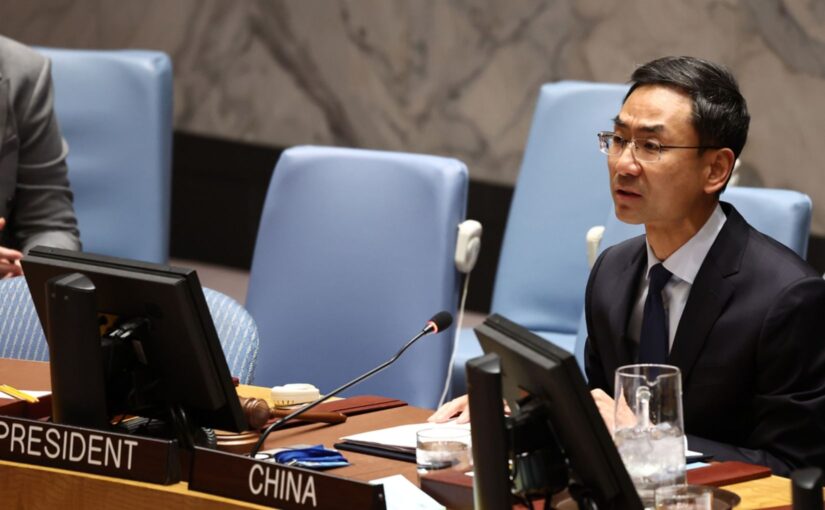
China’s Ambassador to the United Nations Fu Cong addressed the UN Security Council Briefing on the Situation in the Middle East, Including the Palestinian Question on successive days, October 28 and 29.

The first meeting was called at the request of Iran, Algeria, China and Russia following the brazen aerial attack on Iran by Israel. Ambassador Fu told the Security Council:

“China condemns acts that violate Iran’s sovereignty and territorial integrity and opposes acts of destruction that threaten regional peace and security… We are gravely concerned about the escalation caused by Israel’s actions and urge Israel to effectively cease all provocative acts.”

He added: “It must be pointed out that the fundamental reason for the continued worsening of tensions in the Middle East is that the ceasefire in Gaza has remained elusive. The fact that a number of Council resolutions calling for a ceasefire have been shelved undermines the Council’s own authority and is not conducive to a fundamental solution to the conflict. China is of the view that under the current circumstances, the Council should utilise all the means available to it under the Charter to ensure the implementation of its relevant resolutions. We call on the country with significant influence on Israel [namely the United States] to put saving lives and preventing war in the first place, abandon any other political calculations, and support the Council in taking further actions on the current situation, so as to push for an immediate ceasefire in Gaza and de-escalation of the situation in Lebanon and to effectively curb the expansion and spread of the conflict.”

Further derails of this Security Council Briefing were reported by the Palestine Chronicle.

The following day, Fu Cong made six points as follows:

  • An immediate and permanent ceasefire is the prerequisite for saving lives and preventing further deterioration of the situation. There is no justification for any delay. The United States has announced that it would reinvigorate ceasefire negotiations. We hope that the negotiations will not fall into the weird cycle of marking time as we saw in the past several months. Nor should they become a pretext for prolonging and expanding the fighting.
  • Gaza has been bombarded into a living hell, and Northern Gaza is turning into the hell of the hell. Humanitarian supplies have been cut off. Relief operations have been denied. Civilians in Jabalia camp are evacuated at gunpoint. And patients and doctors at the Kamal Adwan Hospital are subjected to inhumane treatment. The bottom line of international humanitarian law has been trampled upon time and again. This is a stain on the conscience of humanity and should not be tolerated at all. Israel must comply with its obligations under international humanitarian law. No double standards should be allowed in this regard.
  • UNRWA [The United Nations Relief and Works Agency for Palestine Refugees in the Near East] has been providing relief in accordance with its mandate from the General Assembly. It is the backbone of humanitarian assistance in Gaza. The Israeli Knesset [parliament], in total disregard of the strong opposition of the international community, passed two bills in an attempt to restrict and close UNRWA. China expresses strong condemnation.
  • Certain countries [referring primarily to the United States but also including a handful of others, such as Britain and Germany] are continuing their massive supply of weapons to Israel. The GA [General Assembly] emergency special session has adopted a resolution urging all states to stop supplying weapons and equipment that might be used in the occupied Palestinian territory. China recently joined the joint letter initiated by Türkiye calling for the implementation of the demand from this GA resolution. We hope that the countries concerned will take seriously the grave consequence of their massive supply of weapons and stop fueling the flames of military adventurism.
  • While the flames of war have been raging on in Gaza over the past year, the situation in the West Bank has also been deteriorating. Illegal settlements have been expanding, with more than 1,700 Palestinian houses confiscated by force or demolished, and thousands of Palestinians displaced. The occupying power has also frequently conducted violence against the Palestinian people and used various means to suppress and restrict the governance of the Palestinian National Authority.
  • An all-out war in the region is looming. The recent Israeli invasion into Lebanon, its continuous indiscriminate bombardment, and multiple airstrikes against Iran and Syria have violated the sovereignty and territorial integrity of the relevant countries and further destabilised the region. We urge Israel to abandon its obsession with force, so as to prevent the region from being plunged into a larger disaster.

We reprint below the full texts of Fu Cong’s remarks. They were originally published on the website of China’s Permanent Mission to the UN.

Remarks by Ambassador Fu Cong at the UN Security Council Briefing on the Situation in the Middle East, Including the Palestinian Question

President, 

I thank you for convening this meeting at the request of Iran, Algeria, China, and Russia. I also thank Assistant Secretary-General Khaled Khiari for his briefing. 

On October 26, Israel launched rounds of air strikes against several sites in Iran, causing damage to facilities and casualties on the Iranian side. China condemns acts that violate Iran’s sovereignty and territorial integrity and opposes acts of destruction that threaten regional peace and security. At present, the Iranian-Israeli relations and the situation of the region are on the edge. We are gravely concerned about the escalation caused by Israel’s actions, and urge Israel to effectively cease all provocative acts. At the same time, we call on all parties to exercise calm and restraint, jointly abide by the UN Charter and the principles of international law, and return to the right track of resolving disputes by political and diplomatic means. 

At present, with the Gaza conflict still dragging on, a new conflict in Lebanon breaking out, and continued tensions between Syria and Israel and in the Red Sea, the situation in the Middle East has long been precarious. At this critical moment, all parties should heed the overwhelming call of the international community for a ceasefire and an end to the fighting, fully implement Council resolutions, and make unremitting efforts to deescalate the situation and restore peace and tranquility in the region. Any reckless provocation or military adventurism to expand the fighting is irresponsible and is highly likely to lead to miscalculation and disastrous consequences. 

It must be pointed out that the fundamental reason for the continued worsening of tensions in the Middle East is that the ceasefire in Gaza has remained elusive. The fact that a number of Council resolutions calling for a ceasefire have been shelved undermines the Council’s own authority and is not conducive to a fundamental solution to the conflict. China is of the view that under the current circumstances, the Council should utilize all the means available to it under the Charter to ensure the implementation of its relevant resolutions. We call on the country with significant influence on Israel to put saving lives and preventing war in the first place, abandon any other political calculations, and support the Council in taking further actions on the current situation, so as to push for an immediate ceasefire in Gaza and deescalation of the situation in Lebanon and to effectively curb the expansion and spread of the conflict. 

I thank you, President.


Remarks by Ambassador Fu Cong at the UN Security Council Briefing on the Situation in the Middle East, Including the Palestinian Question

President, 

I thank you for presiding over this meeting. I would also like to thank Special Coordinator Tor Wennesland for the briefing today. 

As the Council is again considering the situation in the Middle East, what is unfolding before our eyes is that Gaza and the Middle East as a whole are experiencing worsening situation, elusive peace prospects, and a looming all-out war. The Council should act immediately on the pressing issues, with a view to promoting a ceasefire, saving lives, and restoring peace, I wish to stress the following points.

First, an immediate and permanent ceasefire is the prerequisite for saving lives and preventing further deterioration of the situation. There is no justification for any delay. The United States has announced that it would reinvigorate ceasefire negotiations. We hope that the negotiations will not fall into the weird cycle of marking time as we saw in the past several months. Nor should they become a pretext for prolonging and expanding the fighting. The relevant diplomatic efforts should not be used as an excuse to obstruct Council actions. We support the Council in using all the options in its toolbox and take further actions towards a ceasefire.

Second, Gaza has been bombarded into a living hell, and Northern Gaza is turning into the hell of the hell. Humanitarian supplies have been cut off. Relief operations have been denied. Civilians in Jabalia camp are evacuated at gunpoint. And patients and doctors at the Kamal Adwan Hospital are subjected to inhumane treatment. The bottom line of international humanitarian law has been trampled upon time and again. This is a stain on the conscience of humanity and should not be tolerated at all. Israel must comply with its obligations under international humanitarian law. No double standards should be allowed in this regard.

Third, UNRWA has been providing relief in accordance with its mandate from the General Assembly. It is the backbone of humanitarian assistance in Gaza. The Israeli Knesset, in total disregard of the strong opposition of the international community, passed two bills in an attempt to restrict and close UNRWA. China expresses strong condemnation. Closing the Agency would be a new round of collective punishment of millions of Palestinian refugees in the region, and would severely affect the humanitarian situation, security, and stability in the region. We call on Israel to hold and revoke the relevant bills to ensure the dignity, safety, and facilitation for the work of UN humanitarian agencies, including UNRWA.

Fourth, in the current context, certain countries are continuing their massive supply of weapons to Israel. Whether such acts would contribute to achieving the objectives contained in the Council resolutions is a matter that must be taken seriously. The GA emergency special session has adopted a resolution urging all states to stop supplying weapons and equipment that might be used in the occupied Palestinian territory. China recently joined the joint letter initiated by Türkiye calling for the implementation of the demand from this GA resolution. We hope that the countries concerned will take seriously the grave consequence of their massive supply of weapons and stop fueling the flames of military adventurism.

Fifth, while the flames of war have been raging on in Gaza over the past year, the situation in the West Bank has also been deteriorating. Illegal settlements have been expanding, with more than 1,700 Palestinian houses confiscated by force or demolished, and thousands of Palestinians displaced. The occupying power has also frequently conducted violence against the Palestinian people and used various means to suppress and restrict the governance of the Palestinian National Authority. Such practices are creating a new reality and undermining the conditions on which the realization of the two-State solution is based. Preventing the further erosion of the basis of the two-State solution by unilateral actions should be a priority for the international community in advancing Palestinian-Israeli peace in the next phase. 

Sixth, an all-out war in the region is looming. The recent Israeli invasion into Lebanon, its continuous indiscriminate bombardment, and multiple airstrikes against Iran and Syria have violated the sovereignty and territorial integrity of the relevant countries and further destabilized the region. The situation is hanging by a thread. Any irresponsible adventurism would be extremely dangerous and might lead to catastrophic consequences. We urge Israel to abandon its obsession with force, so as to prevent the region from being plunged into a larger disaster. We also call on all parties to exercise maximum restraint, jointly abide by the UN Charter and the principles of international law, and return to the right track of seeking political and diplomatic solutions to disputes.

Thank you, President.

President Xi urges China and India to strengthen communication and cooperation

During his recent visit to the Russian city of Kazan, where he attended the October 22-24 summit meeting of the BRICS cooperation mechanism, Chinese President Xi Jinping also held a number of important meetings on the sidelines.

Among the most significant was his October 23 meeting with Indian Prime Minister Narendra Modi, the two men’s first formal talks since October 2019. Clashes on the two countries’ disputed border (an issue left over from the days of British colonialism) in the Galwan Valley in 2020 had led to a sharp deterioration in bilateral relations. Two days before the Kazan meeting, the Indian Foreign Ministry had announced that an agreement had been reached on patrolling arrangements, which had been the immediate cause of the clash.

At the meeting, President Xi urged China and India to strengthen communication and cooperation, enhance strategic mutual trust, and facilitate each other’s pursuit of their development aspirations. He pointed out that as time-honoured civilisations, large developing countries and important members of the Global South, China and India both stand at a crucial phase of their respective modernisation endeavours.

It is in the fundamental interest of the two countries and two peoples to keep to the trend of history and the right direction of bilateral relations, he said, urging the two sides to shoulder their international responsibility, set an example in boosting the strength and unity of developing countries, and contribute to promoting a multipolar world and greater democracy in international relations.

For his part, Prime Minister Modi noted that maintaining the steady growth of India-China relations is critical to the two countries and peoples. It not only concerns the well-being and future of 2.8 billion people, but also carries great significance for peace and stability of the region and even the world at large.

Against a complex international landscape, cooperation between India and China, two ancient civilisations and engines of economic growth, can help drive economic recovery and promote multipolarity in the world.

The two leaders commended the important progress the two sides had recently made through intensive communication on resolving the relevant issues in the border areas. Modi made suggestions on improving and developing the relationship, which Xi agreed to in principle.

Stressing the need to ensure peace and tranquillity in the border areas and find a fair and reasonable settlement, they agreed on holding talks between their foreign ministers and officials at various levels to bring the relationship back to sound and steady development at an early date.

They further agreed to strengthen communication and cooperation in multilateral fora to safeguard the common interests of developing countries and were of the view that their meeting was constructive and carries great significance. They agreed to view and handle China-India relations from a strategic height and long-term perspective, prevent specific disagreements from affecting the overall relationship, and contribute to maintaining regional and global peace and prosperity and to advancing multipolarity in the world.

India’s main communist parties were quick to voice their support for the meeting and its outcome.

People’s Democracy, the newspaper of the Communist Party of India (Marxist) (CPI(M)) wrote that:

“The economic problems confronting the Indian bourgeoisie have forced them to lobby for easing the ability to do business with China. According to the data of the Ministry of Commerce, China has emerged as India’s top import source with 56.29 billion dollars’ worth of inbound shipments during the April-September period of this fiscal year. In a globalised economic world order, it is increasingly recognised that it is beneficial for both countries to increase economic cooperation. Certain industries for the production of goods like electric vehicles (EVs), smartphones, solar panels and medicine have been identified by the Indian government to transform the country into a manufacturing hub. Most of these industries require the restoration of economic relations with China.”

Continue reading President Xi urges China and India to strengthen communication and cooperation

Kazan Declaration: Strengthening multilateralism for just global development and security

The BRICS cooperation mechanism of Emerging Markets and Developing Countries took a major step forward at its 16th Summit held in the Russian city of Kazan, October 22-24. Following decisions taken at last year’s summit in South Africa, a total of nine countries took part as full members for the first time, with Ethiopia, Egypt, the United Arab Emirates (UAE) and Iran joining Brazil, Russia, India, China and South Africa. A total of 36 countries and subnational entities participated at a high level, along with the leaders of six international organisations. A new category of Partner countries was formally initiated and is seen by many as a steppingstone to possible future full membership for the several dozen countries that have already expressed such an interest. An initial tranche of 13 countries were granted partner status in Kazan. The list of countries is yet to be officially released, but numerous reports have identified them as:

  • Algeria
  • Belarus
  • Bolivia
  • Cuba
  • Indonesia
  • Kazakhstan
  • Malaysia
  • Nigeria
  • Thailand
  • Türkiye
  • Uganda
  • Uzbekistan
  • Vietnam

On October 23, the nine full members adopted the Kazan Declaration, entitled ”Strengthening Multilateralism for Just Global Development and Security”. Running to a little over 13,300 words, and with 134 clauses, the declaration covers a vast number of subjects and itself reflects and reinforces the growing – although not without challenges – cohesiveness of key players in the Global South. It states:

“As we build upon 16 years of BRICS Summits, we further commit ourselves to strengthening cooperation in the expanded BRICS under the three pillars of political and security, economic and financial, cultural and people-to-people cooperation and to enhancing our strategic partnership for the benefit of our people through the promotion of peace, a more representative, fairer international order, a reinvigorated and reformed multilateral system, sustainable development and inclusive growth.”

It further notes the emergence of new centres of power, policy decision-making and economic growth, which can pave the way for a more equitable, just, democratic and balanced multipolar world order.

The declaration reaffirms support for a comprehensive reform of the United Nations, including its Security Council, with a view to making it more democratic, representative, effective and efficient, and to increase the representation of developing countries in the Council’s memberships so that it can adequately respond to prevailing global challenges and support the legitimate aspirations of emerging and developing countries from Africa, Asia and Latin America, including BRICS countries, to play a greater role in international affairs, in particular in the United Nations, including its Security Council, adding:

“We are deeply concerned about the disruptive effect of unlawful unilateral coercive measures, including illegal sanctions, on the world economy, international trade, and the achievement of the sustainable development goals. Such measures undermine the UN Charter, the multilateral trading system, the sustainable development and environmental agreements. They also negatively impact economic growth, energy, health and food security, exacerbating poverty and environmental challenges.”

It recalls the 2001 Durban Declaration and Programme of Action (DDPA) and the Outcome Document of the 2009 Durban Review Conference and acknowledges the need to intensify the fight against racism, racial discrimination, xenophobia and related intolerance as well as discrimination based on religion, faith or belief, and all their contemporary forms around the world including the alarming trends of rising hate speech, and acknowledge the annual UNGA resolution on “Combating glorification of Nazism, neo-Nazism, and other practices that contribute to fuelling contemporary forms of racism, racial discrimination, xenophobia and related intolerance”.

Continue reading Kazan Declaration: Strengthening multilateralism for just global development and security

People’s China at 75: “Anyone who wants to understand socialism in China should read this book”

We recently launched People’s China at 75 – The Flag Stays Red, a collection edited by Keith Bennett and Carlos Martinez, bringing together different perspectives and understandings of the trajectory of Chinese socialism over the past 75 years.

We are pleased to publish below the first review, from Fight Back!, published on 25 October 2024.

After summarising the book’s contents, the review concludes:

Everyone interested in socialism should study the experience of China, and People’s China at 75: The Flag Stays Red stands out as an extraordinary collection of important writings on China’s achievements, struggles, and contributions to the world revolutionary movement. 

The book can be purchased on the Praxis Press website in paperback and digital formats.

Marking the 75th anniversary of the founding of the People’s Republic of China, Praxis Press, together with Friends of Socialist China, has released an excellent new book, People’s China at 75: The Flag Stays Red. This book is edited by Keith Bennett and Carlos Martinez, and compiles articles by China experts from all over the world explaining and defending Chinese socialism. Anyone who wants to understand socialism in China, from 1949 to today, should read this book.

The articles in the book cover a number of important topics. We can’t cover them all here, but we can look at some highlights. For example, Jenny Clegg’s article “China’s transition to socialism: 1949-1956” explains the period during which China laid the foundations of socialism. She discusses China’s post-war rehabilitation, New Democracy, and how it ensured that China would progress along the socialist road. The article examines the practical, economic elements of this transition, such as the development of Agricultural Producers Cooperatives, together with the political and ideological debates of the period. As Clegg writes in her conclusion, 

A careful handling of class relations allowed the people’s struggles against capitalism to unfold in sequenced steps, workers and peasants discussing and educating themselves as they engaged in policy implementation. Grassroots cadres, learning on the job, built broad support as the dynamics of class struggle exposed the inherent contradictions at each step. 

Leading Chinese scholars Cheng Enfu and Chen Jian, in the article “The significance of China’s fulfilment of its Second Centenary Goal by 2049,” explain and analyze the Communist Party of China’s “goal of building China into a modern socialist country that is prosperous, strong, democratic, culturally advanced, harmonious and beautiful by the centenary of the People’s Republic of China.”

The book also includes a short article by Roland Boer titled “China’s socialist democracy” which addresses the principle that “socialist democracy strengthens the leadership of the Communist Party, and the leadership of the Communist Party strengthens socialist democracy.” Boer is explaining a dialectical relationship at the core of the socialist system. “In other words, the leadership of the Communist Party ensures that the people are masters of the country, and the robust exercise of socialist democracy ensures that the Communist Party continues its role of legitimate leadership.”

J. Sykes, author of The Revolutionary Science of Marxism-Leninism, contributes the article “Mao, China, and the development of Marxism-Leninism.” In this article Sykes explains Mao’s contributions to Marxist theory. He breaks down Mao’s contributions to dialectical and historical materialism, revolutionary strategy, problems of socialist construction, and the defense of Marxism-Leninism against modern revisionism. While concisely explaining Mao’s contributions in each of these areas, Sykes makes the point that “Mao’s contributions to revolutionary theory are not limited to the Chinese context,” but are universal. “The theory-practice dialectic in fact goes both ways. By applying Marxism-Leninism to the concrete conditions of China, Marxism-Leninism itself was further developed and enriched.” 

In the article “Building socialism, building the ecological civilization,” Efe Can Gürcan explains how China is leading the way in environmental sustainability. This article does well to highlight how China is working to develop green technology in a world increasingly put at risk by the perils of climate change. 

Finally, the collection ends with an excellent article from Carlos Martinez: “How China survived the end of history.” Martinez examines how China survived the wave of counter-revolution that swept the socialist world between 1989 and 1991 to continue on the socialist road when so many other countries didn’t. 

Everyone interested in socialism should study the experience of China, and People’s China at 75: The Flag Stays Red stands out as an extraordinary collection of important writings on China’s achievements, struggles, and contributions to the world revolutionary movement. 

A retired railroader looks at China’s fantastic rail system

The following article, first published in Struggle for Socialism / La Lucha por el Socialismo, compares the state of the US and Chinese railroad systems. The US system is in a state of disrepair, with a lack of investment and a focus on profit over service. In contrast, China has built a high-speed rail network that is the envy of the world, with trains that are fast, efficient, and affordable. The article notes that “China has built twice as many miles of high-speed rail than the rest of the world combined”. Further: “Last year, Chinese railways carried 3.68 billion passengers. That’s 10 million passengers daily, a hundred times Amtrak’s ridership.”

The parlous state of the US’s railway infrastructure is “the result of decades of a capitalist class allowing much of the railroad system to decay”. Pointing out that almost all of China’s rail network is state-owned, the article concludes:

We need what the People’s Republic of China has: a socialist railroad system. The people need to take over the railroads.

The author, Stephen Millies, is a retired Amtrak worker and a member of the American Train Dispatchers Association and Transportation Communications International Union.

A telling comparison between capitalist decay in the United States and surging economic growth in the socialist People’s Republic of China is in their railroad systems.

Between 1950 and 2000, more than 79,000 miles of railroad lines were abandoned in the United States. Passenger service, now run by Amtrak, has withered.

Meanwhile, China has greatly increased its railroad network and now has 100,000 miles of track. China has built twice as many miles of high-speed rail than the rest of the world combined.

Last year, Chinese railways carried 3.68 billion passengers. That’s 10 million passengers daily, a hundred times Amtrak’s ridership.

China’s railroads are on schedule to move 4 billion metric tons of freight in 2024. That’s about three times the U.S. total. 

Socialist China will invest almost $108 billion in its railroads this year. That’s four-and-half times the $23 billion railroad monopolies in the capitalist United States spend on average. 

How about urban transport? China has 55 cities with subway systems. Just in Beijing, three new metro lines will open this year. 

In contrast, New York City has been trying to complete the construction of the Second Avenue subway for a century. Wall Street’s hometown may be the only metropolis with less rapid transit than it had in the 1930s. That’s because elevated lines were torn down without replacing them with subways.

The biggest victims of capitalist railroad shrinkage in the U.S. are railroad workers. There were two million workers on the railroads in 1920.

The Great Depression helped reduce railroad employment to 1.5 million workers in 1947. Since then, railroad jobs have fallen by 90%, with just 151,200 railroaders working in August 2024.

That’s a smaller number of railroad workers than in 1870, one year after the first transcontinental railroad in the United States was completed. These massive job cuts devastated railroad towns coast to coast.

Continue reading A retired railroader looks at China’s fantastic rail system

People’s China and Western Marxism

On Thursday 24 October, Friends of Socialist China participated in an event in New York City to celebrate the release of two revolutionary books: People’s China at 75: The Flag Stays Red, and Western Marxism by Domenico Losurdo, translated into English for the first time.

The event, which was held at the International Action Center HQ, featured a panel discussion with Carlos Martinez (co-editor of People’s China at 75), Gabriel Rockhill (editor of Western Marxism), and Danny Haiphong (independent journalist and broadcaster). The panel was chaired by Sara Flounders of the International Action Center.

Embedded below is a video of the event, which was live-streamed on Danny Haiphong’s YouTube channel, followed by the approximate text of Carlos’s remarks connecting the two books.

What was the reason for putting People’s China at 75 together?

The main motivation was that this milestone, the 75th anniversary of the founding of the People’s Republic of China, when Mao Zedong famously proclaimed in Tiananmen Square that “the Chinese people have stood up”, provided an opportunity to reflect on the significance of that event.

And it’s an evolving significance. The Chinese people are still living that history; indeed the world is living that history. The Chinese Revolution changed the world forever, and the processes of building socialism and struggling against imperialism are ongoing processes that modern China is very much a part of.

So we wanted to examine China’s trajectory since 1949 and to help people get to grips with China’s socialist project in all its different phases. Certainly this is a topic that’s very little understood in the Western world, including among many on the left.

And that’s perhaps where the overlap lies between the two books we’re discussing this evening.

The Western Marxism described by Losurdo is essentially dogmatic; it considers socialism from an abstract, purely theoretical viewpoint.

For these Western Marxists, it’s a handful of academics spending their time in conferences and writing vast impenetrable volumes that are at the cutting edge of knowledge production.

For the Eastern Marxists on the other hand – the people that are oriented to the actually existing struggle against imperialism and for socialism – it’s precisely those states, movements and parties that are engaged in the process of building socialism and struggling against hegemony that are making the major contribution to moving humanity’s collective understanding forward.

The dialectical relationship between theory and practice is at the core of Marxism. As Mao famously put it in his essay ‘On Practice’, “if you want knowledge, you must take part in the practice of changing reality. If you want to know the taste of a pear, you must change the pear by eating it yourself.”

Abstract theory won’t help us much when it comes to understanding modern China.

Where in Marx’s Capital or Theories of Surplus Value can you find a reference point for China’s reform and opening up process, which was launched in 1978? Nowhere.

Apart from anything else, Marx and Engels didn’t live to see the emergence of socialist states – beyond the early experiment of the Paris Commune – and couldn’t be expected to predict what problems might face a socialist state, recently emerged from semi-colonial semi-feudal status, thirty years after its founding, faced with imperialist encirclement and nuclear blackmail, and dealing with the responsibility of feeding a fifth of the world’s population with 6 percent of the world’s arable land.

Just as no battle plan survives contact with the enemy, no revolutionary process proceeds along straight and predictable lines. Or as Lenin put it when discussing the heroic 1916 Easter Rising in Ireland: “Whoever expects a ‘pure’ social revolution will never live to see it. Such a person pays lip service to revolution without understanding what revolution is.”

People see huge inequality in China, people see private capital in China, people see billionaires in China, people see McDonalds and KFC in China, and they pronounce: this isn’t socialism.

But what about the elimination of absolute poverty? What about the extraordinary improvements in people’s living standards? What about the fact that in this vast Asian country of 1.4 billion people, nobody suffers malnutrition, everybody has sufficient food, everybody has a roof over their head, everyone has clothing, everyone has access to education, healthcare, running water and modern energy.

Here we are in New York, in the heart of global capitalism. Do people here have those basic rights? How far would I have to walk from this building to find someone that doesn’t have a roof over their head, or who doesn’t have healthcare? I suspect not very far.

Why is it that China’s been able to solve these problems? Why is it that China is so focused on living standards and meeting people’s most fundamental human rights? Why is it that China is so far out in front when it comes to renewable energy, electric vehicles, forestation and biodiversity protection? Why is it that China made so much effort to prevent loss of life during the Covid-19 pandemic, whereas in the US over a million people died?

Clearly, the answer relates to China’s economic, political and social project. That China remains on the path to socialism, that has a mixed economy in which the commanding heights are publicly owned, that is run by a Marxist-Leninist party, and where the capitalist class is denied the right to organise in its own political interests.

So in terms of the line Losurdo draws in Western Marxism, I think it’s reasonable to say that on one side of that line you have people who only criticise and condemn China, who label it as capitalist or imperialist, who push the slogan ‘Neither Washington Nor Beijing’; and on the other side you have people who stand in solidarity with China, who seek to learn from China, who showcase China as an example of what can be achieved under socialism, and who resolutely oppose the US’s plans to contain and encircle China.

China at the UN: It is unacceptable to allow the tragedy in Gaza to continue

Chinese Permanent Representative to the United Nations Fu Cong has again strongly condemned the atrocities being committed against the Palestinian people in Gaza and reiterated China’s strong call for peace.

Speaking at the UN Security Council Briefing on the Situation in the Middle East, Including the Palestinian Question, on October 16, in a meeting initiated by Algeria, and in words that have lost none of their cogency, poignancy or urgency in the subsequent days, Fu said:

“The situation in Gaza is not showing any sign of stabilisation but has continued to deteriorate. In the past two weeks, Israel has not relented its military operations in Gaza at all, but has constantly attacked and bombed schools and hospitals, completely cut off the access of humanitarian supplies into northern Gaza, and once again forcibly ordered emergency evacuation of hundreds of thousands of people. In the sea of fire caused by Israel’s bombing, some displaced Palestinian civilians were burnt to their death. They are all human beings like us. Why, when born in Gaza, do they have to suffer like this? Two million people have been struggling on the verge of death for more than a year. How long will it take before they can see any hope of survival? The Security Council shoulders the responsibility to maintain peace. We have held repeated discussions, expressed sympathy, voiced positions, and expressed concerns. But these are not enough. It is unacceptable to allow the tragedy in Gaza to continue, and it is also unacceptable for the Security Council as a collective to continue to be paralysed.”

Noting that using starvation as a weapon of war is a serious war crime, he went on to note that the Council has adopted a number of resolutions regarding the situation in Gaza, explicitly calling for a ceasefire. But none of them has been effectively implemented. This has dealt a serious blow to the credibility of the entire UN system. “In this respect, we particularly hope that the United States will respond to the strong call of the international community and support further actions by the Council to bring about an immediate ceasefire. It needs to be pointed out that, according to reports, since last October, the US has provided Israel with more than 17 billion US dollars’ worth of military aid.”

We publish below the full text of Fu Cong’s remarks. They were originally published on the website of the Chinese Foreign Ministry.

President

I thank Algeria for the initiating this meeting, and thank Acting Under-Secretary-General Joyce Msuya for her briefing.

The sudden escalation of the situation between Lebanon and Israel in the past few days has caused widespread concerns and worries in the international community. At the same time, the situation in Gaza is not showing any sign of stabilization, but has continued to deteriorate. In the past two weeks, Israel has not relented its military operations in Gaza at all, but has constantly attacked and bombed schools and hospitals, completely cut off the access of humanitarian supplies into northern Gaza, and once again forcibly ordered emergent evacuation of hundreds of thousands of people. In the sea of fire caused by Israel’s bombing, some displaced Palestinian civilians were burnt to their death. They are all human beings like us. Why, when born in Gaza, do they have to suffer like this? Two million people have been struggling on the verge of death for more than a year. How long will it take before they can see any hope of survival? The Security Council shoulders the responsibility to maintain peace. We have held repeated discussions, expressed sympathy, voiced positions, and expressed concerns. But these are not enough. It is unacceptable to allow the tragedy in Gaza to continue, and it is also unacceptable for the Security Council as a collective to continue to be paralyzed.

We must uphold and revitalize the authority of international humanitarian law. Using starvation as a weapon of war is a serious war crime. Humanitarian organizations are the lifeline for Gaza. It is intolerable to see them face suppression, restriction, and even security threats. Israel must fulfill its obligations under international humanitarian law, immediately lift the blockade and restrictions on humanitarian access to the entire Gaza, and cooperate fully with the UN and other humanitarian entities to facilitate and ensure the safety of humanitarian operations such as transportation of humanitarian supplies and polio vaccination. UNRWA is the backbone of humanitarian assistance in Gaza. China firmly opposes any smearing and suppression of the Agency.

We must uphold and revitalize the effectiveness of Security Council resolutions. The Council has adopted a number of resolutions regarding the situation in Gaza, explicitly calling for a ceasefire. But none of them has been effectively implemented. This has dealt a serious blow to the credibility of the entire UN system. Council resolutions are binding for all states and must be implemented. We support the Council in using all the options in its toolbox to ensure the implementation of its resolutions. Every member has the responsibility to safeguard the effectiveness of Council resolutions. In this respect, we particularly hope that the United States will respond to the strong call of the international community and support further actions by the Council to bringing about an immediate ceasefire. It needs to be pointed out that, according to reports, since last October, the US has provided Israel with more than 17 billion US dollars worth of military aids. Under the current circumstances, does such a large scale supply of weapons help realize the objectives of Security Council resolutions? This is a question that needs serious consideration.

We must uphold and revitalize the political prospects for the two-State solution. The implementation of the two-State solution and the establishment of an independent Palestinian state is the only viable way to resolve the Palestinian question. Gaza and the West Bank, including East Jerusalem, are all inseparable parts of the state of Palestine. The future governance arrangements for Gaza should be predicated on a full withdrawal of Israeli troops, and should be decide by consultations among the Palestinian people. The implementation of the two-State solution requires the political will of both parties. Israel must stop eroding and jeopardizing the foundations of the two-State solution and return to the right track of the two-State solution. The international community has the responsibility of providing international guarantee for the implementation of the two-State solution. China is ready to continue to play a constructive role and make unremitting efforts to end the fighting as soon as possible and realize peace in the region.

Thank you, President.

Xi Jinping: Global South countries marching together toward modernisation is monumental in world history

The summit meeting of the BRICS cooperation mechanism was held, October 22-24, in Kazan, the capital city of the Republic of Tatarstan in the Russian Federation, and was hosted by Russian President Vladimir Putin.

Alongside dozens of other events within its framework, the summit of the nine full members of BRICS was held on October 23, under the theme “Strengthening Multilateralism for Equitable Global Development and Security”. This was the first such gathering in which Brazil, Russia, India, China and South Africa were joined by Ethiopia, Egypt, the United Arab Emirates (UAE) and Iran, since the 2023 summit meeting held in South Africa invited the latter four countries to take up full membership in the first wave of BRICS expansion.

This meeting was followed, on October 24, by the “BRICS Plus” Leaders Dialogue, the first gathering of its kind, which was held under the theme, “BRICS and the Global South: Building a Better World Together”.

In all, the Kazan gathering drew the participation of leaders of 36 countries and territories, including 22 heads of state. The leaders of six international organisations, including the Secretary-General of the United Nations, also attended.

Chinese President Xi Jinping delivered keynote speeches at both the October 23 and 24 meetings. Together, they provide correct strategic guidance to advance the collective agenda and shared goals of the Global South at the present time.

On October 23, President Xi addressed the BRICS Summit, with a speech entitled, “Embracing a Broader View and Cutting Through the Fog of Challenges to Advance High-Quality Development of Greater BRICS Cooperation”.  He said:

“I would like to take this opportunity to once again welcome new members to our BRICS family. The enlargement of BRICS is a major milestone in its history and a landmark event in the evolution of the international situation. At this summit, we have decided to invite many countries to become partner countries, which is another major progress in the development of BRICS…

“As the world enters a new period defined by turbulence and transformation, we are confronted with pivotal choices that will shape our future. Should we allow the world to descend into the abyss of disorder and chaos, or should we strive to steer it back on the path of peace and development? This reminds me of a novel by Nikolay Chernyshevsky entitled ‘What Is to Be Done?’ The protagonist’s unwavering determination and passionate drive are exactly the kind of willpower we need today. The more tumultuous our times become, the more we must stand firm at the forefront, exhibiting tenacity, demonstrating the audacity to pioneer and displaying the wisdom to adapt. We must work together to build BRICS into a primary channel for strengthening solidarity and cooperation among Global South nations and a vanguard for advancing global governance reform.”

Setting out the key tasks for BRICS members at present, Xi said that:

– We should build a BRICS committed to peace and we must all act as defenders of common security. In this context he specifically referred to the conflicts in Ukraine and the Middle East. “The Ukraine crisis still persists. China and Brazil, in collaboration with other countries from the Global South, initiated a group of Friends for Peace to address the crisis. The aim is to gather more voices advocating peace. We must uphold the three key principles: no expansion of the battlefields, no escalation of hostilities, and no fanning flames, and strive for swift de-escalation of the situation. While the humanitarian situation in Gaza continues to deteriorate, the flames of war have once again been rekindled in Lebanon, and conflicts are escalating among the parties. We must promote an immediate ceasefire and an end to the killing. We must make unremitting efforts toward a comprehensive, just and lasting resolution of the Palestinian question.”

– We should build a BRICS committed to innovation, and we must all act as pioneers of high-quality development. China has recently launched a China-BRICS Artificial Intelligence Development and Cooperation Centre. We are ready to deepen cooperation on innovation with all BRICS countries to unleash the dividends of AI development.

– We should build a BRICS committed to green development, and we must all act as promoters of sustainable development. Green is the defining colour of our times. It is important that all BRICS countries proactively embrace the global trend of green and low-carbon transformation.

– We should build a BRICS committed to justice and we must all act as forerunners in reforming global governance. In light of the rise of the Global South, we should respond favourably to the calls from various countries to join BRICS. We should advance the process of expanding BRICS membership and establishing a partner country mechanism and enhance the representation and voice of developing nations in global governance. 

– The current developments make the reform of the international financial architecture all the more pressing. The New Development Bank should be expanded and strengthened.

– We should build a BRICS committed to closer people-to-people exchanges, and we must all act as advocates for harmonious coexistence among all civilisations.

In conclusion he stated: “China is willing to work with all BRICS countries to open a new horizon in the high-quality development of greater BRICS cooperation and join hands with Global South countries in building a community with a shared future for humanity.”

Xi Jinping addressed the BRICS Plus Dialogue on the theme, “Combining the Great Strength of the Global South to Build Together a Community with a Shared Future for Humanity”. He said that:

“The collective rise of the Global South is a distinctive feature of the great transformation across the world. Global South countries marching together toward modernisation is monumental in world history and unprecedented in human civilisation.”

He went on to argue that:

– We should uphold peace and strive for common security. Last July, Palestinian factions reconciled with each other in Beijing, marking a key step toward peace in the Middle East. We must stop the flames of war from spreading in Lebanon and end the miserable sufferings in Palestine and Lebanon.

– We should reinvigorate development and strive for common prosperity.

– We should promote together the development of all civilisations and strive for harmony among them.

Xi Jinping concluded: “No matter how the international landscape evolves, we in China will always keep the Global South in our heart and maintain our roots in the Global South. We support more Global South countries in joining the cause of BRICS as full members, partner countries or in the “BRICS Plus” format so that we can combine the great strength of the Global South to build together a community with a shared future for humanity.”

The following is the full text of the two speeches. They were originally published by the Xinhua News Agency.

Full Text: Address by Chinese President Xi Jinping at 16th BRICS Summit

KAZAN, Russia, Oct. 23 (Xinhua) — Chinese President Xi Jinping on Wednesday delivered an important speech at the 16th BRICS Summit in Kazan, Russia.

The following is the full text of the speech:

Embracing a Broader View and Cutting Through the Fog of Challenges to Advance High-Quality Development of Greater BRICS Cooperation

Your Excellency President Vladimir Putin,

Colleagues,

First of all, I wish to extend my warm congratulations on the successful opening of this summit. I also wish to thank President Putin and our host Russia for the thoughtful arrangements and warm hospitality.

I would like to take this opportunity to once again welcome new members to our BRICS family. The enlargement of BRICS is a major milestone in its history, and a landmark event in the evolution of the international situation. At this summit, we have decided to invite many countries to become partner countries, which is another major progress in the development of BRICS. As we Chinese often say, “A man of virtue regards righteousness as the greatest interest.” It is for our shared pursuit and for the overarching trend of peace and development that we BRICS countries have come together. We must make full use of this summit, maintain the momentum of BRICS, and consider and devise our strategy to address issues that have a global impact, determine our future direction, and possess strategic significance. We must build on this milestone summit to set off anew and forge ahead with one heart and one mind.

As the world enters a new period defined by turbulence and transformation, we are confronted with pivotal choices that will shape our future. Should we allow the world to descend into the abyss of disorder and chaos, or should we strive to steer it back on the path of peace and development? This reminds me of a novel by Nikolay Chernyshevsky entitled What Is to Be Done? The protagonist’s unwavering determination and passionate drive are exactly the kind of willpower we need today. The more tumultuous our times become, the more we must stand firm at the forefront, exhibiting tenacity, demonstrating the audacity to pioneer and displaying the wisdom to adapt. We must work together to build BRICS into a primary channel for strengthening solidarity and cooperation among Global South nations and a vanguard for advancing global governance reform.

Continue reading Xi Jinping: Global South countries marching together toward modernisation is monumental in world history

Andrew Murray: China’s poverty alleviation is not just an achievement, it is a socialist achievement

We are pleased to reprint below the speech delivered by Andrew Murray to our September 28 conference celebrating the 75th anniversary of the founding of the People’s Republic of China.

In his remarks, Andrew refers to Xi Jinping’s observation that without China socialism might have become marginal to world development.

He notes that China has been central to two major reconceptualisations of socialism – on the role of the peasantry in the revolution and regarding the close association of socialism with national liberation and the struggle against imperialism.

He explains that two key aspects of socialist development are the transformation of social relations and the development of the productive forces and explains how the PRC has adjusted the relative weight given to each in the periods before and after 1978.

He also stresses the continuity in the Chinese position regarding the protracted nature of the transition to socialism.

Andrew Murray is the political correspondent of the Morning Star. He has served as the Chair of the Stop the War Coalition, Chief of Staff at Unite the union, and as an adviser to Jeremy Corbyn MP when he was Leader of the Labour Party. He has written many books including ‘The Fall and Rise of the British Left’ and ‘Is Socialism Possible in Britain?’

First let me congratulate the Chinese comrades on the 75th anniversary of the foundation of the Peoples Republic of China (PRC).  It is an event which reveals new layers of significance today, when other landmarks of the twentieth century have faded.

It is significant of course for world politics and for the Chinese people themselves.  But here I want to discuss its significance for socialism.  As Xi Jinping has said, without China socialism might have become marginal to world development.  There are of course other socialist countries, but none have the size and international importance of the PRC.

Some deny the socialist character of China.  I recall discussing with the eminent Marxist political economist David Harvey his views. He said that when he visited a location in China – he has been many times – he might see a landscape of paddy fields and then come back a few years later and see a city with factories, a high-speed railway and so on in the same spot.  I asked him how this could be done, when such a pace of development would be quite impossible in Britain.  He replied, “no private property rights to get in the way”.  That might not be a scientific definition of the dictatorship of the proletariat, but it is certainly an aspect!

Socialism is not an invariant concept.  It was developed in nineteenth century Europe and could not possibly remain the same as it spreads across the world and new experience from various countries accumulates.  Socialism has already been reconceptualised, and China has been at the centre of two major such developments.  First, it recentred socialism upon the peasantry in the Chinese revolution, and to a certain extent decentred its reliance on the industrial working class of developed capitalist countries.  And secondly, it associated socialism closely with national liberation and the struggle against imperialism, building on the analysis of Lenin and the Communist International.  This has relocated the nexus of socialism to what we now call the Global South.

Of course, socialism cannot be reduced to simply being whatever one chooses to call it.  It has real content.  Two aspects of the development of socialism are the transformation of social relations and the development of the productive forces. Both are essential, and China has laid the emphasis first on one and then the other since 1949.  Until 1978 transforming social relations took pride of place, although there was of course significant advance in the productive forces through that period.  But the focus was on class struggle, sometimes practised in counter-productive ways.  Since 1978 the emphasis has been on the development of the economy and the productive forces.  This has been accompanied by a concern to maintain social stability, but it is certain that the class struggle, which the Communist Party of China (CPC) acknowledges may be decisive in some circumstances, will need to be reasserted if the full achievement of socialism is to be reached.  The two aims are linked dialectically.

Continue reading Andrew Murray: China’s poverty alleviation is not just an achievement, it is a socialist achievement

Li Qiang: The only true security is security for all

Following his visits to Laos and Vietnam, Chinese Premier Li Qiang paid an official visit to Pakistan, October 14-17, and participated in the 23rd Meeting of the Council of Heads of Government of Member States of the Shanghai Cooperation Organisation (SCO), chaired by Pakistan.

In his address to the heads of government meeting, delivered on October 16, Premier Li noted that:

“At the Astana Summit held last July, President Xi Jinping and fellow leaders of member states reached important understandings on jointly building a common home of the SCO featuring solidarity and mutual trust, peace and tranquility, prosperity and development, good-neighbourliness and friendship, and fairness and justice. This endeavour to build a common home is driven by the values we all share; it focuses on the tough issues we all face, and will help create a future we all desire.”

He expressed the view that this common vision necessitated efforts in five aspects:

  • To build an even more solid political foundation.
  • To provide more reliable security safeguards. “As we speak, geopolitical conflicts, power politics and acts of bullying continue to undermine regional peace and stability, while on such fronts as cyber security and biosecurity, new threats and new challenges continue to emerge. No country is immune, and the only true security is security for all.”
  • To foster closer economic bonds. “The SCO’s continuous expansion of membership in recent years has created more notable economic complementarity among member states. By deepening our economic ties, resisting external attempts at pulling us apart, and tapping into and pooling our respective strengths in resources, market and industries, we will be able to foster even stronger synergy for development.”
  • To cultivate stronger emotional bonds. “Our region is home to diverse and splendid civilisations, where different nations and cultures have interacted and converged with each other throughout the course of history and coexisted in harmony. This has been the source of popular support for cooperation among SCO member states.”
  • To boost coordination in multilateral fora. “Embracing 26 countries from three continents [including Members, Observers and Dialogue Partners], the SCO family is a constructive force that carries important global influence.”

The meeting adopted a Joint Communique, in which:

“The Heads of Delegation noted that the Member States advocate respect for the right of peoples to independently and democratically choose their political, social and economic development, emphasising that the principles of mutual respect for the sovereignty, independence, and territorial integrity of states, equality, mutual benefit, non-interference in internal affairs, non-use of force or threat of use of force, are the basis for the sustainable development of international relations. They reaffirm the commitment to the peaceful settlement of differences and disputes between countries through dialogue and consultations.”

They further noted the tectonic shifts in the global economy, characterised by rapid advancements and interconnectivity in the areas of information technology, digitalisation, artificial intelligence, virtual/digital assets, e-commerce, and so on. They expressed concern over the exacerbation of various challenges that have led to reduced investment flows, disrupted supply chains and caused uncertainty in global financial markets as a result of protectionist measures and other impediments to international trade.

They also opposed protectionist actions, unilateral sanctions and trade restrictions that undermine the multilateral trading system and impede global sustainable development. The heads of delegations emphasised that the unilateral application of sanctions is incompatible with the principles of international law and has a negative impact on third countries and international economic relations.

Recognising the unique role of physical culture and sport in strengthening solidarity and peace, the Heads of Delegations stressed that the SCO Member States will promote the development of international sports cooperation on an equal and depoliticised basis, oppose discrimination against athletes on any grounds, including nationality, language, political and other beliefs, national or social origin. [This refers, in particular, to the discrimination against and exclusion of athletes from member states Russia and Belarus by the Olympic and Paralympic movements as well as some other international sporting bodies.]

The communique further addresses a large number of practical matters across a broad range of subjects.

On October 16, in the margins of the meeting, Li Qiang met with his Russian counterpart Mikhail Mishustin.

Li noted that, under the strategic guidance of President Xi Jinping and President Vladimir Putin, the China-Russia comprehensive strategic partnership of coordination for a new era has maintained a high level of development. The two sides firmly support each other on issues concerning their respective core interests and enjoy fruitful strategic coordination, continued progress in practical cooperation, as well as vigorous people-to-people and sub-national exchanges, delivering tangible benefits to the people of both countries.

Continue reading Li Qiang: The only true security is security for all

Jenny Clegg: Orienting our peace movement towards the Global South

The following is the text of Dr. Jenny Clegg’s speech to our conference celebrating the 75th anniversary of the founding of the People’s Republic of China, held at London’s Bolivar Hall on September 28.

Jenny argues that now, as a wider war looms over us, it is imperative that leftists in the West understand the interconnections between multipolarity, the Global South and China so as to grasp what is going on in the world.

According to her analysis, for the Global South, China provides a model of successful development and the eradication of poverty; its vast market and investment resources puts it at the centre of South-South economic cooperation; whilst its diplomacy fosters unity and promotes pathways towards peace.

Whilst not skirting complexities and problematic factors, she notes that in the next few years, much depends on the BRICS+ holding together.

“The litmus test of BRICS+ right now is their independent foreign policies no matter how hesitant and unreliable… Now is not the time for sitting on the fence, picking and choosing what is right and wrong: that is for the utopian socialists. We have to seize the politics of the moment… if we in Britain can orientate especially our peace movement towards the Global South we will be doing something.”

Jenny is an independent writer and researcher, specialising in China’s development and international role; and a former Senior Lecturer in Asia Pacific Studies at the University of Central Lancashire (UCLAN). She is the author of ‘China’s Global Strategy: towards a multipolar world’

(Pluto Press, 2009) and ‘Storming the Heavens – Peasants and Revolution in China, 1925-1949 – from a Marxist perspective’ (Manifesto Press, 2024).

There’s more talk now in the Western mainstream about multipolarity, some acknowledgement at least that the world is beginning to change. But 15 years ago, when I was researching for my book on ‘China’s Global Strategy’, I really struggled to find any mention of multipolarity in Western literature.  Yet at the time there was a great deal of debate amongst Chinese scholars about where China fitted into the multipolar trend. 

Today mainstream views see a few random middle powers – Türkiye, Mexico, Malaysia, Australia – starting to play a more important role. The Chinese view, from a historical and materialist perspective, has long recognised multipolarisation as a rebalancing of world power driven by the rise of the Global South.

Now, as a wider war looms over us, it is imperative that leftists in the West understand the interconnections between multipolarity, the Global South and China so as to grasp what is going on in the world.

Amidst multiplying crises, Global South countries are increasingly looking to each other rather than the West.  Given their experiences of vaccine apartheid, high interest rates exacerbating debt, inflation from the Ukraine war, the failure of rich nations to cough up on climate change, Global South countries have every reason to come together as a more vocal force for peace and development.

South-South networks are proliferating; the objective conditions for multipolarisation are unfolding – India and Brazil have risen into the top 10 world economies soon to be followed by Mexico, Indonesia, Nigeria displacing G7 members. And subjective consciousness is shifting: one after another, countries across the developing world refused to take sides in the Ukraine conflict – now they are united in horror of Israel’s genocide and in anger and disgust at the double standards of the West’s complicity.

Of course, past experience has shown Global South collective efforts are liable to succumb to imperialist division as when their 1974 call for a New International Economic order fell apart by the 1980s.

Today, the role of China as by far the largest developing state is critical.

For the Global South, China provides a model of successful development and the eradication of poverty; its vast market and investment resources puts it at the centre of South-South economic cooperation; whilst its diplomacy fosters unity and promotes pathways towards peace.

For sure there are problems – reproducing the pattern of colonial trade of raw materials for manufactured goods is hard to change in a short time. Investment projects through the Belt and Road Initiative (BRI) have not always been the best or wisest, but even if as many as 40 percent run into difficulties – as some critics claim – that means 60 percent are working and are making a difference.

Now China is opening a path for developing countries to leapfrog into a green and digitised future. Throwing itself into the growth of new quality productive forces domestically, China is becoming the indispensable power in the global green transition.

Deals with China in general offer something stable to hold onto in an anarchic world economy. Against the colonial pattern, the recent China-Africa summit saw important commitments which will amount to one million jobs for African people.

Now, catching the new momentum in the Global South, China has accelerated its diplomatic activity in forums such as the SCO, the G77+, the BRICS+, the China-Africa and other such forums. Its global initiatives on development, security and civilisation carry forward the basic principles of the UN Charter building on the five principles of peaceful coexistence and the 1955 Bandung agreement.

Continue reading Jenny Clegg: Orienting our peace movement towards the Global South

Time to step up against China-baiting

British Foreign Secretary David Lammy is paying an official visit to China, October 18-19. It is the first visit by a cabinet member to China since the Labour Party won the July 4 general election.

Lammy’s visit was inauspiciously prefaced by an exchange in the House of Commons on October 16 between Prime Minister Keir Starmer and his predecessor and outgoing leader of the Conservative Party Rishi Sunak.

In its October 18 edition, the Morning Star newspaper carried an editorial arguing that it was ‘’time to step up against China baiting”.

It noted that Sunak used one of his last appearances at Prime Minister’s Questions as Leader of the Opposition to run through “a familiar litany of sinophobic talking points”, related to Taiwan, Hong Kong, Ukraine and Britain’s higher education sector, and added:

“Sunak is yesterday’s politician. The alarming thing about the exchange is that Keir Starmer agreed with him on every point.”

It noted that while Starmer claimed that Britain stood for a combination of cooperating with, competing with and challenging China:

“In fact, the government’s position is worse than that. It appears fully signed up to the Washington-led agenda of confrontation with China.”

The editorial goes on to argue the need to, “focus on the central issue – this military, political, economic and diplomatic offensive against what will shortly be the world’s largest economy runs profoundly against the interests of working people in Britain.

“Addressing the economic and social problems crippling Britain after 15 years of crisis, austerity and degradation of core state functions depends, among other things, on developing links with a Chinese economy that remains among the most dynamic in the world.

“Sanctions and disruption of trade will certainly hurt us here in Britain more than they will damage China… if there is indeed a ‘black hole’ in the public finances, then better relations with China would go a very long way to filling it.”

It concludes: “Peace demands an end to sinophobia. The labour and peace movements must step up.”

The following is the full text of the editorial.

In Britain as in the United States there is a political consensus around China-baiting. Never has the old saw that when the House of Commons is united it is nearly always wrong been more applicable.

In one of his last appearances at the dispatch box as Tory leader, Rishi Sunak spent his time at Prime Minister’s Questions this week running through a familiar litany of sinophobic talking points, prompted apparently by Foreign Secretary David Lammy’s impending visit to Beijing.

First, there were the military manoeuvres the People’s Republic is conducting near Taiwan, internationally acknowledged to be Chinese territory under the “one China” principle.

Then there was the human rights situation in Hong Kong, a former British colony where London maintained a regime of political repression and the denial of any democratic rights until its return to China in 1997.

That was followed by a denunciation of China for not falling into line with Nato’s position over Ukraine, as if China was obliged to follow the diplomatic diktats of its former imperialist overlords.

And then Sunak raised various purported threats to Britain’s domestic security from China, in higher education and elsewhere.

Sunak is yesterday’s politician. The alarming thing about the exchange is that Keir Starmer agreed with him on every point.

The Prime Minister claimed that Britain stood for co-operation with China where possible, along with competition economically and challenging it over “values” and national security.

In fact, the government’s position is worse than that. It appears fully signed up to the Washington-led agenda of confrontation with China.

This involves conducting a slander campaign about China’s internal affairs while escalating military tension in the Far East, most notably with the Aukus pact with the US and Australia which gives a new twist to the arms race there.

It is not necessary for socialists and peace campaigners in Britain to provide a counter-narrative on every single issue. China can well look after itself and it is sufficient to note that many of the matters raised in this new cold war are China’s internal concerns which it has the sovereign right to address.

More important is to focus on the central issue — this military, political, economic and diplomatic offensive against what will shortly be the world’s largest economy runs profoundly against the interests of working people in Britain.

Addressing the economic and social problems crippling Britain after 15 years of crisis, austerity and degradation of core state functions depends, among other things, on developing links with a Chinese economy that remains among the most dynamic in the world.

Sanctions and disruption of trade will certainly hurt us here in Britain more than they will damage China.

Sorting out our beleaguered higher education sector, with universities on the edge of insolvency, requires more, not fewer, Chinese students.

An intensified arms race of the sort involved in Aukus and other military deployments to the Pacific will also cost working people dear at a time of floundering public services.

Take these points together then, if there is indeed a “black hole” in the public finances, then better relations with China would go a very long way to filling it.

But the main reason for challenging the bipartisan hostility to China is that it is setting the country on the road to war, trailing as ever behind a US desperate to prolong its fading global hegemony.

Britain has no business whatsoever in striking military poses on the other side of the world, nor in interfering in relations between Beijing and Taiwan.

Peace demands an end to sinophobia. The labour and peace movements must step up.