Alex Salmond – a great and sincere friend of China

Friends of Socialist China expresses its sincere condolences following the shocking death of Alex Salmond, who died on October 12, 2024, from a massive heart attack while attending an international conference in North Macedonia. The enduring contribution he made to political life was reflected in the tributes paid from across the political spectrum, in Scotland, the UK and beyond, as well as from people of all walks of life, not least in the minute of applause by thousands of Scotland football fans ahead of their team’s international match against Portugal on October 15.

The founder and leader of the Alba Party, Salmond served as the First Minister of Scotland from 2007-2014. He also served as the leader of the Scottish National Party (SNP) from 1990-200 and from 2004-2014. He founded the Alba Party in 2021.

Alex Salmond was a great and sincere friend of China.  He strongly supported friendship and cooperation with China throughout his time as Scotland’s First Minister. The March 2014 edition of ‘Voice of Friendship’, the magazine of the Chinese People’s Association for Friendship with Foreign Countries, reported on his November 2013 visit to Beijing, describing him as, “an old friend who visited China successively in the years from 2009-2011.”

On that occasion, Salmond presented State Councillor Yang Jiechi with his government’s document, ‘Scotland’s Strategy for Stronger Engagement with China’.

Reporting his visit to the Confucius Institute Headquarters, ‘Voice of Friendship’ noted: “Since he took office, Mr. Salmond has attached great importance to carrying out cultural exchanges with China. Right now, Confucius Institutes have been set up in four universities and Confucius Classrooms in 13 primary and secondary schools in Scotland, with a total of 150 schools and institutions teaching Mandarin.”

When the Conservative government threatened to ban Confucius Institutes in 2022, in contrast to some fair-weather ‘friends’, Salmond retorted:

“This is the sort of Cold War mentality on display by Westminster which ends in hot wars. The Scottish Government should defend these valuable cultural exchanges and oppose any attempts by the UK Government to close them down. We have nothing to fear from talking and exchanging culture. The real danger is from those who wish to divide the world into armed camps and who wish to shut Scotland out from the international community.”

Just last month, he gave an interview to the Xinhua News Agency, in which he identified wind energy as one of the potential areas for cooperation between Scotland and China.  He expressed enthusiasm for Chinese involvement in Scotland’s wind energy sector, “particularly given both sides’ substantial expertise in both onshore and offshore wind power.”

“I hope to see greater collaboration between Chinese and Scottish experts in both continental and offshore wind power,” he said.

Salmond’s unwavering backing for friendship and mutually beneficial cooperation with China, and his opposition to the new Cold War, was consistent with his overall political stance. Along with Jeremy Corbyn and George Galloway – both of whom paid tribute to him – he was one of a handful of leading British politicians to oppose all imperialist wars in his political lifetime, including those against Yugoslavia, Iraq, Afghanistan and Libya.

He was a strong and passionate supporter of the Palestinian people. Middle East Eye reported:

“The former Scottish First Minister Alex Salmond, who died unexpectedly during a conference in North Macedonia at the weekend, was one of the most vocally pro-Palestinian western leaders of his generation and a vociferous opponent of the Iraq war.

“The former SNP leader was a longtime supporter of the Palestinian cause. In 2004, he opposed Britain’s abstention on a UN resolution condemning Israel’s assassination of Hamas founder Sheikh Ahmed Yassin.

“Then in 2010, as SNP leader, Salmond slammed Israel’s assassination of Hamas member Mahmoud al-Mabhouh in Dubai.

“As first minister, he called for an embargo on arms sales to Israel in August 2014, amid Israel’s bombardment of Gaza.

“Salmond later stirred controversy in 2016 as a representative for UK in Europe by attacking the Israeli representative for criticising Iranian President Hassan Rouhani’s presence in France during a Holocaust commemoration service.

“His pro-Palestinian stance continued after his departure from the SNP in 2018, and when he became leader of a new pro-independence party called the Alba Party from 2021 onwards.

“Earlier this month Salmond slammed Britain’s Labour government on social media platform X, asking: ‘Is the UK to ‘stand with Israel’ in Gaza, in Lebanon, in flagrant breaches of international law, in tens of thousands of civilian deaths over the last year?’

‘This was in response to Starmer promising support for Israel after it was hit by an Iranian missile attack.

“Salmond added: ‘Britain is the former colonial power and the Middle East is one of the few areas where what is said by the PM actually matters.

“‘Would a better policy not be to simply say ‘we stand to uphold international law and unequivocally back the UN’s pursuit of peace?’”

“Earlier this year he also made headlines for demanding that Israeli Prime Minister Benjamin Netanyahu be arrested ‘and sent to the courts’ if he steps foot on Scottish soil, following the International Criminal Court’s prosecutor seeking an arrest warrant for Israeli and Hamas leaders.”

Middle East Eye further reported:

“Salmond firmly opposed Britain’s invasion alongside the US of Iraq in 2003, and later said there was ‘substantial evidence’ that Labour Prime Minister Tony Blair had intended to deceive the public.

“In 2016 as the SNP foreign affairs spokesperson, Salmond tabled an unsuccessful motion in the House of Commons calling for parliamentary committees to investigate Blair.

“In 2015, Salmond… led a mission to Tehran to boost business and cultural links between Scotland and Iran.”

Domestically, as First Minister of Scotland, Salmond implemented a number of progressive policies favourable to working people, including free prescriptions and free university tuition.

China’s Consul General in Edinburgh has sent a letter of condolences to the First Minister of Scotland mourning the death of Alex Salmond.

We take this opportunity to express our condolences to Alex’s wife Moira, his other family members, his colleagues in the Alba Party and his countless friends.

We reprint below the statement from the family and also embed a short clip from Alba’s conference in May this year, in which Alex speaks on the ongoing genocide in Gaza with passion and principle.

Family Statement on the Death of Alex Salmond

The family of Alex Salmond would like to extend our sincere thanks for the many hundreds of kind messages, calls and cards.

Alex was a formidable politician, an amazing orator, an outstanding intellect, and admired throughout the world. He loved meeting people and hearing their stories, and showed incredible kindness to those who needed it. He dedicated his adult life to the cause he believed in – independence for Scotland. His vision and enthusiasm for Scotland and the Yes movement were both inspirational and contagious.

But to us, first and foremost, he was a devoted and loving husband, a fiercely loyal brother, a proud and thoughtful uncle and a faithful and trusted friend.

In our darkest of family moments, he was always the one who got us through, making this time even more difficult, as he is not here for us to turn to. His resilience and optimism knew no bounds.

He led us to believe in better. Without Alex, life will never be the same again. But he would want us to continue with his life’s work for independence, and for justice, and that is what we shall do. “The dream shall never die.”

Moira, Margaret, Gail, Bob, Neil, Ian, Karen, Christina and Mark


China and Vietnam reaffirm spirit of being good neighbours, good friends, good comrades, and good partners

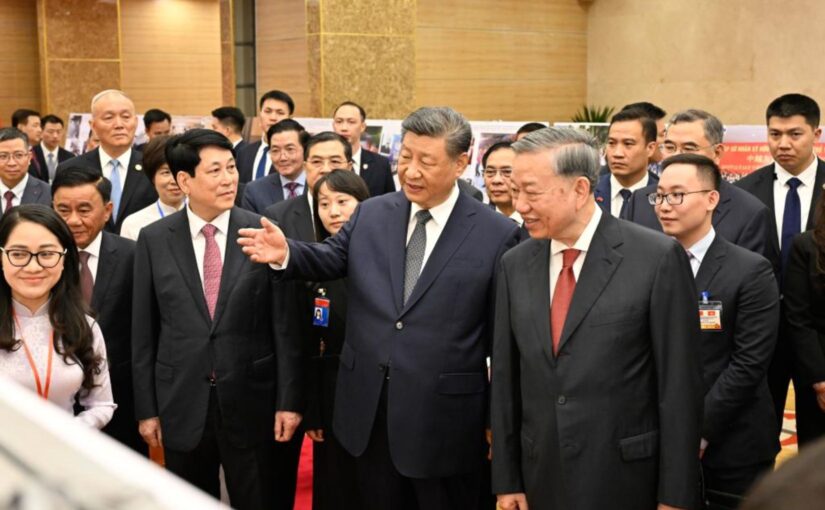
Following his October 9-12 visit to Laos, where he also took part in a series of regional meetings, Chinese Premier Li Qiang visited Vietnam from October 12-14, at the invitation of his Vietnamese counterpart, Pham Minh Chinh. It was Li Qiang’s first visit to the country since he assumed office and the first by a Chinese Premier in 11 years. Moreover, the visit marks a further chapter in the current intense program of high-level bilateral exchanges between the two socialist neighbours.

In his statement on arrival, Li Qiang said that the traditional friendship between China and Vietnam has a long and enduring history, adding that in recent years, under the strategic guidance of the leaders of the two countries, bilateral relations have been developing steadily.

Since the beginning of the year, the two countries have maintained close high-level exchanges and achieved fruitful cooperation in various fields, and the building of a China-Vietnam community with a shared future has started well.

In August, Xi Jinping, General Secretary of the Communist Party of China (CPC) Central Committee and Chinese President, held talks with To Lam, General Secretary of the Communist Party of Vietnam (CPV) Central Committee and Vietnamese President, when the two leaders made a strategic blueprint for comprehensively advancing the China-Vietnam community with a shared future under the new circumstances, charting the course for further development of bilateral relations.

In the face of accelerated changes unseen in a century and growing global risks and challenges, China and Vietnam, as companions of socialism, should strengthen unity and coordination and join hands to promote peace and seek common development, Li said.

On the evening of his arrival, To Lam received the Chinese Premier.

Welcoming Li’s first visit to Vietnam as the Premier of China, Lam stressed that the visit is of important significance, as it helps develop the relationship between the two Parties and the two countries in a deeper and more substantive and comprehensive direction, meeting the aspirations and common interests of the two countries’ people, for peace, cooperation, and development in the region and the world.

On the occasion of the 75th founding anniversary of the People’s Republic of China, he congratulated the Chinese Party, State, and people on their significant achievements, especially the successful implementation of the reform and open-door policy, which has led to many important accomplishments in socio-economic development.

“Vietnam always considers the development of relations with China as a top priority in its foreign policy,” he stressed.

Congratulating the Vietnamese people on their important achievements under the leadership of the CPV, the Chinese Premier emphasised that his country regards the development of relations with Vietnam as a priority in its neighbourhood diplomacy and affirmed that the Chinese Party and Government consistently support Vietnam’s renewal, development, and socialist construction.

In an atmosphere of friendship and trust, the leaders informed each other about the situation of each Party and each country. Lam briefed his guest on major positive results in socio-economic development, Party building and rectification, and the fight against corruption and negative phenomena in Vietnam in the past time, as well as preparations for the 14th National Congress of the CPV, which is identified as an important milestone, opening a new era – the era for realising the goal of successfully building socialism.

Host and guest also reviewed the outstanding achievements in bilateral cooperation in the past time, showing their delight at the important and comprehensive progress of the Vietnam-China relationship. They emphasised that the two sides have seriously and actively implemented the important high-level common perceptions reached during the historic visits of late Party General Secretary Nguyen Phu Trong and General Secretary of the CPC Central Committee and President of China Xi Jinping in 2022 and 2023 respectively; and the state visit to China by General Secretary of the CPV Central Committee and State President To Lam to China in line with the “six major goals” (stronger political trust, more substantial cooperation in defence-security, deeper and more practical cooperation, more solid social foundation, closer multilateral coordination, and better management and settlement of differences).

Lam and Li agreed to maintain regular exchanges at all levels, especially the high level; effectively promote the channels of party diplomacy, state diplomacy, and people-to-people diplomacy; boost cooperation in the fields of defence, security, and foreign affairs; together respond effectively to non-traditional security challenges; and improve the effectiveness of existing mechanisms between the two countries and expand the implementation of new mechanisms.

The top Vietnamese leader said Vietnam welcomes and is willing to create favourable conditions for Chinese enterprises to invest in large-scale, advanced technology projects in Vietnam, representing China’s development level and bringing practical benefits to both nations and their people. The Chinese Premier emphasised that China will further open its market to Vietnamese agricultural products and support the neighbouring country in establishing trade promotion offices in China.

Li Qiang met his Vietnamese counterpart Pham Minh Chinh on October 13.

Congratulating the Chinese Party, Government and fraternal people on their achievements over the past 75 years, Chinh affirmed that Vietnam always attaches importance to strengthening and developing its friendly and cooperative relations with China, considering it a consistent policy, an objective requirement, a strategic choice, and a top priority in Vietnam’s foreign policy.

Continue reading China and Vietnam reaffirm spirit of being good neighbours, good friends, good comrades, and good partners

China, Laos witness new landmark of friendship

Chinese Premier Li Qiang visited the Lao People’s Democratic Republic (LPDR) from October 9-12, where he attended the 27th ASEAN [Association of South East Asian Nations] Plus Three [China, Japan and the Republic of Korea] Summit and the 19th East Asia Summit, and then paid an official visit to Laos, October 11-12, at the invitation of Prime Minister Sonexay Siphandone. The LPDR is the rotating chair of ASEAN for 2024.

Following his visit to Laos, Li paid an official visit to Vietnam, October 12-14, at the invitation of Prime Minister Pham Minh Chinh. These were Premier Li’s first visits to the two countries since he took office.

Meeting on October 11 with General Secretary of the Lao People’s Revolutionary Party (LPRP) Central Committee and Lao President Thongloun Sisoulith, Li said that China and Laos are socialist comrades and brothers, noting that over the past 60 years since the establishment of diplomatic ties, the relations between the two parties and two countries have withstood the test of changes in the international landscape and shown new vitality.

He added that China firmly supports Laos in pursuing a socialist path in line with its national conditions and stands ready to continue firmly supporting each other on issues concerning their core interests and major concerns.

Li called on both sides to speed up the implementation of the new action plan for building a China-Laos community with a shared future and to continue promoting the strategic alignment between the Belt and Road Initiative (BRI) and the planned transformation of Laos from a land-locked to a land-linked country.

Hailing China’s historic development achievements and its rising international influence under the strong leadership of the Communist Party of China (CPC) Central Committee with Comrade Xi Jinping at its core, Thongloun said the Lao party, government and people have always regarded China as an inseparable good neighbour, good friend, good comrade and good partner.

Laos is ready to further strengthen high-level exchanges with China, reinforce the alignment of Laos’ national development strategy with the BRI, advance cooperation in key areas such as the Laos-China Railway, deepen cultural and people-to-people exchanges, and push the construction of the Laos-China community with a shared future to a higher level to better benefit the two peoples.

In his meeting with President of the National Assembly of Laos Saysomphone Phomvihane the same day, Li said China and Laos, as friendly socialist neighbours, support each other in the struggle for national independence and liberation, and learn from each other in their respective causes of reform, opening up and innovation. “Comrades and brothers” is a vivid portrayal of the traditional friendship between the two parties and two countries, he added.

For his part, Saysomphone Phomvihane expressed gratitude for China’s long-term support for Laos’ economic and social development, adding that Laos is willing to strengthen exchanges with China’s legislative bodies, deepen the exchange of experience on state governance, promote the in-depth development of Laos-China friendly and practical cooperation, so as to push for more achievements in the building of a Laos-China community with a shared future.

Meeting with Lao Prime Minister Sonexay Siphandone on October 12, Li said that China and Laos are good neighbours, good friends, good comrades and good partners that share a river and a common future.

Li pointed out that China is ready to work with Laos to speed up the development along the China-Laos Railway and juxtaposed border control, and strengthen cooperation in new energy, advanced manufacturing, digital economy and artificial intelligence, among other fields.

China is also willing to import more quality agricultural products from Laos, he said, calling on the two sides to strengthen exchanges and cooperation in medical care, education, media, culture and tourism and at sub-national levels to deepen mutual understanding and amity between the two peoples and consolidate China-Laos friendship from generation to generation.

Congratulating Laos on the successful hosting of the leaders’ meetings on East Asia cooperation as the rotating chair of ASEAN, Li said that China stands ready to strengthen coordination and cooperation with Laos in the United Nations, ASEAN, Lancang-Mekong Cooperation and other multilateral mechanisms, actively implement the Global Development Initiative, Global Security Initiative and Global Civilisation Initiative, and jointly advocate an equal and orderly multipolar world and universally beneficial and inclusive economic globalisation.

For his part, Sonexay warmly congratulated China on the 75th anniversary of the founding of the People’s Republic, highly praised China’s remarkable development achievements, and sincerely thanked China for its long-term strong support for Laos’ economic and social development.

Laos is willing to work with China to implement the important consensus reached by the top leaders of the two parties and two countries, strengthen high-level and all-level exchanges in various fields, give full play to the role of the Laos-China Railway in driving economic and trade cooperation, expand collaboration in trade, investment, agriculture, infrastructure, digital economy and other areas, as well as deepen cultural, people-to-people and tourist exchanges and cooperation.

After their meeting, Li and Sonexay together attended a ceremony which displayed cooperation documents on interconnectivity, economy and trade, inspection and quarantine, green development and other fields.  During Li’s visit, the two countries also released a joint statement.

In the statement, China and Laos agreed to continue to strengthen practical cooperation under the framework of strategic alignment between China’s Belt and Road Initiative and Laos’ strategy to “convert the landlocked country into a land-linked hub” and to implement the outline of the cooperation plan for jointly building the Belt and Road between the two countries.

Premier Li Qiang and Prime Minister Sonexay Siphandone also attended the inauguration ceremony of the China-aided Mahosot General Hospital building, pledging to reap more fruits in the building of the China-Laos community with a shared future.

Continue reading China, Laos witness new landmark of friendship

Alex Gordon: PRC’s 75th anniversary a moment of hope and inspiration for peoples around the world

The following is the text of the speech delivered by Alex Gordon to the opening session of our conference held on September 28 to celebrate the 75th anniversary of the founding of the People’s Republic of China, “a moment of pride and achievement for the people of China, but also a moment of hope and inspiration for peoples around the world.”

Alex refers to President Xi Jinping’s May Day message this year to the Chinese working class as well as his letter to Serbian steel workers and contrasts this to the looming job cuts at the at the Port Talbot steel plant in South Wales.

He goes on to compare the fiasco of Britain’s HS2 high-speed rail project with the relevant experience in China:

“In the decade it took to turn HS2 from a rail infrastructure project into luxury homes opportunities for billionaires, China developed a 40,000 km publicly owned, high-speed rail network, the largest in world history.”

He also outlines the work of the Chinese trade union movement, noting that Xi Jinping had emphasised that the unions should earnestly safeguard the rights of workers and strive to solve practical problems concerning their vital interests, in particular for workers in new forms of employment.

Alex Gordon is the President of the rail workers and seafarers’ trade union RMT, the Chair of the Marx Memorial Library and Workers’ School and a member of the Political and Executive Committees of the Communist Party of Britain (CPB).

Chair, Minister, Your Excellencies, Comrades and Friends,

On behalf of the Executive Committee of the Communist Party of Britain (CPB), please allow me first to pay tribute to the great work and militant life of our late comrade Sitaram Yechury, General Secretary of the Communist Party of India (Marxist) (CPI[M]). CPB General Secretary, Robert Griffiths has paid tribute to Comrade Sitaram in a eulogy published in the Morning Star. Comrade Sitaram was a friend of China, but also a friend of the CPB and did so much to strengthen and deepen the links between our two parties. We mourn his loss and send our condolences to all his comrades. Vale comrade.

The 75th anniversary of the founding of People’s China is a moment of pride and achievement for the people of China, but also a moment of hope and inspiration for peoples around the world.

On behalf of the CPB, I want to recognise also the significance of this achievement for the working class in our country. But my remarks apply to workers more widely across the developed G7 economies and beyond.

In his May Day greeting to China’s working people this year, President Xi Jinping called on them to “actively participate in advancing Chinese modernisation with high-quality development and work tirelessly to promote the building of a strong country and the rejuvenation of the Chinese nation on all fronts.” He asked party committees and government bodies at all levels to “realise, safeguard and develop the legitimate rights and interests of workers.”

President Xi also replied to a letter from Serbian workers at the HBIS Smederevo Steel Plant who he met on a state visit to Serbia in 2016.

Continue reading Alex Gordon: PRC’s 75th anniversary a moment of hope and inspiration for peoples around the world

Building a peaceful, nuclear-free tomorrow

The following text is of a speech by Sophie Bolt, incoming general secretary of the Campaign for Nuclear Disarmament (CND), at the World We Want conference held in London on 12 October 2024.

Sophie’s speech outlines the current geopolitical situation, in particular the risk of nuclear war, and the need for a mass movement to demand peace and disarmament. She observes that US global dominance is the number one obstacle in the way of a “peaceful, just, sustainable and nuclear-free world”. While many may have hoped that the end of the Cold War would have brought about a more peaceful world, the US developed an aggressive new strategy – the “Wolfowitz doctrine” – which aimed to prevent the rise of any rival power that could challenge US hegemony. “Using its political, economic and military might, the US has attempted to force countries to subordinate their economic and political interests to it. A carrot-and-stick approach, in which the US nuclear arsenal is the ultimate stick.”

Sophie notes that the global economic and political situation is changing, particularly with the emergence of China and the rise of BRICS. In a state of relative decline, the US is increasingly resorting to the use of military power to maintain and reassert its hegemony. “This is the key driver of global tensions which is pushing the world to the brink of destruction.”

The speech calls on the peace movement to mobilise against the US-led drive to war – including the New Cold War on China – and to support peace initiatives emerging from the Global South. For example, Brazil and China are coordinating towards peace talks between Russia and Ukraine; meanwhile South Africa has been blazing a trail on international legal action against Israel for its war crimes in Gaza.

Sophie concludes:

We must take hope and courage from these significant, progressive developments taking place across the global South. And the determined, committed movements that are growing here in the global North.

The text of the speech was first published in the Morning Star on 14 October 2024.

So, the world we want to see! For the Campaign for Nuclear Disarmament, we want a peaceful, just, sustainable and nuclear-free world. But, given where we currently are, how can we secure such a world?

From CND’s perspective, central to this question is overcoming the major obstacle — which is US global dominance.

Since the US atomic bombing of Hiroshima and Nagasaki in 1945, the US has pursued a military doctrine that allows no rival economic or military power to emerge that can challenge it.

Far from ending the second world war, the dropping of these nuclear bombs was a ruthless, barbaric act to ensure the US emerged as the major superpower. It was a warning to every other country.

The bombing unleashed the nuclear arms race and started the cold war, taking the world to the brink of nuclear annihilation.

Following the dissolution of the Soviet Union in the early 1990s, this doctrine was explicitly formalised, coined the “Wolfowitz doctrine,” after Paul Wolfowitz, under-secretary of defence to Dick Cheney. This is why — rather than disbanding Nato — the US aggressively expanded the nuclear-armed alliance right up to Russia’s borders.

Using its political, economic and military might, the US has attempted to force countries to subordinate their economic and political interests to it. A carrot-and-stick approach, in which the US nuclear arsenal is the ultimate stick.

But today, China’s economic growth has overtaken the US, and it is now the biggest economy in the world. Economic co-operation between Brazil, Russia, India, China and South Africa — known as Brics — means these combined economies are larger than the G7. And this economic co-operation is growing, with Iran, Egypt, Ethiopia and the United Arab Emirates joining this year.

Continue reading Building a peaceful, nuclear-free tomorrow

Paweł Wargan: China’s peaceful rise points to the promise of a socialist future

The following text and video are from a pre-recorded contribution by Paweł Wargan at the London conference organised by Friends of Socialist China to mark the 75th anniversary of the founding of the People’s Republic of China.

Paweł’s contribution was very moving, coming from a Polish organiser who is well versed in the history of that country. Being able to celebrate the 75th anniversary of the PRC “feels miraculous to me, because I come from a country that abandoned its socialist path. Knowing what was lost in Poland — in Eastern Europe as a whole — sharpens the appreciation for what has persisted in China.”

Paweł observes that when Poland abandoned the socialist path, “we sold off our public institutions, we joined NATO, and we helped destroy Iraq”. Socialist Poland had built a foreign policy based on solidarity and internationalism, but after 1989, “we lost our solidarity, and we lost a sizeable chunk of our humanity”.

Addressing the standard critique of China as having turned its back on socialism, Paweł poses the question of what China would really look like today if it truly had abandoned the socialist project:

Without socialism, would China build the world’s largest network of high-speed rail? Would China lift 850 million people out of poverty? Would China achieve its climate targets six years ahead of schedule? Without socialism, would China come to lead the global green transition, dramatically cutting the costs of renewable energy for everyone? Would China export its development expertise to countries that for centuries had been denied the right to modernise on their own terms? Would China remain peaceful? 

The speech concludes by urging listeners to take inspiration from China’s continuing successes:

China’s peaceful rise points to the promise of a socialist future on our horizon… In a period in history dominated by the merciless violence we see committed daily against the Palestinian and now Lebanese people by what is a relic of the past — a European colonial project that had no right to survive the era of decolonisation — we can take great hope from the knowledge that there exists somewhere a project of the future.

Paweł Wargan is an activist, researcher and organiser. He serves as Political Coordinator at the Progressive International, an international coalition of over 100 popular movements, political parties, and unions.

In some ways, it feels miraculous to be celebrating the continuation of a socialist project in 2024. And I think that we have to insist on these words: celebration, socialism. Even in the ranks of the left, too many dismiss the seriousness of China’s socialist process, and the idea that there is anything left to celebrate.

This celebration feels miraculous to me, because I come from a country that abandoned its socialist path. Knowing what was lost in Poland — in Eastern Europe as a whole — sharpens the appreciation for what has persisted in China. 

Just last week, on 24 September, an anniversary passed by that is scarcely remembered in my country. 65 years ago, before the rubble from the Second World War had been fully cleared, Władyslaw Gomułka, the leader of the socialist Polish People’s Republic, announced that Poland would build 1,000 schools — one for every year of our country’s existence. 

The war had devastated Poland’s social infrastructure. In 1961, there were 74 children for every classroom, and 700,000 children were born every year between 1949 and 1959. By the end of the 1000 Schools for the Millennium program, the state had built over 1,400 schools and 6,349 homes for Polish teachers — an achievement that it would never repeat in its history. We still go to these schools today.

The experiences gained in our post-war reconstruction were not confined to Poland. Polish architects and builders travelled around the world, helping countries emerging from the ravages of colonialism build their own schools, houses, concert halls, universities, and other public buildings. One of the companies involved in this process, Budimex, helped design a master plan for the city of Baghdad in Iraq, which charted a path for its development until the year 2000.

Then our socialist project collapsed, we sold off our public institutions, we joined NATO, we helped destroy Iraq, and just a couple of years ago Budimex finished work a border wall to stop the victims of US wars in West Asia from crossing into the European Union through Belarus. This is what the collapse of socialism has meant for Poland’s role in the world. We lost our ambition, we lost our solidarity, and we lost a sizeable chunk of our humanity. 

When some on the left expect China to conjure up — as if out of thin air — the socialism imagined in the bedrooms or university halls of Britain or the United States, they ignore not only the continuing achievements of Chinese socialism, won through the arduous effort and tremendous creativity of the Chinese people and the leadership of the Communist Party of China. They also ignore the counterfactual. What would have been lost had China abandoned the path of socialist construction? 

Without socialism, would China build the world’s largest network of high-speed rail? Would China lift 850 million people out of poverty? Would China achieve its climate targets six years ahead of schedule? Without socialism, would China come to lead the global green transition, dramatically cutting the costs of renewable energy for everyone? Would China export its development expertise to countries that for centuries had been denied the right to modernize on their own terms? Would China remain peaceful? 

We find the answers to these questions in the many tragedies that have gripped the former socialist bloc in Eastern Europe. Fraternal nations have been torn apart by the scourge of ethno-nationism — carefully cultivated by the Atlanticist bloc — and entire regions were consumed by war. The social safety net was pulled from under people’s feet, and seven million died early deaths as a result. The very horizon of the future has disappeared.  

That is why we now celebrate the People’s Republic. 

In China, we have proof that the socialist era is not behind us — that we have not, as too many of us insist, been defeated. To the contrary, China’s peaceful rise points to the promise of a socialist future on our horizon. China built on the legacies of the October Revolution, found ways to navigate the contradictions of a global economy captured by imperialism, and has set itself the goal of building an advanced socialist society within our lifetimes. 

In a period in history dominated by the merciless violence we see committed daily against the Palestinian and now Lebanese people by what is a relic of the past — a European colonial project that had no right to survive the era of decolonization — we can take great hope from the knowledge that there exists somewhere a project of the future. 

British communist solidarity with China from the revolution to today

In this, the second of two articles outlining the history of relations between the communists of Britain and China, Robert Griffiths, General Secretary of the Communist Party of Britain (CPB), having briefly recapped some highlights from the 1920s, 30s and 40s, takes up the story from the proclamation of the People’s Republic of China on October 1, 1949.

Very soon after liberation, the Communist Party of Great Britain (CPGB) was instrumental in the formation of the Britain-China Friendship Association (BCFA), which brought together left and progressive trade unionists, co-operators, scientists, academics, artists, writers, musicians and businesspeople, among others. However, in the face of the intensified cold war, and particularly Britain’s participation in the Korean War, the Labour Party placed the BCFA on its list of proscribed organisations. A number of Labour members were expelled from the party as a result, although, in the first half of the 1980s, one of them, Jim Mortimer, was to eventually become the party’s General Secretary.

Against a background of decades of uninterrupted solidarity, CPGB General Secretary Harry Pollitt paid the first of his three visits to China in 1955. The next year, along with Willie Gallacher and George Caborn, he was a fraternal delegate to the eighth national congress of the Communist Party of China (CPC).  And in 1959 he was present for the tenth anniversary celebrations of the People’s Republic.

The close friendship between the CPGB and the CPC did not survive the split between the Soviet and Chinese parties, which burst into the open in the early 1960s and divided communists throughout the world. Relations were not restored until the 1980s.

The collapse of the Soviet Union and the socialist countries of eastern Europe in 1989-91 created a new situation, with the first CPB delegation visiting China in 1995.

Comrade Griffiths concludes his article on a note of optimism, with the CPB, together with Friends of Socialist China, jointly celebrating the 75th anniversary of the People’s Republic of China and beginning to plan for further successful initiatives in 2025.

The article was originally published in the Morning Star. The preceding article, reviewing the earlier years, may be read here and the PDF of the full Morning Star supplement, in which it originally appeared can be downloaded here.

Continue reading British communist solidarity with China from the revolution to today

Zhang Weiwei: China’s astounding success has been achieved in peace and under socialism

The following text and video are from a pre-recorded contribution by Professor Zhang Weiwei at the London conference organised by Friends of Socialist China to mark the 75th anniversary of the founding of the People’s Republic of China.

Professor Zhang notes that China has “accomplished almost one industrial revolution every decade since the early 1980s”, with the result that it is now at the forefront of the Fourth Industrial Revolution. Furthermore, it is sharing its progress with the world, in particular the developing countries.

Zhang further observes that, whereas the West’s modernisation was achieved through war, plunder, colonialism and imperialism, “China’s stunning success has been achieved in peace and under socialism under the leadership of the Communist Party of China”.

He concludes:

Of course, China is by no means perfect, and it is still faced with many challenges, yet I also believe that with China’s extraordinary achievements over the past 75 years, we will be able to overcome these challenges and do even better in the years and decades to come.

Zhang Weiwei is a professor of international relations at Fudan University and a senior research fellow at the Chunqiu Institute, in Shanghai. He has written extensively in English and Chinese on China’s economic and political reform, China’s development model and comparative politics. In the mid-1980s, he worked as a senior English interpreter for Deng Xiaoping and other Chinese leaders. He is one of China’s leading public intellectuals.

Hello, everyone,

On the occasion of the 75th anniversary of the People’s Republic of China, I am more than happy to join you to celebrate this great occasion from Shanghai. With 75 years of socialist construction, China has become the world’s largest economy by purchasing power parity since 2014, and today China is the largest industrial, manufacturing and trading nation, with the world’s largest middle class and extreme poverty eradicated and life expectancy two years higher than the United States. Furthermore, thanks to Chinese socialism, at a speed of accomplishing almost one industrial revolution every decade since the early 1980s, China is now at the fore-frontier of the Fourth Industrial Revolution (with big data, AI and quantum technologies, etc) and now the only country capable of providing goods, services and experience from all the four Industrial Revolutions to the whole world. All this has changed China and the world forever.

Indeed, the first group of countries rising up during the 18th and 19th centuries like Britain and France had a population around tens of millions; the second group of countries rising up during the 20th century like the US and Japan had a population around one hundred million; and China’s rise in the 21st century represents a population of over one billion, which is more than the total populations of the previous two groups combined. Furthermore, China’s stunning success has been achieved in peace and under socialism under the leadership of the Communist Party of China, rather than through wars and plunders under colonialism and imperialism for the West.

What’s more important, China’s rise is not that of an ordinary country, but that of a socialist civilizational state, which means, China is an amalgam of the world’s longest continuous civilization and a super-large modern socialist state, with has at least four features, i.e. (i) a super-large population, (ii) a super-vast territory, (iii) super-long traditions and (iv) super-rich cultures, each of which is a blend of ancient and modern, more specifically, a blend of China’s past and its modern socialist adaptations and innovations.

Taking the super-long traditions as an example, China’s ancient traditions have evolved, develped and adapted in virtually all branches of human knowledge and practices. For instance, the West is critical of China’s one-party system, yet to most Chinese, it’s nothing extraordinary: since its first unification in 221 BC, China has been mostly governed by a unified ruling entity, otherwise the country would have disintegrated. China had copied the American political model following its 1911 Republican Revolution and the country degenerated into warlords fighting each other with millions of lives lost.

In its history, China’s unified ruling entity was mostly sustained by a system of meritocracy, with officials selected through public exams or the Keju system since the Sui Dynasty close to 1500 years ago. Since 1949, under the CPC’s leadership, this ancient system has been adapted into today’s what I call “selection + election”. China’s top echelon leaders have almost all served at least twice as the No.1 of a Chinese province, which means they have administered in most cases more than 100 million people before taking up their current positions. As a result, China’s top echelon leadership is obviously among the most competent in the world.

The tradition of a unified ruling entity has carried with it a holistic way of political governance. I would describe Western-style political parties as partisan interest parties and the CPC as a holistic interest party. This explains why China is able to reform and reinvent itself all the time, pioneering the way to overcome all kinds of vested interests and ensure an overall balance between political, social and capital powers in favor of the vast majority of its people. As a result, most Chinese are the beneficiaries of China’s dramatic transformation, a hallmark of Chinese socialism today.

Of course, China is by no means perfect, and it is still faced with many challenges, yet I also believe that with China’s extraordinary achievements over the past 75 years, we will be able to overcome these challenges and do even better in the years and decades to come. On this positive note, I stop here and wish your celebration a great success!

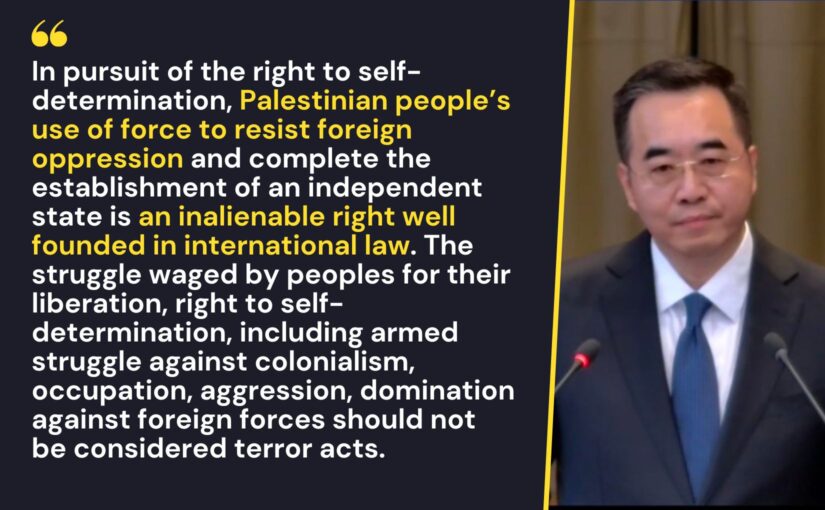
Fu Cong: The tragedy in Gaza is unimaginable and unbelievable in the 21st century

Within the first ten days of October, Chinese Ambassador Fu Cong has spoken out strongly in the United Nations Security Council (UNSC) against the criminal behaviour, war crimes and atrocities of the Israeli regime as well as against the support, connivance and protection afforded to it by the United States.

On October 10, speaking at the UNSC Briefing on the Lebanese-Israeli Situation, Ambassador Fu stated:

“A few hours ago, the IDF [“Israeli ‘Defence’ Force”] attacked UNIFIL [UN peace keepers] positions and an observation tower, causing injuries to UNIFIL personnel. China expresses grave concerns and strong condemnation. UNIFIL carries out its peacekeeping tasks under the mandate from the Security Council resolution. Any deliberate attacks on peacekeepers constitute a severe violation of international humanitarian law and Security Council Resolution 1701.”

He went on to make three points:

First, since October last year, the series of destabilising events that have taken place in the Middle East have resulted in more than 100,000 civilian casualties and left millions of people displaced. The cleanup work will take a decade or so. What’s more, the trauma brought by conflicts will be a lingering nightmare for generations to come. The Middle East cannot afford a full-scale war.

Second, achieving a ceasefire must be an overarching priority. We note that all parties in Lebanon have already made a unanimous call for an immediate ceasefire. The Arab League has also issued an explicit appeal. It is clear who holds the key to ending this crisis.

Third, there is no time to lose for the Council to act. Clearly referring to the United States. he said: “We urge a certain country to stop its passive procrastination, cover-up, and connivance. Instead, it should act responsibly and play a constructive role in order to prevent further destabilisation of the situation.”

The previous day, during the UNSC Briefing on the Humanitarian Situation in Gaza, he noted:

Two million people in Gaza are struggling under the blockade and fire, and one out of every fifty people has suffered violent death. The authority of international law seems to exist in name only for certain states, and the bottom line of international humanitarian law has been repeatedly shattered. The tragedy in Gaza is unimaginable and unbelievable in the 21st century. Like many Council members, China is shocked, disappointed, and outraged. However, we do not believe that the Palestinian people are destined to suffer. Nor do we believe that the Council as a collective body has exhausted all efforts to maintain peace.

We cannot accept that death and hunger have become the new normal in Gaza. Gaza is already an inferno on Earth. For the people there, humanitarian aid is the hope for survival. The role of UNRWA [the United Nations Relief and Works Agency for Palestine Refugees in the Near East] is indispensable and irreplaceable. China firmly opposes Israel’s smearing and suppression of UNRWA and is gravely concerned about the relevant Knesset [Israeli parliament] bills targeting the Agency.

We cannot allow the conflict to drag on and expand. We cannot just sit back and watch the entire Middle East plunging into an all-out war. The harsh reality has proved that winning a war does not necessarily mean having peace, military might alone cannot guarantee lasting security, and the obsession with force only creates more killings and hatred. Israel must cease all military operations in Gaza and put an end to the collective punishment of the people in Gaza. The intensified settlement activities and violence in the West Bank were a de-facto obliteration of the foundation of the two-State solution, and must stop immediately. Lebanon must not become the next Gaza.

We cannot ignore the marginalisation of the Council. There is broad consensus among the vast majority of Council members on the Palestinian-Israeli issue. After repeated vetoes of the Council’s demand for an immediate ceasefire, the US put forward a ceasefire initiative last May, claiming that Israel had accepted it and requesting the Council’s support for an agreement through diplomatic talks. However, over the past five months, the so-called diplomatic efforts seemed to be going in circles, and more time and patience have led to greater civilian casualties and more reckless military adventurism.

Days earlier, on October 2, Ambassador Fu addressed a previous UNSC Briefing on the Lebanese-Israeli Situation. He said: “I would like to reiterate China’s resolute support for the Secretary-General’s work, and we oppose Israel’s groundless accusations against him,” and continued:

“Following the remotely operated and simultaneous detonation of thousands of communications devices in Lebanon, Israel carried out several rounds of large-scale airstrikes in southern and eastern Lebanon, and launched ground offensive and military incursion into Lebanon yesterday. Israel also intensified airstrikes against Syria.”

He then carefully and precisely added: “Iran has concluded a series of military attacks on the military and security targets of Israel, and sent correspondence to the Security Council explaining its position”, and noted that China condemns “all violence and attacks against civilians.” [Emphasis added by us.]

“Gaza has become a hell on Earth. In the meantime, in Lebanon, there has been massive destruction of civilian facilities, thousands of casualties, and more than one million people displaced from their homes, including a large number of Palestinian refugees.”

Finally, he addressed himself to the United States, as well as a tiny number of other countries, including Britain: “With the current situation hanging by a thread, any passive procrastination would be irresponsible, and any rhetoric of condoning further military adventurism would send a wrong message and could cause serious consequences. We hope major countries with influence will adopt a sincere and responsible attitude and earnestly play a constructive role to avoid further escalation of the situation.”

Continue reading Fu Cong: The tragedy in Gaza is unimaginable and unbelievable in the 21st century

China at 75: A journey of revolution, resilience and redistributive development

In the following contributed article, Bhabani Shankar Nayak salutes the Chinese people on the 75th anniversary of their revolution, noting that the founding of the People’s Republic constituted a triumph over imperialism, colonialism and feudalism. However, imperialist aggression against China continues in the midst of the country’s stellar progress in all fields, which stands in stark contrast to the crises enveloping the capitalist world.

Bhabani Shankar Nayak is a Professor of Business Management at London Metropolitan University. He is the author or editor of numerous books and articles on China and other issues related to development in the Global South.

On October 1, 1949, the revolutionary people of China established the People’s Republic of China (PRC) under the leadership of the Communist Party of China (CPC), this being the culmination of a protracted struggle that saw the defeat of Western imperialism, Japanese colonialism, and Chinese feudal warlords, all of whom had unleashed a ‘white terror’ on communists, revolutionaries and the Chinese people generally. Even after the defeat of Japanese militarism, American imperialists supported the so-called nationalist government of Chiang Kai-shek in an attempt to defeat the communists and undermine the victory of the Chinese revolution.

Imperialist aggression against China continues to this day, as the Chinese people celebrate seventy-five years of their revolutionary republic, while progressing along the path of revolution, reform, and redistributive development centreed on the people. The peace, progress, and prosperity in China define its development path, shaped by the resilient and revolutionary spirit of its people under the leadership of the CPC, whose motto is ‘Serve the People’. The journey from the semi-colonial period of shame and humiliation from the mid-19th century onwards to China’s rise to the position of the second-largest economy is a testament to the resilience and dignity of the Chinese people. It is celebration of the abilities of Chinese people and their indomitable spirit.

What have China and its people achieved over the last seventy-five years?

In 1949, China was economically backward, feudalism was endemic, and the people suffered from poverty, hunger, and homelessness. Over the past seven and a half decades, the Chinese people have transformed their agrarian society into an industrial powerhouse, producing quality goods and efficient services for the world. Unprecedented economic growth, coupled with redistributive development policies, has led to the complete eradication of extreme poverty and hunger. Universal access to food, education, and healthcare has contributed to the development of a scientifically advanced society in China, with a rising standard of living, while capitalist countries are facing economic and social crises. The Chinese people have built technologically advanced infrastructure, new cities, ports, airports, and high-speed rail networks that are more efficient than their capitalist counterparts in America and Europe. China’s lunar and Mars missions exemplify the significant progress the country has made in space exploration and scientific innovation. Despite this rapid modernisation, the Chinese people have not forgotten to reclaim their cultural heritage, celebrating their diversity through art, film, music, literature, language, and fashion.

The Chinese policy of peaceful coexistence and a collaborative approach to building a global community with a shared and sustainable future, aimed at addressing global challenges, offers an alternative to a divided world plagued by imperialist wars.  The Global Development Initiative (GDI), Global Civilisation Initiative (GCI) and Global Security Initiative (GSI) are examples of the Chinese approach to global peace and development based on solidarity and cooperation. Such an alternative is not acceptable to American and European hegemons, as it fundamentally opposes their capitalist interests under the guise of democracy dominated by markets, where the majority of people are marginalised. The Chinese vision for global peace and solidarity stands in stark contrast to the confrontational, dominating, competitive, and rent-seeking capitalist approach, which prioritises large corporations while people suffer from never-ending crises.

Therefore, there is relentless propaganda against China and its hardworking people. Phrases like “Chinese goods are cheap”, “Chinese low-quality products”, “Chinese cheap labour”, “Chinese virus”, “Chinese human rights violations”, “expansionist China”, and “Chinese domination and dictatorship” are part of a propaganda campaign designed to undermine the achievements of the Chinese people and their revolution. The Chinese alternative is an anathema to the racial capitalism  where the budget for war is prioritised over those for education and health. In China, the state works for the people and their welfare, whereas in capitalist countries, governments serve corporate interests for profits. It is time to expose the hypocrisies of the West and celebrate the achievements of the Chinese people over the last seventy-five years. These achievements offer hope for working people around the world. Thus, celebrating the 75th anniversary of the founding of the People’s Republic of China is a global event for working people. It is a milestone in the revolutionary history of working-class achievements.

75th anniversary of the founding of the People’s Republic of China marked in Ireland

The 75th anniversary of the founding of the People’s Republic of China, on October 1, was marked in Ireland with a reception hosted by the Chinese Embassy in Dublin as well as with a statement issued by the Communist Party of Ireland (CPI).

Ambassador He Xiangdong, together with his wife Xia Lining, hosted a reception for more than 300 people on the evening of September 26.

Early in his speech, Ambassador He underlined the importance of people-to-people diplomacy by recalling a special moment in China-Ireland relations:

“Here, I would like to pay special tribute to a few special guests. Mr. Kevin Carey, Mr. Patrick Dwyer, Mr. John McGrath, Mr. Norman Plunkett, Mr. Brian Purcell and Mr. Martin Moran. They are among the earliest Irish ‘envoys’ to the new China. In 1976, three years before the establishment of diplomatic relations between China and Ireland, these five gentlemen and their teammates of the UCD [University College Dublin] football team paid a three-week visit to China. They visited Beijing, Shanghai, Changsha, Nanchang, Hangzhou and Guangzhou, and shared their experiences in Irish newspapers, opening a window for the Irish people at that time to know something about China. The spirit of curiosity, exploration and inclusiveness of these young people is still the source of power for the continuing development of China-Ireland relations.”

The Ambassador summarised 75 years of achievements in socialist nation building as follows:

“The past 75 years have witnessed the tremendous development and progress that China has made under the leadership of the Communist Party of China and by the hard-working Chinese people.

–We have historically solved the problem of absolute poverty, and more than 1.4 billion Chinese people have entered a well-off society.

–We have continuously developed the whole-process people’s democracy, and the people’s right to be masters of their own lives and their own country has been more fully realised.

–We have deepened the reform of the judicial system, strengthened the construction of a safe and law-abiding China, and made China one of the safest and most peaceful countries in the world.

–We have built the world’s largest education system, social security system, and medical and health system, and continuously enhanced the people’s sense of gain, happiness, and security.

–We have contributed 25% of the world’s new green area since the beginning of this century, built the world’s largest clean power generation network, with the largest installed capacity of hydropower, wind and solar power in the world. With an average annual energy consumption growth rate of 3%, we have supported an average annual economic growth of more than 6% and contributed to the global response to climate change and green transformation.

–We are committed to promoting the building of a community with a shared future for mankind. While achieving our own development, we provide assistance to more than 160 countries and international organisations to the best of our ability to help many other countries improve their people’s livelihood and move towards the goal of common development.”

He added: “We live in a world of interdependence where the destinies of nations are intertwined. China’s growth and development have been closely linked to its engagement with the global community, including Ireland. Looking into the past, China has proven itself as a partner to Europe and Ireland, not a rival, not a challenger, let alone a threat.

“For China, Ireland is a friend worthy of respect and trust, a bridge for China-EU cooperation and a partner in promoting globalisation. China’s further comprehensive deepening of reform and promotion of Chinese-style modernisation will bring new opportunities for China-Ireland practical cooperation and play a constructive role in maintaining the competitiveness of Irish companies. Let us join hands to promote the sustained and stable development of bilateral relations and build a bright future for Ireland and China.”

Former Taoiseach (Prime Minister) and Co-Chair of the Inter Action Council Bertie Ahern responded, speaking highly of China’s development achievements and praising the country for always being a builder of world peace, a contributor to global development, and a defender of international order. Ireland looks forward to the new high of Ireland-China relations and better benefits for the two countries and two peoples.

Meanwhile, in a statement published on social media, the Communist Party of Ireland sent, “revolutionary greetings to the Communist Party of China and to the Chinese people on the 75th anniversary of the establishment of the People’s Republic of China.”

The CPI noted that: “The victory of the Chinese Revolution shook the foundations of the system of colonial exploitation and sounded the death knell for the old European colonial empires. China’s example inspired other subject peoples in their struggles against colonialism and imperialism… In the 75 years since its foundation, the People’s Republic serves as an example to millions suffering under capitalist and imperialist exploitation.”

The following articles were originally published on the website of the Chinese Embassy in Dublin and on Instagram by the CPI.

The Chinese Embassy in Ireland held a Reception to Celebrate the 75th Anniversary of the Founding of the People’s Republic of China

Sep 27 (Chinese Embassy in Ireland) — On September 26, Ambassador He Xiangdong and Madame Xia Lining held a reception to celebrate the 75th anniversary of the founding of the People’s Republic of China. Ambassador He,  former Taoiseach and Co-Chair of Inter Action Council Bertie Ahern delivered speeches at the reception.

Ambassador He briefed the great achievements China has made in politics, economy, social security, green development, and international cooperation since the founding of the People’s Republic of China, and emphasized that the Third Plenary Session of the 20th CPC Central Committee made systematic arrangements for further deepening reform and promoting Chinese-style modernization, which will bring new opportunities for China-Ireland practical cooperation.

Mr. Bertie Ahern spoke highly of China’s development achievements and praised China for always being a builder of world peace, a contributor to global development, and a defender of international order. Ireland look forward to the new high of Ireland-China relations and better benefits for the two countries and two peoples.

More than 300 guests from the Irish Government, Houses of the Oireachtas, Defense Forces, County and City councils, Diplomatic Corps, and various local communities attended the reception.

Continue reading 75th anniversary of the founding of the People’s Republic of China marked in Ireland

China intensifies push for peaceful resolution to the conflict in Ukraine

China used the 2024 session of the United Nations General Assembly, held in New York in the last week of September, to further intensify its diplomatic push for a peaceful resolution to the conflict in Ukraine.

On September 27, a ministerial meeting of the “Friends for Peace” group on the Ukraine crisis was held at the UN headquarters, co-chaired by Foreign Minister Wang Yi along with Brazilian Foreign Minister Mauro Vieira and Chief Advisor of the Presidency of Brazil Celso Luiz Nunes Amorim. Representatives from 17 Global South countries were present, including the foreign ministers of Egypt, Indonesia, South Africa, Mexico and Zambia.

Wang Yi said, “We gather here with a single purpose: to seek peace… The original intention of this meeting is to unite more forces and amplify stronger voices to contribute Global South countries’ efforts to promoting a ceasefire and achieving lasting peace.”

He emphasised that in the choice between peace and war, the world must resolutely choose peace. “The more critical the situation and the more serious the crisis, the more we cannot give up hope for peace, and the more we cannot slacken our efforts for peace.”

In the choice between dialogue and confrontation, it is essential to firmly choose dialogue. No matter how great the conflicts or how deep the contradictions are, everything must ultimately return to the track of dialogue and negotiation. At the onset of the full escalation of the Ukraine crisis, both Russia and Ukraine were close to reaching an agreement, but it ultimately fell through, and the reasons for this should be reflected upon. [This clearly refers to the efforts of a handful of imperialist countries, principally the United States and Britain, to pressurise, goad and incite Ukraine to reject peace, even when they had already agreed to terms that would have ended the conflict.]

Wang Yi added that Brazil, China, South Africa, Egypt, Indonesia, Türkiye and other countries, as partners of the Global South committed to the political settlement of the Ukraine crisis, agreed to launch the “Friends of Peace” initiative on the Ukraine crisis at the platform of the United Nations. The “Friends of Peace” platform is not about taking sides in the conflict, engaging in bloc confrontation, or replacing existing platforms. It is open and welcomes the joining of more like-minded countries, in particular, Global South countries.

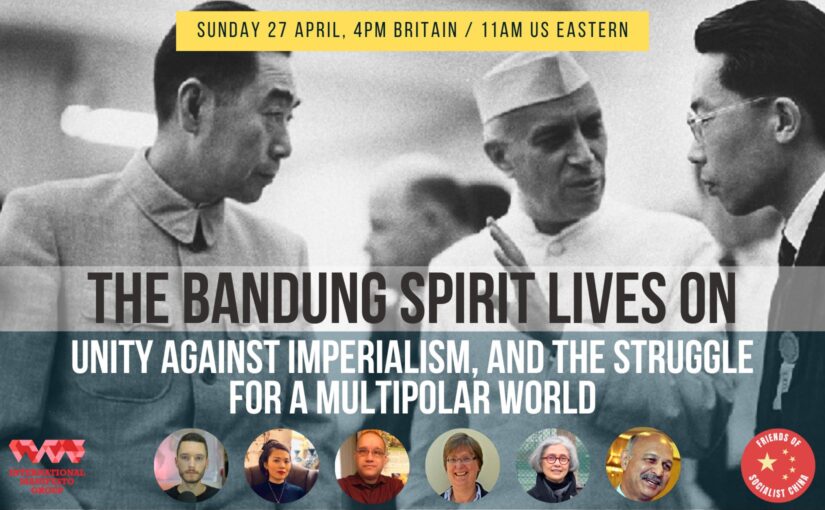
In a joint communique issued by the meeting, the participating countries underlined the importance of peaceful solutions for all international conflicts, whilst continuing to promote the spirit of solidarity and partnership between nations, as emphasised by the Bandung principles.

It further stated:

“We call for increased humanitarian assistance and protection of civilians, including women and children. Civilian infrastructures, including peaceful nuclear facilities and other energy facilities should not be the targets of military operation. We support mediation efforts for the exchange of prisoners of war (POWs) between the parties to the conflict.

“We call for refraining from the use or the threat of weapons of mass destruction, particularly nuclear weapons and chemical and biological weapons. All efforts must be made to prevent nuclear proliferation and avoid a nuclear war. All parties must comply with relevant international laws and agreements and resolutely prevent man-made nuclear accidents.”

The following articles were originally published on the website of the Chinese Foreign Ministry.

“Friends for Peace” Group on the Ukraine Crisis Set up in the United Nations

Sep 28 (MFA) — On September 27, 2024 local time, a ministerial meeting of the “Friends for Peace” group on the Ukraine crisis was held at the UN headquarters in New York. The meeting was co-chaired by Member of the Political Bureau of the CPC Central Committee and Foreign Minister Wang Yi as well as Brazilian Foreign Minister Mauro Vieira and Chief Advisor of the Presidency of Brazil Celso Luiz Nunes Amorim. Representatives from 17 Global South countries were present, including Egyptian Foreign Minister Badr Abdelatty, Indonesian Foreign Minister Retno Marsudi, South African Minister of International Relations and Cooperation Ronald Ozzy Lamola, Mexican Foreign Minister Alicia Bárcena, and Zambian Minister of Foreign Affairs and International Cooperation Mulambo Haimbe.

Wang Yi said, “We gather here with a single purpose: to seek peace.” The Ukraine crisis has entered its third year. The fighting is still raging, the risks of spillover are rising, the dawn of peace has yet to emerge, and the developments in the situation are concerning. The original intention of this meeting is to unite more forces and amplify stronger voices to contribute Global South countries’ efforts to promoting a ceasefire and achieving lasting peace.

Continue reading China intensifies push for peaceful resolution to the conflict in Ukraine

Message of greeting from the DFLP on the 75th Anniversary of the founding of the People’s Republic of China

We reprint below the message of greetings that was sent from the Department of Foreign Affairs of the Democratic Front for the Liberation of Palestine (DFLP), which was read to the events held by Friends of Socialist China in London and New York marking the 75th anniversary of the founding of the People’s Republic of China.

In their message, the Palestinian comrades note that China is known for defending the cause of the Palestinian people and that it sponsored dialogue between the Palestinian factions to achieve internal unity and consensus on a Palestinian government, with the aim of stopping projects related to the future of the Gaza Strip that do not reflect the ambitions of the Palestinian people.

We were honoured to receive this message sent from the embattled and heroic city of Beirut.

It has been lightly edited by us for style.

Dear Comrades

The Democratic Front for the Liberation of Palestine (DFLP) sends its greetings to the participants, and hopes for the success of the conference on the 75th anniversary of the founding of the People’s Republic of China, known for defending the cause of the Palestinian people who face an Israeli colonial and apartheid regime, which commits massacres and crimes against the Palestinian people; and which sponsored dialogue between the Palestinian factions to achieve internal unity and consensus on a Palestinian government, with the aim of stopping projects related to the future of the Gaza Strip that do not reflect the ambitions of the Palestinian people.

The DFLP appreciates your struggle in defending the rights of the Palestinian people stipulated in international legitimacy resolutions, specifically their right to self-determination and ending the Israeli occupation of their lands based on the decision of the International Court of Justice, and the establishment of an independent Palestinian state with Jerusalem as its capital and the return of refugees to their homes in accordance with UN Resolution 194.

The Democratic Front for the Liberation of Palestine (DFLP) points out the necessity of sustaining the relationship between us in order to defend the interests of the people and confront global imperialism that contributes to the destruction of societies and countries, as well as with all leftist parties that are struggling to reach this goal.

The DFLP hopes you continue to provide your permanent political support to the Palestinian people and the just Palestinian cause.

The Democratic Front for the Liberation of Palestine

Department of Foreign Affairs

September 2024

Britain’s communists and China

In the following article, Robert Griffiths, General Secretary of the Communist Party of Britain (CPB), surveys the proud history of solidarity between the Communist Party of Great Britain (CPGB, founded in 1920) and the Communist Party of China (CPC, founded in 1921), up to the founding of the People’s Republic in 1949 and the outbreak of war in Korea the following year.

Noting the British colonial presence in China since the seizure of Hong Kong in 1841, he writes that the CPGB was well aware of its responsibility in the “belly of the beast” to oppose British imperialism’s machinations.

After British colonial police shot down striking workers in Shanghai in May 1923, the CPGB launched a militant ‘Hands off China’ campaign. In 1927, Tom Mann, a leading CPGB trade unionist, embarked on a five-month mission to China on behalf of the Red International of Labour Unions.  Speaking on arrival, he accused the “British imperialist pirates” of filling history with numerous bloody pages.

In his maiden speech to parliament, having been elected as the Communist MP for West Fife in 1935, Willie Gallacher spoke out against the British government’s acquiescence in Japan’s aggression against China.

The Labour government of Clement Attlee announced its recognition of the newly founded People’s Republic on January 6, 1950, but less than a year later Chinese and British troops were confronting each other as the cold war turned hot on the Korean peninsula. The CPGB responded with a courageous ‘Hands off Korea’ campaign.

This article was originally carried in the special supplement marking the 75th anniversary of the founding of the People’s Republic of China, which was compiled and edited by Friends of Socialist China and published together with the Morning Star on Saturday, September 28, to coincide with our conference the same day.

The PDF of the full Morning Star supplement may be downloaded here.

Inspired by Russia’s Bolshevik Revolution, the Communist Party of China (CPC) held its founding congress in July 1921.

With the inability of the nationalist Kuomintang (KMT) to consolidate its authority and therefore its failure to lift the country out of its semi-colonial and semi-feudal state, intellectuals and workers had begun studying the ideas of Marxism.

Since Britain’s seizure of Hong Kong in 1841, other imperialist powers had carved up Chinese territory from Manchuria in the north to the island of Taiwan in the southeast, also taking control of bustling port cities from Shanghai down to Canton (now Guangzhou).

The British, Japanese and French ruling classes had waged wars, imposed treaties and suppressed popular rebellions in order to enforce their commercial interests, often in collaboration with the Qing dynasty or local warlords.

In 1919, student protests erupted in Beijing against the decision of the Great War allies to maintain their “international settlements” in China and specifically to transfer control of Shandong province from Germany to Japan. The May 4th Movement raised the banner of national sovereignty and democracy against this fresh humiliation.

Continue reading Britain’s communists and China

China and DPRK mark 75 years of diplomatic relations

China and the Democratic People’s Republic of Korea (DPRK) marked the 75th anniversary of their establishing diplomatic relations on October 6. One of the first countries to establish diplomatic relations with the People’s Republic of China, the DPRK had been founded in the previous year. However, the north of Korea had been liberated by communist-led partisans, supported by the Soviet Red Army, in August 1945. Between 1946-49, the Korean communists provided very significant support to their Chinese comrades, making an important contribution to the liberation of north-east China.

Top leaders of China and the DPRK, Xi Jinping and Kim Jong Un, marked the occasion with an exchange of messages.

Xi Jinping wrote that: “For 75 years, the two countries have advanced hand in hand on the road of promoting socialist construction while supporting and strengthening exchange and cooperation with each other in the struggle to consolidate the people’s power and defend national sovereignty and have closely cooperated in the work to promote regional peace and stability and safeguard international equity and justice.

“The traditional China-DPRK friendship has withstood the changes of the times and the trials of the ever-changing international situation and become a precious asset common to the two countries and the two peoples.”

He added that: “In the new era and under the new situation, the Chinese side is ready to jointly promote, together with the DPRK side, the stable and further advance of the socialist cause in the two countries and provide the two peoples with better welfare by continuing to write a new chapter of the traditional China-DPRK friendship through strengthened strategic communications and coordination and deepened friendly exchange and cooperation with the 75th anniversary of the establishment of diplomatic relations between the two countries as an occasion.”

For his part, Kim Jong Un stated that: “Over the past 75 years, the two parties and the two countries have vigorously advanced along the road of socialism, withstanding all sorts of trials and challenges of history with the firm faith in the validity of their cause.”

He added: “Recently, the Chinese people celebrated the 75th founding anniversary of the People’s Republic of China. We hope that the Chinese people will achieve steady and fresh successes in the course of building a modern socialist country on a full scale under the leadership of the Communist Party of China with you as its core.”

The two countries’ foreign ministers also exchanged greetings.

Wang Yi wrote to his DPRK counterpart Choe Son Hui that, the traditional China-DPRK friendly and cooperative relations have entered a new historic period and are maintaining stable development under the guidance of General Secretary Xi Jinping and General Secretary Kim Jong Un in recent years.

Saying that it is the steadfast policy of the Chinese party and government to successfully defend, consolidate and develop the China-DPRK relations, the message expressed the willingness to promote the greater development of the China-DPRK relations in line with the important common understanding reached by the top leaders of the two parties and two countries and the common desire of the two peoples.

For her part, Choe Son Hui noted that the two countries have supported and closely cooperated with each other in various fields including politics, economy and culture for the past 75 years since the establishment of diplomatic relations.

She added that it is an important duty for the diplomatic field of the two countries to steadily consolidate and develop the DPRK-China friendship and jointly and dynamically promote the socialist cause under the present complicated international situation.

The following articles were originally published by the Korean Central News Agency (KCNA). A related article issued by the Xinhua News Agency may be read here.

Respected Comrade Kim Jong Un Receives Greetings from Chinese President

Pyongyang, October 6 (KCNA) — Kim Jong Un, general secretary of the Workers’ Party of Korea and president of the State Affairs of the Democratic People’s Republic of Korea, received a message of greeting from Xi Jinping, general secretary of the Central Committee of the Communist Party of China (CPC) and president of the People’s Republic of China (PRC), on October 6.

Continue reading China and DPRK mark 75 years of diplomatic relations

Assessing Chinese socialism 75 years after its revolution

The following article by Andrew Murray explores the enduring significance of the People’s Republic of China, 75 years after its founding.

Andrew writes that this significance proceeds along three axes:

First is the developmental axis – China’s “transformation from the mutilated prey of sundry imperialisms and a laggard in world standards of social development, into a mighty power in sight of having the world’s largest national economy”.

Second is the democratic, anti-imperialist axis – China’s impact on the ongoing eastward and southward shift of the world’s economic and political centre of gravity.

Third is the socialist axis – “by maintaining a socialist orientation after other developments in that direction have faltered it both keeps open the possibility of plural systemic options in the world, defeating Washington’s dreams of ideological unipolarity, and prevents socialism itself from being pushed into the shadows of history”.

Andrew, a longstanding and prominent anti-war campaigner, notes in relation to China’s foreign policy:

The alternative world order promoted by the Chinese government offers co-operation and development for all and eschews militarism and interference. It prioritises adherence to international law and peaceful resolution of disputes. This is not the world order of imperialism — pressure, threats, looting and diktat.

On the nature of China’s political system, Andrew urges the reader not to try and “squeeze the experience of Chinese socialism into the straitjacket of European experience” and to instead study it on its own terms. In spite of undeniable problems and contradictions, “the future of socialism in the world depends very heavily on developments in China and on the leadership of its Communist Party”. And furthermore, “the complete elimination of absolute poverty, a recent achievement of the CPC, is not just a staggering achievement, it is a socialist one”.

The article concludes:

After 75 years, the People’s Republic of China stands at the very heart of an alternative to the world of the Washington Consensus, neoliberal centrism, the militarised “New World Order” and economic crisis and chaos. The alternative itself is unfinished and perhaps unfinishable, but China is holding the door open to possibilities beyond the status quo, to a menu of other options for humanity. That is most likely the most profound global significance of the PRC on its 75th birthday.

This article was written for the Friends of Socialist China special anniversary supplement published by the Morning Star on September 28, to coincide with London conference celebrating the 75th anniversary of the founding of the People’s Republic of China. It is extracted from Andrew’s contribution to the book People’s China at 75 – The Flag Stays Red, available now from Praxis Press.

The PDF of the supplement can be downloaded here.

There is a story, possibly apocryphal, regarding a parliamentary by-election in St Pancras, north London, in 1949. The Communist Party stood a candidate and, amidst a deteriorating Cold War atmosphere, polled fairly dismally.

Johnnie Campbell, a laconic Scotsman central to the CPGB’s leadership for decades, was dispatched to the locality to rally the troops in the aftermath. Surveying his dispirited comrades, he supposedly declared: “Well, things aren’t going our way in St Pancras right now…but we’ve won in China!”

To many, that was the immediate significance of the Chinese revolution. For millions of Communists and sympathisers around the world, as well as oppressed masses in the colonies and semi-colonies, the victory of the Communist Party of China (CPC) and the party-led People’s Liberation Army was a huge advance – really the greatest conceivable – in a worldwide process of socialist revolution.

Continue reading Assessing Chinese socialism 75 years after its revolution

Laos-China friendship: “Let us build socialism together”

We are pleased to reprint below the speech given by Comrade Phonesy Boulom, First Secretary of the Embassy of the Lao People’s Democratic Republic (LPDR) in London, at the opening session of our September 28 conference celebrating the 75th anniversary of the founding of the People’s Republic of China.

The representative of the LPDR outlines the course of Laos-China friendship, which has socialism at the core, as well as her country’s achievements and goals along the road of socialist-oriented development. She concludes with the rousing call: “Let us build socialism together.”

Excellency Ambassadors, colleagues from the Diplomatic Corps

Dear Comrades

At the outset, I would like to apologise that Ambassador Douangmany is unable to join us today due to his earlier commitment in Scotland. I have a great pleasure and honour to attend this important event today. On behalf of the Embassy of the Lao People’s Democratic Republic (LPDR), I would like to convey my heartfelt congratulation to our Chinese comrades and friends on the 75th Anniversary of the founding of the People’s Republic of China.

Under the leadership of the Communist Party of China, it has made a great number of impressive accomplishments in securing national stability, peace and economic growth.  China embraced the centenary of the Communist Party of China and ushered in a new era of socialism with Chinese characteristics and built a prosperous society in all aspects. This is a historic accomplishment by the Communist Party of China and the Chinese people striving for unity and raising a high profile of China in the world, especially in economic development.

Laos and China have enjoyed a long-standing relationship and stable strategic partnership for a long time based on ‘four goods’, namely good neighbours, good friends, good comrades and good partners.  The two parties and the two governments have sympathised with and supported each other in the struggle for national independence, liberation and building socialism, which has created an absorbing and deep friendship. Laos and China are socialist countries with the same ideals, with similar political regimes and development paths. Although the regional and international conditions are rapidly changing and complicated, both countries have continued to adhere to the direction of relations based on mutual trust, which provides assistance and creates mutual benefits at a high level.

Lao PDR, under the leadership of the Lao People’s Revolutionary Party (LPRP), nowadays continues to enjoy political stability, peace, and social order, and steady economic growth, which are the foundation and precondition for social and economic development. Laos was one of the fastest-growing economies in the world prior to the Covid 19 pandemic, averaging growth of 7.5-8% per year. But then the outbreak of the pandemic came, by which the country has been heavily affected. 

In the first 6 months of 2024, the economy grows at about 4.7%. The government adopted in 2021 the 9th 5 year National Social-Economic Development Plan (NSEDP) for 2021-2025, with the aim to graduate from least developed country (LDC) status by 2026, to become a self-reliant and an upper-middle income country by 2030.  This Five-Year Plan sets out the fundamental direction for creating a new turning point in socio-economic development in the coming years.

Once again, we are all here today to commemorate the 75th founding anniversary of the People’s Republic of China. On behalf of the Lao People’s Democratic Republic, and on my own behalf, I would like to express my warmest congratulations and best wishes to Minister Zhao Fei and the entire friendly people of China for good health, well-being and greater success in your noble tasks, as well as continued progress and prosperity.

I am pleased to note that the existing bonds of friendship and close cooperation between our two countries have been further enhanced continuously and widely in various areas. I am confident that our bilateral relations will be further enhanced in the coming years. Let us build socialism together.  

 Thank you!

Venezuelan ambassador: Venezuela and China are pioneering nations in the construction of a multipolar world

We are very pleased to publish below the text of the statement delivered by His Excellency Ambassador Félix Plasencia González, Head of Mission of the Bolivarian Republic of Venezuela to the United Kingdom, at the conference held in London on Saturday 28 September to mark the 75th anniversary of the founding of the People’s Republic of China.

Ambassador Plasencia started by welcoming the audience to Bolívar Hall, a historic venue in Central London which is owned by the Venezuelan Embassy, and “a space of open doors for brotherhood and solidarity between our peoples”.

Plasencia was formerly Venezuela’s ambassador to China and knows the country well. After congratulating the Chinese people on their remarkable achievements over the last 75 years, he went on to discuss China-Venezuela relations and the role the two countries are playing in global politics.

The Bolivarian Republic of Venezuela and the People’s Republic of China are pioneering nations in the construction of a multipolar and multicentric world, where cooperation, solidarity, and respect for international law play a fundamental role.

Comrade Plasencia noted that, while the US and its allies have been subjecting Venezuela to illegal and arbitrary unilateral coercive measures, “China has consolidated itself as a true friend and a beacon of hope for sovereign nations and governments still striving for full independence”.

He concluded by expressing Venezuela’s willingness to continue expanding cooperation and solidarity with China to ever-wider areas of life, “to contribute to the well-being of our peoples, the development of both nations, and to build strengths that will help create a fairer, more inclusive, peaceful, and equitable multipolar world”.

On behalf of the President of the Bolivarian Republic of Venezuela, Nicolás Maduro Moros, the People and the Bolivarian Government, I am pleased to extend to you a warm greeting, as well as the most cordial welcome to the Bolívar Hall, a space of open doors for brotherhood and solidarity between our peoples, provided by the Embassy of the Bolivarian Republic of Venezuela in London.

It is a great honour for me, as a former Ambassador of the Bolivarian Republic to the People’s Republic of China, to be able to accompany our sister nation, China, in this warm and close gathering organised by social movements and friends of the solidarity in London and the United Kingdom, to celebrate the 75th anniversary of the founding of the People’s Republic of China.

This significant date for the Chinese people and government reminds us of the greatness of the Chinese nation, which we in Latin America and particularly in the Bolivarian Republic of Venezuela, recognise for its millennia of historical greatness and contributions to the development of humanity.

Likewise, on this day we are called to reflect on the profound transformations that the People’s Republic of China has undergone over the last 75 years, during which historic achievements have been made to improve the quality of life for the Chinese people.

China has been remarkably successful in achieving major goals, such as the eradication of extreme poverty, a milestone that fills all our developing nations with hope.

Continue reading Venezuelan ambassador: Venezuela and China are pioneering nations in the construction of a multipolar world

China’s ambassador to the UK: History inspires us to better relations

The following article by Zheng Zeguang, China’s Ambassador to the UK, was originally carried in the special supplement marking the 75th anniversary of the founding of the People’s Republic of China, which was compiled and edited by Friends of Socialist China and published together with the Morning Star on Saturday, September 28, to coincide with our conference the same day. It is the main body of the speech he delivered at the reception he hosted to mark the anniversary on the evening of September 25.

The Ambassador’s speech was carried in full on the website of the Chinese Embassy, along with a report on the reception. A response to the Ambassador’s speech, on behalf of the British government, was delivered by Catherine West MP, Parliamentary Under-Secretary of State at the Foreign, Commonwealth and Development Office.

The PDF of the full Morning Star supplement may be downloaded here.

Seventy-five years ago, the birth of New China marked the end of more than a century of humiliation for the country, and the beginning of the historic process of China’s rejuvenation.

Over the past 75 years, under the strong leadership of the Communist Party of China (CPC), Chinese people of all ethnic groups have united as one and worked diligently to achieve two phenomenal miracles of rapid economic growth and long-term social stability.

In the new era, under the strong leadership of the CPC Central Committee with Comrade Xi Jinping at its core, China has made historic achievements and gone through unprecedented transformation.

We have built a well-off society, and are working towards a great, modern socialist country in all respects. National rejuvenation is now on an irreversible course.

China’s composite national strength has achieved historic growth. Once a poor country, China is now the world’s second biggest economy, and the biggest manufacturer, biggest trader in goods, and the country with the biggest foreign exchange reserves.

Based on constant prices, China’s GDP in 2023 is 223 times larger than that of 1952. The average annual growth rate has been 7.9%.

China has become a scientific and technological powerhouse, and important advances have been made in the country’s national defence capabilities.

China is home to the world’s biggest middle-income group with the best growth potential. We have put in place the world’s largest medical, educational and social security systems. The quality of people’s lives has seen continuous improvement.

China’s development has been an engine for the global economy. From 1979 to 2023, China’s contribution to global economic growth averaged 24.8% annually, and for the period between 2013 and 2023, the figure was over 30%.

China itself is making remarkable progress in green and low carbon transition and is now the world’s biggest clean energy producer. In the meantime, China’s ‘new three’, namely, new energy vehicles, lithium batteries, and photovoltaic products are enabling other countries to expedite their transition.

As a developing country itself, China feels the desire of other developing countries for modernisation and is actually facilitating the modernisation of the Global South, through the Belt and Road Initiative and South-South cooperation.

By the end of 2023, the accumulated investment made by China in Belt and Road partner countries reached over two trillion RMB.

Chinese companies have helped to build Latin America’s first ultra-high-voltage transmission line, Africa’s first modern electrified railway, and its first digital mining project, among many other infrastructure and livelihood projects in developing countries.

China’s development has injected positive energy into world peace. Following an independent foreign policy of peace, China has been building friendship and cooperation with all countries on the basis of mutual respect, non-interference in each other’s internal affairs, equality and mutual benefit.

Over the past 75 years, China has never initiated any war or conflict and has never occupied an inch of other countries’ territory. We have always worked for peace and dialogue, and the political settlement of international disputes.

China has sent more troops to UN peacekeeping missions than any other permanent members of the Security Council. We are now the second biggest funding contributor to both the UN and its peacekeeping operations.

In the face of increasing volatility and transformation around the world, we call on all countries to work together to build a community with a shared future and call for an equal and orderly multipolar world and a universally beneficial and inclusive economic globalisation. 

We stand ready to work with all parties to earnestly implement the Global Development Initiative, the Global Security Initiative, and the Global Civilisation Initiative, so as to bring about more stability and economic growth to this turbulent world.

As we speak, the Chinese people are going all out to achieve modernisation through our own path. Daunting as our mission may be, we have full confidence in achieving our goals.

In the next five years, we will complete over 300 reforms and further enhance our institutions in different sectors, as set out at the third plenum of the 20th CPC Central Committee.

With these measures, China’s productivity and social vitality will be further unleashed, the development momentum further reinforced, and new opportunities will be created for China’s cooperation with other countries.

The United Kingdom was among the first major Western countries to recognise New China. And it has been 52 years now since the two countries established full-fledged diplomatic relations.

History has taught us a lot about the relations between these two countries:

–Despite the differences in political system, history and culture, we have a lot in common and extensive shared interests.

–Exchanges and cooperation conform to the common aspiration of our peoples and serve the fundamental interests of both sides.

–With our respective advantages in economy, education and culture, there are great potentials for collaboration.

–We can contribute to the resolution of major international issues by working together, and this is also our responsibility as two permanent members of the United Nations Security Council.

Last month, President Xi Jinping and Prime Minister Keir Starmer reached important common understanding in their phone call. They agreed that we should uphold mutual respect, enhance engagement, and expand cooperation.

And recently, Foreign Minister Wang Yi and Foreign Secretary David Lammy met in Laos, Vice Premier He Lifeng and Chancellor Rachel Reeves talked over the phone, and so did our energy ministers. Our two militaries have just conducted their consultations on defence strategies.

Going forward, we should work together to follow up on the understanding between our leaders and build a stable and mutually beneficial relationship.

The development of China-UK relations needs the support of people across different sectors from both countries.

We never forget the “Icebreakers” who opened the doors for trade between China and the UK in the 1950s.

We never forget that generation of statesmen from both countries who made the strategic decision to establish diplomatic relations 52 years ago.

And we never forget all those who have worked tirelessly to help connect our two peoples over the past seven decades.

All of them continue to give inspiration to us today.

I call on all of you to continue to support and take an active part in China-UK relations and make new contributions to the steady development of this relationship.

75 years of progress!

Writing in his regular blog, on September 29, Chris Nash, the Chair of the Society for Anglo-Chinese Understanding (SACU), who has lived in China, working in the education sector, for the last 10 years, provided a snapshot of various aspects of China’s progress since the founding of the People’s Republic 75 years ago.

In economics, he notes that in 1949 China accounted for just 4% of Global GDP, whereas today it accounts for 19% and moreover is actively fuelling global growth, especially in other developing countries and emerging markets. 

He goes on to explain that “economic growth must be balanced with environmental sustainability. Drawing on deeply embedded cultural ideas of ‘harmony’, China has energetically followed policies that are healing and sustaining eco-systems across the whole country. In my travels all over the country in the last ten years I have seen none of the environmental pollution that used to be presented as the image of rural China. Instead, I have seen landscapes of profound beauty, which are loved and cared for by local populations engaged in their care and preservation.”

With concrete and vivid examples, Chris highlights some of China’s achievements in biodiversity sustainability as well as in the protection of eco-systems and vulnerable species.

On education, he recalls that, in 1949, there was 80% illiteracy in China, but now, a financial aid system covering students from pre-school to postgraduate level has been established, ensuring that no student from a disadvantaged background is forced to drop out because of financial difficulties.

He emphasises: “These are only snapshots from the remarkable journey of the last 75 years in China. What is important to note is that these 75 years of progress have made, and continue to make, international contributions, not just narrow national ones… think of the likely future benefits as China enters the next phase of its modernisation, led by a mission to ‘build a community of shared future for humankind and to achieve shared and win-win development.’”

We reprint the full text of Chris’s article below. It was originally published on the SACU website.

Starting this weekend the people of Beijing and visitors to the city will be able to experience a spectacular light show. Over 2,800 sites across the capital will be bathed in glorious illumination bringing their nocturnal beauty to full expression. This weekend also sees the opening of the National Day holiday all across China. This holiday takes place from October 1st to October 7th every year. It is often called ‘Golden Week’ and it is an annual celebration of the inauguration of New China on October 1st 1949. Those of you who are good at Maths will have worked out that 2024 is then the 75th anniversary celebration. Therefore in this article I want to talk to you about some of the progress China has made over this period, because it not only remarkable but of global importance to us all.

Let’s start with the economics. Up until the middle of the nineteenth century China had the largest and most successful economy in the world. The problems of the late nineteenth and early twentieth centuries had a devastating effect on the lives of the Chinese people. In 1949 China only produced 4% of global GDP. Over 80% of the population worked in agriculture but the country was not self-sufficient in food. In 1949 China produced only 7.9 kwh of electricity per head of capita compared to 1144.6 kwh per capita in America, 141 times greater. In 1949, the average life expectancy in China was only 35 years. It is against baseline figures like these that the remarkable progress of China over the last 75 years can be measured.

China today accounts for almost 19 percent of the global GDP. China’s progress has brought benefits across the developing world. Until the 1990s, the developing world was dependent on the West for many things. But by 2007, large emerging economies, spearheaded by China, were driving global growth, while the advanced Western economies’ growth had slowed down. As a result, the impact of the Chinese economy on low and middle-income economies soared, with development projects such as the Belt and Road Initiative and multilateral financial institutions supported by countries including China such as the Asian Infrastructure Investment Bank and New Development Bank helping boost growth in many emerging and developing economies. In this way, China has been fuelling global growth.

One of the key lessons of the modern era is that economic growth must be balanced with environmental sustainability. Drawing on deeply embedded cultural ideas of ‘harmony’, China has energetically followed policies that are healing and sustaining eco-systems across the whole country. In my travels all over the country in the last ten years I have seen none of the environmental pollution that used to be presented as the image of rural China. Instead I have seen landscapes of profound beauty, which are loved and cared for by local populations engaged in their care and preservation. In Dali, Yunnan Province, a community leader, took me to the exact spot next to Lake Erhai where President Xi had stood and told local hotel owners who had started to make greater and greater profits from the growth of tourism, that they had to take down their lucrative hotels on the shoreline because they were damaging the water quality in the lake.

Over the last 75 years Chinese scientists have made significant contributions to the world in the realm of conservation and sustainable use of biodiversity. For example, China has increased the population of giant pandas by establishing nature reserves and succeeding in artificially breeding them. Yuan Longping, a famous rice breeding expert in China who made outstanding contributions to the world’s food security, developed the first strain of hybrid rice in 1970 by crossing the sterile plants of wild rice found in Hainan with cultivars. Tu Youyou, a Chinese female pharmacist, won the Nobel Prize for her discovery of artemisinin, a drug that that helped save millions of lives from the threat of malaria globally, especially in developing countries.

China has established a system of national parks that are making enormous contributions to protecting eco-systems and vulnerable species. The Tibetan antelope, the flagship species at the Three-River-Source National Park, has increased to over 70,000. The snow leopard population has recovered to over 1,200, and the populations of Northeast tigers and leopards in the national park have grown from the initial 27 and 42 at the pilot stage, respectively, to around 70 and 80. The wild population of the Hainan gibbon, the flagship species at the Hainan Tropical Rainforest National Park, has increased from fewer than 10 in two groups 40 years ago to 42 in seven groups. And in a remarkable story of international co-operation, the World Wild Life Fund, the Chinese Government and local people in the Yangtze River area have worked together to rescue the Yangtze Finless Porpoise that had been declared extinct. A survey in 2023 found a 23% increase in the population. It is hoped that lessons learned from preserving this river species can now be applied globally to rescue five other river Dolphins vulnerable to extinction.

Finally, in our quick tour through 75 years of achievements in China, let’s focus on education. In 1949 astonishingly, there was an 80% illiteracy rate in China. Education became an immediate priority for the new government. In 1952, 1956 and 1958, the Chinese government repeatedly launched free literacy-education campaigns, which were responded to enthusiastically by 150 million participants. As late as 1978, only 60 per cent of primary school pupils went on to study in junior high schools. Now school completion rates are in the high 90% range. There are 9,752 secondary vocational education schools, with a total of 17.847 million students enrolled. A financial aid system covering students from pre-school to postgraduate level has been established, ensuring that no student from a disadvantaged background is forced to drop out because of financial difficulties. This national focus on education has also benefited university education. China’s universities have been edging up the world university rankings, with more making it to the top 100, and some 100 disciplines making it to the world’s top 1,000.  There are now 7 Chinese universities in the World top 100 ranking. For the first time this year, as my Chinese students are studying to gain entrance to western universities, our campus is now hosting international students studying to gain entrance to elite universities in Beijing.

These are only snapshots from the remarkable journey of the last 75 years in China. What is important to note is that these 75 years of progress have made, and continue to make, international contributions, not just narrow national ones. For example, figures from the United Nations show that China’s sustained commitment to poverty reduction over this period has resulted in an over 70% global reduction in poverty rates. It is China’s expertise in manufacturing, supplying and installing highly efficient photo-voltaic solar power technology that is enabling the world to transition to cleaner alternative energy. In the first four months of 2024 alone, 43% of China’s photo voltaic cell production was exported to Europe. History shows us long eras of peaceful co-operation between China and the world, dwarfing any periods of rivalry and competition. The next time you use something as ordinary as a wheelbarrow, remind yourself this was a Chinese invention of an earlier time, which spread to the world across ancient trade routes. And think of the likely future benefits as China enters the next phase of its modernisation, led by a mission to ‘build a community of shared futures for humankind and to achieve shared and win-win development.’