The perils and promise of the emerging multipolar world

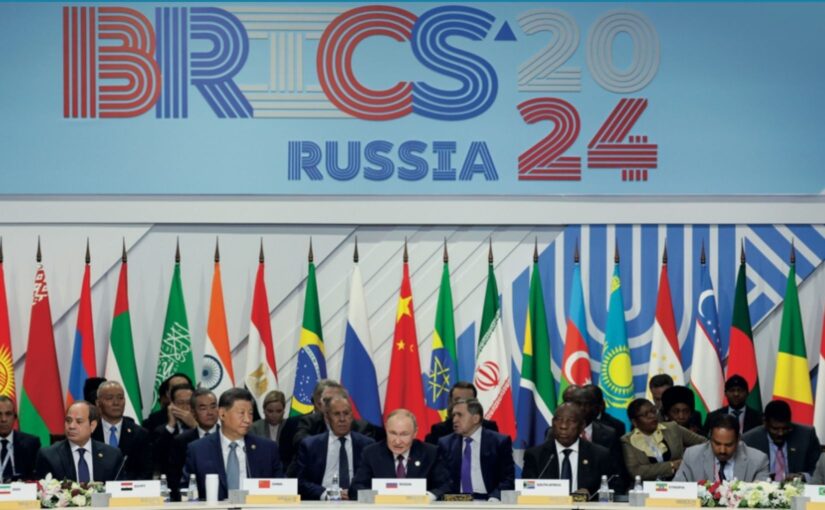
In his recent article for Common Dreams, Columbia professor Jeffrey Sachs describes the world’s trajectory towards multipolarity over the past three decades. He notes that, “in 1994, the G7 countries constituted 45.3% of world output, compared with 18.9% of world output in the BRICS countries (Brazil, China, Egypt, Ethiopia, India, Iran, Russia, South Africa, United Arab Emirates). The tables have turned. The BRICS now produce 35.2% of world output, while the G7 countries produce 29.3%.”

The West’s political influence is also waning, as exemplified by the failure of the US-led sanctions against Russia from 2022: “When the US-led group introduced economic sanctions on Russia in 2022, very few countries outside the core alliance joined. As a result, Russia had little trouble shifting its trade to countries outside the US-led alliance.”

Sachs notes that emerging economies such as China, Russia are Iran are breaking the imperialist stranglehold on technological innovation. In China’s case, it “clearly has a large lead in the manufacturing of cutting-edge technologies needed for the global energy transition, including batteries, electric vehicles, 5G, photovoltaics, wind turbines, fourth generation nuclear power, and others. China’s rapid advances in space technology, biotechnology, nanotechnology, and other technologies is similarly impressive.” All of this is “underpinned by enormous R&D spending and its vast and growing labor force of scientists and engineers.”

And yet US strategists refuse to accept this new reality, and are instead doubling down on their efforts to maintain their hegemony, primarily through military means:

The US is still trying to maintain primacy in Europe by surrounding Russia in the Black Sea region with NATO forces, yet Russia has resisted this militarily in both Georgia and Ukraine. The US is still trying to maintain primacy in Asia by surrounding China in the South China Sea, a folly that can lead the US into a disastrous war over Taiwan. The US is also losing its standing in the Middle East by resisting the united call of the Arab world for recognition of Palestine as the 194th United Nations member state.

In a post-hegemonic, multipolar world, it is crucial that the US and its allies give up on this dangerous and futile quest for global dominance.

The World Bank’s release on May 30 of its latest estimates of national output (up to the year 2022) offers an occasion to reflect on the new geopolitics. The new data underscore the shift from a U.S.-led world economy to a multipolar world economy, a reality that U.S. strategists have so far failed to recognize, accept, or admit.

The World Bank figures make clear that the economic dominance of the West is over. In 1994, the G7 countries (Canada, France, Germany, Italy, Japan, U.K., U.S.) constituted 45.3% of world output, compared with 18.9% of world output in the BRICS countries (Brazil, China, Egypt, Ethiopia, India, Iran, Russia, South Africa, United Arab Emirates). The tables have turned. The BRICS now produce 35.2% of world output, while the G7 countries produce 29.3%.

As of 2022, the largest five economies in descending order are China, the U.S., India, Russia, and Japan. China’s GDP is around 25% larger than the U.S.’ (roughly 30% of the U.S. GDP per person but with 4.2 times the population). Three of the top five countries are in the BRICS, while two are in the G7. In 1994, the largest five were the U.S., Japan, China, Germany, and India, with three in the G7 and two in the BRICS.

As the shares of world output change, so too does global power. The core U.S.-led alliance, which includes the U.S., Canada, U.K., European Union, Japan, Korea, Australia, and New Zealand, was 56% of world output in 1994, but now is only 39.5%. As a result, the U.S. global influence is waning. As a recent vivid example, when the U.S.-led group introduced economic sanctions on Russia in 2022, very few countries outside the core alliance joined. As a result, Russia had little trouble shifting its trade to countries outside the U.S.-led alliance.

The world economy is experiencing a deep process of economic convergence, according to which regions that once lagged the West in industrialization in the 19th and 20th centuries are now making up for lost time. Economic convergence actually began in the 1950s as European imperial rule in Africa and Asia came to an end. It has proceeded in waves, starting first in East Asia, then roughly 20 years later India, and for the coming 20-40 years in Africa.

These and some other regions are growing much faster than the Western economies since they have more “headroom” to boost GDP by rapidly raising education levels, boosting workers’ skills, and installing modern infrastructure, including universal access to electrification and digital platforms. The emerging economies are often able to leapfrog the richer countries with state-of-the-art infrastructure (e.g., fast intercity rail, 5G, modern airports and seaports) while the richer countries remain stuck with aging infrastructure and expensive retrofits. The IMF’s World Economic Outlook projects that the emerging and developing economies will average growth of around 4% per year in the coming five years, while the high-income countries will average less than 2% per year.

It’s not only in skills and infrastructure that convergence is occurring. Many of the emerging economies, including China, Russia, Iran, and others, are advancing rapidly in technological innovations as well, in both civilian and military technologies.

China clearly has a large lead in the manufacturing of cutting-edge technologies needed for the global energy transition, including batteries, electric vehicles, 5G, photovoltaics, wind turbines, fourth generation nuclear power, and others. China’s rapid advances in space technology, biotechnology, nanotechnology, and other technologies is similarly impressive. In response, the U.S. has made the absurd claim that China has an “overcapacity” in these cutting-edge technologies, while the obvious truth is that the U.S. has a significant under-capacity in many sectors. China’s capacity for innovation and low-cost production is underpinned by enormous R&D spending and its vast and growing labor force of scientists and engineers.

Despite the new global economic realities, the U.S. security state still pursues a grand strategy of “primacy,” that is, the aspiration of the U.S. to be the dominant economic, financial, technological, and military power in every region of the world. The U.S. is still trying to maintain primacy in Europe by surrounding Russia in the Black Sea region with NATO forces, yet Russia has resisted this militarily in both Georgia and Ukraine. The U.S. is still trying to maintain primacy in Asia by surrounding China in the South China Sea, a folly that can lead the U.S. into a disastrous war over Taiwan. The U.S. is also losing its standing in the Middle East by resisting the united call of the Arab world for recognition of Palestine as the 194th United Nations member state.

Yet primacy is certainly not possible today, and was hubristic even 30 years ago when U.S. relative power was much greater. Today, the U.S. share of world output stands at 14.8%, compared with 18.5% for China, and the U.S. share of world population is a mere 4.1%, compared with 17.8% for China.

The trend toward broad global economic convergence means that U.S. hegemony will not be replaced by Chinese hegemony. Indeed, China’s share of world output is likely to peak at around 20% during the coming decade and thereafter to decline as China’s population declines. Other parts of the world, notably including India and Africa, are likely to show a large rise in their respective shares of global output, and with that, in their geopolitical weight as well.

We are therefore entering a post-hegemonic, multipolar world. It too is fraught with challenges. It could usher in a new “tragedy of great power politics,” in which several nuclear powers compete—in vain—for hegemony. It could lead to a breakdown of fragile global rules, such as open trade under the World Trade Organization. Or, it could lead to a world in which the great powers exercise mutual tolerance, restraint, and even cooperation, in accord with the U.N. Charter, because they recognize that only such statecraft will keep the world safe in the nuclear age.

Pakistani PM: no force can stop China’s development or shake the iron-clad friendship between Pakistan and China

Pakistan Prime Minister Muhammad Shehbaz Sharif paid an official visit to China from June 4-8, visiting Beijing, Xi’an and Shenzhen.

The Prime Minister met with President Xi Jinping in Beijing on June 7.

President Xi said that China and Pakistan are good neighbours linked by mountains and rivers, good friends who share faith and righteousness, good partners who help each other, and good brothers who share weal and woe. The China-Pakistan all-weather strategic cooperative partnership had continuously deepened and enjoyed solid public support with a strong internal driving force and broad prospects for development.

He added that China is ready to promote the alignment of high-quality Belt and Road cooperation with Pakistan’s development plans, carry out cooperation in agriculture, mining, and social livelihood in light of local conditions, make the high-quality development of the China-Pakistan Economic Corridor (CPEC) go deeper and be more concrete, and help boost Pakistan’s economic and social development.

China is also willing to strengthen coordination and cooperation with Pakistan in the United Nations, the Shanghai Cooperation Organisation (SCO), and other multilateral mechanisms, jointly promote an equal and orderly world multipolarisation and an economic globalisation that is inclusive and benefits all, focus on the development agenda, address security challenges, improve global governance, and safeguard the common interests of developing countries and international fairness and justice.

Shehbaz said that under the leadership of President Xi, China has made great achievements in poverty alleviation, anti-corruption and development, which have attracted worldwide attention.

He added that the CPEC has strongly promoted Pakistan’s national development and brought tangible benefits to the Pakistani people. Pakistan will learn from China’s experience in governance, continue to work with China on high-quality Belt and Road cooperation, and deepen practical cooperation in various fields.

Shehbaz reiterated that no force can stop China’s development and growth or shake the iron-clad friendship between Pakistan and China. Pakistan will continue to firmly support China’s position on all issues concerning its core interests without hesitation.

The Prime Minister also met with Chinese Premier Li Qiang and Zhao Leji, Chairman of the National People’s Congress (NPC) Standing Committee the same day.

Premier Li said that China has always prioritised Pakistan in its neighbourhood diplomacy and stands ready to work with Pakistan to carry forward their traditional friendship, expand mutually beneficial cooperation, and accelerate the construction of a closer China-Pakistan community with a shared future in the new era to bring greater benefits to the two peoples. China is also willing to deepen cooperation with Pakistan in industry, agriculture, aerospace, information technology, ecology and environmental protection.

China will continue to support Pakistan in improving its people’s livelihoods and in its post-disaster reconstruction, and will carry out exchanges and cooperation with Pakistan in the fields of culture, tourism, local governments and think tanks, so that the China-Pakistan friendship will enjoy greater support among the people.

In a detailed joint statement, covering a comprehensive range of issues, the two countries noted that they had reached extensive consensus on further strengthening the China-Pakistan All-Weather Strategic Cooperative Partnership and promoting practical cooperation in various areas, and on international and regional issues of mutual interest.

“The Chinese side reiterated that the China-Pakistan relationship is a priority in its foreign relations. The Pakistani side underscored that the Pakistan-China relationship is the cornerstone of its foreign policy.”

Pakistan believes that the Chinese path to modernisation provides a new option and practical solution for developing countries to achieve independent development.

Both countries recognised that CPEC has been a pioneering project of the Belt and Road Initiative. Since the launch of CPEC, the two sides have adhered to the principle of “planning together, building together, and benefiting together,” which has changed the development landscape of Pakistan, benefited its people’s well-being, and promoted the integrated development of China and Pakistan.

They pledged to upgrade CPEC by jointly building a growth corridor, a livelihood-enhancing corridor, an innovation corridor, a green corridor and an open corridor, aligning with Pakistan’s 5Es Framework based on Exports, E-Pakistan, Environment, Energy, and Equity & Empowerment, to better benefit the two countries and their peoples, working together to build CPEC into an exemplary project of high-quality building of Belt and Road cooperation.

Recognising the significance of Gwadar Port as an important node in cross-regional connectivity, the two sides were satisfied that the New Gwadar International Airport will soon be finished, and reiterated the need to speed up the development of the auxiliary infrastructure of the Gwadar Port in order to fully realise the potential of the coastal city, especially as a transshipment hub. 

They also reiterated that CPEC is an open and inclusive platform for win-win cooperation, and welcomed third parties to actively participate in such CPEC cooperation priority areas as industry, agriculture, ICT, science and technology, and mining.

Both sides underscored the importance of maintaining peace and stability in South Asia, the need for resolution of all outstanding disputes, and their opposition to any unilateral action. The Pakistani side briefed the Chinese side on the latest developments of the situation in Jammu and Kashmir. The Chinese side reiterated that the Jammu and Kashmir dispute is left over from history, and should be properly and peacefully resolved in accordance with the UN Charter, relevant UN Security Council resolutions and bilateral agreements.

They jointly advocated an equal and orderly multipolar world and a universally beneficial and inclusive economic globalisation. Both sides opposed hegemony, domineering and bullying, exclusionist approaches, and opposed power politics, as well as unilateralism in all forms.

China reaffirmed that it always remains a firm member of the developing countries. China is willing to work together with Pakistan and other developing countries, following the principles of mutual respect, equality, mutual trust, win-win cooperation, solidarity and coordination, to jointly embark on the path of fair, open, comprehensive and innovative development, promote development and prosperity of most developing countries, and strive to achieve the goals of the 2030 Agenda for Sustainable Development of the United Nations.

The two sides agreed to strengthen communication and coordination on the Afghanistan issue. They both called for concerted efforts of the international community to positively support Afghanistan in properly addressing challenges in such areas as humanitarianism and economic development, encourage the interim government of Afghanistan to build an inclusive political framework, adopt moderate policies, pursue good-neighbourliness, and firmly combat terrorism. They agreed to play a constructive role in helping Afghanistan to achieve stable development and integrate into the international community.

China and Pakistan reiterated that the fundamental way out of the current crisis in Gaza lies in the two state solution and the establishment of an independent State of Palestine. The resolution adopted by the UN Security Council is legally binding, and should be enforced effectively to achieve an unconditional and lasting ceasefire immediately. They called on the international community to increase political input into the Palestinian question with a greater sense of urgency, stepping up efforts to facilitate the early resumption of peace talks between Palestine and Israel, and to strive for enduring peace.

On June 9, the Xinhua News Agency carried an interview with Mohammad Zubair Khan, a prominent Pakistani economist and former Minister of Commerce.

Describing BRI as a “game changer”, Khan noted that, as one of its flagships, CPEC is connecting the warm waters of the Arabian Sea and the Persian Gulf with the entire Asia that lies to the north, through a corridor linking the Gwadar Port in southwest Pakistan’s Balochistan province with Kashgar in northwest China’s Xinjiang Uygur Autonomous Region, which highlights energy, transport, and industrial cooperation in the first phase, while the new phase expands to the fields of agriculture and livelihood, among others.

“It’s not just about trade with the big economy of China, but the Central Asian economies. They can all be connected through the links into CPEC,” he said. The development of Gwadar port under CPEC would play a major role in reducing the bottlenecks Pakistan had been facing in terms of trade, connectivity and access to international markets.

The former minister, who represented Pakistan at the first ministerial conference of the World Trade Organisation, and has vast experience of working with the World Bank and the International Monetary Fund, rejected the West’s allegation that the BRI’s investment model is exploitative in nature and generates debt traps for the countries involved.

Most of Pakistan’s debt is owed to Western creditors, while China’s credit accounts for a very small portion of Pakistan’s total indebtedness, Khan said, adding that the government is indebted in the local currency to the domestic banks as well. The Chinese investment in CPEC, he added, has been initially in the infrastructure which the South Asian country was lacking. It was not driven by China’s own interests, but suited the development needs of Pakistan, he noted.

The following articles were originally published by the Xinhua News Agency.

Continue reading Pakistani PM: no force can stop China’s development or shake the iron-clad friendship between Pakistan and China

Solar power farms on plateau fuel China’s green energy revolution

The article below, republished from Xinhua, describes a remarkable story of ‘ecological civilisation’ in action, combining holistic ecological protection with poverty alleviation efforts.

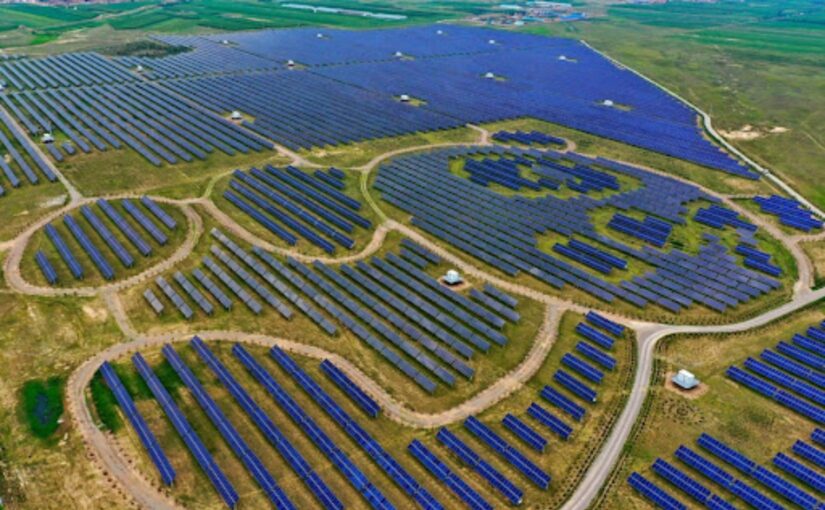
Hainan Tibetan Autonomous Prefecture, in China’s western Qinghai province, is host to the world’s largest solar photovoltaic power plant, with a generation capacity of 8.4 GW (which would be sufficient to provide energy to the whole of London). Nearly 3,000 meters above sea level, and exposed to extreme levels of solar radiation, it is an area that has experienced significant desertification in recent decades: “By the end of the last century, the desertification rate of the land was as high as 98.5 percent, making the solar panels installed here vulnerable to damage from the sand and gravel stirred up by strong gusts of wind.”

More recently, because photovoltaic panels reduce wind erosion on vegetation, grass has been thriving. Meanwhile, in order to maintain the grass and to prevent the proliferation of weeds, sheep have been introduced to the solar park. This has given a major boost to livestock cultivation in the region, with people in the surrounding villages now raising “photovoltaic sheep”.

The plant is thus “simultaneously generating electricity while making exemplary contributions to poverty alleviation and ecological conservation efforts.”

Amid China’s green energy revolution, the world’s largest solar photovoltaic power plant on the Qinghai-Xizang Plateau is forging a unique development path, simultaneously generating electricity while making exemplary contributions to poverty alleviation and ecological conservation efforts.

In late May, greenness finally emerged in the yellow-gray expanse of the Talatan Gobi Desert in Gonghe County, part of the Hainan Tibetan Autonomous Prefecture in northwest China’s Qinghai Province.

Yehdor, a 48-year-old herder from Xaghelesi Village in Tiegai Township, leisurely rode his motorcycle, driving his flock of sheep into the solar photovoltaic power plant owned by Huanghe Hydropower Development Co., Ltd.

Yehdor is no stranger to solar photovoltaic panels, or what he calls “blue mirrors.” In 2006, he received two of these panels through a government project promoting solar power among locals. Since then, the panels have become part of his essential gear, accompanying his tent and other necessities during his six-month-long shepherding journeys each year.

“I set up the panels outside my tent, and they charged during the day, generating enough electricity to power lights and other small appliances throughout the night,” he said.

“However, they are nothing compared to these,” Yehdor added, pointing to the solar panels arranged in a matrix across 4,000 acres of desert land, sparkling like a silver-blue sea under the sun.

More than 200 sheep, a mix of black and white, were spotted roaming among the panels. As startling as it may sound, these sheep have been tasked with protecting the blue panels. Their voracious appetite, once a headache for environmentalists, has now become essential for maintaining the smooth operation of the solar power station.

In 2012, the prefecture initiated the construction of China’s first 10 million kilowatt-class solar power base in Talatan. Today, covering an area of 609 square kilometers, this solar power base boasts a power generation capacity of 8,430 megawatts, making it the largest in the world, according to Qeyang, deputy director of the administration committee of the Hainan prefectural green energy industry park.

It hosts 91 energy enterprises, which include 63 solar photovoltaic power enterprises and 28 wind power enterprises. “Green energy is the signature industry of Hainan prefecture and our annual output accounts for 54.08 percent of the total energy generated in Qinghai,” Qeyang said.

At a deliberation with the lawmakers from Qinghai during the annual session of the National People’s Congress in March 2021, Chinese President Xi Jinping gave instructions to build Qinghai into a highland of clean energies, a destination of international eco-tourism and a source of green and organic farm and livestock products, stressing efforts on fostering a green, low-carbon and circular economic system.

The Qinghai provincial government, since then, has accelerated its efforts to pursue high-quality development of the green energy industry based on local conditions.

Currently, the total installed power generation capacity in Qinghai is 54,970,800 kilowatts, with clean energy accounting for 51,079,400 kilowatts, or 93 percent, of the total. Talatan is also witnessing drastic changes.

Located about 150 kilometers from Qinghai’s provincial capital, Xining, Talatan sits nearly 3,000 meters above sea level and is bombarded with intense solar radiation, which hinders plant growth. By the end of the last century, the desertification rate of the land was as high as 98.5 percent, making the solar panels installed here vulnerable to damage from the sand and gravel stirred up by strong gusts of wind.

Continue reading Solar power farms on plateau fuel China’s green energy revolution

Britain’s century-long opium trafficking and China’s ‘Century of Humiliation’ (1839-1949)

This essay by Stansfield Smith, first published in MR Online, provides a detailed account of China’s Century of Humiliation, a crucial phenomenon to understand and one which continues to inform China’s anti-colonial politics. “For the Chinese, the trauma of the Century of Humiliation continues as a blunt reminder of their past defeat and neo-colonial servitude, as well as a reminder of the West’s self-righteous hypocrisy and arrogance.”

Stansfield describes how the British, later joined by other Western powers, used opium as a weapon to weaken China and reverse the flow of silver. In so doing, they caused untold suffering to the Indian as well as the Chinese people: “Britain taxed away 50% of the value of Indian peasants’ food crops to push them out of agriculture into growing Opium. This soon led to the Bengal famine of 1770, when ten million, a third of the Bengali population, starved to death. Britain took no action to aid them, as they did almost a century later with their orchestrated famine in Ireland.”

Once Britain defeated China in the First Opium War, the Treaty of Nanking gave Hong Kong to Britain as indemnity. Hong Kong “quickly became the center of Opium drug-dealing, soon providing the colony most of its revenue.” Such are the ignominious origins of British rule in Hong Kong.

China’s weakness was quickly leveraged by other Western powers, who imposed unequal treaties on China, and by the turn of the 20th century China was effectively a semi-colonial country. “The Eight-Nation Alliance (Japan, Russia, Britain, France, the United States, Germany, Italy, and Austria-Hungary) invaded again in 1900 to crush the nationalist Boxer Rebellion. An indemnity of 20,000 tons of silver was extracted, and China reduced to a neo-colony.”

Stansfield observes that “the blight of Opium on China was not resolved until the revolutionary victory in 1949.” Socialism has made China strong, and the Chinese people are determined to never again be humiliated by foreign powers. The article concludes:

The West now views China as a renewed threat, again seeking to economically disable it and chop it into pieces. However, this time, the Chinese people are much better prepared to combat imperialist designs to impose a new era of humiliation on them.

Stansfield Smith is an anti-war activist focused mostly on combating US intervention in Latin America. He is an activist with Chicago ALBA Solidarity.

For the Chinese, the trauma of the Century of Humiliation continues as a blunt reminder of their past defeat and neo-colonial servitude, as well as a reminder of the West’s self-righteous hypocrisy and arrogance.

In 1500, India and China were the world’s most advanced civilizations. Then came the Europeans. They eventually looted and wreaked havoc on both, just as they were to on the Americas and Africa. For India and China, Britain was the chief culprit, relying on state-sponsored drug-running backed by industrialized military power. The British Empire was the world’s largest producer and exporter of Opium—the main product of global trade after the gradual decline of the slave trade from Africa. Their “civilization” brought the Century of Humiliation to China, which only ended with the popular revolution led by Mao Zedong. This historic trauma and the struggle to overcome it and re-establish their country is etched in the minds of the Chinese today.

Before the British brought their “culture,” 25% of the world trade originated in India. By the time they left it was less than 1%. British India’s Opium dealing was for the large part of the 19th Century the second-most important source of revenue for colonial India. Their “Opium industry was one of the largest enterprises on the subcontinent, producing a few thousand tons of the drug every year—a similar output to Afghanistan’s notorious Opium industry [during the U.S. occupation], which supplies the global market for heroin.” Opium accounted for about 17-20% of British India revenues.

In the early 1700s, China produced 35% of the world GDP. Until 1800 half the books in the world were printed in Chinese. The country considered itself self-sufficient, not seeking any products from other countries. Foreign countries bought Chinese tea, silk, and porcelain, having to pay in gold and silver. Consequently, the balance of trade was unfavorable to the British for almost two centuries, like the situation the U.S. and Europe face with China today.

This trade slowly depleted Western reserves. Eventually, 30,865 tons of silver flowed into China, mostly from Britain. Britain turned to state sponsored drug smuggling as a solution, and by 1826 the smuggling from India had reversed the flow of silver. Thus began one of the longest and continuous international crimes of modern times, second to the African slave trade, under the supervision of the British crown.

(The just formed United States was already smuggling Opium into China by 1784. The U.S. first multi-millionaire John Jacob Astor grew rich dealing Opium to China, as did FDR’s grandfather, Warren Delano, Jr.)

The British East India Company was key to this Opium smuggling. Soon after Britain conquered Bengal in 1757, George III granted the East India Company a monopoly on producing and exporting Indian Opium. Eventually its Opium Agency employed some 2500 clerks working in 100 offices around India.

Britain taxed away 50% of the value of Indian peasants’ food crops to push them out of agriculture into growing Opium. This soon led to the Bengal famine of 1770, when ten million, a third of the Bengali population, starved to death. Britain took no action to aid them, as they did almost a century later with their orchestrated famine in Ireland. Another famine hit India in 1783, and again Britain did nothing as 11 million starved. Between 1760-1943,

As per British sources, more than 85 million Indians died in these famines which were in reality genocides done by the British Raj.

At its peak in the mid-19th century, the British state-sponsored export of Opium accounted for roughly 15% of total colonial revenue in India and 31% of India’s exports. The massive revenues from this drug money solidified India as a substantial financial base for England’s later world conquests.

Continue reading Britain’s century-long opium trafficking and China’s ‘Century of Humiliation’ (1839-1949)

China, Equatorial Guinea establish comprehensive strategic partnership of cooperation

President of Equatorial Guinea Teodoro Obiang Nguema Mbasogo paid a state visit to China from May 26-31 at the invitation of his Chinese counterpart Xi Jinping. In office since 1982, Obiang is Africa’s longest serving head of state and this was his 11th visit to China, his most recent previous visit having been to attend the 2018 Beijing Summit of the Forum on China-Africa Cooperation (FOCAC).

Meeting on May 28, the two heads of state announced that they had elevated their relations to a comprehensive strategic partnership of cooperation.

Xi said that China and Equatorial Guinea are good friends and partners and their relations feature a high level of political mutual trust. Since they established diplomatic ties more than half a century ago, the two sides have been helping each other through thick and thin, and firmly supporting each other on issues involving each other’s core interests and major concerns.

Under the new circumstances, consolidating and developing China-Equatorial Guinea relations conforms to the fundamental interests and common expectations of the two countries and peoples. China firmly supports Equatorial Guinea in safeguarding national sovereignty and independence, opposing foreign interference, and independently exploring its own development path.

China is also ready to take the opportunity of elevating bilateral ties to further deepen friendly exchanges with Equatorial Guinea, and exchange experience in reform, development and poverty alleviation, so as to inject lasting impetus into the two countries’ traditional friendship.

And China is willing to share development experience in the fields of agriculture and rural affairs with Equatorial Guinea, continue conducting agricultural technical assistance projects, give full play to the role of Chinese medical teams and the China-Equatorial Guinea Friendship Hospital, and deepen medical care, education, exchanges and cooperation in cultural and other fields, to pass on the traditional friendship between the two countries from generation to generation and better benefit the two peoples.

Emphasising that the world today is intertwined with turmoil, the changes unseen in a century are accelerating, and human society is facing unprecedented challenges, Xi said that developing countries need to strengthen solidarity and cooperation more than ever.

China is willing to work with Equatorial Guinea and other developing countries to carry forward the spirit of the Five Principles of Peaceful Coexistence, strengthen coordination and cooperation in international affairs, and safeguard the common interests of developing countries and international equity and justice, to build a community with a shared future for humanity.

Obiang said that China is a great Eastern country, a good brother and reliable strategic partner of Equatorial Guinea. Since the two countries established diplomatic relations 54 years ago, their bilateral relations have always maintained a friendly development and are currently at the best period in history. The cooperation between China and Equatorial Guinea has always been based on equality and mutual respect and is never imposed on others.

Obiang mentioned that Chinese medical teams in Africa, the China-Equatorial Guinea Friendship Hospital and other important projects have benefited the local people and become a symbol of friendship between Africa and China. 

The next day, President Obiang met with Chinese Premier Li Qiang.

Li said that China is willing to strengthen strategic alignment with Equatorial Guinea, work on existing cooperation projects in infrastructure construction and other areas, and expand cooperation in such sectors as marine economy, green economy, and agricultural development.

Both sides should work together to uphold international fairness and justice, and steadfastly safeguard the common interests of the Global South, he added.

Coinciding with President Obiang’s visit, which also took him to Shandong Province, the Xinhua News Agency released a number of stories highlighting the close and long-standing friendship between the two countries.

It reported that during their talks, President Xi expressed appreciation for the kindness the Equatorial Guinea people have shown to the Chinese.

“We will always remember your kindness to the people in the Wenchuan earthquake disaster area and your donation to the construction of Hope Primary School in Jinping County, Yunnan Province,” Xi said.

“Such mutual support between the two countries is a vivid illustration of the sincere friendship and joint development between China and African countries.”

In April 2015, President Obiang announced during his visit to China that Equatorial Guinea would donate a school in Jinping County in China’s southwestern Yunnan Province as a gesture of goodwill and solidarity with the Chinese people.

“The children found themselves in spacious and bright classrooms within a five-story building, and the once muddy hillside was transformed into a well-built playground,” said Ran Hongyan, the school’s principal.

Ran added that the school, which now accommodates over 2,000 students from 16 different ethnic groups, has a special exhibition room to display the children’s photographs, crafts and paintings regarding the friendship between the two countries.

Likewise, in January 2016, the Confucius Institute was established at the National University of Equatorial Guinea, providing young people with more opportunities to learn about Chinese culture.

“When I was a child, Chinese people came to our village to teach farming techniques,” said Jose Antonio Nguema, a 21-year-old student. “They were very friendly and taught me to say ‘hello’ and ‘goodbye’ in Chinese.”

Since then, a “seed of friendship was sown in my heart,” Nguema said. Upon entering university, he was delighted to find a Confucius Institute on campus and eagerly enrolled in Chinese classes. “I have travelled to China twice through the ‘Chinese Bridge’ program. To me, China represents the future.” 

Xinhua commented: “Looking back over more than half a century since the establishment of diplomatic relations, China and Equatorial Guinea have always treated each other as equals, respected each other and supported each other, creating a model of South-South cooperation. Looking ahead, China and Equatorial Guinea will join forces with other African countries to contribute even more to building a high-level China-Africa community with a shared future.

It quoted President Obiang as follows: “I appreciate President Xi Jinping’s initiative to help African countries. I believe it is the most effective way for Africa to overcome all the difficulties it faces today.”

In a recent interview with Xinhua, Alejandro Micha Nsue, President of the National Office of Planning and Project Monitoring of Equatorial Guinea, recalled that Chinese companies arrived in his country during his childhood to construct the Nkue-Mongomo road.

“Today, if we talk about the development of transportation infrastructure, including roads, ports, and airports, Chinese companies have been deeply involved,” he said.

Over the past half a century since China and Equatorial Guinea established diplomatic ties in 1970, Chinese enterprises have constructed hydroelectric power stations, airports, roads, and housing projects, serving as the foundation for the country’s development and progress.

Nsue praised such cooperation projects as the new terminal at Malabo International Airport and the new national university campus. “Equatorial Guinea’s characteristics are being shaped through its cooperation with China,” he said.

In Nsue’s view, the cooperation between China and Equatorial Guinea is sincere.

“The countries that colonised Africa exploited and plundered it, taking away all its resources and leaving the countries in ruins. China’s cooperation is different.”

The following articles were originally published by the Xinhua News Agency.

Chinese, Equatorial Guinean presidents hold talks, elevate ties

BEIJING, May 28 (Xinhua) — China and Equatorial Guinea on Tuesday elevated their relations to a comprehensive strategic partnership of cooperation.

This was announced by Chinese President Xi Jinping and Teodoro Obiang Nguema Mbasogo, president of the Republic of Equatorial Guinea, during their talks in Beijing.

Xi said China and Equatorial Guinea are good friends and partners, and their relations feature a high level of political mutual trust.

Since they established diplomatic ties more than half a century ago, the two sides have been helping each other through thick and thin, and firmly supporting each other on issues involving each other’s core interests and major concerns, he said.

Under the new circumstances, consolidating and developing China-Equatorial Guinea relations conforms to the fundamental interests and common expectations of the two countries and peoples, Xi said.

China firmly supports Equatorial Guinea in safeguarding national sovereignty and independence, opposing foreign interference, and independently exploring its own development path, he said.

China is ready to take the opportunity of elevating bilateral ties to further deepen friendly exchanges with Equatorial Guinea, and exchange experience in reform, development and poverty alleviation to inject lasting impetus into the two countries’ traditional friendship, Xi said.

Xi pointed out that China supports Equatorial Guinea’s economic and social development, supports the country’s efforts to promote economic diversification and industrialization, and is willing to closely synergize the Forum on China-Africa Cooperation (FOCAC) achievements and the Belt and Road Initiative with “Equatorial Guinea Agenda 2035” to improve the quality and performance of cooperation in various fields.

China encourages capable Chinese enterprises to invest in Equatorial Guinea, and is willing to share development experience in the fields of agriculture and rural affairs with Equatorial Guinea, continue conducting agricultural technical assistance projects, give full play to the role of Chinese medical teams and China-Equatorial Guinea Friendship Hospital, and deepen medical care, education, exchanges and cooperation in cultural and other fields, to pass on the traditional friendship between the two countries from generation to generation and better benefit the two peoples, Xi said.

Continue reading China, Equatorial Guinea establish comprehensive strategic partnership of cooperation

Senior Chinese legislator visits Namibia

Cai Dafeng, Vice Chairman of the Standing Committee of China’s National People’s Congress (NPC), visited Namibia from May 30 to June 2 at the invitation of the country’s National Assembly.

Meeting Namibian leaders, Cai said that China and Namibia have been good friends and partners since the establishment of diplomatic ties 34 years ago.

China and Namibia formally established diplomatic relations on the day after the country gained its national independence from the colonial rule of the then racist apartheid regime in South Africa. However, the friendship and solidarity between the two countries were forged from the 1960s onwards, as China extended strong material and moral support to Namibia’s armed liberation struggle.

Accordingly, the Namibian side thanked China for its selfless support during its struggle for national independence as well as in subsequent nation-building.

During his stay in the capital Windhoek, Cai also visited the Independence Memorial Museum, which focuses on the country’s resistance against colonialism and its national liberation movement. Located on Robert Mugabe Avenue, named for the leader of Zimbabwe’s liberation struggle, the museum was built by the Democratic People’s Republic of Korea (DPRK), another socialist country that fully supported the Namibian liberation movement.

The following article was originally published by the Xinhua News Agency.

WINDHOEK, June 2 (Xinhua) — Cai Dafeng, vice chairman of the Standing Committee of China’s National People’s Congress, visited Namibia from May 30 to June 2 at the invitation of the Namibian National Assembly.

During the four-day trip, Cai held talks with Namibian Vice President Netumbo Nandi-Ndaitwah, Speaker of the National Assembly Peter Hitjitevi Katjavivi, and Chairperson of the National Council Lukas Sinimbo Muha.

Cai said that China and Namibia have been good friends and partners since the establishment of diplomatic ties 34 years ago. The two sides have maintained sincere friendship, treated each other as equals through thick and thin, and forged ahead together.

He said that China will continue to be Namibia’s companion on its road to development and revitalization, to further advance the China-Namibia comprehensive strategic partnership of cooperation and achieve new results.

Cai briefed the Namibian officials on China’s modernization drive, the upcoming Forum on China-Africa Cooperation (FOCAC) summit, to be held in Beijing this autumn, as well as China’s push for national revitalization through science and education.

The Namibian side thanked China for its selfless support during its struggle for national independence and nation-building, reiterated its adherence to the one-China principle, and highlighted the important role of working together through the Belt and Road Initiative and forums such as FOCAC.

The Namibian officials also expressed the hope to learn from China’s development experience and its advanced technologies, and to further strengthen bilateral cooperation in various fields.

During his stay in Windhoek, the Namibian capital, Cai also visited the Independence Memorial Museum, which focuses on the country’s resistance against colonialism and its national liberation movement. 

Reaching China, Xi Jinping, and People: Reflections of a delegate’s journey

In the following article, Russel Harland (Deputy Branch Secretary and International Relations Officer, Surrey County UNISON, and a member of the Friends of Socialist China Britain Committee) provides a detailed and throught-provoking description of his experiences on our recent delegation to China.

Discussing the delegation’s field trip to the Beijing headquarters of the ‘12345’ service hotline, Russel observes that this is an example of “Socialism with Chinese Characteristics in action, using all available resources to work for the common goal of serving the people while responding to reality in the process.” He contrasts this with his own experience working in service provision in Britain: “There were many occasions that I knew when giving vulnerable people advice, either in their homes or on the phone, that it was mostly theatre given the constraints on public services in Britain.”

Russel writes that “fundamental to our visit, unsurprisingly, is what you could call our red education”. Through the Chinese presentation of their own historical and ideological trajectory, it becomes clear that “the red gene flows through the life blood of everything that China is trying to do.” Reflecting on his experiences growing up in Belfast, Russel notes: “The battle for symbols is an important arena on the journey of any country’s rejuvenation, known only too well by those us from former colonies who have spent a lifetime walking past statues and symbols of our colonial oppression… After what our delegation experienced during our visit in China, the North of Ireland has some way to go in matching China’s cultural regeneration before it can truly unburden itself from the past.”

The article also explores the nature of China’s evolving Marxism, in particular Xi Jinping Thought on Socialism with Chinese Characteristics for a New Era. Russel emphasises the importance of casting off New Cold War propaganda – and deep-rooted ‘yellow peril’ racism – in order to understand the reality of China today.

It is vitally important for anyone wishing to understand contemporary China, that we attempt to claw ourselves out of the ideological pit of ignorance whence we bathe in untruths, which are then nonchalantly echoed as informed opinion on Xi Jinping, and China in general. Centuries of constructed racism, which we Irish understand only too well, against China from the West, with the alleged threat of the “yellow peril” lurking in the shadows ready to pounce on our “freedoms,” distorts reality and the standing in which President Xi is held, both in China and the non-western world.

Russel concludes: “The Friends of Socialist China 2024 delegation to the People’ Republic of China has born witness to an inspiring alternative that truly puts the wellbeing of all its population first.”

Russel is among the speakers at our webinar on 16 June 2024, China proves that a new world is possible! Delegates report back from China.

A chance quip by a comrade during a discussion on Chinese food one evening stimulated my reflection on the world that had opened up to me before my participation in the 2024 Friends of Socialist China (FoSC) delegation had even been confirmed. For around five years I had been attending online events organised by groups such as No Cold War Britain, the International Manifesto Group, and Friends of Socialist China, where I took inspiration to begin researching Chinese revolutionary history, economics, and Marxist theory. As a child of “The Troubles” in the North of Ireland, as it’s euphemistically known, I was a latecomer to Marxism as a mature student at university in my late thirties. The subsequent new focus on China led me to embrace a world of possibilities that would sit much more comfortably with my working-class experience and global south allegiances.

Reading from many sources, old and new, from Mao Zedong to Xi Jinping, I began to formulate a tentative overview of the historical and contemporary Chinese experience, particularly from the time of China’s defeat to the British in the first Opium War in 1840, which ushered in the ‘century of humiliation’. Around this time in Ireland, Britain’s bloody footprint continued to be stamped on the colonised population, as an Gorta Mór (The Great Hunger) was set to ravage the country with devastating consequences still felt to this day as the outcome. Back in China, the crumbling dynastic society was violently exploited and reduced to extreme poverty by foreign invaders, mainly from the industrialised countries of the West and Japan, which ultimately sowed the seeds for the Civil War from 1945-49, which saw the defeated nationalists of the Guomindang retreat from mainland China to Taiwan. Bear in mind that China’s average life expectancy pre 1949 was just 36 years. Thus, the ‘century of humiliation’ left a deep scar on the population’s psyche.

Yet, in all the darkness there shone a glimmering of hope as the embers of something new began to spark. The second half of the century of humiliation witnessed the introduction of Marxism into Chinese Society, spearheaded by ‍Li Dazhao, which then led to the formation of the Communist Party of China (CPC) in 1921. Mao Zedong, famed for his ability to relay Marxism to the masses by writing in simple and accessible terms,wrote in 1937:

“We must use Marxism, which is positive in spirit, to overcome liberalism, which is negative. A Communist should have largeness of mind and he should be staunch and active, looking upon the interests of the revolution as his very life and subordinating his personal interests to those of the revolution; always and everywhere he should adhere to principle and wage a tireless struggle against all incorrect ideas and actions, so as to consolidate the collective life of the Party and strengthen the ties between the Party and masses…” 

As a result, armed with Marxist theory, inspired by the Russian revolution, Mao Zedong built a revolutionary movement, and despite the odds and impoverished conditions secured victory. A new dawn had broken as the People’s Republic of China (PRC) was declared on 1 October 1949 which set the country on the road to development based on scientific socialism.

We must remember though that China is much more than the last two centuries. In the formidable words of Victor Gao, China is a 5000-year-old civilisational fact. This bears contemporary relevance for those so-called human rights defenders engaging in scurrilous anti-China talking points emanating from destabilising sources in the West, as it reveals that China’s borders have remained largely the same during this long, sometimes turbulent history, with some differentiation in those alleged “disputed territories”, such as Xinjiang, Tibet, Hong Kong, and Taiwan. According to Kishore Mahbubani, there are ‘some hard political realities that cannot be changed’ in China by any leader,and the territorial integrity of the country is one of them. Rather than regurgitating flippant and ignorant remarks about China, people in the West should be mindful that humanity needs engagement, not more estrangement during what appears the decaying stage of American Hegemony.

The contrast between the Chinese and Irish experiences of the 20th century is stark. In Ireland, when an already dying James Connolly was carried on a stretcher, tied to a chair, and executed by the barbarous British for his heroic part in the Easter Uprising of 1916, it is said that Ireland’s chances of a Socialist Republic died too. Without Connolly’s Marxism and indomitable voice, an unfulfilled void was left in Ireland, which was soon to see an undemocratic partition in the north of the country which became the Protestant-dominated Northern Ireland. In the post 1949 years, Catholic Ireland in the south was to totally embrace the “red scare” of anti-communism. By the time Deng Xiaoping’s Reform and Opening Up got underway in 1978, Northern Ireland was witnessing another bloody year of conflict, as the British government was found guilty by the European Court of Human Rights for ‘inhuman and degrading treatment’ of innocent people snatched from their homes by the British army and interrogated in 1971. At this point, the Good Friday Agreement, which would give parity of rights to all citizens in the gerrymandered statelet, was still 20 years away.

This is some of the historical baggage that I was carrying prior to landing in Beijing on Sunday 14 April, although I tried to leave as much of it as I could back in London, in order to approach this delegation with a true open mind. The delegation was made up of 14 people of various ages, experiences, and backgrounds, coming from Ireland, Britain, and the US, but expanding more globally in their origins. For many of us this was our first time in China.

We were met at the airport by our three Chinese representatives from CNIE (China NGO Network for International Exchanges) Ma Jingjing, Xu Luning, and Liu Huihui, who, along with many other people during our stay, played an invaluable role in keeping us on schedule and in the right place during our 10 days in China. I think it is fair to say that by the time that our stay in China came to an end our three hosts had become comrades due to our mutual respect and shared values.

Continue reading Reaching China, Xi Jinping, and People: Reflections of a delegate’s journey

China and Türkiye will strengthen cooperation towards comprehensive, fair and lasting resolution of the Palestinian issue

Turkish Foreign Minister Hakan Fidan, who is considered a rising star in his country’s political scene, visited China from June 3-5.

The visit was treated as having a broader significance, while also representing an important advance in bilateral relations. The wider context was highlighted by Global Times, which wrote:

“China has been in close communication with Muslim countries in the Middle East recently amid the worsening situation in Gaza, as Turkish Foreign Minister Hakan Fidan started his visit to China on Monday, just a few days after the 10th ministerial conference of the China-Arab States Cooperation Forum. Chinese analysts said that apart from boosting bilateral cooperation, China will strengthen cooperation and coordination with Türkiye and other major powers in the region to jointly promote a sustainable ceasefire in the continuing Palestinian-Israeli conflict.” 

It added: “With regard to bilateral relations, the visit will boost the China-Türkiye cooperation under the framework of the Belt and Road Initiative, as Türkiye is a key partner of China with an important location bridging Asia and Europe, and also a major power in the region.”

The newspaper further noted that “the ongoing crisis in Gaza further strengthens unity among Muslim countries.

“On Sunday, a day ahead of Fidan’s visit to China, Iranian Caretaker Foreign Minister Ali Bagheri Kani and Türkiye’s top diplomat called on Muslim states to employ everything in their capacity to support Palestinians and stop the crimes by Israel in the Gaza Strip, according to a statement released by the Iranian Foreign Ministry.

“On the topic of the Palestinian-Israeli conflict and the tragedy in Gaza, China and Muslim countries, including Arab states, Türkiye and Iran, share a similar stance calling for peace and an immediate and sustainable ceasefire to save Palestinian lives, and they all support the just cause of the Palestinian people to restore their legitimate national rights and also to become a full member of the UN… [meanwhile] the Biden administration is now facing increasing internal and external pressures, and even NATO allies like Türkiye are dissatisfied with the role that the US is playing, which allows the bloodshed to continue in the Gaza Strip.”

This broader context likely accounts for the fact that Fidan’s first reported meeting in Beijing, on June 3, was with Politburo member Chen Wenqing, the head of the Commission for Political and Legal Affairs of the Communist Party of China (CPC) Central Committee.

Their talks focused on security matters. The Xinhua News Agency reported Chen as stating that, guided by the important consensus of the leaders of the two countries, China is willing to work with Türkiye to continuously bring cooperation in the field of security to new heights, enrich and expand the connotations of bilateral ties, protect the security interests of both countries in an improved manner, and contribute actively to the peace and development of both countries, the region and the world.

In his meeting with his Turkish counterpart on June 4, Foreign Minister Wang Yi said that building a comprehensive, deep and high-level China-Türkiye relationship is in the fundamental interests of both countries and peoples.

He noted that China and Türkiye are both ancient civilisations and important members of the G20, and are facing profound challenges in the changing international situation, so they should strengthen communication and coordination to make positive contributions to promoting regional peace and global development.

China is willing to maintain multi-level exchanges with Türkiye, play a good role in mechanisms such as the China-Türkiye Intergovernmental Cooperation Committee, promote effective connections between the joint construction of the Belt and Road Initiative and Türkiye’s Middle Corridor Initiative, expand cooperation areas, and explore their potential.

China is also willing to expand imports of high-quality agricultural products from Türkiye, support the continuous improvement of cooperation levels and technological content of enterprises in both countries, and strengthen cooperation in culture, education, tourism, aviation, and other fields.

Wang added that both sides should strengthen coordination and cooperation within the framework of the United Nations (UN) and other multilateral frameworks, support the UN in playing a core role in the global governance system, oppose hegemonism and power politics, oppose a few countries monopolising international affairs, oppose building walls and barriers, “decoupling” and “cutting off supply chains,” maintain the stable operation of the global supply chain and industrial chain, and promote the establishment of a fair and reasonable global governance system.

Fidan said that Türkiye and China have important influence in their regions and globally. China’s development is crucial to world peace and prosperity. Türkiye opposes bloc confrontation, does not agree with or support erroneous actions that suppress China’s development, and does not allow any force to engage in activities on Turkish territory that harm China’s sovereignty and security.

The Middle Corridor Initiative is highly compatible with the Belt and Road Initiative, and Türkiye is willing to cooperate closely with China to achieve more substantive results in trade, investment, finance, agriculture, tourism, education, and other fields through mechanisms such as the China-Türkiye Intergovernmental Cooperation Committee.  Türkiye highly appreciates China’s fair and just position on issues concerning Ukraine and the Middle East and looks forward to working constructively with China to make greater contributions to the prosperity and stability of the region and the world.

Both sides also agreed that it is necessary to promote a ceasefire in Gaza and maintain peace and stability in the Middle East. The Palestinian issue is at the core of Middle Eastern issues. The Gaza conflict is currently the focus, and the priority is to achieve an immediate, comprehensive, and permanent ceasefire, improve humanitarian conditions, and release all detained individuals.

Both China and Türkiye support Palestine becoming a full member of the UN and support internal reconciliation in Palestine. China and Türkiye will strengthen cooperation to jointly promote the early and comprehensive, fair, and lasting resolution of the Palestinian issue.

On the Ukraine issue, Wang said that China’s position is firm and consistent, and the aim is to promote peace and dialogue. Although the conditions for negotiations are not yet in place, China is committed to peace and will not stop its efforts. As long as there is a glimmer of hope, every effort must be made to strive for it.

Wang said China believes that the world needs to hear more objective, balanced, positive, and constructive voices on the Ukraine crisis. China and Brazil jointly issued a six-point consensus recently on promoting a political solution to the Ukraine crisis, emphasising adherence to the three principles of cooling the situation: no spillover from the battlefield, no escalation of the conflict, and no provocation by any party. Within just one week, 45 countries from five continents have responded positively to the six-point consensus in different ways, with 26 countries already confirming their participation or seriously studying how to join.  China believes that the more people participate in the joint appeal, the greater the hope for cooling the situation and the smaller the risk of escalation of the conflict.

Fidan also met the same day with Chinese Vice President Han Zheng.

Earlier, on June 3, Fidan visited the Centre for China and Globalisation (CCG) think tank and delivered a speech.

He discussed the Trans-Caspian East-West Middle Corridor Initiative, noting that this trade route will start from Türkiye and reach China via the Caucasus, Caspian Sea and Central Asia, parallel to China’s Belt and Road Initiative. He also emphasised its benefits in uninterrupted and rapid access to the Black Sea and Mediterranean basins as well as other regions of Europe and Africa.

He further cited Türkiye’s customs union agreement with the European Union (EU) and its pursuit of new opportunities for cooperation with different partners in such platforms as the BRICS cooperation mechanism. According to the South China Morning Post, he said that BRICS could offer “a good alternative” to the EU.  Nearly four decades ago, Türkiye applied to join what was then the European Economic Community (EEC), and in 1999 it was officially recognised as a candidate for full membership in the EU. However, Fidan said that due to “identity politics”, meaning the fact that Türkiye is a Muslim majority nation of over 86 million people, its membership has been consistently blocked by some major EU powers. “So, you have to look for other alternatives. Certainly, we would like to become a member of BRICS. So, we’ll see how it goes this year.”

Fidan added that he looked forward to attending the BRICS Foreign Ministers meeting, to be held in the Russian city of Nizhny Novgorod the next week, preparatory to October’s summit in Kazan.

On May 31, Russian Foreign Minister Sergey Lavrov had said that the doors of BRICS were “open to representatives of the most diverse economic and political systems and macro-regions. The only condition is that you must agree to work on the basis of the key principle of the sovereign equality of states.” 

In his speech, Fidan also highlighted the rich historical and cultural interactions shaping ties between Türkiye and China, referring to them as two great civilisations. He emphasised that these interactions form the strong and lasting foundation of their partnership, citing significant cultural and commercial exchanges facilitated by the historical Silk Road. He noted that the Ottomans sent many envoys to China carrying Ottoman rifles, which could be considered a form of “technology transfer” during that period.

Referring to the designation of the two countries’ relationship as a “strategic partnership” in 2010, Fidan pointed out the intentions of both sides to expand this cooperation. He underscored President Recep Tayyip Erdoğan’s visit to China in 2019 and emphasised this partnership, as displayed during a meeting with his Chinese counterpart Xi Jinping in the Uzbek city of Samarkand in September 2022. Fidan further said that China is Türkiye’s largest trading partner in Asia and third largest in the world, with the bilateral trade volume surpassing $48 billion in 2023, a record high. He also acknowledged the trade imbalance between the two nations in favour of China and underlined the importance of exploring new areas to balance bilateral trade and ensure the sustainability of commercial relations. Fidan also highlighted the crucial role of China’s direct investments in economic ties, emphasising that Türkiye provides an investment-friendly environment for foreign companies.

“Türkiye’s geostrategic position, along with our extensive commercial ties, provides free and easy access to a market of approximately 1.5 billion people and a value of $28 trillion, extending from Europe to the Middle East, North Africa and Central Asia. All of these are within a flight distance of four hours.” 

He also stressed that while Palestinians have long been suffering, this reached an unprecedented level after October 7 last year. “Gaza was once referred to as the world’s largest open-air prison. Now, it has become the world’s largest open-air graveyard. There is currently no place in Gaza that could be considered safe. The humanitarian tragedy unfolding before our eyes has worsened with Israel’s attack on (the city of) Rafah.” He added that Türkiye has been striving to secure a ceasefire in Gaza, prevent the conflict from spilling over into other regions and ensure the uninterrupted delivery of humanitarian aid since Israel’s attacks began in October last year. He further said that Ankara, like Beijing, has highlighted the necessity of an independent, sovereign and geographically contiguous State of Palestine with its capital in East Jerusalem based on the 1967 borders within the framework of a two-state solution.

Another extremely significant aspect of the Turkish Foreign Minister’s trip was that he concluded it in the Xinjiang Uygur Autonomous Region, visiting both the capital Urumqi as well as the city of Kashgar.

Welcoming his visit, regional party secretary Ma Xingrui said that under the strategic guidance of leaders of the two countries, friendly exchanges and practical cooperation in various fields between China and Türkiye have made positive progress. And thanks to the development of China-Türkiye bilateral relations, exchanges between China’s Xinjiang region and areas in Türkiye have become increasingly close.

Fidan noted that during his visit to China’s Xinjiang region, he observed well-developed urban facilities, social prosperity, and good protection of various ethnic cultures and languages.

Türkiye’s stance on Xinjiang-related issues, he said, is clear and firm. It resolutely opposes terrorism, does not support or participate in anti-China activities using ethnic issues, and does not allow activities in Türkiye that harm China’s security or undermine China’s territorial integrity.

The Xinjiang region is a window for China to cooperate with Central Asia and countries such as Türkiye. Both sides should work together to strengthen anti-terrorism cooperation, expand exchanges and interactions, and promote new progress in cooperation in areas such as trade, agriculture, and civil aviation.

The South China Morning Post reported that in Kashgar, which is widely seen as the “cradle of Uygur culture”, Fidan visited the Mausoleum of Yusuf Khass Hajib, a famous 11th century Turkic poet, and the Id Kah Mosque, the largest in Xinjiang. He tweeted of his visit to Urumqi and Kashgar: “Finally, I visited these two ancient cities thanks to my contacts in China.”

Regarding the economic significance of his visit to Xinjiang, the paper reported Li Lifan, a research fellow from the Shanghai Academy of Social Sciences, as saying that Türkiye’s implementation of EU standards, due to their customs union, would be attractive to Chinese companies, while cultural and linguistic similarities could also appeal to Uygur entrepreneurs.

He also mentioned that Türkiye is a Shanghai Cooperation Organisation dialogue partner and seeks to become a full member of the organisation.

Earlier, at a joint press conference with Foreign Minister Wang Yi, Fidan had said that Urumqi and Kashgar play “a bridging role” between China and the Turkish as well as the Islamic world. “They are symbols of our historical friendship and neighbourhood.”

The South China Morning Post article further noted that two months ago, Xinjiang had also hosted a visit by Bassam Zakarneh, a member of the Revolutionary Council of Palestine’s Fatah party, leading a delegation that also included leaders of left-wing political parties from Syria, Egypt, Lebanon, Iraq, Yemen, Jordan and Tunisia.

The following articles were originally published by Global Times, the Xinhua News Agency and Daily Sabah.

Continue reading China and Türkiye will strengthen cooperation towards comprehensive, fair and lasting resolution of the Palestinian issue

Wang Yi meets with Arab foreign ministers

Chinese Foreign Minister Wang Yi held bilateral meetings with a number of Arab foreign ministers who came to Beijing for the 10th conference of the China-Arab States Cooperation Forum, held on May 30.

When meeting with Iraqi deputy prime minister and foreign minister Fouad Hussein, Wang said that China firmly supports Iraq in safeguarding national sovereignty, security, unity and territorial integrity, supports the Iraqi government in developing the economy, improving people’s livelihood and combating terrorism, and opposes external interference in Iraq’s internal affairs.

In his meeting with Algerian Minister of Foreign Affairs and National Community Abroad Ahmed Attaf, Wang said that China and Algeria are sincere friends and natural partners. China is ready to continue to support and cooperate closely with Algeria to safeguard international fairness and justice, as well as the interests of developing countries, and jointly promote an early, full, just and lasting settlement of the Palestinian question.

Meeting with Syrian Foreign Minister Faisal Mekdad, Wang expressed congratulations on Syria’s return to the Arab League family. China supports the Syrian government in safeguarding national security, stability and development. It is believed that Syria’s return to the Arab League will play a constructive role in the development of China-Arab relations, and China-Syria relations will also gain new impetus with the further development of China-Arab relations.

CGTN further noted that Wang  said that China appreciates Syria’s firm support on issues concerning China’s core interests and will, as always, speak out for Syria on multilateral platforms such as the UN Security Council.

Telesur added that both foreign ministers stressed the importance of making progress and intensifying practical cooperation and implementing the agreements reached during President Bashar Al-Assad’s visit to China last year.

Wang Yi also confirmed China’s support for the sovereignty, territorial integrity and legitimate right of Syria to recover its occupied lands in the Golan, as well as the fight against terrorism.

He further called on the United States to respect the territorial sovereignty of Syria and demanded that it stop plundering the wealth of its people and remove illegal unilateral measures that violate the development and welfare of nations.

“The heroic Syrian firmness under the leadership of President Bashar Al-Assad and his keen vision as a great leader will lead Syria to overcome all difficulties and achieve prosperity for the Syrian people,” Wang Yi said.

Meeting Saudi Foreign Minister Prince Faisal bin Farhan Al Saud, Wang said China is ready to work with Saudi Arabia to consolidate the political foundation of bilateral relations, enhance synergy of development strategies, expand cooperation in energy, investment, emerging industries, 5G communications, artificial intelligence, digital economy, aerospace and other fields, and promote green and sustainable development.

During the meeting with Somalian Foreign Minister Ahmed Moallim Fiqi, Wang said that China firmly supports Somalia in safeguarding national sovereignty and territorial integrity, achieving political stability, promoting security transition, and carrying out economic reconstruction.

China is ready to deepen bilateral cooperation in key areas such as agriculture, fisheries and health, and jointly promote Belt and Road cooperation with Somalia.

Fiqi said that Somalia adheres to the one-China principle, firmly supports China’s position on issues related to national reunification, thanks China for its selfless assistance to Somalia’s peace, security, development and revitalisation, hopes to continue to receive China’s support, and looks forward to more cooperation in infrastructure, energy, investment, health, security and other fields under the framework of the Forum on China-Africa Cooperation and the China-Arab States Cooperation Forum.

Wang Yi also met with the foreign ministers of Libya, Mauritania, Morocco and Kuwait, as well as with the Secretary-General of the League of Arab States.

Meanwhile, on May 31, Vice Foreign Minister Deng Li met with Undersecretary of the Foreign Ministry of Oman Sheikh Khalifa Alharthy. Deng said that China supports Oman in safeguarding national sovereignty, security and stability and in advancing economic diversification, and appreciates Oman’s support for China’s just position on issues related to its core interests. China regards Oman as an important partner in the Belt and Road cooperation, and is willing to strengthen strategic synergy with Oman, promote mutually beneficial cooperation in various fields, enhance communication and coordination on regional and international affairs, and achieve more positive progress in China-Oman strategic partnership.

The following articles were originally published by the Xinhua News Agency, CGTN, Telesur and on the website of the Chinese Foreign Ministry.

Top Chinese diplomat meets foreign guests

BEIJING, May 29 (Xinhua) — Chinese Foreign Minister Wang Yi, also a member of the Political Bureau of the Communist Party of China Central Committee, met respectively with foreign guests who came to China to attend the 10th ministerial meeting of the China-Arab States Cooperation Forum, in Beijing on Wednesday.

During the meeting with Abdul-Hamid Dbeibah, prime minister and foreign minister of the Government of National Unity of Libya, Wang said that China has always supported Libya in achieving stable development, and safeguarding its national sovereignty, independence and territorial integrity. China is ready to work jointly with Libya to further consolidate political mutual trust, enhance exchanges, and continuously enrich the connotation of the friendly and cooperative relations between the two sides.

Dbeibah said that Libya attaches great importance to developing relations with China and firmly adheres to the one-China principle. Libya expects China to play a greater role in promoting the early settlement of the Palestinian question.

When meeting with Iraqi deputy prime minister and foreign minister Fouad Hussein, Wang said that China firmly supports Iraq in safeguarding national sovereignty, security, unity and territorial integrity, supports the Iraqi government in developing the economy, improving people’s livelihood and combating terrorism, and opposes external interference in Iraq’s internal affairs.

Hussein said that developing relations with China is a diplomatic priority of the Iraqi government, and Iraq always firmly supports China in safeguarding its core interests. Iraq has been actively participating in the construction of the China-Arab States Cooperation Forum and is willing to continue to expand collective cooperation between the two sides, he added.

During the meeting with Ahmed Aboul Gheit, Secretary-General of the League of Arab States, Wang said that China is ready to work with Arab states, guided by the important consensus reached by the heads of state of China and Arab states, to deepen exchanges and cooperation in various fields, and play a constructive role in maintaining world peace and stability and resolving regional hotspots. China is ready to continue to work with the Arab League and Arab countries to promote an early, full, just and lasting settlement of the Palestinian question.

Gheit said the Arab side is ready to make joint efforts with China to open up broader prospects for richer and more diverse Arab-China relations. The Arab side always firmly adheres to the one-China principle, he added.

During the meeting with Mohamed Salem Ould Merzouk, Mauritania’s minister of foreign affairs, cooperation and Mauritanians abroad, Wang said that China will continue to firmly support Mauritania in pursuing a development path suited to its own national conditions, and oppose external forces interfering in Mauritania’s internal affairs. China is ready to continue to provide assistance within its capacity for Mauritania’s economic and social development, and is ready to cooperate closely with Mauritania to consolidate and expand China-Arab collective cooperation.

Merzouk said Mauritania firmly adheres to the one-China principle, and is ready to work with China to push forward the continuous development of Arab-China and Africa-China relations, and promote the building of a community with a shared future for humanity.

During the meeting with Algerian Minister of Foreign Affairs and National Community Abroad Ahmed Attaf, Wang said that China and Algeria are sincere friends and natural partners. China firmly supports Algeria in safeguarding national sovereignty, independence and territorial integrity, and opposes external forces interfering in Algeria’s internal affairs. China is ready to continue to support and cooperate closely with Algeria to safeguard the international fairness and justice, as well as the interests of developing countries, and jointly promote an early, full, just and lasting settlement of the Palestinian question.

Attaf said that Algeria adheres to the one-China principle, and is ready to further strengthen bilateral cooperation on all fronts and promote greater development of bilateral relations.

When meeting with Syrian Foreign Minister Faisal Mekdad, Wang expressed congratulations on Syria’s return to the Arab League family. China supports the Syrian government in safeguarding national security, stability and development. It is believed that Syria’s return to the Arab League will play a constructive role in the development of China-Arab relations, and China-Syria relations will also gain new impetus with the further development of China-Arab relations, he added.

Mekdad said under the guidance of the two heads of state, Syria is willing to work with China to promote the lasting and in-depth development of bilateral relations.

When meeting with Moroccan Foreign Minister Nasser Bourita, Wang said that China is willing to work with Morocco to deepen exchanges and cooperation in economy, trade, investment, industry, tourism and civil aviation, enhance public support for friendship between the two countries, and open up broader prospects for China-Morocco strategic partnership.

Bourita said Morocco attaches great importance to developing relations with China, and is willing to have close communication and coordination with China under the mechanisms of the China-Arab States Cooperation Forum and the Forum on China-Africa Cooperation.


Wang Yi: China-Syria strategic partnership features mutual trust and support

May 29 (CGTN) — Chinese Foreign Minister Wang Yi on Wednesday said China and Syria have formed a strategic partnership featuring mutual trust and support.

Wang, also a member of the Political Bureau of the Communist Party of China (CPC) Central Committee, made the remarks while meeting with Syrian Foreign Minister Faisal Mekdad, who is in Beijing to attend the 10th Ministerial Conference of the China-Arab States Cooperation Forum.

Congratulating Syria on returning to the League of Arab States (AL), Wang said China and Syria announced the establishment of a strategic partnership last September, drawing a new blueprint for bilateral relations.

China supports Syria in safeguarding its national independence, sovereignty, and territorial integrity, and supports the Syrian government in safeguarding its national security, stability and development, he said.

Wang said China appreciates Syria’s firm support on issues concerning China’s core interests and will, as always, speak out for Syria on multilateral platforms such as the UN Security Council.

It is believed that Syria’s return to the AL will play a constructive role in the development of China-Arab relations, and China-Syria relations will also gain new impetus, he said.

For his part, Mekdad said Syria fully supports all global initiatives proposed by China and is willing to work with China to build an international order featuring mutual respect, equal treatment and opposition to hegemony.

Syria unwaveringly adheres to the one-China principle, he said, adding that Taiwan is an inalienable part of Chinese territory, a fact that cannot be denied or challenged.


Foreign Ministers of Syria and China Hold Bilateral Meeting

May 29 (Telesur) — Syrian Foreign and Expatriate Minister Faisal Al-Mekdad held talks with his Chinese counterpart, Wang Yi, on relations between the two nations and forms of development.

Both foreign ministers stressed the importance of making progress and intensifying practical cooperation and implementing the agreements reached during President Bashar Al-Assad’s visit to China last year.

During the meeting, they discussed the international situation, especially that of the Gaza Strip and the rest of the occupied Palestinian territories, as well as the importance of ending the war and the entry of humanitarian aid and the end of the displacement of Palestinians.

Al-Mekdad underscored Syria’s support for China’s Taiwan, Hong Kong and Xining-related causes, and its responsibility for the one-China principle.

For his part, Wang Yi confirmed China’s support for the sovereignty, territorial integrity and legitimate right of Syria to recover its occupied lands in the Golan, as well as the fight against terrorism.

He also called on the United States to respect the territorial sovereignty of Syria, and demanded that it stop plundering the wealth of its people and remove illegal unilateral measures that violate the development and welfare of nations.

“The heroic Syrian firmness under the leadership of President Bashar Al-Assad and his keen vision as a great leader will lead Syria to overcome all difficulties and achieve prosperity for the Syrian people,” Wang Yi said.

 He added that Syria belongs to the Middle East and there will be no comprehensive solution to the conflict in the region without Damascus.


Chinese FM meets Arab guests

BEIJING, May 31 (Xinhua) — Chinese Foreign Minister Wang Yi on Friday met respectively with some Arab guests who came to China to attend the 10th ministerial meeting of the China-Arab States Cooperation Forum in Beijing.

When meeting with Saudi Foreign Minister Prince Faisal bin Farhan Al Saud, Wang, also a member of the Political Bureau of the Communist Party of China Central Committee, said that China always gives priority to Saudi Arabia in its foreign relations. The leaders of the two countries have established solid mutual trust and friendship, pointing out the direction for the comprehensive strategic partnership between China and Saudi Arabia.

China is ready to work with Saudi Arabia to consolidate the political foundation of bilateral relations, enhance synergy of development strategies, expand cooperation in energy, investment, emerging industries, 5G communications, artificial intelligence, digital economy, aerospace and other fields, and promote green and sustainable development, Wang added.

Faisal said that under the care and guidance of the leaders of the two countries, Saudi Arabia-China cooperation in various fields has yielded fruitful results. Saudi Arabia will continue to be firmly committed to expanding mutually beneficial cooperation between the two countries in various fields and promoting the sustainable development of Saudi Arabia-China comprehensive strategic partnership. Faisal thanked China for upholding a just position on the Palestinian issue.

During the meeting with Somalian Foreign Minister Ahmed Moallim Fiqi, Wang said that China firmly supports Somalia in safeguarding national sovereignty and territorial integrity, achieving political stability, promoting security transition and carrying out economic reconstruction.

China is ready to deepen bilateral cooperation in key areas such as agriculture, fishery and health, jointly promote the implementation of the Belt and Road cooperation and other global initiatives put forward by China in Somalia, Wang added.

Fiqi said that Somalia adheres to the one-China principle, firmly supports China’s position on issues related to national reunification, thanks China for its selfless assistance to Somalia’s peace, security, development and revitalization, hopes to continue to receive China’s support, and looks forward to more cooperation in infrastructure, energy, investment, health, security and other fields under the framework of the Forum on China-Africa Cooperation and the China-Arab States Cooperation Forum.

During the meeting with Comorian Foreign Minister Dhoihir Dhoulkamal, Wang thanked Comoros for supporting China’s legitimate propositions on issues concerning its core interests and major concerns. China is ready to strengthen exchanges with Comoros at all levels, promote high-quality Belt and Road cooperation, deepen cooperation in poverty alleviation, education and training, medical care and other fields, and import more high-quality products from Comoros.

Dhoulkamal said that Comoros firmly supports China in safeguarding its territorial sovereignty. The Belt and Road Initiative helps Arab and African countries achieve common development, and Comoros will continue to actively participate in it.

When meeting with Kuwaiti Foreign Minister Abdullah Ali Al-Yahya, Wang said that China appreciates Kuwait’s active commitment to promoting the solidarity and cooperation between China and Arab states, and supports Kuwait in playing a greater role in international and regional affairs.

China is ready to work with Kuwait to implement the important consensus reached by the two heads of state, actively promote cooperation in renewable energy, sewage treatment, investment, new energy, digital economy, artificial intelligence and other fields, strengthen cultural and people-to-people exchanges, and promote the deepening of China-Kuwait strategic partnership, Wang added.

Al-Yahya said that under the leadership of the two heads of state, Kuwait-China relations have entered the best period in history. Kuwait regards China as a long-term and reliable strategic partner, and looks forward to strengthening high-level exchanges with China, jointly promoting the Belt and Road cooperation, and expanding economic, trade and investment cooperation.

Al-Yahya thanked China for upholding a just position on the Palestinian issue. Kuwait will continue to work to promote the cooperation between Arab states and China to achieve greater results, Al-Yahya said.


Vice Foreign Minister Deng Li Meets with Undersecretary of the Foreign Ministry of Oman Sheikh Khalifa Alharthy

June 1 (FMPRC) — On May 31, 2024, Vice Foreign Minister Deng Li met with Undersecretary of the Foreign Ministry of Oman Sheikh Khalifa Alharthy, who came to China to attend the 10th Ministerial Conference of the China-Arab States Cooperation Forum.

Deng Li said that China and Oman have a traditional friendship, and that in recent years, the political mutual trust between the two countries has been continuously strengthened, and practical cooperation in various fields has been promoted in an orderly manner. China supports Oman in safeguarding national sovereignty, security and stability and in advancing economic diversification, and appreciates Oman’s support for China’s just position on issues related to China’s core interests. China regards Oman as an important partner in the Belt and Road cooperation, and is willing to strengthen strategic synergy with Oman, promote mutually beneficial cooperation in various fields, enhance communication and coordination on regional and international affairs, and achieve more positive progress in China-Oman strategic partnership.

Sheikh Khalifa Alharthy said that Oman and China have a time-honored friendship. Oman attaches great importance to the development of the Oman-China strategic partnership, and will continue to firmly support the one-China principle and deepen friendly cooperation in such fields as economy and trade, investment, energy as well as people-to-people and cultural exchanges. Oman appreciates China’s impartial position as a permanent member of the United Nations on regional and international hotspot issues, and is willing to work with China to make unremitting efforts to maintain regional peace and stability.

The two sides also had an exchange of views on the Palestinian question, among others.

China to work with Niger to deepen cooperation

Our special article on the history of the revolutionary struggle of Niger’s Sawaba Party, published on June 4, concluded that: “Today Niger and China have strong economic and political relations.”

The same day, the website of the Chinese Foreign Ministry reported that Vice Foreign Minister Chen Xiaodong (who prior to his recent appointment served as Ambassador to South Africa) had met in Beijing with the visiting  Nigerien Minister of State for National Defence Salifou Mody and his delegation.

Chen said that no matter how the international situation changes, China and Niger have always firmly trusted and supported each other. China is ready to work with Niger to enhance political mutual trust and deepen practical cooperation in various fields for the benefit of the two peoples.

Mody said that China is a trusted strategic partner of Niger and his country is grateful for China’s assistance in Niger’s national construction.

The below article was first published in English translation on the website of the Chinese Foreign Ministry.

On June 4, 2024, Vice Foreign Minister Chen Xiaodong met with Niger’s Minister of State for National Defense Salifou Mody and his delegation, who are on a visit to China.

Chen Xiaodong said that the friendship between China and Niger has a long history. Regardless of the changes in the international landscape, China and Niger have always firmly trusted and supported each other. China is ready to continuously enhance political mutual trust and deepen practical cooperation in various fields with Niger to benefit the two peoples. The new summit of the Forum on China-Africa Cooperation (FOCAC) will be held in Beijing in September this year. China welcomes Niger’s active participation in the summit to jointly discuss the development plans for China-Africa and China-Niger cooperation.

Salifou Mody said, Niger adheres to the one-China principle and stands ready to work with China to firmly support each other on issues concerning their respective core interests. Noting that China is a trustworthy strategic partner of Niger, he thanked China for its help in Niger’s national development. Niger is willing to take the Beijing Summit of the FOCAC as an opportunity to further deepen cooperation with China in various fields.

On China’s overcapacity

The article below, written for Friends of Socialist China by Shiran Illanperuma, addresses the latest ideological weapon in the Biden-Trump trade war against China: that of ‘overcapacity’. According to Western politicians and neoliberal economists, China’s industrial subsidies and production capacity are to blame for the US’s trade deficit and its apparent inability to reindustrialise its economy.

Shiran, citing fellow Marxist economist Michael Roberts, observes that the US and EU have sustained trade deficits since decades ago, before China’s emergence as an industrial superpower: “In a previous era, it was Japan and Germany that were the source of the US’s protracted trade deficits.” This rather suggests that “the main problem is the decline in the competitiveness and productive capabilities of the US itself rather than China’s (or, for that matter, anyone else’s) industrial policies.”

The article shows that China’s capacity utilisation and inventory levels almost exactly match those of the US. Hence, according to standard metrics, China is no more guilty of ‘overcapacity’ than the US itself. What is true is that China is actively working to contain excess capacity in mature industries such as coal and steel. However, in emerging technologies – particularly those required for solving the climate crisis – China is leveraging its socialist market economy to rapidly innovate and develop its productive forces. It should be noted that this strategy is responsible for a decrease in solar PV and wind energy costs of around 90 percent over the last decade. From the standpoint of maintaining a habitable Earth, the accusations of Chinese ‘overcapacity’ are beyond absurd.

Ultimately, what’s driving these accusations is that “Western imperialism is in crisis and can no longer sustain the position of its old labour aristocracy.”

The thesis of Chinese overcapacity therefore serves a dual purpose. First, it provides the Western ruling class with a means to deflect criticism of its own neoliberal policies in order to scapegoat China for the destruction of its industrial base. Second, it allows that same ruling class to resort to protectionism and subsidies on behalf of monopoly capitalists.

Shiran concludes:

For its part, China is developing technologies that are crucial for the future of mankind. It has done so while the ruling elite in the West gamble away wealth produced by workers through stock buybacks and real estate speculation. It is up to the Western Left to organise workers against imperialism and anti-China chauvinism, and to fight to liberate the productive forces necessary to address the socioeconomic and ecological challenges of this century.

Shiran Illanperuma is an independent journalist and researcher. He is currently reading for a master’s degree in economic policy at SOAS University of London.

In the last few months, there has been an intensified campaign by Western politicians, academics, and mainstream media to popularise the narrative of “Chinese overcapacity.” Like the disproven narrative of the “Chinese debt trap” before it, this appears to be a coordinated attempt by the West to scapegoat China for structural problems and imbalances in the world capitalist economy.

The thesis of China’s manufacturing overcapacity has been in circulation since at least the global financial crisis. In short, the argument goes that China’s investment-driven growth model creates both local and global imbalances. It is argued that higher investment suppresses consumption (as a share of GDP) and drives income inequality and excess production capacity within China. It is further argued that such imbalances are to blame for China’s excessive exports and massive trade surplus, which is said to be at the cost of the United States’ trade deficit.

In academia, this argument has been popularised by Keynesian economist Michael Pettis, who is a Professor of Finance at Peking University. Brad Setser, a former senior advisor to the United States Trade Representative, has also been a champion of this argument. Notably, the overcapacity thesis has also been a consistent theme of the IMF on China.

In May, the IMF Mission to China published a report stating that in order to ensure growth, China’s key priorities should include “rebalancing the economy towards consumption by strengthening the social safety net, liberalising the services sector, and scaling back distortive supply side policies that support the manufacturing sector [emphasis added].”

The IMF is, of course, a Western-dominated institution, where China controls just 6% of voting shares despite contributing to 18% of global GDP.

The overcapacity thesis has been an increasing source of diplomatic tension. US Treasury Secretary Janet Yellen has attempted to rally the G7 on the issue and coax Global South countries such as India and Mexico into the debate. Meanwhile, European Commission President Ursula von der Leyen has argued that Chinese industrial policy is distorting the EU market for electric vehicles (EVs).

The Chinese side has reacted strongly to these allegations. Chinese President Xi Jinping said that there was no such thing as a Chinese overcapacity problem. Meanwhile, Chinese Ministry of Commerce spokesperson He Yadong has said that the accusation of Chinese overcapacity was a typical Western double standard. More recently, Chinese Foreign Ministry Spokesperson Wang Wenbin said, “Overcapacity is just a pretext the US uses to try to coerce G7 members into creating fences and restrictions for Chinese new energy products.”

Following in Trump’s footsteps, the Biden administration recently threw up a slew of new tariffs against Chinese products, including 25% on steel and aluminium, 50% on semiconductors, 50% on solar panels, and a whopping 100% on electric vehicles (EVs). As the US-led trade war against China intensifies, it is worth reflecting on the facts behind the overcapacity thesis.

Measuring China’s overcapacity

French entrepreneur and analyst Arnaud Bertrand has argued that the concept of overcapacity can be measured with a few standard metrics: 1. capacity utilisation rates; and 2. inventory levels.

In economics, capacity utilisation refers to the share of production capacity that is in use at any given time. Generally speaking, a prolonged period of high capacity utilisation can indicate a need to expand productive capacity. In contrast, a prolonged period of low capacity may indicate a need to reduce productive capacity. Bertrand points out that the capacity utilisation rate in China is 76%, which is around the same as in the United States, which is 78%.

Inventory levels are generally used as a measure of how well sales are doing. A growing inventory of goods might mean a combination of sluggish demand or overproduction, while a shrinking inventory might mean growing demand and underproduction. Bertrand points out that the finished good inventory index PMI for China stood at 49, while a similar index for manufacturing inventory for the United States stood at 50.

Neither of the above numbers suggests that China has any more overcapacity than the US. On the contrary, the fact that Chinese industrial profits continue to grow suggests that there is ready demand for Chinese manufactures. Several analysts have also argued that China’s drive to increase production capacity for new energy products makes it indispensable in the global fight for ecological sustainability.

Continue reading On China’s overcapacity

CPC delegation visits Laos, Vietnam and Cambodia to strengthen fraternal ties

A Communist Party of China delegation, headed by Zhao Shitong, Assistant Minister of the Central Committee’s International Department (IDCPC), recently visited Laos, Vietnam and Cambodia to strengthen fraternal ties, at the invitation of the Lao People’s Revolutionary Party (LPRP), Communist Party of Vietnam (CPV) and Cambodian People’s Party (CPP). 

On May 13, the delegation met in Hanoi with Le Hoai Trung, the head of the Vietnamese party’s international commission.

Trung highlighted the sound and practical development in the bilateral relationship and expressed his appreciation for the Chinese people’s assistance to Vietnam’s revolutionary cause, socialist construction and development process through various periods, including the historic Dien Bien Phu Victory, the 70th anniversary of which was recently widely celebrated in Vietnam. He added that the Vietnam-China relationship is a top priority of the Vietnamese party and state.

For his part, Zhao congratulated Vietnam on its great achievements under the leadership of the CPV Central Committee, with General Secretary Nguyen Phu Trong at the helm.

Previously, the delegation visited Laos, from May 9-12, and both sides agreed to implement the important consensus reached by the top leaders of the two parties and the two countries, deepen exchanges and cooperation between the two parties, and work together to build a high-standard, high-quality, and high-level China-Laos community with a shared future.

It visited Cambodia from May 13-16 and the two parties agreed to deepen party-to-party exchanges, actively cooperate in economic, cultural, youth and other fields, and consolidate and carry forward the ironclad friendship between the two countries.

The following articles were originally published by Nhân Dân and the Xinhua News Agency.

Vietnamese, Chinese Party officials pledge stronger cooperation

May 13 (Nhân Dân) — Secretary of the Communist Party of Vietnam (CPV) Central Committee and Chairman of the CPV Central Committee’s Commission for External Relations Le Hoai Trung received Assistant Minister of the Communist Party of China (CPC) Central Committee’s International Department Zhao Shitong in Hanoi on May 13.

The officials highly evaluated positive development steps in the bilateral relations since the two historic visits made by the top leaders of the two Parties.

They agreed that the two strategic advisory bodies on foreign affairs of the CPV and CPC will step up their coordination and will work with relevant agencies and localities in a bid to effectively implement the two countries’ high-level common perceptions, joint statements, and bilateral cooperation documents.

Trung highlighted the sound and practical development in the bilateral relations and expressed his appreciation for the Chinese people’s assistance to Vietnam’s revolutionary cause and socialist construction and development process through various periods, including the historic Dien Bien Phu Victory. He went on noting that the Vietnam-China relationship is a top priority of the Vietnamese Party and State.

For his part, Zhao congratulated Vietnam on its great achievements under the leadership of the CPV Central Committee, with General Secretary Nguyen Phu Trong at the helm.

Zhao led a delegation from the CPC Central Committee’s International Department to pay a working visit to Vietnam on May 12 and 13. Earlier, he held talks with Vice Chairman of the CPV Central Committee’s Commission for External Relations Ngo Le Van, during which the two sides discussed cooperation orientations between the the two agencies and the promotion of exchanges through the Party channel in the time to come.


CPC delegation visits Laos

VIENTIANE, May 12 (Xinhua) — Zhao Shitong, assistant minister of the International Department of the Communist Party of China (CPC) Central Committee, led a CPC delegation on a visit to Laos from May 9 to 12, at the invitation of the Lao People’s Revolutionary Party (LPRP).

During the visit, Zhao met with Bounthong Chitmany, a politburo member of the LPRP Central Committee, a permanent member of the Secretariat of the LPRP Central Committee, and vice president of Laos.

The Chinese delegation held talks with Khamphanh Pheuyavong, a member of the Secretariat of the LPRP Central Committee and head of the Propaganda and Training Board of the LPRP Central Committee.

The delegation also met with Thongsavanh Phomvihane, head of the LPRP Central Committee’s Commission for External Relations and held talks with heads of the Lao party and government departments.

During the visit, the two sides exchanged views on China-Laos relations and issues of common concern.

Both sides agreed to implement the important consensus reached by the top leaders of the two parties and the two countries, deepen exchanges and cooperation between the two parties, and work together to build a high-standard, high-quality, and high-level China-Laos community with a shared future.


CPC delegation visits Cambodia on ties

PHNOM PENH, May 16 (Xinhua) — Zhao Shitong, assistant minister of the International Department of the Communist Party of China (CPC) Central Committee, led a CPC delegation to visit Cambodia from May 13 to 16 at the invitation of the Cambodian People’s Party (CPP).

During the visit, Zhao met with Prak Sokhonn, chairman of the Commission for International Relations of the CPP’s Central Committee and first vice president of the Senate, Hun Many, deputy prime minister, and Suos Yara, vice chairman of the Commission for International Relations of the CPP’s Central Committee, as well as representatives of the Youth House for Cambodia-China Friendship.

The two sides exchanged views on China-Cambodia relations and issues of common concern, and agreed to implement the important consensus reached by leaders of both countries.

Both sides also agreed to deepen party-to-party exchanges, actively carry out exchanges and cooperation in economic, cultural, youth and other fields, and consolidate and carry forward the ironclad friendship between China and Cambodia.

China working with UAE and Bahrain on high-quality Belt and Road cooperation

Chinese President Xi Jinping held talks with President of the United Arab Emirates (UAE) Sheikh Mohamed bin Zayed Al Nahyan on May 30 and with King Hamad bin Isa Al Khalifa of Bahrain on May 31 respectively. The two Gulf heads of state were visiting China coinciding with the 10th conference of the China-Arab States Cooperation Forum, held in Beijing on May 30.

Meeting with Sheikh Mohamed, Xi noted that the UAE is an important comprehensive strategic partner of China. In recent years, China-UAE relations have maintained a sound momentum of development, setting a good example for China-Arab states relations in the new era.

This year marks the 40th anniversary of the establishment of diplomatic relations between China and the UAE, Xi said, adding that it is an important juncture for China-UAE relations to build on past achievements and forge ahead.

He added that China stands ready to work with the UAE to continuously promote high-quality Belt and Road cooperation, strengthen synergy of development strategies, and take the establishment of a high-level committee on China-UAE investment as an opportunity to push for more outcomes in bilateral cooperation.

Noting that at present the trend towards a multipolar world is unstoppable, Xi said multipolarisation in essence should mean mutual respect and peaceful coexistence among different civilisations, systems and paths.

Countries in the Middle East are an important component of the developing countries and an important force in the multipolarisation of the world and China supports countries in the region to continue to follow development paths suited to their national conditions, firmly follow the road of unity and strength, peace and reconciliation, resolve differences through communication and consultation, and hold their future and destiny in their own hands.

Mohamed said that he was very happy to once again visit China, his second hometown. The relations between Arab and Gulf countries and China boast a solid foundation. Deepening and developing relations with China conforms to the common aspiration and fundamental interests of the people of Arab and Gulf countries.

The two sides also exchanged views on the Palestinian-Israeli conflict. Xi stressed that the top priority is a comprehensive ceasefire and cessation of fighting to ease the humanitarian crisis, and the international community should unanimously support an early negotiated settlement of the Palestinian issue on the basis of the two-State solution.

The next day, the UAE head of state met with Chinese Premier Li Qiang. 

Li said China is willing to expand bilateral trade and investment, strengthen cooperation in traditional areas, and explore cooperation in new fields, such as new energy, high technology and artificial intelligence.

China is also willing to improve coordination with the UAE in multilateral mechanisms, such as the United Nations and BRICS, and promote the building of a China-Arab community with a shared future. The UAE joined the BRICS cooperation mechanism on January 1 this year.

Mohamed said the UAE and China enjoy solid and promising relations. He added that the UAE adheres to the one-China principle and will work with China to enhance Belt and Road cooperation.

Also, on May 31, Xi Jinping met with King Hamad of Bahrain. The two leaders announced the establishment of a comprehensive strategic partnership between their two countries, citing it as a new milestone in bilateral relations.

Xi said that, as this year marks the 35th anniversary of the establishment of diplomatic ties between China and Bahrain, China is ready to work together to develop their comprehensive strategic partnership and to bring more benefits to the two peoples. He noted that China advocates mutual respect and peaceful coexistence among countries with different systems and civilisations and supports countries in the Middle East to enhance unity and cooperation, achieve peace and reconciliation, and promote development and revitalisation.

China is willing to work with regional countries, including Bahrain, to develop its relations with the Gulf Cooperation Council (GCC) countries further, host the second China-Arab States Summit successfully, and accelerate the building of a China-Arab states community with a shared future.

King Hamad said that China is a great country and Bahrain is deeply grateful that China has provided significant support for its national construction. Bahrain hopes to take the establishment of this comprehensive strategic partnership as an opportunity to align the development strategies of the two countries, strengthen practical cooperation in various fields, and achieve its own diversified development.  As long as China develops well, other developing countries can do the same, and the process of global multipolarity can continue to advance. Bahrain is firm in its belief that China will realise the great rejuvenation of the Chinese nation and make greater contributions to world peace and prosperity.

The Bahraini King also briefed Xi on the recent 33rd Arab League Summit, which his country had hosted, focusing particularly on the Arab states’ position on the Palestinian question and the efforts they have made to push for an early end to the Gaza conflict. He expressed his appreciation and thanks to China for always upholding justice, and said he looks forward to China’s greater contributions in that regard.

The following articles were originally published by the Xinhua News Agency.

Xi holds talks with UAE president

BEIJING, May 30 (Xinhua) — Chinese President Xi Jinping held talks with President of the United Arab Emirates (UAE) Sheikh Mohamed bin Zayed Al Nahyan in Beijing on Thursday.

Xi noted that the UAE is an important comprehensive strategic partner of China. In recent years, China-UAE relations have maintained a sound momentum of development, setting a good example for China-Arab states relations in the new era.

This year marks the 40th anniversary of the establishment of diplomatic relations between China and the UAE, Xi said, adding that it is an important juncture for China-UAE relations to build on past achievements and forge ahead.

He said China stands ready to work with the UAE to continue to grasp the general direction of bilateral relations from a strategic height and a long-term perspective, and ensure the vigorous development of bilateral comprehensive strategic partnership.

Xi said that China supports the UAE in pursuing an independent development path and safeguarding its national sovereignty, security and development interests, and is willing to consolidate political mutual trust and strengthen cooperation with the UAE to jointly build a community with a shared future for humanity.

He said China stands ready to work with the UAE to continuously promote high-quality Belt and Road cooperation, strengthen synergy of development strategies, and take the establishment of a high-level committee on China-UAE investment and cooperation as an opportunity to push for more outcomes in bilateral cooperation.

Xi called on the two sides to consolidate cooperation in areas such as trade, energy and infrastructure, expand cooperation in high-tech fields such as information technology, artificial intelligence, digital economy and new energy, and strengthen law enforcement and security cooperation.

Xi noted he had recently replied to letters from Chinese language learners in the UAE, encouraging them to master the language, get to know more about China and contribute to promoting friendship between the two countries.

China is willing to continue to support the “Hundred Schools Project” of Chinese language education, push forward the construction of a Chinese culture center in the UAE, enhance people-to-people exchanges, and promote mutual understanding and friendship, he added.

Noting that at present the trend towards a multi-polar world is unstoppable, Xi said multi-polarization in essence should mean mutual respect and peaceful coexistence among different civilizations, systems and paths.

Countries in the Middle East are an important part of developing countries and an important force in the multi-polarization of the world, he said, adding that China supports countries in the region to continue to follow their development paths suited to their national conditions, firmly follow the path of unity and strength, peace and reconciliation, resolve differences through communication and consultation, and hold their future and destiny in their own hands.

Xi said China is ready to work with the UAE and other Arab countries to host the second China-Arab States Summit and promote the building of a community of shared future between China and Arab states.

China is willing to strengthen its strategic partnership with the UAE, expand multilateral cooperation and safeguard the common interests of countries in the Global South, he added.

Mohamed said that he was very happy to once again visit China, his second hometown, and attend the opening ceremony of the 10th ministerial conference of the China-Arab States Cooperation Forum together with President Xi.

He said the relations between Arab and Gulf countries and China boast a solid foundation. Deepening and developing relations with China conforms to the common aspiration and fundamental interests of the people of Arab and Gulf countries.

Mohamed said that UAE-China relations are based on mutual trust, mutual respect and common interests, and cooperation in various fields has reached an extraordinary level.

The UAE attaches great importance to developing relations with China, places China at the top of its diplomatic priority and regards China as a long-term and reliable strategic partner, he said, adding that the UAE is willing to take the 40th anniversary of the establishment of diplomatic ties as an opportunity to further deepen and expand cooperation in such areas as economy, trade, investment, energy, science and technology, education and culture.

The government of the UAE firmly adheres to the one-China policy, opposes “Taiwan independence” in any form and supports China’s efforts to achieve national reunification, he said.

Mohamed added that the UAE highly appreciates and actively supports the Global Development Initiative, the Global Security Initiative and the Global Civilization Initiative proposed by President Xi, will continue to actively participate in the joint construction of the Belt and Road, and is willing to work closely with China in multilateral communication and coordination to promote peace, development and prosperity of the region and the world at large.

The two sides also exchanged views on the Palestinian-Israeli conflict. Xi stressed that the top priority is a comprehensive ceasefire and cessation of fighting to ease the humanitarian crisis, and the international community should unanimously support an early negotiated settlement of the Palestinian issue on the basis of the two-State solution.

Xi said China and the UAE have the same stance on the Palestinian issue and should work together to push for a comprehensive, just and lasting settlement of the issue.

After the talks, the two heads of state witnessed the signing of a number of bilateral cooperation documents in various fields including investment, jointly building the Belt and Road, science and technology, peaceful use of nuclear energy, Chinese education, culture and tourism.


Chinese premier meets UAE president

BEIJING, May 31 (Xinhua) — Chinese Premier Li Qiang met with President of the United Arab Emirates (UAE) Sheikh Mohamed bin Zayed Al Nahyan in Beijing on Friday.

Noting that this year marks the 40th anniversary of the establishment of diplomatic relations between China and the UAE, Li said China is willing to work together with the UAE to implement the important consensus reached by the two heads of state, enhance traditional friendly relations, deepen political mutual trust, advance pragmatic cooperation, and advance bilateral relations to a new level.

Li said China firmly supports the UAE in pursuing an independent development path and in safeguarding national sovereignty, security and stability.

Li said China is willing to expand bilateral trade and investment, strengthen cooperation in traditional areas, and explore cooperation in new fields such as new energy, high technology and artificial intelligence.

He added that both sides should enhance exchanges and cooperation on culture, education and tourism, promote people-to-people exchanges, and jointly host the celebrations for the 40th anniversary of bilateral ties.

China is willing to improve coordination with the UAE in multilateral mechanisms, such as the United Nations and BRICS, and promote the building of a China-Arab community with a shared future, said Li.

Mohamed said the UAE and China enjoy solid and promising relations. He added that the UAE adheres to the one-China principle and will work with China to enhance Belt and Road cooperation.

The UAE congratulated China on successfully hosting the 10th ministerial conference of the China-Arab States Cooperation Forum, said Mohamed, adding that the country is willing to work with China to safeguard the common interests of both sides.


China, Bahrain establish comprehensive strategic partnership

BEIJING, May 31 (Xinhua) — Chinese President Xi Jinping and Bahrain’s King Hamad bin Isa Al Khalifa on Friday announced the establishment of a comprehensive strategic partnership between the two countries, a new milestone in bilateral relations.

The announcement came as Xi held talks with Hamad, who is in China for a state visit. Hamad also attended the opening ceremony of the 10th ministerial conference of the China-Arab States Cooperation Forum in Beijing on Thursday.

Bahrain is a good friend and partner of China in the Gulf region, Xi said, adding that although the two countries have different national conditions, they have always treated each other sincerely and enjoyed friendly relations.

As this year marks the 35th anniversary of the establishment of diplomatic ties between China and Bahrain, Xi said China is ready to work with Bahrain to develop their comprehensive strategic partnership and to bring more benefits to the two peoples.

China firmly supports Bahrain’s efforts to safeguard national sovereignty, security and stability, and supports Bahrain’s path of independent development, as well as Bahrain’s Economic Vision 2030 and its diversified development strategy, he said.

China is willing to strengthen cooperation with Bahrain in the fields of energy, investment, transportation, new energy and digital economy, and achieve more results in high-quality Belt and Road cooperation, Xi said.

Both sides should enhance cultural and people-to-people exchanges, and facilitate personnel exchanges to continuously strengthen public support for the China-Bahrain friendship, Xi said.

He noted that China advocates mutual respect and peaceful coexistence among countries with different systems and civilizations, and supports countries in the Middle East to enhance unity and cooperation, achieve peace and reconciliation, and promote development and revitalization.

China is willing to work with regional countries, including Bahrain, to develop its relations with the Gulf Cooperation Council (GCC) countries further, host the second China-Arab States Summit successfully, and accelerate the building of a China-Arab states community with a shared future, Xi said.

He also called on the two sides to strengthen communication and coordination on multilateral platforms such as the United Nations, practice true multilateralism, and safeguard the common interests of developing countries.

Hamad said that China is a great country, and Bahrain is deeply grateful that China has provided significant support for its national construction. Bahrain hopes to take the establishment of this comprehensive strategic partnership as an opportunity to align the development strategies of the two countries, strengthen practical cooperation in various fields, and achieve its own diversified development, he added.

Bahrain has strong appreciation for and agrees fully with China’s noble values and rational and wise policy propositions, Hamad said. As long as China develops well, other developing countries can do the same, and the process of global multipolarity can continue to advance. Bahrain is firm in its belief that China will realize the great rejuvenation of the Chinese nation and make greater contributions to world peace and prosperity, he added.

He noted that Bahrain abides by the one-China principle, supports China’s peaceful reunification, and is willing to work closely with China through multilateral cooperation to ensure people of all countries enjoy equal rights to subsistence and development. Bahrain is ready to work with China to push for an early completion of the GCC-China Free Trade Agreement, carry forward the spirit of the Arab states-China friendship, and join hands to build an Arab states-China community with a shared future in the new era.

Hamad briefed Xi on the recent 33rd Arab League Summit, focusing particularly on the Arab states’ position on the Palestinian question and the efforts they have made to push for an early end to the Gaza conflict. He expressed his appreciation and thanks to China for always upholding justice, and said he looks forward to China’s greater contributions in that regard.

Xi stressed that China and Bahrain share the same stance on the Palestinian question. China appreciates the common voice the Arab states use to discuss the Palestine-Israel issue at the Arab League Summit, and stands ready to work with Bahrain and other Arab states to push for the early, comprehensive, just and lasting settlement of the Palestinian question.

After their talks, the two heads of state witnessed the signature of a number of bilateral cooperation documents in such fields as investment, green and low-carbon development, and e-commerce and the digital economy.

The two sides also issued a joint statement on the establishment of their comprehensive strategic partnership.

Quiet please! We’re decolonising

Events in the Sahel region of Africa seldom get the international attention they deserve. However, developments in recent years have started to draw greater attention from anti-imperialists. In Mali in 2021, Burkina Faso in 2022, and Niger in 2023, progressive figures from the military have taken power, dealing a blow to the former colonial power France, which has long continued to maintain its effective domination of the region, and arousing renewed hope among the masses of people for independent development and social progress.

On 16 September 2023, these three countries formed the Alliance of Sahel States (AES) as a mutual defence pact when military aggression was threatened against the new government of Niger. The AES joins a growing number of regional and international bodies formed by the countries of the Global South to strengthen their independence against imperialism on the basis of collective self-reliance.

As part of this process, all three countries are strengthening their ties, in the economic, military and other fields, with China, Russia and other anti-imperialist states.

These developments do not occur in a vacuum. Rather, they have deep roots. Many people in the anti-imperialist movement know something of Thomas Sankara, the inspirational Marxist leader of Burkina Faso. Some know of Modibo Keïta, the first, socialist President of Mali. But probably very few know of the Sawaba Party, its leader Djibo Bakary, and the courageous armed struggle they waged in the 1960s for Niger’s true liberation.  

In this special article, written exclusively for Friends of Socialist China, Dr. Sahidi Bilan, Senior Adviser of  London-based Collectif de la Nigérienne Diaspora (Collective of the Nigérien Diaspora – CND), and Rob Lemkin, award-winning filmmaker, whose BBC2/BFI African Apocalypse documents the 1899 French invasion of Niger, bring the hidden history of the Sawaba Party to life, focusing especially on the strong internationalist support and assistance rendered by the People’s Republic of China to the Nigerien revolution – a relationship of solidarity that dates from 1954.

Bringing the story up to date, the authors conclude:

“It may be that the emancipatory force of history that Sawaba fought so hard to release is now beginning to be realised by the people of Niger. Let us hope that long-yearned-for freedom and justice can at last prevail without negative external interference…

“Today Niger and China have strong economic and political relations.  Sawaba’s little-known history and connection with the PRC is an important foundation in the origins of today’s friendship.”

The struggle of the Sawaba Party was suppressed with extreme cruelty. But, facing execution at the hands of Spanish colonialists in 1781, Bolivian national hero, Tupac Katari declared: “I will return and I will be millions.” 

Today, as their countries embark on the difficult road of building a new society, Thomas Sankara, Modibo Keïta and Djibo Bakary have returned. And they are millions.

When Niger’s military government last year expelled the troops and diplomats of the former colonising power France, some Nigeriens saw it as the resumption of a process rudely interrupted in September 1958. Sixty-six years ago, on the eve of independence, Niger’s first African government council was led by the Sawaba party (Sawaba means ‘liberation’ and ‘well-being’ in Niger’s main language Hausa) and its Prime Minister was a charismatic decolonial trade unionist called Djibo Bakary.

Sawaba’s overthrow in 1958 by France was Africa’s first modern coup d’etat. In no time the party was proscribed and driven underground; it went on to create a resistance movement with the support of African anti-imperialist states like Ghana and Algeria and developed a significant guerrilla training programme with help from the socialist bloc notably the People’s Republic of China.

‘Silence! On decolonise!’ is the title of Djibo Bakary’s great book, at once autobiography and manifesto for the radical decolonisation programme of which he was a principal. We use its title to explore a better understanding of the 26 July 2023 military coup and its unilateral  severing of military accords with France and later the United States of America. It is vital to interrogate why no military coup in Niger’s post-independence history (and there have been eight of which five were successful) has had such popular support as that of the CNSP (Conseil national pour la sauvegarde de la patrie, National Council for the Safeguard of the Homeland).

This article gives first a brief introduction to Sawaba’s history and vision for Niger; we then focus on China’s connections, in particular its role in and influence on Sawaba’s remarkably ambitious, but disastrously unsuccessful attempt to invade Niger in 1964; we then outline the intense repression that followed and conclude bringing the story up to the present.

The questions for today include: how aware are Niger’s current rulers of Bakary and Sawaba’s radical decolonial project? Are the recent expulsions of Western military forces part of genuine politics of anti-imperialism or are they merely a populist move by the military government? American and French military presences (Italian and German too) had been justified by the need to combat insurgency. But terror attacks have increased over the last decade. The government is now turning to Russia for military assistance.


 “I believe it is our duty is to inform the representatives of France of the will and thought of the overwhelming majority of the people we claim to work for; to serve the interests of the greatest number and not to use it as a springboard to satisfy desires for luxury and power. For this, we need to grapple with our problems by ourselves and for ourselves and have the will to solve them first on our own, later with the help of others, but always taking account of our African realities (…)

For our part, we have said it again and again: we have been, we are and will remain always for and with the Nigérien “talaka” (peasant)”

Djibo Bakary, Editorial in The Democrat 4 February 1956

Nowadays the history of Sawaba is little known or spoken of in Niger. In fact, it was not until 1991 after the end of the Cold War that the full list could be published of Sawabist political prisoners who had died in detention through the 1960s and 70s. According to Mounkaila Sanda, Djibo Bakary’s nephew and a later leader of Sawaba, there has long been a concerted effort to expunge the memory of Sawaba’s struggle from national consciousness along with the systematic repression of its members.

Continue reading Quiet please! We’re decolonising

Breakthrough by Shanghai doctors uses stem cells to cure diabetes

The following article from China Daily reports on an extremely promising Chinese innovation in the treatment of diabetes: “Doctors in Shanghai have, for the first time in the world, cured a patient’s diabetes through the transplantation of pancreatic cells derived from stem cells.” The patient has been able to function normally without insulin injections for nearly three years.

Up to now, it has been possible to treat severe diabetes patients with pancreatic cell transplantation, but the shortage of donors and the complexity of the technology have meant that clinical needs are not currently being met. The doctors at Shanghai Changzheng Hospital have shown that it is possible to restore normal insulin production using pancreatic cells derived from the patient’s own stem cells – thus not requiring a donor. Yin Hao, director of the hospital’s Organ Transplant Center, commented: “Our technology has matured and it has pushed boundaries in the field of regenerative medicine for the treatment of diabetes.”

Timothy Kieffer, a professor in the department of cellular and physiological sciences at the University of British Columbia, Canada, is cited by South China Morning Post describing the study as “representing an important advance in the field of cell therapy for diabetes.” If the results of the Shanghai study can be reliably reproduced, “it can free patients from the burden of chronic medications, improve health and quality of life, and reduce healthcare expenditures”.

The funding sources for the study were the Chinese Academy of Science, the National Basic Research Program of China, the National Natural Science Foundation of China, the Science and Technology Commission of Shanghai Municipality, and the Shenkang Project. The study has been published in the journal Cell Discovery.

Doctors in Shanghai have, for the first time in the world, cured a patient’s diabetes through the transplantation of pancreatic cells derived from stem cells.

The 59-year-old man, who had Type 2 diabetes for 25 years, has been completely weaned off insulin for 33 months, Shanghai Changzheng Hospital announced on Tuesday.

A paper about the medical breakthrough, achieved after more than a decade of endeavor by a team of doctors at the hospital, was published on the website of the journal Cell Discovery on April 30.

It is the first reported instance in the world of a case of diabetes with severely impaired pancreatic islet function being cured via stem cell-derived autologous, regenerative islet transplantation, the hospital said. The most common pancreatic islet cells produce insulin.

Diabetes poses a serious threat to human health. Medical experts said that poor blood sugar control over a long period can lead to severe complications, including blindness, kidney failure, cardiovascular and cerebrovascular complications, and amputation. Life-threatening situations may also occur due to hypoglycemic coma, and ketoacidosis, which happens when the body begins breaking down fat too quickly.

China is the country with the largest diabetic patient population. There are 140 million diabetes patients in the country, of whom about 40 million depend on lifelong insulin injections, according to the International Diabetes Federation.

Experts said severe diabetes patients struggling with blood sugar control can only be effectively treated by minimally invasive transplantation, which injects islet tissue extracted from the pancreas of a donor.

However, due to factors such as a severe shortage of donors and the complexity of the islet isolation technology, it is hard for such transplantation to meet current clinical needs. That made how to regenerate human pancreatic islet tissue on a large scale in vitro a worldwide academic focus, the team in Shanghai said.

Yin Hao, a leading researcher on the team and director of the hospital’s Organ Transplant Center, said they used the patient’s own peripheral blood mononuclear cells and reprogrammed them into autologous induced pluripotent stem cells. They used technology they devised to transform them into “seed cells” and reconstituted pancreatic islet tissue in an artificial environment.

“Our technology has matured and it has pushed boundaries in the field of regenerative medicine for the treatment of diabetes,” said Yin, whose team conducted the research with scientists from the Center for Excellence in Molecular Cell Science at the Chinese Academy of Sciences.

He said the patient, who was at serious risk of diabetes complications, had a kidney transplant in June 2017 but had lost most pancreatic islet function and relied on multiple insulin injections every day.

The patient received the transplantation in July 2021. Eleven weeks after the surgery, he was weaned off external insulin, and the dose of oral drugs for sugar-level control was gradually reduced and completely withdrawn one year later. “Follow-up examinations showed that the patient’s pancreatic islet function was effectively restored, and his renal function was within normal range,” Yin said. “Such results suggested that the treatment can avoid the progression of diabetic complications.”

China and Tunisia establish strategic partnership

Tunisian President Kais Saied paid a state visit to China coinciding with the 10th conference of the China-Arab States Cooperation Forum, held in Beijing on May 30.

Meeting his Chinese counterpart Xi Jinping on May 31, the two leaders jointly announced the establishment of a strategic partnership between their countries.

Noting that China and Tunisia are good friends and brothers, Xi said that over the past 60 years since the establishment of diplomatic relations, China and Tunisia have always respected and supported each other, and treated each other as equals despite international vicissitudes, writing a vivid chapter of developing countries standing together through thick and thin.

Consolidating and developing China-Tunisia relations conforms to the fundamental interests and common expectations of the two peoples, Xi noted, adding that China is willing to work with Tunisia to continue the traditional friendship, deepen exchanges and cooperation in various fields and push bilateral relations to a new level.

“Today, we announced the establishment of China-Tunisia strategic partnership, which will open up an even brighter future for our relations,” he said.

China is ready to enhance synergy of development strategies with Tunisia, deepen cooperation in such fields as infrastructure construction and new energy, foster new growth engines for cooperation in medical and health care, green development, water resources, agriculture and other fields, and promote high-quality Belt and Road cooperation between the two countries to achieve more results, and China welcomes more high-quality Tunisian products into the Chinese market.

China is willing to continue to send high-calibre medical teams to Tunisia, and to deepen cooperation with Tunisia in education and tourism, and enhance people-to-people exchanges.

Xi urged the two sides to work with countries in the Global South to strengthen solidarity and coordination, practice true multilateralism, advocate an equal and orderly multipolar world and a universally beneficial and inclusive economic globalisation, and achieve common development.

Saied said he is pleased to pay a historic visit to China on the occasion of marking the 60th anniversary of the two countries’ diplomatic ties and to attend the opening ceremony of the 10th ministerial conference of the China-Arab States Cooperation Forum.

Tunisia enjoys profound friendship and fruitful cooperation with China, and the country expects more support from China for its national development and closer cooperation in health, transportation, green development and education, so as to raise bilateral relations to a new level. Every country has the right to independently choose a development path suiting its own national conditions. Tunisia is willing to work with China to uphold the common values of humanity, strengthen unity and coordination, oppose hegemonism and bloc confrontation, and create a more equal and beautiful world, so that people of all countries can enjoy real human rights and freedom, live in harmony, and share peace, security and prosperity.

The previous day, President Saied had met with Chinese Premier Li Qiang.

Li noted that China firmly supports Tunisia in actively exploring a development path with Tunisian characteristics and firmly opposes external interference in Tunisia’s internal affairs.

China is ready to work with Tunisia to deepen practical cooperation guided by high-quality Belt and Road cooperation, make solid progress in key cooperation projects, and expand cooperation in trade and renewable energy. China is ready to work with Tunisia to make every effort to build a China-Arab community with a shared future for the new era and promote the building of a high-level China-Africa community with a shared future, Li added, urging joint efforts from the two sides to strengthen multilateral coordination and cooperation to safeguard the common interests of developing countries.

On May 31, the Tunisian head of state also met with Zhao Leji, Chairman of the National People’s Congress (NPC) Standing Committee.

Zhao said that, taking the 60th anniversary of the establishment of diplomatic relations as an opportunity, the two sides should make good use of important platforms such as the joint construction of the Belt and Road, the China-Arab States Cooperation Forum, and the Forum on China-Africa Cooperation to cultivate new driving forces for bilateral cooperation.

He noted that China and Tunisia are both countries in the Global South, and that they should strengthen their coordination and cooperation on multilateral occasions to promote a more just and equitable global governance system.

Saied said that Tunisia has the unwavering will to develop friendly relations with China. His country adheres to the one-China principle and stands ready to strengthen pragmatic cooperation in various fields, thereby opening broader prospects for bilateral relations. 

The following articles were originally published by the Xinhua News Agency.

China, Tunisia establish strategic partnership

BEIJING, May 31 (Xinhua) — Chinese President Xi Jinping and Tunisian President Kais Saied on Friday announced the establishment of a strategic partnership between the two countries.

The announcement came as Xi held talks with Saied, who is on a state visit to China.

Noting that China and Tunisia are good friends and brothers, Xi said that over the past 60 years since the establishment of diplomatic relations, China and Tunisia have always respected and supported each other, and treated each other as equals despite international vicissitudes, writing a vivid chapter of developing countries standing together through thick and thin.

Consolidating and developing China-Tunisia relations conforms to the fundamental interests and common expectations of the two peoples, Xi noted, adding that China is willing to work with Tunisia to continue the traditional friendship, deepen exchanges and cooperation in various fields and push bilateral relations to a new level.

“Today, we announced the establishment of China-Tunisia strategic partnership, which will open up an even brighter future for our relations,” he said.

China supports Tunisia in pursuing a development path that suits its own national conditions, independently advancing the reform process, and keeping its future firmly in its own hands, Xi said.

China is ready to enhance synergy of development strategies with Tunisia, deepen cooperation in such fields as infrastructure construction and new energy, foster new growth engines for cooperation in medical and health care, green development, water resources, agriculture and other fields, and promote high-quality Belt and Road cooperation between the two countries to achieve more results, Xi said, welcoming more high-quality Tunisian products into the Chinese market.

China is willing to continue to send high-caliber medical teams to Tunisia, deepen cooperation with Tunisia in education and tourism, and enhance people-to-people exchanges, he added.

Continue reading China and Tunisia establish strategic partnership

Contrasting the US’s severe urban decay with China’s extraordinary infrastructure development

In the following article, originally published in the Morning Star, Roger McKenzie contrasts the economic priorities of the US with those of China.

Reporting from Washington DC and New York City, and reflecting on the recent Friends of Socialist China delegation to China, he compares the level of investment in infrastructure in the two countries. A train journey between DC and NYC “revealed a picture of severe urban decay in supposedly the world’s most important and richest nation” – a reflection of the fact that, in the US, “the government, of any colour, prefers to spend immense amounts of money on the military as opposed to the people.”

The article continues:

The US is visibly decaying economically as well as politically, while China is clearly stable, able to act on behalf of the people and on the way up. The transport infrastructure, road, rail and airport systems in China have undergone a massive upgrades in length and quality over the last decade. This is a sentence you simply can’t apply to the US.

In the five cities I visited during my 10-day visit to China I never saw a single homeless person and felt entirely safe to walk the streets and speak with anyone I wanted. Nobody stopped me from doing any of those things. I never felt the same level of safety in DC — or New York for that matter.

Roger notes that the US could learn a great deal from China. If it were willing to adapt to a multipolar reality and give up on its dream of a New American Century, it could prioritise the needs of its people over those of the military-industrial complex. However, he warns that the current trajectory is towards leveraging the US’s military power to maintain its global dominance, even as its economic power wanes. “The temptation will be for the empire to strike back as its power crumbles. Unfortunately it is something I think we are already seeing in Ukraine and in its attempts to stoke up tensions in the breakaway Chinese province of Taiwan.”

The challenge for the left is therefore to build a powerful mass movement that combines the struggle for socialism at home with the struggle against imperialism and war.

Roger will be among the speakers at the upcoming webinar China proves that a new world is possible! on 16 June.

EMPIRES always end. All of them. The only question is about the nature of that end. We can see this before our eyes as the United States empire reaches its inevitable end, internationally and domestically.

We can see it happening in front of our eyes if we choose to look. One of the advantages of travelling by train instead of flying is you get to see much more of the reality of a country.

The Acela Express train ride of 230 miles or so for three hours from New York City to the US capital, Washington DC, was depressing in so many ways.

The train itself was better and more comfortable than many I have travelled on in Britain, but the journey revealed a picture of severe urban decay in supposedly the world’s most important and richest nation.

You could see the wealth on the skyline represented by the skyscraper office blocks of the major cities we passed through — Philadelpia and Baltimore — but much of the rest was a picture of severe urban decay.

The industrial base of the country has been gutted. It reminded me of the train journey through the once thriving Black Country in Britain. Once a hive of industrial activity, now hollowed out with miles of left-to-rot former factories.

In the US the choice has clearly been made that the government, of any colour, prefers to spend immense amounts of money on the military as opposed to the people.

I can’t believe that the minority of the US population that actually bother to come out and vote don’t understand this. It’s no secret that the US spends by far the largest amount on the military of any country on Earth.

The US spends more on the military than China, Russia, India, Saudi Arabia, Britain, Germany, France and South Korea combined.

Between them China and Russia account for only around 13 per cent of the world’s military spend. Not the vast amounts the corporate media would have you believe.

But while content to project its power abroad, the US is crumbling. One visit to the vast and imposing US embassy in London will show you just how much the US is intent on projecting its power. To the US size really does matter.

Continue reading Contrasting the US’s severe urban decay with China’s extraordinary infrastructure development

Xi Jinping meets with Egyptian President Abdel Fattah El-Sisi

Egyptian President Abdel Fattah El-Sisi was one of four Arab heads of state to pay a state visit to China coinciding with the 10th conference of the China-Arab States Cooperation Forum (CASCF), held in Beijing on May 30.

In a round of bilateral meetings with his counterparts, Chinese President Xi Jinping met first with Sisi on May 29.

Xi noted that, 68 years ago, Egypt was the first Arab and African state to establish diplomatic relations with China. This year marks the 10th anniversary of the establishment of the China-Egypt comprehensive strategic partnership, he said, adding that over the past decade, the two heads of state have worked together to guide the vigorous development of bilateral relations.

China-Egypt relations have become a vivid illustration of China’s solidarity, coordination, and mutually beneficial win-win cooperation with Arab, African, Islamic and developing countries, Xi continued, adding that under the new circumstances, building a more enriched and dynamic China-Egypt relationship meets the common expectations of the two peoples.

China supports Egypt in playing a greater role in international and regional affairs, and stands ready to further strengthen coordination and cooperation on multilateral platforms such as the United Nations, the Shanghai Cooperation Organisation and the BRICS cooperation mechanism, advocate an equal and orderly multipolar world and a universally beneficial and inclusive economic globalisation, and jointly safeguard international fairness and justice, as well as the common interests of developing countries.

The two sides also exchanged views on the Palestinian-Israeli conflict.

Xi said that the current round of Palestinian-Israeli conflict has caused heavy casualties of innocent Palestinian civilians and the humanitarian situation in Gaza is extremely grave, and China is deeply saddened. It is imperative to cease fire and stop the war immediately, avoid the spillover of conflict which will impact regional peace and stability, and prevent a more serious humanitarian crisis.

The following day, Sisi met with Chinese Premier Li Qiang.

Hailing China and Egypt as good friends and partners of solidarity and mutual assistance for joint development, Li said that China is willing to work with Egypt to implement the important consensus reached by the two heads of state, carry forward their traditional friendship, continuously strengthen exchanges and cooperation in various fields, and push the comprehensive strategic partnership between the two countries to a new level.

Sisi expressed willingness to work with China to further expand cooperation in agriculture, trade, new energy, communications, and high technology under the framework of the Belt and Road Initiative so as to achieve mutual benefit and win-win results, and better benefit the two peoples.

The following articles were originally published by the Xinhua News Agency.

Xi holds talks with Egyptian president

BEIJING, May 29 (Xinhua) — Chinese President Xi Jinping held talks with Egyptian President Abdel Fattah El-Sisi in Beijing on Wednesday.

Xi noted that, 68 years ago, Egypt was the first Arab and African state to establish diplomatic relations with China. This year marks the 10th anniversary of the establishment of the China-Egypt comprehensive strategic partnership, he said, adding that over the past decade, the two heads of state have worked together to guide the vigorous development of bilateral relations.

China-Egypt relations have become a vivid illustration of China’s solidarity, coordination, and mutually-beneficial win-win cooperation with Arab, African, Islamic and developing countries, Xi said, adding that under the new circumstances, building a more enriched and dynamic China-Egypt relationship meets the common expectations of the two peoples.

Xi said that China is ready to work with Egypt to deepen mutual trust, advance cooperation, build a China-Egypt community with a shared future in the new era, and contribute to regional and world peace, stability, development and prosperity.

Xi stressed that China is striving in all aspects to build a strong and prosperous country and achieve national rejuvenation, and China and Egypt are facing historic opportunities for exchanges and cooperation in various fields. The two sides should continue to firmly support each other and work together to promote common development, Xi added.

China is ready to work with Egypt to tap the potential of cooperation in traditional areas such as infrastructure, industry, electricity and agriculture, explore cooperation in emerging areas such as health care, information and communications, and renewable energy, deepen economic, trade and investment cooperation, and encourage more Chinese enterprises to invest and do business in Egypt, Xi said.

Xi urged efforts to organize the 2024 China-Egypt year of partnership, expand personnel and cultural exchanges, and make the Luban Workshop in Egypt a benchmark for China-Africa vocational education cooperation.

China supports Egypt in playing a greater role in international and regional affairs, and stands ready to further strengthen coordination and cooperation with Egypt on multilateral platforms such as the United Nations, the Shanghai Cooperation Organization and the BRICS cooperation mechanism, advocate an equal and orderly multi-polar world and a universally beneficial and inclusive economic globalization, and jointly safeguard international fairness and justice, as well as the common interests of developing countries, Xi said.

Continue reading Xi Jinping meets with Egyptian President Abdel Fattah El-Sisi

Joint statement of China and Arab states on the question of Palestine

The tenth ministerial conference of the China-Arab States Cooperation Forum (CASCF) was held in Beijing on May 30. The opening session was attended by four Arab heads of state as well as by Chinese President Xi Jinping, who delivered an opening address. Ministers from China and the 22 members of the League of Arab States attended the conference.

Among the conference outcomes, the most significant was the adoption of a 21-point joint statement on the question of Palestine. Showing a high degree of unity between China and the Arab world, and among the Arab states themselves, the comprehensive joint statement calls, among other things, for the implementation of relevant United Nations resolutions, condemns Israeli aggression, calls for a sustained ceasefire, and for the implementation of the interim measures issued by the International Court of Justice in response to the legal case brought against Israel by the government of South Africa under the Genocide Convention. It supports the admission of Palestine to the United Nations as a full member state, the convening of an international peace conference, and calls for Palestinian national unity under the umbrella of the Palestine Liberation Organisation (PLO). It further calls for an end to Israel’s settlement program in occupied territories and protection of the Arab, Islamic and Christian attributes of the city of Jerusalem.  

We carry below the full text of the joint statement. It has been machine translated and sub-edited by us, including by cross checking with other unofficial translations. The full Chinese language text, as released by the Xinhua News Agency, may be read here.

Joint Statement of China and Arab States on the Question of Palestine

On May 30, 2024, the 10th Ministerial Conference of the China-Arab States Cooperation Forum was held in Beijing, during which the two sides had in-depth discussions on the Palestinian issue.

The two sides believe that the relevant resolutions of the UN Security Council and the UN General Assembly, including UN Security Council Resolution 2728, must be fully and effectively implemented, and that joint efforts should be made to promote an early ceasefire and cessation of hostilities in the Gaza Strip as soon as possible and to achieve a comprehensive, just and lasting settlement of the Palestinian issue at an early date. The parties agreed on the following:

  1. The two sides condemn Israel’s continued aggression against the Palestinian people. More than 125,000 Palestinian civilians have been killed or injured in the Gaza Strip, most of them women and children. The Palestinian population in the Gaza Strip have been forced to suffer deadly famine and blockades, cutting off all their livelihoods, systematically destroying residential areas, hospitals, schools, mosques, churches and infrastructure in the Gaza Strip, and detaining and ill-treating thousands of Palestinian prisoners.
  2. The two sides condemned the invasion of the city of Rafah, the bombing of refugee camps and the control of the Rafah crossing.
  3. The two sides oppose the implementation of plans, intentions and acts of forcibly transfering the Palestinian people outside their national territory, which will destroy the opportunity for peace in the Middle East region and lead to the expansion and deterioration of the conflict in the region.
  4. The two sides call on the Security Council to issue binding resolutions to achieve an immediate, comprehensive and sustained ceasefire, to stop the forcible transfer of the Palestinian people, to ensure the delivery of relief supplies throughout Gaza, and to implement the relevant Security Council resolutions so that life in the Gaza Strip can return to normalcy. Both sides condemn the use of the veto by the United States to prevent Palestine from becoming a full Member of the United Nations.
  5. The two sides support the Interim Measures Orders issued by the International Court of Justice on 26 January, 28 March and 24 May 2024 concerning the case against Israel brought by South Africa for violating the Convention on the Prevention and Punishment of the Crime of Genocide, and hold that Israel should comply with the relevant legal provisions, in particular international humanitarian law. Both sides stressed that Israel, as the occupying power, bears responsibility for the dire humanitarian conditions in Gaza.
  6. The Arab side stresses the importance of implementing the resolutions of the Extraordinary Arab-Islamic Joint Summit held in Riyadh on 11 November 2023, including breaking the Israeli blockade of the Gaza Strip and enabling the immediate access of humanitarian relief supplies from Arab and Islamic countries and the international community to the entire Gaza Strip by land, sea and air. The Chinese side expressed its understanding.
  7. The two sides stress that peace, security and stability cannot be achieved in the region without an end to the occupation of the territory of the State of Palestine, with East Jerusalem as its capital, the occupied Syrian Golan Heights and the occupied Lebanese territory. Calling upon the international community to take irreversible steps towards the independent establishment of Palestine and to achieve a political settlement based on international law and relevant international resolutions, including Security Council resolutions 242 (1967), 338 (1973), 497 (1981), 1515 (2003) and 2334 (2016), as well as all the elements of the 2002 Arab Peace Initiative, so as to enable the Palestinian people to fulfil their legitimate and inalienable rights. These include the right to self-determination, the right to establish an independent State of Palestine based on the 1967 borders, with East Jerusalem as its capital, and the right to return and reparation for Palestinian refugees under United Nations General Assembly resolution 194 (1948). The two sides support the admission of the State of Palestine as a full Member of the United Nations and reaffirmed that the two-State solution is the only realistic way out of the Palestinian question.
  8. The two sides call for the convening of a larger-scale, more authoritative and more effective international peace conference as soon as possible, and the initiation of an authoritative peace process on the basis of recognised international principles. The above process should be carried out within a defined time frame and with international guarantees until the end of the Israeli occupation of the Palestinian territories occupied in 1967, including East Jerusalem, along with the occupied Syrian Golan Heights and the remaining occupied Lebanese territories.
  9. The two sides support the Palestinian Government in carrying out its duties in the Gaza Strip, the West Bank and East Jerusalem in accordance with recognised international principles. The Gaza Strip is an integral part of the State of Palestine. Both sides stressed their support for the relief efforts of the Palestinian Government in Gaza. The two sides reaffirmed that the Palestine Liberation Organisation (PLO) is the sole legitimate representative of the Palestinian people and called on all Palestinian factions to unite under the PLO banner and assume their respective responsibilities in a national partnership under the leadership of the PLO.
  10. The two sides welcome the adoption by the UN General Assembly of resolution A/RES/ES-10/23 on 10 May 2024. The resolution affirmed that the State of Palestine was eligible to become a full Member of the United Nations and requires the Security Council to reconsider supporting Palestine’s accession to the United Nations and to grant more rights and interests to the State of Palestine.
  11. The two sides called for support for the United Nations Relief and Works Agency for Palestine Refugees in the Near East (UNRWA) to avoid its closure. They welcomed the resumption of funding  by some countries to the Agency, and called on countries that had frozen their funding to resume their support for the Agency. They welcomed the results of the independent investigation into the work of the Agency, recognised the neutrality and professionalism of the Agency and believe that it is indispensable and irreplaceable.
  12. The two sides welcome the recent recognition of the State of Palestine by many countries, stressing that this was a driving force for achieving the legitimate rights of the Palestinian people and for international and regional peace, security and stability, and called upon those countries that have not yet recognised the State of Palestine to do so as soon as possible.
  13. The Arab side appreciates China’s long-standing position on supporting the Palestinian issue and the inalienable rights of the Palestinian people in bilateral and multilateral forums, and appreciates Chinese President Xi Jinping’s proposals on resolving the Palestinian question, as well as a series of initiatives and propositions put forward by China on the Palestinian question. It appreciates China’s adherence to fairness and justice on the Palestinian issue and its unremitting efforts to promote the peace process. It appreciates China’s support for Palestine in improving people’s livelihood and developing the economy, providing humanitarian assistance to Palestine, and its commitment to promoting the State of Palestine to become a full member of the United Nations.
  14. Both sides stressed that Israel’s unilateral measures aimed at changing the status quo in Jerusalem are invalid and support the protection of Islamic and Christian monuments in occupied Jerusalem by the Hashemite family and its role in protecting the Arab, Islamic and Christian attributes of the city and maintaining the current historical and legal status of Jerusalem and its holy sites. The two sides stressed the need to uphold the Al-Aqsa Mosque’s current historical and legal status.
  15. The two sides condemn the continued promotion by the government of Israel of the targeted settlement programme aimed at changing the existing historical and legal status of the Occupied Palestinian Territory and the occupied Syrian Golan Heights.
  16. The Parties support the efforts of His Majesty King Mohammed VI of Morocco as Chairman of the Jerusalem Committee. They stressed the important role played by the Chairman of the Jerusalem Committee and the efforts of the Jerusalem Wealth House Agency, an institution under the Committee.
  17. The two sides support Egypt in taking all measures to respond to the impact of the aggression in the Gaza Strip and rely on Egypt’s efforts to deliver relief supplies to the Gaza Strip in an immediate and sustained manner and in sufficient quantities. The two sides expressed their support for the measures taken by Egypt to safeguard its national security, which is also a fundamental component of the security of the Arab nation.
  18. The two sides support the joint efforts of Egypt and Qatar to promote a lasting ceasefire and bring life back to normal in the Gaza Strip. Both sides support the role played by Egypt and Algeria in bringing about reconciliation among the Palestinian factions.
  19. The two sides appreciate the role played by Algeria and the United Arab Emirates (UAE) on the Palestinian issue during their tenure as non-permanent members of the Security Council, including their efforts to promote the adoption of relevant UN Security Council resolutions on the Palestinian-Israeli conflict and to promote the State of Palestine to become a full member of the United Nations.
  20. The two sides appreciate the appeal of the Prime Minister and Minister for Foreign Affairs of Qatar for immediate action to help all Palestinian orphans who have lost their parents and families as a result of the aggression against Gaza. They call on all states and the international community to work together to provide the necessary medical and psychological support to orphans and amputee children within the framework of the relevant efforts of the League of Arab States.
  21. The two sides appreciate Algeria’s efforts to support the question of Palestine at the political and material levels, as well as President Tebboune’s active efforts, in particular the convening of the intra-Palestinian reconciliation conference among the various factions on 13 October 2022 and the adoption of the Algiers Declaration, which is a positive step on the road to national unity in Palestine.

Tariffs, technology and industrial policy

In the following article, well-known Marxist economist Michael Roberts assesses the latest set of protectionist measures taken by the Biden administration against China. Roberts notes that these measures include “a quadrupling of the tariff rate to 100% on Chinese electric vehicle (EV) imports, doubling the levy on solar cells and more than tripling the fee on Chinese lithium-ion EV batteries.” These tariffs constitute a doubling-down by President Biden on the measures introduced by the Trump administration in 2018-19.

The article observes that “Chinese EVs are now better and cheaper than their Western counterparts”, and this reflects China’s rapid advance in several key areas of green technology.

China has scaled up its green industries rapidly. It now produces nearly 80% of the world’s solar PV modules, 60% of wind turbines and 60% of electric vehicles and batteries. In 2023 alone, its solar-power capacity grew by more than the total installed capacity in the US.

Biden’s protectionist measures are being justified on the basis that they will stimulate domestic production of green technology in the US. However, Roberts argues that this is unlikely to be the outcome, given historical precedent. Previous tariffs on solar panels, introduced in 2012 and later expanded, did not revitalise the US solar industry. “On the contrary, the American global market share of the solar industry has considerably decreased since the original tariffs were placed — from 9% in 2010 to 2% today. Meanwhile, China’s share of the industry rose from 59% to 78%. There’s no reason to believe that the recent tariff increase will reverse this trend. There’s even less hope that they will help spur a domestic EV industry.”

The article also points to the irony of the US accusing China of violating WTO rules with its green tech subsidies, whilst simultaneously introducing a substantial package of its own green subsidies. “It seems that China’s industrial policy of subsidies is ‘gaming the system’, while US industrial policy of similar subsidies is just ‘protecting’ US industry.”

Rather than boosting domestic production, the tariffs are likely to have the opposite effect, by raising costs for US consumers and businesses and disrupting supply chains. The article notes that “Trump and Biden’s imposition of tariffs risks hindering the adoption of low-emission technologies by American businesses and consumers.”

In general, the US’s strategy of attempting to stifle China’s development will not be successful and will certainly not benefit the US economy; indeed “the cost to the US economy and the profitability of US industry will be considerable, and even more to the real incomes of Americans.” However, in a context where “the US is losing its imperialist profit extraction from trade with China and increasingly being squeezed out of world markets by Chinese goods”, there appears to be a bipartisan consensus on continuing with these last-ditch attempts at destabilising and weakening China, even if ultimately they prove to be a classic case of “lifting a rock only to drop it on one’s own feet.”

The article was originally published on Michael Roberts’ blog on 20 May 2024.

Last Tuesday, the trade and technology war launched by the US on China back in 2019 took another ratchet up. 

The US government announced a new series of protectionist measures on Chinese goods imported into the US. It included a quadrupling of the tariff rate to 100% on Chinese electric vehicle (EV) imports, doubling the levy on solar cells and more than tripling the fee on Chinese lithium-ion EV batteries.  These tariffs are equivalent to an annual $18bn of Chinese goods on top of the previous $300bn slapped down under Trump. 

The new tariffs specifically target ‘green goods’, most notably EVs, but tariffs on lithium-ion batteries, critical minerals and solar cells will also be substantially increased. The measures are set to take effect this year (with the exception of graphite, where Chinese dominance is most stark, so tariffs begin in 2026).

China is the world leader in EV production and innovation.  Chinese EVs are now better and cheaper than their Western counterparts.  Biden’s intention is to stave off Chinese competition while stimulating domestic EV supply.  But China’s EV imports are only 2% of the US market.  And all the goods that these new tariffs were slapped on constitute only about 7% of US-China trade.  What this shows is that, even the US government recognizes that the US still relies heavily on Chinese goods imports and cannot cut them all dead.

That’s because the tariff and technology war is not just about protecting the ailing US auto industry.  China is totally dominant in EV manufacture because it’s also totally dominant in battery (cell) manufacture. And it’s also totally dominant in the manufacture of the chemicals that go into those cells (cathode & anodes).  

China is also utterly dominant when it comes to the refining of the materials that then go into the chemicals that then go into the cells which go into the EVs.

Continue reading Tariffs, technology and industrial policy