China plays a crucial role supporting progress and sovereignty in Latin America

This article by Carlos Martinez, which first appeared in the Morning Star of 4 December 2021, discusses China’s economic engagement with Latin America in recent decades; debunks claims that this engagement is a form of neocolonialism; and concludes that China’s solidarity with Latin America is an important support for sovereign development in the region.

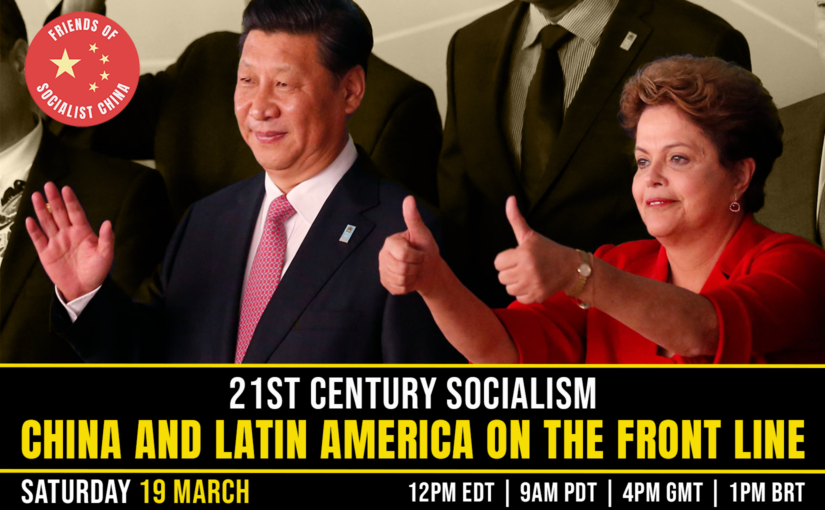
In the last two decades, economic links between Latin America and the People’s Republic of China have been expanding at a dizzying rate. Bilateral trade in 2000 was just 12 billion USD (1 percent of Latin American’s total trade); now it stands at 315 billion USD. In the same time period, China’s foreign direct investment in Latin America has increased by a factor of five.

Since the launch of the Belt and Road Initiative in 2013, 19 of the 33 countries in the Latin American and Caribbean region have signed up to the China-led global infrastructure development strategy. Infrastructure projects have been a particular focus for Chinese firms. Writing in Foreign Policy in 2018, Max Nathanson observed that “Latin American governments have long lamented their countries’ patchy infrastructure.” China has “stepped in with a solution: roughly $150 billion loaned to Latin American countries since 2005.”

Continue reading China plays a crucial role supporting progress and sovereignty in Latin America

On democracy in China: state power serves the people rather than capital

We’re pleased to republish below the full text of China: Democracy That Works, an important white paper released by China’s State Council Information Office on 4 December 2021.

At a time when the US and its allies are making a big push to promote Western capitalist democracy as the only legitimate form of governance (for example by holding a so-called Summit for Democracy this week), the document ‘China: Democracy That Works’ provides a detailed insight into China’s own democratic system. Many in the West, having been told for so long that China is ‘undemocratic’ and ‘authoritarian’, will be surprised to find out that China has an extensive system of electoral representation at every level of society. Unlike in the West, China’s electoral democracy is not manipulated by financial interests; electoral campaigns are not high-budget marketing exercises; and people get elected on the basis of their record of serving the people.

As the document states, “state power serves the people, rather than capital.” This is the fundamental difference between China’s socialist democracy and the West’s capitalist democracy. This basic fact explains how China, in spite of being a developing country, is able to so effectively prioritise meeting the needs of the masses of the people – eradicating absolute poverty, suppressing the Covid-19 pandemic, tackling homelessness, stamping out corruption, constructing the world’s biggest social welfare system, and transitioning to a low-carbon economy.

The document notes that different countries have different histories and national conditions and that there is no one-size-fits-all approach to democracy. It therefore does not attempt to universalise China’s democratic model, but it does forcefully reject the attempts by the Western capitalist countries to universalise their model.

Note that Friends of Socialist China and the International Manifesto Group are holding a Summit for Socialist Democracy on 11 December 2021 that will explore some of these ideas in detail.

Preamble

Democracy is a common value of humanity and an ideal that has always been cherished by the Communist Party of China (CPC) and the Chinese people.

This year marks the centenary of the CPC. Since its founding in 1921, the Party has taken wellbeing for the Chinese people and the rejuvenation of the Chinese nation as its abiding goals, and has made continuous efforts to ensure the people’s status as masters of the country. China is a country with a feudal history dating back several thousand years that descended into a semi-feudal and semi-colonial society after the Opium War of 1840. Over the past hundred years, the Party has led the people in realizing people’s democracy in China. The Chinese people now truly hold in their hands their own future and that of society and the country.

Continue reading On democracy in China: state power serves the people rather than capital

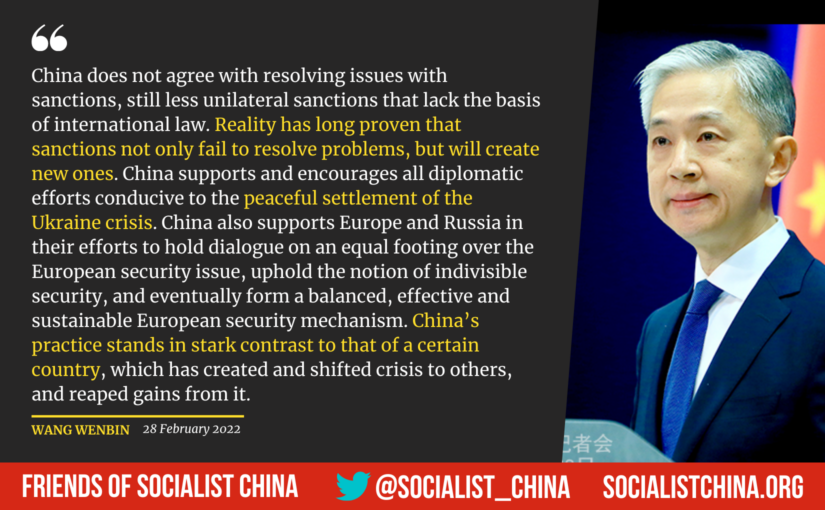
Quote: Wang Wenbin on the US’s brazen misuse of the word ‘democracy’

For too long the US has been using democracy as a cover to flagrantly engage in infiltration and subversion in sovereign countries, impose economic sanctions, cause turmoil and chaos, and wage wars of occupation, bringing disaster to the affected countries and the international community.

The so-called ‘Summit for Democracy’ will not turn Washington into a democratic high ground. It will only expose further the true face of the US as a manipulator and saboteur of democracy in front of the whole world.

Foreign Ministry Spokesperson Wang Wenbin’s Regular Press Conference on December 1, 2021

Danny Haiphong exposes the rank hypocrisy of the so-called Summit for Democracy

Co-editor of Friends of Socialist China Danny Haiphong appeared on By Any Means Necessary with Sean Blackmon and Jacquie Luqman to discuss the upcoming Summit for Democracy led by the Biden Administration. The conversation included an in-depth analysis of the differences between socialist democracy and capitalist democracy in preparation for FoSC’s upcoming Summit for Socialist Democracy. You can register for that here.

John Ross: The international and historical significance of the resolution on the history of the CPC

In his latest article, which we are pleased to republish from Learning from China, John Ross provides a useful summary of the three key resolutions on party history adopted by the Communist Party of China in its century of struggle. Against this background, John further outlines how generations of Chinese communists, and especially Mao Zedong, Deng Xiaoping and Xi Jinping, have defended, applied, enriched and developed Marxism-Leninism and in so doing have not only immeasurably improved the lives of the Chinese people but also contributed significantly  to the progress of humanity, especially to the liberation struggles of the countries and peoples of Asia, Africa and Latin America.

The following article was originally published in Chinese by Guancha.cn.

The “Resolution on the Major Achievements and Historical Experience of the Party over the Past Century”, adopted by the Sixth Session of the 19th Central Committee of the Communist Party of China (CPC) in November 2021, is, rightly, regarded as in the first place an issue for China itself. As the Resolution notes in its first sentence: “Since its founding in 1921, the Communist Party of China (CPC) has remained true to its original aspiration and mission of seeking happiness for the Chinese people and rejuvenation for the Chinese nation.”

It is obviously correct to start with the position of China itself. But the second sentence of the Resolution starts by noting the connection of China’s national struggle with international developments – in particular in regard to socialism: “Staying committed to communist ideals and socialist convictions, it [the CPC] has united and led Chinese people of all ethnic groups in working tirelessly to achieve national independence and liberation.” Indeed, for reasons that will be analysed, this resolution on the history of the CPC is of very great international and historical importance for all countries as well as for China itself. Therefore, while in no way wishing to deflect from the correctly China focussed nature of discussion on the Resolution, it is also hoped here it may cast some light on the discussion if international aspects of the significance of the Resolution are also considered.

Continue reading John Ross: The international and historical significance of the resolution on the history of the CPC

China and Africa: The real story of Western hypocrisy

In this extensive interview and conversation between Brian Becker and Professor Ken Hammond, these two veteran activists dissect China’s policies towards and presence in Africa. Starting with the latest ‘fake news’ fabrication regarding China supposedly seizing control of Uganda’s main airport, they contrast China’s strategy of win-win cooperation to the rapacious record of imperialism on the African continent, and situate this within the changing dynamics of relations between the US and China.

Bertie Ahern: China’s infrastructure investment has been of major benefit to the people of Africa

In this short interview with CGTN in advance of the 8th Ministerial Conference of the Forum on China-Africa Cooperation (FOCAC), former Irish Prime Minister Bertie Ahern gives his opinions on China-Africa relations. He praises the growing role of FOCAC, points to the transformative impact of China’s infrastructure investment, and debunks the idea that China has laid a ‘debt trap’ for African countries; indeed he notes China’s leading role in debt relief for poor and indebted nations. Video embedded below.

Keynote speech by Xi Jinping at opening ceremony of 8th FOCAC ministerial conference

We are very pleased to publish the full text of President Xi Jinping’s important speech to today’s opening ceremony of the Eighth Ministerial Conference of the Forum on China-Africa Cooperation. 

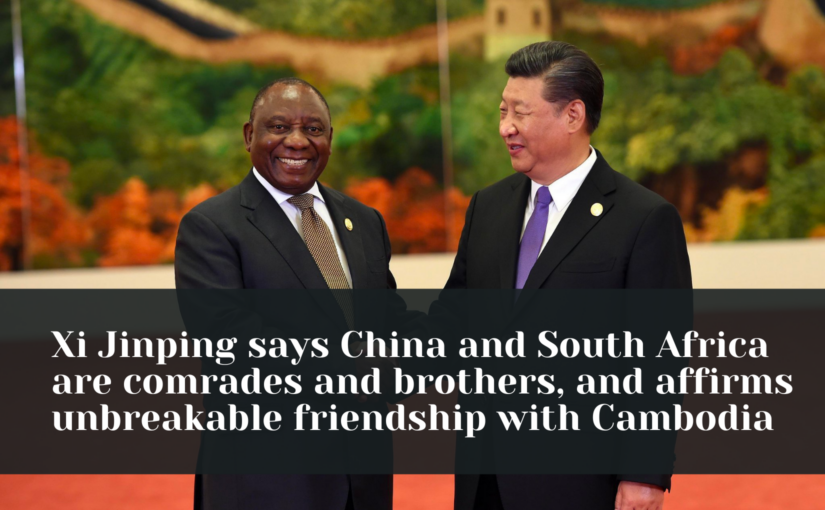
Noting that this year marks the 65th anniversary of the start of diplomatic relations between China and African countries, Xi notes that China and Africa have “forged unbreakable fraternity in our struggle against imperialism and colonialism”.

The Chinese President goes on to make four proposals, concerning fighting Covid-19, deepening practical cooperation, promoting green development and upholding equity and justice. 

He further notes that the two sides have jointly prepared the ‘China-Africa Cooperation Vision 2035’. Its first three-year plan features nine programmes, covering medical and health, poverty reduction and agricultural development, trade promotion, investment promotion, digital innovation, green development, capacity building, cultural and people-to-people exchange, and peace and security. 

Your Excellency President Macky Sall,

Distinguished Colleagues,

Dear Guests and Friends,

It is such a pleasure to attend the opening ceremony of the Eighth Ministerial Conference of the Forum on China-Africa Cooperation (FOCAC). Let me first express sincere appreciation to President Sall and the government of Senegal for their excellent organization, and extend a warm welcome to the colleagues and guests attending the Conference.

This year marks the 65th anniversary of the start of diplomatic relations between China and African countries. Over the past 65 years, China and Africa have forged unbreakable fraternity in our struggle against imperialism and colonialism, and embarked on a distinct path of cooperation in our journey toward development and revitalization. Together, we have written a splendid chapter of mutual assistance amidst complex changes, and set a shining example for building a new type of international relations.

Continue reading Keynote speech by Xi Jinping at opening ceremony of 8th FOCAC ministerial conference

Remembering Mao Anying, son of Mao Zedong who died fighting US imperialism in Korea

The following article by Xia Yuansheng – president of the Hunan Provincial CPC Historical Figures Research Association – recalls the heroic sacrifice of Mao Anying (eldest son of Mao Zedong), who died on the frontlines of resistance against US imperialism and in solidarity with the Korean people. This episode forms part of a tremendously important history of militant anti-imperialist solidarity and enduring bonds of friendship between China and the DPRK.

The article was published in Chinese in 2010. It is included in the most recent issue of Dongsheng Chinese Voices, to mark the 71st anniversary of Mao Anying’s death (25 November 1950). Chinese Voices provides a valuable weekly newsletter containing a selection of articles by key Chinese thinkers.

On 25 June 1950, the Korean War broke out. On the third day, the United States imperialists announced armed assistance to south Korea and at the same time ordered its Seventh Fleet to sail into the Taiwan Strait, blatantly interfering in China’s internal affairs, and on 15 September the United States landed at Inchon and soon crossed the “38th parallel”, blatantly burning the war to the border of China and North Korea and the Yalu River, directly threatening the security and peace-building of new China. Faced with the most severe test of foreign war, political and military struggle, the Central Committee of the Communist Party of China, at the request of the Workers’ Party of Korea, the Government of the Democratic People’s Republic of Korea and the will of the Chinese people, decided to send troops to resist the U.S. and aid the DPRK. on October 18, Mao Zedong, Chairman of the Central Military Commission, issued the order “Resist the U.S. and aid the DPRK, protect the country”. On October 18, Mao Zedong, Chairman of the Central Military Commission, issued an order “to defend the interests of the Korean people, the Chinese people and the peoples of the East by transforming the Northeast Frontier Defense Army into the Chinese People’s Volunteer Army and marching to the territory of Korea at once to fight with the Korean comrades against the invaders and to strive for a glorious victory”. On October 25, the first battle was won, opening the prelude to the war against the U.S. and Korea, so the Chinese people have always taken this day as the anniversary of the Chinese People’s Volunteer Army’s departure for North Korea.

Continue reading Remembering Mao Anying, son of Mao Zedong who died fighting US imperialism in Korea

Elias Jabbour: The “fundamental law” of the new Chinese socioeconomic formation

This brief original essay by Elias Jabbour, Professor at the School of Economics, Rio de Janeiro State University, introduces a key idea from his book with Alberto Gabriele, China: Socialist Economic Development in the 21st Century (due to be released by Routledge in English in March 2022), emphasising that China’s combination of a hybrid economy, Communist Party leadership and innovative and effective governance collectively constitute an important development of Marxist political economic theory.

The task of each and every social scientist dedicated to the evolution of humankind runs through understanding in which stage the human anatomy is, what we must keep in mind in order to better understand the progress of the monkey´s anatomy.

Likewise, in socio-historical terms, it is central to comprehend which is the most advanced formation in course in the world today. This is how we arrived at the Chinese “Market Socialism” and its particularities, what led us to designate it as a “new socioeconomic formation”. As President Dilma Roussef pointed out at the launch of our book, it is “not emerging as a result of a pre-existing capitalism”. The challenge now is to discover the nature of its functioning, its internal coherence, the “universal in the particular”.

Continue reading Elias Jabbour: The “fundamental law” of the new Chinese socioeconomic formation

Global Times editorial on the inclusion of Taiwan province in Biden’s ‘Summit for Democracy’

This significant editorial from leading Chinese newspaper Global Times warns that the Biden administration is making a dangerous and provocative mistake in inviting the Taiwan authorities to its so-called Summit of Democracies next week. This dangerous escalation on the part of the US lends increased topicality and indeed urgency to our own Summit for Socialist Democracy, to be held on December 11, and which includes Chinese, Cuban, Vietnamese, Korean and Venezuelan perspectives among others.

The US Department of State released on Tuesday evening the list of 110 “participants” to the “Summit for Democracy.” 

What caught the immediate attention of worldwide media were, first, the island of Taiwan was on the list; second, several countries were missing from the list, not just China and Russia, but also Turkey, a NATO member, Hungary, an EU and NATO member, and Singapore, Thailand and Vietnam from Asia, and all the countries from the Middle East except for Israel and Iraq. 

Taiwan being invited was the most eye-catching. In addition to being thankful to the Biden administration, the Democratic Progressive Party (DPP) authority immediately announced its representatives to the summit including Audrey Tang Feng, a member of Taiwan’s “executive authority,” and Hsiao Bi-khim, the island of Taiwan’s representative to the US. 

Continue reading Global Times editorial on the inclusion of Taiwan province in Biden’s ‘Summit for Democracy’

China hails solidarity with Africa as cornerstone of its foreign policy

This article from CGTN provides a useful summary of the latest Chinese government White Paper on relations with Africa. China and Africa in the New Era: A Partnership of Equals was published by the State Council of the PRC on Friday, ahead of an important meeting of the Forum on China Africa Cooperation (FOCAC).

China and Africa trust each other, and their friendship is rock solid, a white paper on cooperation with the continent issued by China’s State Council Information Office said on Friday.
  
The report, titled “China and Africa in the New Era: A Partnership of Equals,” said shared past experiences and similar aims and goals have brought China and Africa close together and they will always be a “community of shared future.” 
  
Developing solidarity and cooperation with African countries has been the cornerstone of China’s foreign policy, as well as a firm and longstanding strategy, it said.

Continue reading China hails solidarity with Africa as cornerstone of its foreign policy

Danny Haiphong: The Summit for Democracy’s undemocratic agenda

Co-editor of FoSC Danny Haiphong analyzes the Biden administration’s Summit for Democracy to be held on December 9th and 10th. Haiphong argues that the Summit reinforces the US’s exclusionary imperialist agenda with an aim toward mobilizing allies against China. Friends of Socialist China is organizing a counter Summit for Socialist Democracy. The summit will take place on December 11th and feature analysis of the differences between socialist democracy and capitalist democracy.

The Biden administration is set to hold its “Summit for Democracy” beginning December 9. The summit comes after a period of positive dialogue between the United States and China. China and the U.S. ended COP26 with a joint declaration on the climate crisis.

Less than a week later, Chinese President Xi Jinping and his U.S. counterpart Joe Biden took part in a virtual meeting that further emphasized a spirit of cooperation. Experts from both countries believed that the meeting boosted momentum toward the removal of Trump-era tariffs which continue to harm U.S. economic interests. However, the “Summit for Democracy” possesses a clear political agenda that contradicts the progress made in recent U.S.-China talks.

Continue reading Danny Haiphong: The Summit for Democracy’s undemocratic agenda

China, Africa to further boost ties

With the 8th ministerial meeting of the Forum on China Africa Cooperation (FOCAC) opening in Senegal on Monday, this useful article from China Daily highlights how friendship, solidarity and cooperation with Africa have been a cornerstone of Xi Jinping’s foreign policy since he became President of China in 2013. His first foreign trip as head of state, days after taking office, took him to Russia, Republic of Congo, Tanzania and South Africa.

Development of relations guided by principles of ‘amity, real results’

Days after he was elected China’s president in March 2013, Xi Jinping embarked on his first overseas trip as head of state. Three of the tour’s four destinations were African countries.

When making a speech at the Julius Nyerere International Convention Centre in Dar es Salaam in Tanzania, Xi said the trip was his sixth visit to the continent.

“When I visit Africa, I am always struck by two things,” Xi said. “One is its continuous progress. Each time I come to Africa, I am deeply impressed by new progress in development, which is most encouraging. The other is the warmth of the African people.”

Continue reading China, Africa to further boost ties

Table tennis champ Connie Sweeris discusses her experience playing in China

Embedded below is a lovely video interview of Connie Sweeris, then the US national women’s singles table tennis champion, reflecting on her visit to China in 1971 as part of the ‘ping-pong diplomacy’ mission – an important first step on the road to US-China normalization. With the Beijing Winter Olympics coming up in early 2022, and with the US and other countries threatening a diplomatic boycott, Connie Sweeris emphasizes the power of sport in breaking down barriers and building understanding between peoples.

Keith Lamb: Blocking China’s semiconductor industry is an attempt to impede the construction of socialism

We republish below an important piece of analysis by Keith Lamb, originally published in CGTN on 23 November 2021, seeking to understand the US’s motivations in imposing restrictions on China’s semiconductor industry. The author concludes that semiconductor technology is crucial for China’s goal of building a modern socialist country by 2049, and that the US and its allies are determined to impede – or ideally prevent – any further economic breakthroughs for socialist China.

Since 2015, the U.S. has introduced technological restrictions preventing China from both competing openly in consumer markets and acquiring technology. Restrictions have focused on the semiconductor industry and correlated sectors. For example, the Chinese chipmaker Semiconductor Manufacturing International (SMIC) was blacklisted in December 2020, and, just before this, U.S. and non-U.S. chipmakers who use U.S. semiconductor technology, were forced to comply with U.S. sanctions meaning they could no longer take orders from companies like Huawei.

The U.S. has justified its actions by citing China’s civil-military integration where semiconductors can be used in advanced weaponry. However, even if true, considering the U.S. military and the microchip industry grew in tandem, this crossover wouldn’t be extraordinary. At any rate, it isn’t China’s military that surrounds the U.S., and nor does China seek to confront the U.S. which sits securely protected by two oceans and two compliant neighbors.

Continue reading Keith Lamb: Blocking China’s semiconductor industry is an attempt to impede the construction of socialism

The significance of the new road of Chinese style modernization and its positive role in the world socialist movement

This interesting paper was presented by Guan Wei of the School of Marxism, Dalian University of Technology (DUT) at the School’s Cloud International Workshop on ‘New Forms of Human Civilisation from a World Perspective’, held October 29-31 2021.

Guan argues that: “Since the disintegration of the Soviet Union and the drastic changes in Eastern Europe, the world socialist movement has fallen to a low ebb. Through unremitting efforts, socialism with Chinese characteristics has become the mainstay of the world socialist movement in the 21st century… China has opened a new path of Chinese modernization and a new prospect for the development of world socialism.”

Thanks to the DUT Translation Team and to Professor Roland Boer for subediting.

Abstract: In the “7.1” speech delivered at the 100th anniversary of the Communist Party of China, Comrade Xi Jinping pointed out that China adheres to and develops socialism with Chinese characteristics, and has created a new road of Chinese style modernization and a new form of human civilization. This important exposition breaks through the theoretical and practical model of modernization with the West as the core, and puts forward a new path of Chinese modernization based on the practice of socialist modernization with Chinese characteristics. Since the disintegration of the Soviet Union and the drastic changes in Eastern Europe, the world socialist movement has fallen to a low ebb. Through unremitting efforts, socialism with Chinese characteristics has become the mainstay of the world socialist movement in the 21st century. Especially since the global economic crisis in 2008, China’s developmental achievements are obvious to all. With the achievements of its own development and its own practice of construction, China has opened a new path of Chinese modernization and a new prospect for the development of world socialism.


Since the 18th National Congress of the Communist Party of China (2012), socialism with Chinese characteristics has entered a new era, and China has opened up a new prospect for socialist development with its own developmental achievements and practice in construction. Especially since the global economic crisis in 2008, China’s development achievements are obvious to all. In his “7.1” speech, delivered at the 100th anniversary of the Communist Party of China, Comrade Xi Jinping pointed out that China adheres to and develops socialism with Chinese characteristics, and has created a new path of China’s modernization and new form of human civilization.

Continue reading The significance of the new road of Chinese style modernization and its positive role in the world socialist movement

China’s war on poverty

We are very pleased to publish this original article by Stefania Fusero, analysing the extraordinary successes of China’s targeted poverty alleviation program. The Italian version of the article will be published in two parts in La Città Futura.

In May 2020, PBS, a US public broadcaster, aired “China’s War on Poverty”, a documentary film co-produced with CGTN (Chinese State Television). A few days later, Daily Caller, a right-wing news website, accused the documentary of being “pro-Beijing”. After Fox News followed suit, PBS removed the film from its network.

According to Robert L. Kuhn, the producer of the film, the eradication of poverty in China ought to be understood by everybody, owing to the relevance it bears for the entire planet.

It is undoubtedly the story of a huge success of China’s, therefore it is no surprise that the western media and political establishment does not want it to be known and autonomously evaluated across our “free” world, whose citizens are kept carefully sheltered from any positive news about China.

The film can still be watched on CGTN YouTube channel at this link.

Here we will try to illustrate how the PRC managed to eradicate extreme poverty ten years ahead of the schedule set out in the UN 2030 Agenda for Sustainable Development.


In 2000, all UN member states committed to achieve eight development goals by the year 2015, the so-called Millennium Development Goals, the first of which was to halve the number of people living in poverty. Whereas China managed to achieve the goal by 2015, other countries did not. Thus in 2015 the commitments were reaffirmed in the 2030 Agenda for Sustainable Development, a plan of action for people, planet and prosperity announcing seventeen Sustainable Development Goals to be achieved by 2030, the first and foremost of which was “to end poverty”.

Continue reading China’s war on poverty

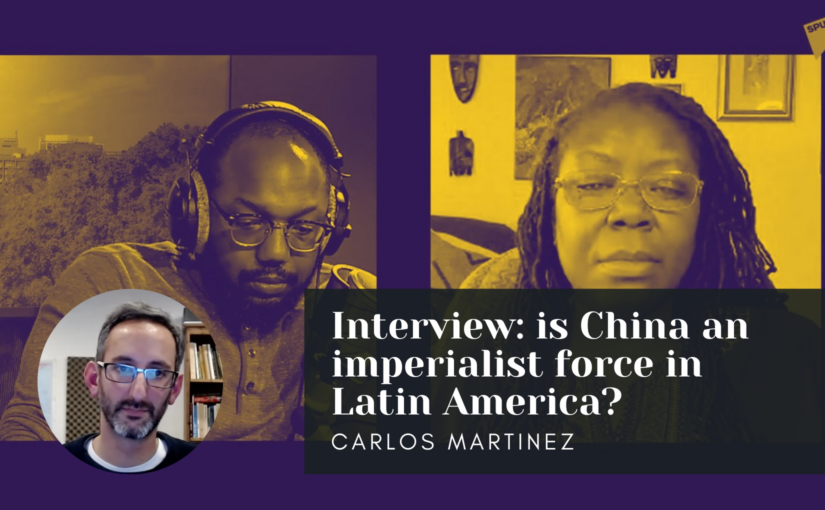
Li Jingjing interviews Carlos Martinez on Xi-Biden Summit

Friends of Socialist China co-editor Carlos Martinez was interviewed by CGTN journalist Li Jingjing about the recent Xi-Biden summit, the prospects for the New Cold War in the coming period, the failure of the trade war, the influence of the military-industrial complex on US policy, escalating tensions over Taiwan, and the possibilities for cooperation between the major countries on the question of climate change.

Danny Haiphong: The fake Peng Shuai scandal is part of US efforts to disrupt Beijing Winter Olympics

The following article by Danny Haiphong, originally published in MintPress News, takes a detailed look at the recent story of Chinese tennis player Peng Shuai, who was alleged to have ‘disappeared’ in early November after posting allegations of sexual assault against former Vice Premier Zhang Gaoli. Danny exposes the absurdly sensationalized version of the story that appeared in the Western press, and shows how it is feeding into US efforts to demonize China and disrupt the Beijing 2022 Winter Olympics.

The New York Times reported on November 3 that Chinese tennis star Peng Shuai had published allegations of sexual assault against former Vice Premier of the People’s Republic of China Zhang Gaoli on the social media platform Weibo. Peng’s post was deleted within 24 hours. This led to a firestorm of speculation in U.S. corporate media about Shuai’s “safety” and whether the tennis star had gone missing. The hashtag #WhereisPengShuai went viral 10 days later after the CEO of the World Tennis Association (WTA), Steve Simon, called on Chinese authorities to investigate the situation. Prominent celebrities and tennis players such as Serena Williams also went public with their concern for Peng.

Continue reading Danny Haiphong: The fake Peng Shuai scandal is part of US efforts to disrupt Beijing Winter Olympics