The Western left must reject anti-China propaganda and join the progressive global trend

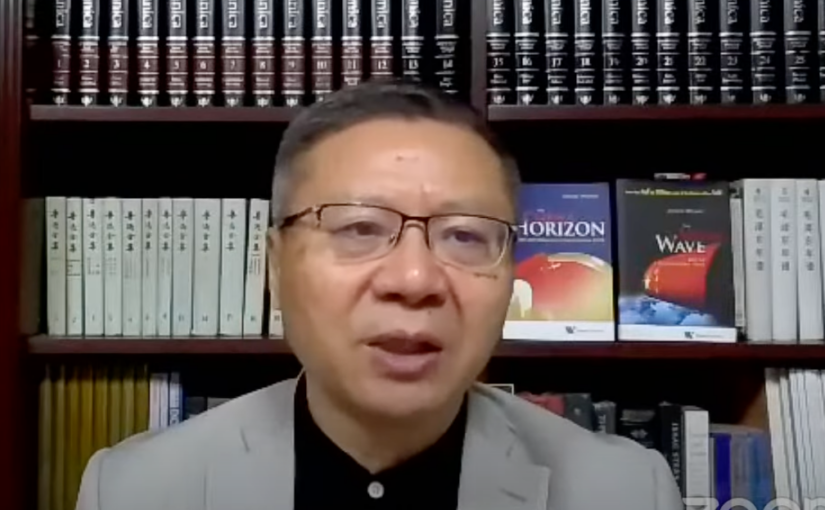
What follows is the text of a speech given by veteran British peace activist and China specialist Jenny Clegg at the launch event in London for Carlos Martinez’s book The East is Still Red: Chinese socialism in the 21st century.

Summarising the key points of the book, Jenny highlights in particular the escalating New Cold War and anti-China rhetoric in the West. “China is being presented as an existential threat to the Western way of life so as to prepare a climate for war.”

Beyond the obvious dangers of preparing a climate for war, Jenny points out that the incessant lies and misinformation about China also serve to cut progressive movements in the West off from a rising multipolarity, thereby leaving them “isolated from potential alternatives, trapped in the cul-de-sac of racist myths of the indispensable West.” And further: “The Western Left risks getting left behind as the multipolar trend begins to shift US hegemonism and imperialism to the margins.”

Jenny concludes by recommending the book as a weapon against the New Cold War; a “tool for activists to get ready to grasp the great changes that are unfolding.”

The East is Still Red – Chinese socialism in the 21st century can be purchased in paperback or digital editions from Praxis Press.

Back in 2017, following Trump’s election, Xi Jinping made a landmark observation that ‘the world is in the midst of great changes unseen in a century’.

At that time, there were only a handful of us on the Left here in Britain seriously following China – connecting now and then to a few other individuals in Europe, in North America.

As Trump went on to unleash his trade and technology wars, disrupting 40 relatively tranquil years of US-China engagement, we found ourselves deluged in hostility, struggling to stay sane in an environment awash with crazy lies and disinformation – about the Hong Kong ‘democracy’ movement, the Uighurs, the so-called ‘Wuhan virus’ – unleashing Sinophobia.  Distinct among racisms, this gives the ‘threatening hordes’ a leader, imagining behind every Chinese lurks a demonic Fu Manchu.  We began to network.

Then came Pompeo’s speech at the Nixon Centre in July 2020 – “Securing our freedoms from the Chinese Communist Party is the mission of our time” he declared.  Our networks sprang into action – first No Cold War, then the International Manifesto Group, initiated by Radhika Desai (whose book on Coronavirus, Capitalism and War we launched here just over a month ago), and also Friends of Socialist China. 

Continue reading The Western left must reject anti-China propaganda and join the progressive global trend

CPC deepens ties with Central and Eastern European Marxist parties

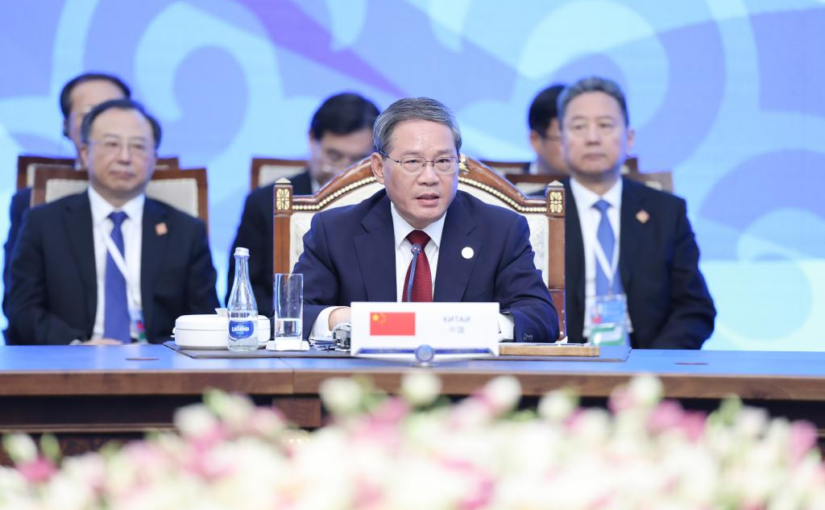
On June 2, the delegation met with Liu Jianchao, Minister of the Communist Party of China’s International Department (IDCPC). Liu told the visitors that the CPC and the communist parties and left-wing parties from Central and Eastern European countries visiting China this time are all Marxist parties. Both sides should strengthen theoretical discussions and jointly tell the stories of Marxism in the 21st century and the communist parties in our respective countries. And both sides should deepen exchanges and mutual learning in the concept and experiences of party building and state governance, better assist each other in advancing the adaptation of Marxism to the local context and the needs of our times, and explore development paths for socialism. Both sides should also strengthen solidarity and cooperation on multilateral platforms, safeguard common interests, and push relations between China and Central and Eastern European countries as well as China-Europe relations more generally.

Leaders of the various parties said that their visit to China had allowed them to witness the tremendous achievements China has made in the economic, social, and cultural fields, fully demonstrating the superiority of the socialist system and indicating that socialism is not only viable but also represents the future of the world. China’s achievements have provided confidence and inspiration for other countries around the world, and more and more countries hope to strengthen cooperation with China, while more and more political parties hope to enhance exchanges and mutual learning with the CPC on state governance and administration.

The following article was originally carried on the website of the IDCPC.

Liu Jianchao, Minister of the International Department of the CPC Central Committee, met here today with a delegation of political parties from Central and Eastern European countries led by Katerina Konecna, Chairwoman of the Communist Party of Bohemia and Moravia and Member of the European Parliament from the Czech Republic.

Liu said, China and Central and Eastern European countries have a long-standing traditional friendship, and bilateral cooperation has maintained good development momentum in recent years. Inter-party exchanges are an important support for the development of state-to-state relations. The CPC and the communist parties and left-wing parties from Central and Eastern European countries visiting China this time are all Marxist parties. Both sides should strengthen theoretical discussions and jointly tell the stories of Marxism in the 21st century and the communist parties in our respective countries. Both sides should deepen exchanges and mutual learning in the concept and experiences on party building and state governance, better assist each other in advancing the adaption of Marxism to the local context and the needs of our times, and explore development paths for socialism. Both sides should also strengthen solidarity and cooperation on multilateral platforms, safeguard common interests, and push relations between China and Central and Eastern European countries as well as China-Europe relations for further development.

Continue reading CPC deepens ties with Central and Eastern European Marxist parties

On economic coercion: Imperialist hypocrisy reigns supreme

In this article for the Morning Star, Andrew Murray takes issue with the G7’s accusations against China over ‘economic coercion’. Andrew points out that this obscenely hypocritical accusation is just the latest excuse for China-bashing. “With Hong Kong now quiet, the Covid pandemic abating and the Dalai Lama asking young followers to suck his tongue, the world’s great capitalist powers have instead united around challenging China’s economic relations with the rest of the world.”

The article details the extensive economic coercion practised by the US, including sanctions on Afghanistan, Belarus, China, Cuba, Eritrea, Russia, Sudan, Syria, Iran, Libya, Myanmar, North Korea, Nicaragua, Venezuela, Yemen, Zimbabwe and Palestine – almost none with UN backing. “The US really loves its sanctions.” Aside from which, the US’s financial domination is built precisely on coercion, in the form of forced austerity, privatisation and deregulation.

China, meanwhile, “has been lending money to countries across the global South to help power their development and give them an option beyond dependence on London and Washington.” Certainly it’s true that China benefits from its loans and investments, but with the all-important difference that “there is no Chinese McDonnell Douglas lurking in the small print of their deals. Beijing is not going to invade or bomb anyone, nor subvert a sovereign government.”

Andrew concludes that the G7’s China-bashing is simply a manifestation of the US and its allies refusal to accept that the days of their “rules-based world order” (ie hegemony) are numbered: “The G7 attacks on China are the sound of the departing masters of the universe raging against the passing of their power.”

A brand new spectre is haunting the head honchos of the world economy — it is “economic coercion.”

Who is doing the coercing? The People’s Republic of China of course.

Having decided to convene, wildly inappropriately, in Hiroshima last month, it was perhaps inevitable that the leaders of the G7 states would devote some time to stoking up international conflict.

Today, that means above all finding fresh reasons to confront China. With Hong Kong now quiet, the Covid pandemic abating and the Dalai Lama asking young followers to suck his tongue, the world’s great capitalist powers have instead united around challenging China’s economic relations with the rest of the world.

Now to accuse imperialists of hypocrisy is akin to accusing the Pope of believing in the resurrection or Keir Starmer of believing in nothing much at all. It is not just a statement of the obvious, it is a key part of the job specification.

Continue reading On economic coercion: Imperialist hypocrisy reigns supreme

Closer ties with NATO would be a strategic blunder for India

In the following article, which was originally published in the Morning Star, Keith Lamb argues that Washington’s flattery of India and its encouragement of stronger ties with NATO, citing an alleged “Chinese threat”, is a trap into which New Delhi should not fall. The border dispute between India and China, he notes, is a legacy of British colonial aggression and India’s future lies in greater cooperation with China and the Global South generally. India’s support for the struggle of Mauritius to reclaim the Chagos Archipelago, a territory in the Indian Ocean which remains under illegal British colonial control and is home to a massive US military base, is cited by Keith as an example of how India grasps this imperative on some level. India’s interests, he argues would be well served by further consolidation of the BRICS grouping and greater promotion of regional energy integration and supply chains, not least the long-mooted Turkmenistan-Afghanistan-Pakistan-India (TAPI) natural gas pipeline.

After a recommendation by the congressional committee on strategic competition with China, the US claims that India “is one of Washington’s closest allies.” As such, it is now courting India to join Nato to counter Chinese “aggression.”

India must not fall to Washington’s flattery and the trumped-up China threat. Strategically and economically, India’s future lies with greater co-operation with China and the global South, not Nato, which opposes development.

In terms of Chinese “aggression,” the US hypes up the border dispute. This dispute is a remnant of British colonialism annexing Chinese territory.

China’s claims are rational, not expansionist — they exist due to British hegemonic attempts to swallow up both China and India.

Importantly, this dispute is managed unprecedentedly well. The line of actual control is patrolled by non-gun-carrying troops. This peaceful status quo would be ruined by US-led Nato machinations, which continue, under a different guise, the hegemonic project of the British empire.

Colonialism hasn’t finished — it is alive under US leadership which has a greater global military presence than under the British empire. It seeks, through its hard power, to divide the global South and bring it to heel — strategically this is what India’s invitation to Nato represents.

On one level, India understands this, which is why India backs Mauritius’s claim on the British-controlled Chagos Archipelago in the Indian Ocean, which hosts a US military base capable of threatening the Indian subcontinent.

The US talks about developing India and using India as the new “world factory,” but due to hegemonic strategic concerns, a country the size of India will never be allowed to develop to a comparable standard to that of the US

Hegemonism doesn’t seek development — it seeks to exploit and it seeks unipolarity. Those who try to break out of the net of economic domination will be countered.

China is the perfect example of this. It co-operated with the US, but due to its huge size, even a modest standard of development is seen as a threat to unipolarity.

India, if successful, would encounter the same problem — though if it loses its independence to the cancer of Nato perhaps it will never develop beyond being a low-end factory.

Anyone who doubts the resolve of the US and its power to silently smother its Nato “allies” needs to revisit the Nord Stream pipeline bombing allegations.

Europe is now cut away from Eurasia and is more reliant than ever on transatlantic shipping for its trade and energy.

India, though artificially disconnected from Eurasia, due to politics and connectivity, unlike the Nato-led Europe, still has the independence to overcome these issues.

Political co-operation can be achieved through the Brics coalition, which is currently expanding based on the principle of win-win global South development, rather than Nato’s principle of preventing the rise of the global South.

Continue reading Closer ties with NATO would be a strategic blunder for India

Friendly foreign leaders congratulate Xi Jinping on his 70th birthday

Although not publicly observed in China, President Xi Jinping marked his 70th birthday on June 15. A number of friendly foreign leaders greeted their Chinese counterpart on this occasion.

In his message, top leader of the Democratic People’s Republic of Korea (DPRK) Kim Jong Un recalled that Xi Jinping, with a high sense of responsibility for the party, the state and the people, has devoted himself to the socialist cause with Chinese characteristics for a long time and now enjoys the respect and trust of all the members of the Communist Party of China and the Chinese people.

Thanks to his energetic leadership, Kim continued, the prestige of the Communist Party of China has been further enhanced, the goal of building a comprehensively well-off society successfully attained, and China’s overall national power and international position remarkably strengthened. The message expressed belief that the struggle for the prosperity of China will surely emerge victorious as there are the leadership of Xi Jinping and the Chinese party and people rallied around the Party Central Committee with him as its core.

Russian President Vladimir Putin wrote that: “The importance of your years-long efforts to strengthen the relations of comprehensive partnership and strategic interaction between our countries cannot be overstated. The state visit you made to Russia in March gave a powerful impetus to the further development of our mutually beneficial cooperation in key areas.”

Belarus President Aleksandr Lukashenko wrote: “As a truly people’s leader of a great country, you have made a significant contribution to maintaining world peace and promoting global progress. The impressive successes of the People’s Republic of China in building a modernized socialist state and reviving the Chinese nation have been made possible thanks to your strategic leadership, which is based on the absolute trust in the Party and genuine service to your people.”

The following articles were originally carried by the Korean Central News Agency (KCNA), the website of the President of Russia, and the Belta Belarus News Agency.

Additionally, we embed below a short but moving documentary released by CGTN on June 17, depicting President Xi’s devoted and untiring service to the people of China, especially farmers, workers, and those in disadvantaged circumstances, from his teenage years to the present.

Respected Comrade Kim Jong Un Sends Birthday Greetings to General Secretary Xi Jinping

KCNA, 15 June 2023

Kim Jong Un, general secretary of the Workers’ Party of Korea and president of the State Affairs of the Democratic People’s Republic of Korea, sent a congratulatory message to Xi Jinping, general secretary of the Central Committee of the Communist Party of China and president of the People’s Republic of China, on Thursday.

The respected Comrade Kim Jong Un in the message extended the warmest congratulations to General Secretary Xi Jinping on his 70th birthday.

The message recalled that Xi Jinping, with a high sense of responsibility for the Party, the state and the people, has devoted himself to the socialist cause with Chinese characteristics for a long time and now enjoys the respect and trust of all the members of the Communist Party of China and its people.

Thanks to his energetic leadership, the prestige of the Communist Party of China has been further enhanced, the goal of building a comprehensively well-off society successfully attained and China’s overall national power and international position remarkably strengthened, the message said.

Kim Jong Un in the message said that he is sincerely pleased to see Xi Jinping achieving great successes in the new course of comprehensively building a modern socialist state by leading the Chinese party and people.

The message expressed belief that the struggle for the prosperity of China will surely emerge victorious as there are the leadership of Xi Jinping and the Chinese party and people rallied around the Party Central Committee with him as its core.

The message wished Xi Jinping greater success in his important and responsible work for leading the Communist Party of China, the People’s Republic of China and the Chinese nation.

It sincerely wished him good health and his family happiness.


Birthday greetings to President of China Xi Jinping

President of Russia, 15 June 2023

Vladimir Putin sent greetings to President of the People’s Republic of China Xi Jinping on his 70th birthday.

The message reads, in part:

“The People’s Republic of China has achieved impressive results under your guidance. Its economy is growing steadily, the well-being of the people is improving, and Beijing’s position on the international stage is growing stronger.

Your re-election as General Secretary of the Communist Party of China and President of the People’s Republic of China has reaffirmed your high political prestige and broad public support for your policy.

The importance of your years-long efforts to strengthen the relations of comprehensive partnership and strategic interaction between our countries cannot be overstated. The state visit you made to Russia in March gave a powerful impetus to the further development of our mutually beneficial cooperation in key areas.

I hope to continue our constructive dialogue and close joint efforts on the main issues of the bilateral, regional and international agenda to the benefit of the peoples of Russia and China.

Dear friend, I wholeheartedly wish you health, happiness, prosperity and success in your public activities.”


Lukashenko confident in Minsk-Beijing future fruitful contacts

Belta, 15 June 2023

Belarusian President Aleksandr Lukashenko has sent birthday greetings to Chinese President Xi Jinping, BelTA learned from the press service of the Belarusian leader.

“As a truly people’s leader of a great country, you have made a significant contribution to maintaining world peace and promoting global progress,” the head of state said. “The impressive successes of the People’s Republic of China in building a modernized socialist state and reviving the Chinese nation have been made possible thanks to your strategic leadership, which is based on the absolute trust in the Party and genuine service to your people.”

Aleksandr Lukashenko stressed: “I highly appreciate our friendly and trusting relations. I am sincerely glad that for many years we have been united by a common aspiration to build a fair multipolar world order and to create conditions for comprehensive development of both countries.”

The Belarusian president has said that he warmly recalls the meeting in March 2023 and expressed strong confidence in the continuation of fruitful contacts between Minsk and Beijing to strengthen the all-weather and all-round strategic partnership.

“I have no doubt that China will hold the next Belt and Road international cooperation forum at the highest level. The Republic of Belarus, as the first country in Eastern Europe to join this project, is ready to take an active part in the event this year, to bring new ideas aimed at ensuring harmonious and sustainable development in the Eurasian space, and to provide all possible assistance in the quality implementation of China’s Belt and Road initiative,” the head of state said.

Aleksandr Lukashenko wished Xi Jinping good health, many more years of creative activities and important achievements for the benefit of friendly China.


China firmly supports the just cause of the Palestinian people

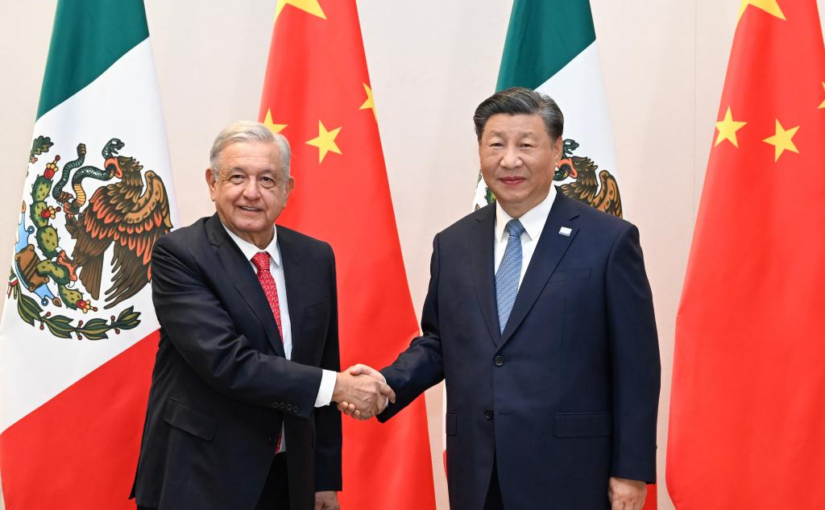
President Mahmoud Abbas of the State of Palestine paid his fifth state visit to the People’s Republic of China, at the invitation of President Xi Jinping, between June 13-16, 2023, becoming the first Arab head of state to visit China this year.

China is one of the earliest and most consistent supporters of the Palestinian people’s just struggle for their national rights and an independent state. This year sees the 35th anniversary of the formal establishment of relations between China and Palestine at state level. However, the mission of the Palestine Liberation Organization (PLO) to China was accorded diplomatic status right from when it was first established in Beijing in 1965.

Meeting President Abbas on June 14, President Xi Jinping said China and Palestine are good friends and good partners who trust and support each other. China has all along firmly supported the Palestinian people’s just cause of restoring their legitimate national rights and worked for a comprehensive, just and durable solution of the Palestinian question at an early date.

China supports Palestine in becoming a full member state of the United Nations, will continue to speak up for Palestine and champion justice on multilateral occasions, and will provide assistance as best as it can to help ease humanitarian difficulties and promote reconstruction in Palestine, Xi added.

The Chinese president put forward a three-point proposal for the settlement of the Palestinian question, stressing that the Palestinian question has remained unresolved for over half a century, causing great sufferings to the Palestinian people; justice must be done to Palestine as soon as possible.

First, the fundamental solution lies in the establishment of an independent state of Palestine that enjoys full sovereignty on the basis of the 1967 borders and with East Jerusalem as its capital, he said.

Second, Palestine’s economic and livelihood needs should be met, and the international community needs to step up development assistance and humanitarian aid to Palestine.

Third, it is important to keep to the right direction of peace talks. The historical status quo of the holy sites in Jerusalem should be respected. A large-scale, more authoritative, and more influential international peace conference should be convened, so as to create conditions for the resumption of peace talks and contribute tangible efforts to help Palestine and Israel live in peace.

Xi added that: “China stands ready to play a positive role to assist Palestine in achieving internal reconciliation.”

On behalf of the Palestinian people, Abbas thanked China for its long-term strong support and selfless assistance for the Palestinian people’s just cause of restoring their legitimate national rights, calling China a trustworthy friend and partner.

Abbas added that Palestine supports China’s position on issues concerning its core interests and follows the one-China principle, adding that Palestine will work with China to promote the Belt and Road Initiative, strengthen bilateral cooperation, and build a community with a shared future for humanity.

Following these talks, a joint statement was released, announcing the establishment of a strategic partnership between China and Palestine. According to the statement, the two heads of state, spoke highly of the traditional friendship between China and Palestine, and agreed that they have always trusted and supported each other, and are truly good friends, good partners, and good brothers.

The two sides will continue to firmly support each other on issues involving each other’s core interests and major concerns. Palestine firmly adheres to the one-China principle, supports China in safeguarding national sovereignty, unity, and territorial integrity, and resolutely opposes interference by any forces in China’s internal affairs. 

China firmly supports the just cause of the Palestinian people to restore their legitimate national rights, stands together with the Palestinian people and makes unremitting efforts to promote an early, comprehensive, just, and lasting settlement of the question of Palestine. China firmly supports the establishment of a fully sovereign and independent Palestinian State based on the 1967 borders, with East Jerusalem as its capital; supports the preservation of the historical status quo of the religious holy sites in Jerusalem; supports Palestine becoming a full member of the United Nations; supports the strengthening of Palestinian internal unity; and the resumption of peace talks between Palestine and Israel.

The two sides support the promotion of the common values of peace, development, fairness, justice, democracy, and freedom for all humanity, respect the independent choice of democratic development path and social and political system suited to their national conditions, resolutely oppose the politicization and instrumentalization of human rights issues, and resolutely oppose any country’s interference in the internal affairs of other countries under the pretext of democracy and human rights.

President Abbas also met with Premier Li Qiang and Zhao Leji, Chairman of the Standing Committee of the National People’s Congress (NPC).

Meanwhile Chinese State Councilor and Foreign Minister Qin Gang met with Palestinian Foreign Minister Riyad Al-Maliki, who was accompanying his president. Qin Gang noted that the fact that Abbas is the first Arab leader to visit China this year speaks volumes about the special friendship between the two countries and China’s support for the just cause of Palestine. 

Al-Maliki said China is a trustworthy, reliable friend, and Palestine appreciates the proposals put forward by China’s head of state for resolving the Palestinian question.

Shortly before the visit, in an interview with Xinhua, Abbas Zaki, a Central Committee member of Fatah and its Commissioner for Relations with Arab Countries and China, said China and Palestine are “friends closer than brothers.” Fatah is a major Palestinian political party that is also led by President Abbas. 

Speaking of the first China-Arab States Summit held late last year, Zaki said it was a milestone in the history of China-Arab relations and would guide the direction for developing them in the new era.

“I am very pleased to see that China has been more involved in Middle East affairs after the China-Arab States Summit last year,” he said, noting that the resumption of diplomatic ties between Iran and Saudi Arabia resulted from the China-proposed Global Security Initiative.

He added that the rapprochement signalled a change in the political landscape in the Middle East and raised awareness of unity and independence among regional countries.

Zaki said Western countries, led by the United States, have destabilized the region. “Iraq, Libya and Syria were destroyed by them, and Sudan is now facing fragmentation.”

The following articles were originally published on the websites of the Xinhua News Agency and People’s Daily. The text of the joint statement was machine translated from Chinese and lightly edited by us.

Chinese, Palestinian presidents hold talks

Xinhua, 14 June 2023

Chinese President Xi Jinping held talks with Palestinian President Mahmoud Abbas in Beijing on Wednesday.

The two leaders announced the establishment of a strategic partnership between China and Palestine.

Xi said China and Palestine are good friends and good partners who trust and support each other. He said China was one of the first countries to recognize the Palestine Liberation Organization and the State of Palestine.

Continue reading China firmly supports the just cause of the Palestinian people

Rapid progress in China-Honduras bilateral friendship

President of Honduras Iris Xiomara Castro Sarmiento paid a state visit to China from June 9-14, 2023, at the invitation of President Xi Jinping. Characterised by the exceptional warmth indicative of leaders and countries dedicated to a common path, Xiomara Castro became not only her country’s first female head of state but also the first to visit China. Coming less than three months after the countries established diplomatic relations, the successful visit shows both the rapid progress made in the bilateral friendship as well as its bright future.  

Meeting his Honduran counterpart in the Great Hall of the People on the afternoon of June 12, President Xi congratulated Castro on rallying her people on an independent path toward new achievements in national development, and commended her unwavering political will as evidenced by the historic decision she made to fulfil her campaign promise of establishing diplomatic relations with China.

Xi also spoke highly of the active role that Castro’s husband, former President Manuel Zelaya, played in this regard, adding that their contribution to the China-Honduras relationship will go down in history.

Underscoring the immediate and long-term significance of the establishment of diplomatic ties, Xi said the bilateral relationship has got off to a good and speedy start and enjoys great dynamism and promise. The establishment of diplomatic relations between China and Honduras will benefit future generations. China will unswervingly develop friendly relations with Honduras and firmly support Honduras’s economic and social development.  China is ready to work with Honduras to increase exchanges on governance experience, share experience in poverty alleviation, social governance, and anti-corruption efforts, and encourage all-round exchanges and cooperation between the governments, legislatures, and political parties, including those at the sub-national level. It stands ready to launch negotiations for a free trade agreement with Honduras as soon as possible and to work together to strengthen solidarity and cooperation among developing countries and to defend their common interests. 

Xiomara Castro said that establishing diplomatic relations with China is a historic decision made by the government of Honduras, and it will definitely go down in history. Honduras deeply admires China’s great development achievements under the strong leadership of President Xi Jinping. The Belt and Road Initiative, the Global Development Initiative, the Global Security Initiative, and the Global Civilization Initiative, all proposed by President Xi Jinping, will contribute to building a more peaceful and secure world that meets the common expectations of people around the world. Honduras highly values these initiatives and will actively participate in them. She expressed Honduras’s conviction that developing friendly and cooperative relations with China will help Honduras obtain more and better development opportunities. The rapid development of bilateral cooperation over the two months since the establishment of diplomatic relations between the two countries has given Honduras great confidence in the future.

Both heads of state attached importance to working together in the Forum of China and the Community of Latin American and Caribbean States (CELAC).

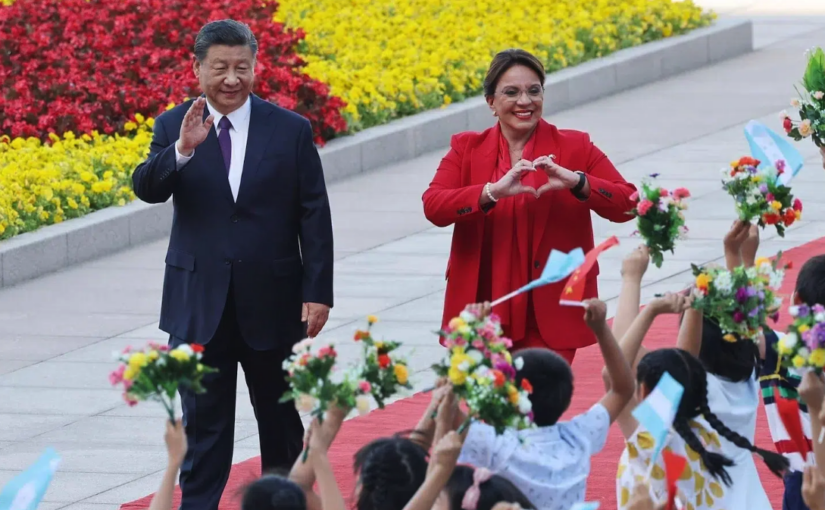
Following their talks, the two leaders witnessed the signing of 17 agreements covering diverse areas and issued a joint statement. As is customary, prior to their talks, a welcoming ceremony was held for the visiting head of state, presided over by President Xi. What drew particular attention was the response of President Castro to the children greeting her. As the Xinhua News Agency reported, the Honduran leader, who was dressed all in red for the occasion, “broke into a smile and reciprocated the warm gestures by forming a heart shape with her hands. Standing beside her was Chinese President Xi Jinping. It’s a scene that would be inscribed in the chronicle of China-Honduras relations.”

President Castro also paid her respects to the martyrs of the Chinese revolution at the Monument to the People’s Heroes.

The joint statement noted that Honduras recalled China’s support at the United Nations General Assembly on June 6 2009 for the adoption of resolution A/RES/30/63 condemning the coup d’état against President Zelaya, and appreciated China’s support for Honduras’s efforts to safeguard sovereignty and security and oppose foreign interference.

The Chinese side highly values the actions and positions of the Government of Honduras under the leadership of the first female President, Xiomara Castro; acknowledging the initiatives of the Government of Honduras to promote equality in the country, uphold the rule of law, and combat corruption in a comprehensive manner. China firmly supports Honduras in independently choosing its development path and independently developing its foreign relations and is willing to exchange experience in governance with Honduras, to provide assistance within its capacity for Honduras’s economic and social development and achieve common development and prosperity.

It added:  The two sides oppose all hegemonism and power politics, any unilateralism, protectionism and violence, as well as interference in the internal affairs of other countries. Honduras agrees with China’s common values of peace, development, fairness, justice, democracy and freedom for all humanity and the concept of building a community with a shared future for humanity; supports China’s Global Development Initiative, which is fully in line with the purpose set by the United Nations to achieve the Sustainable Development Goals; and supports the Global Civilization Initiative and the Global Security Initiative. Honduras is willing to actively participate in the above initiatives and recognizes their important role in addressing global challenges. China appreciates Honduras’s efforts to promote global and regional peace and development.

Whilst in Beijing, President Castro also met with Premier Li Qiang, Chairman of the Standing Committee of the National People’s Congress (NPC) Zhao Leji, and Li Xi, Member of the Standing Committee of the Political Bureau of the CPC Central Committee and Secretary of the CPC Central Committee’s Central Commission for Discipline Inspection (CCDI), referred to by Xinhua as China’s “anti-graft chief”. The fight against corruption was touched on in the talks between the two presidents and is referred to twice in the joint statement. 

President Castro began her visit in Shanghai. Visiting the headquarters of the New Development Bank (NDB), established by the BRICS grouping, and meeting her old friend, Dilma Rousseff, President of the Bank and former President of Brazil, Castro submitted her country’s application to join the growing number of bank members.

In the course of the visit, Honduran Foreign Minister Enrique Reina formally opened his country’s embassy in Beijing alongside his Chinese counterpart, Qin Gang. Reina had also attended the opening of the Chinese embassy in the Honduran capital Tegucigalpa shortly before departing for China as part of President Castro’s entourage.

The following articles were originally carried on the websites of the Xinhua News Agency, the Chinese Foreign Ministry and Global Times. The joint statement, as carried by the website of the Chinese Foreign Ministry, was machine translated and lightly edited by us.

Xi holds talks with Honduran president

Xinhua, 12 June 2023

Chinese President Xi Jinping on Monday held talks with visiting President of the Republic of Honduras Iris Xiomara Castro Sarmiento in Beijing.

Noting President Xiomara Castro is the first Honduran president to pay a state visit to China following the establishment of diplomatic relations between the two countries in March, Xi extended a warm welcome to Castro and hailed her visit as one of special significance as it opens a new chapter in the annals of the China-Honduras relationship.

Continue reading Rapid progress in China-Honduras bilateral friendship

US anti-imperialist delegation meets with Taiwan Democratic Self-Government League

Delegates from the US Workers’ World Party and the International Action Center visited China in May as part of a program organised by the China-US Solidarity Network.

In this first report on their trip, which was originally published in the Workers World newspaper, Arjae Red reports on the delegates’ Beijing meeting with the Taiwan Democratic Self-Government League. The League is one of eight democratic political parties in China that accept the leadership of the communist party and work alongside it in the governance of the country. 

The visitors were briefed on the League’s origins in the Taiwanese Communist Party, which was formed when the Chinese island was under Japanese colonial rule. When the people in Taiwan rose in struggle against brutal repression by the Kuomintang, resulting in the deaths of tens of thousands, the communists were in the forefront of organising and waging the armed resistance. The League was formed in 1947 by survivors, who had been forced to flee to Hong Kong. Today it works for the reunification of China and the well-being of the people in Taiwan.

Workers World Party and International Action Center delegates traveled to the People’s Republic of China in May as part of an educational and political exchange organized by the China-U.S. Solidarity Network. The purpose of the delegation was multifold: to conduct research that brings truth to expose the lies of the U.S. empire, as well as to strengthen international friendships and forge a more resilient global anti-imperialist movement. Among the many stops on this tour was a meeting in Beijing with representatives of the Taiwan Democratic Self-Government League (Taimeng).

One of eight parties in the Chinese People’s Political Consultative Conference, a united front under the leadership of the Communist Party of China, Taimeng works alongside the CPC to formulate the government’s policy in regard to relations between the mainland and Taiwan. 

Taimeng holds 13 seats in the National People’s Congress and three seats in the Standing Committee of the National People’s Congress. The League consists of members of Taiwanese descent and with connections to Taiwan residents. It supports the reunification of Taiwan with the People’s Republic of China mainland.

The meeting between the Taiwan Democratic Self-Government League and Workers World Party May 14 took place at a time when U.S.-China tensions are at an all-time high. Both parties exchanged friendly messages expressing a common interest in de-escalating the U.S.-led war drive against China, in which Taiwan is used as a pawn by U.S. imperialism.

The U.S. empire promotes Taiwan separatism, despite its stated agreement to the “One China” policy that supposedly forms the bedrock of U.S.-China relations. It simultaneously uses sanctions and other methods of economic warfare, in tandem with military encirclement and weapons imports, to turn the region into a powder keg. 

Members of Taimeng brought the delegates from Workers World Party through a tour of their three-story exhibit, showcasing the history of their organization from its inception in 1947, with roots in the Taiwanese Communist Party, to the present day.

Beginning on Feb. 28, 1947, the Kuomintang-led government of Taiwan began massacring people who had become fed up with the brutal administration of the island. Taiwanese communists organized resistance to this KMT violence. Xie Xuehong, a key leader in the Taiwanese women’s movement and founding member of the Taiwanese Communist Party, created a force in Taichung dubbed the 27 Brigade, a communist-led guerilla unit comprising some thousands of fighters.

The violence of the KMT resulted in the deaths of tens of thousands of people. In the end, many left forces were violently suppressed and forced off the island. Surviving members of the Taiwanese Communist Party relocated to Hong Kong and formed the Taiwan Democratic Self-Government League. Two years later in 1949, Taimeng witnessed the victory of the communist forces on the mainland and participated in the birth of the People’s Republic of China.

As an ally in the United Front with the CPC, Taimeng works resolutely toward a united China and promotes policies that mutually benefit people on both sides of the Taiwan Strait. Su Hui, chairperson of the Taiwan Democratic Self-Government League’s Central Committee, said at a press conference in March: “With the word ‘Taiwan’ in our party’s name, one of our missions is to carry on Taiwan compatriots’ noble tradition of loving our nation and homeland, and try our best to realize the motherland’s reunification.”

Britain seems doomed to join the new Washington Consensus

In this article for the Morning Star, Friends of Socialist China co-editor Carlos Martinez takes a look at the results of UK Prime Minister Rishi Sunak’s recent official visit to the US. Sunak’s summit with Joe Biden produced very little of substance, but the Atlantic Declaration for a Twenty-First Century US-UK Economic Partnership reiterates Britain’s ongoing commitment to the New Cold War and the Project for an American Century. Carlos writes that the document “represents a shared commitment to doubling down on the new cold war, continuing with the encirclement and containment of China, and proceeding with the proxy war against Russia.”

While talking up the need for a “rules-based order”, the Declaration makes clear that the US and Britain intend to continue violating international law via their AUKUS nuclear pact and their extensive set of unilateral sanctions. Meanwhile, their calls for global action to tackle climate change ring decidedly hollow given their sanctioning of China’s solar energy products and the trend of replacing Russian energy with North American fracked shale gas.

Noting that Labour in its current iteration offers no improvement on the question of Britain-China relations, Carlos concludes that “Boris Johnson, Liz Truss, Sunak and Keir Starmer are all Trumpists when it comes to pursuing this incredibly reckless new cold war.”

Last Wednesday marked the second annual UK-US Friendship Day. Although this momentous occasion was met with near-universal indifference on both sides of the Atlantic, Rishi Sunak took the opportunity to celebrate by making his first official visit to the US as Prime Minister.

The discussions didn’t reap the variety of fruit Sunak had been hoping for; the Tories’ long-promised free-trade deal remains in deep freeze. Indeed, very little of substance was announced beyond the Atlantic Declaration for a Twenty-First Century US-UK Economic Partnership.

This declaration makes clear that the focus of US-UK collaboration today is to jointly manage “new challenges to international stability,” in particular “from authoritarian states such as Russia and the People’s Republic of China.”

Continue reading Britain seems doomed to join the new Washington Consensus

Dark time in US history rearing its head again

In this important article for China Daily, retired Chinese American judges and renouned peace activists Julie Tang and Lillian Sing highlight the connection between the US’s anti-China agenda and the alarming rise in anti-Asian racism. The authors point to the chilling parallels with the height of the Red Scare in the 1950s:

In the 1950s, during the McCarthy era, the US targeted the Soviet Union and China under a red-baiting hysteria about potential spies. Many Chinese Americans were arrested, incarcerated and subjected to deportation. Their only crime was that they were Chinese. Today, we see this dark history being repeated.

The article reaches the sad but unavoidable conclusion that “the US is no longer a safe place for Chinese Americans.”

The resurgence of anti-Asian racism is one of the key reasons that progressive people must stand up against the New Cold War and the Western ruling classes’ relentless demonization of China.

We are retired Chinese American judges with roots in China. We have spent most of our lives working in the legal system of the United States, rendering justice and fairness to those who appear before us as we adhere to the US and state constitutions, the rule of law, and state and local legal processes in our work.

We understand the importance of good US-China relations, as they affect our lives here in the US. We believe that unless the US resets its current hostile agenda against China, Chinese Americans will continue to have tough times ahead.

In the 1950s, during the McCarthy era, the US targeted the Soviet Union and China under a red-baiting hysteria about potential spies. Many Chinese Americans were arrested, incarcerated and subjected to deportation. Their only crime was that they were Chinese.

Today, we see this dark history being repeated.

Continue reading Dark time in US history rearing its head again

Friendly ties between the communists of China and Cyprus reaffirmed

Ties of friendship and solidarity between the communists of China and Cyprus were reaffirmed in a June 1st meeting between Zhu Rui, Assistant Minister of the International Department of the Communist Party of China Central Committee (IDCPC), and Nicos Ioannou, Political Bureau member of the Progressive Party of the Working People of Cyprus (AKEL). 

Originally founded as the Communist Party of Cyprus, the party assumed its present name due to British colonial repression. AKEL is a major force in Cypriot politics and society. It presently holds 15 out of 56 seats in the Cypriot parliament and two of the country’s six seats in the European Parliament. A former General Secretary of the party, Dimitris Christofias, served as President of Cyprus, 2008-2013.

The below short article originally appeared on the website of the IDCPC

Zhu Rui, Assistant-minister of the International Department of the CPC Central Committee, met here today on the morning with Nicos Ioannou, the member of the Political Bureau of the Progressive Party of the Working People of Cyprus.

Zhu spoke positively of the relations between the two Parties and the two countries, saying that the CPC attaches great importance to the friendly inter-party relations with the Progressive Party of the Working People of Cyprus, and is willing to further strengthen exchanges and mutual learning between the two Parties on policies and concepts, thus jointly promoting the healthy and stable development of the relations between China and the European Union (EU).

Ioannou said that the Progressive Party of the Working People of Cyprus cherishes the traditional friendship with the CPC and stands ready to promote pragmatic cooperation in economy and trade with China, so as to actively contribute to the development of Cyprus-China and EU-China relations.

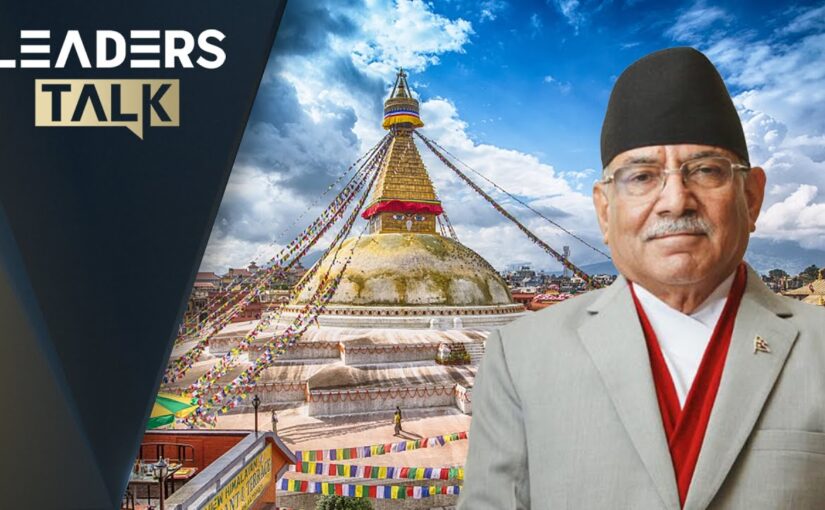
Interview with DR Congo President Felix Tshisekedi

President of the Democratic Republic of the Congo (DRC), Félix Tshisekedi, paid a state visit to China, from May 24-29, visiting Beijing, Shanghai, Shenzhen and Hong Kong. During his visit, President Tshisekedi was interviewed by Wang Guan for the CGTN series, Leaders Talk. 

Noting that he had never visited China before, Tshisekedi congratulated the country on its achievements in modernization, pointing out that, in the late 1960s, China and Congo were at approximately the same level of economic development. The leap China has made, he continued, is impressive. The Chinese model is one that he would like to emulate and replicate in his own country. 

Asked why he had made a point of laying a wreath at the Monument to the People’s Heroes and visiting the Museum of the Communist Party of China, Tshisekedi explained that there are notable parallels between the history of the two countries. They had both suffered from poverty and famine. But China has leveraged its strength and resources to escape from this legacy. Coming to China to see how this had been achieved was, he said, important to him. Regarding some of the negative things said about China by some international voices, he noted that to ensure the safety of more than one billion people, in terms of food security, education and health, is an enormous challenge. Rather than condemn China, he is inspired by its achievements and seeks to build a strong friendship.

Surveying some of the key areas of enhanced cooperation agreed during his visit, the President cited climate change, where the bilateral partnership could benefit the whole world, particularly with the DRC being the most biodiverse country in Africa.

He also laid strong emphasis on the need for the DRC to stop being purely an extractive site for its vast mineral wealth. By moving to refining, jobs would be created and development promoted. China, he explained, had agreed to join hands to promote the industrialisation of the DRC. Without added value, Tshisekedi asserts that Congo’s vast resources are virtually worthless in terms of the country’s development needs. The same could be said for its agricultural produce. Tshisekedi is grateful to China for its understanding and support, which is already producing tangible results, for example in terms of Chinese investment in battery manufacturing facilities that are crucial for renewable energy.

Development is a pressing need and for this peace and security are also needed. In Tshisekedi’s view, Xi Jinping’s concepts of the Global Development Initiative, Global Security Initiative and Global Civilization Initiative can all be of immense benefit to the DRC as well as to Africa as a whole. The DRC and Africa need China to stand alongside them in the search for peace and as a partner for development.

Moving to the end of the interview, President Tshisekedi struck an optimistic note. One day, he insisted, the DRC would achieve zero poverty. It is possible. China has done it.

The full interview with President Tshisekedi is embedded below.

Ramzy Baroud: China remains committed to its principled stance on Palestine

In this article for MintPress News, Palestinian journalist and author Ramzy Baroud analyzes China’s approach to the Palestine question, noting that while China has always based its position on international law and has always stood up for Palestinian national rights, it has been notably more forthright in recent months. Baroud reports that China’s United Nations Ambassador, Geng Shuang, made strong comments recently about the need for a “comprehensive and just solution” based on ending Israel’s provocations, and called on Tel Aviv to “immediately halt” the “illegal expansion of settlements.” Geng also brought up the plight of the Palestinian refugees – a subject that Israel and its allies in the West would very much prefer went unmentioned.

Baroud concludes that China has (correctly) identified US intransigence as the number one reason for the lack of progress in developing a just solution to the Palestine question. Meanwhile, given China’s blossoming relation with the Arab world, “the more Palestine takes center stage in Arab political discourse, the greater emphasis the issue receives in China’s foreign policy agenda.”

With Palestinian President Mahmoud Abbas arriving in Beijing today (13 June 2023), there is a good opportunity for China to lend its assistance to the project of building a just and lasting peace in the region.

Remarks by China’s United Nations Ambassador, Geng Shuang, on the situation in Occupied Palestine on May 24 were impeccable in terms of their consistency with international law.

Compared to the United States’ position, which perceives the UN, and particularly the Security Council, as a battleground to defend Israeli interests, the Chinese political discourse reflects a legal stance based on a deep understanding of the realities on the ground.

Articulating the Chinese thinking during a UNSC ‘Briefing on the Situation in the Middle East, including the Palestine Question,’ Geng did not mince his words. He spoke forcefully about the “irreplaceable” need for a “comprehensive and just solution” that is based on ending Israel’s “provocations” in Jerusalem and the respect for the right of “Muslim worshipers” as well as the “custodianship of Jordan” in the city’s holy sites.

Continue reading Ramzy Baroud: China remains committed to its principled stance on Palestine

Friendly relations between China and South Africa continue to deepen

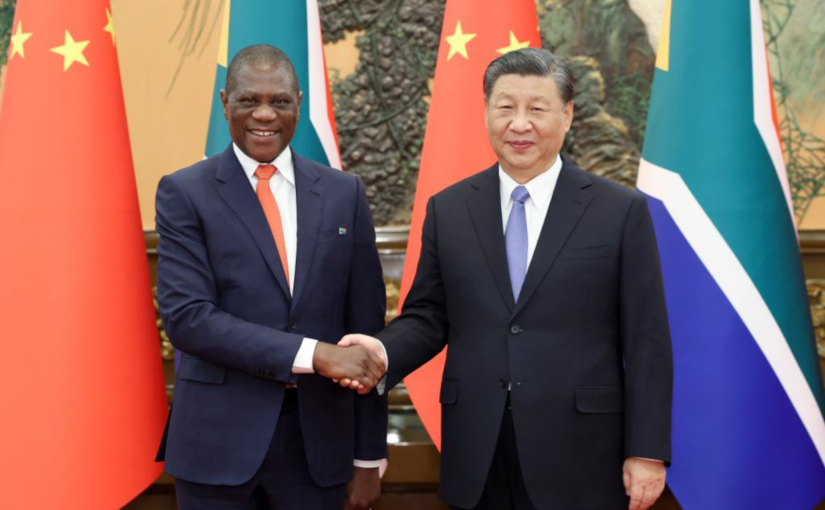
The close brotherly relations between China and South Africa have been underlined by a number of recent diplomatic encounters.

On June 9, President Xi Jinping held phone talks with his South African counterpart, Cyril Ramphosa, in which the Chinese leader said that the two countries are both important major developing countries and enjoy special friendly relations like brothers. 

China-South Africa relations are of important strategic significance to safeguarding the common interests of developing countries and guiding China-Africa solidarity and cooperation, Xi added.

China supports South Africa, as the rotating chair, in successfully hosting various BRICS cooperation activities this year.

Ramaphosa said that South Africa supports China’s position paper on the political settlement of the Ukraine crisis and hopes that relevant parties could resume negotiations at an early date.

A peace delegation consisting of leaders of six African countries, including South Africa, will visit Russia and Ukraine to push for an end to the crisis as soon as possible, he added.

Xi told Ramaphosa that China’s position on the Ukraine crisis has been consistent, which is to promote peace talks.

The Chinese leader said that he hopes all parties will build up favourable conditions for solving the crisis through dialogue, adding that it is a good thing that President Ramaphosa and leaders of relevant African countries have formed a peace delegation to visit Russia and Ukraine.

Earlier, from June 1-2, Chinese Vice Foreign Minister Ma Zhaoxu attended the Formal Meeting of BRICS Ministers of Foreign Affairs and International Relations and the Friends of BRICS Foreign Ministers Meeting in Cape Town, South Africa.

BRICS countries, he said, should adhere to fairness and justice, adhere to self-confidence, self-reliance, independence and self-improvement, strengthen strategic communication and coordination with the vast number of developing countries, and promote the building of a community with a shared future for humanity. 

On June 7, Liu Jianchao, Minister of the International Department of the Communist Party of China (CPC) Central Committee (IDCPC), met with a delegation of the National Executive Committee of the African National Congress (ANC) of South Africa, led by its Secretary-General, Fikile Mbalula.

Liu said, China and South Africa have a deep-rooted traditional friendship.  With close institutionalised exchanges and communication between the CPC and the ANC, political mutual trust has been constantly strengthened. The Chinese side will continue to firmly support South Africa in exploring a development path that suits its national conditions and provide more development opportunities for African countries, including South Africa, through China’s high-quality development and the Chinese path to modernisation. The Chinese side supports the South African side in assuming the rotating presidency of the BRICS countries and is willing to actively participate in the “BRICS Plus” dialogue for political parties to be hosted by the ANC.

Mbalula expressed gratitude to the Chinese side for its valuable support in South Africa’s national liberation and development. He added that, under the strong leadership of the CPC, the cause of socialism with Chinese characteristics has achieved great success, inspiring progressive forces worldwide. Through this visit, he said, we hope to learn from the CPC’s experience in state governance and administration to assist the ANC in building a democratic, prosperous, and free South Africa and promoting the economic and social development of the country.

On June 8, Chinese State Councilor and Minister of Public Security, Wang Xiaohong met with South African Police Minister Bheki Cele in Beijing. Wang stressed the need to strengthen pragmatic cooperation in BRICS Summit security, Belt and Road security, the crackdown on transnational crimes and law enforcement capacity building.

The following articles were originally published by the Xinhua News Agency, the Chinese Foreign Ministry and the IDCPC.

Xi, Ramaphosa hold phone talks over bilateral ties, Ukraine crisis

Xinhua, 10 June 2023

Chinese President Xi Jinping on Friday held phone talks with his South African counterpart, Cyril Ramaphosa, pledging to promote China-South Africa ties, and calling for favorable conditions to solve the Ukraine crisis.

Xi said China and South Africa are both important major developing countries and the two enjoy special friendly relations like brothers.

Continue reading Friendly relations between China and South Africa continue to deepen

Chen Weihua on the New Cold War, Taiwan and Ukraine

On the road in Brussels, Friends of Socialist China co-editor Danny Haiphong caught up with the prominent Chinese journalist Chen Weihua (China Daily’s EU bureau chief) for a very interesting interview.

Chen comments at length on the New Cold War and the deterioration in US-China relations during the Trump administration. Having worked in the US for several years during the Obama years, Chen witnessed a far healthier bilateral relationship, characterized mainly by cooperation – in spite of the launch of the Pivot to Asia, which obviously heralded a strategic shift on the part of the US. However, Trump dismantled the policy of engagement that had been in place since the restoration of relations between the two countries in the 1970s and, sadly, the Biden administration has been no improvement when it comes to US-China relations. Biden on the campaign trail criticized Trump’s trade war, but in office he’s continued and deepened it.

Regarding the Taiwan issue, Chen Weihua appealed to US politicians to not undermine the One China Principle or attempt to change the status quo over Taiwan. He stated that there is a consensus in China in favor of peaceful national reunification, and a general understanding that this process may take considerable time. For the US to encourage Taiwanese separatism and stoke the flames of conflict in the region is dangerous and ill-advised.

China and Palestine always trust and support each other

A delegation from Palestine’s Fatah party, led by Ali Mashal, the party’s Assistant Commissioner of Arab and Chinese Relations, recently visited China and met with Zhu Rui, Assistant Minister of the Communist Party of China’s International Department (IDCPC), in Beijing on June 2nd.

Zhu said China and Palestine have always been trusting and supporting each other. The CPC attaches great importance to the friendly relations with the Fatah party, and is willing to further strengthen exchanges and cooperation between the two parties and work for greater achievements in the development of China-Palestine relations.

Mashal said the Palestine-China relationship was forged by leaders of the elder generation of Palestine and China, and President Abbas and the Palestinian people will stand together with the Chinese people as always. Fatah, he said, is expecting China to play a greater role in the settlement of the Palestinian question, adding that, Xi Jinping Thought on Socialism with Chinese Characteristics in the New Era and the Chinese path to modernisation serve as a model for countries in the world to independently explore their own development paths suited to their national conditions.

Palestinian President Mahmoud Abbas will pay a state visit to China, June 13-16, as the first Arab head of state to visit the country this year.

The below article was originally published on the IDCPC website.

Zhu Rui, Assistant-minister of the International Department of the CPC Central Committee, met here today with a delegation of the Fatah Party of Palestine led by Ali Mashal, Assistant Commissioner of Arab and Chinese Relations of the Fatah Party.

Zhu said, China and Palestine have always been trusting and supporting each other. Ever since the beginning of the new era, President Xi Jinping and President of Palestine Mahmoud Abbas have reached consensus on multiple issues, charting the course for the development of bilateral relations. The Chinese side is thankful for the valuable support from the Palestinian side on issues concerning China’s core interests, and will continue to firmly support the just cause of the Palestinian people. The CPC attaches great importance to the friendly relations with the Fatah Party, and is willing to further strengthen exchanges and cooperation between the two Parties and work for greater achievements in the development of China-Palestine relations. Zhu also gave a briefing on the thematic education campaign on learning and implementing Xi Jinping Thought on Socialism with Chinese Characteristics in the New Era.

Mashal said, the Palestine-China relationship was forged by leaders of the elder generation of Palestine and China, and President Abbas and the Palestinian people will stand together with the Chinese people as always. The Fatah Party is willing to join hands with the CPC to promote the in-depth development of the relations between the two Parties and the two countries, and is expecting China to play a greater role in the settlement of the Palestinian question. He noted that it is because of the scientific guidance of Xi Jinping Thought on Socialism with Chinese Characteristics in the New Era that the CPC is able to lead the Chinese people to win one victory after another. Xi Jinping Thought on Socialism with Chinese Characteristics in the New Era and the Chinese path to modernization serve as a model for countries in the world to independently explore their own development paths suited to their national conditions.

Fariz Mehdawi, Palestinian Ambassador to China, was present.

New book calls for solidarity with People’s China

The following review of Carlos Martinez’s The East is Still Red – Chinese Socialism in the 21st Century was written by Friends of Socialist China advisory group member and ChinaSquare co-editor Dirk Nimmegeers. It was originally published in Dutch on ChinaSquare and republished on the Belgian alternative media website De Wereld Morgen. It was translated into English by the author.

Taking a positive attitude towards China seems unforgivable today; indeed, these days even those who refuse to attack China are already indignantly criticized. Politicians and journalists show themselves eager to lend a helping hand to the new cold war, with all due risks.

For peace and climate activists, trade unionists and other progressive citizens, it is a tough assignment to go against this flow, and that can be done in many different ways. For instance, there are observers who note that China is different and think it is ‘allowed’ to be so. They recognise that China has found a way, adapted to historical and present circumstances, of creating prosperity, high technology, sustainable energy sources and self-reliance, to the satisfaction of its people. Some publicists believe that China has created its own form of capitalism while respecting its Confucian traditions. Others implore their supporters and the general public that we are condemned to cooperate with China, under the motto ‘if you can’t beat them join them’. This may be the motivation of those who prefer to talk about de-risking rather than decoupling. A more generously positive view ranks China among the emerging economies that deserve support because they claim the right to pursue an independent course and, above all, because they want to prevent a world war.

Continue reading New book calls for solidarity with People’s China

Venezuelan ambassador: China shows that socialism is not a failed system

We are very grateful that Venezuela’s ambassador to the UK, Rocío del Valle Maneiro González, spoke at the book launch for Carlos Martinez’s book The East is Still Red on Tuesday 6 June 2023. Rocío was Venezuela’s ambassador to China from 2004 until 2013, and accompanied Hugo Chávez during several of his presidential trips to China.

Rocío described living through a period in which the international balance of power shifted from West to East, principally due to the multipolar strategy promoted by China. Speaking as a representative of Venezuela – a country which continues to suffer due to the sanctions, destabilisation and coercion applied by the Western powers – Rocío stated that China’s international policy is based on equality, on win-win relations, on peaceful cooperation and a collective vision of a prosperous future for humanity. She concluded that, after reading The East is Still Red, “it is almost impossible to describe socialism as a failed political system.”

During the discussion, which can be viewed in the stream of the event (embedded below the article), Rocío intervened in response to a question about women’s equality in China. She observed that, while women are not well represented among the top political leadership of the country, women in China are nonetheless very well represented in the workplace at every level – including as business leaders, engineers, lawyers and academics, as well as having strong social and equal rights. She stated forcefully: “Chinese women are the equal of men; they are the free women of Asia.”

Good evening, first of all, allow me to express my gratitude to Carlos Martínez for inviting me to say a few words on the occasion of the launch of his book “The East is Still Red”. This is an honour for me, even more so as it is held here, at the Carl Marx library, giving it a special historical transcendence.

This is a relevant book and I will explain why. When China decided to open up to the western world, a step it took, in my opinion, in this century, because what China did in the XX century, was to peek through “the window” and start planning a route. Well, when China decided to open up to the world, a number of sinologists, China specialists, showed up in the West, trying to explain China’s complexity with western theories and principles. I read at least 5 of those books published by scholars; I remember one of them having more than 400 pages. Those were the days when I was preparing for the task given to me by President Chavez: I was to become the ambassador of the Bolivarian Republic of Venezuela to the People ́s Republic of China.

When I arrived in China in 2004, nothing of what I had read was of any use to me. Only the books relating to Chinese culture, those great particularities of a civilization that goes back 3 to 5 thousand years, and is still alive. Apart from that, the rest was totally useless, mainly because it had little to do with the facts, with what I was seeing and experiencing.

Carlos’ book has the relevance, the value, to present a different hypothesis to explain what China means to the world today. It is a book that equates with what I lived during those 9 years I

spent as Ambassador in Beijing, from 2004 to 2013. I had the privilege, as did all my colleague ambassadors, to witness how the international balance of power shifted from West to East, due to force applied by China.

From those years of hard work and learning, if one thing became clear to me, it was that China’s greatness is rooted in two main factors: discipline, which comes from the teachings of Confucius and a collective purpose, which is at the heart of Communism. The union of these two factors is, in my opinion, the most objective, rigorous and real starting point to approach to the truth of China. A nation which was reborn and liberated in 1949, a nation which defeated hunger with an enormous effort considered today as a true political and socio-economic miracle of universal history. A nation which today plays a protagonist role as an international player in every field. A nation, and to me this is the most important, which designed an international policy based on equality, a win-win formula, to teach imperialism how to move forward in creating a new world in peace, not with armed intervention but with diplomacy and negotiation guided by a collective purpose.

I congratulate Carlos, because he dares to approach such a complex subject, opposing the position of western experts, and does so based on concrete facts. After reading his book it is almost impossible to affirm that Socialism as a political system is a failure.

Thank you.

“Peak China” – a new low in Western attempts to persuade China to commit suicide

In this detailed article for Guancha (originally published in English on MR Online), British economist John Ross addresses the recent (rehashed) claims by The Econonist that China’s economic development has peaked and that its growth is likely to dramatically slow in the near future.

Noting that The Economist has been making similar pronouncements for the last quarter century, John assesses the specific rationale underlying this most recent claim of ‘Peak China’, which is centered around China allegedly losing its ‘population advantage’. One obvious answer to this is that “China’s average annual population growth from 1978-2022 is 0.9% and China’s annual average GDP growth in the same period is 9.0%.” As such, population size clearly hasn’t been the most important factor driving economic progress in the last four decades, and there’s no reason to believe it would have magically become a key determining factor now.

Far more important to China’s development has been its very high level of investment, coupled with a highly regulated, state-led socialist market economy, with a clear political orientation to meeting the immediate and long-term needs of the Chinese masses. John correctly observes that “it is the CPC, no other political force … which has produced the greatest reduction in poverty in any country in human history, and which overall has produced the most rapid sustained improvement in the living standards of any country in human history.”

That is, China’s extraordinary economic progress is not primarily driven by its large population but by its socialist system and the exceptionally competent and wise leadership of the Communist Party of China.

One of the latest covers of the magazine The Economist carries a headline “Peak China”. This, as its name suggests, is a claim that while during the last seven decades China’s has enjoyed a peaceful “rise”, specifically in relation to the U.S., this has now ended:

Whereas a decade ago forecasters predicted that China’s GDP would zoom past America’s during the mid-21st century (at market exchange rates) and retain a commanding lead, now a much less dramatic shift is in the offing, resulting in something closer to economic parity… One view is that Chinese power will fall relative to that of its rivals… The Peak China thesis rests on the… observation that certain tailwinds are turning to headwinds… All of this is dampening long-run forecasts of China’s economic potential. Twelve years ago Goldman Sachs thought China’s GDP would overtake America’s… and become over 50% larger by mid-century. Last year it revised that prediction, saying China would… peak at less than 15% bigger. Others are more gloomy. Capital Economics, a research firm, argues that the country’s economy will never become top dog, instead peaking at 90% of America’s size in 2035… the most plausible ones [of these projections] seem to agree that China and America will approach economic parity in the next decade or so—and remain locked in this position for decades to come.

The first reaction, was really to literally laugh at what, as will be seen, was the latest of decades long wildly inaccurate predictions by The Economist regarding China. Indeed, the record shows that probably a good working guide to what will happen in China is to take what The Economist says and assume that the opposite will occur! Second, to reflect on what are the deep reasons for such a combination of ignorance and arrogance that it leads to a refusal to make any balance sheet of entirely wrong analyses repeated for these decades but when it still claims to be taken seriously on an issue on which it has such a provenly lamentable record. As the latter applies not only to The Economist but to many other Western publications that make similar claims it will be returned to at the end of this article.

Continue reading “Peak China” – a new low in Western attempts to persuade China to commit suicide

Video: ‘The East is Still Red’ launched in London

On Tuesday 6 June 2023, at Marx Memorial Library in London, we held a launch event for Carlos Martinez’s book The East is Still Red – Chinese socialism in the 21st century. Aside from Carlos, the meeting was addressed by Her Excellency Rocío Maneiro González (Venezuelan ambassador to the UK), Danny Haiphong, Roger McKenzie and Jenny Clegg, and was chaired by Iris Yau.

Carlos opened the session by discussing his purpose in writing the book. He stated that the two key motivations were: to oppose the propaganda war on China such that people’s consent isn’t manufactured for the West’s escalating campaign of containment and encirclement; and to contribute to building understanding of Chinese socialism. Describing China’s extraordinary achievements in the realms of poverty alleviation, green energy development, tackling Covid, and promoting a peaceful, multipolar world order, Carlos questioned why people on the left would want to ascribe such achievements to capitalism. In spite of the introduction of market elements to China’s economy, and its integration into global value chains, the working people led by the Communist Party maintain political power. This is the ‘secret’ of China’s incredible progress and the continuing improvement of people’s living standards.

Roger McKenzie, international editor of the Morning Star, discussed the racist ideology that forms a backdrop to the propaganda war on China and the West’s attempts to disrupt growing economic and political links between the countries of the Global South. Roger further talked about the inspiration the developing world is drawing from China – a country that has directed such massive resources towards improving people’s living standards, which is demonstrating in practice a clear alternative to ‘Washington Consensus’ neoliberalism.

Rocío Maneiro, who was Venezuela’s ambassador to China from 2004 until 2011, and who accompanied Hugo Chávez on his trips to China in that period, described living through a period in which the international balance of power shifted from West to East, principally due to the multipolar strategy promoted by China. Speaking as a representative of Venezuela – a country which continues to suffer due to the sanctions, destabilisation and coercion applied by the Western powers – Rocío stated that China’s international policy is based on equality, on win-win relations, on peaceful cooperation and a collective vision of a prosperous future for humanity. She concluded that, after reading The East is Still Red, “it is almost impossible to describe socialism as a failed political system.”

Danny Haiphong – a popular broadcaster, journalist and co-editor of Friends of Socialist China – focussed on the multipolar project which lies at the heart of China’s foreign policy. The US’s concern with China, Danny pointed out, is not simply about economic factors or the idea that China is becoming economically powerful; more fundamental is that China’s foreign policy – informed by its socialist political system – is offering the global majority a new and far more democratic model of international relations. The Belt and Road Initiative, the BRICS, the Shanghai Cooperation Organisation and other bodies are changing the landscape of international cooperation; are bringing rapid development to the Global South and allowing them to assert their sovereignty and pursue their own development model. This shift constitutes an existential threat to the US-led imperialist world system.

Speaking by Zoom, Jenny Clegg – a longstanding China expert, academic and peace activist – discussed the relentless sinophobic propaganda that accompanies the escalating New Cold War. This propaganda cuts people off from understanding not only China’s internal dynamics but the multipolar project that it pursues. Multipolarity is already opening up space for sovereign development and cooperation in the Global South, and indeed is opening up new paths to socialism, but people in the West find themselves unable to understand and engage with these processes. As long as this is the case, the Western left will continue to struggle to develop its own role in the global struggle against imperialism and for socialism.

The speeches were followed by a lively discussion and Q&A session.

The video stream of the event, hosted by Danny Haiphong, is embedded below.