Russia, socialist countries greet China’s 77th National Day

Leaders of socialist and progressive countries have extended their greetings to the People’s Republic of China on the occasion of its 77th national day, which fell on October 1st.

In his message of greetings to Chinese President Xi Jinping, Russian President Vladimir Putin wrote that:

“Under your leadership, China is achieving impressive success in the socioeconomic, scientific, and technological spheres and making a significant contribution to addressing key regional and global issues.”

He added that: “I am confident that our meeting during the APEC summit in Shenzhen this November will be productive and will contribute to further strengthening the comprehensive partnership and strategic interaction between Russia and China.”

Belarus President Aleksandr Lukashenko wrote to Xi Jinping: “Under your leadership, China is confidently advancing toward the comprehensive rejuvenation of the great Chinese nation, demonstrating impressive achievements in developing new quality productive forces, strengthening technological sovereignty and modernizing its economy.”

Ahead of the 35th anniversary of the establishment of diplomatic relations between the two countries, Aleksandr Lukashenko renewed his invitation to Xi Jinping to pay an official visit to Belarus next year. “Your visit would give special significance to the anniversary and mark the starting point for a new stage in Belarus-China relations.”

The leader of the Democratic People’s Republic of Korea (DPRK) Kim Jong Un wrote to his Chinese counterpart: “Since the founding of new China, the wise and diligent Chinese people have made world-startling progress in the whole realms of the development of the state and built a modern socialist China, weathering through all challenges and trials of history by dint of perseverance and united efforts.

“The noteworthy successes, being achieved in recent years in the fresh course of realizing the socialist ideology of the new era with the Chinese characteristics on a full scale in response to the spirit of the 20th Congress of the Party, enhance the country’s overall national power and international position and, at the same time, clearly show that nothing can check the Chinese people’s cause of building a powerful country and promoting the national prosperity.

“We are sincerely rejoiced over the achievements made in our socialist neighbor, and are convinced that the Chinese people will surely achieve the great prosperity of the Chinese nation under the correct leadership of the Communist Party of China with esteemed Comrade General Secretary Xi Jinping as its core.”

He added that: “The history of the DPRK-China friendship, which was forged at the cost of blood and has been carried forward with genuine comradely friendship, can never be shaken no matter how the international situation may change, and it is the steadfast will of our Party and government to steadily develop the traditional relations of unity and cooperation with socialism, the common ideal, common banner and common cause, as the core.”

Additionally, DPRK Foreign Minister Choe Son Hui wrote to her Chinese counterpart Wang Yi, noting that through the historic Pyongyang meeting and talks in June, the top leaders of the two parties and the two countries reconfirmed the steadfast will to build a beautiful future of the two peoples together on the road of struggle for socialism.

The DPRK Association for Cultural Exchange with Foreign Countries and the DPRK-China Friendship Association hosted a reception on September 29.

Speakers noted that the Chinese people have brought about world-startling miracles and changes, braving all challenges and trials, closely united around the Communist Party of China for the past 77 years since the founding of the new China.

They expressed the belief that the traditional DPRK-China friendship would, in the future, too, grow stronger in response to the requirements of the times, saying that it is the steadfast stand of the parties and governments of the two countries to strengthen and develop the friendly relations between the DPRK and China.

A reception was also hosted by Wang Yajun, Chinese ambassador to the DPRK. Kim Hyong Sik, vice-chairman of the Standing Committee of the Supreme People’s Assembly of the DPRK said that the founding of the People’s Republic of China is an epochal event that opened up a new phase in shaping the destiny of the Chinese people and laid a firm foundation for them to proudly emerge in the world arena and achieve the prosperity of the Chinese nation.

He expressed the will to make joint efforts, together with the Chinese comrades, to promote exchange and cooperation in all fields and consolidate the DPRK-China friendship in the interests of the peoples of the two countries, true to the spirit of the important agreement between the top leaders of the two parties and two countries.

General Secretary of the Communist Party of Vietnam (CPV) Central Committee and President To Lam, Prime Minister Le Minh Hung, President of the National Assembly Tran Thanh Man, and Standing Member of the CPV Central Committee’s Secretariat Tran Cam Tu wrote to General Secretary of the Communist Party of China (CPC) Central Committee and President Xi Jinping, Premier of the State Council Li Qiang, Chairman of the Standing Committee of the National People’s Congress Zhao Leji, and Cai Qi, Member of the Standing Committee of the Political Bureau of the CPC Central Committee, Secretary of the CPC Central Committee’s Secretariat and Chief of the CPC Central Committee’s Office.

They expressed their belief that under the leadership of the CPC Central Committee, with General Secretary and President Xi at its core, China will successfully achieve its goal of building a strong, prosperous, democratic, culturally advanced, harmonious and beautiful modern socialist country, while making positive contributions to peace, stability and prosperity in the region and the world.

The Vietnamese Party and State always consider the consolidation and development of a friendly neighbourliness and comprehensive cooperation with China a consistent policy, a strategic choice and a top priority in Vietnam’s foreign policy, they said, affirming Vietnam’s readiness to work with Chinese Party and State leaders to maintain regular exchanges and strengthen strategic guidance.

Additionally, Bui Thi Minh Hoai, Politburo member, Secretary of the CPV Central Committee and President of the Central Committee of the Vietnam Fatherland Front (VFF), sent a congratulatory message to Wang Huning, member of the Standing Committee of the Political Bureau of the CPC Central Committee and Chairman of the National Committee of the Chinese People’s Political Consultative Conference (CPPCC).

In the message, Hoai expressed her delight that under the wise leadership of the CPC, with General Secretary and President Xi Jinping at the core, the Chinese people have achieved tremendous accomplishments in the cause of reform and opening up and the building of socialism with Chinese characteristics, with the National Committee of the CPPCC making important contributions to these achievements.

“We wish to work together with the National Committee of the CPPCC to further deepen cooperation between the two organisations in the time ahead, with a focus on promoting high-level and multi-level delegation exchanges and enhancing communications and education among people from all walks of life, particularly younger generations, on the traditional friendship between Viet Nam and China.”

Minister of Culture, Sports and Tourism Lam Thi Phuong Thanh attended and addressed a reception marking the 77th anniversary of the founding of the People’s Republic of China.

She extended her warm congratulations on the major achievements attained by the Communist Party of China, the Chinese state and people over 77 years of national development.

In particular, over the past decade, under the leadership of the Central Committee of the Communist Party of China, with General Secretary and President Xi Jinping at its core, China has successfully built a moderately prosperous society in all respects, bringing greater prosperity and happiness to its people. The country has continued to grow in strength and stature and has played an increasingly important role in global security, development, civilisation and governance.

Wang Qun, Chargé d’Affaires of the Chinese Embassy in Vietnam, said bilateral relations are currently enjoying a very positive period of development. He affirmed that, as the two countries enter a new historical starting point, China stands ready to work alongside Vietnam and continue its efforts to support the industrialisation, modernisation and socialist development of both countries.

Additionally, Vietnamese and Chinese artists shared the stage at the Ho Guom Opera House in Hanoi on October 1 for a vibrant celebration of friendship through music. The concert was jointly hosted by Vietnam’s Ministry of Public Security and the Chinese Embassy in Vietnam and staged by the Ho Guom Opera and China’s National Centre for the Performing Arts.

The evening closed with Do Nhuan’s “Vietnam–China”, bringing together Vietnamese and Chinese soloists, the Hanoi Philharmonic Orchestra and the choirs in a powerful finale. Singer Truong Linh said he was honoured to perform alongside artists from both countries, describing the concert as a meaningful opportunity to showcase Vietnam’s cultural identity while discovering more about Chinese music and culture.

Celebrations were also held in the two countries’ border areas. Vietnam’s Nhân Dân newspaper noted: “Viet Nam and China are friendly neighbouring countries, with mountains and rivers connected. The friendship painstakingly cultivated by generations of leaders of the two countries is a precious asset shared by the two parties, two states, and peoples of the two countries.”

It added that: “In the coming period, under the strategic guidance of the senior leaders of the two parties and two states, Quang Ninh City and the Guangxi Zhuang Autonomous Region will continue to make effective use of exchange and dialogue mechanisms and translate signed agreements and cooperation arrangements into concrete actions. This will contribute to strengthening friendship between the border localities and building the Viet Nam-China Community with a Shared Future with a higher level of strategic significance in the new era.”

General Secretary of the Lao People’s Revolutionary Party (LPRP) Central Committee and President of the Lao People’s Democratic Republic (LPDR) Thongloun Sisoulith also sent congratulations to President Xi Jinping.

President Thongloun noted that the founding of the People’s Republic of China on October 1, 1949 marked an important turning point in the country’s development and its pursuit of socialism with Chinese characteristics. He said Laos viewed China’s development achievements as an encouragement for its own efforts in national defence, construction and development.

The Lao leader also expressed appreciation to the Party, Government and people of China for their support and assistance to Laos over the years, including during the country’s current national development efforts.

He wished the Chinese people continued success in building a modern socialist country with Chinese characteristics under the leadership of the Communist Party of China and conveyed his best wishes to President Xi for good health, happiness and success in his duties.

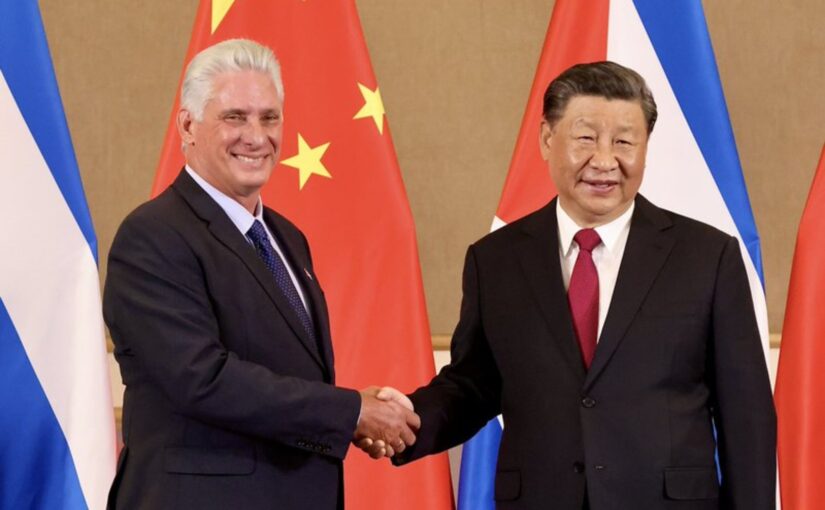
On social media, Cuban leader Miguel Díaz-Canel Bermúdez wrote: “On the occasion of the 77th anniversary of the foundation of the People’s Republic of China, we extend our warm congratulations to Comrade Xi Jinping, to the Party, to the Government, and to the Chinese people. We express our gratitude for the steadfast solidarity with Cuba, grounded in mutual cooperation and solidarity.”

The Telesur news agency added: “This week, Beijing’s ambassador to Havana, Hua Xin, said that his country and Cuba are ‘a community with a shared future’ and stressed that the Asian nation has consolidated itself as the island’s ‘main trading partner.’ He reiterated that China ‘does not stand idly by in the face of the difficulties faced by the Cuban people’ and highlighted the Asian giant’s contributions to ‘the energy and food sectors’ amid the severe crisis affecting Cuba… China has provided Cuba with two donations of photovoltaic panels totaling 5,000 home solar systems, which have been installed in different parts of the country to provide electricity to homes in rural areas. In addition, Beijing will complete a donation of 60,000 tons of rice this year.”

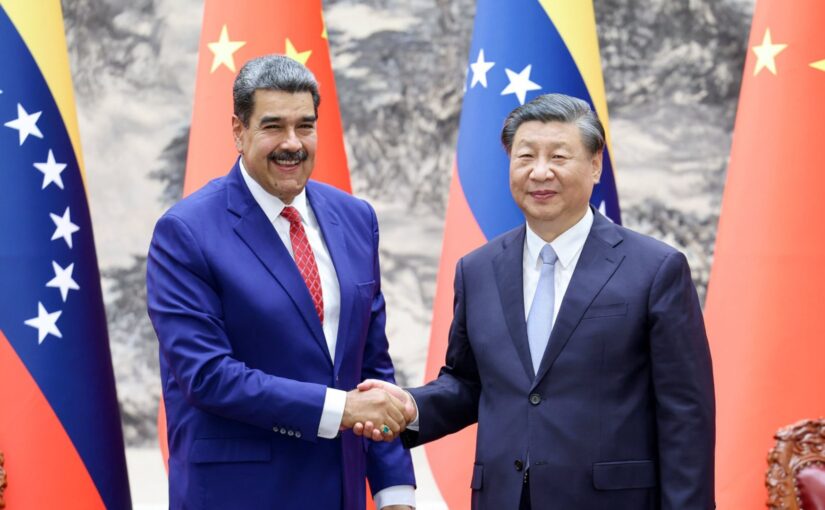
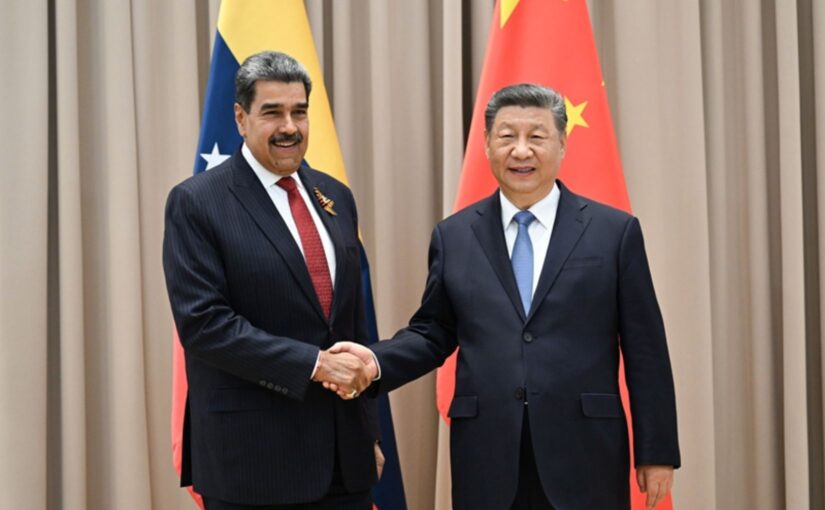
Telesur also reported that Venezuela congratulated China on its National Day, recognising the achievements of the Chinese people and reaffirming bilateral friendship, cooperation and strategic partnership.

The statement of the Government of the Bolivarian Republic of Venezuela said that: “On this day of profound historical significance for the Chinese nation, Venezuela recognizes the important achievements of the Chinese people while reaffirming the bonds of friendship, cooperation and strategic partnership that unite our two countries. Venezuela wishes the Chinese people well-being and prosperity, as well as the continued strengthening of the fraternal friendship between our two nations.”

Continue reading Russia, socialist countries greet China’s 77th National Day
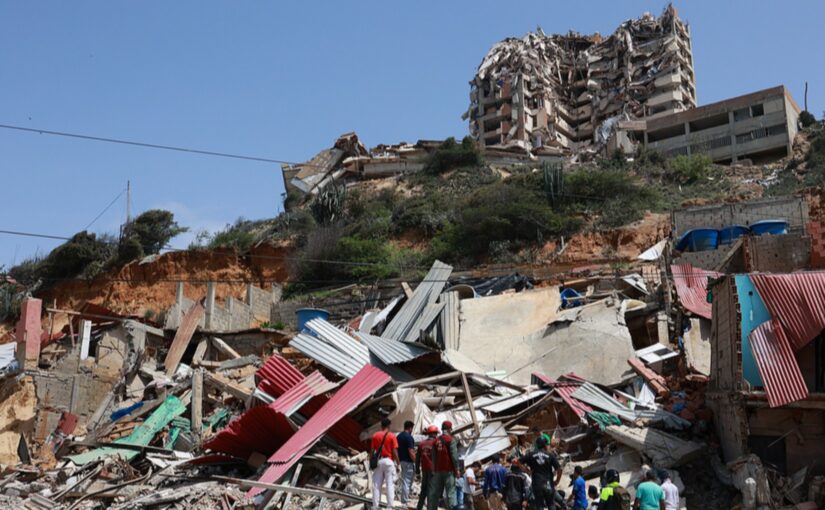
China and Vietnam support Venezuela after devastating earthquakes

Following the devastating double earthquakes that hit Venezuela on June 24, which at time of writing had claimed at least 1,450 lives with more than 3,100 injured and 50,000 or more people missing, and caused extensive damage to infrastructure, including homes, hospitals and the country’s main international airport, China and its socialist neighbour Vietnam have joined the international relief effort for their sister nation in Latin America.

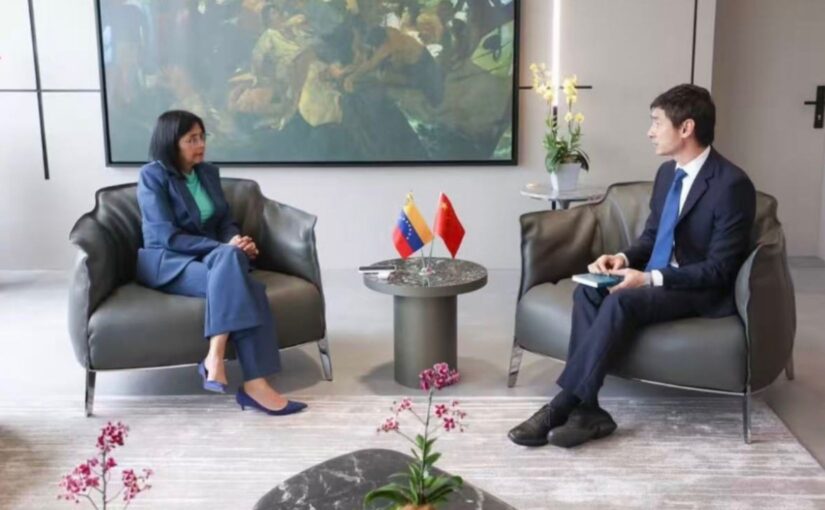
On June 26, Chinese President Xi Jinping sent a message of condolences to Venezuelan acting President Delcy Rodriguez.

On behalf of the Chinese government and the Chinese people, Xi mourned those killed in the earthquakes and expressed sincere sympathy to the bereaved families and those injured. China, he said, stands ready to provide assistance to Venezuela in disaster relief and reconstruction.

He also expressed confidence that under the leadership of the Venezuelan government, the Venezuelan people will overcome the disaster and rebuild their homes at an early date.

At time of writing, it was announced at the Chinese Foreign Ministry’s regular press conference on June 29 that China has decided to offer additional aid to Venezuela for post-quake relief and reconstruction.

According to spokesperson Guo Jiakun, the additional emergency material assistance is worth 100 million yuan (about 14.67 million US dollars), following the cash assistance that has already been provided.

Guo had previously responded to relevant questions at press conferences on June 25 and June 26, where he said that both the Chinese government and the Red Cross Society of China will provide emergency humanitarian aid to Venezuela, adding that the Venezuelan government has thanked China for its support.

In the meantime, Chinese in Venezuela lost no time in supporting relief efforts once the earthquakes struck, with several Chinese-funded enterprises in the country mobilising relief efforts.

The Xinhua News Agency reports that the companies responded quickly to the disaster and, under the guidance of the Chinese Embassy, coordinated with local Chinese communities and business associations to take part in relief work. Their efforts included providing heavy machinery and medical supplies and deploying rescue teams.

Overseas Chinese in Venezuela have so far donated about 500 tonnes of relief supplies. The supplies, including bottled water, biscuits, diapers, milk, rice, sugar and fish, have benefited nearly 10,000 families affected by the disaster.

Xinhua also introduced the moving story of Pitney Delgado, a Venezuelan worker, who has worked alongside Chinese colleagues for more than ten years. When Xinhua interviewed him, he had been working in the relief effort for more than 50 hours without rest.

Delgado said years of working with Chinese colleagues had left him with a lasting impression of their “warm hearts,” strengthening his willingness to help others in times of crisis. That commitment was reinforced by a practical skill: more than a decade ago, while working at a Chinese company, he learned to operate heavy machinery under Chinese mentors.

He first met Jiang Wangbing, now president of the China-Venezuela Chamber of Commerce, in 2015, when he began learning crane operation.

“It was a huge machine weighing dozens of tonnes,” Delgado said. “At first I was nervous. One mistake could damage property or hurt someone.”

With patient instruction, he said he mastered basic crane operations within a week. “The training was very focused. They wanted you to learn everything,” he said.

After the earthquakes, the China-Venezuela Chamber of Commerce quickly mobilised cranes and heavy machinery for rescue operations at collapsed buildings. Delgado joined without hesitation. He said he could not stop working after seeing on social media people digging through rubble with their bare hands. “Without machines, how could we clear the debris?” he said. “It would be impossible.”

Asked about working under dangerous conditions, he said: “There were aftershocks and unstable structures. Of course, I was afraid. But when I thought people might still be trapped, I could not stop.”

“As long as I am needed here, as long as there are still people to rescue, I will keep working.”

Meanwhile, socialist Vietnam has launched a major national effort to support Venezuela.

The country’s Ministry of National Defence promptly decided to deploy an 82-member military humanitarian and disaster relief team to support search and rescue operations and post-earthquake recovery efforts. To support relief efforts, the Vietnam People’s Army has established a humanitarian assistance mission comprising command personnel, a military engineering search-and-rescue unit, medical personnel, and a canine search-and-rescue unit.

During the mission, the Vietnamese force will use search dogs to locate victims trapped under collapsed structures, conduct urban search-and-rescue operations, provide emergency medical assistance to survivors, and carry out other humanitarian tasks to help Venezuelan authorities and local communities recover from the disaster.

Addressing a meeting to assign tasks to the rescuers in the capital Hanoi, General Nguyen Tan Cuong, Chief of the General Staff of the Vietnam People’s Army (VPA) and Deputy Minister of National Defence, stressed that the mission carries profound international significance, reflecting the party and state’s foreign policy, contributing to enhancing the country’s reputation in global disaster response and reaffirming the traditional friendship and comprehensive partnership between Vietnam and Venezuela.

He stressed that the operation will be demanding and potentially dangerous, requiring close coordination with personnel from the Vietnamese People’s Public Security force, international rescue teams and Venezuelan authorities and people. He instructed the team to comply with local laws, ensure the safety of personnel and equipment, actively assist local communities within their capabilities, and uphold the image and traditions of the VPA throughout the mission.

The mission is also transporting about 88 tonnes of equipment and relief supplies, including 50 compressed ration bars, 1,600 tents and 15 generators.

For its part, the Ministry of Public Security also held a departure ceremony in Hanoi on June 28 for a 41-member search and rescue team heading to Venezuela.

Following instructions from Vietnam’s party and state leadership, the ministry decided to send a specialised team to support searching for missing victims, rescue and emergency response operations, and post-disaster recovery efforts.

Speaking at the ceremony, Deputy Minister Senior Lieutenant General Le Van Tuyen said the deployment reflects not only humanitarian support but also international solidarity and the traditional friendship between Vietnam and Venezuela.

Estela del Valle Quijada Suarez, Chargé d’Affaires of the Venezuelan Embassy in Vietnam, expressed appreciation to Vietnam’s party, state, government and Ministry of Public Security for the timely assistance, describing the mission as a symbol of friendship, solidarity, and mutual support between the two countries’ people during a difficult period.

Vietnam Airlines, the country’s national carrier, organised a special flight to carry the 124 members of the two rescue teams, their 10 search and rescue dogs, approximately 25 tonnes of humanitarian supplies, specialised equipment and rescue gear to support relief operations in the earthquake-affected areas.

To ensure the timely deployment of the mission, Vietnam Airlines mobilised extensive resources, including ground service personnel and a dedicated flight crew of 23 members. The airline also completed logistical preparations and flight clearance procedures within a short timeframe to meet the urgent requirements of the mission.

Continue reading China and Vietnam support Venezuela after devastating earthquakes

Chinese lawyers condemn US and Israel

The Chinese Society of International Law has issued a powerful statement on April 25 opposing the illegal use of force by the United States and Israel, citing the examples of Venezuela and Iran.

The statement notes that Article 2(4) of the United Nations Charter establishes the fundamental principle under international law of the prohibition of the use of force: “All Members shall refrain in their international relations from the threat or use of force against the territorial integrity or political independence of any state, or in any other manner inconsistent with the Purposes of the United Nations.”

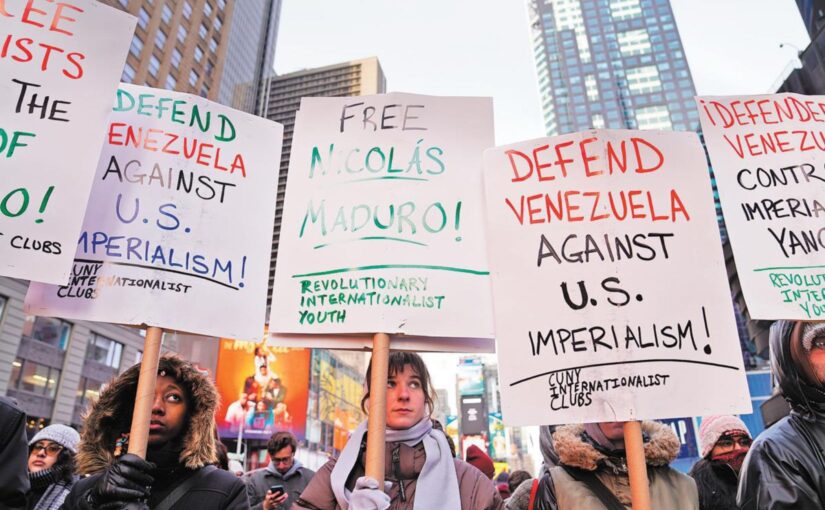
It further notes that on January 3 this year, the United States “blatantly launched a military strike against Venezuela, forcibly seized Venezuela’s President Nicolás Maduro and his wife, and removed them to the United States. There is no lawful justification for this US military operation… It has brutally trampled on international law and the basic norms of international relations and must be rectified as soon as possible.”

Turning to Iran, it says: “The joint airstrikes by the United States and Israel have targeted multiple cities and regions including the capital Tehran. These actions constitute the use of force prohibited by international law, amount to an armed attack against and invasion of Iran and violate the rule under international law regarding the personal inviolability of heads of State. The use of force by the United States and Israel against Iran finds no basis in international law; it is a serious illegal act and must cease immediately.”

The following article was originally published by the Xinhua News Agency.

The Chinese Society of International Law on Saturday issued a statement on upholding international law and opposing the illegal use of force.

The statement said that in recent months, there have been grave instances of illegal use of force in Latin America and the Middle East. It solemnly condemns the illegal acts of the United States and Israel, and believes that it is necessary to reaffirm the imperative of observing the Charter of the United Nations (the Charter) and international law in order to effectively safeguard international peace and security.

The statement added that the Charter constitutes the legal cornerstone of the post-World War II international order. Article 2(4) of the Charter establishes the fundamental principle under international law of the prohibition of the use of force: “All Members shall refrain in their international relations from the threat or use of force against the territorial integrity or political independence of any state, or in any other manner inconsistent with the Purposes of the United Nations.” “Territorial integrity” means “the inviolability of territory.” The Charter expressly provides for only two exceptions to this prohibition of the use of force: actions authorized by the United Nations Security Council under Chapter VII of the Charter and the exercise of the inherent right of self-defense of States referred to in Article 51 of the Charter.

The statement said that on Jan. 3 this year, the United States blatantly launched a military strike against Venezuela, forcibly seized Venezuela’s President Nicolás Maduro and his wife, and removed them to the United States. There is no lawful justification for this U.S. military operation. It seriously violates the principle prohibiting the use of force, severely infringes on Venezuela’s territorial sovereignty, and grossly breaches the rule under international law regarding the personal inviolability and immunity of heads of State. It has brutally trampled on international law and the basic norms of international relations and must be rectified as soon as possible.

The statement further stressed that on Feb. 28 this year, the United States and Israel initiated large-scale military strikes against Iran. The armed conflict in the Middle East has continued to this date. The joint airstrikes by the United States and Israel have targeted multiple cities and regions including the capital Tehran. These actions constitute the use of force prohibited by international law, amount to an armed attack against and invasion of Iran, and violate the rule under international law regarding the personal inviolability of heads of State. The use of force by the United States and Israel against Iran finds no basis in international law; it is a serious illegal act and must cease immediately. Furthermore, the attacks on Iranian civilians and civilian objects, including schools, hospitals and energy facilities, also seriously violate international humanitarian law.

The statement called on all States, especially major States with special responsibilities and influence in international affairs, to abide by international law, practice international rule of law, and settle international disputes peacefully. It called on all States to resolutely oppose the illegal use of force in international relations, maintain international peace and security, and promote the building of a community with a shared future for humanity.

China’s solidarity with Venezuela, Iran and Cuba

The text below is an edited version of a talk given by Alex C during a launch event for the book “China Changes Everything” held at the SHAPE (Self Help for African People Everywhere) Center in Houston and online on March 28, 2026.

The speech observes that, as the US escalates its wars of aggression against the Global South – invading Venezuela, bombing Iran and tightening its stranglehold on Cuba – the People’s Republic of China has stood firmly alongside the peoples under attack. Alex C traces China’s concrete solidarity with three revolutionary nations on the frontlines of the struggle against imperialism. In Venezuela, China defended Maduro’s government against US-backed coup attempts, and provided critical economic assistance and diplomatic support.

In Iran, China has been a lifeline, purchasing Iranian oil to offset the impact of sanctions, supplying military components, and building a comprehensive strategic partnership that has fundamentally undermined Washington’s efforts to economically strangle the Islamic Republic.

In Cuba, China has contributed $80 million toward the island’s electrical grid, forgiven substantial debt, and partnered with Havana on an ambitious transition to renewable energy.

Drawing on the lessons of Lenin and Mao, the speech reminds us that “nations which embrace revolutionary socialism can and will endure the onslaught of imperialism” – and calls on those of us in the imperial core to stand with the anti-imperialist camp.

The text of the speech first appeared on Workers World. The text is followed by a video of the full launch event.

Venezuela — like China, Iran, Cuba and so many other countries under siege by the United States — is one of many links in the chain of international proletarian revolution. To paraphrase China’s Chairman Mao Zedong, the Venezuelan people stood up in 1999, proclaiming that from that day forth, they would be the masters of Venezuela’s destiny, not international capital. 

Continue reading China’s solidarity with Venezuela, Iran and Cuba

China chokehold: Long-term goal of the US war on Iran

Why is the United States waging war on Iran? The official justifications shift by the day – nuclear weapons, Israeli security, bringing “democracy” – but CJ Atkins, writing in People’s World, cuts through the noise to identify a deeper strategic logic.

Ironically, it has fallen to the far-right, pro-Trump, Falun Gong-affiliated Epoch Times to spell it out most clearly. The war on Iran, like the January invasion of Venezuela, is to a considerable degree a move against China. Iran supplied 13.4 percent of China’s seaborne oil imports last year, Venezuela a further 4.5 percent. Combined with Russia, sanctioned suppliers accounted for a third of China’s entire crude import mix in 2024. Neutralising Iran – and with it, threatening Chinese access to the Strait of Hormuz, through which 37.7 percent of China’s crude oil flows – is a bid to put Beijing in an energy chokehold.

Atkins writes: “Iran sits alongside that chokepoint and, as recent days have made abundantly clear, is capable of threatening access to it. It is the one independent actor in the region that can seriously complicate shipping through the whole corridor. That’s a power the U.S. government would prefer to have in its own hands.”

As such, the criminal aggression against Iran and Venezuela forms part of the US-led long-term campaign of containment and encirclement of the People’s Republic of China.

This is a must-read for anyone seeking to understand the deeper architecture of US imperialism’s current offensive. It makes clear that the wars on Iran and Venezuela are not separate conflicts but coordinated moves in a single grand strategy: not only a war on Tehran or Caracas, but a war on the multipolar trajectory. Such a strategy must be resolutely opposed.

There’s an angle to the Iran War that the cable news anchors, retired generals-turned-commentators, and corporate-owned newspapers are barely talking about, if at all. They report on the shifting justifications proffered by Pete Hegseth, Marco Rubio, or Donald Trump, but few in the press are doing anything to illuminate the bigger picture.

The United States isn’t attacking Iran simply because of Tehran’s nuclear program, or out of concern for the welfare of the Iranian people, or even purely for Israel’s security. The Trump administration’s decision to launch its war was motivated by a goal that goes well beyond nuclear non-proliferation. Nor is the war a case of Tel Aviv telling Washington what to do, regardless of what some of Netanyahu’s most intense critics want to believe.

It has fallen to the far-right, anti-communist outlet The Epoch Times—the newspaper associated with the Falun Gong cult—to offer the truth about what the U.S. is up to. “A key strategic dimension of the Iran conflict,” wrote James Gorrie, a regular columnist for the pro-Trump paper in its March 13 issue, “involves Washington’s efforts to control and even restrict Iranian oil flows to China.”

Continue reading China chokehold: Long-term goal of the US war on Iran

Venezuela and China reaffirm mutual solidarity

Venezuela and China have taken several opportunities to reaffirm their continued mutual support and solidarity following the brigandish US aggression which saw the kidnap of President Maduro and his wife, the murder of numerous Venezuelans and Cuban internationalists, and repeated hegemonic acts and utterances by the US, seeking, among other things, to estrange Venezuela from its closest friends, including China, Cuba and Russia.

On January 9, Acting President Delcy Rodriguez reported that she had met the previous day with Chinese Ambassador Lan Hu and expressed gratitude to China for condemning the US aggression against Venezuela and the seizure of the country’s legitimate President and First Lady. She noted that Caracas values China’s firm position in strongly denouncing the grave violations of international law and Venezuelan sovereignty.

For her part, responding to Rodriguez’s comments on social media, Chinese Foreign Ministry Spokesperson Mao Ning said that China attaches importance to its relations with Venezuela and maintains sound communication and cooperation with the Venezuelan government.

Also on January 8, Venezuelan Foreign Minister Yván Gil once again expressed his gratitude to China for its support for Venezuela in social media posts. Posting on X, he said that: “We thank China for its firm position in rejecting the violation of international law and of Venezuela’s sovereignty. The Venezuelan people reaffirm their commitment to political, territorial sovereignty and over their natural resources.”

He also posted a video of Mao Ning responding to questions on Venezuela and stated on Telegram that: “Venezuela reaffirms its commitment to deepening trade and economic agreements with the People’s Republic of China.”

In a previous posting on X, Gil stated that: “We particularly value its [China’s] warning that no country can place its norms and foreign policies above the international provisions that govern and protect all our peoples. Likewise, we extend our gratitude for China’s willingness to collaborate with the Latin American and Caribbean region in preserving the status of peace zone.”

The following article was originally published by Global Times.

Venezuela’s acting president Delcy Rodriguez on Thursday expressed gratitude to China for condemning the US aggression against Venezuela and the seizure of Venezuelan President Nicolas Maduro and his wife, according to a post Rodriguez published on Instagram.

Continue reading Venezuela and China reaffirm mutual solidarity

International law a casualty in US assault on Venezuela

The following opinion piece from China Daily, written by Beijing-based commentator Xu Ying, vehemently decries the US’s bombing of Venezuela and the kidnapping of President Nicolás Maduro and his wife Cilia Flores.

It was not an internationally sanctioned action. It was a unilateral act of force against a sovereign state — one that directly violates the United Nations Charter and undermines the most basic norms governing relations between nations.

The author points out:

The prohibition on the use of force is not a marginal rule of international law, it is its cornerstone. Article 2 of the UN Charter leaves no ambiguity: states must refrain from threatening or using force against the territorial integrity or political independence of other states. Only two exceptions exist — self-defence against an armed attack, or authorisation by the UN Security Council. The US’ action against Venezuela satisfies neither.

While the Trump administration has sought to justify its actions on the basis of absurd claims about narcotics trafficking by top Venezuelan officials, the article points out that “international law does not recognise the extraterritorial enforcement of domestic criminal law through military means”.

The US government’s statements about “managing” Venezuela and running its oil industry “strip Venezuelan sovereignty of any real meaning” and “treat a UN member state as an object to be administered rather than as a subject of international law”.

The article concludes by saying that “Governance imposed at gunpoint is no governance at all, and abandoning restraint today risks a world where, tomorrow, no rule, no border and no state will be secure”. The correct approach to international relations is that taken by China:

China advocates a multipolar world where all countries, regardless of size or strength, enjoy equal sovereignty. Upholding international law is not a rhetorical preference, it is a practical necessity for global stability.

On Jan 3, 2026, the United States crossed a line that the postwar international order was explicitly designed to prevent. In a coordinated military operation involving air strikes and special forces, US troops entered Venezuelan territory, forcibly seized the country’s sitting president Nicolás Maduro and his wife Cilia Flores and transferred them to the United States to face domestic criminal charges. Washington subsequently announced its intention to oversee a “transition” in Venezuela and facilitate the entry of US oil companies into the country’s energy sector.

Continue reading International law a casualty in US assault on Venezuela

China at UN: Venezuela has every right to defend its sovereignty and national dignity

China has again declared its solidarity with Venezuela and its strong condemnation of the United States’ flagrant and brigandish acts of aggression, including the illegal kidnapping of the country’s President and First Lady.

Speaking at an emergency session of the United Nations Security Council on January 5, requested by Colombia and supported by China, Russia and other countries, Chargé d’Affaires a.i. Sun Lei said that:

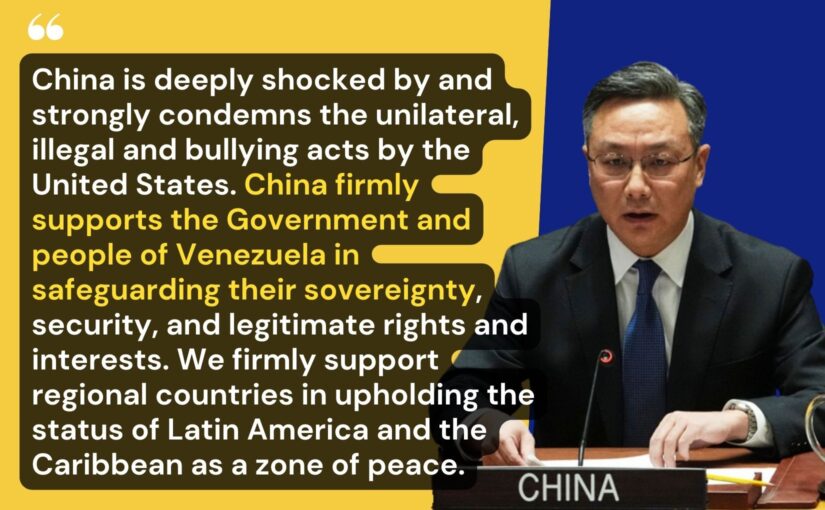
“On January 3, the United States blatantly launched large-scale military strikes against Venezuela, forcibly seized Venezuelan President Nicolás Maduro and his wife, and took them out of the country. It claimed that it would ‘run’ Venezuela and even did not rule out launching a second round of military operations on an even larger scale. China is deeply shocked by and strongly condemns the unilateral, illegal, and bullying acts by the United States.”

Noting that the council had already previously convened two emergency meetings in connection with the US sanctions, blockade, and threats of force against Venezuela, he said that, “the US has disregarded the grave concerns of the international community, wantonly trampled upon Venezuela’s sovereignty, security, and legitimate rights and interests, and seriously violated the principles of sovereign equality, non-interference in internal affairs, peaceful settlement of international disputes, and the prohibition of the use of force in international relations. These principles constitute the fundamental tenets of the UN Charter and form the cornerstone of maintaining international peace and security. The US has placed its own power above multilateralism and military actions above diplomatic efforts, posing a grave threat to peace and security in Latin America and the Caribbean and even internationally. China firmly opposes this, and the international community has also expressed widespread grave concerns and strong condemnation.”

Continue reading China at UN: Venezuela has every right to defend its sovereignty and national dignity

US invasion act of imperialist aggression: China Daily editorial

China Daily published a hard-hitting editorial on January 4, branding US actions against Venezuela an invasion and an act of imperialist aggression.

It began by noting that: “The international community is deeply shocked by the United States’ blatant use of force against Venezuela, including large-scale air strikes on the country and the forcible seizure of its president and his wife. Its actions should be condemned as they constitute a naked act of armed aggression against a sovereign state and flagrantly violate international law…

“By any definition, the US military operation amounts to an invasion. It dangerously escalates the so-called ‘Monroe Doctrine’ from a 19th-century, isolationist-era concept into a 21st-century doctrine of force and coercion. This sets an alarming precedent for Latin America and the Caribbean, posing a direct threat to the sovereignty and security of countries across the region.”

Dealing with various pretexts advanced by the US, it points out: “Washington’s justification of it being a ‘counter narcotics’ action is neither credible nor legitimate. No such pretext can justify the bombing of a sovereign country or the abduction of its head of state. If such reasoning were to be accepted, it would effectively grant powerful nations a license to intervene militarily wherever they see fit, under a pretext given by themselves, hollowing out international law and replacing it with the law of the jungle.”

And referring to Trump’s statements that the US would “run” Venezuela to “get the oil flowing”, it responds: “These remarks tore away the already thin veil of moral pretence, exposing the operation for what it was: a resource-grabbing power play. Any veneer of pursuing justice or stability was blasted away in a blatant demonstration of lawless hypocrisy. The pattern is disturbingly reminiscent of the Iraq War — another chapter in Washington’s long record of seizing other countries’ resources under false pretences.”

While Washington speaks of “strategic retrenchment”: “For other countries in the Americas, this is not retrenchment but imperialist expansion — an aggressive reassertion of arrogant conceit. Venezuela is unlikely to be the last victim if this logic is allowed to prevail. The military action also aims to intimidate regional countries and deter them from deepening cooperation with other partners in the fields that the US is trying to dominate.”

“From fabricated charges to military strikes and regime change, the operation follows a familiar and deeply troubling script — one that reflects the logic of state piracy. Sovereign governments are first delegitimised, then destroyed by force, after which foreign capital moves in to carve up natural resources. This behaviour drags the world back toward a barbaric colonial era of plunder, in open defiance of international law… No wonder even some in the US political circle said they never again wanted to hear US leaders preach about a so-called ‘rules-based’ international order.”

It concludes: “What the world is witnessing is not a ‘rules-based’ order, but colonial pillaging. Upholding sovereignty, equality and non-interference is not optional. It is the foundation of global stability — and it must be defended.”

The following is the full text of the editorial.

Continue reading US invasion act of imperialist aggression: China Daily editorial

Xi Jinping assails unilateral and bullying acts in meeting with Irish leader

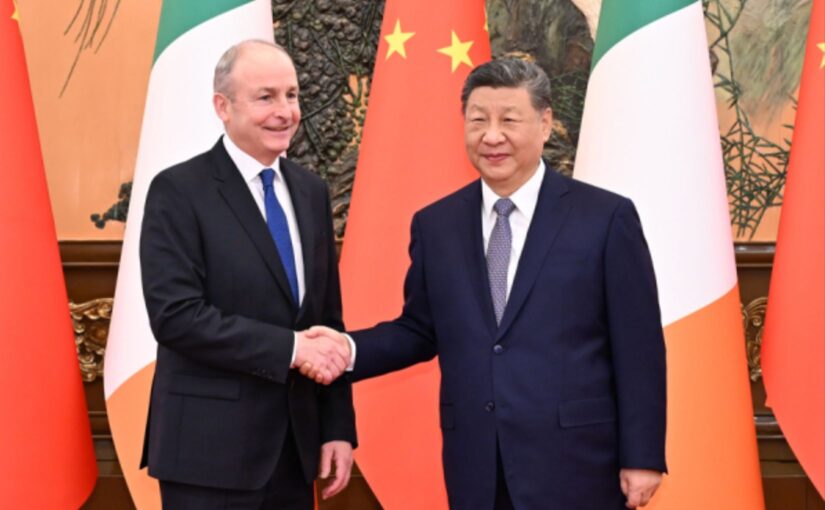
Chinese President Xi Jinping has taken the opportunity of his first meeting with a foreign visitor in 2026 to denounce unilateral and bullying acts in international relations – a clear reference not least to the piratical action of the United States in brutally kidnapping, maltreating and attempting to humiliate Venezuelan President Nicolás Maduro and his wife.

Xi was meeting on the morning of January 5 with Irish Taoiseach (Prime Minister) Micheál Martin, who began an official visit to China the previous day. It is the first visit to China by an Irish head of government in 14 years and will last until January 8.

At the start of his opening remarks, Xi Jinping made a significant statement, noting that both China and Ireland are peace-loving, open, inclusive, self-reliant and enterprising. The two countries achieved independence and national liberation through the struggle of the people and have advanced toward modernisation with the hard work of one generation after another.

He added that mutual respect, equality and mutual benefit are valuable experience gathered from long-term steady development of China-Ireland relations. He said the two sides should jointly pass them down and carry them forward and underlined the need for China and Ireland to maintain friendly exchanges at multiple levels and in different fields, continuously enhance communication and understanding, accommodate each other’s core interests and major concerns, cement political mutual trust, and consolidate the political foundation of bilateral relations. China stands ready to work with Ireland to step up economic and trade cooperation, seek synergy of development strategies in such areas as artificial intelligence, the digital economy, and pharmaceuticals and health, and encourage two-way investment, so as to draw on each other’s strengths, share opportunities, and pursue common development. The two sides need to strengthen cooperation in education, culture and tourism, and foster closer people-to-people bonds. China welcomes more Irish youth to come to China for study and exchanges.

President Xi then pointed out that the world today is undergoing changes and turbulence. Unilateral and bullying acts are dealing a serious blow to the international order. All countries should respect other countries’ development paths chosen independently by their people and observe international law and the purposes and principles of the UN Charter. Major countries, in particular, should lead by example. Both China and Ireland support multilateralism and advocate international fairness and justice. The two sides should strengthen coordination and cooperation in international affairs, jointly uphold the authority of the UN, and work for a more just and equitable global governance system.

Continue reading Xi Jinping assails unilateral and bullying acts in meeting with Irish leader

China strongly condemns US aggression against Venezuela, kidnapping of President Maduro

China has immediately responded to the latest US aggression against Venezuela and its brigandish and gangster-like kidnapping, in blatant violation of international law, of the country’s President Nicolás Maduro and his wife Cilia Adela Flores de Maduro.

On Saturday January 3, in a statement issued prior to confirmation of President Maduro’s arrival in New York, a foreign ministry spokesperson said that China is deeply shocked by and strongly condemns the US’s blatant use of force against a sovereign state and action against its president, adding:

“Such hegemonic acts of the US seriously violate international law and Venezuela’s sovereignty and threaten peace and security in Latin America and the Caribbean region.”

The next day, in a further statement, the Foreign Ministry said that China called on the United States to immediaetely release Venezuelan President Nicolás Maduro and his wife.

“China calls on the United States to ensure the personal safety of Maduro and his wife, release them at once, stop toppling the government of Venezuela, and resolve issues through dialogue and negotiation.”

Also, on Sunday January 4, the issue was directly addressed by Foreign Minister Wang Yi.

When holding the Seventh Round of China-Pakistan Foreign Ministers’ Strategic Dialogue with Pakistani Deputy Prime Minister and Foreign Minister Mohammad Ishaq Dar in Beijing, Wang Yi said that China always opposes the use or threat of force, as well as any imposition of one country’s will on another.

“We never believe that any country can play the role of world policeman, nor do we agree that any country can claim itself to be an international judge,” Wang said, adding that the sovereignty and security of all countries should be fully protected by international law.

China is willing to work with the international community, including Pakistan, to firmly uphold the United Nations Charter, maintain the bottom line of international morality, adhere to the equality of all countries’ sovereignty, and jointly safeguard world peace and development and promote the building of a community with a shared future for humanity.

On China-Pakistan relations, Wang said China hopes this visit will kick off the commemoration of the 75th anniversary of diplomatic relations between the two countries.

Both sides agreed to unite the Global South to safeguard common interests, uphold the UN Charter, and oppose bullying acts that violate the sovereignty of other countries.

On January 3, the Xinhua News Agency issued a commentary entitled, ‘Venezuela strike shows who is really undermining the International law’. It said:

“The US military incursion into Venezuela and the action against its President, Nicolás Maduro, as announced by the US administration, once again lays bare Washington’s reliance on unilateral force to shape outcomes beyond its borders. This aggression also hollows out decades of US rhetoric positioning America as the guardian of international rules.

“Article 2(4) of the United Nations Charter, a foundational principle of international law, explicitly prohibits the use or threat of force against the sovereignty and territorial integrity of states. Therefore, the action against a sovereign nation’s leader has shown the world, unequivocally, who stands as the true transgressor of international law.

“History offers ample precedent. From Iraq and Libya to Panama and Grenada, the United States has repeatedly used or threatened force under dubious justifications… Venezuela, long subjected to sanctions and political pressure, now joins that list, with diplomacy once again sidelined in favor of military coercion.”

Continue reading China strongly condemns US aggression against Venezuela, kidnapping of President Maduro

China backs Venezuela, condemns US at UN Security Council

China has condemned the US threats to and aggression against Venezuela and reaffirmed its support for the government of President Maduro.

Speaking at a United Nations Security Council Briefing held on December 23, 2025, Ambassador Sun Lei began by stating that China appreciates Slovenia’s presidency for convening the emergency meeting requested by Venezuela and supported by Russia, China, and other countries.

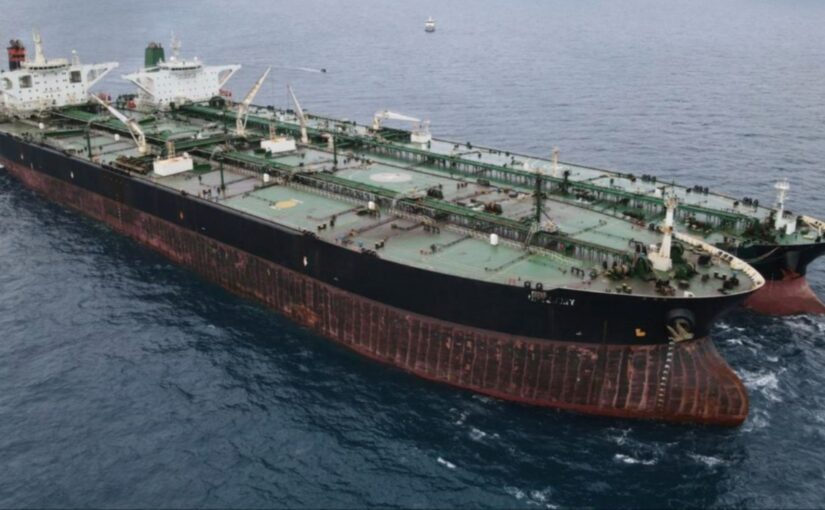
He stated that: “For some time now, under the pretext of combating drug trafficking, the United States has continued to increase its military deployment in the waters of the Caribbean off the coast of Venezuela. It has escalated sanctions, blockades, and military threats against Venezuela and claimed to have sunk Venezuelan vessels, shot dead crew members, and seized oil tankers. It has designated the Venezuelan Government as a foreign terrorist organisation, claimed that Venezuela’s territory, oil, and assets belong to the United States, and even threatened military strikes against the Venezuelan territory.

“The US actions seriously infringe upon other countries’ sovereignty, security, and legitimate rights and interests, seriously violate the UN Charter and international law, and threaten peace and security in Latin America and the Caribbean.”

The Chinese representative went on to note that: “As an independent sovereign state, Venezuela has the right to independently develop mutually beneficial cooperation with other countries and defend its legitimate rights and interest, which should be respected and supported by the international community. China opposes all acts of unilateralism and bullying and supports all countries in defending their sovereignty and national dignity. We stand against any move that violates the purposes and principles of the UN Charter and infringes upon other countries’ sovereignty and security, against the threat or use of force in international relations, against external interference in Venezuela’s internal affairs under any pretext, and against illicit unilateral sanctions and long-arm jurisdiction that have no basis in international law or authorisation by the Security Council.”

The following is the full text of Ambassador Sun Lei’s remarks. They were originally published on the website of China’s Permanent Mission to the UN.

President,

China appreciates Slovenia’s presidency for convening this emergency meeting requested by Venezuela and supported by Russia, China, and other countries. We thank Assistant Secretary-General Khaled Khiari for his briefing.

For some time now, under the pretext of combating drug trafficking, the United States has continued to increase its military deployment in the waters of the Caribbean off the coast of Venezuela. It has escalated sanctions, blockades, and military threats against Venezuela and claimed to have sunk Venezuelan vessels, shot dead crew members, and seized oil tankers. It has designated the Venezuelan Government as a foreign terrorist organization, claimed that Venezuela’s territory, oil, and assets belong to the United States, and even threatened military strikes against the Venezuelan territory. The US actions and rhetoric have led to continued tensions in the region, raising serious concerns among regional countries and the international community. 

The UN Charter establishes the fundamental principles of governing international relations, including sovereign equality, non-interference in internal affairs, and peaceful settlement of disputes. They constitute the cornerstone of international rule of law and are crucial for maintaining world peace and security. The US actions seriously infringe upon other countries’ sovereignty, security, and legitimate rights and interests, seriously violate the UN Charter and international law, and threaten peace and security in Latin America and the Caribbean. More and more countries in the region and beyond have voiced their grave concern about and strong condemnation of the US actions. We note that Secretary-General Guterres has clearly stated the need for all countries to respect international law and the UN Charter, exercise restraint, and deescalate tensions to preserve regional stability, and his readiness for good offices to this end. 

China attaches importance to President Maduro’s recent open letter. As an independent sovereign state, Venezuela has the right to independently develop mutually beneficial cooperation with other countries and defend its legitimate rights and interest, which should be respected and supported by the international community. China opposes all acts of unilateralism and bullying, and supports all countries in defending their sovereignty and national dignity. We stand against any move that violates the purposes and principles of the UN Charter and infringes upon other countries’ sovereignty and security, against the threat or use of force in international relations, against external interference in Venezuela’s internal affairs under any pretext, and against illicit unilateral sanctions and long-arm jurisdiction that have no basis in international law or authorization by the Security Council. We call the United States to heed the just call of the international community, immediately halt relevant actions, and avoid further escalation of tensions. We urge the United States to uphold the navigation safety of regional countries and the freedom and rights they enjoy under international law, to conduct normal law enforcement and judicial cooperation under bilateral and multilateral legal frameworks, to lift illicit unilateral sanctions, and to do more to promote peace, stability, and development in Latin America and the Caribbean. 

President, 

Latin America and the Caribbean constitute an important part of the Global South and are a vital force in maintaining world peace and stability and promoting global development and prosperity. China recently released its third policy paper on Latin America and the Caribbean, reaffirming its support for the Proclamation of Latin America and the Caribbean as a Zone of Peace and the Declaration of the Member States of the Agency for the Prohibition of Nuclear Weapons in Latin America and the Caribbean. This fully demonstrates the high importance attached to and the support by China for the region. China stands ready to work with countries in the region to strengthen solidarity and cooperation, uphold fairness and justice, and jointly safeguard peace and stability in Latin America and the Caribbean. 

Thank you, President.

Nicolás Maduro commemorates the birth of Mao Zedong

On Friday 26 December, Venezuelan President Nicolás Maduro marked the birth anniversary of Chairman Mao with a message on his official Telegram channel.

Attached to the message is a video in which President Maduro elaborates on the historic importance of the Chinese Revolution and China’s role in the world. The video transcript (translated to English by us) reads as follows:

Our tribute to the Great Helmsman Mao Zedong, founder of the People’s Republic of China, who, through his example, his ideas, and the revolutionary struggle he led, undoubtedly shaped the 20th century worldwide and marked the future of China. The 21st century is the century in which the destiny of humanity, as President Xi Jinping says, must be characterised by the common destiny of humanity.

Only the great republic founded by the great Mao Zedong, the great Helmsman, was able to bring China and the entire Chinese people together, enabling them to establish a political model that has allowed for the development and expansion of productive forces, and has managed to transform China in just 50 or 60 years from a semi-feudal country to a country with the highest level of scientific, technological, cultural, economic, financial and commercial development in the world.

A powerful culture and a powerful revolution, the revolution of the Great Helmsman, who founded the People’s Republic of China on 1 October 1949.

One must study the epic journey of the Chinese people and how the Great Helmsman, Mao Zedong, together with the Communist Party of China and the People’s Liberation Army, managed to forge the greatest national alliance in Chinese history.

We share the same values, the historic values of the great Mao Zedong and Xi Jinping, Simón Bolívar and Hugo Chávez. So we are united in soul, spirit and values.

Below you will find the text of the Telegram message (translated to English by us) and the associated video.

We celebrate the birthday of Mao Zedong, one of the giants of the 20th century. His genius in strategy and the formation of a revolutionary army of workers and peasants demonstrated that peoples can defeat empires. His legacy taught us that: “Weapons are an important factor in war, but not the decisive one; the decisive factor is man and not things”. This strategic vision was the cornerstone for the victory and liberation of the Chinese people.

Thanks to leaderships like that of Mao, China has regained its power, transforming itself into a superpower of knowledge, education and technology, and restoring dignity to a nation. Mao’s figure represents rebellion and the construction of a sovereign project, elements that inspire our homeland in the defence of its own sovereignty and independence.

China backs Venezuela’s call for emergency session of UN Security Council

On the same day as US President Donald Trump declared a “total and complete” blockade of Venezuela and brazenly threatened to seize the country’s land and oil (Venezuela has the world’s largest proven oil reserves), Chinese Foreign Minister Wang Yi held a telephone conversation with his Venezuelan counterpart Yván Gil at the latter’s request.

Gil stressed that the Venezuelan government and people will firmly safeguard the country’s sovereignty and independence, resolutely defend their legitimate rights and interests, and will not accept threats from any bullying power.

Wang said that that mutual trust and support are a longstanding tradition of China-Venezuela relations. China opposes all forms of unilateral bullying and supports countries in safeguarding their sovereignty and national dignity.

The following day, December 18, at the regular Foreign Ministry press conference in Beijing, spokesperson Guo Jiakun expressed China’s support for Venezuela’s call for an emergency session of the UN Security Council to discuss the situation. In response to questions from the Japanese broadcaster NHK and the Reuters news agency, he stated:

“China opposes all acts of unilateralism and bullying and supports countries in defending their sovereignty and national dignity. Venezuela has the right to independently develop mutually beneficial cooperation with other countries. We believe the international community can understand and support Venezuela’s stance of protecting its own legitimate rights and interests. China supports Venezuela’s request for holding an emergency session of the UN Security Council.”

The following article was originally published by Global Times.

Chinese Foreign Minister Wang Yi on Wednesday held a phone conversation with Venezuela’s Minister of Foreign Affairs, Yván Gil, at the latter’s request, according to a readout published by China’s Ministry of Foreign Affairs.

Gil briefed Wang on the current domestic situation in Venezuela, stressing that the Venezuelan government and people will firmly safeguard the country’s sovereignty and independence, resolutely defend their legitimate rights and interests, and will not accept threats from any bullying power.

Wang, also a member of the Political Bureau of the Communist Party of China (CPC) Central Committee, said that China and Venezuela are strategic partners, and that mutual trust and support are a longstanding tradition of China-Venezuela relations. China opposes all forms of unilateral bullying and supports countries in safeguarding their sovereignty and national dignity. 

Venezuela has the right to independently develop mutually beneficial cooperation with other countries, and it is believed that the international community understands and supports Venezuela’s position in defending its own legitimate rights and interests, said Wang. 

CPC reiterates solidarity with Venezuela

The Communist Party of China (CPC) has reiterated its solidarity with the United Socialist Party of Venezuela (PSUV) and with the revolutionary government of President Maduro.

Liu Haixing, Minister of the International Department of the CPC Central Committee (IDCPC), met on November 26 with Remigio Ceballos, the Venezuelan Ambassador to China.

Liu said, in recent years, under the strategic guidance of President Xi Jinping and President Nicolas Maduro, China-Venezuela relations have continuously reached new heights. China will, as always, firmly support Venezuela in safeguarding its sovereignty and independence, oppose external interference and support Venezuela in independently choosing its development path. The CPC and the PSUV share similar ideals and goals.

The Chinese side is willing to jointly implement the important consensus reached by the two heads of state, continuously deepen exchanges and mutual learning of experience in party building and state governance, enhance exchanges at all levels, promote cooperation in areas such as cadre training, and increase coordination and cooperation in international and regional affairs, so as to advance the all-weather strategic partnership between China and Venezuela through inter-party channels.

Ceballos said, the governments, political parties and people of Venezuela and China maintain a brotherly friendship. Venezuela firmly supports China’s position on the Taiwan question and the concept of a community with a shared future for humanity and the Belt and Road cooperation proposed by President Xi Jinping. No matter how the international situation changes, Venezuela will continue to uphold and fulfill its firm commitment to developing friendly relations with China and is willing to deepen practical cooperation with China in areas such as economy, trade, energy and education. The Embassy of Venezuela in China is willing to actively promote exchanges and cooperation between the ruling parties of the two countries.

The following article was first published on the website of the IDCPC.

Beijing, November 26th—Liu Haixing, Minister of the International Department of the CPC Central Committee (IDCPC), met here today with Remigio Ceballos, Venezuelan Ambassador to China.

Continue reading CPC reiterates solidarity with Venezuela

Xi Jinping: China categorically rejects interference by external forces in Venezuela’s internal affairs

The United States is once again steering dangerously toward an illegal war, this time in Latin America. Over the past two months Washington has been engaged in a military buildup around Venezuela, launching lethal strikes in international waters, dispatching its most advanced aircraft carrier, and openly weighing plans for direct attacks on Venezuelan territory. It is the largest US military concentration in the region in decades.

The arrival of the USS Gerald R Ford, the world’s largest aircraft carrier, along with three destroyers and more than 5,500 troops, has heightened fears of imminent assault. The Ford joins roughly 10,000 US troops already stationed in the region. Ostensibly, these deployments are to counter drug trafficking, but Washington has provided zero evidence to substantiate any such threat.

Since early September, US forces have carried out at least 19 airstrikes, killing nearly a hundred people on boats in international waters. These attacks have been widely denounced as being extrajudicial killings and blatant violations of international law.

President Trump said on 16 November that he wouldn’t rule out sending US troops to Venezuela, essentially to carry out a regime change operation. “I don’t rule out anything. We just have to take care of Venezuela.”

China on the other hand has taken a consistently clear and principled stand, continuing to develop its bilateral cooperation with Venezuela and roundly condemning the US’s “unilateral and excessive enforcement operations”, stressing that these violate international law and the UN Charter. China has urged the US to return to proper judicial cooperation frameworks rather than acting as a self-appointed global policeman. In contrast to Washington’s coercion, China’s position rests on respect for sovereignty and international law, and an orientation towards peace.

Continue reading Xi Jinping: China categorically rejects interference by external forces in Venezuela’s internal affairs

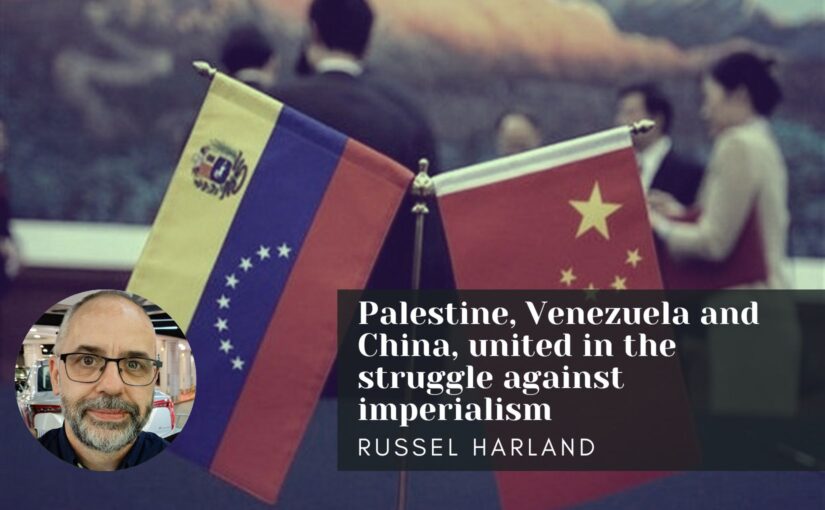
Palestine, Venezuela and China, united in the struggle against imperialism

The following is the text of a speech given by Russel Harland, representing Friends of Socialist China’s Britain Committee, at an event held on 15 November at Bolívar Hall in London on the theme Viva Venezuela: stand against fascism, imperialism and war.

Russel argues that the world is entering a historic period of crisis and transformation marked by imperialist violence, economic oppression, and popular resistance. Drawing a line from colonialism to contemporary neoliberalism, he cites the genocide in Gaza as the culmination of imperialism’s lawless depravity, enabled by the complicity of Western governments, including that of Britain.

The speech links Palestine’s struggle against colonial oppression to US attempts to impose regime change on Venezuela, driven by its socialist orientation, its natural resources, and its close friendly relations with China and other countries that refuse to bend to US diktat. In general, the crises we are witnessing form part of the West’s response to the global multipolar shift, driven in large part by China’s rise – a “megatrend” that Western elites increasingly openly cannot prevent or reverse.

The speech concludes that defending working class interests in Britain requires supporting sovereignty and anti-imperialist struggles globally as part of a revolutionary moment demanding systemic change.

Dear friends and comrades,

It is a pleasure to speak with you today as a representative of Friends of Socialist China during what are terrifyingly dangerous times.

From the Monroe Doctrine to the Opium Wars, to the Balfour Declaration and beyond, oppressed and working-class people globally have faced a unified war of subjugation by the forces of capitalism, colonialism and imperialism. Ordinary people around the world have been dehumanised, demonised, oppressed and repressed, and their scope for economic development has been systematically constrained.1

Yet in the decaying world of neo-liberalism, capitalism’s most brutal guise2, the ongoing genocide in Gaza has propelled imperialists to the zenith of their lawless depravity. This is a watershed moment that corresponds with the Communist Party of China’s statement in its new Five-Year Plan, that “internationally, momentous changes of a magnitude not seen in a century are unfolding across the world at a faster pace”.

Continue reading Palestine, Venezuela and China, united in the struggle against imperialism

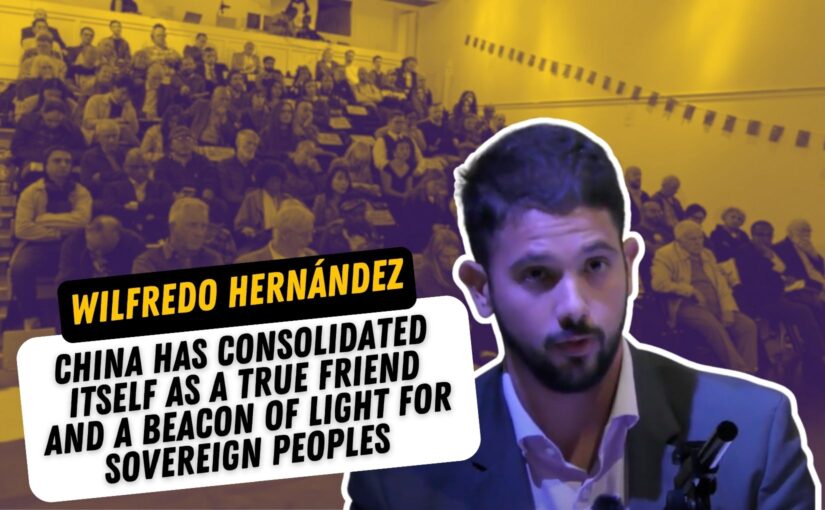
China has consolidated itself as a true friend and a beacon of light for sovereign peoples

Wilfredo Hernández Maya, Counsellor of the Embassy of the Bolivarian Republic of Venezuela, was among the members of the diplomatic corps in London who extended greetings in the opening rally of our 2025 second annual conference, held on Saturday, September 27.

Gathered in Bolívar Hall, he noted that, “your presence in this space, which bears the name of our Liberator, Simón Bolívar, is deeply meaningful: it unites the memory of the struggles for independence with today’s commitment to building a fairer, more supportive and multipolar world.”

“Today, through its clear international leadership, China offers us pathways of progress, cooperation and development in a world where traditional hegemonic powers seek to impose their will on our peoples through violence, imperialism, and a supremacist and racist vision.”

We are pleased to publish Comrade Wilfredo’s speech below.

Dear friends,

On behalf of Ambassador Félix Plasencia González and the Bolivarian Government of Venezuela, I extend to you all a fraternal word of welcome to our Bolívar Hall, which today is honoured to open its doors once again to celebrate the 76th anniversary of the founding of the People’s Republic of China, together with Friends of Socialist China, as well as representatives of solidarity movements and the diplomatic corps of brotherly nations present here.

Allow me to begin by expressing our sincere gratitude to Friends of Socialist China for choosing Bolívar Hall once more as the venue for this important gathering. Your presence in this space, which bears the name of our Liberator, Simón Bolívar, is deeply meaningful: it unites the memory of the struggles for independence with today’s commitment to building a fairer, more supportive and multipolar world.

We also wish to give special thanks to the friendly embassies and solidarity movements whose steadfast commitment accompanies us in the defence of sovereignty, the self-determination of peoples and respect for international law. Your support and friendship stand as testimony that our causes are shared, and that international cooperation founded on mutual respect is not only possible but essential.

Dear comrades,

In this year, when we mark both the 76th anniversary of the founding of the People’s Republic of China and the 80th anniversary of the victory over fascism, we must remember the millions of men and women who gave their lives in the struggle against imperialist barbarism. That achievement was more than a military triumph: it represented the affirmation of the dignity of all humanity and the birth of a new hope. The brave Chinese people rose from the ruins and, through sacrifice, wrote one of the most glorious chapters in world history.

Venezuela recognises in that epic struggle the spiritual strength that continues to inspire the Chinese Revolution, today a beacon of sovereignty and social justice for its people and for the world. The People’s Republic of China, with its renewed and robust global leadership, now puts forward proposals of great meaning and potential for humanity, such as the Global Governance Initiative presented by President Xi Jinping at the Shanghai Cooperation Organisation Summit, held in Tianjin this year.

This new international project complements the three initiatives previously advanced by China: the Global Development Initiative, the Global Civilisation Initiative and the Global Security Initiative. Together, they point towards building a Community of Shared Future for Mankind, in full harmony with Venezuela’s Bolivarian Diplomacy of Peace and with our vision of a balanced world order, based on the sovereign equality of States, respect for international law, genuine multilateralism, and a focus on the wellbeing of peoples.

Continue reading China has consolidated itself as a true friend and a beacon of light for sovereign peoples