Senator Mushahid Hussain: Two visions, two destinies

In this short commentary for CGTN Reality Check, Senator Mushahid Hussain – Chairman of the Senate Defence Committee of Pakistan, Chairman of the Pakistan-China Institute, and member of the Friends of Socialist China advisory group – compares and contrasts two of this year’s anniversaries: the 10th anniversary of China advancing the Belt and Road Initiative (BRI) and the 20th anniversary of the US invasion of Iraq. 

Mushahid describes the BRI as “probably the most important diplomatic and developmental initiative launched in the 21st century… about connectivity, about cooperation, about reviving the ancient Silk Road, which 2,000 years ago was probably the first instance of globalisation linking China’s Silk Road with Central Asia, with the Middle East, with even Europe.”

In contrast he notes that the US-led invasion of Iraq was “a war that was unjust, a war that was illegal, a war that was immoral, because it had no sanction of the United Nations, no sanctions of legality behind it.”

And while China is talking about connectivity and cooperation, “the West, led by the United States, is obsessed with the militarisation of international relations, igniting a new Cold War, talking of containing China, building a new pattern of military alliances.”  In this regard, Mushahid draws attention to the moves to create an ‘Asian NATO’, along with AUKUS, the Quad, and the tripartite alliance agreed between the United States, Japan and South Korea at their Camp David meeting. The senator concludes:

“These two contrasting visions show that the world is headed in a manner of confrontation sparked by the West, while what the world needs today in the post-pandemic world is to have a common approach, to face common challenges in a collective manner. And that is what China is doing and that is what the Global South would like – to build a better tomorrow without overlords and without underdogs.”

We reprint the article and embed the video below.

This year marks the 10th anniversary of the Belt and Road Initiative – BRI, which is probably the most important diplomatic and developmental initiative launched in the 21st century. And it was done by President Xi Jinping of China when he spoke at Astana in Kazakhstan, about connectivity, about cooperation, about reviving the ancient Silk Road, which 2000 years ago was probably the first instance of globalization linking China’s Silk Road with Central Asia, with the Middle East, with even Europe. Connectivity through commerce and culture among countries and continents.

And this year on March 16, and I was present then, when President Xi Jinping launched the Global Civilization Initiative at the World Political Parties High-level Dialogue. Dialogue among civilizations, respect among civilizations, cooperation among civilizations, learning from each other. A civilizational cooperation in contrast to the vision that had been once presented and very popular in the West about the clash of civilizations.

But 2023 also marks another anniversary, and if I may say so, a dark anniversary, a sad anniversary. Twenty years ago, the United States launched unilaterally a war in Iraq. A war that was unjust, a war that was illegal, a war that was immoral, because it had no sanction of the United Nations, no sanctions of legality behind it. It was an attempt to bully and browbeat a country for ideological and geopolitical reasons. 

And these two anniversaries also present humankind today two contrasting visions. I would say that we are perhaps at an inflection point when the global center of gravity is shifting, when we are facing turbulence and transformation.

China is talking of connectivity and cooperation. The West is talking of containment, conflict, confrontation. China is talking of modernization, of being more inclusive, of diversity, of equality in international relations. The West, led by the United States, is obsessed with the militarization of international relations, igniting a new Cold War, talking of containing China, building a new pattern of alliances, military alliances.

NATO is now becoming an “Asian NATO.” NATO was talking of a threat from China while China is not part of the North Atlantic. China is thousands of miles away from the North Atlantic.

They are talking of AUKUS, Australia, UK, U.S., a new military organization. They are talking of Quad, which is again a military alliance, and recently U.S. President Biden hosted the leaders of South Korea and Japan at Camp David to forge yet another alliance, yet another pact ostensibly to contain China.

So, these contrasting visions are reflected in the pattern of contemporary international relations. China is building bridges, and a great example of that bridge building has been the China-brokered rapprochement between Iran and Saudi Arabia, who were at loggerheads for the last three-four decades, which destabilized the Middle East. And thanks to China’s efforts, there’s been normalization, there’s been rapprochement, and there’s been the reestablishment of diplomatic relations between Iran and Saudi Arabia.

Conversely, we see the United States, the Western countries, building barriers based on protectionism, tariffs and trying to isolate China. These two contrasting visions show that the world is headed in a manner of confrontation sparked by the West, while what the world needs today in the post-pandemic world is to have a common approach, to face common challenges in a collective manner. And that is what China is doing and that is what the Global South would like – to build a better tomorrow without overlords and without underdogs.

Dee Knight: Traveling to prove China is not our enemy

This fascinating article by Dee Knight describes a recent peace tour to China by a small group of activists from the US, and includes Dee’s reflections on his visit and a number of topics related to China and the New Cold War.

The report includes mention of the group’s brief stopover in Taipei, and Dee briefly discusses the US’s recent undermining of the One China policy:

“Visiting Taiwan enroute to mainland China reveals something nearly everyone agrees on: Taiwan is very much part of China. Both Chinese governments agree, and the US government has shared this view since at least 1972, when US President Nixon and Chinese leader Deng Xiaoping signed a treaty to that effect. It makes you wonder why the US is pushing for Taiwan to be ‘independent’ of the mainland, spending billions to arm it to the teeth, and sending war ships through the Taiwan Strait, thus violating China’s territorial waters, at the risk of triggering a flareup to war at any moment.”

Describing the group’s trip to Shanghai, Dee contrasts the relative affluence and modernity of the city today with the poverty and backwardness imposed upon it in the early part of the 20th century, when it was a playground for Western imperialists – a time when “the colonial powers forced China’s weak government to cede control of trade in both Shanghai and Beijing” and the streets of Shanghai’s ‘International Settlement’ concessions “had signs saying ‘No Chinese or Dogs Allowed.'”

Comparing Shanghai’s transport infrastructure with that of the US, Dee writes:

Underground, the metro hums along: more than 20 lines rival the extent of New York’s MTA, and humble it for cleanliness, courteous service and safety. All the stations I saw have escalators, elevators, and super-clean floors. They also have moving barriers between the passenger platforms and incoming trains, to protect riders.

On China’s network of high-speed rail, Dee observes: “These bullet trains now connect all of China’s major cities, following the gigantic infrastructure projects of recent decades. The US has no bullet trains, and can’t seem to find the financing for them, especially since the profit potential in military production is so much higher.”

Dee also includes some reflections on China’s system of governance, describing the mechanics of its whole-process people’s democracy and countering the Western media’s tropes about China as an authoritarian tyranny and police state.

We didn’t see homeless people anywhere in China. We also didn’t see any signs of repression or oppression anywhere – including Xinjiang. The Chinese people we encountered seemed both calm and content. Tension, conflict and stress are low.

Dee writes powerfully that “visiting China made me believe peace is possible”, that the Chinese people very much do not want war or confrontation with the US, and opining that the US’s policy of trade war and military brinkmanship is a dead-end for humanity.

Cooperation, common prosperity and a shared future make much more sense. That formula has found warm welcomes across the globe. It even includes major initiatives in green development, where again China is leading the way. It has more solar and wind energy generation than the rest of the world combined. And while it still uses more fossil fuel for energy than non-polluting sources, Xi Jinping has pledged that by mid-century fossil fuels will be phased out. That would be an accomplishment worth emulating. It’s much better to save the world from burning up than continue with the current US craze of military brinksmanship!

Dee Knight is a veteran of the US peace and socialist movements, and is a member of the International Committee of the Democratic Socialists of America (DSA) and of the Friends of Socialist China advisory group.

“China Is Not Our Enemy” was the theme of a ten-day visit to China in early November. The visit was designed to find and highlight a path to common prosperity and a shared future between China, the United States, and the rest of the world. Visiting China made me believe peace is possible.

We flew from JFK to Taipei to Shanghai. Then we took a “bullet train” to Beijing. From there we flew to Urumqi and Kashgar, Xinjiang. Then back to Urumqi to Changsha, Hunan, and from Changsha to Shanghai. Then back to Taipei and from there to JFK.

1. Taiwan is part of China.

Getting to China from the USA is easier now than it was centuries ago for Marco Polo when he traveled from Venice by camel over the old Silk Road. We boarded a jumbo jet at 1am November 1 at Kennedy Airport in New York – actually 1pm in Taiwan and China, which are 12 hours ahead of New York. The flight was a mere 17 hours, so we landed at about 6am November 2. We flew nonstop through northern Canada, then down past Japan and Korea to reach Taiwan. Service on the China Airlines jumbo jet was impeccable – two main meals, enjoyable movies, and plentiful snacks with beverage service.

Visiting Taiwan enroute to mainland China reveals something nearly everyone agrees on: Taiwan is very much part of China. Both Chinese governments agree, and the US government has shared this view since at least 1979, when US President Nixon and Chinese leader Deng Xiaoping signed a treaty to that effect. It makes you wonder why the US is pushing for Taiwan to be “independent” of the mainland, spending billions to arm it to the teeth, and sending war ships through the Taiwan Strait, thus violating China’s territorial waters, at the risk of triggering a flareup to war at any moment.

Before landing in Taipei we spoke with a Chinese couple who were part of the original post-WW2 migration from the Mainland to Taiwan after the Red Army defeated Chiang Kai Shek’s Kuomintang (KMT). Chiang transferred what was left of his army, plus thousands of camp followers and businesspeople across the strait, and took over the Taiwan government with US backing. There was no pretense of democracy – Chiang staged a military takeover and set up a dictatorship that lasted till his death in 1975, always with lavish US support. It was much the same in the southern half of Korea following Japan’s surrender at the end of WW2. There the US backed one dictator after another until the 1990s, when massive popular protests led to brief periods of democratic government – in each case ultimately suppressed by military takeovers backed by the US. Recently Biden held a summit with the leaders of Japan and South Korea to forge an alliance against China and North Korea.

Continue reading Dee Knight: Traveling to prove China is not our enemy

China’s vision of jointly building a community with a shared future among neighbouring countries

On October 24, the Chinese government published an important policy paper on its foreign policy regarding neighbouring countries. Clearly, policy towards one’s neighbours forms a significant part of any country’s foreign policy, but recently China has been attaching ever greater significance to this and theorising it as a specific area of diplomacy in its own right.

The document is “based on the assessment and overview of the current situation and future trends in Asia, comprehensively outlines the achievements, policies, visions and objectives of China’s neighbourhood diplomacy, and declares China’s commitment to the path of peaceful development, to promoting development of the neighbourhood through its own development, to working with regional countries to advance modernisation, to jointly building a community with a shared future among neighbouring countries and to realising the vision of a peaceful, secure, prosperous, beautiful, amicable and harmonious Asia in the new era.”

It notes that Asia has doubled its share of the world economy, made the leap from a region of low income to one of middle income, and formed a momentum of cooperation, development and rapid rise, in a short span of 40 years. In recent years, it adds, Asia, as an important engine driving global economic recovery, has contributed more than 50 percent to global growth.

However, at the same time, “global governance is in dysfunction; Cold War mentality is resurfacing; unilateralism, protectionism and hegemonism run rampant; multiple risks in such fields as energy, food, finance, industrial and supply chains, and climate change are having greater impact on Asia.”

Hence:

“There are two opposite propositions and trends concerning the future of Asia. One advocates open regionalism, true multilateralism, a development-first approach, mutually beneficial cooperation, openness and inclusiveness, integrated development, and pursuit of common development in harmony. The other represents a relapse into the Cold War mentality and exclusive clubs, and attempts to draw lines based on values, politicise economic issues, divide the region into different security blocs, and stoke division and confrontation. Good principles keep abreast of the times. The right choice for Asia should be openness, solidarity, cooperation, justice and harmony rather than isolation, division, confrontation, hegemony and zero-sum approach.”

In terms of historical background, the paper recalls that China and fellow Asian countries jointly advanced the Five Principles of Peaceful Coexistence and have carried forward the Bandung Spirit of solidarity, friendship and cooperation, continously advancing good-neighbourliness and mutually beneficial cooperation.

In the present period, political mutual trust has been growing. Among the various examples it cites are that China has established diverse and substantive partnerships, cooperative relations and strategic relations of mutual benefit with 28 neighbouring countries as well as with ASEAN (the Association of South East Asian Nations). And the country has resolved historical boundary issues with 12 neighbours on land through negotiations and signed treaties of good-neighbourliness and friendly cooperation with nine neighbouring countries. Meanwhile, on the economic front, China is the largest trading partner of 18 neighbouring countries.

“The remarkable progress made in Asia is attributable to the joint efforts of China and neighbouring countries and needs to be cherished. China’s development would not be possible without a peaceful and stable neighbouring environment.”

In terms of the principles underlining its policy positions, the document reaffirms that China upholds equality between countries regardless of their size, promotes the unity and cooperation of the Global South, upholds the common interests of developing countries, and works to raise the representation and voice of emerging markets and developing countries in global affairs. 

“China rejects the Cold War mentality, unilateralism, group politics and bloc confrontation. China attaches importance to the legitimate security concerns of all countries, upholds the principle of indivisible security, seeks to build a balanced, effective and sustainable security architecture, and follows a new path to security that features dialogue over confrontation, partnership over alliance, and win-win over zero-sum together with regional countries.”

It underlines the importance of common but differentiated responsibilities in the fight against climate change and for green development, stating:

“China stands ready to work with regional countries to pursue green development and a green growth model, drive economic growth with innovation, transform and upgrade economic, energy and industrial structures, and strike a fine balance between emission reduction and economic growth, in a bid to build an Asian home enjoying the concerted progress of economic growth and environmental progress.”

The document also deals with a wide range of other topics and policies connected to neighbourhood diplomacy. We reprint the full text below. It was originally published by the Xinhua News Agency.

Preface

China and its neighboring countries enjoy geographical proximity, cultural affinity and integrated interests with a shared future. The millennium-old friendly exchanges between the two sides are a vivid history of exchanges and mutual learning among civilizations. Such friendly bonds are best captured by the Chinese saying: “true friendship weathers the changing seasons without fading away and is made even stronger by hardships.”

The neighborhood is where China survives and thrives and the foundation of its development and prosperity. As a member of the Asian family and a responsible major country, China attaches great importance to neighborhood diplomacy, always prioritizes the neighborhood on its diplomatic agenda, and remains committed to promoting regional peace, stability, development and prosperity.

Outlook on China’s Foreign Policy on Its Neighborhood in the New Era, based on the assessment and overview of the current situation and future trends in Asia, comprehensively outlines the achievements, policies, visions and objectives of China’s neighborhood diplomacy, and declares China’s commitment to the path of peaceful development, to promoting development of the neighborhood through its own development, to working with regional countries to advance modernization, to jointly building a community with a shared future among neighboring countries and to realizing the vision of a peaceful, secure, prosperous, beautiful, amicable and harmonious Asia in the new era.

I. Asia Faces New Opportunities and Challenges

In the Report to the 20th National Congress of the Communist Party of China (CPC), Xi Jinping, General Secretary of the CPC Central Committee and Chinese President, pointed out that changes of our world, our times, and of historical significance are unfolding in ways like never before. The world has once again reached a crossroads in history. Asia, amidst the changes unseen in a century, stands at a new starting point towards development and revitalization and faces unprecedented opportunities and challenges.

Asia, with its vast land and abundant resources, is home to a large population with diverse cultures and development. It has remained generally stable in the past few decades. Regional countries have enjoyed growing political mutual trust and ever deepening cooperation and exchanges. As a result, Asia has doubled its share of the world economy, made the leap from a region of low income to one of middle income, and formed a momentum of cooperation, development and rapid rise in a short span of 40 years. In recent years, Asia, as an important engine driving global economic recovery and growth, has contributed more than 50 percent to global growth. Asia is the most dynamic region with the biggest development potential in the world and will remain a promising land for global development and prosperity.

Meanwhile, global governance is in dysfunction; Cold War mentality is resurfacing; unilateralism, protectionism and hegemonism run rampant; multiple risks in such fields as energy, food, finance, industrial and supply chains and climate change are having greater impact on Asia. Asia also faces challenges such as uneven economic growth, and pronounced security and governance issues. Some countries have intensified efforts to build regional military alliances; the Korean Peninsula issue remains complicated and intractable; Afghanistan faces numerous challenges in its reconstruction; terrorism, natural disasters and other non-traditional security threats persist.

There are two opposite propositions and trends concerning the future of Asia. One advocates open regionalism, true multilateralism, a development-first approach, mutually beneficial cooperation, openness and inclusiveness, integrated development, and pursuit of common development in harmony. The other represents a relapse into the Cold War mentality and exclusive clubs, and attempts to draw lines based on values, politicize economic issues, divide the region into different security blocs, and stoke division and confrontation.

Good principles keep abreast of the times. The right choice for Asia should be openness, solidarity, cooperation, justice and harmony rather than isolation, division, confrontation, hegemony and zero-sum approach. This not only hinges on the future prospects of countries in the region, but will also have a fundamental and far-reaching bearing on the future of Asia and the world. Building a community with a shared future for mankind is the sure path to a prosperous and better Asia and the world.

Continue reading China’s vision of jointly building a community with a shared future among neighbouring countries

China and the US: who’s really in a ‘vulnerable negotiating position’?

In the following article, originally published in the Morning Star, Friends of Socialist China co-editor Keith Bennett argues that, contrary to the Western media consensus that China is in a “vulnerable negotiating position” vis-a-vis the US-China relationship, it’s actually the US which is struggling economically and which is increasingly isolated on the global stage.

Keith observes that the deterioration in the relationship over the last decade was not instigated or encouraged by China. “As a socialist country still engaged in a quest for modernisation and development, China is committed to peace and has no interest in war.” The US has been steadily undermining the One China Principle, surrounding China with military bases, and “rigged up a string of alliances aimed at containing China, be it the Quad with India, Japan and Australia, Aukus with Australia and Britain, or this summer’s Camp David deal with Japan and South Korea.”

However, while the US has continued to escalate its aggression towards China, it has comprehensively failed to achieve its objectives, and China’s weight in the global economy and standing in the international community have been steadily rising. Keith points out that, for example, more than 40 countries have now expressed interest in joining BRICS.

Speaking at the opening ceremony of the recent Belt and Road Forum – which included representatives from more than 150 countries, including some 23 heads of state and government and the secretary-general of the UN – Xi Jinping set out in simple but powerful terms China’s vision of development and peaceful cooperation:

We have learned that humankind is a community with a shared future. China can only do well when the world is doing well. When China does well, the world will get even better.

This is a message that resonates with people around the world, and which stands in stark contrast to the US’s increasingly aggressive and belligerent stance. As Keith notes, “it is little wonder that this is a more appealing message to the majority of countries in the world, that wish to develop their economies while maintaining their independence.”

Meanwhile the US finds itself increasingly isolated on the world stage, for example with the vast majority of countries opposing its brutal embargo against Cuba and its pro-genocide stance in relation to the Gaza war.

The recent Apec summit in San Francisco was largely overshadowed by the meeting between US President Joe Biden and his Chinese counterpart Xi Jinping that immediately preceded it.

The two men met for four hours on November 16, in a mansion once better known for the US soap opera Dallas having been filmed there. For what was almost certainly the most important diplomatic encounter of 2023 its actual results appear rather modest.

They featured an agreement on Artificial Intelligence, counternarcotics co-operation, the resumption of military-to-military communications, the expansion of direct flights, and the promotion of a range of bilateral exchanges, including a high-level dialogue on tourism and streamlining visa application procedures.

An agreement to co-operate on climate change was announced just before the summit. US Special Presidential Envoy for Climate Change John Kerry has been one of just a handful of US politicians to have retained a rational approach to China.

But what was actually significant about the meeting was that it took place at all — and in so doing, as a number of commentators have noted, established a floor under bilateral relations.

That this should rightly be regarded as a not inconsiderable achievement is in itself testimony to just how far the world’s most important diplomatic relationship has deteriorated in the last decade under the successive presidencies of Obama, Trump and Biden.

From the Chinese point of view, Xi’s visit was above all a voyage for peace. As the Chinese leader told a subsequent business dinner: “I often say that what the Chinese people oppose is war, what they want is stability, and what they hope for is enduring world peace.”

Continue reading China and the US: who’s really in a ‘vulnerable negotiating position’?

China’s position paper calls for comprehensive ceasefire in Gaza

On Thursday 30 November, China released a position paper on resolving the Palestinian-Israeli conflict. The paper reiterates China’s longstanding position of support for the national rights of the Palestinian people, and sets out realistic proposals for a peaceful and durable solution to the crisis in Gaza and its underlying factors.

In sharp contrast to the statements made by the Western powers, which have largely given a carte blanche to Israel in its brutal assault on Gaza, China’s position paper calls for a comprehensive and immediate ceasefire, and for an end to the forced transfer of Palestinians – which by any reasonable definition must be considered as ethnic cleansing.

The position paper states that there will be no lasting peace without the “restoration of the legitimate national rights of Palestine, and the establishment of an independent State of Palestine that enjoys full sovereignty based on the 1967 borders and with east Jerusalem as its capital.”

It is worth noting that China is a longstanding friend of the Palestinian people and supporter of Palestinian national rights. In a letter to Ahmad al-Shukeiri, president of the Palestine Liberation Organisation (PLO), dated 6 June 1967, Premier Zhou Enlai wrote: “The Chinese people will forever remain comrades-in-arms of the Palestinian people and the people of the Arab countries in the struggle against imperialism.”

This was four years before the People’s Republic of China’s rightful seat at the United Nations was restored. Since taking up its position in the UN General Assembly and Security Council, China has been a loud and consistent voice on the international stage in favour of justice for the Palestinian people.

China sent its first aid to the Palestinian people in 1960, and when the PLO was founded in 1964, China became the first non-Arab country to recognise it. It was also one of the first countries to recognise the State of Palestine – on 20 November 1988. Indeed Yasser Arafat – historic leader of the Palestinian resistance and Chairman of the PLO from 1969 to 2004 – stated in 1970 that “China is the biggest influence in supporting our revolution and strengthening its perseverance.”

In May 2013, just two months after his election as president, Xi Jinping put forward a four-point proposal for the settlement of the Palestinian question, highlighting his personal commitment to the cause. This proposal was pragmatic and realistic, and centred around the demand for an independent, viable Palestinian state enjoying full sovereignty on the basis of the 1967 borders and with East Jerusalem as its capital. Xi reiterated this demand in a new three-point proposal for settlement of the Palestinian question, put forward during discussions with Palestinian President Mahmoud Abbas in Beijing in June this year.

In response to the current crisis raging in Gaza, Xi has commented that “the right of the Palestinian people to statehood, their right to existence, and their right of return have long been ignored.” China’s often-repeated demand – for a Palestinian state based on 1967 borders, with East Jerusalem as its capital and with the right of return for Palestinian refugees – reflects the legitimate national rights of the Palestinian people, and is consistent with the position of the PLO and the Arab League, and furthermore with UN General Assembly Resolution 3236, adopted in 1974, which affirms the Palestinians’ right to national independence and sovereignty.

With Israel committing war crimes on a vast scale in Gaza – targeting hospitals, schools, residential buildings, refugee camps and mosques, and killing civilians in their thousands – China has persistently called for a ceasefire, a position supported by the vast majority of the world’s countries, although unfortunately not the US and Britain.

Addressing an extraordinary joint meeting of the leaders of the BRICS countries last week, President Xi called for the convening of an international peace conference to build international consensus and to create a path towards Palestinian statehood. He stated: “The only viable way to break the cycle of Palestinian-Israeli conflict lies in the two-state solution, in the restoration of the legitimate national rights of Palestine, and in the establishment of an independent State of Palestine.”

With its facilitation of a rapprochement between Iran and Saudi Arabia earlier this year, China has shown that it has a valuable role to play in helping to resolve conflicts in the Middle East region. This is why, earlier this month, a delegation of foreign ministers from Arab and Islamic countries seeking to find a solution to the Gaza crisis chose China as the first destination of their ministerial tour.

It is increasingly clear to the peoples of the world that while the imperialist powers cling on to their old habits of war, aggression, unilateralism and coercion, China is working determinedly and resolutely for peace, development, multipolarity and common prosperity.

The full text of the position paper is republished below, along with a report from the Chinese Foreign Ministry of President Xi Jinping’s message of congratulations to the 30 November UN meeting marking the International Day of Solidarity with Palestinian People.

Position Paper of the People’s Republic of China on Resolving the Palestinian-Israeli Conflict

The current Palestinian-Israeli conflict has caused heavy civilian casualties and a serious humanitarian disaster. It is a grave concern of the international community. President Xi Jinping stated China’s principled position on the current Palestinian-Israeli situation on a number of occasions. He stressed the need for an immediate ceasefire and ending the fighting, ensuring that the humanitarian corridors are safe and unimpeded, and preventing the expansion of the conflict. He pointed out that the fundamental way out of this lies in the two-state solution, building international consensus for peace, and working toward a comprehensive, just and lasting settlement of the Palestinian question at an early date.

Pursuant to the Charter of the United Nations, the Security Council shoulders primary responsibility for the maintenance of international peace and security, and should thus play an active and constructive role on the question of Palestine. In this connection, China offers the following proposals:

Continue reading China’s position paper calls for comprehensive ceasefire in Gaza

The West is not living up to its responsibilities on climate change

The following article by Friends of Socialist China co-editor Carlos Martinez – a slightly expanded version of an opinion piece written for the Global Times – discusses the controversies and difficulties setting up the loss and damage fund agreed at last year’s UN Climate Change Conference (COP27).

Noting that the fund is an application of the principle of common but differentiated responsibilities (CBDR), which principle lies at the core of international environmental law, the article points out that the rich countries have consistently failed to meet their clear legal and moral responsibility to provide the technology and finance to ensure the Global South can continue to develop, industrialise and modernise without causing significant environmental harm. The best-known example of this is the rich nations’ failure to meet their commitment, made in 2009, to channel $100 billion per year to developing countries to help them adapt to climate change and transition to clean energy systems.

The imperialist powers have developed the bad habit of blaming China for everything that goes wrong. In terms of environmental questions, Western politicians and journalists deflect criticism of their own slow progress on green energy by essentially assigning China culpability for the climate crisis. Carlos points out that, firstly, China is a developing country and thus has different responsibilities under the framework of CBDR; secondly, China has emerged as the pre-eminent force in renewable energy, electric transport, biodiversity protection, afforestation and pollution reduction. Furthermore it’s working with other countries of the Global South on their energy transitions.

The article concludes by calling on the wealthy countries to stop blaming China and to focus instead on meeting their own responsibilities.

The most significant outcome of last year’s UN Climate Change Conference (COP27) was an agreement to set up a “loss and damage” fund to help climate-vulnerable countries pay for the damage caused by the escalating extreme weather events linked to climate change, such as wildfires, heatwaves, desertification, rising sea levels and crop failures. It is widely estimated that the level of funding needed for this purpose will be in the hundreds of billions of dollars annually.

Simon Stiell, UN Climate Change Executive Secretary, warmly applauded this agreement, for which the developing countries – including China – had fought long and hard. “We have determined a way forward on a decades-long conversation on funding for loss and damage – deliberating over how we address the impacts on communities whose lives and livelihoods have been ruined by the very worst impacts of climate change.”

The fund is an application of the principle of common but differentiated responsibilities (CBDR), agreed at the UN Framework Convention on Climate Change of Earth Summit in Rio de Janeiro in 1992. Under this principle, the developed countries have a duty to support developing countries in climate change adaptation and mitigation. All countries have a “common responsibility” to save the planet, but they vary in their historical culpability, level of development and availability of resources, and thus have “differentiated responsibilities”.

CBDR lies at the core of international environmental law, and is a key demand of those campaigning for climate justice. It recognises that development is a human right, and that the countries of North America, Europe, Japan and Australia fuelled their own development with coal and oil; they got rich while colonising the atmospheric commons. The US and Europe alone are responsible for just over half the world’s cumulative carbon dioxide emissions since 1850, although representing just 13 percent of the global population.

Therefore the primary moral, historical and legal responsibility is on the developed countries to provide the technology and the finance such that the Global South can continue to develop, industrialise and modernise without causing significant environmental harm.

Unfortunately, in the year since COP27, precious little progress has been made in terms of setting up the loss and damage fund. There have been numerous disagreements about which countries will contribute and which will benefit, and the US and other advanced countries have been firmly resisting the idea that contributions should be mandatory. Meanwhile the developing countries have had to accept the fund being hosted by the World Bank – which is seen as being essentially a policy instrument of the United States.

This is a familiar story. At the UN climate summit in Copenhagen in 2009, the rich nations pledged to channel 100 billion US dollars per year year to developing countries to help them adapt to climate change and transition to clean energy systems. Respected environmental journalist Jocelyn Timperley wrote that, “compared with the investment required to avoid dangerous levels of climate change, the 100 billion dollar pledge is minuscule”; and yet the promise has never been kept. The US spends upwards of 800 billion dollars a year on its military, but seems to be almost entirely unresponsive to the demands of the Global South for climate justice.

‘Blaming China’ has of course become the go-to option for Western politicians seeking to escape accountability and divert attention from their own failures. Various representatives from the wealthy countries have suggested that China – as the world’s second-largest economy and highest overall emitter of greenhouse gases – should contribute to the loss and damage fund in order for it to be fair and viable. Wopke Hoekstra, EU commissioner for climate action, recently commented: “I’m saying to China and others that have experienced significant economic growth and truly higher wealth than 30 years ago, that with this comes responsibility.”

The notion that China has the same duties as North America and Western Europe means turning the principle of CBDR on its head. China is a developing country, with a per-capita income a quarter of that of the US. It is still undergoing the process of modernisation and industrialisation.

Meanwhile, although it is the world’s largest emitter of greenhouse gases, its per capita carbon emissions are half those of the US, in spite of the US having exported the bulk of its emissions via industrial offshoring. Chinese emissions are certainly not caused by luxury consumption like in the West – average household energy consumption in the US and Canada is nine times higher than in China.

Furthermore, according to the World Food Programme, China is one of the most disaster-prone countries in the world, with up to 200 million people exposed to the effects of droughts and floods.

From the very beginning of the international discussions around managing climate change, China has stood together with, and taken up the cause of, the developing countries. Indeed, China was one of the countries arguing vociferously for the loss and damage fund to be created.

China has nevertheless emerged as a global leader in the struggle against climate breakdown. According to an analysis by Carbon Brief, China’s carbon dioxide emissions are expected to peak next year, six years ahead of schedule. Given China’s extraordinary investment in renewable energy – its current renewable capacity is equivalent to around half the global total, and is rising fast – there’s every likelihood that it will reach its goal of achieving carbon neutrality by 2060 or sooner.

Meanwhile China is making a profound contribution to assisting other countries of the Global South with their energy transitions. Nigerian journalist Otiato Opali writes: “From the Sakai photovoltaic power station in the Central African Republic and the Garissa solar plant in Kenya, to the Aysha wind power project in Ethiopia and the Kafue Gorge hydroelectric station in Zambia, China has implemented hundreds of clean energy, green development projects in Africa, supporting the continent’s efforts to tackle climate change.”

While politicians and journalists in the West tend to ignore China’s successes in renewable energy, they loudly decry its construction of new coal plants. However, a recent Telegraph article provided an exception to this rule, noting that the approval of new coal plants “does not mean what many in the West think it means. China is adding one GW of coal power on average as backup for every six GW of new renewable power. The two go hand in hand.” That is, coal plants are being installed to compensate for the intermittency problems of renewable energy, and will therefore be idle for most of the time.

The US, Canada, Britain, the EU and Australia are all making insufficient progress on renewable energy, and are failing to meet their commitment to supporting energy transition in the Global South. By sanctioning Chinese solar materials and imposing tariffs on Chinese electric vehicles, they are actively impeding global progress. Their proxy war against Russia in Ukraine has led to a dramatic expansion in the production and transport of fracked shale gas, at tremendous environmental cost.

These countries should stop pointing the finger at China and start taking their own responsibilities seriously. Let us hope we see some evidence of this at COP28.

UK white paper smears China’s growing role in world development

In the following article, which was originally published by Global Times, Deng Xiaoci responds to the British government’s latest White Paper on overseas aid, which said that the UK would resist the alleged risks China “poses to open societies and good governments.” The article notes that Chinese analysts see the report as an example of “blunt smearing and desperate effort by the former colonial power to maintain its global influence and tackle its own internal social and political divisions.”

According to Li Guanjie, a research fellow at Shanghai International Studies University, the hostile tone is, “not surprising at all, as it marks simply a continuation of the China policy that the current Conservative government of the UK adopts.” He added that such hostile remarks against China are desperate attempts to tackle its own crisis, showing that the previous colonial empire is deeply troubled by its waning global influence and has met problems in positioning itself in the current world, especially after the turmoil of Brexit. 

Despite the recent appointment of David Cameron, “famous for his pragmatic China approach”, as Foreign Secretary, Britain still lacks the will to return its relations with China to the right track. The government of Prime Minister Rishi Sunak, Li notes, is in dire need of “establishing an external stimulus to unite…  the Conservative Party, which is riven by internal divisions, as well as create headlines to boost public support in order to win the next general election.”

Polling in early November showed the Conservatives trailing the Labour Party by 23% to 47%, the paper notes.

According to Li Haidong, Professor at the China Foreign Affairs University: “The goal of this white paper from the British government is to ensure that Anglo-Saxon nations continue to play a dominant role in the global development pattern, with intolerance toward any non-Anglo-Saxon nation assuming a leading position in the development pattern.”

Asked to what extent Britain’s White Paper could impact third parties around the world, Chinese experts said that most would keep their distance from such a malicious defamation of China’s role in global development, especially those who have participated in and benefit from the China-proposed Belt and Road Initiative.

The British government’s latest white paper on aid has explicitly raised the so-called concerns over China’s growing role in international development, while promising that the UK will resist the risks China “poses to open societies and good governments.” Such a move to characterize China as a “challenge” with profound prejudice is a blunt smearing and desperate effort by the former colonial power to maintain its global influence and tackle its own internal social and political divisions, Chinese analysts said on Tuesday. 

The white paper smeared the Chinese development model with accusations on its drawbacks including “lower standards and limited transparency,” while underscoring the necessity for the UK to robustly challenge China, especially when British interests are endangered by China’s significant financial role, according to the Guardian’s report on the white paper, a brainchild of British development minister Andrew Mitchell,. 

The white paper, published on Monday UK local time, claims that “between 2008 and 2021, China made $498 billion in loan commitments, equivalent to 83 percent of World Bank sovereign lending during the same period,” adding that “its increased assertiveness in seeking to shape the international order makes it essential for us to navigate the challenges that come with its evolving development role.”

Li Guanjie, a research fellow with the Shanghai Academy of Global Governance and Area Studies under the Shanghai International Studies University, found the hostile tone in the text “not surprising at all, as it marks simply a continuation of the China policy that the current conservative government of the UK adopts.”

British Prime Minister Rishi Sunak described China as the “biggest challenge of our age to global security and prosperity,” after the Group of Seven (G7) summit in May. And before that, Sunak made similar remarks, calling China “the biggest state threat” and “a systemic challenge for the world order,” during an NBC Interview in March.

Li Guangjie told the Global Times on Tuesday that such hostile remarks against China are desperate attempts to tackle its own crisis, showing that the previous colonial empire is deeply troubled by its waning global influence and has met problems in positioning itself in the current world, especially after the turmoil of Brexit. 

The white paper indicates that the Sunak administration, with the recent appointment as foreign secretary of former British prime minister David Cameron, famous for his pragmatic China approach, still lacks determination to drive China-UK relations on the right track and dig them out of the current low tide, observers said.

It also suggested that the Sunak administration is in dire need of establishing an external stimulus to unite domestic forces and the Conservative Party, which is riven by internal divisions, as well as create headlines to boost public support in order to win the next general election, Li Guangjie noted. 

Recent polling showed that as of early November, 47 percent of British adults would vote for the Labour Party in a general election, compared with 23 percent who would vote for the ruling Conservative Party.

“The goal of this white paper from the British government is to ensure that Anglo-Saxon nations continue to play a dominant role in the global development pattern, with intolerance toward any non-Anglo-Saxon nation assuming a leading position in the development pattern. Fundamentally, it’s a matter of leadership in world affairs. The UK finds itself unable to accept China playing a leading role in world affairs,” Li Haidong, a professor at the China Foreign Affairs University, told the Global Times on Tuesday. 

Opposing such an obsolete imperialist mentality, Zhang Jun, China’s permanent representative to the UN, called on Monday for expanding the voice of developing countries in global governance, at an open debate on promoting sustainable peace through common development at the UN headquarters in New York City. 

Peace, development and human rights are the three pillars of the United Nations, among which development is the master key to solving all problems and the foundation for promoting peace and safeguarding human rights, the Chinese envoy said. 

Luo Zhaohui, chairman of the China International Development Cooperation Agency, said in his address to the 2023 Tongzhou Global Development Forum on Saturday that “I can proudly say that China is the developing country that has implemented the Sustainable Development Goals (SDGs) the fastest. We have eliminated absolute poverty, achieved the SDG’s poverty reduction target 10 years ahead of schedule, and fully built a moderately prosperous society.” 

“As the world’s largest developing country, China’s rapid economic development is in itself a major contribution to global development. At the same time, it has accumulated valuable experience for other countries in implementing the SDGs, providing a feasible and replicable practical reference for the world to achieve modernization,” Luo remarked.

The UK might also intend to use the white paper as a reminder for the US, as relations between China and the US have significantly warmed after the leaders of two countries held a summit in San Francisco last week, observers said. 

As the UK considers that its foreign policy and views on global landscape are more advanced that those of the US, the UK may tend to release a white paper like this to remind the US that Beijing is still a threat or competitor, so as to lead or mislead the US, amid warming ties between Washington and Beijing, Li Guanjie said.

Also the “limited coordination through the multilateral system, especially of bilateral instruments like the Belt and Road Initiative (BRI),” is also mentioned in the white paper among listed drawbacks of China’s growing role in global development. 

When asked to what extent the white paper could impact third parties around the globe, Chinese observers noted that most would keep their distance from such a malicious defamation of China’s role in global development, especially those who have participated in and benefit from the China-proposed BRI.

Vladimir Putin: US exceptionalism is an extension of the colonial mindset

In this edition of the CGTN series Leaders Talk, Wang Guan travels to Moscow to interview Vladimir Putin, shortly before the Russian President left for Beijing to attend the Third Belt and Road Forum for International Cooperation. 

President Putin notes that, in building their relations, Russia and China have “always tried to reach a compromise, even on complicated issues inherited from the old days. Our relations have always been driven by goodwill. It helped us solve the border delimitation issues that had remained outstanding for 40 years.”

Wang Guan gives his impression of the thriving economic relations between the two countries, saying that on this visit to Moscow, he “saw that the streets and stores, including online trading platforms, were increasingly filled with Chinese brands. At the same time, Russian gas is supplied to the homes of Chinese consumers and Russian meat and dairy products, for example, are becoming more and more common in Chinese stores.”

President Putin agrees that his country and China are well on the way to meeting their joint target for two-way trade to reach 200 billion US dollars by 2024.

Turning to the Belt and Road Initiative (BRI), the Russian leader commented that: “Yes, we see that some people consider it an attempt by the People’s Republic of China to put someone under its thumb, but we see otherwise, we just see desire for cooperation. Our own ideas on the development of the Eurasian Economic Union, for example, on the construction of a Greater Eurasia, fully coincide with the Chinese ideas proposed within the framework of the Belt and Road Initiative.”

Thanks to the BRI, the countries of the Eurasian Economic Union (EAEU) have already secured $24 billion dollars’ worth of investments, Putin says, and continues:

“It seems to me that the main advantage of the concept of cooperation proposed by the Chinese side is that nobody imposes anything on anybody in the framework of this work. Everything is done within the framework of finding not only acceptable solutions, but such projects and such ways of achieving a common goal that are acceptable to all. This is what makes China today, under the leadership of President Xi Jinping, unique in building relations with others: no one imposes anything on anyone; no one forces anything on anyone, but only gives them opportunity. And, as I said, if there are difficulties, compromises are sought and always found. In my view, this is what distinguishes the Belt and Road Initiative proposed by the Chinese President from many others that countries with a heavy colonial legacy are trying to implement in the world.”

Reflecting his well-known interest, President Putin refers several times to sports, especially the martial arts and ice hockey, and to his hope to increase cooperation with China in this field, and, citing the importance of sports in his own life, states:

“Everyone knows and it’s not a secret that I come from a simple working-class family, and in the past, I had a lot of time to spend in the yard. I don’t know how my life would have turned out if I hadn’t taken an interest in sports. It doesn’t really matter what kind of sports I did, it’s important that I paid a lot of attention to it.”

Following up on what he said recently at the annual meeting of the Valdai Discussion Club, President Putin excoriated the Western verbiage about a “rules-based order”:

“Have you ever seen those rules? No, you haven’t, because no one has agreed on them with anyone. So how can one talk about order based on rules that no one has ever seen? In terms of common sense, it’s nonsense. But it is beneficial to those who promote this approach. Because if no one has seen the rules, it only means that those who talk about them are making them up themselves from time to time to their own advantage. That is the colonial approach.

“Because colonial countries have always believed that they are first-rated people. After all, they have always talked about bringing enlightenment to their colonies, that they are civilized people who bring the benefits of civilization to other nations, whom they consider second-rate people. No surprise today’s political elite, say, in the United States, talks about its exceptionalism. This is the extension of this colonial mindset, meaning that when they consider themselves exceptional in the United States, it means that other people, all the people in fact, are just some second-rate people. How else could one understand it? Those are mere vestiges of colonial thinking, nothing else.

“Our approach is quite different. We proceed from the fact that all people are equal, all people have the same rights; the rights and freedoms of one country and one nation end where the rights and freedoms of another person, of an entire state, appear. This is the way in which a multipolar world should be evolving gradually. This is exactly what we are striving for, and this is the basis of our interaction with China on the international stage.”

He also speaks about the BRICS cooperation mechanism and its recent expansion from five to 11 members, saying that “all those who have joined BRICS support the idea and concept of forming a multipolar world. No one wants to play second fiddle to some sovereign, everyone wants equal rights. And when they join BRICS, they see that we can achieve this goal by joining efforts within the framework of expansion and strengthening of such a format.”

President Putin also discusses the conflict in Ukraine and the Chinese proposal for a political solution:

“We are thankful to our Chinese friends for trying to think about ways to end this crisis. However, I would like to remind you that hostilities in Ukraine did not start with our special military operation, but way before – in 2014, when the Western countries, after having volunteered as guarantors of the agreements between President Yanukovich and the opposition, forgot about those guarantees in a matter of days and – worse still – supported a coup d’état. United States Administration officials even acknowledged spending big money on it…

“Therefore, the start of the special military operation was not the start of a war, but an attempt to end it.”

Referring to the negotiations held in the Turkish city of Istanbul, shortly after the start of the special military operation, Putin notes that agreement was almost reached, however, “as soon as we pulled our troops back from the Ukrainian capital, Kiev, the Ukrainian side committed all the arrangements to flames.” Therefore:

“Of course, we know the proposals of our Chinese friends. We highly value those proposals. I think they are absolutely realistic and could lay the foundation for peace arrangements. But, unfortunately, the opposing side does not want to enter into any negotiations. In fact, the President of Ukraine has even issued a decree prohibiting everyone – including himself – to conduct any negotiations with us. How can we conduct negotiations if they are not willing to and even issued a regulation prohibiting such negotiations?”

Asked if there is any possibility to make progress based on the Chinese standpoint of building shared, common, and indivisible security, Putin says:

“Yes, we have always said that, too… In this context, it is extremely important for us that Ukraine stays outside any blocs. We were told as far back as 1991 – by the then US Administration – that NATO would not expand further east. Since then, there have been five waves of NATO expansion, and every time we expressed our concerns. Every time we were told: yes, we promised you not to expand NATO eastwards, but those were verbal promises – is there any paper with our signature on it? No paper? Good-bye.

“You see, it is very difficult to engage in a dialogue with people like that. I have already cited the example of the Iranian nuclear programme. The negotiations on the Iranian nuclear programme were very, very lengthy. An agreement was reached, a compromise found, and documents signed. Then came a new Administration and threw everything in the trash, as if those arrangements never existed. How can we agree on anything if every new Administration starts from scratch – begin each time from the centre of the playing field?”

The CGTN interview with President Putin is embedded below. We also reproduce the full text of the interview as published by the Russian President’s website. The quotations above are taken from the latter version.

Continue reading Vladimir Putin: US exceptionalism is an extension of the colonial mindset

The Western left and the US-China contradiction

In the following article, which was originally published in People’s Democracy, the weekly English-language newspaper of the Communist Party of India (Marxist) (CPIM), Prabhat Patnaik takes up the contradictions in the view taken by parts of the western left with regard to China and its growing contradictions with US imperialism. 

He begins by stating that, “significant segments of the non-Communist Western Left see the developing contradiction between the United States and China in terms of an inter-imperialist rivalry.” (One would just observe here that Comrade Patnaik is being either diplomatic or charitable, or quite possibly both, as a number of western communist parties, not least the Communist Party of Greece [KKE], are at least equally prone to this fundamental political error.)

Such a characterisation, Comrade Patnaik notes, “ironically makes these segments of the Left implicitly or explicitly complicit in US imperialism’s machinations against China… since the two countries are at loggerheads on most contemporary issues, it leads to a general muting of opposition to US imperialism.”

Comrade Patnaik further notes that this deviation is not new on the part of some sections of the left, citing attitudes to NATO’s bombing of the former Yugoslavia and current conflicts in both Ukraine and Gaza. 

Regarding the claims that China is a capitalist country, Patnaik writes:

“As for China being a capitalist economy, and hence engaged in imperialist activities all over the globe in rivalry with the US, those who hold this view are, at best, taking a moralist position and mixing up ‘capitalist’ with ‘bad’ and ‘socialist’ with ‘good’. Their position amounts in effect to saying: I have my notion of how a socialist society should behave (which is an idealised notion), and if China’s behaviour in some respects differs from my notion, then ipso facto China cannot be socialist and hence must be capitalist. The terms capitalist and socialist however have very specific meanings, which imply their being associated with very specific kinds of dynamics, each kind rooted in certain basic property relations. True, China has a significant capitalist sector, namely one characterised by capitalist property relations, but the bulk of the Chinese economy is still State-owned and characterised by centralised direction which prevents it from having the self- drivenness (or ‘spontaneity’) that marks capitalism. One may critique many aspects of Chinese economy and society but calling it ‘capitalist’ and hence engaged in imperialist activities on a par with western metropolitan economies, is a travesty. It is not only analytically wrong but leads to praxis that is palpably against the interests of both the working classes in the metropolis and the working people in the global south.”

Hence:

“It is not inter-imperialist rivalry, but resistance on the part of China, and other countries following its lead, to the re-assertion of hegemony by western imperialism that explains the heightening of US-China contradictions.”

Significant segments of the non-Communist Western Left see the developing contradiction between the United States and China in terms of an inter-imperialist rivalry. Such a characterisation fulfils three distinct theoretical functions from their point of view: first, it provides an explanation for the growing contradiction between the US and China; second, it does so by using a Leninist concept and within a Leninist paradigm; and third, it critiques China as an emerging imperialist power, and hence by inference, a capitalist economy, which is in conformity with an ultra-Left critique of China.

Such a characterisation ironically makes these segments of the Left implicitly or explicitly complicit in US imperialism’s machinations against China.  At best, it leads to a position which holds that they are both imperialist countries, so that there is no point in supporting one against the other; at worst, it leads to supporting the US against China as the “lesser evil” in the conflict between these two imperialist powers. In either case, it leads to the obliteration of an oppositional position with regard to the aggressive postures of US imperialism vis-à-vis China; and since the two countries are at loggerheads on most contemporary issues, it leads to a general muting of opposition to US imperialism.

For quite some time now, significant sections of the western Left, even those who otherwise profess opposition to western imperialism, have been supportive of the actions of this imperialism in specific situations. It was evident in their support for the bombing of Serbia when that country was being ruled by Slobodan Milosevich; it is evident at present in the support for NATO in the ongoing Ukraine war; and it is also evident in their shocking lack of any strong opposition to the genocide that is being perpetrated by Israel on the Palestinian people in Gaza with the active support of western imperialism. The silence on, or the support for, the aggressive imperialist position on China by certain sections of the western Left, is, to be sure, not necessarily identical with these positions; but it is in conformity with them.

Such a position which does not frontally oppose western imperialism, is, ironically, at complete variance with the interests and the attitudes of the working class in the metropolitan countries. The working class in Europe for instance is overwhelmingly opposed to NATO’s proxy war in Ukraine, as is evident in many instances of workers’ refusal to load shipment of European arms meant for Ukraine. This is not surprising, for the war has also directly impacted workers’ lives by aggravating inflation. But the absence of any forthright Left opposition to the war is making many workers turn to right-wing parties that, even though they fall in line with imperialist positions upon coming to power as Meloni has done in Italy, are at least critical of such positions when they are in opposition. The quietude of the western left vis-à-vis western imperialism is thus causing a shift of the entire political centre of gravity to the right over much of the metropolis. And looking upon the US-China contradiction as an inter-imperialist rivalry plays into this narrative.

As for China being a capitalist economy, and hence engaged in imperialist activities all over the globe in rivalry with the US, those who hold this view are, at best, taking a moralist position and mixing up “capitalist” with “bad” and “socialist” with “good”. Their position amounts in effect to saying: I have my notion of how a socialist society should behave (which is an idealised notion), and if China’s behaviour in some respects differs from my notion, then ipso facto China cannot be socialist and hence must be capitalist. The terms capitalist and socialist however have very specific meanings, which imply their being associated with very specific kinds of dynamics, each kind rooted in certain basic property relations. True, China has a significant capitalist sector, namely one characterised by capitalist property relations, but the bulk of the Chinese economy is still State-owned and characterised by centralised direction which prevents it from having the self- drivenness (or “spontaneity”) that marks capitalism. One may critique many aspects of Chinese economy and society, but calling it “capitalist” and hence engaged in imperialist activities on a par with western metropolitan economies, is a travesty. It is not only analytically wrong but leads to praxis that is palpably against the interests of both the working classes in the metropolis and the working people in the global south.

But the question immediately arises: if the US-China contradiction is not a manifestation of inter-imperialist rivalry, then how can we explain its rise to prominence in the more recent period? To understand this we have to go back to the post-second world war period. Capitalism emerged from the war greatly weakened, and facing an existential crisis: the working class in the metropolis was not willing to go back to the pre-war capitalism that had entailed mass unemployment and destitution; socialism had made great advances all over the world; and liberation struggles in the global south against colonial and semi-colonial oppression had reached a real crescendo. For its very survival therefore capitalism had to make a number of concessions: the introduction of universal adult suffrage, the adoption of welfare State measures, the institution of State intervention in demand management, and above all the acceptance of formal political decolonisation.

Political decolonisation however did not mean economic decolonisation, that is, the transfer of control over third world resources, exercised till then by metropolitan capital to the newly independent countries; indeed against such transfers imperialism fought a bitter and prolonged struggle, marked by the overthrow of governments led by Arbenz, Mossadegh, Allende, Cheddi Jagan, Lumumba and many others. Even so, however, metropolitan capital could not prevent third world resources in many instances from slipping out of its control to the dirigiste regimes that had come up in these countries following decolonisation.

The tide turned in favour of imperialism with the coming into being of a higher stage of centralisation of capital that gave rise to globalised capital, including above all globalised finance, and with the collapse of the Soviet Union that itself was not altogether unrelated to the globalisation of finance. Imperialism trapped countries in the web of globalisation and hence in the vortex of global financial flows, forcing them under the threat of financial outflows into pursuing neo-liberal policies that meant the end of dirigiste regimes and the re-acquisition of control by metropolitan capital over much of third world resources, including third world land-use.

It is against this background of re-assertion of imperialist hegemony that one can understand the heightening of US-China contradiction and many other contemporary developments like the Ukraine war. Two features of this re-assertion need to be noted: the first is that metropolitan market access for goods from countries like China, together with the willingness of metropolitan capital to locate plants in such countries to take advantage of their comparatively lower wages for meeting global demand, accelerated the growth-rate in these economies (and only these economies) of the global south; it did so in China to a point where the leading metropolitan power, the US, began to see China as a threat. The second feature is the crisis of neo-liberal capitalism that has emerged with virulence after the collapse of the housing “bubble” in the US.

For both these reasons the US would now like to protect its economy against imports from China and from other similarly-placed countries of the global south. Even though these imports may be occurring, at least in part, under the aegis of US capital, the US cannot afford to run the risk of “deindustrialising” itself. The desire on its part to cut China “down to size” so soon after it had been hailing China for its “economic reforms” is thus rooted in the contradictions of neo-liberal capitalism, and hence in the very logic inherent to the reassertion of imperialist hegemony. It is not inter-imperialist rivalry, but resistance on the part of China, and other countries following its lead, to the re-assertion of hegemony by western imperialism that explains the heightening of US-China contradictions.

As the capitalist crisis accentuates, as the oppression of third world countries because of their inability to service their external debt increases through the imposition of “austerity” by imperialist agencies like the IMF, and in turn calls forth greater resistance from them and greater assistance to them from China, the US-China contradictions will become more acute and the tirades against China in the west will grow shriller.

Rejoice: China has now outlasted the USSR

In the following thoughtful and insightful article, originally published in the Morning Star, Andrew Murray observes that, as of this month, the People Republic of China has now outlasted the Soviet Union (even when setting the latter’s start date as the victory of the October Revolution in 1917, rather than the actual formation of the USSR in 1922).

Andrew notes that this milestone represents an inevitable and ongoing eastward shift in the world’s political centre of gravity, “as the depredations wrought by 300 years of imperialism are gradually undone.” Additionally, the survival of Chinese socialism – and specifically a version of Marxism that is grounded in China’s own history and philosophical traditions – is “a dialectical step in the universalisation of Marxism”. This universalisation expands the scope and applicability of Marxism beyond the 19th century industrial heartlands of Europe and North America, to take on board the struggle of peoples the world over against colonialism, imperialism, exploitation and all forms of oppression. Andrew writes:

It should be neither surprising nor alarming that Chinese Marxism is refreshed from a variety of sources of which Marx and Engels knew little or nothing. That is the inevitable interplay of the development of a methodology which aims to encompass the totality of social experience across the world.

Given the longevity of the Chinese Revolution, along with China’s size and growing strengh, Andrew argues persuasively that the “the perspective of socialism in the world today rests heavily on Chinese shoulders” and urges readers to “acknowledge the immensity of the achievement of the CPC and the Chinese people.”

Some of the ideas in this article are explored in more detail in Andrew’s article The significance of the Chinese revolution, based on a presentation to the Friends of Socialist China dialogue held in London in November 2022 on the theme On the evolving significance of the Chinese Revolution.

A landmark in socialist history passed largely unremarked this month.

The People’s Republic of China (PRC) has now lasted longer than the USSR did, counting the latter’s lifespan, as one reasonably should, from the October Revolution of 1917 rather than the actual formation of the USSR in 1922.

Such milestones may mean little in and of themselves. But this one carries a freight of historical significance.

It is emblematic of the shift of the leading edge of human development from Europe and North America to Asia and the Pacific, as the depredations wrought by 300 years of imperialism are gradually undone.

But that is only one side of the issue. China’s rise, after a century of violent interruption by Western aggression, would have significance even if it were an entirely capitalist project, which its critics say it is but which the government of the PRC itself emphatically says it isn’t.

It has additional, and greater, importance in the world because the PRC places its advance within the framework of the worldwide movement for socialism as well as China’s tortured history.

The two revolutions were intimately connected. The Chinese communists are fond of saying that the salvoes of the October Revolution brought Marxism to China.

That is indeed true — before Lenin and the Communist International, there was no Marxism and no Marxist party in China, unlike in Europe where existing Marxist traditions flourished before the first world war.

It was Soviet Marxism that initially shaped the Communist Party of China (CPC). And without the CPC the struggle for China’s freedom from imperialism would have remained in the corrupted and compromised hands of the Kuomintang.

It is doubtful that this counterfactual China could have ever established a genuine unity and independence from foreign hegemony, prerequisites for the huge economic advances of the last 45 years in particular.

In that sense perhaps the most enduring legacy of the Russian revolution in world history has been the Chinese revolution. As to why and how socialist China has lasted longer than its Soviet progenitor — that is a very complicated question.

The reasons for the Soviet collapse of the 1980s have been endlessly chewed over. But there is probably a consensus that a cardinal factor was the unyielding pressure from Western imperialism on the Soviet state, ultimately beyond what its economic system could readily sustain.

That is a problem China seems to have cracked. Its accelerating economic strength has not merely guaranteed its independence — Soviet socialism established that too — but it has been able to reproduce itself at more advanced levels to the point where being broken by economic coercion, expressed through an arms race or otherwise, seems all-but impossible.

The connections between the two great revolutions of the 20th century should not blind us to the discontinuities, however. The CPC may have taken the Comintern’s Marxism-Leninism as its foundation but its work, since 1935 at any rate, has turned on trying to integrate those principles with a reality very different from the one that originally produced Marxism.

For example, Lenin told the victorious Russian communists that they stood on the shoulders of the experience of the Paris Commune and of pre-1914 German social democracy.

Such points of reference meant little in China. The CPC was however the inheritor of indigenous revolutionary traditions, like the 19th-century Taiping Rebellion, a decade-long insurrection animated by a sort of quasi-Christian utopian peasant communism which dwarfs the Paris Commune in duration and bloodshed.

The history of Chinese socialism needs to be read as much or more against this background as it does against the more familiar — in the West — narratives of the international communist movement of Lenin, Stalin and beyond.

The CPC describes its long struggle to make Marxist politics suitable to the different conditions of China as the “localisation” of Marxism. It is also, however, a dialectical step in the universalisation of Marxism, a doctrine first developed in industrialising Western Europe from sources which included Hegelian philosophy and French understandings of socialism.

That such a doctrine could remain the same as it extends its reach across the world, to countries with very different civilisational roots, philosophical traditions, and specific histories of class struggle is a massive implausibility.

It should be neither surprising nor alarming that Chinese Marxism is refreshed from a variety of sources of which Marx and Engels knew little or nothing. That is the inevitable interplay of the development of a methodology which aims to encompass the totality of social experience across the world.

And that should inform the debate as to whether or not the PRC is today authentically socialist. Socialism and capitalism are terms with universal application, but to expect them to retain the same precise definition over the passage of centuries and the sweep of the world is in a sense to deny Marxism itself.

The CPC, unlike the Communist Party of the USSR (CPSU) for most of its history, makes no claim to have developed a model for all countries to follow, nor to have spoken the last word on Marxism. Other peoples and movements will bring something to the common cause too.

So Chinese socialism is very different from Soviet socialism, in good and bad ways. On the positive side, it has endured, with astonishing benefits to the Chinese people from sustained economic growth. And as China has stood up, so too has the global South, forming a loose pole of opposition to imperialism, albeit not in its 20th-century form.

It has done that through using a plurality of economic mechanisms, some of which clearly carry risks of ultimately upsetting the class nature of the PRC. Massive income inequality and persistent unemployment must be put down on the negative side of the ledger — neither can be reconciled with any serious notion of socialism.

Chinese communists have, however, been quite consistent in arguing that the transition to a socialist society is the work of centuries, not the relatively quick sprint imagined in Soviet times. The CPC took that view even under Mao’s sometimes-leftist leadership, and under subsequent leaders too.

That is perhaps a hard concept to embrace. After all, socialists would like to see their efforts for a better society consummated within their own lifetime. Moreover, the menace of climate change and catastrophic war may make a perspective of such protracted progress an unaffordable luxury. Nevertheless, it is not unrealistic, based on the evidence.

And while one may regret that the CPC does not see itself at the heart of the world revolutionary movement in the way that the CPSU once did, it is unarguable that the perspective of socialism in the world today rests heavily on Chinese shoulders. It is recounted, probably apocryphally, that Lenin danced in the snow in Moscow on the day his Soviet government outlasted the first workers’ regime, the Paris Commune.

It is hard to imagine Xi Jinping skipping in celebration, but that should not stop the rest of us from acknowledging the immensity of the achievement of the CPC and the Chinese people.

On the strategic relationship between Venezuela and China

During a state visit to the People’s Republic of China in September 2023, Venezuelan president, Nicolas Maduro met president Xi Jinping and both agreed to strengthen the relationship of their countries by establishing seven sub commissions to elevate it to the level of ‘all-weather strategic partnership’. This is the culmination of a relationship that began with president Hugo Chavez’s first visit to Beijing in 1999, the very first year of his presidency.

Chavez’s first visit went well beyond friendly diplomacy since Venezuela’s president and the then president of China, Jiang Zemin, signed fifteen cooperation and commercial agreements. This was followed by President Jiang’s visit to Venezuela in 2001. Trade between the two countries in 1998 amounted to a paltry US$182.8 million, which would grow hundred-fold by the 21st century’s second decade.

In his 1999 visit Chavez described the People’s Republic as “a true model and example of mutual respect”, adding “we [in Venezuela] have developed an autonomous foreign policy, independent from any world power and on that, we resemble China.” After that, high officials from both governments would visit each other’s country to develop a commercial and political relationship, which has grown stronger ever since.

Whilst Hugo Chavez was president of Venezuela, he visited China in 2001, 2004, 2006, 2008, 2009, 2010, 2011, 2012, and 2013. President Maduro did so in 2013, 2015, 2018, 2021 and 2023. For their part, Chinese leaders also visited Venezuela: after Jiang Zemin’s 2001 visit, Xi Jinping (then vice-president) visited in 2009 and in 2013, president Hu Jintao planned a visit in 2010 (interrupted due an earthquake in China), and Xi Jinping, as president, visited in 2014.

This detailed article by Francisco Dominguez – an expert on Latin American politics, National Secretary of the Venezuela Solidarity Campaign, and Friends of Socialist China advisory group member – endeavours to chart the evolution of the relationship between Bolivarian Venezuela and the People’s Republic of China and its significance for Latin America as a whole.

Introduction

Being a consummate strategist, Hugo Chavez understood earlier than other Latin American left-wing leaders, the significance and weight of China in world politics and economics, especially, the rising Asian power’s commitment to build a multipolar world. Chavez, an avid reader, endowed with a formidable intellect, was also aware not only of the significance of the 1949 Chinese revolution and the leading role played by Mao Zedong, but also of Deng Xiaoping’s economic reform in bringing about China’s extraordinary economic development. He knew that given the affinities between the Bolivarian and Chinese revolutions, the People’s Republic was a friendly ally.

Chavez communicated as much to his host, China’s president Jiang Zemin, and to the people of China in his first visit to the People’s Republic in October 1999. During the visit he went to Mao’s Mausoleum and declared, “I have been a Maoist all my life”. The 1999 visit to China was part of a tour for markets for Venezuelan and potential commercial partners to help break the overwhelming economic dominance of the United States over Venezuela. The tour included visits to Hong Kong, Japan, South Korea, Malaysia, Singapore and the Philippines.

Though the tour produced positive results in all the other Asian countries, the outcome of his visit to China went well beyond all expectations: to the already existing eight cooperation agreements between Venezuela and China signed since Chavez coming to office in February 1999, his visit in October produced seven more covering the fields of energy, oil, credits to purchase agricultural machinery, investment, diplomacy and academia.

Chavez combined his strategic political audacity in promulgating an anti-neoliberal constitution in 1999, with a vigorously independent foreign policy seeking to establish strong links of every kind with the People’s Republic of China, as an alternative to Venezuela’s heavy dependence on the US. The Comandante knew Washington had activated all its resources aimed at ousting him and eliminating his government – perceived by the US as an abhorrent anomaly. Chavez’s political courage is even more impressive considering that in 1999, Latin America, with the exception of Cuba, was a sea of neoliberalism.

Washington’s relations with the People’s Republic had begun to sour because in 1996 Clinton had authorised a visit by Taiwan president, Lee Teng-hui, reversing a fifteen-year-old policy against granting visas to Taiwan’s leaders. Worse, in May 1999, NATO, during its war against Yugoslavia, had “accidentally” bombed the Chinese embassy in Belgrade killing three Chinese journalists. Though for Venezuela and China, the United States was an important trading partner, they both agreed to comprehensive levels of cooperation knowing that over time it would be viewed with hostility in Washington.

Hugo Chavez opened the gates and was a pioneer in the relations with the Peoples’ Republic of China for the rest of Latin America. Chavez was elected in 1999; the second left wing government in this ‘Pink Tide’ to be elected was Lula in 2002 in Brazil, who would be inaugurated in 2003. That is, four years later. Between 1999 and 2003, Chavez’s government faced intense US-led destabilization, which included right wing street violence, a worldwide media demonization campaign, national protests, economic sabotage, a short-lived coup d’état and a 64-day oil lockout that nearly brought about the country’s economic collapse. Though fully aware of this context, president Jiang Zemin paid a formal visit to Venezuela in 2001, occasion in which both countries decided to establish a “Strategic Association for Shared Development” and set up a High Level Chinese-Venezuelan Commission.

Continue reading On the strategic relationship between Venezuela and China

U.S. media narrative on Xinjiang attempts to ingrain hostility toward China

This article by Sara Flounders, originally published in Global Times and reprinted by Workers World, connects the dots between the US’s military-industrial complex and the ongoing slander campaign concerning alleged human rights abuses in China’s western province of Xinjiang.

Sara writes that the huge, complex and powerful corporate media web – which “seeps into every area of conscious life” – is “intermeshed with the top US military corporations.” These in turn “are also privately owned capitalist corporations. Their survival is based on enormous, government subsidized military contracts. Military corporations make the highest rate of profit with the highest returns to stockholders.” Sara continues: “The media’s task is to sell war and to justify war,” in this instance the New Cold War and the escalating campaign of China encirclement.

Noting that “no Muslim country has ever backed up the charges of genocide in Xinjiang”, Sara points out that numerous delegations from Muslim-majority countries – as well as the Arab League and the Organization of Islamic Cooperation – have sent delegations to Xinjiang in recent months and have “praised the Chinese government’s policies and the harmonious relations and respect for the religion and culture of the people that they observed.”

Seeing China’s rise as a threat to its global hegemony, and furthermore “attempting to deflect attention away from the massively destructive US wars against Muslim people in Afghanistan, Iraq, Libya and Syria”, the US is issuing baseless slanders against China. Our movements must understand, reject and expose this cynical propaganda.

A recent nine-day visit to Xinjiang in September 2023 by 22 foreign journalists from 17 overseas media organizations reported favorably on the vibrant local economy and China’s efforts to preserve the local traditional and diverse cultures.

Instead of ending the flood of lies in the U.S. media about Xinjiang, a U.S. State Department agency, the Global Engagement Center, attacked this fact-finding visit, the visiting journalists and also China. This U.S. agency released a 58-page report warning that China’s information campaign on Xinjiang “could sway public opinion and undermine U.S. interests.” The U.S. corporate media dutifully picked up the report and spread it. 

An [Associated Press] news story, “The U.S. warns of a Chinese global disinformation campaign that could undermine peace and stability,” used quotes from other government-funded organizations to reinforce its lies. This included Freedom House, which is 90% funded by U.S. federal grants. 

The antiwar movement in the U.S. is aware of the media’s role. At a recent rally in front of CNN News followed by a march through busy Times Square to the New York Times media conglomerate, the resounding chant was: “Corporate media, we can’t take lies anymore! Stop your drumbeat for war!” This reflected the growing rage at the role of the largest media conglomerates in promoting militarism and racism. 

The Big Lie

“Repeat a lie often enough, and it becomes the truth.” This comment, attributed to Nazi propagandist Joseph Goebbels, is obvious in how news coverage in the U.S. is organized today. Sometimes this leads even well-meaning people astray. They might say that, “I’ve heard so often that there is slave labor and genocide of the Uygur Muslim people in Xinjiang, so it must be true.”

I’ve held a series of talks and interviews with different audiences describing the diversity of cultures, modern cities and new farming techniques in Xinjiang, which I visited this May. My comments were greeted with a mixture of interest, curiosity and a frustrated suspicion from the U.S. media, which have continually lied in the past and demonized a targeted country to justify each war.

Continue reading U.S. media narrative on Xinjiang attempts to ingrain hostility toward China

Michael Roberts: debt trap accusation “does not hold much water”

In the following article, which was originally published on the author’s blog, the renowned Marxist economist Michael Roberts dissects the oft repeated claim that China is ensnaring countries, in this case specifically Sri Lanka, in a debt trap and then taking over the country’s assets. 

This widespread charge, he notes, “does not hold much water. It leaks badly… China is not a particularly large lender to poor countries like Sri Lanka compared to Western creditors and the multi-national agencies.” Whilst China holds 10% of Sri Lanka’s debt, commercial lenders, from the imperialist countries, account for nearly 50%. 

Moreover, he argues, the rise in the country’s debt burden did not result from any trap set by China, but rather from the desperate needs of the previous Sri Lankan government. After the 2008 global financial crisis, Roberts explains, interest rates fell globally, and Sri Lanka’s government looked to international sovereign bonds to further finance spending. But the country was then hit by the Covid pandemic, which ravaged the tourism sector, on which Sri Lanka was heavily reliant. 

As for the port project at Hambantota, which is the most frequently cited example of China’s supposed debt trap, “China did not propose the port; the project was overwhelmingly driven by the Sri Lankan government with the aim of reducing trade costs.”

Noting a recent US district court case, Roberts explains that “it is the obscure Hamilton Bank that is opposed to any agreement [on the restructuring of Sri Lanka’s debt] and instead is demanding full repayment [of US$250 million plus interest] on its holding of Sri Lankan bonds. Hamilton is what is called a ‘vulture’ fund’, buying up the ‘distressed debt’ of poor country governments at rock bottom prices and then pushing for full repayment at par (the original bond issue price), using the blackmail of refusing to agree to any ‘restructuring’.”

He adds that in a presentation, the bank, whose directors include former British Conservative MP, government minister and personal assistant to Margaret Thatcher, Sir Tony Baldry, says that “suing a sovereign for non-debt payment can be a justified and lucrative business.”

Last week a US district court granted Sri Lanka’s request for a six-month pause on a creditor lawsuit against the country.  Hamilton Reserve Bank holds a big chunk of one of Sri Lanka’s now-defaulted bonds and had been suing it for immediate repayment.  

The court decided that there should be a pause in Hamilton’s demand for immediate repayment so that Sri Lanka could arrange a deal with other private sector creditors and bilateral lenders, as well as obtaining new funds from the IMF.  The IMF has been unwilling to cough up money as long as it considered Sri Lanka unable to pay back its debt obligations.  It is insisting that all creditors agree to a ‘restructuring’ of existing debt before agreeing to new IMF funding (which would also be accompanied by strong ‘conditionalities’ ie fiscal austerity, privatisations etc).

The IMF, World Bank and other Western creditors have claimed that what is holding up a rescheduling is China.  In turn, China is refusing to agree to a deal unless all other parties are agreed on the terms, and it does not like the terms currently proposed. 

In the case of Sri Lanka and many other poor peripheral countries in serious debt distress, it is regularly argued that they are in a ‘debt trap’ caused by taking loans from China to such an extent that they cannot repay them and then China insists on taking over the country’s assets to meet the bill. Indeed, US President Biden reiterated this charge only this week in a speech claiming that the West was ready to help poor countries expand their infrastructure.

Continue reading Michael Roberts: debt trap accusation “does not hold much water”

Britain’s disdain for the Belt and Road Initiative goes against the national interest

In the following short op ed, which was originally published in China Daily, our co-editor Keith Bennett reviews the Belt and Road Initiative (BRI), 10 years after it was first proposed by President Xi Jinping. 

He notes that BRI projects are becoming more focused, with an emphasis on avoiding waste and corruption, synergising with the development plans and priorities of the countries and regions concerned, ensuring both economic and ecological sustainability, and delivering real and tangible benefits to local people and communities.

Refuting the ‘China debt trap’ canard, Keith writes that China, has “no interest in some fanciful conspiracy that would only arouse the resentment of friendly countries and peoples with whom China has shared weal and woe for many decades, going back to the days of mutual national liberation struggles against colonialism and imperialism and for independence. Rather, talk of a ‘debt trap’ on the part of countries of the Global North is simply another instance of their ascribing their own behaviour to others.”

Noting that Britain could benefit greatly from participation in the BRI, he regrets that, unfortunately, the British government has chosen to follow behind the United States in its new Cold War against China.

The Third Belt and Road Summit for International Cooperation held in Beijing on Oct 18 was very timely because it coincided with the 10th anniversary of China first putting forward the initiative. In that time, the BRI has secured, to varying degrees, the support and participation of the majority of countries in the world and in the process has considerably extended beyond the first routes proposed. For example, it has drawn in countries in the South Pacific, West Africa, and Central and South America.

Moreover, as it accumulates experience, BRI projects are becoming more focused, with an emphasis on avoiding waste and corruption, synergizing with the development plans and priorities of the countries and regions concerned, ensuring both economic and ecological sustainability, delivering real and tangible benefits to local people and communities, and so on.

China lends to countries on favorable terms and is always sympathetic when they encounter difficulties. The very countries that talk the most about the so-called China’s “debt trap diplomacy” tend to be those holding most of the debt of the countries concerned – whether directly, through their private sector or through their disproportionate control over international financial institutions – and with the greatest historical responsibility for the plight of the Global South.

China has no interest in setting a “debt trap”. It lends on reasonable terms because without this, many developing countries would have no way to acquire the infrastructure and realize the modernization they so desperately need.

China responds to the needs and wishes of the countries concerned. It does not interfere in internal affairs, demand privatization, impose structural adjustment programs, instigate coups, or foment color revolutions. And it certainly has no interest in some fanciful conspiracy that would only arouse the resentment of friendly countries and peoples with whom China has shared weal and woe for many decades, going back to the days of mutual national liberation struggles against colonialism and imperialism and for independence. Rather, talk of a “debt trap” on the part of countries of the Global North is simply another instance of their ascribing their own behavior to others.

Britain could potentially benefit greatly from participation in the BRI, whether in terms of participation by British companies in projects in third countries or in terms of our own infrastructure needs. China was quite prepared to combine BRI projects with priorities identified by the UK, such as the Northern Powerhouse.

Unfortunately, the British government has chosen to follow behind the United States in its new Cold War against China. Meanwhile, the Northern Powerhouse has been abandoned, leaving the UK with progressively deteriorating and decaying infrastructure.

Last month, UK Prime Minister Rishi Sunak announced the abandonment of the Manchester link of the HS2 high-speed rail link, from London to Birmingham to Manchester, at his party’s recent annual conference in that very city. He then proceeded to make himself look even more ridiculous when his list of alternative projects was soon exposed as being comprised, in no small part, of projects that had either already been completed or abandoned. The UK’s disdain for the BRI clearly goes against the national interest.

Nicaraguan Ambassador: China helping to build 5G network in Nicaragua

In the following short interview, given to CGTN in the margins of the Sixth China International Import Expo, recently held in Shanghai, Michael Campbell, Nicaragua’s Ambassador to China, explains how his country is benefiting from its economic cooperation with China and the immense opportunities of the Chinese market.

Nicaragua and China resumed their diplomatic relations in 2021, shortly thereafter Nicaragua signed up to the Belt and Road Initiative, and more recently the two countries concluded a free trade agreement.

Ambassador Campbell points out that in this context it is important to understand that the relations between the Sandinista National Liberation Front (FSLN) and the Communist Party of China (CPC) “go way back”. Nicaragua wants, he continues, to strengthen the relations between the two countries, parties, and peoples, and to be China’s strategic partner for the Central American region. 

Asked for his interpretation of the pledge made by Chinese Premier Li Qiang, in his opening speech to the Expo, that China would engage in higher level opening up, Campbell describes it as another example of China’s willingness to construct a shared future of greater prosperity for the entire world. The expo was giving Nicaragua the opportunity to present its products to the enormous Chinese market, showing how far China’s solidarity and willingness to cooperate with the world goes.

He contrasts China’s cooperation under the auspices of the BRI, characterised by mutual respect, trust and win-win cooperation, with the conditionalities and political interference that Nicaragua had experienced from the imperialist countries. The BRI is giving Nicaragua opportunities that it did not have before. For example, during the recent Belt and Road Forum in Beijing, an agreement was signed to build a new airport in Nicaragua, which will enable the country to welcome wide-bodied aircraft, thereby improving connectivity and ease of transportation.

Meanwhile, on November 7, Li Mingxiang, Vice-Minister of the International Department of the CPC Central Committee (IDCPC), met with a Nicaraguan delegation led by Laureano Ortega, advisor on investment, trade and international cooperation at the Nicaraguan president’s office, and coordinator for cooperation with China.

Li said the CPC is willing to strengthen exchanges and cooperation with the FSLN, so as to push China-Nicaragua relations to new highs. Laureano said the FSLN is willing to strengthen exchanges of experience in party building and state governance and to deepen traditional friendship with the CPC.

We embed the interview with Ambassador Campbell below and also reproduce a short news article from the IDCPC website.

Li Mingxiang Meets with a Nicaraguan Delegation

Beijing, November 7th—Li Mingxiang, Vice-minister of the International Department of the CPC Central Committee, met here today on the afternoon with a Nicaraguan delegation led by Laureano Ortega, advisor on investment, trade and international cooperation at the Nicaraguan president’s office, and coordinator for cooperation with China.

Li said, under the strategic guidance of the top leaders of the two Parties and two countries, China-Nicaragua cooperation in various fields has achieved fruitful results. The CPC is willing to strengthen exchanges and cooperation with the Sandinista National Liberation Front (FSLN) of Nicaragua, to push China-Nicaragua relations to new highs.

Laureano said, Nicaragua sees China as an important strategic partner, firmly adheres to the one-China principle, and is willing to continuously strengthen practical cooperation with the Chinese side in economy, trade, investment, and infrastructure under the framework of the Belt and Road Initiative. The FSLN is willing to strengthen experience exchanges in party building and state governance and deepen traditional friendship with the CPC.

The West’s accusations against the Belt and Road are a form of projection and deflection

In the run-up to the Third Belt and Road Forum, which took place in Beijing on 17-18 October, the Beijing Daily subsidiary Capital News – in collaboration with the Chongyang Institute for Financial Studies (RDCY) – carried out an interview with Friends of Socialist China co-editor Carlos Martinez, addressing various questions related to the Belt and Road Initiative (BRI), particularly the reasons for the BRI’s success and the absurd nature of the West’s assorted accusations against it – that it constitutes a “debt trap”, or that it is part of a Chinese hegemonic project.

The interview also covers the US-led New Cold War on China, and the West’s attempts to consolidate an anti-China alliance; the significance of the Global Development Initiative, Global Security Initiative, and Global Civilisation Initiative; the difference between China and the West’s responses to the Ukraine crisis; the significance of BRICS; and the possibilities for getting Britain-China relations back on track.

We published an excerpt and short video clip from the interview several weeks ago. The full transcript has now been published on the Beijing Daily website, and is reproduced below.

Capital News: As of June this year, China has signed over 200 cooperation agreements on jointly building the BRI with 152 countries and 32 international organization. Why are more and more countries and regions getting on board with the BRI?

Carlos Martinez: The BRI is playing a hugely significant role in global development. Its historical importance lies in providing primarily the countries of the Global South with the opportunity to modernize and break free from the chains of underdevelopment. These are the same chains that were originally imposed during the colonial era, affecting regions such as Africa, Asia, Latin America, the Caribbean, the Middle East, and the Pacific.

In many instances, these chains have persisted beyond the colonial era, extending into what are now considered northern neo-colonial areas or the imperialist era. The relationship between the US, Canada, Europe, and the Global South, particularly developing countries, remains fundamentally predatory. Here, the Global South often provides cheap labor, land, and natural resources, driving a relentless pursuit of profit in the advanced capitalist nations.

China’s approach with the BRI stands in stark contrast to that. It represents a profoundly important shift, characterized by the construction of an extensive network of roads, railways, bridges, factories, ports, telecommunications, green energy infrastructure, and more. These projects leverage China’s exceptional expertise in high-quality construction, honed through decades of infrastructure development within China itself.

This initiative is now opening up some of the world’s most challenging terrains for the construction of roads and railways. For the countries involved, what they are seeking and indeed gaining from the BRI on a historically unprecedented scale is nothing short of development, modernization, and industrialization.

And that means transforming people’s lives. It means creating jobs. It means lifting people out of poverty. It means breaking dependence on the West. Many of the times, when these countries have needed assistance, when they needed help, when they needed loans, they had to go to the IMF or they had to go to the Western lending institutions. And where they got any assistance, it’s been in the form of conditional loans.

You want to loan, that means you have to privatize your water supply, you have to privatize your education system, you have to liberalize your economy. You have to open up your domestic market to western multinationals and so on. Conversely, the BRI, and I would say China’s investment policy in general, works in a fundamentally different way. There are no loan conditions, no traps and none of the punishing, punitive measures often associated with vital infrastructure projects. Recently, CGTN carried an interesting interview with Senegalese president Macky Sall. He underscored precisely this point, emphasizing that China’s financial support in Africa is based on requests made by African nations, with the priorities being set by Africa itself. Furthermore, China’s loans typically come with roughly half the interest rate of Western loans. The repayment period is as much longer, and the terms are far more flexible.

And the results of this type of dynamic is that now Ethiopia has the first metro train in Africa. Lao has a high-speed railway, and it’s now possible to travel from Jakarta to Bandung in 30 minutes, rather than 3 hours. It’s this topic dynamic. That means that Africa has been able to join the renewable energy revolution. So, China is bringing development where the West for so many centuries brought under-development and exploitation. And for China, of course, it’s benefiting economically. These are win-win relationships. But I think more importantly, China’s got the opportunity to share its expertise, its resources, its experiences, which contributes to human progress. Overall, I think it’s part of China’s vision of a community with a shared future for humanity.

Capital News:What do you think are the challenges that the BRI is currently facing on the international stage? And what are the underlying reasons for these challenges?

Carlos Martinez: The BRI has already demonstrated significant successes, especially in the developing regions of Africa, the Middle East, Central Asia, Southeast Asia, and the Pacific.

Now, it’s making inroads into Latin America and the Caribbean. I believe this positive momentum will persist. Notably, Syria, Nicaragua, Argentina, Cuba, and Zambia have recently joined the BRI. If one pays close attention, many other nations are deepening their involvement with this initiative.

However, the complexity arises from the fact that the United States, which holds the top spot in nominal GDP and wields immense influence, especially in the Western world, harbors discontent with the BRI. The U.S. strategy is essentially rooted in extending its 20th-century dominance into the 21st century, a vision encapsulated in what they term the “Project for a New American Century.” This objective is at odds with the BRI’s transformative direction.

The BRI is pivotal in enabling the Global South to reduce its reliance on the West. It’s paving the way for a shift towards a multipolar and post-imperialist world order. In this emerging landscape, the U.S. will continue to be significant, but it won’t retain its status as the sole superpower or the policeman of the world. It must adapt to this evolving reality of a democratic, multipolar, and multilateral world. It’s evident that the U.S. leadership is grappling with this paradigm shift.

Continue reading The West’s accusations against the Belt and Road are a form of projection and deflection

Xi Jinping: the collective punishment of people in Gaza must stop

On November 21, Chinese President Xi Jinping addressed an extraordinary joint meeting of the leaders of the BRICS countries, along with the leaders of those countries who have been invited to join the cooperation mechanism from January 1, 2024, called to discuss the situation in the Middle East with particular reference to Gaza. The meeting was held virtually and was initiated by the current chair of BRICS, President Cyril Ramaphosa of the Republic of South Africa. 

In his address to the meeting, President Xi said that China is gravely concerned that the current conflict is causing enormous civilian casualties and a humanitarian disaster. He stressed that the collective punishment of people in Gaza in the form of forced transfer or water, electricity and fuel deprivation must stop and continued:

“The root cause of the Palestinian-Israeli situation is the fact that the right of the Palestinian people to statehood, their right to existence, and their right of return have long been ignored. I have emphasised on many occasions that the only viable way to break the cycle of Palestinian-Israeli conflict lies in the two-state solution, in the restoration of the legitimate national rights of Palestine, and in the establishment of an independent State of Palestine. There can be no sustainable peace and security in the Middle East without a just solution to the question of Palestine. China calls for early convening of an international peace conference that is more authoritative to build international consensus for peace and work toward an early solution to the question of Palestine that is comprehensive, just and sustainable.”

He also outlined the humanitarian assistance that China has so far provided to the Palestinian people in the current situation, adding that, “China will provide more supplies and assistance according to the needs of the people in Gaza.”

We reprint the full text of President Xi’s remarks below. They were originally published by the Xinhua News Agency.

Working Toward a Ceasefire and Realizing Lasting Peace and Sustainable Security

Remarks by H.E. Xi Jinping
President of the People’s Republic of China
At the Extraordinary Joint Meeting of BRICS Leaders
And Leaders of Invited BRICS Members
On the Situation in the Middle East with Particular Reference to Gaza

November 21, 2023

Your Excellency President Cyril Ramaphosa,

Colleagues,

This is our first summit since the expansion of BRICS. Before I speak about the issue of our discussion, I wish to extend a warm welcome to leaders of new BRICS members and express my thanks to President Ramaphosa and the South African government for your efforts that have made our meeting possible. Given the current circumstances, it is very timely and very important that we meet and speak up for justice and for peace on the Palestinian-Israeli issue.

The conflict in Gaza is raging on into its second month. China is gravely concerned that the conflict is causing enormous civilian casualties and a humanitarian disaster, and tends to expand and spill over. China believes that the following is urgent and imperative: First, the parties to the conflict must end hostilities and achieve a ceasefire immediately, stop all violence and attacks against civilians, release civilians held captive, and act to prevent loss of more lives and spare people from more miseries. Second, humanitarian corridors must be kept secure and unimpeded, and more humanitarian assistance should be provided to the population in Gaza. The collective punishment of people in Gaza in the form of forced transfer or water, electricity and fuel deprivation must stop. Third, the international community must act with practical measures to prevent the conflict from spilling over and endangering stability in the Middle East as a whole. China supports the resolution adopted at the emergency special session of the U.N. General Assembly on October 27. The U.N. Security Council under China’s presidency has adopted Resolution 2712. All the parties must act to deliver on these resolutions through concrete measures on the ground.

The root cause of the Palestinian-Israeli situation is the fact that the right of the Palestinian people to statehood, their right to existence, and their right of return have long been ignored. I have emphasized on many occasions that the only viable way to break the cycle of Palestinian-Israeli conflict lies in the two-state solution, in the restoration of the legitimate national rights of Palestine, and in the establishment of an independent State of Palestine. There can be no sustainable peace and security in the Middle East without a just solution to the question of Palestine. China calls for early convening of an international peace conference that is more authoritative to build international consensus for peace and work toward an early solution to the question of Palestine that is comprehensive, just and sustainable.

Since the outbreak of the latest Palestinian-Israeli conflict, China has been working actively to promote peace talks and a ceasefire. China has provided humanitarian assistance to help ease the humanitarian plight in Gaza. This includes USD 2 million of emergency humanitarian assistance provided through the Palestinian National Authority and U.N. agencies, and emergency humanitarian supplies worth RMB 15 million, such as food and medicine, to the Gaza Strip with the help of Egypt. China will provide more supplies and assistance according to the needs of the people in Gaza. At the U.N. Security Council, China has acted in its capacity as president to facilitate the adoption of the resolution, which calls for extended humanitarian pauses and corridors, the protection of civilians, and the provision of humanitarian assistance.

Colleagues,

The BRICS cooperation mechanism is an important platform for emerging markets and developing countries to strengthen solidarity and cooperation and safeguard common interests. Our meeting today to coordinate positions and actions on the Palestinian-Israeli conflict marks a good start for greater BRICS cooperation following its enlargement. China commends South Africa for its significant contribution as BRICS chair to advancing BRICS development. As Russia will take over BRICS chairmanship next year, China stands ready to work with other members to jointly support Russia’s work as the chair and usher in a new era for BRICS cooperation.

Thank you.

China calls for Gaza ceasefire and an end to collective punishment

A delegation of Arab-Islamic Foreign Ministers began a two-day visit to China on November 20. Comprised of the foreign ministers of Saudi Arabia, Jordan, Egypt, Indonesia, and Palestine, along with the Secretary-General of the Organisation of Islamic Cooperation (OIC), the delegation chose to visit China first on a peace mission where they plan to visit all five permanent members of the United Nations Security Council.

Meeting the delegation, China’s top diplomat, Foreign Minister Wang Yi said the fact that the delegation chose China as the first leg of their tour for international mediation shows deep trust in China and embodies the fine tradition of mutual understanding and support between the two sides. China is a good friend and brother of Arab and Islamic countries. China has always firmly upheld the legitimate rights and interests of Arab and Islamic countries and firmly supported the just cause of the Palestinian people to restore their legitimate national rights and interests. In regard to this conflict, China has firmly stood on the side of justice and fairness, has been working hard to de-escalate the conflict, protect civilians, expand humanitarian aid, and prevent humanitarian disasters. He further noted that today marks the 35th anniversary of the establishment of diplomatic relations between China and Palestine.

Briefing Wang on the Joint Arab-Islamic Extraordinary Summit, which was held in the Saudi city of Riyadh, November 11-12, the visiting ministers, noting the large number of civilian casualties and continued humanitarian disasters in Gaza, said that the international community should take responsible actions as soon as possible to promote an immediate ceasefire and cessation of hostilities, ensure unimpeded delivery of humanitarian aid and supplies to Gaza, protect innocent Palestinian civilians and prevent the forced relocation of civilians in Gaza.

Arab and Islamic countries spoke highly of China’s long-standing just position on the Palestinian question and appreciated China’s efforts as the rotating presidency of the United Nations (UN) Security Council to facilitate the adoption of the first Security Council resolution since the outbreak of the current Palestine-Israel conflict. They look forward to closer coordination with China to prevent the crisis from spreading, restart the peace talks process, promote the establishment of an independent Palestinian state on the basis of the two-state solution, avoid a vicious cycle of violence for violence, and achieve enduring peace and stability in the Middle East. Arab and Islamic countries expect China to play a greater role in ending the Palestine-Israel conflict, resolving the Palestine-Israel issue, and achieving fairness and justice.

Wang Yi said that a pressing task now is to achieve an immediate ceasefire and cessation of hostilities. A ceasefire should not be a diplomatic rhetoric. It is a matter of life and death for the people in Gaza. A ceasefire should be achieved as a top priority. This is the pressing need of the people in Gaza, the wish of the overwhelming majority of countries, and the unanimous voice of all peace-loving people around the world.

China opposes any forced displacement and relocation of Palestinian civilians. Israel should stop its collective punishment of the people in Gaza and open humanitarian corridors as soon as possible to prevent a wider humanitarian disaster. He further stressed that any arrangement concerning the future and destiny of Palestine must be based on the consent of the Palestinian people.

The Chinese Foreign Minister added that the fundamental reason for the cycle of conflict between Palestine and Israel is that the Palestinian people’s right to statehood and survival and their right of return to their homes have been ignored for a long time. The way out is to implement the two-state solution and establish an independent Palestinian state. The Palestinian question is at the heart of the Middle East issue. Without a just settlement of the Palestinian question, there will be no enduring peace and stability in the Middle East. China will continue to stand firmly on the side of Arab and Islamic countries and on the side of international fairness and justice. 

Chinese Vice President Han Zheng also met with the delegation on November 20.

The below article was originally published on the website of the Chinese Foreign Ministry.
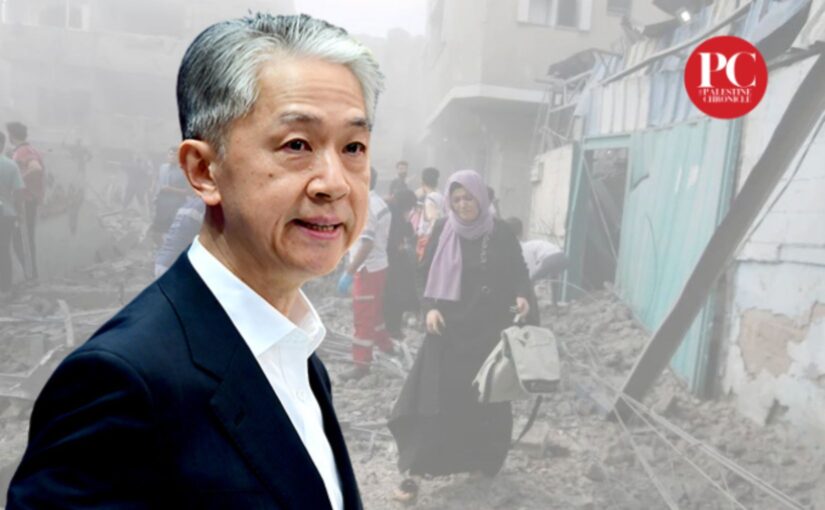
On November 20, 2023, Member of the Political Bureau of the CPC Central Committee and Foreign Minister Wang Yi held talks with the delegation of Arab-Islamic foreign ministers consisting of Saudi Foreign Minister Prince Faisal bin Farhan Al Saud, Jordanian Deputy Prime Minister and Foreign Minister Ayman Safadi, Egyptian Foreign Minister Sameh Shoukry, Indonesian Foreign Minister Retno Marsudi, Palestinian Foreign Minister Riyad Al-Maliki and Secretary General of the Organisation of Islamic Cooperation Hissein Brahim Taha in Beijing.

Wang Yi said the fact that the delegation chose China as the first leg of their tour for international mediation shows deep trust in China and embodies the fine tradition of mutual understanding and support between the two sides. China is a good friend and brother of Arab and Islamic countries. China has always firmly upheld the legitimate rights and interests of Arab and Islamic countries and firmly supported the just cause of the Palestinian people to restore their legitimate national rights and interests. In regard to this conflict, China has firmly stood on the side of justice and fairness, has been working hard to de-escalate the conflict, protect civilians, expand humanitarian aid, and prevent humanitarian disasters, and has been calling for a return to the two-state solution and the early settlement of the Palestinian question. Today marks the 35th anniversary of the establishment of diplomatic relations between China and Palestine. China appreciates Arab and Islamic countries for their active mediation efforts for peace, and stands ready to work with them to make unremitting efforts for an early ceasefire in Gaza, the easing of the humanitarian crisis, the release of the detainees and an early, comprehensive, just and enduring settlement of the Palestinian question.

Continue reading China calls for Gaza ceasefire and an end to collective punishment

Amlo: At the height of the pandemic, China was the first to offer assistance

Chinese President Xi Jinping held a number of bilateral meetings with other national leaders during his recent visit to San Francisco to attend the APEC (Asia-Pacific Economic Cooperation) summit and to meet with US President Joe Biden.

On November 16, Xi met with his Mexican counterpart, President Andrés Manuel López Obrador. Popularly known as Amlo, Obrador is generally considered to be Mexico’s first left-wing president since Lázaro Cárdenas del Río, who nationalised the country’s oil industry and mineral resources in 1938. It was the first occasion for the two leaders to meet.

At the meeting, Xi Jinping said that the friendship between China and Mexico has grown stronger over time, noting that last year the two countries celebrated the 50th anniversary of diplomatic ties, and this year marks the 10th anniversary of the establishment of the China-Mexico comprehensive strategic partnership. Mutual understanding and support on issues concerning each other’s core interests and major concerns have become firmer, he added.

The Chinese president stressed that China supports Mexico’s independent development path in line with its national conditions and is willing to strengthen exchanges with Mexico in country governance.

Bilateral trade volume between China and Mexico has increased by more than 7,000 times since the establishment of diplomatic relations, and highlights of cooperation in fields including railways, automobiles and new energy are abundant. 

The two sides should strengthen multilateral coordination, firmly uphold multilateralism and democracy in international relations, and safeguard international fairness and justice as well as the legitimate rights and interests of developing countries, Xi said.

Noting that next year marks the 10th anniversary of the China-CELAC (Community of Latin American and Caribbean States) Forum, he said that China is ready to work with Mexico to promote the steady and long-term development of China-Latin America relations in the new era.

For his part, Obrador said both Mexico and China have splendid civilisations and the two peoples know each other well and treat each other like brothers.

At the height of the COVID-19 pandemic, China was the first to offer assistance, providing a large amount of precious anti-pandemic supplies to Mexico and helping the country tide over the difficulties, he said.

He added that after Mexico was hit by a recent severe hurricane in the Pacific Ocean, China immediately expressed sympathy and support, for which Mexico is grateful.

Both Mexico and China safeguard their own independence and firmly oppose interference in other countries’ internal affairs, he noted, adding that Mexico will, as always, adhere to its friendly policy towards China.

Obrador added that Mexico is willing to closely coordinate with China in multilateral affairs, and actively promote Latin America-China relations.

The following report was originally published by the Xinhua News Agency.

SAN FRANCISCO, Nov. 16 (Xinhua) — Chinese President Xi Jinping on Thursday called for expanding China-Mexico cooperation in finance, electric vehicles and other emerging industries.

Xi made the remarks when meeting his Mexican counterpart, Andres Manuel Lopez Obrador, on the sidelines of the Asia-Pacific Economic Cooperation (APEC) Economic Leaders’ Meeting. He also said that the two sides should make good use of the inter-governmental cooperation mechanism and deepen cooperation in traditional areas such as infrastructure construction.

The friendship between China and Mexico has grown stronger over time, Xi said, noting that last year the two countries celebrated the 50th anniversary of diplomatic ties, and this year marks the 10th anniversary of the establishment of the China-Mexico comprehensive strategic partnership.

Xi said that at present, the strategic, complementary and mutually beneficial nature of China-Mexico relations has become increasingly prominent, and mutual understanding and support on issues concerning each other’s core interests and major concerns have become firmer.

China attaches great importance to China-Mexico relations and is willing to work with Mexico to enhance strategic alignment, tap cooperation potential and leverage complementary advantages to push bilateral relations to a new level, he added.

The Chinese president stressed that China supports Mexico’s independent development path in line with its national conditions and is willing to strengthen exchanges with Mexico in country governance.

Bilateral trade volume between China and Mexico has increased by more than 7,000 times since the establishment of diplomatic relations, and highlights of cooperation in fields including railways, automobiles and new energy are abundant, he said.

Xi said the two sides should deepen counternarcotics law enforcement cooperation, and actively support each other in organizing events for people-to-people exchanges such as cultural performances and exhibitions.

Continue reading Amlo: At the height of the pandemic, China was the first to offer assistance

Xi Jinping: The principles we follow in handling China-US relations are mutual respect, peaceful coexistence and win-win cooperation

During his recent visit to San Francisco, and following his meeting with US President Joe Biden, Chinese President Xi Jinping attended a gala business dinner on the evening of November 15. Organised by the National Committee on US-China Relations (NCUSCR), the US-China Business Council (USCBC), the Asia Society, the Council on Foreign Relations, the US Chamber of Commerce, and other organisatons with a stake in positive US-China relations, the several hundred participants included many of the most powerful figures in US business, including Tim Cook of Apple, Albert Bourla of Pfizer, Steve Schwarzman of Blackstone, Larry Fink of Blackrock, Stan Deal of Boeing, Ray Dalio of Bridgewater Associates, and (at the pre-dinner reception only) Elon Musk of Tesla. They were also joined, at the invitation of the Chinese side, by some US citizens who have made outstanding contributions to friendship between the two peoples and who have enjoyed a personal relationship with President Xi over many decades.

Attending the dinner was not without controversy and risks. Mike Gallagher, the hard right Chairman of the absurdly named congressional Select Committee on the Chinese Communist Party, wrote to the organisers that: “It is unconscionable that American companies might pay thousands of dollars to join a ‘welcome dinner’ hosted by the very same CCP officials who have facilitated a genocide against millions of innocent men, women, and children in Xinjiang.”  

He then insolently and threateningly demanded, with full McCarthyite intimidation tactics, that the organisers should, by no later than November 21:

  • “Please provide a complete list of individuals, companies, financial institutions, and other entities that have purchased tickets to the CCP dinner;
  • Please provide a separate list of individuals and companies that have paid the $40,000 fee to sit at the table with Xi;
  • Please provide a breakdown of how profits from the CCP dinner will be distributed between USCBC, NCUSCR, and other entities, as applicable; and
  • What steps, if any, has USCBC and NCUSCR taken to defend human rights in China and to prevent the genocide of Uyghurs and other ethnic minorities in Xinjiang?”

There can surely be few words adequate to describe the murderous, evil and cynical irony of venal US politicians working themselves up into a state of self-righteous and hypocritical hysteria over a completely non-existent ‘genocide’ in Xinjiang at the very time that they are facilitating and cheering on an all too real genocide in Gaza, having long supported and abetted genocidal US-led wars of aggression in numerous Muslim-majority countries, including Iraq, Afghanistan, Libya, Syria and Somalia.

The success of the dinner was, therefore, a significant rebuttal of the most aggressive, warlike and fascistic circles of US imperialism.

President Xi delivered a warm speech at the dinner, in which he also addressed a number of important issues. He began by recalling that, “my first visit to the United States in 1985 started from San Francisco, which formed my first impression of this country,” and continued:

“San Francisco has borne witness to exchanges between the Chinese and American peoples for over a century. A hundred and fifty-eight years ago, a large number of Chinese workers came all the way to the United States to build the first transcontinental railroad and established in San Francisco the oldest Chinatown in the Western hemisphere.”

Another significant historical tie between San Francisco and China is that: “Seventy-eight years ago, after jointly defeating fascism and militarism, our two countries initiated together with others the San Francisco Conference, which helped found the United Nations, and China was the first country to sign the UN Charter.”

Since that time: “Over 100 countries have gained independence one after another. Several billion people have eventually shaken off poverty. The forces for world peace, development and progress have grown stronger.”

President Xi stressed the people’s role in laying the foundations of China-US relations:

“During World War II, our two countries fought side by side for peace and justice. Headed by General Claire Lee Chennault, a group of American volunteers, known as the Flying Tigers, went to the battlefield in China. They not only engaged in direct combats fighting Japanese aggressors, but also created ‘The Hump’ airlift [from Myanmar] to transport much-needed supplies to China. More than 1,000 Chinese and American airmen lost their lives on this air route. After Japan attacked Pearl Harbor, the United States sent 16 B-25 bombers on an air raid to Japan in 1942. Running low on fuel after completing their mission, Lieutenant Colonel James Doolittle and his fellow pilots parachuted in China. They were rescued by Chinese troops and local civilians. But some 250,000 civilian Chinese were killed by Japanese aggressors in retaliation… I have kept in touch with some of them [the Flying Tigers] through letters. Most recently, 103-year-old Harry Moyer and 98-year-old Mel McMullen, both Flying Tigers veterans, went back to China. They visited the Great Wall and were warmly received by the Chinese people.”

Following this period: “For 22 years, there were estrangement and antagonism between our two countries. But the trend of the times brought us together, converging interests enabled us to rise above differences, and the people’s longing broke the ice between the two countries. In 1971, the US table tennis team visited Beijing – a small ball moved the globe. Not long after that, Mr. Mike Mansfield led the first US Congressional delegation to China.”

Continue reading Xi Jinping: The principles we follow in handling China-US relations are mutual respect, peaceful coexistence and win-win cooperation