Summing up a busy year of activity for Friends of Socialist China

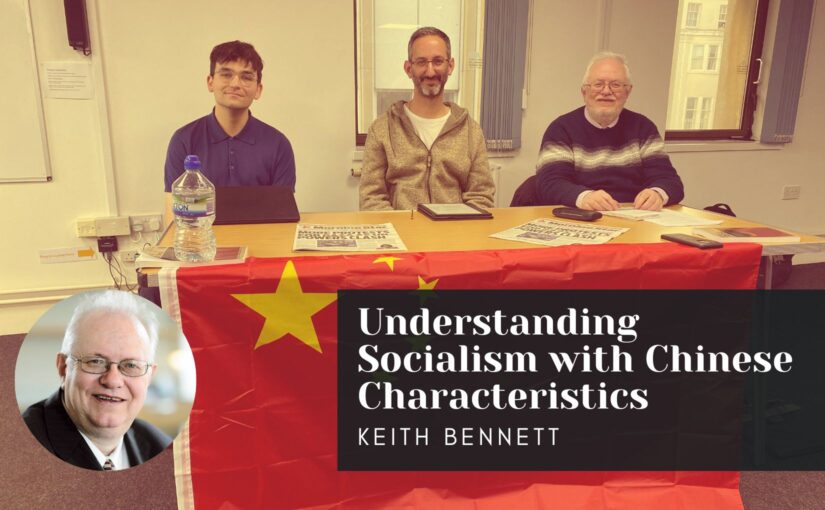
The text below is a speech given by our co-editor Keith Bennett at a Friends of Socialist China end-of-year social held on Sunday 17 December at Hiba, a Palestinian restaurant in London.

Around 40 friends and activists joined us, including Minister Zhao Fei from the Chinese Embassy and two of his colleagues. Unfortunately due to illness and unexpected circumstances, a number of comrades who had planned to be present were not able to, including the ambassadors of the Democratic People’s Republic of Korea and Timor-Leste, and the Counsellor for Press and Cultural Affairs from the Cuban Embassy.

The speech summarises our work over the past year and sets the scene for 2024, as well as expressing our solidarity with the Palestinian people, currently facing a genocidal war in Gaza. Referencing China’s recent commemoration of the Nanjing Massacre – which took place when Japanese troops captured the city on 13 December 1937 and brutally killed approximately 300,000 Chinese civilians and unarmed soldiers in just over six weeks – Keith drew a parallel between the Chinese people’s struggle for freedom and that of the Palestinians.

As we recall that dark page in history, and as our hearts are broken by the bestial atrocities being perpetrated, with the support and connivance of our government, in Gaza, and indeed on the West Bank, too, let us remember that ultimately nothing is stronger than the people’s will for freedom. The Chinese people won their liberation and, however long it takes, the Palestinian people, and all the oppressed people of the world, will surely win theirs, too.

Minister Zhao Fei and Comrades from the Chinese Embassy

Comrades and Friends

First, thank you all for being here. I hope you will have an enjoyable evening.

All of you here have supported, helped and encouraged the work of Friends of Socialist China, in your various ways, over the year that is just ending. Thank you.

When we sent out the invitations for tonight, we wrote: “Without wishing to seem immodest, we are pleased with what we have managed to achieve in 2023. It is inseparable from your cooperation and encouragement.”

I thought I’d give you some flavour of that, which I’m able to do thanks to the invaluable and forensic input from Carlos.

We started Friends of Socialist China in May 2021, with no resources and no masterplan.

As of now, our followers on Twitter, or, as I should say, X, formerly known as Twitter, are now just under 35,000.

We have 5,400 followers on Facebook.

Our YouTube subscribers are just under 10,000.

The subscribers to our weekly e-bulletin, containing links to all of our articles, are around 2,000.

In terms of events this year, we began with a hybrid meeting hosted at the Marx Memorial Library, and also organised in conjunction with the Morning Star, the Cuba Solidarity Campaign and the Nicaragua Solidarity Campaign Action Group on Socialist Solutions to the Climate Crisis, with speakers including the Nicaraguan Ambassador (much missed since her return to Managua), visiting US comrade and author Dan Kovalik and a comrade from the Greener Jobs Alliance.

We responded to Genocide Joe Biden’s laughable Summit for Democracy with our own online counter summit, joined by top quality speakers including Margaret Kimberley from Black Agenda Report in the US, the legendary activist and cultural worker Lowkey, Luna Oi, the inimitable Vietnamese blogger, Venezuelan Vice Minister for Foreign Affairs Carlos Ron, Pawel Wargan from the Progressive International, Calla Walsh, a true rising star of the Young Communist League in the United States, as well as in Cuba solidarity work, who was recently arrested for taking direct action in support of Palestine, Ju-Hyun Park from the Korean diaspora, Mohammed Marandi from Iran, and Ben Norton, whose work will be familiar to many of you.

Then we were back at the Marx Memorial Library for the hybrid launch of Carlos’s book, The East is Still Red. If anyone hasn’t read it yet, you really have to. And if you’re still wondering what to get that special comrade in your life for Christmas – problem solved. Carlos has, in my view, made a truly outstanding contribution to the movement with this book. If there is one book on China by a non-Chinese author – where it is today, where it has come from, where it is going – that everyone on the left should read, it’s this one.

Continue reading Summing up a busy year of activity for Friends of Socialist China

Malian FM: China is a reliable friend and partner of Mali

A salient feature of the international scene recently has been the revolt against French neo-colonialism, in particular, in the Sahel region of West Africa. Progressive military officers, with broad and extensive popular support, have taken power in Mali, Niger, and Burkina Faso, with an orientation to national development and independence against imperialism. And, in order to deter the threat of external aggression, on 16 September 2023, the three countries formed the Alliance of Sahel States as a mutual defence pact, under which “any attack on the sovereignty and territorial integrity of one or more contracted parties will be considered an aggression against the other parties.”

Against this background, Mali’s Foreign Minister Abdoulaye Diop visited China in early December. The importance attached by Mali to the visit was highlighted by the fact that Diop was accompanied by several other ministers, including those of Economy and Finance and Industry and Commerce. 

The delegation met with China’s Foreign Minister Wang Yi on 8 December. At the meeting, Wang remarked that the China-Mali friendship was forged by the elder generation of the leaders of both countries.

It should be noted here that Mali won its independence from French colonial rule on 20 June 1960, proclaimed itself a republic on 22 September and established diplomatic relations with China on 25 October. Mali’s first president, Modibo Keïta (1915-1977), who served as head of state from independence until he was overthrown in 1968, spending the rest of his life in prison, was one of the outstanding leaders of the African liberation struggle and was committed to Mali taking the socialist road. It is this heritage from which the current Sahelian leaders are taking inspiration, with Burkina Faso, in particular, learning from its previous outstanding leader, Thomas Sankara, and adopting a clear socialist orientation.

Wang Yi went on to note that sixty years ago, Premier Zhou Enlai visited ten African countries including Mali, opening a historical chapter of long-term friendship, solidarity, and cooperation between the two peoples. That visit, from December 1963-February 1964, ended with Zhou’s famous declaration that “Africa is ripe for revolution.”

China, Wang Yi said, fully understands and respects the independent choice of the Malian people and never interferes in other countries’ internal affairs. Noting that Mali has achieved important results in maintaining national stability and protecting the safety of its people, he expressed the belief that Mali has the wisdom and ability to solve the temporary difficulties it is currently facing, grasp the destiny of national development and progress, and achieve lasting peace and tranquility.

This is a significant statement in terms of the unfolding political dynamic in the region. China customarily refers to respecting the political developments in other countries. The addition of understanding, in the context of the ongoing attempts by some outside forces to question or undermine developments in Mali – which include insisting on the withdrawal of foreign troops – underlines China’s support and solidarity with the progressive changes currently underway in the country.

Wang Yi added that China is ready to deepen cooperation with Mali in education, training, medical care, and agriculture, among other areas, and to carry out more projects such as the “Mali Digital” project and the “Africa Solar Belt” Program, to help promote the peace and development process in Mali. And, underlining the common interest in opposing imperialist-backed ‘Islamist’ terrorist forces, he also expressed the hope that Mali can continue to take concrete and effective measures to ensure the safety of Chinese personnel in the country.

For his part, Abdoulaye Diop said that Mali and China enjoy a long history of friendship and share similar positions on significant issues of principle. In significant remarks that echoed those of his Chinese counterpart, he went on to note that China supports Mali in safeguarding sovereignty and territorial integrity and always listens patiently to Mali’s appeals and is a reliable friend and partner of Mali.

Mali, Diop added, adheres to independence, and abides by the one-China principle. His country hopes to deepen mutually beneficial cooperation with China and will make all-out efforts to ensure the safety of Chinese personnel in the country. Mali also attaches great importance to a series of important initiatives proposed by President Xi Jinping and looks forward to learning from China’s successful development experience, continuing to receive support and assistance from China, and deepening practical cooperation between Africa and China across the board.

The below article was originally published on the website of the Chinese Foreign Ministry.

On December 8, 2023, Member of the Political Bureau of the CPC Central Committee and Foreign Minister Wang Yi held talks with Mali’s Foreign Minister Abdoulaye Diop. Mali’s Minister of Economy and Finance and Minister of Industry and Commerce, among others, were present.

Wang Yi said that the China-Mali friendship was forged by the elder generation of the leaders of both countries. Sixty years ago, Premier Zhou Enlai visited ten African countries including Mali, opening a historical chapter of long-term friendship, solidarity and cooperation between the two peoples. China fully understands and respects the independent choice of the Malian people and never interferes in other countries’ internal affairs. Noting that Mali has achieved important results in maintaining national stability and protecting the safety of its people, Wang Yi expressed the belief that Mali has the wisdom and ability to solve temporary difficulties it is currently facing, grasp the destiny of national development and progress, and achieve lasting peace and tranquility. China is willing to work with Mali to continue to firmly support each other and jointly safeguard the legitimate rights and interests of developing countries as well as the basic norms governing international relations.

Wang Yi said that in recent years, a number of China-Mali practical cooperation projects have been successfully implemented, bringing benefits to the Malian people. China is ready to deepen cooperation with Mali in education, training, medical care and agriculture, among others, and carry out more projects such as the “Mali Digital” project and the “Africa Solar Belt” Program, to help promote the peace and development process in Mali. Wang Yi expressed the hope that Mali can continue to take concrete and effective measures to ensure the safety of Chinese personnel in the country.

Wang Yi said, in response to the urgent needs of African countries, President Xi Jinping has put forward three important initiatives, namely, the Initiative on Supporting Africa’s Industrialization, the Plan for China Supporting Africa’s Agricultural Modernization, and the Plan for China-Africa Cooperation on Talent Development. China is ready to work with Africa to implement these initiatives, strengthen cooperation under the mechanism of the Forum on China-Africa Cooperation, and accelerate common development and revitalization.

Abdoulaye Diop said that Mali and China enjoy a long history of friendship and share similar positions on significant issues of principle. China supports Mali in safeguarding sovereignty and territorial integrity and always listens patiently to Mali’s appeals, and is a reliable friend and partner of Mali. Mali adheres to independence and abides by the one-China principle. Mali hopes to deepen mutually beneficial cooperation with China, and will make all-out efforts to ensure the safety of Chinese personnel in the country. Mali attaches great importance to a series of important initiatives proposed by President Xi Jinping, and looks forward to learning from China’s successful development experience, continuing to receive support and assistance from China, and deepening practical cooperation between Africa and China across the board.

The international China and Marxism symposium in Istanbul

The Turkish journal Teori ve Politika (Theory and Politics) organised an international symposium on China and Marxism in Istanbul on November 18. Aiming to understand and discuss Socialism with Chinese Characteristics and the Communist Party of China (CPC’s) approach to Marxism, the conference featured a total of 16 papers in four languages.

The opening speeches were delivered by 90-year-old Korkut Boratav, one of Turkey’s most prominent Marxist economists, and Qian Xinyi from the Chinese Embassy in Ankara.

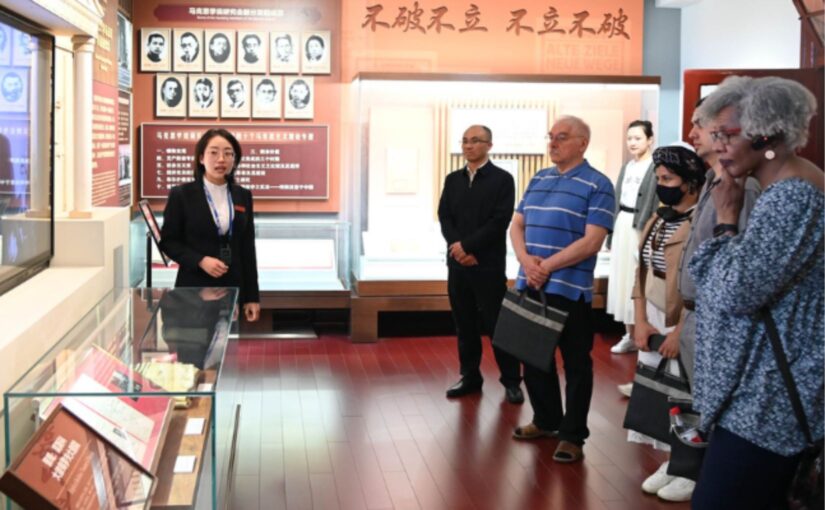
In the first session, Marxism’s Conception of Socialism and China, speakers included Professor Tang Ming from the Central China Normal University and Carlos Martinez from Friends of Socialist China.

Carlos compared China’s reform and opening-up with perestroika and glasnost in the former Soviet Union, highlighting the significant differences between the USSR and China in economic (dramatic and continual improvement in the living standards of the Chinese people), political (not allowing the capitalists to organise as a class) and geostrategic (long period of peace and security) aspects.

Another session featured Azad Barış from HEDEP (the People’s Equality and Democracy Party of Turkey), Yu Weihai, Director of the Central China Normal University, Ben Chacko, Editor of the Morning Star, and Maher Al-Taher from the Popular Front for the Liberation of Palestine (PFLP).

Yu Weihai highlighted the dramatic change in the international communist and workers movement after the collapse of the Soviet Union, leading to a more pluralistic, independent, diverse, and egalitarian reality. Ben Chacko stated that challenging the narrative that China poses a threat to the global order requires demolishing lies about China posing a military or security threat to the West and examining whether China’s rise is that of a new aspiring hegemon wanting to replace the US.

Comrade Maher Al-Taher, who was welcomed with strong feelings and expressions of solidarity, argued that the perception of Marxism as a dogmatic and unchangeable whole is wrong, emphasising the need to deepen Marxism in the specificity of each country and adding that the Chinese experience is a creative example of this.

The following report was originally published in the Morning Star.

On a stormy and rainy weekend in Istanbul last month, an international symposium entitled China and Marxism was organised by the Teori ve Politika (Theory and Politics) magazine. The symposium aimed to understand and discuss Socialism with Chinese Characteristics and the Communist Party of China (CPC’s) approach to Marxism, featuring a total of 16 papers in four languages.

The opening speeches were delivered by 90-year-old Korkut Boratav, one of Turkey’s most prominent Marxist economists, and Qian Xinyi, the Undersecretary of the Embassy of the People’s Republic of China. Boratav expressed that the most prevalent form of the relations of production in Chinese society is capitalist, but questioned whether these are dominant relations due to the established forms of public ownership surrounding them.

He stated that the future cannot be guaranteed but emphasised that the bourgeoisie does not hold power in China and their attempts to seize power have been thwarted by the CPC. Qian Xinyi highlighted that Socialism with Chinese Characteristics is a natural outcome of China’s particular conditions.

In the first session, Marxism’s Conception of Socialism and China, speakers including Professor Tang Ming from the Central China Normal University, Carlos Martinez from Friends of Socialist China, Sungur Savran from Revolutionary Marxism, and Metin Kayaoğlu from the Teori ve Politika magazine presented their papers.

Tang Ming divided China’s socialist transformation into two periods: Mao, and Deng and post-Deng periods. Savran emphasised that the biggest challenge that led to the collapse of really existing socialisms in the 20th century was the corruption that developed around the swelling bureaucratic class and that the same challenge is being faced today in China.

Martinez compared China’s reform and opening-up with perestroika and glasnost, highlighting the significant differences between the USSR and China in economic (dramatic and continual improvement in the living standards of the Chinese people), political (not allowing the capitalists to organise as a class) and geostrategic (long period of peace and security) aspects.

Kayaoğlu pointed out different approaches within Marxist literature regarding the relationship between productive forces and relations of production referencing Lenin and Kautsky and made precise that despite the autonomy of political forces, the laws of the production maintain themselves.

In the second session, Economy, Politics, and Society in China, speakers including Fatih Oktay from Özyeğin University, Chen Feng from Shandong University — School of Marxism, Jülide Yazıcı from the Teori ve Politika magazine, and Hu Zongshan from Central China Normal University presented their papers.

Oktay provided a brief and clear presentation on the history of China’s reform, emphasising the need for stronger steps toward a socialist formation to ensure the country’s socialist future. Dr Chen Feng stated that the development of rural areas is one of the most important tasks for China as a modern socialist country. Yazıcı argued that CPC is leading an experiment of transition from capitalism to advanced socialism, that it is inevitable in a transition period that certain capitalistic mechanisms maintain themselves, and that what is important is the CPC’s ideological and political insistence on Marxism. Hu Zongshan diagnosed three challenges ahead of China’s modernisation: the Two Huangs Trap related to national governance, yhe Middle Income Trap, and the Thucydides Trap.

In the third session, China in the World, speakers including Çağdaş Üngör from Marmara University, historian Kamuran Kızlak, historian Vijay Prashad from TriContinental, and Mehmet Yılmazer from the Yol magazine delivered their speeches.

Üngör discussed whether the China model could be exported to the world, attributing the interest in China to the quest that emerged in the world following the 2008 crisis. Kızlak provided an informative presentation on China, the US and Soviet relations during the reform era, concluding with a focus on the CPC’s conception of Confucianism. Prashad, questioning Biden’s rhetoric of “Chinese aggression,” highlighted that Nato forces in the Asia-Pacific are more aggressive in foreign policy, and that China, unlike the United States, has adopted a no-first-use nuclear policy which means that China will not fire a nuclear weapon before anybody else.

Yılmazer emphasised that the US strategy focuses on preventing the strengthening of Russia-Europe relations, hindering the development of Russia-China relations, and limiting China’s influence in the Asia-Pacific.

In the continued session with the same title, speakers including Azad Barış from HEDEP (People’s Equality and Democracy Party), Yu Weihai, Director of the Central China Normal University, Ben Chacko from the Morning Star newspaper and Maher Al-Taher from the Popular Front for the Liberation of Palestine, presented their talks.

Azad Barış stated that in the new world order, there are no clear boundaries between ideologies, and China’s success against imperialism strengthens the struggles of oppressed peoples.

Yu Weihai highlighted the dramatic change in the internationalist movement after the collapse of the Soviet Union, leading to a more pluralistic, independent, diverse, and egalitarian organisation of international movements. Chacko stated that challenging the narrative that China poses a threat to the global order requires demolishing lies about China posing a military or security threat to the West and examining whether China’s rise is that of a new aspiring hegemon wanting to replace the US.

Maher Al-Taher, welcomed with strong solidarity feelings, argued that the perception of Marxism as a dogmatic and unchangeable whole is wrong, emphasising the need to deepen Marxism in the specificity of each country and that Chinese experience is a creative example of this.

In the closing speech, Elif Nur Aybaş from the Teori ve Politika magazine reminded us that the critique of Eurocentrism in the 20th century provided an opportunity to recognise the political agency of oppressed peoples.

She expressed a preference for considering the Chinese experience as a critique of Eurocentrism from within Marxism, and emphasized that Marxists in other parts of the world have the duty of learning from this experience. Teori ve Poltika announced that the video recordings of the symposium will be made available for viewing in the near future, and the speeches will also be published as a book.

A new chapter in the development of bilateral relations between China and Honduras

Relations between China and the Central American nation of Honduras have been developing well since the latter’s progressive, socialist-oriented government established diplomatic relations with Beijing on 26 March 2023. This was followed by a highly successful state visit by President Xiomara Castro, June 9-14.

In the latest development, Luis Redondo, the President of the National Congress of Honduras, visited China in early December. 

Redondo met with his counterpart, Zhao Leji, Chairman of the National People’s Congress (NPC) Standing Committee, on December 7. 

Zhao said that the establishment of diplomatic ties between China and Honduras was a major political decision of historic significance made by the two heads of state, and that it has opened a new chapter in the development of bilateral relations between the two countries.

He expressed China’s willingness to work with Honduras to implement the important consensus reached by the two heads of state, promote communication and cooperation in various fields, and push for the sustained and steady development of bilateral relations.

And he further noted that China highly appreciates Honduras’ firm adherence to the one-China principle and firmly supports Honduras’ efforts to safeguard its national sovereignty and independence, promote its development and improve its people’s well-being.

China welcomes Honduras to join the Belt and Road Initiative (BRI), and is willing to accelerate the synergy of development strategies and promote new achievements in practical cooperation.

Redondo said the establishment of diplomatic ties between Honduras and China was of historic significance. Honduras adheres firmly to the one-China principle, and supports and actively participates in global initiatives such as the BRI, which are significant contributions that China has made to the progress of human civilisation.

Following their talks, the two leaders signed an agreement to promote cooperation between their respective congresses.

The same day, Redondo also met with Chinese Vice President Han Zheng. 

Han said that relations between China and Honduras have got off to a good start, showing broad prospects for development since the establishment of diplomatic ties.

He also expressed China’s willingness to walk hand in hand with Honduras on the road towards modernisation, promote exchanges, mutual learning, solidarity and cooperation, and achieve mutual benefits and common development.

Redondo said that the establishment of diplomatic ties with China marks a historic decision by Honduras, which has a long-term perspective and is in line with the will of the people.

The following articles were originally published by the Xinhua News Agency.

China’s top legislator holds talks with Honduran national congress president

BEIJING, Dec. 7 (Xinhua) — China’s top legislator Zhao Leji held talks with Luis Redondo, president of the National Congress of Honduras, in Beijing on Thursday.

Zhao, chairman of the National People’s Congress (NPC) Standing Committee, said that the establishment of diplomatic ties between China and Honduras earlier this year was a major political decision of historic significance made by the two heads of state, and that it has opened a new chapter in the development of bilateral relations between the two countries.

Zhao expressed China’s willingness to work with Honduras to implement the important consensus reached by the two heads of state, promote communication and cooperation in various fields, and push for the sustained and steady development of bilateral relations.

Zhao noted that China highly appreciates Honduras’ firm adherence to the one-China principle and firmly supports Honduras’ efforts to safeguard its national sovereignty and independence, promote its development and improve its people’s well-being.

China welcomes Honduras to join the Belt and Road Initiative (BRI), and is willing to accelerate the synergy of development strategies and promote new achievements in practical cooperation, Zhao said. He noted that China appreciates Honduras’ support for the global initiatives China has put forward, and hopes to strengthen coordination on multilateral occasions to promote the building of a community with a shared future for humanity.

The NPC of China is willing to facilitate dialogue and exchanges with the National Congress of Honduras, consolidate political mutual trust, and work with Honduras to safeguard the achievements of diplomatic ties between the two countries, Zhao said.

The legislatures of the two countries should carry out their duties fully, improve legal systems further to create a sound legal environment for investment, cooperation and personnel exchanges, and serve as a bridge for exchanges between communities to consolidate popular support for bilateral relations, he said.

He also noted that China is willing to increase exchanges with Honduras on governance experience, as well as on developing economy and improving people’s livelihoods.

Redondo said the establishment of diplomatic ties between Honduras and China was of historic significance.

Honduras adheres firmly to the one-China principle, and supports and actively participates in global initiatives such as the BRI, which are significant contributions that China has made to the progress of human civilization, Redondo said.

The National Congress of Honduras is willing to strengthen cooperation with the NPC of China and make contributions to the bright future of common prosperity of the two countries, he added. 

Continue reading A new chapter in the development of bilateral relations between China and Honduras

China-Angola relations continue to bring tangible benefits to both sides

Foreign Minister of Angola Tete Antonio recently paid a visit to China at the invitation of his counterpart, Wang Yi. At their meeting, Wang Yi said that under the strategic guidance of the two heads of state, China-Angola relations have maintained a strong momentum of development with fruitful results in practical cooperation, which has brought tangible benefits to the two peoples, provided an important boost to Angola’s development and set an example for South-South cooperation.

China is willing to share with Angola its experience of development as well as opportunities in the Chinese market, expand practical cooperation on infrastructure, digital economy, clean energy, health care and food security, deepen people-to-people exchanges, and consolidate the popular foundation of China-Angola friendship, he added.
In a meeting with Commerce Minister Wang Wentao, the two countries also signed an agreement to facilitate and protect bilateral investment. The agreement 

 stipulates a dispute settlement mechanism and the investment protection obligations of the two sides and is expected to mutually enhance investor confidence on both sides and create a more stable, convenient and transparent business environment for enterprises from both countries.

This year marks the 40th anniversary of the establishment of diplomatic ties between China and Angola.

The following articles were originally published by the Xinhua News Agency.

Chinese FM holds talks with Angolan counterpart

BEIJING, Dec. 6 (Xinhua) — Chinese Foreign Minister Wang Yi held talks with Foreign Minister of Angola Tete Antonio in Beijing on Wednesday.

Wang, also a member of the Political Bureau of the Communist Party of China Central Committee, said that under the strategic guidance of the two heads of state, China-Angola relations have maintained a strong momentum of development with fruitful results in practical cooperation, which has brought tangible benefits to the two peoples, provided an important boost to Angola’s development and set an example for South-South cooperation.

China is willing to share with Angola the experience of development and opportunities in the Chinese market, expand practical cooperation on infrastructure, digital economy, clean energy, health care and food security, deepen people-to-people exchanges, and consolidate the popular foundation of China-Angola friendship, said Wang.

Wang also expressed China’s willingness to strengthen coordination on multilateral platforms with Angola, advance the mechanism building of the Forum on China-Africa Cooperation, build a closer China-Africa community with a shared future, jointly safeguard the legitimate rights and interests of developing countries, and promote the development of the international order in a more just and reasonable direction.

Antonio said that Angola will stick to the one-China principle and support China in safeguarding its sovereignty and territorial integrity.

Bilateral cooperation between the two countries is mutually beneficial, Antonio said, adding that Angola welcomes Chinese investment, and is willing to continue close communication and coordination with China. 


China, Angola sign investment protection agreement

BEIJING, Dec. 6 (Xinhua) — China and Angola on Wednesday signed an agreement in Beijing to facilitate and protect bilateral investment, according to the Ministry of Commerce of China.

The pact, signed by Chinese Minister of Commerce Wang Wentao and Foreign Minister of Angola Tete Antonio, is a mutually beneficial, high-quality investment agreement that stipulates a dispute settlement mechanism and the investment protection obligations of the two sides.

This year marks the 40th anniversary of the establishment of diplomatic ties between China and Angola.

The signing of the agreement is expected to enhance investor confidence on both sides and create a more stable, convenient and transparent business environment for enterprises from both countries, the ministry said.

Next, the two sides will carry out their respective domestic procedures to promote the agreement’s early entry into force, according to the ministry. 

Vietnam-China joint statement

Chinese President Xi Jinping successfully concluded his state visit to Vietnam and returned to China on the afternoon of December 13. In a further meeting with Nguyen Phu Trong, General Secretary of the Central Committee of the Communist Party of Vietnam (CPV), just prior to his departure, Xi said that his current visit marks a good conclusion to China’s diplomatic events this year and thus has great significance.

It is, he added, a fine tradition between China and Vietnam to have leaders of the two parties chart the course for the development of party-to-party and bilateral relations. He added that the visit had been a heartwarming and touching one. He was particularly impressed by General Secretary Nguyen Phu Trong’s repeated description of the profound friendship between the two countries as “camaraderie plus brotherhood”. This serves as the starting point and foundation for China-Vietnam relations. As long as the two countries stay committed to this course, their relations are set to make new progress and bring more benefits to their people. 

The two countries also issued a joint statement on December 13, which, at more than 6,000 words, provides a comprehensive review of and program for their relations. 

The statement notes that:

“The two sides hold that Vietnam and China are good neighbours, good friends, good comrades, and good partners, and both are socialist countries under the leadership of a communist party, with similar political regimes, compatible ideology and belief, similar development path, shared vision, shared future, and common efforts for happy people and a wealthy and strong country and for the noble cause of peace and progress of humanity.

“To inherit and promote the traditional friendship of ‘Vietnam-China close bonds as both comrades and brothers’ and continue to deepen and further elevate the Vietnam-China Comprehensive Strategic Cooperative Partnership, the two sides agree to build a Vietnam-China Community with a Shared Future having strategic significance and to exert efforts for the happiness of the two peoples and for the cause of peace and progress of humanity.

“The Vietnamese side supports the building of a community with shared future for humanity, the Global Development Initiative, the Global Security Initiative, and the Global Civilisation Initiative. These initiatives have the aim of protecting the common interest of the whole of humanity, for the cause of peace, fairness and progressive development of people all over the world, meeting the aspiration to build a better world for people in all countries.”

On this basis, the two sides agree to take the Vietnam-China relations to a new stage with stronger political trust, more substantial defence-security cooperation, deeper tangible collaboration, firmer social foundation, closer multilateral coordination, better management and settlement of differences, and joint efforts for boosting the development of the world socialism cause, making positive contributions to the cause of peace and progress of humanity.

It notes that, in a “friendly, straightforward atmosphere, the two sides informed each other on the situations of their respective Parties and countries, as well as the theory and reality of the building of socialism; showing delight at the great and historic achievements that each Party and country has gained during the cause of national development, modernisation and socialism building in line with each country’s conditions; asserting that these fully demonstrate the vitality and superiority of the socialist systems in Vietnam and China.”

They also looked back at the development process of relations between the two Parties and countries, appreciate the invaluable and selfless support that the two Parties, countries and their people have provided for each other in various periods; and unanimously agree that the traditional friendship as “both comrades and brothers” founded and nurtured by President Ho Chi Minh and Chairman Mao Zedong and generations of leaders, is an invaluable asset of the two countries’ people that needs to be inherited, well-protected, and effectively upheld. The Party, State and people of Vietnam always hold in high regard and deeply appreciate the strong support and assistance provided by the Party, State and people of China in the struggle for national liberation and independence, as well as the cause of socialism building and national development.

Both sides affirm their consistent support for the two Parties, countries and their people to persevere with independence in strategy and choice of development paths that suit each country’s situation; be persistent in properly handling and actively resolving disagreements through peaceful means on the basis of mutual understanding and mutual respect in accordance with international law, maintaining the good development momentum of Vietnam – China relations, and making more active contributions to peace, stability and development in the region and the world.

On the basis of the above common perceptions, in the context of rapid, complicated, unpredictable and unprecedented developments in the world, both sides agree to persist with the political orientations of the highest Party and State leaders, looking at and developing the Vietnam-China relationship from a strategic height and long-term perspective.

Both sides agree to bring into full play the special role of the Party channel, further enhance the direction and coordination of the high-level meeting mechanism of the two Parties as well as the promotion and coordination roles of the two Parties’ external relations organisations; improve the efficiency of the exchange and cooperation between the two Parties’ respective agencies at the central level, Party organisations of localities, especially border provinces and regions; approve the mechanism of theoretical workshops between the two Parties and personnel training cooperation plans, promote delegation exchanges via the Party channel, step up exchanges and consult each other in Party building and country management, as well as socialism building and many other fields.

Both sides also agree to further enhance high-level exchanges between the two militaries; bring into play the role of cooperation channels such as border defence friendship exchange, strategic defence dialogue and hotline between the two defence ministries; effectively carry out the joint vision statement on defence cooperation until 2025 between the two defence ministries; step up exchange and cooperation between the two militaries in the fields of political work, personnel training and joint research; further strengthen cooperation in defence industry, joint exercise and training, health care, logistics, UN peace keeping activities and non-traditional security; continue intensive border cooperation by promoting joint border patrols and encouraging border stations of both sides to set up friendly relations and enhance coordination on border management and protection; and continue effective joint patrols on the Gulf of Tonkin and military ships’ mutual visits as well as deepen exchange and cooperation mechanisms between the naval and coast guard forces.

Emphasis was also placed on high-level exchanges between law-enforcement agencies, significantly including stress on boosting intelligence cooperation and sharing experience on the issues of anti-interference, anti-secession, and prevention and fighting of “peaceful evolution” and “colour revolution” of hostile and reactionary forces.

The statement also addressed a host of areas of practical cooperation, including around the Belt and Road Initiative and Vietnam’s development priorities, with a particular emphasis on railway connectivity and border infrastructure, trade, investment, food security and green development, people-to-people and cultural exchanges, tourism, education, sports, human resources, science and technology, health care, and natural disaster prevention and control.

The two sides agreed to speed up the implementation of projects using non-refundable aid funded by the Chinese Government for Vietnam, including a project to build the second facility of the Traditional Medicine Hospital.

They also agreed to enhance the exchange of experience in reforming state-owned enterprises and managing state capital at enterprises, cooperate in training human resources, especially high-level management human resources of state-owned enterprises; encourage state capital management agencies at enterprises of the two countries to increase contacts and connection, and create favourable conditions for enterprises of the two countries to boost mutually beneficial cooperation.

The Chinese side supports the opening of a Vietnamese Consulate General in Chongqing, the active roles of Vietnamese trade promotion offices in Chongqing and Hangzhou in economic and trade cooperation between the two countries and is willing to further create favourable conditions for the Vietnamese side to soon open more trade promotion offices in relevant Chinese localities.

The statement also pledged to increase cooperation in such fields as biodiversity conservation, climate change response, new energy automobiles, the management of Asian natural reserves, the protection of migratory wildlife, and the control of invasive alien species along the border region.

Regarding coordination in the international arena, the two countries agreed that to protect international fairness, justice and common interests, promote peace, stability and prosperous development in the region, create an external environment beneficial to the development of each country and the Vietnam – China relations, the two sides concur to persistently uphold multilateralism, strengthen multilateral coordination and cooperation, and jointly protect the international system with the United Nations as its core and an international law-based international order.

They also committed themselves to better management and settlement of outstanding differences and will “engage in sincere and straightforward in-depth discussions on sea-related issues and stress the need to better manage and actively address differences at sea and maintain peace and stability in the East Sea [South China Sea] and the region.”

In conclusion, the statement notes that: “Party General Secretary and President Xi Jinping sincerely thanks Party General Secretary Nguyen Phu Trong, President Vo Van Thuong, and senior leaders of the Vietnamese Party and State and the Vietnamese people for their grand, warm and friendly welcome; and respectfully invites Party General Secretary Nguyen Phu Trong and President Vo Van Thuong to soon visit China again. Party General Secretary Nguyen Phu Trong and President Vo Van Thuong express their thanks and accept the invitation with pleasure.”

We reprint below the full text of the joint statement. It was originally published by the Vietnamese newspaper Nhan Dan, and the English translation is by the Vietnam News Agency. The preceding article was originally published on the website of the Chinese Foreign Ministry.

Continue reading Vietnam-China joint statement

Wang Yi: Any arrangement concerning the future of Palestine must be Palestinian-owned and Palestinian-administered

China has recently intensified its diplomatic engagement with Iran, not least in the context of Israel’s genocidal war of aggression against the people of Gaza. 

As part of that process, China’s top diplomat, Foreign Minister Wang Yi exchanged views on the situation in Gaza, as well as on bilateral relations, in a December 11 phone conversation with his Iranian counterpart Foreign Minister Hossein Amir-Abdollahian. 

Wang said that China’s position on the Palestinian-Israeli conflict can be summarised as realising a ceasefire and ending the conflict as soon as possible, ensuring humanitarian relief, and returning to the two-state solution.

Amir-Abdollahian highly appreciated China’s efforts to achieve a humanitarian ceasefire in Gaza during its rotating presidency of the UN Security Council last month. He said the Iranian side opposes the killing of women and children and advocates an immediate ceasefire and cessation of fighting in Gaza and opening humanitarian relief corridors.

Iran, he added, supports the Global Security Initiative proposed by China and expects China to be more actively committed to easing the situation in Gaza, resolving the Palestinian question, and safeguarding regional peace and stability.

Wang said China’s position is consistent with that of Arab countries and is highly congruous with that of Islamic countries and the international community. Countries should raise a stronger voice and form a more unified position on the conflict.

China, the foreign minister underlined, believes that any arrangement concerning the future and destiny of Palestine should fully reflect the will of the Palestinian people, fully respect their right to statehood and self-determination, and embody the principle of “Palestinian-owned, Palestinian-led and Palestinian-administered.”

He also said that China supports Iran and Saudi Arabia in continuously improving relations, promoting the unity and cooperation of countries in the region and taking regional peace and security in their own hands.

Amir-Abdollahian thanked China for its contribution to mediating the rapprochement between Iran and Saudi Arabia, saying that Iran is willing to strengthen cooperation with China in various fields and promote the continuous development of Iran-China relations.

The following article was originally published by the Xinhua News Agency.

BEIJING, Dec. 12 (Xinhua) — Chinese Foreign Minister Wang Yi and Iranian Foreign Minister Hossein Amir-Abdollahian exchanged views on the situation in the Gaza Strip and bilateral relations during a phone conversation on Monday.

Wang, also a member of the Political Bureau of the Communist Party of China Central Committee, said China’s position on the Palestinian-Israeli conflict can be summarized as realizing a cease-fire and ending the conflict as soon as possible, ensuring humanitarian relief, and returning to the two-state solution.

Amir-Abdollahian highly appreciated China’s efforts to achieve a humanitarian cease-fire in Gaza during its rotating presidency of the UN Security Council.

He said the Iranian side opposes the killing of women and children and advocates an immediate cease-fire and cessation of fighting in Gaza and opening humanitarian relief corridors.

The United Nations should play an important role in the future settlement of the Palestinian question, he said, adding that Iran is willing to maintain close communication with regional countries to safeguard regional security and stability.

The Iranian side supports the Global Security Initiative proposed by China and expects China to be more actively committed to easing the situation in Gaza, resolving the Palestinian question, and safeguarding regional peace and stability, the top Iranian diplomat said.

Wang said China’s position is consistent with that of Arab countries and is highly congruous with that of Islamic countries and the international community.

Countries should make a stronger voice and form a more unified position on the conflict, Wang said.

China believes that any arrangement concerning the future and destiny of Palestine should fully reflect the will of the Palestinian people, fully respect their right to statehood and self-determination, and embody the principle of “Palestinian-owned, Palestinian-led and Palestinian-administered,” he said.

China is ready to strengthen communication and coordination with Arab and Islamic countries to gradually create conditions for returning to the two-state solution and continue to play a role in truly resolving the Palestinian question, he said.

On bilateral ties, Wang said China stands ready to work with Iran to implement the important consensus reached by Chinese President Xi Jinping and Iranian President Ebrahim Raisi during their two meetings this year.

He said China will strengthen communication, consolidate mutual trust, expand cooperation, coordinate and cooperate with Iran on international and multilateral occasions, practice genuine multilateralism, safeguard the legitimate rights and interests of the two countries and developing countries as well as international equity and justice, and push forward the stable and long-term development of China-Iran relations.

China supports Iran and Saudi Arabia in continuously improving relations, promoting the unity and cooperation of countries in the region and taking regional peace and security in their own hands, Wang said.

Amir-Abdollahian thanked China for its contribution to mediating the rapprochement between Iran and Saudi Arabia, saying that Iran is willing to strengthen cooperation with China in various fields and promote the continuous development of Iran-China relations. 

Xi Jinping meets with Vietnamese leadership

Chinese leader Xi Jinping’s December 12-13 state visit to Vietnam was characterised by exceptional warmth, not only on the bilateral level but also, and perhaps most significantly, from the standpoint of two socialist countries jointly taking responsibility for the destiny and progress of socialism in the world.

Meeting the General Secretary of the Communist Party of Vietnam (CPV) Central Committee Nguyen Phu Trong, shortly after his arrival in Hanoi, Xi and his host announced a new characterisation of the relationship between their two parties and two countries, as working together for a China-Vietnam community with a shared future that carries strategic significance, on the basis of deepening the comprehensive strategic cooperative partnership, which the two countries unveiled fifteen years previously. 

General Secretary and President Xi Jinping expressed his pleasure in coming to Vietnam as previously agreed, accomplishing three mutual visits with General Secretary Nguyen Phu Trong. He expressed the genuine happiness of China as a comrade and brother for the development achievements of Vietnam over the past nearly four decades of Doi Moi (reform), especially since the 13th CPV National Congress. Xi Jinping expressed China’s firm support for Vietnam in continuing advancing its socialist cause and the firm belief that under the strong leadership of the CPV Central Committee with General Secretary Nguyen Phu Trong at the helm, the CPV and the Vietnamese government will surely accomplish all the tasks put forward at the 13th CPV National Congress, and lay a solid foundation for realising the goals and targets set for the centenaries of the CPV and the Socialist Republic of Vietnam.

Xi Jinping further underlined that China and Vietnam have supported each other in their struggle for national independence and liberation, and learned from each other’s causes of reform and opening up and Doi Moi. The characterisation “camaraderie plus brotherhood” well captures the profound friendship between the two countries. China all along views its relations with Vietnam from a strategic height and long-term perspective. Changes of the world, of our times and of historical significance are unfolding like never before. The CPC and CPV are the two largest governing communist parties in the world. Both uphold and develop Marxism, both are committed to the path of socialism, and both are leading their countries in socialist development. It is therefore all the more important that the two parties grasp the special strategic significance of China-Vietnam relations and solidly advance the building of a China-Vietnam community with a shared future from the height of building the strengths of socialism in the world and ensuring the sound and sustained development of their respective socialist causes.  China and Vietnam will achieve more progress in their socialist causes, and make new contributions to stability, development and prosperity of the region and the entire world.

It is important, Xi continued, to keep to the right political direction. The two sides should follow the high-level strategic guidance, enhance exchanges and mutual learning on party and national governance experience, and work together to deepen the understanding of the laws of governance by communist parties, socialist development and the development of human society. The two sides should give each other firm support on issues concerning respective core interests and major concerns and jointly safeguard international fairness and justice. 

Both sides should give top priority to protecting national political security, keep to socialism without any deviation, so as to ensure that the red flag will not be changed, and forestall, diffuse and contain various political security risks with all-out efforts.

Modernisation of the over 1.4 billion Chinese people is a huge opportunity for the world. China would like to share opportunities and pursue common development with comrades in Vietnam. It is important to strengthen the popular and mass foundation for bilateral relations. China-Vietnam cooperation needs to be more weighted toward agriculture, education, medical care and other livelihood areas. The two sides should step up cooperation on youth, tourism and at subnational levels and forge closer bonds between young people.

General Secretary Nguyen Phu Trong noted that under the strong leadership of General Secretary Xi Jinping and the guidance of Xi Jinping Thought on Socialism with Chinese Characteristics for the New Era, China has made achievements on all fronts and steadily increased its international standing and influence. Vietnam is genuinely delighted for brotherly China. Vietnam firmly believes that under the leadership of the CPC Central Committee with Comrade Xi Jinping at its core, China will undoubtedly realise all the objectives outlined at the 20th CPC National Congress as scheduled, and make new and important contributions to human progress.

General Secretary Nguyen Phu Trong continued to say that Xi Jinping is a beloved leader of the Chinese people, a prominent leader in the world, and a respected and revered comrade and friend of the Vietnamese people. He added that both the invitation extended to him for a visit to China immediately after the 20th CPC National Congress and this third visit as previously agreed speak volumes about the special friendship of Xi Jinping for Vietnam and the high-level nature of Vietnam-China relations. Vietnam and China have a profound friendship featuring camaraderie plus brotherhood. Not long ago, he had visited the Friendship Pass at the Vietnam-China border and planted a “friendship tree” there to demonstrate the special brotherhood and send a positive signal of the special friendship between Vietnam and China.

Maritime differences, the Vietnamese leader noted, are only part of the overall relationship between Vietnam and China. It is believed that the two sides will properly handle them in the spirit of mutual trust and mutual respect.

Following the talks, the two General Secretaries jointly witnessed the documents signed on bilateral cooperation in 30 plus areas, including Belt and Road cooperation, quarantine and inspection, development cooperation, digital economy, green development, transportation, subnational cooperation, defence, law enforcement and security cooperation, and maritime cooperation.

The next day, President Xi continued his talks with other Vietnamese leaders.

Meeting with President Vo Van Thuong, Xi said that yesterday he and General Secretary Trong had jointly announced the building of a China-Viet Nam community with a shared future that carries strategic significance, raising the relations between the two parties and two countries up to a new stage. The Chinese and Vietnamese people have fought side by side in their struggles for national independence and liberation and supported each other in the cause of socialist revolution and construction. Such a commitment to each other through thick and thin has forged a friendship featuring “camaraderie plus brotherhood.” To build a China-Vietnam community with a shared future that carries strategic significance is to renew the shared will of the older generation of leaders of the two parties and countries, to pay tribute to the heroic past, and to carry forward the revolutionary friendship between the two countries. It is also a major historic decision made by the leadership of the two parties and countries, bearing in mind the larger interests of the long-term development of China-Vietnam relations and the strategic overall picture of solidarity of socialist forces in the world. It meets the common needs of China and Vietnam to advance their respective modernisation and serves the common interests of the two peoples.

President Xi Jinping stressed that the two sides need to fully appreciate the historical imperative, strategic significance, immediate necessity, and international responsibilities of building a China-Vietnam community with a shared future. 

He added that it is important to enhance solidarity and coordination to safeguard the China-Vietnam community with a shared future. China and Vietnam are both socialist countries under the leadership of a communist party. It is their shared responsibility and mission to safeguard the security of the political system and defend the cause of socialism. The two sides should strengthen solidarity, stay committed to openness and mutual benefits, jointly guard against external infiltration and sabotage attempts, and make due contributions to strengthening world socialist forces and promoting peace and progress of humanity.

President Vo Van Thuong said that the profound traditional friendship between Vietnam and China, forged by the older generation of the two sides, has stood the test of the evolving international dynamics and become a shared asset of the two peoples. Amid complex transformation of the international landscape, both Vietnam and China are at a critical development stage. It is therefore the shared aspiration of the Vietnamese and Chinese people to consolidate and strengthen the trust and cooperation between the two parties and two countries, and continuously advance the socialist cause of the two countries. Under the irreplaceable strategic guidance of General Secretary Nguyen Phu Trong and General Secretary Xi Jinping, the Vietnam-China relationship has never been so comprehensive, profound and friendly as it is today.

 And in words that did not name any third country, but which were clearly directed at the attempts by the United States, in particular, to drive a wedge between China and Vietnam, for example during US President Biden’s recent visit, and the insinuations and rumours spread by the imperialist mass media in that regard, the Vietnamese President very pointedly noted:

“The Vietnamese side hopes that President Xi Jinping’s visit will send a clear message to the world once again, that developing relations with China has always been a top priority and strategic choice for the Vietnamese party and government. The Vietnam-China relationship is as solid as rock. No external force can sow discord, disrupt or undermine this bilateral relationship.”

He added that the Vietnamese side will earnestly implement the important consensus of the General Secretaries of the two parties, fully leverage the unique advantage of the two countries in sharing the same social system and similar ideals and philosophies, strengthen experience exchange in party and state governance, comprehensively advance practical cooperation in various fields including politics, economy, trade, people-to-people exchanges and security, uphold national political security, and facilitate industrialisation and modernisation.

Vietnam is committed to the one-China policy, and sincerely supports China’s reunification. The Vietnamese side stands ready to properly address maritime differences under the spirit of mutual respect and win-win cooperation, and push for steady progress of the Vietnam-China community with a shared future. The initiatives on global development, security and civilisation proposed by President Xi Jinping demonstrate the sense of responsibility of a major country and a major party, as well as China’s important role in leading international development and cooperation. Vietnam is ready to be actively involved, and will enhance international coordination with China to jointly make new contributions to world peace and stability and the progress and well-being of humanity.

Meeting Vietnamese Prime Minister Pham Minh Chinh, President Xi stressed the need for China and Vietnam to work in solidarity in their socialist cause. The two sides may increase exchanges on ideological work and party theories and share experience on party and state governance. It is also important that the two sides increase people-to-people exchanges and cooperation to deepen the friendship between the two peoples and prepare the younger generation for the task of taking over the baton of China-Vietnam friendship at an early date. While the remarkable achievements in China’s reform and opening up and in Viet Nam’s Doi Moi are the result of hard work by the two countries, they are also attributable to a peaceful and stable world in general and an open and inclusive Asia-Pacific in particular. The two sides must guard against and oppose any attempt to destabilise the Asia-Pacific, and at the same time strengthen coordination and collaboration on international affairs and jointly safeguard a sound external environment.

For his part, Prime Minister Pham Minh Chinh said that Vietnam and China are two countries cherishing the same ideals and pursuing similar paths. All of President Xi’s visits to Vietnam and his important remarks have strengthened Vietnam’s recognition theoretically and emotionally, and deepened the friendship and mutual trust and enhanced the amity and affinity between the two countries.  The further strengthening of Vietnam’s relations with China is the top priority and a strategic choice of the party and government of Vietnam. It is also the strong desire of the Vietnamese people. Noting that the bilateral relationship has stood the test of time and history, Prime Minister Pham Minh Chinh expressed his conviction that the relationship will not be affected by any external force trying to sow discord or cause disruption and that the building of a Vietnam-China community with a shared future will benefit the two peoples and contribute to peace, stability and prosperity in the region.

In his meeting with the Chairman of the National Assembly of Vietnam Vuong Dinh Hue, President Xi Jinping noted that China and Vietnam share the same political system, similar aspirations and philosophies and an intertwined future. Relations with each other hold a special place in their respective party-to-party and state-to-state relations. Over the past 73 years since the establishment of diplomatic relations, the traditional friendship between China and Vietnam has been further enriched through mutual support and assistance in the struggle for national independence and liberation, and further deepened as the two sides move forward comprehensive strategic cooperation to advance the socialist causes. This year marks the 15th anniversary of the comprehensive strategic cooperative partnership. Yesterday, leaders of the two countries jointly announced the building of a China-Vietnam community with a shared future that carries strategic significance. This sends a positive message of solidarity, friendship and common development between China and Vietnam as two socialist countries.

Xi added that it is important to take stock of the fine traditions and good practices in bilateral relations, step up high-level strategic communication, share experience on the governance of parties and countries, explore ways to enrich the theories and practices of socialist development, uphold common strategic interests, and keep the bilateral relationship on the right track. It is also important, the Chinese leader stressed, to properly manage problems and differences. It is important to translate the understandings and desires of the leadership of the two parties and countries into concrete actions, advance cooperation while managing differences, and steadily take forward maritime cooperation, especially joint development.

Chairman Vuong Dinh Hue said that the agreements reached between General Secretaries Xi Jinping and Nguyen Phu Trong take forward the special friendship of camaraderie plus brotherhood forged by the older generation leaders, and will steer the relationship in the direction of steady development in the long run and toward a brighter future. The Vietnamese side identifies with the CPC on its governance philosophy, sincerely congratulates China on its remarkable achievements, and firmly believes that China will realise the goal of building a great modern socialist country in all respects as scheduled.

Xi Jinping also delivered an important speech at a meeting of young Chinese and Vietnamese people who have contributed to the friendship between the two peoples. He said that:

“Yesterday, General Secretary Nguyen Phu Trong and I jointly announced our decision to build a China-Vietnam community with a shared future that carries strategic significance, thus ushering in a new stage in the relations between our two parties and countries. This is a major strategic decision we have made to revitalise world socialism and ensure long-term stability and security of our two countries. It is rooted in our traditional friendship and represents the shared interests and aspirations of our two peoples.”

President Xi then outlined some key moments in the long history of mutual support and solidarity between the Chinese and Vietnamese revolutions:

“In the past, we stood by and reached out to each other as we pursued common goals together. In modern times, our two parties and peoples stayed true to our common ideals and supported each other in trying times as we fought for national independence and liberation. Chairman Ho Chi Minh was engaged in revolutionary activities in China for 12 years, during which he first established the Vietnamese Revolutionary Youth League in Guangzhou, and later founded the Communist Party of Vietnam in Hong Kong. For a long time, he also gave guidance to the Vietnamese revolution from Yunnan and Guangxi. Nong Qizhen, a villager in Guangxi’s Longzhou County, risked his life to protect Chairman Ho Chi Minh. It was in Guangxi where Chairman Ho Chi Minh wrote the resounding letter to all Vietnamese. He left Guangxi and returned to Vietnam in 1945, where he led the August Revolution to victory, and founded the Democratic Republic of Vietnam. In Vietnam’s War Against French Occupation and its War Against US Aggression to Save the Nation, more than 1,400 Chinese officers and men gave their lives, and they now rest in peace in Vietnam. More than 5,000 injured Vietnamese soldiers were treated in Nanxishan Hospital in Guilin, Guangxi, and over 10,000 Vietnamese students received education in Yucai School there. Vietnam also actively supported the Chinese Revolution. General Nguyen Son, who participated in the Guangzhou Uprising of 1927 and later joined the Long March of the Chinese Red Army, is well-known in China as a general of both countries. Today, when we read the famous poetic line by Chairman Ho Chi Minh that ‘So profound is the friendship between Vietnam and China, because we are both comrades and brothers’, the memory of those fiery and exciting years of our two peoples is kept alive.”

And he continued: “Today, we remain firmly committed to our shared aspiration forged in the early days and are pursuing win-win cooperation. Since we established the comprehensive strategic cooperative partnership 15 years ago, we the Communist Party of China and the Communist Party of Vietnam have pursued people-centred mutually beneficial cooperation, delivering true benefits to our two peoples… We are now striving to build China into a great modern socialist country in all respects and advance the rejuvenation of the Chinese nation on all fronts by pursuing Chinese modernisation. What we are pursuing is not modernisation just for China itself. We will stay committed to peaceful development, the policy of forging friendships and partnerships with neighbours, and the principles of amity, sincerity, mutual benefit and inclusiveness. And we are ready to share more of the benefits of Chinese modernisation with our neighbours. Vietnam, on its part, is vigorously advancing its industrialisation and modernisation drive to realise the goals set for the centenary of its Party and the centenary of the country… With remarkable economic and social advances, China and Vietnam demonstrate to the world that we have found the right development paths. And enhanced solidarity and cooperation will strengthen our socialist causes.”

Expressing his expectations of the young people present, Xi Jinping said in conclusion:

“I hope that you will be pioneers in promoting human progress and contribute to the building of a community with a shared future for humanity. Our two Parties are both Marxist parties that bear in mind the overall interests of the world, and our two countries are both responsible members of the international community. And both of us should play a major role in advancing human progress. To build a community with a shared future for humanity is an inspiring goal, a goal that requires generations of efforts to achieve. We should be visionary, look beyond the horizon and shoulder responsibilities entrusted upon us by the times, stand up for international fairness and justice, and contribute our share to global development… Keeping in mind the journey we have traversed will enable us to advance along the right path. The challenging paths China and Vietnam have travelled and the remarkable achievements we have made in developing socialism fully demonstrate that enhanced solidarity and cooperation between our two countries has enabled us to overcome all risks and challenges and to move from one victory to another. Going forward, we need to remain true to our commitment and strive to fulfil our mission. And we should pursue our respective paths to socialism and deliver the gains of industrialisation and modernisation to more people of our two countries. Let us join hands and make even greater contribution to the advancement of humanity.”

The following articles were first published on the website of the Chinese Foreign Ministry.

Continue reading Xi Jinping meets with Vietnamese leadership

Xi Jinping: Building a China-Vietnam Community with a Shared Future

Chinese President Xi Jinping’s December 12-13 state visit to Vietnam has been an historic one, not only in terms of promoting good neighbourly and friendly bilateral relations, but especially in stressing the two countries’ common adherence to socialism, strengthening the unity and solidarity of the socialist countries and hence the position of socialism in the world.

To coincide with his arrival in Vietnam, President Xi contributed an article to Nhan Dan, the daily newspaper of the Communist Party of Vietnam. In opening, the Chinese leader notes:

“It will be my third visit to this beautiful country since I became General Secretary of the Central Committee of the Communist Party of China (CPC) and President of the People’s Republic of China. I feel that I am already immersed in the warmth that people would only have when visiting relatives and neighbours.”

He continues: “China and Vietnam are connected by mountains and rivers. We enjoy cultural proximity, cherish the same ideals, and have a shared future ahead of us. Inspired by common visions, convictions and empathy, Comrade Mao Zedong, Comrade Ho Chi Minh and other older-generation leaders of our two parties and countries jointly cultivated the China-Vietnam traditional friendship featuring ‘camaraderie plus brotherhood.’ We stood together wholeheartedly and supported each other in pursuing national independence and liberation. In advancing socialism, we shared our experience and expanded our cooperation, writing together a historic chapter of China-Vietnam friendship.”

Noting that 2023 marks the 15th anniversary of the China-Vietnam comprehensive strategic cooperative partnership, Xi writes: “No matter how the global environment has changed, our two parties and countries have worked together to uphold peace and tranquility, pursue development and cooperation, and promote prosperity and progress. We have found a promising path of jointly building a community with a shared future for humanity.” He adds that “leaders of our two parties and countries have visited each other frequently like relatives.”

Drawing attention to their common interests and mutually beneficial cooperation, Xi points out that: “China has long been Vietnam’s largest trading partner, and Vietnam is China’s biggest trading partner in ASEAN and the fourth largest globally.” Giving a specific example, he writes: “Vietnam’s first urban light rail project, the Cat Linh-Ha Dong metro line, which was built by a Chinese company, has served nearly 20 million passenger trips so far, making travels in Hanoi more convenient.”

Having observed that “building a community with a shared future for humanity should start from Asia,”, Xi continues: “Vietnam’s friendship with China featuring ‘camaraderie plus brotherhood’ is profound indeed. The CPC and the Chinese government always take it as a priority in our neighbourhood diplomacy to develop relations with Vietnam. We sincerely hope that our two nations will always hold dear to the hearts our traditional friendship, always keep in mind our shared visions and missions, advance together along the socialist path, and steadily promote the building of a community with a shared future that carries strategic significance… It is important that we keep strategic communication at high levels to ensure that the ship of China-Vietnam relations can break waves and keep making steady progress. We should firmly support each other in pursuing the socialist path suited to our respective national realities… We need to deepen exchanges on the theory and practices of socialist development, fend off external risks and challenges together, and ensure steady and sustained progress in our socialist endeavours.”

Stressing the need to properly manage differences, Xi writes that: “Both sides need to act on the common understandings reached by the leaders of our two parties and countries, properly manage differences on maritime issues, and jointly look for mutually acceptable solutions. Both should bear in mind the long-term well-being of our peoples, and stay committed to striving for mutual benefit and win-win cooperation.”

The following is the full text of President Xi’s article. It was originally published on the website of the Chinese Foreign Ministry.

I will soon pay a state visit to the Socialist Republic of Viet Nam at the invitation of General Secretary of the Central Committee of the Communist Party of Viet Nam (CPV) Nguyen Phu Trong and President Vo Van Thuong. It will be my third visit to this beautiful country since I became General Secretary of the Central Committee of the Communist Party of China (CPC) and President of the People’s Republic of China. I feel that I am already immersed in the warmth that people would only have when visiting relatives and neighbors.

China and Viet Nam are connected by mountains and rivers. We enjoy cultural proximity, cherish the same ideals, and have a shared future ahead of us. Inspired by common visions, convictions and empathy, Comrade Mao Zedong, Comrade Ho Chi Minh and other older-generation leaders of our two parties and countries jointly cultivated the China-Viet Nam traditional friendship featuring “camaraderie plus brotherhood.” We stood together wholeheartedly and supported each other in pursuing national independence and liberation. In advancing socialism, we shared our experience and expanded our cooperation, writing together a historic chapter of China-Viet Nam friendship.

This year marks the 15th anniversary of the China-Viet Nam comprehensive strategic cooperative partnership. No matter how the global environment has changed, our two parties and countries have worked together to uphold peace and tranquility, pursue development and cooperation, and promote prosperity and progress. We have found a promising path of jointly building a community with a shared future for mankind.

We have conducted exchanges with mutual trust. Leaders of our two parties and countries have visited each other frequently like relatives. I had close interactions with General Secretary Nguyen Phu Trong through the year. We jointly drew up a blueprint for China-Viet Nam relations in the new era from a strategic and long-term perspective, adding new dimensions to the relationship and raising it up to a new stage. I met with President Vo Van Thuong, Prime Minister Pham Minh Chinh, and permanent member of the Secretariat of the Central Committee of the CPV Truong Thi Mai, who came to China for bilateral visits or international conferences. The two sides held the session of the steering committee for bilateral cooperation, the party-to-party theoretical symposium, the conference on crime control between the two public security ministries, and other meetings under bilateral mechanisms. Interagency and subnational cooperation was getting ever closer.

Continue reading Xi Jinping: Building a China-Vietnam Community with a Shared Future

Marxian Ecology, East and West: Joseph Needham and a non-Eurocentric view of the origins of China’s ecological civilisation

We are pleased to reproduce the below article by John Bellamy Foster, editor of the prestigious socialist journal, Monthly Review, who is also professor of sociology at the University of Oregon, concerning the contributions of the late Dr. Joseph Needham (1900-1995) to the understanding of the deep roots of China’s views on an ecological civilisation in particular and the dialectical nature of much of traditional Chinese philosophy and culture more generally. The article is especially important in that, whilst the contribution of Needham, who, at the time of his death was described by Britain’s Independent newspaper as “possibly the greatest scholar since Erasmus”, to the understanding of science and civilisation in China, the title of his monumental, multi-volume, lifelong work, remains known in some relevant academic circles, for example through the work of the Needham Research Institute, and somewhat more generally through a popular biography by Simon Winchester, his lifelong Marxism, and his significant contributions to Marxist theory, have been all but forgotten.

Bellamy Foster begins by posing the question as to why the most developed version of ecological Marxism is to be found today in China and argues:

“The answer is that there is a much more complex dialectical relation between East and West with respect to materialist dialectics and critical ecology than has been generally supposed, one that stretches back over millennia.”

He further explains that:

“Materialist and dialectical conceptions of nature and history do not start with Karl Marx. The roots of ‘organic naturalism’ and ‘scientific humanism,’ according to the great British Marxist scientist and Sinologist Joseph Needham (李約瑟), author of Science and Civilisation in China, can be traced to the sixth to third centuries BCE both in ancient Greece, beginning with the pre-Socratics and extending to the Hellenistic philosophers, and in ancient China, with the emergence of Daoist and Confucian philosophers during the Warring States Period of the Zhou Dynasty.”

In ‘Within the Four Seas: The Dialogue of East and West’, a 1969 book by Needham, the author noted “the absolute alacrity with which ‘dialectical materialism’ was taken up in China during the Chinese Revolution… The Marxian materialist dialectic, with its deep-seated ecological critique rooted in ancient Epicurean materialism, was in Needham’s view, so closely akin to Chinese Daoist and Confucian philosophies as to create a strong acceptance of Marxian philosophical views in China, particularly since China’s own perennial philosophy was in this roundabout way integrated with modern science. If Daoism was a naturalist philosophy, Confucianism was associated, Needham wrote, with ‘a passion for social justice.'”

Bellamy Foster further notes that: “The Needham thesis, as presented here, can also throw light on the spurious proposition, recently put forward by cultural theorist Jeremy Lent, author of The Patterning Instinct, that the Chinese conception of ecological civilisation is derived entirely from China’s own traditional philosophy, rather than being influenced by Marxism. Lent’s argument fails to acknowledge that ecological civilisation as a critical category was first introduced by Marxist environmentalists in the Soviet Union in its closing decades, and immediately adopted by Chinese thinkers, who were to develop it more fully.”

He acknowledges that, “of course, the Needham thesis may seem obscure at first from the usual standpoint of the Western left”, one reason being a “deep Eurocentrism characteristic of contemporary Marxism in the West, associated with the systematic downplaying of colonialism and imperialism.”

But, also citing the work of the late Egyptian Marxist Samir Amin, Bellamy Foster quotes Needham as explaining that “the basic fallacy of Europocentrism is therefore the tacit assumption that because modern science and technology, which grew up indeed in post-Renaissance Europe, are universal, everything else European is universal also.” However, Bellamy Foster continues:

“Marxist thought and socialism in general have always been radically opposed to Eurocentrism, understood as the ideology of Western colonialism. This is as true of Marx and Frederick Engels, particularly in their later years, as it was of V.I. Lenin and Rosa Luxemburg. In the twentieth century, moreover, the impetus for revolution shifted to the Global South and its struggle against imperialism, generating in the process new Marxist analyses in the works of figures as distinct as Mao Zedong, Amílcar Cabral, and Che Guevara, all of whom insisted on the need for a world revolution.”

Whilst it is possible to point to traces of European ethnocentrism in some of Marx’s early work, Bellamy Foster notes that, by the late 1850s, he had “become increasingly focused on the critique of colonialism, actively supporting anti-colonial rebellions, and progressively more concerned with analysing the material and cultural conditions of non-Western societies.” This was “further facilitated by the ‘revolution in ethnological time’ with the discovery of prehistory and the rise of anthropological studies, occurring in tandem with Charles Darwin’s theory of evolution.” In this regard, Bellamy Foster draws a line of demarcation with the recent influential work, ‘Marx in the Anthropocene‘ by the Japanese Marxist Kohei Saito.

Bellamy Foster draws out the connection between Needham’s pioneering work and Xi Jinping’s thoughts on this issue, citing Chinese scholar Huang Chengliang explaining that “the theoretical origins of Xi Jinping’s thought on Ecological Civilisation can be traced to five sources: (1) Marxist philosophy, integrating “the three fundamental theories of ‘dialectics of history, dialectical materialism and dialectics of nature’”; (2) traditional Chinese ecological wisdom on “[human]-nature unity and the law of nature”; (3) the actual historical context of ecological governance in China in response to the ecological crisis; (4) struggles to develop a progressive and ecological model of sustainable development; and (5) the articulation of ecological civilisation as the governing principle of the new era of socialism with Chinese characteristics.”

He concludes:

“In Xi’s analysis, the traditional Chinese emphasis on the harmony of humanity and nature, or the view that ‘the human and heaven are united in one,’ is wedded to Marxian ecological views with a seamlessness that can only be explained in terms of Needham’s thesis of the correlative development of organic materialism in both the East and West, with Marxism as the connecting link. From this perspective, the Chinese notion of ecological civilisation, due to its overall theoretical coherence and coupled with China’s rise in general, is likely to play an increasingly prominent role in the development of ecological Marxism worldwide. As Needham wrote: ‘China has in her time learnt much from the rest of the world; now perhaps it is time for the nations and the continents to learn again from her.’”

This article, first published in Monthly Review, is based on a talk presented online to the School of Marxism, Shandong University, in Jinan, in March 2023 and was revised and expanded from an original published version, printed in International Critical Thought, a journal of the Chinese Academy of Social Sciences.

Ecological materialism, of which ecological Marxism is the most developed version, is often seen as having its origins exclusively within Western thought. But if that is so, how do we explain the fact that ecological Marxism has been embraced as readily (or indeed, more readily) in the East as in the West, leaping over cultural, historical, and linguistic barriers and leading to the current concept of ecological civilization in China? The answer is that there is a much more complex dialectical relation between East and West with respect to materialist dialectics and critical ecology than has been generally supposed, one that stretches back over millennia.

Materialist and dialectical conceptions of nature and history do not start with Karl Marx. The roots of “organic naturalism” and “scientific humanism,” according to the great British Marxist scientist and Sinologist Joseph Needham (李約瑟), author of Science and Civilization in China, can be traced to the sixth to third centuries BCE both in ancient Greece, beginning with the pre-Socratics and extending to the Hellenistic philosophers, and in ancient China, with the emergence of Daoist and Confucian philosophers during the Warring States Period of the Zhou Dynasty.1 As Samir Amin indicated in his Eurocentrism, the “philosophy of nature [as opposed to metaphysics] is essentially materialist” and constituted a “key breakthrough” in tributary modes of production, both East and West, beginning in the fifth century BCE.2

In Within the Four Seas: The Dialogue of East and West in 1969, Needham noted the absolute alacrity with which “dialectical materialism” was taken up in China during the Chinese Revolution and how this was treated as a great mystery in the West. Nevertheless, the sense of mystery, he contended, did not extend in the same way to the East itself. He wrote: “I can almost imagine Chinese scholars,” confronted with Marxian materialist dialectics, “saying to themselves ‘How astonishing: this is very like our own philosophia perennis integrated with modern science at last come home to us.’”3 The Marxian materialist dialectic, with its deep-seated ecological critique rooted in ancient Epicurean materialism, was in Needham’s view, so closely akin to Chinese Daoist and Confucian philosophies as to create a strong acceptance of Marxian philosophical views in China, particularly since China’s own perennial philosophy was in this roundabout way integrated with modern science. If Daoism was a naturalist philosophy, Confucianism was associated, Needham wrote, with “a passion for social justice.”4

The Needham convergence thesis—or simply the Needham thesis, as I am calling it here—was thus that Marxist materialist dialectics had a special affinity with Chinese organic naturalism as represented especially by Daoism, which was similar to the ancient Epicureanism that lay at the foundations of Marx’s own materialist conception of nature. Like other Marxist scientists and cultural figures associated with what has been called the “second foundation of Marxism,” centered in Britain in the mid-twentieth century, Needham saw Epicureanism as providing many of the initial theoretical principles on which Marxism, as a critical-materialist philosophy, was based.5 It was the similar evolution of organic materialism East and West—but which, in the case of Marxism, was integrated with modern science—that explained dialectical materialism’s profound impact in China.6

Continue reading Marxian Ecology, East and West: Joseph Needham and a non-Eurocentric view of the origins of China’s ecological civilisation

British and US hypocrisy over Chagos Islands exposes the true nature of their ‘values-based alliance’

The following article, which originally appeared in the Global Times on 9 December 2023, exposes the utter hypocrisy of the US and Britain in relation to their supposed ‘values-based alliance’ and its role in upholding a ‘rules-based international order’.

The article discusses the recent press conference by US Secretary of State Antony Blinken and British Foreign Secretary David Cameron, at which Cameron refused to say whether Britain would return its Chagos Islands colony to Mauritius – as required by international law – and Blinken said that Washington “recognises UK sovereignty” over the territory. As the author points out: “The Chagos Islands do not belong to the UK; they belong to Mauritius. This has been formally determined by a UN resolution and a ruling of the International Court of Justice. It is also the general consensus of the international community and there is no dispute about it.”

Britain split the Chagos archipelago from Mauritius in 1965 in advance of the latter’s independence, essentially so that it could fulfil a promise to lease Diego Garcia – the largest of the islands – to the US as an airbase. Incidentally, this thoroughly unscrupulous act was carried out by Harold Wilson’s Labour government. The approximately 2,000 indigenous inhabitants of the islands were forcibly relocated to Mauritius and the Seychelles.

Mauritius has long fought for the return of Chagos to its sovereignty, and the Chagossian people have long fought for the right to return to their homeland. In 2019, the International Court of Justice ruled that Britain’s separation of the Chagos Islands from Mauritius was illegal, and ordered the UK to return the territory to Mauritius as soon as possible. The UN General Assembly passed a resolution by large majority calling for the same (the only six countries to vote against the resolution were Britain, the US, Australia, Israel, Hungary, and the Maldives).

The author notes that Diego Garcia has become an “‘unsinkable aircraft carrier’ for the US military in the Indian Ocean. It has been used for bombing missions in Afghanistan and Iraq and plays a crucial role in the later-introduced ‘Indo-Pacific strategy'”. Meanwhile, bizarrely, Britain and the US “argue that the island is crucial for the US, so it cannot be returned, and are even suggesting that returning it might benefit China.”

It is clear that these upholders of ‘democratic values’ are only too happy to flout international law in the pursuit of hegemony. As the article rightly concludes, “these new and old Anglo-Saxon empires still persist in attempting to apply imperialistic practices in many international affairs in 2023, treating their self-interest as international norms.”

US Secretary of State Antony Blinken and visiting British Foreign Secretary David Cameron said on Thursday local time in a joint press conference that they had discussed the “vital” US-UK Indian Ocean air base at Diego Garcia. Cameron did not give a specific response when asked if the UK was dropping plans to return the Chagos Islands, of which Diego Garcia is the largest member, to Mauritius, while Blinken said that Washington “recognizes UK sovereignty over British Indian Ocean Territory.”

The word “recognize” here is full of darkness, injustice and irony. This immediately makes people think of the past and ongoing political deals between the UK and the US on the issue of the sovereignty of the Chagos Islands. The deals are extremely dirty and shameful. This is why Blinken and Cameron dare not speak clearly or elaborate.

The Chagos Islands do not belong to the UK; they belong to Mauritius. This has been formally determined by a UN resolution and a ruling of the International Court of Justice. It is also the general consensus of the international community and there is no dispute about it. As early as 2019, a UN resolution required the UK to transfer sovereignty of the Chagos Islands to Mauritius within six months, but the UK has delayed it until today, and it obviously wants to delay it further. In November last year, the UK and Mauritius decided to start negotiations, giving Mauritius some hope, but now various signs indicate that the UK is likely to change its mind again, and the negotiations are turning into a deception.

The Chagos Islands were Britain’s last colony in Africa and seen as the final “holdout” of colonialism. Britain occupied the Chagos Islands for over 200 years, during which illegal and inhumane acts of violence, plundering, and deception against the indigenous Chagossians were rampant. As the outcome of a war between colonial empires, the islands first came under British rule in 1814 after a British-led coalition defeated Napoleon, taking possession of Mauritius, including the Chagos Islands, as colonies. When Mauritius gained independence, Britain attempted to deceive Mauritius into relinquishing its sovereignty over the Chagos Islands, but this ploy was unsuccessful. It was at this point that the US entered the picture.

In 1965, the UK forcefully “acquired” the Chagos Islands. The following year, it transferred the largest island in the Chagos, Diego Garcia, as a “gift” to the US, leading to a grave humanitarian tragedy. In order to meet US military demands to “clear” the islands, the British authorities created an artificial famine by cutting off water and food supplies, prohibiting ships carrying food from reaching the island, and other measures. This forced over 2,000 indigenous people on the island to leave their ancestral homes, fleeing to Mauritius and Seychelles thousands of miles away. Many islanders resorted to suicide. Over the years, the Chagos Islanders and the Mauritius government have continuously sought justice through various avenues, including the British High Court, the European Court of Human Rights, and relevant courts and institutions in United Nations. They have achieved almost every legal victory, including the 2019 UN resolution, but remained limited to this.

After the US established the military base, the situation became even more complex. Diego Garcia Island became an “unsinkable aircraft carrier” for the US military in the Indian Ocean. It has been used for bombing missions in Afghanistan and Iraq and plays a crucial role in the later-introduced “Indo-Pacific strategy.” Some US media outlets even refer to Diego Garcia Island as “one of the most strategically important and secretive US military installations outside the US,” a description that may not be an exaggeration.

Therefore, whether the UK will return the Chagos Islands depends on the US attitude. If the US does not agree, the UK, even if willing, may not dare to return them. However, the reasons given by the UK and the US for refusing to return the islands are peculiar. They argue that the island is crucial for the US, so it cannot be returned, and are even suggesting that returning it might benefit China. This is akin to stealing someone’s belongings and then claiming it’s essential, so the stolen objects cannot be returned. What logic and reasoning is that? In the Chagos Islands issue, both the UK and the US have trampled on human rights, international norms, morality, and international law, subjects that they always talk about.

The US and the UK have one foot in the 21st century while the other remains planted in the 19th century, revealing the true nature of their “values alliance.” These new and old Anglo-Saxon empires still persist in attempting to apply imperialistic practices in many international affairs in 2023, treating their self-interest as international norms. However, they are not dealing with a “weak” Mauritius, but countless awakening developing nations. Fairness and justice are no longer dictated solely by powers like the US and the UK.

Dee Knight: Eyewitness Xinjiang

We are pleased to republish below the second of Dee Knight’s reports from his recent visit to China (we posted the first instalment last week).

This article focuses specifically on the trips to Xinjiang’s two largest cities – Urumqi and Kashgar – where the group aimed to deepen their understanding of the region, particularly in light of the slanderous accusations routinely hurled by the Western media about putative human rights abuses against the Uyghur Muslim population.

Describing the group’s trip to Urumqi’s main bazaar, Dee observes that Uyghurs and Han Chinese can be seen “mixing, mingling and melding nonchalantly while shopping and doing business.” Meanwhile, contrary to the claims of cultural genocide, “street signs and advertisements typically appeared in both Chinese characters and Uyghur script.”

Dee addresses the claim that the Chinese government uses ‘concentration camps’ to indoctrinate Uyghurs and to destroy their cultural identity. He explains: “Such facilities were set up by the government to provide under-employed Uyghurs with vocational skills, recreational activities, medical services and other benefits. Most have included dormitories, where people who lived far from the center could stay during the week, and return home on weekends.” He describes meeting a 21-year-old Uyghur woman “who spoke near-perfect English” which she had learned precisely in one of these supposed ‘concentration camps’. “The training gave her the skill she needs to earn a living in the bazaar, where other members of her family also work.”

The author further discusses China’s policy in relation to minorities and religion, and notes that none of the accusations levelled at China about suppression of religious freedoms in Xinjiang are borne out by either statistics or observation. The Uyghur birth rate has been steadily rising at a far faster rate than that of Han Chinese; Uyghur life expectancy has increased from 31 years in 1949 to 72 currently; Xinjiang, like the rest of China, enjoys near-100 percent literacy; and there are a huge number of mosques in Xinjiang, which are very well maintained.

Dee concludes:

More westerners need to come and see for themselves. That may be the best way to disprove the official government and media slanders. It could also help to build people-to-people friendship. We found nothing but friendliness everywhere we visited. People were pleased when we tried to communicate in Chinese, and also pleasant and patient to communicate with us however possible. The Chinese people are definitely not our enemy, and their government is doing a very good job serving and protecting them. It really is time for the US government to try harder to make friends with China, and help forge common prosperity and a shared future.

Dee Knight is a veteran of the US peace and socialist movements, and is a member of the International Committee of the Democratic Socialists of America (DSA) and of the Friends of Socialist China advisory group.

This article was first published in LA Progressive on 19 November 2023.

As US President Joe Biden and Chinese leader Xi Jinping prepare to meet this week at the Asia-Pacific Economic Cooperation (APEC) meeting in San Francisco, the question arises whether Biden will pull back from spurious claims of “genocide” and “forced labor” against the Uyghur population in Xinjiang, China’s economically dynamic far western province.

Xinjiang, China’s far western province, has borders with Russia, Kazakhstan, Kyrgyzstan, Afghanistan, Pakistan and India. It is China’s Belt and Road portal to all these countries.

On a ten-day visit to China in early November with the theme that “China Is Not Our Enemy,” I had an opportunity to visit Xinjiang’s two major cities – Urumqi and Kashgar – hoping to see the situation up close. There have been horrific claims by US officials and the mainstream media of severe repression of Xinjiang’s Muslim Uyghur population. While these claims have recently been “walked back,” or reduced to claims of “cultural genocide” according to a YouTube report by Cyrus Janssen, our delegation wanted to see for ourselves. (The “cultural genocide” claim relates to the fact that Mandarin Chinese is a required subject in Xinjiang’s schools, while the Uyghur language is an elective.)

Xinjiang’s Surprises

No matter what you might expect from Xinjiang, it’s full of surprises – mostly very pleasant. After a five-hour flight from Beijing, Urumqi, the capital, appears like a valley oasis emerging as the rugged and craggy (and very high) Tianshan mountains loom nearby. This city of 4 million (of whom over half are Uyghurs and smaller percentages are Hui and Khazak), is a market center serving as a portal to Central Asia on the western edge of China’s famous Belt and Road. It buzzes with activity, especially near the wholesale markets where traders come to order all kinds of consumer products from everywhere, but mainly either from local artisans or from China’s manufacturing centers in the east and southeast of the country. We took advantage of wholesale prices to get a coat and hat suitable for the chilly autumn weather, and an extra piece of luggage to manage our tourist acquisitions.

China’s State Council on October 31 announced a plan to build a Xinjiang Free Trade Zone, including the regional capital of Urumqi, Kashgar prefecture and Horgos. It is the first such zone in China’s northwest border region and the 22nd pilot Free Trade Zone in China.

While shopping for beautiful silk scarves in the main bazaar, we were served by a 21-year-old Uyghur woman who spoke near-perfect English. She told us she learned it in a 10-month course in a government-sponsored training center. The training gave her the skill she needs to earn a living in the bazaar, where other members of her family also work.

Continue reading Dee Knight: Eyewitness Xinjiang

South Korean president visits Europe to promote US-led war drive against China

South Korea’s hard right President Yoon Suk-yeol toured a number of European countries, including Britain and France, in late November. 

Following talks with British Prime Minister Rishi Sunak, the two issued the Downing Street Accord, which stated in part: “Peace and stability across the Taiwan Strait is an indispensable element in the security and prosperity of the international community. Given the serious nature of the situation in the East and South China Seas, we strongly oppose any unilateral attempts to change the status quo in the region.”

This drew a sharp reaction from China. At a November 24 regular press conference, spokesperson Mao Ning urged the two countries to stop making irresponsible comments on issues bearing on China’s core and major concerns.

Noting that Taiwan is an inalienable part of China’s territory, Mao emphasised that the Taiwan question is purely China’s internal affair and brooks no interference by any external forces.

She added: “China urges relevant parties to stop making irresponsible comments on issues bearing on China’s core and major concerns and be very prudent about what they say or do.”

In a November 28 article published by the World Socialist Website (WSWS), Ben McGrath writes that the Downing Street Accord “specifically denounces North Korea and Russia as well as Hamas, while all but ignoring the genocide being committed by Israel in Gaza. However, as with all such agreements being adopted today, whether with the US or between Washington’s allies, the chief target is China.

“The ‘international order’ is that established by Washington in the post-World War II period and which is threatened by China’s economic growth. Yoon and Sunak’s claims that they are defending ‘stability’ or the ‘rule of law’ is to uphold an international order dominated by the US in which it set the rules and under which London and Seoul have pursued their own national interests.”

He further notes:

“Over the last decade, the US has responded to China’s economic rise by drastically ramping up the militarisation of the Indo-Pacific to encircle and undermine the world’s second-largest economy. British imperialism has signed up to this war drive as a means of reestablishing a military presence and expand their own influence in Asia…  

“For all their talk of the ‘rule of law’ and ‘human rights,’ both London and Seoul have demonstrated they have no concern for either in their defence of Israel and its genocidal war against the oppressed Palestinian people.”

Noting the reference to Taiwan, McGrath explains that it “is not an innocent remark, but specifically meant to challenge the ‘One China’ policy under which the vast majority of countries including the US recognise Beijing as the legitimate government of all China, including Taiwan.”

“The focus on Taiwan represents the most open and provocative attempt by Washington and its allies to goad China into a war, given that Beijing will not allow Taiwan to become a military base for imperialism or to set a precedent for carving up Chinese territory.”

He adds that: “Specific measures in the accord call for London and Seoul to prepare a Memorandum of Understanding on closer military cooperation, increasing bilateral military exercises between the two and conducting joint patrols, supposedly targeting North Korea’s attempts to avoid sanctions. This can only raise tensions in the Indo-Pacific, where patrols and military exercises on Beijing’s doorstep have become an almost daily occurrence and heighten the danger of military conflict…

“South Korea’s increased cooperation with Britain also means increased cooperation with AUKUS, the military pact that includes Australia and the US. Notably, a UK [parliamentary] Foreign Affairs Committee recommended in August that South Korea as well as Japan be invited to join parts of AUKUS, specifically the technological defence cooperation agreement, or Pillar Two of the pact. US military officials and those close to the military have similarly argued for an ‘AUKUS+2’ deal. The inclusion of South Korea or Japan in any aspect of AUKUS would be highly provocative.”

The following articles were originally published by the Xinhua News Agency and the World Socialist Website.

China tells ROK, Britain to stop making irresponsible comments on issues concerning China’s core interests

BEIJING, Nov. 24 (Xinhua) — China on Friday urged the Republic of Korea (ROK) and Britain to stop making irresponsible comments on issues bearing on China’s core and major concerns.

Chinese foreign ministry spokesperson Mao Ning made the remarks at a press briefing when asked to comment on contents in the Downing Street Accord signed by ROK President Yoon Suk-yeol and British Prime Minister Rishi Sunak concerning China’s Taiwan region and the South and East China Seas.

Noting Taiwan is an inalienable part of China’s territory, Mao emphasized that the Taiwan question is purely China’s internal affair and brooks no interference by any external forces.

As for issues related to the South and East China Seas, neither the ROK nor the UK is a party concerned, and there has never been any problem with regard to the “freedom of navigation and overflight,” she said.

“China urges relevant parties to stop making irresponsible comments on issues bearing on China’s core and major concerns and be very prudent about what they say or do,” Mao said. 


South Korean president visits Europe to promote US-led war drive against China

Nov. 28 (wsws.org) — South Korean President Yoon Suk-yeol completed a trip to Europe last Sunday with stops in the United Kingdom and France. The tour was closely bound up with the development of military alliances throughout the Indo-Pacific region and with European powers as part of the US-led war drive aimed at China.

Continue reading South Korean president visits Europe to promote US-led war drive against China

Friendly relations between China and Mexico further consolidated

Following the first meeting between Chinese President Xi Jinping and his Mexican counterpart, President Andrés Manuel López Obrador, popularly known as Amlo, held in the margins of the APEC (Asia-Pacific Economic Cooperation) summit on November 16, friendly relations between China and Mexico have been further consolidated with a visit to Beijing by Mexican Foreign Minister Alicia Barcena. 

In a November 6 meeting, Chinese Vice President Han Zheng told Barcena that bilateral relations had become increasingly strategic, complementary, and mutually beneficial. Expressing sympathies over the recent hurricane disaster that hit Mexico’s Pacific coast, Han said China will provide support and assistance to the post-disaster reconstruction.

Barcena thanked China for always providing timely assistance to Mexico when it encountered difficulties.

The previous day, Barcena had met with her Chinese counterpart, Foreign Minister Wang Yi, who said that China is willing to view and develop relations with Mexico from a strategic and long-term perspective, adding that his country stands ready to work with Mexico to uphold mutual respect and equal treatment, and bring bilateral relations to a new level.

Commenting on the meetings, the Mexican Foreign Ministry affirmed that “both parties agreed that the recent engagement between the presidents has strengthened bilateral ties, reaffirmed the friendship between Mexico and China, and achieved significant agreements.”

The following articles were originally published by the Xinhua News Agency and Telesur.

Chinese VP meets Mexican foreign minister

BEIJING, Dec. 6 (Xinhua) — Chinese Vice President Han Zheng met with Mexican Foreign Minister Alicia Barcena in Beijing on Wednesday.

Han said that under the strategic guidance of the two heads of state, China-Mexico relations have maintained a high level of operation, becoming increasingly strategic, complementary and mutually beneficial.

Noting that this year marks the 10th anniversary of the establishment of China-Mexico comprehensive strategic partnership, Han said the two sides should implement the important consensus reached by the two heads of state, consolidate political mutual trust, firmly support each other, deepen practical cooperation, and enhance people-to-people understanding.

He said China welcomes Mexico to integrate its development strategy with China’s major concepts and initiatives to elevate bilateral relations to a new level.

Expressing sympathies over the recent hurricane disaster that hit Mexico’s Pacific coast, Han said China will provide support and assistance in the post-disaster reconstruction.

Barcena thanked China for always providing timely assistance to Mexico when it encountered difficulties.

Barcena said the Mexican side highly appreciates the major concepts and initiatives put forward by the Chinese head of state and is willing to implement the important consensus reached by the two heads of state, deepen bilateral and multilateral coordination and cooperation, and promote the continuous development of bilateral relations. 


Chinese FM meets with Mexican counterpart

BEIJING, Dec. 5 (Xinhua) — Chinese Foreign Minister Wang Yi met with Mexican Foreign Minister Alicia Barcena on Tuesday in Beijing.

Wang, also a member of the Political Bureau of the Communist Party of China Central Committee, said that the recent meeting between the two heads of state in San Francisco, the United States, has provided important strategic guidance for the development of bilateral relations and drawn a blueprint for bilateral cooperation.

China is willing to view and develop relations with Mexico from a strategic and long-term perspective, Wang said, adding that China stands ready to work with Mexico to uphold mutual respect and equal treatment, and bring bilateral relations to a new level.

Barcena said that Mexico attaches great importance to relations with China, and is willing to work with China to implement the important consensus reached by the two heads of state to promote the greater development of bilateral ties. 


Foreign Ministers of Mexico and China Strengthen Relations

Dec. 7 (Telesur) — On Wednesday, Mexican Foreign Minister Alicia Barcena met with her Chinese counterpart, Wang Yi, with the aim of “deepening the bilateral relationship” during her first official visit to the Asian country.

The Mexican Foreign Affairs Ministry affirmed that “both parties agreed that the recent engagement between the presidents has strengthened bilateral ties, reaffirmed the friendship between Mexico and China, and achieved significant agreements.”

Barcena’s visit to Beijing follows the meeting between Presidents Andres Manuel Lopez Obrador and Xi Jinping on November 16 during the Asia-Pacific Cooperation Forum (APEC) summit in San Francisco, USA.

Both foreign ministers agreed to “hold the Seventh Session of the Permanent Bilateral Commission next year, actively resuming bilateral cooperation after the pandemic.”

Additionally, they emphasized the need for the “establishment of a working group between Mexico and China” to combat the “trafficking of chemical precursors that can be used in the production of synthetic drugs and fentanyl, as well as to monitor the production chain accurately and exchange information to combat the illegal use of these substances.”

Barcena highlighted the importance of China strengthening its ties with Latin America through the enhancement of the CELAC-China forum under the Pro Tempore Presidency of Honduras.

A tale of two Chinas: Rhetoric on foreign domination and domestic instability

The following original article, submitted to Friends of Socialist China by Nolan Long (a Canadian undergraduate student studying politics at the University of Saskatchewan), shines a light on the absurdly contradictory Western media coverage of China. “First, China is described as a global superpower in terms of its supposedly dominating and exploitative foreign policy; on the other hand, China is represented as an unstable, backward, underdeveloped country, bound to inevitably collapse due to the failures of socialism.”

This portrayal and the various popular narratives associated with it – that China is engaged in “debt trap diplomacy”, or that the Belt and Road Initiative is a form of colonialism, or that the Chinese economy is on the verge of collapse – are promoted as part of an ongoing propaganda war, itself a crucial component of an escalating effort to contain and encircle the People’s Republic. These various claims “exist at the heart of the West’s insecurity about its decreasing relevancy and power in the twenty-first century.”

The falsity of this anti-China hysteria is amply exposed by its contradictory nature; and yet it is unlikely to go away any time soon. As Nolan concludes: “The tale of two Chinas presents a picture of Western insecurity and modern Chinese power, a theme that will increasingly come to the fore as China continues to develop on its own and on the world stage.”

Contemporary rhetoric on the People’s Republic of China, as disseminated by Western corporate media, is made up of contradictory claims about Chinese domination and Chinese instability. It is simple enough to find intentionally missing information or context, exaggerations, and even outright lies in the muniments of most corporate media. But a deeper analysis reveals two competing narratives, both of which have become increasingly (and paradoxically) common over the last few years.

First, China is described as a global superpower in terms of its supposedly dominating and exploitative foreign policy; on the other hand, China is represented as an unstable, backward, underdeveloped country, bound to inevitably collapse due to the failures of socialism.

Notably, the first typified China is used in Western capitalist media to generate fears about China’s development efforts in the Global South, which have largely been at the expense of Western hegemony and financial interests. Despite the positive results of the Belt and Road Initiative, capitalist media portrays China as a rapacious villain running rampant across the globe.

Here, China is described as an economic powerhouse. But when discussing Chinese domestic affairs, Western journalists suddenly think China is a poor, underdeveloped state, sometimes on the brink of complete collapse. These two conceptions of China cannot coexist, and go a long way in demonstrating the irrationality and lack of scholarship among anti-communists and defenders of American hegemony.

Continue reading A tale of two Chinas: Rhetoric on foreign domination and domestic instability

Wang Yi: The tree of China-Vietnam friendship will surely flourish

Chinese President Xi Jinping is to pay a state visit to the Socialist Republic of Vietnam, December 12-13, at the invitation of his Vietnamese counterparts, Communist Party of Vietnam General Secretary Nguyen Phu Trong and President Vo Van Thuong. This will be Xi’s third state visit to China’s socialist neighbour, his previous trips being in 2015 and 2017.

Preparatory to the state visit, China’s top diplomat, Foreign Minister Wang Yi visited the Vietnamese capital Hanoi at the beginning of December, where he co-chaired the 15th meeting of the China-Vietnam Steering Committee for Bilateral Cooperation together with Vietnamese Deputy Prime Minister Tran Luu Quang on December 1. 

Wang Yi said, this year is of special significance to both China and Vietnam. The socialist causes of both countries have entered a crucial stage and the two sides have reached important common understandings on upgrading the positioning of bilateral relations, which will usher in a new stage of bilateral relations. 

Facing a world with changes and turmoil and the complicated situation, China and Vietnam should stay true to their original aspirations, remain united, firmly follow the path of peace, cooperation and development, and view the relations between the two parties and between the two countries from the strategic perspective of promoting human progress and boosting the strength of socialism.

Wang Yi further said that the two countries should manage differences through friendly consultation, actively advance maritime cooperation, and safeguard the hard-won peace and stability in the South China Sea.

Tran Luu Quang said as a “comrade and brother”, Vietnam supports China’s development and strength and supports China in playing an increasingly important role in safeguarding regional and world peace and stability.

Also, on December 1, Wang Yi met with General Secretary of the Communist Party of Vietnam (CPV) Central Committee Nguyen Phu Trong. 

The Chinese Foreign Minister first conveyed General Secretary Xi Jinping’s most sincere greetings to General Secretary Nguyen Phu Trong. Wang Yi said that under the strong leadership of the CPV Central Committee headed by General Secretary Nguyen Phu Trong, Vietnam has achieved political and social harmony and stability, vigorous economic development and the continuous improvement of its international status, expressing confidence in Vietnam to achieve its set strategic goals. The top leaders of the two parties of China and Vietnam have established solid political mutual trust and profound comradeship, steering the course of bilateral relations and providing important strategic guidance. He added that sharing the same ideals and a shared future are the most salient features of China-Vietnam relations.

Nguyen Phu Trong asked Wang Yi to convey his warmest greetings to General Secretary Xi Jinping. He said that Vietnam and China are linked by mountains and rivers. The “comradely and brotherly” friendship between Vietnam and China is particularly unique in the world. The Vietnamese leader said that after he took office as General Secretary of the CPV Central Committee for the third time, the first country he paid a visit to was China, and he had very good exchanges with General Secretary Xi Jinping, of which he has a fresh memory. Nguyen Phu Trong said that not long ago, he travelled to the Youyi Pass, or Friendship Pass, on the Vietnam-China border to plant a friendship tree. The border port between Vietnam and China, which is the only one named after friendship among neighbours, fully highlighted the traditional friendship between the two countries cherished by Vietnam.

Wang Yi responded that General Secretary Nguyen Phu Trong’s deep feelings toward China are very touching, and expressed the belief that the tree of China-Vietnam friendship will surely flourish and be fruitful.

On the same day, Wang Yi also met with President of Vietnam Vo Van Thuong. He said that Comrade President attended the third Belt and Road Forum for International Cooperation in October upon invitation, making important contributions to the success of the Forum. General Secretary Xi Jinping and President Vo Van Thuong reached important common understandings on consolidating China-Vietnam friendship and advancing high-quality cooperation on the Belt and Road Initiative and the “Two Corridors and One Economic Circle” plan, charting the course for deepening China-Vietnam comprehensive strategic cooperation. 

Vo Van Thuong said that both Vietnam and China are at a critical stage of development, and strengthening cooperation is conducive to their respective revitalisation. Vietnam is ready to make joint efforts with China to continuously consolidate and deepen the Vietnam-China comprehensive strategic cooperative partnership. The two sides should make thoughtful preparations for the important political agenda in the next stage and put into real action the common understandings reached by the top leaders of the two parties. 

Meeting with Vietnamese Foreign Minister Bui Thanh Son, also on December 1,Wang Yi said that sharing the same ideals and a shared future are the salient features of China-Vietnam relations. The two parties and two countries have seen close high-level exchanges and frequent contacts like visiting relatives, which fully demonstrates the high level and special nature of China-Vietnam relations. China and Vietnam have the same social system and shared ideals and beliefs, and bilateral relations should be at the forefront compared to other countries. Defining a new positioning and setting new goals for bilateral relations will not only open up new prospects for the development of the relations between the two parties and the two countries, but also make new contributions of China and Viet Nam to the cause of peace and progress of humanity. 

Bui Thanh Son said the party, state and people of Vietnam have special feelings for China, and the friendship between Vietnam and China is deeply rooted in people’s hearts. Vietnam regards the development of relations with China as a strategic choice and top priority, and hopes to promote the sound, stable and lasting development of relations between the two parties and between the two countries, and elevate bilateral relations to new heights.

Finally, on December 2, Wang Yi met with Member of the CPV Central Committee Secretariat and Head of the CPV Central Committee’s Commission for External Relations Le Hoai Trung.

Wang Yi said that sharing the same ideals and a shared future are the most salient features of China-Vietnam relations, and the “comradely and brotherly” friendship between China and Vietnam is the most vivid illustration of their relations. The top leaders of the two parties have established solid mutual trust and deep friendship, which is the most important political safeguard for the steady development of relations between the two countries. China regards Vietnam as a priority in its neighbourhood diplomacy, and stands ready to work with Vietnam to follow through on the high-level common understandings, make good preparations for the important political agenda between the two countries, and join hands in advancing the building of a China-Vietnam community with a shared future. 

Le Hoai Trung said that Vietnam, the CPV and the Vietnamese people have deep feelings toward China, and developing Vietnam-China relations is a strategic choice and top priority of Vietnam’s foreign policy. The Vietnamese side is satisfied with the sound and positive development momentum of bilateral relations. Vietnam and China are both socialist countries at the crucial stage of national development. Facing the complex and changing world situation, the Vietnamese side looks forward to closer high-level exchanges between the two sides to bring bilateral relations to a new stage of more in-depth, more solid, more comprehensive and more effective development, so as to lay a more sound and solid foundation for the future of Vietnam-China relations.

The following reports were first published on the websites of the Xinhua News Agency and the Chinese Foreign Ministry.

Xi to pay state visit to Vietnam

BEIJING, Dec. 7 (Xinhua) — Xi Jinping, general secretary of the Communist Party of China Central Committee and Chinese president, will pay a state visit to Vietnam from Dec. 12 to 13, foreign ministry spokesperson Hua Chunying announced on Thursday.

Xi’s visit is at the invitation of General Secretary of the Communist Party of Vietnam Central Committee Nguyen Phu Trong and State President of the Socialist Republic of Vietnam Vo Van Thuong, Hua said.

Continue reading Wang Yi: The tree of China-Vietnam friendship will surely flourish

Chinese, Belarusian presidents pledge to enhance ties

The President of Belarus, Alexander Lukashenko paid a working visit to China from December 3-4. Indicating the particularly close and friendly relations between the two countries, this was Lukashenko’s second visit to China this year, following his February 28-March 2 state visit.

Meeting his Belarus counterpart on December 4, President Xi Jinping pointed out that he and Lukashenko reached important consensus on promoting the high-level development of China-Belarus relations during Lukashenko’s visit earlier this year. The two countries have strengthened political mutual trust and international coordination since then.

China always views its relations with Belarus from a strategic and long-term perspective, firmly supports Belarus in pursuing a development path suited to its national conditions and opposes external interference in Belarus’ internal affairs.

Having addressed the question of cooperation within the framework of the Belt and Road Initiative (BRI), Xi added that both countries should also expand cooperation in education, health, sports and tourism, support exchanges and cooperation between the youth, and enhance understanding and friendship between the two peoples. 

Lukashenko said under the leadership of President Xi, China has made great achievements in its development and over 1.4 billion Chinese people live a happy life, making an important contribution to the world.

Belarus sincerely hopes that China will grow stronger, which is conducive to peace and progress in the world, Lukashenko added. Belarus has always been a reliable partner for China and will remain so.

Significantly, Lukashenko added that the development of comprehensive and all-weather strategic cooperation between Belarus and China is “determined by the similarity of our ideologies and the very logic of international events.”

Belarus not only maintains an independent, anti-imperialist stand in international relations, it has also refused to engage in full-scale capitalist restoration, maintaining the leading position of the publicly owned sector in the national economy, along with many of the traditions and values of the USSR. It is, for example, the only former Soviet republic to continue observing and honouring the anniversary of the 1917 Great October Socialist Revolution. 

Lukashenko also noted that: “Belarus has been a reliable partner for China and will remain so. I don’t think anyone in China needs to be convinced of this… We decided a long time ago that we would cooperate and live in friendship with China. As I said, this friendship is more than 30 years old. We have never turned from this path either to the left or to the right.” 

Regarding BRI, Lukashenko said: “No one can find even a trifle to criticise. The most important thing is that you have defined the common destiny for humankind as the goal. Unlike Western countries that are trying to tear everything apart, you have set the single goal for all. Who can argue with that? No one. The world will be grateful to Great China for this… We would like to see China a powerful country. We would like to see it grow. This is not only our interest. It is the interest of the whole planet.”

The following articles were originally published by the Xinhua News Agency and the Belarus Telegraph Agency (Belta).

Chinese, Belarusian presidents pledge to enhance ties

BEIJING, Dec. 4 (Xinhua) — Chinese President Xi Jinping met with Belarusian President Alexander Lukashenko in Beijing on Monday.

Xi pointed out that he and Lukashenko reached important consensus on promoting the high-level development of China-Belarus relations during Lukashenko’s state visit to China earlier this year. The two countries have strengthened political mutual trust and international coordination since then.

China always views its relations with Belarus from a strategic and long-term perspective, firmly supports Belarus in pursuing a development path suited to its national conditions, and opposes external interference in Belarus’ internal affairs, Xi said.

“China is willing to continue to strengthen strategic coordination with Belarus, firmly support each other, promote practical cooperation and deepen bilateral relations,” Xi said.

Xi stressed that more than 150 countries have signed Belt and Road Initiative cooperation documents a decade after he proposed the initiative, adding that he announced not long ago eight major steps China would take to support the joint pursuit of high-quality Belt and Road cooperation. “China welcomes Belarus to continue its active participation and gain more tangible development opportunities from it.”

Xi called on the two sides to implement projects such as the China-Belarus Industrial Park, push for more results in industrial cooperation, and further facilitate cross-border transport to promote trade and personnel exchanges.

He said both sides should expand cooperation in education, health, sports and tourism, support exchanges and cooperation between the youth, and enhance understanding and friendship between the two peoples.

Noting that China and Belarus are important forces in the reform and development of the global governance system, Xi said China is willing to strengthen coordination and cooperation with Belarus within multilateral mechanisms such as the United Nations and the Shanghai Cooperation Organization, promote the implementation of the Global Development Initiative, the Global Security Initiative, and the Global Civilization Initiative, and advance the building of a community with a shared future for humanity.

Lukashenko said under the leadership of President Xi, China has made great achievements in its development and over 1.4 billion Chinese people live a happy life, making an important contribution to the world.

Belarus sincerely hopes that China will grow stronger, which is conducive to peace and progress in the world, Lukashenko added.

Belarus is committed to developing friendly relations with China and is willing to keep close high-level exchanges with China, firmly support each other, deepen mutually beneficial cooperation, strengthen international and multilateral strategic coordination, and push for greater development of the all-weather comprehensive strategic partnership, Lukashenko said.

He said Belarus firmly believes that the initiatives proposed by President Xi truly muster international consensus and cooperation, and Belarus will continue to actively participate in them.

The two heads of state also exchanged views on the Ukraine crisis.

Senior Chinese officials Cai Qi and Wang Yi attended the event. 


Lukashenko at talks with Xi: Belarus is a reliable partner for China

MINSK, 4 December (BelTA) – Belarus has always been a reliable partner for China and will remain so, Belarusian President Aleksandr Lukashenko said during talks with Chinese President Xi Jinping in Beijing, BelTA has learned.

“I am glad to have this opportunity and discuss topical issues of cooperation with you in a friendly atmosphere and express our points of view on various problems of international relations, as it has always been the case between us. The development of comprehensive and all-weather strategic cooperation between Belarus and China is determined by the similarity of our ideologies and the very logic of international events and processes that are taking place today,” Aleksandr Lukashenko said. “Our meeting on 1 March [2023] was in many ways pivotal and set the momentum for the whole year. Since March, more than 120 mutual visits have been carried out. Those are various visits. What is most pleasing is that the visits are related to cooperation in the manufacturing sector, trade and economy.”

The Belarusian head of state stressed that the historic rise in relations had given a powerful impetus to the deepening of cooperation in traditional areas and launched new vectors and mechanisms of cooperation.

“Belarus has been a reliable partner for China and will remain so. I don’t think anyone in China needs to be convinced of this. All this has happened before my eyes for the last 30 years, and even way back. I came to China for the first time as a member of parliament,” the Belarusian leader said.

Aleksandr Lukashenko also noted his long-term acquaintance with Xi Jinping and joint work to advance bilateral relations.

“We have a lot of experience. We know what our countries need. We have done a lot in this regard,” the Belarusian president said.

“We decided a long time ago that we would cooperate and live in friendship with China. As I said, this friendship is more than 30 years old. We have never turned from this path either to the left or to the right,” the president emphasized.

Aleksandr Lukashenko thanked Xi Jinping for the meeting, noting that the Chinese leader has recently had a very busy schedule: a huge number of international meetings, not to mention domestic policy events in China itself.

“Upon reflecting on this, I can say: well, this is the burden of one of the world leaders,” the head of state said. “Therefore, I am very grateful to you for this meeting, for the responsiveness.”


Lukashenko: Belarus supports China’s idea of building community with shared future for mankind

MINSK, 4 December (BelTA) – Belarus supports the concept of building a community with a shared future for mankind put forward earlier by the Chinese leader, Belarusian President Aleksandr Lukashenko said during talks with Chinese President Xi Jinping in Beijing, BelTA has learned.

“You just mentioned the Belt and Road. I came to the conclusion a long time ago that the Belt and Road Initiative is, as you said, no longer a concept today. It is already a practice. In progress. No one can argue with this today, and no one can find even a trifle to criticize. The most important thing is that you have defined the common destiny for humankind as the goal. Unlike Western countries that are trying to tear everything apart, you have set the single goal for all. Who can argue with that? No one. The world will be grateful to Great China for this,” the head of state said.

“We would like to see China a powerful country. We would like to see it grow. This is not only our interest. It is the interest of the whole planet, because a huge number of talented hardworking people live here [in China],” Aleksandr Lukashenko added.

George Galloway: The West sucks the blood of Africans, while China transfuses hope

In this short, three-minute film for Chinese broadcaster CGTN, George Galloway, former Member of Parliament, and leader of the Workers’ Party of Britain, refutes western propaganda regarding China’s role in Africa and makes a stark contrast between the western record with regard to the African continent and that of China. The West, George insists, sucks the blood of Africans, while China transfuses hope.

The United States has 29 military bases in Africa. China has one – in Djibouti, where the US also has a base. Yet it is China that is accused of interference. China is building the infrastructure that the colonial powers never did and promoting the post-independence economic development that the West did everything to try to strangle at birth. 

Unlike the West, George notes, China did not enslave anybody in Africa. It occupied nowhere – unlike the imperialist scramble for every last square inch of the continent. Again, unlike the west, China murdered no African leaders, carried out no coups, did not “buy” uranium from Niger at grotesquely undervalued prices and nor did it support apartheid in South Africa or the former Rhodesia – rather it supported the freedom struggle. 

Under the Belt and Road Initiative, George notes, China is building road, rail and air transportation networks across the continent, along with schools, hospitals, universities and kindergartens.

This succinct and poweful video is embedded below.

The BRICS and China: towards an International New Democracy

We are very pleased to publish this important discussion article by Dr Jenny Clegg on the interrelationship between the development of the BRICS cooperation mechanism and multipolarity, anti-imperialism and socialism. 

Jenny looks carefully at the contrasting positions of those she dubs BRICS optimists and BRICS pessimists, as well as those occupying a political and analytical space between these two poles. Whilst there is a certain consensus that multipolarity is on the rise, there is a wide divergence of views as to how this relates to anti-imperialism let alone socialism. However, for Jenny, “the challenge for the left is to understand the interconnections: to fail to grasp the threats and opportunities at this momentous international juncture would be to fail spectacularly.”

Having discussed the political standpoint of the BRICS, assessed the prospects for their replacing dollar hegemony, and outlined the anti-imperialist framework of President Xi Jinping’s various global initiatives, Jenny draws attention to Mao Zedong’s and the Communist Party of China’s development of the concept of new democracy during the war of resistance to Japanese aggression, arguing forcefully for its applicability to the international terrain in the current period:

“As China now directs its efforts towards encouraging an international anti-imperialist movement among states of the Global South, with the BRICS as a significant group, the concept of New Democracy can shed light on the thinking behind this. There are three key points to highlight: an understanding that world revolution develops through stages; an analysis of the national bourgeoisie which recognises their potential to resist imperialist subordination and take part in independent development; and the assessment of the overall international situation given the existence of a major socialist state.”

In her conclusion, Jenny writes that: 

“Anti-imperialism and socialism are… not the same but they are inter-related: in the ebb and flow of the international situation the BRICS may swing this way and that, but what does make a difference to the anti-imperialist struggle in its international dimension is the solidity of China’s socialism.

“As a socialist country China is the most firm in its anti-imperialist stance: it has the strength, unity and manoeuvrability to stand up to and resist US pressure; it has its past experience to draw lessons from, failures as well as successes; it can stabilise the vacillations of the BRICS members to foster the group’s collective focus; it has the commitment and the sense of direction for the future to open the way ahead for the wider Global South in its struggle against imperialism.

“Through its own development, China is able to offer an enabling environment for other developing countries to remove those obstacles still constraining their national development.” 

Jenny’s article, which is based on her presentation to a conference hosted by the Shanghai University of Finance and Economics in September, represents a profound and original contribution to a vital debate and deserves the widest possible readership and discussion.

A member of our advisory group, Jenny is a retired academic and an activist in the anti-nuclear, peace and friendship movements. She is the author of China’s Global Strategy Towards a Multipolar World, published by Pluto Press.

Introduction

Over the last year or so the world has undergone a transition: from the all out drive by the US to assert its dominance through the New Cold War on China and Russia, it is now agreed across the international political spectrum – and widely acknowledged in the mainstream press – that a multipolar era has arrived.

When Biden, visiting Latin America, the Middle East, and then Southeast Asia through the summer months of 2022, failed to rally support for Ukraine and for isolating Russia economically, it became clear that the multipolar surge was cresting.  2023 then brought numbers of proposals for peace and offers of mediation from across the Global South – China, Brazil, Indonesia, Saudi Arabia, the African peace delegation.  Meanwhile, squeezed ever further as Western banks jacked up interest rates, developing countries began to come forward with their own proposals to change the system of debt financing.[1]

The BRICS summit in August was seen to mark the watershed moment with its expanded membership now looking to eclipse the G7 as leaders agreed to explore ways to sidestep the dollar.

With US hegemony fraying and numbers of countries starting to break free from its dominance, what is the left to make of this? What kind of a group is the BRICS with its mix of capitalist countries together with socialist China? 

Reactions to the summit exposed divisions amongst the left.  On the one hand, there are those who welcome unequivocally the rise of BRICS in the multipolar terrain as an advance for anti-imperialism.  Hailing the summit as a ‘giant step for multipolarity’, Pepe Escobar, well-known leftist geopolitical analyst and contributor to the Asia Times, reported its calling to ‘abandon the US dollar,’ whilst Fiona Edwards of No Cold War offered unalloyed support with the summit presenting a new high in the rise of the Global South and the priorities of economic co-operation and peace.[2]  Meanwhile, Ben Norton of the Geopolitical Economy Report website is constantly positive about the BRICS as, with the financial architecture of the world fracturing, the group works ‘to develop a fairer system of monetary exchange’.[3]

At the other end of the spectrum, political economist Patrick Bond has emphasised the ‘sub-imperialist and neo-imperialist tendencies of powerful BRICS members’, claiming this renders them ‘helpless to enact any substantive changes’.[4]  In similar vein, in a recent piece entitled Multipolarity: false hope for the Left, Zoltan Zigedy, a US-based communist, launches an uncompromising critique of left-wing intellectuals and academics who ‘cheer any force that attempts to diminish US power’: warning against the confusion of multipolarisation with anti-imperialism, he claims these analysts have just ‘become observers of a chess game between capitalist governments’.  What he asks, has this got to do with socialism?[5]

Between these BRICS pessimists and BRICS optimists are numbers who bridge both sides of the argument, including Vijay Prashad of the Tricontinental Institute who, seeing the development of the BRICS as part of a long history of struggle against colonialism and imperialism, hails the summit ‘for peace and development’ whilst pointing to a certain neo-liberal influence, as well as Andrew Murray and the editors of the Morning Star for whom BRICS is necessary but ultimately, lacking political cohesion, not enough.[6]

Continue reading The BRICS and China: towards an International New Democracy

Chinese modernisation is the modernisation of harmony between humanity and nature

In the following article, which was originally published in the English language July/August 2023 edition of Qiushi, the theoretical journal of the Communist Party of China (CPC), Wang Guanghua, the Minister and Secretary of the CPC Leadership Group of China’s Ministry of Natural Resources, introduces the thesis put forward at the CPC’s 20th National Congress regarding “the need to advance the rejuvenation of the Chinese nation on all fronts via a Chinese path to modernisation and pointing out that Chinese modernisation is the modernisation of harmony between humanity and nature.”

Noting that “Marxism states that ‘man lives on nature’ and humanity lives, produces, and develops by continuously interacting with nature,” Wang argues that: “President Xi’s innovation explains the interdependence between humans and the natural world, as well as their mutually reinforcing dialectical unity, and it is a succinct expression of contemporary Marxism in China as well as 21st century Marxism in the area of ecological conservation. The ecological wisdom embodied in China’s traditional culture constitutes the national soil and cultural roots of the theory of harmony between humanity and nature in Chinese modernisation.” Xi Jinping, he continues, has “integrated the essence of Marxist thought with the best of China’s traditional culture and with the common values that our people intuitively apply in their everyday lives, thus infusing modernisation theory with distinctive Chinese features.”

The CPC has led the Chinese people in exploring how to achieve the country’s modernisation since the founding of the People’s Republic in 1949. This has included, “theoretical and practical investigations of how to approach the relationship between humanity and nature. Mao Zedong pointed out that the CPC’s task is to focus on building modernised industry, agriculture, science and culture, and national defence. He also called for conservation of mountains and rivers as well as afforestation.”

After detailing a number of the practical steps that China has taken, Wang continues:

“China has an enormous population that exceeds the total population of the world’s developed countries. Nevertheless, our per capita resources and factors of production are below the global average levels, and we have limited and unevenly distributed land suitable for living and working as well as a lack of focus on ecological protection and restoration in the past. We also face new challenges, such as global climate change and frequent extreme weather events. Our population has peaked, and we are experiencing population aging, declining fertility, and varying regional trends of population growth and decline, all of which are having a profound impact on our management of territorial space. We must improve our awareness of the issues we face and approach problems, make decisions, and act based on our national conditions. We must fully consider resource and environmental carrying capacities and endowments and keep developing new thinking, new approaches, and new ways to effectively resolve problems.”

And he draws a clear line of demarcation with the modernisation paradigm followed under capitalism:

“In the modern era, the modernisation of Western countries has largely been at the expense of resources and the environment. In addition to creating substantial material wealth, it has led to issues including environmental pollution and resource depletion, which have created tension between humans and the natural environment and seen nature take merciless revenge at times. To promote modernisation of harmony between humanity and nature, we must strive to avoid the environmental issues that have arisen in the course of Western capitalist modernisation and renounce the old approach of ‘pollute first, clean up later.’ We must stay committed to green, low-carbon development and adhere to the basic requirement of pursuing protection amidst development and development amidst protection. We must also allocate resources equitably and rationally within and between generations, so that the present generation and those to come can enjoy abundant material wealth while also being able to enjoy stars in the night sky, lush mountains, and fresh flowers.”

“The fundamental objective of the modernisation of the harmony between humanity and nature,” the Minister insists, “is to serve and benefit the people.”

The 20th National Congress of the Communist Party of China (CPC) held in October 2022 expounded the theory of Chinese modernization, emphasizing the need to advance the rejuvenation of the Chinese nation on all fronts via a Chinese path to modernization and pointing out that Chinese modernization is the modernization of harmony between humanity and nature. The congress also stressed the need to uphold and act on the principle that lucid waters and lush mountains are invaluable assets and to maintain harmony between humanity and nature when planning development. This represents an important innovation in modernization theory, the latest theoretical innovation of Xi Jinping Thought on Ecological Conservation, and a practical requirement for advancing ecological conservation.

I. The logic of the modernization of harmony between humanity and nature

Since its 18th National Congress, the CPC has built on existing foundations to make innovative breakthroughs in theory and practice that have successfully advanced and expanded Chinese modernization. 

From a theoretical perspective, the theory of harmony between humanity and nature in Chinese modernization is the crystallization of the wisdom of Marxism adapted to the Chinese context and the needs of our times 

The cornerstone of this theory is Marxist thought on the relationship between humanity and nature. Marxism states that “man lives on nature” and humanity lives, produces, and develops by continuously interacting with nature. Chinese President Xi Jinping inherited and developed this Marxist thought, which he has combined with the specific realities of ecological conservation in China to propose the modernization of harmony between humanity and nature. President Xi’s innovation explains the interdependence between humans and the natural world, as well as their mutually reinforcing dialectical unity, and it is a succinct expression of contemporary Marxism in China as well as 21st century Marxism in the area of ecological conservation. The ecological wisdom embodied in China’s traditional culture constitutes the national soil and cultural roots of the theory of harmony between humanity and nature in Chinese modernization. Always respecting and loving nature, the Chinese people have cultivated rich ecological elements in the culture during more than 5,000 years of Chinese civilization. President Xi has developed philosophical concepts from traditional Chinese culture, such as the unity of humanity and nature and “The Dao follows what is natural,” and integrated the essence of Marxist thought with the best of China’s traditional culture and with the common values that our people intuitively apply in their everyday lives, thus infusing modernization theory with distinctive Chinese features and adding original contemporary elements to traditional Chinese culture.

Continue reading Chinese modernisation is the modernisation of harmony between humanity and nature