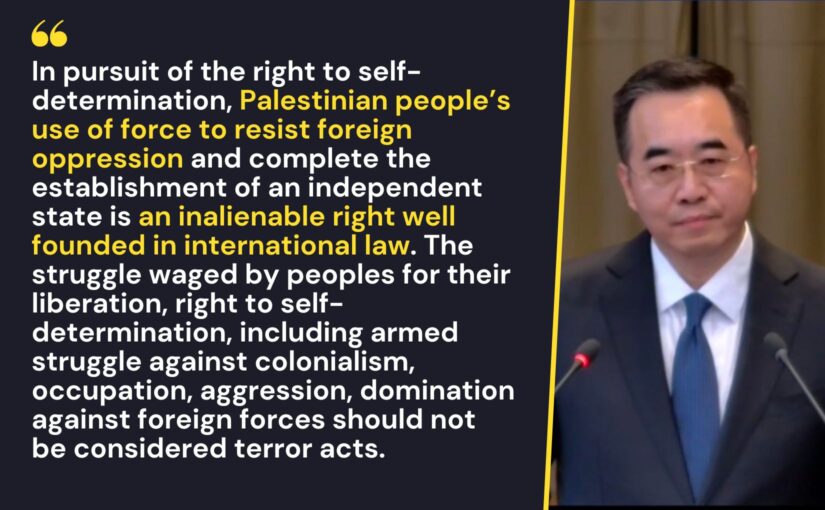
China and the purity fetish of Western Marxism

In this essay, extracted from the book The Purity Fetish and the Crisis of Western Marxism, Carlos Garrido takes a detailed look at China’s socialist market economy and seeks to understand why so much of the Western left insistently misunderstands it.

Carlos discusses the assorted tropes about China’s ‘authoritarianism’ and ‘totalitarianism’, as well as the obscene slanders that are thrown at it in relation to human rights in Xinjiang. However, the central focus of this essay is the Reform and Opening Up process introduced from the late 1970s, specifically addressing the claims that the existence of markets and private capital in China make it a capitalist country.

The author explains that markets have existed in human society for long before the advent of capitalism (citing Marx that “market economies have existed throughout human history and constitute one of the significant creations by human societies”) and that the character of any given market is determined by its overall socioeconomic context. Deng Xiaoping made this point with particular clarity: “We cannot say that market economy exists only under capitalism. Market economy was in its embryonic stages as early as feudalist society. We can surely develop it under socialism… As long as learning from capitalism is regarded as no more than a means to an end, it will not change the structure of socialism or bring China back to capitalism.”

Carlos writes that the reform strategy responded to a specific set of circumstances and needs, “wherein an overly centralized economy, combined with imperialist-forced isolation from the world, stifled development and necessitated reforms which would allow China to develop its productive forces, absorb the developments taking place in science and technology from the West, and ultimately, protect its revolution.” Given that China has emerged as a science and technology powerhouse; given the extraordinary increase in living standards; and given the continued legitimacy and popularity of the CPC-led government, it seems uncontroversial to say that the strategy has been highly successful.

In the context of an escalating New Cold War against China, “all progressive forces in the West should unite against the US and NATO’s anti-China rhetoric and actions.” China “stands as the main global force countering US/NATO led imperialism. Its rise signifies much more than the end of US unipolarity – it marks the end of the Columbian era of European global dominance that began in 1492.” As such it is imperative that the Western left develop its understanding of Chinese socialism and build solidarity with People’s China, rather than “parroting state-department narratives on China with radical-sounding language.”

One debateable assertion the essay makes is in regard to Hua Guofeng, who served as top leader of the CPC for two years following Mao’s death in 1976. Carlos writes that “Hua Guofeng’s two whatevers (‘We will resolutely uphold whatever policy decisions Chairman Mao made, and unswervingly follow whatever instructions Chairman Mao gave’) perpetuated the sort of book worshiping which not only sucked the living spirit out of Marxism-Leninism and Mao Zedong Thought, but proved futile in dealing with the problems China faced.”

This is at odds with recent research presented by Isabella Weber in her book How China Escaped Shock Therapy: The Market Reform Debate. Weber writes that the two whatevers slogan was essentially a means of emphasising loyalty to the Chinese Revolution and socialist construction, and that “paying tribute to Mao in the year after his passing was not unique to Hua.” Meanwhile, “Hua redefined revolution itself as ‘liberation of productive forces’ and elevated national economic development to the highest priority” and in so doing “paved the way for the Deng-era reforms.” It was under Hua that major efforts were first made to attract foreign investment. Weber considers it “remarkable that such drastic changes occurred under a leader who has frequently been described as a relatively unremarkable Mao loyalist.”

This article first appeared on Midwestern Marx.

The stakes of the imperialist West’s New Cold War against China are as great as they can get. This means that the Western left’s role as controlled counter-hegemony and left-wing delegitimizers of socialist states – a role ideologically grounded in their purity fetish outlook – is as dangerous as it can get. In our current geopolitical climate, all progressive forces in the West should unite against the US and NATO’s anti-China rhetoric and actions. Unfortunately, what we find from large portions of this Western left is parroting of state-department narratives on China with radical-sounding language. Leading ‘socialist’ outlets in the US often echo baseless ruling class propaganda such as the ‘Uyghur genocide,’ Zero Covid authoritarianism, Belt and Road imperialism, debt trapping, and other similar fabrications.[1] Far from a concrete-dialectical study of China, in many of these spaces the claims of the ruling class are just assumed to be true, and anyone who dares to question them – and henceforth, bring the real truth to light – is labeled a puppet of Xi Jinping and the ‘CCP’ (which, like the Western bourgeoisie, is continuously labeled by these ‘socialists’ as CCP and not CPC in order to play on CCCP fears from the last cold war).[2]

Most of these tactics center on age-old claims of communist ‘authoritarianism,’ ‘totalitarianism,’ and all other such words used to equate fascism with communism and judge ‘democracy’ according to Western liberal-bourgeois standards. These assumptions and purity fetish engagements with Chinese socialist governance blind the Western Marxist from seeing China’s de facto geopolitical role as a beacon in the anti-imperialist struggle, in the Covid struggle, in the struggle for environmental sustainability, and in the struggle to develop with the darker nations which have been kept poor by centuries of colonialist and imperialist looting, debt traps, and superexploitation.[3]

The unquestioned, purity fetish grounded, and Sinophobic assumption of Chinese ‘authoritarianism’ and ‘lack of democracy’ also prevents the Western Marxist from learning how the Chinese socialist civilization has been able to creatively embed its socialist democracy in “seven integrated structures or institutional forms (体制tizhi): electoral democracy; consultative democracy; grassroots democracy; minority nationalities policy; rule of law; human rights; and leadership of the Communist Party.”[4] It has withheld them from seeing how a comprehensive study of this whole-process people’s democracy would lead any unbiased researcher to the conclusion Roland Boer has arrived at: namely, that “China’s socialist democratic system is already quite mature and superior to any other democratic system.” This is a position echoed by John Ross (and many other scholars of China), who argues that the “real situation shows that China’s framework and delivery on human rights and democracy is far superior to the West’s.”[5]

​The purity fetish Marxists of the West love to think about democracy in the abstract, and hold up as the pure ideal a notion of democracy which is only quantitatively different from the bourgeois notion. Then, this ideal notion of bourgeois democracy is measured up against the atrocity propaganda riddled caricature of socialist states which their ruling classes paint – and they unquestioningly accept. When the caricature of reality fails to measure up to the ideal, reality – which they have yet to engage with – is condemned. What the Western Marxist forgets – thanks to the purity fetish and their social chauvinism – is that in societies divided by class antagonisms we can never talk about ‘pure democracy,’ or abstract democracy in general; we must always ask – as Lenin did – “democracy for which class?”[6] The ‘democracy’ and ‘democratic freedoms’ of capitalist to exploit and oppress will always be detrimental to working and oppressed peoples. Only an all-people’s democracy (a working and popular classes’ democratic-dictatorship) can be genuinely democratic, for it is the only time ‘power’ (kratos) is actually in the hands of ‘common people’ (dēmos).

To claim – as American capitalists, their puppet politicians and lapdog media, and their controlled counter-hegemonic ‘socialists’ do – that the US is a ‘beacon of democracy,’ and China an ‘authoritarian one-party system,’ is to hold on to a delusional topsy turvy view of reality.[7] If democracy is considered from the standpoint of the capitalist’s ability to arbitrarily exert their will on society at the expense of working people and the planet, then, of course, the US is a beacon of this form of so-called ‘democracy,’ and China an ‘authoritarian’ regime that stands in the way of this ‘freedom.’ If instead, democracy is considered from the standpoint of common people’s ability to exert their power successfully over everyday affairs – that is, if democracy is understood in the people-centered form it etymologically stands for – then it would be indisputable that China is far more democratic than the US (and any other liberal-bourgeois ‘democracy’).

However, the object of this text is not to address and ‘debunk’ all the assertions made about China (or any other socialist country) from the Western left – specifically the Trotskyites and the Democratic Socialists. That would, for one, require a much more expansive project, and two, is a task that has already been done many times before. Projects like Friends of Socialist China and Qiao Collective consistently engage in the practice of debunking the propaganda on China proliferated by the Western ruling class and the ‘left.’ The objective of this text is different; it seeks not only to point out falsities in the Western left’s positions, but to understand the worldview which consistently reproduces these. I have called this worldview the purity fetish. In it we can find the ideological roots for the Western Marxist positions on China.

In the Western Marxist’s purity fetish assessment of China, it is held that because China doesn’t measure up to the pure socialist Ideal in their heads, because China does not have, as Samir Amin notes, “the communism of the twenty-third century,” – it is not actually socialism.[8] The question of democracy and authoritarianism has already been assessed in previous chapters – it is a classic of the Western Marxist condemnation toolbox. My focus in this chapter will be on those who claim China is ‘capitalist’ because it developed private ownership and markets with the period of Reform and Opening Up in 1978. This form of the purity fetish centers on their inability to understand, in a dialectical manner, how markets and private property function within China’s socialism. China, according to these Western Marxists, took the ‘capitalist road’ in 1978. As Roland Boer has shown in his article “Not Some Other -ism”—On Some Western Marxist Misrepresentations of Chinese Socialism,” there are four major ‘sub-forms’ through which this first form of condemnation occurs: 1) capitalist socialism; 2) neoliberalism with Chinese characteristics; 3) bureaucratic capitalism; and 4) state capitalism. Often, variations of these can be found within the same critic, as none are the result of a rigorous, principled analysis.

As US and Western imperialist powers ramp up the New Cold War against China, Western Marxism’s erroneous purity fetish view of Chinese socialism requires closer examination.

Continue reading China and the purity fetish of Western Marxism

The West’s stance on the Israeli-Palestinian conflict is callous and irresponsible

The following article from Global Times discusses the recent escalation of the Israeli-Palestinian conflict and the hypocritical behaviour of the Western powers.

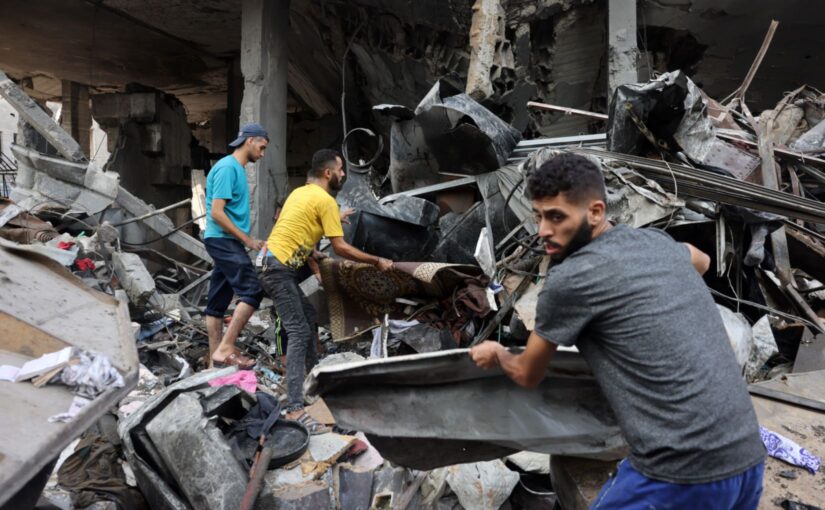
The article observes that the Israeli state has ordered a “complete siege” on Gaza – a densely-populated area which has already been under effective siege for the last 16 years, and which has often been described as the world’s largest open-air prison. In addition to the loss of several thousand Palestinian lives in the last decade (mostly the result of missile strikes), Israel’s ongoing abuse of Palestinian human rights has led to the devastation of the economy and the near-collapse of basic services. Now in response to the surprise attack led by Hamas, Israel is engaged in a further act of collective punishment, cutting off electricity and water supplies, while mobilising its military for a possible full-scale ground invasion of Gaza.

The author asserts that “the urgent task facing the international community, especially the major powers, is to quickly put the brakes on this tragedy and prevent a larger-scale humanitarian catastrophe.” Unfortunately the imperialist powers are showing no interest in preventing a catastrophe or in addressing the fundamental cause of the crisis – the ongoing national oppression of the Palestinian people.

The article points out that “the most rational and responsible approach is to call on all parties to exercise maximum restraint and calm and to achieve a ceasefire as soon as possible.” But the US and its allies are instead increasing their military aid to Israel, cracking down on pro-Palestine opinion at home, and waging fierce propaganda against the Palestinian resistance movement. “The words and actions of the US and many Western countries are fanning the flames rather than cooling down the situation.”

Xi Jinping commented in December 2022 that “the legitimate rights of a nation are not up for trade. I would like to reiterate that China firmly supports the establishment of an independent State of Palestine that enjoys full sovereignty based on 1967 borders and with East Jerusalem as its capital.” It is perfectly clear that there will be no lasting peace in the region until the Palestinian people gain their freedom and self-determination, in accordance with international law.

The casualty data of this round of the Israeli-Palestinian conflict is being updated every day, causing concern and distress for the civilians living in the area. According to Israeli media reports on October 9, the conflict has resulted in more than 1,300 deaths and over 5,000 injuries on both sides. Both Israel and Palestine have suffered a large number of civilian casualties. Additionally, humanitarian relief organizations of the United Nations have stated that over 120,000 Palestinians in the Gaza Strip have been displaced. The conflict is still escalating, and there is a significant degree of uncertainty about how much it will escalate and in which direction it will develop in the future. However, one thing is certain: The damage and suffering caused by the conflict will largely be borne by the local civilians, and they are in great need of care and protection from the outside world.

Israeli Defense Minister Yoav Gallant has ordered a “complete siege” on Gaza, where over 2 million Palestinian residents live densely packed. They already endure severe material blockades and restrictions on movement year-round, and the outbreak of the conflict has added to their dangers and hardships. Electricity and water supplies have been cut off, and a new humanitarian disaster is brewing. This is a focal point that the international community cannot afford to ignore in the Israeli-Palestinian conflict. The urgent task facing the international community, especially the major powers, is how to quickly put the brakes on this tragedy and prevent a larger-scale humanitarian catastrophe. It is the responsibility of the international community to address this issue promptly.

Continue reading The West’s stance on the Israeli-Palestinian conflict is callous and irresponsible

A Global Community of Shared Future: China’s Proposals and Actions

On 26 September 2023, the State Council Information Office of the People’s Republic of China issued a white paper titled “A Global Community of Shared Future: China’s Proposals and Actions”, setting out China’s high level foreign policy and describing a bold vision for building a peaceful, prosperous and sustainable future for humanity.

The central theme of the document is succinctly stated in the preface:

To build a global community of shared future, all peoples, all countries, and all individuals – our destinies being interconnected – must stand together in adversity and through thick and thin, navigating towards greater harmony on this planet that we call home. We should endeavor to build an open, inclusive, clean and beautiful world that enjoys lasting peace, universal security, and common prosperity, turning people’s longing for a better life into reality.

The white paper describes the current division in geopolitics; the fork in the road, with one direction characterised by a “Cold War mentality that deepens division and antagonism and stokes confrontation between blocs” and the other aimed at developing common wellbeing of humanity, solidarity, cooperation, openness, equality and respect. “The tug of war between these two options will shape the future of humanity and our planet in a profound way.”

The paper can be considered as a modern reiteration of the Five Principles of Peaceful Co-Existence – mutual respect for sovereignty and territorial integrity; mutual non-aggression; non- interference in each other’s internal affairs; equality and mutual benefit; and peaceful coexistence – which have been the lodestar of Chinese foreign policy since their announcement in 1954. Core to these principles is the notion – embedded in the UN Charter – of the sovereign equality of all states. The white paper observes:

The world needs justice, not hegemonism. No country has the right to dominate global affairs, dictate the future of others, or monopolize development advantages. Countries should safeguard the international order based on international law, uphold the authority of the international rule of law, and ensure equal and unified application of international law. The practice of double standards or selective application of law should be rejected.

This stands in contrast with the much-vaunted ‘rules-based international order’, which is in fact a euphemism for the primacy of the US and its allies, and the imposition of their will on the rest of the world.

The document reiterates China’s commitment to environmental sustainability and to the highest level of international cooperation in preventing catastrophic climate change.

We should reconcile industrial development with nature, and pursue harmony between humanity and nature to achieve sustainable global development and all-round human development. We should respect nature, follow its ways, and protect it. We should firmly pursue green, low-carbon, circular and sustainable development… We should make our world clean and beautiful by pursuing green and low-carbon development… We must follow the philosophy of harmony between humanity and nature and observance of the laws of nature and pursue a path of sustainable development, so that everyone is able to enjoy a starry sky, lush mountains and fragrant flowers.

Recognising the potentially catastrophic consequences of war in the nuclear age, the white paper also re-states China’s commitment to the principle of no-first-use of nuclear weapons, and to the goal of complete nuclear disarmament.

China actively advocates the complete prohibition and thorough destruction of nuclear weapons, and it is the only nuclear country that has publicly committed to no-first-use of nuclear weapons, and not using or threatening to use nuclear weapons against non-nuclear-weapon states and nuclear-weapon-free zones.

While “it is normal for countries to have differences”, there is always the possibility for these to be overcome through peaceful means and within a framework of international law. “No conflict is too big to resolve and no ice too thick to break.”

Quoting a number of powerful proverbs from around the world – including the Russian proverb “Together we can weather the storm”, the African proverb “One single pillar is not sufficient to build a house” and the Arabic proverb “If you want to walk fast, walk alone; if you want to walk far, walk together” – the document notes that the concept of a global community of shared future is not unique to China but runs deep through the history of civilisation. It is a unifying dream of humanity, which can inspire this generation to work seriously towards its realisation.

If the peoples of the world can work together to build a global community of shared future, “emerging countries and established powers can avoid falling into the Thucydides trap” and can “find the right way to get along in mutual respect, peaceful coexistence and win-win cooperation.” (Thucydides trap is a term popularised by US political scientist Graham Allison, describing a tendency towards war when an emerging power threatens to displace an existing great power).

The white paper describes the ways in which China, particularly over the last decade, has worked tirelessly towards building a global community of shared future. This includes the Belt and Road Initiative, which has already brought tremendous benefits to the people of Pakistan, Laos, Greece, Ethiopia, Kenya, Malawi, Tajikistan and many other countries. The Global Development Initiative, Global Security Initiative and Global Civilization Initiative – proposed by China in 2021, 2022 and 2023 respectively – provide an important framework for helping to meet humanity’s collective need for material prosperity, peace, and cultural progress and mutual learning.

The document concludes with a powerful call to joint action:

In the face of common challenges, no person or country can remain isolated. The only response is to work together in harmony and unity. Only by strengthening coordination and cooperation, and ensuring that the interests of the people of every country will be kept in line with those of all others, can all countries move forward towards a global community of shared future…

When all countries unite in pursuing the cause of common good, plan together, and act together day by day towards the right direction of building a global community of shared future, we can build an open, inclusive, clean, and beautiful world of lasting peace, universal security and shared prosperity, and jointly create a better future for all of humanity.

We reprint the full text of the white paper below. It was originally published on the website of the State Council Information Office.

A Global Community of Shared Future: China’s Proposals and Actions

The State Council Information Office of the People’s Republic of China
September 2023

Continue reading A Global Community of Shared Future: China’s Proposals and Actions

The historian rewriting China’s understanding of the world

Qian Chengdan is one of China’s best-known but more elusive historians. In 2006, he was a key consultant for a major CCTV television series which analysed the rise and fall of nine world-historical empires. It was widely and correctly identified at the time as illustrating socialist China’s determination that its peaceful rise would never lead to the previous historical outcomes of colonialism, imperialism and hegemony.

Following this high-profile project, Professor Qian preferred to concentrate on his own niche interests, including publishing monographs on English history and translating The Cambridge Introduction to the History of Art.

However, he is now once again in the spotlight having led a team of scholars in a three-year project, resulting in An Outline of World History, which was published in June by Peking University Press. The publishers have described the work as “the first attempt by Chinese scholars to create a new system of knowledge for world history, and to use that system to write a history of the world.”

The book draws heavily on the work of Karl Marx, but, according to an article and abbreviated interview by Wu Haiyun carried by the popular Sixth Tone website, it has “taken pains to distance the work from that of earlier Soviet scholars, whom he believes were overly dogmatic and overlooked key aspects of Marx’s ideas.”

In the interview, Professor Qian says that:

“The Soviet system boils down to two elements: the ‘five modes’ and class struggle. The importance of class struggle to Marxism is well known, but many Chinese also learn about the five modes of production, which refer to the progression of human society from primitive communism to slavery, feudalism, capitalism, and ultimately a future communist society.

“The problem with the Soviet system was its absolutism. It rejected the idea of cultural diversity and posited that all regions and countries worldwide underwent the same process. This does not align with historical reality.”

His interviewer responded: “What you described as the two key points of the Soviet system are fundamental concepts that every Chinese person learns from an early age. Isn’t that standard Marxism? How exactly does your approach differ from the Soviet one?”

This drew the following response:

“In his book The German Ideology, Karl Marx provided a clear description of the formation of world history. He wrote, ‘the more the original isolation of the separate nationalities is destroyed by the developed mode of production and intercourse and the division of labour between various nations naturally brought forth by these, the more history becomes world history.’

“This is Marx’s own understanding of the formation of world history. Regrettably, his words were largely ignored by Soviet historians…This implies that human society is not only characterised by the progression from lower to higher stages but also by the transition from fragmentation to unity. From this perspective, we can see the superiority of Marx’s theory of world history… We aim to restore history to its authentic form, preserving its most genuine characteristics. In my view, Marx’s theory of ‘world history’ comes closest to grasping the essence of history. Sadly, his theory has long been overlooked.”

One of the things that is not explored in the interview is that Professor Qian’s rejection of simplistic and dogmatic interpretations of historical materialism, something by no means confined to many Soviet Marxists, but also to be found, for example, in many schools and adherents of Western Marxism, is essential to correctly understanding and appreciating the fact that a number of countries have embarked on the road of socialism without first going through the phase of capitalist development.

Concluding on a note of well-placed optimism, Professor Qian notes that:

“From the late 19th century to the early 20th century, the Western world, bolstered by capital and war, essentially gained control over the entire globe, leaving almost no room for the survival of non-Western civilisations. This was a comprehensive ‘horizontal’ shift. However, from that point onward, history has begun to reverse course, and the world today is markedly different from a century ago. Various regions are pursuing their unique development paths, and differences are becoming increasingly pronounced and apparent.”

We reprint the article and interview from Sixth Tone below.

Qian Chengdan might be the Platonic ideal of an ivory tower academic. The director of both Peking University’s Center for World History Research and its Institute of Area Studies, Qian occupies a prestigious perch at one of China’s top universities, but unlike many of his peers, he seems to have little interest in fame or attention: He rarely participates in public forums or sits for interviews, and he avoids all social media — even WeChat.

On the rare occasion Qian does descend from the ivory tower, however, he almost always leaves a mark. In 2006, Qian served as a key consultant on the acclaimed CCTV-produced documentary series “The Rise of the Great Powers,” which told the story of nine world-historical empires, from Portugal and Spain to Japan and the United States. It was one of the first extended introductions to world history aired on Chinese television — and a significant departure from past programming focused on China’s own history.

After the series aired, Qian quietly returned to academic life, eventually publishing a number of well-received monographs on world and English history while pursuing his passion project: translating “The Cambridge Introduction to the History of Art” in its entirety.

Continue reading The historian rewriting China’s understanding of the world

Hakainde Hichilema: China’s modernisation is a crucial reference point for Zambia

Zambian President Hakainde Hichilema paid a state visit to China from September 10-16, where, following talks with his counterpart Xi Jinping, the two countries upgraded their bilateral relationship to that of a comprehensive strategic cooperative partnership.

In this episode of the CGTN series Leaders Talk, President Hichilema recaps with Li Tongtong his six day journey through four provinces. 

He started his visit in Shenzhen, China’s first special economic zone, visiting such cutting edge companies as the telecoms giant Huawei and the electric vehicle pioneer BYD. An enthusiast for China’s modernisation path, he next went to the Jinggangshan mountainous region in Jiangxi province, which was Chairman Mao’s first revolutionary base area in the fight he led to liberate China and the Chinese people. Hichilema opined that Mao had displayed great vision in selecting this region and he saw his own visit as a key part of completing his understanding of the jigsaw of China’s development.

In a similar vein, he also visited a fishing village and other local areas in Fujian province where Xi Jinping had worked and led at the grassroots level, especially in the areas of poverty alleviation and green development. He sees the leapfrog progression to digital development as a crucial reference point for Zambia’s own development path. Zambia needs to drive industrialisation, so that it does not simply extract its natural resources but also processes them to add value.

Zambia joined the Belt and Road Initiative (BRI) in 2018 and tangible benefits so far include the stabilising of the energy sector, to eliminate the frequent power cuts known as ‘load shedding’, and the revival of the Tazara Railway, originally built by China in the 1970s to help free landlocked Zambia from the economic strangulation of its southern neighbours, then under European colonialist and white racist rule. The programme includes some moving footage from those years as a highlight of the long and consistent friendship between the two countries and peoples. Winning independence from British colonialism on October 24, 1964, Zambia established diplomatic relations with the People’s Republic of China just five days later, becoming the first country in southern Africa to do so.

The full interview with President Hichilema is embedded below.

Forecasting China?

In the following article, which was originally carried by Sidecar, the blog published under the auspices of New Left Review, on 8 September 2023, Nathan Sperber addresses some typical but fundamental western misconceptions concerning the Chinese economy.

He begins with the observations of Nobel Prize-winning economist Paul Krugman that “China is in big trouble. We’re not talking about some minor setback along the way, but something more fundamental. The country’s whole way of doing business, the economic system that has driven three decades of incredible growth, has reached its limits…the only question now is just how bad the crash will be”; only to then note that Krugman had been writing in the summer of 2013.

In fact, China’s GDP grew by 7.8 percent that year and in the ensuing decade its economy has expanded by 70 percent in real terms compared to 21 percent for the United States.

Similar dire predictions were made, the article points out in the early 2000s, “when runaway investment was thought to be ‘overheating’ the economy; in the late 2000s, when exports contracted in the wake of the global financial crisis; and in the mid-2010s, when it was feared that a buildup of local government debt, under-regulated shadow banking and capital outflows threatened China’s entire economic edifice.” Today, the trigger for such doom mongering is the relatively low growth figures for the second quarter of 2023.

Sperber asserts that the existence of structural weaknesses in the Chinese economy is not in dispute. But he also considers that a fundamental weakness in much Western coverage of the Chinese economy is that it responds to the needs of the ‘investor community’:

“The most salient preoccupations of Western commentators reflect the skewed distribution of foreign-owned capital within the Chinese economy. China’s economy is highly globalized in terms of trade in goods but not in terms of finance: Beijing’s capital controls to a large degree insulate the domestic financial sector from global financial markets. Overseas financial capital has only a handful of access points to China’s markets, meaning international exposure is uneven. China-based companies with foreign investors, offshore debt or listings on stock markets outside of the mainland (that is, free of China’s capital controls) generate attention precisely in proportion to their overseas entanglements.”

To illustrate his argument, he notes how countless news articles have been devoted to the travails of real estate giants Evergrande (Hong Kong-listed and reliant on dollar-denominated debt) and, more recently, Country Garden (Hong Kong-listed and again carrying offshore debt). Readers of the Wall Street Journal or the New York Times will be far less likely to read about State Grid, the world’s largest electricity provider, or China State Construction Engineering, the world’s largest construction firm – “two companies less dependent on global finance and over which international investors are unlikely to lose any sleep.”

Noting how the “slow-motion collapse” of Evergrande has been portrayed in the Western media as a “calamity in waiting for the entire Chinese economy”, Sperber adds that this “elides the fact that the Chinese government deliberately prevented highly indebted property developers, including Evergrande, from accessing easy credit in the summer of 2020… Of course, no large-scale corporate default and restructuring is desirable per se. But it appears that failures like Evergrande’s have been treated by Chinese authorities as the price of disciplining the property sector as a whole and reducing its weight in the broader economy.”

Although not mentioned by Sperber, his above point also serves, inter alia, to underline how, again contra to much western reportage (even by some progressive scholars not unfriendly to China), China has not strategically departed from President Xi Jinping’s insistence that homes are for living in not for speculation. Against the common western narratives, Sperber argues that a more level-headed approach would be to put China’s current economic moment in a longer-term perspective. China’s economy was comprehensively transformed in the 1980s and 1990s, and “since this era of intense institutional restructuring ended in the early 2000s, China’s GDP has more than quadrupled in real terms but the country’s fundamental economic structure has remained stable, in terms of both the balance between state-owned enterprises and private capital, and the precedence of investment over consumption.”

Nobel Prize-winning economist Paul Krugman does not mince his words:

the signs are now unmistakable: China is in big trouble. We’re not talking about some minor setback along the way, but something more fundamental. The country’s whole way of doing business, the economic system that has driven three decades of incredible growth, has reached its limits. You could say that the Chinese model is about to hit its Great Wall, and the only question now is just how bad the crash will be.

That was in the summer of 2013. China’s GDP grew by 7.8 per cent that year. In the decade since, its economy has expanded by 70 per cent in real terms, compared to 21 per cent for the United States. China has not had a recession this century – by convention, two consecutive quarters of negative growth – let alone a ‘crash’. Yet every few years, the Anglophone financial media and its trail of investors, analysts and think-tankers are gripped by the belief that the Chinese economy is about to crater.

The conviction reared its head in the early 2000s, when runaway investment was thought to be ‘overheating’ the economy; in the late 2000s, when exports contracted in the wake of the global financial crisis; and in the mid-2010s, when it was feared that a buildup of local government debt, under-regulated shadow banking and capital outflows threatened China’s entire economic edifice. Today, dire predictions are out in force again, this time triggered by underwhelming growth figures for the second quarter of 2023. Exports have declined from the heights they reached during the pandemic while consumer spending has softened. Corporate troubles in the property sector and high youth unemployment appear to add to China’s woes. Against this backdrop, Western commentators are casting doubt on the PRC’s ability to continue to churn out GDP units, or fretting in grander terms about the country’s economic future (‘whither China?’, asks Adam Tooze by way of Yang Xiguang). Adam Posen, president of the Washington-based Peterson Institute, has diagnosed a case of ‘economic long Covid’. Gloom about China’s economic prospects has once again taken hold.

That there are structural weaknesses in the Chinese economy is not in dispute. After two waves of dramatic institutional reform in the 1980s and 1990s respectively, China’s economic landscape has settled into a durable pattern of high savings and low consumption. With household spending subdued, GDP growth, slowing over the past decade, is sustained by driving up investment, enabled in turn by growing corporate indebtedness. But despite this slowdown, the current bout of doomsaying in the English-language business press, half investor Angst, half pro-Western Schadenfreude, is not an accurate reflection of the fortunes of China’s economy – plodding, but still expanding, with 3 points of GDP added over the first six months of 2023. It is rather an expression of an intellectual impasse, and of the flawed conditions in which knowledge about the Chinese economy is produced and circulated within the Western public sphere.

Continue reading Forecasting China?

Minister Liu Jianchao: Promoting a human community with a shared future

We reprint below an important article by Liu Jianchao, Minister of the International Department of the Communist Party of China Central Committee, which first appeared in China Daily.

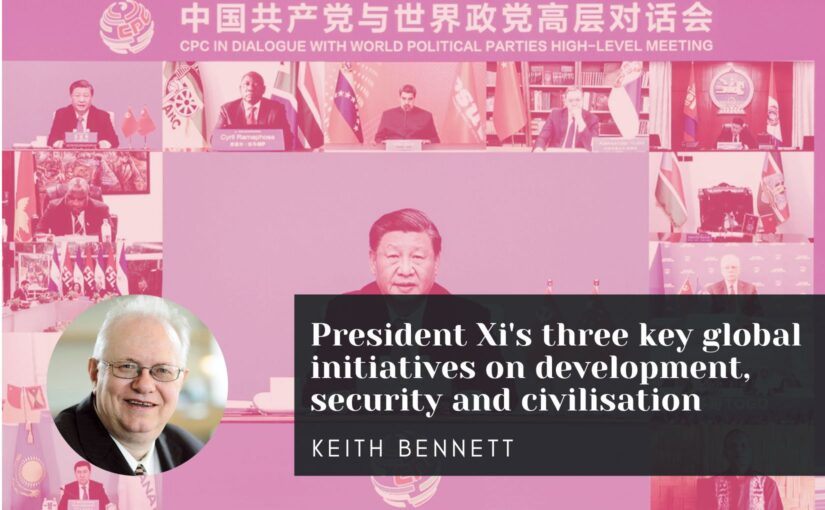
In his article, Minister Liu outlines the key points and significance of the three major initiatives put forward by President Xi Jinping, namely the Global Development Initiative (GDI), Global Security Initiative (GSI) and Global Civilisation Initiative (GCI). According to Liu, together they promote “global organic unity… in order to build a human community with a shared future.” This unity, “following the trend of human progress and in response to the unprecedented changes in the world, points to the direction in which the world, which now is at a crossroad, should go.”

He further outlines the essence of each initiative, as follows:

“The GDI, from the perspective of growth, answers the question of what development philosophy people need and how to achieve global development. It is aimed at creating the material foundation for a human community with a shared future. The GSI, from the viewpoint of security, focuses on the issue of what sort of security humanity needs and how to achieve universal security. It is aimed at providing security guarantee for the community. The GCI… answers the question of how to view different civilisations and promote exchanges and mutual learning among them. It aims to build the cultural foundation for the human community.”

Targeting issues like humanity’s survival, development, and modernisation, the GDI effectively responds to the strong aspiration and urgent need of the international community, developing countries in particular, to achieve faster economic growth. It also focuses on tackling the unbalanced and inadequate development within and among nations, thus setting the direction for the cause of global development and global cooperation on development.

China’s success in brokering a rapprochement between Saudi Arabia and Iran, and its commitment to promoting the political settlement of the Ukraine crisis through peace talks, are all examples of how we address security dilemmas by following the GSI. Targeting issues such as misunderstandings, estrangement, lack of mutual trust and inclusiveness among civilisations, the GCI aims to achieve dialectical unity based on the commonality and notwithstanding the diversity of civilisations, by seeking the common ground among them while fully respecting that diversity.

Whilst also outlining the influence of traditional Chinese culture and philosophy on the initiatives, Liu particularly emphasises how they are rooted in and embody Marxism.

“The vision of building a human community with a shared future and the three global initiatives are scientific. They encapsulate the stances, viewpoints, and methods of Marxism, reflecting the hallmarks of Marxism, and demonstrating salient theoretical characters. Underpinned by dialectical and historical materialism, the vision and the three global initiatives reveal the laws governing the development of human society and its future direction.”

They are also people-centred: “Focusing on the aspiration for a better life of the peoples across the world, the vision and the three global initiatives highlight the overall interests of humanity and strive to improve the common wellbeing of all peoples.

“Moreover, their vision of caring for every individual is self-evident. Responding to the yearning of peoples of different countries for peace, development and cooperation, the vision and the three global initiatives are committed to creating the right conditions to realise and guarantee each individual’s well-rounded development.”

Concluding his arguments, Minister Liu notes:

“The vision of a human community with a shared future and the three global initiatives uphold and apply Marxist stances, viewpoints and methods, and constitute a well-developed system of thought with compelling logic. They reflect China’s keen grasp of the law of history and its civilisation, and its deep reflection on the questions that have emerged in modern times.

“The three global initiatives, which are interconnected, interdependent and mutually reinforcing, provide a strong underpinning for the vision of building a global community with a shared future and offer China’s solution to build a better world.”

In March this year, Xi Jinping, general secretary of the Communist Party of China Central Committee, proposed the Global Civilization Initiative at the CPC in Dialogue with World Political Parties High-Level Meeting. The GCI was the third global initiative he proposed to promote global organic unity after the Global Development Initiative and the Global Security Initiative in order to build a human community with a shared future.

The unity, following the trend of human progress and in response to the unprecedented changes in the world, points to the direction in which the world, which now is at a crossroad, should go. It is a new development of Xi Jinping Thought on Diplomacy and speaks volumes about the sense of history, mission and responsibility, and the global vision of Chinese communists with Xi Jinping as their chief representative. To break new ground in advancing major country diplomacy with Chinese characteristics, we must get a sound grasp of the scientific nature and the considerable significance of this unity and the inherent relationship between the vision and the three global initiatives.

From the historical perspective, the three global initiatives, reflecting three major themes of human progress, constitute three pillars that support the overarching vision of a human community with a shared future.

In the long river of history, different civilizations, flowing and converging from time to time, have surged forward like waves. Along with the continuous progress of human society and the deepening of globalization, countries have become increasingly connected and inter-dependent, forming a community with a shared future.

People of all countries have come to realize that material abundance, peace and stability and cultural prosperity are what all societies aspire for. To achieve them, we need growth, security and civilization, which complement and reinforce each other.

As an ancient Chinese saying goes, “Only when the granary is full will people learn etiquette; only when people are well fed and clothed will they know honor and shame.” Growth is the basis for security and civilization. Only when all countries prosper can peace last and civilizations thrive.

“Stability brings a country prosperity, while instability leads a country to poverty,” is another ancient Chinese saying. Security is a prerequisite of growth and civilization. Chinese people in ancient times believed that the civilized tend to enjoy safety while the uncivilized are more prone to face troubles and encounter danger. Civilization develops on the basis of economic growth and security. It is the accumulation of a people’s cultural pursuit and carries the imprint of a nation’s history. It has a gradual and imperceptible influence on people’s way of thinking and doing things, providing spiritual strength to the cause of development and security.

Continue reading Minister Liu Jianchao: Promoting a human community with a shared future

Bashar al-Assad: China has gone from being the world’s factory to being the world’s innovation powerhouse

In this edition of the CGTN series Leaders Talk, Zou Yun interviews Syrian President Bashar al-Assad, who was visiting China for the first time in 19 years. His 21-26 September visit began in Hangzhou, where he and his wife Mrs. Asma al-Assad were among the international leaders to attend the opening of the 19th Asian Games. Talks with his Chinese counterpart Xi Jinping saw the two countries establish a strategic partnership and their agenda focused in particular on the Syrian people’s efforts to rebuild their country after years of war and its full return to the regional and international stage.

In the interview, President Assad was clearly touched by the warm and spontaneous welcome given by Chinese spectators to the Syrian athletes as they entered the stadium as well as by the subsequent comments by Chinese netizens on social media. Comparing the China of today with the one he saw on his previous visit in 2004, he said it had gone from being the world’s factory to being the world’s innovation powerhouse. But what was even more important than the changes was that the patriotic qualities of the Chinese people had not changed.

Reflecting on his talks with President Xi, the Syrian leader noted that China rejects hegemony and always stands with Syria politically. He felt that there was much that could be learned from the Chinese experience of modernisation as China’s own situation was once similar to that of many other third world countries. Syria and other countries, he continued, had once tried to learn from the western experience, but these attempts had proved to be unsuccessful and even counterproductive.

Turning to the current situation in Syria, Assad noted that the war is not over. The physical destruction could be addressed, as Syria had done many times in its long history, but the destruction of national culture and civilisation by western neoliberalism led by the United States, along with the related issue of extremism, was more dangerous. If Syria is rebuilt, he continued, his country will have a bright future. It had previously enjoyed high growth and low debt, was an exporter of wheat and other foodstuffs and had been developing various industries.

He praised the recent reconciliation between Iran and Saudi Arabia, which was facilitated by China, as a huge achievement and a wonderful surprise. Syria had suffered for years from the estrangement between these two neighbouring countries. According to the Syrian President, the world is now in a period of transition from the centuries of colonialism, which had begun with the “discovery” of the Americas, and which has been characterised by slaughter and exploitation. It is this transition that underlines the significance of the various international initiatives proposed by President Xi Jinping.

The full interview with President Bashar al-Assad is embedded below.

The West’s blueprint for goading China was laid out in Ukraine

The following article by Jonathan Cook (first published by Middle East Eye) explores the complex and contradictory policies of the Western powers in relation to China. On the one hand, Western leaders talk of wanting a collaborative relationship with China, and on this basis “US and European officials have scurried to Beijing for so-called talks”, including a high-profile visit by British foreign secretary James Cleverly in August. On the other hand, these same leaders are taking reckless steps towards confrontation: “showering Taiwan with weapons systems”; setting up AUKUS; forging a trilateral security arrangement between the US, Japan and South Korea; and developing new military bases in the Pacific as part of an ongoing strategy of encirclement. NATO last year declared Beijing a challenge to its “interests, security and values.”

Jonathan writes that “European leaders are torn. They fear losing access to Chinese goods and markets, plunging their economies deeper into recession after a cost-of-living crisis precipitated by the Ukraine war. But most are even more afraid of angering Washington, which is determined to isolate and contain China.”

The manifestation of these contradictory motivations is a policy of aggression combined with the pretence of a meaningful desire for peaceful engagement. “But the only real engagement is the crafting of a military noose around China’s neck, just as a noose was crafted earlier for Russia.” And the crafting of this military noose is justified to ordinary people in the West – who will inevitably shoulder the economic costs of the deteriorating relationship – with an absurd but carefully-curated narrative about protecting Taiwan. This “obscures Washington’s less palatable aim: to enforce US global dominance by smashing any economic or technological threat from China and Russia.”

The West is writing a script about its relations with China as stuffed full of misdirection as an Agatha Christie novel.

In recent months, US and European officials have scurried to Beijing for so-called talks, as if the year were 1972 and Richard Nixon were in the White House.

But there will be no dramatic, era-defining US-China pact this time. If relations are to change, it will be decisively for the worse.

The West’s two-faced policy towards China was starkly illustrated last week by the visit to Beijing of Britain’s foreign secretary, James Cleverly – the first by a senior UK official for five years.

While Cleverly talked vaguely afterwards about the importance of not “disengaging” from China and avoiding “mistrust and errors”, the British parliament did its best to undermine his message. 

The foreign affairs committee issued a report on UK policy in the Indo-Pacific that provocatively described the Chinese leadership as “a threat to the UK and its interests”. 

In terminology that broke with past diplomacy, the committee referred to Taiwan – a breakaway island that Beijing insists must one day be “reunified” with China – as an “independent country”. Only 13 states recognise Taiwan’s independence.

The committee urged the British government to pressure its Nato allies into imposing sanctions on China.

The UK parliament is meddling recklessly in a far-off zone of confrontation with the potential for incendiary escalation against a nuclear power, a situation unrivalled outside of Ukraine

But Britain is far from alone. Last year, for the first time, Nato moved well out of its supposed sphere of influence – the North Atlantic – to declare Beijing a challenge to its “interests, security and values”.

There can be little doubt that Washington is the moving force behind this escalation against China, a state posing no obvious military threat to the West.

Continue reading The West’s blueprint for goading China was laid out in Ukraine

Prachanda: China’s socialism offers Nepal valuable insights for improving the lives of the disadvantaged

Prime Minister Pushpa Kamal Dahal Prachanda, Prime Minister of Nepal, who is also the leader of the Communist Party of Nepal (Maoist Centre), visited China from September 23-30, with his first engagement being to attend the opening of the 19th Asian Games in Hangzhou and to meet there with Chinese President Xi Jinping. Prachanda has visited China many times, but this was the first visit of his current third term as Prime Minister.

During his visit, Prachanda gave an exclusive interview to the Chinese newspaper, Global Times.

In its preamble, the newspaper described the Nepalese leader as having witnessed abject poverty in his youth and therefore, becoming “determined to change his country’s corruption and a ruling exploitative class, Prachanda embarked on a revolutionary path to transform Nepal’s destiny.” It added: “As a staunch socialist and a long-time member of the Communist Party, Prachanda has deep ties to China.”

The interview features a detailed overview of the economic situation in Nepal and the current stage and prospects of the country’s relations with China in the economic and social fields. Prachanda tells his interviewers that:

“Nepal urgently requires to create more jobs in order to address the unemployment problem, enhance productivity, expand the output of exportable goods and services, explore new markets for export, control inflation, and maintain trade balance. These objectives stand as my foremost priorities.”

He then adds: “China has ascended to become the world’s second-largest economy, showcasing remarkable achievements in the socio-economic transformation of its society. Notably, China serves as a significant pillar of economic support for Nepal. Since the establishment of diplomatic relations between Nepal and China in 1955, China has played an important role in assisting Nepal’s infrastructure and development endeavours. Many of these projects hold immense importance for our nation’s progress. As China continues to advance, its support and investment in Nepal are continuously growing. Nepal views China’s development trajectory as an opportunity, with the BRI [Belt and Road Initiative] serving as a suitable platform for enhancing trans-Himalayan multidimensional connectivity.”

One key element of the two countries’ cooperation, which holds the potential to be transformatory for the Nepalese economy, is a planned railway link. On this, Prachanda notes:

“The primary concern associated with this project is how quickly we can bring it to fruition. You must be aware that the construction of this project requires a substantial amount of resources that Nepal alone cannot afford. In such a situation, we have no choice but to rely on external funding. However, we also share concerns that the size of the loan for this project and terms and conditions should be manageable for the Nepali economy.”

Asked whether he believes that socialism is still relevant in Nepal, the veteran communist leader replies:

“Nepal’s constitution defines Nepal as a socialism-oriented state. In my view, socialism and Chairman Mao’s ideas and teachings remain relevant to transform Nepal into a socialist country.

“Under the socialism and the leadership of Mao, the Communist Party of China (CPC) established the People’s Republic of China. The CPC developed its unique path to socialism with Chinese characteristics.

“Similarly, Nepal will determine its own path as a socialism-oriented country that suits its historical political development and current geopolitical realities. It’s not about Nepal imitating China’s socialism and Chairman Mao Zedong. China’s socialism and Mao’s ideas offer us valuable insights to improve the socio-economic status of the oppressed and economically disadvantaged class of people.”

He is also asked whether he believes he has realised the dreams and goals he had when he first fought in the revolution, drawing this reply:

“I should say our dreams have been partially realised. Politically, the country has overthrown a centuries-old monarchy and has been transformed into a republic. This would not have been possible without our ‘People’s War.’ Now, in the eyes of the constitution and laws, all citizens are equal. The country has adopted inclusive policies protecting the basic rights of people from all walks of life. From the highest level such as parliament and other constitutional bodies to the lowest level of political representations such as ward committees, from government institutions to cooperatives, from recruitments in government jobs to student admissions in colleges, certain reservations have been ensured for people from marginalised groups like women, the economically poor, and the underprivileged classes. This remarkable achievement was institutionalised through the constitution promulgated in 2015.

“Despite achievements made in several areas, I must admit that much remains to be done in the economic sector. Economic, technical, and educational advancements take a longer time to show visible results. To achieve progress in these sectors, we need consistent, long-term efforts, and most importantly national consensus.”

We reprint below the full text of Comrade Prachanda’s interview.

We also reprint the full text of the joint statement between China and Nepal, which was released following Prachanda’s talks with his Chinese counterpart, Premier Li Qiang, in Beijing on September 26.

The statement notes that both countries agreed that, “since the establishment of diplomatic relations between the two countries in 1955, China and Nepal have withstood changes of the international situation, always upheld mutual respect, equality, solidarity, mutual assistance and win-win cooperation, setting a fine example of friendly interaction between countries with different social systems and of different sizes… China firmly supports Nepal in upholding its independence, sovereignty and territorial integrity, and respects and supports Nepal’s independent choice of social system and development path that suits its national conditions.”

The statement reviews in detail all areas of bilateral cooperation and addresses ways to advance them in a smoother and more expeditious manner. It adds:

“The two sides commended their mutual support in fighting COVID-19 together. The two sides expressed satisfaction over the completion and handover of the China-aided project of upgrading and renovating the Civil Service Hospital in Nepal and are ready to further strengthen health and medical cooperation, including expediting the installation of a Bone Marrow Transplant Service at the B.P. Koirala Memorial Cancer Hospital in Nepal.”

China and Nepal also stressed “the importance to uphold true multilateralism, promote greater democracy in international relations, and make global governance more just and equitable. The two sides agreed to strengthen cooperation within the framework of the United Nations and other multilateral mechanisms to uphold the common interest of developing countries. The two sides support the multilateral trading system and oppose protectionism. They will work together to make economic globalisation more open, inclusive, balanced and beneficial for all, promote global and regional peace, security, development and prosperity, and build a community with a shared future for humanity.”

The following articles were originally published by Global Times and the Xinhua News Agency.

Nepal to maintain non-aligned policy in friendly relations with neighbors, hopes China’s strengths will help bolster economy: Nepalese PM

At the invitation of Chinese Premier Li Qiang, Nepalese Prime Minister Pushpa Kamal Dahal Prachanda commenced his five-day state visit to China from September 23 to 30, his first visit to China since the start of his third term as the Prime Minister of Nepal. The 69-year-old is a legendary figure in Nepal. Born in a poor Brahmin farming family in Pokhara in 1954, he witnessed abject poverty in his youth. Determined to change his country’s corruption and a ruling exploitative class, Prachanda embarked on a revolutionary path to transform Nepal’s destiny. In 2008, he became the first prime minister of Nepal after the abolition of the monarchy. In 2016, he assumed the office of prime minister for a second term, and in November 2022, this veteran of Nepalese politics made a comeback for a third term. As a staunch socialist and a long-time member of the Communist Party, Prachanda has deep ties to China. After assuming office as the first term as prime minister of Nepal, the first country he visited was China. In 2008, he also came to Beijing to attend the opening ceremony of the Beijing 2008 Olympic Games.

Continue reading Prachanda: China’s socialism offers Nepal valuable insights for improving the lives of the disadvantaged

Chinese Embassy symposium: The CPC and the Building of a Community with a Shared Future for Mankind

On 22 August 2023, the Chinese Embassy in the UK held a symposium themed The Communist Party of China and the Building of a Community with a Shared Future for Mankind, to which a range of political parties, organisations and individuals were invited. Three people attended the symposium on behalf of Friends of Socialist China, at which Ambassador Zheng Zeguang, Minister Zhao Fei, Minister Wang Qi and other senior diplomats introduced Xi Jinping’s concepts in relation to building a community with a shared future for mankind.

Ambassador Zheng and the ministers from the Chinese Embassy provided valuable reports on China’s major foreign policy initiatives directed at supporting global peace, prosperity and friendship: the Belt and Road Initiative, the Global Development Initiative, the Global Security Initiative, and the Global Civilisation Initiative. The presentations were followed by contributions from Robert Griffiths of the Communist Party of Britain; Ella Rule of the Communist Party of Great Britain (Marxist Leninist); Andy Brooks of the New Communist Party; Keith Bennett of Friends of Socialist China; and British scholars Martin Albrow, Frances Wood and Martin Jacques. The event concluded with a wide-ranging discussion, to which Carlos Martinez and Francisco Dominguez both contributed on behalf of Friends of Socialist China.

We publish below the report of the syposium from the Embassy of the People’s Republic of China in the UK, along with Keith Bennett’s speech and Carlos Martinez’s remarks.

The Chinese Embassy in the UK Holds a Symposium on “The Communist Party of China and the Building of a Community with a Shared Future for Mankind”

On 22 August 2023, the Chinese Embassy in the UK held a symposium themed “The Communist Party of China and the Building of a Community with a Shared Future for Mankind”, which was attended by representatives of various political parties and people from different sectors in the UK. At the symposium, H.E. Ambassador Zheng Zeguang, Minister Zhao Fei, Minister Wang Qi and other senior diplomats at the Embassy introduced the important thought of General Secretary Xi Jinping on Party building and the important contributions made by the CPC to building a community with a shared future for mankind. Participants from the British side made remarks respectively, sharing their understanding of the tenets and significance of the relevant philosophies of the CPC.

Ambassador Zheng pointed out that to understand China, one must understand the CPC. The key to China’s great achievements to date lies fundamentally in the strong leadership of the CPC and its Party building. Since the 18th Party Congress, the Chinese communists with General Secretary Xi Jinping as their chief representative, have attached great importance to the innovation of Party building on practical, theoretical, institutional and other aspects, and formed the important thought of General Secretary Xi Jinping on Party building.

This important thought is a scientific summary of the theoretical development and practical experience of Party building in the new era. It represents a major theoretical innovation that answers the call for the great rejuvenation of the Chinese nation. It has given sensible answers to what kind of Marxist party exercising long-term governance we should develop in the new era, and how we should go about achieving it. This innovation has enabled the CPC to always remain at the forefront of the times, brimming with vigour and vitality.

Ambassador Zheng said that the CPC has led the Chinese people in a concerted effort to finish building a moderately prosperous society in all respects, thus completing the First Centenary Goal, to embark on a new journey to build China into a modern socialist country in all respects and advance towards the Second Centenary Goal, and to promote the rejuvenation of the Chinese nation on all fronts through a Chinese path to modernisation.

Continue reading Chinese Embassy symposium: The CPC and the Building of a Community with a Shared Future for Mankind

BRICS and G20: A tale of two summits

In the following article, which was originally published in the Pakistani newspaper The Express Tribune, Senator Mushahid Hussain, the Chairman of the Defence Committee of Pakistan’s Senate, who is also a member of our advisory group, compares and contrasts two recent major summits, that of the BRICS grouping, that was held in South Africa in August, and that of the G-20, held in India in September.

Whilst observing that they reflected a polarised world, Senator Mushahid goes on to state that “both summits were dominated by the ‘China factor’. BRICS was essentially showcasing Chinese diplomacy at its best, because after Beijing brokered the historic Iran-Saudi Arabia rapprochement in March 2023, at BRICS, both these protagonists together with the UAE plus Ethiopia, Egypt and Argentina were welcomed into what is now BRICS+, making the largest producers and consumers of oil sit around one table. And at the G-20 Summit in Delhi, which was more about symbolism as a two-in-one attempt by PM Narendra Modi to make India the West’s bridge to the Global South while choreographing the early launch of his own election campaign through extensive billboards, photo ops and not-so-sophisticated PR, the most concrete outcome was yet another attempt to unveil a copycat project of China’s BRI [Belt and Road Initiative].”

Noting that the West had pushed for the launch of the “rather grandiose sounding” India-Middle East-Europe Economic Corridor (IMEC), he writes that this is the fifth attempt in five years to launch a Western copycat version of the BRI.

Senator Mushahid also points out that 2023 is, “the year of anniversaries for both China and the US, reflecting a marked contrast in perspectives and policies. For China, it marks 10 years of BRI, probably the most important developmental and diplomatic initiative of the 21st century. For the US, it marks three anniversaries reflecting the US security-centric, military-dominated worldview: 70 years of the CIA coup in Iran, 50 years of the CIA coup in Chile and 20 years of the war in Iraq.”

China, he concludes, “is embarked on presenting a strategic option to the Global South by building an alternative, more equitable world economic and political order, reflecting the shift in the global centre of gravity from the West to the East.”

Reflecting a polarised world, two major summits, within a span of three weeks, with some overlap in membership in different continents, presented a sharp contrast in goals and outcomes. The Summit of BRICS hosted by South Africa, and the G-20 Summit held in India, in August and September respectively, are contrasting examples.

The BRICS Summit in the land of Mandela reflected the late leader’s ethos of pluralism and inclusivity, while the G-20 Summit in the land of Modi saw the conspicuous absence of China’s President Xi Jinping, who had been the star of the show at Johannesburg. President Vladimir Putin was absent at both, while President Joe Biden and other Western leaders were in attendance in a spruced-up New Delhi, keen to cover the ugly reality of a divisive, bigoted polity.

However, both summits were dominated by the ‘China factor’: BRICS was essentially showcasing Chinese diplomacy at its best, because after Beijing brokered the historic Iran-Saudi Arabia rapprochement in March 2023, at BRICS, both these protagonists together with the UAE plus Ethiopia, Egypt and Argentina were welcomed into what is now BRICS+, making the largest producers and consumers of oil sitting around one table. And at the G-20 Summit in Delhi, which was more about symbolism as a two-in-one attempt by PM Narendra Modi to make India the West’s bridge to the Global South while choreographing the early launch of his own election campaign through extensive billboards, photo ops and not-so-sophisticated PR, the most concrete outcome was yet another attempt to unveil a copycat project of China’s BRI.

Despite deriding BRI, the West pushed for launch of the rather grandiose sounding India-Middle East-Europe Economic Corridor (IMEC). This is the fifth attempt in five years of a Western copycat project of the BRI: in 2018, the US Congress passed the BUILD Act (Better Utilisation of Investments Leading to Development) with a $60 billion outlay for a dedicated body for its implementation, the International Development Finance Corporation; in 2021, President Biden had announced the B3W (Build Back Better World) which was later rebranded as the Partnership for Global Infrastructure & Investment; while the EU announced its own copycat version of BRI, calling it ‘Global Gateway’.

And what was touted as a ‘breakthrough achievement’ at G20, the ‘consensus’ on Ukraine, was actually a rehash of universal principles enshrined in the UN Charter and the Five Principles of Peaceful Coexistence. The real story was in the West’s retreat on Ukraine from a position of outright condemnation of Russia to acquiescence to India’s superb ‘diplomacy by deft drafting’ of verbiage in the English language! The fundamental differences between G20 and BRICS+ is that the G20 remains an extension of the G7 with strong geopolitical overtones, as largely a status quo platform, now influenced by a Cold War mindset, of which India, as a major American ally, is a key component. Conversely, BRICS+, spearheaded by China, is both geopolitical and geoeconomic, with clarity on a vision and will to play a proactive role in a world where the Global South is the pivot. Hence, dedollarisation forms part of the BRICS+ agenda.

The future of both BRICS+ and G20 will also be determined by their respective goals and contrasting visions. China has been the harbinger of globalisation for the past 2,000 years when the Silk Road used to connect China with Central Asia, the Middle East and Europe through commerce and culture. Its modern day version of the Silk Road, the BRI, now is 10 years old, comprising 150 countries and 32 international organisations, with an investment of $1 trillion in 3,000 projects, generating 420,000 jobs and lifting 40 million out of poverty. Out of 193 UN member countries, 130 have more trade with China than with the US. Underpinning the BRI, and BRICS+ for that matter, are institutions like the Asian Infrastructure Investment Bank and New Development Bank, respectively. And BRI has been reinforced by the Global Development Initiative, Global Security Initiative and Global Civilisation Initiative, which are promoting equality, inclusivity and diversity through connectivity and cooperation.

China is focusing on modernisation, and according to a landmark study by the Harvard University, “China is displacing the U.S. in hi-tech manufacturing”, evident in the recent launch of the Huawei Mate60Pro smartphone, which has managed to beat the American sanctions by producing an advanced, sophisticated, state-of-the-art technology product.

Conversely, the past two American Administrations have been busy in the militarisation of international relations, increasing their military budgets, building military bases, arming Asian allies against China and building a network of military alliances including an ‘Asian NATO’, while NATO itself now talks of the ‘China threat’.

Year 2023 is also the year of anniversaries for both China and the US, reflecting a marked contrast in perspectives and policies. For China, it marks 10 years of BRI, probably the most important developmental and diplomatic initiative of the 21st Century. For the US, it marks three anniversaries reflecting the US security-centric, military-dominated worldview: 70 years of the CIA coup in Iran, 50 years of the CIA coup in Chile and 20 years of the war in Iraq.

Key components of China’s Strategic Culture include: Silk Road, connectivity and cooperation amongst countries, cultures and civilisations; Great Wall, which manifests China’s defensive and protective approach against outside intruders and aggressors; Long March, an epic of the Chinese Revolution which demonstrates patience, perseverance and persistence; and ‘Century of Humiliation’, from 1840-1949, a determination of ‘never again’ allowing for violations of China’s unity, sovereignty, territorial integrity and dignity. China’s March to modernisation takes its inspiration from its Strategic Culture. Hence, it is no accident that China is the only global power in history to rise peacefully without any invasion, conquest, colonisation or aggression.

For the foreseeable future, as these Summits underline, China is embarked on presenting a strategic option to the Global South by building an alternative, more equitable world economic and political order, reflecting the shift in the global centre of gravity from the West to the East.

Western leaders too have hinted at this transformation. German Chancellor Olaf Scholz has talked of an ‘epochal tectonic change’ or ‘Zeitenwende’, referring to a rapidly transforming global scenario.

French President Emmanuel Macron was even more blunt, telling French diplomats that “we should learn to accept the fact that 300 years of Western hegemony is coming to an end.”

Given this context, Pakistan’s policymakers need to demonstrate Strategic Clarity, by being on the right side of history and not be swayed by tactical considerations or be nostalgic about a non-existent romance with distant Godfathers!

Capitalist and socialist modernisation

The Sixteenth Forum of the World Association for Political Economy (WAPE) took place from 25 to 27 September 2023 in Fuzhou, China, co-organised by Fujian Normal University. The theme of the forum was Chinese modernisaton and the prospects of world modernisation. Although unable to attend in person, Friends of Socialist China co-editor Carlos Martinez was invited to submit a video presentation.

Carlos’s presentation, entitled Capitalist and socialist modernisation, takes up a number of questions: What is modernisation? Is modernisation desirable? How has modernisation been achieved in the West? What is China’s modernisation plan? What are the unique characteristics of Chinese modernisation? How does socialist modernisation differ from capitalist modernisation? What effect does China’s modernisation on the global journey towards development and socialism?

The video and the text of Carlos’s presentation are available below.

What is modernisation, and is it necessary?

Modernisation is a somewhat nebulous concept. It means different things to different societies at different times. By definition, its parameters are constantly changing.

In the broadest sense, it means adapting to the latest, most advanced ideas and techniques for meeting humanity’s material and cultural needs.

In sociology, there is more or less an equals sign between modernisation and industrialisation, and is generally held to begin with Britain’s Industrial Revolution. We can think of it essentially as the transition from ‘developing country’ status to ‘developed country’ status; from a predominantly rural society to a predominantly urban society; from a technologically backward society to a technologically advanced society.

Is this desirable? Beauty is of course in the eye of the beholder, but most people consider modernisation to be desirable, because it enables higher living standards for the masses of the people.

With modernised industry, production techniques, communication methods, transport systems, energy systems and healthcare strategies, there exists the possibility of providing a healthy, meaningful and dignified life to all, such that each individual has reliable access to a healthy diet, to decent housing, to clothing, to education, to healthcare, to a vibrant cultural, social and intellectual life, and to fulfilling work. In short, modernisation makes it possible to attend to people’s basic human rights.

The fruits of modernisation have thus far been divided extremely unequally: the process of industrialisation in North America, Europe and Japan has created previously unimaginable wealth for a few, but this has been accompanied by desperate poverty and alienation for significant numbers. However, modernisation creates a material basis for common prosperity, far beyond what a pre-modern economy can offer.

Specifically in the case of China, the government has set a goal of “basically realising socialist modernisation by 2035”, and has defined some parameters for this:

  • Reaching a per-capita GDP on a par with that of the mid-level developed countries such as Spain or the Czech Republic
  • Joining the ranks of the world’s most innovative countries in the realm of science and technology
  • Becoming a global leader in education, public health, culture and sport
  • Substantially growing the middle-income group as a proportion of the population
  • Guaranteeing equitable access to basic public services
  • Ensuring modern standards of living in rural areas
  • Steadily lowering greenhouse gas emissions and protecting biodiversity, so as to restore a healthy balance between humans and the natural environment

If achieved, these aims will constitute a significant – indeed world-historic – improvement in the living standards of the Chinese people, and will blaze a trail for other developing countries.

How did the West modernise?

But is China doing anything new? After all, it won’t be the first country to achieve modernisation.

In mainstream modernisation theory in the West, the dominant narrative is that the countries of Western Europe, North America and Japan achieved their advances via a combination of good governance, liberal democracy, free-market economics, scientific genius, geographical serendipity and a dash of entrepreneurial spirit.

Historical investigation reveals a considerably different story.

The most important precursors of the West’s modernisation are colonialism, slavery and genocide. The conquest of the Americas, the settlement of Australia, the transatlantic slave trade, the colonisation of India, the rape of Africa, the Opium Wars, the theft of Hong Kong, and more. The profits of colonialism and the slave trade were essential for propelling the West’s industrialisation, as was so eloquently uncovered in Eric Williams’ classic 1944 work, Capitalism and Slavery.

As Karl Marx famously wrote in Volume 1 of Capital: “The discovery of gold and silver in America, the enslavement and entombment in mines of the aboriginal population, the beginning of the conquest and looting of the East Indies, the turning of Africa into a warren for the commercial hunting of black-skins, signalled the rosy dawn of the era of capitalist production.”

Such is the ugly truth of European modernisation. And the story is not so different in the United States. Many of the so-called founding fathers of that country were slave-owners, and they established a slave-owners’ society. They went to war against the indigenous peoples and against Mexico in order to expand their territory.

In the 20th century, having established their domination over the Americas, they constructed a neocolonial global system that is still in place to a significant degree, imposing American hegemony on the world.

A network of 800 foreign military bases. NATO. An enormous nuclear arsenal. Genocidal wars waged on Korea, Vietnam, Laos, Cambodia, Yugoslavia, Afghanistan, Iraq, Libya. Systems of economic coercion and unilateral sanctions.

Proxy wars, coups, regime change projects, destabilisation.

This is the global system of violence that has facilitated and accompanied North American modernisation.

Japan’s rapid rise was facilitated first by its brutal expansionist project in East Asia, particularly Korea and China, and then through adaptation to and integration with the US-led imperialist system, the much-vaunted ‘rules-based international order’.

South Korea, Singapore and Taiwan Province constitute the small handful of non-imperialist territories that have been able to achieve modernisation, but these are special cases. Their shared proximity to China and the DPRK is no coincidence; they have been inducted into the imperialist club by the US, to play a dual role as regional policemen and living advertisements for capitalism on the frontline of its confrontation with socialism. Both roles rely on at least a certain degree of prosperity for a section of the population.

There is no shortage of countries of the Global South which have attempted to apply the “liberal democracy plus free market capitalism” formula, but none have been successful in modernising. Indeed the West’s prescriptions for (and interference in) developing countries have largely led to chaos and disaster.

The contrast between the West’s success in modernising and the Global South’s failure has fed into a largely unspoken but widespread and pernicious racism: an assumption that white people are somehow inherently more advanced than everyone else.

This supremacism is allowed to fester, because in addition to dividing working class and oppressed communities, it provides convenient cover for the reality that capitalist modernisation is built on the foundations of colonialism, imperialism and hegemonism.

As Kwame Nkrumah commented, “in the era of neocolonialism, under-development is still attributed not to exploitation but to inferiority, and racial undertones remain closely interwoven with the class struggle.”

How is China modernising?

China’s journey towards modernisation starts in 1949 with the founding of the People’s Republic, the early construction of socialist industry, land reform and the extirpation of feudalism and the landowning class, and the provision of at least basic levels of education and healthcare services to the whole population.

In 1963, Premier Zhou Enlai, supported by Liu Shaoqi, Deng Xiaoping and Chen Yun, first raised the question of the Four Modernisations: of agriculture, industry, national defence, and science and technology. Despite a complex political environment this goal was revived in the early 1970s, and, with the launch of reform and opening up in 1978, China accelerated its pursuit of those goals, and ushered in an era of rapid development of the productive forces and improvement in the people’s living standards.

China’s journey of modernisation has evolved again in recent years with the pursuit of the second centenary goal: of building a great modern socialist country that is prosperous, strong, democratic, culturally advanced, harmonious and beautiful by 2049.

China is on a fast track to becoming an advanced, developed country, and this process stands in stark contrast to the West’s modernisation process:

First, China’s modernisation is built on the efforts of the Chinese people rather than on war, colonialism and slavery.

Second, its fruits are to be shared by everybody, not dominated by the wealthy. As General Secretary Xi Jinping said in his work report to the 20th National Congress of the Communist Party of China, China’s modernisation is “the modernisation of common prosperity for all.”

Even today, not everyone in the West is able to enjoy the fruits of modernisation. Consider for example the US, where tens of millions lack access to healthcare; where over half a million people are homeless; where life expectancy for African Americans is six years less than for their white counterparts; where – according to the US Department of Education – over half of adults read below a sixth-grade level.

Third, China’s modernisation is becoming a green modernisation, fuelled by clean energy, careful not to destroy the planet that sustains us. Again quoting Xi Jinping’s work report, “it is the modernisation of harmony between humanity and nature.”

Capitalist modernisation has had a disastrous impact on the environment. With 4 percent of the global population, the US alone is responsible for 25 percent of historic greenhouse gas emissions. The simple fact is that humanity literally cannot afford for China’s modernisation to follow this pattern.

Socialist modernisation will become the ‘new normal’

The West’s modernisation path is not open to the countries of the Global South, and it wouldn’t be desirable even if it were. Today, the road of capitalist modernisation is closed, so how is China able to modernise?

China does not have an empire, formal or informal, but it does have a particular advantage of being a socialist state, a “people’s democratic dictatorship based on the alliance of workers and peasants”, to use Mao Zedong’s expression. Such a state can use its power to direct economic activity towards the goals of the social classes it represents.

Thus the specificities of China’s modernisation – the commitment to common prosperity, to ending poverty and underdevelopment, to preventing climate collapse and to peaceful development – are a function of China’s political system, its revolutionary history, and the leadership of the CPC.

At a meeting of the Chinese Academy of Sciences in 2016, Xi Jinping made this point very succinctly: “Our greatest strength lies in our socialist system, which enables us to pool resources in a major mission. This is the key to our success.”

Or as Deng Xiaoping famously commented in 1984: “the superiority of the socialist system is demonstrated, in the final analysis, by faster and greater development of the productive forces than under the capitalist system.”

In a world still largely dominated by capitalism – and an intellectual world still dominated by bourgeois ideology – it’s easy to forget this system’s fundamental and irreconcilable contradictions, which Marx identified with such clarity and profundity 150 years ago; contradictions which lead inexorably to inefficiency, stagnation and crisis. A political economy directed at the production of exchange values rather than use values can never result in common prosperity.

In China, the capitalist class is not the ruling class and is therefore not able to direct the country’s resources according to its own prerogatives. At the top level, resources are allocated by the state, in accordance with long-term planning carried out by, and in the interests of, the people.

This is what is enabling a new type of modernisation, which is blazing a trail for socialist and developing countries the world over.

The fruits of this process are being shared with the world, via mechanisms such as the Belt and Road Initiative and the Global Development Initiative, which are creating a path for the countries of the Global South to break out of underdevelopment, even where they lack China’s resources and political advantages.

As such, China’s evolving modernisation has great historic significance, and offers valuable lessons for the world. It is an embodiment of historical materialism in the current era: capitalism has long since exhausted its ability to fundamentally drive human progress, and therefore the future lies with socialism.

Whole Process People’s Democracy is a significant contribution to human rights

The 2023 China-Europe Seminar on Human Rights was held in the Italian capital Rome on September 20, with the theme, “Modernisation and the diversity of human rights among civilisations”.

Organised by the Human Rights Institute of the South West University of Political Science and Law (SWUPL) in Chongqing, China, and the Roma 9 China-Italy Economic and Cultural Exchange Centre, and hosted by the China Society for Human Rights Studies and the Faculty of Law at Sapienza University of Rome, it was attended by distinguished academics and prominent political and social activists from China, Italy, Austria, Britain, Bulgaria, Czech Republic, Germany, Greece, Netherlands, Norway, Poland, Portugal, Serbia, Spain and Switzerland.

In his paper, entitled ‘Whole Process People’s Democracy is a significant contribution to Human Rights’, our co-editor, Keith Bennett noted that:

“To frame international relations as being characterised by a supposed struggle between democracy and autocracy, and to stigmatise, sanction and even commit acts of war against other countries on such a basis, is itself the grossest violation of the most fundamental human rights of many millions of people and potentially of the majority of humanity.”

Drawing on The German Ideology, an 1846 work by Karl Marx and Friedrich Engels, Keith noted that, “it is on the basis of this materialist Marxist principle that socialist countries like China, and many developing countries more generally, have placed such emphasis on the liberation and development of the productive forces. This has not been to negate or to violate human rights. On the contrary, it has been the prerequisite for their development and their guarantee.

“In this way, socialist countries, both historically and today, have paved, and are paving, the way for the elaboration of a human rights paradigm that is actually focused on people’s right and ability to manage the affairs of the state, economy and society as a whole.”

Xi Jinping’s concept of whole process people’s democracy, he explained, has its roots in Marxist theory, the historical experience of the Chinese revolution and in China’s fine traditional culture and civilisational experience.

According to this concept, politics, and therefore social relations, are not characterised by an adversarial division into contending and hostile camps, but rather by a search for consensus, harmony and inclusivity, whereby the achievement of the rights of all becomes the prerequisite for the achievement of the rights of one.

The necessary prerequisite, and material basis, to fully embody such inclusive and non-adversarial democracy is the establishment of a socialist system, where exploitation and oppression are no longer the defining characteristics of society, although they may persist to a certain extent in a primary phase of socialism.

In a situation characterised variously by frequent changes of prime ministers, unstable coalition governments, and the crisis and implosion of the traditional political party system, with once almost hegemonic political forces reduced to insignificance or even extinction, whilst new party formations prove to be nebulous and ephemeral, it surely behoves those of us in Europe to look without prejudice at alternative experiences and experiments and not least at China’s evolving whole process people’s democracy.

The full text of Keith’s paper is printed below.

We also reproduce a news report on the conference originally published by the Chinese newspaper, Global Times. Reporting the presentation made by Lord (Neil) Davidson, a member of the British House of Lords from the Labour Party and former minister, it notes his observation that certain sections in the UK’s political parties have been particularly vocal in their use of human rights criticisms to attack other states’ parties, adding:

“In the case of the UK, one does not require to be steeped in history to reflect that the history of the British Empire reveals case after case of the destruction of the human rights of peoples across the world.”

He noted that discussions on human rights with the objective of mutual understanding between countries can only serve to improve relations. Differing ideologies and differing cultures are a given in today’s world but an acceptance that mutual understanding makes for a safer world for all is hardly a controversial proposition.

Whole Process People’s Democracy is a significant contribution to human rights

Thank you very much for your invitation to participate in the 2023 China-Europe Seminar on Human Rights and for giving me an opportunity to say a few words.

Dialogue of this type is extremely relevant and timely. Human rights are the universal aspiration and entitlement of humanity. But each country and each people have to find their own way to realise them. No country can genuinely claim that its human rights situation is perfect. They remain a work in progress. To frame international relations as being characterised by a supposed struggle between democracy and autocracy, and to stigmatise, sanction and even commit acts of war against other countries on such a basis, is itself the grossest violation of the most fundamental human rights of many millions of people and potentially of the majority of humanity.

Continue reading Whole Process People’s Democracy is a significant contribution to human rights

Timor-Leste PM: Chinese modernisation creates new paths for developing countries

China and the Democratic Republic of Timor-Leste have jointly announced the elevation of their bilateral relations to a comprehensive strategic partnership. This move came as President Xi Jinping met with Timor-Leste Prime Minister Xanana Gusmão at the opening of the 19th Asian Games in Hangzhou.

Meeting the Timorese leader, Xi said that China is willing to join hands with Timor-Leste on the journey of modernisation to bring more benefits to the two peoples. The two countries should strengthen cooperative efforts in the four key areas, namely industrial revitalistion, infrastructure development, food self-sufficiency and livelihood improvement.

In the joint statement announcing their comprehensive strategic partnership, both nations share the view that since their establishment of diplomatic 21 years ago, the two countries have acted with mutual respect and treated each other as equals, with their friendship continuing to deepen.

Timor-Leste believes that Chinese modernisation presents a new paradigm, which broadens paths and options for developing countries to achieve modernisation and provides a Chinese solution for humanity to pursue a better social system.

Regarding industrial revitalisation, Timor-Leste expressed appreciation to the Chinese government for granting zero-tariff treatment to 98 percent of Timor-Leste exports to China. China will continue to render help in technology training on coffee growing and support Timor-Leste in exporting coffee to China to support revitalising the Timor-Leste coffee industry.

On infrastructure development, China will focus on the policy priorities of the government of Timor-Leste, guide enterprises to ensure sound operation and maintenance of the national grid in Timor-Leste and conduct cooperation with Timor-Leste on communication infrastructure. China expressed its willingness to encourage its enterprises to actively participate in the development of infrastructure, including roads, bridges and ports.

On food self-sufficiency, the two nations will implement agricultural projects to help Timor-Leste achieve food self-sufficiency and modernisation of agriculture.

Regarding the improvement of people’s livelihood, the Chinese government will continue to send medical teams to Timor-Leste, providing medical services for the Timorese people and will ensure sound implementation of projects including the National Imaging Centre of Timor-Leste. The two nations will also accelerate cooperation on the China-Timor-Leste Friendship Hospital.

The statement noted that China and Timor-Leste share common interests and similar positions in international affairs, support the United Nations (UN) in playing a central role in maintaining world peace, promoting common development and advancing international cooperation, and will strengthen mutual support in international affairs, including upholding the UN-centered international system. Both nations agreed to jointly maintain the unity and cooperation of the international community, oppose hegemonism and power politics, uphold true multilateralism, and promote humanity’s common values of peace, development, equity, justice, democracy and freedom.

Prime Minister Gusmão was a key leader of the armed struggle that secured his country’s independence against almost impossible odds. Indonesia invaded the country in December 1975, nine days after it had declared its independence from Portuguese colonialism. In the initial days of the struggle Gusmão walked from village to village to gain support and recruits. Finally captured in November 1982, he was sentenced to life imprisonment in May 1993, commuted to twenty years in August 1993. He was released in late 1999, as the struggle moved towards victory, following the toppling of the brutal Suharto dictatorship in May 1998. Gusmão had continued to lead the resistance from prison with the courageous help of his Australian wife Kirsty Sword.

The following articles were originally published by the Xinhua News Agency.
China, Timor-Leste elevate ties to comprehensive strategic partnership

HANGZHOU, Sept. 23 (Xinhua) — Chinese President Xi Jinping and Prime Minister Xanana Gusmao of Timor-Leste on Saturday jointly announced the elevation of bilateral relations to a comprehensive strategic partnership.

They met in Hangzhou, capital city of east China’s Zhejiang Province, ahead of the opening of the 19th Asian Games scheduled for Saturday.

The elevation of bilateral ties is a practical necessity for the two countries to advance their cooperation, and a shared expectation of the two peoples, Xi said.

China is willing to join hands with Timor-Leste on the journey of modernization to bring more benefits to the two peoples, Xi added.

Xi emphasized that being staunch supporters for each other’s core interests and major concerns serves as an important political foundation for the continuous upgrading of bilateral relations.

The two sides should continue to promote Belt and Road cooperation and strengthen cooperative efforts in the four key areas, namely industry revitalization, infrastructure development, food self-sufficiency and livelihood improvement, Xi said, adding that China supports Timor-Leste in better integrating into the regional development.

The Timor-Leste prime minister said he is glad that bilateral relations have continuously achieved positive results in recent years, and the people of Timor-Leste will always remember Chinese government’s timely and tremendous help during Timor-Leste’s fight against COVID-19.

He welcomed Chinese enterprises to invest in Timor-Leste and help the country with its development. He expressed the hope to work with China to usher bilateral ties into the new phase of a comprehensive strategic partnership.

The two sides issued a joint statement on the establishment of the comprehensive strategic partnership.

Senior Chinese leaders including Cai Qi, Ding Xuexiang, Wang Yi, and Shen Yiqin attended the meeting. 

Continue reading Timor-Leste PM: Chinese modernisation creates new paths for developing countries

China and Syria announce establishment of a strategic partnership

President Bashar al-Assad of the Syrian Arab Republic, accompanied by First Lady Mrs. Asma al-Assad and a large government delegation, visited China from September 21-26, beginning with attending the opening of the 19th Asian Games in Hangzhou.

This was President Assad’s second visit to China, the first being in 2004. Syria was one of the first Arab countries to establish diplomatic relations with China, on August 1, 1956, preceded by Egypt on May 30, 1956.

Meeting his Chinese counterpart Xi Jinping on September 22, the two leaders jointly announced the establishment of a China-Syria strategic partnership. Xi Jinping said that over the 67 years since the establishment of diplomatic relations between the two countries, the China-Syria relationship has stood the test of changes in the international situation, and their friendship has grown stronger over time, and went on to note that the establishment of the strategic partnership will be an important milestone in the history of bilateral ties.

Xi emphasised that China will continue to work with Syria to firmly support each other on issues concerning the two sides’ respective core interests and major concerns, safeguard the common interests of both countries and other developing countries, and uphold international fairness and justice.

China supports Syria in opposing foreign interference, rejecting unilateralism and bullying, and safeguarding national independence, sovereignty and territorial integrity, he said.

Assad said that in international affairs, China has always aligned itself with international fairness and justice, and upheld international law and humanitarianism, playing an important and constructive role.

The Syrian side thanks the Chinese government for its invaluable support to the Syrian people, firmly opposes any act of interference in China’s internal affairs and is willing to be China’s long-term and staunch friend and partner.

In the joint statement announcing their establishment of a strategic partnership, Syria affirmed its adherence to the one-China principle and expressed support for China’s positions with regard to Taiwan, Hong Kong and Xinjiang affairs.

In turn: “China firmly supports Syria in safeguarding national independence, sovereignty, unity and territorial integrity, supports the Syrian people in following a development path suited to its national conditions, supports the policies and measures adopted by the Syrian government aimed at safeguarding national security, stability and development, opposes interference by external forces in Syria’s internal affairs and undermining of Syria’s security and stability, opposes the illegal military presence in Syria, the launching of illegal military operations and the illegal plundering of Syria’s natural resources, and urges relevant countries to immediately lift all illegal unilateral sanctions against Syria.”

The two sides expressed willingness to deepen exchanges and cooperation between political parties, parliaments and local governments of the two countries and to strengthen the exchange of experience in governance. They will also strengthen friendly cooperation in various fields, such as economy and trade, agriculture, culture, youth work and journalism. China will continue to provide assistance to Syria within its capacity to support it in its reconstruction and restoration. The Syrian side thanks China for its political support and selfless help, as well as for speaking out for Syria at the UN Security Council. The two countries agreed to continue to strengthen counterterrorism and security cooperation and to work together to combat terrorism.

China supports and welcomes Syria’s return to the League of Arab States, supports Syria in improving its relations with other Arab countries, and supports Arab countries in the region, including Syria, in unity and self-strengthening.

China and Syria will strengthen coordination and cooperation in regional and international affairs, jointly adhere to true multilateralism, defend the international system with the United Nations at its core, the international order based on international law, and the basic norms governing international relations based on the purposes and principles of the UN Charter, resolutely oppose all forms of hegemonism and power politics, including the imposition of illegal unilateral sanctions and restrictive measures against other countries, and promote the building of a new type of international relations, and work together to build a community with a shared future for humanity.

From Hangzhou, President Assad and his party continued to Beijing, where they met with Premier Li Qiang and Zhao Leji, Chairman of the Standing Committee of the National People’s Congress.

Premier Li said that China and Syria have shared a time-honoured friendship and are true friends who stand together through thick and thin.

He added that China will continue to firmly support Syria in safeguarding its national independence, sovereignty, and territorial integrity, in following a development path suited to its national conditions, and firmly opposes external interference in Syria’s internal affairs.

China welcomes Syria’s participation in the Belt and Road Initiative, will continue to support Syria’s reconstruction, recovery, and development, and is willing to expand bilateral economic and trade exchanges with Syria, and strengthen people-to-people exchanges and cooperation.

The Chinese Premier told President Assad: “Friendship is a tree whose roots are loyalty and whose branches are kindness. You, Your Excellency, are an old and dear friend of the people of China.”

President Assad thanked the Chinese government for providing support to Syria in its war against terrorism and in dealing with the aftermath of the earthquake that hit the country last February.

He pointed out that friendship and trust between Syria and China are based on a similar history and fixed principles, and these principles are the same ones from which we can move towards the future.

Meeting Zhao Leji, President Assad said that the transition from the old world, which depends on force, to the new world, which is based on morals, must start from the role of China, which follows an ethical policy and development and presents initiatives to the whole world.

He said that China stood by Syria politically, based on the Chinese policy that rejects interference in the internal affairs of countries, respects the policies of countries, and rejects terrorism and added that China also supported Syria on the economic and humanitarian fronts, helping the Syrian people to mitigate the effects of the siege.

For his part, Zhao Leji said that: “Syria and China are working together and will continue to exchange support regarding the core interests of both sides in order to strengthen friendship between the two countries and enhance understanding between the two peoples.”

He added that: “China will continue to be on the right side of history to promote development for all humanity.”

The following reports were originally published by the Xinhua News Agency, the website of the Chinese Foreign Ministry and the Syrian Arab News Agency (SANA). The text of the joint statement was machine translated from Chinese and lightly edited by us.

Xi, Assad jointly announce China-Syria strategic partnership

HANGZHOU, Sept. 22 (Xinhua) — Chinese President Xi Jinping and Syrian President Bashar al-Assad on Friday jointly announced the establishment of a China-Syria strategic partnership.

The two presidents met in the eastern Chinese city of Hangzhou, Zhejiang Province, ahead of the opening of the 19th Asian Games scheduled for Saturday.

Syria was one of the first Arab countries that established diplomatic relations with the People’s Republic of China, and was one of the countries that co-sponsored the resolution to restore the lawful seat of the People’s Republic of China in the United Nations, Xi said.

Over the 67 years since the establishment of diplomatic relations between the two countries, the China-Syria relationship has stood the test of changes in the international situation, and their friendship has grown stronger over time, he said.

Xi noted that the establishment of the strategic partnership will be an important milestone in the history of bilateral ties.

China is willing to work with Syria to enrich their relationship and continuously advance the China-Syria strategic partnership, Xi said.

Xi emphasized that China will continue to work with Syria to firmly support each other on issues concerning the two sides’ respective core interests and major concerns, safeguard the common interests of both countries and other developing countries, and uphold international fairness and justice.

China supports Syria in opposing foreign interference, rejecting unilateralism and bullying, and safeguarding national independence, sovereignty and territorial integrity, he said.

China supports Syria in conducting reconstruction, enhancing counter-terrorism capacity building, and promoting a political settlement of the Syrian issue following the “Syrian-led, Syrian-owned” principle, Xi said.

China also supports Syria in improving its relations with other Arab countries and playing a greater role in international and regional affairs, he added.

China is willing to strengthen Belt and Road cooperation with Syria, increase the import of high-quality agricultural products from Syria, and jointly implement the Global Development Initiative, the Global Security Initiative and the Global Civilization Initiative to make active contributions to regional and global peace and development.

Assad said that in international affairs, China has always aligned itself with international fairness and justice, and upheld international law and humanitarianism, playing an important and constructive role.

Syria highly appreciates and firmly supports the Belt and Road Initiative, the Global Development Initiative, the Global Security Initiative and the Global Civilization Initiative, and will actively participate in them, Assad added.

The Syrian side thanks the Chinese government for its invaluable support to the Syrian people, firmly opposes any act of interference in China’s internal affairs, and is willing to be China’s long-term and staunch friend and partner, he said.

Assad said Syria will take the establishment of the Syria-China strategic partnership as an opportunity to strengthen bilateral friendly cooperation and step up their communication and coordination in international and regional affairs.

After the talks, the two heads of state witnessed the signing of bilateral cooperation documents in areas including Belt and Road cooperation, and economic and technological cooperation.

The two sides issued a joint statement on the establishment of the strategic partnership.

Senior Chinese leaders including Cai Qi, Ding Xuexiang, Wang Yi and Shen Yiqin attended the activities. 

Continue reading China and Syria announce establishment of a strategic partnership

China to deepen cooperation with Brazil

Li Xi, a member of the Standing Committee of the Political Bureau of the Communist Party of China (CPC) Central Committee, visited Brazil from September 18-22, at the invitation of the Brazilian government and the Workers’ Party (PT).

Meeting with Brazilian President Luiz Inácio Lula da Silva, Li said that China and Brazil are the largest developing countries in the Eastern and Western hemisphere respectively, and are comprehensive strategic partners,adding that the two countries will celebrate the 50th anniversary of the establishment of their diplomatic ties next year.

The CPC is willing to strengthen exchanges and mutual learning with the Workers’ Party of Brazil, jointly explore the modernisation path in line with their respective national conditions, and promote the in-depth development of China-Brazil comprehensive strategic partnership, he added.

Recalling his friendship with President Xi Jinping, and conveying his best wishes to the Chinese leader, Lula said that Brazil and China are good friends and partners, embracing fruitful bilateral cooperation in such fields as politics, economy and trade, party-to-party relations and collaboration on international affairs.

Brazil hopes to promote the synergy between its New Growth Acceleration Program and China’s development strategies, so as to advance the sustainable development of the two countries, he said, adding that Brazil stands ready to strengthen cooperation with China within multilateral mechanisms, so as to jointly address such global challenges as poverty, inequality and climate change, as well as conflicts and confrontation, and to promote world peace, development and prosperity.

Noting that the Workers’ Party of Brazil and the CPC have maintained close contacts, Lula said he is willing to play a positive role in deepening bilateral relations and the friendship between the two peoples.

During his meeting with the President of the Workers’ Party, Gleisi Hoffmann, Li said the CPC attaches great importance to strengthening experience exchanges with the PT on party and country governance.

China stands ready to work with Brazil to take the 40th anniversary of the establishment of party-to-party relations between the CPC and PT next year as an opportunity to advance exchanges at all levels, making good use of the BRICS interparty exchange mechanism as well as the platform of the China-Latin America political parties forum, and promote bilateral and multilateral cooperation, he added.

Li and Hoffman jointly attended the signing ceremony for an agreement on exchanges and cooperation between their two parties.

Li’s visit to Brazil, during which he also met a number of other political leaders, followed his visit to Cuba, where he also participated in the Summit Meeting of the Group of 77 and China, as President Xi’s Special Representative.

The following article was originally published by the Xinhua News Agency.
BRASILIA, Sept. 22 (Xinhua) — China is ready to work with Brazil to deepen all-round practical cooperation, cement coordination within such multilateral mechanisms as BRICS and the Group of 20, and promote the building of a community with a shared future for mankind, said a senior official of the Communist Party of China (CPC) during his visit to Brazil.

Li Xi, a member of the Standing Committee of the Political Bureau of the CPC Central Committee, made the remarks when meeting with Brazilian President Luiz Inacio Lula da Silva.

Li paid an official friendly visit to Brazil from Monday to Friday.

Conveying cordial greetings of Chinese President Xi Jinping to Lula, Li noted that this year marks the 30th anniversary of the establishment of strategic partnership between China and Brazil.

Xi and Lula have met and exchanged views with each other on several occasions, jointly opening up and steering the future for China-Brazil relations in the new era, said Li, also secretary of the CPC Central Commission for Discipline Inspection.

China and Brazil are the largest developing countries in the Eastern and Western Hemisphere respectively, and are comprehensive strategic partners, he said, adding that the two countries will celebrate the 50th anniversary of the establishment of their diplomatic ties next year.

Continue reading China to deepen cooperation with Brazil

‘The East is Still Red’ an able defence of People’s China

In this concise review of Carlos Martinez’s The East is Still Red, Graham Harrington summarises the book’s main arguments, describing it as a “very readable and able defence of the current People’s Republic of China.”

Graham notes that, while the socialist market economies of China and Vietnam are controversial among many Marxists in the West, it is important to recognise these countries’ achievements – particularly in relation to poverty alleviation – and to assess them from a position of humility. “Given the lack of any revolution in the West, we should perhaps not be so dismissive of what has been achieved in China, or look at China from an ivory tower.”

The review originally appeared in Socialist Voice, the official newspaper of the Communist Party of Ireland (CPI).

The CPI is hosting book launches for The East is Red at Connolly Books, Dublin, on Wednesday 27 September 2023, and Cultúrlaan Mac Adam Ó Fiach, Belfast, on Thursday 28 September 2023.

For those based in the EU, Connolly Books is the best place to order a paperback copy. Elsewhere, we recommend buying from Praxis Press.

The East Is Still Red is a very readable and able defence of the current People’s Republic of China. The basic argument of the book is that China is on the right path with regard to building socialism, despite the controversy a statement like this causes among the Western left.

The Chinese Revolution of 1949 put an end to what Chinese call their “century of humiliation,” the period of the Opium Wars, Japanese colonialism, famine, and warlord rule. It was also the culmination of decades of struggle by the Communist Party of China, which had endured massacres and guerrilla struggle before the revolution.

The new People’s Republic managed to unite the country, double the life expectancy of China’s people, end horrific misogynist practices such as foot-binding in some areas, and eliminate landlordism and inequality. This was despite failures and mistakes, such as the Great Leap Forward.

For the author, China’s achievements are not just historical but in fact continue to this day. The reform and opening-up period did not mark a break with socialism in China. At the time of Mao’s death the People’s Republic had achieved many advances. Its economy had impressive successes in heavy industry, but the majority of its people continued to languish in objective poverty, and it was this fact that made the CPC examine the direction of the country.

Essentially, the argument of the CPC for reform was that if poverty remained in the country it would threaten socialism. In the 1970s China’s neighbours, including Japan, South Korea, and Malaysia, were experiencing economic booms, while China’s citizens lived on state rations. The leadership felt that this was a threat to the existence of the People’s Republic. Foreign investment was encouraged, as was a domestic private sector. The rest is history. China is now the world’s second-largest economy.

Despite the huge increase in inequality, the author argues that the reforms were still necessary for development and people’s needs. The strongest argument for this is that China has taken some 800 million citizens out of absolute poverty. The reforms did indeed create billionaires, but they also eliminated absolute poverty. If China is capitalist, then this presents major challenges to the Marxist understanding of capitalism.

We may add the existence of the second economy in the socialist states, past and present, as documented in Roger Keeran and Thomas Kenny’s book Socialism Betrayed (2010). The second economy incorporated the black market, those who hoarded state-subsidised goods and in effect provided the material basis for the destruction of socialism in the country where it was born. In no country today is there a perfect socialism, where there is no private sector or markets. Martinez writes how carefully the Chinese leadership analysed the defeat of the USSR.

Along with several quotations from Mao in the PRC’s early days, Martinez gives a quotation from Lenin in 1921 to show how the CPC’s post-reform thinking was not something new: “What we must fear is protracted starvation, want and food shortage, which create the danger that the working class will be utterly exhausted and will give way to petty-bourgeois vacillation and despair.”

While China’s recent trajectory is not popular among leftists in the West, the author believes it should perhaps give us some reason to examine how Western leftists can over-idealise socialism into a utopia, while countries such as China or Vietnam have to provide for their people’s basic needs after decades of imperialist underdevelopment. Given the lack of any revolution in the West, we should perhaps not be so dismissive of what has been achieved in China, or look at China from an ivory tower.

The environment, and specifically China’s response, is looked at in a very important chapter of the book. While China’s economic boom produced much pollution, China now produces more solar panels than any other country, and is first in investment in renewable energy. It has also doubled its forest coverage.

Additionally, it is noted that China’s pollution cannot be compared with historical pollution by the likes of the United States and Britain. Per capita, China’s emissions are similar to those of Ireland and Austria. A huge amount of greenhouse gas emissions is in fact caused by production for Western consumption: American and Canadian households emit nine times the emissions of the average Chinese household. In effect, the West has exported its polluting to China, leaving it with the blame.

The book does not pretend to be a comprehensive overview of China, nor a justification of every policy taken. It seeks to examine China and explain why we need to examine it seriously, not rating it out of ten but instead seeing how China has remained much closer to its original path than Western leftists believe it to be.

Building a Cambodia-China community with a shared future

King Norodom Sihamoni of Cambodia was among the friendly foreign leaders to attend the September 23 opening of the 19th Asian Games in Hangzhou, the capital city of China’s Zhejiang province, as a guest of President Xi Jinping.

Meeting Sihamoni, Xi said that China stands ready to work with Cambodia to achieve solid progress in building the China-Cambodia community with a shared future. Noting that this year marks the 65th anniversary of the establishment of China-Cambodia diplomatic ties and the Year of China-Cambodia Friendship, he added that China cherishes the friendship with the Cambodian royal family and attaches great importance to the development of ties with Cambodia.

He also stressed that China supports Cambodia in taking a development path that suits its national conditions, maintaining stability and development, and playing an important role on the international and regional stage.

Cambodia will always remember the brotherly ties forged by King Father Norodom Sihanouk with Chinese leaders and cherish the ironclad friendship with China, the Cambodian king said, adding that his country stands ready to work with China on Belt and Road cooperation and to build a Cambodia-China community with a shared future.

Like his late father and his mother, Queen Mother Norodom Monineath Sihanouk, King Sihamoni enjoys a particular friendship with China and visits the country frequently, including for regular medical checkups, together with the Queen Mother.

The following article was originally published by the Xinhua News Agency.
Xi meets Cambodian king

HANGZHOU, Sept. 23 (Xinhua) — Chinese President Xi Jinping said Saturday China stands ready to work with Cambodia to achieve solid progress in building the China-Cambodia community with a shared future.

Xi made the remarks when meeting with Cambodian King Norodom Sihamoni, who is in Hangzhou, capital city of east China’s Zhejiang Province, to attend the opening ceremony of the 19th Asian Games.

Noting that this year marks the 65th anniversary of the establishment of China-Cambodia diplomatic ties and the Year of China-Cambodia Friendship, Xi said China cherishes the friendship with the Cambodian royal family and attaches great importance to the development of ties with Cambodia.

Xi said relations between China and Cambodia epitomize the diplomatic principle of amity, sincerity, mutual benefit, and inclusiveness, which he proposed a decade ago.

He stressed that China supports Cambodia in taking a development path that suits its national conditions, maintaining stability and development, and playing an important role on the international and regional stage.

The two countries should maintain high-level exchanges and deepen mutually-beneficial cooperation, he said.

Noting that China has successfully hosted two Asian Games, Norodom Sihamoni said he believes that China, under the strong leadership of President Xi, will deliver a spectacular sports event again and make new contributions to promoting solidarity and friendship among the people of Asia.

Cambodia will always remember the brotherly ties forged by King Father Norodom Sihanouk with Chinese leaders and cherish the ironclad friendship with China, the Cambodian king said, adding that the country stands ready to work with China on Belt and Road cooperation and build a Cambodia-China community with a shared future.

Senior Chinese leaders including Cai Qi, Ding Xuexiang, Wang Yi and Shen Yiqin attended the meeting. 

China and Nepal an example of equal treatment between big and small countries

The 19th Asian Games (Asiad) were officially opened in the Chinese city of Hangzhou by President Xi Jinping at a spectacular ceremony on the evening of Saturday September 23. With the participation of all 45 members of the Olympic Council of Asia (OCA) and more than 12,000 athletes, it is the largest Asiad to date.

A number of leaders of friendly countries paid visits to China on this occasion and attended the ceremony. They included President Bashar al-Assad of Syria, King Norodom Sihamoni of Cambodia, Prime Minister Pushpa Kamal Dahal Prachanda of Nepal and Prime Minister Xanana Gusmão of Timor-Leste.

Meeting with the Nepalese Prime Minister, President Xi Jinping said that China and Nepal have set an example of equal treatment and win-win cooperation between big and small countries. The two countries are partners and opportunities for each other on their way to national development and prosperity.

Noting that the two countries have made progress in Belt and Road cooperation, and the Trans-Himalayan Multi-Dimensional Connectivity Network has taken shape, Xi urged efforts from both sides to promote infrastructure connectivity and expand transit transportation cooperation to help Nepal transform itself from a landlocked country to a land-linked country at an early date.

Prachanda, who is also the leader of the Communist Party of Nepal (Maoist Centre), said that Xi is a visionary global leader and a good friend of all Nepalese people. Hailing Nepal and China as friends and partners who can understand, rely on, and support each other, he reiterated Nepal’s firm adherence to the one-China policy.

Prachanda further noted that Nepal will actively participate in Belt and Road cooperation and will also promote the construction of the Trans-Himalayan Multi-Dimensional Connectivity Network.

Following the opening of the Asian Games, Prachanda continued his official visit to China in the capital, Beijing. Meeting his counterpart, Premier Li Qiang on September 25, he said that Nepal-China relations are based on the Five Principles of Peaceful Coexistence and have stood the test of the changing international situation.

Premier Li noted that China and Nepal have always respected, trusted and supported each other since the establishment of diplomatic ties nearly 70 years ago and said that their bilateral relations have enjoyed sound and steady development, and that cooperation in various fields has constantly scored new achievements, setting a good example of equality and mutual benefit between countries.

China is willing to work with Nepal to implement the important consensus reached by the leaders of the two countries, enhance development strategy synergies, consolidate and expand practical cooperation, push China-Nepal relations to a higher level, and jointly create a better future for the two countries, he added. China will, as always, firmly support Nepal in safeguarding national independence, sovereignty and territorial integrity and taking a development path that suits its national conditions.

After the talks, Li and Prachanda witnessed the signing of over 10 bilateral cooperation documents in economy and trade, agriculture, science and technology, culture, publishing, digital economy, green and low-carbon industry, inspection and quarantine, and development assistance.

Prior to the visit, at a regular Chinese Foreign Ministry Press Conference on September 21, spokesperson Mao Ning noted that, “Prime Minister Prachanda has visited China many times and made an important contribution to the growth of China-Nepal relations.”

She added: “China and Nepal are traditional friends, neighbours and strategic cooperative partners. Since our two countries established diplomatic relations 68 years ago, no matter how the international or regional situations have evolved, China-Nepal relations have maintained sound and steady progress. Our two countries have given each other understanding and support on issues concerning our respective core interests.”

The following articles were originally published by the Xinhua News Agency.

Xi meets Nepalese prime minister

HANGZHOU, Sept. 23 (Xinhua) — Chinese President Xi Jinping on Saturday met with Nepalese Prime Minister Pushpa Kamal Dahal Prachanda in Hangzhou, capital city of east China’s Zhejiang Province.

China and Nepal have set an example of equal treatment and win-win cooperation between big and small countries. The two countries are partners and opportunities for each other on their way to national development and prosperity, Xi said.

The two sides should always understand and support each other on issues concerning each other’s core interests and major concerns, and constantly consolidate the political foundation of bilateral relations, Xi said.

Noting that the two countries have made progress in Belt and Road cooperation and the Trans-Himalayan Multi-Dimensional Connectivity Network has taken shape, Xi urged efforts from both sides to promote infrastructure connectivity and expand transit transportation cooperation to help Nepal transform itself from a landlocked country to a land-linked country at an early date.

China is willing to strengthen multilateral coordination with Nepal, safeguard the common interests of the two countries and other developing countries, and promote the building of a community with a shared future for humanity, Xi said.

Prachanda said Xi is a visionary global leader and a good friend of all Nepalese people.

Continue reading China and Nepal an example of equal treatment between big and small countries