
The video embedded below is of a presentation and extended question and answer session with Carlos Martinez, co-editor of Friends of Socialist China, on assorted topics connected to socialism in China. The session took place at the Critical Theory Workshop‘s Summer School in Paris, on 18 July 2022. The themes covered include: is China socialist? What is the specific importance of China in terms of global politics? Is China ‘authoritarian’? What is the basis of China’s foreign policy? How can we assess the overall record of actually existing socialism? What’s the nature of the New Cold War?
Category: Socialism
On the application of Xi Jinping Thought in an imperialist country
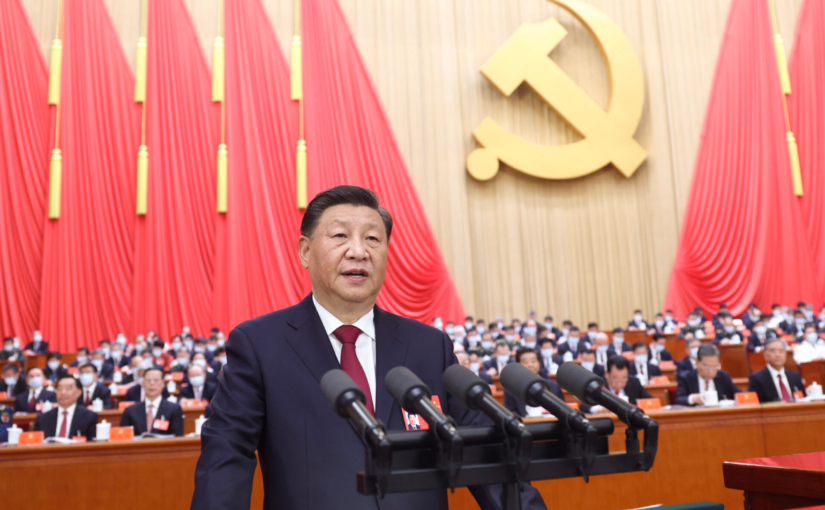
On 10 December, the first of two online seminars on the theme ‘The 20th National Congress of the Communist Party of China and its World Significance’, organised jointly by Friends of Socialist China and the International Department of the Central Committee of the Communist Party of China, was held. We are pleased to publish below the contribution by Dr Hugh Goodacre, Managing Director of the Institute for Independence Studies and lecturer in the History of Economic Thought at University College London. Hugh’s speech provides a profound and thought-provoking analysis of the global relevance of Chinese socialism, situating the new developments in Xi Jinping Thought on Socialism with Chinese Characteristics for a New Era within the overall and ongoing 170-year evolution of Marxism. He observes: “Xi Jinping Thought is deeply grounded in the scientific socialist tradition, standing in direct continuity with the work of its founders, and is indeed the Marxism of today.”
Thank you for the opportunity to participate in this Seminar on the world significance of the 20th Congress of the Communist Party of China. This was indeed an event of historic significance, in particular for its having firmly established the core position of Comrade Xi Jinping in the Central Committee and the Party as a whole, as well as of Xi Jinping Thought.
As the Resolution on the Party Constitution amendment noted: “The Congress unanimously agrees that the new developments in Xi Jinping Thought on Socialism with Chinese Characteristics for a New Era since the Party’s 19th National Congress should be incorporated into the Party Constitution, so as to better reflect the major contributions made by the Central Committee with Comrade Xi Jinping at its core to advancing the Party’s theoretical, practical, and institutional innovations.”
As a contribution to the assessment of its significance, my following comments aim to establish three interlinked points:
First, Xi Jinping Thought, the guiding ideology of socialism with Chinese characteristics, epitomises the outstanding features of socialism in the world today.
Secondly, Xi Jinping Thought is deeply grounded in the scientific socialist tradition, standing in direct continuity with the work of its founders, and is indeed the Marxism of today.
Thirdly, Xi Jinping Thought provides the basis for substantial steps forward in our work in this country to forge a socialist ideology and political line, on the basis of which we can build a genuinely socialist movement in this, the oldest imperialist country.
Continue reading On the application of Xi Jinping Thought in an imperialist country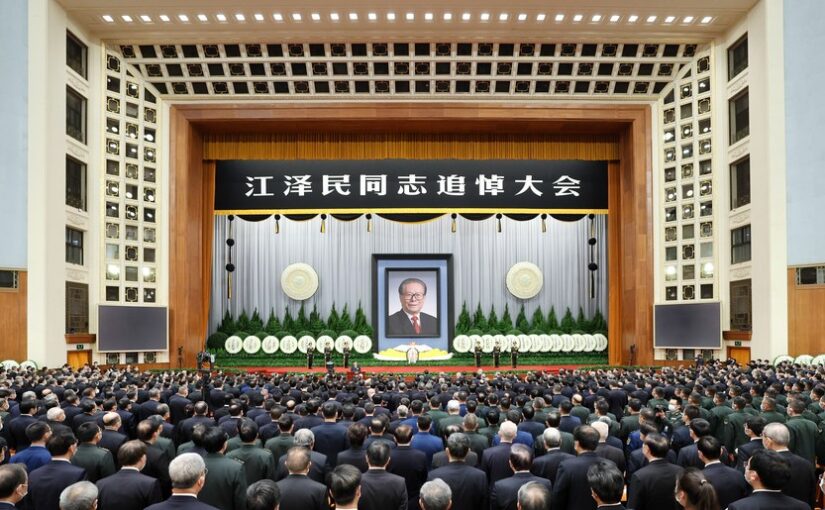
Xi Jinping’s speech at memorial meeting for Comrade Jiang Zemin
China paid its last farewell to former leader Jiang Zemin with a solemn memorial meeting in Beijing’s Great Hall of the People on Tuesday December 6, at which President Xi Jinping delivered the eulogy.
President Xi said: “We hold Comrade Jiang Zemin in high esteem and cherish the memory of Comrade Jiang Zemin because he devoted his life to the Chinese people and worked tirelessly throughout his life to contribute to the cause of national independence and the liberation of the people, and to the prosperity of our country and the well-being of our people.”
He noted that: “At the time when Comrade Jiang Zemin assumed principal leading posts in the Party and the military, China was at a critical moment, facing both pressure from abroad and difficulties at home. Comrade Jiang Zemin took charge at a challenging time. ‘For the cause of the Party and the people, I would give my best, give my all, till my heart ceases to beat,’ Comrade Jiang Zemin had said with a strong resolve…
“Between the late 1980s and early 1990s, political disturbances erupted in the international arena and in China. World socialism experienced serious twists and turns. Some Western countries imposed so-called ‘sanctions’ on China. The development of China’s socialist cause faced unprecedented difficulties and pressures. At this historical juncture critical to the future and destiny of the Party and the state, Comrade Jiang Zemin led the central collective leadership of the CPC – which firmly relied on the whole Party, the entire military and the Chinese people of all ethnic groups – in unswervingly taking economic development as the central task, unequivocally upholding the Four Cardinal Principles, adhering to reform and opening-up, resolutely carrying out rectifications and strengthening ideological work in all respects. He also led the leadership in furthering the efforts to improve Party conduct, build clean government and fight corruption, in strengthening the Party’s ties with the masses, and in actively carrying out diplomatic struggles and resolutely safeguarding national independence, dignity, security and stability. All these safeguarded the great cause of socialism with Chinese characteristics. After painstaking efforts, the Party and the people successfully stabilized the general situation of reform and development, laying a solid foundation for our country’s development…
“Comrade Jiang Zemin engaged in forward-looking strategic thinking on building a moderately prosperous society in all respects and attaining the third-step strategic objectives for the modernization drive. He pointed out that efforts should be concentrated on fully building a moderately prosperous society of a higher standard for the benefit of well over one billion people in the first two decades of the 21st century.”
Touching on international issues, Xi noted that Jiang Zemin had, “actively promoted the building of a multipolar world, pushed for greater democracy in international relations, respected the diversity of the world, pushed for the establishment of the Shanghai Cooperation Organization, and led us in breaking new ground on the diplomatic front…
“China cannot develop without the rest of the world, and the world needs China for prosperity. Comrade Jiang Zemin stressed that we must adjust ourselves to the historical trends, promote the establishment of a new international political and economic order that is just and reasonable, strive for a long-term peaceful international environment, comprehensively safeguard our national security and interests, and constantly make new and greater contributions to the noble cause of humankind’s peace and development. On the new journey, we must always keep global well-being in mind, holding high the banner of peace, development, cooperation and mutual benefit and promoting the common values shared by humankind. Efforts should be made to jointly advance high-quality Belt and Road cooperation, facilitate the establishment of a new type of international relations, push forward the building of a community of shared future for humankind, and join hands and press ahead with all the progressive forces in the world.”
The following is the full text of Comrade Xi Jinping’s eulogy. It is reprinted from the Xinhua News Agency.
Comrades and friends,
Today, with profound grief, we hold a memorial meeting at the Great Hall of the People in Beijing to mourn our beloved Comrade Jiang Zemin.
At this moment, the people in Party and government organs, business and public institutions, the countryside, schools, military units, and urban neighborhoods across the country, staff with Chinese embassies and consulates as well as institutions stationed abroad, compatriots in the Hong Kong Special Administrative Region (SAR), the Macao SAR and Taiwan, and overseas Chinese, are together with us to cherish the memories of Comrade Jiang Zemin’s extraordinary achievements and outstanding qualities and to express our grief.
The whole Party, the entire military and the Chinese people of all ethnic groups are in profound grief for the loss of a great man in the passing of Comrade Jiang Zemin. People all over the world, leaders of other countries and international friends in various fields have also expressed their heartfelt condolences.
Comrade Jiang Zemin was an outstanding leader enjoying high prestige acknowledged by the whole Party, the entire military and the Chinese people of all ethnic groups, a great Marxist, a great proletarian revolutionary, statesman, military strategist and diplomat, a long-tested communist fighter, and an outstanding leader of the great cause of socialism with Chinese characteristics. He was the core of the Party’s third generation of central collective leadership and the principal founder of the Theory of Three Represents.
Continue reading Xi Jinping’s speech at memorial meeting for Comrade Jiang Zemin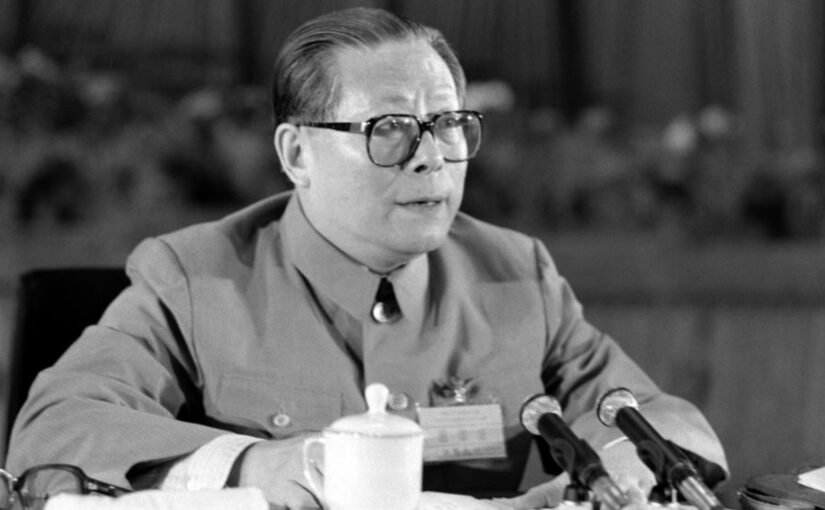
On the revolutionary life of Jiang Zemin
We republish below a profile of the late Chinese leader Comrade Jiang Zemin, originally issued by the Xinhua News Agency, which illustrates and explains the deep respect and affection that the Chinese people hold for this outstanding communist, patriot and internationalist, whose revolutionary career spanned very nearly eight decades.
Much of the information contained here was already covered in the official Chinese letter announcing Comrade Jiang’s passing, which we have already reported. However, there is also much new material, some of which has never appeared in English before.
The article notes a young Jiang Zemin’s contribution to the war to resist US aggression and aid Korea:
“To boost efforts to resist US aggression and aid Korea, Jiang organized the production of canned food specially provided for the Chinese People’s Volunteers. He also oversaw the design of the first homegrown turbo-generator in New China.”
Highlighting his creative application and development of Marxism-Leninism in the evolving situation in China and the world, it states:
“On learning lessons from the demise of the Soviet Union and the drastic changes in Eastern European countries, and the Cultural Revolution in China, Jiang stressed the importance of adhering to socialism, and carrying out socialist reform to explore a path of socialist development that suits China’s actual conditions.”
The now rapidly developing and expanding Shanghai Cooperation Organization (SCO) was to a great extent a creation of Jiang:
“Jiang promoted the establishment of the Shanghai Cooperation Organization (SCO), the first regional cooperation organization set up with China’s participation and named after a Chinese city. The Shanghai Spirit championed by the SCO – mutual trust, mutual benefit, equality, consultation, respect for diverse civilizations and pursuit of common development – has exerted an important influence on contemporary international relations.”
And he stayed true to some of the finest traditions of the Chinese revolution:
“He said the biggest danger for the Party when it becomes the ruling party is its detachment from the masses and that resolutely opposing and preventing corruption is a major political task for the whole Party. Underscoring the importance of adhering to the Party’s mass line, he demanded the Party do everything for the people while relying on the people in every task. He asked officials at all levels to bear in mind the purpose of serving the people wholeheartedly and doing practical and good things for them.”
One thing not covered in this article, which we would like to reference, is Jiang Zemin’s relationship to Ireland and Ireland’s special contribution to China’s development. The Shannon Free Zone, established in 1959, was the world’s first free trade zone. In 1980, Jiang Zemin led a Chinese government delegation to study and learn from its experience and, in many respects, it was used as a model for China’s early development of special economic zones, which have played such a crucial role in the country’s development. Shannon has continued to be visited by senior Chinese delegations over the years.
Jiang Zemin was an outstanding leader enjoying high prestige acknowledged by the whole Communist Party of China (CPC), the entire military and the Chinese people of all ethnic groups.
He was a great Marxist and a great proletarian revolutionary, statesman, military strategist and diplomat. He was a long-tested communist fighter and an outstanding leader of the great cause of socialism with Chinese characteristics. He was the core of the third generation of the Party’s central collective leadership and the principal founder of the Theory of Three Represents.
Jiang’s life was a glorious and fighting one. During his revolutionary career of more than 70 years, he remained unswervingly firm in communist ideals, utterly loyal to the Party and the people, and resolutely committed to the cause of the Party and the people.
After the fourth plenary session of the 13th CPC Central Committee, faced with the complexity of the domestic and international situations and the grave challenges posed by the serious twists and turns world socialism had experienced, Jiang led the Party’s central collective leadership — firmly relying on the whole Party, the entire military and the Chinese people of all ethnic groups — in safeguarding the great cause of socialism with Chinese characteristics and successfully advancing the cause of socialism with Chinese characteristics into the 21st century.
He made indelible achievements and won the heartfelt love of the whole Party, the entire military and the Chinese people of all ethnic groups, as well as the wide acclaim of the international community.
Continue reading On the revolutionary life of Jiang Zemin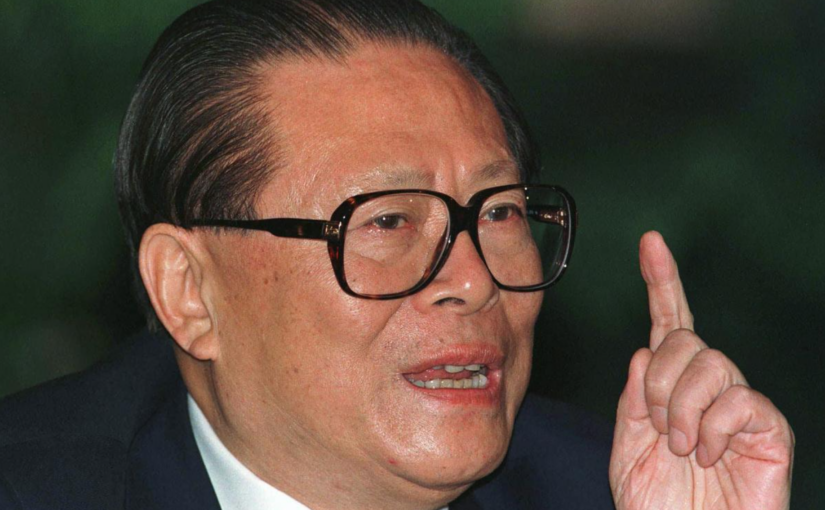
Jiang Zemin: upholder of socialism
Following our initial post yesterday regarding the passing away of Comrade Jiang Zemin, the Xinhua News Agency has now released a much more detailed summary of the official letter released by the leading party, government and military bodies of China, which we reprint below.
The letter notes that: “Ever since his adolescent years, Jiang had been a diligent learner and seeker of truth enlightened by patriotism and the ideas of the democratic revolution. Through active participation in patriotic anti-Japanese movements during his college years, he developed a Marxist worldview, made his life choice and established his lifelong ideal and belief of working for national liberation and the people’s well-being.”
Referring to the period when he assumed the leadership of the party and the country, it stated: “Between the late 1980s and early 1990s, severe political disturbances erupted in the international arena and in China. World socialism experienced serious twists and turns. The development of China’s socialist cause faced unprecedented difficulties and pressures.
“At this critical historical juncture that determined the future and destiny of the Party and the state, Jiang led the central collective leadership of the CPC and firmly relied on the whole Party, the entire military and the Chinese people of all ethnic groups to unequivocally uphold the Four Cardinal Principles, and safeguard national independence, dignity, security and stability. He also unswervingly took economic development as the central task, adhered to reform and opening-up, defended the great cause of socialism with Chinese characteristics, and broke new ground in China’s reform and opening-up as well as socialist modernization.”
Summarizing his character, it added: “Jiang was firm in his convictions and decisive in actions. He always put the Party and the people first, and unswervingly adhered to the ideals and beliefs of communists. At critical moments, Jiang had the great courage to make resolute decisions and theoretical innovation…
“Jiang respected and cared for the people, always paying attention to their security and well-being, and assessing and advancing work based on the fundamental interests of the greatest possible majority of the Chinese people.”
It has further been announced that a memorial meeting for Comrade Jiang Zemin will be held in Beijing’s Great Hall of the People on Tuesday December 6th.
Jiang Zemin passed away due to leukemia and multiple organ failure in Shanghai at 12:13 p.m. on Nov. 30, 2022, at the age of 96, it was announced on Wednesday.
The announcement was made by the Central Committee of the Communist Party of China (CPC), the Standing Committee of the National People’s Congress of the People’s Republic of China (PRC), the State Council of the PRC, the National Committee of the Chinese People’s Political Consultative Conference, and the Central Military Commissions (CMC) of the CPC and the PRC.
It was announced in a letter addressing the whole Party, the entire military and the Chinese people of all ethnic groups.
The letter says they proclaim with profound grief to the whole Party, the entire military and the Chinese people of all ethnic groups that our beloved Comrade Jiang Zemin died of leukemia and multiple organ failure after all medical treatments had failed.
The letter says that Comrade Jiang Zemin was an outstanding leader enjoying high prestige acknowledged by the whole Party, the entire military and the Chinese people of all ethnic groups, a great Marxist, a great proletarian revolutionary, statesman, military strategist and diplomat, a long-tested communist fighter, and an outstanding leader of the great cause of socialism with Chinese characteristics. He was the core of the CPC’s third generation of central collective leadership and the principal founder of the Theory of Three Represents.
Continue reading Jiang Zemin: upholder of socialism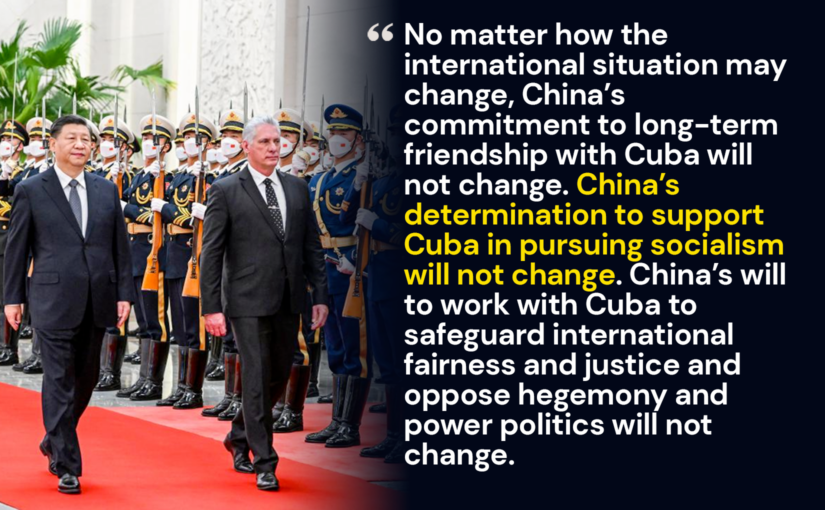
China and Cuba: an exemplar of solidarity and cooperation between socialist countries
The recent state visit to China by Cuban President Miguel Díaz-Canel Bermudez was significant on a number of levels.
It was the first state visit from Latin America and the Caribbean following the 20th National Congress of the Communist Party of China, highlighting the special importance of relations between socialist countries. An article in the Global Times pointedly remarked: “China-Cuba relations have become a model of socialist countries to unite and cooperate and of developing countries to sincerely assist each other. This is beyond the comprehension of the arrogant and narrow-minded US and Western elites.” It is notable in this regard that the first national leader to visit China after the 20th Congress was Nguyen Phu Trong, General Secretary of the Communist Party of Vietnam.
Xi Jinping classified the relations between Cuba and China as being “an exemplar of solidarity and cooperation between socialist countries,” adding:
No matter how the international situation may change, China’s commitment to long-term friendship with Cuba will not change. China’s determination to support Cuba in pursuing socialism will not change. China’s will to work with Cuba to safeguard international fairness and justice and oppose hegemony and power politics will not change.
Congratulating the CPC on the successful conclusion of its 20th Congress, Díaz-Canel stated that he greatly appreciates “the theoretical and practical contributions made by Xi Jinping’s leadership in the construction of socialism with Chinese characteristics in the new era, which we Cubans consider a true stimulus for all progressive forces.”
The relationship between the two countries goes back a long way. Xi Jinping observed that Cuba was the first country in the Western hemisphere to establish diplomatic relations with the People’s Republic of China, shortly after the victory of the Cuban Revolution. A report from Granma – the official organ of the Central Committee of the Communist Party of Cuba – notes that, a few months later, in November 1960, “a Cuban delegation, headed by Ernesto Che Guevara, visited the Asian giant, and from that moment economic, scientific and technological cooperation agreements, and bilateral trade agreements were born.”
Díaz-Canel’s visit had a specific importance in light of the economic difficulties Cuba is currently experiencing – the product of the tightening of the US’s criminal blockade on the island, compounded by the impact of Covid-19 (and consequent reduction in tourism income) and a sequence of natural disasters and accidents. The numerous investment agreements signed, the renegotiation and restructuring of Cuba’s debt to China, and the donation by China of 100 million US dollars will serve to create much-needed breathing space for the Cuban economy.
Xi Jinping commented: “Currently, comrades in Cuba are confronted with great challenges. But the cause of socialism always advances through surmounting difficulties. China firmly believes that comrades in Cuba will overcome all difficulties, and China will do its best to provide support and assistance.”
China also took the opportunity to reiterate its whole-hearted opposition to the US blockade on Cuba:
China firmly supports the just struggle of the Cuban people to defend their national sovereignty and oppose foreign interference and blockade. The erroneous practice of a small number of countries indiscriminately imposing unilateral sanctions, cutting off development assistance, and freezing legal assets of other countries must be corrected.
We are pleased to reproduce below the Joint Statement between the People’s Republic of China and the Republic of Cuba on Deepening China-Cuba Relations in the New Era, along with a selection of articles from Chinese and Cuban media.
Joint Statement between the People’s Republic of China and the Republic of Cuba on Deepening China-Cuba Relations in the New Era
Foreign Ministry of the People’s Republic of China (machine-translated from Chinese)
At the invitation of General Secretary of the Central Committee of the Communist Party of China and President Xi Jinping, Miguel Diaz-Canel Bermudez, First Secretary of the Central Committee of the Cuban Communist Party and President of Cuba, addressed the Chinese people from November 24 to 26, 2022 on a state visit.
During the visit, General Secretary Xi Jinping held cordial talks with First Secretary and President Díaz-Canel, reflecting the close friendship between the two parties, governments and peoples. Premier Li Keqiang and Chairman Li Zhanshu met with Diaz-Canel respectively.
Comrade Diaz-Canel conveyed the greetings and congratulations of General Raúl Castro to Comrade Xi Jinping. Comrade Xi Jinping expressed his gratitude and asked him to convey his regards to General Raul Castro. The two heads of state spoke highly of the traditional friendship between the People’s Republic of China and the Republic of Cuba (hereinafter referred to as “both parties”). The China-Cuba friendship was forged by the older generations of leaders of the two countries represented by Mao Zedong and Fidel Castro. Cuba established diplomatic relations with the People’s Republic of China in 1960, becoming the first country in the Western Hemisphere to establish diplomatic relations with the People’s Republic of China. The two heads of state expressed satisfaction with the development of China-Cuba relations and the fruitful results of bilateral cooperation in various fields since the establishment of diplomatic relations 62 years ago. China-Cuba relations have become a model of solidarity and cooperation among socialist countries and sincere mutual assistance among developing countries.
The two heads of state emphasized that both China and Cuba are socialist countries, and both firmly uphold sovereignty, independence, national unity and national dignity, have always adhered to the socialist road with their own characteristics, and have made major achievements.
The two heads of state exchanged in-depth views on the relationship between the two parties and the two countries and international and regional issues of common concern. They expressed that they will continue to promote the implementation of the important consensus reached. Visits and political dialogues, promote exchanges at all levels and cooperation in various fields, make good use of various cooperation mechanisms, continue to deepen the special friendly relationship between China and Cuba in the new era, and join hands in building a community with a shared future for mankind in the process of promoting the construction of a community with a shared future for mankind.
1. The Cuban side warmly congratulates the complete success of the 20th National Congress of the Communist Party of China. The First Secretary of Diaz-Canel and the President warmly congratulated Comrade Xi Jinping on his election as General Secretary of the 20th Central Committee of the Communist Party of China. The Cuban side believes that the 20th National Congress of the Communist Party of China is of great historical significance to the development of the Communist Party of China and China, and the results of the congress will become a new driving force for all progressive forces in the world to move forward. Gu Fang believes that Xi Jinping Thought on Socialism with Chinese Characteristics for a New Era is a milestone in the modernization of Marxism in China, and firmly believes that under the leadership of General Secretary Xi Jinping, the Communist Party of China and the Chinese people will continue to achieve new greatness in the cause of socialism with Chinese characteristics in the new era Achievement.
Continue reading China and Cuba: an exemplar of solidarity and cooperation between socialist countries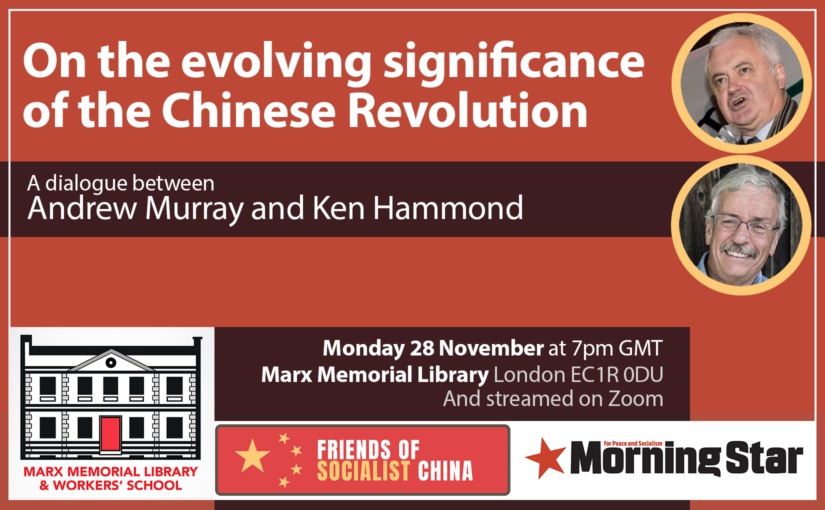
Video: On the evolving significance of the Chinese Revolution, with Andrew Murray and Ken Hammond
On 28 November 2022, Friends of Socialist China organised, jointly with the Morning Star and Marx Memorial Library, a dialogue between Andrew Murray and Ken Hammond on the evolving significance of the Chinese Revolution. The event, conducted both in-person at the Marx Library and online via Zoom and YouTube, was very interesting and useful, with both panelists making highly insightful remarks, and a lively discussion following the panelist introductions.
About the participants
Andrew Murray is vice-president and founding chair of Stop the War Coalition, a longstanding trade unionist, peace campaigner, and one of the leading thinkers of the British left. He has written a number of books, including most recently ‘Is Socialism Possible in Britain?’, reflecting on his time serving as a political advisor to Jeremy Corbyn. Andrew has maintained an active interest in China for several decades, and has been vocal in his opposition to the New Cold War.
Ken Hammond is a professor of East Asian and Global History at New Mexico State University. He was a student organiser at Kent State University at the time of the shocking incident of 4 May 1970, when the Ohio Army National Guard shot and killed four students peacefully protesting the invasion of Cambodia when Nixon escalated the Vietnam War, and was indicted as one of the ‘Kent 25’. Ken lived and worked in Beijing between 1982 and 1987 managing activities for American educational delegations.
Ken earned his PhD in History and East Asian Languages from Harvard University in 1994, and has worked in support of friendly US-China relations for many decades. He is a founder of the US-based movement Pivot to Peace, set up in 2020 in response to the escalating anti-China rhetoric emanating from US politicians and media. He is an Associate Editor of the Journal of Chinese History, published by Cambridge University Press, and the author of several books, including From Yao to Mao: 5,000 Years of Chinese History. Over the years he has taught at universities in Beijing, Shanghai and Shijiazhuang.
The dialogue was moderated by Roger McKenzie, International Editor of the Morning Star, and introduced by Iris Yau.
Sergio Rodríguez Gelfenstein: Socialism is alive in China
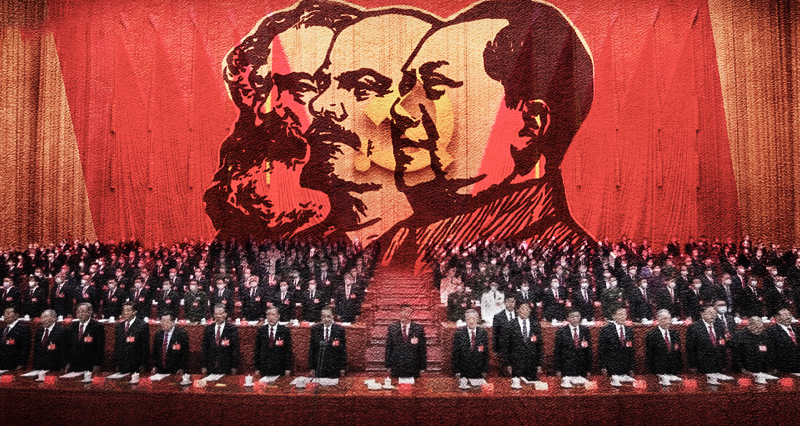
This article by Sergio Rodriguez Gelfestein, former director of international relations in Venezuela’s presidential office and former ambassador to Nicaragua, discusses the recent 20th National Congress of the Communist Party of China, situating it within the broader process of socialist construction in both China and the world.
The author connects Socialism with Chinese Characteristics to the overall Marxist tradition stretching back to the first works of scientific socialism of the 1840s. Although the global socialist movement suffered a terrible blow with the collapse of the Soviet Union and the European people’s democracies, the CPC has now “shouldered the responsibility and has the confidence and ability to contribute to the development of scientific socialism.”
As such, the emerging US-led New Cold War is not simply a matter of economic competition, or even “inter-imperialist rivalry” as some in the Western left believe; rather it occurs “within a framework of systemic confrontation between development models that emerge from antagonistic ideological proposals.”
The English translation of this article was published by Workers World.
Many important issues were discussed at the recently concluded 20th Congress of the Communist Party of China (CPC). Chinese and foreign analysts have written extensively on the subject. As almost always when giving an opinion about China, the analyses mostly deal with state issues that — in this case — were discussed at the event.
But if I were asked what was the highlight of this event, I would have no hesitation in affirming that the great event of the Chinese Communist Party had a keen orientation toward the internal strengthening of the organization, so that it can play its role as leader of the Chinese society on its way to socialism.
CPC part of a long process
In this context, it seems necessary to highlight the strong ideological content of the debates in this Congress. It continued discussions held in the past and in previous similar events, and has presented a solid vindication of Marxism-Leninism as part of the support that has allowed the Communist Party of China “to comprehensively dominate the great struggle, the great work, the great cause and the great dream” . . . that “has culminated in the historic task of completing the comprehensive construction of a society modestly well-off and the consequent fulfillment of the objective of struggle established for the first centenary (year 2021) and has undertaken the new expedition of the comprehensive construction of a modern socialist country toward the objective of struggle set for the second.” (2049)
Continue reading Sergio Rodríguez Gelfenstein: Socialism is alive in China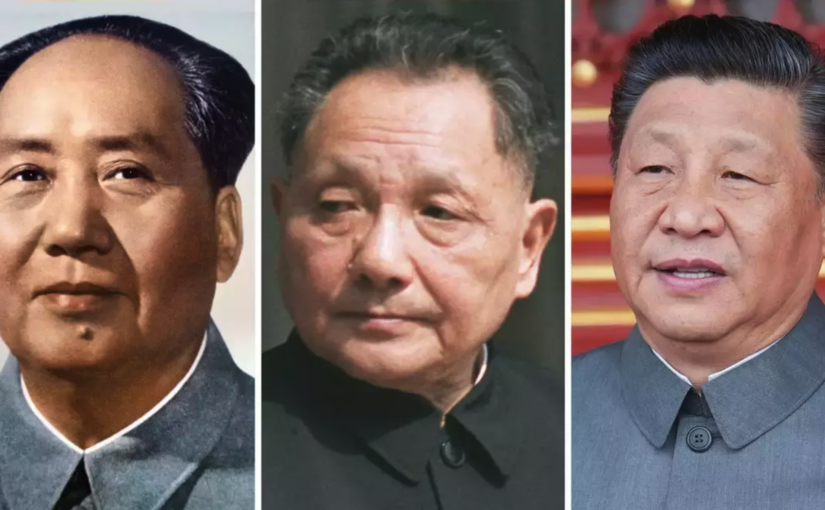
Ideological work in the new era of socialism in China
We are pleased to publish this important and well-researched article by Gabriel Martinez on ideological work and struggle in China since the beginning of ‘reform and opening up’ at the end of the 1970s. Gabriel is a postgraduate student from Brazil, currently finishing his studies in Marxist Philosophy at Beijing Normal University. He has lived in China for the last five years.
He notes that the important changes in the country’s economic sphere have been accompanied by a series of ideological changes, with both positive and negative aspects and bringing new challenges for the development of socialism in China. Noting the emergence of a trend of bourgeois liberalization, the author stresses that this has always been opposed by successive generations of Chinese leaders. “However, while recognizing that the Party has always called attention to the need to strengthen ideological work, one cannot fail to recognize that Xi Jinping’s coming to power represents a turning point in the Communist Party of China’s political line… Xi Jinping has been paying close attention to this problem, aiming to restore and consolidate the authority and leading role occupied by Marxism as the theoretical basis guiding socialist construction and modernization in China.”
Analyzing the effects of the existence of capitalist relations of production in the primary stage of socialism on the ideological sphere, Gabriel notes that “it is necessary, therefore, to differentiate between what are the positive effects that capitalist private property can create for the development of the productive forces, from what is the ideology it inevitably produces, and the negative effects generated by capitalist relations of production in the most varied domains of social life.”
A great deal of other important material is covered in the article, which we consider well worth careful study and discussion. It was previously published in Chinese on the website of Kunlunce, a Chinese think tank that publishes articles by Marxist professors and researchers, and in Portuguese on the website Resistencia, which is associated with the Communist Party of Brazil (PCdoB).
The Reform and Opening policy, initiated by the Communist Party of China in 1978, has produced important transformations in the economic sphere of the country. The transformation in the structure of property, little by little, caused the basic structure of property relations in the country to change to a system where the state public economy was considered its backbone, but coexisting with multiple forms of property, which exist and develop together (including domestic and foreign private property). These transformations were accompanied by a series of ideological changes, changes that have an influence on the most varied sectors of social life. This influence can be seen in the way of life of the population, in the economy, in culture, in the arts, and also in politics. Chinese society, from an ideological point of view, has become more “diversified”, and such diversification, obviously, not only has positive aspects, but also produces negative consequences and brings new challenges for the development of socialism in China. In this article I will try to outline some aspects of the formulations of the Communist Party of China on ideological work and how this work is acquiring a new role in China led by Xi Jinping.
The struggle against bourgeois liberalization in the new era of socialism
After the beginning of the reforms, an ideological trend emerged in China called “bourgeois liberalization. The phenomenon of bourgeois liberalization, to this day, exerts a pernicious influence on China’s development process and the building of a socialist culture. How does the Communist Party define this liberalization? According to Deng Xiaoping:
Since the fall of the Gang of Four an ideological trend that we call bourgeois liberalization has emerged. Its exponents idolize the “democracy” and “freedom” of Western capitalist countries and reject socialism. This cannot be tolerated. China must modernize, but she must not promote liberalization or take the capitalist path, as Western countries have done. [1]
Deng Xiaoping’s quotation clearly shows us that, from the very beginning, the problem of bourgeois liberalization has always been the object of attention by the leaders of the Communist Party of China. Deng Xiaoping, Chen Yun, Jiang Zemin, Hu Jintao, etc., dealt with this problem several times. However, it is not wrong to say that over the years, far from being solved, it still exists and exerts considerable influence. Faced with the new political line approved after the 3rd Plenary Session of the 11th Central Committee of the CCP held in 1978, which established a break with the previous line of “taking class struggle as the main link,” placing economic construction and socialist modernization at the center of the Party’s activity, a very active political tendency arose, which defended the idea that besides reforms in the economic sphere, it was also necessary to carry out reforms of a political nature, calling for more “democracy” and “freedom. This ideological current became quite politically active, especially from the 1980s onwards, seeking to divert the Reform and Opening from its original path and direction of perfecting the socialist system, to the path of restoring capitalism and the bourgeois-type political system, as happened in the Soviet Union.
At first, especially among intellectual circles, an anti-Mao Zedong wave swept the country, leading to an open contestation of the resolutions presented by the CCP in its historic document On Some Problems in the History of Our Party from the Founding of the PRC to the Present Day in 1981. The document, while stating that Mao Zedong made some mistakes at the end of his life, is quite clear in its recognition and exaltation of the Chinese leader’s historical role in the history of Party and Republic building. The document clearly states that Mao Zedong’s successes far outweigh his mistakes. Says the resolution:
Continue reading Ideological work in the new era of socialism in China
Listening to our CPC comrades on the nature of China’s socialist path
We are very pleased to republish this instructive article by Professor Roland Boer, which was first carried by the Australian Marxist Review (AMR), journal of the Communist Party of Australia.
The article considers three main points, namely “what our comrades in the Communist Party of China say about their own system; what insights the Marxist-Leninist method provides; and how Chinese communists see the economic development of China from 1949 through to today,” and is based not least on the author’s last 12 years of engagement with China, living there for up to six months of the year and learning the language.
Roland locates the background to how the Chinese communists approach, assess and analyse issues arising in their development within the basic framework of Marxism-Leninism, including that the seizure of power by the proletariat is not the end, but rather the beginning of a long and complex struggle to actually build a socialist society. He further analyses the three main stages in the development of New China, from 1949-1978, 1978-2012 and 2012-, noting the achievements scored in each, the problems that arose, and how they were addressed, particularly in the subsequent stage.
In his conclusion he notes: “I suggest that it is important to listen to what our CPC comrades think about their own system, based upon immense amounts of research on the concrete reality in China, and not let bourgeois criticisms and Western imperialist assumptions set the agenda.” We agree!
This article formed part of a special May 2022 edition of AMR, devoted to China, and containing many interesting articles. It may be read in full here.
I would like to make a small contribution to a topic of discussion and debate in a number of Communist parties in the world today, including the CPA. It concerns the nature of socialism in China, or what is also known as Socialism with Chinese Characteristics – better translated as ‘socialism in light of China’s conditions’. My contribution arises from more than a dozen years of experience in China. I would like to do so in three main parts: what our comrades in the Communist Party of China say about their own system; what insights the Marxist-Leninist method provides; and how Chinese communists see the economic development of China from 1949 through to today. The assumption in what follows is that inner-party discussions such as this are undertaken in a comradely manner. I hope that what is provided here can aid our discussion in some ways.
Listening to Our CPC Comrades
The CPC is a fraternal party with the CPA, so it would be helpful to listen carefully to what our CPC comrades say about the nature of their system. There are a number of ways we can do so. As for me, I prefer engaging in person-to-person discussion with members of the CPC. This has meant that over the last 12 years of my engagement with China (living and working there for up to 6 months a years), I have learnt the language and researched in depth Chinese Marxism and its socio-economic system. I have spoken with CPC cadres at many levels of the party, in the city and in the countryside, at major meetings and at local party branches. We have discussed many, many topics concerning the Marxist method and the difficult tasks of constructing socialism.
Another approach is to keep up with the many developments via CPC sources. Given the size of the party and its close involvement at all levels of Chinese society, there are very many of these sources. The following comprise only a small sample: the Central Committee journal Qiushi,[1] which comes out twice a month (www.qstheory.cn/) – note that English translations lag by a few months (http://en.qstheory.cn/) and not all of the articles on the Chinese site are translated into English; Red Flag (www.qstheory.cn/dukan/hqwg/2021-07/09/c_1127638960.htm);CPC news (http://cpc.people.com.cn/); the party history site (http://dangshi.people.cn/); the party’s newspaper, ‘Renmin Ribao’ (http://www.people.com.cn/), and so on. If you need to use an online translator, it would better to use more reliable ones, such as fanyi.youdao.com or fanyi.baidu.com (google translate is not reliable). Of course, there are even more local party sites and social media apps for local branch members. After all, the CPC has 92 million members.
Continue reading Listening to our CPC comrades on the nature of China’s socialist path
China’s path to socialist modernization
The following article by Vijay Prashad and Tings Chak discusses some of the important policies and ideas emerging from the recently-held 20th National Congress of the Communist Party of China. Disregarding the Western media’s “wild speculations about the deliberations in the party”, the authors explore the concept of socialist modernization, as well as detailing China’s ongoing fight against corruption and its successes in poverty alleviation and environmental action.
Vijay and Tings note that per capita GDP has doubled in the last decade and that, in the same period, the CPC has worked relentlessly to tackle corruption, adhere to the mass line, and re-center itself in the grassroots. Furthermore, “China’s interest in tackling the climate catastrophe is evidenced by its planting of a quarter of the world’s new forests over the past decade and in becoming a world leader in renewable energy investment and electric vehicle production.”
The authors also point out that China’s development has been extraordinarily peaceful, quoting Xi Jinping’s work report to the Congress: “In pursuing modernization, China will not tread the old path of war, colonization, and plunder taken by some countries. That brutal and blood-stained path of enrichment at the expense of others caused great suffering for the people of developing countries. We will stand firmly on the right side of history and on the side of human progress.”
As China becomes richer, it is also becoming fairer and greener, and its modernization is based on its own efforts, not on imperialism and aggression. Such is the meaning of China’s socialist modernization, which is a great inspiration for progressive forces globally.
This article was produced by Globetrotter.
The Communist Party of China (CPC) held its 20th National Congress from October 16 to October 22, 2022. Every five years, the delegates of the CPC’s 96 million members meet to elect its top leaders and to set the future direction for the party. One of the main themes of the congress this year was “rejuvenation” of the country through “a Chinese path to modernization.” In his report to the congress, Xi Jinping, the CPC’s general secretary, sketched out the way forward to build China “into a modern socialist country.”
Most of the Western media commentary about the congress ignored the actual words that were said in Beijing, opting instead to make wild speculations about the deliberations in the party (including about the sudden departure of former Chinese President Hu Jintao from the Great Hall of the People during the closing session of the congress, who left because he was feeling ill). Much could have been gained from listening to what people said during the National Congress instead of putting words in their mouths.
Socialist modernization
When the Communist Party took power in China in 1949, the country was the 11th poorest country in the world. For the first time since the “century of humiliation” that began with the British wars on China from 1839 onward, China has developed into a major power with the social situation of the Chinese people having greatly improved from their condition in 1949. A short walk away from the Great Hall of the People, where the congress was held, is the Chairman Mao Memorial Hall, which reminds people of the immense achievement of the Chinese Revolution of 1949 and its impact on Chinese society.
Continue reading China’s path to socialist modernization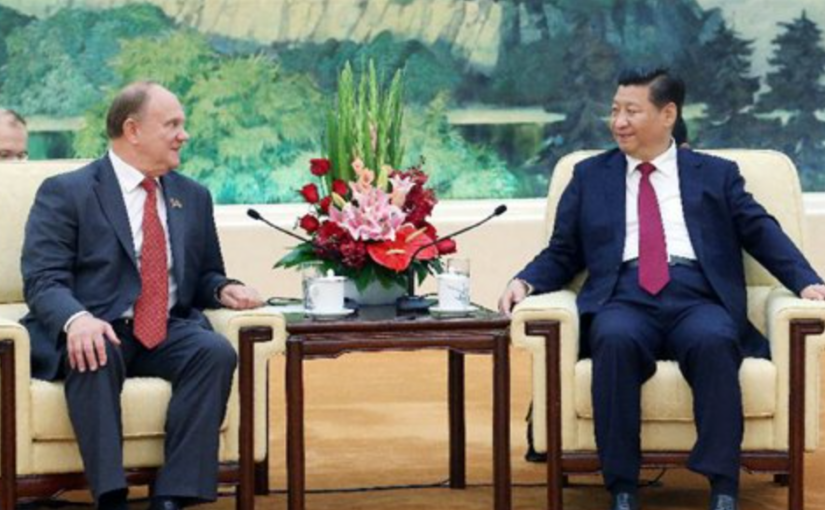
Interview with Gennady Zyuganov on Chinese socialism
The recently concluded 20th National Congress of the Communist Party of China (CPC) attracted the close attention of communist and progressive forces around the world.
In that regard, shortly before the opening of the Congress, Comrade Gennady Zyuganov, Chairman of the Central Committee of the Communist Party of the Russian Federation (CPRF), gave an extensive interview to the leading Chinese newspaper, Guangming Ribao.
Acclaiming the CPC’s century of struggle, the Russian communist leader noted that: “Over the past hundred years the CPC dramatically changed the destiny of the Chinese people. It liberated them from the shackles of semi-colonial dependence, national humiliation and economic enslavement and made the people masters of their land and their destiny. Under the leadership of the CPC the working people of China have driven out foreign invaders, established and consolidated their power and built a middle-income society.”
Speaking of his Chinese counterpart, Zyuganov said: “Xi Jinping is flesh of the flesh of the great Chinese people.” He further noted that the Chinese leader’s father, Comrade Xi Zhongxun, is “a representative of the first generation of Chinese revolutionaries. He was among the founders and leaders of the revolutionary base in the liberated regions of the Shanxi and Gansu provinces and organizers of political work in the People’s Liberation Army of China.”
Noting that the ideas contained in Xi Jinping Thought on Socialism with Chinese Characteristics for a New Era are “universal in character,” and that they “constitute a major innovative contribution to the development of the Marxist theory”, Zyuganov continued: “Writing about socialist society in 1890, Friedrich Engels pointed out that it is not ‘something given once and for all.’ And the great thinker stressed: ‘Like any other social system it should be seen as subject to constant changes and transformations’ … Marx, Engels and Lenin have repeatedly stressed that the characteristics of the socialist social and economic system manifest themselves in the practice of socialist construction in each individual country. Life has vindicated these theoretical premises: a socio-economic system cannot be created according to a single template. Historical experience shows that transition to socialism calls for a combination of the fundamental ideas of Marxism-Leninism and the real state of affairs.”
After speaking about the present situation regarding relations between Russia and China, and such related topics as the conflict in Ukraine, the heightened imperialist hostility and threats to both Russia and China, and the related moves to rehabilitate and revive fascism and militarism and reverse the correct verdicts passed in 1945, Comrade Zyuganov concludes:
“The CPRF is preparing to mark the centenary of the formation of the USSR. Moving along the path of building socialism our country has achieved great successes which have an intransient significance for the whole human race. In 1917 Russia was the first to breach the international front of imperialism and embark on the building of a new society. Following this path under the leadership of the Communist Party the Soviet people have created the most advanced economy for that time, raised living standards, developed science and culture, vanquished fascism and conquered outer space. In the 21st century the relay of victories and accomplishments has been confidently taken from the USSR by socialist China…
“It is only by working persistently to strengthen the unity of the Russian and Chinese people and build up our joint efforts in the struggle against the West’s neo-colonial aspirations that we can uphold the sovereignty of our countries. As Stalin would have said in a similar situation, we will either do it quickly, or we will be crushed.”
We are pleased to republish the full text of this important interview. It was originally published in English on the website of the CPRF.
Speaking at the International Forum of the CPC and Marxist Parties organized by the Communist Party of China you noted that the centenary of the CPC which was marked a year ago was an outstanding milestone in the history of the Chinese people which had great resonance in many countries. How do you assess the successes achieved by the Chinese people under the leadership of the Communist Party of China during the 101 years of revolutionary development?
During its more than a century-long existence the Communist Party of China has traversed a glorious path of creative endeavor. Following its initial goal and fulfilling its mission of social restructuring it managed to unite the popular masses and launch the struggle for a great resurgence of the country on the basis of the values of peace, labor, justice, humanism and progress. In this struggle it has achieved outstanding historic results. Over the past hundred years the CPC dramatically changed the destiny of the Chinese people. It liberated them from the shackles of semi-colonial dependence, national humiliation and economic enslavement and made the people masters of their land and their destiny. Under the leadership of the CPC the working people of China have driven out foreign invaders, established and consolidated their power and built a middle-income society. Today the Chinese look to the future with complete confidence and are making the history of their great Motherland in the new era. Within a historically brief space of time a massive leap has been made toward creating a high-tech industry and dramatically raising people’s living standards. Along with dynamic economic growth long-term stability of the Chinese society has been ensured. This is extremely important for the country as a whole and for each concrete individual. Socialist China is an indisputable leader on many key parameters.
Continue reading Interview with Gennady Zyuganov on Chinese socialism
The CPC: the most successful political party in history
The following article, written for China Today by Carlos Martinez, describes the historic progress China has made over the last decade, and seeks to understand the political framework in which this progress has been made. “Why China? Why is it China and not another country that has carried out the most comprehensive poverty elimination in history? How has China been able to leap from a state of intense poverty, underdevelopment and backwardness just 73 years ago to becoming a country with the second-largest economy in the world, with the average life expectancy of its citizens surpassing that of people in the United States?” Carlos concludes that the answer lies in “China’s political system, its revolutionary history, and the leadership of the CPC”. He opines that China’s socialist system privileges the interests of the masses, unlike the capitalist countries, in which the capitalist class is the ruling class and the interests of the people are subjugated to those of profit. Carlos concludes by noting that China’s successes are a source of inspiration to progressive people the world over.
The 20th National Congress of the Communist Party of China (CPC), which commenced on October 16, 2022, is seen as a milestone event in the history of the CPC.
In the Report delivered by Xi Jinping, general secretary of the CPC Central Committee, to the Congress, major achievements that the country has accomplished over the past 10 years were summarized.
A decade ago, Xi Jinping put forward the Two Centenary goals: to achieve a “moderately prosperous society in all respects” by the centenary of the CPC in 2021, and a “great modern socialist country that is prosperous, strong, democratic, culturally advanced, harmonious and beautiful” by the centenary of the founding of the People’s Republic of China in 2049.
The core component of achieving a “moderately prosperous society in all respects” was the campaign to alleviate extreme poverty. This goal was achieved in late 2020 – remarkably, whilst China was concurrently battling the COVID-19 pandemic (a pandemic which has sadly resulted in a dramatic rise in poverty in many countries around the world). At the start of the targeted poverty alleviation program in 2014, just under 100 million people were identified as living below the poverty line; seven years later, the number was zero.
United Nations Secretary-General Antonio Guterres stated that China had carried out “the greatest anti-poverty achievement in history.” To eradicate extreme poverty in a developing country of 1.4 billion people – which at the time of the founding of the People’s Republic of China in 1949 was one of the poorest countries in the world – is without a doubt an extraordinary accomplishment.
Continue reading The CPC: the most successful political party in history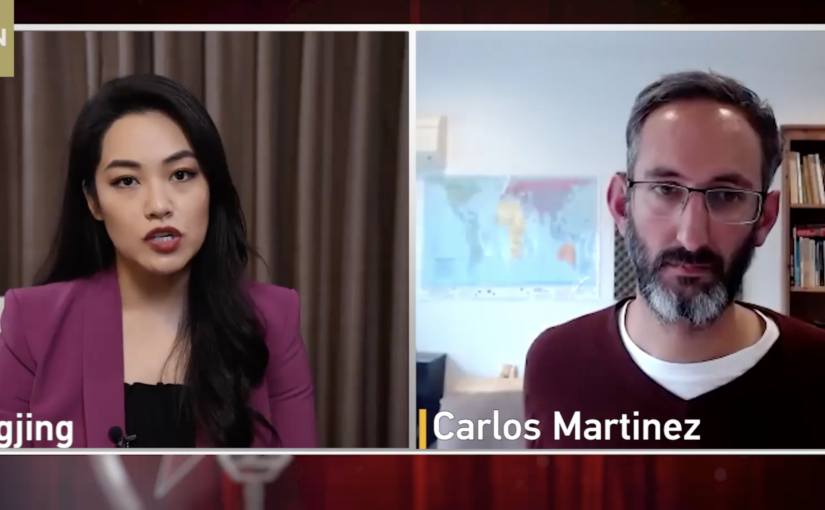
Video: China’s socialist development model speaks for itself
In the video below, originally carried on CGTN, Li Jingjing interviews Carlos Martinez about the recently-concluded 20th National Congress of the CPC – in particular its focus on common prosperity – as well as the successes of China’s development model.
Carlos outlines the core principles of common prosperity – reducing poverty, reducing inequality, improving distribution, and increased regulation of capital. He highlights in particular the measures that have already been taken in support of workers in the ‘gig economy’, including recent legislation supporting and encouraging unionisation, and mandating that all workers have proper contracts and full insurance entitlement. These measures compare very favourably with the situation in the West, where casual workers face terrible working conditions, zero-hour contracts and anti-union policies.
Discussing China’s development model of Socialism with Chinese Characteristics, Carlos points out that the successes of this model speak for themselves. It is a model that has been able to eliminate extreme poverty in a huge country of 1.4 billion people – an unprecedented achievement. “Anyone saying it’s a bad model is saying that it’s bad for people who used to face famines to now live comfortable lives.”
China and Cuba: a relationship of solidarity, friendship and cooperation
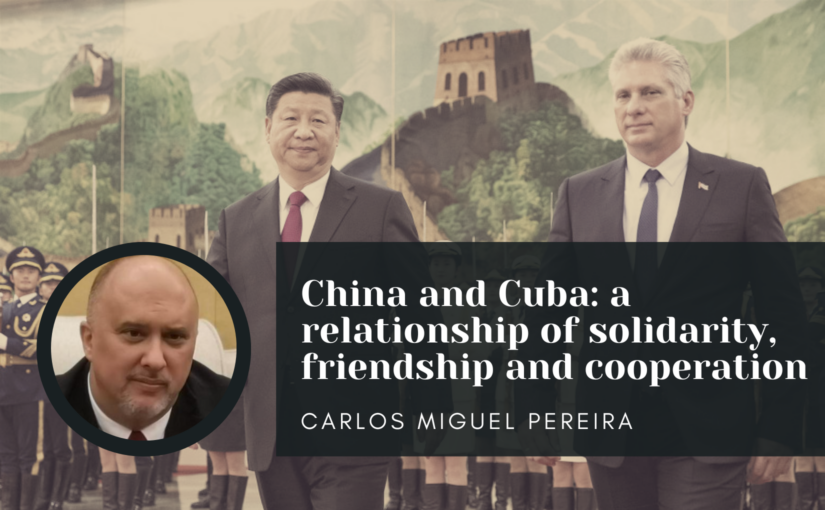
We are very pleased to publish below an interview with Carlos Miguel Pereira Hernández, Cuba’s ambassador to China, conducted by People’s Daily and published in Chinese on 13 October. The unabridged English translation has been provided to us by the Cuban Embassy in Beijing.
Timed to coincide with the 62nd anniversary of the establishment of diplomatic relations between the Republic of Cuba and the People’s Republic of China, the interview gives an overview of the history and contemporary reality of relations between the two countries.
Noting that revolutionary Cuba was the first country in the Western hemisphere to extend diplomatic recognition to the People’s Republic of China – in 1960, just a year after the 26th of July Movement came to power – Pereira references the role played by Chinese immigrants in Cuba’s independence struggle. He points out that Cuba and China consider themselves “mutual referents in the construction of socialism with our own characteristics” and notes that President Miguel Díaz-Canel describes Cuba-China ties as “paradigmatic”, and President Xi Jinping describes them as those of “good friends, good comrades and good brothers”.
Describing the cooperation between China and Cuba fields in a vast array of fields, Comrade Pereira expresses confidence that the relationship will continue to deepen.
This year marks the 62nd anniversary of the establishment of diplomatic relations between China and Cuba, how do you assess the fraternal friendship between the two countries? What are your specific plans to further promote economic, trade and people-to-people exchanges between the two countries?
Relations between Cuba and China were made official on September 28, 1960, a formal step after the announcement by Commander in Chief Fidel Castro a few days earlier in front of more than a million Cubans, in the context of the historic First Declaration of Havana, to recognize the New China and rescind ties with Taiwan. That just decision was born of the political and popular will that have accompanied our relations throughout these 62 years.
The nascent Cuban Revolution definitively broke with the Monroe Doctrine and blind obedience to Washington, allowing Cuba to become the first country in the entire Western Hemisphere to establish ties with New China. We are honored to have made that modest contribution as one of the first manifestations of independence from our foreign policy.
The historical foundations and deep bonds of friendship between our peoples go back to the arrival of those first Chinese immigrants 175 years ago, who also had an outstanding and glorious participation in our struggles for independence.
Throughout these years of uninterrupted relations, Cuba has had the historic privilege of always being in the front row in promoting exchanges with China. Our relations represent a model of cooperation based on equality, respect and mutual benefit. We consider ourselves mutual referents in the construction of socialism with our own characteristics and on that basis, we carry out a broad and systematic exchange of experiences.
Continue reading China and Cuba: a relationship of solidarity, friendship and cooperation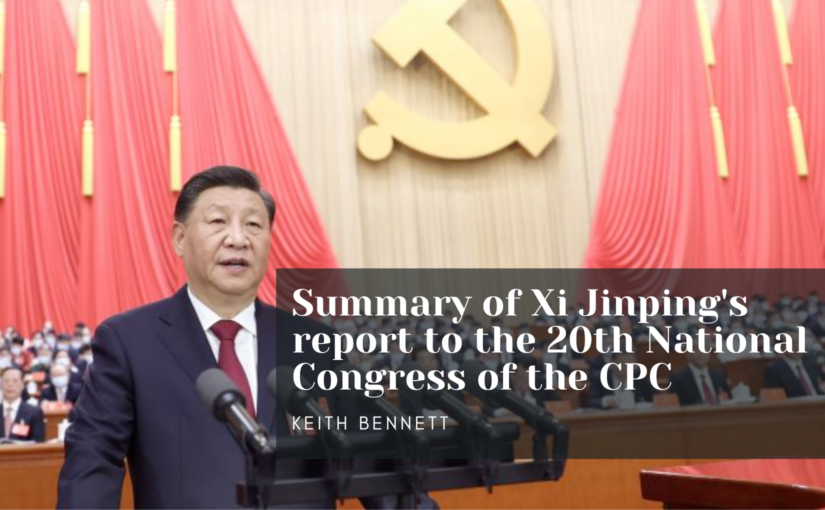
Summary of Xi Jinping’s report to the 20th National Congress of the CPC
The following article by Friends of Socialist China co-editor Keith Bennett provides a brief summary of Xi Jinping’s highly significant and substantial report given at the opening of the CPC’s 20th National Congress on 16 October 2022.
As soon as the official English translation of the report is available, we will republish it on this site.
Entitled Hold High the Great Banner of Socialism with Chinese Characteristics and Strive in Unity to Build a Modern Socialist Country in All Respects, Comrade Xi Jinping’s report to the 20th National Congress of the Communist Party of China is a political document of great significance, summing up the work of a 96-million strong party over the last period and outlining its course ahead.
Comrade Xi begins by noting that the congress, “takes place at a critical time as the entire Party and the Chinese people of all ethnic groups embark on a new journey to build China into a modern socialist country in all respects and advance toward the Second Centenary Goal”, which is that of building a fully modernized socialist country. In this course, it is imperative that the party “never forget our original aspiration and founding mission”, and “always stay modest, prudent, and hard-working.”
Calling the five years since the last congress, “truly momentous and extraordinary”, he noted that the Party had led the Chinese people in “effectively responding to grave, intricate international developments and a series of immense risks and challenges.” It had promoted high-quality development, whole-process people’s democracy, improved public well-being as a matter of priority, put the people and their lives above all else, and launched an all-out people’s war to stop the spread of Covid-19.
Moreover, it had dealt with “drastic changes in the international landscape, especially external attempts to blackmail, contain, blockade, and exert maximum pressure on China”, by showing a “fighting spirit” and a “firm determination to never yield to coercive power.”
Over the last five years, the party had led the people “in solving a great number of problems that had long gone unsolved, securing many accomplishments that hold major future significance, and achieving impressive advances in the cause of the Party and the country.”
Continue reading Summary of Xi Jinping’s report to the 20th National Congress of the CPC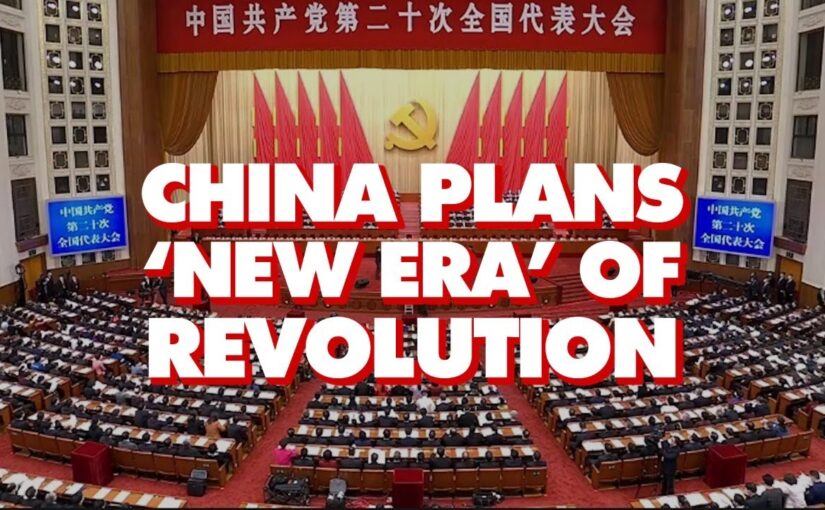
Video: China plans new era of revolution in 20th CPC national congress
On 21 October 2022, Friends of Socialist China co-editors Danny Haiphong and Carlos Martinez joined Multipolarista editor Ben Norton to discuss the CPC’s 20th National Congress, currently drawing to a close in Beijing.
In the 90-minute stream embedded below, the three discuss some of the key themes emerging from the Congress, including the pursuit of China’s Second Centenary Goal (“building a great modern socialist country that is prosperous, strong, democratic, culturally advanced, harmonious and beautiful”), common prosperity, ecological civilization, whole-process people’s democracy, and the need for self-reliance and military modernization in the face of escalating hostility from the imperialist countries.
The stream was broadcast simultaneously on Multipolarista, The Left Lens, and Friends of Socialist China.

Capitalism’s senility and socialism’s vigor are increasingly apparent to world
We are pleased to republish this important interview with Professor Radhika Desai, Convenor of the International Manifesto Group and member of our advisory group, originally published by Global Times. The focus of the interview is the ever more stark demarcation between stagnating western capitalism and booming socialist China.
Analysing the turn to neo-liberalism, particularly in the wake of the 2008 global financial crisis, Radhika asserts: “Liberal democracy is a contradiction in terms… Capitalism is not in the interests of the vast majority of working people.”
Questioned on the premise of earlier Western engagement with China, and its expectation that it would lead to the demise of socialism, Radhika notes: “China’s development is entirely attributed to the country’s adherence to socialism, both in the early period under Mao and in the later reform and opening-up period… After reform and opening-up, the US stepped up economic engagement with China and the idea, particularly after the end of the Soviet Union in 1991, was that such engagement would also make China more or less capitalist, even neoliberal. However, for China this engagement was only another means to advance socialism… Capitalism’s senility and socialism’s vigor are increasingly apparent.”
For the Chinese people, the past decade has been epic and inspirational. The country, under the leadership of the CPC Central Committee with Comrade Xi Jinping at the core, has made great endeavors in boosting its economy, deepening reforms, improving the rights of its people and acting as a responsible power globally.
The world has been increasingly turbulent in recent years due to multiple crises triggered by the US-led West, while there is an obvious tendency that the West is more and more difficult to maintain its development momentum like in the last century. After the 2008 financial crisis, economic growth in Western countries has remained low, in stark contrast to China’s boom. Global Times (GT) reporter Yan Yuzhu talked to Radhika Desai (Desai), convenor of International Manifesto Group and professor of political studies at the University of Manitoba in Canada, about her opinion toward the weakness of capitalism, the adverse consequences of neoliberalism for Western development, as well as China’s role in making a way to pluripolarity.
This is the 25th of the series about this special decade.
GT: After the 2008 financial crisis, especially in the last decade, economic growth in the West has remained very low and the crisis of their domestic political system has been highlighted time and again. In contrast, China has maintained a relatively stable momentum of development, and the gap between China and the US has gradually narrowed. What do you think are the reasons for this difference?
Desai: The low economic growth of major capitalist countries since 2008 is the result of the turn to neoliberalism. It never managed to restore the growth of the 1970s. It occurred because production had outstripped demand and, rather than solving the demand problem, neoliberalism only made it worse. Its attack on organized labor and social spending restricted consumption demand while its encouragement towards financial and rentier activity reduced investment demand, siphoning away funds into speculation and predatory activity. The attempt to compensate for low demand, low growth and low government revenues by extending credit to consumers and governments has only led to mountains of debt and asset bubbles that have regularly burst, weakening economies further.
This process has been ongoing for more than four decades. At the start, the major capitalist countries were much healthier thanks to their “golden age” of robust growth and the broad-based distribution of incomes. But over time, the disastrous effects of neoliberal policies were assailing ever weaker economies.
Continue reading Capitalism’s senility and socialism’s vigor are increasingly apparent to world
The Communist Party of China’s congress matters to us all
In the following article, first published in the Morning Star, Friends of Socialist China co-editor Keith Bennett previews the 20th National Congress of China, which started on 16 October 2022. Noting the superficial and, in no small measure, racist coverage of the Congress in the Western mainstream media, Keith explores some of the key themes that are likely to figure prominently in the proceedings, including common prosperity, tackling inequality, continuing the struggle against corruption, and promoting sustainable development and the pursuance of an “ecological civilisation”.
Keith notes that, at the 19th Congress five years ago, Xi Jinping defined the principal contradiction in Chinese society as being between unbalanced and inadequate development on the one hand and the people’s ever-growing needs for a better life on the other. As such, the CPC-led government has in recent years developed a laser focus on corruption, regional disparities, excessive inequality and environmental degradation; since 2020, the extraordinarily effective campaign to suppress Covid-19 must be added to this list. Readers in the West may well find themselves wishing their own governments would learn a lesson or two.
The article concludes on an inspiring note: “In July 1921, 13 delegates representing 57 party members met in conditions of secrecy, in fear of their lives but with great optimism and courage, to found the Communist Party of China. From there to a party of nearly 97 million, from a ruined to a strong and proud nation, is a long march without historical equal.”
The Communist Party of China (CPC) will open its 20th national congress on October 16. While Western media obsess about personalities, gossip and supposed intrigues, a sort of the West Wing meets I, Claudius, overlain with a not very well disguised coating of racist orientalism, this is actually a very serious political event.
How could it be otherwise? The CPC leads a country of some 1.4 billion people, the most populous on Earth. That country is the world’s second largest economy. By some methods of calculation, it may already be the largest.
As the CPC is a proudly Marxist party and leads a country engaged in a long-term socialist project, this five-yearly gathering is naturally of great interest to the communist and socialist movements.
However, considering China’s weight and role in the world, whether in economy, geopolitics or climate change, its decisions will impact in some way on every human being on Earth.
As befits such a serious political event, the congress will have been meticulously prepared. The political report to be delivered by general secretary Xi Jinping will sum up the work since the 19th congress held in October 2017 and set out the roadmap not just for the next five years, but also, more generically, to the 100th anniversary of the People’s Republic in 2049, by which time the goal is for China to have become a highly developed, modern socialist country, with 2035 being seen as a significant midway point from the “first centenary,” namely that of the CPC last year.
Certainly, the report will bear Xi’s personal imprint and reflect his leading role, but it will also be very much a collective effort. Over the last year, it will have gone through numerous drafts, with a huge number of contributions and suggestions from specialised groups and party structures at all levels from the grassroots up.
The contrast with the clownish and dysfunctional farces into which the conferences of Britain’s major political parties have descended could scarcely be starker.
The Chinese media has reported that a total of 2,296 delegates have been elected to the congress. Quoting an official statement, China Daily reported that they “are outstanding CPC members who are highly qualified ideologically and politically, have good work styles and high moral standards, are competent in discussing state affairs and have made remarkable achievements in their work.”
Considering that they have been chosen to represent more than 96.7 million party members that should certainly be the case.
The paper further reported: “Among the delegates are party members in leadership positions and those from the grassroots, a considerable number of female party members and those from ethnic minority groups. They also come from all walks of life, such as the economy, science, national defence, law enforcement, education, health, sports and culture.”
The congress can be expected to reflect both the essential continuity of the long Chinese revolution, through all its many phases, but particularly the changes that have occurred since Xi was elected to lead the party at the 18th congress in 2012.
At the last congress, Xi announced that the principal contradiction in Chinese society had changed. It was now to be understood as being between unbalanced and inadequate development on the one hand and the people’s ever-growing needs for a better life on the other.
This may seem to be a somewhat arcane formulation, but it is actually extremely important. Following the death of Mao Zedong in 1976 and the formal end to the Cultural Revolution, the party leadership abandoned the view that the principal contradiction in Chinese society was represented by the class struggle, considering it inappropriate for a country in which the basic system of socialism had already been established, but which had a crying need for development.
Instead, the leadership around Deng Xiaoping decided that the principal contradiction was now that between people’s ever-growing material and cultural needs and China’s relatively backward social productive forces. According to this formulation, overriding priority was to be given to development.
The result was, of course, the most rapid and dramatic economic transformation of any society in human history. With hundreds of millions of people lifted out of poverty, the creation of the world’s largest middle income group, a country whose per capita GDP was below that of most of sub-Saharan Africa (albeit its “social wage” was mostly higher) and which was quite marginal to the global economy, became the “workshop of the world,” and by 2020 was the top trading partner of some 128 countries.
Continue reading The Communist Party of China’s congress matters to us all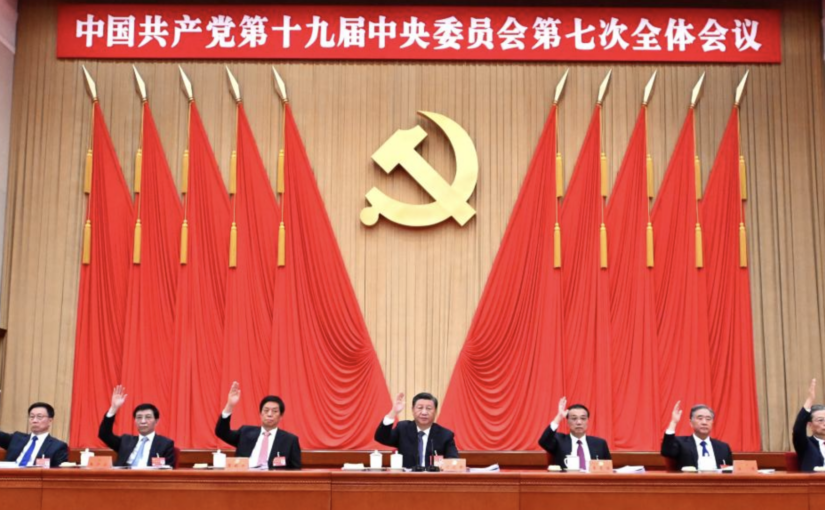
Plenum makes full preparation for 20th CPC National Congress
The Xinhua News Agency has released a report on a meeting of the Communist Party of China’s Central Committee. It notes that it completed all preparations needed so that the 20th Party Congress can open as scheduled on October 16.
The report stressed that, “the CPC Central Committee with Comrade Xi Jinping at its core has held high the banner of socialism with Chinese characteristics, and united and led the whole Party, the armed forces and the people of all ethnic groups in completing the historic mission of building a moderately prosperous society in all respects and thus realizing the first centenary goal, and in embarking on a new journey toward building a modern socialist country in all respects.”
Over the last five years since the 19th Congress, it noted, “many tough problems that remained unsolved for a long time have been solved.” Specifically, looking at the work of the Central Commission for Discipline Commission (CCDI), it said that “an overwhelming victory has been achieved in the fight against corruption.”
We reprint the article from Xinhua below.
The 19th Central Committee of the Communist Party of China (CPC) concluded its seventh plenary session in Beijing on Wednesday with a communique issued.
Xi Jinping, general secretary of the CPC Central Committee, made an important speech at the four-day session, which was presided over by the Political Bureau of the CPC Central Committee.
It was decided at the plenary session that the 20th CPC National Congress will open on Oct. 16 in Beijing, according to the communique.
Entrusted by the Political Bureau of the CPC Central Committee, Xi delivered a work report to the plenum.
The plenary session also discussed and adopted a report to be made by the 19th CPC Central Committee to the 20th CPC National Congress, a work report of the 19th CPC Central Commission for Discipline Inspection (CCDI) to the congress, and an amendment to the CPC Constitution.
Continue reading Plenum makes full preparation for 20th CPC National Congress