Video: China’s socialist development model speaks for itself

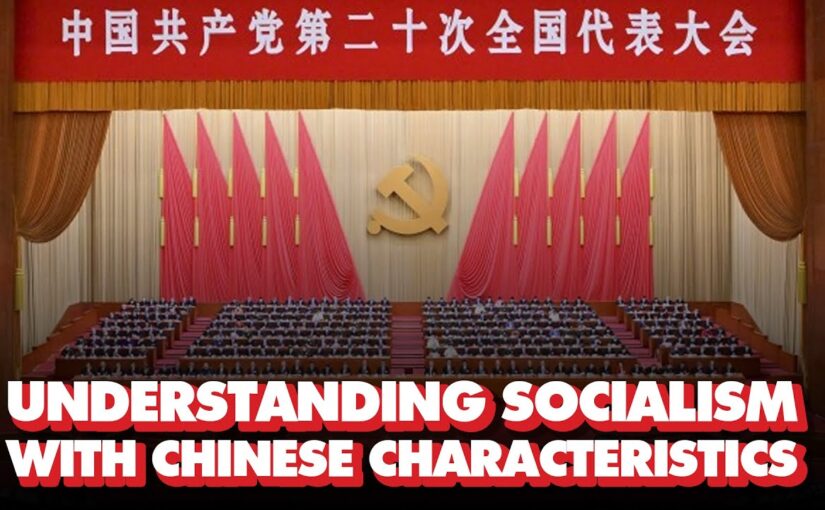
In the video below, originally carried on CGTN, Li Jingjing interviews Carlos Martinez about the recently-concluded 20th National Congress of the CPC – in particular its focus on common prosperity – as well as the successes of China’s development model.

Carlos outlines the core principles of common prosperity – reducing poverty, reducing inequality, improving distribution, and increased regulation of capital. He highlights in particular the measures that have already been taken in support of workers in the ‘gig economy’, including recent legislation supporting and encouraging unionisation, and mandating that all workers have proper contracts and full insurance entitlement. These measures compare very favourably with the situation in the West, where casual workers face terrible working conditions, zero-hour contracts and anti-union policies.

Discussing China’s development model of Socialism with Chinese Characteristics, Carlos points out that the successes of this model speak for themselves. It is a model that has been able to eliminate extreme poverty in a huge country of 1.4 billion people – an unprecedented achievement. “Anyone saying it’s a bad model is saying that it’s bad for people who used to face famines to now live comfortable lives.”

China and Cuba: a relationship of solidarity, friendship and cooperation

We are very pleased to publish below an interview with Carlos Miguel Pereira Hernández, Cuba’s ambassador to China, conducted by People’s Daily and published in Chinese on 13 October. The unabridged English translation has been provided to us by the Cuban Embassy in Beijing.

Timed to coincide with the 62nd anniversary of the establishment of diplomatic relations between the Republic of Cuba and the People’s Republic of China, the interview gives an overview of the history and contemporary reality of relations between the two countries.

Noting that revolutionary Cuba was the first country in the Western hemisphere to extend diplomatic recognition to the People’s Republic of China – in 1960, just a year after the 26th of July Movement came to power – Pereira references the role played by Chinese immigrants in Cuba’s independence struggle. He points out that Cuba and China consider themselves “mutual referents in the construction of socialism with our own characteristics” and notes that President Miguel Díaz-Canel describes Cuba-China ties as “paradigmatic”, and President Xi Jinping describes them as those of “good friends, good comrades and good brothers”.

Describing the cooperation between China and Cuba fields in a vast array of fields, Comrade Pereira expresses confidence that the relationship will continue to deepen.

This year marks the 62nd anniversary of the establishment of diplomatic relations between China and Cuba, how do you assess the fraternal friendship between the two countries? What are your specific plans to further promote economic, trade and people-to-people exchanges between the two countries?     

Relations between Cuba and China were made official on September 28, 1960, a formal step after the announcement by Commander in Chief Fidel Castro a few days earlier in front of more than a million Cubans, in the context of the historic First Declaration of Havana, to recognize the New China and rescind ties with Taiwan. That just decision was born of the political and popular will that have accompanied our relations throughout these 62 years.

The nascent Cuban Revolution definitively broke with the Monroe Doctrine and blind obedience to Washington, allowing Cuba to become the first country in the entire Western Hemisphere to establish ties with New China. We are honored to have made that modest contribution as one of the first manifestations of independence from our foreign policy.

The historical foundations and deep bonds of friendship between our peoples go back to the arrival of those first Chinese immigrants 175 years ago, who also had an outstanding and glorious participation in our struggles for independence.

Throughout these years of uninterrupted relations, Cuba has had the historic privilege of always being in the front row in promoting exchanges with China. Our relations represent a model of cooperation based on equality, respect and mutual benefit. We consider ourselves mutual referents in the construction of socialism with our own characteristics and on that basis, we carry out a broad and systematic exchange of experiences.

Continue reading China and Cuba: a relationship of solidarity, friendship and cooperation

Summary of Xi Jinping’s report to the 20th National Congress of the CPC

The following article by Friends of Socialist China co-editor Keith Bennett provides a brief summary of Xi Jinping’s highly significant and substantial report given at the opening of the CPC’s 20th National Congress on 16 October 2022.

As soon as the official English translation of the report is available, we will republish it on this site.

Entitled Hold High the Great Banner of Socialism with Chinese Characteristics and Strive in Unity to Build a Modern Socialist Country in All Respects, Comrade Xi Jinping’s report to the 20th National Congress of the Communist Party of China is a political document of great significance, summing up the work of a 96-million strong party over the last period and outlining its course ahead.

Comrade Xi begins by noting that the congress, “takes place at a critical time as the entire Party and the Chinese people of all ethnic groups embark on a new journey to build China into a modern socialist country in all respects and advance toward the Second Centenary Goal”, which is that of building a fully modernized socialist country. In this course, it is imperative that the party “never forget our original aspiration and founding mission”, and “always stay modest, prudent, and hard-working.”

Calling the five years since the last congress, “truly momentous and extraordinary”, he noted that the Party had led the Chinese people in “effectively responding to grave, intricate international developments and a series of immense risks and challenges.” It had promoted high-quality development, whole-process people’s democracy, improved public well-being as a matter of priority, put the people and their lives above all else, and launched an all-out people’s war to stop the spread of Covid-19.

Moreover, it had dealt with “drastic changes in the international landscape, especially external attempts to blackmail, contain, blockade, and exert maximum pressure on China”, by showing a “fighting spirit” and a “firm determination to never yield to coercive power.”

Over the last five years, the party had led the people “in solving a great number of problems that had long gone unsolved, securing many accomplishments that hold major future significance, and achieving impressive advances in the cause of the Party and the country.”

Continue reading Summary of Xi Jinping’s report to the 20th National Congress of the CPC

Video: China plans new era of revolution in 20th CPC national congress

On 21 October 2022, Friends of Socialist China co-editors Danny Haiphong and Carlos Martinez joined Multipolarista editor Ben Norton to discuss the CPC’s 20th National Congress, currently drawing to a close in Beijing.

In the 90-minute stream embedded below, the three discuss some of the key themes emerging from the Congress, including the pursuit of China’s Second Centenary Goal (“building a great modern socialist country that is prosperous, strong, democratic, culturally advanced, harmonious and beautiful”), common prosperity, ecological civilization, whole-process people’s democracy, and the need for self-reliance and military modernization in the face of escalating hostility from the imperialist countries.

The stream was broadcast simultaneously on Multipolarista, The Left Lens, and Friends of Socialist China.

Capitalism’s senility and socialism’s vigor are increasingly apparent to world

We are pleased to republish this important interview with Professor Radhika Desai, Convenor of the International Manifesto Group and member of our advisory group, originally published by Global Times. The focus of the interview is the ever more stark demarcation between stagnating western capitalism and booming socialist China.

Analysing the turn to neo-liberalism, particularly in the wake of the 2008 global financial crisis, Radhika asserts: “Liberal democracy is a contradiction in terms… Capitalism is not in the interests of the vast majority of working people.”

Questioned on the premise of earlier Western engagement with China, and its expectation that it would lead to the demise of socialism, Radhika notes: “China’s development is entirely attributed to the country’s adherence to socialism, both in the early period under Mao and in the later reform and opening-up period… After reform and opening-up, the US stepped up economic engagement with China and the idea, particularly after the end of the Soviet Union in 1991, was that such engagement would also make China more or less capitalist, even neoliberal. However, for China this engagement was only another means to advance socialism… Capitalism’s senility and socialism’s vigor are increasingly apparent.”

For the Chinese people, the past decade has been epic and inspirational. The country, under the leadership of the CPC Central Committee with Comrade Xi Jinping at the core, has made great endeavors in boosting its economy, deepening reforms, improving the rights of its people and acting as a responsible power globally.

The world has been increasingly turbulent in recent years due to multiple crises triggered by the US-led West, while there is an obvious tendency that the West is more and more difficult to maintain its development momentum like in the last century. After the 2008 financial crisis, economic growth in Western countries has remained low, in stark contrast to China’s boom. Global Times (GT) reporter Yan Yuzhu talked to Radhika Desai (Desai), convenor of International Manifesto Group and professor of political studies at the University of Manitoba in Canada, about her opinion toward the weakness of capitalism, the adverse consequences of neoliberalism for Western development, as well as China’s role in making a way to pluripolarity. 

This is the 25th of the series about this special decade.


GT: After the 2008 financial crisis, especially in the last decade, economic growth in the West has remained very low and the crisis of their domestic political system has been highlighted time and again. In contrast, China has maintained a relatively stable momentum of development, and the gap between China and the US has gradually narrowed. What do you think are the reasons for this difference? 

Desai: The low economic growth of major capitalist countries since 2008 is the result of the turn to neoliberalism. It never managed to restore the growth of the 1970s. It occurred because production had outstripped demand and, rather than solving the demand problem, neoliberalism only made it worse. Its attack on organized labor and social spending restricted consumption demand while its encouragement towards financial and rentier activity reduced investment demand, siphoning away funds into speculation and predatory activity. The attempt to compensate for low demand, low growth and low government revenues by extending credit to consumers and governments has only led to mountains of debt and asset bubbles that have regularly burst, weakening economies further. 

This process has been ongoing for more than four decades. At the start, the major capitalist countries were much healthier thanks to their “golden age” of robust growth and the broad-based distribution of incomes. But over time, the disastrous effects of neoliberal policies were assailing ever weaker economies. 

Continue reading Capitalism’s senility and socialism’s vigor are increasingly apparent to world

The Communist Party of China’s congress matters to us all

In the following article, first published in the Morning Star, Friends of Socialist China co-editor Keith Bennett previews the 20th National Congress of China, which started on 16 October 2022. Noting the superficial and, in no small measure, racist coverage of the Congress in the Western mainstream media, Keith explores some of the key themes that are likely to figure prominently in the proceedings, including common prosperity, tackling inequality, continuing the struggle against corruption, and promoting sustainable development and the pursuance of an “ecological civilisation”.

Keith notes that, at the 19th Congress five years ago, Xi Jinping defined the principal contradiction in Chinese society as being between unbalanced and inadequate development on the one hand and the people’s ever-growing needs for a better life on the other. As such, the CPC-led government has in recent years developed a laser focus on corruption, regional disparities, excessive inequality and environmental degradation; since 2020, the extraordinarily effective campaign to suppress Covid-19 must be added to this list. Readers in the West may well find themselves wishing their own governments would learn a lesson or two.

The article concludes on an inspiring note: “In July 1921, 13 delegates representing 57 party members met in conditions of secrecy, in fear of their lives but with great optimism and courage, to found the Communist Party of China. From there to a party of nearly 97 million, from a ruined to a strong and proud nation, is a long march without historical equal.”

The Communist Party of China (CPC) will open its 20th national congress on October 16. While Western media obsess about personalities, gossip and supposed intrigues, a sort of the West Wing meets I, Claudius, overlain with a not very well disguised coating of racist orientalism, this is actually a very serious political event.

How could it be otherwise? The CPC leads a country of some 1.4 billion people, the most populous on Earth. That country is the world’s second largest economy. By some methods of calculation, it may already be the largest.

As the CPC is a proudly Marxist party and leads a country engaged in a long-term socialist project, this five-yearly gathering is naturally of great interest to the communist and socialist movements.

However, considering China’s weight and role in the world, whether in economy, geopolitics or climate change, its decisions will impact in some way on every human being on Earth.

As befits such a serious political event, the congress will have been meticulously prepared. The political report to be delivered by general secretary Xi Jinping will sum up the work since the 19th congress held in October 2017 and set out the roadmap not just for the next five years, but also, more generically, to the 100th anniversary of the People’s Republic in 2049, by which time the goal is for China to have become a highly developed, modern socialist country, with 2035 being seen as a significant midway point from the “first centenary,” namely that of the CPC last year.

Certainly, the report will bear Xi’s personal imprint and reflect his leading role, but it will also be very much a collective effort. Over the last year, it will have gone through numerous drafts, with a huge number of contributions and suggestions from specialised groups and party structures at all levels from the grassroots up.

The contrast with the clownish and dysfunctional farces into which the conferences of Britain’s major political parties have descended could scarcely be starker.

The Chinese media has reported that a total of 2,296 delegates have been elected to the congress. Quoting an official statement, China Daily reported that they “are outstanding CPC members who are highly qualified ideologically and politically, have good work styles and high moral standards, are competent in discussing state affairs and have made remarkable achievements in their work.”

Considering that they have been chosen to represent more than 96.7 million party members that should certainly be the case.

The paper further reported: “Among the delegates are party members in leadership positions and those from the grassroots, a considerable number of female party members and those from ethnic minority groups. They also come from all walks of life, such as the economy, science, national defence, law enforcement, education, health, sports and culture.”

The congress can be expected to reflect both the essential continuity of the long Chinese revolution, through all its many phases, but particularly the changes that have occurred since Xi was elected to lead the party at the 18th congress in 2012.

At the last congress, Xi announced that the principal contradiction in Chinese society had changed. It was now to be understood as being between unbalanced and inadequate development on the one hand and the people’s ever-growing needs for a better life on the other.

This may seem to be a somewhat arcane formulation, but it is actually extremely important. Following the death of Mao Zedong in 1976 and the formal end to the Cultural Revolution, the party leadership abandoned the view that the principal contradiction in Chinese society was represented by the class struggle, considering it inappropriate for a country in which the basic system of socialism had already been established, but which had a crying need for development.

Instead, the leadership around Deng Xiaoping decided that the principal contradiction was now that between people’s ever-growing material and cultural needs and China’s relatively backward social productive forces. According to this formulation, overriding priority was to be given to development.

The result was, of course, the most rapid and dramatic economic transformation of any society in human history. With hundreds of millions of people lifted out of poverty, the creation of the world’s largest middle income group, a country whose per capita GDP was below that of most of sub-Saharan Africa (albeit its “social wage” was mostly higher) and which was quite marginal to the global economy, became the “workshop of the world,” and by 2020 was the top trading partner of some 128 countries.

Continue reading The Communist Party of China’s congress matters to us all

Plenum makes full preparation for 20th CPC National Congress

The Xinhua News Agency has released a report on a meeting of the Communist Party of China’s Central Committee. It notes that it completed all preparations needed so that the 20th Party Congress can open as scheduled on October 16. 

The report stressed that, “the CPC Central Committee with Comrade Xi Jinping at its core has held high the banner of socialism with Chinese characteristics, and united and led the whole Party, the armed forces and the people of all ethnic groups in completing the historic mission of building a moderately prosperous society in all respects and thus realizing the first centenary goal, and in embarking on a new journey toward building a modern socialist country in all respects.”

Over the last five years since the 19th Congress, it noted, “many tough problems that remained unsolved for a long time have been solved.” Specifically, looking at the work of the Central Commission for Discipline Commission (CCDI), it said that “an overwhelming victory has been achieved in the fight against corruption.”

We reprint the article from Xinhua below.

The 19th Central Committee of the Communist Party of China (CPC) concluded its seventh plenary session in Beijing on Wednesday with a communique issued.

Xi Jinping, general secretary of the CPC Central Committee, made an important speech at the four-day session, which was presided over by the Political Bureau of the CPC Central Committee.

It was decided at the plenary session that the 20th CPC National Congress will open on Oct. 16 in Beijing, according to the communique.

Entrusted by the Political Bureau of the CPC Central Committee, Xi delivered a work report to the plenum.

The plenary session also discussed and adopted a report to be made by the 19th CPC Central Committee to the 20th CPC National Congress, a work report of the 19th CPC Central Commission for Discipline Inspection (CCDI) to the congress, and an amendment to the CPC Constitution.

Continue reading Plenum makes full preparation for 20th CPC National Congress

CPC’s 20th National Congress – along the path towards building a modern socialist country

The following article by Chen Weihua, originally carried in China Daily, collates the opinions of various analysts in the West in relation to the forthcoming 20th National Congress of the CPC, which will kick off on Sunday 16 October. The article includes quotes from Friends of Socialist China co-editor Carlos Martinez, who opines that the Congress will likely emphasize common prosperity: “Alleviating poverty, reducing inequality, preventing the unchecked expansion of capital and ensuring all people in China benefit from China’s growing economic strength — these are all tremendously important in terms of working toward the second centenary goal of building a modern socialist country that is prosperous, strong, democratic, culturally advanced and harmonious.”

Carlos also notes China’s important contribution to the global struggle to prevent climate breakdown, and states his belief that the Congress will reaffirm the CPC’s commitment to ecological issues.

Many international experts are voicing expectations that the 20th National Congress of the Communist Party of China, which is expected to open on Oct 16 in Beijing, will generate successes not only for China but also the world.

Erik Solheim, former executive director of the United Nations Environmental Programme and former UN under-secretary-general, said that after 40 years of unprecedented economic growth and poverty reduction, China should focus on how to take the next step toward a high-quality and people-centered society.

He said the 20th CPC National Congress is an opportunity to celebrate China’s progress since it initiated the reform and opening-up drive in 1978, consequently eradicating extreme poverty, extending life expectancy to the level of developed countries and becoming a global leader in renewable energy and green development.

“China should set new high ambitions for its global leadership toward an ecological civilization and shared prosperity for humankind,” the Norwegian politician said.

He said China is already ahead of all other nations in new green technologies and can help lead the world on climate and the environment.

“At a time of much global uncertainty, China’s leadership is critical to create a stable world order for economic progress and green development,” he said.

Carlos Martinez, a British commentator and co-editor of Friends of Socialist China, said the 20th CPC National Congress will likely emphasize common prosperity.

“Alleviating poverty, reducing inequality, preventing the unchecked expansion of capital and ensuring all people in China benefit from China’s growing economic strength — these are all tremendously important in terms of working toward the second centenary goal of building a modern socialist country that is prosperous, strong, democratic, culturally advanced and harmonious,” he said.

He pointed to China’s commitment to peak carbon emissions before 2030 and achieve carbon neutrality by 2060, and said he believes the Congress will reaffirm the Party’s commitment to the climate and biodiversity.

He said China is leading the way with renewable energy, electric vehicles, afforestation, pollution reduction and biodiversity preservation.

“With an increasingly urgent climate crisis, this (China’s) leadership is indispensable,” he said.

Martinez believes China will continue to pursue a foreign policy based on peace, development and mutually beneficial cooperation.

However, the 20th CPC National Congress will inevitably have to seriously consider China’s defense capacity, and the need to foster domestic innovation and consumption, in the face of increasingly hostile forces led by the United States, which is attempting to contain China.

Bernard Dewit, chair of the Brussels-based Belgian Chinese Chamber of Commerce, has traveled to China almost every year since the 1980s but has not been able to during the past three years because of COVID-19.

He said the Congress will need to focus on measures to support the economy and hopes China’s pandemic-control policies could adapt to ease travel for businesspeople and tourists from the rest of the world.

Dewit added that he hopes China’s economy will remain open to foreign investment and to partnerships between Chinese and foreign companies in China and abroad.

As Western capitalism faces repeated crises, socialist China achieves spectacular success

We are pleased to reproduce this article by Professor Radhika Desai, which originally appeared in Global Times.

Radhika notes that, “After the disintegration of the USSR, the People’s Republic of China, under leadership of the CPC, not only survived, but succeeded spectacularly…(but) none of this was inevitable.”

The secret behind the success of socialism in China and the failure of capitalism, particularly the variety practiced in the United States and Britain, she argues, is best understood by returning to the teachings of Marx.

A further very important factor identified by Radhika is that “the Chinese revolution, even more than the Russian revolution, was at once socialist and anti-imperialist.” Her conclusion is that, “while China does not aim to be a model for other nations, its experience and policies do serve as a worthy example. Other countries can best benefit from their relations with socialist China if they also adapt China’s experience to their aspirations and circumstances.” This resonates with President Xi Jinping’s important observation that: “It [socialism with Chinese characteristics] offers a new option for other countries and nations who want to speed up their development while preserving their independence.”

After the disintegration of the USSR, the People’s Republic of China, under leadership of the CPC, not only survived, but succeeded spectacularly. The party-state holding overall control of the economy composed of a pragmatic mix of state and private enterprise has managed to harness market forces to build socialism and brought a very poor society to the threshold of moderate prosperity. It has scored many technological achievements along the way. 

None of this was inevitable. All of it required leadership, who has been capable of well-judged decisions, political skill and wisdom, the ability to learn from mistakes, to listen to the people and, above all, to stand up to powerful capitalism and imperialism. It also required a long-standing commitment to China’s original revolutionary principles. 

Continue reading As Western capitalism faces repeated crises, socialist China achieves spectacular success

Video: on Xi Jinping’s ‘The Governance of China’, Volume IV

With the 20th National Congress of the Communist Party of China scheduled to open on October 16, the International Department of the Communist Party of China has released this short video highlighting the publication of Volume IV of President Xi Jinping’s collection of articles and speeches, The Governance of China.

The video highlights how China has achieved its first centenary goal (marking 100 years since the founding of the Communist Party of China in 1921) of building a moderately prosperous society in all respects, with the complete elimination of extreme poverty, and is now advancing towards the second centenary goal (which will mark 100 years since the founding of the People’s Republic of China in 1949) of building a great modern socialist country in all respects.

President Xi points out that China is now closer than ever before to realizing its cause of national rejuvenation and more confident than ever of achieving it. 

The video also outlines the Chinese leader’s thinking on building a community with a shared future for humanity, highlighting in particular China’s global supply of vaccines and the role of the Belt and Road Initiative (BRI) in poverty alleviation, along with China having signed BRI agreements with 149 countries and 32 international organizations.

Socialist countries greet China’s National Day

Marking the 73rd anniversary of the founding of the People’s Republic of China on October 1, leaders of numerous countries sent greetings to President Xi Jinping and other Chinese leaders.

Reporting the messages of greetings, the Xinhua News Agency and other Chinese media gave notable pride of place to the greetings sent by China’s fraternal socialist countries, the Democratic People’s Republic of Korea (DPRK), Socialist Republic of Vietnam, Lao People’s Democratic Republic, and Republic of Cuba. 

DPRK leader Kim Jong Un noted that, over the past 73 years, China has made “remarkable successes in accomplishing the socialist cause, braving all sorts of challenges and trials of history” and had entered the new stage of comprehensively building a modern socialist country since the 18th Party Congress. 

The Korean leader also expressed solidarity with China’s struggle to defend the country’s sovereignty and territorial integrity and realize national reunification. He further noted that the two parties and two countries are supporting and encouraging each other in the common socialist cause.

Vietnamese Party leader Nguyen Phu Trong and state President Nguyen Xuan Phuc expressed their firm belief that under the leadership of the CPC Central Committee with Comrade Xi Jinping at its core, the Chinese people will certainly achieve the national development tasks and goals set forth by the CPC and forge ahead on the road of building China into a great modern socialist country that is prosperous, strong, democratic, culturally advanced, harmonious, and beautiful.

Lao leader Thongloun Sisoulith expressed his belief that the brotherly Chinese people will make new and greater achievements in the new journey toward China’s second centenary goal of building a great modern socialist country in all respects, and successfully realize the great rejuvenation of the Chinese nation.

Cuban President Miguel Diaz-Canel and Prime Minister Manuel Marrero conveyed their conviction that the socialist cause in China will be strengthened after the successful holding of the Congress of the Communist Party this month.

The following articles were originally carried by the Xinhua News Agency, the Korean Central News Agency (KCNA), the Vietnamese Communist Party newspaper Nhan Dan, and the Cuban news agency Prensa Latina.

Foreign leaders congratulate the People’s Republic of China on 73rd founding anniversary

Leaders of many countries and international organizations have recently telephoned or sent letters to Xi Jinping, general secretary of the Communist Party of China (CPC) Central Committee and president of the People’s Republic of China (PRC), to warmly congratulate on the 73rd anniversary of the founding of the PRC and wish the upcoming 20th National Congress of the CPC a full success.

Kim Jong Un, general secretary of the Workers’ Party of Korea (WPK) and chairman of the State Affairs Commission of the Democratic People’s Republic of Korea (DPRK), on behalf of the WPK, the government of the DPRK and the people of the DPRK, extended warm congratulations to Comrade General Secretary Xi Jinping, the CPC, the government of the PRC and the brotherly Chinese people.

Continue reading Socialist countries greet China’s National Day

China’s 73 years of moving forward

We are pleased to reproduce this article by Stephen Millies, originally carried by our US comrades of Struggle/La Lucha greeting the 73rd anniversary of the founding of the People’s Republic of China and celebrating the struggles and achievements of the Chinese revolution.

Since Mao Zedong declared that “the Chinese people have stood up”, Stephen notes, life expectancy has more than doubled, surpassing that in the US. Illiteracy, which stood at some 80% at the time of liberation, has been virtually eliminated. Thirty-seven million people attend university. 52% of them are women. 

Noting the centuries-long confrontation between China and imperialism, the author notes that imperialist hatred has only increased in the face of the socialist country’s achievements. The terrible wars in Korea and Indochina were a key part of US imperialism’s response to the Chinese revolution, as was McCarthyism at home. Refuting some of the key anti-China smears used to confuse working and oppressed people in the United States, Stephen concludes: “Our enemy is high rents, police brutality and mass incarceration. We need what China has: a socialist revolution.”

When the People’s Republic of China was born on Oct. 1, 1949, the country was devastated by years of war. At least 20 million Chinese people were killed. Starvation stalked the land. 

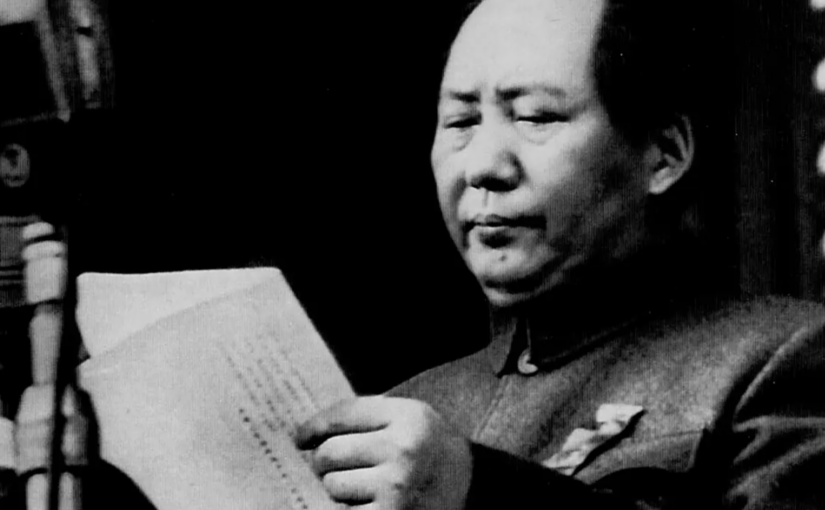
The Chinese Revolution swept that misery away. Seventy-three years after Mao Zedong declared that “China has stood up,” look at what socialism has accomplished:

  • Life expectancy has more than doubled to reach 77.3 years. That’s a longer lifespan than in the U.S.
  • Women moved forward with unbound feet. Chinese scientist Tu Youyou won the Nobel Prize in medicine in 2015. She discovered artemisinin and dihydroartemisinin, which are used to combat malaria.
  • While 80% of China’s people couldn’t read or write in 1949, illiteracy has been virtually abolished. Thirty-seven million people attend universities compared with 117,000 before the revolution. More than 52% of college students were women
  • China has become the workshop of the world. The People’s Republic makes more than a billion tons of steel annually. China has built more miles of high-speed rail than the rest of the world combined.
  • Even greater advances have been made by China’s national minorities, whose languages and cultures flourish. One of the great victories of human rights was the abolition of serfdom in Tibet by the People’s Liberation Army. The Chinese Revolution inspired oppressed people around the world, including Malcolm X.
Continue reading China’s 73 years of moving forward

Seminar: China in the World Today

Britain’s General Federation of Trade Unions (GFTU) initiated an autumn series of online seminars, under the theme The Bigger Picture, on September 15, by inviting Friends of Socialist China co-editors Carlos Martinez and Keith Bennett to introduce on the theme ‘China in the World Today’. Chaired by GFTU General Secretary Doug Nicholls, Carlos kicked off with a look at China’s domestic situation, focusing on poverty elimination and preventing climate catastrophe. Keith followed, addressing the questions of Taiwan and the relations between China, Britain, and the US. A lively discussion ensued, which could certainly have gone on for much longer.

Next events in the series will feature Dr. Francisco Dominguez, academic, activist and member of our advisory group, who will speak on the Decline of US imperialism on October 20; and our friend Dr. Kate Hudson, General Secretary of the Campaign for Nuclear Disarmament (CND), who will speak on NATO Friend or Foe on November 17. You can register for these events at The Bigger Picture: Autumn Series of Online Seminars – GFTU.

The GFTU is pleased to facilitate informed debate and critical thinking about many subjects in its education programme and the views of speakers and participants do not necessarily reflect those of the GFTU.

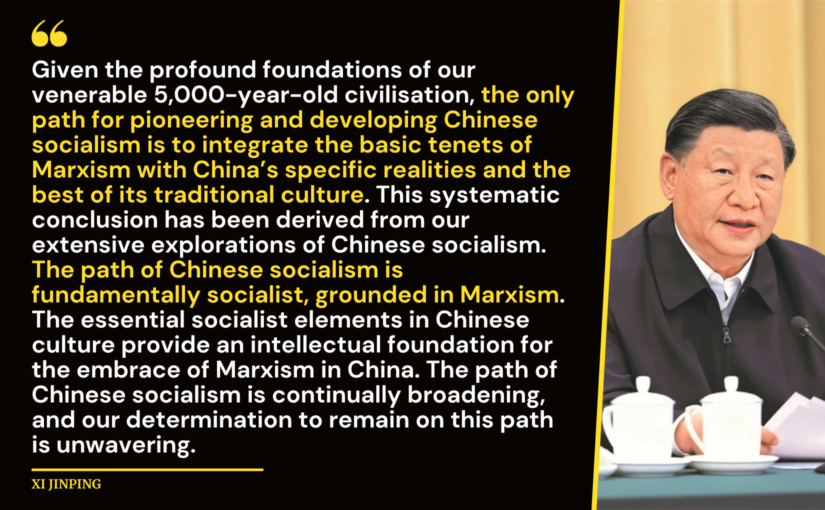
Xi Jinping: Consistently develop and uphold Socialism with Chinese characteristics

With the Twentieth National Congress of the Communist Party of China scheduled to open on October 16, the party’s leading theoretical journal, Qiushi, has recently published an extract from an extremely important speech made by General Secretary Xi Jinping on January 5, 2018, at a seminar for new central committee members and other leading cadres. 

Echoing the opening of Comrade Mao Zedong’s famous article, ‘Where do correct ideas come from?’, Comrade Xi asserts that, “Socialism with Chinese characteristics did not fall from the sky”, but rather is deeply rooted not simply in the four decades of ‘reform and opening up’, but in the whole history of the Chinese revolution and in the inheritance of 5,000 years of Chinese civilization. 

He goes on to explain that the socialist revolution constituted, “the most extensive and profound social transformation in the history of the Chinese nation.” After the establishment of the basic socialist system, the Party has, “made a long-term exploration of how to build socialism in China and has made important achievements as well as experienced serious twists and turns. The main problem here is that building socialism in a semi-colonial and semi-feudal society like ours is an unprecedented undertaking, and there is no ready-made model to follow.”

Engels, he points out, noted that “‘the so-called ‘socialist society’ is not something that is set in stone, but should be seen, like any other social system, as a society that changes and reforms frequently.'” Socialism with Chinese characteristics has to be grasped, “in the course of the evolution of socialism in the world,” from Marx and Engels who turned socialism from an ideal into a science, to the October Revolution, which saw scientific socialism develop from theory to practice. Furthermore: “After the end of the Second World War, a number of socialist countries were born, especially our Party led the people to establish New China and the socialist system, which led scientific socialism from practice in one country to development in many countries. At that time, the socialist camp was flourishing, and together with the anti-imperialist and anti-colonialist struggles of Asian, African and Latin American countries, it formed a basically evenly matched pattern with the capitalist world, which is why Comrade Mao Zedong said that ‘the east wind overwhelmed the west wind.'”

However, historical development is full of twists and turns. Events in the late 1980s and early 1990s not only led to the collapse of the Soviet Union and the East European socialist countries, they also, “brought a serious impact on the vast number of developing countries that aspired to socialism, and many of them were forced to take the path of copying the Western system.”

Noting that the previous year had seen the 100th anniversary of the October Revolution, Comrade Xi explained, “I mentioned this major historical event at the beginning of the second part of the 19th Party Congress report in order to declare the historical impact of the October Revolution on the birth and development of the Chinese Communist Party. As Lenin profoundly pointed out in commemorating the fourth anniversary of the October Revolution, ‘this first victory is not yet final,’ but ‘we have already begun this enterprise. It does not matter when and for what period the proletarians of which country will carry this cause to its conclusion. What is important is that the ice has been broken, the voyage has been opened, the way has been shown.'”

Therefore, Xi notes, “The success of scientific socialism in China is of great significance to Marxism and scientific socialism, and to socialism in the world.” It is conceivable, he continues, that if the leadership of the CPC and China’s socialist system had also collapsed, then the cause of socialism as a whole could have been plunged into darkness. As it is, “Socialism with Chinese characteristics is becoming the banner for the development of scientific socialism in the 21st century and the mainstay for the revitalization of socialism in the world.”

The Chinese leader also addresses the question of the CPC being both a “ruling party” and a “revolutionary party”. He explains that those who assert that the party has transitioned from a revolutionary party to a ruling party are mistaken. They are not two distinct things. “We are communists and revolutionaries and should not lose our revolutionary spirit,” Comrade Xi notes, and continues: “Our Party is a Marxist ruling party, but at the same time it is a Marxist revolutionary party, and we must maintain the same vigor, revolutionary enthusiasm, and desperate spirit as in the past during the revolutionary war and carry out the revolutionary work to the end.”

This document has yet to be officially published in English translation. What follows is a machine translation from the Chinese original, received from the Dongsheng news group. As a result, it may contain some minor inaccuracies and should not be considered definitive. However, we are reprinting it on account of its great importance, rich content and timeliness.

When I met with Chinese and foreign journalists after the First Plenary Session of the 19th CPC Central Committee, I said that practice has proved that our Party is able to lead the people not only in a great social revolution, but also in a great self-revolution of the whole Party. Let me first make some comments from the perspective of social revolution.

Socialism with Chinese characteristics in the new era is the fruit of the great social revolution led by our Party and the continuation of the great social revolution led by our Party, and must be carried out consistently.

Both history and reality tell us that a social revolution often requires a long historical process to achieve ultimate victory. Only by looking back at the road taken, comparing the road of others, looking far ahead of the road, to figure out where we came from, where to go, many issues to see deep, accurate.

Continue reading Xi Jinping: Consistently develop and uphold Socialism with Chinese characteristics

Why China isn’t capitalist

The below article by Stephen Millies was originally published by the US socialist journal Struggle/La Lucha. It is an interesting and provocative response to those comrades on the left who contend that capitalism has been restored in the People’s Republic of China.

Noting that China’s economy may already be larger than that of the United States, Stephen asserts that: “This tremendous economic growth is the result of China’s socialist revolution… You can’t explain China’s fantastic economic growth except by admitting there’s some other social system than capitalism in charge.”

An interesting aspect of the article is its presentation of how the Soviet Union, even in the late 1980s, played a major part in the liberation of southern Africa. It also notes that: “Sometimes retreats are absolutely necessary. For example, the Long March was a glorious retreat that saved the Communist Party of China from being destroyed.” In this context, Stephen also references Lenin’s New Economic Policy (NEP), along with an observation from Karl Marx that, following a socialist revolution, the working class might have to “buy off the band” of the wealthy.

Wall Street and the Pentagon view the People’s Republic of China as their number one enemy. China is the target of U.S. imperialism’s “Pivot to Asia.” 

China’s economy may already be larger than the United States. The American Enterprise Institute―one of the best-known capitalist think tanks ― admits China surpassed the U.S. as the world’s biggest manufacturer back in 2010. 

That’s historically significant. Factories in the United States exceeded Britain’s production in the 1890s.

China is now the “workshop of the world.” In 2021, China built nearly 17 million more motor vehicles than the U.S.

This tremendous economic growth is the result of China’s socialist revolution. It’s not just a matter of China making more than a billion tons of steel a year or having more miles of high-speed rail than the rest of the world.

When Mao Zedong declared “China has stood up” in 1949 and the People’s Republic of China was born, Chinese people lived to be, on average, just 36 years old. 

By 2022 life expectancy had more than doubled to reach 77.3 years. That’s a longer lifespan than in the United States.

Despite these tremendous gains, some communists and revolutionaries contend that capitalism has been restored in the People’s Republic of China. They point to the 606 billionaires in China, including 67 in Hong Kong. 

Continue reading Why China isn’t capitalist

China’s development an inspiration for people around the world, an alternative to capitalist exploitation

Reproduced below is an important interview with Ken Hammond, professor of East Asian history at the New Mexico State University, originally published in the Global Times. Ken provides a concise and valuable description of Socialism with Chinese Characteristics, outlining China’s political trajectory in recent decades, including some of the problems and contradictions emerging from its extraordinary development.

Ken highlights the key themes of the last decade – “The lifting of hundreds of millions of people out of absolute poverty, the ongoing work to suppress corruption and promote a socialist ethical order, the vital struggle to solve environmental problems and address the global concern of climate change, and the program of outreach to other developing countries and people around the world through the BRI and other initiatives” – and discusses how China’s successes have prompted a dangerous and negative response from the US.

Beyond China’s economic rise, Professor Hammond also notes that China’s socialist nature and Marxist orientation constitute a particularly acute challenge to Western ideological hegemony. “Socialism as an alternative to capitalism is seen as a threat, although in fact it offers the only path to social and economic justice, and indeed to saving the planet from ecological catastrophe.”

GT: Last year, you mentioned in an article on the 100th anniversary of the founding of the CPC that under Xi’s leadership, China has not succumbed to the wished-for transformation of its political and economic systems. How do you understand the political and economic systems of China?

Hammond: I see China as working to develop a system of political economy with public, social ownership and control of the basic economic resources of the country, a socialist system in which the wealth produced by working people is distributed based upon the contribution they make through their labor. China is not yet at the point of having reached this, but this is the goal toward which the Party and the government and the people are working. To reach this objective China has chosen to utilize market mechanisms to pursue the rapid development of the economy, raise the overall level of production both in terms of quantity and quality, and enhance the material conditions of life for the people. Great successes have been achieved in these areas.

The process of development, especially with the use of markets, has also generated contradictions and challenges which China has to face, including corruption, increased inequality, and environmental stresses such as pollution and the rising dangers of climate change. These contradictions are recognized and acknowledged, and China is making serious efforts to address them. This, too, is an ongoing process, and the outcome is not predetermined. This is why the leadership of the Party is so critical, to ensure that the original mission of the revolution, the creation of a just, equitable, socialist society, with the eventual goal of a communist system, remains the guiding vision and the practical program.

GT: In the past 10 years, which policy or practice initiated by the CPC impressed you the most?

Hammond: The decade since Xi Jinping assumed the leadership of the Party and the presidency of the PRC has been one of dramatic changes in China. The project of development, the movement toward a system of socialism with Chinese characteristics, has begun to yield significant positive results. The lifting of hundreds of millions of people out of absolute poverty, the ongoing work to suppress corruption and promote a socialist ethical order, the vital struggle to solve environmental problems and address the global concern of climate change, and the program of outreach to other developing countries and people around the world through the BRI and other initiatives, have all achieved important advances. In conjunction with these, China has also been re-emerging as a significant participant in global affairs. 

Continue reading China’s development an inspiration for people around the world, an alternative to capitalist exploitation

20th Congress of the CPC proposed for October 2022

The Communist Party of China announced on August 30 that it plans to open its 20th Congress on October 16. According to the Xinhua News Agency: 

“It was stressed at the meeting that the 20th CPC National Congress is a congress of great significance to be convened at a crucial moment, as the whole Party and the entire nation embark on a new journey toward building a modern socialist country in all respects, and advance toward the Second Centenary Goal…

“The congress will thoroughly review the international and domestic situations, comprehensively grasp the new requirements for the development of the cause of the Party and the country on the new journey in the new era, as well as the new expectations of the people.

“The congress will formulate action plans and major policies, mobilize all Party members and people from all ethnic groups across the country to firm up confidence in history, strengthen historical initiative, innovate on the basis of what has been done, and bravely charge ahead.”

The following report was originally carried by the Xinhua News Agency.

The Political Bureau of the Communist Party of China (CPC) Central Committee on Tuesday held a meeting on the preparatory work for the seventh plenary session of the 19th CPC Central Committee, and the 20th CPC National Congress. Xi Jinping, general secretary of the CPC Central Committee, presided over the meeting.

The meeting decided that the seventh plenary session of the 19th CPC Central Committee is to be convened on Oct. 9 in Beijing. The Political Bureau of the CPC Central Committee will propose to the plenary session that the 20th CPC National Congress be convened on Oct. 16 in Beijing.

It was stressed at the meeting that the 20th CPC National Congress is a congress of great significance to be convened at a crucial moment, as the whole Party and the entire nation embark on a new journey toward building a modern socialist country in all respects, and advance toward the Second Centenary Goal.

The congress will hold high the great banner of socialism with Chinese characteristics, uphold Marxism-Leninism, Mao Zedong Thought, Deng Xiaoping Theory, the Theory of Three Represents and the Scientific Outlook on Development, and thoroughly implement Xi Jinping Thought on Socialism with Chinese Characteristics for a New Era.

The congress will take stock of the Party’s work over the past five years, as well as major achievements and valuable experience of the Party’s Central Committee with Comrade Xi Jinping at its core in uniting and leading the whole Party and Chinese people of all ethnic groups to uphold and develop socialism with Chinese characteristics in the new era.

The congress will thoroughly review the international and domestic situations, comprehensively grasp the new requirements for the development of the cause of the Party and the country on the new journey in the new era, as well as the new expectations of the people.

The congress will formulate action plans and major policies, mobilize all Party members and people from all ethnic groups across the country to firm up confidence in history, strengthen historical initiative, innovate on the basis of what has been done, and bravely charge ahead.

All Party members and people from all ethnic groups across the country will be mobilized to continue advancing the Five-Sphere Integrated Plan and the Four-Pronged Comprehensive Strategy in a coordinated manner, pushing forward common prosperity for all, advancing the great new project of Party building, and promoting the building of a community with a shared future for humanity.

All Party members and people from all ethnic groups across the country will be mobilized to work together for building China into a modern socialist country in all respects and advancing the great rejuvenation of the Chinese nation on all fronts.

A new CPC Central Committee and a new CPC Central Commission for Discipline Inspection will be elected at the congress.

All preparatory work for the congress is proceeding smoothly and preparations should be continued earnestly to ensure a successful congress, according to the meeting.

Other issues were also discussed at the meeting.

China and Cuba: “faithful friends with unbreakable ties”

The special friendship between socialist China and socialist Cuba was underlined in an August 23 video call between Vice Foreign Minister Xie Feng and Deputy Foreign Minister Anayansi Rodriguez Camejo. 

Comrade Xie pointed out that China and Cuba are “faithful friends with unbreakable ties, and tested friends devoted to each other and as close as brothers.” He observed that they “have forged ahead hand in hand on the path of building socialism with their own characteristics, supported each other on issues concerning respective core interests, and collaborated closely on international and regional issues, setting a good example of sincerity and mutual support between developing countries and solidarity and cooperation between socialist countries.”

China, he continued, “always views and develops the special friendly relations between the two parties and the two countries from a strategic and overall perspective, and always places China-Cuba relations as special in its overall diplomacy.”

For his part, Comrade Rodriguez thanked the Chinese side for extending condolences and providing emergency humanitarian assistance to Cuba right after the explosions at an oil storage facility in Cuba recently. He stressed that Cuba and China are good friends, good comrades and good brothers, with the two parties and two countries enjoying special friendly relations.

The below report was originally carried on the website of the Chinese Foreign Ministry.

On August 23, 2022, Vice Foreign Minister Xie Feng and Cuban Deputy Foreign Minister Anayansi Rodríguez Camejo held political consultation between Chinese and Cuban Foreign Ministries via video link. The two sides exchanged in-depth views on China-Cuba relations and international and regional issues of common concern.

Xie Feng said that Cuba is the first country in the western hemisphere to establish diplomatic relations with New China and has been taking the lead in developing relations with China in the Latin American region. China and Cuba are faithful friends with unbreakable ties, and tested friends devoted to each other and as close as brothers. Over the past 60 plus years since the establishment of diplomatic relations, in the face of the evolving international landscape, China and Cuba have forged ahead hand in hand on the path of building socialism with their own characteristics, supported each other on issues concerning respective core interests, and collaborated closely on international and regional issues, setting a good example of sincerity and mutual support between developing countries and solidarity and cooperation between socialist countries.

Xie Feng said that President Xi Jinping had twice conversations with President Miguel Diaz-Canel last year, charting the course for the relations between the two parties and between the two countries. China always views and develops the special friendly relations between the two parties and the two countries from a strategic and overall perspective, and always places China-Cuba relations as special in its overall diplomacy. China is unswervingly committed to deepening the friendship that devotes to each other, to carrying out mutually beneficial and win-win cooperation, and to being a partner for reform and development. The Chinese side highly appreciates Cuba’s firm support for China on issues related to Taiwan, Xinjiang, Xizang and human rights, among others, and will, as always, support Cuba in its just struggle to safeguard sovereignty and against interference. For the next stage, the two sides should follow the important consensus reached by the two heads of state, deepen political mutual trust, advance practical cooperation, strengthen multilateral coordination, and constantly consolidate and develop the special friendly relations between China and Cuba.

Xie Feng briefed the Cuban side on the great significance of the upcoming 20th National Congress of the Communist Party of China (CPC) and elaborated on the Global Development Initiative (GDI) and the Global Security Initiative (GSI). He said that China is ready to work with Cuba to step up exchanges of experience in party governance and state administration, jointly promote global development, safeguard world peace and tranquility, advance the socialist cause together, and promote the building of a community with a shared future for mankind.

Rodríguez thanked the Chinese side for extending condolences and providing emergency humanitarian assistance to Cuba right after the explosions at an oil storage facility in Cuba recently. He stressed that Cuba and China are good friends, good comrades and good brothers, with the two parties and two countries enjoying special friendly relations. He sincerely wishes othe 20th National Congress of the CPC a successful convening. Rodríguez said that under the strategic guidance of the two heads of state, Cuba and China have continuously deepened political mutual trust and maintained close collaboration on international and multilateral occasions over the past years. Cuba always prioritizes Cuba-China relations in its foreign relations, and stands ready to work with China to follow the course charted by the top leaders of the two parties and two countries, further strengthen high-level exchanges, join hands to advance the Belt and Road cooperation, jointly promote the implementation of the GDI and the GSI, unswervingly deepen exchanges and cooperation in various fields, and constantly push for new progress in Cuba-China relations.

Rodríguez reiterated that Cuba firmly supports the one-China principle, unconditionally supports China on the Taiwan question, strongly condemns any acts that attempt to undermine China’s national sovereignty and territorial integrity, and firmly opposes interference by external forces.

Xie Feng stressed that non-interference in internal affairs is a “golden rule” that must be abided by in state-to-state exchanges and the essential safeguards for the very survival of developing countries. China’s firm countermeasures are a legitimate, necessary, and legal response to Nancy Pelosi’s visit to Taiwan. They are aimed at stopping the United States’ attempt to use Taiwan to contain China, shattering the Taiwan authorities’ illusion to pursue Taiwan independence by soliciting the support of the United States, and safeguarding China’s core interests. By so doing, China is also upholding the principles of international law, the basic norms governing international relations and the international order, maintaining regional peace and stability, and safeguarding the common interests of developing countries.

Xi stresses revitalization of northeast China

Chinese President Xi Jinping recently conducted an extensive inspection tour of Liaoning province. Situated in north-east China, Liaoning is one of China’s old industrial bases and borders the Democratic People’s Republic of Korea (DPRK). 

President Xi visited a revolutionary memorial, a river and lake management project, an enterprise and a residential community, meeting people from all walks of life. The party’s goal of realizing common prosperity was a major theme of his tour and the President stressed that no political consideration is higher than the people – so long as the party maintains its ties with the people, breathes the same air as the people, shares the same destiny, and stays connected to them, it can obtain the power to triumph over any difficulty.

He also noted that the local people had sacrificed a great deal for the liberation of north-east China and made massive contributions to the development of New China and the victory in the War to Resist US Aggression and Aid Korea, adding that, “We will never allow our socialist country to change its nature. Nor will the people.”

Xi also laid stress on ecological conservation and green development, flood control and prevention, independent innovation, promoting self-reliance in science and technology and boosting the country’s grip on core technologies, and developing elderly care programs whilst also ensuring healthy growth of the younger generation. 

He told local residents that Chinese-style modernization means common prosperity for all, not just a few. “More efforts must be made so that the people feel the CPC serves the people wholeheartedly and is always with the people,” he stressed.

The below report was originally carried by the Xinhua News Agency.

President Xi Jinping has stressed greater sense of responsibility and endeavors in the revitalization of China’s northeast region in the new era.

During his inspection tour in Liaoning Province from Tuesday to Wednesday, Xi, also general secretary of the Communist Party of China (CPC) Central Committee and chairman of the Central Military Commission, called for breaking new ground in the revitalization and development of the northeastern province.

Xi called for coordinating the COVID-19 response with economic and social development, balancing development and security imperatives, fully and faithfully implementing the new development philosophy, and firmly promoting high-quality development.

Efforts should be made to promote common prosperity for all, advance the modernization of China’s system and capacity for governance, and deepen the Party’s full and rigorous self-governance, to set the stage for the 20th National Congress of the CPC, said Xi.

During the inspection, Xi went to the cities of Jinzhou and Shenyang, where he visited several places, including a revolutionary memorial, a river and lake management project, an enterprise, and a community.

Continue reading Xi stresses revitalization of northeast China

Argentine ambassador reflects on the successes of socialism in China

In this fascinating interview with Global Times, Argentina’s Ambassador to China, Sabino Vaca Narvaja, reflects on the extraordinary progress made by the Chinese people since the establishment of the People’s Republic. Vaca Narvaja talks about hearing the song Without the Communist Party, there would be no new China during the centenary celebrations of the CPC in July 2021. The lyrics captured his attention “because they explain why China has made such unprecedented achievements in human history, and why China has changed from a feudal society to an advanced country.”

Vaca Narvaja notes that he spent his childhood in Cuba and had the opportunity to experience socialism first-hand, which immunized him from the prevailing anti-communist ideology in the West. He calls on people in the West to drop the “end of history” narrative, to reject Cold War propaganda, and to make an effort to study and understand China.

“‘Without the Communist Party, there would be no new China.’ These lyrics succinctly capture the fundamental reason why China has achieved unprecedented progress in human history,” Argentine Ambassador to China, Sabino Vaca Narvaja told the Global Times in an exclusive interview.

The Ambassador said one thing that impressed him the most in China was the moment when he heard the song “Without the Communist Party, There Would Be No New China” at Tiananmen Square one early morning at a ceremony marking the centenary of the founding of the CPC in 2021, because the lyrics also expressed his true feelings. Narvaja said he was impressed by China’s admirable economic, technological, and social development particularly in relation to people’s livelihoods over the last decade, especially in its efforts to reduce poverty and address the inequities brought about by development.

When speaking of the ambassador, many Chinese people are instantly curious about his Chinese name, Niu Wangdao. Why does an ambassador from Latin America have such a bookish Chinese name? How does his Chinese name Niu Wangdao express his feelings and thoughts about China?

Narvaja told the Global Times that before coming to China, he had noticed that many Chinese immigrants in Latin America gave themselves a Spanish name to facilitate communication with the locals, which he believed is a friendly move. Therefore, after coming to China as ambassador, he decided to take a Chinese name to express his goodwill to China. So, the name “Wangdao” occurred to him.

Continue reading Argentine ambassador reflects on the successes of socialism in China