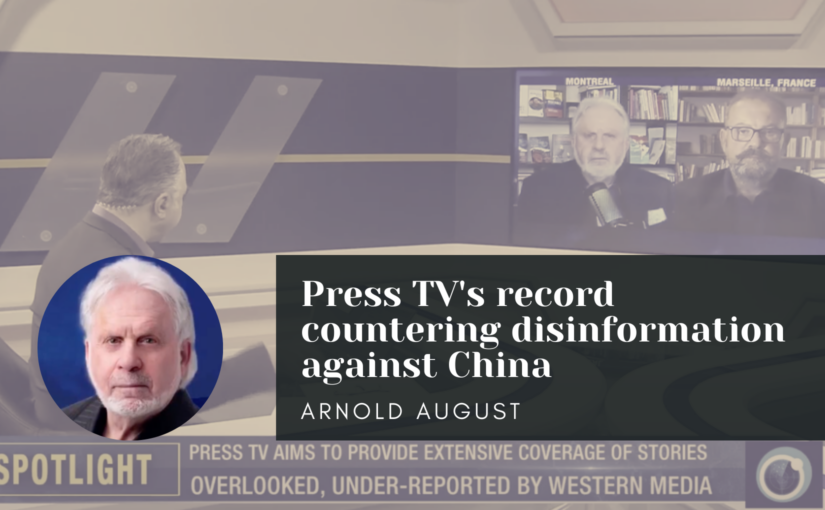
On the occasion of the 15th anniversary of Press TV, on July 2, 2022 an extensive interview was carried out by the Tehran-based channel’s anchor and producer Kaveh Taghvai with Arnold August of Montreal, and journalist Elijah Magnier of Marseille, France. We are pleased to reproduce extracts from the special anniversary edition of the Spotlight programme of Iran’s Press TV that deal with China. August focused on the impressive Press TV pushback against US-led disinformation regarding China, such as “genocide” in Xinjiang, Hong Kong protesters, Taiwan, the “authoritarian” rule of the Communist Party of China. Also dealt with were the Press TV coverage of the China-Iran twenty-five-year cooperation agreement, BRICS and the Belt and Road Initiative.
Author: Friends of Socialist China

Danny Haiphong and Carlos Martinez discuss NATO, BRICS and the New Cold War
On 1 July, our co-editors Danny Haiphong and Carlos Martinez had a detailed discussion on Danny’s Left Lens YouTube show about the crisis in Ukraine, NATO’s escalation against both Russia and China, the comparison between the recent BRICS and NATO Summits, and the foreign policy continuity from Trump to Biden. Watch below.
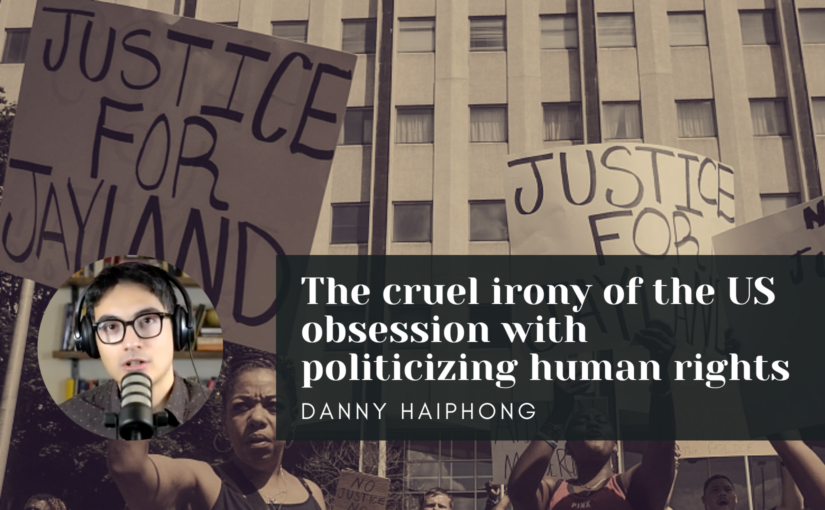
The cruel irony of the US obsession with politicizing human rights
Co-editor of Friends of Socialist China Danny Haiphong explains why the US’s obsession with politicizing human rights against China is both baseless in substance and a deflection from its own heinous human rights record in all areas of economic, social, and political development. This article was originally published on CGTN.
The 50th session of the United Nations Human Rights Council (UNHRC) has entered its last week of deliberation. This particular session of the UNHRC saw the United States immediately politicize the issue of human rights by signing a statement from the Kingdom of the Netherlands and 46 other countries condemning China. The letter expressed “grave” concern over the human rights situation in China, listing the popular talking points in the West regarding the Xinjiang Uygur Autonomous Region, Hong Kong Special Administrative Region, and the Tibet Autonomous Region.
China’s Permanent Representative to the UN Office at Geneva Chen Xu said that “disinformation has become rampant, which seriously runs counter to the original purpose of the Human Rights Council.” Cuba made a joint statement on behalf of 70 countries, stating that “the affairs of Xinjiang, Hong Kong and Tibet are China’s internal affairs.”
The U.S.’s politicization of human rights against China is ironic in a cruel way. Washington refuses to acknowledge the mountain of evidence proving that its allegations against China are illegitimate in the eyes of the rest of the world. The Organization of Islamic Cooperation (OIC) sent a delegation to China and expressed satisfaction with its treatment of Muslims, including Uygurs, in a resolution on their findings. The OIC includes 57 member states and a population of near two-billion people. In 2020, Cuba made a statement on behalf of 45 countries that praised China’s counterterrorism and deradicalization policies in Xinjiang.
Continue reading The cruel irony of the US obsession with politicizing human rights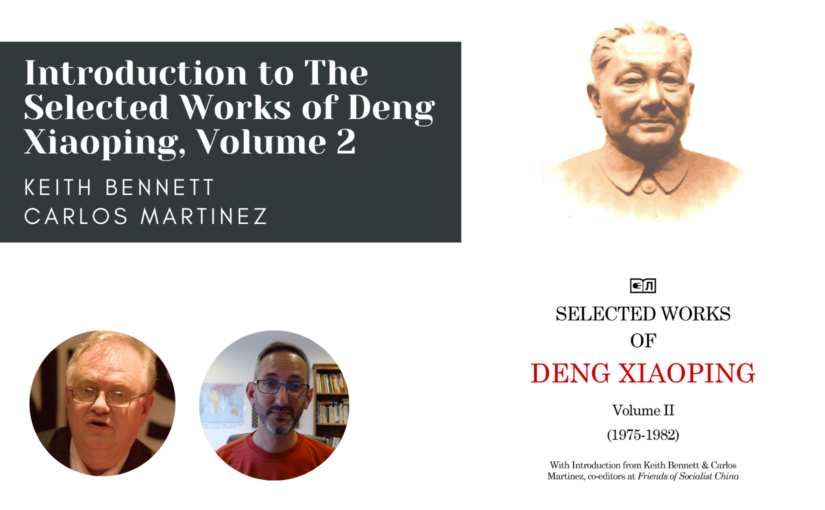
Introduction to The Selected Works of Deng Xiaoping, Volume 2
The following article was written by Friends of Socialist China co-editors Keith Bennett and Carlos Martinez on request from our friends at Laika Press. Their new edition of Volume 2 of the Selected Works of Deng Xiaoping can be found on their website.
History will record Deng Xiaoping as one of the great communist leaders of the 20th century; someone who made an indispensable contribution to the development of Chinese socialism and to the global socialist project. Yet this contribution is widely misunderstood among the left in the imperialist countries, much of which shows more ignorance and prejudice than knowledge and understanding when it comes to assessing actually (and formerly) existing socialism.
Deng Xiaoping might be said to suffer particularly in that regard. Left and right are seemingly united in assessing him as the man who led China back to capitalism – their difference confined to whether they see this as a good or a bad thing. Yet the veracity of this myth (not to say gross calumny against a man who devoted his entire life from his teenage years until his death at age 92 to the liberation and uplifting of the Chinese people and the international cause of communism) becomes harder to sustain with each passing day in the face of the steady progress made by socialist China.
In contrast to his appraisal by much of the western left, Deng Xiaoping is loved by hundreds of millions of ordinary people in China – as a man who was devoted to their welfare, did more than anyone else to lift them out of poverty and gave them life chances of which they could not previously have dreamt. Not for nothing is it said that China stood up under Mao Zedong, became rich under Deng Xiaoping and is becoming strong under Xi Jinping.
Viewed internationally, Deng’s wisdom in finding a way to both preserve and advance socialism in China overlapped with the demise of the Soviet Union and the collapse of socialism in Central and Eastern Europe. Deng Xiaoping therefore rendered not only immortal service to the Chinese people but also to the international working class, oppressed nations and peoples, and humanity in general. In a critical period, it is not an exaggeration to say that Deng Xiaoping, along with his veteran comrades like Chen Yun – as well as the leaders of the Democratic People’s Republic of Korea, Cuba, Vietnam and Laos – literally saved world socialism. As he said in a talk with Tanzania’s Julius Nyerere in 1989, “so long as socialism does not collapse in China, it will always hold its ground in the world.”
Historical continuities
This volume covers the period from 1975-1982. However, there is a gap between October 1975 and May 1977. This is itself significant in that it coincided with the second time that Deng was removed from office in the history of the PRC. Inevitably this finds reflection in the tone of the articles. Prior to his dismissal Deng Xiaoping was working closely with an ever more ailing Premier Zhou Enlai to bring order and stability to the economy and society after nearly a decade of turmoil and upheaval. Chairman Mao was also gravely ill and the ambitious Gang of Four were scheming to seize complete power. It was the Gang of Four’s suppression of popular mourning for the much-loved Premier Zhou when he passed away in February 1976 that allowed them to, in turn, engineer Deng’s second dismissal. However, and as officially reported at the time, it was on Mao Zedong’s proposal that Deng, whilst dismissed from his posts, was not expelled from the party. Despite all the complexities of the time, this should be affirmed as one of Chairman Mao’s last great services to the people of China and the world.
A simplistic reading of modern Chinese history views Deng Xiaoping Theory, Reform and Opening Up and Socialism with Chinese Characteristics as constituting a fundamental break with the politics of the Mao leadership. While it is certainly true that Deng led the introduction of significant changes to which Mao would likely have been opposed, at least in his later years, we contend that these innovations were strongly grounded in the Chinese Marxism to which Mao Zedong had made the single most important contribution. Indeed the slogan so often identified with Deng’s practical approach – seek truth from facts – had been used by Mao as far back as the Sixth National Congress of the CPC in 1938, as Deng himself notes in his 1978 speech Hold High the Banner of Mao Zedong Thought and Adhere to the Principle of Seeking Truth From Facts: “Comrade Mao Zedong wrote a four-word motto for the Central Party School in Yan’an: ‘Seek truth from facts.’ These four words are the quintessence of Mao Zedong Thought.”
The late Egyptian Marxist Samir Amin wrote that the economic take-off of the post-1978 period “would not have been possible without the economic, political and social foundations that had been built up in the preceding period”. One crucially important factor was a relatively stable international environment, in particular China’s improved relations with the leading capitalist countries.
From 1950 the US imposed a tight embargo on China and mobilised its allies to prevent China from taking its rightful place at the United Nations. Then China’s access to the technologically advanced countries was further circumscribed from the late 1950s with the Sino-Soviet split. It was the re-establishment of relations between the US and China from 1972, and China’s accession to the UN in 1971, that transformed China’s international environment and laid the ground for developing trade links with, and absorbing technological expertise from, the capitalist world. Although Opening Up became official policy in 1978, the process can be considered as having begun several years earlier, guided by Mao Zedong and Zhou Enlai.
Premier Zhou had long been vocal about the need for China to catch up with the West in science and technology, in order to raise productivity and improve the material wellbeing of the population. In his last major speech, at the Fourth National People’s Congress in 1975, he spoke of the need to take advantage of the relatively stable international context to “accomplish the comprehensive modernisation of agriculture, industry, national defence and science and technology before the end of the century, so that our national economy will be advancing in the front ranks of the world.”
In Deng’s speech at the Opening Ceremony of the National Conference on Science in 1978 (contained in this volume), he observed: “Modern science and technology are now undergoing a great revolution… Profound changes have taken place and new leaps have been made in almost all areas. A whole range of new sciences and technologies is continuously emerging. Modern science opens the way for the improvement of production techniques and determines the direction of their development.” However, as things stood at the time, there was still an “enormous gap between the level of our science and technology and that of the most advanced countries.” To bridge the gap and push forward China’s program of comprehensive modernization, it was imperative to learn from others.
One must learn from those who are more advanced before he can catch up with and surpass them… Independence does not mean shutting the door on the world, nor does self-reliance mean blind opposition to everything foreign. Science and technology are part of the wealth created in common by all mankind. Every people or country should learn from the advanced science and technology of others… Even after we catch up with the most advanced countries, we shall still have to learn from them in areas where they are particularly strong.
Only by opening up, learning new techniques, improving productivity and realising the Four Modernizations would it finally be possible “to rid our country of poverty and backwardness” and create the conditions for building common prosperity.
Four Cardinal Principles
Deng insisted on the essential political continuity between the era of initial socialist construction and the era of reform, encapsulating this unity in the Four Cardinal Principles:
- We must keep to the socialist road.
- We must uphold the dictatorship of the proletariat.
- We must uphold the leadership of the Communist Party.
- We must uphold Marxism-Leninism and Mao Zedong Thought.
In his speech Uphold the four cardinal principles, he put forward the formula that “socialism and socialism alone can save China,” warning that if China drops its commitment to socialism, it will “inevitably retrogress to semi-feudalism and semi-colonialism.”
Upholding the dictatorship of the proletariat and the leadership of the Communist Party – that is, upholding the principles of socialist democracy rather than capitalist democracy – provides the fundamental guarantee for continuing along the path of socialism. The Chinese leadership well understood the risks involved in encouraging private capital, foreign investment, and “letting some get wealthy first.” Only by sticking to socialist democracy, to the rule of the working classes, is it possible to restrict the power of capital, to protect the overall interests of the masses, and to prevent a regression to capitalism.
Reiterating the continued relevance of Marxism-Leninism and Mao Zedong Thought, Deng highlights the fundamental correctness of the Chinese Revolution, its socialist path and its anti-imperialist strategy. His remarks were made in a context where there was wide discussion of mistakes the party had made during the last years of Mao’s life, particularly during the Cultural Revolution (1966-76). By upholding Mao Zedong Thought, Deng was warning against what Xi Jinping has referred to as “historical nihilism” – painting a distorted and unnecessarily negative picture of the first decades of the People’s Republic. Deng asserts: “Despite our errors, in the past three decades we have made progress on a scale which old China could not achieve in hundreds or even thousands of years.” In another speech in this volume, Emancipate the Mind, Seek Truth from Facts and Unite as One in Looking to the Future, he appraises Mao’s record in the following terms:
The great contributions of Comrade Mao in the course of long revolutionary struggles will never fade… It is no exaggeration to say that were it not for Chairman Mao there would be no New China.
In a fascinating 1980 interview with the Italian journalist Oriana Fallaci, Deng again insists that Mao’s “contributions are primary and his mistakes secondary”, and that “we will forever keep Chairman Mao’s portrait on Tiananmen Gate as a symbol of our country”. Poignantly, he adds: “We will not do to Chairman Mao what Khrushchev did to Stalin.”
Relations between fraternal parties
Deng Xiaoping also spearheaded reforms and changes to the party’s international work, adopting a broader and more flexible approach. In his talk with senior party officials on May 31 1980, published here as An Important Principle for Handling Relations Between Fraternal Parties, Deng began by stating:
When a Communist Party comments on the actions of a foreign fraternal Party, it may often judge them according to some rigid formula or established pattern. Facts have shown that this approach gets one nowhere. Conditions vary greatly from country to country, the level of political awareness varies from people to people, and the class relations and the alignment of class forces in one country are vastly different from those in another. How can a fixed formula be applied mechanically despite all these differences?
Specifically, China had, at that time, started to resume relations with major communist parties that were considered ‘Eurocommunist’ and he argued:
Similarly, the correctness of Eurocommunism should not be judged by outsiders: it is not for others to write articles affirming or denying it. It should be judged by the European Parties and peoples themselves, and in the final analysis their own practice will provide the answer. We can’t criticize people when they conduct experiments in line with their own conditions. Even if they are wrong, it is up to them to sum up their own experience and try a different path.
This article certainly struck a chord with one of us, as he made his first visit to China just under a year later and was told by the Party International Department: “As for the internal policies of these parties [the communist parties of Spain and Italy] we do not want to say very much…, but we deeply feel that the question of how to make a revolution in the countries of Western Europe remains an unanswered one.”
Conclusion
Comrades! While building our own country, our working class must always keep in mind the proletariat and the oppressed people and nations of the world. We must go on strengthening our unity with the workers and revolutionary people the world over and support their struggles against imperialism, colonialism and hegemonism as well as their struggles to win or safeguard national independence and to make social progress. We must make our contribution to the emancipation of the working class throughout the world and to the progress of all mankind.
Depending on how you measure, China is now the world’s largest or second-largest economy. It is the only country to have jumped from ‘low’ to ‘high’ in the Human Development Index since the measure was launched in 1990. China has successfully eliminated extreme poverty, is the global leader in renewable energy, has become a science and technology powerhouse, and is a key driving force in support of development throughout the Global South. Such remarkable successes are testament to Deng Xiaoping’s vision.
As with other maligned revolutionaries, the greatest antidote to the slanders is to read and learn what they actually stood for, said and wrote. In publishing the works of Deng Xiaoping, and other great revolutionary leaders, and making them widely available and affordable, Laika Press is to be warmly congratulated and supported.
Keith Bennett and Carlos Martinez
London, July 2022
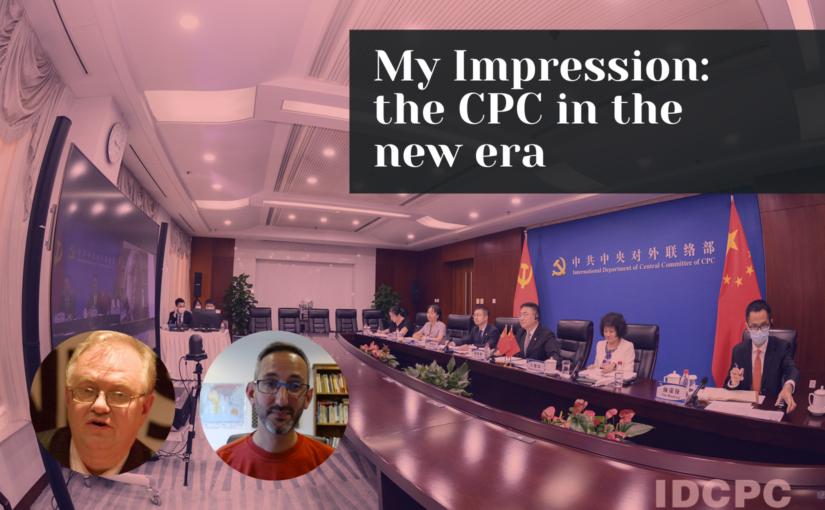
My Impression: the CPC in the new era – report
On Wednesday May 25th, the International Department of the Central Committee of the Communist Party of China organised an online meeting with comrades in Britain around the theme ‘My Impression: the CPC in the new era’.
According to the letter of invitation: “In 2021, the Communist Party of China (CPC) solemnly celebrated its centenary and convened the Sixth Plenary Session of its 19th Central Committee, through which we took stock of the major achievements and historical experience of the Party’s endeavours over the past century… In 2022, the CPC will hold its 20th National Congress, which is a major political event for both the Party and the country. As the changes of the times combine with the once-in-a-century pandemic, the international landscape is evolving at a faster pace, and the world finds itself in a new period of turbulence and transformation. As far as China itself is concerned, we are committed to upholding the CPC leadership, putting people first and sticking to the new path to modernisation of socialism with Chinese characteristics. In this process we look forward to strengthening communications and dialogues… and to understanding your take on China’s development as well as your expectations on China and the CPC in the new era and the upcoming 20th CPC National Congress.”
A delegation from Friends of Socialist China participated in the meeting, where the keynote address was given by Comrade Guo Yezhou, Vice-Minister of the CPC International Department.
Co-Editors of Friends of Socialist China, Keith Bennett and Carlos Martinez both delivered speeches, which we publish below.
Speeches were also made by Comrades Robert Griffiths, General Secretary of the Communist Party of Britain (CPB), Ella Rule, Chair of the Communist Party of Great Britain (Marxist-Leninist) (CPGBML), Andy Brooks, General Secretary of the New Communist Party of Britain (NCPB), and Jacob Maseyk of the Young Communist League (YCL) of Britain.
The CPC International Department carried the following report on its website: International Department Central Committee of CPC (idcpc.org.cn)
Also embedded below is a short video produced by the International Department featuring clips from different ‘My Impression: the CPC in the new era’ meetings held with comrades in various countries. The video includes clips of the speeches made by Friends of Socialist China co-editors Keith Bennett and Carlos Martinez, as well as advisory group member (and Communist Party of Britain General Secretary) Robert Griffiths.
Speech by Keith Bennett
Dear Comrades
First, on behalf of Friends of Socialist China, I would like to thank the International Department of the Central Committee of the Communist Party of China for their kind invitation and express our full support for this meeting. We are very pleased to join with all the other comrades participating here.
In the time available to me, I am choosing to focus on one of your suggested themes, namely important and most memorable moments of your interactions with the CPC and China. We are talking about several decades so I can only touch on a few aspects.
I suppose that my first contact with China was at the age of about 12 or 13, when I rang on the bell of the Chinese Embassy in London and asked to be given a copy of the Red Book and a badge with Chairman Mao’s portrait – which they were pleased to do.
Probably my first formal interaction with the CPC was around the 11th National Congress of the Party in August 1977. I proposed to the National Committee of the organisation I was a member of at that time that we send greetings to the congress, which I then drafted. Considering that I had celebrated my 19th birthday just days before, and considering that then, as now, I considered the CPC to be the most important party of the world communist movement, I was so thrilled when I saw the message printed in full in the Daily Bulletin of the Xinhua News Agency.
Since that time, although generally not sent in my own name, I have drafted messages of greetings to most, if not all, of the subsequent congresses. For the last, 19th Congress, I wrote my draft in the port of Gwadar, where I was able to see for myself how the China Pakistan Economic Corridor has the potential to transform not just Pakistan but the wider region as a flagship of President Xi Jinping’s Belt and Road Initiative.
From the 11th Congress to the eve of the 20th is a long road. So much has changed in China, Britain and the world. But one thing that has remained constant is my friendship with the Communist Party of China and my support for socialist China. That is why I believe it is fair and accurate to describe ours as an all-weather friendship and as a relationship of good friends, good comrades and good brothers and sisters, united by the same ideals and beliefs and committed to the same cause, although the concrete circumstances of our struggles differ radically.
My first visit to China was made in April and May 1981, with the last week being as a guest of your department. In those days, from the centre of Beijing one had to drive through quite a bit of countryside to reach your guest house. I had travelled quite extensively in China before reaching Beijing, including seeing the early days of the household responsibility system in Anhui province. To reach Beijing we made a long train journey from Nanjing. The days when China would be covered by the world’s biggest network of high-speed rail seemed far off. I was still only 22 and this was my first time in Asia, so my memories of that visit are abiding ones. It was a time of taking pride in China’s immense achievements since Liberation, but also of summing up mistakes, rectifying errors, learning everything that was useful and charting a new course. One could sense the people’s aspirations for a better life and felt that China was on the cusp of great change. But still one could not have imagined how far and how fast China would develop in the ensuing decades.
The most abiding impression I took away with me, from which I have never wavered, is that whatever the obstacles they might face, and whatever the twists and turns, the Chinese people, under the leadership of the Communist Party of China, will succeed in their goal of building a strong, modernised and prosperous socialist country and in making a greater contribution to humanity.
Another very memorable aspect of that visit is that it was a time for reassessment, not only with regard to China’s socialist development, but also with regard to the international communist movement and the international work of the party more generally. Naturally this was reflected in our discussions and I still recall the following words of one of your comrades:
“We deeply feel that the question of how to make a revolution in the countries of Western Europe remains an unanswered one.”
I am sure that he was trying to give me a message in a very polite, diplomatic and comradely fashion. I hope that it has been well received.
As part of this reassessment, the CPC was starting to move away from the policy it had hitherto followed for some years of overwhelmingly confining its relations to what were then termed the “genuine Marxist-Leninist parties and organisations”. One of the first developments was the resumption of relations with mass communist parties in Europe that displayed a degree of independence. Indeed, shortly before my own visit, Comrade Enrico Berlinguer had led the delegation of the Italian Communist Party, then well over a million strong and a very major participant in national political life. This was followed by the resumption or establishment of relations and exchanges with communist parties of various kinds, revolutionary democratic, national democratic and national liberation parties and movements throughout the Global South, socialist and social democratic parties, and then significant political parties without regard to ideology or differences in view. The culmination of this process has seen the CPC come to play an indispensable part in China’s overall diplomacy and external work and in global political affairs generally, as well as in steadily strengthening the unity, cohesion and effectiveness of the world communist movement, of which today’s meeting is but one example. I am so proud to have accompanied you on that journey, enjoying and benefiting from our friendship at every step.
In November 1989, speaking with Tanzanian President Julius Nyerere, Comrade Deng Xiaoping said: “So long as socialism does not collapse in China, it will always hold its ground in the world.”
Today, under the bold and wise leadership of Comrade Xi Jinping, socialist China is steadily marching towards the centre of the world stage. As Comrade Xi said at the 19th Party Congress, the new era will be one “that sees China moving closer to centre stage and making greater contributions to humanity.” Socialism with Chinese characteristics, he further pointed out, “offers a new option for other countries and nations who want to speed up their development while preserving their independence; and it offers Chinese wisdom and a Chinese approach to solving the problems facing humanity.”
It is in this spirit and against this background that a small group of us formed Friends of Socialist China a year ago this month. We did so for two distinct reasons that together form an integrated whole: To support and defend the People’s Republic, especially in the context of the new Cold War being waged by the USA, Britain and other imperialist countries against China and other socialist and independent countries; and also to promote understanding of Chinese socialism, because, in the words of our founding statement:
“The global advance to socialism is indispensable if humanity is to survive and to flourish; humanity needs socialism in order to prevent climate breakdown, end poverty, establish global peace and work towards dismantling structural discrimination and oppression.”
We applaud Comrade Xi Jinping’s resolute opposition to historical nihilism with our statement that: “We believe that the record of the socialist countries is overwhelmingly positive; that socialism has been able to – or has the potential to – solve many of humanity’s most burning issues; that the most impressive advances in people’s living conditions have occurred under socialist systems; that socialist states and movements played the decisive role in the defeat of European fascism and Japanese militarism; that the socialist world was pivotal to the dismantling of colonialism; that the socialist states have made historic strides in tackling discrimination based on race, ethnicity and gender.”
The gains made by working people in the capitalist countries, for example our National Health Service, have always been inseparable from the strength, example and inspiration of the socialist countries. Equally, it is no coincidence that the setbacks encountered by global socialism, particularly around 1989-91, fuelled neoliberalism and savage attacks on working people everywhere that the socialist system did not exist. China’s historic elimination of extreme poverty, its advance to the front ranks of the world economy, its building of an ecological civilisation, its transition to a high income country, and the building of a China that is, in Comrade Xi’s words, “a great modern socialist country that is prosperous, strong, democratic, culturally advanced, harmonious, and beautiful” is decisive not only for the destiny of the Chinese people but also for that of global socialism and therefore humanity.
We need to study, disseminate and apply Xi Jinping Thought as 21st century Marxism and continue the long march with our Chinese comrades towards a bright socialist future for the whole of humanity.
Thank you once again for your initiative in organising this meeting and for inviting us. We wish every success to the 20th National Congress of the great Communist Party of China!
Speech by Carlos Martinez
China’s progress over the last decade has been truly inspirational.
At the 18th National Congress of the Communist Party of China in 2012, General Secretary Xi Jinping put forward the Two Centenary goals: to achieve a “moderately well-off” society by 2021, and a “great modern socialist country that is prosperous, strong, democratic, culturally advanced, harmonious and beautiful” by 2049.
In pursuit of the first centenary goal, millions of cadres were mobilised in a targeted poverty alleviation campaign, with the goal of eliminating extreme poverty. At the start of that campaign, eight years ago, just under 100 million people were identified as living below the poverty line. By late 2020, the number was zero.
And it’s important to note that rising out of poverty in China means more than just surpassing an income threshold. It also means having assured access to adequate food and clothing, along with guaranteed access to medical services, safe housing with drinking water and electricity, and nine years of free education.
Meanwhile, the land ownership system in China means that the rural poor have rent-free access to land and housing – putting them in an entirely different category to the rural poor elsewhere in the world.
As Xi Jinping has observed, “thanks to the sustained efforts of the Chinese people from generation to generation, those who once lived in poverty no longer have to worry about food or clothing or access to education, housing and medical insurance.”
To eradicate extreme poverty in a developing country of 1.4 billion people, which at the time of the founding of the People’s Republic of China was one of the poorest countries in the world – characterised by widespread malnutrition, illiteracy, foreign domination and technological backwardness – is a truly extraordinary achievement, and it’s an achievement of socialism. It is possible because of the leading position of the working class and peasantry.
As Deng Xiaoping put it in 1987, “only the socialist system can eradicate poverty.”
Poverty alleviation is part of the DNA of the Communist Party of China. It’s a thread that runs throughout the history of the Chinese Revolution, starting with the land reform measures in the liberated areas before 1949, and continuing with the dismantling of the feudal system after the founding of the People’s Republic, then Reform and Opening Up, and now the targeted poverty alleviation program.
Meanwhile in the West, where the bourgeoisie is the ruling class – and where neoliberal economic theory has dominated for several decades – the last ten years have witnessed an alarming rise in poverty and inequality.
In 2019, I visited two important cities for the first time: Beijing and New York. New York is unquestionably a wonderful city in many respects, but the levels of deprivation and inequality, the widespread homelessness, along with the crumbling infrastructure and simmering social tensions, are quite stark – certainly when compared with Beijing, which stands out as a very modern, harmonious, well-organised city, in which the problems of homelessness and extreme poverty have been solved.
Another key area in which China has made outstanding progress in the last decade is in the fight against climate breakdown and in promoting biodiversity, clean air and clean water.
In 2017, Xi Jinping introduced the concept of ‘ecological civilisation’, putting environmental sustainability at the heart of Chinese policy-making. And in 2021, China committed to reaching peak carbon emissions by 2030 and carbon neutrality by 2060, and has already developed systematic programs for reaching these goals.
China is already by far the world leader in renewable energy, with a total capacity greater than the US, the EU, Japan and Britain combined. China’s forest coverage has doubled in the last four decades. Meanwhile it also leads the world in the production and use of electric cars, trains and buses.
China has led the way in the battle against the Covid-19 pandemic. Its dynamic Zero Covid strategy has saved millions of lives in China. Furthermore China has provided extensive assistance to countries around the world, particularly in the Global South, supplying enormous quantities of medical supplies, as well as more than 2 billion vaccine doses.
The Belt and Road Initiative, first advanced in 2013, has transformed the global investment landscape for infrastructure and connectivity, particularly in the developing world. Over 140 of the world’s 195 countries have formally affiliated to the Belt and Road, assisting them in addressing their substantial needs in terms of physical infrastructure, telecommunications, transport, and energy production and transmission.
Meanwhile China is playing a crucial role in international organisations, promoting peace, dialogue, multilateralism and multipolarity.
American politicians sometimes refer to the US as “the indispensable nation”. But if we look at what country is contributing the most to poverty alleviation, to global development, to the construction of a more peaceful world, to the fight against the pandemic, to the fight against climate breakdown; and if we contrast that with the US’s record of non-stop war, unilateral sanctions, destabilisation and bullying; we would have to conclude that China is much closer to meeting the definition of “indispensable” than the US is.
Looking to the future, with the first centenary goal now achieved, the second goal is coming into sharp focus. Building a great modern socialist country in all respects implies taking on relative poverty, improving per capita GDP, reducing inequality between regions and groups, and developing in an ecologically sustainable manner.
Common prosperity will be a key theme: reducing inequality, increasing the size of the middle income population, and improving the lives of the least affluent.
The CPC and the government it leads are not in the habit of making empty promises, and significant progress has already been made on tackling the disorderly expansion of private capital, housing speculation, extreme income inequality, and excessive power of tech companies and private education providers.
In the coming years and decades, Chinese people will increasingly come to enjoy a standard of living and quality of life comparable to, or indeed ahead of, working people in the advanced capitalist countries. And unlike in the advanced capitalist countries, this shared wealth won’t have its origins in historic colonialism and ongoing hegemonism, but in the hard work of the people and the sustained wise leadership of the CPC.
China’s successes since the founding of the PRC, and the successes it will surely achieve on the path to becoming a great modern socialist country in all respects, should serve to inspire working people around the world as to what can be achieved under socialism.
And for this reason, the Western ruling classes are working round the clock to ensure that ordinary people know nothing about China’s progress. The mass media barely mentions China’s successes in poverty alleviation. Rather than commending China for its handling of the pandemic, newspaper headlines talk about how “oppressive” and “authoritarian” the dynamic Zero Covid strategy is. Politicians and journalists accept that millions of lives have been saved as a result of China’s Covid suppression efforts, but they never fail to ask: “but at what cost?” As if human life had a quantifiable cost, and as if millions of deaths might have been “worth it” for the sake of smoother-running supply chains and corporate profits.
In order to pull the wool over people’s eyes, the West is waging a systematic propaganda war against China. Consuming mainstream media in Britain or the US, what you hear about China is that a “cultural genocide” is happening in Xinjiang; that pro-democracy students are being attacked by the Hong Kong police; that China is trapping African, Asian, Latin American, Caribbean and South Pacific countries in “debt traps”.
This web of lies is serving to keep people ignorant about the reality of Chinese socialism, and therefore it is extremely important to debunk these fabrications.
The slander that there is a “genocide” or “cultural genocide” against Uyghur Muslims, or that there are “concentration camps” in Xinjiang, has been repeated a thousand times. And yet, anyone visiting Xinjiang can see the total falsehood – indeed the utter absurdity – of this slander.
I personally went to Ürümqi in January 2020, with a group of friends. We walked around freely and certainly didn’t see any evidence of religious persecution or ethnic oppression. In fact we saw hundreds of Uyghur Muslims, wearing Uyghur clothing, going about their normal lives and practising their culture, religion and traditions.
We ate in Uyghur restaurants, where the food was halal and where alcohol wasn’t available. We heard the Uyghur language being spoken everywhere. All road signs have both Uyghur and Chinese writing. You see Uyghur language newspapers and magazines everywhere.
It’s notable how many mosques there are. Indeed Xinjiang has one of the highest concentrations of mosques in the world. And this is what the Western media calls a “cultural genocide”!
One of the reasons we formed Friends of Socialist China, just over a year ago, was to systematically oppose this propaganda war – a propaganda war that serves the interests of the imperialist ruling classes, and that runs directly counter to the interests of the working classes and oppressed communities.
As Marxists, as communists, as people working to popularise and promote socialism, we consider it crucial to spread an understanding of the remarkable successes of socialist China.
We deeply value our relationship with the CPC International Department, and we look forward to expanding our work together with you and with the other organisations represented here today.
US ‘forced labor’ allegations in Xinjiang nothing but imperial projection
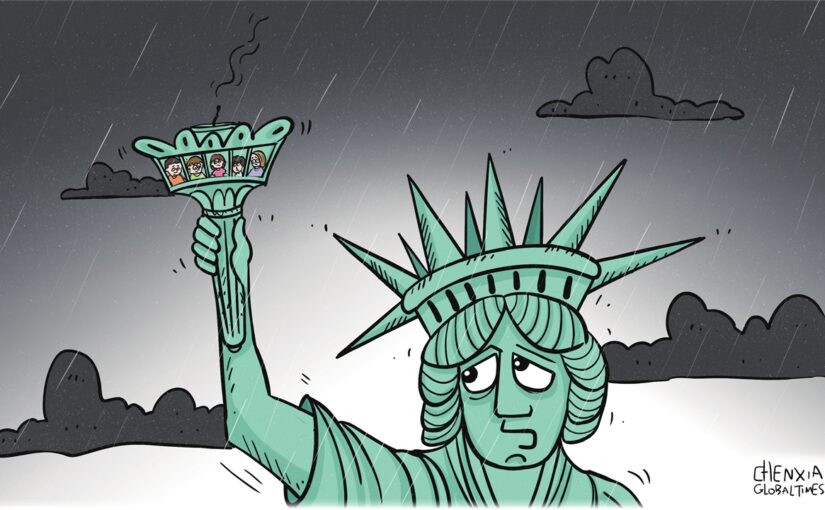
The following article by Friends of Socialist China co-editor Danny Haiphong, originally carried in the Global Times on 3 July 2022, addresses the recent implementation of the Uyghur Forced Labor Prevention Act, effectively imposing a blanket ban on goods produced in Xinjiang. Danny notes the startling hypocrisy of the US – the global capital of prison labor and modern slavery – slandering China on this basis. He further points to the two central motivations for the ‘China Bad’ narrative: firstly, creating a scapegoat for the steadily worsening problems of contemporary US capitalism; secondly, increasing demand (and thereby profits) for the military-industrial complex. What is abundantly clear is that ordinary people in the US have absolutely nothing to gain from the ruling class’s New Cold War.
US President Joe Biden has begun enforcing the Uyghur Forced Labor Prevention Act that was passed in late 2021. The legislation is comprised of a set of economic sanctions that represent some of the broadest the US has leveled upon China since the normalization of relations between the two countries. This includes a ban on all imported goods from the Xinjiang Uygur Autonomous Region and a US Department of Commerce review of all goods produced outside of the region that may have connections to economic institutions in Xinjiang. These measures have been justified by Biden and the US political establishment as a measured response to China’s use of “forced labor” in Xinjiang, particularly of its Uygur minority ethnic group. Allegations of forced labor in the region have never been proven and both foreign companies and Uygur workers alike have denied its existence.
That the US would attempt to punish China over forced labor is a clear act of imperial projection. Forced labor is a serious problem in the US. According to a new report from the American Civil Liberties Union, US prisoners produce more than $11 billion in profits and services despite being paid an hourly wage of between $0.13 and $0.52. Seven states were found to pay no compensation for prison labor. Prisoners cited that punishment in the form of solitary confinement and family visitation was routinely employed against those who refused to work.
Continue reading US ‘forced labor’ allegations in Xinjiang nothing but imperial projection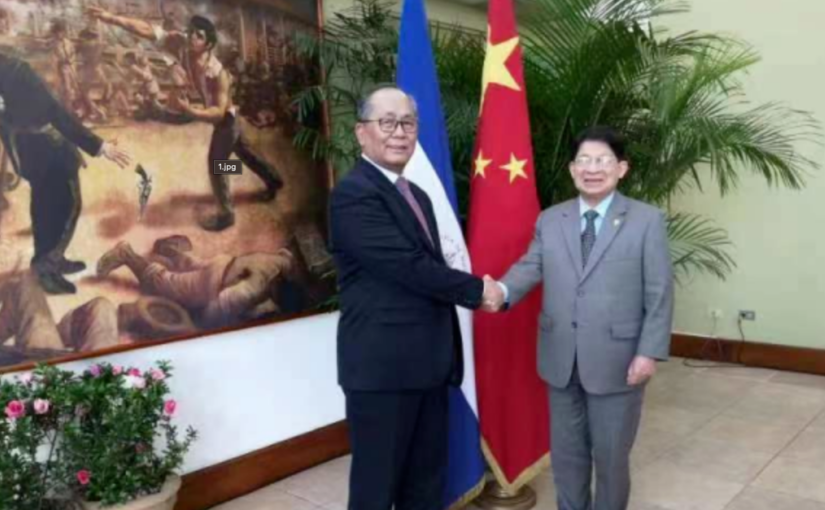
China stands with progressive Latin America
Two recent events served to underline the close and developing relations between China and progressive Latin America.
As part of a regional tour, Special Representative of the Chinese Government on Latin American Affairs, Qiu Xiaoqi, visited Nicaragua from June 25-27.
Meeting Nicaraguan Foreign Minister Denis Moncada on June 25, Qiu said that since the resumption of diplomatic ties more than six months ago, bilateral relations have been developing rapidly and flourishing with all-round progress. China, Qiu noted, “firmly supports Nicaragua in safeguarding its sovereignty, independence and national dignity and independently choosing its development path and governance model.”
For his part, Moncada said that Nicaragua “is willing to be a trustworthy brother and partner of China. The Nicaraguan side thanked China for its selfless help and is ready to seize the huge opportunities brought by China’s development and create more benefits for the Nicaraguan people. The Nicaraguan side thanked China for speaking up for Nicaragua in the international arena and will work with China to safeguard international fairness and justice as well as the rights and interests of developing countries.”
Meanwhile, on June 28, State Councillor and Foreign Minister Wang Yi had a phone conversation with his Venezuelan counterpart Carlos Faria, coinciding with the 48th anniversary of the two countries’ establishing diplomatic relations.
Wang Yi said that the Chinese side thanks Venezuela for standing firmly with China and speaking out for justice. China will, as always, firmly oppose external forces’ interference in Venezuela’s internal affairs under any pretext, firmly support Venezuela in safeguarding national sovereignty and social stability and support the Venezuelan people in choosing a development path suited to their national conditions. He added that the trend toward a multi-polar world, economic globalisation and greater democracy in international relations is irresistible. China is ready to work with Venezuela to stand on the right side of history, uphold international fairness and justice, safeguard the common interests of developing countries and jointly build a community with a shared future for humanity.
For his part, Faria extended warm congratulations on the forthcoming 101st anniversary of the founding of the Communist Party of China, hailing the CPC as a great political party that holds high the banner of socialism with Chinese characteristics and has always been committed to serving the Chinese people.
The following reports were originally carried on the website of the Chinese Foreign Ministry.
Nicaraguan Foreign Minister Denis Moncada Meets with Special Representative of the Chinese Government on Latin American Affairs Qiu Xiaoqi
From June 25 to 27, 2022, Special Representative of the Chinese Government on Latin American Affairs Qiu Xiaoqi visited Nicaragua. On June 25, Nicaraguan Foreign Minister Denis Moncada met with visiting Special Representative Qiu Xiaoqi in Managua. The two sides had an in-depth exchange of views on bilateral relations and international and regional issues of common concern. Chinese Ambassador to Nicaragua Chen Xi attended the meeting.
Qiu Xiaoqi said that since the resumption of China-Nicaragua diplomatic ties more than six months ago, bilateral relations have been developing rapidly and flourishing with all-round progress in political, economic and trade, and cultural cooperation. China firmly supports Nicaragua in safeguarding its sovereignty, independence and national dignity and independently choosing its development path and governance model. China is ready to strengthen synergy with Nicaragua and promote fruitful practical cooperation across the board. In the face of global challenges, the two countries should take the implementation of the Global Development Initiative and Global Security Initiative as an opportunity to strengthen coordination and cooperation in international affairs and jointly build a more peaceful, secure and prosperous world.
Moncada said, the rapid development of bilateral relations since the resumption of diplomatic ties more than six months ago fully proves that the resumption of diplomatic ties between Nicaragua and China is a correct decision that accords with the historical trend and serves the fundamental interests of the two countries and two peoples. Nicaragua will unswervingly abide by the one-China principle and is willing to be a trustworthy brother and partner of China. The Nicaraguan side thanked China for its selfless help, and is ready to seize the huge opportunities brought by China’s development and create more benefits for the Nicaraguan people. The Nicaraguan side thanked China for speaking up for Nicaragua in the international arena, and will work with China to safeguard international fairness and justice as well as the rights and interests of developing countries.
Wang Yi Speaks with Venezuelan Foreign Minister Carlos Faria on the Phone
On June 28, 2022, State Councilor and Foreign Minister Wang Yi had a phone conversation with Venezuelan Foreign Minister Carlos Faria at the latter’s request.
Wang Yi said that today coincides with the 48th anniversary of the establishment of diplomatic relations between China and Venezuela, and our phone conversation is just at the right time. Since the establishment of diplomatic ties, China-Venezuela relations have remained rock-solid regardless of changes in the international landscape. The leaders of the two countries have established solid mutual trust and friendship, providing important political guarantee and strategic guidance for the development of the China-Venezuela comprehensive strategic partnership. China is ready to continue to deepen political mutual trust, pass on the traditional friendship and enhance mutually beneficial cooperation with Venezuela.
Wang Yi said that the Chinese side thanks Venezuela for standing firmly with China and speaking out for justice on Taiwan, Hong Kong, Xinjiang and human rights issues. China will, as always, firmly oppose external forces’ interference in Venezuela’s internal affairs under any pretext, firmly support Venezuela in safeguarding national sovereignty and social stability, and support the Venezuelan people in choosing a development path suited to their national conditions. The Chinese side will continue to provide assistance within its capacity to the Venezuelan side in fighting the pandemic.
Wang Yi pointed out that China and Venezuela should continue to strengthen solidarity and coordination in multilateral affairs, safeguard the legitimate rights and interests of the two countries, practice true multilateralism, and safeguard the international system with the United Nations at its core and the international order underpinned by international law. China appreciates Venezuela’s active support for President Xi Jinping’s Global Development Initiative (GDI) and stands ready to strengthen cooperation with Venezuela to jointly forge a global development partnership and well implement the UN 2030 Agenda for Sustainable Development. The trend toward a multi-polar world, economic globalization and greater democracy in international relations is irresistible. China is ready to work with Venezuela to stand on the right side of history, uphold international fairness and justice, safeguard the common interests of developing countries and jointly build a community with a shared future for mankind.
Faria said that under the guidance of the two heads of state, the Venezuela-China comprehensive strategic partnership has made great progress and is full of vitality. He thanked China for providing strong support to Venezuela in its fight against the pandemic. Venezuela firmly supports the one-China principle and the principle of “one country, two systems”, firmly supports China in safeguarding national sovereignty, independence and territorial integrity, and stands ready to work with China to deepen mutually beneficial cooperation in innovative ways. China is playing an increasingly important role in the international arena. The Venezuelan side speaks highly of President Xi Jinping’s GDI and other initiatives and is ready to deepen communication and coordination with China within the frameworks of the Group of Friends of the Global Development Initiative and the Group of Friends in the Defense of the Charter of the United Nations to jointly uphold multilateralism. In particular, Faria extended warm congratulations on the 101st anniversary of the founding of the Communist Party of China (CPC) in advance, hailing the CPC as a great political party that holds high the banner of socialism with Chinese characteristics and has always been committed to serving the Chinese people.
CPC deepens relations with Nepal’s communist parties
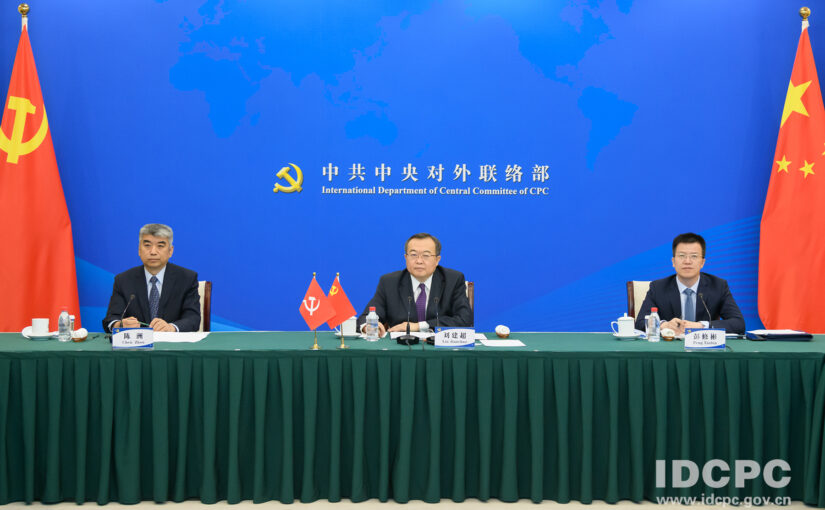
Liu Jianchao was recently appointed as the Minister of the International Department of the Central Committee of the Communist Party of China, succeeding Song Tao, who completed his term of office. On being informed of his appointment, in a message to a relevant official of the International Department, Friends of Socialist China wrote:
“We wish him every success in his responsible work, and good health, and stand ready, as ever, to maintain and develop our greatly valued friendship and our close cooperation.”
Comrade Liu’s first announced engagement in his new role was to meet separately with the Ambassadors of the four other socialist countries to China, namely the Democratic People’s Republic of Korea (DPRK), Vietnam, Laos and Cuba. In a brief report, the International Department noted that the meetings, “focused on exchanging views on consolidating and deepening the traditional friendship between China and the four countries, and relations between the ruling parties of China and the four countries, continuously promoting cooperation in various areas, and jointly boosting the development of socialist causes in the new era.”
A longer report was issued on his next reported engagements, which took place on June 23 and 24, when he held video calls with the leaders of Nepal’s two main communist parties – Prachanda, Chairman of the Communist Party of Nepal (Maoist Center) and KP Sharma Oli, Chairman of the Communist Party of Nepal (Unified Marxist Leninist), both of whom are also former Prime Ministers.
According to Liu, the CPC and the two Nepalese parties share similar philosophies and close ties. In turn, both Nepalese parties said that they give top priority to relations with China and the CPC.
Following the calls, the CPC signed memoranda of exchange and cooperation with both parties.
Some days later, Liu also held a video call with Nepalese Foreign Minister Narayan Khadka, who is also the leader of the Nepali Congress party.
The following report on the online meeting with the Nepali communist leaders was originally carried on the website of the CPC International Department.
On June 23 and 24, Liu Jianchao, Minister of the International Department of the CPC Central Committee, held video calls with Prachanda, Chairman of the Communist Party of Nepal (Maoist Center) and former Prime Minister of Nepal, and KP Sharma Oli, Chairman of the Communist Party of Nepal (Unified Marxist Leninist) and former Prime Minister of Nepal respectively.
Liu said that China and Nepal are friendly neighbors linked by mountains and rivers, and development partners sharing the same destiny. In October 2019, General Secretary Xi Jinping paid a historic visit to Nepal. China-Nepal relations were upgraded to the China-Nepal strategic partnership of cooperation featuring ever-lasting friendship for development and prosperity, and entered a new era of rapid development. The Chinese side is willing to work with the Nepali side to implement the important consensus reached by the leaders of the two countries, deepen mutual political trust, actively promote practical cooperation in major projects and various fields under the framework of the Belt and Road Initiative, and push the friendship across the Himalayas to new heights.
Liu said, the CPC and the Communist Party of Nepal (Maoist Center) and the Communist Party of Nepal (Unified Marxist Leninist) share similar philosophies and close ties. The CPC is willing to strengthen inter-party exchanges, promote “political parties plus” cooperation, enhance people-to-people bond, and respect each other’s core interests and major concerns, so as to play a role in facilitating the healthy and stable development of China-Nepal relations. The 20th CPC National Congress will be held in the second half of this year, which will draw a blueprint for China’s development in the next phase and will certainly provide new impetus for the development of China-Nepal relations. The CPC is willing to strengthen exchanges with political parties in Nepal on state governance and administration.
Prachanda and Oli said, the friendship between Nepal and China has grown ever stronger as time goes by and the Nepali side appreciates the Chinese side’s support for Nepal in safeguarding sovereignty and territorial integrity and opposing foreign interference and China’s valuable help for Nepal to fight against the Covid-19 epidemic. The Communist Party of Nepal (Maoist Center) and the Communist Party of Nepal (Unified Marxist Leninist) give top priority to the relations with China and the CPC. The two Parties will continue to firmly uphold the one-China principle, support the issues related to each other’s core interests and major concerns, adhere to the path of independent development, and will never allow any forces to use the Nepali territory to engage in any anti-China activities. The major achievements and historical experience of the CPC’s century-long struggle have provided important inspiration and lessons for the Nepali political parties. The Communist Party of Nepal (Maoist Center) and the Communist Party of Nepal (Unified Marxist Leninist) are willing to strengthen cooperation with the CPC in such areas as the joint construction of the Belt and Road Initiative, so as to promote the long-term and stable development of Nepal-China relations. We look forward to the 20th CPC National Congress and wish it a complete success.
After the video calls, the Chinese representatives also signed memorandums of exchange and cooperation with the representatives of the Communist Party of Nepal (Maoist Center) and the Communist Party of Nepal (Unified Marxist Leninist) respectively.

Comparing the response to Covid-19 in China and the US
The following article by John V Walsh, republished from Popular Resistance, debunks various misconceptions about China’s response to the Covid-19 pandemic, and contrasts China’s performance with that of the US. Walsh observes that the deaths per million figure in the US currently stands at 3,042; for China the figure is 3.7. So on this metric – surely the most meaningful in terms of assessing a given country’s public health response to a pandemic – China has outperformed the US by a factor of over 800. Anticipating the usual cries of “you can’t trust the Chinese numbers”, Walsh links to numerous articles in the scientific literature confirming the validity of China’s statistics.
While China clearly pursued a strategy that prioritized human life over corporate profits, the author notes that, ironically, China’s economy has also fared far better than the US’s since the start of the pandemic. Walsh concludes that the Chinese experience “should not be lightly dismissed let alone be the subject of mean-spirited attacks” since the measures taken “may be a means of saving millions of lives when the next variant or the next pandemic strikes”.
Covid Deaths In The US (Over 1 Million) And China (About 5000).
“History Should Judge Us” – and it will.
In May and June of 2022 two milestones were passed in the world’s battle with Covid and were widely noted in the press, one in the US and one in China. They invite a comparison between the two countries and their approach to combatting Covid-19.
The first milestone was passed on May 12 when the United States registered over 1 million total deaths (1,008,377 as of June 19, 2022, when this is written) due to Covid, the highest of any country in the world. Web MD expressed its sentiment in a piece headlined: “US Covid Deaths Hit 1 Million: ‘History Should Judge Us.’”
Second, on June 1, China emerged from its 60-day lockdown in Shanghai in response to an outbreak there, the most serious since the Wuhan outbreak at the onset of the pandemic. The total number of deaths in Mainland China since the beginning of the epidemic in January 2020 now stands at a total of 5226 as of June 19,2022.
To put that in perspective, that is 3042 deaths per million population in the US versus 3.7 deaths in China due to Covid. 3042 vs. 3.7! Had China followed the same course as the US, it would have experienced at least 4 million deaths. Had the US followed China’s course it would have had only 1306 deaths total!
The EU did not fare not much better than the US with 2434 deaths per million as of June 19.
Continue reading Comparing the response to Covid-19 in China and the US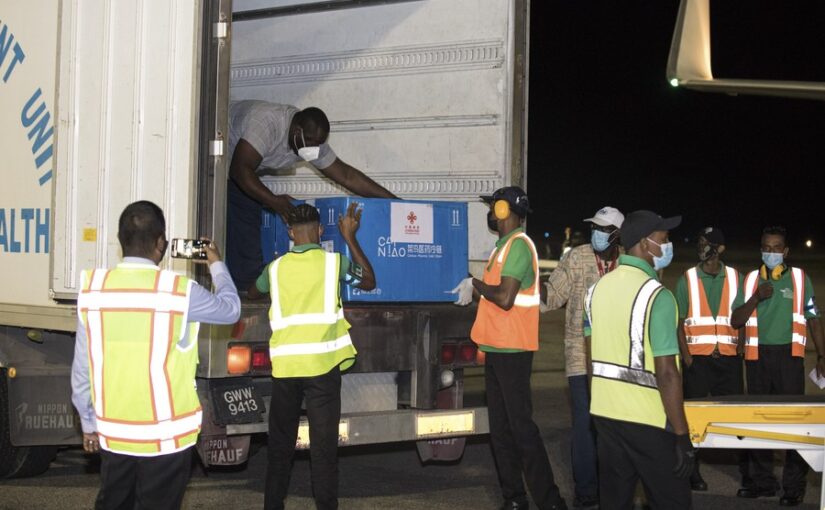
Guyana and China: 50 years of diplomatic ties and future prospects
On June 27th, China and Guyana celebrated the 50th anniversary of their establishment of diplomatic relations. Guyana’s bold move, becoming the first country in the English-speaking Caribbean to establish official relations with the People’s Republic, was followed by Jamaica on November 21st that year. Together this marked a milestone in the development of friendship and cooperation between the peoples of China and the Caribbean and in the developing countries’ common struggle against imperialism.
Marking this anniversary, Chinese President Xi Jinping exchanged messages with his Guyanese counterpart Irfaan Ali. Writing in the local media, China’s Ambassador to Guyana Guo Haiyan noted that trade between the two countries grew by 123% in 2021.
Friendship with China constitutes a bipartisan policy in Guyanese politics. A statement from the Office of the Leader of the Opposition noted that:
“We in Guyana will and must always appreciate that during the 1980s, when the country faced steep economic challenges, China without hesitation provided much needed assistance to Guyana. With modest beginnings in the seventies, the economic exchanges have grown to impressive dimensions. Guyana and China now cooperate over a wide range of economic areas and are involved in major projects which can transform Guyana and benefit China as well. The emergence of Guyana as a petro-state will further catalyse and intensify this trend.”
An example of this was the conclusion last month of a US$260 million agreement with a Chinese joint venture company for the construction of a new bridge across the Demerara River. Speaking at the ceremony, Guyana’s Finance Minister, Dr. Ashni Singh said: “Make no mistake that you are witnessing history today. The making of modern Guyana is well underway, and today’s generation of Guyanese are incredibly privileged not only to witness it, but to be part of it.”
Writing in China Daily on June 15th, Donald Rabindranauth Ramotar, who was President of Guyana from 2011-2015, and General Secretary of the People’s Progressive Party (PPP) from 1997-2013, said that:
“When China established diplomatic relations with Guyana in 1972, it was still very underdeveloped. Guyana’s per capita GDP was higher than that of China. Yet China helped the country try to lessen its dependence on a few big capitalist countries and the unequal trade relations inherent in capitalist relations.”
Ramotar goes on to explain how this relationship has only deepened as China has grown from a poor developing country to become the world’s second-largest economy. China, he notes, “has become a great example. It is one of the most studied countries as mankind looks to build a better future.”
We are pleased to reprint his article below.
On June 27, Guyana and the People’s Republic of China will celebrate 50 years of diplomatic relations. These have been 50 very fruitful years, and our relations have been mutually enriching for both countries.
When China established diplomatic relations with Guyana in 1972, it was still very underdeveloped. Guyana’s per capita GDP was higher than that of China. Yet China helped the country try to lessen its dependence on a few big capitalist countries and the unequal trade relations inherent in capitalist relations.
We recall the assistance China provided for the establishment of the Sanata Textile Mill in Georgetown and the clay brick factory in Canal’s Polder. At that time, these were significant investments in the country. Many houses, built with materials produced by the clay brick factory, are still standing and are testament to the friendship between China and Guyana.
China has changed dramatically over the past 50 years. From being a poor developing country, it has developed into the world’s second-largest economy, and its prestige has soared, with its achievements known around the globe. It leads the world in many spheres of the scientific and technological revolution and has had an impact on almost every country. It is widely recognized for its innovation and progress.
China has become the greatest builder in the world, in terms of both physical structures that it has constructed at home and abroad and in its advocating of fair international relations. It promotes true equality and the independence of countries. China correctly describes its partnerships as “win-win”. This gives dignity to every country. For the first time, many small and middle-income developing countries have the belief that they are on an equal footing with other higher-income countries.
We in Guyana, like so many other countries, have benefited greatly from cooperation with China over the years. Some of our most important structures have been built by Chinese contractors. The convention center and the Marriott Hotel stand out in Georgetown and evoke pride among our people.
Our airport is being modernized by another contractor from China. Moreover, we have agreements with Chinese companies to build a modern bridge across the Demerara River.
In 2013, President Xi Jinping proposed the Belt and Road Initiative. This has the great potential to really unite the world and create new wealth and prosperity for all participants.
Guyana has signed up with China to be part of this historic project, which is uniting millions of people around the world.
This initiative has also prompted the West to react. Not so long ago, the United States and the European Union, still unable to shed their old habits in pursuit of self-interest, announced their own initiative to help build up world infrastructure. They have talked of millions of dollars to begin this work. At this time, its performance cannot be evaluated, since it is only at the embryo stage.
What is very significant about this Western project, though, is that it has come about primarily not as a means to assist the less wealthy Third World countries but to counter the constructive move of China and to try to limit China’s great influence in the world. That, of course, is not a good premise to start from.
China is now the largest trading partner for the majority of countries. Its contribution to global economic growth is now the largest in the world.
These are remarkable feats.
China has become a great example. It is one of the most studied countries as mankind looks to build a better future.
Fifty years of diplomatic relations between China and Guyana have seen very beneficial cooperation and a demonstration of support without strings attached. This is not unique, because this is how China relates with all countries it has ties with, and the win-win approach promotes friendship, solidarity and peace.
In evaluating this period, we must give it the highest marks and further deepen our ties with the People’s Republic of China. Most important, the past 50 years of good diplomatic relations between the two countries have strengthened the close friendship between our peoples.
The author is former president of Guyana.
Deciphering the Chinese economic miracle: lessons for the developing world
We are pleased to publish this important article by Associate Professor Efe Can Gürcan, which sets out what he describes as the ‘Chinese miracle’, “that China has enjoyed unprecedented economic success in world history despite enormous historical, demographic, geographical and geopolitical adversities.” Despite this, he notes, “China has developed an exemplary model of economic development that inspires much of the developing world.” Therefore, “to decipher the formula behind China’s historic economic success” is to “offer fundamental hints to guide developing countries in their endeavours to reach an advanced stage of economic development.”
Professor Gürcan surveys the various stages of China’s socialist development under Mao Zedong, Deng Xiaoping, Jiang Zemin, Hu Jintao and Xi Jinping, noting that “the roots of the Chinese economic miracle can be traced back to the early phase of the Chinese revolution under the leadership of Mao,” who he sees as the real originator of the concept of socialism with Chinese characteristics. Deng Xiaoping developed this, including by digging deeper into Mao’s work, for example his, ‘A Critique of Soviet Economics’, and he highlights Deng’s view of the essence of socialism lying in the “liberation and development of the productive forces, elimination of exploitation and polarisation, and the ultimate achievement of prosperity for all.”
Professor Gürcan concludes by stating that: “In contrast to Western capitalism, the Chinese economic miracle does not originate from forced accumulation, wars, and colonialism. On the contrary, it springs from peaceful development and international cooperation. Understood as such, China’s model also constitutes the living example of the rising relevance and superiority of socialism over the capitalist system.”
This is an extremely important article that is worthy of careful study. It was originally published in Volume 3 Issue 2 of the Turkish journal Belt and Road Initiative Quarterly (BRIQ) and is reproduced with thanks. The article can be also be read/downloaded in PDF form.
Abstract
Despite enormous historical, demographic, geographical, and geopolitical adversities, China has enjoyed unprecedented economic success in world history. This article aims to decipher the formula behind China’s historic economic success and distill policy lessons for developing countries in their endeavors to reach an advanced stage of economic development. Based on descriptive case study and statistics, the article suggests that the Chinese economic miracle can be explained by a four-fold formula: a) devising an autocentric economic model aspiring to improve national autonomy and cushion the impact of foreign interference, b) insisting on socialism and the leadership of the Communist Party of China (CPC), which allows for strategic coherence and long-term planning to overcome free-market anarchy, c) creating a state-driven industrial base fueled by national science and technology policies, and d) adopting a balanced approach to development centered on attaining a higher sociocultural and ecological quality of life. The findings also help to debunk the myths surrounding the Chinese miracle, particularly the “cheap labor thesis”, the “technology theft thesis”, the “foreign investment and capitalist integration theses”, the “imperialism thesis”, and the “Mao-the-monster thesis”.
Keywords: Chinese miracle,economic development, Mao Zedong Thought, socialism with Chinese characteristics, Xi Jinping Thought
Deciphering the Chinese Economic Miracle: Lessons for the Developing World
The “Chinese miracle” has become a widely used term in development studies, inspiring developing countries to achieve high levels of prosperity, living standards, and stability over the last decade. The popularity of this term can be explained in large part by the fact that China has enjoyed unprecedented economic success in world history (Zakaria, 2011; Gürcan 2021a), despite enormous historical, demographic, geographical, and geopolitical adversities. China was one of the world’s poorest countries before the socialist revolution in 1949. In the early revolutionary era, China struggled much to overcome its crippling semi-colonial legacy characterized by the medieval conditions of an agricultural economy and the weakness of its industrial base. History aside, China is the largest country by population size, which currently accounts for 22% of the world’s population. This goes hand in hand with China’s resource scarcity problem as a structural adversity constraining its development potential. China possesses only 7% of the world’s arable land and freshwater resources and 8% of the world’s natural resources. Furthermore, only 19% of its surface area is suitable for human habitation, and 65% of its surface area is rugged. This severely cripples China’s farming capabilities and facilitates ethnic heterogeneity as a potential impediment to political cohesion (Morton, 2006; Naughton, 2018). Another adversity threatening China’s economic development concerns geopolitical circumstances. Cases in point are how China’s membership in the United Nations was stalled until 1971, and the US resorted to military interventions in China’s neighboring regions to suffocate the revolution. The current geopolitical circumstances find their sharpest expression in the current US containment strategy and the US-led trade and technology war against China (Gürcan, 2019; Gürcan, Kahraman & Yanmaz, 2021).
Despite such adversities, China has developed an exemplary model of economic development that inspires much of the developing world. Since 1979, China is the only country that has remained untouched by any economic crisis. The 1979-2018 period testified to an average economic growth rate of 9.4% in the lead of the CPC, making China the world’s second-largest economy, top producer, and the leading exporter of technological goods (Hu, 2020). By 2015, China came to assume the global production of 40% of washing machines, 50% of textiles, 60% of buttons, 70% of shoes, 80% of televisions, and 90% of toys. Recently, China has made significant progress in producing higher-value added products in the computer, aviation, and medical technology sectors, among others. One should also note that China has risen to the world’s largest lender to the developing world, second-largest investor in foreign direct investment (FDI), and top leader in green bonds and credits. China’s contributions to green finance also bring to mind China’s global leadership in sustainable development. China has recently emerged as the world’s top leader in green transportation as the largest producer of electric buses and the largest market for electric vehicles and bikes. Similarly, China’s status as the world’s top producer of solar, wind, and hydroelectric power is closely related to its reputation as the world’s top investor in sustainable energy technology (Gürcan, 2021a). Besides China’s historic success in economic and environmental development, one should also note that the Chinese economic miracle is credited for 70% of global poverty eradication between 1990 and 2015 (Gardner, 2018).
Continue reading Deciphering the Chinese economic miracle: lessons for the developing world
Building the “New Three Rings”: China’s choice in the face of possible complete decoupling
We are pleased to republish, from Monthly Review (MR) Online, this interesting discussion article by Professor Cheng Yawen, from the School of International Relations and Public Affairs, Shanghai International Studies University, previously carried by Culture Vertical and China Environment News.
According to Professor Cheng, the conflict in Ukraine marks the end of the US-led globalisation wave. As a result, China urgently needs to make a new choice in its diplomatic and strategic priorities to downgrade the importance of Europe and the US and to promote a new international system based on South-South cooperation. He says that whilst many people believe globalisation to be irreversible, the question still needs to be posed as to what to do should a full decoupling occur in the future. Events in Ukraine mean that China no longer has the peaceful external environment it has enjoyed for the past 40 years. This necessitates a greater focus on other developing countries, who, in turn, need to break from dependence on western countries and intensify cooperation amongst themselves. Drawing on Mao Zedong’s thesis of surrounding the cities from the countryside, Professor Cheng notes that: “The Russia-Ukraine conflict and the West’s unrelenting sanctions against Russia further highlight the fact that most of the world’s countries are in the ‘countryside’ on the periphery, while a few are in the ‘city’ in the centre, and the United States is the ‘city centre.’”
Outlining how, since the days of the Communist International, and through all subsequent phases, the Chinese revolution has advanced in close coordination with the movements of oppressed nations and peoples, Professor Cheng shows in detail how South-South cooperation has actually become more realistic today.
Introduction
Since the change of China and the United States in 2018, the world situation has been in turmoil, and various “decoupling theories” have become popular at home and abroad. Especially since the Russia-Ukraine conflict, the international situation has become clearly camped, and the United States is targeting China from all aspects of domestic and foreign affairs. Although many people believe that globalization is irreversible and do not believe that there will be a day of full decoupling, how should we respond if full decoupling does occur in the future?
This article argues that the Russia-Ukraine conflict is a landmark event in the end of U.S.-led globalization, meaning that China no longer has the peaceful external development environment it has enjoyed for the past 40 years. In the future China will have to promote a new global system, a “three-ring” international system that will guarantee China’s national security and development: the first ring is China’s neighboring East Asia, Central Asia and the Middle East, with which China has formed a close industrial division of labor and through which it obtains a stable energy supply and a reliable security barrier. The second ring is the developing countries of Asia, Africa and Latin America, with which China exchanges raw materials and industrial goods and assists their development; the third ring extends to the traditional industrialized countries, mainly in Europe and the United States. The “first ring” is the key to China’s construction of a “new three-ring” international system. In recent decades, a new global system has been formed among developing countries in Asia, Africa, and Latin America, and the solid foundation formed by developing countries in terms of economic volume, trade exchanges, and economic cooperation is not what it used to be, but in order to further enhance their economic and political autonomy, they must break away from their financial and monetary dependence on Western countries. Therefore, to build a “new three-ring” international system, developing countries should also develop higher-level and broader financial and monetary cooperation among themselves.
Russia’s “special military operation” against Ukraine, and the ensuing full-scale confrontation between the West and Russia, is a landmark event in the end of the globalization tide that has been underway since the 1980s. The U.S. is holding its allies hostage to impose deadly sanctions on Russia and forcing the rest of the world to choose sides between the West and Russia, which has led to a recurrence of the deadly struggle of a century ago and poses a huge challenge to China. The “end of globalization” has left China without the external development environment it has had for the past four decades, and the U.S. push to rebuild its dominant international system and “decouple” from China and Russia is likely to intensify in the future. Today’s world is characterized by a paradigm shift. Faced with the possibility of a passive and comprehensive decoupling, China needs to take the initiative to make adjustments in its foreign strategic arrangements and make new choices in its national engagement priorities in order to shape a new international system that is conducive to counteracting the negative effects of the West’s decoupling of China.
In the thirty years since the collapse of the Soviet Union, Russia has gone from an initial active approach to the United States and the West, to a gradual alienation from them, to the current unrelentingly fierce confrontation, highlighting the political limits of globalization. Contrary to the romantic imagination of globalization, the latest round of globalization was initially an investment of U.S. hegemony, partly serving the purpose of dismantling the Soviet Union and the socialist camp, which determined that it could not be expanded indefinitely. In terms of the relationship between the leading and following countries of globalization, or between developed and developing countries, there are equal limits to international politics: when globalization backfires on its initiators and threatens their power advantage, globalization will inevitably be “reversed” and the path of operation will be redesigned. The process of globalization in recent decades and the pursuit of U.S. power dominance are the two sides of the same coin, and they are mutually conditional and mutually reinforcing. Russia’s “special military operation” against Ukraine is the result of this round of globalization, which has fully exposed its true nature of power and put an end to the U.S.-led globalization.
NATO’s expansion to the east is the main reason for Russia’s initiative. It appears to be a security issue, but in fact it is also an economic issue in the process of globalization. Peripheralization of the Soviet Union in the global system is the goal of the U.S.-initiated globalization process, and Russia’s intention to use globalization to achieve national renaissance and become a center-state clearly runs right counter to its occurrence and evolutionary logic. The interest of global capital, especially financial capital, in Russia is more focused on energy, food and minerals, which are the areas from which financial capital can make huge profits. But since Putin took power, Russia has strengthened its control over key industries that are crucial to national security and basic livelihoods, and is committed to building the Eurasian Economic Union and shaping an economic development space that is suitable for itself, something that external capital is not happy about. NATO’s expansion to the east is a manifestation of capital’s swaying politics to achieve market expansion, which continues to squeeze Russia’s development space and intensify Russia’s peripheralization. If no effective response is made, Russia will be further defined as a provider of primary products, lose its ability to participate in great power politics, and even have an internal crisis. This is what the Russian elite does not want to see.
NATO’s expansion to the east and the current Western sanctions against Russia have revealed the power structure of the contemporary world. “After the end of World War II, the European colonial system gradually collapsed, and the explicit rule of the international order since the second half of the 20th century was centered on the United Nations and international law, which embodied the principle of sovereign equality of states. However, the central-peripheral hierarchical international order under the European colonial system has not really disappeared, but has continued as a subtle rule and hidden order, except that the absolute hierarchical power relations characterized by direct drives in the past no longer exist, and have been replaced by a “common but differentiated” international order, i.e., all countries are sovereign and equal on the surface. In other words, all states are sovereign and equal, but in practice there are still differences in power. The “rule-based order” is the main expression of this order, in which all countries are required to follow the same rules, but the real meaning of these rules is not centered on the United Nations and international law, but on the Western countries.
The U.S. hegemony since the post-war period and the G-7 established after the 1970s are the main manifestations of the contemporary version of the global center-fringe order. The annual meeting of the G-7 discusses not only the affairs of seven countries, but also the affairs of the whole world, and they negotiate and then promote the transformation into global rules. The “rule-based order” is actually “an order based on the rules set by the West”, and it is the key who is the rule-maker. In a global division of labor system, rule-making, money supply and industrial goods production are the business of a few countries at the center, and if other countries want to join in, they risk dismantling the dominant position of a few countries, which is something countries that hold rule-making and monetary dominance and maintain technological superiority with intellectual property rights do not want to see. China’s unexpected economic growth in recent decades has disrupted the post-war center-periphery international order and threatened the unspoken rules centered on Western countries. The main reason for this is that China’s development has touched the cheese of the United States and other Western countries, which never envisioned that China could also “take center stage”, even if it is only “approaching” for now.
Whether it is the expansion of NATO to the east or the selection of China as a key target of the U.S. crackdown, it reflects that the U.S. and the West want to maintain and strengthen their own power advantage. The Russia-Ukraine conflict and the West’s unrelenting sanctions against Russia further highlight the fact that most of the world’s countries are in the “countryside” on the periphery, while a few are in the “city” in the center, and the United States is the “city center” in the global The “city center” of the “urban center”, the “city” does not want to see the “rural” like them The “cities” do not want to see the “countryside” become “cities” like them. The obstruction of the global “urban centers” by China and Russia lies both in their strong control over capital, which is the last two largest uncontrolled areas of capitalist globalization, and in the fact that they have become “urban centers” due to their much stronger state power compared to most countries. The two countries are also obstacles to the “urban centers” further controlling the “rural” fringes of the globe because they are much stronger than most countries. In this round of globalization, China, with its strong economic growth and overall increase in national power, has shown a tendency to move from the “rural” to the “urban” areas, and in contrast to its earlier overtures to globalization, the central countries have in recent years become “This has exposed the “common” limits of the post-war international order. The fact that China has become one of the “cities” is intolerable for the center-state.
In the first article of Selected Works of Mao Zedong, “Analysis of the Classes in Chinese Society,” the opening chapter poses the question: “Who are our enemies? Who are our friends? This question is the primary question of the revolution.” Over the past 40 years, China has carried out reform and opening up, and in recent years it has initiated the building of a community of human destiny. In its international exchanges, it no longer deliberately emphasizes the distinction between enemies and friends, but hopes to promote “beauty and commonwealth” in the “beauty of each, beauty of the beauty”. But can we achieve “commonwealth”? However, whether the world can achieve “commonwealth” is not determined by China’s wish alone. With the U.S.-led Western countries showing a full-scale confrontation with Russia and China, the contemporary world can no longer be considered mechanically as “peace and development”, but needs to seriously consider “competition” or even “war”. “Even if war can be ruled out, it is no longer possible to achieve better development in a globalized system dominated by Western countries. China has to rethink the “primary question” in its foreign dealings: who are the possible partners of China now and in the future, and who are the partners that China cannot pull in?
Things come together in groups, and people are divided by groups. The same is true for countries. Countries with similar experiences, situations and aspirations are more likely to form long-lasting cooperative relationships. In contemporary international relations discourse, Western vs. non-Western countries, developed vs. developing countries, and Northern vs. Southern countries are common distinctions between types of countries, with developed countries and Northern countries being mostly Western countries and Southern countries and developing countries being non-Western countries. Unlike the distinctions of developed vs. developing countries and North vs. South countries, which are economic in nature, the distinctions of Western vs. non-Western countries also point to political and cultural dimensions, implying global power relations. Since the nineteenth century, the world has undergone a “global transformation”: the formerly discrete “centerless, pluralistic world” has shifted to a highly interconnected and hierarchical “center-marginal” global system. The “imperialism” of the late 19th century and the revolutionary era of the first half of the 20th century is a description and characterization of the relationship between this order and the highly interconnected and hierarchical “center-periphery” global international system, of which the West was the center. Imperialism and globalization from the mid-to-late 19th century to the early 20th century were two sides of the same coin: imperialism came with globalization, and globalization strengthened imperialism, both of which together set up an “iron barrel formation” for countries on the periphery, from which it was very difficult to escape. The Western countries used to be the center of the global system and the place of imperialism, from which the colonial order of the modern world and the American hegemony since the middle and second half of the 20th century came; at the same time, many revolutions since modern times, including the anti-colonial movement in the middle and second half of the 20th century, were aimed at breaking this unequal and unjust center-marginal power structure.
In the center-fringe global power structure, the center states cannot sincerely help the revolution of the peripheral states, nor will they welcome the peripheral states to join the center states on an equal footing. During the Chinese revolution in the first half of the 20th century and the consolidation of power in the second half of the 20th century, the main external forces that China relied on were from the periphery of the global system. The Communist International network, in which the Chinese Communist Party was involved, was an alliance between the non-regime forces of the colonized and oppressed peoples of the time; in the war against Japan, China took the opportunity of its participation in the world war against fascism to continue the “anti-imperialist” demands of the previous Chinese revolution and to further promote the abolition of the various unequal rights imposed on China by the imperialist countries; in 1949, when the People’s Republic of China was founded, the Chinese government was able to achieve its goal. After the founding of the People’s Republic of China in 1949, China attached great importance to cooperation with “Third World” countries and supported the anti-colonial movement and post-independence nation-building in Asia, Africa and Latin America, especially its active participation in the Bandung Conference in 1955 and its proposal of the Five Principles of Peaceful Coexistence, which were well received by Asian, African and Latin American countries and became the basis for China’s cooperation with them. It also became an important point in the virtuous circle of relations between China and Asian, African and Latin American countries, and with the latter’s support and cooperation, China returned to the United Nations in 1971 and became a permanent member of the Security Council.
China’s mutual solidarity and assistance with Asian, African and Latin American countries in their resistance to colonial rule and nation-building have established a key feature of Chinese multilateralism in recent times, namely, the high priority given to cooperation with non-Western developing countries in defending national independence and development progress in their joint resistance to the unequal and unjust international order constructed by the central state. In its all-round diplomacy based on non-Western developing countries, China does not exclude its contacts and even the development of friendly and cooperative relations with developed Western countries and other major powers. However, it should also be noted that China’s past interactions and cooperation with the centerland countries have always been based on two premises: first, from China’s perspective, China insists on developing its foreign relations under the premise of independence, equality and reciprocity, and opposes the hierarchy of power in international relations; second, from the perspective of the centerland countries, their cooperation with China has always had a ceiling, which is not to shake the global power structure centered on the Western countries. structure. When either of these two premises changes, it will be difficult for China, as a developing country, to continue to develop cooperative relations with Western countries in depth, especially politically.
Over the past four decades, China has abandoned ideological differences and avoided differences in national systems, and has committed itself to cooperating with all countries, gradually forming a pattern of foreign relations in which “major powers are key, the periphery is primary, developing countries are fundamental, and multilateralism is an important stage. However, this pattern has encountered many obstacles when the time of “the end of globalization” comes. The “decoupling” of China’s economy, technology, knowledge, and people-to-people contacts, initiated by the U.S. with the help of other Western countries, is unlikely to be withdrawn by the war between Russia and Ukraine, but may be intensified.
Since the founding of the People’s Republic of China, it has undergone several changes in diplomatic direction, from the “one-sided” approach when the country was first established, to the “one line, one big area” and “three worlds” division in the 1970s, to the shift to reform and opening up after 1978, focusing on developing cooperation with Western countries. From the “one-sided” approach when the country was first founded, to the “one line, one big area” and “three worlds” division in the 1970s, to the shift to reform and opening up after 1978, focusing on developing cooperation with Western countries, all in response to the prevailing situation. At this time of “unprecedented changes”, Western countries are showing stronger and stronger intentions to suppress potential challengers, especially after the outbreak of the war between Russia and Ukraine, which has exposed the Western countries’ tendency to gather and suppress non-Western countries on all fronts, and will become a structural presence in international relations for a long time to come. China cannot help but be highly alert to the fact that the West’s omnipotent sanctions and repressive tactics against Russia will be applied to China in the future. For this reason, it is urgent to re-examine China’s past tradition of multilateralism, adjust the spatial pattern of its foreign relations, and strengthen cooperation with non-Western developing countries in order to create a new international environment conducive to safeguarding China’s national security and long-term development.
In 1974, Mao Zedong proposed the division of the “three worlds” and made an analysis of the three types of countries in the world at that time and the way China could interact with them, with the developing countries of the “third world” being the main target of China’s interaction and China itself being a member of the “third world”. “The Chinese government and people firmly supported the just struggle of all oppressed people and nations. The “three worlds” theory follows the previous experience of China’s foreign relations, which ranked the spatial priority of China’s foreign relations at that time and was an important ideological guide for China’s past participation in South-South cooperation, and it still has strong inspiration for China to reconstruct the spatial priority of its foreign relations at present. Compared to the increased emphasis on cooperation with Western countries since the reform and opening up, China will have to give prominence to promoting South-South cooperation in the future. Whether seeking diplomatic breakout, long-term development, or national rejuvenation, China’s foreign strategic arrangements will have to focus primarily on promoting the construction of a new global system based on Asia and its surrounding region for quite some time to come. The ultimate result is the formation of a “three-ring” international system to guarantee China’s national security and development: the first ring is China’s neighboring East Asia, Central Asia and the Middle East, where East Asia is connected to the world’s financial resources and China has formed a close industrial division of labor with the countries in this region, and Central Asia and the Middle East are connected to the world’s resources and China has to rely on the countries in this region for a stable energy supply and a reliable security barrier. The second ring is the vast number of developing countries in Asia, Africa and Latin America, with which China exchanges raw materials and industrial products, and China’s foreign aid should be mainly directed to these countries; the third ring extends to the traditional industrialized countries, mainly Europe and the United States, with which China exchanges industrial products, technology and knowledge. This “three-ring” structure is used to prioritize and redirect foreign contacts and to redefine the direction and content of foreign contacts.
The first and key to the construction of the “new three-ring” international system is in the “first ring”, that is, the two wings of Asia: one is East Asia, the other is Central Asia, the Middle East. In order to continue to further promote the process of economic integration in East Asia and strengthen the linkage with Central Asia and the Middle East, it is necessary to enrich the issues of interaction with Asian countries as a prerequisite. Over the past years, China has devoted itself to promoting economic diplomacy with other countries, and has strongly promoted East Asian economic integration and economic cooperation with many Asian countries. The latest breakthrough in East Asian economic integration is the conclusion of the Regional Comprehensive Economic Partnership (RCEP) after years of negotiations, which will enter into force on January 1, 2022. However, economic exchanges among East Asian countries have been increasingly affected by extraterritorial forces and security factors in recent years. Disputes over maritime rights in the South China Sea and the U.S. “Indo-Pacific” strategy have added uncertainty to the process of East Asian economic integration. China should step out of its previous “GDP supremacy” in international relations, pay attention to political and security issues, and promote more security cooperation among Asian countries to avoid internal problems in Asia from being exploited by external forces.
The basis of international relations for China’s promotion of a “new three-ring” international system is “South-South cooperation,” an old concept that emphasizes mutual cooperation and support among non-Western “third world” countries. It is an old concept that emphasizes mutual cooperation and support among non-Western “third world” countries. In the second half of the 20th century, the meaning of South-South cooperation was more political, as developing countries were generally economically underdeveloped and technologically weak, and the trade and technology exchanges between them were of limited help to each other and had little impact on the global economy. However, in fact, South-South cooperation is building a new foundation in the new century and has become more realistic today. The main reason is that, in recent decades, developing countries in Asia, Africa and Latin America have become industrialized or quasi-industrialized countries, following the wave of globalization and “laddering up” to a new global system in terms of global material production and circulation, and the original globalization “ladder” set up by the West has become a new global system. The original “ladder” of globalization built by the West has lost its color in their eyes. This new global system has the following main manifestations.
First, the global share of developing countries is not what it used to be: in 1980, developed countries accounted for 78.9 percent of global GDP, while developing countries accounted for only 21 percent; in 2021, developed countries’ share of global GDP falls to 57.8 percent, while developing countries’ share rises to 42.2 percent. The combined GDP share of the BRIC countries (Brazil, Russia, India, and China) plus Turkey, South Korea, and Indonesia in terms of purchasing power parity increases from 18 percent of the global economy in 1992 to 37.36 percent in 2021, while the G7 countries decline from 51 percent to 44 percent in the same period.
Second, trade exchanges and mutual investment among developing countries have also become pivotal. Trade between China and Africa increased 22.6 times between 1997 and 2010, and trade with Latin America increased 22 times; by 2021, China-Africa and China-Latin America trade will increase another 2 times and 2.5 times, respectively, compared to 2010. in 2000, China-Arab trade was only $15.2 billion, and by 2018 it reached $244.3 billion, an increase of 16 times in less than 20 years. Brazil’s trade with Arab countries increased fourfold from 2003 to 2010, while trade with Africa increased fivefold to a total of $26 billion, a figure higher than Brazil’s trade with traditional trading partners such as Germany or Japan; by 2019, Brazil’s trade with Arab countries and Africa increased 0.98 times and 0.68 times, respectively, compared to 2010. Since 2001, India’s trade with Africa has grown at an average annual rate of 17.2%, with 2.26 times more in 2021 than in 2011. India’s trade with Latin America and Middle East and North African countries has experienced similar growth. Both mutual trade and investment between emerging economies such as India and Brazil are also heating up rapidly, with trade volumes among developing countries growing faster than the global average growth rate, while trade exchanges with developed countries continue to decline, and the division of labor and cooperation among these countries in the production of primary and industrial goods replicates the historical globalized exchange of material goods.
Then again, from around China, Asia has formed a network of co-existing economic cooperation. This is demonstrated by the following.
In 1980, developing countries in Asia accounted for only 12.7% of the world’s GDP, but in 2010 it rose to 20.6%, and by 2021 it will reach 31.2%. By 2020, the 15 RCEP members will have a total population of 2.27 billion, a GDP of U.S.$26 trillion and total imports and exports of over U.S.$10 trillion, all accounting for about 30% of the global total. HSBC predicts that by 2030, the global share of economic volume of the RCEP economic circle will increase to 50%.
Second, the center of gravity of global trade and investment has also been shifting to Asia. Asia’s share in global trade increased from 15.7% in 1980 to 22.2% in 1990, 27.3% in 1995, 26.7% in 2000, 25.6% in 2001, and further rose to 36% of world trade in 2020, becoming the world’s leading trading bloc.
Third, the level of intra-Asian trade exceeds that of extraterritorial trade. between 2001 and 2020, total intra-Asian regional trade jumps from $3.2 trillion to $12.7 trillion, with an average annual nominal growth rate of 7.5%. During the same period, Asia’s share of total world trade increased from 25.6% to 36.0%, and in 2020, Asia’s intra-regional trade accounted for nearly 58.5% of foreign trade.
Fourth, the two wings of Asia are becoming one world economically, and the flow of energy from the Middle East has shifted from its previous direction mainly to Europe and the United States to East and South Asia.
To date, developing countries have initially formed a global economic system, but further economic and political unity is needed to achieve a higher degree of economic connectivity among them, as well as a stronger political influence in the international arena and freedom from the control or coercion of Western countries. Since the second decade of the 21st century, China has become the world’s largest real economy and the second largest economy, as well as the largest trading partner of most countries in the world; the global contribution of China’s manufacturing sector is close to 30% in 2021, and as the country that produces the most material goods in the world China’s global manufacturing contribution will be close to 30% by 2021, and as the world’s largest producer of material goods, it will play the role that the United States played at the end of World War II (at its peak, in 1953, the United States accounted for about 28% of global industrial output). What China can and should do is to actively promote the improvement of the global system of material exchange among developing countries in a global strategy, i.e., to truly realize South-South cooperation.
But there are still deficiencies. Current trade flows and mutual investments of developing countries still rely heavily on the financial and monetary networks provided by the West. If developing countries are to further enhance their economic and political autonomy, and if emerging economies are to gain political influence in the world system commensurate with their economic size, they must break away from their financial and monetary dependence on the West. Therefore, to build a “new three-ring” international system, it is necessary to consider not only the traditional geopolitical factors, but also the currency and information margins as important considerations. Over the past few years, China has explored this by developing currency swaps with some emerging market economies. A higher level and broader scope of financial and monetary cooperation should be developed among developing countries in general. To this end, there is a need to make good use of some existing platforms and mechanisms to take South-South cooperation to a new level, including upgrading and revamping the ADB and the BRICS Bank, and improving an autonomous and controllable international payment system; strengthening security cooperation in the Shanghai Cooperation Organization and China-Russia-India-Iran cooperation under its framework, especially financial cooperation, and the need to see that Russia is also a developing country and that China and Russia are highly complementary economically. The government should further promote the economic integration of East Asia under the framework of “One Belt, One Road”, especially consolidate the achievements of RCEP; build a common energy market in Asia, so that the energy buyers’ markets in East and South Asia and the energy sellers’ markets in the Middle East, Central Asia and Russia can share the same energy trading and payment network; make good use of the BRICS meeting mechanism, thus leading to the deepening of South-South cooperation; and promote the international cooperation between China and Russia. It should promote the internationalization of the RMB in the context of the diversification of the international monetary system and South-South cooperation, and provide support to the international status of the euro while hedging against the hegemony of the U.S. dollar.
One hundred years ago, the leaders of the Chinese Communist Party proposed the revolutionary path of “encircling the city in the countryside. At this time of “unprecedented changes”, China and the developing countries need to break the center-periphery order of the contemporary world and the Western countries’ prevention and suppression of non-Western countries, as well as to improve solidarity and cooperation in the global “rural” areas. The emergence of a new global system and the deepening of South-South cooperation will create good conditions for China to enter the forefront of the world economy and politics, and to mobilize global resources to build a “three-ring” international system, to resolve international pressures and to break through. After more than 40 years of reform and opening up, China must adjust its understanding of “opening up” and make a new breakthrough in its thinking about foreign exchanges. Of course, China should still try to maintain its cooperation with the West as long as possible, and should not give up on working with the latter as long as they do not make the choice to be completely enemies of China.
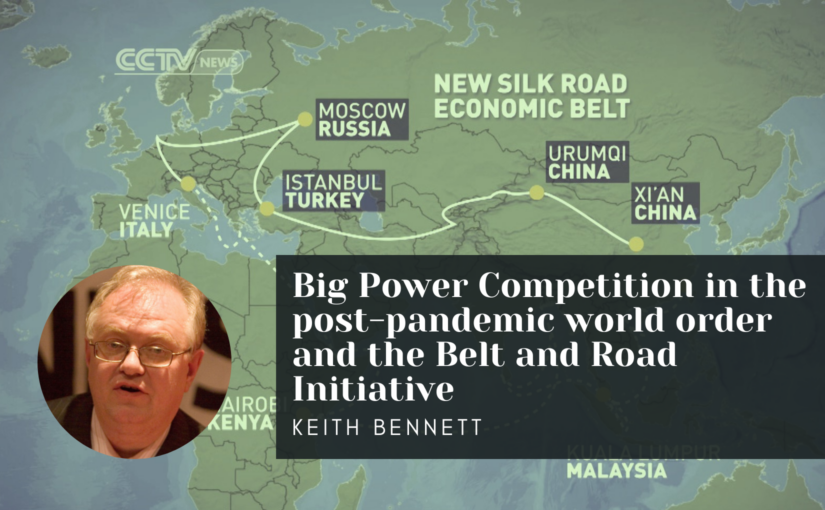
Big Power Competition in the post-pandemic world order and the Belt and Road Initiative
As part of its Friends of the Silk Road Series, the Pakistan China Institute organised a webinar on the theme, ‘Big Power Competition in the Post-Pandemic World Order and the Belt and Road Initiative’ on June 20th. Co-Editor of Friends of Socialist China Keith Bennett made a presentation on ‘What to Expect in big power competition – how the Global South Should Respond’. We print his remarks below.
The event was chaired by Tehmina Janjua, former Foreign Secretary of Pakistan. The other speakers were Senator Mushahid Hussain Sayed, Chairman of the Defence Committee of the Pakistan Senate and of the Pakistan China Institute; Mustafa Hyder Sayed, Executive Director of the Pakistan China Institute; Jayanath Colombage, former Foreign Secretary of Sri Lanka and former Commander of the Sri Lankan Navy; Suos Yara, Member of the Central Committee of the Cambodia People’s Party, Spokesperson and Vice-Chair of its Commission for External Relations, as well as member of the National Assembly of Cambodia and Chairman of its Commission of Foreign Affairs, International Cooperation, Media and Information; Wang Wen, Executive Dean of the Chongyang Institute for Financial Studies at Beijing’s Renmin University; and William Jones, Senior Non-Resident Fellow of the Chongyang Institute.
The full event stream is also embedded below.
Dear Friends
Thank you to the Pakistan China Institute for your invitation to speak at this important and timely webinar. And thank you for your consistent and sincere support to Friends of Socialist China which we greatly value.
It is nearly 33 years since the fall of the Berlin Wall. And nearly 31 years since the red flag was lowered from the Kremlin and the USSR ceased to exist. Such was the air of triumphalism that one political philosopher was even moved to declare the end of history.
In return, we were promised a peace dividend. But for the peoples of the Global South, in particular, there was no dividend. And there was no peace. For the peoples of Iraq, Afghanistan and a number of other countries there was only starvation sanctions and devastating war.
Continue reading Big Power Competition in the post-pandemic world order and the Belt and Road Initiative
BRICS indispensable for the collective interests of developing countries
The following article, by Friends of Socialist China co-editor Carlos Martinez, is a slightly expanded version of a piece written for Global Times and published on 20 June 2022. Carlos writes about what to expect from the forthcoming BRICS Summit, which will be hosted by China on 24 June 2022, and discusses the global significance of BRICS in terms of the pursuit of a democratic and multipolar system of international relations.
The 14th BRICS Summit, to be held virtually on 24 June, comes at a crucial moment, as the US is escalating and expanding its New Cold War. While waging a proxy war in Ukraine with a view to inflicting a heavy blow against Russia, the US and its allies are also stepping up their anti-China rhetoric, recklessly undermining the One China principle, sending warships and spy planes to Chinese waters and airspace, and reviving their despicable slanders about the human rights situation in Xinjiang.
The Ukraine crisis has exposed important fault-lines in the so-called rules-based international order. The US has been able to persuade its European and Anglo-Saxon allies to impose unprecedented sanctions on Russia – at significant cost to ordinary people in those countries, who now face a cost of living crisis that threatens to drive millions into poverty. These sanctions, and the provision of heavy weaponry to Kyiv, are aimed not at resolving the conflict but prolonging it.
However, most countries of the developing world have rejected the West’s strategy of division and escalation. China’s principled opposition to unilateral sanctions and its emphasis on a negotiated solution to the crisis are well known. India, which the US has long sought to cultivate as a stable ally and stalking horse against China, has also been firm in its opposition to sanctions against Russia. South African president Cyril Ramaphosa incurred the wrath of the Western media when he stated the blunt truth that the Ukraine war was primarily a result of NATO expansion. Even Brazil, while tending under its current government to side with the US, is taking a position of neutrality in relation to Ukraine.
Continue reading BRICS indispensable for the collective interests of developing countries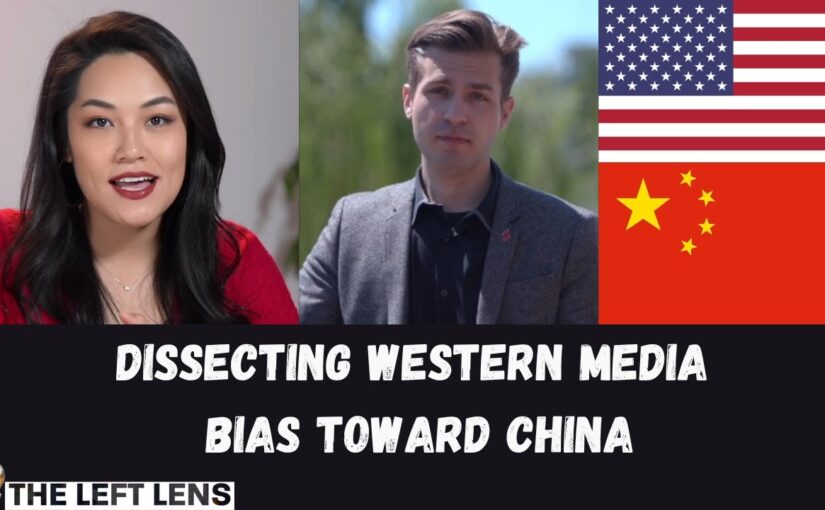
China-based journalists respond to Western media attacks
In the video embedded below, Friends of Socialist China co-editor Danny Haiphong interviews CGTN’s Li Jingjing and China Daily’s Ian Goodrum on their insights into the Western media’s attacks on China-based journalism and anyone who stands up to anti-China narratives. Of particular note is Li Jingjing’s personal experience of being slandered by three different Western news outlets (The New York Times, AP, and the Daily Beast) in a span of less than six months.
China’s long war on poverty
This article by Friends of Socialist China co-editor Carlos Martinez provides a detailed analysis of China’s ongoing war against poverty. In addition to discussing the recently-concluded targeted poverty alleviation program, in which the government achieved its goal of ending extreme poverty, Carlos discusses the anti-poverty measures taken during the various phases of the Chinese Revolution, including land reform in the liberated areas in the 1930s and 40s; the period of initial socialist construction from 1949; Reform and Opening Up from 1978; and the more recent measures aimed at building common prosperity. He concludes that poverty alleviation, and more broadly the improvement of people’s living standards, is foundational to the entire Chinese socialist project and constitutes a key theme of each of its stages.
In late 2020, the Chinese government announced that its goal of eliminating extreme poverty by 2021 (the centenary of the founding of the Communist Party of China) had been met. At the start of the targeted poverty alleviation program in 2014, just under 100 million people were identified as living below the poverty line; seven years later, the number was zero.
To eradicate extreme poverty in a developing country of 1.4 billion people – which at the time of the founding of the People’s Republic of China in 1949 was one of the poorest countries in the world, characterised by widespread malnutrition, illiteracy, foreign domination and technological backwardness – is without doubt “the greatest anti-poverty achievement in history”, in the words of UN Secretary General Antonio Guterres.1
What does it mean to not suffer extreme poverty in China? The most easily measurable aspect is having a daily income higher than the World Bank-defined international poverty line of 1.90 USD per day. But according to the Chinese government’s definition, a person can be considered to have left extreme poverty only if the “two assurances and three guarantees” have been met.2 The two assurances are for adequate food and clothing; the three guarantees are for access to medical services, safe housing with drinking water and electricity, and at least nine years of free education. Meanwhile, the land ownership system in China means that the rural poor have rent-free access to land and housing – putting them in a very different category to the rural poor elsewhere in the world.
Continue reading China’s long war on poverty
Taiwan: Red lines and strategic ambiguity
We are pleased to reproduce this article by Stefania Fusero, a Friends of Socialist China advisory group member from Italy, about recent developments in US rhetoric regarding Taiwan and the Biden administration’s undermining of the One China policy. The article was first published in New Cold War.
On May 5, 2022, the State Department amended its Taiwan factsheet removing the part in which it acknowledged that Taiwan is a part of China and stated that the US does not support Taiwan’s independence.
While Washington has said the update does not reflect a change in its policy, it has clearly increased both its military and political activism in the region and Biden even went so far as to say in Tokyo on May 23 that the US is ready to use military force to defend Taiwan in the event of an intervention from Beijing.
As the US-led proxy war of NATO against Russia in Ukraine continues, are we going to open a new front against another nuclear power, this time in Southeast Asia? Already our press has begun to compare the situation in Ukraine with the Taiwan issue, so we can expect that the great media circus will soon light up its spotlights to the seas of China – the narrative being likely the same as the one we have been made addicted to by now.
Will we therefore learn to recognise a glorious new flag to insert in the host of democratic countries, that of Taiwan? This will be the easy part, the harder one will be to understand what Taiwan is and why it will have become a vital issue for Western democracies. Will we once again be inundated with a thumping propaganda campaign focused on the epic struggle of democracy against autocracy, freedom against tyranny, light against darkness, good against evil?
Brief historical notes
First of all, it must be noted that Taiwan is not an independent state, in fact it is not even a state according to international law.
After the defeat of Japan in the Second World War, Taiwan returned to be an integral part of China, and as a consequence, after the defeat of Chiang Kai-shek’s Kuomintang, of the People’s Republic of China.
The name of Taiwan denotes an island (+ some other islets) about 160 km from the south-eastern coast of China, surrounded by the East China Sea to the north, the Philippine Sea to the east, the Luzon Strait to the south and the South China Sea to the southwest. The inhabitants are about 23 million, the capital is Taipei.
Starting from the end of the 13th century groups of Chinese began to arrive from the mainland and settle on the island, but during the 17th century Taiwan, to which Portuguese explorers had given the name of Formosa, became a pole of attraction also for Europe: the Dutch colonised the south and the Spanish colonised the north.
In 1644 the Ming were defeated by the Manchus, who founded the new Qing dynasty, which would be the last in Chinese imperial history. The prince of Yanping, known in the West as Koxinga, did not recognise the authority of the new Qing dynasty, and attempted to restore the Ming. In 1661 he crossed the strait, attacked the Dutch settlers claiming the island of Taiwan as a historic property of China, and ended Dutch colonisation, which had lasted nearly 40 years. Taiwan thus became a military base from which Koxinga and later his descendants tried in vain to restore the Ming dynasty. After finally defeating them in 1683, the Qing integrated Taiwan into their empire.
England defeated the Qing in the First Opium War in 1842, ushering in the so-called “century of humiliation” for China, which became the prey of the greed of several empires. To Japan, the last newcomer to the imperial club, the dying Qing dynasty was forced with the 1895 treaty of Shimonoseki to cede the island of Taiwan, which remained a Japanese colony until October 25, 1945, when the government of China, which had been became a republic, finally regained possession of Taiwan and the Penghu archipelago, reassuming their full legitimate sovereignty.
The victory over the Japanese, however, did not mean the end of military hostilities in China, where since 1927 the civil war between the Communist Party led by Mao Zedong and Chiang Kai-shek’s Kuomintang (KMT) had been intermittently raging.
The civil war ended in 1949 with the victory of the Communists and the defeat of Chiang Kai-shek, who, just as Koxinga had done a few centuries earlier, fled the mainland and occupied Taiwan, where his regime took on the name of ROC (Republic of China), the same name adopted by the state entity born after the fall of the Qing Empire in 1912.
This is the origin of the so-called ‘Taiwan question’.
One China or two Chinas?
For its part, on the very day of its foundation, October 1, 1949, the government of the People’s Republic of China (PRC) announced to the world that it “… is the sole legitimate government representing the entire people of the People’s Republic of China”. It declared to the United Nations that the KMT authorities had “lost all basis, both de jure and de facto, to represent the Chinese people” and therefore had no right to represent China. Since the founding of the PRC, a sine qua non condition for any country wishing to have relations with the PRC has been to recognise the government of the PRC as the sole legitimate authority of the whole of China, as well as to sever or refrain from establishing diplomatic relations with the Taiwanese authorities.
At least on this point did Mao Zedong and Chiang Kai-shek agree: China is one and has only one legitimate government, which obviously for the PRC is that of Beijing and for the KMT that of Taipei.
The US, which during the civil war had gambled on the Kuomintang, supporting it militarily and economically against the Communist Party, did not resign to its victory and continued to give generous aid to the KMT.
After the start of the Korean War in June 1950, the US government not only sent troops to Taiwan, which General Mac Arthur compared to an “unsinkable aircraft carrier”, but even considered using nuclear weapons against the PRC.
From a diplomatic point of view, meanwhile, the US questioned the status of Taiwan and lobbied for “dual recognition” among the international community in order to create “two Chinas”, whereas the government of the PRC, to safeguard the sovereignty and territorial integrity of the nation, staunchly supported the one China principle: there is only one China in the world, Taiwan is an integral part of it, and the PRC government is the sole legitimate government representing the whole of China.
This principle came gradually to be accepted by the international community, until on October 25, 1971, the United Nations General Assembly adopted Resolution 2758, which expelled the representatives of the Taiwanese regime and awarded the seat in the United Nations to the government of the PRC.
In the following year, February 1972, President Nixon’s historic visit to China led to the total revision of the official position of the US towards Taiwan. With the famous Shanghai communiqué, which was to be followed by another two in 1979 and 1982, later defined as “the three joint communiqués”, the USA relinquished the doctrine of the two Chinas, recognised the indivisibility of China, declared that Taiwan is a province of China and that the liberation of Taiwan is an internal affair of China; they also pledged to withdraw all US military forces stationed in Taiwan.
Was that the happy ending for the Taiwan issue, then? Unfortunately not, as shown by the tensions which today, while a war is still being waged in Ukraine, are intensifying around the Seas of China.
The one-China principle vs the so-called US strategic ambiguity
If from the very moment of its foundation in 1949 the position of the PRC on Taiwan has remained unequivocal and constant overtime, that of the US has instead been configuring in terms of “strategic ambiguity”.
As early as in 1979 Deng Xiaoping’s government articulated the policy of “peaceful reunification and one country, two systems”: China is committed to achieving peaceful reunification but will not rule out the use of force if any of its red lines were to be overpassed, if for example Taiwan ceased to recognise the principle that China is one and inalienable and/or proclaimed independence from the PRC or were occupied by any foreign countries.
The PRC wants to achieve reunification through peaceful negotiations and is willing to negotiate any matter except the overriding one-China principle. After reunification, the “one country, two systems” policy will be practiced: mainland China will continue with its socialist system and Taiwan will maintain its capitalist system for a long time to come. After reunification, Taiwan will enjoy a high degree of autonomy and the central government will not send troops or administrative personnel to be stationed in Taiwan.
Economic and cultural exchanges and people-to-people contacts between the two sides of the Taiwan Strait have made rapid progress since the end of 1987, and economic data shows that imports from the PRC and exports to the PRC far outweigh those with all other countries. Despite these trends, the current majority party in Taipei, the DPP (Democratic Progressive Party) led by Tsai Ing-wen, has increased military spending, moved closer to the US, and sharpened the hostility of its government towards the PRC.
Notwithstanding the principles solemnly stated in the three Communiqués between 1972 and 1982, the US has in fact often contradicted the spirit and the letter of them, adopting a policy toward Taiwan that they equivocally define as “strategic ambiguity”, which certainly does not favour a climate of trust and détente between the USA and the PRC.
We could give many examples to illustrate the ambiguous US policy on Taipei, such as the steady increase in arms sales to the island, the incendiary declarations of members of Congress on official visits to what the US does not even officially recognise as a nation, as well as the fact revealed in the WSJ last October 2021 that US military advisers had been present in Taiwan for at least one year, all obviously in flagrant violation of the agreements made in the three communiqués.
And what about a 2002 act that: “… Taiwan shall be treated as though it were designated a major non-NATO ally (as defined in section 644(q) of the Foreign Assistance Act of 1961?”
We can get an idea of how their policy of “strategic ambiguity” can be correctly interpreted by turning directly to official US sources. I highly recommend reading the Taiwan fact sheet on the official website of the US State Department, or rather its different versions that have appeared between 2019 and a few days ago. To facilitate comparison for anyone wishing to go through them in detail, I have prepared a PDF with the three versions in chronological order, highlighting the most significant parts (see here).
June 8, 2019: the fact sheet begins with the 1979 communiqué recognising the PRC as the sole legitimate government of one China. It also importantly states that the US does not support Taiwan’s independence.
May 8, 2022: what a twist! The sheet has dramatically changed: it begins by saying that Taiwan is a key partner of the United States in the Indo-Pacific and that the United States and Taiwan share the same values. US policy is guided by the Taiwan Relations Act, the three joint US-China Communiqués and the Six Assurances (in that order).
The PRC government is well aware that a few fundamental words have gone missing from the fact sheet, i.e. “the US does not support Taiwan’s independence”. On the other hand, the so-called Six Assurances are in!
To understand the reason why the Chinese government promptly and firmly reacted to these changes, we need to say just a few words about the Taiwan Relations Act and the Six Assurances.
The Taiwan Relations Act is a pro-Taiwan lobby-inspired law passed by Congress in 1979 to offset the effects of the US government’s recognition of the PRC: “…the United States shall provide Taiwan with arms of a defensive character and shall maintain the capacity of the United States to resist any resort to force or other forms of coercion that would jeopardize the security, or social or economic system, of the people of Taiwan.”
The term ‘Six Assurances’, instead, refers to six Reagan-era security assurances unilaterally provided to Taiwan in 1982 but not formally made public, which the United States declassified in 2020, among which: the United States has not agreed to set a date for ending arms sales to Taiwan; the United States has not agreed to consult with the PRC on arms sales to Taiwan; the United States has not agreed to revise the Taiwan Relations Act.
May 28, 2022: the fact sheet, surreptitiously modified one more time, reaffirms that the US does not support Taiwan’s independence.
Playing with the Joint Communiqués as well as with laws and provisions that unilaterally regulate, in a more or less open way, relations between China and the USA, erratically emphasising either, is sufficient in itself to convey totally contradictory and obviously destabilising messages to the world.
What is China doing in the meantime? Its policy has constantly remained the same, that to foster a gradual and peaceful reunification but in the meantime, it is bracing for the worst. In fact, for the PRC Taiwan is not a pawn to be used to destabilise countries thousands of km away from its national territory, but “… it is part of the sacred territory of the People’s Republic of China. It is the sacred duty of all the Chinese people, including our fellow Chinese in Taiwan, to achieve the great reunification of the motherland.” (from the Preamble of the Constitution of the PRC)
Sources:
https://en.wikisource.org/wiki/Shanghai_Communiqu%C3%A9
https://en.wikisource.org/wiki/Joint_Communiqu%C3%A9_on_the_Establishment_of_Diplomatic_Relations
https://en.wikisource.org/wiki/US%E2%80%93PRC_Joint_Communique,_August_17,_1982
https://web.archive.org/web/20190608140339/https://www.state.gov/u-s-relations-with-taiwan/
https://www.state.gov/u-s-relations-with-taiwan/
https://oec.world/en/profile/country/twn#Profile
https://www.mfa.gov.cn/ce/celt/eng/zt/zgtw/t125229.htm
https://uscode.house.gov/view.xhtml?req=(title:22%20section:2321k%20edition:prelim)
http://www.npc.gov.cn/englishnpc/constitution2019/201911/1f65146fb6104dd3a2793875d19b5b29.shtml
Danny Haiphong: The trend toward a multipolar world is defined by class struggle
These edited remarks were given by Friends of Socialist China co-editor Danny Haiphong at our recent webinar, The Empire Strikes Back: Imperialism’s Global War on Multipolarity. The full event can be viewed on YouTube.
In the post-Soviet era, it has become fashionable to strip all geopolitical developments of their class roots. Wars have been explained away by bourgeois propaganda: the War on Terror, Great Power Competition, and matters of “national security.” The Ukraine crisis is a case in point. Russia’s military operation in Ukraine has been labeled a war without a cause by Western detractors. But underneath the cacophony of capitalist ideology and propaganda is a class struggle occurring on the global stage for multipolarity where the Russia-Ukraine conflict is but one flashpoint.
Vladimir Lenin is perhaps the most well-known Marxist revolutionary to advance a modern theory of international relations rooted in the class struggle brought about by imperialism. Lenin concluded that the ascendency of monopoly and finance capital divided the world into colonies and oppressed nations. The self-determination of these nations would therefore form a core pillar in the struggle for socialism worldwide. Without self-determination, workers and oppressed people of the world would suffer immeasurable losses from the scourge of colonial domination and its triple evils of military occupation, economic plunder, and racial discrimination.
Multipolarity is in essence a continuation of the struggle for self-determination in the modern era. After years of imperialist ramblings about the “End of History” and “There is No Alternative” (TINA) to neoliberalism, the trend toward a multipolar world is demonstrating that the exact opposite is true. In all corners of the globe, the unipolar dominance of U.S. imperialism is collapsing upon its own contradictions. In Europe, U.S. imperialism threatens to shut the lights out and place what was once the center of capitalist development into a permanent state of decay. In Latin America, insurgent left-wing governments led by Cuba, Venezuela, Nicaragua, Bolivia, and others are rejecting U.S. domination in their pursuit of peoples-centered socialist development and integration. In Africa, Western plunder and militarization led by the U.S. has led many countries to pursue stronger relations with China and Russia.
Continue reading Danny Haiphong: The trend toward a multipolar world is defined by class struggle
Videos: The Empire Strikes Back – Imperialism’s global war on multipolarity
Our webinar The Empire Strikes Back – Imperialism’s global war on multipolarity took place on Saturday 11 June 2022, addressing the latest developments in international politics, particularly around NATO, AUKUS, the war in Ukraine, and the increasing militarization of the US-led New Cold War. The full set of videos is embedded below.
Full event stream
Radhika Desai: Pluripolarity is indispensable to the project of undermining imperialism
Victor Gao: China’s successes are based on its socialist system; its focus on peace and development
Li Jingjing: The West deliberately spreads disinformation about Xinjiang in order to discredit China
Ding Yifan: We must mobilize social forces to unmask and oppose the US’s wars and proxy wars
Ben Norton: Socialist countries play a vital role orienting multipolarity towards anti-imperialism
Rob Kajiwara: China doesn’t seek domination of Okinawa or Guam or Hawai’i or other Pacific islands
Jenny Clegg: The US-led empire is seeking to simultaneously crush Russia and isolate China
Mustafa Hyder Sayed: The US needs to understand that the world rejects a New Cold War
Chris Matlhako: In a time of crisis, unite against the forces of colonialism, neoliberalism, fascism
Ju-Hyun Park: The US opposes Korean reunification because it would undermine US regional domination
Sara Flounders: The socialist countries are leading the way in terms of meeting humanity’s needs
Danny Haiphong: US imperialism’s war on multipolarity is a war on self-determination and sovereignty
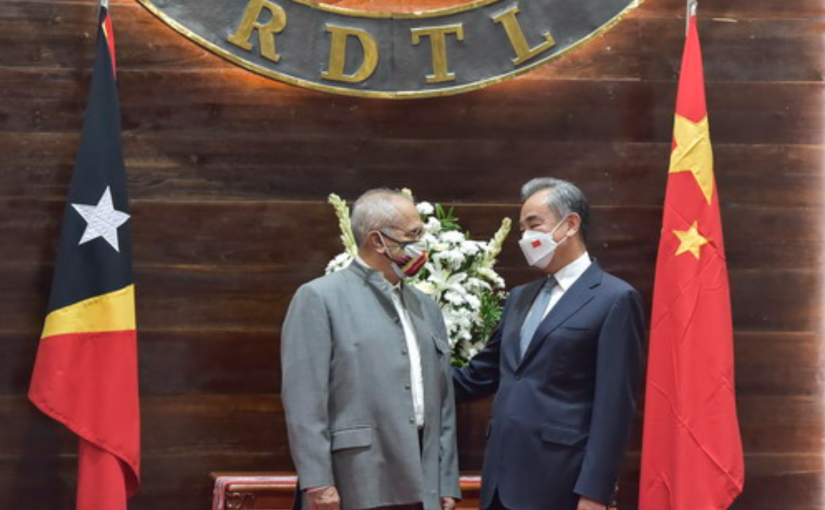
China cements its ties with Timor-Leste
Chinese Foreign Minister Wang Yi concluded his recent visits to South Pacific island nations with a highly significant stop, with an intense and packed agenda, to Timor-Leste on June 3-4.
His first reported meeting was with Prime Minister Taur Matab Ruak, who said that his country, “thanked China for speaking up for [his] country in the international arena and supporting Timor-Leste’s integration into the international system.” For his part, Wang “extended his congratulations on Timor-Leste’s 20th anniversary of the restoration of independence and the 20th anniversary of the establishment of diplomatic ties between the two countries. The Independence Day of Timor-Leste coincides with the date of the establishment of diplomatic relations between the two countries, which fully demonstrates that the two countries have stood firmly together.”
Wang noted that last year, Timor-Leste’s exports to China increased by more than 90 times, leading Ruak to observe that, “under the leadership of the Communist Party of China (CPC), China has achieved miracles of rapid economic growth and poverty alleviation of hundreds of millions of people. Its great achievements are unparalleled. Timor-Leste looks forward to seizing the huge development opportunities brought by China, expanding bilateral practical cooperation in economy, trade, investment, infrastructure, education and tourism, among others, speeding up self-driven development and bringing more benefits to the people of Timor-Leste.”
In a meeting with Timor-Leste’s Minister of Foreign Affairs and Cooperation Adaljiza Albertina Xavier Reis Magno, Wang cited the cooperation between the two countries in fighting Covid-19, with nine medical teams sent by China having provided help to 300,000 patients. Among many further areas identified for cooperation were the cultivation of hybrid rice and the building of agricultural high-tech development zones, to help Timor-Leste achieve self-sufficiency in grain and agricultural modernisation.
Wang also met with Xanana Gusmão, known as Timor-Leste’s Founding Father and who is often compared to Nelson Mandela. Xanana, noting that all the small and medium-sized Pacific Island countries were faced with the common task of development, added that: “What we need is a united response to the challenges, more attention and support from the international community and tangible assistance. The Chinese Foreign Minister’s visit to the South Pacific region sent a positive signal, showing that China stands with developing countries and brings hope to small island countries.”
Meeting with Mari Alkatiri, the Secretary-General of Fretilin (The Revolutionary Front for an Independent East Timor), the party which led the armed struggle for independence, Wang said that “Fretilin is a political party with a glorious tradition, which has been committed to the rebirth of the country and the nation since its birth and still plays an important role in the development and revitalisation of Timor-Leste today. The Communist Party of China (CPC) has time-honoured contacts with Fretilin and the two parties have always maintained inter-party exchanges.” For his part, Alkatiri said that, “China not only firmly defends world peace, but also shares development dividends with other countries and stays committed to upholding fairness and justice. China has never exported its ideology and has brought development and opportunities to all countries. Timor-Leste trusts China, supports China’s development and growth, and is willing to work with China to dedicate to the common pursuits and goals of developing countries.”
Finally, Wang met with President Jose Ramos-Horta, to whom he expressed appreciation for his signing the joint communique on establishing diplomatic ties with China on the day of independence in 2002, when he served as the first Foreign Minister of Timor-Leste.
Prior to his Timor-Leste visit, Wang had visited Solomon Islands, Kiribati, Samoa, Fiji, Tonga, Vanuatu and Papua New Guinea. He also held virtual meetings with the leaders of Micronesia, Cook Islands and Niue, the latter two being still in an essentially colonial relationship with New Zealand. He made a stop over in Malaysia on his way home from Timor-Leste.
The following reports on Wang Yi’s visit to Timor-Leste were originally published on the website of the Chinese Ministry of Foreign Affairs.
Timor-Leste’s Prime Minister Taur Matan Ruak Meets with Wang Yi
On June 3, 2022 local time, Timor-Leste’s Prime Minister Taur Matan Ruak met with State Councilor and Foreign Minister Wang Yi in Dili.
Ruak warmly welcomed Wang Yi’s visit to Timor-Leste on the occasion of the 20th anniversary of the establishment of diplomatic ties between the two countries, saying that the visit shows the great importance China attaches to bilateral relations and its positive willingness to deepen bilateral cooperation. Ruak said that Timor-Leste and China have a long history of exchanges and since the establishment of diplomatic ties, the two countries have carried out mutually beneficial cooperation in a wide range of areas. Timor-Leste sincerely thanked China for having assisted the country in a time of urgent need and helping the country safeguard security, deal with disasters and fight the pandemic since the establishment of diplomatic ties. Timor-Leste thanked China for speaking up for the country in the international arena and supporting Timor-Leste’s integration into the international system. Timor-Leste will always be a friend of China and will stay committed to consolidating the achievements of the establishment of diplomatic ties, firmly pursuing the one-China principle, expanding friendly cooperation and opening up new prospects for the development of bilateral relations.
Continue reading China cements its ties with Timor-Leste