New book: The East is Still Red – Chinese socialism in the 21st century

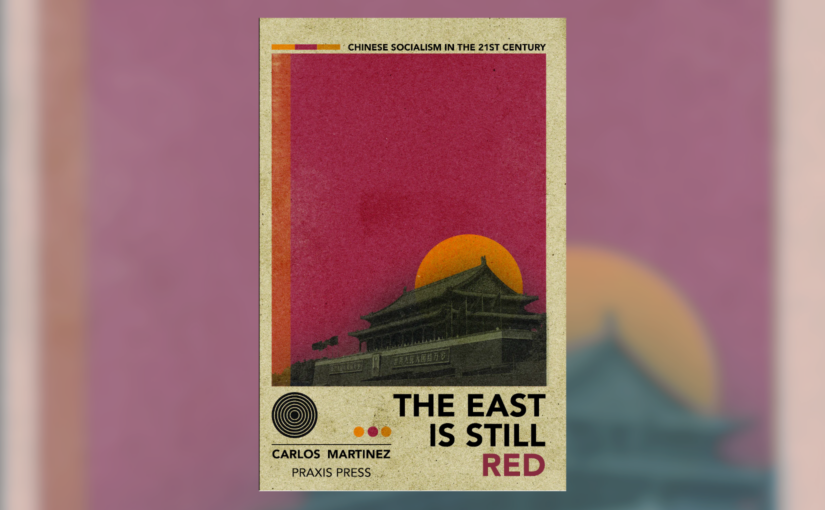
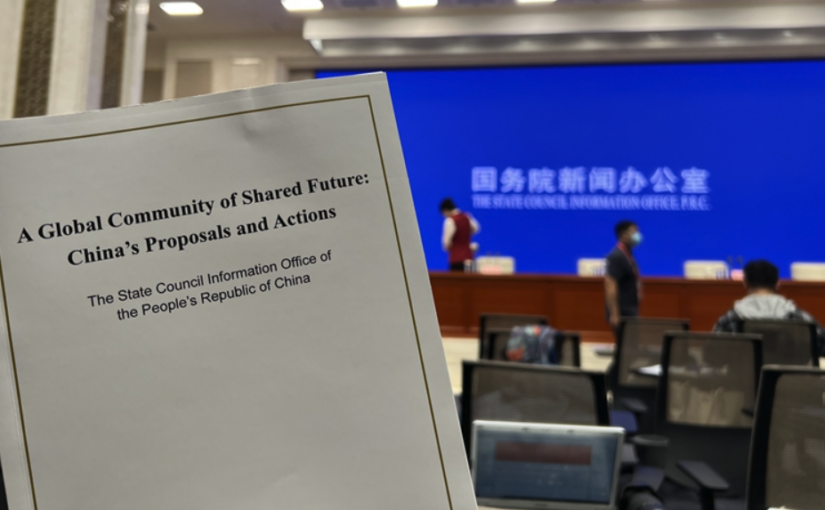
We are pleased to announce that the new book by Friends of Socialist China co-editor Carlos Martinez, The East is Still Red – Chinese socialism in the 21st century, has been published by Praxis Press. It is currently available to buy on the Praxis Press website in paperback and ePub forms, and will be available more widely from early June.

Description

China provides a powerful living example of what can be achieved under a socialist system; by a Marxist-led government firmly grounded among the people. The East is Still Red explains the escalating hostility by the imperialist powers towards China and clears up various popular misconceptions.

All available evidence indicates that not only is the Communist Party of China committed to Marxism, but it is a leading force for the development and enhancement of Marxism in the 21st century.

If the first century of human experience of building socialism teaches us anything, it is that the road from capitalism to socialism is a long and complicated one, and that ‘actually existing socialism’ varies enormously according to time, place and circumstances. China is building a form of socialism that suits its conditions, using the means it has at its disposal, in the extraordinarily challenging circumstances of global imperialist hegemony.

Carlos Martinez provides a concise, deeply researched and well argued account that China’s remarkable rise can only be understood by acknowledging its socialist past, present and future.

Continue reading New book: The East is Still Red – Chinese socialism in the 21st century

Aukus might create jobs – but at what cost?

This article by Jenny Clegg, originally published in the Morning Star, discusses the recent announcement by Britain’s Confederation of Shipbuilding and Engineering Unions (CSEU) that it welcomes the Aukus trilateral security deal on the grounds that it will ostensibly create thousands of well-paid jobs for British engineers.

Jenny points out that, even on the basis of purely economic calculations, directing Britain’s advanced engineering sector towards a project like Aukus is utterly self-defeating. It will adversely affect ties with China – trade with which is connected to orders of magnitude more jobs than Aukus is. Furthermore, it means divesting from far more promising and worthwhile projects, particularly in relation to preventing climate breakdown.

Aukus is part of an escalating US-led drive to war against China, and what’s more it violates the nuclear Non-Proliferation Treaty (NPT). It is patently foolish for Britain to attach itself to such a project, and particularly so for the British working class. Jenny asks of CSEU members: “Do they want to be building a world of conflict, tension and destabilisation for decades to come? Is that the kind of future they envisage for their children and grandchildren?”

THE Confederation of Shipbuilding and Engineering Unions (CSEU) has welcomed the benefits of Aukus, creating thousands of well-paid jobs, securing thousands more across the supply chains for years to come.

But what about the costs?

Within Britain’s constrained budgets, creating one job in the defence sector means cutting significantly more jobs — quite possibly those of trade union members — in sectors, for example, that provide for social welfare.

The £3 billion defence spending increase recently announced by PM Rishi Sunak to go on supporting the delivery of Aukus is enough to pay the junior doctors’ claims in full one-and-a-half times over. And it is just the start.

The benefits to the supply chain might not be that great either since over a third of MoD supplies are purchased from overseas.

The reactors to power the Aukus submarines are to be built by Rolls-Royce in Derby using weapons-grade highly enriched uranium.

Thousands of jobs will be created, yes, but these vessels are for war-fighting so this will breach the nuclear Non-Proliferation Treaty (NPT) stipulation that the exchange of nuclear technology must be “for peaceful purposes.”

This also violates the spirit of the Nuclear Weapon Free Zones of the south Pacific and south-east Asia. There, the expanding authority of the Anglosphere is not something that is welcomed.

It goes against hopes to make the region a zone of peace, instead increasing the likelihood of regional nuclear proliferation and an escalating arms race.

A recent meeting of former Pacific leaders raised complaints about the “staggering” amount of money committed to Aukus which “flies in the face of Pacific Islands countries … crying out for climate change support,” the “threat … challenging our future existence,” they said, “is not China but climate change.”

The gross overexpansion of Britain’s military industrial base is to prepare for war with China. But China has not fought a war for 40 years; it maintains a defensive military posture with just one overseas base and only a small nuclear arsenal kept under “no first use.” By treating China as the enemy, Aukus will surely turn it into one.

China in fact is Britain’s fourth-largest trading partner; economic links have generated at least 150,000 jobs across the country and there is great potential for this to grow.

Not long ago Chinese companies stepped in to help in the rescue of Jaguar Land Rover and saved 3,000 jobs at British Steel.

Why put all this at risk? China should be seen as an opportunity not a threat.

By the time the submarines become operational in the 2040s, the world will be massively transformed.

The emerging markets of the Brics countries already exceed the G7 in economic size and will easily double this in 20 years.

A paradigm shift is under way as these rising powers reset world agendas — it is their priorities on climate change, health and tackling poverty that are now driving the world economy.

Yet Britain continues on the path of disproportionate military influence even as it drops out of the world’s top 10 economies in the coming years.

The CSEU is working with the Australian engineering unions, yet the Australian Council of Trade Unions (Actu), which brings together 36 trade unions, has not endorsed the pact and maintains its backing of Australia’s nuclear-free defence policy.

To support the huge Aukus military expansion, the Australian taxpayer will pay on average US$6bn per year for the next 30 years — a whacking total of US$245bn.

To secure Britain’s high-skilled base requires long-term contracts but the MoD’s seemingly easy solution stokes more problems for the future: the more that is invested in arms production, the harder it is to reverse — the end of a contract means thousands of jobs are at stake and the chase for investment becomes endless.

The British government has just spent over £6bn on the two aircraft carriers, now one is being mothballed. How many more white elephants are planned?

The CSEU needs to think again. Instead of delivering the labour movement into the pockets of BAE Systems and Rolls-Royce, instead of driving China onto a war-footing, it should inform its members of the implications of the scheme.

It should ask them: do they want to be building a world of conflict, tension and destabilisation for decades to come? Is that the kind of future they envisage for their children and grandchildren?

We are nowhere close to having sufficient green skills to deliver the green transition globally — the CSEU should be encouraging apprentices to hone their skills for a green future; and it should get creative and set up teams of members to come up with alternative ideas not least to serve the new agendas and growing markets of the global South.

People in Britain can only rely now on skilled engineers to ensure the economy remains relevant in the coming decades. Politicians are failing us — it is up to the unions to envisage a different future for the country and to see that Britain’s advanced engineering is put to good use in a vastly changing world.

Liu Liangmo: China’s anti-imperialist, anti-racist, Christian revolutionary

We are pleased to republish the following article on the revolutionary life of Liu Liangmo (1909-1988), a Chinese anti-imperialist, progressive Christian, and pioneer of solidarity between the African-American people and the Chinese revolution. Written by Eugene Puryear, it was originally published by Liberation School, an initiative of the US Party for Socialism and Liberation (PSL). As Comrade Puryear explains:

“While excavating this history is important in its own right, it is even more so because the promise and the contradictions of these wartime attempts to build unity among the exploited and oppressed hold important lessons for our own time.” 

Liu’s political activity began with the progressive cultural circles in Shanghai linked to the underground Chinese Communist Party, where he pioneered the use of mass singing of patriotic and anti-imperialist songs as a means of popular mobilization.

In 1940, he left China for the United States to work with United China Relief, which worked to build support for the Chinese people’s resistance to Japanese aggression, as an arm of the united front that had been re-established between the Communist Party and the Kuomintang. Once in the United States, his interest in cultural work inevitably and rapidly drew him into a close association and friendship with Paul Robeson, with whose work he had already become familiar before leaving China. 

Liu began writing regularly for the progressive black press in the United States. In 1942, he reported on a New York rally, also attended by Claudia Jones, demanding the opening of a Second Front in western Europe, at a time when the Soviet people were heroically resisting the Nazis at Stalingrad. Clearly linking this demand to the struggle for the liberation of oppressed people everywhere, he wrote:

“Forty thousand New Yorkers … attended the Second Front rally at Union Square… I was very much interested in the placards which people carried … the most outstanding ones are: ‘Smash Race Discrimination,’ ‘Equal Rights to Negroes NOW!’ and ‘Free India NOW!… It is interesting to me because it clearly demonstrated the inter-relationship of these problems … the reactionaries and Tories don’t want to see Soviet Russia win; neither do they want India to be free, nor Negro people to have equal rights so they delay the opening of a Second Front, they delay in giving freedom to India, and they keep on Jim-Crowing the Negro people in this country. But the people of the world black and white and brown together demand that: a Second Front be opened in Europe NOW; Free India NOW; Equal rights to Negroes NOW.” 

Liu returned to China after liberation and the founding of the People’s Republic, but his work and example undoubtedly helped to lay important foundations for ensuing decades of collaboration and solidarity between the black liberation movement and socialist China. Mentioning a number of key people who contributed to this, Puryear writes: 

“Harry Belafonte would tell Paul Robeson’s confidante Helen Rosen of his fascination with New China: ‘When Alassane Diop, Guinea’s former Minister of Communications, came back from a visit to the new China in the early 50s, he told me that the city of Shanghai was clean and beautiful, that its citizens had a decency and spirit unequaled anywhere else in the world. I asked myself how a nation devastated by war and riddled with hunger, disease, and illiteracy was able to order the lives of 800 million citizens. I erupted into an insatiable curiosity about China.'”

The great singer, actor and lifelong progressive activist and freedom fighter, Harry Belafonte, passed away this April 25th at the age of 96.

A second article by Puryear sets out the author’s view of the communist movement’s popular front policy, with particular reference to Liu’s work in the United States.

Introduction

Liu Liangmo (1909-1988) was a prominent Chinese anti-imperialist, religious leader and, from 1942-1945, columnist for the Pittsburgh Courier—at that time the nation’s widest circulating Black newspaper. Liu’s columns (and actions as an organizer) were a significant part of efforts by progressive Chinese people, on the mainland and in the diaspora, to build alliances with the Black Liberation movement as part of a broader effort to shape the post-war world.

His words linked the causes of ending colonialism, imperialism, and race discrimination—from the Yangtze to the Ganges to the Mississippi—mirroring the words and actions of millions of others involved in similarly-minded struggles around the world, including Liu’s favorite U.S. singer: Paul Robeson.

Liu’s columns represent the efforts of Communist and aligned currents to turn the allied effort in the favor of the exploited and the oppressed. This was counteracted in the so-called “Cold War,” as imperialist forces worked to make the world “safe for capitalism” in the wake of the World War II.

His columns and activities offer interesting insight into the struggle within the “Second United Front” in China between the Nationalist Kuomintang and the Communists during the Second World War and their differing approaches to the post-war world: whether China should be an anti-colonial vanguard or seek inclusion in the imperialist “great power” club. The “Nationalist” Chinese government’s chose the latter, heavily impacting their approach to racism in the US.

On the other side, the nascent global left-wing coalition hoped to use the new leverage the war created: notably the curtailing of the anti-Bolshevik crusade and the embrace of the USSR as an ally, the attendant rise in the prestige of communism, and the need to mobilize colonial and all resources on the U.S. home-front. This leverage opened some space for the first legal labor and political organizations in colonial Africa and the Black Liberation movement in the U.S. Also critical was the importance of India and China to the overall allied effort against Germany, Italy, and Japan; to end colonialism, Jim Crow, and the old imperialism.

Continue reading Liu Liangmo: China’s anti-imperialist, anti-racist, Christian revolutionary

Interview: China is governed in the interests of working people, the US in the interests of capital

In this interview with Global Times, Sara Flounders – a contributing editor to Workers World and a member of our advisory group – shares her analysis of the escalating New Cold War and the US’s global hegemonic project. Comparing the West’s approach of war, sanctions, coercion and destabilisation with China’s vision of a human community with a shared future, Sara observes:

The very concept of shared future and cooperation has a profound impact. It’s not threatening to other countries, and it has the win-win idea, meaning if your economy is growing and our economy is growing, that’s better for both of us. That’s the basis of building further and deeper trust.

Sara points out that the differing approaches to international and domestic politics taken by the US and China can ultimately be explained by their differing social systems. In socialist China, the government operates in the interests of working people, whereas “the political parties in the US operate in the interests of the top corporations and banks.”

The interview concludes with a note of caution: with US hegemony in decline, the US ruling class is hitting out in all directions in a bid to prevent that decline. “It’s a very dangerous juncture, because this is very threatening to US imperialism and we have to be prepared what they will do to try to preserve their role.” The situation calls for maximum unity of the global working class and oppressed nations, to defend our collective interests and press ahead to a multipolar future free from imperialism.

GT: The Russia-Ukraine conflict has dragged on for more than a year. What lessons can the world draw from this conflict?

Flounders: Hopefully, they will draw the conclusion not to go along with US provocations, intentional disruptions, and efforts to create crisis.

Now, out of this war in the past year, Russia has not only survived economically, its currency and its trade with the Global South have been reinforced and are stronger today. However, for the EU, they’re in a much weaker position. We shouldn’t forget that even though they are US allies, they are also competitors. The euro is now weaker than the dollar, the war has benefited the US and yet has been very harmful for all of the EU countries that went along with the war.

I think countries around the world will draw their conclusions. Do they want to be roped into this? Especially in Asia, who can US imperialism rope in in terms of their own sovereignty? Who can resist the US pressure?

GT: Taiwan regional leader Tsai Ing-wen was in California and met US House Speaker Kevin McCarthy. While the US contains Russia through the Ukraine war in Europe, does it also want to provoke a war in the Taiwan Strait to contain China?

Flounders: This meeting was a direct and intentional violation of signed agreements that the US has made with China. China is one. Taiwan is a province of China. This is agreed to by the world, by the United Nations, by the US and by Taiwan’s “constitution.” For Kevin McCarthy to line up other congressional members and meet with Tsai Ing-wen is a direct violation of past agreements.

In the same way that Nancy Pelosi’s trip to Taiwan last year was a direct and deliberate violation of the agreement. There’s no reason to do this, except to attempt to create provocations, to create further disruption of what had been an orderly process of reconciliation and of Taiwan becoming part of China, which is the wish for great majority of the people, even in Taiwan.

China’s approach is to continue to use diplomacy to not be baited into an intentional provocation. However, it is becoming a difficult situation because one offense after another, one arms shipment after another. And US aircraft carriers, nuclear submarines, destroyers, sail into the Taiwan Straits. These are all intended provocations, and any one of them could be a dangerous jumping-off point. 

GT: The US pursues hegemony by provoking conflicts. China promotes a human community with a shared future. What do the two differing governance concepts bring to the world?

Flounders: The very concept of shared future and cooperation has a profound impact. It’s not threatening to other countries, and it has the win-win idea, meaning if your economy is growing and our economy is growing, that’s better for both of us. That’s the basis of building further and deeper trust.

Continue reading Interview: China is governed in the interests of working people, the US in the interests of capital

Is London returning to a sane policy towards Beijing?

In this short op-ed for China Daily, Friends of Socialist China co-editor Carlos Martinez discusses the significance of Chinese Vice-President Han Zheng’s visit to London, in the context of recent indications from Westminster that it is shifting somewhat away from the viscerally anti-China strategy it has been pursuing in recent years. Although the UK government remains essentially tied to its heavily pro-US orientation, it is increasingly clear that ‘decoupling’ from China is a dead end.

Chinese Vice-President Han Zheng’s visit to London to attend the coronation ceremony of King Charles III is a reminder of China’s willingness to develop a productive and mutually-beneficial relationship with the United Kingdom.

The recent deterioration in relations between the two countries has not been instigated or fomented by Beijing. China has always sought to foster a bilateral relationship of friendship, exchange, mutual learning, trade and investment that brings material and cultural benefits to both sides.

The most emblematic moment of the “golden era” of UK-China relations was Chinese President Xi Jinping’s five-day visit to the UK in 2015. At the joint news conference addressed by both President Xi and then British prime minister David Cameron, it was announced that the two countries will build a global comprehensive strategic partnership for the 21st century.

There was even talk of the UK aligning its “Northern Powerhouse” project with the Belt and Road Initiative. Eight years later, Belt and Road projects have helped boost infrastructure development in many parts of the world, while almost no progress has been made on the Northern Powerhouse initiative, which is a real shame.

China’s strategic approach to its ties with Britain and its wish to establish long-term win-win relations have not changed. The major change in the relationship is that the British establishment seems to have become anti-China, in step with the United States’ geopolitical game to maintain its global hegemony.

This reflects two political shifts. First, the US, in recent years, has adopted an increasingly confrontational stance toward China: imposing sanctions and extra tariffs, forming the trilateral security alliance AUKUS, waging a trade war and initiating a tech war against China, undermining the one-China principle.

Second, in the aftermath of Brexit, the UK has been slowly but steadily losing its foreign policy independence, choosing to act on the instructions of the US in the hope it will prepare the ground for a comprehensive US-UK trade deal that makes up for what Britain has lost by leaving the European Common Market. The result is that the UK now follows the US’ lead when it comes to relations with China.

In 2015, Britain faced significant pressure from the US to not join the China-initiated Asian Infrastructure Investment Bank, but it was able to withstand that pressure in defense of its own economic interests. It’s unlikely that Britain would act in a similarly independent way today.

However, British Foreign Secretary James Cleverly’s recent speech on UK-China relations seems to indicate some willingness on the part of the British government to return to a sane policy. Cleverly’s speech — and British Prime Minister Rishi Sunak’s refusal to label China as a “strategic threat” — represent a growing understanding that Britain needs investment from, and trade with, China, and that “decoupling” of economies leads to a dead end. The British people will benefit greatly if this understanding can be turned into a policy of cooperation and mutually-beneficial relations.

And Han’s visit to the UK will hopefully provide an opportunity for Britain’s political leadership to take some concrete steps in this direction.

Embassy spokesperson responds to Irish politician’s remarks on China

On Tuesday May 2, Micheál Martin, Tánaiste (Deputy Prime Minister), as well as Minister for Foreign Affairs and for Defence, of the Republic of Ireland, and leader of the  Fianna Fáil party, delivered a major speech at the Royal Irish Academy in Dublin on the question of his country’s relations with China. 

Whilst acknowledging that this relationship is valued, and highlighting the €34.5 billion in two-way trade as well as “enduring links in education, in culture and in tourism,” Martin echoed a number of European politicians, as well as US Treasury Secretary Janet Yellen, in calling for ‘de-risking’ Ireland’s ties with China. The financial news service Bloomberg noted that, in so doing, Martin had positioned Ireland in opposition to the recent call by French President Emmanuel Macron for a more constructive relationship with China. According to the Irish Times, Martin stated:

“We must be clear-eyed about China’s strategic objectives and about what these might mean for the European Union and Ireland.

“Ireland’s message on human rights will remain consistent, whether in relation to Xinjiang, Tibet, Hong Kong, or elsewhere – China has an obligation to act in a manner that ensures full respect for the rule of law.”

He further called on China to use its “considerable influence” to end Russia’s military operation in Ukraine.

Responding to the speech, the Chinese Embassy in Ireland said that it had “taken note of the positive elements… that Ireland values its bilateral relationship with China and wants to work constructively together with China; that Ireland reaffirms it adheres to the one-China policy,” but continued:

“Regrettably, the speech over-exaggerated the differences between China and Ireland and emphasized the concept of ‘de-risking’ with China. It also made misleading comments on China’s stance on current international hot issues and made groundless accusations against China on issues related to Taiwan, Xinjiang, and Hong Kong, interfering in China’s internal affairs.”

Stressing that it disagreed with the concept of ‘de-risking’ and the idea that differences in worldview would “inevitably shape” the way the two countries viewed one another, the Embassy noted that: “The tremendous development of bilateral cooperation between China and Ireland over the past more than 40 years has fully demonstrated the fact that China and Ireland share extensive common interests, the convergence of our views far outweighs our differences, and our cooperation far outweighs our competition.”

On the Ukraine crisis, it said that: “China always stands on the side of peace. Its core stance is to facilitate talks for peace. China did not create the Ukraine crisis, nor is it a party to the crisis.”

Regarding the Taiwan issue, the embassy stated that, “just as ‘no one group can have a veto on Ireland’s future’, no one can have a veto on Chinese people’s aspiration and determination to achieve national reunification.”

It added that “a lot of international friends who have been to Xinjiang said that what they saw with their own eyes in Xinjiang is completely different from what has been portrayed by Western media. We welcome Irish friends from all walks of life to visit Xinjiang and find out the true picture there, instead of being misled by Xinjiang-related lies.

Towards its conclusion, it invoked the words of the late John Hume, leader of the Social Democratic and Labour Party (SDLP) in the north of Ireland, and an architect of the Good Friday Agreement, which recently marked its 25th anniversary:

“Difference is the essence of humanity. Difference is an accident of birth, and it should therefore never be the source of hatred or conflict. Therein lies a most fundamental principle of peace: respect for diversity.” 

We reprint below the full text of the statement. It originally appeared on the website of the Chinese Embassy in the Republic of Ireland.

Question: On 2nd May, Micheál Martin, Tánaiste and Minister for Foreign Affairs and Minister for Defence, delivered a speech mainly on China and China-Ireland relations. What is the Chinese Embassy’s comment?

Answer: We have taken note of the positive elements of the speech that Ireland values its bilateral relationship with China and wants to work constructively together with China; that Ireland reaffirms it adheres to one-China policy.

Continue reading Embassy spokesperson responds to Irish politician’s remarks on China

Carry forward the spirit of Dr Kotnis to strengthen China-India friendship

As part of a tour of South Asian countries in the first week of May, Chinese State Councilor and Foreign Minister Qin Gang visited India to attend the Foreign Ministers Meeting of the Shanghai Cooperation Organization (SCO), which was held in Goa. Whilst there, on May 4, Qin Gang met with the family members of Dr. Dwarkanath Kotnis (known in China as Ke Dihua), along with representatives of friendship organizations with China and young people from both countries.

Dr. Kotnis was one of a team of five Indian doctors, one of whom had previously served with the International Brigades in Spain, who were sent to help the Chinese people in their war of resistance against Japan by India’s Congress party, then led by Jawaharlal Nehru and Subhas Chandra Bose, after China’s Red Army leader Zhu De had written a request to Nehru on the suggestion of Agnes Smedley, the American internationalist who maintained deep ties with the freedom movements in both countries.

In the spirit of the great Canadian communist, Dr. Norman Bethune, who the team had gone to replace following his death from sepsis incurred while operating behind enemy lines, Dr. Kotnis worked tirelessly, sometimes for 72 hours without sleep. He refused any special treatment, taught himself fluent Chinese, and passed on his knowledge by writing two textbooks on surgery (one uncompleted, he was actually struck by a fatal seizure as he was writing), and becoming a teacher and then the head of the Bethune Medical School.

It was while teaching at the school that he met, fell in love with and married Guo Qinglan, a nurse and nursing teacher. Their son, Yinhua, whose name means India-China, was born just four months before Dr. Kotnis’s death. In July 1942, Dr. Kotnis was admitted to membership of the Communist Party of China. 

After Dr. Kotnis passed away on December 9, 1942, from epileptic seizures exacerbated by prolonged overwork, Mao Zedong wrote the following calligraphy in his memory: 

“Dr. Kotnis, our Indian friend, came to China from afar to assist us in our war of resistance. He worked for five years in Yan’an and north China, giving medical treatment to our wounded soldiers and died of illness owing to constant overwork. The army has lost a helping hand, and the nation has lost a friend. Let’s always bear in mind his internationalist spirit.”

In meeting with Dr. Kotnis’s relatives, Qin Gang carried on a tradition of senior Chinese leaders visiting India, beginning with Premier Zhou Enlai in the 1950s through to President Xi Jinping in recent times. 

Qin Gang said that  Dr. Kotnis was a great friend of the Chinese people and an outstanding fighter in the anti-fascist war, who devoted his precious youth and life to the Chinese people’s war of resistance against Japanese aggression. His spirit, Qin continued, is a humanitarian one of saving lives, a heroic one of daring to struggle and not being afraid of sacrifice, and an internationalist one of advocating peace, friendship, and a shared future.

One distinct feature of Qin’s meeting, consistent with the change of generations, as well as the fact that May 4 is celebrated as Youth Day in China, in honour of the anti-imperialist May 4 Movement of youth and students in 1919 that contributed significantly to the founding of the Communist Party of China two years later, was the emphasis placed on the need for young people to inherit and carry forward the spirit of Dr. Kotnis so as to firmly safeguard peace and friendship between China and India.

Noting that the young people of both China and India are full of vitality and are the main force for development in their respective countries, Qin Gang called on them to  promote people-to-people exchanges and to explore a path for the two major neighbors to coexist in peace, get along in amity and seek rejuvenation together.

He also urged the youths to promote bilateral cooperation for mutual benefit and to boost mutual trust, so as to jointly safeguard the common interests of developing countries and uphold international fairness and justice.

The following articles were originally published by the Chinese Foreign Ministry and the Xinhua News Agency.

Qin Gang Meets with Relatives of Dr. Dwarkanath Kotnis and Representatives of Chinese and Indian Young People

On May 4, 2023 local time, State Councilor and Foreign Minister Qin Gang met with relatives of Dr. Dwarkanath Kotnis and representatives of China-India friendship organizations and Chinese and Indian young people in Goa, India.

Qin Gang and relatives of Dr. Kotnis visited the photo exhibition of Dr. Kotnis’ life. Qin Gang said that Dr. Kotnis, a great friend of the Chinese people and an outstanding fighter in the anti-fascist war, devoted his precious youth and life to the Chinese people’s war of resistance against Japanese aggression. The spirit of Dr. Kotnis is a humanitarian one of saving lives, a heroic one of daring to struggle and not being afraid of sacrifice, and an internationalist one of advocating peace, friendship and a shared future.

Continue reading Carry forward the spirit of Dr Kotnis to strengthen China-India friendship

Qin Gang trip consolidates China’s ties with South Asian countries

Chinese State Councilor and Foreign Minister Qin Gang spent the first week of May on an important visit to South Asian countries.

On May 1, he met in Beijing with Noeleen Heyzer, the Special Envoy of the United Nations (UN) Secretary-General on Myanmar. Qin Gang said that China and Myanmar are close neighbors linked by mountains and rivers, and China hopes more than any other country that Myanmar will realize stability and development. With internal and external factors intertwined, the Myanmar issue is complex and has no “quick fix”. The international community should respect Myanmar’s sovereignty, and support all parties and factions in Myanmar in bridging differences and resuming the political transition process through political dialogue within the constitutional and legal frameworks. He further noted that the international community should respect the mediation efforts of the Association of Southeast Asian Nations (ASEAN) and promote the implementation of ASEAN’s Five-Point Consensus on Myanmar.

The following day, Qin Gang arrived in China’s Yunnan province for an inspection tour, in which he stressed the need to maintain stability at the China-Myanmar border, advance the friendship and cooperation between China and Myanmar, and open up new prospects of border-related and Myanmar-related work. Visiting various places and projects, including ‘One Village, Two Countries’ border communities, he took opinions and suggestions from those working at primary-level units and on the front line. He stressed the importance of pushing forward the building of the China-Myanmar Economic Corridor with a focus on industrial capacity cooperation and industrial park construction, to help boost the economic and social development of the two countries, as well as maintaining peace and tranquility in the border area and safeguarding the overall situation of China-Myanmar friendship.

This somewhat unusual public engagement by a Chinese foreign minister reflects the special position of the southwestern province regarding Myanmar, with, for example, the same and closely related ethnic groups and nationalities living on both sides of the border. It might also be considered as an extension of whole process people’s democracy on the diplomatic front.

The same day, Qin Gang began his visit to Myanmar, meeting with Than Shwe, the former Chairman of the Myanmar State Peace and Development Council, in the country’s new capital, Nay Pyi Taw.

Qin Gang said that China respects Myanmar’s sovereignty and territorial integrity, supports Myanmar in advancing its domestic peace process, and stands ready to continue actively providing assistance for Myanmar in safeguarding independence, maintaining political stability and realizing sustainable development. Than Shwe said that the “pauk-phaw” [brotherly] friendship between Myanmar and China was forged by the leaders of the elder generations of the two countries, has been promoted by every generation of their leaders, and is deeply rooted in the hearts of the two peoples.

Also on May 2, Qin Gang met with Myanmar leader Min Aung Hlaing. The Chinese Foreign Minister pointed out that China sincerely hopes for a stable situation and national development in Myanmar, supports Myanmar in exploring a development path suited to its national conditions and with Myanmar’s characteristics, supports Myanmar in continuously advancing its political transition process, and supports all parties in Myanmar to properly handle differences and achieve reconciliation under the constitutional and legal framework. China will continue to provide assistance within its capability for Myanmar’s development, accelerate key cooperation projects of the China-Myanmar Economic Corridor, and carry out projects on agriculture, education and health care, among others, for the benefit of Myanmar people.

Continue reading Qin Gang trip consolidates China’s ties with South Asian countries

China reiterates support for Syria’s unity, sovereignty and independence

Some 12 years after it was unjustly excluded, Syria was readmitted to the Arab League on May 7. An emergency meeting of the League’s Foreign Ministers, held in the Egyptian capital Cairo, resolved to restore Syria’s membership with immediate effect. This clears the way for Syria to attend the League’s Summit, which is due to convene in the Saudi Arabian city of Riyadh on May 19. The Wall Street Journal described the move as, “complicating American efforts to isolate President Bashar al-Assad and signalling a waning of US influence in the Middle East.” The paper added: “The decision to readmit Syria to the Arab League represents a rejection of US interests in the region and shows that Middle Eastern countries are forging policies independent of Western concerns.”

Syria’s diplomatic victory is part of a broad and dramatic redrawing of the geopolitical map of West Asia particularly following the agreement between Iran and Saudi Arabia, mediated by China, to restore bilateral relations.

Reporting on the summit meeting between China and the Arab League, held during President Xi Jinping’s visit to Saudi Arabia last December, and noting that the Chinese leader’s proposals to his Arab counterparts included a pledge to provide humanitarian support and reconstruction efforts for a number of countries, including Syria, this website commented, on December 12 2022, that: “This is particularly significant in that Syria is still unjustly excluded from the League of Arab States, although considerable progress is being made to rectify this.”

Consistent with these trends, on April 29, Syrian President Bashar al-Assad received the visiting Special Envoy of the Chinese Government on the Middle East, Zhai Jun in his capital, Damascus.

At their meeting, President Assad noted that the most significant positive change in the world has been the Chinese role, which is increasing in a calm and balanced manner, and that this role has become a new model in politics, economy, and culture. He went on to observe that the entire world today needs the Chinese presence politically and economically to rebalance the global situation and praised the Chinese mediation that culminated in the rapprochement and improvement of relations between Saudi Arabia and Iran, which, he said, will have a positive impact on the stability of the entire Middle East region.

Underlining the importance of the Belt and Road Initiative (BRI), the Syrian leader said that the confrontation with imperialism has become economic in the first place, which makes it increasingly necessary to reduce the use of the US dollar in transactions, and that BRICS countries can play a leading role in this area, along with the option of adopting the Chinese yuan for trade payments between countries.

Assad said that Syria does not forget that Beijing has been by its side during the war years to defend its sovereignty, adding that all the assistance provided by Beijing during the earthquake catastrophe was appreciated.

For his part, Zhai Jun expressed China’s satisfaction with the victory achieved by the Syrian people in their battle against terrorism, considering it a victory for all countries that defend their sovereignty and dignity. He added that Beijing will support Syria with words and deeds in international forums in defense of truth and justice, and support its battle against hegemony, terrorism and external interference. He also expressed his country’s support for the positive developments taking place in the rapprochement between Syria and the Arab countries.

Shortly before his meeting with the head of state, Zhai Jun met with Fayssal Mikdad, Syria’s Foreign and Expatriates Minister, who renewed his country’s support for the territorial integrity of China and the one-China principle, while, for his part, Zhai expressed his appreciation for the achievements made by Syria, a country friendly to China, and China’s rejection of all attempts to interfere in Syria’s internal affairs, reiterating his country’s support for Syria’s unity, sovereignty and independence.

The following reports were originally carried by the Syrian Arab News Agency (SANA).

President al-Assad receives Special Envoy of the Chinese Government on the Middle East

President Bashar al-Assad received Saturday Special Envoy of the Chinese Government on the Middle East Zhai Jun.

The central topic between the President al-Assad and Zhai Jun was the common perceptions of the bilateral relationship between Syria and China within the larger landscape of China’s relationship with the countries of the Middle East and its vital role throughout this region.

President al-Assad pointed out that the most significant positive change in the world has been the Chinese role, which is increasing in a calm and balanced manner, and that this role has become a new model in politics, economy and culture, especially as it is based on the principle of achieving stability, peace and profit for all.

President al-Assad noted that the entire world today needs the Chinese presence politically and economically to rebalance the global situation, taking into account the Russian-Chinese relations and the BRICS alliance in terms of constituting a strong international space capable of creating a multipolar international order.

President al-Assad praised the Chinese mediation that culminated in the rapprochement and improvement of relations between Saudi Arabia and Iran, which will have a positive impact on the stability of the entire Middle East region.

His excellency underlined the importance of the Belt and Road Initiative aimed at achieving development and economic cooperation.

President al-Assad stressed that the confrontation has been economic in the first place, which makes it increasingly necessary to release the US dollar in transactions, and that BRICS countries can play a leading role in this area, as well as the option of adopting the Chinese yuan for trade transactions between countries.

President al-Assad said that Syria does not forget that Beijing has been by its side during the war years to defend its sovereignty in accordance with international law and the United Nations Charter, and we appreciate all the assistance provided by Beijing during the earthquake catastrophe.

President al-Assad conveyed his greetings to the Chinese President Xi Jinping and the Chinese people.

For his part, the special envoy Zhai Jun conveyed to President al-Assad the greetings of the Chinese president, Xi Jinping, and his keenness to achieve greater results at the level of bilateral relations.

He stressed that China views relations with Syria from a strategic perspective and within the framework of a comprehensive vision for the region.

Zhai Jun expressed his country’s satisfaction with the victory achieved by the Syrian people in their battle against terrorism and considered that it is a victory for all countries that defend their sovereignty and dignity.

He said that Beijing will support Syria with words and deeds in international forums in defense of truth and justice, and support its battle against hegemony, terrorism and external interference

He expressed his country’s support for the positive developments taking place in the rapprochement between Syria and the Arab countries.

Mikdad: Syria supports the One-China principle

Foreign and Expatriates Minister, Fayssal Mikdad, met on Saturday the Special representative of the Chinese Government for the Middle East affairs Zhai Jun and the accompanying delegation.

During the meeting, Minister Mikdad renewed Syria’s support for the territorial integrity of China and the one-China principle , rejecting in this regard the attempts of some countries to interfere in China’s domestic affairs.

In turn, the Chinese envoy expressed his appreciation for the achievements made by Syria, a country friendly to China, and China’s rejection of all attempts to interfere in its internal affairs, reiterating his country’s support for Syria’s unity, sovereignty and independence.

China’s report on US cyber attacks only scratches surface of Washington’s impunity

In this article, first published in CGTN, Friends of Socialist China co-editor Danny Haiphong analyzes a report released by China’s cyber security investigators detailing US interference in China’s internal affairs. The report concluded that the Central Intelligence Agency (CIA) is conducting a cyber warfare campaign on key Chinese economic sectors and that this behavior is emblematic of the CIA’s role in overthrowing governments that challenge US hegemony.

U.S. political leaders and media analysts often hype “threats” from abroad in order to justify an increasingly aggressive foreign policy. China is now considered a top “threat” from significant elements of the U.S. political establishment and is regularly accused of conducting cyber espionage and other forms of snooping. Often, these accusations reflect the actual policies carried out by the U.S. government regardless of which political party holds majority power. On May 4, China’s National Computer Virus Emergency Response Center (NCVERC) and internet security company 360 offered verifiable proof of this in a joint report detailing the cyber weapons used by the U.S.’ Central Intelligence Agency (CIA) on other countries.

The report builds on earlier findings in 2020 that an unknown cyber organization hacked into China’s major petroleum, infrastructure, aviation, and several other industries using methods related to WikiLeaks’ “Vault 7” documents. These documents revealed that the CIA was able to infiltrate cyber technology and use it to spy on other countries as well as U.S. citizens.

Continue reading China’s report on US cyber attacks only scratches surface of Washington’s impunity

Grenadian PM: We support China’s efforts towards peace and global development

We are pleased to republish the speech given by Hon. Dickon Mitchell, Leader of the National Democratic Congress (NDC) and Prime Minister of Grenada, at the CPC in Dialogue with World Political Parties High-level Meeting, which was organized by the Communist Party of China on 15 March. It was originally carried on the website of the CPC’s International Department. Mitchell became Prime Minister of Grenada in June 2022, after his party was victorious in the general election, winning 9 out of 15 seats. 

Noting that humanity was at a crossroads, the Prime Minister referred to “unprecedented cross-border challenges of recent years”, such as climate change and Covid-19. Such challenges highlighted the need for leaders to “work together to ensure the wellbeing of all.”

He went on to state that: “Political parties also have a responsibility to promote social and economic justice, ensuring that all citizens have access to fundamental human rights, such as housing, and healthcare, as well as promoting economic policies that support job creation, sustainable development, and the reduction of economic inequality.”

This statement is very important to note, as the Grenada Prime Minister here advocates a concept as to what are the really fundamental human rights which is far closer to the position advanced by the socialist countries rather than the capitalist powers. 

Dickon Mitchell went on to state: “My own party, the National Democratic Congress, came to power on a mandate of transformation. We, too, understood the urgent need to adopt an inclusive and sustainable approach to the development of people and our region. To this end, I place on record Grenada’s support for China’s Global Development Initiative.”

I extend respectful greetings to the President, His Excellency Xi Jinping, and the distinguished Members of the Communist Party of China (CPC), fellow Leaders of Political Parties, as well as the esteemed audience today.

On behalf of the Government and people of Grenada, and as leader of the National Democratic Congress, it is my honour to deliver brief remarks on the theme for this Dialogue: “The Path Towards Modernisation: The Responsibility of Political Parties”

Colleagues, in the current global construct, we are at a crossroads. The unprecedented cross border challenges of recent years, such as climate change, and the COVID-19 pandemic, among others, continue to highlight the need for leaders to work together to ensure the wellbeing of all.

Collective decision-making and inclusiveness, therefore, will play a crucial role if we are to maintain the quality of our co-existence on this planet. The path towards modernisation must encourage increased people-to-people dialogue, cultural exchanges, and cooperation for the common good. Political parties play a vital role in shaping the direction of a country. Through the promotion of democratic values and principles, and championing respect for the diversity of all civilizations, parties can contribute to the creation of a more inclusive society.

Political parties also have a responsibility to promote social and economic justice, ensuring that all citizens have access to fundamental human rights, such as housing, and healthcare, as well as promoting economic policies that support job creation, sustainable development, and the reduction of economic inequality.

The interlocking crises of the past few years have underscored the importance of effective leadership in political parties, as many nations are still grappling with a post-pandemic reality of exacerbated poverty, supply chain challenges and rising energy costs due to ongoing armed conflicts.

I must emphasise here that, as political parties, we have a cardinal responsibility to promote peace and security, both within our own countries and internationally.

Fellow leaders, our shared path towards modernisation will require a transformation in our modus operandi as political parties and as nations, but it will prove essential to our longevity as a civilization. My own party, the National Democratic Congress, came to power on a mandate of transformation. We, too, understood the urgent need to adopt an inclusive and sustainable approach to the development of people and our region.

To this end, I place on record Grenada’s support for China’s Global Development Initiative, which seeks to steer global development toward a new stage of balanced, coordinated, and inclusive growth in the face of the severe shocks.

Let me also take this opportunity to commend you, President Xi, and the CPC leadership for your continued efforts towards a peaceful coexistence with all states, and to provide opportunities of upliftment and common development for all.

I thank you.

Keith Bennett: Conditions are maturing for the final defeat of neo-colonialism

Friends of Socialist China co-editor Keith Bennett spoke at the Global Conference on Multipolarity, held online on Saturday April 29. The conference, which was jointly convened by organizations from China, Türkiye, Russia, Brazil and elsewhere, and coordinated from Moscow, was addressed by more than 120 speakers from over 60 countries.

Addressing the theme of neo-colonialism, Keith said that the founding of the People’s Republic of China was among the great historic events which made the persistence of the old colonial empires untenable.

The collapse of the Soviet Union temporarily gave colonialism and imperialism a new lease of life, but a number of factors had served to make the moment of imperialist triumphalism a fleeting one. In particular, the People’s Republic of China, far from changing its class character, had deepened its socialist orientation and has continued its steady rise, remaining on course to overtake the United States as the world’s single largest economy, a change unseen in well over a century. Keith recalled that President Xi Jinping first said in 2017 that socialism with Chinese characteristics, “offers a new option for other countries and nations who want to speed up their development while preserving their independence.”

We reproduce below the text and video of Keith’s speech.

Dear Friends and Comrades

First, I would like to thank Nova Resistência of Brazil, the New International Order Initiative of Türkiye, the International Eurasian Movement of Russia, the Thinker’s Forum of China, and the International Russophile Movement for organizing today’s Global Multipolarity Conference and for inviting me to share some thoughts on the sub-theme of the Struggle Against Neo-Colonialism in a Multipolar World.

The themes you have chosen for today’s deliberations are the central questions of contemporary global politics. Indeed, I would argue, they are among the most vital issues facing humanity for centuries.

What is most significant about the present conjuncture is that the conditions are maturing for the final resolution of this historical problem, through the creation of a truly multipolar, or pluripolar, world, with independence as its foundation and at its core.

At the dawn of the twentieth century, the great African-American scholar and revolutionary, Dr. WEB DuBois said that the defining issue of that coming century would be what he termed the ‘colour line’. He spoke just a few short years after the European colonial powers had met in Berlin to carve the continent of Africa between themselves like so many slices of cake.

Continue reading Keith Bennett: Conditions are maturing for the final defeat of neo-colonialism

John Pilger: The coming war – time to speak up

This powerful and wide-ranging essay by the Australian journalist John Pilger, originally published in Consortium News, decries mainstream journalists’ role in building support for the US-led Cold War against China and NATO’s proxy war against Russia.

The author notes that leading Australian newspapers have been hyping up “the looming threat” of China and calling on the Australian government to bolster the country’s military defences. Essentially this is a thinly-concealed marketing campaign for the AUKUS nuclear submarine deal. Pilger states bluntly – and correctly: “There is no threat to Australia, none.” However, “China-bashing draws on Australia’s long history of racism towards Asia,” and much of the Australian public finds it all too easy to accept an anti-China narrative, no matter how transparently idiotic.

Turning to the United States, and the Obama-Clinton Pivot to Asia that initiated the now-escalating New Cold War, Pilger assesses the claims that this ‘pivot’ was a response to a serious threat:

There was no threat from China; there was a threat to China from the United States; some 400 American military bases formed an arc along the rim of China’s industrial heartlands, which a Pentagon official described approvingly as a “noose.”

The article compares today’s war by media with the techniques used by the Nazis, as described by a Nuremberg prosecutor in 1945:

Before each major aggression, with some few exceptions based on expediency, they initiated a press campaign calculated to weaken their victims and to prepare the German people psychologically… In the propaganda system… it was the daily press and the radio that were the most important weapons.

Pilger concludes by demanding that journalists report the truth; that they expose – rather than amplify – the cynical lies that are used to justify the military murder of millions.

In 1935, the Congress of American Writers was held in New York City, followed by another two years later. They called on “the hundreds of poets, novelists, dramatists, critics, short story writers and journalists” to discuss the “rapid crumbling of capitalism” and the beckoning of another war. They were electric events which, according to one account, were attended by 3,500 members of the public with more than a thousand turned away. 

Arthur Miller, Myra Page, Lillian Hellman, Dashiell Hammett warned that fascism was rising, often disguised, and the responsibility lay with writers and journalists to speak out. Telegrams of support from Thomas Mann, John Steinbeck, Ernest Hemingway, C Day Lewis, Upton Sinclair and Albert Einstein were read out. 

The journalist and novelist Martha Gellhorn spoke up for the homeless and unemployed, and “all of us under the shadow of violent great power.” 

Martha, who became a close friend, told me later over her customary glass of Famous Grouse and soda:

“The responsibility I felt as a journalist was immense. I had witnessed the injustices and suffering delivered by the Depression, and I knew, we all knew, what was coming if silences were not broken.”

Her words echo across the silences today: they are silences filled with a consensus of propaganda that contaminates almost everything we read, see and hear.  Let me give you one example: 

Continue reading John Pilger: The coming war – time to speak up

Aleksandar Vučić: The world looks to China for innovative solutions that help tackle the challenges of the future

We are pleased to republish the speech given by  Aleksandar Vučić, President of the Serbian Progressive Party (SNS) and the Republic of Serbia, at the CPC in Dialogue with World Political Parties High-level Meeting, which was organized by the Communist Party of China on 15 March. It was originally carried on the website of the CPC’s International Department.

Congratulating Xi Jinping on his re-election as Chinese President, Vučić stressed that: “Your leadership is more critical than ever, as the world faces unprecedented challenges that demand bold and visionary solutions.”

Reviewing relations between the two countries, President Vučić noted that both China and Serbia advocate, “strict compliance with the basic principles of international law. The UN Charter does not distinguish the big and the small, the strong and the weak, but it rather establishes rules of conduct amongst equals… China and Serbia insist on the fact that all states must have equal rights and equal voice in the highest political forums.”

Referring to the status of Kosovo, Vučić said that China has, “always provided Serbia with diplomatic support for our territorial integrity, and our attempts to defend the international legal order. We are grateful to the People’s Republic of China for its down to the letter respect of the United Nations Resolution 1244, which guarantees peace and integrity to our country.” Equally, he added, Serbia fully supports the one-China policy.

Surveying the economic aspects of bilateral relations, Vučić noted that, “Chinese involvement in infrastructure, energy and mining sectors in Serbia has significantly boosted our economy, creating jobs and opportunities for our citizens, and has helped promote cooperation and exchange between our two nations.” Especially, China has helped Serbia’s important infrastructure projects, including the modernization and construction of roads, bridges and railways. China has also invested in Serbia’s energy, technology, agriculture and tourism.

Honorable friends,
Presidents from political parties and countries from all over the world,
Members of Central Committee,
Most honorable Friend President Xi Jinping,

Congratulations on your historic third term as President of your Great country. This remarkable achievement is a testament to your unwavering dedication to serving the Chinese people and advancing the prosperity and stability of your nation. Under your leadership, China has achieved continuous economic growth and has become a leading global power. Your visionary approach to development, your commitment to innovation, and your steadfast focus on building a better future for all of the Mankind.

Dear Friend,

As you embark on this new term as President, I have no doubt that you will continue to lead China with wisdom, strength, and compassion. Your leadership is more critical than ever, as the world faces unprecedented challenges that demand bold and visionary solutions.

My dear Friends,

A great leader and guarantor of security, China, has the privilege of being led by a visionary like President Xi. I would like to start my speech by quoting my friend, architect of peace, President Xi Jinping. He once observed that “peace is like air and sun. We hardly notice him. None of us can live without peace.” The entirety of my public service and my diplomatic discourse is based on my ambition to promote Peace, Solidarity and Cooperation amongst the peoples and nations that comprise the Humanity. What a difficult task that is! Specially today in this ever-changing world full of disparity, inequality and hatred.

Continue reading Aleksandar Vučić: The world looks to China for innovative solutions that help tackle the challenges of the future

Radhika Desai’s book ‘Capitalism, Coronavirus and War’ launched in London

London’s Marx Memorial Library hosted a hybrid launch for Capitalism, Coronavirus and War – A Geopolitical Economy, the latest book by Professor Radhika Desai, on Thursday April 27. 

Professor Desai’s book  investigates the decay of neoliberal financialized capitalism as revealed in the crisis that Covid-19 triggered but did not cause, a crisis that has been deepened by the conflict over Ukraine and its repercussions across the globe.

The author argues that the pandemic accelerated the imperial decline of the US-led capitalist world’s power, intensifying the tendency to lash out with aggression and militarism, as seen in the US-led West’s New Cold War against China and the proxy war against Russia over Ukraine. The geopolitical economy of the decay and crisis of this form of capitalism suggests that the struggle with socialism that has long shaped the fate of capitalism has reached a tipping point. She further argues that mainstream and even many progressive forces take capitalism’s longevity for granted, misunderstand its historical dynamics and deny its formative bond with imperialism. It contends that only by appreciating the seriousness of the crisis and rectifying our understanding of capitalism can progressive forces thwart a future of chaos and/or authoritarianism and begin the long task of building socialism.

Following an introduction by Radhika, who is a Professor in the Department of Political Studies at the University of Manitoba in Canada, the Convenor of the International Manifesto Group (IMG), and a member of the Friends of Socialist China (FOSC) advisory group, contributions were made by FOSC co-editors Keith Bennett and Carlos Martinez.

Noting that Xi Jinping always reminds us that we are currently seeing changes unseen in a century, Keith outlined Radhika’s conception of the unfolding of multipolarity, or pluripolarity, emphasizing the qualitative and fundamental change represented by the emergence of actually existing socialism following the 1917 October Revolution. He added that:

“Those socialist countries that survived – China, the Democratic People’s Republic of Korea, Vietnam, Laos, and Cuba – are precisely those that proceeded to the building of socialism via the anti-imperialist struggle for national liberation. And who see socialism, of course, as the universal cause and aspiration of working and oppressed people everywhere, but equally as being actually synonymous with their very national identity and existence.”

Carlos refuted the thesis of Francis Fukuyama that the setback experienced by socialism some three decades ago somehow represented the ‘end of history’. He counterposed this to the materialist approach of the Chinese communist leader Deng Xiaoping, who around the same time advised his comrades:

Feudal society replaced slave society, capitalism supplanted feudalism, and, after a long time, socialism will necessarily supersede capitalism. This is an irreversible general trend of historical development, but the road has many twists and turns. Over the several centuries that it took for capitalism to replace feudalism, how many times were monarchies restored! So, in a sense, temporary restorations are usual and can hardly be avoided. So don’t panic, don’t think that Marxism has disappeared, that it’s not useful any more and that it has been defeated. Nothing of the sort!”

Carlos contrasted the sorry state of contemporary imperialism, with the rich getting richer and the poor getting poorer, lack of preparation for recent or future pandemics, inadequate and antiquated infrastructure, failure in the face of  climate change, and the pursuit of war and sanctions, with the example set by China, which has ended absolute poverty, is developing green energy systems and protecting biodiversity, and promoting multipolarity, peace and equality in international relations.

Additional contributions were made by Marxist scholars and friends of China, Jenny Clegg, John Foster and John Ross, and the event was chaired by Marjorie Mayo.

We reprint below the remarks delivered by Keith and Carlos. The video of the proceedings is also embedded below.

As well as in printed format, the book is available in PDF format free from the publishers at their website.

Keith Bennett: Socialism is the universal cause and aspiration of working and oppressed people everywhere

Thank you, Radhika, and comrades.

It’s a pleasure for me to say a few words on this occasion.

To my mind, Radhika Desai is one of the most important, profound, innovative, and principled Marxist scholars and theoreticians presently writing in the English language.

And integral to why I say this is that she is also someone who is never afraid to put herself on the frontline. Never afraid of engaging with the really difficult issues. Her two recent visits to Russia alone attest to this. In a word, she passes Marx’s “the point is to change it” test with flying colours.

Continue reading Radhika Desai’s book ‘Capitalism, Coronavirus and War’ launched in London

China deepens its friendship with Central Asian countries

China and the five Central Asian countries of Kazakhstan, Kyrgyzstan, Tajikistan, Uzbekistan and Turkmenistan have agreed to hold the China-Central Asia Summit this month. It is expected to be one of the two key multilateral diplomatic events hosted by China this year, the other being a Belt and Road cooperation forum, and will be held in the city of Xi’an, appropriately the starting point of the ancient silk road.

To prepare well for this meeting, Chinese State Councilor and Foreign Minister Qin Gang hosted his counterparts from the four countries in the same city, April 26-27.

The first day was given over to bilateral meetings. Qin Gang said that:

  • China and Kazakhstan have agreed to a shared future defined by lasting friendship, a high degree of mutual trust and sharing weal and woe.
  • China and Kyrgyzstan have achieved leapfrog development in their relationship and become comprehensive strategic partners true to the name. 
  • China and Tajikistan are ironclad friends.
  • China-Uzbekistan relations have reached an unprecedented height.
  • China and Turkmenistan have  jointly announced the decision to elevate their relationship to a comprehensive strategic partnership and to practice the vision of a community with a shared future at the bilateral level.

He stressed that China will, as always, firmly support the Central Asian countries in safeguarding national sovereignty, independence, security, and territorial integrity. China also firmly supports the development paths independently chosen by the Central Asian countries in line with their national conditions. China resolutely opposes any external forces interfering in the internal affairs of the Central Asian countries.

The following day, Qin Gang chaired the fourth China-Central Asia Foreign Ministers’ Meeting. He said that China and Central Asian countries are good neighbors, good friends, good partners and good brothers sharing weal and woe and went on to note that the world finds itself in a new period of turbulence and transformation. Unity is strength. The more chaotic the world is and the more complex the situation is, the more we need to stay focused, strengthen unity and enhance cooperation.  The two sides should step up the fight against terrorism, separatism and extremism, and jointly strengthen the regional security net. The two sides should firmly oppose interference in the internal affairs of countries in the region by any forces under any pretext, and make Central Asia a clean land for win-win cooperation rather than a battlefield for geopolitical games.

Following the meeting, Qin Gang briefed the press, explaining that the foreign ministers had reached consensus on five key points:

  • Adhering to good-neighborliness and friendship, and working together to ensure the success of the Xi’an Summit.
  • Adhering to solidarity and mutual assistance, and enhancing mutual support. 
  • Adhering to mutual benefit and win-win results, and advancing high-quality Belt and Road cooperation.
  • Adhering to sharing weal and woe, and expanding security cooperation.
  • Adhering to fairness and justice, and resolutely safeguarding the international order.

The following articles were originally published on the website of the Chinese Foreign Ministry.

Qin Gang Holds Talks Respectively with Foreign Ministers of Five Central Asian Countries

On April 26, 2023, State Councilor and Foreign Minister Qin Gang held talks in Xi’an respectively with Deputy Prime Minister and Minister of Foreign Affairs of Kazakhstan Murat Nurtleu, Minister of Foreign Affairs of Kyrgyzstan Kulubaev Zheenbek Moldokanovich, Minister of Foreign Affairs of Tajikistan Sirojiddin Muhriddin, Minister of Foreign Affairs of Uzbekistan Saidov Bakhtiyor Odilovich, and Deputy Minister of Foreign Affairs of Turkmenistan Vepa Hajiyev. The ministers were in China for the fourth China-Central Asia Foreign Ministers’ Meeting.

Qin Gang said that President Xi Jinping and President Kassym-Jomart Tokayev have agreed to build a China-Kazakhstan community with a shared future defined by lasting friendship, a high degree of mutual trust and sharing weal and woe. Both sides should take this as fundamental guidance to enable the China-Kazakhstan permanent comprehensive strategic partnership to deliver more benefits to the two peoples.

Qin Gang said that China and Kyrgyzstan have achieved leapfrog development in their relationship and become comprehensive strategic partners true to the name. The two sides should harness the role of the China- Kyrgyzstan Intergovernmental Cooperation Committee and strengthen mutually beneficial cooperation. China supports Kyrgyzstan in hosting a successful meeting of the Council of Heads of Government (Prime Ministers) of the Member States of the Shanghai Cooperation Organization (SCO) this year.

Continue reading China deepens its friendship with Central Asian countries

Xi Jinping sends greetings on International Workers’ Day

While facing a range of serious challenges – most notably the Covid-19 pandemic and the rapid escalation in the US’s campaign to encircle, contain and suppress China – the working people of China have continued to enjoy sustained improvement in their living standards. Income, life expectancy, average years of education, access to healthcare, pension coverage, dignified housing, access to culture – life is improving in all of these measures, thanks to China’s socialist democracy, the hard work of the Chinese people, and the dedicated leadership of the Communist Party of China.

The article below, originally published in Xinhua, reports President Xi Jinping’s May Day greetings to China’s working people.

Chinese President Xi Jinping on Sunday extended festive greetings and best wishes to the country’s working people ahead of International Workers’ Day, which falls on May 1.

Xi, also general secretary of the Communist Party of China (CPC) Central Committee and chairman of the Central Military Commission, sent the greetings and wishes on behalf of the CPC Central Committee.

Xi called on the working people to foster an ethos of work, foster respect for model workers, and promote quality workmanship.

He asked them to work diligently and boldly engage in innovation to make solid progress in advancing Chinese modernization, encouraging them to play a leading role on the new journey to build China into a stronger country and realize national rejuvenation.

Xi urged Party committees and governments at all levels to protect workers’ legitimate rights and interests, earnestly help them solve their problems and difficulties, and promote a social atmosphere in which work and working people are treated with reverence and great respect.

South African president: cooperating toward a peaceful, prosperous and equitable world order

We are pleased to republish the speech given by Cyril Ramaphosa, the President of the African National Congress (ANC) of South Africa, as well as of the Republic of South Africa, at the CPC in Dialogue with World Political Parties High-level Meeting, which was organized by the Communist Party of China on 15 March. It was originally carried on the website of the CPC’s International Department.

Speaking directly after the keynote address by President Xi Jinping, President Ramaphosa congratulated his Chinese counterpart on his re-election and looked forward, “as the ANC , to deepening the bonds of cooperation that you yourself have always championed.”

Echoing Xi’s call for a Global Civilization Initiative (GCI), first made on this occasion, Ramaphosa said that, as a “liberation movement steeped in the traditions of revolutionary progress”, the ANC seeks to advance the best in human civilization and believes that dialogue is always to be preferred to violence.

Supporting Xi’s call for dialogue and cooperation, Ramaphosa drew attention to such global problems as climate change, pandemics, terrorism, conflict, rising geopolitical tension, poverty, hunger, unemployment, illiteracy, and inequality within and between nations. He expressed gratitude for China’s support to the countries of Africa in dealing with Covid-19.

Stressing his opposition to a unipolar world, and his support for a multipolar global order, the South African leader called for the, “forging of a progressive global movement”, underlining that, “progressive internationalism requires building alliances and solidarity amongst like-minded parties in both the South and North.”

General Secretary of the Communist Party of China, President Xi Jinping, Members of the Central Committee of the CPC,
Leaders from political parties,
Comrades and friends,

It is indeed an honour and privilege to represent the African National Congress of South Africa in this dialogue with world political parties.

President Xi, allow me to extend congratulations and best wishes to you on your unanimous election as President by the National People’s Congress. We look forward, as the ANC, to deepening the bonds of cooperation that you yourself have always championed.

The African National Congress is a liberation movement that is steeped in the traditions of revolutionary progress. Central to our mission is to defend humanity against all social and economic ills.

We therefore seek to advance the best in human civilisation.

We negotiated an end to apartheid as South Africans and forged a democratic consensus through dialogue with our enemies. From this experience, we learned the profound lesson that continues to inform our principled position on many global issues: that dialogue is always to be preferred to violence.

Our history of conflict has instilled in our people a great appreciation of the value of social cohesion, of unity in diversity, and of tolerance and respect.

We therefore readily align ourselves with the Four Calling-ons articulated by President Xi, which call on all countries to respect the diversity of human civilisations and perspectives while advancing the common values of humanity.

We support the call by President Xi for dialogue and cooperation; that all peoples should join hands in advancing the development and progress of human civilisation.

This approach is becoming ever more important as the world confronts challenges that have the potential for great devastation. Today we are faced with the effects of climate change, global pandemics, terrorism, conflict and rising geopolitical tension.

At the same time, we are called upon to end poverty, hunger, unemployment, illiteracy and the inequality that exists within and between nations.

The recent COVID-19 pandemic has demonstrated both the extent of global inequality and the power of solidarity and cooperation. As countries of Africa, we are grateful for China’s support for our continental response to COVID-19 and for those within the international community that stood by the countries of the Global South as they confronted this devastating disease and its consequences.

Our commitment to the best values and practices in human civilisation necessarily places us on the side of the oppressed and poor of the world.

South Africa applauds China’s principled foreign policy posture as it is based on the principles of non-interference and mutual benefit. We are keen that these principles are strengthened and directed at developmental initiatives that are critical for our collective success as nations of the South.

The ANC continues to respect the United Nations and its Charter as the basis for international law. We continue to call for the reform of international institutions, including the UN Security Council and global financial institutions, to foster peace, stability, inclusive economic growth and a development path that leaves no one behind.

We are opposed to a unipolar world order driven by unilateralism and continue to strive for a multipolar global order based on mutual respect and the creation of win- win partnerships.

The idea that there should be harmony between humanity and nature is an ancient value that we need as we reverse the effects of climate change threats while building a human community with a shared future.

Comrades and friends, we live in difficult times.

The global economy is under pressure, multilateralism is severely challenged, and there are great threats to the peaceful world order. As nations of the South, we cannot accept the increasing burden of global inequality and poverty.

Yet, we are not powerless in the face of such difficulties.

Progressive internationalism requires building alliances and solidarity amongst like- minded parties in both the South and North. It requires bold advocacy for the fundamental transformation of the global balance of forces, a radical restructuring of global governance and the forging of a progressive global movement

Through engagements of this nature, I believe that we can continue our cooperation toward a peaceful, prosperous and equitable world order.

I thank you for this opportunity. The ANC of South Africa is pleased to participate in this Dialogue.

Daniel Ortega: Nicaragua stands in full solidarity with China against imperialism

We are pleased to publish our English translation of the speech by Daniel Ortega, President of Nicaragua, at the CPC in Dialogue with World Political Parties High-level Meeting held on 15 March.

Ortega passionately denounces the prevailing Western model of neoliberal, imperialist capitalism, which never ceases attempting to impose subjugation, oppression, injustice and insecurity on the peoples of the Global South. What the world needs, he says, is an international order based on “peace, understanding, solidarity, cooperation and coexistence as a human community.”

He warmly commends China for its initiatives towards developing such an international order, and states Nicaragua’s whole-hearted commitment to the multipolar project.

Brother President of the People’s Republic of China and General Secretary of the Communist Party of China
Comrade and companion Xi Jinping
Presidents and General Secretaries and delegates of the political parties of Our America-Caribbean
Brothers, sisters and comrades all:

The neoliberal model of attempted domination and submission of the peoples of the world has run its course.

So say our people, and so says the intelligence that mobilises our political parties and social movements: that we struggle, everywhere, demanding a world free of absurd attempts of subjugation, oppression, injustice and discord, with which they sow terror, insecurity and chaos, to prolong division and the consequent fragility in the face of their obsessions of power and its terrible and inhuman consequences.

In the face of the abominable panorama of insecurity that generates wars, and of imperialist, colonialist and neocolonial stubbornness, the unstoppable rebellion and heroism of our peoples – who struggle to assert our rights, freedoms, sovereignties, cultures, and social and political models – continues to emerge.

The world we want to create must be for peace, understanding, solidarity, cooperation and coexistence as a human community, which shares the advances of science and technology and is on the road to delivering justice and equitable development, that is to say, the good of all.

The commitment and responsibility of the People’s Republic of China and the Communist Party of China, of you, Comrade Xi Jinping – who approaches our countries and peoples with respect, seeking the indispensable communication and constructive coordination to continue building cooperation for the work, wellbing, prosperity and security of all – has been admirable.

The Sandinista National Liberation Front, after decades of guerrilla struggle with implacable struggles against the imperialist enemy that intervened, occupied and assassinated thousands in Nicaragua, we achieved the triumph of the Popular Sandinista Revolution on July 19, 1979.

Our Revolution represents the courage and dignity of so many brothers and sisters who, with heroism and determination, have learnt how to expel imperialist and colonialist invaders, and today, confronted with the same interventionist policies, with forms both different and similar, we continue to fight all the necessary battles to defend peace and the right to live as we deserve, with respectful, fraternal, sincere and solidary relations, with all the peoples of the world and in particular with the countries and governments with whom we share ideals and values in relation to our independences, sovereignties and the right to security and peace.

In that sense, our Nicaragua, which continues to fight against imperial domination, is in full solidarity with all the efforts of the People’s Republic of China, the Communist Party of China, the heroic Chinese people, in every initiative that promotes civilisational growth and joint learning to continue to assume our rights and full freedoms, participating in all just causes and in everything that defines us as what we are: hardworking, courageous, noble peoples, and firm and consistent defenders of peace, justice and development, in a multipolar, respectful world of recognised and considered cultures, in the advances towards an ever greater integration of thoughts and ways of life that strengthen our commitment to unity, civilisation and prosperity.

The Sandinista National Liberation Front proudly participates in this important event and is grateful for the initiative and the announcement by Brother President and Secretary General Xi Jinping, of a permanent project to promote forms of communication and efforts like this, to oppose domination, unipolarity, injustice, and to continue sharing languages and actions that affirm these paths of encounter, fraternity and unity for the common good.

We support and endorse the proposals that you’ve presented, and with full conviction of continuing to work together for life, justice and peace, we congratulate ourselves on our relations, on the harmony and identification of our parties and peoples in all the international forums and meetings where we prioritise light, life and truth.

To conclude, comrade and friend Xi Jinping, allow us to congratulate you – with admiration and affection – on your re-election as President of the People’s Republic of China.

Donald Ramotar: the US is waging a massive propaganda campaign against China

We are pleased to republish this article by the veteran Guyanese politician Donald Ramotar, which was originally carried by China Daily

Noting that Washington is leading a propaganda campaign aimed at undermining China’s bonds with other developing countries, Ramotar states that the expressed fear of China is not because it is threatening any country militarily, but because of its success in developing its economy and the goodwill it has generated by assisting poorer countries.

Outlining China’s external economic relations, Ramotar points out that, on the one hand, the country became one of the main destinations for investment from the developed countries as well as the largest holder of US government bonds. On the other hand, China’s assistance to developing countries started with an emphasis on the least developed ones, who were generally unable to secure loans from the international financial institutions. 

“It was the selfless assistance it provided that raised China’s reputation as a true friend to peoples in the developing world, Africa in particular,” Ramotar notes. 

US hostility increased after the 2008 global financial crisis, he explains, when, “China’s economic importance to the world economy became manifest.”

Turning his attention to the myth of ‘Chinese debt trap diplomacy’, the author writes: “When countries got into difficulties repaying loans, they were supported by China, which renegotiated the loans and gave the borrowing countries more time to repay. That allowed the repayments to be made on much easier terms. It also allowed countries to pay their debts with produce that they have in abundance, thereby reducing the pressure to repay in hard currency.”

He outlines how the imperialist countries have announced various initiatives in response to China’s Belt and Road Initiative (BRI), observing that, “on the face of it this seems laudable.” But as their main purpose is simply to counter the BRI, “it is clear that development of poor countries is not a priority for G7 countries.”

China’s reputation as a reliable partner and a real friend to the developing countries continues to grow, but as it does, US hostility, including the imposition of sanctions aimed at slowing the country’s progress, is also increasing.

Concluding, Ramotar states: “Clearly the US is very scared of China. Not because it believes that China wants to dominate the world militarily. The main reason is the example that China has become for many countries in the world. It shows that another road to freedom is possible and very viable.”

Donald Ramotar was President of Guyana, 2011-2015, as well as General Secretary of the People’s Progressive Party (PPP), 1997-2013, to which post he succeeded the late Dr. Cheddi Jagan.

The United States’ attitude toward China has always been complex.

It is apposite to note that the expressed fear of China by the US is not because China is threatening any country militarily, nor because it has attacked any state. It is because of China’s success in developing its economy and the goodwill China has garnered by helping poor countries to improve their productive capacity, that the US has been leading the West in waging a massive propaganda campaign against China. The aim of which is to create a false image of China as an exploitative state.

The reality is vastly different to their smears.

After China’s economy began to grow rapidly, it very soon surpassed that of Europe and Japan to become the second-largest economy in the world. At the same time, in keeping with its internationalist philosophy and its commitment to opening up to the world, China began to create links with the rest of the world, both developed and developing countries.

For the developed countries, China became one of the main destinations for investment. Meanwhile, the economy of China and those of Western countries became very much linked. Indeed China has become the largest holder of the US government’s bonds. It was an example of real mutual economic benefits for all concerned.

China’s assistance to developing countries started with the least developed ones, which were unable to get any loans from international financial organizations. They were considered high risk countries and practically ignored by Western governments.

It was the selfless assistance it provided that raised China’s reputation as a true friend to peoples in the developing world, Africa in particular, which had the greatest need.

During those times the US, from time to time made some criticism of China. But those criticisms grew in hostility particularly after the 2008 global financial crisis.

In this period China’s economic importance to the world economy became manifest. China became the greatest driver of the international economy and a key trading partner for most countries in the world.

From this time, relations with the US and China began to encounter choppy waters.

The main reason for this was an unreasonable fear by the US of China’s growing economic strength and the friendships China was forging by providing assistance to many developing countries.

Continue reading Donald Ramotar: the US is waging a massive propaganda campaign against China