Senior Chinese leader visits Slovakia and Albania

Li Hongzhong, a member of the Political Bureau of the Communist Party of China (CPC) Central Committee and vice chairman of the National People’s Congress (NPC) Standing Committee, paid a visit to Slovakia from May 18-20.

During his visit, Li respectively met with President Peter Pellegrini, Prime Minister Robert Fico and National Council Speaker Richard Rasi. He also held talks with Deputy Speaker of the National Council Tibor Gaspar.

Li said that under the strategic guidance of Chinese President Xi Jinping and the Slovak leaders, the development of the China-Slovakia strategic partnership has entered a new stage. Both sides should continue to consolidate political mutual trust, deepen traditional friendship, and firmly support each other’s core interests and major concerns, building up the foundation of bilateral relations.

China is willing to strengthen strategic alignment with Slovakia, deepen and expand practical cooperation in trade and investment, new energy, digital economy and other fields, promote high-quality joint construction of Belt and Road projects and China-Central and Eastern European Countries cooperation, and enhance people-to-people and cultural exchanges, bringing more benefits to both peoples.

The Slovak side welcomed more Chinese enterprises to invest and do business in Slovakia and said the government will strengthen exchanges between both legislative bodies and promote the Slovakia-China strategic partnership to be more dynamic.

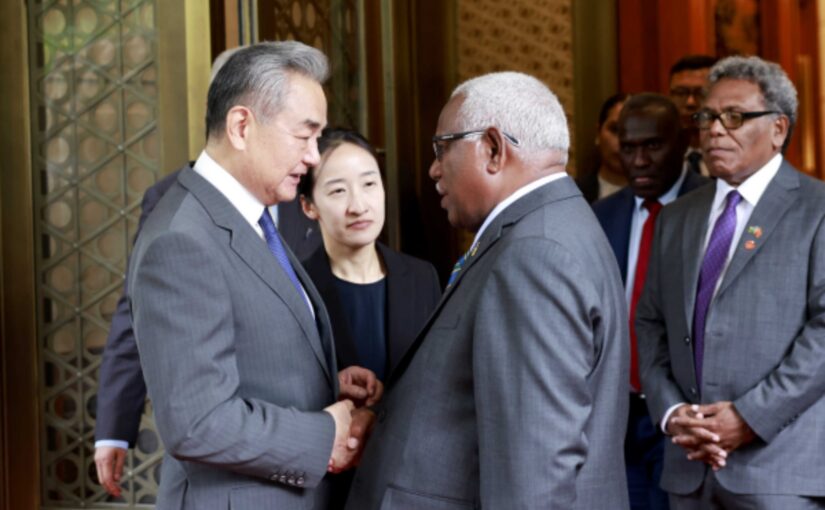
Li’s delegation then visited Albania from May 20-22 and met with Parliament Speaker Niko Peleshi and Deputy Prime Minister Albana Kociu, held talks with Deputy Parliament Speaker Klodiana Spahiu, and exchanged views with the Albanian-China Friendship Association.

Li said that China appreciates Albania’s important support for the restoration of China’s lawful seat in the United Nations and is willing to work with Albania to implement the important consensus reached by the leaders of both countries, consolidate the foundation of political mutual trust, explore potential for practical cooperation, enhance the friendship between the two peoples, strengthen exchanges between the legislative bodies of both countries, and continuously inject new vitality into China-Albania relations. (On October 25, 1971, the then Socialist Albania led 17 UN members in proposing General Assembly Resolution 2758 which expelled the representatives of the authorities on Taiwan and restored China’s rightful place in the world body.)

The Albanian side said that it values the traditional good relations between the two countries, firmly supports the one-China principle, and is willing to share the opportunities of China’s development.

In the 1960s and 1970s, China sent more than 6,000 experts and assisted in more than 140 projects in Albania, providing outstanding support for the country’s economic and social development. Some of the projects are still in operation today.

Continue reading Senior Chinese leader visits Slovakia and Albania

CPC delegation visits Egypt and Tanzania

As reported by the Xinhua News Agency, Liu Haixing, Minister of the International Department of the Communist Party of China (CPC) Central Committee (IDCPC), led a CPC delegation to visit Egypt and Tanzania from May 17 to 20.

On May 20, the Dialogue between the CPC and the six sister parties in Southern Africa was held at Tanzania’s Mwalimu Julius Nyerere Leadership School. Centered on the theme “strengthening solidarity and cooperation, advancing side by side on the path to modernisation”, it was attended by Liu Haixing and leaders of the six sister parties, including Asha-Rose Migiro, Secretary General of Tanzania’s Chama Cha Mapinduzi Party (CCM); Ludmila Maguni, Secretary for Foreign Relations of the Central Committee of the Mozambique Liberation Front (FRELIMO); Nomvula Mokonyane, First Deputy Secretary-General of the African National Congress (ANC) of South Africa; Sophia Shaningwa, Secretary General of the South West Africa People’s Organisation (SWAPO) Party of Namibia; Gonçalves Muandumba, Secretary of Organisation and Mobilisation of the Central Committee of the People’s Movement for the Liberation of Angola (MPLA); and Munyaradzi Machacha, National Political Commissar of the Zimbabwe African National Union-Patriotic Front (ZANU-PF).

Liu noted that, over the years, the CPC and the six sister parties have forged an unbreakable brotherhood in the fight against imperialism and colonialism and blazed a distinctive path of cooperation in the journey of development and rejuvenation. Against a complex and grave international landscape, further deepening solidarity and cooperation between the CPC and the six sister parties meets the shared aspirations of the people of China and the six Southern African countries and aligns with the global trend of unity and self-strengthening among the Global South. The CPC stands ready to work with the six sister parties to implement the important consensus reached between General Secretary Xi Jinping and the top leaders of the six parties, draw wisdom and strength from their shared struggles, carry forward fine traditions, and remain good comrades for mutual learning, good partners for common development, good brothers for mutual support, and good friends for solidarity and coordination. No matter how the international situation evolves, the CPC will work with the six sister parties to practice true multilateralism, advance the implementation of the four major global initiatives, and jointly safeguard international fairness and justice and build a community with a shared future for humanity.

Leaders of the six sister parties in Southern Africa noted, over the 70 years since the establishment of diplomatic relations between African countries and China, China has been a staunch supporter and reliable cooperation partner of Africa. They spoke highly of the remarkable development achievements made by China under the CPC’s leadership, and commended China for firmly safeguarding the interests of developing countries on international and regional issues. Facing mounting internal and external pressures, many African political parties are thinking and exploring future development paths. They believed that political liberation without economic prosperity is incomplete and unsustainable. Africa is embracing a new wave of pursuit of economic independence. Africa’s modernisation drive shares core commonalities with China’s path to modernisation.

Continue reading CPC delegation visits Egypt and Tanzania

China and Russia agree joint statement on Further Strengthening Comprehensive Strategic Cooperation and Deepening Good-Neighbourliness and Friendly Cooperation

Among the 40 agreements concluded during Russian President Vladimir Putin’s May 19-20 successful state visit to China the most comprehensive was the joint statement on Further Strengthening Comprehensive Strategic Cooperation and Deepening Good-Neighbourliness and Friendly Cooperation.

At a little over 11,700 words, it covers a huge range of bilateral and international issues testifying to the close coordination, consensus and complementarity that has been painstakingly built between the world’s two main anti-hegemonic powers.

Some of the salient points in the joint statement are as follows:

  • This year marks the 30th anniversary of both sides’ declaration of their determination to develop a strategic partnership of cooperation for the 21st century based on equal trust and equality, and the 25th anniversary of the signing of the China-Russia Treaty of Good-neighbourliness, Friendship and Cooperation.
  •  The Treaty of Good-Neighborliness, Friendship and Cooperation inherits and promotes the long-standing tradition of China-Russia exchanges, follows recognised principles and norms of international law, and lays a long-term legal foundation for the development of contemporary China-Russia relations. It not only fully demonstrates the long-standing good-neighbourly friendship and the willingness to develop intergenerational friendship between the peoples of both countries, but also concretely embodies the common values of peace, development, fairness, justice, democracy, and freedom for all humanity.
  • The basic principles of bilateral cooperation established in the China-Russia Treaty of Good-Neighbourliness, Friendship and Cooperation have stood the test of time and still hold significant practical significance today. The bilateral relationship is characterised by non-alignment, non-confrontation, and non-targeting of third countries.
  • Both sides agreed to extend the treaty in accordance with Article 25 of the Treaty of Good-Neighbourliness, Friendship and Cooperation, and will continue to abide by the principles and spirit of the treaty.
  • Both sides will continue to consolidate the traditional friendship between the two militaries, enhance mutual trust in the military field, improve cooperation mechanisms, expand joint exercises and joint sea and air patrols, strengthen coordination under bilateral and multilateral frameworks, jointly address various risks and challenges, and jointly safeguard global and regional security and stability.
  • Both sides emphasised the need to protect memorial facilities for martyrs who died in World War II within each other’s territories, and will continue cooperation in the protection and management of these facilities, jointly promoting the search and extraction of martyrs and missing remains, commemorating and honouring heroes, and improving the foundations of relevant laws and regulations.
  • Both sides highly appreciated the further deepening of coordination and cooperation under the tripartite mechanism involving Mongolia, as well as the prospects for the China-Mongolia-Russia Economic Corridor and will actively promote the implementation and cooperation of key joint projects under the framework of this corridor. Both sides agreed to assist Mongolia in joining the regional integration process, including the Shanghai Cooperation Organisation.
  • Both sides will further strengthen cooperation in the protection of wildlife such as the Amur tiger, Amur leopard, giant panda, golden snub-nosed monkey, and migratory birds, and enhance the exchange of management experiences in nature reserves.
  • Both sides agreed to strengthen close cooperation in environmental protection and water resources. Continue to deepen cooperation in cross-border water and hydrological flood reporting and flood control to ensure flood safety in border areas between the two countries. Continue to deepen practical cooperation in water quality protection across boundary water bodies, maintain cooperation on emergency liaison for sudden ecological environmental incidents, promote the construction of a network of transboundary nature reserves, protect biodiversity, strengthen cooperation in waste management, and continue to advance nature conservation cooperation under the framework of the G20, BRICS, Shanghai Cooperation Organisation, and the Northeast Asia subregional environmental protection cooperation program.
  • Both sides agreed to deepen pragmatic cooperation between China and the Eurasian Economic Union under the framework of the “Agreement on Economic and Trade Cooperation between China and the Eurasian Economic Union,” and to continuously advance the alignment of the Belt and Road Initiative and the Eurasian Economic Union development plan in areas such as transportation, logistics, transportation, digitalisation, e-commerce, policy coordination and elimination of trade barriers, food, and agricultural product trade. Both sides believe that this dialogue mechanism is crucial for promoting trade cooperation, facilitating deepening economic integration and connectivity in the Asia-Pacific and Eurasian regions, and advancing the joint development of the Belt and Road Initiative and the establishment of the Greater Eurasian Partnership. Both sides are willing to further upgrade and expand the institutional arrangements for economic and trade cooperation between China and the Eurasian Economic Union and its member states.
Continue reading China and Russia agree joint statement on Further Strengthening Comprehensive Strategic Cooperation and Deepening Good-Neighbourliness and Friendly Cooperation

China and Russia issue joint statement on advocating global multipolarity and new types of international relations

One important outcome of Russian President Vladimir Putin’s May 19-20 state visit to China  was the adoption of a Joint Statement on Advocating Global Multipolarity and New Types of International Relations.

Without criticising any country by name, it sets out a democratic program for a new world fundamentally at odds with the arbitrary and aggressive paradigm followed by the imperialist and hegemonist powers headed by the United States.

The statement begins by noting that: “Both the People’s Republic of China and the Russian Federation have long histories and civilisations, are founding members of the United Nations and permanent members of the Security Council, and are important forces in a multipolar world, playing a constructive role in maintaining the global balance of power and improving the international relations system.”

Noting that since the end of World War II, the international landscape and balance of power have accelerated their evolution, it goes on:

“On one hand, the wave of decolonisation and the end of the Cold War have greatly increased the number of sovereign countries worldwide, making the international community more diverse and complex. The development level and international influence of countries in Asia, Africa, the Middle East, Latin America, and the Caribbean have surged, and the number of regional and transregional organisations has surged, covering areas such as international politics, security, economy, and cultural cooperation, with their roles in global affairs continuously growing.”

However: “Some countries arbitrarily manipulate international affairs, impose their interests worldwide with colonial-era thinking, and restrict the development of other sovereign nations [but this has] completely failed.”

Rather: “The international relations system of the 21st century is undergoing profound transformation, gradually evolving toward multipolarity and new types of international relations.”

But: “The international situation is becoming increasingly complex, with unilateral coercion, hegemonism, bloc confrontation, and neo-colonialism surging against the currents. International law and basic norms of international relations are being continuously trampled, making it even harder for many global governance institutions to coordinate actions between states and mediate international disputes and to operate effectively. World peace and development face new risks and challenges, with the danger of fragmentation and regression to the law of the jungle within the international community.”

The statement then makes a number of calls:

  • Adhere to openness, inclusiveness, and mutually beneficial cooperation. We should respect the sovereignty, territorial integrity, and uniqueness of each country, and respect the development paths and models chosen independently by each sovereign nation. There is no universal development path in the world, nor is there any country or nation superior to others. In the complex international landscape, natural differences between countries should not become obstacles to developing equal, mutually beneficial, and mutually respectful interstate relations. Unilateral means to solve common problems, any form of hegemonic or coercive policies, are unacceptable.
  • Adhere to safety, equality, and indivisibility. Against the backdrop of growing risks and challenges facing humanity, building a more united international community means that one country’s security cannot come at the expense of another’s security. All sovereign states enjoy equal rights to ensure their own security. We should pay attention to the legitimate security concerns of all countries, strengthen coordination on security issues, resist bloc confrontation and ‘zero-sum games,’ oppose the expansion of military alliances, hybrid wars, and proxy wars, and advocate for the construction of a balanced, effective, and sustainable new global and regional security architecture.
  • Adhere to promoting the democratisation of international relations and improving the global governance system. All countries and national groups are free to choose partners and international cooperation models. Hegemonism is unacceptable and should be resisted. No country or group of countries may control international affairs, dominate the fate of other countries, or monopolise development advantages. Upholding multilateralism is the main approach to solving complex global problems, and its role should be strengthened to prevent the UN’s authority from being weakened. Reforms of the United Nations and other multilateral institutions should serve the interests of all humanity and continuously enhance the representation and voice of developing countries in the international system. Rules established by a few countries cannot replace universally accepted international laws. A major power should earnestly shoulder its special responsibilities and missions, strengthen self-restraint, and refrain from abusing its own strength.
  • Uphold world civilisation and value diversity.  All human civilisations are equal and possess unique value, with no superiority or inferiority. No civilisation’s moral and spiritual system should be regarded as exclusive or superior to other civilisations.

Both sides agreed that they will continue to develop a shared vision for building a multipolar world and a more just new type of international relations.

Continue reading China and Russia issue joint statement on advocating global multipolarity and new types of international relations

Pakistan Prime Minister to visit China as the two countries celebrate 75 years of diplomatic ties

Chinese President Xi Jinping and his Pakistani counterpart Asif Ali Zardari exchanged congratulatory messages on May 21, marking the 75th anniversary of diplomatic ties between their two countries.

Xi said that China and Pakistan are good friends and all-weather strategic cooperative partners linked by mountains and rivers and sharing weal and woe. Since the establishment of diplomatic relations 75 years ago, no matter how the international situation has changed, the friendship between China and Pakistan has always remained rock-solid and unbreakable.

For his part, Zardari said the Pakistan-China all-weather strategic cooperative partnership has stood the test of time and become a steadfast pillar for regional peace, stability and development. Pakistan sincerely appreciates China’s steadfast support for Pakistan in safeguarding its sovereignty and territorial integrity and promoting its economic and social development, said Zardari, adding that his country will continue to support China on issues concerning its core interests and further elevate the Pakistan-China friendship to new levels.

On the same day, Chinese Premier Li Qiang and Pakistani Prime Minister Shehbaz Sharif also exchanged congratulatory messages.

Also on May 21, the Chinese Foreign Ministry announced that at the invitation of Premier Li Qiang, Prime Minister Shehbaz Sharif will pay an official visit to China from May 23-26.

Spokesperson Guo Jiakun said at a regular press briefing that Sharif’s visit is an important high-level exchange between China and Pakistan on the occasion of the 75th anniversary of their diplomatic relations. During the visit, President Xi Jinping will meet with Sharif and Premier Li Qiang will hold talks with him.

Noting that China and Pakistan are good friends and all-weather strategic cooperative partners, Guo said that over the past 75 years, China-Pakistan relations have stood all tests and remained rock-solid, setting a fine example for state-to-state relations. He added that in recent years, under the strategic guidance of leaders of the two countries, the two sides have maintained close high-level exchanges and steadily advanced practical cooperation, yielding fruitful outcomes in the high-quality development of the China-Pakistan Economic Corridor (CPEC).

Meanwhile, Cai Dafeng, vice chairman of the Standing Committee of China’s National People’s Congress (NPC), led a delegation to visit Pakistan from May 20-22 at the invitation of the National Assembly of Pakistan.

During his stay, Cai met with President Asif Ali Zardari, Prime Minister Shehbaz Sharif, National Assembly Speaker Sardar Ayaz Sadiq and Senate Chairman Yusuf Raza Gilani, and attended the commemorative activities marking the 75th anniversary of the establishment of diplomatic relations between China and Pakistan together with the four Pakistani leaders.

Continue reading Pakistan Prime Minister to visit China as the two countries celebrate 75 years of diplomatic ties

President Putin makes historic 25th visit to China

Testifying to the exceptionally close friendly relations between the People’s Republic of China and the Russian Federation, Russian President Vladimir Putin paid a state visit to China, May 19-20, at the invitation of his Chinese counterpart Xi Jinping. It was the Russian leader’s 25th visit to China since he first assumed the presidency of his country.

President Putin arrived in Beijing at night on May 19 and was warmly welcomed at the airport by Chinese Foreign Minister Wang Yi, who is also a member of the political bureau of the central committee of the Communist Party of China. The substantive business of the visit was conducted throughout an intense May 20.

On the morning of May 20, President Xi Jinping held talks with President Putin at the Great Hall of the People in Beijing. The talks were held consecutively in small and large group formats and the two presidents agreed to further extend the China-Russia Treaty of Good-Neighbourliness and Friendly Cooperation.

According to the report published by the Chinese Foreign Ministry, President Xi noted that this year marks the 30th anniversary of the China-Russia strategic partnership of coordination and the 25th anniversary of the signing of the Treaty of Good-Neighbourliness and Friendly Cooperation Between China and Russia. The signing of the treaty established by law the institutional foundation of long-term good-neighbourliness, friendship and comprehensive strategic coordination. Since then, the bilateral relationship has achieved leapfrog development. China-Russia relations have come this far step by step, “precisely because we have kept deepening political mutual trust and strategic coordination with unyielding tenacity, expanded all-round cooperation with a drive to always scale new heights, and defended international justice and fairness and advanced the building of a community with a shared future for humanity with unflappable resolve. Under the current international situation, as permanent members of the UN Security Council and important major countries in the world, China and Russia should take a strategic and long-term perspective, drive the development and revitalisation of our respective countries through comprehensive strategic coordination of even higher quality, and work to make the global governance system more just and equitable.  The two sides should deepen multilateral coordination, further increase coordination and collaboration on multilateral platforms such as the UN, the SCO (Shanghai Cooperation Organisation), BRICS and APEC, unswervingly uphold the postwar international order and the authority of international law, unite the Global South, and steer the reform of the global governance system in the right direction.”

President Putin said that Russia-China cooperation is an important stabilising factor in the turbulent international environment. Russia is ready to continue to strengthen multilateral coordination with China, support China in hosting the APEC Economic Leaders’ Meeting, jointly enhance the standing and influence of the SCO, strengthen BRICS unity and coordination, uphold the authority of the UN, advocate diversity of civilisations, and make the international order more just and equitable. 

Following the talks, the two heads of state signed and issued the Joint Statement Between the People’s Republic of China and the Russian Federation on Further Strengthening Comprehensive Strategic Coordination and Deepening Good-Neighbourliness and Friendly Cooperation and witnessed the signing of 20 cooperation documents in such areas as economy and trade, education, and science and technology.

Continue reading President Putin makes historic 25th visit to China

Cuban commentary on the Xi Trump summit

In the following article, which is reproduced from Resumen Latinoamericano and the Global South, veteran Cuban journalist Luis Manuel Arce Issac writes that:

“Trump’s visit to China highlighted Xi Jinping’s rise and the United States’ global decline in the economy, technology, and international leadership.”

According to Arce: “There is a consensus that… in a year and a few months as president in his second term, the Republican leader set his country back on all fronts with his failed goal of weakening China… China’s strategy has extraordinarily outperformed the US strategy due to a degree of effectiveness that ideologues and political and economic leaders allied with Trump never foresaw or imagined: while they filled the world with wars of all kinds to achieve their goals through brute force, Xi Jinping did the opposite by prioritising peace and mutually beneficial collaboration, with surprisingly positive results.”

He concludes: “While Xi Jinping builds factors of balance and dialogue, Trump destroys what little the US had left and speaks on equal footing with only three countries: China, Russia, and the Democratic People’s Republic of Korea—all of which are also nuclear powers.

 “Outside that narrow framework, it treats even its European allies with contempt and points its guns and missiles at the heads of others or surrounds them with its destroyers and aircraft carriers.

“In short, the US is a power in decline, while China is on the rise.”

Luis Manuel Arce Issac is a Cuban journalist with more than six decades of uninterrupted professional experience. He served as a war correspondent in Vietnam, Laos, Cambodia, and Nicaragua, and as a correspondent for the Prensa Latina news agency in countries such as Venezuela, Uruguay, Spain, and Mexico. He served as spokesperson for Commander Ernesto “Che” Guevara when Guevara was Cuba’s Minister of Industry and was part of the group of journalists who covered the overseas trips of the historic leader of the Cuban Revolution, Fidel Castro. He has received awards and honours for his journalistic work in Cuba, Vietnam, Venezuela, and Mexico.

Continue reading Cuban commentary on the Xi Trump summit

Wang Yi elaborates on outcomes from Donald Trump China visit

Following the May 13-15 state visit to China by US President Donald J. Trump, Chinese Foreign Minister Wang Yi, who is also a member of the Political Bureau of the Central Committee of the Communist Party of China, gave a detailed briefing on the outcomes and on what China considers to be the common understandings reached between the two sides.

Some of the key points made by Wang Yi include:

  • China-US relations have reached a new starting point. This is the first face-to-face engagement between President Xi and President Trump since their Busan [Republic of Korea] meeting last October, and also the first visit to China by a US president in nine years. As transformation not seen in a century accelerates across the globe, the world has once again reached a crossroads. President Xi raised some important questions: Can China and the United States overcome the Thucydides Trap and create a new paradigm of major-country relations? Can we meet global challenges together and provide greater stability for the world? Can we build a bright future together for our bilateral relations in the interest of the well-being of the two peoples and the future of humanity? These questions are vital to history, to the world, and to the people. They are the questions of our times.
  • The most important political understanding they reached was the agreement to build “a constructive China-US relationship of strategic stability.” They also agreed for the two sides to pursue more exchanges on foreign policy, military-to-military relations, economy and trade, public health, agriculture, tourism, people-to-people ties, and law enforcement. This will provide a powerful boost to China-US interactions at all levels and in all fields.
  • President Xi and President Trump agreed on a new vision of building a constructive China-US relationship of strategic stability. This is how China understands it:
  • As the world’s top two economies, China and the United States share deep ties. Neither can cut the other out or prosper without the other. We both gain from cooperation and lose from confrontation. While a confrontational relationship will be disastrous for both countries and the world, China-US cooperation will get many great things done to the benefit of both and all.
  • It should be healthy stability where competition is kept within proper limits and is not turned into a zero-sum game. Major-country competition is nothing new, but China-US relations should not be defined by competition. When competition does happen, it must be a healthy one where we learn from each other, pursue excellence together, and compete fairly in compliance with rules.
  • It should be constant stability where differences are manageable, and the relationship should not be like a roller coaster. Both sides should maintain policy continuity and stability. It is very important for both sides to honour our words and move in the same direction.
  • It should be lasting stability where peace is expectable and conflicts and wars are not acceptable. Peaceful coexistence is the biggest common denominator of China and the United States. Conflict and confrontation between us will produce consequences no one can bear. To prevent this from happening, the bottom line is that both sides must abide by the three China-US joint communiqués, respect each other’s social systems and development paths, respect each other’s core interests and major concerns, and respect each other’s right to development.
  • In short, building a constructive China-US relationship of strategic stability is not a slogan. It should be a goal both sides uphold and entail concerted actions.
  • At the invitation of President Trump, President Xi will pay a state visit to the United States this fall.
  • The Beijing summit will reenergise exchanges between the two sides’ legislative bodies, subnational entities and business, academic and media communities, and add more dimensions to the constructive China-US relationship of strategic stability.
  • President Xi has pointed out that the hope of the China-US relationship lies in the people, its foundation is in grassroots connections, its future depends on the youth, and its vitality comes from subnational exchanges. During this summit, both presidents spoke about the importance of promoting people-to-people exchanges. President Xi specially cited the “Ping-Pong diplomacy” which took place 55 years ago. It opened up the China-US relations that had remained frozen for over two decades and marked a milestone in contemporary international relations. President Trump also reviewed historical interactions between the two nations, noting that Sino-US friendship goes all the way back to America’s founding and the American and Chinese people have shared a deep sense of appreciation and respect that ran in both directions.
  • During the visit, the two presidents toured the Temple of Heaven together. The tour provided insights into the Chinese appreciation of harmony among all beings and respect for the law of nature. This special program attested to the need for the two great countries to deepen mutual understanding and foster people-to-people friendship.
  • In the past year and more, legislative, subnational, and business delegations have visited each other more frequently. Many US business leaders accompanied President Trump to China on this trip, and he even invited them to the official talks. President Xi spoke to every one of them, encouraged them to strengthen cooperation with China, and stressed that China will open its door still wider. Premier Li Qiang also met with the US business leaders. They all said that they have a deep commitment to the Chinese market and want to grow their business here and strengthen cooperation with Chinese partners.
  • The Taiwan question was an important topic taken up at the summit. China’s position is very clear:
  • First, the Taiwan question is China’s internal affair. Realising complete reunification is an aspiration shared by all sons and daughters of the Chinese nation. It is also the unwavering, historic mission of the Communist Party of China. The mainland and Taiwan belong to one and the same China. This is a fact established since antiquity, the real status quo of the Taiwan Strait, and an important part of the postwar international order. We hope that the US side will strictly abide by the one-China principle and the three China-US joint communiqués and honour its international obligation.
  • Second, the Taiwan question is the most important issue between China and the US, one that affects the entire relationship. If it is handled properly, the overall relationship will be stable, and the two sides will be able to devote more energy to advancing mutually beneficial cooperation. Otherwise, the two countries will have clashes and even conflicts, and the entire relationship will be in great jeopardy. China hopes that the US side will take concrete actions to keep the relationship on an even keel and contribute to peace and stability in the Taiwan Strait.
  • Third, China and the US both agree on the vital importance of safeguarding cross-Strait peace and stability. To ensure this is the case, one must never indulge or support “Taiwan independence,” because “Taiwan independence” and cross-Strait peace are as irreconcilable as fire and water. Our impression coming out of the summit is that the US side understands China’s position, takes China’s concerns seriously, and, like the rest of the international community, does not agree with or accept Taiwan’s moving toward independence.
  • President Xi emphasised that the economic and trade ties are mutually beneficial and win-win by nature. Where disagreements and frictions exist, equal-footed consultation is the only right approach. The two economic and trade teams produced generally balanced and positive outcomes, including continuing to implement all the consensus reached in prior consultations, establishing a board of trade and a board of investment, addressing each other’s concerns regarding market access for agricultural products, and expanding two-way trade within the framework of reciprocal tariff reduction.
  • On the Middle East situation, President Xi set forth China’s consistent position. He emphasised that the use of force cannot solve problems, and dialogue is the only right choice. Negotiation may not produce immediate results, but now that the door of dialogue has been opened, it should not be closed again. China encourages the US and Iran to continue settling their differences and disputes through negotiation, including on the nuclear issue. China calls for reopening the Strait of Hormuz as soon as possible on the basis of continued ceasefire and believes that the fundamental solution to the stalemate in the Strait lies in achieving a permanent and comprehensive ceasefire. China has been working to promote peace talks and will continue to play its role for an early end to the conflict and restoration of peace in the Middle East.
Continue reading Wang Yi elaborates on outcomes from Donald Trump China visit

Following the May 13-15 state visit to China by US President Donald J. Trump, Chinese Foreign Minister Wang Yi, who is also a member of the Political Bureau of the Central Committee of the Communist Party of China, gave a detailed briefing on the outcomes and on what China considers to be the common understandings reached between the two sides.

Some of the key points made by Wang Yi include:

  • China-US relations have reached a new starting point. This is the first face-to-face engagement between President Xi and President Trump since their Busan [Republic of Korea] meeting last October, and also the first visit to China by a US president in nine years. As transformation not seen in a century accelerates across the globe, the world has once again reached a crossroads. President Xi raised some important questions: Can China and the United States overcome the Thucydides Trap and create a new paradigm of major-country relations? Can we meet global challenges together and provide greater stability for the world? Can we build a bright future together for our bilateral relations in the interest of the well-being of the two peoples and the future of humanity? These questions are vital to history, to the world, and to the people. They are the questions of our times.
  • The most important political understanding they reached was the agreement to build “a constructive China-US relationship of strategic stability.” They also agreed for the two sides to pursue more exchanges on foreign policy, military-to-military relations, economy and trade, public health, agriculture, tourism, people-to-people ties, and law enforcement. This will provide a powerful boost to China-US interactions at all levels and in all fields.
  • President Xi and President Trump agreed on a new vision of building a constructive China-US relationship of strategic stability. This is how China understands it:
  • As the world’s top two economies, China and the United States share deep ties. Neither can cut the other out or prosper without the other. We both gain from cooperation and lose from confrontation. While a confrontational relationship will be disastrous for both countries and the world, China-US cooperation will get many great things done to the benefit of both and all.
  • It should be healthy stability where competition is kept within proper limits and is not turned into a zero-sum game. Major-country competition is nothing new, but China-US relations should not be defined by competition. When competition does happen, it must be a healthy one where we learn from each other, pursue excellence together, and compete fairly in compliance with rules.
  • It should be constant stability where differences are manageable, and the relationship should not be like a roller coaster. Both sides should maintain policy continuity and stability. It is very important for both sides to honour our words and move in the same direction.
  • It should be lasting stability where peace is expectable and conflicts and wars are not acceptable. Peaceful coexistence is the biggest common denominator of China and the United States. Conflict and confrontation between us will produce consequences no one can bear. To prevent this from happening, the bottom line is that both sides must abide by the three China-US joint communiqués, respect each other’s social systems and development paths, respect each other’s core interests and major concerns, and respect each other’s right to development.
  • In short, building a constructive China-US relationship of strategic stability is not a slogan. It should be a goal both sides uphold and entail concerted actions.
  • At the invitation of President Trump, President Xi will pay a state visit to the United States this fall.
  • The Beijing summit will reenergise exchanges between the two sides’ legislative bodies, subnational entities and business, academic and media communities, and add more dimensions to the constructive China-US relationship of strategic stability.
  • President Xi has pointed out that the hope of the China-US relationship lies in the people, its foundation is in grassroots connections, its future depends on the youth, and its vitality comes from subnational exchanges. During this summit, both presidents spoke about the importance of promoting people-to-people exchanges. President Xi specially cited the “Ping-Pong diplomacy” which took place 55 years ago. It opened up the China-US relations that had remained frozen for over two decades and marked a milestone in contemporary international relations. President Trump also reviewed historical interactions between the two nations, noting that Sino-US friendship goes all the way back to America’s founding and the American and Chinese people have shared a deep sense of appreciation and respect that ran in both directions.
  • During the visit, the two presidents toured the Temple of Heaven together. The tour provided insights into the Chinese appreciation of harmony among all beings and respect for the law of nature. This special program attested to the need for the two great countries to deepen mutual understanding and foster people-to-people friendship.
  • In the past year and more, legislative, subnational, and business delegations have visited each other more frequently. Many US business leaders accompanied President Trump to China on this trip, and he even invited them to the official talks. President Xi spoke to every one of them, encouraged them to strengthen cooperation with China, and stressed that China will open its door still wider. Premier Li Qiang also met with the US business leaders. They all said that they have a deep commitment to the Chinese market and want to grow their business here and strengthen cooperation with Chinese partners.
  • The Taiwan question was an important topic taken up at the summit. China’s position is very clear:
  • First, the Taiwan question is China’s internal affair. Realising complete reunification is an aspiration shared by all sons and daughters of the Chinese nation. It is also the unwavering, historic mission of the Communist Party of China. The mainland and Taiwan belong to one and the same China. This is a fact established since antiquity, the real status quo of the Taiwan Strait, and an important part of the postwar international order. We hope that the US side will strictly abide by the one-China principle and the three China-US joint communiqués and honour its international obligation.
  • Second, the Taiwan question is the most important issue between China and the US, one that affects the entire relationship. If it is handled properly, the overall relationship will be stable, and the two sides will be able to devote more energy to advancing mutually beneficial cooperation. Otherwise, the two countries will have clashes and even conflicts, and the entire relationship will be in great jeopardy. China hopes that the US side will take concrete actions to keep the relationship on an even keel and contribute to peace and stability in the Taiwan Strait.
  • Third, China and the US both agree on the vital importance of safeguarding cross-Strait peace and stability. To ensure this is the case, one must never indulge or support “Taiwan independence,” because “Taiwan independence” and cross-Strait peace are as irreconcilable as fire and water. Our impression coming out of the summit is that the US side understands China’s position, takes China’s concerns seriously, and, like the rest of the international community, does not agree with or accept Taiwan’s moving toward independence.
  • President Xi emphasised that the economic and trade ties are mutually beneficial and win-win by nature. Where disagreements and frictions exist, equal-footed consultation is the only right approach. The two economic and trade teams produced generally balanced and positive outcomes, including continuing to implement all the consensus reached in prior consultations, establishing a board of trade and a board of investment, addressing each other’s concerns regarding market access for agricultural products, and expanding two-way trade within the framework of reciprocal tariff reduction.
  • On the Middle East situation, President Xi set forth China’s consistent position. He emphasised that the use of force cannot solve problems, and dialogue is the only right choice. Negotiation may not produce immediate results, but now that the door of dialogue has been opened, it should not be closed again. China encourages the US and Iran to continue settling their differences and disputes through negotiation, including on the nuclear issue. China calls for reopening the Strait of Hormuz as soon as possible on the basis of continued ceasefire and believes that the fundamental solution to the stalemate in the Strait lies in achieving a permanent and comprehensive ceasefire. China has been working to promote peace talks and will continue to play its role for an early end to the conflict and restoration of peace in the Middle East.
Continue reading Wang Yi elaborates on outcomes from Donald Trump China visit

A successful visit to Beijing: is the US ruling class starting to face reality?

In the following article, our co-editor Carlos Martinez assesses Donald Trump’s 13-15 May state visit to China, arguing that the positive mood music between Trump and Xi Jinping reflects a (slowly) growing understanding in US policy circles that a hawkish anti-China strategy simply is not working. The semiconductor war has accelerated Chinese self-sufficiency rather than slowed it; Trump’s 145 percent tariffs collapsed within days of Beijing tightening rare-earth export controls; and the US-Israeli criminal war on Iran has strengthened, rather than weakened, the multipolar trajectory.

The deeper meaning of this summit is that the US ruling class is having to, very reluctantly, start to come to terms with the world as it actually is. It does not “hold the cards”. As Xi put it at the Great Hall of the People, “the world is big enough to accommodate both countries, and one country’s success is an opportunity for the other.” The Chinese have been consistently saying this for years. The difference now is that, as a growing number of US analysts are admitting that they’re right: win-win cooperation between major powers is possible; what isn’t possible is the indefinite extension of unipolar US hegemony.

NB. An expanded version of this article, including analysis of Vladimir Putin’s visit a few days later, has been published in Beijing Review.

Donald Trump’s 13-15 May state visit to China has produced a raft of headlines that would have been unthinkable a decade ago. “This time, Trump and Xi meet as equals”, declared The Times. The White House spoke of a “constructive relationship of strategic stability”.

A delegation of CEOs – Nvidia’s Jensen Huang (who joined at the last minute), Tesla’s Elon Musk, Apple’s Tim Cook and more – accompanied the president to Beijing, signalling that the decoupling project has, at least for the moment, run its course. Trump publicly defended the right of half a million Chinese students to attend US universities. He called Xi a “great leader” and said “the relationship is a very strong one”. The Times columnist Gerard Baker, who has spent years cheerleading for the China hawks, conceded that “the unipolar moment was fleeting” and that “there are two true superpowers”.

This is a remarkable shift. Trump has cast himself as a China hawk since at least his 2016 campaign. “We can’t continue to allow China to rape our country”, he infamously told a rally in Indiana. He pledged to label China a currency manipulator on day one, accused Beijing of “stealing our jobs” and made tariffs on Chinese goods a centrepiece of his platform. Once in office, he initiated the trade war, banned Huawei from US 5G networks, expelled Chinese journalists, signed bipartisan legislation funnelling weapons to Taiwan, and oversaw the 2017 National Security Strategy that designated China as a “strategic competitor”.

Continue reading A successful visit to Beijing: is the US ruling class starting to face reality?

Working people around the world look for Cold War reset as Xi and Trump meet

As Chinese President Xi Jinping sat down with his US counterpart and guest Donald Trump in Beijing’s Great Hall of the People on May 14, the US publication People’s World published an article issued in the name of its editorial collective, saying that “the eyes of working people around the world are fixed on this two-day summit with both urgency and hope.”

It went on to note that the “relationship between the United States and China has deteriorated badly in recent years. Military posturing in the Asia-Pacific and the signing of new war pacts like the AUKUS nuclear submarine scheme have raised the specter of catastrophic conflict. A ‘new Cold War’ framework—driven by Washington’s bipartisan foreign policy establishment—has pushed the two largest economies on earth toward confrontation rather than cooperation… This summit is an opportunity to step back from the brink and push the reset button.”

According to the US comrades, in his opening remarks addressed to Trump, President Xi posed the right question: “Can the United States and China avoid the ‘Thucydides Trap,’ the historical pattern in which a rising power and an established one blunder into war? That question deserves a serious answer, and it demands more than diplomatic pleasantries. It demands concrete commitments.”

We reprint the article below.

As U.S. President Donald Trump and Chinese President Xi Jinping sit across from one another at the Great Hall of the People in Beijing, the eyes of working people around the world are fixed on this two-day summit with both urgency and hope.

The relationship between the United States and China has deteriorated badly in recent years. Reckless tariff wars have disrupted global supply chains and squeezed workers and consumers in both countries with inflation and layoffs. Military posturing in the Asia-Pacific and the signing of new war pacts like the AUKUS nuclear submarine scheme have raised the specter of catastrophic conflict.

Continue reading Working people around the world look for Cold War reset as Xi and Trump meet

Trump goes to Beijing as Washington faces a changed world

The immediate agenda for the summit between presidents Donald Trump and Xi Jinping on 14-15 May is crowded enough – the Iran war and the Strait of Hormuz energy shock, tariffs and rare earths, Taiwan arms sales, AI and semiconductors. But Gary Wilson’s analysis in Struggle La Lucha cuts through the media headlines to the deeper question: what has actually changed in the world that makes this summit so important?

The answer is not to be found in the language of “geopolitical rivalry” that dominates mainstream coverage. It lies in something more fundamental: a historic shift in the centre of gravity of industrial production, as a result of which US imperialism no longer holds an uncontested monopoly over the factories, supply chains and technologies that shape the world economy. That a socialist country, outside the framework of the US-led imperialist system, is shifting to the centre of the global economy is causing panic in the hallways of power in Washington. “That is what underlies every major issue surrounding the summit — trade, chips, Taiwan, oil, Iran and artificial intelligence — whether the participants acknowledge it or not.”

Gary notes that Trump will also be keen to secure Xi Jinping’s help digging him out of a quagmire in Iran, by putting pressure on Iran to open the Strait of Hormuz. Treasury Secretary Scott Bessent has explicitly called on China to “step up with some diplomacy and get the Iranians to open the strait”. However, China is unlikely to shift its consistent position, calling for a lasting peace based on the recognition of Iran’s sovereign rights (including to nuclear energy development) and an end to the US and Israel’s illegal assault. It’s significant that, just a week prior to Trump’s arrival, Iranian FM Abbas Araghchi was in Beijing for discussions with Wang Yi, who reiterated that “China supports Iran in safeguarding its national sovereignty and security and appreciates Iran’s willingness to seek a political solution through diplomatic channels”.

Washington wants China’s help cleaning up crises U.S. imperialism created, especially the war on Iran and the oil shock spreading from Hormuz. At the same time, it wants to block China’s industrial rise and keep control over technology, oil routes and world markets. But the old setup has already been broken. The centre of world production has shifted. So has the weight of the world working class.

President Donald Trump arrived in Beijing on May 13 ahead of two days of talks with Chinese President Xi Jinping — the first visit by a sitting U.S. president to China since Trump’s last trip in 2017. 

He will bring with him a delegation from the biggest U.S. banks, tech firms, manufacturers and financial monopolies: Nvidia’s Jensen Huang, Tesla’s Elon Musk, Apple’s Tim Cook, BlackRock’s Larry Fink, Blackstone’s Stephen Schwarzman, Goldman Sachs CEO David Solomon, Boeing CEO Kelly Ortberg, Citigroup CEO Jane Fraser, Mastercard CEO Michael Miebach, Micron CEO Sanjay Mehrotra, Qualcomm CEO Cristiano Amon, Visa CEO Ryan McInerney, Meta executive Dina Powell McCormick, and others.

Trade, technology controls, Taiwan and the U.S. war on Iran are the immediate issues around the Beijing meeting. Artificial intelligence may also be discussed. But understanding what is really at stake requires stepping back from the daily headlines.

China is not what the headlines say

The U.S. corporate media covers the Trump-Xi summit as a clash between rival powers. That is the language of “geopolitics” — a way of describing world events that hides classes, hides imperialism and hides the struggle over who controls production, technology and the wealth created by workers.

China is not a mirror image of the United States. By nominal GDP — measured at market exchange rates — China’s economy is roughly two-thirds the size of the United States’. In purchasing power terms, which adjusts for price levels and better reflects real productive output, China’s economy is larger. Still, China is not a rich imperialist country like the United States. Its enormous economy is spread across more than 1.4 billion people, including a vast rural population. Hundreds of millions have been lifted out of extreme poverty, but China still carries the burdens of a formerly oppressed country that industrialized late and unevenly.

Continue reading Trump goes to Beijing as Washington faces a changed world

Iranian Foreign Minister visits Beijing

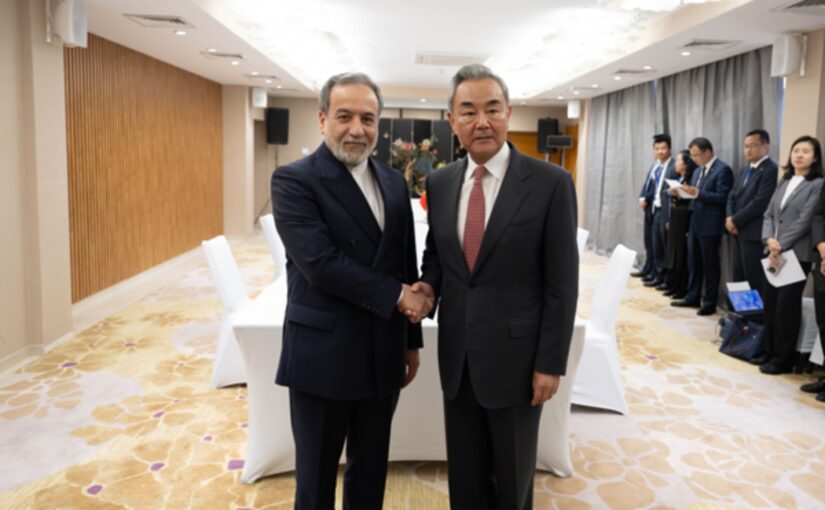
Iranian Foreign Minister Seyyed Abbas Araghchi visited China on May 6 for talks with his Chinese counterpart Wang Yi.

Araghchi briefed Wang on the latest developments in the Iran-US negotiations and Iran’s next steps, stating that facts have proven that political crises cannot be resolved through military means. Iran will resolutely safeguard its national sovereignty and national dignity while continuously building consensus through peaceful negotiations to seek a comprehensive and permanent solution. Currently, the issue of opening the Strait of Hormuz could be promptly addressed. Iran highly appreciates and agrees with the four propositions put forward by President Xi Jinping [during his recent meeting with the Crown Prince of the United Arab Emirates {UAE}] on safeguarding and promoting peace and stability in the region. Iran commends China for always standing on the right side of history and making unremitting efforts with a constructive attitude to prevent the situation from deteriorating and spilling over. Iran trusts China and looks forward to China continuing to play an active role in promoting peace and ending the conflict and supports the establishment of a new post-war regional framework that can coordinate development and security.

The Iranian Foreign Minister added that his country is willing to take the 55th anniversary of the establishment of diplomatic relations between the two countries this year as an opportunity to strengthen exchanges at all levels, tap into cooperation potential, provide firm mutual support, and deepen all-round cooperation. Iran is also willing to strengthen communication and coordination with China in multilateral affairs and continuously deepen the Iran-China comprehensive strategic partnership.

Wang Yi reiterated China’s principled position on the situation in Iran, emphasising that China has been actively promoting peace and facilitating talks since the outbreak of hostilities. President Xi Jinping solemnly put forward four propositions on safeguarding and promoting peace and stability in the Middle East, which has received a positive response from the international community. The current regional situation is at a critical juncture between war and peace. China believes that a comprehensive ceasefire is of utmost urgency, that resuming hostilities is even less acceptable, and that adhering to negotiations is particularly important. China supports Iran in safeguarding its national sovereignty and security and appreciates Iran’s willingness to seek a political solution through diplomatic channels. Regarding the Strait of Hormuz, the international community shares a common concern about restoring normal and safe passage through the strait, and China hopes that the parties involved will promptly respond to the strong call from the international community.  [In this regard it should be noted above that Araghchi said that this issue could be promptly addressed, whereas the same day, US President Donald Trump boasted that, “the blockade will remain in full force and effect.” Iran has consistently stressed that the Strait remains open to all but the US aggressors and their allies.]

Continue reading Iranian Foreign Minister visits Beijing

Pakistan president pays tribute to Chairman Mao on Hunan visit

Pakistan president Asif Ali Zardari visited China’s Hunan and Hainan provinces from April 25-May 1.

In the year in which the two countries are celebrating the 75th anniversary of their diplomatic relations, a key focus of the visit was on a wide range of economic sectors along with other areas of practical cooperation. It was also notable that the Pakistan head of state chose to visit the home province of Chairman Mao, paying warm tribute to the leader of the Chinese revolution and founder of New China and referencing his own family’s special relationship with China over three generations.

An April 26 post on the official social media page of The President of Pakistan, datelined from Changsha, Hunan’s provincial capital, noted:

“President Asif Ali Zardari, currently visiting Changsha in Hunan province of China, held a meeting with Mr Shen Xiaoming, Party Secretary of Hunan Province, and attended a banquet hosted in his honour by Governor of Hunan Province, Mr Mao Weiming…

“During the meeting, the President invited Mr Shen Xiaoming to visit Pakistan in connection with the 75th anniversary celebrations of diplomatic relations between the two countries. He underscored that Pakistan-China ties remain a cornerstone of Pakistan’s foreign policy and continue to enjoy broad-based support. He also referred to his long-standing personal connection with China, recalling that his family, including his late father-in-law Shaheed Zulfikar Ali Bhutto and his late wife Shaheed Mohtarma Benazir Bhutto, had always attached special importance to relations with China. He said this tradition is now being carried forward by the next generation, including his son, former foreign minister Bilawal Bhutto Zardari and [daughter] First Lady Bibi Aseefa Bhutto Zardari…

“In his remarks, President Zardari said that Hunan holds a special place as the birthplace of Chairman Mao Zedong, whose legacy continues to resonate. He observed that the idea that power rests with the people remains deeply admired by the Pakistanis. Reflecting on his personal connection with China, he noted that he first visited the country in 1989 and that his affinity for China has grown stronger over time…

“Speaking at the banquet, the Chinese Ambassador to Pakistan Jiang Zaidong remarked that the President’s decision to visit Hunan reflects his special regard for Chairman Mao. He noted that Pakistan and China are expanding collaboration in agriculture, industry and minerals, and expressed hope that the visit would further strengthen bilateral cooperation, bring the two peoples closer and add significance to the 75th anniversary of diplomatic relations.”

On April 28, the president’s social media updated from Chairman Mao’s birthplace, Shaoshan:

Continue reading Pakistan president pays tribute to Chairman Mao on Hunan visit

China sets out position on Palestine and Strait of Hormuz at UN

Chinese Ambassador to the UN Fu Cong has reiterated China’s clear positions on the rights of the Palestinian people and on the present situation in the Strait of Hormuz at open debates in the Security Council held on consecutive days.

Speaking on April 28, Fu Cong said:

“The Palestinian question has always been at the heart of the Middle East issue and must not be marginalised under any circumstances. For decades, the Palestinian-Israeli conflict has revolved in cycles. Its fundamental crux is that the two-State solution is only half-realised. The State of Israel was established long ago, while the State of Palestine remains out of reach. Although intense clashes have come to a halt, the Palestinian people are still forced to keep company with death and suffering, the situation in the occupied Palestinian territories continues to worsen, and the foundation of the two-State solution risks being completely hollowed out. Turmoil and war are not the fate of the Palestinian people. The international community must summon the greatest sense of urgency to reverse this negative trajectory and rectify the historic injustice endured by Palestine.”

He went on to make three points:

  • Gaza is not a permanent battlefield, and the suffering of its civilians must cease immediately. While efforts by the international community to broker a ceasefire in Gaza are welcome, the most pressing task remains cementing the ceasefire and scaling up aid. Since October last year, Israel has relentlessly mounted attacks and fortified its military presence, resulting in over 800 fatalities and more than 2,000 wounded. The humanitarian crisis in Gaza remains dire, characterised by scarcity of essential supplies, deplorable sanitary conditions, and a medical system teetering on the precipice of total collapse. Israel must fulfill its international humanitarian law obligations, dismantle all barriers to humanitarian access, and guarantee that UNRWA [the United Nations Relief and Works Agency for Palestine Refugees in the Near East] and other humanitarian agencies can carry out their aid work.
  • Settlement activities are unacceptable, and tensions in the West Bank must be deescalated. Israel is currently accelerating the expansion of settlements, having recently approved the construction of 34 additional settlements and initiating the rebuilding of the Sanur settlement, which had been shuttered for many years. The escalating violence in the West Bank is equally concerning. Settler violence is intensifying, and the occupying power frequently conducts searches, arrests, and raids, even promulgating death penalty legislation specifically targeting Palestinians. Israel must heed the strong appeals of the international community, immediately halt illegal settlement activities, effectively curb settler violence, and ensure robust accountability for all attacks.
  • The two-State solution is non-negotiable, and the independent statehood of Palestine must be supported. It is deeply concerning that voices opposing the two-State solution continue to come from Israel, with some even threatening to strangle the idea of a Palestinian state. The international community must increase support for Palestine to advance the early establishment of a fully sovereign and independent state of Palestine based on the 1967 borders with East Jerusalem as its capital.

The previous day, Fu Cong made remarks on the Safety and Protection of Waterways in the Maritime Domain in which he said:

Continue reading China sets out position on Palestine and Strait of Hormuz at UN

China and Laos mark 65 years of relations

On April 25, Xi Jinping, general secretary of the Communist Party of China (CPC) Central Committee and Chinese president, exchanged congratulations with Thongloun Sisoulith, general secretary of the Lao People’s Revolutionary Party (LPRP) Central Committee and Lao president, on the 65th anniversary of China-Laos diplomatic relations.

Xi said that as socialist neighbours in a community with a shared future, China and Laos are united by shared ideals and beliefs, identical social systems and similar development paths and that their “comradely and brotherly” bond, personally forged by the older generation of leaders of both parties and countries, has grown ever stronger over time.

The Chinese leader voiced willingness to work with Thongloun to take the 65th anniversary of China-Laos diplomatic relations and the Year of China-Laos Friendship as an opportunity to enhance strategic mutual trust, carry forward the traditional friendship, and push for more outcomes in practical cooperation across various fields, so as to deliver more benefits to the two peoples.

For his part, Thongloun said that over the 65 years since the establishment of diplomatic relations, the friendly ties between the two parties, the two countries and the two peoples — marked by solidarity in times of difficulty — have been lifted to higher levels, with fruitful outcomes in building the Laos-China community with a shared future. He expressed gratitude for the long-standing valuable support and assistance provided by the CPC, the Chinese government and people.

Chinese Premier Li Qiang and Lao Prime Minister Sonexay Siphandone also exchanged congratulations on the same day.

A guest column contributed to the Xinhua News Agency by Liu Ting noted:

“Sharing weal and woe for the past 65 years, China and Laos enjoy a friendship that is rooted in the geographical proximity connected by mountains and rivers, tempered by the joint struggle for independence and liberation, and enriched by mutual support in their respective socialist causes.”

He added that: “The 2024-2028 action plan on building a China-Laos community with a shared future signed in October 2023 has drawn up a clear blueprint for all-round cooperation. Connectivity paves the way for win-win cooperation, and the China-Laos Railway stands as a landmark of friendship. As a landmark project of high-quality Belt and Road cooperation, the railway has continued to unleash the efficiency of a ‘golden corridor’ since its opening.”

Continue reading China and Laos mark 65 years of relations

It takes two to tango: Will Ukraine meet China halfway?

In the following article, Kemran Mamedov, a staff member of the Confucius Institute at the Free University of Tbilisi in Georgia, assesses the prospects for China-Ukraine relations, noting that the allegations made against China by powerful forces in Ukrainian society, from President Zelensky downwards, are generally “devoid of substantive content and carry a politically biased undertone.” In contrast, China has consistently sent signals of readiness for constructive dialogue with Ukraine, but Kyiv “rejects the proposed path of finding common ground in relations with Beijing.” In fact, a “careful analysis of Ukraine’s media landscape leads to the conclusion that the country’s leadership is launching a large-scale information campaign to discredit China’s policy.”

On March 2, Ukrainian President Volodymyr Zelensky once again made a loud accusation against China, stating that Beijing is “not involved” in the process of peaceful resolution of the Russian-Ukrainian conflict. “It is very important for us to involve China not in the war, but specifically in ending the war… For us, China’s participation would certainly be valuable, but so far we do not see its involvement,” said the Ukrainian leader.

The Ukrainian president’s attacks on China are traditionally devoid of substantive content and carry a politically biased undertone, which immerses the Ukrainian audience in an atmosphere of fictitious explanations for Ukraine’s military and economic failures as the result of cooperation between Beijing and Moscow.

Meanwhile, China is consistently pursuing a policy of seeking a diplomatic solution to the deep and systemic contradictions between Russia and Ukraine. During a briefing at the United Nations Security Council on February 17, dedicated to Ukraine, China’s Permanent Representative, Fu Cong, stated that Beijing holds an open and clear position on the Ukrainian issue, namely its unconditional willingness to assist in a peaceful dialogue. He emphasised that China is neither the creator of the Ukrainian crisis nor a participant in it. Earlier, during negotiations with Ukraine’s Foreign Minister Andriy Sybiha on the sidelines of the 62nd Munich Security Conference, Chinese Foreign Minister Wang Yi stated that China and Ukraine should adhere to the “right course and support the stable and healthy development of bilateral relations,” highlighting Beijing’s commitment to the principles of mutual respect, equality, and mutually beneficial cooperation.

Continue reading It takes two to tango: Will Ukraine meet China halfway?

China strengthens ties with southeast Asian neighbours

Chinese Foreign Minister Wang Yi paid visits to Cambodia, Thailand and Myanmar, three of China’s southeast Asian neighbours, between April 22-25.

The first meeting of the China-Cambodia “2+2” strategic dialogue mechanism between foreign and defence ministers was held in the Cambodian capital Phnom Penh on April 22.

Wang Yi and Minister of National Defence Dong Jun co-chaired the meeting with Cambodian Deputy Prime Minister and Minister of Foreign Affairs and International Cooperation Prak Sokhonn and Deputy Prime Minister and Defence Minister Tea Seiha. The two sides exchanged in-depth views on bilateral relations, political and defence security cooperation and international and regional issues and reached a broad consensus.

Wang Yi stated that the current international situation is undergoing turbulent changes and intertwined disruptions, weighing on the stability and development of regional countries. In the face of a complex and grim external environment, China and Cambodia have maintained strategic clarity, stood side by side and supported each other, which has further cemented bilateral mutual trust and steadily boosted strategic resilience. President Xi Jinping’s historic visit to Cambodia last April and in-depth strategic communication with Cambodian leaders opened a new chapter for building an all-weather China-Cambodia community with a shared future in the new era. The leaders of both countries agreed on establishing the “2+2” strategic dialogue mechanism between foreign ministers and defence ministers of the two countries to inject new impetus into fostering stronger strategic mutual trust and strategic coordination.

The Chinese Foreign Minister noted that amid accelerated major changes unseen in a century, China and Cambodia need to need to forge closer solidarity than ever before. Both sides should deepen political and security cooperation, strengthen the exchange of governance experience, enhance their respective governance capabilities, and firmly keep the initiative in national development and security in their own hands. China is ready to provide platforms for more comprehensive and effective communication between Cambodia and Thailand (following their recent border conflict). China will continue to support Cambodia in accelerating development and revitalisation, and its efforts to improve people’s livelihoods. China will also continue providing humanitarian support for the resettlement of Cambodian border residents and other needs, and advance cooperation on poverty alleviation demonstration projects.

He added that the international community is currently undergoing the most profound turbulence and transformation since the end of the Cold War. China appreciates Cambodia’s active support for the four major global initiatives proposed by President Xi Jinping, and stands ready to deepen cooperation with Cambodia within the framework of the initiatives, build an Asian security model featuring common security, seeking common ground while reserving differences, and dialogue and consultation, and steer the global governance system toward greater fairness and equity.

Continue reading China strengthens ties with southeast Asian neighbours

Xi Jinping says that China and Laos should take a strategic perspective on the future and destiny of socialism

Special envoy of General Secretary of the Lao People’s Revolutionary Party (LPRP) Central Committee and President of Laos Thongloun Sisoulith, Saleumxay Kommasith, recently visited China. The visit took place within the context of the close comradely relations between the two neighbouring socialist countries, and in particular to further brief China’s leaders on the key outcomes of the 12th National Congress of the LPRP, which took place in early January, and also as part of the Year of China-Laos Friendship, with 2026 marking the 65th anniversary of their diplomatic relations.

Chinese President and General Secretary of the Communist Party of China (CPC) Central Committee Xi Jinping met with Saleumxay Kommasith on April 21.

Xi pointed out that the mutual dispatch of special envoys by the CPC and the LPRP to brief each other on major political agendas demonstrates the profound traditional friendship and high-level political mutual trust between the two sides. He expressed his belief that that under the leadership of the Central Committee of the LPRP headed by General Secretary Thongloun, the Lao Party, state and people will surely overcome all difficulties, successfully complete all goals and tasks, steadily follow the socialist path, and achieve the centenary goal of the Party.

Xi emphasised that, at this new historical starting point, China and Laos should follow the policy of long-term stability, forward thinking, good neighbourliness and comprehensive cooperation, and the spirit of being good neighbours, good friends, good comrades and good partners. The two sides should take a strategic perspective on the future and destiny of socialism to maintain close coordination and cooperation, deepen strategic alignment, expand practical cooperation, jointly address common challenges, and advance the building of a China-Laos community with a shared future toward high standards, high quality and high levels.

Saleumxay, who is a member of the Political Bureau of the LPRP Central Committee and deputy prime minister of Laos, conveyed a letter from Thongloun to Xi and briefed him on the 12th National Congress of the LPRP. He noted that China has maintained a safe and stable domestic political and social environment for a long time and created a miracle of sustained and rapid economic growth, and its role and influence on the international stage have been continuously enhanced.

Chinese Foreign Minister Wang Yi, who is also a member of the Political Bureau of the CPC Central Committee, met with Saleumxay on the same day.

Continue reading Xi Jinping says that China and Laos should take a strategic perspective on the future and destiny of socialism

Pioneers of Ireland-China friendship make 50th anniversary return trip

On April 22, 18 former students from University College Dublin (UCD) arrived in Beijing for what for most of them is their first visit to China for half a century. The last time was in September 1976 when they came as members of a 24-strong UCD Soccer Club squad, the first Western football team to play in China since the establishment of the People’s Republic in 1949.

In an interesting article previewing this return visit, Denis Staunton, the newspaper’s Beijing correspondent, writes in the Irish Times:

“Richard Nixon and Henry Kissinger had already initiated the West’s opening to Beijing, which was by then represented at the United Nations, but it was still a highly unusual destination for Irish people.”

Indeed, it was to still be another three years before Ireland and China established diplomatic relations.

Setting out some of the background, Staunton writes: “Paddy Dwyer was an 18-year-old commerce student when he captained the team in China on an expedition that seemed too outlandish when their coach Tony O’Neill proposed it. A medical student known as the Doc, O’Neill worked out the plan, found contacts in China and secured sponsors to help pay for the trip.”

“Certainly, my parents were in disbelief initially. I don’t think anybody believed that it was going to materialise,” Dwyer recalls.

“David Andrews,” Staunton continues, “who was the club’s president and already a Fianna Fáil TD [member of the Irish parliament], described the idea of playing in China as like going on a trip to the moon.”

Their first game was in Shanghai, where they played in front of a crowd of 40,000 people. Dwyer recalls: “We were wearing green Irish jerseys. And I think in retrospect, the Chinese soccer people believed that this was an Irish team. But this was an under-19 UCD team.

“For me, the team that we played against, it was like a provincial team. It would be the equivalent of a Leinster team or a Munster team now in rugby terms. It wasn’t a university side. I think they hammered us 4-1.”

Their trip was to take a dramatic turn. John McGrath, one of the team’s goalkeepers who was a first-year student of history and politics, recalls that a few days after the match in Shanghai, they walked up a hillside to a tea house where they were drinking “a cup of hot water with some tea leaves in it”, when Andrews appeared.

Continue reading Pioneers of Ireland-China friendship make 50th anniversary return trip

President Chapo’s visit strengthens traditional China-Mozambique friendship

Mozambican President Daniel Chapo paid a state visit to China, April 16-22, at the invitation of his Chinese counterpart Xi Jinping.

Meeting with President Chapo in Beijing on April 21, Xi Jinping pointed out that the China-Mozambique traditional friendship has travelled through history and across mountains and seas. Since the establishment of diplomatic relations, China and Mozambique have extended mutual trust and mutual support for each other, setting up a fine example of China-Africa friendship and South-South cooperation. Under the new circumstances, further deepening China-Mozambique friendly cooperation meets the shared expectations of the people of both countries and conforms to the prevailing trend of stronger solidarity and coordination among Global South countries against common challenges. He further stressed that friendship and mutual trust are the defining features and political strengths of China-Mozambique relations. Facing the changing and turbulent international landscape, the two sides should continue to strengthen coordination, solidarity and collaboration in the UN and other institutions, and jointly advocate an equal and orderly multipolar world and a universally beneficial and inclusive economic globalisation, and safeguard international fairness and justice.

President Xi Jinping noted that in the past 70 years of China-Africa diplomatic relations, no matter how the international landscape evolved, the two sides have always forged ahead shoulder to shoulder, through thick and thin. China and Africa, together with other Global South countries, represent a just force in this turbulent and transforming world. The conflicts in the Middle East are spilling over into African countries. China is ready to work with Africa to navigate these challenging times and jointly promote peace and seek common development. As it expands high-standard opening-up, China always puts Africa in a special and prioritised position. Starting from May 1, China will roll out zero-tariff measures across the board to all the 53 African countries having diplomatic relations with China and further expand access of African products to the Chinese market through an upgrade of the green channel and other initiatives.

President Chapo noted that it is a great pleasure to be the first leader of an African country to pay a state visit to China this year, which testifies to the friendly and brotherly bond between the two countries, and carries great significance to the people of Mozambique. He congratulated China on its remarkable achievements made under the leadership of President Xi Jinping, and on China’s exemplary role among Global South countries. China is a true friend of Mozambique that all along extends selfless support and assistance to his country.

Following the talks, the two heads of state jointly witnessed the signing of over 20 cooperation documents in areas including Belt and Road cooperation, implementation of the Global Security Initiative, economy and trade, people-to-people exchanges, medical and health, and news media. The two sides issued the Joint Statement Between the People’s Republic of China and the Republic of Mozambique on Building the China-Mozambique Community with a Shared Future in the New Era.

The Mozambican leader met with Chinese Premier Li Qiang the same day.

Li said that China will help Mozambique extend its industrial chains, increase added value and better turn its resource advantages into development momentum. China stands ready to strengthen the alignment of development strategies with Mozambique, steadily expand the scale of bilateral trade, and deepen cooperation in fields such as agriculture, fisheries, energy and mineral resources, and infrastructure construction.

The two sides should also strengthen cooperation in healthcare, education, culture, tourism, disaster prevention and mitigation, among other areas. And given the changing international landscape, China and Africa should strengthen solidarity and collaboration, actively implement the four major global initiatives, uphold fairness and justice, and safeguard shared interests.

Continue reading President Chapo’s visit strengthens traditional China-Mozambique friendship