Understanding the role of the private sector in the Chinese economy

We are pleased to publish below the text of a speech by Dr Jenny Clegg at a public meeting in Manchester, Britain, organised by the Greater Manchester Morning Star Readers and Supporters Group. The title of the event was China and the Western Left, and it aimed to uncover the nature of China’s political economy and its role in the world. The other guest speaker was Friends of Socialist China co-editor Carlos Martinez.

Jenny’s speech seeks to explain the role of the private sector in the current phase of China’s development. Jenny lays the ground for understanding today’s domestic capitalist class by uncovering the role of the national bourgeoisie in the history of the Chinese Revolution, including in the massive strike wave of the 1920s, the United Front to resist Japanese invasion, and the period of rebuilding during the New Democracy phase between 1949 and 1956. Jenny posits that this group, while not always reliable, “had an anti-imperialist side” and furthermore “was prepared to accept CPC leadership in the right circumstances – something still influencing the CPC’s attitude to today’s private entrepreneurs.”

The speech explains the unusual nature of China’s socialist market economy, in which the public and private sectors have an essentially symbiotic relationship, and where the state maintains overall control.

“The majority of large-scale private enterprises are linked into the state through mixed-ownership arrangements, with the state investing and divesting to shape industrial growth according to overall plans… Around 40 percent of private entrepreneurs are Party members and around half of private enterprises have CPC cells organised within them. Over 40 percent of workplaces so far are unionised, more than twice the rate here in Britain.”

As such, “the relationship then between the socialist state and the private sector is one of unity in developing the economy as well as struggle to ensure public benefit.”

A member of our advisory group, Jenny is a retired academic and an activist in the anti-nuclear, peace and friendship movements. She is the author of China’s Global Strategy: Towards a Multipolar World, published by Pluto Press.

The major stumbling point for the Western Left in understanding China as a socialist country is the question of the growth in recent decades of market relations and the private sector. This question requires in the first place a consideration of the contribution that the domestic capitalist class made in China’s revolutionary process before getting some measure of the private economy in China today.

The historical role of the national bourgeoisie in the Chinese revolution

One hundred years ago – minus one year – in 1925, on May 30, a British officer ordered the police in the Shanghai British concession to open fire on Chinese protestors, killing at least nine of them. The protests were part of a mounting strike wave in which the Communist Party of China (CPC) – founded in 1921 – was very active, and the incident sparked some momentous developments as anti-imperialist feelings surged.

Ayear-long strike in Hong Kong, starting in 1925, dealt a great blow to British imperialism, which from its island base had extended its influence, becoming the leading imperialist power not only in China but across Southeast Asia. The fact that Chinese capitalists supported and funded the strike, showing they too had an anti-imperialist side, was a particular lesson for the CPC.

The Kuomintang (KMT), supported by the CPC in the first United Front, began to prepare its army for the Northern Expeditionwhich set off in 1926to overthrow the feudal warlords and imperialist rule. As it advanced, peasant associations spread like wildfire.

The British Tory government launched a 20,000 strong expeditionary force; and in due course cities along the Yangtze came under British bombardment.

And in Britain, Hands off China became the largest anti-imperialist movement during the General Strike.

The situation in China became highly radicalised as peasants’ moderate demands for rent reductions gave way to land seizures and workers took over the British concession in Wuhan. These developments caused KMT Nationalist army officers to take fright, and what followed was a brutal massacre of communists in Shanghai, ordered by KMT head Chiang Kai-shek. Too late, the remaining CPC activists formed their own Red Army but, failing to capture an urban base, retreated to the mountains to set up worker-peasant soviets.

Over the next ten years, the CPC carried out various land reform policies with limited success. It was Mao who recognised the Leftist errors thatfailed to take capital into account in implementing reforms to eradicate feudal relations. Taking corrective measures, following the Long March (1934-35), by the time the Japanese escalated its occupation of China in 1937, the CPC was ready to meet the new anti-imperialist upsurge by entering a second United Front of resistance with the KMT. 

In the red base areas under its control, the CPC moderated its land reform policies, and the two-class Soviet strategy was replaced with a New Democratic alliance including the national bourgeoisie as well as the petty bourgeoisie.

These adjustment proved a great success: in the eight years to the defeat of Japan in 1945, the red bases grew from a population of one million to nearly 100 million people, almost a quarter of China, and the Red Army from 30,000 to 900,000.

New Democracy was to continue through the ensuing years of civil war (1945-49), the founding of the People’s Republic (1949), up to the 1956 transition to socialism.

In 1949, whilst others fled, some capitalists stayed on to make valuable contributions to China’s recovery. The fact that China was able to stabilise within three years to 1952 after a century of wars and economic ruin was truly remarkable.

Then in 1956, when private enterprises were nationalised, these former owners stayed on as managers, as Mao declared the contradiction with the national bourgeoisie, now antagonistic under socialism, was to be handled in non-antagonistic ways, that is by ideological struggle.

History thus shows the important role the nationalist capitalist class played in the Chinese revolution: if not always reliable, not only did it have an anti-imperialist side but it was prepared to accept CPC leadership in the right circumstances – something still influencing the CPC’s attitude to today’s private entrepreneurs.

Continue reading Understanding the role of the private sector in the Chinese economy

George Galloway: Chinese dragon soars despite West’s biased caricature

The veteran British parliamentarian and anti-imperialist campaigner George Galloway has been returned to Westminster after a dramatic February 29th byelection victory in the northwestern English town of Rochdale, caused by the death of the sitting MP, Tony Lloyd.

The leader of the Workers’ Party of Britain (WPB) polled 12,335 votes, giving him a majority of 5,697 and 39.7 percent of the vote. He began his victory speech with reference to the current leader of the British Labour Party:

“Keir Starmer, this is for Gaza. You will pay a high price for the role that you have played in enabling, encouraging and covering for the catastrophe presently going on in occupied Palestine, in the Gaza Strip.”

George Galloway is also a long-standing and prominent friend of China. In this short video, shown by CGTN on February 5, five days before the start of the Year of the Loong or Dragon, George cites examples of how western media have used dragon imagery to project a hostile picture of China. For example, the Economist had branded China as the “world’s worst polluter”, ignoring both the culpability of western countries since the industrial revolution and current per capita emissions.

Such narratives, George continues, contrast with China’s actual contributions and initiatives fostering global cooperation and prosperity. Referencing this year’s 75th anniversary of the founding of the People’s Republic, George notes that many western leaders have tried to stop the rise of the dragon, but all have failed in the face of modern China with its mixed economy under socialist leadership. The sun has risen in the east.

Referring to the Belt and Road Initiative (BRI), in which more than 130 countries participate, George says that while China’s adversaries deliver lectures, orders, threats and invasion, China delivers airports, high-speed rail, six-lane highways and rising prosperity.

Last year, he concludes, Britain named China as its biggest threat. He relates this to the increasing dysfunction and decay of Britain’s economy, politics and society. The more China advances, the more the UK falls behind.

People gather to celebrate the life of communist activist Claudia Jones

Comrades from Friends of Socialist China participated in the third annual commemoration of the birth of Claudia Jones (21 February 1915) organised by the Communist Party of Britain (CPB) at her graveside, to the left of Karl Marx, in London’s Highgate Cemetery on Sunday February 25. 

Claudia was outstanding activist and leader of the US, British and international communist movements, who creatively enriched and developed Marxist-Leninist theory on questions of national, racial and gender oppression in particular. A staunch friend of China, she met with Chairman Mao Zedong on her 1964 visit to the People’s Republic, shortly before her tragically early death at the age of 49.

More than 50 people attended the ceremony including a delegation from the Chinese Embassy led by Minister Zhao Fei.

Dr. Claire Holder, who was the longest serving Director of the Notting Hill Carnival, Europe’s largest street festival that was originally inspired by Claudia, read the text of her February 2, 1953 speech from the dock immediately before she was imprisoned under US anti-communist legislation on account of her struggle for peace and in particular against what she called the “bestial Korean war”, which was then still raging.  

In a speech that surely ranks among the greatest made by a communist revolutionary before a bourgeois court, Claudia noted that she was being sentenced for an appeal that, “urges American mothers, Negro women and white, to emulate the peace struggles of their anti-fascist sisters in Latin America, in the new European democracies, in the Soviet Union, in Asia and Africa to end the bestial Korean war, to stop ‘Operation Killer’, to bring our boys home, to reject the militarist threat to embroil us in a war with China, so that their children should not suffer the fate of the Korean babies murdered by napalm bombs of B-29s, or the fate of Hiroshima.

“Is all this not further proof that what we were also tried for was our opposition to racist ideas, so integral a part of the desperate drive by the men of Wall Street to war and fascism.”

This theme was echoed in speeches by CPB General Secretary Robert Griffiths, who referred to the immense destruction visited upon the Democratic People’s Republic of Korea (DPRK) and the Korean people during the war of 1950-53, and by historian David Horsley of the CPB’s Anti-Racist and Anti-Fascist Committee, and the author of a pamphlet on Claudia’s life, who said that if she were still with us, Claudia would surely be at the head of every demonstration in solidarity with the Palestinian people in Gaza. 

Other speakers were veteran Pan-Africanist activist and scholar Cecil Gutzmore and Fran Heathcote, General Secretary of the Public and Commercial Services Union (PCS), the largest trade union representing civil servants in the UK. The proceedings were chaired by CPB Chair Ruth Styles.

Floral tributes were paid by the Chinese Embassy, the CPB, the CPB London District Committee, the Young Communist League, PCS, the Greater London Association of Trade Union Councils and Friends of Socialist China. Among the attendees were Michael and Paul Crook, sons of the veteran communists and lifelong friends of China, Isabel and David Crook. Michael is also a member of the Friends of Socialist China advisory group.

The following report was originally published by the Morning Star.

More than 50 people gathered at London’s historic Highgate Cemetery on Sunday to celebrate the life of legendary communist activist Claudia Jones.

Jones, who is buried to the left of Karl Marx, died on Christmas Day 1964, having made a massive contribution to the movement for socialism in the United States and Britain.

Among the speakers was Fran Heathcote, the first female general secretary of the PCS union.

She highlighted the continued attacks and superexploitation of low-paid women and black members who work in outsourced industries.

Leading pan-African activist Cecil Gutzmore highlighted the continued racism faced by the black community in Britain.

Historian David Horsley said that he was convinced that “comrade Claudia would have been at the forefront of today’s fight for migrants and refugees.”

Dr Clare Holder, a past director of the Notting Hill Carnival, read out the statement Jones made to the US court before her deportation to Britain. She said it was as “powerful as others made by others such as Castro and Mandela.”

Communist Party general secretary Rob Griffiths recalled how the Smith Act in the US “was used against trade unionists, socialists as well as communists.”

Chinese president’s special envoy attends state funeral of late Namibian president

Chinese President Xi Jinping’s Special Envoy and Vice Chairperson of the National Committee of the Chinese People’s Political Consultative Conference (CPPCC) Jiang Zuojun attended the state funeral of the late Namibian President Hage Geingob, who died from cancer on February 4, which was held at the Heroes’ Acre (a project built by the Democratic People’s Republic of Korea) in the capital Windhoek, over the weekend of February 24-25. 

Jiang delivered a speech at the mourning event and also met with new President Nangolo Mbumba. During the meeting, Jiang conveyed cordial greetings and best wishes from President Xi to President Mbumba, expressing deep condolences over the death of President Geingob and extending sincere sympathy to the government and people of Namibia.

He noted that China and Namibia enjoy profound traditional friendship and bilateral cooperation in various fields has maintained a sound momentum of development in recent years. 

Numerous high-ranking delegations attended the funeral for Namibia’s late leader who had devoted his life to the struggle for national liberation and the building of a new society. They included the Presidents of South Africa, Zimbabwe, Angola, Mozambique, Zambia, Botswana, Malawi, Tanzania, Kenya, Burundi, and Ghana, the President of the People’s National Assembly of Algeria, and the President of the Senate of Nigeria.

The following article was originally published by the Xinhua News Agency.
WINDHOEK, Feb. 26 (Xinhua) — Chinese President Xi Jinping’s Special Envoy and Vice Chairperson of the National Committee of the Chinese People’s Political Consultative Conference Jiang Zuojun attended the state funeral of the late Namibian President Hage Geingob, held in Windhoek, the capital of Namibia, from Saturday to Sunday, and delivered a speech at the mourning event.

Namibia’s new President Nangolo Mbumba met with Jiang at the Presidential Palace Sunday afternoon. During the meeting, Jiang conveyed cordial greetings and best wishes from President Xi to President Mbumba, expressing deep condolences over the death of President Geingob and extending sincere sympathy to the government and people of Namibia.

China and Namibia enjoy profound traditional friendship and bilateral cooperation in various fields has maintained a sound momentum of development in recent years, said the Chinese special envoy.

China attaches great importance to its relations with Namibia and is willing to work with the new government of Namibia to deepen political mutual trust and friendly cooperation and push forward the comprehensive strategic cooperative partnership between the two countries, Jiang noted.

Mbumba thanked President Xi for appointing a special envoy to offer condolences and asked Jiang to convey sincere greetings to President Xi.

He stressed that Namibia is willing to make concerted efforts with China to carry forward bilateral friendship and strengthen cooperation in trade, investment, agriculture, science and technology for the benefit of both countries and their peoples. 

Chinese Embassy in London organises round table discussion on building a shared future for humanity

On February 21, the Chinese Embassy in London organised a lunch and round table discussion for representatives of fraternal parties and other British friends of China to celebrate the Lunar New Year and to explore the topic of building a shared future for humanity along with the other major themes raised at the Central Conference on Work Related to Foreign Affairs, held in Beijing last December. 

In his keynote report, Ambassador Zheng Zeguang first dealt with economic developments. China’s economy, he noted, had become greener, the middle income group had already reached 400 million, and Premier Li Qiang has noted that it will reach 800 million in five years. There were intensified efforts to sort out the problems in the real estate market. 

On foreign policy, the Ambassador laid particular stress on high quality Belt and Road (BRI) developments, the historic reconciliation between Iran and Saudi Arabia, brokered by China, China’s contribution to the UAE consensus on climate change reached at COP 28, along with China’s role in the Global South, championing the expansion of the BRICS cooperation mechanism and the African Union’s admission to the G-20. 

China’s policy, he explained, was to promote peace and oppose war. Without peace there could be no development and peace can only be possible if the independence and territorial integrity of nations was defended. It was further necessary to uphold mutual learning and to oppose ideas of a clash of civilisations. 

Friends of Socialist China was represented by our co-editor Keith Bennett along with committee member Dr. Ali Al-Assam. In his contribution, Keith laid stress on how President Xi’s concept of a community with a shared future for humanity, which is described as the core tenet of Xi Jinping Thought on Diplomacy, embodies Xi’s concept of the “two integrations”, namely the integration of Marxism with China’s specific realities and especially the best of its traditional culture. 

Other speeches were made by Robert Griffiths, General Secretary of the Communist Party of Britain (CPB); Andy Brooks, General Secretary of the New Communist Party of Britain (NCP); Christina Kostoula, Vice Chair of the Communist Party of Great Britain (Marxist-Leninist) (CPGBML); Wang Qi, Minister of the Chinese Embassy; Stephen Perry, Honorary President of the 48 Group Club; Right Honourable Lord Davidson KC of Glen Cova, Labour Member of the House of Lords; Martin Albrow, Fellow of Britain’s Academy of Social Sciences; Martin Jacques, author of the best selling ‘When China rules the world’; Sam Daws, Director of the Project on UN Governance and Reform at the Centre for International Studies, University of Oxford; and Hugh Goodacre, Secretary of the Xi Jinping Thought Study Group of the Institute for Independence Studies.

Further contributions were made in discussion by Roger McKenzie, Foreign Editor of the Morning Star; and Ali Al-Assam of Friends of Socialist China.

The below article was originally published on the website of the Chinese Embassy in the UK. It is followed by the full text of Keith’s contribution to the discussion.

The Chinese Embassy in the UK Holds a Chinese New Year Luncheon for Representatives of British Political Parties to Discuss China’s Practice and the Global Significance of Building a Community with a Shared Future for Mankind

On 21 February 2024, the Chinese Embassy in the UK invited representatives from various British political parties and people from different sectors for a Chinese New Year luncheon. H.E. Ambassador Zheng Zeguang delivered a keynote address and the other participants shared their views. While celebrating the Chinese New Year, the participants engaged in in-depth discussions on China’s practice and the global significance of building a community with a shared future for mankind.

In his address, Ambassador Zheng pointed out that building a community with a shared future for mankind is the core tenet of Xi Jinping Thought on Diplomacy. It is the Communist Party of China (CPC)’s answer to the question of what kind of world we should build and how to build it. It is also the noble goal pursued by China in conducting major country diplomacy with Chinese characteristics in the new era.

Ambassador Zheng elaborated on the goal, the pathway, the guiding principle, the basic underpinning, the strategic guidance and the platform for building a community with a shared future for mankind. He pointed out that building a community with a shared future for mankind has developed from a conceptual proposition to a scientific system, from a promising vision to substantive actions and from a Chinese initiative to an international consensus. Extending to various regions and covering various areas, it has served as a glorious banner leading the progress of the times.

Ambassador Zheng noted that over the past year, China continued to steadfastly advance the building of a community with a shared future for mankind through practical actions. China’s economy grew by 5.2%, contributing about one-third of the global economic growth. China’s rapid green and low-carbon transition propelled global sustainable development. And China shared more development opportunities with the world through expanded high-level opening up.

China made active efforts to improve relations between other major countries, successfully mediated a historic reconciliation between Saudi Arabia and Iran, and played a constructive role in addressing regional hotspots such as the Palestine-Israel conflict and the Ukraine crisis, making new contributions to world peace.

China actively contributed to the UAE Consensus at the COP28 UN Climate Change Conference, enhanced solidarity of the Global South, promoted the historic expansion of BRICS and gave support to the African Union in joining the G20, playing an important role in improving global governance.

Continue reading Chinese Embassy in London organises round table discussion on building a shared future for humanity

Chinese envoy urges nations to prevent further humanitarian catastrophe in Gaza

With the humanitarian situation in Gaza deteriorating by the day in the face of Israel’s genocidal war against the Palestinian people, a senior Chinese diplomat has again made a powerful call for action to “protect civilians, save lives, and make every effort to prevent an even greater humanitarian disaster.”

Dai Bing, Charge d’Affaires of China’s permanent mission to the United Nations, speaking at the Security Council briefing on the food security risks in Gaza on February 27, said that:

“Millions of people in Gaza are suffering the pain of losing their loved ones or are still unable to find safe shelter after multiple times of forced displacement.

“They lack the most basic safety guarantees and supplies for survival and are constantly faced with the threat of death, hunger, and disease. Even more so, women and children are living in fear and desperation every single day.” 

He added that events in Gaza severely violate international law and international humanitarian law and go beyond the bottom line of human morality and conscience.

“The international community must take actions to protect civilians, save lives, and make every effort to prevent an even greater humanitarian disaster.”

Noting that the Security Council had already adopted two resolutions on protecting civilians and expanding humanitarian access, he continued:

“However, due to man-made obstacles, the entry of humanitarian supplies into Gaza has faced many difficulties. For nearly a month now, the humanitarian supplies received in Gaza have been far below the average of earlier periods, and Northern Gaza has not received any humanitarian supplies.

“We call on Israel to earnestly fulfill its obligations as the occupying power under the Geneva Convention, fully cooperate in the implementation of Security Council resolutions, open up all land, sea, and air access routes, and ensure the safe, rapid, and unimpeded entry of humanitarian supplies.”

He underscored that the International Court of Justice had ordered provisional measures that require Israel to take all measures to prevent genocide and provide the population in Gaza with urgently needed basic services and humanitarian assistance. “The order of provisional measures must be effectively implemented.”

The following article was originally published by the Xinhua News Agency.
UNITED NATIONS, Feb. 27 (Xinhua) — A Chinese envoy urged the global community to take action to avert a more severe humanitarian crisis in Gaza.

“The international community must take actions to protect civilians, save lives, and make every effort to prevent an even greater humanitarian disaster,” Dai Bing, charge d’affaires of China’s permanent mission to the United Nations, said Tuesday at the UN Security Council briefing on the food security risks in Gaza.

Dai said Gaza has sunk into an unprecedented humanitarian catastrophe since the conflict’s outbreak over four months ago, with nearly 30,000 civilians having lost their lives. “Millions of people in Gaza are suffering the pain of losing their loved ones or still unable to find safe shelter after multiple times of forced displacement.”

“They lack the most basic safety guarantees and supplies for survival and are constantly faced with the threat of death, hunger, and disease. Even more so, women and children are living in fear and desperation every single day,” he said.

He said events in Gaza severely violate international law and international humanitarian law and go beyond the bottom line of human morality and conscience.

“The international community must take actions to protect civilians, save lives, and make every effort to prevent an even greater humanitarian disaster,” said Dai.

The envoy stressed that humanitarian assistance is what the people in Gaza rely on for hope of survival.

“With the focus on protecting civilians and expanding humanitarian access, the council has adopted Resolutions 2712 and 2720.”

“However, due to man-made obstacles, the entry of humanitarian supplies into Gaza has faced many difficulties. For nearly a month now, the humanitarian supplies received in Gaza have been far below the average of earlier periods, and Northern Gaza has not received any humanitarian supplies,” the envoy added.

“We call on Israel to earnestly fulfill its obligations as the occupying power under the Geneva Convention, fully cooperate in the implementation of Security Council resolutions, open up all land, sea, and air access routes, and ensure the safe, rapid, and unimpeded entry of humanitarian supplies,” Dai said.

Dai pointed out that Israel should strictly comply with the requirements of deconfliction, effectively guarantee the safety of humanitarian agencies and personnel and provide necessary facilitation for humanitarian agencies to carry out assistance in Gaza.

He underscored that the International Court of Justice ordered provisional measures that require Israel to take all measures to prevent genocide and provide the population in Gaza with urgently needed basic services and humanitarian assistance. “The order of provisional measures must be effectively implemented.”

Noting that the United Nations Relief and Works Agency for Palestine Refugees (UNRWA) is the lifeline for the people in Gaza, the envoy said that “its role is indispensable and irreplaceable. We support the UN in conducting an independent and impartial investigation into the allegations against UNRWA staff. Israel should support and cooperate with the UN in the investigation.”

Dai said that the international community should continue to support UNRWA and other humanitarian agencies in their work.

“We call upon the international community, and in particular, the major donors, to promptly resume their funding for UNRWA.”

Dai quoted UN Secretary-General Antonio Guterres as saying that with Gaza under gunfire, conditions are impossible for the delivery of humanitarian aid.

The envoy stressed that an immediate ceasefire is necessary to protect civilians, deliver assistance and alleviate the humanitarian disaster.

“This is currently the overwhelming call of the international community and the overwhelming consensus among Council members.”

“We hope that the relevant country will adopt a responsible and constructive attitude and support the Council in taking action to demand an immediate ceasefire in Gaza,” he said.

“China will continue to work with the international community to make tireless efforts to restore peace and save lives, to end the fighting in Gaza, to implement the two-state solution, and to achieve lasting peace in the Middle East,” Dai said. 

Xi says ready to join president of the Republic of the Congo for stronger strategic partnership

Chinese President Xi Jinping exchanged congratulations on February 22 with President Denis Sassou-N’guesso of the Republic of the Congo (commonly known as Congo Brazzaville) on the 60th anniversary of their diplomatic relations and vowed to join Sassou-N’guesso in promoting the strategic partnership between the two sides.

Noting that their friendship has stood the test of time, Xi added that over the 60 years, the two countries, despite changes in the international situation, have consistently engaged in sincere cooperation and mutual development, and have become good friends who trust each other politically and good partners for win-win economic cooperation.

Sassou-N’guesso observed that over the 60 years of diplomatic relations, the people of both countries have always been united and friendly, upholding common aspirations for peace, justice, and prosperity. This has propelled the rapid development of the comprehensive strategic and cooperative partnership between the Republic of the Congo and China.

On the basis of mutual trust and mutual benefit, both sides have engaged in extensive cooperation with fruitful outcomes, Sassou-N’guesso said, adding that he is willing to further consolidate and deepen the friendly cooperation between the Republic of the Congo and China, so as to make positive contributions to the building of a high-level community with a shared future between China and Africa. 

On the same day, at the Chinese Foreign Ministry’s regular press conference, spokesperson Mao Ning replied to a question from the Xinhua News Agency as follows:

“Today marks the 60th anniversary of the diplomatic relations between China and the Republic of the Congo. President Xi Jinping and President Denis Sassou-N’Guesso exchanged messages of congratulations to commemorate this important day.

“When meeting with President Sassou-N’Guesso last October, President Xi Jinping noted that shared ideals, mutual trust and mutual support are the key to the sustained and steady growth of China-Congo relations. Over the past six decades, no matter how the international landscape has evolved, the two countries have always shared weal and woe, and given each other mutual understanding and support on major issues of core interests. Our two countries have journeyed together with similar philosophies and been each other’s true partners with mutual trust and iron-clad friends with mutual support. Over the past six decades, the two sides have striven forward together, made solid efforts and engaged in sincere cooperation that delivered tangible benefits to the two peoples. The No.1 National Highway in the Congo has shortened travel time between the capital Brazzaville and the economic centre Pointe-Noire from one week to eight hours. The Sino-Congolese Bank for Africa is providing convenient financial services to local residents. The aircraft maintenance centre that is under construction will further boost the aviation industry of the Congo and the sub-region. The China-Congo Friendship Primary School, built with the aid from the Congo to the earthquake-stricken area in Yushu, Qinghai, is a vivid illustration of China-Congo friendship that shines in difficult times.

“Going forward, China stands ready to continue working with the Congo to deliver on the common understandings of the leaders of the two countries and bring the China-Congo comprehensive strategic cooperative partnership to a new level. China will take the Forum on China-Africa Cooperation meetings to be held this year as an opportunity to seek synergy between Chinese modernisation and Africa’s peace and development, work with friendly countries of Africa including the Congo, and build the China-Africa community with a shared future at a higher level.”

The references to “shared ideals” and “similar philosophies” are significant. Between 1969-1977, under the leadership of President Marien Ngouabi, the then People’s Republic of Congo made serious efforts to build a socialist state under the guidance of Marxism-Leninism. President Sassou-N’Guesso continues to lead the Congolese Party of Labour (PCT), founded by Ngouabi, and has frequently referred to the teachings of Lenin and to the historical experiences of both the Soviet Union and China. The website of the PCT may be viewed here.

The following article was first published by the Xinhua News Agency.
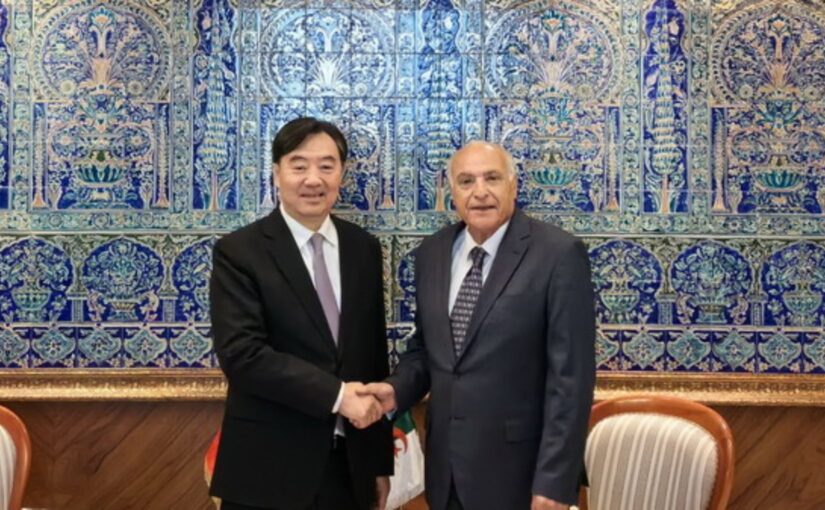
BEIJING, Feb. 22 (Xinhua) — Chinese President Xi Jinping exchanged congratulations on Thursday with President Denis Sassou Nguesso of the Republic of the Congo on the 60th anniversary of diplomatic relations, and vowed to join Sassou in promoting the strategic partnership of the two sides.

The friendship between China and the Republic of the Congo has stood the test of time, Xi remarked.

Over the 60 years, the two countries, despite changes in the international situation, have consistently engaged in sincere cooperation and mutual development, during which the two sides have become good friends who trust each other politically and good partners for win-win economic cooperation, Xi added.

In recent years, the frequent exchanges between the two countries, the continuous deepening of political mutual trust, and the steady progress of practical cooperation have brought tangible benefits to the people of both countries, which is a vivid reflection of the spirit of friendly cooperation between China and Africa, Xi said.

The Chinese president said he highly values the development of bilateral relations and is willing to work with President Sassou to take the anniversary of relations as a new starting point, continuously enrich the comprehensive strategic and cooperative partnership between the two countries, and work together to build a high-level China-Africa community with a shared future.

Sassou expressed that over the 60 years of diplomatic relations, the people of both countries have always been united and friendly, upholding common aspirations for peace, justice, and prosperity. This has propelled the rapid development of the comprehensive strategic and cooperative partnership between the Republic of the Congo and China.

On the basis of mutual trust and mutual benefit, both sides have engaged in extensive cooperation with fruitful outcomes, Sassou said, adding that he is willing to further consolidate and deepen the friendly cooperation between the Republic of the Congo and China, so as to make positive contributions to promote the building of a high-level community with a shared future between China and Africa. 

Peace delegates report back from China

Although the Biden administration has made some small gestures towards improving US-China relations, the US continues to escalate its campaign of encirclement and containment. The US has ramped up its military aid to Taiwan; it is attempting to strengthen the AUKUS nuclear alliance; it is doing everything it can to prevent China’s emergence as a major computing power; it is imposing sanctions and tariffs on China; and it is relentlessly spreading lurid anti-China slander.

Recognising the terrible dangers posed by the New Cold War (and its potential degeneration into a hot war), a number of peace activists from the US have recently taken part in delegations to China, in order to build understanding and solidarity, and to see China’s reality with their own eyes.

On Sunday 18 February 2024, we heard back from these peace delegates and discussed ways to continue building people-to-people links between the West and China, and to develop a powerful movement for peace and cooperation.

Embedded below are the videos from the event.

Full event stream

Lee Siu Hin: building US-China relations at the grassroots

Charles Xu (Qiao Collective): reflections on a trip to China

Sara Flounders: Organize collectively to demand hands off China and show solidarity with Palestine

Danny Haiphong: telling the truth about China and being an ambassador for peace

Dee Knight: If we want to make peace, more of us should visit China

Bahman Azad: debunk lies about China in order to advance the cause of peace

CPUSA: By developing people-to-people relations, we can all build a bedrock for peace

Africa, China and the Rise of the Global South

Date Saturday 17 March
Time6pm Britain / 1pm US Eastern / 10am US Pacific
VenueMarx Memorial Library
London EC1R 0DU
And Zoom

Speakers

  • Booker Ngesa Omole – National Vice-Chairperson and National Organising Secretary of the Communist Party of Kenya (CPK)
  • Roger McKenzie – Foreign Editor, Morning Star
  • Fiona Sim – Black Liberation Alliance
  • Cecil Guzmore – veteran Pan-African community activist and historian
  • Alex Gordon – RMT President
  • Frank Murray – Caribbean Labour Solidarity
  • Radhika Desai – Convenor, International Manifesto Group

Information

The geopolitical map of the world is changing at a rapid pace and in profound ways, with the dominant characteristic being the rise of the Global South, with the rise of socialist China at its heart.

Two years ago, the imperialist powers, led by the United States, were shocked when, almost in its entirety, the Global South, repulsed by the hypocrisy and double standards, refused to follow in imposing sanctions on Russia following the launch of its Special Military Operation.

Now, that hypocrisy and double standards are on unprecedented and shameless display, with the United States having so far used its veto three times in the United Nations Security Council to block calls for a ceasefire in Israel’s genocidal war against the Palestinian people.

As Chinese President Xi Jinping often says, the world is currently witnessing changes unseen in a century, a timeframe that links to the creation of the world’s first workers’ state in the Soviet Union. Today, President Xi has noted, socialism with Chinese characteristics offers a new option for countries that wish to rapidly develop their economies while maintaining their independence. The expansion of the BRICS grouping, whose GDP has surpassed that of the G7, and the admission of the African Union to the G-20, both of which were championed by China, are important reflections of this.

In his February 17th message to the 37th Summit of the African Union, Xi said that the Global South, represented by China and Africa, is booming and this has a profound impact on the course of world history.

Our meeting provides a rare chance to hear a first-hand perspective from the frontline of this anti-imperialist struggle in Africa.

Booker Ngesa Omole is the National Vice-Chairperson and National Organising Secretary of the Communist Party of Kenya (CPK). He also serves as the President of the Marxist-Leninist Institute, responsible for training party cadres, and is the editor of the party’s official quarterly publication, “Itikadi – Socialism Theory and Practice,” which reflects the CPK’s unwavering commitment to the principles of Marxism-Leninism as its guiding ideology.

The CPK is at the heart of an emerging new wave of Marxist-Leninist parties across Africa. Their website explains:

“CPK is conscious of Kenya’s noble history of struggle against foreign domination and imperialism. Our Party is the continuation of the social and national liberation struggle of the Kenyan patriots that ultimately brought about independence from British colonialism in 1963. We remember those elders who died or survived with great suffering in the struggles for national freedom. They sacrificed their lives and blood to give us self-respect in the period and aftermath of colonial domination… However, these noble wishes and aspirations will only be realised when Kenya replaces the capitalist system with the socialist system… CPK is a vanguard Party, as well as a mass organisation guided by the ideology of Marxism-Leninism and its application based on the historical and material conditions of Kenya and the world around us. The Party is a people’s organisation, its paramount interests are the interests of the broadest masses of the people.”

The CPK is building unity and solidarity with the socialist countries, with Comrade Booker having visited China twice in 2023, the second time for the World Socialism Forum, which was also attended by Friends of Socialist China.

We hope as many comrades and friends as possible will take the opportunity to hear him during his brief visit to London.

Organisers

This event is organised by Friends of Socialist China and supported by the Morning Star, Caribbean Labour Solidarity, the Black Liberation Alliance and the International Manifesto Group.

China, a member of the Global South, cares about and takes root in the Global South

The United Russia party organised the International Forum of Supporters of the Struggle against Modern Practices of Colonialism, “For the Freedom of Nations!” in Moscow, from February 16-17. It was attended by more than 400 participants from over 60 political parties in more than 55 countries as well as prominent people from other social circles.

In his message of greetings, Russian President Vladimir Putin said that: “Neocolonialism is a shameful legacy of centuries of plunder and exploitation of the peoples of Africa, Asia, Latin America and other regions of the world. We see its aggressive manifestations today in the attempts of the collective West to preserve its domination by any means, to economically subjugate other countries, [and] to deprive them of sovereignty.”

Referring primarily to the historical legacy of the Soviet Union, he added: “I would like to note that our country has done a lot to destroy the foundations of the colonial system and support national liberation movements. It has provided serious assistance to the young independent states in ensuring security, developing the economy, and solving acute social and humanitarian problems. And today, we are ready to join forces in the struggle for genuine freedom and justice, for progress for all countries and peoples, for the formation of a democratic multipolar world order. It is based on the principles of international law, respect for each other’s legitimate interests, mutual trust and constructive cooperation.”

Chairman of United Russia Dmitry Medvedev proposed that the UN General Assembly consider the possibility of establishing a Day of Remembrance for the Victims of Colonialism on December 14, the date of the adoption of the Declaration on the Granting of Independence to Colonial Countries and Peoples in 1960, and also to systematise information regarding the crimes committed during the colonial period, so as to begin an objective assessment of the damage caused by them.

As the head of the United Russia Commission on International Cooperation, Foreign Minister Sergei Lavrov, recalled that Russia has previously been a leader in promoting decolonisation processes. “We propose to develop common approaches of the world majority to the understanding of neocolonialism, to complete the work on decolonisation initiated by Soviet diplomacy at the UN. To this day, 17 territories remain in colonial dependence. The time has come to join forces and start systematic work to eradicate neocolonial practices.”

Entrusted by the Communist Party of China’s Central Committee, Minister Liu Jianchao of the party’s International Department (IDCPC) extended warm congratulations on the establishment of the forum and the convening of the conference. He said, in the current world intertwined with turbulence and changes, humanity faces many common challenges. The establishment of the forum conforms to the trend of the times for countries around the world to pursue peace, development and cooperation, and builds a good dialogue platform for political parties in various countries to jointly respond to challenges. Colonialism once brought grave disasters to the world and left a very disgraceful page in human history. Even today, it continues to appear in new ways, bringing pain and disaster to the world. China, like most of the countries represented by the participating political parties, emerged from the historical quagmire of colonialism. After going through untold hardships and making huge sacrifices, China achieved national independence and people’s liberation. China, a member of the Global South, cares about and takes root in the Global South. China breathes the same breath with other countries of the Global South and pursues a shared future with them. China is willing to work with all progressive forces to jointly safeguard international fairness and justice, resolutely oppose colonialism of all forms and manifestations, and work for a more just and equitable international order.

Kim Su Gil, alternate member of the Political Bureau of the Central Committee of the Workers’ Party of Korea (WPK) and chief secretary of its Pyongyang Municipal Committee, said in his speech that the desire of the peoples of all the countries to build up their own strength and develop in their own way is getting stronger day by day and, accordingly, the world’s multipolarisation has become an irresistible trend of the times. He continued:

The US and the West, very fearful of their waning dominant position, are clinging to the modern-day neocolonialist policy to maintain political and military subjugation and economic infiltration by inciting inter-state, inter-national and inter-religious confrontations and distrust and causing bloodshed in different parts of the world. Thus, the structure of a ‘new Cold War’ has been fixed on a global scale and proxy wars broke out in Ukraine and the Middle East, more badly plaguing the international security environment.

We will never tolerate the US arrogant infringement upon sovereignty, consistently holding fast to independence against imperialism as the first state policy in the future, too, and will strive to defend justice and peace and establish a new international order while strengthening unity and solidarity with all the countries and political parties aspiring after independence.

He extended the warmest militant respect and full support to the fraternal Russian people and service members who have turned out in the heroic struggle to firmly defend the sovereign rights, development and interests of the country against the hegemonic policy of the US and Western group.

He firmly reaffirmed that the WPK would always fight shoulder to shoulder with all the progressive political parties of the world in the struggle for opposing the tyranny and arbitrary practices of the imperialists and for building an independent new world.

Among other important political figures and forces participating in the forum were Faustin-Archange Touadéra, President of the Central African Republic; Milorad Dodik, President of the Republika Srpska (in Bosnia and Herzegovina); Mbalula Fikile, Secretary-General of the African National Congress (ANC) of South Africa; Oleg Romanov, Chairman  of the Belaya Rus Party of Belarus; as well as delegations from the Lao People’s Revolutionary Party (LPRP), the Communist Party of Cuba, Workers’ Party of Brazil, Party of Socialists of the Republic of Moldova, and Union Solidarity and Development Party of Myanmar, among many others.

Dmitry Medvedev said that United Russia will hold a meeting of the standing committee of the forum in July in Vladivostok. It will be timed to coincide with the BRICS inter-party conference, which United Russia plans to organise as part of Russia’s chairmanship of the cooperation body.

In addition, the Forum itself will be held every two years, and its organising committee has been transformed into a standing committee with executive powers until 2026.

The following articles were originally published on the website of the IDCPC.

Liu Jianchao Attends the Forum of Supporters of the Struggle Against Modern Practices of Neocolonialism “For the Freedom of Nations”

Moscow, February 16th—Liu Jianchao, Minister of the International Department of the CPC Central Committee, attended and addressed here today the opening ceremony of the Forum of Supporters of the Struggle Against Modern Practices of Neocolonialism “For the Freedom of Nations”.

Entrusted by the CPC Central Committee, Liu extended warm congratulations on the establishment of the forum and the convening of the conference. He said, in the current world intertwined with turbulence and changes, mankind faces many common challenges. The establishment of the forum conforms to the trend of the times for countries around the world to pursue peace, development and cooperation, and builds a good dialogue platform for political parties in various countries to jointly respond to challenges. Colonialism once brought grave disasters to the world and left a very disgraceful page in human history. Even today, it continues to appear in new ways, bringing pain and disaster to the world. China, like most of the countries represented by the participating political parties, emerged from the historical quagmire of colonialism. After going through untold hardships and making huge sacrifices, China achieved national independence and people’s liberation. China, a member of the Global South, cares about and takes root in the Global South. China breathes the same breath with other countries of the Global South and pursues a shared future with them. China is willing to work with all progressive forces to jointly safeguard international fairness and justice, resolutely oppose colonialism of all forms and manifestations, and work for a more just and equitable international order.

Liu said, China is currently advancing the noble cause of building a great country and national rejuvenation on all fronts through a Chinese path to modernization. China adheres to the path of peaceful and high-quality development, and high-level opening up to the outside world. In advancing modernization, China will neither tread the old path of colonization and plunder, nor the crooked path taken by some countries to seek hegemony once they grow strong. Instead, China will provide new opportunities brought by Chinese modernization for all countries in the world to realize modernization. The CPC calls on all sides to jointly defend all countries’ rights to develop and prosper, maintain world peace, promote exchanges and mutual learning among civilizations, promote the reform of the global governance system, and help build a community with a shared future for mankind.

Continue reading China, a member of the Global South, cares about and takes root in the Global South

Message of greetings on the 55th anniversary of the founding of the DFLP

The Democratic Front for the Liberation of Palestine (DFLP), a Marxist-Leninist party which forms part of the Palestine Liberation Organisation (PLO) and which plays a full part in the resistance of the Palestinian people against Zionism and imperialism, marked its 55th anniversary on February 22.

In this regard, the Foreign Affairs Department of the DFLP wrote to fraternal and friendly parties and organisations as follows:

On the occasion of the 55th anniversary of the founding and launch of the Democratic Front for the Liberation of Palestine (DFLP) on February 22, 1969, and in light of the Israeli genocidal crimes committed against the Palestinian people that have continued for more than 75 years, the DFLP continues its struggle and resistance in order to end the Israeli occupation of its lands and establish the independent Palestinian state with Jerusalem as its capital, the return of refugees to their homes, and self-determination of the Palestinian people.

DFLP has sacrificed a large number of martyrs in the face of the Israeli occupation and its crimes against the Palestinian people, including members of the Central Committee and the Political Bureau, and it is still defending its Marxist-Leninist ideas in order to implement its political program.

Based on the extent of the real suffering and tragedy that the Palestinian people are experiencing in the Gaza Strip, DFLP will suspend its celebrations on the 55th anniversary of its launch, and activities will be limited to support the resistance and struggle of the Palestinian people.

In response, Friends of Socialist China sent the following message to the DFLP:

Please accept our warmest fraternal greetings on the 55th anniversary of the founding of your party. We greet you with particularly intense and heartfelt feelings of solidarity at this time, in particular, when the heroic Palestinian people are facing the sternest of tests and the most arduous of trials in the face of the rabid genocidal onslaught of the Israeli Zionists and their masters and backers among the imperialist powers led by the United States.

Our hearts are broken as we witness the unspeakable cruelty visited upon the Palestinian people, women, and children, the old, the sick and the young, in flagrant violation of the tenets of international law, international humanitarian law in particular, as well as the most basic principles of humanitarianism and human conscience.

This is not a time for celebration. It is a time for resistance. The fighters of the DFLP are standing in their place, defending their people and struggling for liberation, and we salute them.

We know that throughout the last 55 years the comrades of the DFLP have never wavered in their anti-imperialist and socialist struggle. Comrade Mao Zedong observed that the party, the people’s army and the united front were the three magic weapons with which the Chinese people were able to defeat their enemies and win their liberation. The DFLP has also embodied this idea, building its ranks as a Marxist-Leninist party, persisting in armed struggle, and standing for a principled unity among all national Palestinian political forces and institutions.

Faithful to proletarian internationalism, your party has also maintained unity and solidarity with the socialist countries, as well as with revolutionary states, national liberation movements, and communist, workers and left-wing political parties and organisations worldwide. We appreciate the hand of friendship that you have extended to Friends of Socialist China even at this most difficult moment.

The Irish revolutionary martyr Bobby Sands once wrote: “Our revenge will be the laughter of our children.” We stand with you until the trauma etched on the faces of the children of Gaza, the West Bank and the whole of historic Palestine is replaced with smiles and laughter. Until all the children of Palestine can live a happy life and realise their dreams in a free and independent country.

Until then we join with you in saying:

Victory to the Palestinian Resistance!
Revolution until victory!

Once again, dear comrades, please accept our warmest and most comradely greetings.

China affirms Palestinian people’s right to wage armed struggle for liberation

The government of China has made an extremely important statement affirming the right of the Palestinian people to engage in armed struggle for liberation.

Speaking on February 22, on the second day of the International Court of Justice (ICJ)’s hearings on ‘The Legal Consequences arising from the Policies and Practices of Israel in the Occupied Palestinian Territory, including East Jersusalem’, held at the Hague, Holland, Ma Xinmin, Legal Adviser to China’s Ministry of Foreign Affairs, said, referring to the results of the ‘Six Day War’ in June 1967, that 57 years have passed since Israel began its occupation and that the unlawful nature of the occupation as well as the sovereignty over the occupied territory remain unchanged. The Palestinians must not be denied justice, he added. “Justice has been long delayed, but it must not be denied.”

In the section of his speech released as a short clip by Al Jazeera, Ma said that the “Palestinian people’s use of force to resist foreign oppression and complete the establishment of an independent state is an inalienable right. This recognition is also [having previously referred to a resolution of the United Nations General Assembly] reflected in international conventions. For example, the Arab Convention for the Suppression of Terrorism of 1998 affirms, ‘the right of peoples to combat foreign occupation and aggression by whatever means, including armed struggle, in order to liberate their territories and secure their right to self-determination and independence.’ Armed struggle in this context is distinguished from acts of terrorism.”

Telesur reported that: “Besides mentioning the United Nations General Assembly’s resolutions related to the Palestinian case, the Chinese ambassador indicated that the armed struggle is usually one of the means to which nations resort when seeking to achieve their self-determination.”

“The 1973 UNGA Resolution 3070 reaffirms the legitimacy of the people’s struggle for liberation from colonial and foreign domination and alien subjugation by all available means, including armed struggle,” he stressed.

The Palestine Chronicle described the Chinese statement as the strongest made in the day’s proceedings.

It quoted Ma as saying that: “The struggle waged by peoples for their liberation, right to self-determination, including armed struggle against colonialism, occupation, aggression, domination against foreign forces should not be considered terror acts.” 

In a separate article, The Palestine Chronicle reports that, “Ma also noted that the conflict stems ‘from Israel’s prolonged occupation of Palestinian territory and Israel’s longstanding oppression of the Palestinian people.’

Therefore, according to the Chinese representative, “‘the Palestinian peoples’ fight against Israeli oppression and their struggle for completing the establishment of an independent state under occupied territory are essentially just actions.’”

Hugo Chávez, Xi Jinping, and a global community of shared future

The following is the text of the presentation delivered by Carlos Martinez, co-editor of Friends of Socialist China, at a round-table discussion on Venezuela’s foreign policy in a changing world, held on 20 February 2024 at Bolivar Hall in London. The event was organised by the Ambassador of the Bolivarian Republic of Venezuela in the UK in coordination with the Venezuela Solidarity Campaign.

The speech discusses Hugo Chávez’s vision of a multipolar world, and explores how that vision overlaps with China’s strategy of pursuing a global community of shared future.

Other speakers at the event included Her Excellency Rocío Maneiro, Ambassador of the Bolivarian Republic of Venezuela in the UK; Francisco Domínguez, Secretary of the Venezuela Solidarity Campaign; Calvin Tucker, Campaigns Manager of the Morning Star; and Radhika Desai, Convenor of the International Manifesto Group.

Dear friends and comrades, thanks so much for inviting me to today’s important event.

And thank you in particular to Her Excellency compañera-embajadora Rocío Maneiro, who continues to do such a wonderful job representing her country and standing in solidarity with the progressive movement here in Britain and with the working class and oppressed peoples of the world.

Thanks also to the indefatigable comrade Francisco Domínguez for his hard work putting this event together.

I’m going to focus these brief remarks on the connection between Venezuela’s foreign policy and that of China.

As you’re all no doubt aware, Hugo Chávez had an extremely far-sighted worldview. While the Bolivarian Revolution has always aimed to have good relations with the US, its foreign policy has nonetheless been informed by the identification of that country as the principal enemy to sovereignty and to socialism, not just in Venezuela but throughout the world.

And of course the US’s consistently aggressive stance in relation to Venezuela – its campaign of sanctions, of coercion, of destabilisation – has only confirmed what Chávez and his comrades already knew.

Chávez saw Venezuela as part of a global movement challenging half a millennium of colonialism, imperialism and racism; a global movement that included the growing leftist and pro-sovereignty trend in Latin America and the Caribbean, but also China, Cuba, Russia, Libya (until NATO’s war of regime change in 2011), Syria, South Africa, Vietnam, Iran, the DPRK, Belarus and others.

This global movement seeks to put an end to the unipolar era of US hegemony, and to create a multipolar – or as Chávez called it, pluripolar – world, with multiple centres of power, in which countries and regions all have their role in global politics and in which no one power can impose its will on others.

Under the guidance of Hugo Chávez and then Nicolás Maduro, Venezuela has become one of the most prominent voices in support of this multipolar project.

Indeed, one of the slogans of Chávez’s 2012 presidential election campaign was: “to develop a new international geopolitics forming a multicentric and pluripolar world to achieve equilibrium in the universe and guarantee planetary peace.”

Continue reading Hugo Chávez, Xi Jinping, and a global community of shared future

Dismantling Western hypocrisy on Xinjiang and Gaza

We are pleased to republish below a valuable article by Arjae Red, a union activist and Workers World Party leader, on the attempts by the imperialist media to misdirect pro-Palestinian sentiments on the left towards an anti-China narrative based on slanders about the treatment of Uyghurs in Xinjiang.

Arjae observes that Western propagandists are “making bogus comparisons between the Israeli settler regime’s treatment of Palestinians and the treatment of Uyghur people by the Chinese government and Communist Party.” He points out that, however, not a single government in a majority-Muslim country has backed these slanders against China, whereas they do unequivocally condemn Israel’s genocidal acts.

The article explores the national question as it relates to both situations. The US views Palestine as a “strategic staging ground for US military and economic domination of West Asia”, and the Palestinian people as “an obstacle in the way of the accumulation of superprofits”. This provides the clear context for the sustained national oppression of the Palestinians. The People’s Republic of China, on the other hand, was founded “as a multinational workers’ state, forged through the overthrow of feudal and capitalist ruling classes and by ousting parasitic forces, such as Japanese and British imperialism.” From the beginning, the PRC has promoted the rights and cultures of minority nationalities. Indeed, “the Chinese People’s Republic inscribed into its political framework regional autonomy for formerly oppressed nationalities, like the Uyghurs in Xinjiang.”

Comparing the Israeli state’s treatment of Palestinians with the Chinese state’s treatment of Uyghurs, the difference could hardly be starker. While Palestinians experience blockade, occupation, siege, apartheid, ethnic cleansing and bombardment, “Uyghur and other ethnic minorities enjoy government grants and other affirmative action programs in education and job opportunities… Rather than destruction and extraction in Xinjiang, Beijing’s policies promote development. Major infrastructure projects have built housing, schools, hospitals and high-speed public transport.”

Arjae further notes that the US-led sanctions over Xinjiang have a dual purpose: to disrupt Xinjiang’s integration into the Belt and Road Initiative; and to cause economic hardship and discontent among the local population.

The author concludes with two key slogans of our time: “Free Palestine from the river to the sea! US hands off China!”

This article was originally published in Workers World on 16 January 2024.

The movement in the U.S. supporting Palestinian national liberation has drawn truly massive numbers of people in action. On Jan. 13, for example, a reported 400,000 people marched on the White House, marking the largest pro-Palestine demonstration in U.S. history.

To counter this growing outpouring of support for Palestine in the center of world imperialism, Western propagandists are trying to misdirect the popular outrage towards People’s China. They are trying to revive the discredited “Uyghur genocide” narrative, making bogus comparisons between the Israeli settler regime’s treatment of Palestinians and the treatment of Uyghur people by the Chinese government and Communist Party. A closer look at each situation reveals enormous differences.  

Who do we believe? 

The intense propaganda charging “Uyghur genocide,” starting in 2016, saturated the U.S. corporate media, quoting statements by U.S.-funded NGOs and U.S. politicians. The statements aimed to slam through heavy sanctions against China.

Following a fact-finding trip to the region, however, a 2019 delegation from the Council of Foreign Ministers — a key decision-making body of the Organization of Islamic Cooperation (OIC) — endorsed and commended China’s treatment of its Muslim citizens (hongkongfp.com, March 3, 2019). With 57 member states, the OIC is one of the largest intergovernmental bodies in the world.

A week after our trip to Xinjiang last year, a large delegation from the League of Arab States, including top official representatives from more than 16 Arab/Muslim countries, visited Xinjiang. In a June 2023 press statement, the delegation praised “the social harmony, economic development, people of all ethnic groups living in harmony in Xinjiang and accelerated progress.” They urged caution toward “international forces who smear and even demonize Xinjiang.”

No governments in majority-Muslim countries support the U.S. charge of “genocide” of a Muslim minority population in Xinjiang. Meanwhile, these governments publicly criticize U.S.-supported Israeli genocide in Gaza.

Multinational workers’ state vs. Zionist settler colony

Central to the comparison is a class analysis of the social foundation of the states of Israel and the People’s Republic of China. Like the United States, Israel was founded as a settler colony, built upon the slaughter and forced removal of Indigenous peoples, theft of their lands and the settlement of a majority European population. 

U.S. strategists viewed the Israeli state on Palestine’s land mainly as a strategic staging ground for U.S. military and economic domination of West Asia, and thus as a major contributor to the profits of the world imperialist ruling class. They saw Palestinians as an obstacle in the way of their accumulation of these superprofits. To accomplish this conquest, the Israeli state has threatened to appropriate or erase every vestige of Palestinian culture, including Palestine’s history and food.

Israel as a state is thoroughly exploitative, extractive, and oppressive to the core. The state and the settler population, if it subscribes to Zionist ideology, serve the ends of the global imperialist ruling class.

The People’s Republic of China, on the other hand, was founded as a multinational workers’ state, forged through the overthrow of feudal and capitalist ruling classes and by ousting parasitic forces, such as Japanese and British imperialism. The Chinese Revolution established a state based on the political rule of an alliance between the workers, peasants and other progressive classes, led by the Communist Party. 

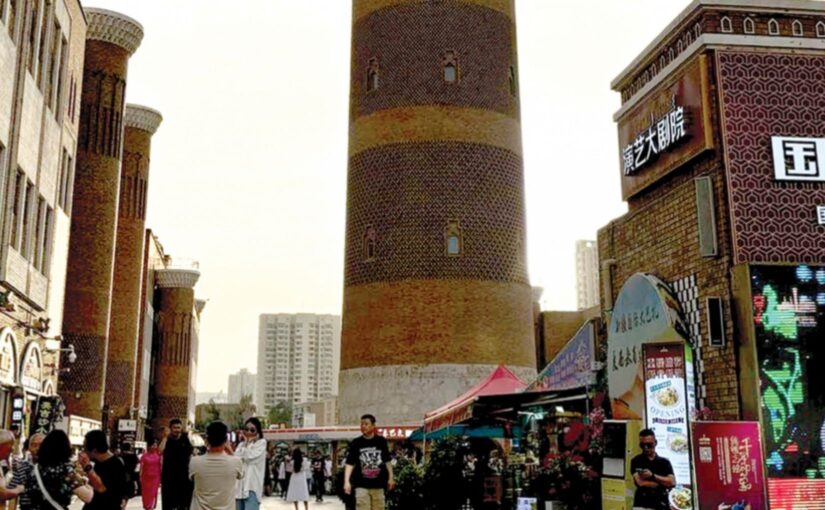
The Chinese People’s Republic inscribed into its political framework regional autonomy for formerly oppressed nationalities, like the Uyghurs in Xinjiang. Historic Uyghur cities, such as Ürümqi, which had been renamed “Dihua” (meaning “to civilize”) following a 1755 Qing Dynasty invasion, regained their original Uyghur names. 

Uyghur culture is widespread and celebrated in today’s China, which includes teaching the Uyghur language, as well as the languages of other ethnic populations in the region, in public schools. Before the Chinese Revolution, these languages were suppressed.

The People’s Republic is thoroughly multinational, based on the political rule of the working class and guided by the Communist Party. Its public goals involve developing a socialist economy and maintaining social harmony between ethnicities. 

Israel destroys, China builds

Videos abound of the unmitigated destruction of Gaza by Israeli Occupation Forces. The IOF have bombed and bulldozed entire city blocks to dirt and rubble, razing homes, hospitals and schools. 

Over decades, Israel has kept Gaza under a brutal blockade and crushed Palestinian businesses. Now the attacks have left the population without food, water, medicine and electricity.

Rather than destruction and extraction in Xinjiang, Beijing’s policies promote development. Major infrastructure projects have built housing, schools, hospitals and high-speed public transport. These projects outdo anything U.S. business or government projects have done on U.S. territory. 

Uyghur and other ethnic minorities enjoy government grants and other affirmative action programs in education and job opportunities, which enable them to establish their own thriving businesses and fully participate in the vibrant Chinese economy. All of this has gradually reduced the wealth and development gap between the western Xinjiang region and the eastern coastal region of China, where, historically, all of the heavy industry was concentrated. 

Xinjiang experiences no economic blockade except what U.S. policies impose. The Chinese government ensures that the basic needs of the people are met. During the COVID-19 outbreak, for example, Communist Party organizations delivered food and other supplies to Uyghur communities.

Continue reading Dismantling Western hypocrisy on Xinjiang and Gaza

Zhang Jun: While the US vetoes ceasefire resolution, innocent civilians in Gaza are dying

On February 20, the United States again vetoed a resolution in the United Nations Security Council (UNSC) calling for a ceasefire in Israel’s war of aggression against the Palestinian people in Gaza. The resolution was moved by Algeria, currently the only Arab member of the Security Council. Thirteen countries voted in favour, Britain abstained and the United States, as one of the five permanent members, exercised its veto in flagrant defiance of the overwhelming view of the international community.

In a statement following the vote, China’s UN Ambassador Zhang Jun expressed “strong disappointment and dissatisfaction” with the US action. 

Algeria, he noted, had held lengthy and extensive consultations on the draft resolution with all parties and taken many ideas on board. He added:

“The outcome of today’s vote clearly shows that on the issue of a ceasefire to halt the fight in Gaza, it is not that the Security Council does not have an overwhelming consensus, but rather it is the exercise of veto by the United States that stifles the Council consensus…

“While the Council ceasefire resolution has been vetoed, innocent civilians in Gaza are dying in the fighting and struggling on the brink of death. The US claimed that the Council resolution would interfere with the ongoing diplomatic efforts. Such a claim is totally untenable. Given the situation on the ground, the continued passive avoidance of an immediate ceasefire is nothing different from giving a green light to the continued slaughter.”

Noting that as the resolution has been vetoed, the spillover of the Gaza conflict is destabilising the entire region, Zhang said:

“Only by extinguishing the flames of war in Gaza, can we prevent the fires of hell from engulfing the entire region. The Council must act quickly to stop this carnage in the Middle East.”

With the US veto, “the basics of international law are being trampled upon, and the bedrock of the multilateral system is being eroded.”

According to the Chinese Ambassador:

“The Security Council must take actions to push for a ceasefire. This should not be a matter of debate, but rather a moral obligation that the Council cannot shy away from. It is a legal responsibility that the Council must assume. Even more so, this is a political requirement that the Council must fulfil in accordance with the Charter. The veto cannot muffle the strong call for a ceasefire and an end to the war. The Security Council cannot stop its work to uphold justice and fulfil its responsibilities just because of the veto. 

“China urges Israel to heed the call of the international community, abandon its plan for a Rafah offensive, and stop its collective punishment of the people of Palestine.”

We reproduce the full text of Ambassador Zhang Jun’s statement below. It was originally published on the website of the Permanent Mission of the People’s Republic of China to the UN.

Madam President,

China has voted in favor of the draft resolution, and we express our strong disappointment by and dissatisfaction with the veto of the United States. Algeria, on behalf of the Arab states, put forward the draft resolution demanding an immediate ceasefire in Gaza, immediate release of all hostages, guaranteed access for humanitarian supplies, and the rejection of forced displacement. This is both urgently required by the situation on the ground and it is also based on the minimum requirements of humanity. It deserves the support of all Council members. 

Algeria, demonstrating reason, sincerity, and an open attitude, held lengthy and extensive consultations with all parties on the draft resolution and took on board many constructive ideas, making the draft resolution more balanced. The outcome of today’s vote clearly shows that on the issue of a ceasefire to halt the fight in Gaza, it is not that the Security Council does not have an overwhelming consensus, but rather it is the exercise of veto by the United States that stifles the Council consensus. The US veto sends a wrong message, pushing the situation in Gaza into a more dangerous one. 

While the Council ceasefire resolution has been vetoed, innocent civilians in Gaza are dying in the fighting and struggling on the brink of death. The US claimed that the Council resolution would interfere with the ongoing diplomatic efforts. Such a claim is totally untenable. Given the situation on the ground, the continued passive avoidance of an immediate ceasefire is nothing different from giving a green light to the continued slaughter. 

While the Council ceasefire resolution has been vetoed, the spillover of the conflict is destabilizing the entire Middle East region, leading to rising risks of a wider war. Only by extinguishing the flames of war in Gaza, can we prevent the fires of hell from engulfing the entire region. The Council must act quickly to stop this carnage in the Middle East. 

While the Council ceasefire resolution has been vetoed, the basics of international law are being trampled upon, and the bedrock of the multilateral system is being eroded. The Secretary-General of the United Nations has already written to the Council invoking Article 99 of the Charter and the International Court of Justice has issued provisional measures. The Council must respond forcefully to the serious violations of international law and international humanitarian law in the Gaza conflict and uphold the authority of international rule of order. 

Madam President, 

The Security Council must take actions to push for a ceasefire. This should not be a matter of debate, but rather a moral obligation that the Council cannot shy away from. It is a legal responsibility that the Council must assume. Even more so, this is a political requirement that the Council must fulfill in accordance with the Charter. The veto cannot muffle the strong call for a ceasefire and an end to the war. The Security Council cannot stop its work to uphold justice and fulfill its responsibilities just because of the veto. 

China urges Israel to heed the call of the international community, abandon its plan for Rafah offensive, and stop its collective punishment of the people of Palestine. We expect country with significant influence to do less of its political calculations, to be truly impartial and responsible, and to make the right choice to push for a ceasefire in Gaza. We call on the international community to pool all diplomatic efforts to give the people of Gaza a chance to live, give the people of the entire Middle East region a chance to have peace, and give it a chance for justice to be upheld. 

I thank you, Madam President.

To be a socialist one must be an anti-imperialist

In the following article, which was originally published by Fight Back! News, the US Marxist-Leninist, J. Sykes argues forcefully that to be a socialist one must be an anti-imperialist.

He develops his argument not least on the basis of comparing and contrasting the global roles played respectively by the United States and other imperialist powers on the one hand and socialist China on the other as well as by drawing on the theoretical contributions of Mao Zedong to the Marxist understanding of the anti-imperialist struggle.

According to Sykes:

“For the US, this [necessity of imperialism to resort to military force] includes a network of military bases, spanning the world, and its military alliances, like NATO, which it dominates. It will not hesitate to intervene militarily, or to arm and fund its proxies, such as Ukraine and Israel. It will stage coups and assassinate leaders. There is no price in human bloodshed and suffering that is too high to protect US hegemony and imperialist super-profits.

“China’s foreign policy in the developing world is nothing like this. It is neither exploitative nor extractive and is based on equal and mutually beneficial trade agreements. It is also fundamentally peaceful. The countries that benefit from trade and development from China are not locked into underdevelopment by China. Nor are they targeted for Chinese military intervention, or coups. On the contrary, China provides an alternative to imperialist underdevelopment that many countries in Africa, Asia, and Latin America are glad to take.

“China doesn’t do this because the Chinese are nice and the imperialists aren’t. The imperialists are violent, exploitative and extractive because they must be. The imperialist system is governed by laws, laws inherent to capitalism. China behaves differently because these are laws from which the working class has freed itself in the socialist countries. Socialism, and China in particular, is thus a counterbalance to imperialism in the world. This counterbalance causes the contradiction between the imperialist and socialist systems to sharpen, leading to a constant barrage of anti-China propaganda and increasing aggression from the US towards China.”

Sykes further draws on Mao Zedong’s famous article On Protracted War to explain the difference between just and unjust wars, and on Mao’s The Role of the Chinese Communist Party in the National War for its specific application of this understanding to World War II, where Chairman Mao made his famous observation that, “in wars of national liberation patriotism is applied internationalism.”

Since the writing of The Communist Manifesto and the founding of the First International, proletarian internationalism has been a cornerstone of scientific socialism, and is a pillar of Marxism-Leninism. Today, in the era of imperialism, putting genuine proletarian internationalism into practice demands that we be consistent anti-imperialists.

Beyond any moral questions, there are two obvious, material reasons for this proletarian internationalist, anti-imperialist unity. On the one hand every dollar that goes to imperialist war is a dollar that could have been spent on people’s needs at home. But even more importantly, every blow struck against imperialism weakens the monopoly capitalist class here.

What imperialism is and what it is not

First, let’s be clear on what imperialism means. Understanding the link between imperialism and monopoly capitalism is essential. Indeed, imperialism and monopoly capitalism aren’t just linked, they’re synonymous. Failing to understand this, some people think any kind of big country is an empire and that any empire is imperialist, from ancient Rome to socialist China. But this is an idealist and metaphysical view. In other words, this view fails to look at how imperialism develops historically, according to definite material processes. It should be obvious that the Roman Empire and the U.S. empire are qualitatively different.

If we look at imperialism historically, we have to understand its relationship to the dominant socio-economic system. V.I. Lenin developed the scientific analysis of imperialism in his book Imperialism, the Highest Stage of Capitalism, to help the working-class movement understand the demands that this new historical stage of capitalism placed on the socialist movement. In “Imperialism and the Split in Socialism,” Lenin writes, “Imperialism is a specific historical stage of capitalism. Its specific character is threefold: imperialism is monopoly capitalism; parasitic, or decaying capitalism; moribund capitalism. The supplanting of free competition by monopoly is the fundamental economic feature, the quintessence of imperialism.”

Continue reading To be a socialist one must be an anti-imperialist

Tazara: Why China built a railway that many thought would fail

This short film made by CGTN documents the history, present situation and prospects of the Tazara Railway which links Zambia and Tanzania. 

By far China’s largest foreign aid project at the time, it was built during the first half of the 1970s, when China was itself still a poor country and after the United States, Britain, Japan and even the Soviet Union had all refused to build it. It enabled landlocked Zambia to get its copper to port whilst avoiding countries then still under colonial and white racist rule.

The 1,800 km railway took five years to build, with 50,000 Chinese workers taking part in the project. 65 of them gave their lives. 

In recent years, the railway has encountered problems, with freight traffic, not least due to the availability of other options since the liberation of all countries in southern Africa. Nevertheless, it still plays an important role in the lives of local people and communities. A joint statement adopted by China and Zambia in September last year, during the state visit of the Zambian president, saw China pledge support to the railway’s upgrading and renovation.

Disappointing “rush to judgment” on China’s role in the Congo

The article below, written by Dee Knight and republished from Black Agenda Report, responds to a recent review by Ann Garrison of Siddharth Kara’s 2023 book Cobalt Red: How the Blood of the Congo Powers Our Lives.

Garrison had written, also in Black Agenda Report, that “huge Chinese corporations so dominate Congolese cobalt mining, processing and battery manufacture that one has to ask why a communist government, however capitalist in fact, doesn’t at least somehow require more responsible sourcing of minerals processed and then advanced along the supply chain within its borders.”

Dee Knight responds with a comradely criticism – while recalling Garrison’s “strong record of incisive anti-imperialist reporting on Africa” – that the book review (and the book under review) ignores some important facts about Congo’s mining industry and China’s role in it.

Referencing the work of Isabelle Minnon, a lawyer and activist in Belgium, and others, Dee observes that “China’s role has been to bring new, large-scale investment on a new basis: combined financing for industrial mining and public infrastructure – roads, railroads, dams, health and education facilities.” The effect of this has been to reverse the trajectory towards de-industrialisation of Congo’s cobalt economy, and to provide much-needed infrastructure for development.

Furthermore, “China cancelled the DRC’s interest-free loans worth an estimated $28 million, promised to fund more infrastructure projects and also give $17 million in other financial support as the DRC joins the Belt and Road Initiative (BRI).”

The win-win nature of the China-DRC relationship – as opposed to some sort of neo-colonial dynamic – is what has provoked the ire of Western commentators.

Based on her reading of Cobalt Red, Ann Garrison writes that “Huge Chinese corporations so dominate Congolese cobalt mining, processing and battery manufacture that one has to ask why a communist government, however capitalist in fact, doesn’t at least somehow require more responsible sourcing of minerals processed and then advanced along the supply chain within its borders.” [emphasis added]

Garrison has a strong record of incisive anti-imperialist reporting on Africa, so it is necessary to consider her question seriously. Unfortunately, the result of such consideration suggests Garrison rushed to judgment about China’s role in the Congo, and failed to look beyond Cobalt Red for facts and analysis of the DRC’s rapidly changing mining industry.

Others have researched the issue more fully and accurately. One is Isabelle Minnon, a lawyer and activist in Belgium. Her research report, “Industrial Turn-Around in Congo?” appeared last October in Lava, a Belgian magazine of social criticism and Marxist analysis.

Minnon shows that China has been part of the solution, not of the problem. “China has responded to the DRC’s need to have partners who invest in industrialization,” she writes. Western colonists had bled Congo dry through onerous debt, leaving it “weighed down by a burden that prevented it from developing economically. In 2001 industrial production was at a standstill, mining sites deserted.”

When the DRC turned to the World Bank and IMF for help, they insisted on privatizing the mining sector, laying off thousands of mine workers. Hundreds of mines were sold with “dormant mining titles” to foreign companies – “not to produce but to resell them at the right time” for big profits.

The measures didn’t wipe out the mining industry, but they pushed thousands of laid-off mine workers and their families to fend for themselves as artisanal miners, and then sell the minerals to processing companies. That was the situation described in Cobalt Red.

China’s role has been to bring new, large-scale investment on a new basis: combined financing for industrial mining and public infrastructure – roads, railroads, dams, health and education facilities. The result was “After decades of almost non-existent industrial production, the country became and remains the world’s leading producer of cobalt and, by 2023, became the world’s third largest producer of copper.” The new deal “puts an end to the monopoly of certain Western countries and their large companies whose history shows that this exclusivity has not brought development to the country.”

The arrangement has dramatically reduced the role of artisanal mining. “Since the enormous increase in production in the mining sector in Congo, 80% of mining production is done industrially. Sicomines [China-Congolese Mining Co.] has built the most modern factory in the DRC for processing raw copper.” The same is true for cobalt, replacing artisanal mining with organized, industrial production. Industrial mining is a reversal of artisanal mining.

“Resource-for-Infrastructure (RFI) deals like this all over Africa have helped China foster strong relations with several countries,” writes Halim Nazar of India’s Institute for Chinese Studies .

Western competitors are not happy. “The IMF publicly criticized the DRC for taking on too much debt,” Nazar writes. But it has been a “debt-investment” based on real growth.

A Peace-for-Concessions Swap?

Avril Haines, US Director of National Intelligence, visited Kinshasha airport last November 20, to meet with DRC President Tshisekedi, together with Molly Phee, Undersecretary of State for Africa, the State Department’s most senior official for Africa. It was the first day of Tshisekedi’s presidential campaign, reports Tony Busselen , author of Congo for Beginners. The top US officials focused on peace between the DRC and neighboring Rwanda, offering help in difficult upcoming elections. Tshisekedi won the heavily contested elections in a landslide .

December 1 report in Politico suggests it may have been a peace for concessions swap. “The meeting with Haines comes at a time when Washington is trying to counter China in Africa. Congo is home to about 70 percent of the world’s cobalt reserves and China is the largest producer. Beijing is Kinshasa’s largest trading partner and has acquired important mining rights since the 2000s. Control of the market gives the country a big lead over the US in the race for crucial parts for electric vehicle batteries.”

Did Haines press for Tshisekedi to review Congo’s contracts with China? Politico quotes Cameron Hudson, a former CIA intelligence analyst for Africa: “If anything, this administration has already shown that it is willing to review contracts with China.” Last February 16, Tshisekedi’s administration published a highly critical report on the China contract. The President ordered an audit of the contract, and called on China to revise it on a “win-win” basis.

When President Tshisekedi was invited to China last May, he gave an interview on Chinese TV in which he distanced himself from the policy of condemnation and interference against China. China had cancelled the DRC’s interest-free loans worth an estimated $28 million , promised to fund more infrastructure projects and also give $17 million in other financial support as the DRC joins the Belt and Road Initiative (BRI).

Isabelle Minnon cites Franz Fanon’s observation that “Africa has the shape of a revolver whose trigger is in the Congo.” She adds that “those whose finger is on this trigger have the power to build or destroy the DRC and all of Africa.” She says this is how, following the 1961 US-and-Belgium-backed coup d’état and assassination of Patrice Lumumba, the colonialists were able to install Mobutu Sese Seko, who governed for 31 years, and cooperated with them in destroying the Congolese economy by miring it in debt. After the DRC and China agreed on a resource-for-infrastructure deal, the situation has improved – so much that the deal “fueled the fury of Western countries to the point that” the World Bank and IMF tried to force a 50 percent reduction in the infrastructure budget.

The Wilson Center published a report in September 2021, that “Artisanal miners produce 20% of the country’s cobalt output. The remainder comes from foreign-owned firms, primarily Chinese, whose rechargeable battery industry accounts for around 60 percent of global cobalt demand.” [emphasis added] Note that industrialized mining is many times more productive than artisanal mining, so even producing 20% of output, there are more artisanal miners than industrial mine workers.

Who likes Cobalt Red, and who doesn’t

Ann Garrison acknowledges criticism of Cobalt Red – she says Open Democracy “called it a sensationalistic, self-aggrandizing ‘White Saviour’ exposé.” OD said Cobalt Red “simply rehashes old stereotypes and colonial perceptions of the DRC, with indulgent use of dehumanizing rhetoric, lack of research ethics, and ignorance and/or erasure of local knowledge.” Perhaps most telling, the OD critics say Cobalt Red’s author “is intent on portraying the DRC as an unchanging, suffering world out of time.” But times are changing, and much of this change can be traced to the innovation of the resource-for-infrastructure deal with China.

Garrison notes that “Kara (the author of Cobalt Red), “has been interviewed on countless podcasts, on Democracy Now, and at the Foreign Policy Association. This last – along with bestseller ranking in the NY Times and Publishers Weekly and shortlisting for the Financial Times Best Business Book of the Year – suggest approval from questionable sources. There is questionable honor sharing glory with such “heroes” of the Foreign Policy Association as Antony Blinken and Madeleine Albright, General David Petraeus, journalists Robin Wright and David Sanger, and foreign policy titans like William Burns and Fiona Hill.

It may be that Ann Garrison didn’t notice that China’s role in the Democratic Republic of Congo was a significant change. In one sense that’s understandable. Change has not manifested itself completely, and the process may well be far from perfect. But in her article she rushed to judgment too quickly, without making appropriate comparisons.

Isabel Crook: an appreciation

We are very pleased to publish this touching and informative tribute to the outstanding communist and lifelong friend of China, Isabel Crook (1915-2023), written by her close friend of many decades, Dr. Jenny Clegg.

Jenny, a retired academic, peace activist and member of our advisory group, provides rich insights in the course of summing up Isabel’s lifelong commitment to the Chinese revolution, her unique and path breaking approach to anthropology, her deep empathy for China’s rural poor, and her enduring yet careful optimism regarding the future of socialist China.

We previously reported on Isabel’s death, including here. Among many other obituaries were those published by British newspapers, The TimesFinancial Times, Guardian, and Economist; the New York Times and Canada’s Globe and Mail

“A rare bridge between the West and China”; “a committed communist”; “a peoples’ diplomat”; “a pioneering anthropologist” – so read the obituaries for Isabel Crook (1915-2023). Indeed, she was all of these in one.

Isabel’s 107 years, almost all spent in China, were to span two world wars, two great revolutions, a socialist transition under a Cold War, all through the twists and turns of Mao’s mass campaigns to Deng’s reform and opening up, with China now led by Xi Jinping stepping onto the world stage.

No mere observer, Isabel’s participation in the New China along with husband David saw them personally suffer under the excesses of the Cultural Revolution.  Isabel was kept in confinement for three years by Red Guards, in a room on the top floor of a campus building separated from her boys, still only teenagers, and with husband David in prison. Freed from detention in 1972, both were cleared of all charges in 1973 and, along with other foreign experts, received an apology from Premier Zhou Enlai.

Her commitment was again put to the test with the suppression of the Tiananmen protests in 1989 – the Crooks had called on the government not to use force. Yet despite all this Isabel was to remain optimistic as to China’s future under CPC leadership.

To properly appreciate Isabel’s special contribution to understanding China, and the reasons why she never succumbed to disillusionment, requires both a consideration of her life experiences as well as her anthropological work on rural China.

In particular, through many months spent in the rural areas, living among the people gathering materials on village life, Isabel was to develop a particular empathy for Chinese country folk. Her two separate studies of villages undergoing reform, under first a Nationalist, then a Communist-led government, provided deep insight from a comparison between the failure of one and the success of the other.

Early influences: the Rural Reconstruction Movement

Isabel was born in China, the daughter of Canadian missionary educators.  Leaving for Canada to study, she was to graduate from the University of Toronto with a bachelors and then a masters degree[1] [2] , returning to China in 1939 aged 24 to do anthropological field research in the western province of Sichuan among the Yi, a slave owning society. 

From this remote ‘opium country’, she moved nearer to the wartime capital of Chongqing in 1941 to take part in a year-long ‘action research’ project sponsored by the National Christian Council.  Hired by rural reformer, THSun, Isabel was to carry out a survey of a small market town of 1,500 households.  With the overwhelming majority of its families living in desperate poverty, Prosperity township was decidedly ill-named.

Joining a small team including two experts on cooperatives, Isabel was introduced to the progressive ideas of the rural reconstruction movement.  Founded in 1926 by the influential James Yen, whose work in mass literacy, begun amongst the Chinese labourers in France during World War I, was to gain international acclaim, the movement had a strong following among China’s Christian community and the left wing of the nationalist KMT.

Continue reading Isabel Crook: an appreciation

Chip wars: breaking the siege

The following article by Bappa Sinha, originally published in People’s Democracy (the English-language weekly newspaper of the Communist Party of India (Marxist)) provides valuable insight into the US-initiated “chip wars” against China, which “show no signs of abating and have escalated further in 2023 with indications of more to come.”

Sinha describes the rationale for the chip wars as being essentially economic, with the US seeking to maintain its technological dominance. “Having already lost its manufacturing leadership due to outsourcing production, the US is critically dependent on its lead in advanced technologies to retain its global dominance. With China catching up and, in many cases, leapfrogging the US in frontier technologies, the US sees the denial of semiconductor technologies with its outsized impact on modern production and economy as an effective mechanism of keeping China down.”

The author details the numerous measures that have been taken by both the Trump and Biden administrations to restrict China’s access to advanced semiconductor technologies, including the imposition of export controls, the blacklisting of Chinese companies, and the imposition of sanctions.

However, “China has not been sitting on its hands waiting for its economic development to be choked.” China has been leveraging its particular advantages – its huge internal market, its dominant position in manufacturing, its education system, massive funding for research, and its “socialist economic planning which can set national industrial policy to undertake long term strategic initiatives” – in order to break the US’s technology siege.

In August 2023, Huawei released the Mate 60 pro, powered by a Chinese-manufactured 7nm chip – “precisely the kind of processor that the US sanctions had sought to prevent with their stated goal of denying China access to 14nm and below chip technology.” Industry insiders expect that China will soon be able to produce a 5nm chip. “These releases and announcements indicate China has weathered the storm and is poised to break through the siege that the US sanctions have sought to enforce.”

Sinha concludes that the US’s chip wars are destined for failure.

“Despite its head start in semiconductor technologies and massive financial resources at its disposal, the US, under neoliberal capitalism, is unlikely to be able to put policies in place to be able to remain ahead of China in the long run.”

The chip wars launched by the United States and its allies against China show no signs of abating and have escalated further in 2023 with indications of more to come. These wars are, in effect, a siege on China’s technological progress and economy. These across-the-board sanctions on leading-edge semiconductor chips, technology and equipment are a desperate attempt by the US to hold on to its geopolitical hegemony.

Background

While people are focused on the Ukraine war and Taiwan as frontiers of the geopolitical tussle between the US-led western alliance and the emerging powers of China and Russia, another front where the battle is being waged is in the tech domain – specifically, the semiconductor sanctions that the US is using to curtail China’s access to advance chips and technology to manufacture them. The US’s excuse for these measures is framed in military terms, saying that advanced semiconductors enable China to produce advanced military systems and improve the speed and accuracy of military decision-making. The tired western bogeyman of human rights violations is also cited as a reason for these sanctions. The sanctions are a naked attempt by the US to wage economic war against China. Having already lost its manufacturing leadership due to outsourcing production, the US is critically dependent on its lead in advanced technologies to retain its global dominance. With China catching up and, in many cases, leapfrogging the US in frontier technologies, the US sees the denial of semiconductor technologies with its outsized impact on modern production and economy as an effective mechanism of keeping China down. These actions are akin to technology denial regimes that the US, along with its allies, implemented during the Cold War.

The current round of technology sanctions by the US started in 2018 under the Trump administration. With the US increasingly getting concerned with China’s progress and leadership in telecommunications, especially in 5G, the US barred procurement of Huawei and ZTE equipment by all US federal government agencies, citing security concerns. This was especially ironic given the Snowden revelations about all leading US telecom equipment makers routinely having backdoors in their equipment for snooping purposes by the US intelligence agencies. The ban was preceded and followed by intense US lobbying worldwide, asking foreign governments to implement similar restrictions on Huawei. In December 2018, Huawei CFO Meng Wanzhou was arrested in Canada on US request under the pretext of violating US sanctions against Iran. These actions wouldn’t suffice as Huawei was already the global leader in 5G technology, having become the world’s largest manufacturer of telecommunications equipment and the second largest manufacturer of mobile phones, supplanting Apple from that position.  In May 2019, the US cut off Huawei from access to American technology. This not only cut off Huawei from procuring US chips but also from designing and getting the chips made from foundries such as TSMC, as those also depended on US technology. On the software side, Google announced that it would cut Huawei’s access to the Android platform. These moves were a fatal blow to Huawei’s phone business as Huawei had no short-term solutions for the loss of access to mobile chips. Their telecom equipment business (such as bay stations) survived as it didn’t depend on leading-edge chips and could be procured locally.

Continue reading Chip wars: breaking the siege