Developed countries must prioritise climate cooperation over China containment

The article below, republished from Global Times, reports on the high number of abnormal weather events this spring and summer, including unusually high temperatures in Northern China, heavy rainfall in Southern China, Hurricane Beryl in the Americas, and a series of droughts, floods and heatwaves elsewhere. “These scenes once again sound the alarm on climate issues for all of humanity.”

The author observes that “people generally hope that governments worldwide can work together to address the frequent occurrences of extreme weather globally”; that is, ordinary people expect their governments to pursue intense cooperation with countries around the world in order to tackle this existential issue. However, in spite of talking a good game on environmental questions, “developed countries such as the US and Europe have failed to fulfill their commitments in actual implementation”. Alarmingly, these issues seem to be increasingly sidelined in the US. The article cites Jeff Goodell, author of the book The Heat Will Kill You First: Life and Death on a Scorched Planet, remarking on the recent presidential debate between Trump and Biden: “More time discussing golf than climate. What a world we are living in.”

Meanwhile, as China races ahead in renewable energy and other green technologies, the US and Europe are imposing tariffs and sanctions on Chinese EVs and solar power materials, the objective of which is to suppress China’s rise.

The author concludes:

Global climate change is a common enemy of all humanity. Countries around the world must work together, share responsibilities and take positive and effective actions. This is not only to protect our planet but also for the well-being of future generations. Only through global cooperation can we make substantial progress in addressing climate change, which especially requires developed countries to broaden their mind and take pragmatic actions.

Abnormal climate and frequent severe weather events have been a common experience for many people this summer. Recently, northern China has experienced prolonged high temperatures, while southern China has been hit by frequent heavy rains. Floods exceeding warning levels have occurred in 98 rivers in the Yangtze River Basin, the Xijiang River in the Pearl River Basin and the Taihu Basin, said the Ministry of Water Resources on June 30. On a global scale, since the beginning of this year, extreme weather events such as heavy rains, floods, heatwaves and droughts have frequently occurred in many places. Hurricane Beryl has intensified into a Category 3 storm and is making landfall in the Americas, while “deadly heatwaves are scorching cities across four continents.” These scenes once again sound the alarm on climate issues for all of humanity.

The latest Global Risks Report released by the World Economic Forum warns that in the next decade, the primary global risk will not be armed conflicts or social division but extreme weather events. For this reason, people generally hope that governments worldwide can work together to address the frequent occurrences of extreme weather globally. A survey report released by the UN Development Programme on June 20 shows that 80 percent of respondents globally hope for a stronger climate action.

Addressing climate change requires the full co-operation of the international community and both developed and developing countries need to fulfill their respective responsibilities and obligations. As early as 1992, the UN Framework Convention on Climate Change enshrined the principles of equity, common but differentiated responsibilities and respective capabilities, recognizing the historical responsibility of developed countries for their emissions. However, developed countries such as the US and Europe have failed to fulfill their commitments in actual implementation despite having shown a positive attitude in international negotiations on global climate governance. This has directly slowed down the process of global green and low-carbon transformation.

As the largest global economy and most advanced developed country, the US plays a crucial role in the process of global climate governance. Especially, the commitments and actions of the US not only set an example for other developed countries but also bring expectations and confidence to the international community as a whole. Unfortunately, the US is the only signatory that has withdrawn from the Paris Agreement to date, showing significant regression in its stance on addressing global climate change, which has severely undermined the confidence in international cooperation on global climate governance. Although the Biden administration announced US’ return to the Paris Agreement in 2021, it is hard to hide the wobbly nature of US climate policy, especially under the highly politicalized landscape of bipartisan competition, where climate issues are not purely scientific topics but highly politicized ones.

It is worth noting that the importance of climate issues ranks far lower on the US political spectrum than economic, diplomatic, or even China-related issues. The recent first televised debate among candidates for the 2024 US presidential election was a prime example. Despite the New York Times emphasizing beforehand that “no election has more potential to affect the planet’s warming climate than the rematch between Joe Biden and Donald Trump,” the two candidates only devoted a very short amount of time to climate issues. Author Jeff Goodell, of the book The Heat Will Kill You First: Life and Death on a Scorched Planet, expressed frustration on social media, perhaps representing the thoughts of most Americans: “More time discussing golf than climate. What a world we are living in.”

As an important player in the global arena, Europe also has room for improvement in its approaches to addressing global climate change. The EU has initiated several anti-subsidy investigations against Chinese new energy companies and recently, the European Commission announced plans to impose tariffs on pure electric vehicles imported from China starting in July. British scholar Martin Jacques recently warned in the Global Times, “What compromise will it finally reach between protecting European carmakers and prioritizing its commitment to decarbonization? Or, to put it another way, what role does it see Chinese EVs playing in Europe’s fight against global warming?” Such reminders not only question European decision-makers but also question Europe’s sincerity and determination in promoting global climate governance.

To push forward global climate governance, China has always been a firm activist. We are not only promoting sustainable development at home but also actively cooperating with all parties, continuously injecting stable momentum into global climate governance. China has exceeded its 2020 climate action targets ahead of schedule and will realize carbon neutrality from carbon peaking in the shortest time in global history. The green and low-carbon transformation that China promotes is not just a transformation at the technological and energy levels but involves the transformation of the entire social system, as well as the economy, culture, finance and other aspects. This is an important strategic decision and action statement made by China in response to global climate change.

Global climate change is a common enemy of all humanity. Countries around the world must work together, share responsibilities and take positive and effective actions. This is not only to protect our planet but also for the well-being of future generations. Only through global cooperation can we make substantial progress in addressing climate change, which especially requires developed countries to broaden their mind and take pragmatic actions.

EU tariffs on China: a script written in Washington

The following article by Carlos Martinez, first published in the Morning Star, comments on the European Union’s recent decision to impose tariffs of up to 38 percent on Chinese electric vehicles (EVs). The only enthusiastic supporter (and presumably instigator) of these tariffs is the US, which is embarked on an escalating New Cold War against China.

Carlos describes the negative reaction to the tariffs not just in China but within much of the European business community and among environmentalists. Ultimately, aside from likely inspiring reciprocal tariffs from China, the move will have the effect of “making the EU’s transition slower and more expensive” – in the words of a Chatham House article.

Carlos further notes that “imposing tariffs on the basis of Chinese public investment creates a precedent that any such central investment in sustainable development is unacceptable”, and as such, “would render any sort of green new deal out of the question”.

The article concludes: “For the sake of peace, development and the habitability of the planet, Europe must change course.”

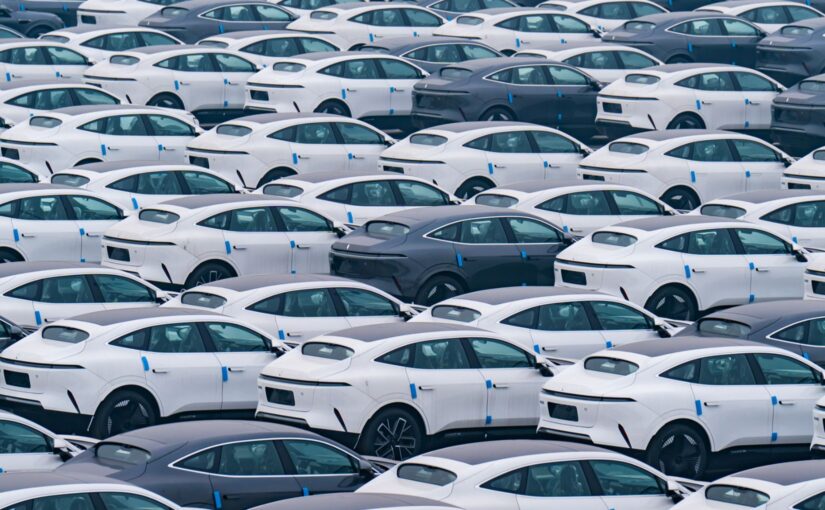
Last week the EU notified Beijing that, following a nine-month investigation into alleged unfair state subsidies, it will impose new tariffs of up to 38 per cent on Chinese electric vehicles (EVs).

Given the existing 10 per cent tariff on car imports, this will mean Chinese EVs will be hit with tariffs of up to 48 per cent. These new tariffs are due to kick in on July 4.

Germany, Sweden and Hungary have been vocal in opposing the move, with German Chancellor Olaf Scholz stating the obvious: “Isolation and illegal customs barriers ultimately just makes everything more expensive, and everyone poorer.”

Of course, this reflects the importance of the Chinese market for German car manufacturers, who will be hoping beyond hope that the authorities in Beijing haven’t been studying the Book of Exodus and thus are not minded to apply the principle of “an eye for an eye.”

BMW CEO Oliver Zipse commented: “The decision for additional import duties is the wrong way to go. The EU Commission is thus harming European companies and European interests.”

This sentiment was echoed by a spokesperson for Volkswagen: “The negative effects of this decision outweigh any potential benefits for the European and especially the German automotive industry.”

Indeed there seems to be little enthusiasm for these tariffs anywhere outside the White House. The Bloomberg editorial board argues that “tariffs won’t bring the EU prosperity” and that the increased price of EVs will decelerate Europe’s green transition.

Similarly, an article for Chatham House — titled “Imposing tariffs on Chinese electric vehicles will make the EU’s transition slower and more expensive” — notes that the EU has a legally binding target of reaching net-zero greenhouse gas emissions by 2050.

Meanwhile “decarbonisation technologies like solar panels, wind turbines and electric vehicles share a characteristic that sets them apart from other traded goods: when swapped for fossil fuel alternatives, they reduce the quantity of planet-warming gases being pumped into the atmosphere.” Such technologies “are needed in vast quantities, and in very short order, to give any chance of avoiding the worst impacts of climate change.”

It is noteworthy — and presumably not entirely coincidental — that the EU’s announcement came just a month after the Biden administration announced tariffs on Chinese EVs of 100 per cent.

In the case of the US, the material impact of these tariffs is virtually non-existent, given that Chinese-made models constitute just 2 per cent of all EV sales; and this in a market where EVs only make up 8 per cent of all car registrations (compared with almost 50 per cent in China).

The US tariff increase is simply an attempt by Biden to appear “tough on China” in the run-up to the presidential election. Donald Trump, not to be outdone on such matters, has promised tariffs of 200 per cent. As such, what we’re talking about is yet another component in the US-led new cold war on China, for which there is bipartisan consensus.

So it would appear the EU is acting in accordance with the strong recommendations (instructions) of Washington.

This certainly wouldn’t be the first time Europe has compromised its climate commitments and economic stability in order to participate in the US’s pursuit of 21st century hegemony.

In 2022, in order to punish Russia and to generate profits for the US’s domestic fossil fuel industry, the Biden administration heavily promoted sanctions on Russian natural gas. The result has been a major increase in US exports of fracked shale gas to Europe.

To get this gas from North America to Europe, it has to be liquified, stored at minus 70°C, and transported by ship. This whole process is extremely costly in both financial and ecological terms, certainly much more so than using existing pipelines running from Russia through Europe.

The European working class and progressive movement should oppose these tariffs on Chinese EVs and should resist the ongoing attempts by sections of the bourgeoisie to align Europe with Washington’s reckless foreign policy.

As noted in these pages in August last year, “major problems facing humanity require international co-operation — and China’s leading position in green technology makes co-operation in this field essential.”

China has raced ahead in renewable energy and electric transport because it has identified those sectors as being absolutely crucial for the future of not only China but the world.

As such, it has built environmental considerations into the core of its planning system and has targeted public investment accordingly. Rather than complaining about China’s investment in new productive forces, Europe should be following its example.

Imposing tariffs on the basis of Chinese public investment creates a precedent that any such central investment in sustainable development is unacceptable. This precedent would render any sort of green new deal out of the question.

Even the Economist acknowledges that “the potential gains to the West from a ready supply of cheap, green vehicles are simply enormous.” And, momentarily overcoming its Eurocentric instincts, it admits that Chinese cars “are not only cheap; they are better-quality, particularly with respect to the smart features in EVs that are made possible by internet connectivity.”

The article concludes that “if China wants to spend taxpayers’ money subsidising global consumers and speeding up the energy transition, the best response is to welcome it.”

Inasmuch as there’s such a thing as a sane bourgeois perspective, this is what it looks like.

In the words of former undersecretary-general of the UN and former executive director of the UN Environment Programme Erik Solheim: “China is now the indispensable country for everything green … And all historical experiences show that if you create closed-down markets and separate markets from different parts of the world, we will all be poorer.”

For the sake of peace, development and the habitability of the planet, Europe must change course.

The US ruling class, not China, is responsible for the opioid crisis

The following article by Friends of Socialist China co-founder Danny Haiphong, originally published in Beijing Review, discusses the growing opioid crisis in the United States and the tendency of US politicians to place blame for the crisis on China. Noting that opioid overdoses caused over 112,000 deaths in 2023, Danny writes that “the causes for the spike in both the use of fentanyl and its deadly consequences have been obscured by the rampant politicization of the issue”.

The House Select Committee on “Strategic Competition between the United States and the Chinese Communist Party” claims that China has been promoting the manufacture and export of the precursor chemicals critical to the production of fentanyl. Danny observes however that this claim is not substantiated by meaningful evidence, and furthermore “disregards China’s serious efforts in cracking down on the trafficking of fentanyl despite having no domestic problem with opioid abuse.” For example, in 2019, “China became the first country in the world to include all fentanyl-related substances in its supplementary list of controlled narcotic drugs and psychotropic substances.”

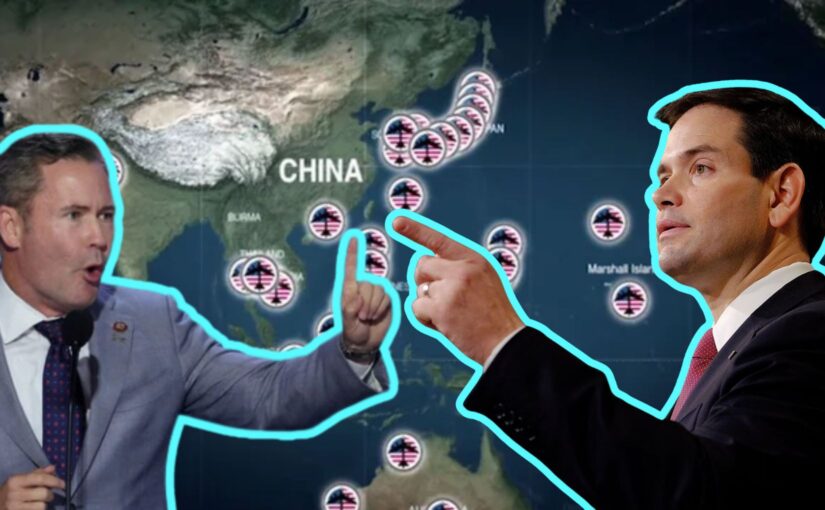
In truth the regulatory failures are taking place in the US, not China – “in large part due to the influence of corporate power on politics”. The attempt to pin blame on China is part of a broader New Cold War agenda in which China is demonised and its rise presented as an existential threat to the Western way of life. This narrative in turn serves to justify the US military build-up in the Pacific and the escalating campaign of China encirclement.

It is no secret that drug addiction is a major problem in the United States. When it comes to opioids, the crisis has become increasingly deadly. Over 112,000 fatal overdoses occurred in the U.S. in 2023. The potent synthetic opioid, fentanyl, is now a household name for its role in aggravating overdoses in the country to such a historic scale.

However, the causes for the spike in both the use of fentanyl and its deadly consequences have been obscured by the rampant politicization of the issue. In recent years, U.S. political elites have attempted to explain away the crisis by blaming a convenient scapegoat: China.

The House Select Committee on “Strategic Competition between the United States and the Chinese Communist Party” in April released a report claiming that China has directly subsidized precursor chemicals critical to the production of fentanyl.

The insinuation is that China is directly trading these substances with illicit fentanyl producers and therefore fueling the opioid crisis in the U.S.

Blaming China for the opioid crisis didn’t begin this year, however. Political officials placed fentanyl production at the top of their domestic agenda in 2021 and immediately blamed China for the deadly consequences. U.S. President Joe Biden stated prior to his meeting with Chinese President Xi Jinping on the sidelines of the APEC conference in San Francisco, California, last November that he would make pressuring China on fentanyl a key topic and claimed a “diplomatic victory” after China and the U.S. agreed to resume talks on the issue.

Blaming China for the U.S. opioid overdose crisis is rife with problems. For one, the House committee is a byproduct of a broader Cold War agenda and the credibility of its report is in serious question given the majority of its sources are anecdotal or regurgitation of Western media claims.

Furthermore, U.S. claims disregard China’s serious efforts in cracking down on the trafficking of fentanyl despite having no domestic problem with opioid abuse. In 2019, China became the first country in the world to include all fentanyl-related substances in its supplementary list of controlled narcotic drugs and psychotropic substances.

The country has also taken numerous security measures in compliance with the law, and many of these actions include cooperating directly with U.S. export-import control mechanisms.

It’s also important to note that the responsibility of how precursor chemicals are utilized falls on the importing country. The U.S. has consistently ignored necessary regulations on the sale and distribution of opioids in large part due to the influence of corporate power on politics.

U.S. pharmaceutical company Purdue Pharma LP is infamous for starting the opioid epidemic in the U.S. beginning in the 1990s as the maker and aggressive peddler of OxyContin, a strong and potentially addictive pain medication.

Purdue Pharma opened the floodgates to the over-prescription of opioids within an already profit-driven health insurance and medical system. For the past 30 years, pharmaceutical corporations have poured billions of dollars into political campaigns to ensure that their products receive legislative priority and protection.

The close relationship between U.S. politicians and pharmaceutical corporations has created what’s called the “revolving door.” For example, during the Donald Trump administration, former Commissioner for the Food and Drug Administration Scott Gottlieb resigned to join the board of directors of Pfizer, one of the world’s premier pharmaceutical and biomedical enterprises.

And the revolving door is no partisan affair. Major members of Biden’s staff, such as former Deputy Chief of Staff Jennifer O’Malley Dillon and current Ambassador to the United Nations Linda Thomas-Greenfield, have worked for law firms representing major pharmaceutical corporations such as Pfizer and Gilead Sciences, Inc.

The U.S. geopolitical footprint on the illicit drug trade has contributed to countless suffering and chaos throughout the Global South, or the nations of the world that are considered to have a relatively low level of economic and industrial development and are typically located to the south of more industrialized nations. The U.S. played a role in the Opium Wars in the 19th century which led to China’s “century of humiliation” and was a major force in the global opium trade of that period. Throughout the Cold War, covert U.S. wars in Latin America led to the proliferation of the drug trade from Colombia to Central America. And Afghanistan, suffering decades of U.S. interventions, became the top producer of opium in the world for much of the 21st century until its growth and distribution was banned by the Taliban in 2022 following the U.S. withdrawl from the country.

Blaming China won’t address any self-inflicted wounds. It is U.S. policy, or rather the lack thereof, that is responsible for making American society an attractive market for the illicit drug trade. Despair, stress, poverty and racial discrimination make for a toxic mix that continues to fester and grow in the heart of American society. Political leaders and their elite sponsors are the ones who need to be held accountable. Not China.

Wang Yi: BRICS is opening up a new chapter of the Global South

The Foreign Ministers’ Meeting of the BRICS dialogue mechanism was held on June 10 in the Russian city of Nizhny Novgorod. Russia holds the rotating chair of BRICS for 2024 and the meeting of foreign ministers was preparatory to the annual summit, to be held in Kazan. It was attended by the nine current BRICS member countries, along with 12 other developing countries, namely Thailand, Laos, Vietnam, Bangladesh, Sri Lanka, Kazakhstan, Belarus, Türkiye, Mauritania, Cuba, Venezuela and Bahrain.

According to the Chinese Foreign Ministry, the participants had an in-depth exchange of views on BRICS cooperation and international and regional hotspot issues. All parties spoke highly of the important role of the BRICS mechanism and the achievements of its membership expansion. They agreed that the accession of more countries to BRICS has accelerated the process of building a multipolar world and promoted a more just and equitable international order. They also voiced support for the establishment of partner countries. All parties called for adherence to multilateralism, opposition to unilateralism and protectionism, promoting reform of the international financial architecture, enhancing and improving global governance, and increasing the voice and representation of developing countries. They also emphasised the need for peaceful settlement of disputes through dialogue and consultations and their support for all efforts conducive to peaceful resolution of crises. The meeting adopted a joint statement, the full text of which can be read here.

In his speech to the meeting, Chinese Foreign Minister Wang Yi said that: “Over the past year, BRICS cooperation has moved forward with highlights, with speed and with strength.We made pioneering efforts and expanded the BRICS mechanism, opening up a new chapter of the Global South seeking strength through unity… Upon expansion, BRICS countries account for nearly half of the global population and one-fifth of global trade, and their total economic output has overtaken that of the G7 in PPP [Purchasing Power Parity] terms.”

Unmistakeably referring to the United States, Wang said that a major country was “still harbouring Cold War mentality, is cobbling up geopolitical blocs and even publicly challenging United Nations Security Council (UNSC) resolutions, which erodes the authority of multilateral mechanisms. Economic issues are politicised; the notion of national security is overstretched; and unilateral sanctions and technology barriers are growing. In the face of a contest between forces promoting world multipolarity and forces holding onto unipolar hegemony, between globalisation and anti-globalisation, we must follow the trend of history, stand on the side of fairness and justice, and make the right choice.”

He further stressed the need to, “firm up determination to safeguard peace and security and make new contributions to the political settlement of international hotspot issues. History shows that Cold War mentality, bloc confrontation or external interference cannot solve problems. Instead, they will create bigger problems or even crises. No matter how complex the situation is, parties must not give up dialogue and consultation. No matter how acute the conflict is, political settlement must be pursued.”

Addressing the two major conflicts in the world today, China’s top diplomat said that the war in Gaza is testing human conscience and sense of justice. We must push for an immediate ceasefire that is comprehensive and lasting, ease the humanitarian crisis and prevent further spillover of the conflict. We should support Palestine’s bid for full UN membership, support its efforts to restore legitimate national rights, restart the two-state solution, and bring about lasting peace in the Middle East.

Meanwhile, the conflict in Ukraine also continues.  China supports the convening, in due course, of a true international peace conference that is recognised by both Russia and Ukraine, participated in by all sides on an equal footing, and where all peace plans are discussed fairly. BRICS countries should take an independent, objective and just stance, help build international consensus for peace, and oppose attempts to instigate a new Cold War.

He also alluded to the need to break dollar hegemony in international banking and finance, saying: “We should work for early breakthroughs on local currency settlement and cross-border payment cooperation through the financial track. We should promote the use of more diverse currencies at the New Development Bank for financing and increase the share of local currencies in investment and financing activities.”

Wang Yi also held a number of bilateral meetings with his counterparts on the sidelines of the gathering.

Meeting with Russian Foreign Minister Sergey Lavrov, he noted that President Vladimir Putin’s recent visit to China was a great success, adding that both sides should fully implement the important common understandings reached between the top leaders of the two countries and advance cooperation in various fields.

Lavrov said that Russia is willing to closely cooperate with China on multilateral platforms including the UNSC and enhance diplomatic coordination. The number of like-minded countries continues to increase in international and regional affairs while BRICS expansion reflects this positive trend.

Speaking with South African Minister of International Relations and Cooperation Naledi Pandor, Wang Yi congratulated South Africa on the smooth holding of the general election and the African National Congress (ANC) on continuing to play a leading role in South Africa’s politics as the largest party. He expressed the belief that the ANC will remain true to its original aspiration and firm faith and continue to lead the South African people to make greater achievements in building a new South Africa enjoying unity, stability and prosperity. Last year, President Xi Jinping paid a state visit to South Africa and attended the BRICS Summit, during which he reached important common understandings with President Cyril Ramaphosa, ushering in a new era of building a high-level China-South Africa community with a shared future. The historic expansion of the BRICS mechanism in South Africa has further encouraged the Global South countries to seek strength through unity.

China, he added, attaches importance to South Africa’s role as a major developing country, and stands ready to keep close multilateral coordination, be an objective, balanced and constructive voice on the Ukraine crisis and other hotspot issues, and contribute to world peace and stability.

Naledi Pandor said that last year, South Africa was honoured to host President Xi Jinping and thanked China for supporting South Africa in successfully hosting the BRICS Summit. South Africa not only attaches great importance to its relations with China, but also attaches great importance to Africa’s cooperation with China and the role of the Forum on China-Africa Cooperation (FOCAC). Cooperation with China is the most important part of Africa’s international cooperation. Naledi Pandor looks forward to China strengthening cooperation in such fields as infrastructure, digital economy, renewable energy and human resources development in light of Africa’s development needs, so as to contribute to the continent’s stable development.

Meeting with Brazilian Foreign Minister Mauro Vieira, Wang Yi noted that this year marks the 50th anniversary of the establishment of China-Brazil diplomatic relations, a significant year in bridging the past and the future for the development of bilateral relations. As President Xi Jinping stressed, both sides should grasp the strategic importance of the China-Brazil relationship, enhance its mutually beneficial nature, and highlight its comprehensiveness. China values Brazil’s significant influence in the Latin American region and is willing to jointly promote cooperation between China, the Community of Latin American and Caribbean States (CELAC), and the Southern Common Market (Mercosur).

For his part, Mauro Vieira said that Brazil highly values its relationship with China, is ready to closely engage in high-level exchanges with China, strengthen cooperation in various fields including trade and economy, and define a new positioning for bilateral relations to open new prospects for the next 50 years. Brazil and China share similar stances on many issues, and the joint statement on the six common understandings on the political settlement of the Ukraine issue is of great importance.  Noting that President Luiz Inácio Lula da Silva firmly believes that dialogue and cooperation between China and CELAC are highly significant, Vieira said the China-CELAC Forum is a beneficial platform, and Brazil is willing to work with China to arrange forum activities and promote its further development.

On meeting with Iranian Acting Foreign Minister Ali Bagheri Kani, Wang Yi expressed condolences once again over the unfortunate passing of President Ebrahim Raisi and Foreign Minister Hossein Amir-Abdollahian in a helicopter accident. Wang Yi said that during the current period, the Iranian state and nation has undergone a significant test. As a comprehensive strategic partner, China supports the Iranian government and people in adhering to their established domestic and foreign policies, maintaining independence, sovereignty, stability and development, and wishes Iran a successful presidential election.

Ali Bagheri Kani, on behalf of the Iranian government, thanked China for expressing condolences over the unfortunate passing of the President and Foreign Minister and for sending a special representative to attend the memorial service. 

Under the current international circumstances, he continued, developing Iran-China relations not only benefits the people of both countries but is also conducive to regional and world peace and stability, as well as to building a fairer and more reasonable international order and safeguarding the legitimate rights of developing countries. Unilateralism has reached a dead end, and cannot solve domestic problems, let alone global issues, as is fully proved in the prolonged Gaza conflict. Iran is willing to strengthen communication and coordination with China in international and regional affairs, jointly uphold multilateralism, and seek solutions to global issues.

Meeting with Taye Atske Selassie, the Foreign Minister of Ethiopia, a new member of BRICS, Wang noted that Ethiopia is an influential African nation and the seat of the African Union (AU) headquarters. Over the past two years, Ethiopia has made orderly progress in its domestic peace process and made remarkable achievements in economic and social development. Wang Yi expressed his belief that the Ethiopian government and people will achieve even greater success on the path of peace, development, and prosperity.

Noting Ethiopia’s deep friendship with China, Taye Atske Selassie said the elevation of bilateral relations to an all-weather strategic partnership is warmly welcomed by the Ethiopian government and people. China is Ethiopia’s largest source of foreign investment and export destination, and bilateral cooperation has strongly promoted Ethiopia’s economic and social development. Ethiopia is willing to learn from China’s development experience and to work with other African countries to promote greater development in China-Africa cooperation. 

In his meeting with Lao Deputy Prime Minister and Foreign Minister Saleumxay Kommasith, Wang Yi said that under the strategic guidance of General Secretary Xi Jinping and General Secretary Thongloun Sisoulith, solid progress has been made in building a China-Laos community with a shared future. In the face of the complex international situation and domestic development tasks, China and Laos, as friendly neighbours with a shared future, need to work together to meet challenges, eliminate all kinds of external interference, oppose stoking bloc confrontation, and earnestly safeguard regional peace and stability. China firmly supports Laos in serving as the rotating chair of ASEAN (the Association of South East Asian Nations) and working together to build an even closer China-ASEAN community with a shared future.

Saleumxay Kommasith said that both Laos and China are socialist countries with similar ideas and systems. They both adhere to the Five Principles of Peaceful Coexistence and are committed to safeguarding international justice and world peace. In the face of the current complex international and regional situation, the importance of Laos-China cooperation has never been greater.

Wang Yi also met with Thai Foreign Minister Maris Sangiampongsa and noted that China is full of confidence in the prospect of China-Thailand relations and is willing to strengthen high-level exchanges with Thailand, enhance cooperation in various fields, accelerate the construction of the China-Thailand Railway and other major projects, and realise the vision of interconnected development of China, Laos and Thailand at an early date.

Maris Sangiampongsa said that Thailand hopes to learn from China’s successful experience in economic development, strengthen practical cooperation in various fields, and better achieve economic and social development. Thailand stands ready to work with China to jointly plan the celebrations of the 50th anniversary of the establishment of their diplomatic relations next year so as to highlight the close friendship between the two peoples. Thailand is also ready to join the BRICS mechanism as soon as possible, play a more active role in South-South cooperation, and strengthen coordination and cooperation with China on multilateral platforms.

The following articles were originally published on the website of the Chinese Foreign Ministry.

Pooling Strengths and Working Together For a Brighter Future of BRICS

June 11 (Foreign Ministry)

Remarks by H.E. Wang Yi at the BRICS Ministers of Foreign Affairs / International Relations Meeting

Nizhny Novgorod, June 10, 2024

Dear Colleagues, 

Good morning. It is a great pleasure to join you at Nizhny Novgorod for the BRICS Ministers of Foreign Affairs / International Relations Meeting. I thank Minister Lavrov and the Russian government for the thoughtful arrangements.

Continue reading Wang Yi: BRICS is opening up a new chapter of the Global South

The perils and promise of the emerging multipolar world

In his recent article for Common Dreams, Columbia professor Jeffrey Sachs describes the world’s trajectory towards multipolarity over the past three decades. He notes that, “in 1994, the G7 countries constituted 45.3% of world output, compared with 18.9% of world output in the BRICS countries (Brazil, China, Egypt, Ethiopia, India, Iran, Russia, South Africa, United Arab Emirates). The tables have turned. The BRICS now produce 35.2% of world output, while the G7 countries produce 29.3%.”

The West’s political influence is also waning, as exemplified by the failure of the US-led sanctions against Russia from 2022: “When the US-led group introduced economic sanctions on Russia in 2022, very few countries outside the core alliance joined. As a result, Russia had little trouble shifting its trade to countries outside the US-led alliance.”

Sachs notes that emerging economies such as China, Russia are Iran are breaking the imperialist stranglehold on technological innovation. In China’s case, it “clearly has a large lead in the manufacturing of cutting-edge technologies needed for the global energy transition, including batteries, electric vehicles, 5G, photovoltaics, wind turbines, fourth generation nuclear power, and others. China’s rapid advances in space technology, biotechnology, nanotechnology, and other technologies is similarly impressive.” All of this is “underpinned by enormous R&D spending and its vast and growing labor force of scientists and engineers.”

And yet US strategists refuse to accept this new reality, and are instead doubling down on their efforts to maintain their hegemony, primarily through military means:

The US is still trying to maintain primacy in Europe by surrounding Russia in the Black Sea region with NATO forces, yet Russia has resisted this militarily in both Georgia and Ukraine. The US is still trying to maintain primacy in Asia by surrounding China in the South China Sea, a folly that can lead the US into a disastrous war over Taiwan. The US is also losing its standing in the Middle East by resisting the united call of the Arab world for recognition of Palestine as the 194th United Nations member state.

In a post-hegemonic, multipolar world, it is crucial that the US and its allies give up on this dangerous and futile quest for global dominance.

The World Bank’s release on May 30 of its latest estimates of national output (up to the year 2022) offers an occasion to reflect on the new geopolitics. The new data underscore the shift from a U.S.-led world economy to a multipolar world economy, a reality that U.S. strategists have so far failed to recognize, accept, or admit.

The World Bank figures make clear that the economic dominance of the West is over. In 1994, the G7 countries (Canada, France, Germany, Italy, Japan, U.K., U.S.) constituted 45.3% of world output, compared with 18.9% of world output in the BRICS countries (Brazil, China, Egypt, Ethiopia, India, Iran, Russia, South Africa, United Arab Emirates). The tables have turned. The BRICS now produce 35.2% of world output, while the G7 countries produce 29.3%.

As of 2022, the largest five economies in descending order are China, the U.S., India, Russia, and Japan. China’s GDP is around 25% larger than the U.S.’ (roughly 30% of the U.S. GDP per person but with 4.2 times the population). Three of the top five countries are in the BRICS, while two are in the G7. In 1994, the largest five were the U.S., Japan, China, Germany, and India, with three in the G7 and two in the BRICS.

As the shares of world output change, so too does global power. The core U.S.-led alliance, which includes the U.S., Canada, U.K., European Union, Japan, Korea, Australia, and New Zealand, was 56% of world output in 1994, but now is only 39.5%. As a result, the U.S. global influence is waning. As a recent vivid example, when the U.S.-led group introduced economic sanctions on Russia in 2022, very few countries outside the core alliance joined. As a result, Russia had little trouble shifting its trade to countries outside the U.S.-led alliance.

The world economy is experiencing a deep process of economic convergence, according to which regions that once lagged the West in industrialization in the 19th and 20th centuries are now making up for lost time. Economic convergence actually began in the 1950s as European imperial rule in Africa and Asia came to an end. It has proceeded in waves, starting first in East Asia, then roughly 20 years later India, and for the coming 20-40 years in Africa.

These and some other regions are growing much faster than the Western economies since they have more “headroom” to boost GDP by rapidly raising education levels, boosting workers’ skills, and installing modern infrastructure, including universal access to electrification and digital platforms. The emerging economies are often able to leapfrog the richer countries with state-of-the-art infrastructure (e.g., fast intercity rail, 5G, modern airports and seaports) while the richer countries remain stuck with aging infrastructure and expensive retrofits. The IMF’s World Economic Outlook projects that the emerging and developing economies will average growth of around 4% per year in the coming five years, while the high-income countries will average less than 2% per year.

It’s not only in skills and infrastructure that convergence is occurring. Many of the emerging economies, including China, Russia, Iran, and others, are advancing rapidly in technological innovations as well, in both civilian and military technologies.

China clearly has a large lead in the manufacturing of cutting-edge technologies needed for the global energy transition, including batteries, electric vehicles, 5G, photovoltaics, wind turbines, fourth generation nuclear power, and others. China’s rapid advances in space technology, biotechnology, nanotechnology, and other technologies is similarly impressive. In response, the U.S. has made the absurd claim that China has an “overcapacity” in these cutting-edge technologies, while the obvious truth is that the U.S. has a significant under-capacity in many sectors. China’s capacity for innovation and low-cost production is underpinned by enormous R&D spending and its vast and growing labor force of scientists and engineers.

Despite the new global economic realities, the U.S. security state still pursues a grand strategy of “primacy,” that is, the aspiration of the U.S. to be the dominant economic, financial, technological, and military power in every region of the world. The U.S. is still trying to maintain primacy in Europe by surrounding Russia in the Black Sea region with NATO forces, yet Russia has resisted this militarily in both Georgia and Ukraine. The U.S. is still trying to maintain primacy in Asia by surrounding China in the South China Sea, a folly that can lead the U.S. into a disastrous war over Taiwan. The U.S. is also losing its standing in the Middle East by resisting the united call of the Arab world for recognition of Palestine as the 194th United Nations member state.

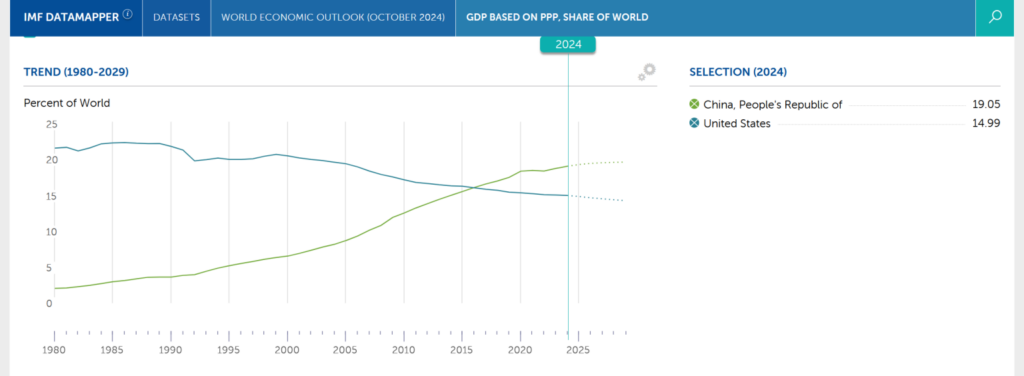
Yet primacy is certainly not possible today, and was hubristic even 30 years ago when U.S. relative power was much greater. Today, the U.S. share of world output stands at 14.8%, compared with 18.5% for China, and the U.S. share of world population is a mere 4.1%, compared with 17.8% for China.

The trend toward broad global economic convergence means that U.S. hegemony will not be replaced by Chinese hegemony. Indeed, China’s share of world output is likely to peak at around 20% during the coming decade and thereafter to decline as China’s population declines. Other parts of the world, notably including India and Africa, are likely to show a large rise in their respective shares of global output, and with that, in their geopolitical weight as well.

We are therefore entering a post-hegemonic, multipolar world. It too is fraught with challenges. It could usher in a new “tragedy of great power politics,” in which several nuclear powers compete—in vain—for hegemony. It could lead to a breakdown of fragile global rules, such as open trade under the World Trade Organization. Or, it could lead to a world in which the great powers exercise mutual tolerance, restraint, and even cooperation, in accord with the U.N. Charter, because they recognize that only such statecraft will keep the world safe in the nuclear age.

On China’s overcapacity

The article below, written for Friends of Socialist China by Shiran Illanperuma, addresses the latest ideological weapon in the Biden-Trump trade war against China: that of ‘overcapacity’. According to Western politicians and neoliberal economists, China’s industrial subsidies and production capacity are to blame for the US’s trade deficit and its apparent inability to reindustrialise its economy.

Shiran, citing fellow Marxist economist Michael Roberts, observes that the US and EU have sustained trade deficits since decades ago, before China’s emergence as an industrial superpower: “In a previous era, it was Japan and Germany that were the source of the US’s protracted trade deficits.” This rather suggests that “the main problem is the decline in the competitiveness and productive capabilities of the US itself rather than China’s (or, for that matter, anyone else’s) industrial policies.”

The article shows that China’s capacity utilisation and inventory levels almost exactly match those of the US. Hence, according to standard metrics, China is no more guilty of ‘overcapacity’ than the US itself. What is true is that China is actively working to contain excess capacity in mature industries such as coal and steel. However, in emerging technologies – particularly those required for solving the climate crisis – China is leveraging its socialist market economy to rapidly innovate and develop its productive forces. It should be noted that this strategy is responsible for a decrease in solar PV and wind energy costs of around 90 percent over the last decade. From the standpoint of maintaining a habitable Earth, the accusations of Chinese ‘overcapacity’ are beyond absurd.

Ultimately, what’s driving these accusations is that “Western imperialism is in crisis and can no longer sustain the position of its old labour aristocracy.”

The thesis of Chinese overcapacity therefore serves a dual purpose. First, it provides the Western ruling class with a means to deflect criticism of its own neoliberal policies in order to scapegoat China for the destruction of its industrial base. Second, it allows that same ruling class to resort to protectionism and subsidies on behalf of monopoly capitalists.

Shiran concludes:

For its part, China is developing technologies that are crucial for the future of mankind. It has done so while the ruling elite in the West gamble away wealth produced by workers through stock buybacks and real estate speculation. It is up to the Western Left to organise workers against imperialism and anti-China chauvinism, and to fight to liberate the productive forces necessary to address the socioeconomic and ecological challenges of this century.

Shiran Illanperuma is an independent journalist and researcher. He is currently reading for a master’s degree in economic policy at SOAS University of London.

In the last few months, there has been an intensified campaign by Western politicians, academics, and mainstream media to popularise the narrative of “Chinese overcapacity.” Like the disproven narrative of the “Chinese debt trap” before it, this appears to be a coordinated attempt by the West to scapegoat China for structural problems and imbalances in the world capitalist economy.

The thesis of China’s manufacturing overcapacity has been in circulation since at least the global financial crisis. In short, the argument goes that China’s investment-driven growth model creates both local and global imbalances. It is argued that higher investment suppresses consumption (as a share of GDP) and drives income inequality and excess production capacity within China. It is further argued that such imbalances are to blame for China’s excessive exports and massive trade surplus, which is said to be at the cost of the United States’ trade deficit.

In academia, this argument has been popularised by Keynesian economist Michael Pettis, who is a Professor of Finance at Peking University. Brad Setser, a former senior advisor to the United States Trade Representative, has also been a champion of this argument. Notably, the overcapacity thesis has also been a consistent theme of the IMF on China.

In May, the IMF Mission to China published a report stating that in order to ensure growth, China’s key priorities should include “rebalancing the economy towards consumption by strengthening the social safety net, liberalising the services sector, and scaling back distortive supply side policies that support the manufacturing sector [emphasis added].”

The IMF is, of course, a Western-dominated institution, where China controls just 6% of voting shares despite contributing to 18% of global GDP.

The overcapacity thesis has been an increasing source of diplomatic tension. US Treasury Secretary Janet Yellen has attempted to rally the G7 on the issue and coax Global South countries such as India and Mexico into the debate. Meanwhile, European Commission President Ursula von der Leyen has argued that Chinese industrial policy is distorting the EU market for electric vehicles (EVs).

The Chinese side has reacted strongly to these allegations. Chinese President Xi Jinping said that there was no such thing as a Chinese overcapacity problem. Meanwhile, Chinese Ministry of Commerce spokesperson He Yadong has said that the accusation of Chinese overcapacity was a typical Western double standard. More recently, Chinese Foreign Ministry Spokesperson Wang Wenbin said, “Overcapacity is just a pretext the US uses to try to coerce G7 members into creating fences and restrictions for Chinese new energy products.”

Following in Trump’s footsteps, the Biden administration recently threw up a slew of new tariffs against Chinese products, including 25% on steel and aluminium, 50% on semiconductors, 50% on solar panels, and a whopping 100% on electric vehicles (EVs). As the US-led trade war against China intensifies, it is worth reflecting on the facts behind the overcapacity thesis.

Measuring China’s overcapacity

French entrepreneur and analyst Arnaud Bertrand has argued that the concept of overcapacity can be measured with a few standard metrics: 1. capacity utilisation rates; and 2. inventory levels.

In economics, capacity utilisation refers to the share of production capacity that is in use at any given time. Generally speaking, a prolonged period of high capacity utilisation can indicate a need to expand productive capacity. In contrast, a prolonged period of low capacity may indicate a need to reduce productive capacity. Bertrand points out that the capacity utilisation rate in China is 76%, which is around the same as in the United States, which is 78%.

Inventory levels are generally used as a measure of how well sales are doing. A growing inventory of goods might mean a combination of sluggish demand or overproduction, while a shrinking inventory might mean growing demand and underproduction. Bertrand points out that the finished good inventory index PMI for China stood at 49, while a similar index for manufacturing inventory for the United States stood at 50.

Neither of the above numbers suggests that China has any more overcapacity than the US. On the contrary, the fact that Chinese industrial profits continue to grow suggests that there is ready demand for Chinese manufactures. Several analysts have also argued that China’s drive to increase production capacity for new energy products makes it indispensable in the global fight for ecological sustainability.

Continue reading On China’s overcapacity

Contrasting the US’s severe urban decay with China’s extraordinary infrastructure development

In the following article, originally published in the Morning Star, Roger McKenzie contrasts the economic priorities of the US with those of China.

Reporting from Washington DC and New York City, and reflecting on the recent Friends of Socialist China delegation to China, he compares the level of investment in infrastructure in the two countries. A train journey between DC and NYC “revealed a picture of severe urban decay in supposedly the world’s most important and richest nation” – a reflection of the fact that, in the US, “the government, of any colour, prefers to spend immense amounts of money on the military as opposed to the people.”

The article continues:

The US is visibly decaying economically as well as politically, while China is clearly stable, able to act on behalf of the people and on the way up. The transport infrastructure, road, rail and airport systems in China have undergone a massive upgrades in length and quality over the last decade. This is a sentence you simply can’t apply to the US.

In the five cities I visited during my 10-day visit to China I never saw a single homeless person and felt entirely safe to walk the streets and speak with anyone I wanted. Nobody stopped me from doing any of those things. I never felt the same level of safety in DC — or New York for that matter.

Roger notes that the US could learn a great deal from China. If it were willing to adapt to a multipolar reality and give up on its dream of a New American Century, it could prioritise the needs of its people over those of the military-industrial complex. However, he warns that the current trajectory is towards leveraging the US’s military power to maintain its global dominance, even as its economic power wanes. “The temptation will be for the empire to strike back as its power crumbles. Unfortunately it is something I think we are already seeing in Ukraine and in its attempts to stoke up tensions in the breakaway Chinese province of Taiwan.”

The challenge for the left is therefore to build a powerful mass movement that combines the struggle for socialism at home with the struggle against imperialism and war.

Roger will be among the speakers at the upcoming webinar China proves that a new world is possible! on 16 June.

EMPIRES always end. All of them. The only question is about the nature of that end. We can see this before our eyes as the United States empire reaches its inevitable end, internationally and domestically.

We can see it happening in front of our eyes if we choose to look. One of the advantages of travelling by train instead of flying is you get to see much more of the reality of a country.

The Acela Express train ride of 230 miles or so for three hours from New York City to the US capital, Washington DC, was depressing in so many ways.

The train itself was better and more comfortable than many I have travelled on in Britain, but the journey revealed a picture of severe urban decay in supposedly the world’s most important and richest nation.

You could see the wealth on the skyline represented by the skyscraper office blocks of the major cities we passed through — Philadelpia and Baltimore — but much of the rest was a picture of severe urban decay.

The industrial base of the country has been gutted. It reminded me of the train journey through the once thriving Black Country in Britain. Once a hive of industrial activity, now hollowed out with miles of left-to-rot former factories.

In the US the choice has clearly been made that the government, of any colour, prefers to spend immense amounts of money on the military as opposed to the people.

I can’t believe that the minority of the US population that actually bother to come out and vote don’t understand this. It’s no secret that the US spends by far the largest amount on the military of any country on Earth.

The US spends more on the military than China, Russia, India, Saudi Arabia, Britain, Germany, France and South Korea combined.

Between them China and Russia account for only around 13 per cent of the world’s military spend. Not the vast amounts the corporate media would have you believe.

But while content to project its power abroad, the US is crumbling. One visit to the vast and imposing US embassy in London will show you just how much the US is intent on projecting its power. To the US size really does matter.

Continue reading Contrasting the US’s severe urban decay with China’s extraordinary infrastructure development

Tariffs, technology and industrial policy

In the following article, well-known Marxist economist Michael Roberts assesses the latest set of protectionist measures taken by the Biden administration against China. Roberts notes that these measures include “a quadrupling of the tariff rate to 100% on Chinese electric vehicle (EV) imports, doubling the levy on solar cells and more than tripling the fee on Chinese lithium-ion EV batteries.” These tariffs constitute a doubling-down by President Biden on the measures introduced by the Trump administration in 2018-19.

The article observes that “Chinese EVs are now better and cheaper than their Western counterparts”, and this reflects China’s rapid advance in several key areas of green technology.

China has scaled up its green industries rapidly. It now produces nearly 80% of the world’s solar PV modules, 60% of wind turbines and 60% of electric vehicles and batteries. In 2023 alone, its solar-power capacity grew by more than the total installed capacity in the US.

Biden’s protectionist measures are being justified on the basis that they will stimulate domestic production of green technology in the US. However, Roberts argues that this is unlikely to be the outcome, given historical precedent. Previous tariffs on solar panels, introduced in 2012 and later expanded, did not revitalise the US solar industry. “On the contrary, the American global market share of the solar industry has considerably decreased since the original tariffs were placed — from 9% in 2010 to 2% today. Meanwhile, China’s share of the industry rose from 59% to 78%. There’s no reason to believe that the recent tariff increase will reverse this trend. There’s even less hope that they will help spur a domestic EV industry.”

The article also points to the irony of the US accusing China of violating WTO rules with its green tech subsidies, whilst simultaneously introducing a substantial package of its own green subsidies. “It seems that China’s industrial policy of subsidies is ‘gaming the system’, while US industrial policy of similar subsidies is just ‘protecting’ US industry.”

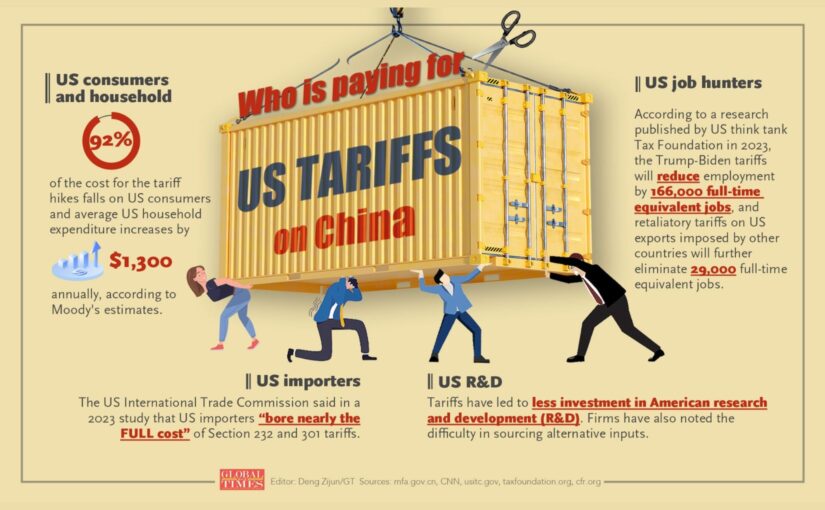
Rather than boosting domestic production, the tariffs are likely to have the opposite effect, by raising costs for US consumers and businesses and disrupting supply chains. The article notes that “Trump and Biden’s imposition of tariffs risks hindering the adoption of low-emission technologies by American businesses and consumers.”

In general, the US’s strategy of attempting to stifle China’s development will not be successful and will certainly not benefit the US economy; indeed “the cost to the US economy and the profitability of US industry will be considerable, and even more to the real incomes of Americans.” However, in a context where “the US is losing its imperialist profit extraction from trade with China and increasingly being squeezed out of world markets by Chinese goods”, there appears to be a bipartisan consensus on continuing with these last-ditch attempts at destabilising and weakening China, even if ultimately they prove to be a classic case of “lifting a rock only to drop it on one’s own feet.”

The article was originally published on Michael Roberts’ blog on 20 May 2024.

Last Tuesday, the trade and technology war launched by the US on China back in 2019 took another ratchet up. 

The US government announced a new series of protectionist measures on Chinese goods imported into the US. It included a quadrupling of the tariff rate to 100% on Chinese electric vehicle (EV) imports, doubling the levy on solar cells and more than tripling the fee on Chinese lithium-ion EV batteries.  These tariffs are equivalent to an annual $18bn of Chinese goods on top of the previous $300bn slapped down under Trump. 

The new tariffs specifically target ‘green goods’, most notably EVs, but tariffs on lithium-ion batteries, critical minerals and solar cells will also be substantially increased. The measures are set to take effect this year (with the exception of graphite, where Chinese dominance is most stark, so tariffs begin in 2026).

China is the world leader in EV production and innovation.  Chinese EVs are now better and cheaper than their Western counterparts.  Biden’s intention is to stave off Chinese competition while stimulating domestic EV supply.  But China’s EV imports are only 2% of the US market.  And all the goods that these new tariffs were slapped on constitute only about 7% of US-China trade.  What this shows is that, even the US government recognizes that the US still relies heavily on Chinese goods imports and cannot cut them all dead.

That’s because the tariff and technology war is not just about protecting the ailing US auto industry.  China is totally dominant in EV manufacture because it’s also totally dominant in battery (cell) manufacture. And it’s also totally dominant in the manufacture of the chemicals that go into those cells (cathode & anodes).  

China is also utterly dominant when it comes to the refining of the materials that then go into the chemicals that then go into the cells which go into the EVs.

Continue reading Tariffs, technology and industrial policy

Three US wars threaten World War Three: $95 billion targets Palestine, Iran, Russia and China

The following article by Sara Flounders, originally published in Workers World, discusses the 95 billion dollar “supplemental aid” bill passed by Congress and signed by President Joe Biden on 24 April 2024. Of the $95 billion, $61 billion is allocated to Ukraine, $26 billion to Israel and $8 billion to Taiwan and the Pacific region. Sara writes that the package constitutes “a declaration of war on the world … an ominous and highly publicised military escalation on three fronts.” She continues:

In an era when uncontested US economic, productive and technological hegemony has decisively deteriorated, the only way that US corporate power can assert its dominance is in the military destruction of its rivals. Instigating wars and imposing sanctions are desperate efforts to destroy the emerging poles of development, cooperation and trade in West Asia, Russia and China that are outside of US control.

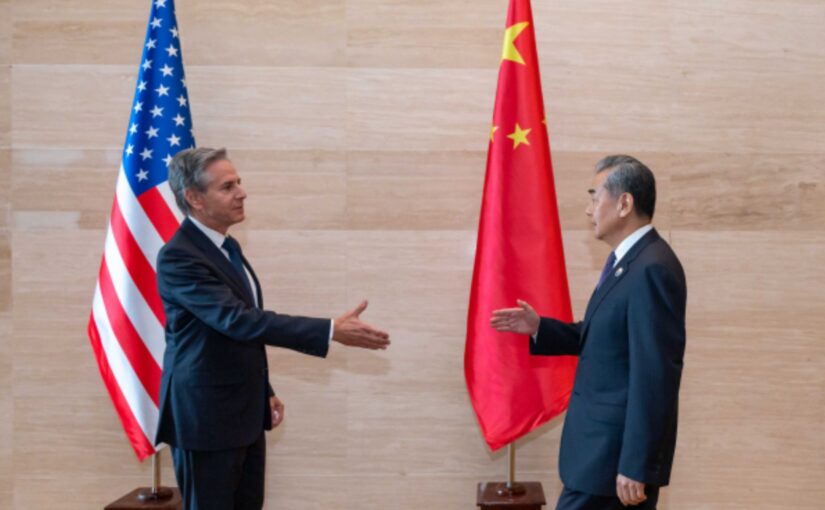
Sara observes that, as the bill was being signed, US Secretary of State Antony Blinken was in China – “not to promote diplomacy, but to make threats”. Blinken was demanding that China support the US’s unilateral and illegal sanctions against Russia, while back in Washington funds were being assigned to support Taiwanese separatism and stir up tensions in the Taiwan Strait. The hypocrisy is mind-boggling.

The article concludes:

The bill finances a drive toward World War III on three fronts: the U.S.-Israeli genocidal war aimed at Palestine, the US-NATO proxy war against Russia in Ukraine, and preparation for a US-led war in the Pacific against People’s China and the Democratic People’s Republic of (North) Korea.

The powerful global movement that has taken bold steps to stop Israeli genocide will be stronger as it grows to understand that this whole imperialist system is its enemy.

Anyone who thinks that the U.S. policy of continued arming and fully supporting the Israeli genocide is an accident or a mistake need only look at the $95 billion “supplemental aid” bill just passed by Congress and signed by President Joe Biden on April 24.

The same group of war criminals in Washington who back genocide in Gaza also support the NATO-provoked proxy war in Ukraine and maneuvers in the Pacific that threaten war against China.

The U.S. “supplemental” military aid package is a declaration of war on the world. It is an ominous and highly publicized military escalation on three fronts.

In an era when uncontested U.S. economic, productive and technological hegemony has decisively deteriorated, the only way that U.S. corporate power can assert its dominance is in the military destruction of its rivals. Instigating wars and imposing sanctions are desperate efforts to destroy the emerging poles of development, cooperation and trade in West Asia, Russia and China that are outside of U.S. control.

U.S. accelerates aid to Israel 

The $26 billion in additional aid to Israel, part of the supplement package, is a public statement of complete support for genocide in Gaza. It confirms U.S. determination to escalate the brutal aggression.

Moreover, it is sending a threat of escalating war to Iran, Lebanon, Yemen and the vast majority of the people of the world who support the Palestinian people’s justified resistance to colonial occupation.

This $26 billion is in addition to Washington’s $4 billion a year allotment to Israel, which has already been committed through 2028, and the over 100 military aid transfers to Israel that are intentionally kept out of the accounting process.

Since World War II, the U.S. has provided more foreign aid to Israel than to any other country. In 2022, 99.7% of those funds went to the Israeli military.

The huge infusion of aid to Israel confirms the decision by U.S. corporate powers to prop up Washington’s primary strategic ally in West Asia. This has been the goal behind the billions of dollars allocated to the apartheid state over decades.

Despite receiving enormous funds and creating massive destruction, Zionist forces have failed to defeat the unified Palestinian Resistance. This is a political blow to Israel and a humiliating setback to U.S. imperialism’s position in the entire region.

For this reason, Israel and some U.S. policy strategists are seeking to widen the war by bombing Iran, Syria, Lebanon and Yemen.

Israeli Prime Minister Benjamin Netanyahu welcomed the billions of dollars in U.S. assistance, writing on X (formerly Twitter) that it “demonstrates strong bipartisan support for Israel and defends Western civilization.” He immediately announced plans to proceed with a major military operation in Rafah.

Funds for humanitarian assistance are supposedly included in the bill. Yet its language stipulates that financial allocations for the United Nations Relief and Works Agency for Palestine Refugees are prohibited. UNRWA is a lifeline for nearly two million people in Gaza and for Palestinians in the West Bank, Jordan, Syria and Lebanon. Without this U.N. agency’s help, there is no way to provide food aid, teachers or medical care.

Continue reading Three US wars threaten World War Three: $95 billion targets Palestine, Iran, Russia and China

Daniel Ortega: China is contributing to development in Africa, Asia and Latin America

In a recent speech commemorating the anniversary of the death of Nicaraguan freedom fighter and politician Tomás Borge, President Daniel Ortega surveyed the current geopolitical landscape, in particular expressing Nicaragua’s solidarity with the Palestinian people and applauding the student protests in the US and elsewhere: “The Peoples cannot accept, they cannot understand that a genocide is being committed with the participation of the powers of the Empires, headed by the North American Rulers, the Germans, the English, the French.”

Ortega describes the escalating campaign of encirclement and containment against China, asking “what threat is the People’s Republic of China?”

He contrasts China’s foreign policy with that of the Western powers: China “is not installing military bases like so very many military bases the United States has and has installed here in Latin America and the Caribbean alone”; China “is not promoting any war.”

The problem the US and its allies have with China is that “the People’s Republic of China has been growing, developing and has become close with the world’s developing countries… it is contributing to the development of these Peoples, contributing to the fight against poverty among these Peoples, to generating employment”. These are the same countries of the Global South which “the colonialist, imperialist countries used as nothing more than a source of wealth that they could steal.”

The threat to them, the greatest threat to them, to the Europeans, to the United States, is the way in which China has been growing, the threat is that the Chinese economy will grow, when on the other hand history tells us that the economies of the colonialist and imperialist Countries have only grown, using their economies, making them serve so as to dispossess other Peoples, to occupy other Peoples, to exploit other Peoples.

The speech was first published in English on the Tortilla Con Sal website.

Good evening, Nicaraguan Brothers and Sisters, Families of these Blessed Lands. Good evening, Beloved Internationalist Brothers and Sisters. And we are the expression that a New World is possible.

Here we meet as Brothers and Sisters, Compañeros and Compañeras born in the United States of America, born in Switzerland, like that Compañero who died murdered by the bullets of the Empire; Compañeros and Compañeras born in different Countries, Developed and Developing, and we meet, we join each other, in this year of the 45th Anniversary of the Revolution we meet, affirming, assuring, that the day will come when we will all become truly Brothers, Sisters.

That day will come, here is an example, and this has multiplied at different times in history, where Peoples have fought together and continue to fight for Peace; in a World that today more than ever insists on Peace, demands Peace.

And we see youth in North America raising the protest, the condemnation of the genocide that is being committed against the Palestinian People. North American youth protesting, right now, yes, they are protesting, and the protest is multiplying not only in North America, but in every country of our planet.

The Peoples cannot accept, they cannot understand that a genocide is being committed with the participation of the powers of the Empires, headed by the North American Rulers, the Germans, the English, the French.

That is, precisely that World where the Rulers pride themselves on being the most just, the most democratic, the most respectful of Rights, of International Law, they are unmasking themselves. Because they have managed to deceive our Peoples for a long time, thinking that Europe, North America, are Democracies, forgetting or getting us to forget how in a Developed Country, in a democratic Country, Germany, with the support of the great North American capital, Nazism came to Government.

And the war, that great war, that terrible war that caused millions of deaths, originated in a European country, it did not originate in an African country, nor did it originate in a Latin American or Caribbean or Asian country, it originated in Germany… Germany! And then the United States showing off that they own the atomic weapon, because in that war they started looking for how to build atomic weapons, Hitler wanted atomic weapons and the United States also wanted atomic weapons.

The United States had the atomic weapon and it did not take them long to launch it, to drop atomic bombs on Hiroshima and Nagasaki, two cities where there was no Army, two Cities where the victims were the civilian citizens of Japan, and where that horrendous crime caused more than 200,000 deaths as well as the incurable damage, as a result of radiation, in children, who as they were growing up were manifesting multiple diseases as adults and the elderly, finishing them off.

That is to say, they managed to cover up all those crimes over time. There was no condemnation of the use of atomic weapons. And today, well, there are atomic weapons everywhere, and that’s why the world has become more tense, pushing humanity to its limits.

There is a lot of talk about not crossing the red line, because now it is no longer a question of one Country against another, but one where all of humanity is exposed to crimes such as those now being committed against the Palestinian People, and the rulers of Israel insist on that, while as a People, the People of Israel is a People that we respect.

Continue reading Daniel Ortega: China is contributing to development in Africa, Asia and Latin America

DPRK exposes US military strategy in the Pacific

The Korean Central News Agency (KCNA), the official news agency of the Democratic People’s Republic of Korea (DPRK), published two important commentaries in April concerning US strategy in the Asia-Pacific region, noting that its principal target is China.

Writing on April 12, Jong Min, an international security analyst, focused on the US attempt to deploy intermediate-range missiles in the region.

He said that not long ago, the US army Pacific commander claimed that the Chinese army is taking an irresponsible way in the use of military means, adding that the US forces are planning to deploy new intermediate-range missiles in the Asia-Pacific region later this year to restrain China.

Jong adds: “Not content with persistently escalating the situation and inciting constant war fever through frequent dispatch of strategic assets to the Asia-Pacific region, the US is scheming to deploy even ground-launched intermediate-range missiles capable of directly aiming at specific countries in the region and promptly striking them at any moment. This clearly shows what phase the US ambition for military supremacy has reached.”

He notes that the US started to develop and modernise intermediate-range missiles, as soon as it unilaterally withdraw from the Treaty on the Elimination of Intermediate-Range and Shorter-Range Missiles between Russia and US in August 2019 and completed the development of an intermediate-range missile system by the end of 2022.

“This fact goes to prove that the US attempt to deploy intermediate-range missiles in the Asia-Pacific region is not a defensive step to cope with ‘threat’ from someone but a product of the offensive and hegemonic military strategy which has been steadily pushed forward in a sequential and planned way for a long time.

“The US attempt to deploy intermediate-range missiles is dangerous enough to explosively aggravate the political and military situation in the Asia-Pacific region, trigger off strong rebuff and counteraction of China and other regional countries and spark off a fierce arms race in the region.

“In view of the range of those missiles, their deployment in Guam, Hawaii and other territories of the US has no military significance. Accordingly, they will have to be deployed in such allies of the US in the Asia-Pacific region as Japan and the puppet Republic of Korea (ROK).

“The US arms buildup to check China’s peaceful development and growth and restrain it militarily will inevitably invoke strong countermeasures. And Japan and the puppet ROK or any third country might be well aware of the fact that they would be the first target of military retaliation if the US intermediate-range missiles were deployed in their territories.

“After all, the US deployment of intermediate-range missiles in the Asia-Pacific region is not for protecting its junior allies. On the contrary, it will lead them to the fate of being victims and sacrifices of the US strategy for hegemony.”

Then, on April 25, international affairs analyst Kang Jin Song commented on the US attempt to expand the AUKUS military alliance, presently consisting of Australia, Britain and the United States, to other countries, starting with Japan.

He notes that since its founding, AUKUS has been called a nuclear mine planted in the waters of the Asia-Pacific as ‘the Anglo-Saxon nuclear submarine alliance’ for seeking nuclear supremacy in the Asia-Pacific region by detouring the international nuclear non-proliferation system.

It is the sinister intention of the US to make Japan a crewmember of a confrontation ship called AUKUS and put it at the outpost line of the anti-China pressure and push the nuclear minefield in the Asia-Pacific region closer to China.

He goes on to outline how the Biden administration recently held a tripartite summit of the US, Japan and the Philippines in the wake of a US-Japan summit to call for strengthened security cooperation between Manila and Tokyo, as well as Canberra and Seoul.

“This is mainly aimed at building double and triple infrastructure for implementing the ‘integrated deterrence strategy’ against China by ultimately putting together tools designed for achieving supremacy existing in the Asia-Pacific region in a ‘latticed’ way.

“The reality goes to prove once again that the ‘competition accompanied by dialogue’ with China and the ‘installation of a guard rail’ in bilateral relations, heard from US public officials, are nothing but deceptive slogans and their thinking and practice are oriented to anti-China confrontation from A to Z.

“Owing to the establishment of a ‘small group’ of the US whose arch enemy is China and its ceaseless attempt to expand the group, the Asia-Pacific region, where opportunities and potentials for development are richer than any other region of the world, is turning into a theatre of muscle-flexing and a touch-and-go nuclear minefield.”

The following articles were originally published by KCNA.

Continue reading DPRK exposes US military strategy in the Pacific

The latest danger from China: too much clean energy?

This brief article by Friends of Socialist China advisory group member Stefania Fusero, originally published in Italian in Futura Società, brings some much-needed clarity to the question of US allegations concerning China’s “over-capacity”, particularly in green technologies such as renewable energy, electric vehicles and lithium-ion batteries.

Stefania rightly points out that, by demanding that China curtail its production of materials that are essential for a global green transition, US Treasury Secretary Janet Yellen “implicitly admits that the priority for the US government is not to join in the global fight against climate breakdown, but instead to sustain the profits of US corporations and financial elites.” This in turn serves to reiterate that “Western governments serve the interests of small oligarchic minorities, not the masses of their populations.”

Stefania notes that the diverging priorities of China and the US are amply evidenced by the fact that, while China directs enormous resources towards development, infrastructure, sustainable energy, and the fight against poverty, the US devotes enormous resources to war, domination, hegemonism, and the pursuit of a ‘rules-based international order’ where the rules are written in Washington and serve the exclusive interests of the US ruling class.

The article concludes by predicting failure for the US’s tactic, citing Radhika Desai’s recent article in CGTN: China “will not roll over and play dead when asked to harm its own economy, its own workers and the possibility of dealing with climate change, all only so that the interests of unproductive inefficient and financialised US corporations may be advanced.”

The article was translated into English by the author.

Giuseppe Masala gave an exhaustive explanation in l’Antidiplomatico of the real reasons which brought US Treasury Secretary Janet Yellen back to China.

Among other things, after quoting from a statement by Yellen – ”we now see the development of excess capacity in ‘new’ industries such as solar panels, lithium-ion batteries and electric vehicles” – Masala rightly states that, translated into simple language, Yellen is saying that the US productive system cannot cope with Chinese competition.

Simplicius the Thinker gets to the same conclusion in his post Yellen Dispatched to Beg China for Face-Saving Slowdown: “The fact of the matter is, China is simply leaping ahead of the decrepit, deteriorating U.S. by every measure and the panicked elites have sent Yellen to beg China to ‘slow down’ and not embarrass them on the world stage.”

There’s more to it, though. When Yellen denounces and laments China’s “overcapacity of clean energy” – specifically mentioning solar panels, electric vehicles and lithium-ion batteries – she gets straight to the issue of the global climate breakdown.

In this context, contrary to incessant Western smearing campaigns, China has acted consistently with the commitment to defend the environment Xi Jinping announced in 2014, and has translated it into a climate strategy the extent of which has never been seen before, as acknowledged by the president of the Environmental Defense Fund: “the world has never before seen a climate program on this scale.”

In solar energy alone, the International Energy Agency noted that China’s PV-focused industrial policies have contributed to more than 80 percent cost reductions, helping the sector become the most cost-effective electricity generation technology in many parts of the world – an important contribution to global decarbonisation.

Complaining about what she calls “clean energy overcapacity”, Yellen implicitly admits that the priority for the US government is not to join in the global fight against climate breakdown, but instead to sustain the profits of US corporations and financial elites. She lays bare the fact that Western governments serve the interests of small oligarchic minorities, not the masses of their populations.

Just take a simple look at the composition of the US public debt, which has reached the stratospheric figure of $34 trillion, of which 14 trillion has gone to military spending since the start of the war in Afghanistan. While the US has been throwing money into the bottomless pit of its endless wars ‘on terror’, China has been investing in the development of its economy, its infrastructure, as well as the fight against poverty, demonstrating that the priority of the PRC is development, whereas the priority of the US is war.

It is thus unsurprising that the foreign policies of the two countries are poles apart, both in the guiding principles and the parlance set out in their respective official documents, and in the posture adopted towards other countries.

China uses the language of diplomacy, rejects the logic of opposing blocs, is not part to any military alliances, and engages with partners for its various international projects, the Belt and Road Initiative first and foremost, in ways which are beneficial both to itself and to them. The US, on the other hand, does not want partners, but vassals from whom it demands exclusive allegiance to the point of agreeing to sacrifice their own interests, and does not hesitate to use the weapons of military and economic threat, in line with a purported ‘international rules based order’, which the US bends to its own will and convenience.

Will China bow to the requests and more-or-less veiled threats coming from the USA and its satellites?

As Radhika Desai writes in a recent article: “Sadly, for Yellen, China is neither Japan nor Europe but a socialist economy whose government is oriented towards advancing egalitarian development for its people. Yellen will find it willing to cooperate for the benefit of people and the planet. But it will not roll over and play dead when asked to harm its own economy, its own workers and the possibility of dealing with climate change, all only so that the interests of unproductive inefficient and financialized US corporations may be advanced.”

China hosts dialogue between Palestinian factions

As part of its support for the just struggle of the Palestinian people, and to encourage and facilitate unity in the ranks of the Palestinian liberation movement, China hosted talks between Fatah and the Islamic Resistance Movement Hamas in Beijing on April 26.

Little news has been published with regards to the talks. However, on the same day, in response to a media question, Chinese Foreign Ministry spokesperson, Wang Wenbin, at the ministry’s regular press conference, noted that China supports all Palestinian factions in achieving reconciliation and increasing solidarity through dialogue and consultation.

At the April 30 press conference, spokesperson Lin Jian added:

“At the invitation of the Chinese side, representatives of the Palestinian National Liberation Movement (Fatah) and the Palestinian Islamic Resistance Movement (Hamas) recently came to Beijing to have in-depth and candid dialogue on promoting Palestinian reconciliation. The two sides fully expressed their political will of realising reconciliation through dialogue and consultation, had discussions on many specific issues, and made encouraging progress. They agreed to continue this dialogue process so as to achieve Palestinian solidarity and unity at an early date. They highly appreciated China’s firm support for the just cause of the Palestinian people in restoring their legitimate national rights, thanked the Chinese side for its efforts to help strengthen Palestinian internal unity, and reached agreement on ideas for future dialogue.”

Also on April 26, China’s top diplomat, Foreign Minister Wang Yi gave a written interview to the Qatar-based Al Jazeera Media Network.

Wang stated that the protracted conflict in Gaza has become a humanitarian catastrophe that should not have happened, adding that it has gone far beyond the bottom line of modern civilisation. The overriding priority is to realise a ceasefire as soon as possible:

“Even one more day of delay would mean further violation of human conscience and more erosion of the cornerstone of justice.”

Regarding the UN Security Council calling for a ceasefire, he noted that “the resolution is legally binding, and should be enforced effectively to achieve an unconditional and lasting ceasefire right away.”

The foreign minister went on to say that unimpeded humanitarian assistance must be ensured at all times, describing this as a “pressing moral obligation.” China has firmly opposed forced transfer of Palestinian civilians and collective punishment against people in Gaza since the beginning of the conflict and continuously provided humanitarian assistance to Gaza.

The historical injustice done to the Palestinian people must be redressed in a timely fashion, he said, adding that this is the right way to address the root cause of the conflict in Gaza. The Gaza calamity shows once again that the perpetual denial of the legitimate national rights of the Palestinian people is the root cause of the Palestinian question, and it is also the core issue of the Middle East question. 

In a highly significant passage, he added:

“China will continue to strengthen solidarity and cooperation with Middle East countries and the whole international community to firmly support the just cause of the Palestinian people in restoring their legitimate national rights; firmly support internal reconciliation among different factions of Palestine through dialogue; firmly support Palestine’s full membership in the United Nations at an early date; and firmly support establishing the independent State of Palestine and realising ‘the Palestinians governing Palestine.’ (Emphasis in Foreign Ministry original.)

Wang Yi also addressed a number of other major international issues.

Regarding the conflict in Ukraine, he again said that it is imperative to address both symptoms and root causes. Alluding to the steady encroachment of US-led NATO on Russia, he said: “To uproot the crisis, we must dive deeper into the question of security. Pursuing unilateral or absolute security by willfully compressing the security space of others will inevitably tip the balance of power in the region and give rise to conflicts.”

On Taiwan, he reiterated China’s long-standing and consistent position that: “We will strive for peaceful reunification with the utmost effort and greatest sincerity. In the meantime, our bottom line is also clear: we will absolutely not allow anyone to separate Taiwan from China in any way.”

He went on to note that “some countries are giving ‘Taiwan independence’ separatist elements more and more weapons behind the scenes, in stark contrast to their calls for peace and stability of the Strait. These moves will only increase the risk of conflict and confrontation, and seriously undermine peace and stability in the Strait and the region as a whole. China will not sit on its hands [in the face of] external disruptions… As President Xi Jinping has stressed, complete reunification of our motherland is the shared aspiration of the people, the trend of the times and a historical inevitability, and no force can stop it. China will ultimately achieve complete reunification, and Taiwan is bound to return to the embrace of the motherland.”

Turning to prospects for relations between China and the United States, he said that despite the agreements reached between the two heads of state at their meeting in San Francisco last November, “the United States still sticks to its misperception of China and presses ahead with its misguided policy to contain China. It has recently continued to woo its so-called allies in an attempt to provoke tensions at sea in the region and build networks to contain China at a faster pace. It has kept ratcheting up its unilateral sanctions and gone all out to constrain China’s development of science and technology. The United States should not view the world through the lens of Cold War and zero-sum mentality, and it should not say one thing but do another. The people of the world have clear eyes, and even more so for the Middle East people who can see easily who is on the right side of history and justice.”

The following articles were originally published by the Xinhua News Agency and on the website of the Chinese Foreign Ministry.

Continue reading China hosts dialogue between Palestinian factions

Asian ‘Nato’ encircles China

Writing in the Morning Star, Fiona Edwards provides a useful and detailed analysis of recent developments in the US-led campaign of China encirclement.

Fiona describes a number of alarming steps taken by the US in the month of April: the announcement of a proposal for Japan to join AUKUS; a trilateral agreement between the US, Japan and the Philippines; and the first joint naval and air drills between the US, Australia, Japan and the Philippines in the South China Sea. Fiona observes that “these new initiatives aim to bolster the US’s already substantial military encirclement of China, threatening to destabilise the region and lay the foundations for a US-led hot war against China.”

The US has appointed itself “the world’s policeman”, and uses this role to justify its increasing militarisation of the South China Sea, claiming a responsibility to preserve freedom of navigation. One small detail is that there is not a single case of China having impeded freedom of navigation. Meanwhile, as Fiona points out, “the South China Sea is 12,000 kilometres away from the US … Beijing is not conducting naval exercises off the coast of California and has no military bases surrounding the US.”

Recent foreign policy shifts by the Philippines and Japan are particularly dangerous. As the article points out, the previous Filipino administration pursued a policy of neutrality which served to facilitate win-win cooperation between the Philippines and China and contributed to the cause of peace in the region. Meanwhile, “the plan to invite Japan into Aukus threatens to escalate Japanese militarism and encourage Japan to move even further away from its post-War World II pacifist constitution.”

The article correctly concludes: “The US’s increasing militarisation of the Asia-Pacific is a key component of Washington’s global war drive. It should be vigorously opposed by all those who want to stop the US dragging everyone into another world war.”

Major new announcements this month indicate that the US is intent on escalating its military interference in the Asia-Pacific and the seas around China.

The first announcement by the defence ministers of the US, Britain and Australia on the April 8 2024, revealed that the Aukus military alliance is seeking to expand with plans to invite Japan into the anti-China pact.

This was followed by another announcement, three days later, at a summit in Washington between the US President Joe Biden, Prime Minister of Japan Fumio Kishida and the President of the Philippines Ferdinand Marcos Jnr, where a new trilateral agreement between the countries was unveiled, including plans to conduct joint naval exercises in the South China Sea this year.

Days before this announcement, on April 7, the first joint naval and air drills between the US, Australia, Japan and the Philippines took place in the South China Sea.

These new initiatives aim to bolster the US’s already substantial military encirclement of China, threatening to destabilise the region and lay the foundations for a US-led hot war against China.

Continue reading Asian ‘Nato’ encircles China

US anti-war conference builds unity against the hybrid war on China

The following article by Joe Lombardo, first published in Workers World, reports on the recent United National Antiwar Coalition held in St. Paul, Minnesota, on April 5, 6 and 7. The conference brought together a wide range of progressive and anti-imperialist forces, including Black Alliance for Peace, the US Palestinian Community Network, Veterans For Peace, CODEPINK, US Peace Council, Freedom Road Socialist Organization, Workers World Party, Alliance for Global Justice, Party of Communists-USA, Struggle La Lucha and more.

The various trends at the conference were united around support for Palestinian resistance against occupation, opposition to the genocide in Gaza, opposition to NATO, and opposition to the New Cold War on China. The article notes:

The impending U.S. war against China and how to oppose it was the focus of a major conference plenary, as well as a follow-up workshop where buzzing discussion provided participants with details of the bristling U.S. armada that now threatens China. Bruce Gagnon described the scale of U.S. space weapons blanketing the skies. Mike Wong, former national vice president of Veterans For Peace, gave a close-up view of the true stories in Hong Kong and Xinjiang, while Lee Siu Hin raised the importance of eyewitness delegations and video images to counter official U.S. propaganda’s false pictures of “genocide” and repression — hiding the true role of the CIA in both places.

Along with calling for an end to US aid to Israel and the abolition of the trillion-dollar US war budget, the conference demanded the dismantling of the US’s 800-plus overseas military bases and the unilateral elimination of its nuclear arsenal.

Over 400 antiwar, anti-imperialist and Palestine solidarity activists convened in St. Paul, Minnesota, on April 5, 6 and 7, in the first major conference of the U.S. antiwar movement since before the COVID-19 pandemic. Geographical representation ranged from Maine and New York to California and the Pacific Northwest, and from Minnesota to New Orleans and Florida, as well as Canada. There were international representatives from a number of countries.

More than 50 national and local groups participated — most notably the Black Alliance for Peace, the U.S. Palestinian Community Network, American Muslims for Palestine, Veterans For Peace, CODEPINK, U.S. Peace Council, Green Party Action Committee, BAYAN USA, International League for Peoples’ Struggle, Bolivarian Circle, Just Peace Advocates from Canada, Sanctions Kill Campaign, Task Force on the Americas, China-U.S. Solidarity Network, Freedom Road Socialist Organization, Workers World Party, Alliance for Global Justice, Socialist Action, Party of Communists-USA, Struggle La Lucha and Movement Against War and Occupation.

Conference hosts included Minneapolis-based Women Against Military Madness, local antiwar committees, Twin Cities Students for a Democratic Society and Students for Justice in Palestine. There were community-based groups from around the country including the Bethlehem Neighbors for Peace, Bronx Anti-War Coalition, Virginia Defenders, New Orleans Stop Helping Israel’s Ports, antiwar committees from Dallas and Denver and others.

Ajamu Baraka of Black Alliance for Peace and UNAC’s National Coordinator Joe Lombardo opened the conference, and the Twin City Free Palestine Coalition provided the opening panel, recapping lessons from months of struggle. At sundown Friday, the Twin Cities Free Palestine Coalition hosted a fast-breaking for Ramadan, followed by a Palestinian drum performance.

United for Palestine

The Palestine issue and Palestinian delegations inspired a high level of spirited unity against the U.S.-backed Israeli genocide in Gaza. At its founding 15 years ago, UNAC came together as an antiwar coalition determined to include support for Palestine and united on the demand to “End All U.S. Aid to Israel.”

The Palestinian resistance struggle was a key focus throughout the conference, generating shared determination and strong unity. Other major issues included “No to NATO,” opposition to the U.S. hybrid war against China and resistance to racist U.S. government attacks on migrants and people of color.

Greetings and receptions from the United Nations Ambassador Lautaro Sandino of Nicaragua and Dr. Sidi M. Omar, Ambassador of the Polisario Front of Western Sahara, were highlights of the conference. Ambassador Sandino told participants that the Nicaraguan government has filed a charge against Germany in the International Court of Justice for providing weapons to Israel.

Mnar Adley, founding editor of MintPress News, gave an extremely moving account of her family’s experience living in Jerusalem/Al-Quds during the Israeli crackdown against the Second Intifada of the 1990s. Conference participants also heard a greeting from Olga Sanabria Davila, representing the struggle to  decolonize Puerto Rico, while William Camacaro of the Alliance for Global Justice raised accelerating U.S. interventions in Latin America and the significance of the return of diplomat Alex Saab to Venezuela after torturous imprisonment by the U.S.

A video message from the Union of Political Emigrants, speaking from Ukraine about popular resistance to U.S.-backed fascism, along with Jeff Makler and Tom Baker from Socialist Action, addressed the danger of an expanding NATO war in Ukraine.

Stop the U.S. war against China

The impending U.S. war against China and how to oppose it was the focus of a major conference plenary, as well as a follow-up workshop where buzzing discussion provided participants with details of the bristling U.S. armada that now threatens China. Bruce Gagnon described the scale of U.S. space weapons blanketing the skies. Mike Wong, former national vice president of Veterans For Peace, gave a close-up view of the true stories in Hong Kong and Xinjiang, while Lee Siu Hin raised the importance of eyewitness delegations and video images to counter official U.S. propaganda’s false pictures of “genocide” and repression — hiding the true role of the CIA in both places.

K.J. Noh, noted Korean researcher and analyst, provided valuable details of ongoing U.S. war plans against China and the ominous threats by U.S. generals of war with China by 2025. Dee Knight, an author and GI resister during the Vietnam War, raised a proposal to build large-scale support for the right of active duty U.S. soldiers and sailors to say no to being sitting ducks and cannon fodder in extremely dangerous U.S. war moves against China.

Sara Flounders of Workers World Party posed the setbacks and defeats confronting U.S. imperialism — Afghanistan, Syria, Ukraine and the global turning point of resistance in Gaza driving U.S. imperialism toward war with China — a desperate attempt to reassert its fading global economic position by military means.

Defending our movement, confronting repression

A key part of the conference program was fighting repression across the U.S. Mick Kelly opened the session by recounting the unity built by the Antiwar 23 against FBI frame-up charges. The panel focused on the “Uhuru Three,” leaders of the African People’s Socialist Party, who are being prosecuted for opposing the U.S. proxy war against Russia; and Efia Nwangaza on the campaigns to Stop Kop Cities.

Roger Harris described the international campaign to gain the return of diplomat Alex Saab to Venezuela. Colleen Rowley focused on the mobilization for Julian Assange, while Tom Burke described the continuing campaign to free Colombian Simon Trinidad, currently held in a U.S. prison. Mel Underbakke described the two decades focused on the hundreds of FBI frame-ups of Muslims to justify the so-called U.S. War on Terror.

The conference took months in planning, with over 60 sponsoring organizations, all of which experienced a major surge in street actions in the past six months, since the Palestinian resistance forces broke out of military encirclement in Gaza last October 7.

Action Plans

Major action plans discussed in workshops and approved at the conference included:

  • Support for May 1/May Day actions as Workers Day to Defend Palestinian Resistance,
  • Major national protests at NATO’s 75th Anniversary Summit July 6-7 in Washington, D.C.
  • Mobilization against the Republican National Convention July 15-18 in Milwaukee and the Democratic National Convention Aug 19-22 in Chicago.
  • A call to oppose the “RIMPAC” naval war games in the Pacific in July, sponsored by ILPS and BAYAN.

The conference called for ending all U.S. aid to Israel, opposing all U.S. wars, abolition of the trillion-dollar U.S. war budget, shutting down the 800-plus U.S. military bases around the world and elimination of nuclear weapons worldwide starting with the U.S. arsenal.

There were 16 workshops during the conference, providing ample time for participants to discuss and make proposals. Focus topics included Palestine organizing across the U.S.; the ominous U.S. Pivot to Asia; tactics in bringing anti-imperialist issues into community, workplace and school settings; tactics in movement building; building Zones of Peace in the Americas; challenging U.S. sanctions and hybrid warfare; imperialism out of Africa; and connecting climate change and climate justice to war.

In the final plenary, a full range of resolutions and action plans were developed that reflected the cohesion and level of unity at the conference. Margaret Kimberley, senior editor of Black Agenda Report, gave the concluding talk to a resounding ovation.

Spectre of Fu Manchu still influences UK’s modern Sinophobia

In the following brief article, Ding Gang, a senior editor with People’s Daily and senior fellow with the Chongyang Institute for Financial Studies, discusses the historical roots of the current wave of anti-China fearmongering in the British media and political establishment.

Ding Gang references the notorious fictional character Fu Manchu, invented by Sax Rohmer in the early 20th century. Fu Manchu was the personification of the “menace from the East”, masterminding a dangerous conspiracy to undermine Western civilisation. As China expert and peace activist Jenny Clegg has pointed out, the image of Fu Manchu came to “resonate into the deepest recesses of popular consciousness the world over”.

Ding Gang explains that the Fu Manchu character feeds into a racist ‘yellow-peril’ narrative, within which “East Asians pose a mortal threat to the Western world … reflecting and reinforcing Western anxieties about Asian influence and power.” This mentality continues to stand in the way of mutual understanding and cooperation between China and the West.

The author concludes:

Recognizing and addressing the historical roots of Western perceptions can lead to an informed, respectful and conducive approach to engaging with China for a constructive global future, fostering dialogue and exchanges between China and Britain to build mutual understanding and respect.

This article first appeared in Global Times on 27 March 2024.

The concepts in this article are explored further in a 2021 Society for Anglo-Chinese Understanding webinar Standing Up to Sinophobia – from Fu Manchu to Bat Soup!.

“China could use its electric cars to attack the West” was the title of a commentary I recently read on The Telegraph’s website. The article has even more eye-catching content: “Data espionage has become the signature weapon of the Chinese party state.”

Several other major British media outlets ran front-page headlines on Monday and Tuesday about the so-called Chinese cybersecurity threat, “identifying” China as a significant threat to the UK.

A wave of Sinophobia is sweeping across the country, reminding me of a name that Chinese people have long forgotten, Dr Fu Manchu.

Fu is a fictional character created by English author Sax Rohmer in the early 20th century. He first appeared in the 1913 novel The Mystery of Dr Fu Manchu. Fu is depicted as a brilliant but evil genius, embodying the Western archetype of the “yellow peril.” Over the years, the character has appeared in a series of Rohmer novels and numerous movies, television shows, radio dramas and comic books.

The term refers to the racist ideology that East Asians pose a mortal threat to the Western world. Fu and his adventures inspire and perpetuate fears of the “exotic” and “mysterious” Orient, reflecting and reinforcing Western anxieties about Asian influence and power. Fu’s opponents are usually the British and other Western protagonists who endeavor to thwart Fu’s evil schemes.

As we explore the complexities of modern-day Sinophobia in the UK, it is essential to recognize that the specter of Fu and the historical prejudices he represents still influence contemporary attitudes toward China and its people.

Few figures in the tapestry of British cultural history have cast such a long and dark shadow over perceptions of China as Fu.

While today’s Sinophobia is shaped by the realities of the geopolitical and economic challenges posed by a rising China, it cannot be fully understood without recognizing this historical legacy.

Fu is a creation of the early 20th-century imagination that has continued to resonate in the Western collective consciousness for over a century, regardless of Britain’s shift from a dominant empire to its current state as a declining Western power.

This is not to diminish the possibility of an old empire’s fears about an Eastern power, especially one it once colonized, but to emphasize how historical biases can affect our perceptions and responses today.

If we fail to scrutinize these issues, there will be a danger of worsening the conflict and misinterpreting China’s growth and its population in the future, which will pose a significant challenge to the Western world.

The narrative of China as an economic and security threat, engaging in unfair trade practices and threatening jobs in the West, may help politicians gain votes, but it hinders constructive engagement with China. Misunderstanding the country only fuels unfounded fears and narrow-mindedness.

It reveals, in one way or another, how complex, challenging, and long-term the process of Western acceptance of China’s rise has been. However, there is one thing that even these politicians who promote the “China threat” theory know only too well: China’s rise is unstoppable. What the West needs to do is to sit down with China and find the best way for common development.

In the face of modern Sinophobia, there are serious shortcomings in Western historical education and views on civilization. Their insistence on the superiority of Western civilization often causes them to project their current issues onto external changes, hindering their ability to effectively address such transformations.

As we move forward, let us remember that the shadows cast by figures like Fu Manchu are long. Still, through work and efforts that the sunlight of civilization’s evolution can shine.

Recognizing and addressing the historical roots of Western perceptions can lead to an informed, respectful and conducive approach to engaging with China for a constructive global future, fostering dialogue and exchanges between China and Britain to build mutual understanding and respect.

China and the struggle for peace

The following text is based on presentations given by Friends of Socialist China co-editor Carlos Martinez at Morning Star Readers and Supporters meetings in Manchester (19 February), Leeds (13 March) and Brighton 24 March), on the subject of China’s global strategy.

Carlos responds to the assertion by Western politicians and media that China is an aggressive and expansionist power, comparing China’s foreign policy record with that of the United States. He shows that China’s foreign policy is based on the principles of peace, development and win-win cooperation, and explains how this approach is rooted in China’s history and ideology, and is consistent with China’s overall strategic goals.

Carlos also takes note of China’s contribution to the global struggle for multipolarity and to the project of global development. He highlights the Belt and Road Initiative and China’s role in the struggle against climate catastrophe.

The text concludes:

On questions of peace, of development, of protecting the planet, China is on the right side of history. It’s a force for good. As socialists, as progressives, as anti-war activists, as anti-imperialists, we should consider China to be on our side… Those of us who seek a sustainable future of peace and prosperity, of friendship and cooperation between peoples, have a responsibility to oppose this New Cold War, to oppose containment and encirclement, to demand peace, to promote cooperation with China, to promote understanding of China, to build people-to-people links with China, and to make this a significant stream of a powerful mass anti-war movement that our governments can’t ignore.

The Manchester event was also addressed by Jenny Clegg; the Leeds event by Kevan Nelson; and the Brighton event by Keith Bennett.

I’m going to focus my remarks on China’s international relations and its global strategy. This is a subject about which there’s a great deal of misunderstanding and obfuscation, particularly in the context of an escalating New Cold War that’s being led by Washington and that the British ruling class is only too happy to go along with.

The mainstream media is full of hysteria about China’s “aggression” or “assertiveness”. When China reiterates its position on Taiwan – a position which in fact has not meaningfully changed in the last seven decades, and which is completely in line with international law – it’s accused of ramping up the threat of war.

When China refuses to go along with the US’s illegal, unilateral sanctions (for example on Russia, Iran, Syria, Nicaragua, Cuba, Venezuela, Eritrea and Zimbabwe), it’s accused of “subverting the international rules-based order”.

When China establishes bilateral relations and trade agreements with Solomon Islands, Honduras, Nicaragua and Nauru, it’s accused of engaging in colonial domination.

When Chinese companies invest in Africa, Latin America, the Caribbean and the Pacific, they’re accused of imposing debt traps.

And unfortunately much of the left takes a fairly similar position to the ruling class on these issues, considering that China’s an imperialist power, that it’s engaged in a project of expansionism.

This sort of analysis on the left leads inexorably to a position of “Neither Washington Nor Beijing”, putting an equals sign between the US and China; putting China in the same category as the imperialist powers. According to this analysis, the basic dynamic of global politics is today that of inter-imperialist rivalry between the US and China.

And of course if that’s the case, if China’s just another imperialist power, and its only interest is growing its own profit margins and competing with the US, Britain, the EU, Canada and Japan for control of the world’s resources, labour, land and markets, it goes without saying that the global working class and oppressed – the vast majority of the population of the world – cannot possibly consider China to be a strategic ally in the pursuit of a better, fairer, more peaceful, more equal, more prosperous, more sustainable world.

China’s view of international relations

How does China consider its role in the world? What does the Communist Party of China propose regarding China’s foreign relations?

What the Chinese leadership calls for is “building a global community of shared future, with the goal of creating an open, inclusive, clean and beautiful world that enjoys lasting peace, universal security, and common prosperity.”

China consistently expresses its commitment to multipolarity; to peace; to maximum and mutually beneficial cooperation around economic development and tackling climate change, pandemics, and the threat of nuclear war; to working within the context of the UN Charter and international law in support of peaceful coexistence.

Foreign Minister Wang Yi, at his recent Meet the Press session, talked of China “advocating vigorously for peace, development, cooperation and mutual benefit”, and urged that “countries should rise above their differences in history, culture, geography and system, and work together to protect the Earth, the only inhabitable planet for us all, and make it a better place.”

Xi Jinping often talks about China’s orientation towards peace: “Without peace, nothing is possible. Maintaining peace is our greatest common interest and the most cherished aspiration of people of all countries.”

All of this is of course a pretty beautiful and compelling vision. But to what extent does it line up with reality? To what extent is China actually working towards peace, development and sustainability? To what extent does China diverge from the model of international relations pursued by the US and its imperialist allies?

Continue reading China and the struggle for peace

What’s really behind the campaign to ban TikTok?

The following article by Chris Garaffa, originally published in Liberation News, provides valuable insight into the US government’s campaign to ban TikTok.

Chris notes that, while some in the US are concerned about TikTok’s data collection, such concerns “play into racist tropes about surveillance in China”. In reality, US social media apps such as Facebook, Twitter and Instagram “collect as much or more information than TikTok and use it to create profiles on users in order to target advertisements”. Furthermore, “these companies willingly hand over information to US law enforcement and surveillance agencies.” Data privacy is an important consideration in general, but it can only be addressed by regulation of the entire industry, not by singling out Chinese companies.

The attempt to ban TikTok must be considered in the context of “the ongoing effort by the US government to stop China’s ascendance on the global stage as part of its new Cold War efforts”, writes Garaffa. This broader campaign also incorporates the US government’s efforts to block Chinese technology companies such as Huawei from participating in the development of 5G networks, and the ongoing (and hapless) ‘semiconductor war’.

The author makes an important connection between the campaign against TikTok and the US-based genocide taking place in Gaza:

The renewed focus on TikTok also comes at a time when millions of people have continuously mobilized in defense of the Palestinian people since Oct 7. The genocide in Palestine is being livestreamed for the world to see on TikTok, and young people increasingly get their news from short-form videos on the platform…

Banning TikTok, or forcing it to be sold to a company based in the United States to continue operating, would have a chilling effect on the ability for people to see what Israel is doing to Palestinians with U.S. political, diplomatic, military and financial support. Such a ban would only be beneficial for U.S. tech giants and their investors, and would serve as a stepping stone in the growing confrontation that the United States is building towards with China.

On March 13, the U.S. House of Representatives passed H.R. 7521. This bill, called the “Protecting Americans from Foreign Adversary Controlled Applications Act,” but more commonly known as the TikTok ban, was passed just eight days after its introduction in the House. If the bill passes the Senate, President Joe Biden has said he will sign it.

The bill explicitly targets ByteDance, the owner of popular social media app TikTok, both in its introduction and in its text. If passed, the legislation would force the sale of the app so long as it’s owned by ByteDance, a Beijing-based company. It would also allow for the blocking of applications and websites with more than 1 million monthly active users if the company that makes the app is based in one of four “foreign adversary countries” defined by U.S. law: North Korea, China, Russia and Iran. App stores run by companies like Apple and Google would be prevented from allowing users to download TikTok and other covered apps to users in the United States.

Not a win for data privacy

Some privacy advocates claim this bill is a win for privacy rights, citing concerns about data collection by TIkTok. While some of these concerns may come from a well-intentioned place, they play into racist tropes about surveillance in China. U.S.-based social media apps collect as much or more information than TikTok and use it to create profiles on users in order to target advertisements. These companies also willingly hand over information to U.S. law enforcement and surveillance agencies.

Apple’s App Store added privacy labels to apps in 2020. Facebook’s app lists a massive 17 categories of information under the “Data Used to Track You” and “Data Linked to You” sections, including ominous and vague Sensitive Info and Other Data items.

Data Used to Track You includes information that may be shared directly with other companies including data brokers, while Data Linked to You includes information that is tied to your identity on the app. By comparison, TikTok lists 13 categories of data under these sections, and doesn’t include Sensitive Info, Health & Fitness or Other Data. X, formerly Twitter, similarly has 17 items under the two sections, with many more items listed directly as “Data Used to Track You” than either Facebook or TikTok. 

Data privacy is not the real concern of those pushing for a TikTok ban. If it were, they would be focusing on the multi-trillion dollar data collection industry that seeks to monetize every video view, every tap, every reaction GIF, and every message we send as users of these apps. If the U.S. government had real data protection regulations, all apps — including TikTok — would be required to follow them in order to do business in the country.

TikTok is already banned on the work devices of federal employees and of state employees in a majority of states. Donald Trump similarly tried to force the sale of TikTok to U.S. companies in 2020, giving retailer Walmart and enterprise software company Oracle a combined 20% stake in the company. Austin, Texas-based Oracle got its start in 1977 with the Central Intelligence Agency as its first customer, and heavily relies on government contracts for its business. Oracle co-founder and multi-billionaire Larry Ellison called for “a national security database combined with biometrics, thumb prints, hand prints, iris scans or whatever is best…” that could be “built in a few months” in a New York Times opinion piece months after the 9/11 attacks.

Continue reading What’s really behind the campaign to ban TikTok?

Cyberattack allegations: smoke and mirrors instead of truth

In the following brief article for the Morning Star, Carlos Martinez scrutinises the British government’s recent claim that China is engaged in “malicious” cyber activities directed against the UK.

While these allegations are being led by fanatically anti-China Tory MPs such as Iain Duncan Smith, the article notes that Starmer’s Labour Party has also been quick to jump on the bandwagon, with shadow foreign secretary David Lammy promising that a Labour government would put a stop to Chinese cyberattacks by “working with Nato allies to develop new measures designed to protect our democratic values, institutions and open societies”. Carlos comments: “Lammy perhaps missed the irony of lauding Nato’s ‘democratic values’ on the 25th anniversary of that organisation’s criminal bombing campaign against Yugoslavia.”

The slanders about Chinese cyberattacks “contribute to anti-China hysteria, thereby building public support for Britain’s role in a reckless US-led new cold war.” Carlos concludes:

There is no benefit to the British working class of joining in with the new cold war. China does not pose a threat to us. China’s proposal is for mutual respect and non-interference; an economic relationship based on mutual benefit; and for close co-operation on the central issues of our era: climate change, pandemics, peace and development. This is a vision worthy of our support.

On Monday March 25 2024, in an obviously co-ordinated move, the US, UK, New Zealand and Australia accused the Chinese government of backing cyberattacks in order to gather data and undermine Western democracy. On top of their unproven allegations, these countries announced the introduction of new sanctions against China.

Claiming that China was engaged in “malicious” cyber campaigns against MPs, and that it was responsible for a cyberattack on the UK Electoral Commission between August 2021 and October 2022, Deputy PM Oliver Dowden announced: “The UK will not tolerate malicious cyber activity. It is an absolute priority for the UK government to protect our democratic system and values.”

The accusations were led by members of the viscerally anti-China Inter-Parliamentary Alliance on China (IPAC), the ostensible purpose of which is to “counter the threats posed by the Chinese Communist Party to democratic principles.”

IPAC lists its funding sources as the Open Society Foundations, the National Endowment for Democracy and the Taiwan Foundation for Democracy, which should give readers some idea as to its ideological orientation.

Its most prominent British member is Tory MP Iain Duncan Smith, a notoriously fanatical China hawk, who talks often about the “terrible genocide in Xinjiang,” while simultaneously defending Israel’s actual genocide in Gaza. In short, he is an utter reactionary, albeit not a terribly bright one — his rambling utterances bring to mind Marx’s quip about the “British Parliament, which no one will reproach with being excessively endowed with genius.”

His Majesty’s Loyal Opposition was eager to show the ruling class that its foreign policy is every bit as absurd as that of the Tories. Writing in the Mirror on Monday, shadow foreign secretary David Lammy stated: “The wave of cyber-attacks against British politicians and the hack of 40 million voters’ data is chilling. One country, China, is responsible.”

He promised that, if elected, “Labour will work with Nato allies to develop new measures designed to protect our democratic values, institutions and open societies.”

Lammy perhaps missed the irony of lauding Nato’s “democratic values” on the 25th anniversary of that organisation’s criminal bombing campaign against Yugoslavia.

Needless to say, the government singularly failed to back up its accusations with meaningful evidence. Chinese Foreign Ministry spokesperson Lin Jian commented quite reasonably that “there should be comprehensive and objective evidence, rather than slandering other countries without any factual support.”

He added: “China firmly opposes and combats all kinds of cyberattacks, and is committed to working with all countries, on the basis of mutual respect, equality and mutual benefit, to strengthen co-operation and jointly deal with the threats of cybersecurity through channels such as bilateral dialogue or judicial assistance.”

He further affirmed that “the evidence provided by the British side was inadequate and relevant conclusions lack professionalism,” and noted that the US, Britain and their allies themselves have a long history of cyberattacks and espionage against China.

He called on the US and Britain to “stop politicising cybersecurity issues, stop smearing China and imposing unilateral sanctions on China, and stop cyberattacks against China.”

A statement issued by the Chinese embassy in London branded Britain’s accusations “completely unfounded and malicious slander,” adding that “China has always adhered to the principle of non-interference in each other’s internal affairs.”

The embassy statement observed drily that: “whether the British government is good or bad, the British people will come to a conclusion sooner or later.”

Of course, the key purpose of these latest slanders is to contribute to anti-China hysteria, thereby building public support for Britain’s role in a reckless US-led new cold war.

An editorial in the Global Times pointed out that Britain’s shift away from a “golden era” of relations with China towards a position of hostility coincides with an increased economic and political dependence on the US in the aftermath of Brexit.

“It seems that the only way for Britain to secure its position in the ‘co-pilot’ seat is by closely aligning with the US and causing trouble for China.” Issuing slanders against China is simply an example of “deliberately stoking fear to advance their political agendas and achieve their political goals.”

An additional incentive for Britain in painting China as a security threat is to promote protectionism, for example in relation to Chinese-made electric vehicles — which are well known to be both cheaper and better than their European and North American counterparts, and could help meet Britain’s stated environmental objectives.

There is no benefit to the British working class of joining in with the new cold war. China does not pose a threat to us. China’s proposal is for mutual respect and non-interference; an economic relationship based on mutual benefit; and for close co-operation on the central issues of our era: climate change, pandemics, peace and development.

This is a vision worthy of our support.

ALBA party calls for calm to stop UK-China cold war becoming a hot war

Alba, the Scottish nationalist party founded by former First Minister Alex Salmond, has condemned the latest cold war moves by the British government against China.

In a March 26 statement the party’s General Secretary Chris McElney said that the sort of Cold War mentality on display by Westminster ends in hot wars. He called on the Scottish government to reject this approach, adding: “The real danger is from those who wish to divide the world into armed camps and who wish to shut Scotland out from the international community.”

Scotland had benefitted from a positive relationship with China in areas including education, trade, investment and tourism.

The below is reprinted from the Alba website.

Reacting to the UK Government statement on China, Alba Party General Secretary Chris McEleny said:

“As Alex Salmond has previously warned, this is the sort of Cold War mentality on display by Westminster which ends in hot wars. The Scottish Government should reject this viewpoint, defend valuable cultural exchanges and oppose any attempts by the UK Government to close them down or reduce the number of Chinese students who have the ability to be educated in Scotland. We have nothing to fear from talking and exchanging culture. The real danger is from those who wish to divide the world into armed camps and who wish to shut Scotland out from the international community.

“Scotland’s educational links with China have long presented opportunities to increase trade and secure Chinese investment in industry and infrastructure.

“These links also promote Scotland as a destination of choice for Chinese tourists – something which pre-pandemic delivered 172,000 visits to Scotland from China bringing £142M into the Scottish economy.

“Westminster’s feud with China undermines and will deeply damage over a century of Sino-Scottish educational relations”