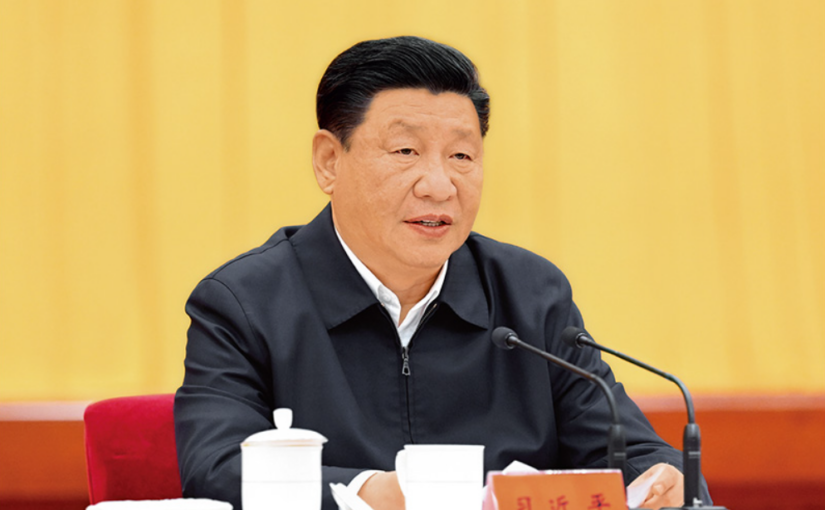
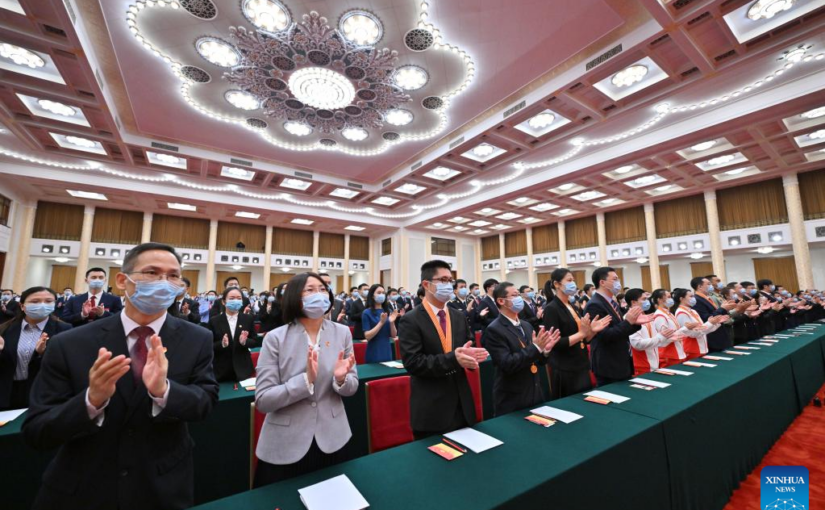
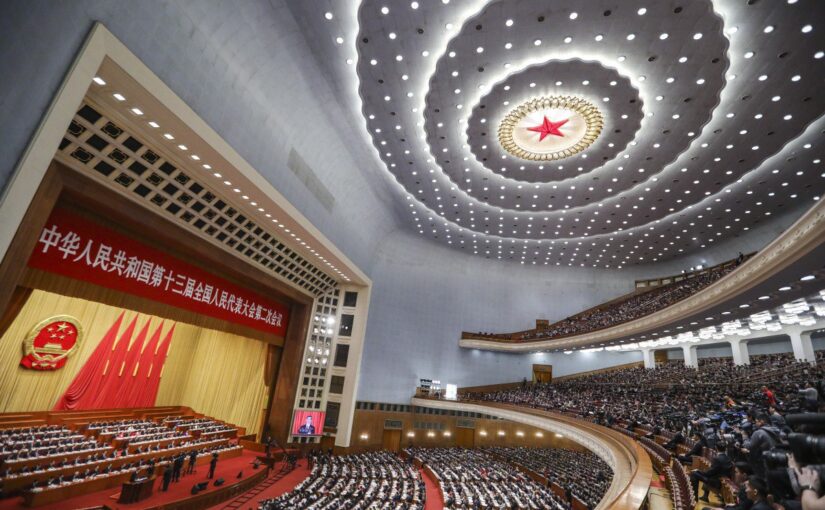
We are very pleased to publish the full text of President Xi Jinping’s speech on China’s practice of socialist democracy via the system of people’s congresses. This was originally delivered to the Central People’s Congress Work Conference on October 13th 2021. The full text has just been published in the latest Chinese and English language editions of Qiushi, the lead theoretical journal of the Communist Party of China.
President Xi dates China’s system of people’s congresses to ideas first put forward by Mao Zedong in 1945, four years before liberation, and notes that since the Party’s 18th National Congress in 2012, this system has been further developed in six aspects, namely:
Upholding the Communist Party’s leadership;
Making institutional provisions to ensure that the people actually run the country;
Advancing law-based governance;
Upholding democratic centralism;
Keeping to the path of socialist political development with Chinese characteristics;
Continuing to modernise China’s governance system and capacity.
To further improve the work of people’s congresses as China advances towards the status of a modern socialist country, Xi Jinping put forward a further six key tasks:
To ensure the full implementation of the constitution and safeguard its authority;
Improve the socialist legal system and use the law to ensure good governance;
People’s congresses should make good use of their oversight powers;
People’s congress deputies should respond to the demands of the people;
People’s congresses should intensify their self-improvement;
The party’s overall leadership should be strengthened.
In his speech, President Xi draws a powerful line of demarcation between bourgeois democracy and socialist democracy, stating:
“Democracy is not an ornament to be put on display, but an instrument for addressing the issues that concern the people. Whether a country is democratic or not depends on whether its people are truly the masters of the country. It depends on whether the people have the right to vote, and more importantly, the right to participate; what promises they are given during elections, and more importantly, how many of these promises are delivered after elections; what kind of political procedures and rules are set through state systems and laws, and more importantly, whether these systems and laws are truly enforced; and whether the rules and procedures for the exercise of power are democratic, and more importantly, whether the exercise of power is genuinely subject to public oversight and checks. If the people are only engaged with to solicit votes and then are left in the dark, if they must listen to grandiose election slogans but have no voice when the elections are over, or if they are only treated well by candidates during elections and are ignored after, this is not true democracy…
“The Communist Party of China has always upheld people’s democracy and has always adhered to the following basic ideas. First, people’s democracy is the life of socialism; without democracy, there would be no socialism, socialist modernisation, or national rejuvenation. Second, the running of the country by the people is the essence and heart of socialist democracy. The very purpose of developing socialist democracy is to give full expression to the will of the people, protect their rights and interests, spark their creativity, and provide a system of institutions to ensure that it is they who are running the country. Third, the Chinese socialist path of political development is the right path, as it conforms to China’s national conditions and guarantees the position of the people as the masters of the country. It is the logical outcome of history, theory, and practice based on the strenuous efforts of the Chinese people in modern times. It is a requisite for maintaining the very nature of our Party and fulfilling its fundamental purpose. Fourth, China’s socialist democracy takes two important forms: one in which the people exercise rights by means of elections and voting, and another in which people from all walks of life are consulted extensively in order to reach the widest possible consensus on matters of common concern before major decisions are made. Together these make up the institutional features and strengths of China’s socialist democracy. Fifth, the key to developing China’s socialist democracy is to fully leverage its features and strengths. As we continue to advance socialist democracy with well-defined institutions, standards, and procedures, we can provide better institutional safeguards for our Party and country’s prosperity and long-term stability.”
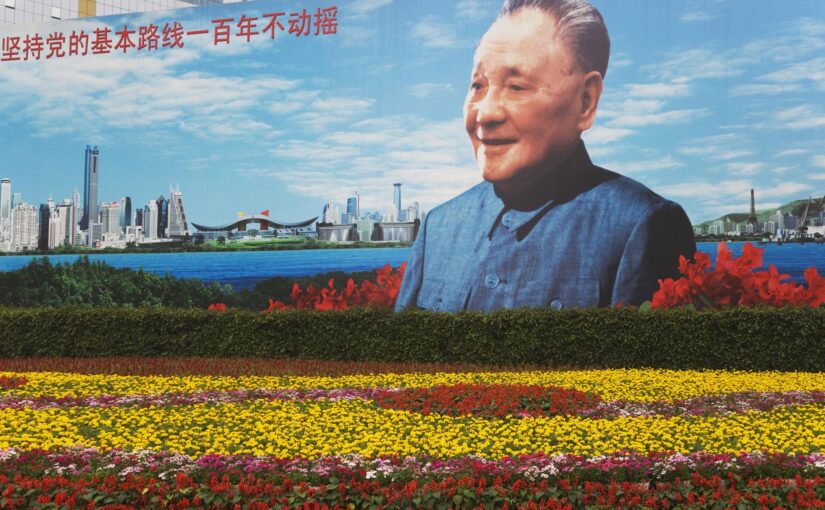
And the Chinese leader reminded his audience: “Deng Xiaoping once said, ‘The democracy in capitalist societies is bourgeois democracy – in fact, it is the democracy of monopoly capitalists.'”
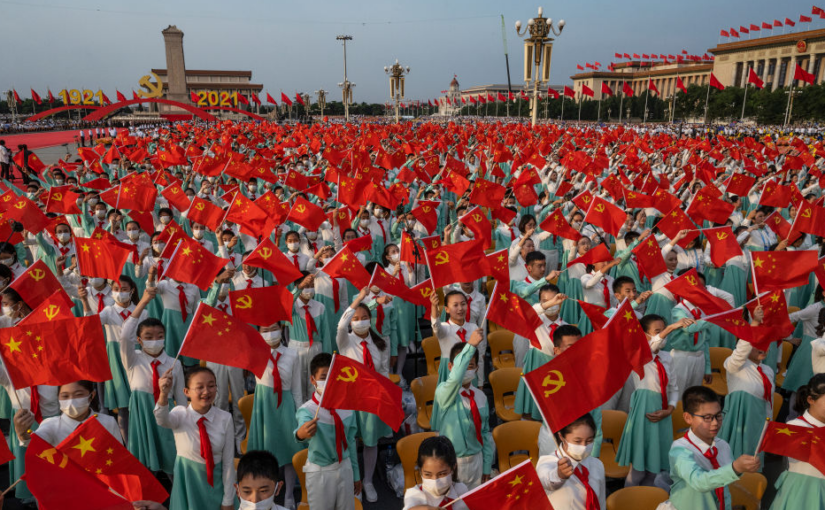
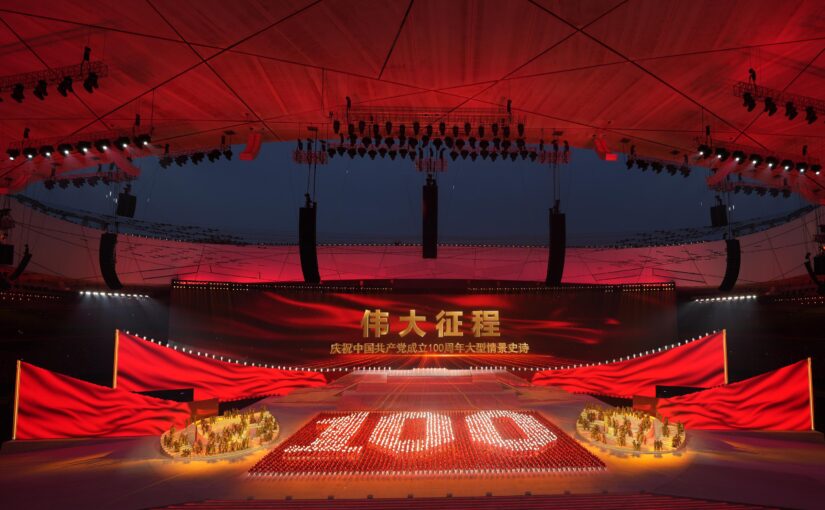
This year marks the centenary of the Communist Party of China (CPC). Upon its founding a hundred years ago, our Party made the pursuit of happiness for the Chinese people and rejuvenation for the Chinese nation its founding aspiration and mission, and it has since explored every means to ensure that it is the people who run the country. During the New Democratic Revolution, our Party established people’s governments in base areas and provided practical experience for building a new political system.
Through practice and theoretical reflection, Chinese Communists, with Mao Zedong as their chief representative, put forward the original idea to implement a system of people’s congresses. As early as April 1945, Mao Zedong said, “The organizational principle of the new democratic state should be democratic centralism, with the people’s congresses at all levels determining the major policies and electing the governments. It is both democratic and centralized, that is, centralized on the basis of democracy and democratic under centralized guidance. This is the only system that can give full expression to democracy with full powers vested in the people’s congresses at various levels and, at the same time, ensure centralized administration with the governments at each level exercising centralized management of all the affairs entrusted to them by the people’s congresses at the corresponding level and safeguarding whatever is essential to the democratic activities of the people.”
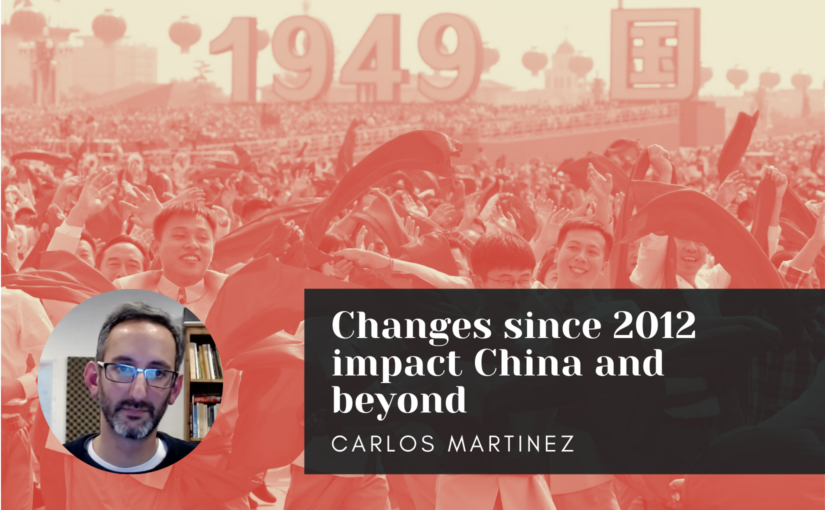
In the following short video, produced by China Daily, Friends of Socialist China co-editor Carlos Martinez discusses the extraordinary changes that have taken place in China over the last decade since the 18th National Congress of the Communist Party of China. Carlos particularly emphasises the progress in poverty alleviation, environmental protection, foreign policy, and the pursuit of common prosperity.
We are very pleased to publish the full text of the speech given on May 10th 2022 by President Xi Jinping marking the 100th anniversary of the founding of the Communist Youth League of China.
In his comprehensive exposition, President Xi outlines how the youth have always stood in the forefront of the struggles and striving of the Chinese people and nation. The May Fourth Movement of the youth and students in 1919, “promoted the spread of Marxism in China, ushered in the new-democratic revolution, and marked the beginning of the youth’s role as the pioneers advancing social changes in China… As Marxism-Leninism was becoming closely integrated with the Chinese workers’ movement, the Communist Party of China was born. Since the day of its founding, the Party has paid particular attention to the youth and placed the hopes of revolution on them.”
He further outlined the indispensable role of the Communist Youth League and young people generally in the periods of the new-democratic revolution, socialist revolution and construction, reform, opening up and socialist modernisation, and the new era of socialism with Chinese characteristics.
“Inspired by ideals and convictions,” Xi pointed out, “the Communist Youth League has organised and united young people with firm belief and scientific thinking. The first national congress of the League defined building a communist society as its ultimate ideal and made clear its banner of socialism, which has lit the beacon of ideals and convictions among generations of young people. This is the most fundamental and enduring cohesion of the League. History tells us that only by holding high the banner of communism and socialism, can the Communist Youth League form the most solid unity, forge the most effective organisation, and ensure that the youth are united under the banner of the Party’s ideals and convictions.”
Expressing the hope that the League would continue to play its vanguard role, President Xi noted that: “Young people are the most vigorous, enterprising, and least conservative group in society, who possess infinite power to improve the objective world and promote social progress,” adding:
“Revolutionaries are always young. Today, a hundred years on from its founding, the Communist Party of China is still in its prime, and remains as determined as ever to achieve lasting greatness for the Chinese nation. Quoting from Engels, Lenin once said, ‘We are the party of the future, and the future belongs to the youth. We are a party of innovators, and it is always the youth that most eagerly follows the innovators. We are a party that is waging a self-sacrificing struggle against the old rottenness, and youth is always the first to undertake a self-sacrificing struggle.’ Both history and reality have shown that the Communist Party of China is a party that always preserves its youthful features and a party that is worthy of the young people’s trust and worth following.”
Party organisations, the Chinese President said, “must attach great importance to the training and recruitment of outstanding young people and should particularly focus on cultivating and admitting outstanding League members into the Party, so as to ensure our socialist country never changes its nature.”
Members of the Communist Youth League of China (League), young friends, and comrades,
Youth gives rise to infinite hope, and young people are the creators of a bright future. A nation can thrive and prosper only when it places hopes on its youth and maintains its youthful vigor.
Today, we are gathered here at the ceremony marking the centenary of the Communist Youth League of China to encourage League members and young people to forge ahead on the new journey toward realizing the Chinese Dream of national rejuvenation.
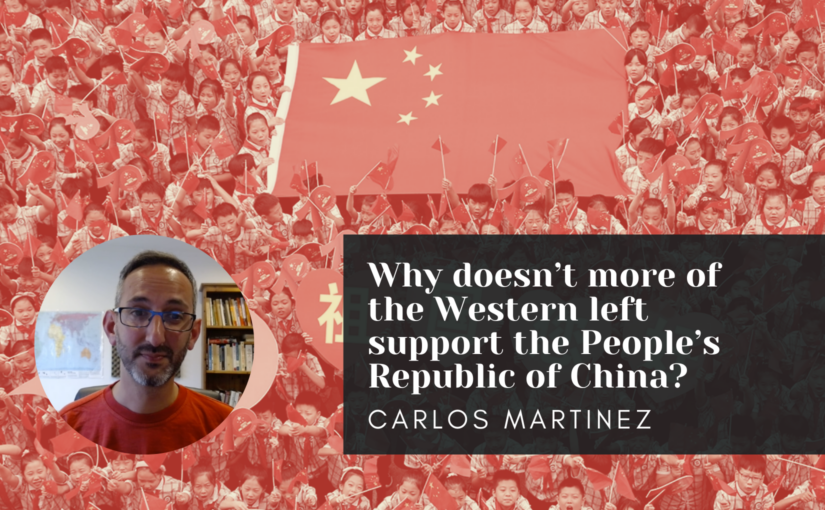
At a webinar of the International Manifesto Group on the theme of Anti-imperialism and the Western Left, Friends of Socialist China co-editor Carlos Martinez gave this talk about the Western left’s failure to meaningfully engage with Chinese socialism.
The focus of my presentation is: why doesn’t more of the Western left support the People’s Republic of China? Why doesn’t more of the Western left engage in a serious way with Chinese socialism?
There are lots of things about modern China that seem worthy of support, from a socialist point of view.
Poverty alleviation. Reducing poverty is a decidedly leftist objective. If there was no poverty under capitalism – if there were no homeless, no people without sufficient food to eat, without access to education and healthcare, without work or the possibility of earning an income – most people on the left would probably find something better to do with their time than struggling for a new society.
So the fact that China has achieved so much in the realm of poverty alleviation should obviously be something that we study and celebrate.
Not everyone trusts the Chinese government’s statistics, not everyone is convinced by the claim that China in 2020 eliminated extreme poverty. Fine. But it is absolutely beyond question that, in the period from 1949, when the People’s Republic of China was proclaimed, the Chinese people have experienced an unprecedented and extraordinary improvement in their living standards and their level of human development.
We are pleased to republish from Workers Today this very important article by the late Domenico Losurdo (1941-2018), a distinguished Italian Marxist scholar and communist militant. Losurdo outlines three distinct waves of social experiment in the young Soviet state in the 15 years following the October Revolution and makes a comparative analysis with the development of the People’s Republic of China, with particular reference to the post-Mao period. Both theoretical and empirical in his approach, Lusurdo draws on the work of Marx, Lenin, Mao Zedong, Deng Xiaoping and, interestingly, Antonio Gramsci to formulate and outline his thesis whilst further illustrating it with reference to the work of scholars and journalists, both Marxist and non-Marxist. His conclusion should serve as a watchword:
“It is very clear which weapons will be used to fight in the country that has emerged from the greatest anti-colonial revolution in history to engage in a long-term process of building a post-capitalist and socialist society. Which side will the Western left take?”
Abstract
If we analyse the first 15 years of Soviet Russia, we see three social experiments.
The first experiment, based on the equal distribution of poverty, suggests the “universal asceticism” and “rough egalitarianism” criticised by the Communist Manifesto.
We can now understand the decision to move to Lenin’s New Economic Policy, which was often interpreted as a return to capitalism.
The increasing threat of war pushed Stalin into sweeping economic collectivisation.
The third experiment produced a very advanced welfare state but ended in failure: in the last years of the Soviet Union, it was characterised by mass absenteeism and disengagement in the workplace; this stalled productivity, and it became hard to find any application of the principle that Marx said should preside over socialism — remuneration according to the quantity and quality of work delivered.
The history of China is different: Mao believed that, unlike “political capital,” the economic capital of the bourgeoisie should not be subject to total expropriation, at least until it can serve the development of the national economy.
After the tragedy of the Great Leap Forward and the Cultural Revolution, it took Deng Xiaoping to emphasise that socialism implies the development of the productive forces.
Chinese market socialism has achieved extraordinary success.
Soviet Russia and Various Experiments in Post-Capitalism
Nowadays it is common to talk about the restoration of capitalism in China as resulting from the reforms of Deng Xiaoping.
But what is the basis for this judgment?
Is there a more or less coherent vision of socialism that can be contrasted with the reality of the current socio-economic relations in China today?
Let’s take a quick look at the history of attempts to build a post-capitalist society.
If we analyse the first 15 years of Soviet Russia, we see war communism, then the New Economic Policy (NEP), and finally the complete collectivisation of the economy (including agriculture) in quick succession.
These were three totally different experiments, but all of them were an attempt to build a post-capitalist society.
Why should we be shocked that, in the course of the more than 80 years that followed these experiments, other variations like market socialism and Chinese socialism appeared?
Let’s concentrate for now on Soviet Russia: which of the three experiments mentioned is closest to the socialism espoused by Marx and Engels?
War communism was greeted by a devout French Catholic, Pierre Pascal, then in Moscow, as a “unique and intoxicating performance […] The rich are gone: only the poor and the very poor […] high and low salaries draw closer. The right to property is reduced to personal effects.” [1]
This author read the widespread poverty and privation not as wretchedness caused by the war, to be overcome as quickly as possible; in his eyes, as long as they are distributed more or less equally, poverty and want are a condition of purity and moral excellence; on the contrary, affluence and wealth are sins.
It is a vision that we can call populist, one that was criticised with great precision by the Communist Manifesto: there is “nothing easier than to give Christian asceticism a Socialist coat of paint”; the “first movements of the proletariat” often feature claims in the name of “universal asceticism and a rough egalitarianism.” [2]
Lenin’s orientation was the opposite of Pascal’s, as he was far from the view that socialism would be the collectivisation of poverty, a more or less egalitarian distribution of privation.
In October 1920 (“The Tasks of the Youth Associations”) Lenin declared, “We want to transform Russia from a poor and needy country to a rich country.”
First, the country needed to be modernised and wired with electricity; therefore, it required “organised work” and “conscious and disciplined work,” overcoming anarchy in the workplace, with a methodical assimilation of the “latest technical achievements,” if necessary, by importing them from the most advanced capitalist countries. [3]
A few years later, the NEP took over from war communism.
It was essential to overcome the desperate mass poverty and starvation that followed the catastrophe of World War I and the civil war, and to restart the economy and develop the productive forces.
This was necessary not only to improve the living conditions of the people and to broaden the social basis of consensus on revolutionary power; it was also about avoiding an increase in Russia’s lag in development compared to the more advanced capitalist countries, which could affect the national security of the country emerging from the October Revolution, not to mention it being surrounded and besieged by the capitalist powers.
To achieve these objectives, the Soviet government also made use of private initiative and a (limited) part of the capitalist economy; it used “bourgeois” specialists who were rewarded generously, and it sought to take advanced technology and capital, which were guaranteed attractive returns, from the West.
The NEP had positive results: production started up again, and a certain development of the productive forces began to take place.
Overall, the situation in Soviet Russia improved noticeably: on the international level it did not worsen; rather, Russia’s delay in development started to decrease compared to the successful capitalist countries.
Domestically, the living conditions of the masses improved significantly.
Precisely because social wealth increased, there were more than just “the poor and the very poor,” as in the war communism celebrated by Pierre Pascal; desperate hunger and starvation disappeared, but social inequalities increased.
These inequalities in Soviet Russia provoked a widespread and intense feeling of betrayal of the original ideals.
Pierre Pascal was not the only one wanting to abandon the Communist Party of the Soviet Union; there were literally tens of thousands of Bolshevik workers who tore up their party cards in disgust at the NEP, which they re-named the “New Extortion from the Proletariat.”
In the 1940s, a rank-and-file militant very effectively described the spiritual atmosphere prevailing in the immediate aftermath of the October Revolution — the atmosphere arose from the horror of war caused by imperialist competition in plundering the colonies in order to conquer markets and acquire raw materials, as well as by capitalists searching for profit and super-profit:
We young Communists had all grown up in the belief that money was done away with once and for all. […]
If money was reappearing, wouldn’t rich people reappear too?
Weren’t we on the slippery slope that led back to capitalism? [4]
Therefore, one can understand the scandal and a persistent feeling of repugnance for the market and the commodity economy at the introduction of the NEP; it was above all the growing danger of war that caused the abandonment of the NEP and the removal of every trace of the private economy.
The wholesale collectivisation of the country’s agriculture provoked a civil war that was fought ruthlessly by both sides.
And yet, after this horrible tragedy, the Soviet economy seemed to proceed marvellously: the rapid development of modern industry was interwoven with the construction of a welfare state that guaranteed the economic and social rights of citizens in a way that was unprecedented.
This, however, was a model that fell into crisis after a couple of decades.
With the transition from great historical crisis to a more “normal” period (“peaceful coexistence”), the masses’ enthusiasm and commitment to production and work weakened and then disappeared.
In the last years of its existence, the Soviet Union was characterised by massive absenteeism and disengagement in the workplace: not only did production development stagnate, but there was no longer any application of the principle that Marx said drove socialism — remuneration according to the quantity and quality of work delivered.
You could say that during the final stage of Soviet society, the dialectic of capitalist society that Marx described in The Poverty of Philosophy had been overturned:
While inside the modern factory the division of labour is meticulously regulated by the authority of the entrepreneur, modern society has no other rule or authority to distribute the work, except for free competition. […]
One can also determine, as a general principle, that the less the authority presides over the division of labour inside the society, the more the division of labour develops inside of the factory, and it is placed under the authority of just one person.
Thus the authorities in the factory and in society, in relation to the division of labour, are inversely related to each other. [5]
In the last years of the Soviet Union, the tight control exercised by the political powers over civil society coincided with a substantial amount of anarchy in workplaces.
It was the reversal of the dialectic of capitalist society, but the overthrow of the capitalist society’s dialectic was not socialism and, therefore, it produced a weak economic order unable to resist the ideological and political offensives of the capitalist-imperialist world.
The Peculiarity of the Chinese Experience
China’s history is different.
Although the Communist Party of China seized power at the national level in 1949, 20 years earlier it had already started to exercise its power in one region or another, regions whose size and population were comparable to those of a small or medium-sized European country.
For much of these 85 years in power, China, partly or totally ruled by the communists, was characterised by the coexistence of different forms of economy and property.
This was how Edgar Snow described the situation in the late 1930s in the “liberated” areas:
To guarantee success at these tasks it was necessary for the Reds, even from the earliest days, to begin some kind of economic construction. […]
Soviet economy in the Northwest was a curious mixture of private capitalism, state capitalism, and primitive socialism.
Private enterprise and industry were permitted and encouraged, and private transactions dealing in the land and its products were allowed with restrictions.
At the same time the state owned and exploited enterprises such as oil wells, salt wells, and coal mines, and it traded in cattle, hides, salt, wool, cotton, paper, and other raw materials.
But it did not establish a monopoly in these articles and in all of them private enterprises could, and to some extent did, compete.
A third kind of economy was created by the establishment of cooperatives, in which the government and the masses participated as partners, competing not only with private capitalism but also with state capitalism! [6]
This picture is confirmed by a modern historian: in Yan’an, the city where Mao Zedong directed the struggle against Japanese imperialism and promoted the construction of a new China, the Communist Party of China did not pretend “to control the whole of the base area’s economy.”
It rather supervised a “significant private economy,” which also included “large private landholdings.” [7]
In an essay in January 1940 (“On the New Democracy”), Mao Zedong clarified the meaning of the revolution taking place at that time:
Although such a revolution in a colonial and semi-colonial country is still fundamentally bourgeois-democratic in its social character during its first stage or first step, and although its objective mission is to clear the path for the development of capitalism, it is no longer a revolution of the old type led by the bourgeoisie with the aim of establishing a capitalist society and a state under bourgeois dictatorship.
It belongs to the new type of revolution led by the proletariat with the aim, in the first stage, of establishing a new-democratic society and a state under the joint dictatorship of all the revolutionary classes.
Thus this revolution actually serves the purpose of clearing a still wider path for the development of socialism. [8]
This was a model characterised, at the economic level, by the coexistence of different forms of ownership; at the level of political power, by a dictatorship exercised by the “revolutionary classes” as well as the leadership of the Communist Party of China.
It is a pattern confirmed 17 years later, although in the meantime the People’s Republic of China was founded, in a speech on January 18, 1957 (“Talks at a Conference of Secretaries of Provincial, Municipal and Autonomous Regions Party Committees”):
As for the charge that our urban policy has deviated to the Right, this seems to be the case, as we have undertaken to provide for the capitalists and pay them a fixed rate of interest for a period of seven years.
What is to be done after the seven years? That is to be decided according to the circumstances prevailing then.
It is better to leave the matter open, that is, to go on giving them a certain amount in fixed interest.
At this small cost we are buying over this class. […]
By buying over this class, we have deprived them of their political capital and kept their mouths shut. […]
Thus political capital will not be in their hands but in ours.
We must deprive them of every bit of their political capital and continue to do so until not one jot is left to them.
Therefore, neither can our urban policy be said to have deviated to the Right. [9]
It is, therefore, a matter of distinguishing between the economic expropriation and the political expropriation of the bourgeoisie.
Only the latter should be carried out to the end, while the former, if not contained within clear limits, risks undermining the development of the productive forces.
Unlike “political capital,” the bourgeoisie’s economic capital should not be subject to total expropriation, at least as long as it serves the development of the national economy and thus, indirectly, the cause of socialism.
After taking off in the second half of the 1920s, this model revealed a remarkable continuity and offered great economic vitality before 1949 to the “liberated” areas governed by the communists and then the People’s Republic of China as a whole.
The dramatic moment of breakthrough came with the Great Leap Forward of 1958–59 and with the Cultural Revolution unleashed in 1966.
The coexistence of different forms of ownership and the use of material incentives were radically thrown on the table.
There was an illusion of accelerating economic development through calls for mass mobilisation and mass enthusiasm, but this approach and these attempts failed miserably.
Moreover, the struggle of everyone against everyone heightened the anarchy in factories and production sites.
The anarchy was so widespread and deep-rooted that it did not disappear immediately with the reforms introduced by Deng Xiaoping.
For some time, customs continued in the public sector as described by a witness and Western scholar, “even the last attendant […], if he wants to, can decide to do nothing, stay home for a year or two and still receive his salary at the end of the month.”
The “culture of laziness” also infected the expanding private sector of the economy.
“The former employees of the State […] arrive late, then they read the newspaper, go to the canteen a half-hour early, leave the office an hour early,” and they were often absent for family reasons, for example, “because my wife is sick.”
And the executives and technicians who tried to introduce discipline and efficiency into the workplace were forced to face not only resistance and the moral outrage of the employees (who considered it infamy to impose a fine on an absent worker caring for his wife), but sometimes even threats and violence from below. [10]
Thus, there was a paradox.
After distinguishing itself for decades for its peculiar history and its commitment to stimulating production through competition not only between individuals but also between different forms of ownership, the China that arose from the Cultural Revolution resembled the Soviet Union to an extraordinary degree in its last years of existence:
the socialist principle of compensation based on the amount and quality of work delivered was substantially liquidated, and disaffection, disengagement, absenteeism and anarchy reigned in the workplace.
Before being ousted from power, the “Gang of Four” attempted to justify the economic stagnation, debating the populist reason for a socialism that is poor but beautiful, the populist “socialism” that in the early years of Soviet Russia was dear to Pierre Pascal, the fervent Catholic whom we already know.
Then populism became the target of Deng Xiaoping’s criticism.
He called on the Marxists to realise “that poverty is not socialism, that socialism means eliminating poverty.”
He wanted one thing to be absolutely clear:
“Unless you are developing the productive forces and raising people’s living standards, you cannot say you are building socialism.”
No, “there can be no communism with pauperism, or socialism with pauperism. So to get rich is no sin.” [11]
Deng Xiaoping had the historic merit of understanding that socialism had nothing to do with the more or less egalitarian distribution of poverty and privation.
In the eyes of Marx and Engels, socialism was superior to capitalism not only because it ensured a more equitable distribution of resources but also, and especially, because it ensured a faster and more equal development of social wealth, and to achieve this goal, socialism stimulated competition by affirming and putting into practice the principle of remuneration according to the quantity and quality of work delivered.
Deng Xiaoping’s reforms reintroduced in China the model that we already know, although giving it new coherence and radicalism.
The fact remains that the coexistence of different forms of ownership was counterbalanced by strict state control directed by the Communist Party of China.
If we analyse the history of China, not beginning with the founding of the People’s Republic, but as early as the first “liberated” areas being set up and governed by communists, we will find out that it was not China of the reforms of Deng Xiaoping, but China in the years of the Great Leap Forward and of the Cultural Revolution that was the exception or the anomaly.
Marxism or Populism? A Confrontation of Long Duration
Well beyond the borders of Russia and China, during the twentieth century and even now,
populism influenced and still negatively influences the reading of the great revolutions that radically changed the face of the world.
In this sense, we can say that, after having played a part as an essential feature of the twentieth century, the conflict between populism and Marxism is far from over.
Pascal condemned the abandonment of war communism, or the society in which there are “only the poor and the very poor,” and that is precisely why it was free of the tensions and rifts caused by inequality and social polarisation.
The attitude taken by fervent Christians at that time in Moscow was not in any way confined to Soviet Russia.
Traces of populism can be felt in the young Ernst Bloch.
In 1918, when he published the first edition of Spirit of Utopia, he called on the Soviets to effect a “transformation of power into love” and to put an end not only to “every private economy,” but also to any “money economy” and with it the “mercantile values that consecrate whatever is most evil in man.” [12]
Here the populist trend was intertwined with Messianism: no attention was paid to the task of rebuilding the economy and developing the productive forces in a country destroyed by war and having a history marked by recurrent and devastating famines.
The horror at the carnage of World War I stimulated the dream of a community that is satisfied with the scarce material resources available and that only in this circumstance, freed from worrying about wealth and power, can people live shielded from the “money economy” and instead live in “love.”
When he published the second edition of Spirit of Utopia in 1923, Bloch believed that it was appropriate to delete the populist and Messianic passages, as previously mentioned.
However, the state of mind and the vision that inspired them did not vanish either in the Soviet Union or outside of it.
The transition to NEP found perhaps its most passionate or sentimental critics among the militants as well as among Western communist leaders.
As for them, in the “Political Report” he presented to the XI Congress of the Communist Party held on March 27, 1922, Lenin sarcastically wrote:
Seeing that we were withdrawing, some of them scattered, childishly and shamefully, even with tears, as happened at the last large session of the Executive Committee of the International Communist Party.
Motivated by the best communist sentiments and the most ardent communist aspirations, some friends burst into tears. [13]
Antonio Gramsci had a very different attitude as early as the October Revolution, which he expressed in this way:
Collectivism of poverty and suffering will be the principle.
But those very conditions of poverty and suffering would be inherited from a bourgeois regime.
Capitalism could not immediately do more than collectivism did in Russia.
Today, it would do even less, because it would have immediately run afoul of an unhappy, frantic proletariat, now unable to bear for others to endure the pain and bitterness that the economic hardship would have brought. […]
The suffering that will come after peace will be tolerated only because the workers feel that it is their will and their determination to work to suppress it as quickly as possible. [14]
In this context, the war communism about to prevail in Soviet Russia was at the same time legitimised tactically and delegitimised strategically, legitimised immediately and delegitimised with an eye to the future.
The “collectivism of poverty and suffering” is justified by the specific conditions prevailing in Russia at the time: capitalism would not be able to do anything better.
It was understood, however, that the privation had to be overcome as quickly as possible.
Precisely for this reason, Gramsci had no difficulty in recognising himself in the NEP, the meaning of which he made sharply clear in his October 1926 stance: the reality of the Soviet Union put us in the presence of a phenomenon “never before seen in history.”
A politically “dominant” class “as a whole” finds itself “in living conditions inferior to certain elements and strata of the [politically] dominated and dependent class.”
The masses of people who continued to suffer a life of hardship were confused by the spectacle of “the NEPman dressed in fur who has at his disposal all the goods of the earth.”
And yet this should not constitute grounds for a scandal or feelings of repugnance, because the proletariat, as it cannot gain power, also cannot even keep power if it is not capable of sacrificing individual and immediate interests to the “general and permanent interests of the class.” [15]
Those who read the NEP as synonymous with a return to capitalism committed two serious errors: ignoring the issue of the fight against mass poverty and thus the development of the productive forces; they also wrongly identified the economically privileged class and the politically dominant class.
A reading of the NEP not unlike that seen in Gramsci came from another great intellectual of the twentieth century.
He was Walter Benjamin, who, after returning from a trip to Moscow in 1927, summed up his impressions:
In a capitalist society, power and money have become of equal dimension.
Any given amount of money can be converted into a well-defined portion of power and the exchange value of all power is a calculable entity. […]
The Soviet state has interrupted this osmosis of money and power.
The Party, of course, reserves power for itself; it does, however, leave the money to the NEPman. [16]
The latter, however, underwent a “terrible social isolation.”
For Benjamin, too, there was no correspondence between economic wealth and political power.
The NEP had nothing to do with the restoration of bourgeois and capitalist power.
Soviet Russia could not help but engage in the reconstruction of the economy and the development of the productive forces.
The task was made more difficult by the persistence of customs that were not suited to a modern industrial society.
In Moscow, Benjamin was a direct witness to a very instructive display:
Not even in the Russian capital is there, in spite of all the “rationalisation,” a sense of the value of time.
The “trud,” the Trade Union Institute of Work, by means of wall posters, waged […] a campaign for punctuality […] “time is money”; to give credence to such a strange rallying cry, they had to draw on Lenin’s authority in the posters.
So, this mentality is foreign to Russians.
Their playful instinct prevails over everything […]
If, for example, a movie scene is being shot in the street, they forget where they are going and why, they queue up behind the crew for hours and arrive at work befuddled. [17]
Pascal also witnessed the developments in Soviet Russia, forming an opinion of strong condemnation: now in Moscow and in the rest of the country, everything revolved around the question of whether “industrialisation must be a little faster or a little slower,” around the problem of “how to get the necessary money.”
The consequences of this new approach, which put aside “every revolutionary purpose,” were devastating: yes, “on the material level we approach Americanisation, a great development of national wealth,” but at what cost?
“The docile mass became a slave to it, to its work, to its exploitation. It produces, there is an economic recovery, but the revolution is well buried.” [18]
The great Austrian writer Joseph Roth, not involved in the communist movement, reached the same conclusions.
When visiting the land of the Soviets between September 1926 and January 1927, he expressed his disappointment at the “Americanisation” in progress.
“They despise America, meaning big soulless capitalism; the country where gold is God. But they admire America, meaning progress, the electric iron, the hygiene and the waterworks.”
In conclusion, “This is a modern Russia, technically advanced, with American ambitions. This is no longer Russia.” [19]
The “spiritual void” had opened in a country that initially aroused many hopes. [20]
The popular inspiration for these positions was obvious: as expressions of betrayal of the original revolutionary inspiration and of a drift toward a philistine and vulgar worldview, they pointed to the desire to improve living conditions and the pursuit of comfort (or of a minimum of comfort).
As Pascal did, Roth also expressed his distaste for the “Americanisation” under way.
These were the years in which the Bolsheviks engaged in the reconstruction and development of the economy to try to learn from the most advanced capitalist countries and the United States in particular.
In March and April 1918 (“The Immediate Tasks of Soviet Power”) Lenin noted that “compared to workers in the most advanced nations, the Russian is a bad worker”; therefore, he must “learn to work,” assimilating critically the “rich scientific achievements” of the “Taylor system” developed and implemented in the North American Republic. [21]
On the same wavelength, Bukharin proclaimed in 1923, “We need to add Americanism to Marxism.” [22]
The following year, Stalin made a significant appeal to the Bolshevik cadres: if they really wanted to be at the height of “principles of Leninism,” they should try to weave “Russian revolutionary impulses” with “the practical American approach.” [23]
“Americanism” and “the practical American approach” were here synonyms for the development of productive forces and the escape from poverty or scarcity: socialism is not the equal sharing of poverty or deprivation, but the definitive and widespread overcoming of these conditions.
From outside of Russia, Gramsci countered populism with particular rigour and consistency.
As we know, from the beginning he stressed the need for a rapid end to this “collectivism of poverty and suffering.”
It was a political position with a wider theoretical vision as its foundation.
L’Ordine Nuovo (The New Order) — the weekly he founded in the wake of the October Revolution in Russia — plus the movement to occupy factories in Italy, asked the revolutionary workers to fight for wages and thus for a more equitable distribution of social wealth, but also and above all to be “producers” taking “control of production” and the “development of work plans.”
In doing so, in order also to promote the development of the productive forces, the revolutionary workers must know how to make use of the “most advanced industrial technology” that “(in a sense) is independent from the method of appropriating the assets produced,” that is, it got its autonomy from capitalism or socialism. [24]
Not coincidentally, between October and November 1919, L’Ordine Nuovo devoted several articles to Taylorism, analysed beginning with the latest analysis of the distinction between “rich scientific achievements” (mentioned by Lenin) and their capitalist use. [25]
In this sense, the Prison Notebooks later observed that already L’Ordine Nuovo had claimed its “Americanism.” [26]
It was the Americanism that Lenin, Bukharin and Stalin directly or indirectly referenced.
And it should be clear that this is an Americanism that does not in any way rule out a judgment and clear condemnation of US capitalism and imperialism.
In Gramsci’s eyes, this was a country that, despite its professions of democratic faith, imposed slavery on blacks for a long time and that, even after the Civil War, was characterised by a terrorist regime of white supremacy, as shown by “lynching of blacks by crowds incited by atrocious merchants dispossessed of human flesh.” [27]
That terrorism was also manifested in terms of foreign policy:
The North American Republic threatened to deprive the Russians of the grain necessary for their survival
and, therefore, to starve to death the people who felt the pull of the October Revolution and were tempted to follow its example.
The “Americanism” understood as attention reserved for the problem of development of the productive forces pushed Gramsci, in the early 1930s, to greet enthusiastically the launching of the first Soviet five-year plan: the economic and industrial development of the country that emerged from the October Revolution was proof that, far from stimulating “fatalism and passivity,” in fact, “the concept of historical materialism […] gives rise to a flowering of initiatives and enterprises that astonishes many observers.” [28]
Materialism and Marxism showed the ability to influence reality concretely, not only inspiring revolutions like the one that occurred in Russia but also promoting the growth of social wealth and freeing the masses from centuries of poverty and deprivation.
More disappointed than ever, even outraged by the developments in Soviet Russia, however, was Simone Weil, who in 1932 proceeded to a final showdown with the country which she had initially looked to with sympathy and hope: Soviet Russia had ended up taking America, American efficiency, productivity and “Taylorism” as its models.
There could no longer be any doubts.
The fact that Stalin, on this issue, which is at the centre of the conflict between capital and labour, has abandoned the views of Marx and has been seduced by the capitalist system in its most perfect form, shows that the USSR is still quite far from having a working-class culture. [29]
In fact, the position taken here had nothing to do with Marx and Engels: according to the Communist Manifesto, capitalism is destined to be overcome because, after developing the productive forces with unprecedented scope and speed, it became an obstacle to their further development, as confirmed by the recurrent crises of overproduction.
This deeply Christian French philosopher, also inclined to populism, recognised the country that emerged from the October Revolution only up to the stage of more or less equal distribution of poverty or deprivation; later, in addition to Soviet Russia, Weil also broke with Marx and Engels.
Global Inequality and Inequality in China
Populism continues to make its presence felt more than ever in the dismissive judgment that the Western left passes on today’s China.
It is true that the reforms introduced by Deng Xiaoping spurred an economic boom unprecedented in history, with hundreds and thousands of millions of people liberated from poverty, but this is basically irrelevant for the populists.
Did the elimination of desperate and mass poverty happen at the same time as the worsening inequality?
The answer to that question is less obvious than it may appear at first glance.
Throughout history, the communist parties have won power only in countries that are relatively undeveloped economically and technologically; for this reason, they had to fight against not one but two types of inequality: 1) inequality existing on the global scale between the most and least developed countries; and 2) the inequality existing within each individual country.
Only if we take into account both sides of the struggle can we adequately take stock of policy reform.
With regard to the first type of inequality, there are no doubts: internationally, global inequality is levelling out sharply.
Yes, China is gradually catching up to the most advanced Western capitalist countries.
It is a turning point!
In the last years of the twentieth century, a prominent American political scientist noted that if the process of industrialisation and modernisation that started with Deng Xiaoping is to be successful, “China’s emergence as a major power will dwarf any comparable phenomena during the last half of the second millennium.” [30]
About 15 years later, again with reference to the prodigious development of this great Asian country, a no less illustrious British historian noted, “What we are living through now is the end of 500 years of Western predominance.” [31]
The two authors cited here share the same, emphatic, view of timing.
About five centuries ago, the discovery/conquest of America took place.
In other words, the extraordinarily rapid rise of China is ending or promises to end the “Colombian epoch,” a period characterised by extreme inequality in international relations: the distinct lead held by the West in economics, technology and military might has allowed it to subdue and plunder the rest of the world for centuries.
The fight against global inequality is part of the struggle against colonialism and neo-colonialism.
Mao understood this well and, in a speech given on September 16, 1949 (“The Bankruptcy of the Idealist Conception of History”) warned that Washington wants China reduced to relying “on US flour, in other words, to become a US colony.” [32]
In fact, the newly founded People’s Republic of China became the target of a deadly embargo imposed by the United States.
Its objectives are clear from studies done by the Truman administration and the confessions and statements of its leaders.
It started from the premise that the type of measure that could defeat and oust the communist government “is economic rather than military or political.”
And so, they needed to ensure that China suffered or continued to suffer the scourge of a “general standard of living around and below the subsistence level”; Washington felt committed to causing “economic backwardness” and “cultural lag” and leading a country of “desperate needs” to “a catastrophic economic situation,” “toward disaster” and “collapse.” [33]
At the White House, one president succeeds another, but the embargo remains, and it is so ruthless as to include medicines, tractors and fertilisers. [34]
In short: in the early 1960s, a collaborator of the Kennedy administration, Walt W. Rostow, pointed out that, because of this policy, the economic development of China was delayed for at least “tens of years.” [35]
There is no doubt: Deng Xiaoping’s reforms greatly stimulated the fight against global inequality and thus placed the economic (and political) independence of China on a solid footing.
High technology is no longer a monopoly of the West, either.
Now we see the prospect of overcoming the international division of labour, which for centuries has subjected people outside the West to a servile or semi-servile condition or relegated them in the bottom of the labour market.
It is thus outlining a worldwide revolution that the Western left does not seem to be noticing.
Rationally, they consider a strike obtaining better wages or better working conditions in a factory as an integral part of the process of emancipation, or they discuss it in the context of the patriarchal division of labour.
It is very strange, then, that the struggle to end the oppressive international division of labour that was established through armed force during the “Colombian epoch” is considered something alien to the process of emancipation.
In any case, those who condemn China today as a whole due to its inequalities would do well to consider that Deng Xiaoping also promoted his reform policies as a part of the fight against planetary inequality.
In a conversation on October 10, 1978, he noted that the technology “gap” was expanding compared to more advanced countries; these were developing “with tremendous speed,” while China could not keep up in any way. [36]
And, 10 years later, “High technology is advancing at a tremendous pace”; so that there was a risk that “the gap between China and other countries will grow wider.” [37]
Quantitative and Qualitative Inequality
Drawing attention to the importance of global inequality does not mean losing sight of the second type of inequality.
So, what is happening with China’s existing inequality?
Have the reforms introduced by Deng Xiaoping escalated it to an intolerable point?
Before answering these questions, we should make a preliminary observation: both the Soviet NEP and the new Chinese course were preceded by poverty and shortages acute and widespread enough to cause large-scale starvation; this situation had to be ended and a repetition had to be prevented, and this marked the turning point within Soviet Russia and China.
But how is inequality fought in such a desperate economic situation?
In the quantitative sense, the distribution of the scarce available resources can be inspired by emphasising egalitarianism, so as to try to feed individuals, families and villages uniformly; however, the overall inadequacy of the available resources does not change, nor does the differing degree of need (the weakest individuals succumb more easily than the others); in such conditions, starvation can be contained but not eliminated.
Well, the piece of bread that allows the most fortunate to survive, as modest and reduced in terms of quantity as it may be, nevertheless sanctions an absolute inequality in terms of quality, the absolute inequality that exists between life and death.
In other words, when scarcity reaches an extreme level, the struggle against inequality can only be tackled effectively by focusing on the development of the productive forces.
That is, even with regard to the second type of inequality, the inequality within a single country, Deng Xiaoping’s reforms eliminated once and for all the absolute qualitative inequality inherent in starvation and the risk of starvation.
Of course, once this scourge has been ended once and for all, it is time to address the problem of the struggle against quantitative inequality, as well as to achieve what Deng Xiaoping called “common prosperity.” [38]
There is no doubt: the achievement of this goal is still far away.
According to the Gini coefficient, which measures income distribution within a single country, social polarisation has reached alarming levels in China.
We should of course pay close attention to the Gini coefficient, but without overemphasising its significance.
Despite its utility, it has fundamental limitations: not only does it not distinguish between the two types of inequality (the global and the local), but it also tells us nothing about the underlying trends in local inequality in a given country.
The changes that have occurred in recent decades in China might be illustrated with a metaphor.
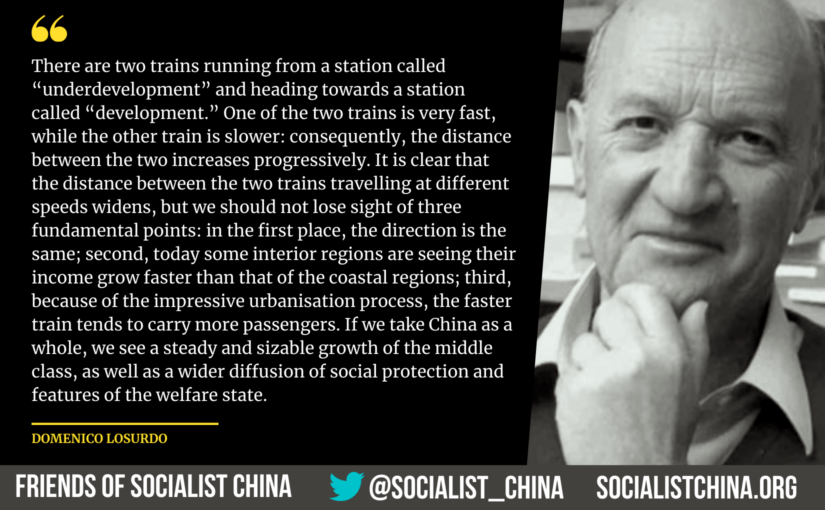
There are two trains running from a station called “underdevelopment” and heading towards a station called “development.”
One of the two trains is very fast, while the other train is slower: consequently, the distance between the two increases progressively.
This discrepancy can be explained easily if you keep in mind the size of continental China and its tormented history: the coastal regions, which already had infrastructure (albeit elementary), enjoying easier access and the possibility of trade with developed areas, are in a better situation than the traditionally less developed regions that are landlocked and have as neighbours countries and areas marked by economic stagnation.
It is clear that the distance between the two trains travelling at different speeds widens, but we should not lose sight of three fundamental points: in the first place, the direction (the development) is the same; second, today some interior regions are seeing their income grow faster than that of the coastal regions; third, because of the impressive urbanisation process (which pushes the population to the most developed regions and areas), the faster train tends to carry more passengers.
Not surprisingly, if we take China as a whole, we see a steady and sizable growth of the middle class, as well as a wider diffusion of social protection and features of the welfare state.
However, the implicit warning in the values reported by the Gini coefficient still applies: if not contained in a proper and timely manner, quantitative inequality can also result in social and political destabilisation.
Wealth and Political Power: An Adversarial Relationship
Social and political destabilisation can also come from another front.
How long will the new rich continue to accept a situation in which they can quietly enjoy their economic wealth (accumulated legitimately) but cannot turn it into political power?
Mao was aware of this problem.
In 1958, he responded to criticism from the Soviet Union regarding the persistence of capitalist areas in the Chinese economy by saying, “There are still capitalists in China, but the state is under the leadership of the Communist Party.” [39]
Almost 30 years later, to be exact, in August 1985, Deng Xiaoping made a remark we should ponder: “Perhaps Lenin had a good idea when he adopted the New Economic Policy.” [40]
Here is an indirect comparison between the Soviet NEP and the reform policies adopted by Deng Xiaoping in China.
It is obvious what the two have in common: total political expropriation of the bourgeoisie does not equal total economic expropriation.
Of course there are also differences.
The NEP involved a very small part of the private economy and was primarily intended as a temporary “retreat.”
In other words, what was driving the Soviet NEP was the need to find some way out of an economically hopeless situation.
There was no comprehensive reflection on which economic model to pursue: not surprisingly, according to Benjamin’s testimony, which we have already seen, the rich NEP man, who was also expected to contribute to developing the productive forces, was facing a “terrible social isolation.”
The policy adopted by Deng Xiaoping, on the other hand, leaves behind a clear historic toll: experience has shown that the totally collectivist economy erases all material incentives and motives for competition, paving the way (as previously seen) for mass disaffection and absenteeism;
moreover, the populism that saw wealth and gain as such a sin hindered the development of entrepreneurship and technological innovation.
While initiating his policies of reform and openness, Deng was aware of their inherent risks.
In October 1978, he cautioned, “We shall not allow a new bourgeoisie to take shape.”
This goal is not contradicted by tolerance granted to individual capitalists.
Of course, they must be given much consideration.
However, one point is constant: “the struggle against these individuals is different from the struggle of one class against another, which occurred in the past (these individuals cannot form a cohesive and overt class).” [41]
Although there are residues of the old class struggle, on the whole, with the strengthening of the revolution and the communist party’s power, a new situation was created.
“Is it possible that a new bourgeoisie will emerge? A handful of bourgeois elements may appear, but they will not form a class,” especially as there is a “state apparatus” that is “powerful” and able to control them. [40]
Besides the power of the state, ideology plays an important role: many of the new rich, although not communists, feel patriotic and share the horror at the “century of humiliation” that began with the Opium Wars and ended with the victory of the revolution, so these new rich also share the dream of “rejuvenation of the Chinese nation.”
And yet, precisely as a result of the success of policy reforms and the extraordinary economic growth of China, the number of millionaires and billionaires is growing dramatically; will the wealth accumulated by the new capitalists have an influence on politics?
It is in light of this concern that you may fully comprehend the ongoing campaign against corruption.
The clean-up process does not aim only to consolidate social consensus on the Communist Party of China and the government; it means to implement Deng Xiaoping’s recommendation and thus prevent the “bourgeois elements” from forming a class that is ready to take power.
The Sights of the West: “Democratisation” or “Plutocratisation” of China?
The capitalists who were established and continue to get established can be a real danger only if they ally themselves with imperialist circles or pro-imperialists committed to achieving a “colour revolution” even in China.
Strengthened by their excessive media power, for a very long time the United States has been trying to consolidate their world hegemony in order to impose a “democracy” on China in the time and manner Washington dictates.
In this behaviour, the United States shows ignorance of the lessons offered by their own national history and liberalism, that is, from the school of thought that they claim to represent.
In 1787, just before the implementation of the Federal Constitution, Alexander Hamilton explained that limits on power and the establishment of the rule of law had been successful in two “insular” countries, Great Britain and the United States, thanks to the protection given by the ocean and their geopolitical position shielding them from threats from rival powers.
If the plans for a federal union had failed and a system of states similar to the one in Europe had formed on its ruins, soon America would have seen a standing army, a strong central power and absolutism regardless.
“Thus we should in a little time see established in every part of this country, the same engines of despotism, which have been the scourge of the old world.” [42]
Hamilton ascribed so much weight to geopolitical security in creating a system based on the rule of law that he wrote how if, instead of being an island surrounded and protected by the sea, Britain had been placed on the continent, it “would in all probability, be at this day a victim to the absolute power of a single man,” just like the other European continental powers. [43]
On the other hand, according to Hamilton, whenever “the preservation of the public peace” is threatened either by “external attacks” or by “internal convulsions,” even a country like the United States, which also enjoys an extremely fortunate geopolitical position, is authorised to resort to a strong power “without limitations” and without “constitutional shackles.” [44]
In fact, even protected by the Atlantic and the Pacific, every time it has felt, whether rightly or wrongly, in danger, the North American Republic has more or less drastically strengthened executive power and more or less heavily restricted freedom of association and expression.
This was the case in the years immediately following the French Revolution (when its followers in America were affected by the harsh measures provided by the Alien and Sedition Acts) and during the Civil War, World War I, the Great Depression, World War II, the Cold War and the situation created by the attack on the Twin Towers.
To give an example: What happened to traditional liberal freedoms after the passage, on May 16, 1918, of the Espionage Act?
Based on this act, a person could be sentenced to up to 20 years in prison for having expressed:
[…] any disloyal, profane, scurrilous, or abusive language about the form of government of the United States, or the Constitution of the United States, or the military or naval forces of the United States, or the flag […] or the uniform of the Army or Navy of the United States. [45]
If the leaders in Washington were really serious about the banner of democracy that never tires of waving, they would seek in some way to reinforce geopolitical peace and a sense of security in the countries they claim to want to see become democratic.
At the end of the Cold War (as was calmly acknowledged by a scholar who was an adviser to Vice President Dick Cheney), the lone superpower used its naval and airforces to violate “China’s airspace and territorial waters with little fear of harassment and interdiction” unscrupulously and with impunity.
The great Asian country was powerless at that time.
Today, the situation has changed significantly.
The United States is, however, still able to control the channels of maritime communications.
Therefore, “China is already vulnerable to the effects of a naval blockade, and it will become even more so as its economy grows”; in fact, “its fate could depend on American forbearance.” [46]
And it is this situation that the United States strives to perpetuate.
All this is not conducive to the development of the rule of law.
The campaign of the West for the “democratisation” of China is taking place just as many political analysts are forced to see the decline of democracy in the West.
A few years before the economic crisis, one could read in the International Herald Tribune that the United States had become a “plutocracy”; now the forces of private and corporate wealth have already taken hold of political institutions, while the rest of the population is cut off. [47]
Nowadays, on the left as well as among those completely opposed to the Marxist tradition, it is common to read that in the West, and primarily in the United States, plutocracy has taken the place of democracy.
We can conclude that the on-going campaign for the “democratisation” of China is actually a campaign for its plutocratisation, to turn in the opposite direction the “political expropriation” of the bourgeoisie that has taken place since 1949 in the big Asian country.
A second campaign, as usual, conducted by Washington and Brussels, requires substantial liquidation of the state-owned sector and the public economy which play such an important role in the fight against two great inequalities: on the international scene, this sector is making a major contribution to China’s technological development, which is increasingly closing the gap with the advanced countries; internally, the state-owned sector and the public economy reduce inequalities between different regions, accelerating the development of China’s less developed regions, which are now growing at a much faster pace than the coastal regions.
If this second campaign launched by the West had been successful, the “economic” expropriation of the bourgeoisie, already reduced, would have been cancelled altogether, so that the bourgeoisie could enormously increase its influence in society and again pave the way for conquest of political power.
It is very clear which weapons will be used to fight in the country that has emerged from the greatest anti-colonial revolution in history to engage in a long-term process of building a post-capitalist and socialist society.
Which side will the Western left take?
References
Bloch, E. (1918) 1971. Geist der Utopie [Spirit of Utopia]. Frankfurt am Main: Suhrkamp.
Commager, H. S., ed. 1963. Documents of American History. 7th ed. New York: Appleton-Century-Crofts.
Deng, X. 1992–95. Selected Works. Beijing: Foreign Languages Press.
Ferguson, N. 2011. Civilization: The West and the Rest. London: Penguin Books.
Figes, O. 1996. A People’s Tragedy: The Russian Revolution 1891–1924. London: Pimlico Random House.
Friedberg, A. L. 2011. A Contest for Supremacy: China, America, and the Struggle for Mastery in Asia. New York, NY: Norton.
Gramsci, A. (1926) 1971. “Lettera dell’Ufficio Politico del PCI al Comitato Centrale del Partito Comunista Sovietico” [Letter of the Politburo of the Italian Communist Party to the Central Committee of the Soviet Communist Party]. In La Costruzione del Partito Comunista [Building the Communist Party], 124–31. Turin: Einaudi.
Gramsci, A. 1975. Quaderni del Carcere [Prison Notebooks]. Edited by V. Gerratana, critical edition. Turin: Einaudi.
Gramsci, A. 1982. La Città Futura 1917–1918 [The Future Society 1917–1918]. Edited by S. Caprioglio. Turin: Einaudi.
Gramsci, A. 1987. L’Ordine Nuovo 1919–1920 [The New Order 1919–1920]. Edited by V. Gerratana and A. Santucci. Turin: Einaudi.
Hamilton, A. 2001. Writings. Edited by J. B. Freeman. New York: The Library of America.
Huntington, S. 1996. The Clash of Civilizations and the Remaking of World Order. New York: Simon & Schuster.
Lenin, V. I. 1955–70. Opere Complete [Collected Works]. Rome: Editori Riuniti.
Losurdo, D. 1997. Antonio Gramsci dal Liberalismo al “Comunismo Critico” [Antonio Gramsci from Liberalism to “Critical Communism”]. Rome: Gamberetti.
Losurdo, D. 2007. Il Linguaggio dell’Impero. Lessico dell’Ideologia Americana [The Language of the Empire: Lexicon of the American Ideology]. Rome: Laterza.
Losurdo, D. 2013. La Lotta di Classe. Una Storia Politica e Filosofica [Class Struggle: A Political and Philosophical History]. Rome: Laterza.
Mao, Z. 1965–77. Selected Works of Mao Tse-Tung. Beijing: Foreign Languages Press.
Mao, Z. 1998. On Diplomacy. Beijing: Foreign Languages Press.
Marx, K., and F. Engels. 1955–89. Werke [Works]. Berlin: Dietz.
Mitter, R. 2014. China’s War with Japan, 1937–1945: The Struggle for Survival. London: Penguin Books.
Pascal, P. 1982. Russie 1927 [Russia 1927]. Vol. 4 of Mon Journal de Russie [My Diary in Russia]. Lausanne-Paris: L’Age d’Homme.
Pfaff, W. 2000. “Money Politics Is Winning the American Election.” International Herald Tribune March 11–12.
Sisci, F. 1994. La Differenza tra la Cina e il Mondo: La Rivoluzione Degli Anni Ottanta [The Difference between China and the World: The Revolution in the Eighties]. Milan: Feltrinelli.
Snow, E. (1937) 1972. Red Star over China. London: Penguin Books.
Weil, S. 1989–91. Écrits historiques et politiques [Historical and Political Writings]. Vol. II of Oeuvres Complètes [Collected Works], edited by A. A. Devaux and F. de Lussy. Paris: Gallimard.
Zhang, S. 2002. Economic Cold War: America’s Embargo against China and the Sino-Soviet Alliance, 1949–1963. Redwood City: Stanford University Press.
Marx and Engels 1955–89, vol. 4, 484, 489; translated from Italian. (See also: Karl Marx & Friedrich Engels, 1848. Manifesto of the Communist Party.[web] — R. D.) ↩
Lenin 1955–70, vol. 31, 283–84; translated from Italian. (See also: V. I. Lenin, 1920. The Tasks of the Youth Leagues.[web] — R. D.) ↩
Mao 1965–77, vol. 2, 344. (See also: Mao Zedong, 1940. On New Democracy.[web] — R. D.) ↩
Mao 1965–77, vol. 5, 357. (See also: Mao Zedong, 1957. Talks at a Conference of Secretaries of Provincial, Municipal, and Autonomous Region Party Committees.[web] — R. D.) ↩
Deng 1992–95, vol. 3, 122, 174. (See also: Deng Xiaoping, 1986. Replies To the American TV Correspondent Mike Wallace. Deng goes on: “However, what we mean by getting rich is different from what you mean. Wealth in a socialist society belongs to the people. To get rich in a socialist society means prosperity for the entire people. The principles of socialism are: first, development of production and second, common prosperity.” [web] — R. D.) ↩
Lenin 1955–70], vol. 33, 254–55; translated from Italian. (See also: V. I. Lenin, 1922. Political Report Of The Central Committee Of The R.C.P. (B.) March 27.[web] — R. D.) ↩
Gramsci 1982, 516; translated from Italian. (See also: Antonio Gramsci, 1917. The Revoution against “Das Kapital.”[web] — R. D.) ↩
Gramsci (1926) 1971, 129–30. (See also: Antonio Gramsci, 1926. “Letter to the Central Committee of the Soviet Communist Party,” Gramsci Pre-Prison Writings. — R. D.) ↩
Quoted in Losurdo 2013, 227–28; translated from Italian. ↩
Quoted in Losurdo 2013, 184; translated from Italian. ↩
Quoted in Losurdo 2007, chapter III, § 2. (See also: J. V. Stalin, 1924. The Foundations of Leninism.[web] — R. D.) ↩
Gramsci 1987, 622, 607–8, 624; translated from Italian. ↩
Carlo Petri, 1919. “Il sistema Taylor e i Consigli dei produttori, I-IV” [The Taylor Sytem and the Councils of Manufacturers, I-IV], L’Ordine Nuovo. Anno I, N°23-26. [web] — R. D. ↩
Gramsci 1975, 72; translated from Italian. (See also: Antonio Gramsci, 1929-30. Prison Notebooks. Notebook 1, §61, “Americanism.” — R. D.) ↩
Losurdo 1997, chapter II, 11–12; translated from Italian. (See also: Antonio Gramsci, 1913-17. Cronache Torinesi [Chronicles of Turin]. 520-1. — R. D.) ↩
Gramsci 1975, 893, 2763–64; translated from Italian. (See also: Antonio Gramsci, 1930-31. Prison Notebooks. Notebook 7, §44, “Reformation and Renaissance.” — R. D.) ↩
Deng 1992–95, vol. 2, 143. (See also: Deng Xiaoping, 1978. Carry Out the Policy of Opening to the Outside World and Learn Advanced Science and Technology From Other Countries.[web] — R. D.) ↩
Deng 1992-95, vol. 3, 273. (See also: Deng Xiaoping, 1988. China Must Take Its Place In the Field of High Technology.[web] — R. D.) ↩
Deng 1992–95, vol. 3, 174. (See also: Deng Xiaoping, 1992. Marxism is a Science.[web] — R. D.) ↩
Mao 1998, 251. (See also: Mao Zedong, 1958. Minutes of Conversation with (Soviet) Ambassador Yudin.[web] — R. D.) ↩
Deng 1992–95, vol. 3, 143. (See also: Deng Xiaoping, 1985. Reform is the only way for China to develop its productive forces.[web] — R. D.) ↩↩
Deng 1992–95, vol.2, 144, 178. (See also: Deng Xiaoping, 1979. Uphold the Four Cardinal Principles.[web] — R. D.) ↩
By John Ross, Praxis Press, 2021 Reviewed by Dr Jenny Clegg
Updated 09 April 2022: John Ross contacted us to note that the review incorrectly quoted him as describing Deng Xiaoping as “the greatest Marxist of all time”. This should have been “the world’s greatest economist.”
John Ross has, for some years now, been one of the most forceful advocates of the present Chinese road to socialism on the Western left. His ‘China’s Great Road’ (for which we held an online launch) presents his key arguments. In this detailed review, Dr Jenny Clegg, writer, China specialist, peace campaigner and Friends of Socialist China advisory group member, acknowledges Ross’s useful contribution to the debate, but also draws attention to what she considers its flaws, regarding both the complexities of China’s recent trajectory and the historical record of socialism under Stalin and Mao.
Introduction
Literature on China’s supposed ‘reversion to capitalism’, whether of the neoliberal or state-led kind, abounds. It has been argued over again that China’s success over the last four decades came as a result of its abandoning ideology for pragmatism so as to follow policies of ‘reform and opening up’. Either that or the wholesale embrace of markets unleashing the creativity of its individual capitalist entrepreneurs. John Ross, a Senior Fellow at the Chongyang Institute for Financial Studies at Beijing’s Renmin University, swims hard against this tide in his book, China’s Great Road, arguing the exact opposite:that China’s remarkable achievements are the result, not of a reversal of Marxism, but in fact a return to basic Marxist tenets.
The book comprises a collection of recent articles, some originally published in Chinese, others in English, which makes for some repetition, but leaves no doubt as to the arguments. Ross’s aim is to persuade others on the international left to look seriously at China’s socialism and see what can be learnt from its success.
The book presents two key propositions.
The first, that China has achieved far more than any other country in history in improving the well-being of its people, is set out with the help of easy-to-read graphs. The evidence, as Ross shows, is all there in World Bank figures: China has lifted over 900 million people out of poverty, raising livelihoods and life expectancy at unprecedented rates, whilst exceeding every other economy in output, wage growth and household consumption over the last 30 years.
The following China Daily op-ed, written by Friends of Socialist China co-editor Carlos Martinez, reflects on the last decade of dramatic change in China, particularly in relation to poverty alleviation, environmental protection, foreign policy, and the pursuit of common prosperity.
In the past decade, the People’s Republic of China has grown enormously in economic strength and global stature.
At the 18th National Congress of the Communist Party of China in 2012, Xi Jinping, general secretary of the CPC Central Committee, put forward the “two centenary goals”. The goals mean building a moderately well-off society in all respects by 2020, just before the centenary year of the CPC in 2021, and a great modern socialist country that is prosperous, strong, democratic, culturally advanced, harmonious and beautiful by the middle of this century, while the People’s Republic’s 100th anniversary is 2049.
The Party and the leadership mobilized tens of millions of people to achieve the first goal, the key component of which was the eradication of extreme poverty, which was achieved in 2020.
At the start of the targeted poverty alleviation program in 2013, a little less than 100 million people were identified as living below the poverty line. Seven years later, the figure was zero. As Xi said, “thanks to the sustained efforts of the Chinese people from generation to generation, those who once lived in poverty no longer have to worry about food or clothing or access to education, housing and medical insurance”.
Friends of Socialist China were honored to be invited to speak at a March 22 webinar organised by our friends in the Pakistan China Institute under the banner of Friends of Silk Road. The webinar, entitled Whole-Process People’s Democracy: Understanding the Chinese System, used this concept of President Xi Jinping’s to explore various aspects of China’s unique form of socialist democracy. It was chaired by Senator Mushahid Hussain Sayed, who chairs both the Defense Committee in the Pakistan Senate as well as the Pakistan China Institute, and who is also a member of the Friends of Socialist China advisory group.
Opening the event, Senator Hussain noted that it coincided with Chinese Foreign Minister Wang Yi’s speech as a special guest at the ministerial meeting of the 57-member Organisation for Islamic Cooperation (OIC), also being held in Islamabad. A highlight of Minister Wang’s South Asian tour, this historic first, Senator Hussain noted, represented the close camaraderie and support to Muslim countries and Muslim causes, such as Kashmir and Palestine, on the part of China.
Joining our co-editor Keith Bennett as speakers were HE Ambassador Masood Khalid, Pakistan’s former Ambassador to China; Group Captain Sultan M. Hali, author of four books on China; Zoon Ahmed Khan, a research fellow at the Center for China and Globalisation in Beijing; and Raza Naeem, President of the Progressive Writers Association in Lahore.
The webinar was reported in Pakistan’s leading English-language daily newspapers, Dawn and The News.
The full webinar is embedded below, followed by Keith Bennett’s speech.
Ambassador Ma discusses the nature, development and trajectory of Socialism with Chinese Characteristics; the history of China-Cuba relations; Cuba’s remarkable progress in pursuing its own form of socialism; and the importance of ending the criminal US blockade against Cuba.
Dear friends:
I am delighted to join you at this very important webinar. The topics are wide-ranging. I will first share two points on what socialism with Chinese characteristics is and what it is not, then two points on Chinese-Cuban relations, and then my observations about Cuba.
First, socialism with Chinese characteristics is the result of the Chinese people’s painstaking trials and great sacrifices. It just doesn’t come easy to us.
Since the 1840s, through successive aggression such as the two Opium Wars, the Sino-French War, the First Sino-Japanese War, and the Eight-Allied Powers invasion, the Western powers bullied China into signing a series of unequal treaties, gradually reducing China from a world power to a semi-colonial and semi-feudal state. As a result, the Chinese people embarked on the arduous quest for survival and rejuvenation. China tried constitutional monarchy, parliamentary system, multi-party system, presidential system, you name it, but all failed.
In this video made for CGTN by Michael Dunford, Visiting Professor at the Chinese Academy of Sciences (and Friends of Socialist China advisory group member), we get a glimpse of common prosperity in action, as Michael travels to a village at Tuohu Lake, in the northeast of Anhui Province. With the aim of revitalizing the village and promoting high-quality sustainable development, the village cooperative has worked with the local authorities to improve the water system and to adopt traditional, environmentally-friendly agricultural practices. Combined with technologies such as an internet-of-things monitoring system and e-commerce, the villagers have been able to significantly improve their standard of living whilst simultaneously contributing to biodiversity and environmental protection.
This interview with Friends of Socialist China co-editor Danny Haiphong was published in Global Times on 7 March 2022. Global Times reporter Yu Jincui asks Danny’s opinion regarding the 2022 ‘Two Sessions’, the evolution of China’s whole-process people’s democracy, the comparison between Chinese and Western democracy, and the motivation for setting up Friends of Socialist China.
GT: What’s your expectation for the Two Sessions this year and how do you view its significance concerning China’s future development?
Haiphong: China is holding the two sessions in a moment of unprecedented global crisis. The resurgence of COVID-19 due to the Omicron variant has dampened the economic forecast in China and the ongoing Russia-Ukraine conflict has certainly raised questions about the future of international stability and China’s role in helping secure it.
Despite the gravity of these developments, China will use the two sessions to begin discussions on a number of policies that embody the spirit and mission of the 14th Five-Year plan. At the top of the agenda is the dual management of COVID-19 and economic growth targets. Issues and policies relating to China’s goal of achieving “common prosperity” on the road to fully building a modern socialist country by 2050 will undoubtedly be the subject of deliberations at the two sessions.
My expectation is that the two sessions will reaffirm China’s capacity to lead by example through whole-process democracy. China is the only world power at the moment in a position to chart a development plan that meets the interests of the people for a better life. Through direct consultation and participation of grassroots deputies representing all levels of society, China possesses a mechanism in the two sessions which can chart a clear path toward meeting concrete development goals.
GT: How do you understand whole-process people’s democracy? Compared with Western-style democracy, what do you think is the biggest difference?
Haiphong: Whole-process people’s democracy is a governance system congruent with socialism with Chinese characteristics. Whole-process people’s democracy establishes a system of consultation and grassroots mobilization which takes into account China’s specific conditions of development. Direct elections are held at the village level and corresponding deputies at higher levels are subsequently elected by lower levels of the governance system based upon a record of service to the people. Whole-process democracy is bidirectional, meaning that regular consultation occurs between higher levels of the governance system such as the NPC and provincial and local authorities to ensure policies properly balance national priorities and local considerations.Whole-process people’s democracy is different from Western-style democracy in several areas. The biggest difference is that whole-process people’s democracy is structured to meet the goals and plans set forth by the system of socialism with Chinese characteristics while Western-style democracy is structured to serve the interests of monopoly capitalism. Unlike Western-style democracy, whole-process people’s democracy does not view procedure as an achievement in and of itself. A major measure of success is how well deputies and governance structures serve the desire of the people for a better life. Western-style democracy, on the other hand, views the election of representatives itself as the highest achievement. The question of whether this system serves the needs of the broad masses of people is generally ignored in order to obscure the fact that powerful corporate interests set the policy agenda well before votes are cast.
GT: Over 5,000 deputies of the National People’s Congress (NPC) and members of the Chinese People’s Political Consultative Conference are gathering in Beijing. They come from all walks of life across the country. How do you see the difference between Chinese lawmakers and American lawmakers? A view holds that US lawmakers are more adept at playing electoral politics rather than solving real problems facing the country. How do you view this?
Haiphong: US lawmakers are generally selected by wealthy elites first and elected by the people second. The majority of representatives in the US Congress are millionaires who accumulated their wealth through satisfying the interests of monopoly corporations and private financial institutions.
House Speaker Nancy Pelosi, for example, has achieved a net worth of about $100 million during her more than 30-year career in Congress. US lawmakers and their staff often move from government positions to the corporate boardrooms of their donors and lobbyists. Several former aides to Democratic Party Senator Joe Manchin currently work for energy lobbies that played a key role in stymying increased investment in infrastructure and renewable energy development.
The immense influence of private wealth over the political careers and policies of US lawmakers incentivizes procedure over solving real problems that impact the lives of the impoverished and oppressed. Unlike China, where the government is structured to enact people-centered development plans, the US governance system is designed to reproduce policies that reinforce the status quo. This explains why despite rhetorical differences on certain issues, Democrats and Republicans from Joe Biden and Donald Trump to members of Congress often carry out a similar policy framework of increased war spending, subsidies for the wealthiest corporations, and austerity measures that negatively impact the livelihoods of ordinary people.
Another stark difference between lawmakers in the US and China is their social character. Poor workers in the US generally do not have the means or wealth to compete in elections that require massive financial expenditures to run successful campaigns. Furthermore, the interests of ethnic and racial minorities are only given attention when social conditions, such as the Black Lives Matter protests, demand it. It’s clear, however, that Joe Biden’s key role in writing legislation that led to an enormous rise in the African-American prison population and his support of militarizing police departments that exacerbate racial tensions indicate that the interests of racial minorities are treated as an afterthought.
In China, ethnic minorities are not only provided representation at the highest levels of governance but their economic, cultural, and political interests also find expression in policy discussion and implementation. Furthermore, wealth is not a determinant of political participation. Lawmakers come from all walks of life and are judged by their service to the village, municipality, province, and the nation at large.
GT: China insists that countries with different political systems can coexist, and it emphasizes win-win results in the development process. However, the US and some Western countries want to divide the world into democracy vs autocracy. What risks and consequences will this bring to the world?
Haiphong: Viewing the world from the prism of “democracy” and “autocracy” is indicative of a new Cold War mentality. The US describes China, Russia, and a select number of countries as “autocratic” to justify its policy of unipolar aggression. The label “autocracy” comes with an equally aggressive propaganda campaign that influences public opinion to support war. Furthermore, Americans and citizens of the West are taught to blame their problems on a foreign “adversary.” Major threats to humanity such as war, climate change, and poverty become increasingly difficult to address when so-called “democracies” in the West pursue narrow self-interests and divide the world instead of win-win cooperation. This is the true character of Western-style “democracy:” endless militarism and domestic policies that favor a small, wealthy minority of the population.
GT: Friends of Socialist China is aimed at spreading an understanding of Chinese socialism. Why do you choose to engage in such a work? Being an editor of Friends of Socialist China, What are the difficulties in promoting the understanding of Chinese socialism in the Western world?
Haiphong: Friends of Socialist China was conceived by myself and colleagues of mine amid great dissatisfaction with the low level of solidarity with China that exists even among the most progressive-minded journalists and activists in the West.
It is important to us that the New Cold War being led by the US is challenged not just on the basis of its irrationality and negative consequences for humanity, but also from the standpoint of an endless stream of misinformation about China.
Much of the propaganda spread by Western media is based on a Cold War understanding of China that negates the important achievements of socialism with Chinese characteristics in the modern era. This is a great disservice to people in the West. People in the West are denied the right to learn from China’s successes in poverty alleviation, renewable energy, high-technology, COVID-19 containment, infrastructure development and more. We hope to change that in the interest of peace. People in the West need to know the real China if they are to develop the empathy and solidarity required in the development of world peace.
The biggest impediment to this work is the highly concentrated private media in the West and how it acts as a lever of misinformation for US-led cold war policies. Public opinion on China has declined significantly, and anti-China propaganda has led to a spike in racist incidents toward Chinese and people of Asian descent in the US and the West. All of this creates inevitable hostilities to our work, but we have also seen an increasing number of people take interest in China and want to do their part to reverse these troubling trends.
GT: Under the crisis of capitalism and democracy in the US, what changes have occurred in the attitudes of young Americans toward socialism? Is socialism becoming more attractive?
Haiphong: Rampant inequality and dim prospects for the future have indeed increased interest in socialism in the US, especially for young Americans under the age of 35.
This is a massive shift in the post-Cold War status quo in the US which argued that the world had entered the “end of history”, meaning capitalism would forever remain hegemonic. The collapse of the Soviet Union paved the way for an unprecedented expansion of US aggression and wars on Yugoslavia, Afghanistan, Iraq, and several others. Finance capital also found ample room to expand to the point where it became “too big to fail” after causing the biggest global economic crisis since the Great Depression in 2007-08.
Amid increased spending for war and decreased spending on social needs, young Americans have become frustrated with low wages, diminished job prospects, high costs of living, blatant racial injustices, and the hypocrisy of political officials spending enormous resources on massive defense budgets, fossil fuel subsidies, and stimulus packages for the wealthiest financial institutions responsible for their problems. Young Americans desire a kind of “common prosperity” that takes their interests into account. They believe that socialism is worth exploring as a possible way forward. However, the debate over what socialism would look like in the US remains unresolved. We at Friends of Socialist China understand that while China’s model of socialism cannot be exported to the US, its commitment to improving the lives of the people certainly deserves more attention.
We are pleased to republish this informative article by Bradley Blankenship, originally carried by RT, refuting the recent call by billionaire currency speculator George Soros for ‘regime change’, that is counter-revolution, in China. Blankenship’s article is particularly valuable in that it demolishes the attempt to juxtapose Xi Jinping’s leadership and programme to that of Deng Xiaoping, the architect of China’s hugely successful reforms. In Blankenship’s words, “to state the obvious, Deng Xiaoping was a committed communist. There’s no doubt about it.”
Billionaire George Soros, the founder of the Open Society Foundations, gave a speech this week to the conservative Hoover Institution in which he compared China under President Xi Jinping to Nazi Germany and called for regime change in Beijing.
Soros said in his speech, “Xi Jinping has done his best to dismantle Deng Xiaoping’s achievements. He brought private companies under Deng under the control of the [CPC] and undermined the dynamism that used to characterize them.” He also said that Xi, unlike other Chinese leaders like Deng Xiaoping, is “a true believer in communism,” and added: “It is to be hoped that Xi Jinping may be replaced by someone less repressive at home and more peaceful abroad.”
Apart from the facts that this is a pretty bold attempt to interfere in China’s internal affairs and that it ignores the reality that Beijing’s government has a trust rating of 91% from its citizens, Soros’ assessment of what’s going on in the country is extraordinarily ignorant and, for the most part, just not true.
China is no longer the China of the feudal lords, nor the constant victim of the aggressions of colonial and imperial powers. This is the new China that emerges from the victorious national liberation struggle and the socialist revolution, exploits unsurpassed in human history. Everything was carried out under the immortal ideas of Marxism-Leninism and their wise application to China’s conditions. The path China has had to travel following liberation has been long, difficult, and risky in a world where imperialism exercised and still exercises power and hegemonic influence. Colossal successes have been attained. The era of disasters and famines has been left behind. Only socialism could have been capable of the miracle of feeding; clothing; providing with jobs, education, and healthcare; raising life expectancy to 70; and providing decorous shelter for more than 1 billion human beings in a minute portion of the planet’s arable land. Thanks to such a feat at this difficult time for the world’s peoples, over one-fifth of humanity remains under the banner of socialism.
Fidel on China: "Only socialism could have been capable of the miracle of feeding; clothing; providing with jobs, education, and healthcare; raising life expectancy to 70; and providing shelter for more than 1 billion human beings in a minute portion of the planet's arable land." pic.twitter.com/YuzKtjVaNH
— Friends of Socialist China (@socialist_china) January 21, 2022
In this article, originally carried by CGTN, Keith Lamb makes the cogent point that it is not only Western specialists that need to make more effort to understand China and its rise on its own terms. Western socialists and Marxists do, too.
On January 11, Chinese President Xi Jinping, addressing the opening study session at the Party School of the Communist Party of China (CPC) Central Committee, called for a greater effort to deepen the review, study, education, and promotion of the CPC’s history so as to better understand and make good use of the historical experience of the Party over the past century. With China’s rapid rise, this advice is also applicable to Western socialists and China observers.
China’s rise will usher in multi-polarity yet, bizarrely, few Western experts, including Western socialists, understand China from its own historical standpoint. This is highlighted by the many prophetic calls that have thus far proved wrong.
For example, that China would become more like a Western liberal democracy never came to pass. The “China collapse” theory fails regularly, only to get put on “life support” to extend it indefinitely into the future. Then, the “China is a neoliberal state working towards capitalist restoration,” posited by some Western Marxists, looks like a historical inaccuracy today.
We are pleased to republish this succinct summary by Christopher Helali, international secretary of the Party of Communists USA, of President Xi Jinping’s inspiring New Year address. The article was first published on CGTN.
As 2021 comes to an end, Xi Jinping, China’s president and general secretary of the Central Committee of the Communist Party of China (CPC), delivered a hopeful and significant 2022 New Year Address to the Chinese nation and the world.
In his optimistic address, Xi outlined the historic achievements made by the Chinese nation and its people in 2021. Even with the difficulties posed by the ongoing COVID-19 pandemic and the increasing international tensions, the Chinese people under the leadership of the CPC have shown the path forward for the nation.
The historic achievements of 2021 center on the monumental accomplishments achieved by the Chinese people and nation in the 100-year journey of the CPC. In 2021, the CPC celebrated its centenary anniversary, becoming one of the oldest and the largest political parties in terms of membership in the world. Under the leadership of the CPC, the Chinese people were able to throw off the yoke of colonialism and destroy the vestiges of a feudal society which impoverished the people.
An increasingly strong, prosperous, modern, socialist China is your greatest legacy.
We must hold high the great banner of Chairman Mao. Chairman Mao’s banner is the banner of the united revolution of the whole Party, the whole army and the whole nation, and the banner of the international communist movement.
Deng Xiaoping
Celebrating the 128th anniversary of the birth of Mao Zedong. An increasingly strong, prosperous, modern, socialist China is his greatest legacy. pic.twitter.com/gdgMztDYi9
The 12th World Socialism Forum was held on December 21st 2021, hosted by the Chinese Academy of Social Sciences (CASS) and organised by the World Socialism Research Centre, the Academy of Marxism and the Research Centre of Xi Jinping Thought on Socialism with Chinese Characteristics for a New Era of CASS. It was held in the Chinese Academy of History of CASS, with both offline and online participation.
The theme of the event was the Preservation and Innovation of Marxism in the 21st Century, with a key focus on:
The Major Achievements and Inspiring Experience of the Communist Party of China over the Past Century
The Contribution of the Path of Socialist Political Development with Chinese Characteristics to Political Civilisations of Humanity
Lessons and Insights from the Downfall of the Soviet Communist Party and the Dissolution of the Soviet Union
Upholding and Developing Marxism in the 21st Century
The Forum heard a total of 23 presentations, including 13 from leading Chinese Marxist thinkers and theoreticians as well as from the Cuban Ambassador to China; Egon Krenz, former leader of the German Democratic Republic (GDR); two speakers from Russia, including the Vice Chair of the Communist Party of the Russian Federation (CPRF); Keith Bennett, Co-Editor of Friends of Socialist China; and speakers from Argentina, Italy, Cameroon, Venezuela and Vietnam.
We print below Keith Bennett’s speech to the Forum.
Dear Comrades and Friends
On behalf of Friends of Socialist China, a platform established earlier this year to support the People’s Republic of China and spread understanding of Chinese socialism on the basis of Marxism, I’d like to extend our thanks to the World Socialism Forum for inviting us to attend this important meeting and to submit a paper. We also extend warm greetings to everyone participating and hope that we can find concrete ways of working together in the future.
What follows is a presentation on the Western left’s solidarity with the Chinese Revolution and the People’s Republic of China over the years, and the motivation for setting up Friends of Socialist China. It was delivered at the the Fifteenth Forum of the World Association for Political Economy (hosted by the Shanghai International Studies University, China, and held online on 18-19 December 2021), and was jointly written by Friends of Socialist China’s co-editors.
The accompanying slides can be found at SlideShare.
Dear Comrades
On behalf of Friends of Socialist China, I would like to express our thanks to the World Association of Political Economy for inviting us to participate in this important conference and to extend our greetings to all our fellow participants.
Friends of Socialist China was formed in May 2021 by a small group of activists in Britain and the USA with a long record in the progressive movement and specifically of solidarity with the People’s Republic of China and the Chinese revolution.
Our analysis of our tasks and our understanding of our work flow from the basic tenets of Marxism, starting from the observation by Marx and Engels in the Communist Manifesto that, unlike other parties in the working-class movement, communists bring to the fore the interests of the working class as a whole, independent of all nationality. This premise was further elaborated and developed by Mao Zedong, who noted that the people of countries yet to win their liberation have a duty to support the socialist countries, whilst the socialist countries have the responsibility to support the countries and peoples who are still struggling for their liberation.
The following article, written by Danny Haiphong and Carlos Martinez, has been accepted for publication in the journal International Critical Thought, where it will appear in early 2022. We have permission to publish the draft on this website, since the subject matter is particularly pertinent to current debates on the question of democracy.
The word democracy is connected to a large and diverse body of meaning. In the broadest sense, it simply refers to the exercise of power – directly or indirectly – by the people. However, in the leading capitalist countries, its meaning is much more specific: it has become synonymous with the system of ‘liberal democracy’, characterized by a multi-party parliament, universal suffrage, the separation of powers, and a strong emphasis on the protection of private property.
This narrow definition is widely considered in the West as a universal and absolute truth. Indeed, in the dominant Western narrative, adherence to the principles of liberal democracy constitutes the fundamental dividing line in global politics. On one side there is a group of ‘democracies’ (including the US, Canada, Australia, New Zealand, most of Europe, Japan, India and South Korea) and on the other side a group of ‘non-democracies’ or ‘authoritarian regimes’ (including the People’s Republic of China, the Democratic People’s Republic of Korea, Vietnam, Laos, Cuba, Iran, Russia, Venezuela, and most of the countries of Asia, Africa and Latin America).
With respect the December 9-10 “Summit for Democracy,” hosted by U.S. President Joe Biden, the Korean intellectual Kiyul Chung had the quote of the day. Kiyul characterized the event as an “imperial circus,” and he declared that “if Malcolm X were still alive, he would probably say that all of the house Negroes have been invited, but all of the field Negroes have not been invited.”
In response to the imperial circus, the Friends of Socialist China and the International Manifesto Group organized The Summit for Socialist Democracy. The participants in the December 11 panel were: