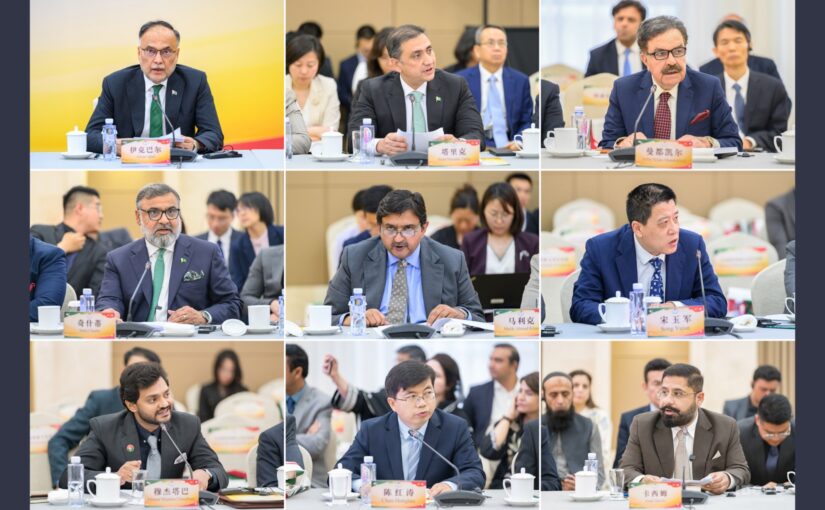
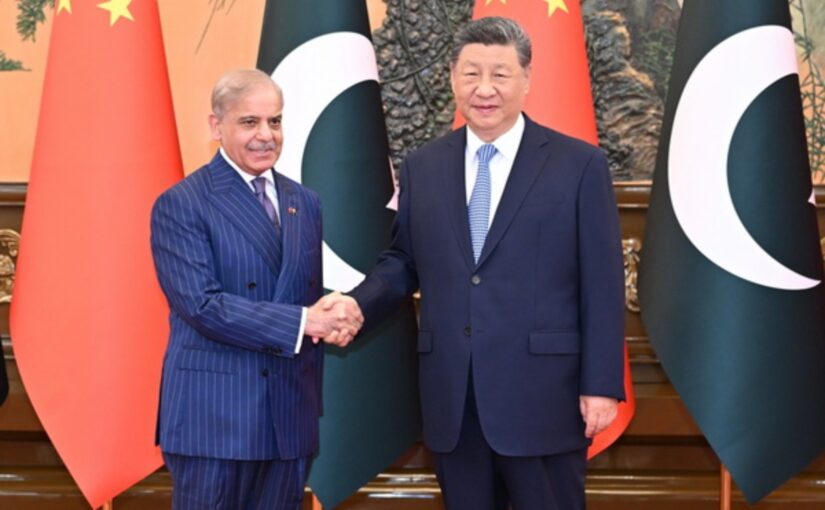
As part of the Beijing activities marking the 75th anniversary of the diplomatic relations between China and Pakistan, the China-Pakistan Political Parties Forum and the Meeting of the CPEC [China Pakistan Economic Corridor] Political Parties Joint Consultation Mechanism, hosted by the International Department of the Communist Party of China (CPC) Central Committee (IDCPC), was held on May 24 under the theme “Jointly Building a China-Pakistan Community with a Shared Future in the New Era: Political Parties in Action”.
IDCPC Minister Liu Haixing and Ishaq Dar, Deputy Prime Minister and Foreign Minister of Pakistan, delivered keynote speeches. The event was attended by about 140 participants, including leaders of 12 major Pakistani political parties, along with representatives from Pakistani think tanks, media and social organisations, and representatives from Chinese ministries, commissions, enterprises, media and academic circles.
Liu noted, over the 75 years since the establishment of diplomatic ties, China and Pakistan have always stood side by side through thick and thin, setting an example of political mutual trust, mutual benefit, win-win cooperation, friendship between the two peoples and multilateral coordination between countries with different ideologies and systems.
The CPC stands ready to work with all major Pakistani political parties to build political consensus, make full use of platforms such as the China-Pakistan Political Parties Forum, and conduct regular consultations on major issues in bilateral relations to continuously consolidate the political foundation for bilateral strategic cooperation. It is necessary to build development consensus, leverage the CPEC Political Parties Joint Consultation Mechanism to advance high-quality practical cooperation and ensure cooperation outcomes benefit all Pakistani people.
Dar noted, Pakistan and China share a close, brotherly relationship. Inter-party exchanges are an important part of bilateral relations. Over the past 75 years since diplomatic ties were established, exchanges and cooperation between political parties of both countries have never been interrupted despite changes in the international landscape. Maintaining and developing the Pakistan-China all-weather strategic cooperative partnership is a cross-party consensus in Pakistan. The world today is undergoing profound changes unseen in a century, and China-Pakistan solidarity and cooperation serves as an important stabilising force in the region.
Pakistan Federal Minister for Planning, Development and Special Initiatives Ahsan Iqbal, who is also secretary-general of the Pakistan Muslim League – Nawaz (PML-N) said that CPEC, a flagship project of the Belt and Road Initiative, has helped reshape Pakistan’s economic landscape over the past decade and is now moving into a more demanding phase. Its focus is shifting beyond infrastructure-led growth and toward industrialisation, innovation, sustainability, agricultural modernisation, and people-centred development — areas that require stronger planning, policy continuity, and institutional coordination. China’s development offers useful references for that transition.
Syed Hussain Tariq, a senior leader of the Pakistan People’s Party (PPP), said CPEC 2.0 will require more than project-level cooperation, calling on Pakistani political parties to help build the policy understanding, social support, and political momentum needed for the corridor’s future development. He said that the delegation’s visit to Beijing has offered a closer look at China’s push to develop new quality productive forces and its emphasis on making artificial intelligence serve ordinary people, including farmers. Such exchanges, he said, have offered inspiration for Pakistan as it seeks to turn CPEC into broader gains for society.
Balochistan Governor Jaffar Khan Mandokhail said Pakistan-China cooperation should be measured not only by the projects completed, but also by whether ordinary people can see real changes in their daily lives. Stronger public trust depends on tangible benefits, especially for young people, he said, citing scholarships, support for public universities, and cooperation in digital connectivity, artificial intelligence, and green technology as ways to bring new opportunities to local communities.
Amir Chishti, a senior leader of the Muttahida Qaumi Movement (Pakistan) (MQM-P), said CPEC’s future development should place greater emphasis on local empowerment and youth employment. Industrial projects and job creation, he said, can improve living standards, strengthen people’s sense of ownership, and make the corridor more socially sustainable. The second phase of CPEC is therefore not only an economic necessity, but also a social and strategic one, as its success will depend on whether local communities can share in the prosperity it brings.
The question of whether development can reach ordinary families also shaped Malik Ahmad Khan’s view of China’s poverty reduction record. The speaker of the Provincial Assembly of Punjab said China’s success in lifting nearly 800 million people out of poverty is one of the greatest achievements in human history. For Pakistan, cooperation with China should not only be about learning how to build, but also about ensuring that every family truly benefits from development.
On the same day, the Pakistan delegation also met with IDCPC vice-minister Sun Haiyan.
The Pakistan side spoke highly of the fruitful outcomes achieved over the 75 years since the establishment of China-Pakistan diplomatic relations, noting that developing friendly relations with China has long been the cross-party consensus in Pakistan. In recent years, the development of CPEC has given a strong boost to Pakistan’s economic and social development, including the development of Balochistan Province. All political parties in Pakistan hope to continue strengthening inter-party exchanges with the CPC and contribute the strength of political parties to the development of bilateral relations.
Sun also met with the delegation of the Punjab Provincial Assembly of Pakistan led by its speaker Malik Ahmad Khan.
Sun noted, over the 75 years since the establishment of diplomatic relations between China and Pakistan, bilateral relations have maintained high-level development under the strategic guidance of the two countries’ leaders. The CPC stands ready to take the 75th anniversary of China-Pakistan diplomatic relations as an opportunity to work with Pakistan to implement the important consensus reached by the leaders of the two countries and promote exchanges and cooperation between relevant Chinese provinces and Punjab in agriculture, artificial intelligence, youth and other fields.
Malik said, China is Pakistan’s most reliable all-weather strategic partner, and friendship with China is a cross-party consensus in Pakistan. CPEC has transformed the lives of the Pakistani people. Punjab hopes to take the opportunity of the Upgraded Version 2.0 of CPEC to deepen exchanges and cooperation with China in agriculture, artificial intelligence, youth and other fields, and ensure the enduring friendship between the two countries from generation to generation.
The following articles were originally published on the website of the IDCPC and by China Daily.
China-Pakistan Political Parties Forum and Meeting of CPEC Political Parties Joint Consultation Mechanism Held
Beijing, May 24th (IDCPC) — China-Pakistan Political Parties Forum and Meeting of CPEC Political Parties Joint Consultation Mechanism, hosted by the International Department of the CPC Central Committee (IDCPC), was held here today under the theme “Jointly Building a China-Pakistan Community with a Shared Future in the New Era: Political Parties in Action”. Liu Haixing, Minister of the IDCPC, and Ishaq Dar, Deputy Prime Minister and Foreign Minister of Pakistan, attended and delivered keynote speeches. The event was attended by about 140 participants, including Ahsan Iqbal, Secretary-General of the PML-N and Federal Minister for Planning, Development and Special Initiatives, leaders of 12 major Pakistani political parties, as well as representatives from Pakistani think tanks, media and social organizations, and representatives from Chinese ministries, commissions, enterprises, media and academic circles.
Liu noted, over the 75 years since the establishment of diplomatic ties, China and Pakistan have always stood side by side through thick and thin, setting an example of political mutual trust, mutual benefit, win-win cooperation, friendship between the two peoples and multilateral coordination between countries with different ideologies and systems. Since the beginning of the new era, under the strategic guidance of President Xi Jinping and Pakistani leaders, the China-Pakistan all-weather strategic cooperative partnership has been continuously deepened, advancing steadily toward the goal of building a China-Pakistan community with a shared future. Both countries are currently at a crucial stage of development and rejuvenation. The two sides should implement the latest important consensus reached by the two countries’ leaders, seize the opportunities of the new round of scientific and technological revolution and industrial transformation, promote the upgrading of the China-Pakistan Economic Corridor (CPEC), maintain close communication and coordination on major international and regional hotspot issues, and jointly build a China-Pakistan community with a shared future featuring stronger political mutual trust, closer economic ties, deeper security cooperation and a firmer public opinion foundation, contributing more to safeguarding world peace and stability.
Liu said, political parties should play an active role in providing ideological guidance and building consensus for the building of a China-Pakistan community with a shared future. The CPC stands ready to work with all major Pakistani political parties to build political consensus, make full use of platforms such as the China-Pakistan Political Parties Forum, and conduct regular consultations on major issues in bilateral relations to continuously consolidate the political foundation for bilateral strategic cooperation. We need to build development consensus, leverage the CPEC Political Parties Joint Consultation Mechanism to advance high-quality practical cooperation and ensure cooperation outcomes benefit all Pakistani people. We need to foster security consensus to support deeper cooperation in counter-terrorism, security and defense, and build social consensus to tell stories of China-Pakistan friendship well, expand exchanges on areas such as think tanks, youth, women, and culture, and launch “small and beautiful” livelihood projects to consolidate public support for China-Pakistan friendship.
Dar noted, Pakistan and China share a close, brotherly relationship. Inter-party exchanges are an important part of bilateral relations. Over the past 75 years since diplomatic ties were established, exchanges and cooperation between political parties of both countries have never been interrupted despite changes in the international landscape. Maintaining and developing the Pakistan-China all-weather strategic cooperative partnership is a cross-party consensus in Pakistan. The world today is undergoing profound changes unseen in a century, and China-Pakistan solidarity and cooperation serve as an important stabilizing force in the region. The two countries maintain high-level communication and coordination on international and regional issues. Pakistan highly appreciates the major global initiatives proposed by President Xi Jinping, which reflect his far-sighted vision. Pakistan will firmly support and actively participate in these initiatives. Pakistan stands ready to further consolidate strategic and political mutual trust with China, deepen practical cooperation across all fields, jointly build an upgraded version of the CPEC, promote exchanges at all levels including political parties, legislatures, media and youth, implement the action plan for building a China-Pakistan community with a shared future, and inject more stability and positive energy into the region and the world.
Foreign guests attending the meeting noted, the Pakistan-China friendship has stood the test of international changes and remains unbreakable. A firm policy of developing friendly relationship with China is the cornerstone of Pakistan’s foreign and development strategies. The China-Pakistan Political Parties Forum provides an important platform for both countries to implement the important consensus of the two countries’ leaders, enhance mutual trust and build consensus. The CPEC has provided significant support for improving Pakistan’s economic and social landscape and is a jewel in the Belt and Road Initiative. China’s 15th Five-Year Plan is highly aligned with URAAN Pakistan Program. Pakistan stands ready to strengthen inter-party exchanges and cooperation, promote the alignment of national development strategies through the political party channel, provide political support for the upgraded version of the CPEC, and strive for more outcomes in the Pakistan-China all-weather strategic cooperative partnership to better benefit the two peoples.
Participants also exchanged views on topics including consolidating high-level political mutual trust, deepening high-level cooperation, and promoting high-level people-to-people exchanges.
Sun Haiyan, Vice Minister of the IDCPC, chaired the meeting.
The meeting adopted the Joint Initiative of Chinese and Pakistani Political Parties to Join Hands to Build a China-Pakistan Community with a Shared Future in the New Era.
Party exchanges spur evolution of China-Pakistan cooperation
May 25 (China Daily) – Pakistani political leaders said party-to-party exchanges with China are gaining greater significance as the two countries mark the 75th anniversary of diplomatic ties and seek to advance the China-Pakistan Economic Corridor into a new phase focused on industry, technology, agriculture, and people’s livelihoods.
Speaking at the China-Pakistan Political Parties Forum and Meeting of CPEC Political Parties Joint Consultation Mechanism, they said cooperation with China now goes beyond infrastructure and trade to include lessons from China’s long-term planning, policy continuity, poverty reduction, and people-centered development.
The event, hosted by the International Department of the Communist Party of China Central Committee, was attended by about 140 people from China and Pakistan. Liu Haixing, head of the International Department of the CPC Central Committee, said the two countries’ political parties should deepen exchanges, strengthen strategic coordination, and build a consensus on development.
China would work with Pakistan to upgrade CPEC with high standards and bring more tangible benefits to the Pakistani people through practical cooperation, he said.
Pakistan’s Deputy Prime Minister and Foreign Minister Ishaq Dar said party-to-party exchanges have been a key pillar of bilateral cooperation over the past 75 years, helping the relationship withstand changes in the international environment and domestic political cycles.
The all-weather strategic cooperative partnership enjoys cross-party support in Pakistan, he said, adding that both countries attach importance to the people, social development, and economic growth. China’s achievements, Dar said, have been underpinned by policy consistency, the hard work of its people, and zero tolerance for corruption.
Federal Minister for Planning, Development and Special Initiatives Ahsan Iqbal said CPEC, a flagship project of the Belt and Road Initiative, has helped reshape Pakistan’s economic landscape over the past decade and is now moving into a more demanding phase.
Its focus, he said, is shifting beyond infrastructure-led growth and toward industrialization, innovation, sustainability, agricultural modernization, and people-centered development — areas that require stronger planning, policy continuity, and institutional coordination.
China’s development offers useful references for that transition, Iqbal said, adding that Pakistani political parties, provincial governments, and public institutions can deepen exchanges with their Chinese counterparts under the CPEC framework on poverty alleviation, digital governance, urban planning, public services, and local development.
Syed Hussain Tariq, a senior leader of the Pakistan People’s Party, said CPEC 2.0 will require more than project-level cooperation, calling on Pakistani political parties to help build the policy understanding, social support, and political momentum needed for the corridor’s future development.
Tariq said that the delegation’s visits to Beijing have offered a closer look at China’s push to develop new quality productive forces and its emphasis on making artificial intelligence serve ordinary people, including farmers. Such exchanges, he said, have offered inspiration for Pakistan as it seeks to turn CPEC into broader gains for society.
Balochistan Governor Jaffar Khan Mandokhail said Pakistan-China cooperation should be measured not only by the projects completed, but also by whether ordinary people can see real changes in their daily lives.
Stronger public trust depends on tangible benefits, especially for young people, he said, citing scholarships, support for public universities, and cooperation in digital connectivity, artificial intelligence, and green technology as ways to bring new opportunities to local communities.
Amir Chishti, a senior leader of the Muttahida Qaumi Movement-Pakistan, said CPEC’s future development should place greater emphasis on local empowerment and youth employment. Industrial projects and job creation, he said, can improve living standards, strengthen people’s sense of ownership, and make the corridor more socially sustainable.
The second phase of CPEC is therefore not only an economic necessity, but also a social and strategic one, he said, as its success will depend on whether local communities can share in the prosperity it brings.
The question of whether development can reach ordinary families also shaped Malik Ahmad Khan’s view of China’s poverty reduction record. The speaker of the Provincial Assembly of Punjab said China’s success in lifting nearly 800 million people out of poverty is one of the greatest achievements in human history, achieved not through slogans, but through generations of persistent and practical effort.
Malik said his visit to Beigou village showed how a once underdeveloped community had achieved prosperity within a single generation. For Pakistan, cooperation with China should not only be about learning how to build, but also about ensuring that every family truly benefits from development, he said.
Ahmad Mujtaba Chaudhary, a member of the Pakistan Tehreek-e-Insaf, said his first visit to China replaced a childhood image shaped by films with the reality of a country that had eliminated extreme poverty.
That achievement was not a cold statistic, but “a living testimony of a civilization”, he said, adding that China’s development showed what people can achieve when they work together toward a shared goal.
Sun Haiyan Meets with a Delegation of Political Parties of Pakistan
Beijing, May 24th (IDCPC) — Sun Haiyan, Vice-minister of the International Department of the CPC Central Committee, met here today on the morning with a delegation of political parties of Pakistan.
Sun said, since the establishment of diplomatic relations between China and Pakistan 75 years ago, the two countries have withstood numerous trials in history and forged an ironclad friendship. In recent years, under the strategic guidance of General Secretary Xi Jinping and Pakistani leaders, the China-Pakistan all-weather strategic cooperative partnership has advanced steadily. China stands ready to take the 75th anniversary of diplomatic relations as an opportunity to work with all political parties in Pakistan to deliver on the important consensus reached by the two countries’ leaders, enhance exchanges and interactions, enable China-Pakistan cooperation to benefit more people, and promote the building of an even closer China-Pakistan community with a shared future in the new era.
The Pakistani side spoke highly of the fruitful outcomes achieved over the 75 years since the establishment of China-Pakistan diplomatic relations, noting that developing friendly relations with China has long been the cross-party consensus in Pakistan. In recent years, the development of the China-Pakistan Economic Corridor (CPEC) has given a strong boost to Pakistan’s economic and social development, including the development of Balochistan Province. It is expected that the two countries will seize the opportunity of the 75th anniversary of diplomatic relations to further deepen exchanges and cooperation in infrastructure, new energy, digital economy, agriculture and fisheries, as well as education and youth affairs. All political parties in Pakistan hope to continue strengthening inter-party exchanges with the CPC and contribute the strength of political parties to the development of bilateral relations.
Sun Haiyan Meets with a Delegation of the Punjab Provincial Assembly of Pakistan
Beijing, May 24th (IDCPC) — Sun Haiyan, Vice-minister of the International Department of the CPC Central Committee, met here today with a delegation of the Punjab Provincial Assembly of Pakistan led by Malik Muhammad Ahmad Khan, Speaker of the Punjab Provincial Assembly.
Sun noted, over the 75 years since the establishment of diplomatic relations between China and Pakistan, bilateral relations have maintained high-level development under the strategic guidance of the two countries’ leaders. The CPC stands ready to take the 75th anniversary of China-Pakistan diplomatic relations as an opportunity to work with Pakistan to implement the important consensus reached by the leaders of the two countries, and promote exchanges and cooperation between relevant Chinese provinces and Punjab in agriculture, artificial intelligence, youth and other fields. She also emphasized the CPC’s readiness to maintain close contacts with political parties in Pakistan including the Pakistan Muslim League-Nawaz, deepen mutual learning, and contribute to building an even closer China-Pakistan community with a shared future in the new era.
Malik said, China is Pakistan’s most reliable all-weather strategic partner, and friendship with China is a cross-party consensus in Pakistan. Under the wise leadership of General Secretary Xi Jinping, China has maintained long-term political stability and lifted nearly 100 million rural people out of absolute poverty, creating a remarkable “China model”. The China-Pakistan Economic Corridor (CPEC) has transformed the lives of the Pakistani people. Punjab hopes to take the opportunity of the Upgraded Version 2.0 of the CPEC to deepen exchanges and cooperation with China in agriculture, artificial intelligence, youth and other fields, and ensure the enduring friendship between the two countries from generation to generation.