Bank rescue implies US insecurities about technological hegemony

We are pleased to publish this original article by Serena Sojic-Borne – a community organizer in New Orleans and member of Freedom Road Socialist Organization – about the economics and geopolitics of the banking crisis.

Serena locates the origins of this crisis in overproduction in the US technology sector, along with the risk-taking behavior inherent to venture capital. She further explores the link between the situation of the US technology sector and the escalating US-led New Cold War on China. In contrast to the chaos and declining innovation of the tech industry in the US, China is “successfully regulating larger firms and taking advantage of smaller start-ups to fuel technological growth for the socialist state”. The only response the US has is, contrary to all its free market rhetoric, to resort to protectionism. The article cites former chair of the National Security Commission on Artificial Intelligence Jon Bateman recommending that Washington “institute controls in technology areas where China seems close to securing unique, strategically significant, and long-lasting advantages.” This provides important context to, for example, the attempts to ban TikTok.

Hence Cold War attacks on China are, to a significant degree, an expression of a capitalist system that’s running out of steam.

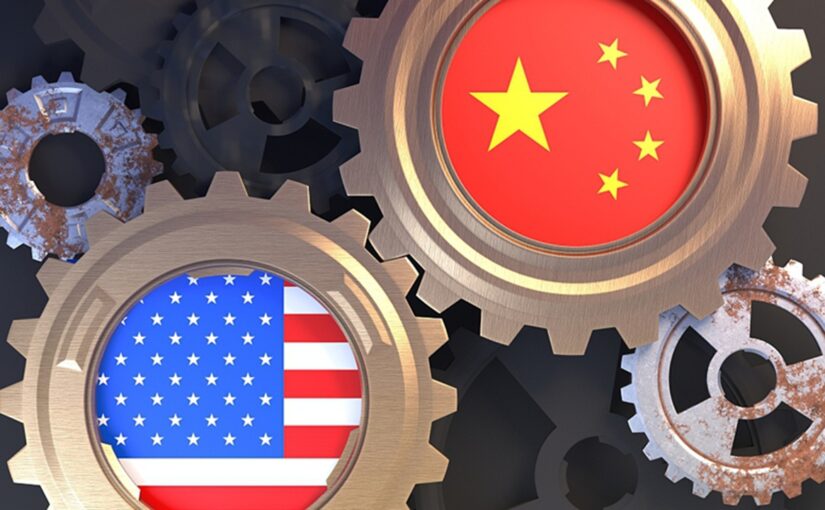
Less than one month before Silicon Valley Bank collapsed, the Chinese Foreign Ministry released “US Hegemony and its Perils,” a report outlining the strategies of US imperialism. Technological monopoly, important among them, now exposes its contradictions. The recent banking panic reflected just how much American capitalism threatens its own technological growth, and the lengths the US will go to salvage it.

SVB relied on the tech industry. During the height of the pandemic, tech boomed as it provided for work and education going remote. The bank’s main depositors came from this sector. As firms rushed to corner their share of the expanding market, SVB scrambled to make new deposits profitable. Lending money wasn’t easy, because the industry rolled in revenue faster than it could re-absorb it. So the bank invested in held-to-maturity securities, such as long-term bonds. The longest-term bonds yielded the best interest rates of the time, even though these rates are unprofitably low today.

The writing was on the wall when the tech industry reached a point of overproduction and reversal in 2021, months before the Fed’s aggressive interest rate hikes began. Big companies laid off workers and small ones closed down. SVB’s loans failed and its deposits started declining. Higher rates only lit the match, and burned up the value of bank’s low interest assets. Silvergate and Signature suffered similar fates because of their similar reliance on a tech-related expansion in cryptocurrency.

Some commentators say this is the story of an interest rate crunch, and blame SVB for failing to diversify its assets. Others recognize the difficulty of doing so when lending opportunities were scarce, and will still blame SVB for being too reliant on one economic sector.

Continue reading Bank rescue implies US insecurities about technological hegemony

Online event: The Counter-Summit for Democracy

Our next online event takes place on Sunday 2 April 2023, 11am (US Eastern) / 8am (US Pacific) / 4pm (Britain) / 11pm (China).

Biden‘s attempts to consolidate a ‘democratic’ alliance are part of the escalating US-led New Cold War. Labelling socialist and anti-imperialist states as ‘authoritarian’, the US ruling elite seeks to consolidate a military, economic and political bloc on the basis of its own narrow interests, and to build popular support for its rising hostility towards China, Russia, Iran, Cuba, the DPRK, Nicaragua, Venezuela, Syria, Eritrea, Zimbabwe and other countries in the crosshairs of imperialism.

The US and its allies are seeking to universalize the Western model of so-called liberal democracy. This narrative provides valuable cover for the fundamentally plutocratic nature of neoliberal capitalism, whilst simultaneously asserting that all other models of democracy – such as China‘s whole-process people’s democracy – lack legitimacy.

Held to coincide with Biden‘s Summit for Democracy 2023, this counter-summit will: expose the hegemonic reality behind the US’s talk of a ‘rules-based world order’; explore alternative models of democracy; denounce US-led attempts at ‘decoupling’ and incitement of division; promote an emerging multipolar, multilateral model of international relations; and call for global cooperation to solve the vast problems collectively faced by humanity.

Confirmed speakers

  • Vijay Prashad (Executive Director, Tricontinental Institute)
  • Seyed Mohammad Marandi (Professor, University of Tehran)
  • Luna Oi (Vietnamese blogger and broadcaster)
  • Victor Gao (Chair Professor, Soochow University)
  • Margaret Kimberley (Executive Editor, Black Agenda Report)
  • Lowkey (Musician and activist / Journalist with MintPress News)
  • Carlos Ron (Venezuelan vice-minister / President of the Instituto Simón Bolívar)
  • Ben Norton (Editor, Geopolitical Economy Report)
  • Pawel Wargan (Coordinator of the International Secretariat, Progressive International)
  • Ju-Hyun Park (Organizer and writer with the Nodutdol collective)
  • Calla Walsh (Co-Chair of the National Network on Cuba)

Organizers

This webinar is jointly organised by Friends of Socialist China and the International Manifesto Group, and is co-sponsored by the following groups:

Please register and spread the word!

The Summit for Democracy is really a summit for hegemony

In this opinion piece for China Daily, Carlos Martinez exposes the hypocrisy and cynicism of Joe Biden’s second Summit for Democracy, which takes place 28-30 March 2023. Carlos writes that the goals of this Summit are: firstly, to buttress Biden’s 2024 presidential campaign, diverting attention from the startling lack of progress his administration has made thus far in improving people’s lives; and secondly, to consolidate a global military and economic alliance built around the specific interests of the US ruling class and its ‘Project for a New American Century’. This is a Cold War alliance aimed at the containment and encirclement of China, the undermining of Russia, and escalated hostilities against Cuba, Venezuela, Nicaragua, Iran, Syria, Belarus, the Democratic People’s Republic of Korea and other countries.

Carlos writes that “Biden’s Summit for Democracy is part of an elaborate marketing campaign that places an equal sign between hegemonism and democracy and, conversely, between sovereign development and authoritarianism.” Such division is reckless and dangerous, particularly at a time when humanity faces collective existential threats of the magnitude of climate change and nuclear war.

The article notes that Friends of Socialist China and the International Manifesto Group are organizing a Counter-Summit for Democracy on Sunday 2 April, in order to expose the hegemonic reality behind US talk of a “rules-based world order”.

Embedded below the article is a short video, produced by China Daily, in which Carlos Martinez and David Castrillon-Kerrigan, a professor and researcher at Externado University of Colombia, share their views on the Summit for Democracy.

With his second so-called Summit for Democracy, US President Joe Biden is seeking to achieve two goals, one domestic and one international.

On the domestic front, he is still struggling to define a political identity that can appeal to voters in next year’s presidential election. Consistently polling about 40 percent in approval ratings, Biden has delivered very little for the American people in over two years in office.

The Biden administration’s handling of the novel coronavirus pandemic has been abysmal. There has been precious little action on the social justice issues that are supposed to be the hallmark of a Democratic leadership. Real GDP growth is projected to be almost zero this year. And the United States is failing in its climate action responsibilities.

Worse, it has been sending tens of billions of dollars worth of heavy weaponry to Ukraine to fight a proxy war against Russia, while its infrastructure crumbles and tens of millions are denied access to healthcare.

In the face of his administration’s failure to actually improve people’s lives, Biden is campaigning on the basis of liberal democratic ideology — a very specific vision of democracy based on the political and economic needs of the capitalist class. His strategists have calculated that this narrative will help create some distance between him and his likely competitor for the presidency — which could be Donald Trump, who is not known for adhering to any sort of democratic thinking, bourgeois or otherwise.

Continue reading The Summit for Democracy is really a summit for hegemony

Is Taiwan the next Ukraine?

Interviewed on BreakThrough News by Eugene Puryear and Rania Khalek, Professor Ken Hammond gives an extremely clear explanation of US policy in relation to Taiwan. Ken points out that the corporate media has reached fever pitch, encouraging the Western public to think that China is on the cusp of launching a military invasion of Taiwan Island; that this is a prima facie example of China’s disruption of the peaceful “rules-based order” that the US so benevolently presides over. This narrative functions to raise public support for a New Cold War, and to silence those voices making the rather obvious point that US-China cooperation over climate change and other global problems is both urgent and necessary.

Ken points out that China’s position in relation to Taiwan has not changed. China has always reiterated its commitment to a peaceful resolution of the issue, whilst maintaining its right to use force in the face of interference or any unilateral attempt by separatists to declare Taiwan’s independence. The issue is a fundamental concern of China: for hundreds of years, Taiwan has been part of China, and the only reason Taiwan is administered separately today is that the US Navy positioned itself in the Taiwan Strait following the victory of the Chinese Revolution in order to protect the remnants of the Nationalist regime and prevent national reunification under the CPC-led government in Beijing.

The US continues to provoke China over the Taiwan issue – and other issues – in the hope of triggering an incident that can be parlayed into a conflict which the US can somehow leverage to stall China’s development and its emergence as a major player in global affairs. Ultimately, Ken points out, this is done in order to protect US hegemony, and would certainly not benefit the ordinary people of the US. It’s a profoundly dangerous strategy which must be exposed and opposed.

The interview is embedded below.

Xi Jinping’s keynote address at the CPC in Dialogue with World Political Parties High-level Meeting

On March 15, the International Department of the Communist Party of China (IDCPC) held a High-Level Meeting under the title The CPC in Dialogue with World Political Parties and with the theme Path towards modernization: The Responsibility of Political Parties, via video link. It was attended by leaders and representatives from hundreds of political parties and organizations from around the world, including a delegation of Friends of Socialist China.

The meeting was opened with a keynote address from Comrade Xi Jinping, General Secretary of the Central Committee of the Communist Party of China and President of the People’s Republic of China.

Noting that the history of human development is full of twists and turns and that the path to modernization is also arduous, Xi said that “in today’s world, multiple challenges and crises are intertwined. The global economic recovery remains sluggish, the development gap is widening, ecological environment is deteriorating, and the Cold War mentality is lingering,” meaning that we are once again at a crossroads of history.

Sharing some of his observations, Xi noted:

  • We must put the people first and ensure modernization is people-centered. The ultimate goal of modernization is people’s free and well-rounded development. “Modernization is not only about indicators and statistics on the paper but more about the delivery of a happy and stable life for the people.”
  • We must uphold the principle of independence and explore diversified paths towards modernization. Each country must consider its own national conditions and unique features. “It is the people of a country that are in the best position to tell what kind of modernization best suits them. Developing countries have the right and ability to independently explore the modernization path with their distinctive features based on their national realities.”
  • We must uphold fundamental principles and break new ground. “We should work together to reform and develop the global governance system and make the international order more just and equitable as we advance humanity’s modernization in an environment of equal rights, equal opportunities and fair rules for all.” Xi added that we must help others to succeed while seeking our own success. “We stand firmly opposed to the practice of preserving one’s own development privilege by suppressing and containing other countries’ endeavor to achieve modernization.”

Turning to China’s experience, Xi noted that, “The journey of over 100 years that the Party has traversed to unite and lead the Chinese people in pursuing national rejuvenation is also an exploration of a path towards modernization.” And he reiterated that, “Chinese modernization is one of a huge population, of common prosperity for all, of material and cultural-ethical advancement, of harmony between humanity and nature, and of peaceful development,” adding: “We will stay committed to the right direction, right theories and the right path. We will not veer off course by changing our nature or abandoning our system.”

Addressing the international context for his country’s modernization, the Chinese leader reaffirmed that: “In advancing modernization, China will neither tread the old path of colonization and plunder, nor the crooked path taken by some countries to seek hegemony once they grow strong… We firmly oppose hegemony and power politics in all their forms… The world does not need a new Cold War. The practice of stoking division and confrontation in the name of democracy is in itself a violation of the spirit of democracy… No matter what level of development China achieves, it will never seek hegemony or expansion.”

Moving towards the close of his speech, Xi Jinping proposed for the first time his concept of a Global Civilization Initiative. According to this proposal:

  • We advocate the respect for the diversity of civilizations.
  • We advocate the common values of humanity. Peace, development, equity, justice, democracy and freedom are the common aspirations of all peoples.
  • We advocate the importance of inheritance and innovation of civilizations.
  • We advocate robust international people-to-people exchanges and cooperation.

Finally, Xi observed that: “There are bound to be setbacks on humanity’s journey to modernization, but the future is bright.”

Following Xi Jinping’s address, speeches were made by:

  • Cyril Ramaphosa, President of the African National Congress (ANC) of South Africa and President of the Republic of South Africa.
  • Nicolás Maduro, President of the United Socialist Party of Venezuela (PSUV) and President of the Bolivarian Republic of Venezuela.
  • Aleksandar Vučić, President of the Serbian Progressive Party and President of the Republic of Serbia.
  • Luvsannamsrain Oyun-Erdene, Chairman of the Mongolian People’s Party and Prime Minister of Mongolia.
  • Xie Chuntao, Executive Vice President of the CPC Central Party School.
  • James Marape, Leader of the Pangu Party and Prime Minister of Papua New Guinea.
  • Salva Kiir Mayardit, Chairman of the Sudan People’s Liberation Movement (SPLM) and President of South Sudan.
  • Daniel Ortega, President of the Sandinista National Liberation Front (FSLN) of Nicaragua and President of Nicaragua.
  • Boris Gryzlov, Chairman of the Supreme Council of United Russia.
  • Han Wenxiu from the Financial and Economic Office of the CPC Central Committee.
  • Dickon Mitchell, Leader of the National Democratic Congress and Prime Minister of Grenada.
  • Yawa Djigbodi Tsegan, Treasurer of the National Office of Union for the Republic (UNIR) and President of the National Assembly of Togo.
  • Erlan Qoşanov, Chairman of the Amanat Party and of the Mazhilis (lower house of parliament) of Kazakhstan.
  • Taur Matan Ruak, President of the People’s Liberation Party and Prime Minister of Timor Leste.
  • Cai Qi, Member of the Standing Committee of the Political Bureau of the CPC Central Committee.

We reprint below General Secretary Xi Jinping’s speech to the meeting. It was originally carried by the Xinhua News Agency.

Join Hands on the Path Towards Modernization

Keynote Address by H.E. Xi Jinping
General Secretary of the Central Committee of the Communist Party of China
And President of the People’s Republic of China
At the CPC in Dialogue with World Political Parties
High-level Meeting
Beijing, 15 March 2023

Leaders of political parties from around the world,

Ladies and Gentlemen,

Friends,

It gives me great pleasure to join all of you for the discussion on “Path Towards Modernization: The Responsibility of Political Parties”.

The history of human development is full of twists and turns. Similarly, the journey of each country to explore the path to modernization is also arduous. In today’s world, multiple challenges and crises are intertwined. The global economic recovery remains sluggish, the development gap is widening, ecological environment is deteriorating, and the Cold War mentality is lingering. Humanity’s modernization process has once again reached a crossroads of history.

Polarization or common prosperity? Pure materialistic pursuit or coordinated material and cultural-ethical advancement? Draining the pond to catch the fish or creating harmony between man and nature? Zero-sum game or win-win cooperation? Copying other countries’ development model or achieving independent development in light of national conditions? What kind of modernization do we need and how can we achieve it? Confronted with these questions, political parties as an important force steering and driving the modernization process are duty bound to provide answers. Here, I wish to share some of my observations.

Continue reading Xi Jinping’s keynote address at the CPC in Dialogue with World Political Parties High-level Meeting

US is maintaining tensions with North Korea to draw in allies against China

In this detailed and well-researched article, originally published by Truthout, Simone Chun argues that, “the US military encirclement of China threatens to escalate into an Asia-Pacific war, with the Korean Peninsula at the focal point of this dangerous path. Garrisoned with nearly 30,000 combat-ready US forces manning the astonishing 73 US military bases dotting its tiny landmass, South Korea is the most critical frontline component of US military escalation in northeast Asia.” She further notes that, “sixty percent of US naval capacity has been transferred to the Asia-Pacific region, and 400 out of 800 US worldwide military bases and 130,000 troops are now circling China.”

This, Simone observes, is a reflection of Washington’s Asia-Pacific grand strategy, which views China as the US’s top security challenge and prioritizes the maintenance of US regional hegemony through military force. From this, she highlights three important implications, namely:

  • The accelerated remilitarization of Japan;
  • The revitalization of extremist hardline North Korea policies in both Washington and Seoul;
  • The intensification and expansion of belligerent wargames targeted at China and North Korea.

Whilst hosting more than 50,000 American troops, Tokyo, she notes, has steadily laid the groundwork for its own remilitarization program by characterizing North Korea as an existential threat, and designating Beijing’s regional activities as a danger to its homeland. According to the retired Maritime Self-Defense Force (MSDF) Admiral Tomohisa Takei, China has been the main target for Japanese rearmament, “using North Korea’s threat as cover.”

Secondly, Washington’s zero-sum stance against China obstructs its ability to craft a sensible North Korea policy. “The goal of Washington’s North Korea policy…is not to achieve rapprochement with Pyongyang or establish peace in the Korean Peninsula, but rather to nurture and even enhance the purported ‘North Korean threat’ as a pretext to rally South Korea and Japan behind its goal of containing China.” Furthermore, Washington’s policy also serves to empower the extreme right in South Korea.

Third, Washington’s anti-China stance fuels belligerent wargames targeted at China and North Korea on the Korean Peninsula. The world’s largest bilateral peacetime military drills explicitly include the rehearsed attack on and occupation of North Korea as well as the ‘decapitation’ of its leadership. She notes that, “Washington’s resolve to push its exorbitant imperial privilege by any means necessary is forcing South Korea down a risky and self-destructive path that promises little benefit for the Korean nation itself,” and continues: “The greatest threat to peace and stability in northeast Asia is the US Indo-Pacific military encirclement of China, which by design serves to escalate tensions and create a dangerous cycle of provocation and response.”

Yet, “hawkish US policies have consistently failed to garner public support in South Korea. According to a series of polls conducted in 2021, 61 percent of South Koreans support relaxing sanctions against the north and 79 percent support peace with Pyongyang, with an additional 71 percent supporting a formal end-of-war declaration between the two Koreas.” And seven in ten Americans are supportive of a summit between Biden and North Korean leader Kim Jong Un.

Simone Chun is a researcher and activist focusing on inter-Korean relations and US foreign policy on the Korean Peninsula. She has served as an assistant professor at Suffolk University, a lecturer at Northeast University and an associate in research at Harvard University’s Korea Institute. She is on the Korea Policy Institute Board of Directors, and serves on the advisory board for CODEPINK.

The U.S. military encirclement of China threatens to escalate into an Asia-Pacific war, with the Korean Peninsula at the focal point of this dangerous path. Garrisoned with nearly 30,000 combat-ready U.S. forces manning the astonishing 73 U.S. military bases dotting its tiny landmass, South Korea is the most critical frontline component of U.S. military escalation in northeast Asia.

Since the Obama administration’s 2012 “pivot to Asia,” Washington has intensified tensions with Beijing, doubling down on a “full-scale multi-pronged new Cold War” through the Indo-Pacific Strategy pursued by both the Trump and Biden administrations. Sixty percent of U.S. naval capacity has been transferred to the Asia-Pacific region, and 400 out of 800 U.S. worldwide military bases and 130,000 troops are now circling China.

This is a reflection of Washington’s Asia-Pacific grand strategy, which views China as the U.S.’s top security challenge and prioritizes the maintenance of U.S. regional hegemony through military force by “defending the homeland, paced to the growing multi-domain threat posed by the PRC [People’s Republic of China].”

It promotes the vision of an empire with unipolar hegemonic ambitions, expanding the theater of war in northeast Asia and distributing the totality of threats facing China. Its goal is to force China’s hand by triggering and escalating a hybrid war on multiple fronts, including military, technology, economy, information and media.

This strategy is based on chaining together a regional “anti-hegemonic coalition” of U.S.-armed allies encircling China from South Korea and Japan in the north to Australia and Indonesia in the south. In spite of the significant state-level and public resistance in these nations toward U.S. pressure to choose between allegiance to Beijing and allegiance to Washington, this vision has been largely realized thanks to unrelenting U.S. coercion through successive administrations.

Three important implications of this grand strategy, which places the Korean Peninsula at the pernicious center of intensified China-U.S. competition, merit attention: 1) the accelerated remilitarization of Japan; 2) the revitalization of extremist hardline North Korea policies in both Washington and Seoul; and 3) the intensification and expansion of belligerent wargames targeted at China and North Korea.

First, Washington’s military encirclement of China strategy bolsters Japan’s military build-up program. The U.S., despite having imposed a “pacifist” constitution on Japan in the wake of WWII, has for decades aggressively pushed for Japanese rearmament as a necessary adjunct of Washington’s efforts to dominate the Asia-Pacific. Labeling Japan a “failed peace state,” Gavan McCormack points out the ironic trajectory of its transformation into “one of the world’s great military powers” as a state actively girding for war under a so-called pacifist constitution. “With US encouragement, over time Japan built formidable land, sea, and air forces, evading the constitutional proscription by calling them ‘Self-Defence’ forces (rather than Army, Navy, and so on),” McCormack writes. “Other states with good reason to know and fear Japanese militarism (Australia included) also abandoned their commitment to the idea of its permanent demilitarisation…. [Its] constitution steadily sidelined, by early 21st century Japan was one of the world’s great military powers.”

Continue reading US is maintaining tensions with North Korea to draw in allies against China

Why did Biden snub China’s Ukraine peace plan?

This insightful article by Medea Benjamin, Marcy Winograd and Wei Yu, published in CODEPINK on 3 March 2023, analyzes the Biden administration’s kneejerk negative reaction to China’s recent position paper on the political settlement of the Ukraine crisis.

Biden, Blinken, Austin and Stoltenberg have all rubbished China’s credentials as a peacemaker, pointing to the fact that China has not condemned Russia, and accusing China of planning to provide Russia with military support. The authors make the important point that “it is the US, not China, that is fueling the conflict with at least $45 billion dollars in ammunition, drones, tanks and rockets in a proxy war that risks – with one miscalculation – turning the world to ash in a nuclear holocaust.” Furthermore “it is the US, not China, that has provoked this crisis by encouraging Ukraine to join NATO, a hostile military alliance that targets Russia in mock nuclear strikes, and by backing a 2014 coup of Ukraine’s democratically elected Russia-friendly president Viktor Yanukovych.”

China’s peace proposal calls for a negotiated peace; it calls for abandoning a Cold War mentality; it calls for an end to unilateral sanctions; and it states that “the legitimate security interests and concerns of all countries must be taken seriously and addressed properly.” Unfortunately the US cannot accept any of this. The US seeks precisely to keep the war going in order to further its Cold War agenda of weakening Russia and consolidating US hegemony over Europe. This is the real reason the Biden administration is so quick to dismiss China’s proposals.

It is a great shame for the people of Ukraine that peace is not on the US’s agenda. What’s more, as the authors point out, cooperation between the US and China on this question might also “pave the way for cooperation with China on all kinds of other issues – from medicine to education to climate – that would benefit the entire globe.”

There’s something irrational about President Biden’s knee-jerk dismissal of China’s 12-point peace proposal titled “China’s Position on the Political Settlement of the Ukraine Crisis.”

“Not rational” is how Biden described the plan that calls for de-escalation toward a ceasefire, respect for national sovereignty, establishment of humanitarian corridors and resumption of peace talks.

“Dialogue and negotiation are the only viable solution to the Ukraine crisis,” reads the plan. “All efforts conducive to the peaceful settlement of the crisis must be encouraged and supported.”

Biden turned thumbs down.

“I’ve seen nothing in the plan that would indicate that there is something that would be beneficial to anyone other than Russia if the Chinese plan were followed,” Biden told the press.

In a brutal conflict that has left thousands of dead Ukrainian civilians, hundreds of thousands of dead soldiers, eight million Ukrainians displaced from their homes, contamination of land, air and water, increased greenhouse gasses and disruption of the global food supply, China’s call for de-escalation would surely benefit someone in Ukraine.

Other points in China’s plan, which is really more a set of principles rather than a detailed proposal, call for protection for prisoners of war, cessation of attacks on civilians, safeguards for nuclear power plants and facilitation of grain exports.

“The idea that China is going to be negotiating the outcome of a war that’s a totally unjust war for Ukraine is just not rational,” said Biden.

Instead of engaging China–a country of 1.5 billion people, the world’s largest exporter, the owner of a trillion dollars in US debt and an industrial giant–in negotiating an end to the crisis in Ukraine, the Biden administration prefers to wag its finger and bark at China, warning it not to arm Russia in the conflict.

Psychologists might call this finger-wagging projection–the old pot calling the kettle black routine. It is the US, not China, that is fueling the conflict with at least $45 billion dollars in ammunition, drones, tanks and rockets in a proxy war that risks–with one miscalculation–turning the world to ash in a nuclear holocaust.

It is the US, not China, that has provoked this crisis by encouraging Ukraine to join NATO, a hostile military alliance that targets Russia in mock nuclear strikes, and by backing a 2014 coup of Ukraine’s democratically elected Russia-friendly president Viktor Yanukovych, thus triggering a civil war between Ukrainian nationalists and ethnic Russians in eastern Ukraine, regions Russia has more recently annexed.

Biden’s sour attitude toward the Chinese peace framework hardly comes as a surprise. After all, even former Israeli Prime Minister Naftali Bennett candidly acknowledged in a five-hour interview on YouTube that it was the West that last March blocked a near-peace deal he had mediated between Ukraine and Russia.

Why did the US block a peace deal? Why won’t President Biden provide a serious response to the Chinese peace plan, let alone engage the Chinese at a negotiating table?

President Biden and his coterie of neo-conservatives, among them Undersecretary of State Victoria Nuland, have no interest in peace if it means the US concedes hegemonic power to a multi-polar world untethered from the all-mighty dollar.

What may have gotten Biden unnerved—besides the possibility that China might emerge the hero in this bloody saga—is China’s call for the lifting of unilateral sanctions. The US imposes unilateral sanctions on officials and companies from Russia, China and Iran. It imposes sanctions on whole countries, too, like Cuba, where a cruel 60-year embargo, plus assignment to the State Sponsor of Terrorism list, made it difficult for Cuba to obtain syringes to administer its own vaccines during the COVID pandemic. Oh, and let’s not forget Syria, where after an earthquake killed tens of thousands and left hundreds of thousands homeless, the country struggles to receive medicine and blankets due to US sanctions that discourage humanitarian aid workers from operating inside Syria.

Despite China’s insistence it is not considering weapons shipments to Russia, Reuters reports the Biden administration is taking the pulse of G-7 countries to see if they would approve new sanctions against China if that country provides Russia with military support.

The idea that China could play a positive role was also dismissed by NATO Secretary General Jens Stoltenberg, who said, “China doesn’t have much credibility because they have not been able to condemn the illegal invasion of Ukraine.”

Ditto from US Secretary of State Antony Blinken, who told ABC’s Good Morning America, “China has been trying to have it both ways: It’s on the one hand trying to present itself publicly as neutral and seeking peace, while at the same time it is talking up Russia’s false narrative about the war.”

False narrative or different perspective?

In August of 2022, China’s ambassador to Moscow charged that the United States was the “main instigator”of the Ukraine war, provoking Russia with NATO expansion to Russia’s borders.

This is not an uncommon perspective and is one shared by economist Jeffrey Sachs who, in a February 25, 2023 video directed at thousands of anti-war protesters in Berlin, said the war in Ukraine did not start a year ago, but nine years ago when the US backed the coup that overthrew Yanukovych after he preferred Russia’s loan terms to the European Union’s offer.

Shortly after China released its peace framework, the Kremlin responded cautiously, lauding the Chinese effort to help but adding that the details “need to be painstakingly analyzed taking into account the interests of all the different sides.” As for Ukraine, President Zelinsky hopes to meet soon with Chinese President Xi Jinping to explore China’s peace proposal and dissuade China from supplying weapons to Russia.

The peace proposal garnered more positive response from countries neighboring the warring states. Putin’s ally in Belarus, leader Alexander Lukashenko, said his country “fully supports” the Beijing plan. Kazakhstan approved of China’s peace framework in a statement describing it as “worthy of support.” Prime Minister of Hungary Viktor Orbán–who wants his country to stay out of the war– also showed support for the proposal.

China’s call for a peaceful solution stands in stark contrast to US warmongering this past year, when Secretary of Defense Lloyd Austin, a former Raytheon board member, said the US aims to weaken Russia, presumably for regime change–a strategy that failed miserably in Afghanistan where a near 20-year US occupation left the country broke and starving.

China’s support for de-escalation is consistent with its long-standing opposition to US/NATO expansion, now extending into the Pacific with hundreds of US bases encircling China, including a new base in Guam to house 5,000 marines. From China’s perspective, US militarism jeopardizes the peaceful reunification of the People’s Republic of China with its break-away province of Taiwan. For China, Taiwan is unfinished business, left over from the civil war 70 years ago.

In provocations reminiscent of US meddling in Ukraine, a hawkish Congress last year approved $10 billion in weapons and military training for Taiwan, while House leader Nancy Pelosi flew to Taipei – over protests from her constituents–to whip up tension in a move that brought US-China climate cooperation to a halt.

A US willingness to work with China on a peace plan for Ukraine might not only help stop the daily loss of lives in Ukraine and prevent a nuclear confrontation, but also pave the way for cooperation with China on all kinds of other issues–from medicine to education to climate–that would benefit the entire globe.

Blinken attacks China for seeking peace in Ukraine

In this insightful article for Fighting Words, Chris Fry summarizes the latest efforts by the Biden administration to slander – and escalate tensions with – China.

The article starts by describing Antony Blinken’s recent accusations that China is sending – or “contemplating sending” – military assistance to Russia. Chris notes the twisted irony of this accusation, given that “the US has supplied more than $100 billion in military aid to Ukraine so far, with more on the way,” and given that the US government is quite clearly implementing a strategy directed not at bringing about peace or saving Ukrainian lives, but at defeating and weakening the Russian Federation and expanding NATO’s hegemony in Europe.

It is presumably not a coincidence that this accusation is being amplified at a time when China has put forward an important position paper on the Ukraine conflict, calling for the abandoning of Cold War mentality, a resumption of peace talks, and an end to illegal sanctions. China’s peace proposals – grounded firmly in international law and consistent with the principles of the UN Charter – are resonating with governments throughout the world, particularly in the Global South. Therefore the US is doing what it can to tarnish China’s reputation as a responsible power.

Chris also highlights the US’s increasingly desperate attempts to stoke tensions in relation to Taiwan Province. With the anti-independence Kuomintang having scored an important victory in Taiwan’s local elections last year – and having good prospects in next year’s presidential elections – the US is fast-tracking its provocations, which “seek to provoke a justified but costly Chinese military attack on Taiwan and thus ‘justify’ a US war against China.”

China’s response to such provocations has been measured and proportional; as such the US strategy is failing. Nonetheless, notes the author, “progressives and anti-war activists must prepare now to muster their forces.”

Unable to intimidate the leadership of the People’s Republic of China (PRC) over its balloon being shot down by U.S. Air Force jets along with three other balloons in a missile-firing frenzy, President Biden, through his war hawk Secretary of State Antony Blinken, is now accusing China of “contemplating sending lethal aid” to the Russian Federation.

Speaking to “Meet the Press” on February 9 after meeting with Chinese top diplomat Wang Yi in Munich, Blinken arrogantly attacked China for its relations with the Russian Federation while it maintains strict neutrality in the conflict:

“Publicly, they present themselves as a country striving for peace in Ukraine,” he said … “But privately, as I said, we’ve seen already over these past months the provision of nonlethal assistance that does go directly to aiding and abetting Russia’s war effort.”

Continue reading Blinken attacks China for seeking peace in Ukraine

Wang Yi: However difficult the situation is, peace should be given a chance

On February 18, Wang Yi, Member of the Political Bureau of the CPC Central Committee and Director of the Office of the Central Commission for Foreign Affairs, delivered a keynote speech at the 59th Munich Security Conference. 

Towards the start of his speech, entitled Making the World a Safer Place, Wang recalled that they had last gathered in the German city three years ago at the start of the Covid-19 pandemic. That experience had shown that: “We can overcome challenges when we stand together; we can win victory when we trust each other.” 

However: “Three years on, the pandemic is contained, but the world is not yet safer. Trust between major countries is lacking, geopolitical rifts are widening, unilateralism is rampant, the Cold War mentality is back, new types of security threats from energy, food, climate, bio-security and artificial intelligence keep emerging.

“Standing at a critical juncture of history, human society must not repeat the old path of antagonism, division and confrontation, and must not fall into the trap of zero-sum game, war and conflict.”

Stressing the need to respect the sovereignty and territorial integrity of all countries, Wang Yi noted that, “interference in other countries’ internal affairs, in whatever name, disregards and defies the basic norms of international relations” and warned that violations of the One China Policy, “pose real threats to peace and stability across the Taiwan Strait.”

Calling for the peaceful settlement of disputes, Wang Yi said that, “however difficult the situation is, peace should be given a chance,” adding that, with regard to the conflict in Ukraine, “China’s position boils down to supporting talks for peace. We will put forth China’s proposition on the political settlement of the Ukraine crisis, and stay firm on the side of peace and dialogue.”

China’s top diplomat also asserted that: “The world should not be a place where the rich stay rich while the poor remain poor. Efforts should be stepped up in implementing the UN 2030 Agenda for Sustainable Development, the legitimate right to development of all countries, especially developing countries, should be effectively protected.” Refuting the idea that China would renounce the path of peaceful development as it became stronger, he insisted that, “China’s experience shows that the path of peaceful development has worked, and worked well.”

After his speech, Wang Yi took questions from his audience, a number of which focused on the state of China-US relations following the US shooting down of an unmanned Chinese airship that had strayed off course due to climatic conditions. He described this incident as, “a political farce manufactured by the United States” and continued:

“This mind-boggling and hysterical act is a hundred percent abuse of force and a clear violation of common practice and relevant international conventions. China will never stand for this, and has lodged strong protest with the US. Each day, balloons fly across the sky in large numbers. Does the United States want to shoot them all down? What the US has done is not a sign of strength, but exactly the opposite. China urges the US to stop doing such absurd things out of domestic political needs.”

Describing China’s policy towards the United States as clear and transparent, Wang Yi added that it was based on, “mutual respect, peaceful coexistence and win-win cooperation, and, based on these principles, exploring the right way for the two major countries with different social systems, histories and cultures to get along with each other.”

The following articles were originally carried on the website of the Chinese Foreign Ministry.

Making the World a Safer Place

Ministry of Foreign Affairs of the People’s Republic of China, 18 February 2023

Keynote Speech by Director Wang Yi
Member of the Political Bureau of the CPC Central Committee and
Director of the Office of the Central Commission for Foreign Affairs
At the 59th Munich Security Conference
Conversation with China

Munich, 18 February 2023

Dear Friends,
Colleagues,

I am delighted to join you in person at the Munich Security Conference (MSC) after three years, and meet face to face with friends old and new.

I recall vividly how I came here with the Chinese delegation three years ago when COVID-19 just struck. I presented China’s efforts in fighting the virus and urged solidarity among countries in face of the trying times. The international community gave China valuable understanding and support, for which we are deeply grateful.

Humanity’s three-year fight against COVID tells us a simple truth: as President Xi Jinping repeatedly stressed, we are members of one global village, and we belong to one community with a shared future. We can overcome challenges when we stand together; we can win victory when we trust each other.

Three years on, the pandemic is contained, but the world is not yet safer. Trust between major countries is lacking, geopolitical rifts are widening, unilateralism is rampant, the Cold War mentality is back, new types of security threats from energy, food, climate, bio-security and artificial intelligence keep emerging.

Continue reading Wang Yi: However difficult the situation is, peace should be given a chance

Balloon shootout: Pretext for war with China

In this article for Fighting Words, Chris Fry discusses the latest developments in – and motivation for – the US’s bizarre War on Balloons. Chris notes that by far the most plausible explanation for the appearance of the first “spy balloon” is that provided by the Chinese government: that it was a meteorological research balloon that had accidentally drifted off-course. Hawkish US politicians and journalists claimed that China was attempting to gather information about the Montana nuclear missile base, and yet: “One could easily go onto the internet to find the location of the Montana missile base. And no balloon could possibly find the location of any of the nuclear missile-carrying submarines the U.S. has stationed around the world under water.” Meanwhile, if international surveillance is the hot topic, “no country conducts more aggressive spying on countries than US imperialism, which it combines with its regime change strategy to overturn governments that it is unable to bend to its will.”

What is the rationale for this manufactured “spy balloon crisis”? The author reminds us that “Biden was a supporter of the Bush doctrine of ‘preemptive strike’ and the Iraq war”, and compares the balloon narrative with the Gulf of Tonkin (phantom) incident of 1964, which was used by the Johnson administration to drive public support for a major US military intervention in Vietnam. Chris points out that the US has been steadily undermining the One China policy and giving strong support to separatist forces in Taiwan Province, with the aim of “provoking China to launch a quite justified but costly war to recover its Taiwan province.” However, it’s increasingly likely that next year’s elections in Taiwan will bring the pro-unification Kuomintang back to power on the island. Chris opines that, for this reason, “the Biden administration is trying to find any pretext, even as absurd as a weather balloon, to spark a war with China before the current pro-independence regime in Taiwan is kicked out next year.”

The author concludes by calling on progressive and anti-war forces in the West to develop a mass peace movement to stop this reckless behavior on the part of the US and its allies.

A stealth F22 fighter, costing some $350 million, managed to shoot down its first aircraft on February 4, a large Chinese balloon off the South Carolina coast. The People’s Republic of China (PRC) stated that it was a weather research device and apologized that it inadvertently passed over U.S. territory because of unexpected wind currents.

But the Biden administration, the Congress and the Pentagon launched a full-scale tirade, accusing China of using balloons to spy on nuclear missile silos, intercept messages and, most importantly, “violating U.S. sovereignty.” The corporate media has whipped up a frenzied campaign of mass hysteria.

Of course, every country, particularly the U.S., proclaims the right to conduct reconnaissance of other countries’ weapons systems that target them. China has more than 500 satellites circling the planet, which obviously makes balloon surveillance superfluous. But no country conducts more aggressive spying on countries than U.S. imperialism, which it combines with its regime change strategy to overturn governments that it is unable to bend to its will.

Continue reading Balloon shootout: Pretext for war with China

Flap over Chinese balloon a colossal demonstration of warped thinking in the US

In the following article, originally published in Global Times, Ken Hammond, Professor of East Asian and Global History at New Mexico State University and a member of our advisory group, dissects the grotesque over-reaction to the accidental intrusion of a Chinese meteorological balloon into US airspace and notes that “all this would be funny, if it weren’t so dangerous.”

Situating the recent development against a background that begins at least with President Obama’s 2011 ‘Pivot to Asia’, Ken notes that, sadly, the “rather ridiculous” and “absurd” behaviour on the part of the US, is  “just the latest round in the ongoing effort to demonize China, to prepare the American people for possible conflict, and to ensure that most Americans have only the most one-sided and hostile kind of knowledge and information.”

Noting that a new world order has begun to emerge, Ken points out that: “China has been a leading example of this, having raised the material conditions of the lives of its people over the past 70 years, extending life expectancy, drastically reducing infant mortality, improving housing, providing educational opportunities, and creating national health care systems which saved millions of lives through the course of the COVID-19 epidemic.”

The accomplishments of the Chinese people since the founding of the People’s Republic in 1949, “are a source of justifiable pride for their country, and serve as an inspiration for many people around the world, but for American elites they represent an existential threat. The rich and powerful in America do not want to share the wealth created by working people with those who actually produce it, in their own country or elsewhere.”

American military and political leaders, and the front pages of the corporate media, have been devoted to the denunciation of China for allowing a balloon to float across the Pacific Ocean and across North America. Although spokesmen for the Pentagon had acknowledged that the balloon actually posed no threat to the US and that any information the so-called spy balloon might gather would be only a redundant version of information routinely available to satellites and already widely known in intelligence circles around the world, pundits and politicians have been almost hysterical to outshout one another and demonstrate their hatred and aggressive intentions toward China. All of this would be funny, if it weren’t so dangerous.

It has been clear for a long time now, since at least the “Pivot to Asia” announced by former president Barack Obama in 2011, that the US has embarked on a campaign to isolate and contain China, to try to disrupt China’s development and derail its efforts to improve the lives of its people and the peoples of other developing countries around the world. The American military maintains bases all around China, and US intelligence agencies operate highly sophisticated listening posts to monitor communications and other kinds of information sources within China. American spy planes routinely fly just beyond the limits of China’s airspace, sometimes even venturing into that airspace, to gather information. And of course the US has a long history of “overflights” by the infamous U-2 aircraft to spy on Cuba, the former Soviet Union, and other countries, not to mention the many American surveillance satellites which track over China every day. 

Continue reading Flap over Chinese balloon a colossal demonstration of warped thinking in the US

China balloon is pretext for US provocation

In the following article Margaret Kimberley, Black Agenda Report Executive Editor and Senior Columnist, joins the dots between the Biden administration’s seemingly insane reaction to a Chinese meteorological research balloon and the longstanding attempts by Washington to bully China into complying with US imperialist strategy.

Margaret writes that, with its bipartisan manufactured hysteria, US politicians “hope to find or create a provocation that will result in congressional and public support for sanctions or even military action.” Furthermore the US government aims to provoke a dangerous over-reaction from China which would serve to deepen public support for anti-China aggression. Thankfully, Margaret observes, the US administration “isn’t smart enough to deal with a nation acting with intelligence and maturity,” as China does.

One terrible byproduct of this Cold War hysteria is a rising trend of anti-Asian racism. “These sentiments start at the top with presidents, congress, and supposedly reputable media. Despite any alleged differences they join together at the opportune moment to spread fear or use nonsense for already ridiculous and dangerous purposes.”

The People’s Republic of China has a space program. They have a space station where they deploy their taikonauts. China has satellites orbiting the earth. Yet despite these advances, we are told that this same country would send a balloon, visible to the naked eye, to spy on the United States. The more logical explanation is just what the Chinese said: a balloon conducting meteorological research was blown off course. There have been several previous instances of such equipment flying in or near U.S. territory .

The mixture of hysteria whipped up by the Biden administration and their mouthpieces in corporate media were fodder for jokes and internet memes. However, U.S. actions which created this incident are part of a pattern of provocations and dangerously amateurish diplomacy.

Joe Biden began his term in office by attempting to bully Beijing. Secretary of State Antony Blinken and National Security Adviser Jake Sullivan met with their Chinese counterparts in early 2021 and proceeded to insult them very publicly . The interaction was so bad that Yang Jiechie, Director of the Central Commission on Foreign Affairs, felt compelled to say, “Well, I think we thought too well of the United States.  We thought that the U.S. side will follow the necessary diplomatic protocols.” Relations between the two nations have gone steadily downhill ever since.

The Biden administration is now using the same failed playbook it used against Russia and hoping to somehow snatch victory from the jaws of defeat with China. They hope to find or create a provocation that will result in congressional and public support for sanctions or even military action. But their Ukraine policy should be jettisoned instead of copied elsewhere. In instigating Russia to act in Ukraine, Biden succeeded in severing relations between Russia and EU nations, and ended their natural gas sales, to the detriment of Europe. But Russia prepared for sanctions while the Biden team engaged in wishful thinking. Remember when he said the sanctions would, “turn the ruble to rubble?” Ukraine suffers from this miscalculation more than any other country and the U.S. is left to commit desperate acts, such as its probable involvement in the explosion of the Nord Stream pipelines. Their fantasy foreign policy consists of escalating tensions for the sake of doing so.

Continue reading China balloon is pretext for US provocation

Hypocrisy, histrionics and hot air: the US and one Chinese balloon

The following Morning Star editorial analyses the ongoing propaganda blitz in relation to the Chinese weather balloon that drifted over the continental United States. Noting that “both the US parties of the ruling class have been falling over each other to sound more confrontational and shout louder for escalation and more aggression towards China,” the author concludes that this escalating rhetoric signifies US determination to continue pursuing a New Cold War.

The editorial points to the shameless hypocrisy of the US complaining about its sovereignty being violated by China, given “the innumerable very real and outrageous US transgressions against China’s national and territorial sovereignty.” These include “the ring of US bases surrounding China from the Pacific to the Indian Ocean and the Middle East”, as well as the “aggressive manoeuvres of massive US fleets, thousands of miles from the US, in the South China Sea and all across the Pacific.”

The editorial makes a powerful call for the left to oppose the drive to war and to expose the monopoly media offensive against China – “and the racist and anti-communist tropes which characterise it.”

You would have struggled to miss the sensationalist coverage of the Chinese weather balloon which drifted over the continental United States last week, only to be heroically downed by a $400,000 sidewinder missile.

The Chinese government has been clear from the outset that the balloon is from China and is a civilian airship, mainly for meteorological research.

It asserts that the balloon was blown off course and was never intended to pass over the US and that this was an unfortunate accident which should be dealt with sensibly and calmly.

Eager to never let a good crisis go to waste or, in this case, fabricate one out of thin (or perhaps hot? …) air, the US government has responded with hysteria and sabre-rattling of the highest order.

The US military establishment has been feverishly declaring that the very obvious and apparently helpless balloon is a sophisticated spying device and that the “deliberate” act by China amounts to a gross threat to sacrosanct US “national security” and a violation of its territorial sovereignty.

Continue reading Hypocrisy, histrionics and hot air: the US and one Chinese balloon

US media whips up anti-Chinese hysteria over balloon flight

In the below article, which was originally published by the World Socialist Website (WSWS) on February 6, and which has lost none of its pertinence in the ensuing days, Andre Damon demolishes the lies spread regarding the Chinese unmanned civilian airship shot down by the US military and exposes the war-mongering agenda that lies behind the propaganda.

Underlining the seriousness of the incident, Andre notes that it is the first US attack on a Chinese aircraft since the Korean War and continues: “While the specific purpose of the balloon cannot be definitively stated, the notion that the Chinese government is seeking to secretly obtain vital information on US nuclear weapons by means of a gigantic and clearly visible object slowly passing through US airspace is, to put it mildly, ludicrous.

“Far more likely is the account given by Beijing that the high-altitude balloon was conducting meteorological surveillance and was blown off course, entering the United States on January 28.”

He points out that NASA (the US National Aeronautics and Space Administration) has launched dozens of similar balloon missions as, according to a University of Hawaii Professor, they “offer flight opportunities for unique science investigations that require, or can be done in, near-space.”

The article further notes that: “In publications that are written primarily for those within the state apparatus, a more sober assessment can be found. The Center for Strategic and International Studies (CSIS), a leading think tank connected to US intelligence agencies, commented on Friday that ‘the most likely explanation is that this is an errant weather balloon that went astray.'” Which, incidentally, is exactly the explanation consistently offered by the Chinese side! Perhaps that is the reason for the author’s following observation: “But in the media, such an appraisal is nowhere to be found.”

The article links the present campaign to both previous build-ups prior to US acts of military aggression and the present campaign against China, noting that, “This type of wall-to-wall media hysteria was used to justify the 1991 Gulf War, the 1998 bombing of Yugoslavia, the 2001 invasion of Afghanistan, the 2003 invasion of Iraq, and the 2011 bombings of Syria and Libya. All of these claims…turned out to be nothing more than hot air.”

It adds that: “Even as the US and NATO powers recklessly escalate the war with Russia over Ukraine, the ruling class is preparing for a conflict with China, for which the war against Russia has been viewed as a necessary precondition.”

Just days before the ‘balloon incident’, US Air Force General Mike Minihan had forecast that the US may be at war with China as early as 2025.

Over the past four days, the American population has been subjected to a barrage of war propaganda over the claim that China sent a huge balloon visible to the naked eye to spy on US nuclear bases.

The media machine is operating at full throttle. Since the balloon’s existence was publicly announced last week, breathless coverage provided minute-by-minute updates on the progress of the floating white balloon as it slowly traversed across the continental United States. The story led every newspaper for days, was the first item on the evening news broadcasts, and dominated the 24-hour cable news networks.

On Friday, former President Donald Trump called for the balloon to be shot down—a demand that was repeated by Republican and Democratic politicians. On Saturday, under orders from Biden, the US Air Force shot down the balloon in the first US attack on a Chinese aircraft since the Korean War.

A day after the existence of the balloon was publicly announced, US Secretary of State Antony Blinken canceled his scheduled trip to China, which had been promoted as part of a supposed rapprochement between the two countries.

All of the media coverage has accepted the unsubstantiated claim that the airship was a secret Chinese “surveillance balloon” specifically targeting US military installations.

Continue reading US media whips up anti-Chinese hysteria over balloon flight

Foreign Ministry statement on US claim of downing a Chinese unmanned airship

We reprint below an initial statement from China’s Foreign Ministry regarding the US attack on a civilian unmanned airship. The Foreign Ministry expresses its strong disapproval and protest, noting that it had repeatedly informed the US side of the civilian nature of the airship and that its entry into US skies was due to force majeure and totally unexpected. China had asked the US to handle matters in a calm, professional and restrained manner, but what the US had done was a clear overreaction and a serious violation of international practice. China, it concluded, reserves the right to make further responses if necessary.

The statement was originally carried on the website of the Chinese Foreign Ministry.

China strongly disapproves of and protests against the US attack on a civilian unmanned airship by force. The Chinese side has, after verification, repeatedly informed the US side of the civilian nature of the airship and conveyed that its entry into the US due to force majeure was totally unexpected. The Chinese side has clearly asked the US side to properly handle the matter in a calm, professional and restrained manner. The spokesperson of the US Department of Defense also noted that the balloon does not present a military or physical threat to people on the ground. Under such circumstances, the US use of force is a clear overreaction and a serious violation of international practice. China will resolutely safeguard the legitimate rights and interests of the company concerned, and reserves the right to make further responses if necessary.

US issues ludicrous spy balloon charge against China

The below article, which was originally carried by the World Socialist Website (WSWS), is a timely and succinct rebuttal of the ever more hyped war hysteria being stirred up by US imperialism by means of faux outrage at the accidental intrusion of a Chinese civilian airship, mainly used for meteorological research, into the airspace above the United States.

The article notes that the idea that China would use such outmoded means to conduct surveillance over sensitive nuclear sites – as alleged by the US – is patently ridiculous. However, the hysteria points to Washington’s increasingly strident war propaganda and the potential for this to be used to trigger military conflict. It also quotes China Daily as noting: “Surveillance balloons being used as military technology dates back to the early 20th century, the technology is outdated one can hardly imagine any nation like China still resorting to it today.”

It has however been given as the reason for US Secretary of State Anthony Blinken to indefinitely postpone a visit to China that was reportedly to have taken place this weekend. However, it is noteworthy that the Chinese Foreign Ministry had not confirmed the dates for this visit – which was agreed in principle when Presidents Xi Jinping and Joseph Biden met in the margins of the G-20 Summit in Bali last November – making it at least possible that the two sides had failed to reach a consensus related to the visit and that therefore the US may have chosen to seize on an apparent excuse to call it off.

The article further notes that the extraordinary output of anti-China propaganda that has ensued is, “entirely hypocritical to say the least,” considering not least the ongoing intelligence gathering by US aircraft and spy ships operating close to the Chinese mainland. Moreover, the US move to delay or scrap Blinken’s visit comes, “amid a mounting series of aggressive and provocative moves by the US against China.” These include last week’s visits to South Korea and the Philippines by Defense Secretary Lloyd Austin, in which the US regained access to five military bases in the latter country; increased efforts to sabotage China’s hi-tech industries; plans by the new US House of Representatives Speaker Kevin McCarthy to visit Taiwan; and the leaking of an internal memo by Air Force General Michael Minihan, predicting that the US could be at war with China by 2025 and ordering his commanders to make detailed preparations.

As the article concludes: “It is Washington that is escalating its confrontation with China.”

The past several days have seen feverish accusations by US authorities and media outlets of an alleged Chinese spy balloon “hovering” over ballistic missile launch sites in Montana.

From China’s response and expert accounts, however, it appears that a clumsy, hard-to-manoeuvre, high-altitude weather test balloon was blown by winds across North America. On its current course, the balloon was expected to drift off the US east coast on Saturday.

The claim that China would use such outmoded and difficult-to-control means to conduct surveillance over sensitive nuclear war sites, rather than sophisticated low-orbit satellites, is patently ridiculous. But the hysteria points to the increasingly strident war propaganda emanating from Washington against China, as well as the potential for such an incident to be inflated to trigger a military conflict.

The Pentagon said it had readied fighter jets, including F-22s, to shoot down the craft if ordered to do so by President Joe Biden. On Friday, the White House abruptly used the incident to postpone a major two-day visit to Beijing by Secretary of State Anthony Blinken.

Prominent figures in the US ruling establishment, including 2024 Republican presidential candidates ex-president Donald Trump and former South Carolina governor and UN ambassador Nikki Haley, demanded that the US military immediately shoot down the balloon.

Biden apparently took Pentagon advice not to blow up the errant balloon, citing the danger of falling debris from the craft, which was said to be the size of three buses. Yet the administration took the confrontational step of calling off Blinken’s trip, just before he was due to embark. The top-level visit had been agreed between Biden and Chinese President Xi Jinping at a summit last November in Indonesia. Blinken was due to meet Xi to discuss the worsening US-China relations.

Continue reading US issues ludicrous spy balloon charge against China

Standing against NATO and AUKUS a key issue for the peace movement

On Saturday January 21, Britain’s Stop the War Coalition organised its first-ever trade union conference.

Speakers included former Leader of the Labour Party, Jeremy Corbyn MP; President of the RMT rail workers union Alex Gordon; Deputy President of the PCS civil service union Martin Cavanagh; Alex Kenny from the National Education Union; Liz Wheatley of public service union Unison; Ricardo de la Torre of the Fire Brigades Union (FBU); Daniel Zahedi of the junior doctors section of the British Medical Association (BMA); striking ambulance worker George Solomou; José Nivoi from the Autonomous Collective of Dockworkers in Genoa, Italy, who have repeatedly prevented arms shipments from being sent to conflict zones in the Middle East; Deputy President of Stop the War Andrew Murray; Stop the War Convenor Lindsey German; and veteran anti-war campaigner Salma Yaqoob.

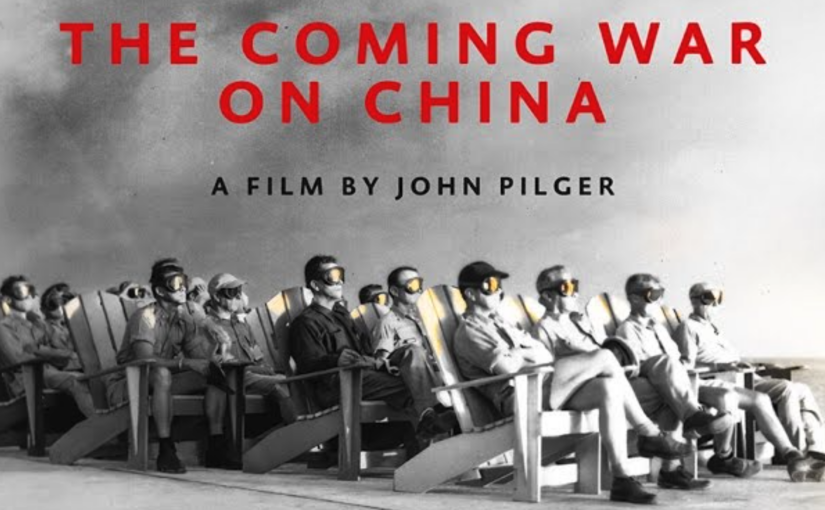
China specialist Dr Jenny Clegg, who is a member of the Friends of Socialist China advisory group, introduced and led a well-attended session on the AUKUS pact between Britain, Australia and the United States, and on the ‘coming war on China’. She was joined on the panel by Dr. Kate Hudson, General Secretary of the Campaign for Nuclear Disarmament (CND), and Warren Smith of the Australian Maritime Union.

We reproduce Jenny’s opening remarks below, which present an admirable and concise summary of the regional situation. Their cogency and urgency are only underlined by the subsequent visit of NATO Secretary General Jens Stoltenberg to Japan and South Korea.

Introduction

The Ukraine war, Russia, and NATO, have been demanding the attention of the anti-war movement, but there is also a whole other dimension to Global Britain that is unfolding in the Asia Pacific.

Some might say that the US and NATO want to weaken Russia before moving on to China in the future – in fact war preparations are accelerating right now in the East.

Progress on AUKUS

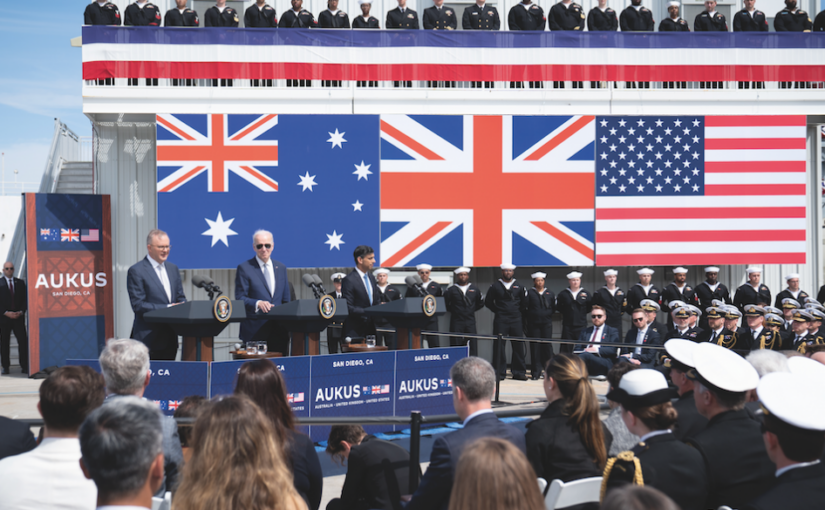
The announcement of AUKUS in September 2021 was a surprise, made with no democratic debate.  It came as the new Queen Elizabeth aircraft carrier was engaging in multiple joint military exercises in the South China Sea – flying the flag for Johnson’s Global Britain, demonstrating the new Indo Pacific tilt, but the F35 fighter jets it carried actually belonged to the USAF.

The key feature of the AUKUS pact was seen to be the US and UK agreement to assist Australia in acquiring nuclear powered submarines.  BAE systems declared itself ready to support production. However, over the last year, as the US and UK have tried to wangle their way around the nuclear Non-Proliferation Treaty (NPT) without apparent success, the deal has struggled and it is not certain that the US and UK can take on the building work given their own nuclear submarines programme commitments.

However, AUKUS is more than just the submarines: it is about Australian militarisation, about advancing military technologies and military industrial cooperation.  BAE systems, Rolls Royce and MBDA have long had subsidiaries in Australia helping to supply its armed forces.

Continue reading Standing against NATO and AUKUS a key issue for the peace movement

Presentation: Give Peace A Chance – China and the World Today

This presentation by Friends of Socialist China co-editor Carlos Martinez was given at a webinar organised by the Communist Party of the United States of America (CPUSA) Education Commission on the theme ‘Give peace a chance – China and the world today.’ The webinar took place on 22 January 2023.

Carlos discusses the current state of US-China relations, the reason for the deterioration in recent years, the bipartisan nature of the New Cold War, the dangers of ‘decoupling’, and the possibilities for moving towards a trajectory of peace and cooperation. He also answers the assertion that the hostility between US and China is a case of inter-imperialist rivalry, and explains why ‘Neither Washington Nor Beijing’ is a reactionary slogan, the effect of which runs counter to the aims of peace, progress, multipolarity and socialism.

Decoupling from China, Russia suicidal for Europe

This article by Friends of Socialist China co-editor Carlos Martinez, originally published in Global Times, discusses the record of the Biden administration in ramping up Cold War hostilities against China and Russia, and its attempts to get Europe on board with its strategy for protecting US hegemony. Carlos points out that “Anti-Russia and anti-China positions are harming the people of Europe”: sanctions on China’s semiconductor and solar energy industries are utterly self-defeating, and sanctions on Russian energy are feeding directly into a very serious cost of living crisis. He concludes that “the countries of Europe would be well advised to exercise foreign policy independence and to make decisions based on the needs of their own populations, which are calling out for peace, prosperity and a sustainable future.”

When Joe Biden was elected in November 2020, many around the world were hoping for a change of course in the US’ reckless new Cold War.

US-China relations have always been complex and difficult; yet from the early 1970s onward, the trajectory had been toward deepening economic cooperation and a nuanced handling of the contradictions immanent in the relationship. Even with the Obama-Clinton “Pivot to Asia,” which signaled the US’ shift in geostrategic focus toward China containment, there was still significant and productive cooperation between the two countries – most notably in the drafting of the Paris Agreement.

Donald Trump came to power with a promise to stop China “raping” the US economy. Blaming China soon became the new magic wand for explaining away the problems of US capitalism without having to deal with any of the real underlying causes of American decline. Singaporean academic and former diplomat Kishore Mahbubani noted that, rather than blaming China for everything, living standards in the US might improve if America stopped fighting unnecessary foreign wars and used its resources to improve the well-being of its people.

The Trump team initiated a trade war, imposed a ban on Huawei, and sought to ban TikTok and WeChat. They aimed to generate mass anti-China sentiment by engaging in flagrant racism, most infamously blaming the coronavirus pandemic on China. They introduced sanctions and issued disgraceful slanders. So it was assumed that surely, things would only get better under Biden.

Continue reading Decoupling from China, Russia suicidal for Europe

Webinar: Give peace a chance – China and the world today (22 January)

On Sunday 22 January (at 11am EST, 8am PST, 4pm GMT), the CPUSA Education Commission is organizing a webinar on the theme Give peace a chance – China and the world today. There will be a presentation by Friends of Socialist China co-editor Carlos Martinez, followed by discussion and Q&A.