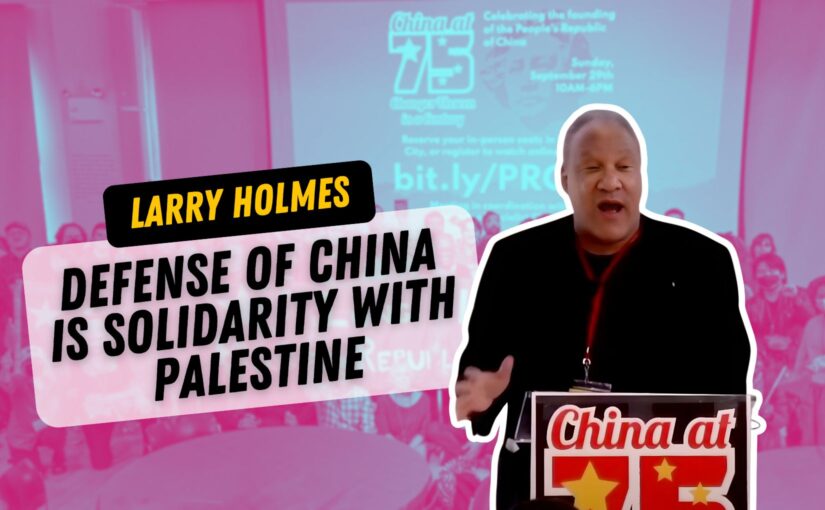
The following is the text of the talk given by Larry Holmes, First Secretary of the Workers World Party (WWP), at the September 29 meeting held in New York City to celebrate the 75th anniversary of the founding of the People’s Republic of China, which was initiated by Friends of Socialist China, together with WWP.
Larry begins by extending fraternal greetings to the Communist Party of China. on behalf of the WWP Central Committee, on the 75th anniversary.
After briefly reviewing the current situation in Palestine and Lebanon, he notes that this is part of a wider war against anti-imperialist forces around the world, including China, and explains:
“It’s against China… Why is this? Is it because China supports the Palestinians? That’s part of it. But that’s a small reason. China has, on a number of occasions, brought the Palestinian people together to try to help them forge unity… But the bigger reason… is because China is so powerful now. It’s so powerful and so developed as people are rising up and this has changed the balance of forces in the world. But we need to be very clear about something. China does not want war. China wants peace. It wants to continue its development in peace. It wants to help the world develop in peace, especially the people of the Global South who have been the big victims of imperialism and colonialism. It wants to help them, but US imperialism does not want peace. It doesn’t want China to develop in peace. It doesn’t want the world that it does not control to develop, and this is the problem.”
The text of Larry’s talk was originally published by Workers World.
First, on behalf of the Central Committee of Workers World Party, we would like to extend our fraternal greetings to the Communist Party of China on this historic occasion.
I think it’s relevant, even though our event is about China, to ask ourselves what we should make out of the assassination of the leader of Hezbollah two days ago.
This was so important to them — I’m not forgetting the genocide of Gaza — but this event, coming at this time — they dropped eight bombs on a neighborhood in Beirut. 2,000-pound bombs. One of these military analysts said the only thing bigger they could have dropped would have been a tactical nuclear weapon. These 2,000-pound bombs were given to Israel by who? The U.S. gave them thousands of them. I forget the exact number, but thousands of them.
I do not buy for a second this idea that, well we didn’t know about this, and they didn’t tell the secretary of war here. That’s BS. If they weren’t down with it, they could have stopped it. The message was just not from Netanyahu. It was from Washington, D.C. It was from the Pentagon.
And I’ll tell you why it’s relevant to China and the whole world. Everything in the world’s struggle is connected. Everything is dots all together. They wanted to let the world know that you don’t have to speculate about a wider war. You don’t have to lie to us about “why we don’t want one, and we have all this diplomacy trying to stop it.” That’s not what’s really going on.
The wider war is already here, and it’s not just against the Palestinians, although they are the main target, just as are the Lebanese, you know, the resistance forces of West Asia and, of course, Iran. It’s against People’s Korea, Cuba, Venezuela, the struggling people of West Africa, who, as you might notice recently, have been throwing the colonialists and the imperialists out.
And it’s against Russia through Ukraine, and ultimately, it’s against China.
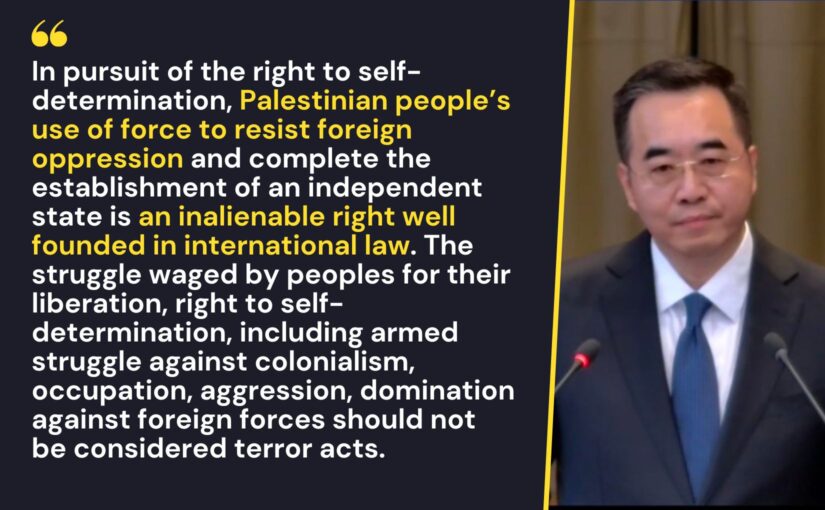
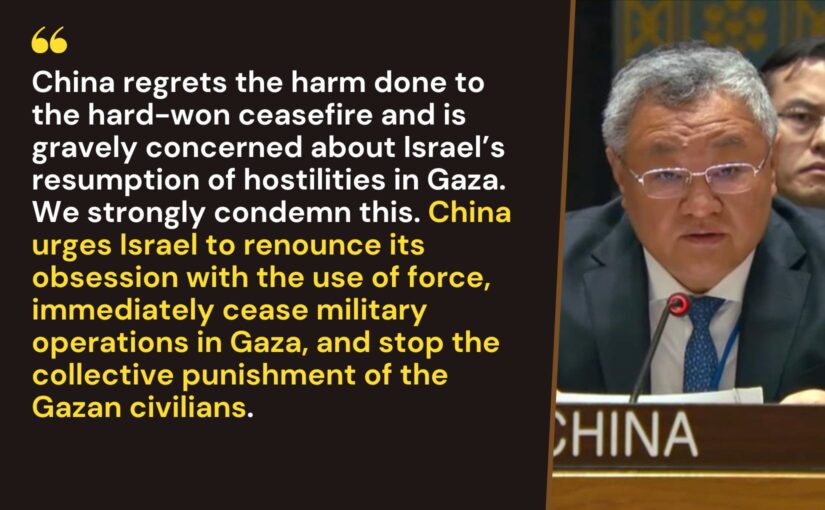
It’s against China. Wow. Why is this? Is it because China supports the Palestinians? That’s part of it. But that’s a small reason. China has, on a number of occasions, brought the Palestinian people together to try to help them forge unity. Very, very important.
But the bigger reason, the bigger reason, is because China is so powerful now. It’s so powerful and so developed as people are rising up, and this has changed the balance of forces in the world. But we need to be very clear about something.
China does not want war. China wants peace. It wants to continue its development in peace. It wants to help the world develop in peace, especially the people of the Global South who have been the big victims of imperialism and colonialism. It wants to help them, but U.S. imperialism does not want peace. It doesn’t want China to develop in peace. It doesn’t want the world that it does not control to develop, and this is the problem.
And what this murder in Beirut tells us – and there have been almost 1,000 people who have been murdered in Lebanon over the past couple of weeks – and the genocide in Gaza, what it tells us is that U.S. imperialism is willing to go to almost any length, unimaginable lengths of violence and terror to maintain its empire, which is crumbling.
They are willing to flirt with World War Three, which could mean the end of all life on the planet Earth. And you know, when an empire is crumbling, that’s when it’s most desperate and dangerous. That’s when it’s most likely to resort to violence. And this is what we are witnessing, comrades.
There are some in the ruling class here who are afraid of war, a wider war, a world war. They don’t think the U.S. will win. As a matter of fact they think it would hasten the demise of U.S. imperialism. And we think that they are right about that, and they’d like to maintain U.S. hegemony by other means. But whatever that is for the ruling class, they are losing. They’re not in the driver’s seat.
It’s the warmongers who are in the driver’s seat. So we see the people rising up all over the world against the empire. We see the people demonstrating in the streets over the murder of the leader of Hezbollah. Actually, as I was leaving home, I saw on social media that there was a demonstration of thousands of people in Baghdad. They had entered the Green Zone and were trying to get into the U.S. Embassy.
There are people demonstrating everywhere, around the world and particularly in West Asia. It shows you that — this is a hunch — they’re not going to take it by lying down. As a matter of fact, it’s going to wave off the mere resistance and, of course, the countries that are under attack, in particular China, that are in the crosshairs of U.S. imperialism, are going to fight back to defend themselves. They can defend themselves.
But we have to ask ourselves this. Are we going to just leave it up to people in other places, to China, they’re willing to do it, they’ll do what they have to do, but are we just going to leave it up to them? Especially those of us who happen to be at the center of world imperialism, particularly here in the U.S. which they used to call the belly of the beast. We can’t do that. That’s not right.
We have to seriously consider what our responsibilities as anti-imperialist revolutionaries are, and we have to show them those responsibilities, and then we gotta, we gotta do whatever it takes. You see, the people of the world, they’re demanding this of us. History is demanding us. Save this planet if it could talk, is demanding this of us, that we do whatever is necessary, however we need to do it. However long it takes, and it doesn’t have to take too long for the anti-war and anti-imperialist forces to get so big and so strong that we can shut the world down to stop war. What real choice do we have?
We’ve got to get away from complacency if that’s an issue. I know that there are those of us who do whatever we are doing on a day-to-day basis, whenever we can. We’ve got to get away from our routine — what they call routinism. It’s almost like a semi-conscious feeling that, yes, that needs to be done, but somebody else can do it.
Sometimes, I think we have a partial kind of disconnect, a partial, you know, denial of what’s happening. Perhaps we can feel somewhat powerless, but all things we’ve got to push aside now, we got to push them aside, and we got to figure out what we are going to do.
I think, I’m not sure, that comrade Maduro in Venezuela, a couple of months ago, called for an international united front against imperialism. Not sure if it’s just something that he floated, or whether it’s real and how he’s following up on that. But I’ll tell you comrades, if there was ever a time for that, and I’m not talking about just a name — he seems to have a name — I’m talking about something flesh and blood and strength and power that’s real. If there was ever a time for that, it’s now.
I’m thinking about our own plan. The BRICS countries are meeting in Russia in the last week of October. And that’s good. People have talked about … and we can talk about that. But again we can’t just leave it up to the BRICS to push imperialism back, to marginalize it, to diminish its hegemony. We’ve got to do something! The masses have to do something. The working class has to do something decisive. And a lot of us are convinced that they can. And those who are not convinced, better get with it.
Long live the People’s Republic of China!
Long live the struggle for socialism! Defend China!