Chinese Premier meets Malaysian, Vietnamese, Cambodian and Kuwaiti counterparts

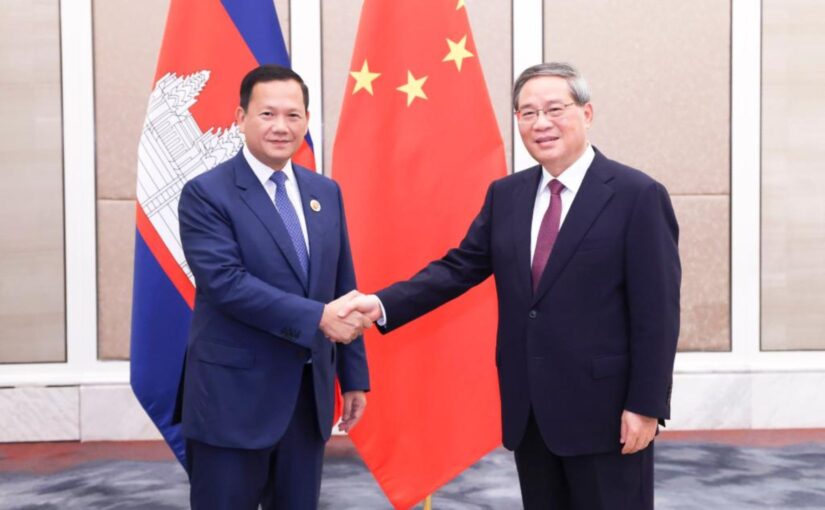
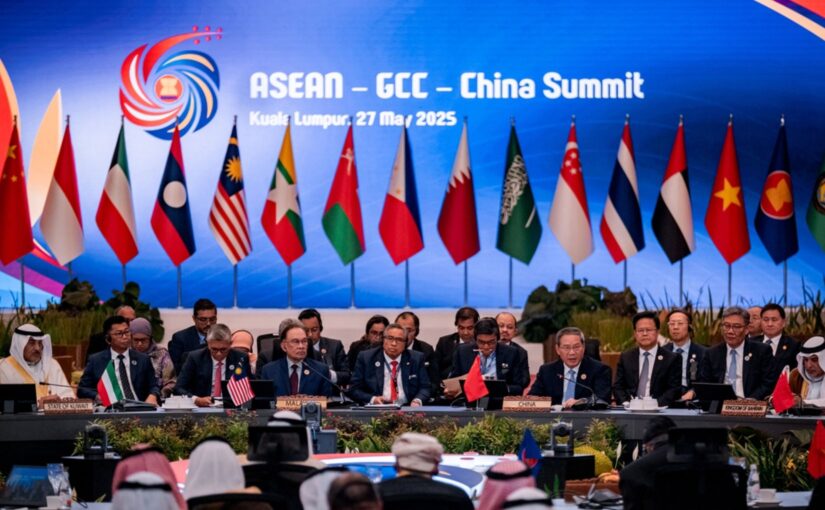
During his visit to Malaysia to participate in the first ASEAN (the Association of South East Asian Nations)-GCC (the Gulf Cooperation Council)-China Summit, May 26-28, held in the capital Kuala Lumpur, Chinese Premier Li Qiang also met on the sidelines with his host, Prime Minister Anwar Ibrahim, as well as with his counterparts from Vietnam and Cambodia and the Crown Prince of Kuwait.

Meeting with Anwar Ibrahim, Li said that China is ready to work with Malaysia to deepen exchanges and collaboration across various fields, and jointly usher in a new “Golden 50 Years” for bilateral ties guided by the principles of mutual respect and trust, equality and mutual benefit for win-win outcomes.

Recalling that Chinese President Xi Jinping paid a state visit to Malaysia last month, Li said that both sides agreed to build a high-level strategic China-Malaysia community with a shared future and mapped out the strategic direction for the development of bilateral relations. China is willing to work with Malaysia to implement the important outcomes of this historic visit. He urged the two sides to continue expanding trade and investment cooperation with a focus on cutting-edge areas, including the digital economy, the green economy and artificial intelligence, promote the integrated development of industrial and supply chains and value chains, and steadily advance major projects such as the “Two Countries, Twin Parks” and the East Coast Rail Link, so as to strengthen the economic growth engine of the China-Malaysia community with a shared future.

Noting that Malaysia is both the rotating chair of ASEAN and the host of the trilateral summit, Li said that China is ready to work closely with Malaysia to take the event as an opportunity to push for closer economic cooperation among the three sides, build a model of global cooperation and development, jointly safeguard free trade and the multilateral trading system and address global challenges together, so as to contribute greater stability, certainty and positive energy to a turbulent world.

Meeting with Vietnamese Prime Minister Pham Minh Chinh, Li said that not long ago, General Secretary of the Communist Party of China Central Committee and Chinese President Xi Jinping paid a successful state visit to Vietnam, where the two sides agreed to accelerate the building of a China-Vietnam community with a shared future that carries strategic significance. China stands ready to work with Vietnam to implement the outcomes of the visit, maintain high-level exchanges, deepen mutual political trust and enhance mutually beneficial cooperation in various fields.

For his part, Pham Minh Chinh noted that Xi paid a successful state visit to Vietnam last month. He said Vietnam will join hands with China to actively implement the important consensus reached by the top leaders of the two parties and the two countries, intensify high-level exchanges and deepen mutually beneficial cooperation in various fields. The Vietnamese side congratulates on the success of the first ASEAN-China-GCC Summit, he said, voicing his country’s willingness to work with China to pursue more practical achievements in tripartite cooperation.

Meeting Cambodian Prime Minister Hun Manet, Li said that Chinese President Xi Jinping has lately paid a historic visit to Cambodia, during which both sides jointly announced the building of an all-weather China-Cambodia community with a shared future in the new era.

 China-Cambodia relations have once again taken the lead in building a community with a shared future for humanity, and the ironclad friendship between the two countries has been further deepened, he added.

China stands ready to work with Cambodia to follow through on the outcomes of Xi’s visit, strengthen high-level exchanges, deepen political mutual trust, make good use of the China-Cambodia Intergovernmental Coordination Committee, and steadily advance practical cooperation across various fields. Encouraging more Chinese enterprises to invest in Cambodia, China is willing to strengthen cooperation with Cambodia in such areas as infrastructure, digital economy, advanced manufacturing and clean energy. China is willing to work with Cambodia and other countries in the region to strengthen solidarity and cooperation, jointly oppose unilateralism and power politics, safeguard international fairness and justice, uphold the multilateral trading system and maintain the stable and smooth flow of industrial and supply chains, so as to inject more positive energy into world peace, stability, prosperity and development.

Hun Manet said the Cambodian side stands ready to work with China to follow through on the outcomes of Xi’s visit, maintain high-level exchanges, give full play to the role of various dialogue mechanisms, boost practical cooperation, enhance cultural and people-to-people exchanges, and jointly combat cross-border crimes.

Noting that Cambodia supports the three global initiatives proposed by Xi, Hun Manet said that Cambodia looks forward to working with China to further strengthen multilateral coordination, uphold multilateralism, oppose protectionism, maintain regional security and stability, and promote global common development.

Continue reading Chinese Premier meets Malaysian, Vietnamese, Cambodian and Kuwaiti counterparts

ASEAN, GCC and China forge the new golden triangle of South-South Cooperation

Following his visit to Indonesia, Chinese Premier Li Qiang visited Malaysia for the first ASEAN (the Association of Southeast Asian Nations)-GCC (the Gulf Cooperation Council)-China Summit, held in the capital Kuala Lumpur, May 26-28.

This meeting, bringing together three key economic centres in the Global South, is being seen as a landmark development in international geopolitics and geoeconomics.

A commentary published by the Xinhua News Agency on the eve of the gathering described it as a new inter-regional cooperation model in Asia that will boost Global South unity:

“As leaders of the Association of Southeast Asian Nations (ASEAN) prepare for their 46th summit, an inaugural ASEAN-GCC (the Gulf Cooperation Council)-China Summit is also on the agenda, with expectations to expand inter-regional cooperation in Asia and shore up the common development of Global South countries.

“The gatherings, bringing together leaders of the three sides that have their unique strengths, will innovate cooperation models, boost growth momentum for Asia and beyond, and set a good example for Global South countries to unite and consolidate their collective development rights.

“The new endeavour is of special significance at a time when the world is haunted by the menace of protectionism and unilateralism, and international institutions are confronted with the challenge of fragmentation.

“ASEAN countries are beaming with economic vitality and development potential, while the GCC is a bloc rich in energy resources and investment capital. China, the world’s second-largest economy, also has much to offer in creating new cooperation opportunities through its vast consumer market and complete industrial system.

“China, the region’s economic powerhouse and an ardent promoter of cooperation, enjoys strong ties with both ASEAN and GCC countries.

“Trade, people-to-people exchanges, cooperation in energy, connectivity projects, finance and investment, innovation and green development have all witnessed steadfast growth among the three sides.

“As neighbours, China and ASEAN had by 2024 been each other’s largest trading partner for five consecutive years. Bilateral trade value soared from less than 8 billion US dollars in 1991 to nearly 1 trillion dollars in 2024.

“In  the latest development, China and 10 ASEAN countries have fully completed negotiations on the Version 3.0 China-ASEAN Free Trade Area, a milestone in bilateral trade cooperation that will inject greater momentum and stability into the world economy.

“With the GCC, China established contact upon the bloc’s inception in 1981. Forty-plus years on, the two sides have written together a splendid chapter of solidarity, mutual assistance and win-win cooperation.

“In 2024, trade between China and GCC countries reached over 288 billion dollars. Cooperation in investment, energy and green transformation is on the rise, thanks to the growing mutual trust and the high degree of complementarity in their respective economies.

“As the trilateral model of ASEAN-GCC-China cooperation continues to take shape, more growth momentum can be expected. Moreover, the three sides can coordinate better on regional and international affairs.

“With expanded and strengthened cooperation, the new model, together with mechanisms like the BRICS, can help create more solidarity and common prosperity for Global South countries.”

Xinhua also published a guest column by Julia Roknifard, a senior lecturer at the School of Law and Governance at Malaysia’s Taylor’s University, entitled “ASEAN-GCC-China cooperation a new ‘golden triangle’ in global affairs”.

According to Roknifard, “A remarkable mechanism of multilateral cooperation is emerging as the Association of Southeast Asian Nations (ASEAN), China and the Gulf Cooperation Council (GCC) are to hold an inaugural joint summit.

“The three parties now have more incentive than ever to coordinate in the current geopolitical climate, as some major countries are pursuing confrontation and protectionism, making the list of divergent interests only growing longer.

“China has already had a transformative impact on ASEAN and the broader Middle East economically, including the GCC states, through major infrastructure, trade and development efforts – particularly the Belt and Road Initiative and the Global Development Initiative. But the relationship runs deeper, with growing cooperation in technology, industrial development, tourism, cultural exchange and longstanding people-to-people ties.”

She adds: “China’s diplomatic and stabilising role on crucial issues has also boosted its standing in the region. Its calls for a peaceful and just resolution to the Palestinian conflict resonate with many in ASEAN, while its success in bringing together key Middle East powers, especially Iran and Saudi Arabia, has further elevated its profile and generated goodwill across the region.

“Despite efforts to draw ASEAN and the GCC members into bloc confrontation, the West is unable to pressure these countries as it previously could with its military and economic power, signaling a steady erosion of the leverage it once had. Amid ongoing conflicts and shifting economic realities, countries are increasingly prioritising partnerships that best serve their development goals, rather than accepting policies that hinder their progress.

“Bringing together all three parties creates a new platform for cooperation. Barring interference from outside parties, this emerging ‘Golden Triangle’ of resources, manufacturing, and consumers is poised to drive the global economy forward. It could also accelerate the spread of cutting-edge technologies pioneered by China – particularly in renewable energy vehicles and artificial intelligence tools like DeepSeek, which is developed at a fraction of the cost of Western counterparts.”

By way of contrast she notes: “As major European economies are close to recession and de-industrialisation, and the United States itself has lost its edge in shipbuilding tonnage and continues to lapse in other sectors, China continues to move forward as it is able to recognize this simple fact that ASEAN, the GCC and other regional groupings across Africa and Latin America are looking forward to a new era of peace and stable international relations.”

Addressing the summit, Premier Li Qiang said: “China, ASEAN and GCC countries have a long history of friendly interactions, with exchanges and cooperation between us spanning thousands of years from the ancient Silk Road to the Belt and Road Initiative. Today, against a volatile international landscape and sluggish global growth, the establishment of the ASEAN-China-GCC Summit creates a platform for exchanges and a mechanism for cooperation. It is a groundbreaking initiative in regional economic cooperation that has carried forward the legacy of history, and more importantly, answered the call of the times.

“Together, China, ASEAN and the GCC account for roughly a quarter of the world’s population and economic output. Our markets, if fully connected, will generate even greater space for development and more substantial economies of scale… China is ready to, on the basis of mutual respect and equality, work with ASEAN and the GCC to strengthen the alignment of development strategies, increase macro policy coordination, and deepen collaboration on industrial specialisation. We should make efforts to turn our respective strengths into collective strengths and help each other tackle development challenges.

“Countries of the three sides have diverse civilisations. At the same time, we all belong to the same Asian family and share the same Asian values of peace, cooperation, openness and inclusiveness. We should deepen people-to-people exchanges to further consolidate the foundation for mutual trust. We should effectively manage differences in the spirit of mutual understanding, advance win-win cooperation through the exchange of ideas, and explore a new way for promoting the inclusiveness and common progress of different civilisations. China actively supports [Malaysian] Prime Minister Anwar’s initiative on Islam-Confucianism dialogue.

“We should enhance synergy and connectivity in infrastructure, market rules and payment systems, actively consider establishing a regional business council, deepen economic integration, and make development more resilient and efficient. While expanding cooperation in traditional areas such as energy and agriculture, we also need to step up cooperation in emerging areas such as AI, the digital economy, and green and low-carbon development to foster and cultivate new growth drivers.

“At the global level, we should always stand on the right side of history and add more positive energy to world peace and development. We should pursue equal, mutually beneficial, open, inclusive, practical and efficient cooperation, and, through our example, encourage the international community to uphold multilateralism and free trade and reject unilateralism and protectionism. China will work with ASEAN and GCC countries to step up communication and coordination in multilateral mechanisms including the United Nations, vigorously defend the common interests of developing countries, categorically oppose hegemonism and power politics, and make global governance more just and equitable.”

Continue reading ASEAN, GCC and China forge the new golden triangle of South-South Cooperation
China blasts yet another US veto of Gaza ceasefire resolution

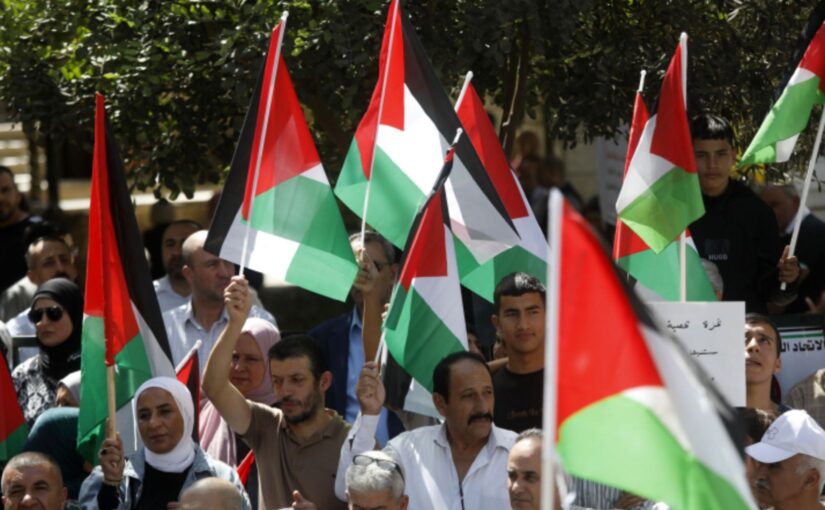
On June 4, the United States once again vetoed a United Nations Security Council (UNSCC) resolution on the humanitarian situation in Gaza and calling for a ceasefire. All other 14 members of the Council, including France and Britain, voted in favour of the resolution, which had been jointly prepared by the E10, the 10 rotating, non-permanent UNSC members.

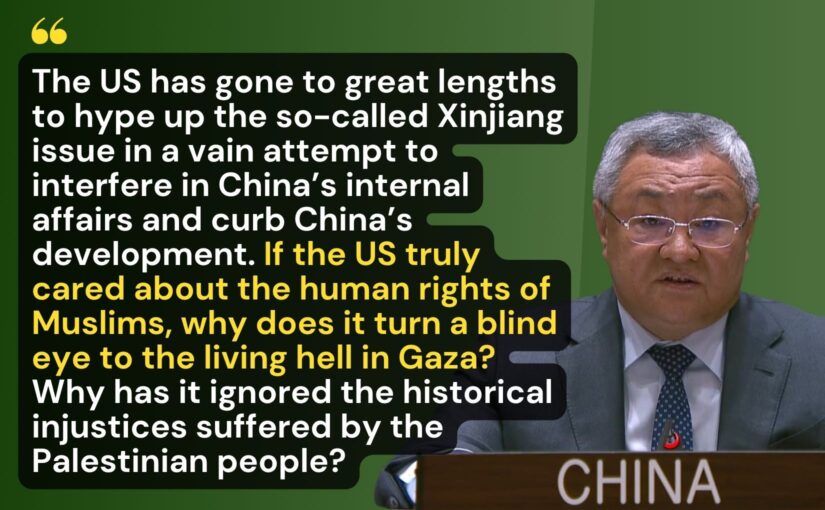
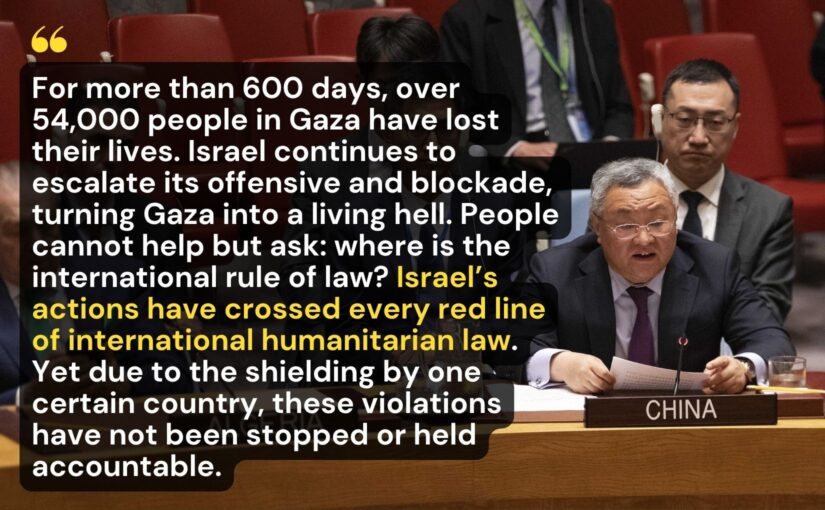
Following the US veto, Chinese Ambassador to the UN Fu Cong stated: “China is deeply disappointed by the result of today’s vote. The draft resolution on the humanitarian situation in Gaza, tabled by the E10 of the Security Council, clearly calls for an immediate and permanent ceasefire in Gaza and the lifting of the blockade on humanitarian supplies. These are the most pressing demands of the people in Gaza, who are struggling amid death and despair, and they reflect the overwhelming voice of the international community. The United States has once again abused its veto power, extinguishing the glimmer of hope for the people in Gaza and ruthlessly continuing to leave over two million people in darkness.”

He continued:

  • People cannot help but ask: where is fairness and justice? For more than 600 days, over 54,000 people in Gaza have lost their lives. Israel continues to escalate its offensive and blockade, turning Gaza into a living hell. Innocent civilians are killed in the conflict every day, while a large portion of the population is on the brink of famine. The United Nations has clearly pointed out that the aid delivery mechanism promoted by the US and Israel violates the principles of impartiality, independence, and neutrality. Recently, there have been repeated incidents of civilian casualties near distribution sites, and this mechanism has even become a death trap.
  • People cannot help but ask: where is the international rule of law? Since the outbreak of the conflict, we have witnessed the weaponisation of humanitarian aid, the targeting of civilian infrastructure, such as schools and hospitals, and the ruthless killing of journalists and humanitarian workers. Israel’s actions have crossed every red line of international humanitarian law and seriously violated Security Council and General Assembly resolutions, as well as the provisional measures ordered by the ICJ [International Court of Justice]. Yet due to the shielding by one certain country, these violations have not been stopped or held accountable.
  • People cannot help but ask: where is the authority of the Security Council? Today’s vote result once again exposes that the root cause of the Council’s inability to quell the conflict in Gaza is the repeated obstruction by the US, who has vetoed the Council’s request for a ceasefire multiple times. And because of its shielding of Israel, several resolutions adopted by the Council have not been effectively implemented. Claims that Security Council actions would interfere with diplomatic efforts are completely untenable.

Earlier, in remarks at a Security Council briefing on the situation, held on May 28, during the drafting of the resolution, Fu Cong said that:

“Since May 16, Israel has continued to intensify its military offensive in Gaza, which has completely destroyed large densely populated areas and caused the deaths of more than 1,000 Gazans in the past two weeks alone.”

He continued:

  • The question has been repeatedly asked: When will this conflict end? Over the past 600 days, northern, central, and southern Gaza have been ravaged by war, claiming the lives of more than 54,000 people. The population of Gaza has been forcefully displaced time and again.
  • The question has been repeatedly asked: Are there no limits to the means of this conflict? Even wars have rules. Compliance with international humanitarian law is an undeniable obligation of all parties. In Gaza, however, we have witnessed the red lines of international law and the bottom line of human morality being repeatedly violated and breached. Humanitarian assistance has been weaponised, with two million people plunged into extreme hunger as a result of the prolonged blockade. Schools, hospitals, refugee camps, and UN facilities have been targeted. Journalists and humanitarian workers have been mercilessly killed. Securing humanitarian assistance is an obligation of the occupying power under international law.
  • The question has been repeatedly asked: Will the Palestinian people be forced to lose their homes once again? Gaza is in ruins with living conditions severely jeopardised. Recently, there have been repeated calls from the Israeli side for completely destroying and taking over all of Gaza. The Israeli army has already controlled more than 70% of Gaza. At the same time, continued expansion of settlements in the West Bank and intensified settler violence gravely squeezed the space for the Palestinian people to survive. Changing the demographic and territorial composition of Gaza, as well as settlement activities, are in violation of the Security Council resolutions and international law. The annexation of Gaza and the West Bank will completely take away the prospects for peace in the Middle East.

He added: “Gaza and the West Bank are inalienable parts of the State of Palestine. The international community must firmly oppose any attempt to annex the territories of Gaza or the West Bank and oppose the forced displacement of the population of Gaza. The United States, as a country with significant influence over the party involved, should act in a fair and responsible manner and take effective and forceful actions.”

The following articles were originally published on the website of the Chinese Mission to the United Nations.

Explanation of Vote by Ambassador Fu Cong on the UN Security Council Draft Resolution on the Humanitarian Situation in Gaza

June 4 (China UN Mission) — President,

At the outset, let me congratulate Guyana on assuming the Presidency of the Security Council this month, and Greece on successfully completing its Presidency of the Council last month. 

Continue reading China blasts yet another US veto of Gaza ceasefire resolution

China condemns Israeli war crimes and expresses solidarity with the Palestinian people

China has twice recently used the platform of the United Nations to condemn Israeli war crimes, draw attention to the role played by the United States and to express solidarity with the struggle of the Palestinian people and with their national aspirations.

Speaking at a Nakba commemoration on May 15, Ambassador Geng Shuang said that: “Seventy-seven years ago, more than half of the Palestinian people were expelled or fled from their homes during the Arab-Israeli war, and they have since embarked on the arduous journey of striving for their legitimate rights and interests. Today, 77 years later, the historical injustice suffered by the Palestinian people has not only remained unaddressed but has even worsened. 

“The war in Gaza has lasted for 19 months, claiming the lives of more than 53,000 Gazans and leaving the once beautiful cities and towns in ruins. Israel’s escalating siege on Gaza has led to an unprecedented humanitarian catastrophe for two million people who face the threat of forced relocation. The continued expansion of settlements in the West Bank and the intensifying settler violence have relentlessly squeezed the space for the Palestinian people and eroded the basis of the two-State solution.”

He added that, “On the question of Palestine, China, upholding fairness and justice, remains steadfast in its support for the just cause of the Palestinian people to restore their legitimate national rights, for the early establishment of the fully sovereign and independent State of Palestine based on the 1967 borders with East Jerusalem as its capital, and for the early admission of the State of Palestine as a full member of the UN,” adding that China would continue to work tirelessly for, “a comprehensive, just, and lasting solution to the question of Palestine at an early date, so that the Nakba day will forever remain in the past.”

Two days previously, on May 13, Ambassador Fu Cong addressed a UN Security Council Briefing on the Humanitarian Situation in Gaza and said:

“Gaza has become a living hell. Israel’s continuous bombing and raids are causing civilian casualties every day. On May 7 alone, there were more than 100 lives lost. Over the two-month-plus blockade, Gaza’s survival supplies were depleted. Hunger and disease are spreading rapidly. According to the IPC [Integrated Food Security Phase Classification] report, the population in Gaza are suffering from severe food shortages, with nearly half a million people in a state of catastrophic hunger.

Continue reading China condemns Israeli war crimes and expresses solidarity with the Palestinian people

China says Gaza humanitarian crisis ‘unprecedented’, urges ICJ to uphold law

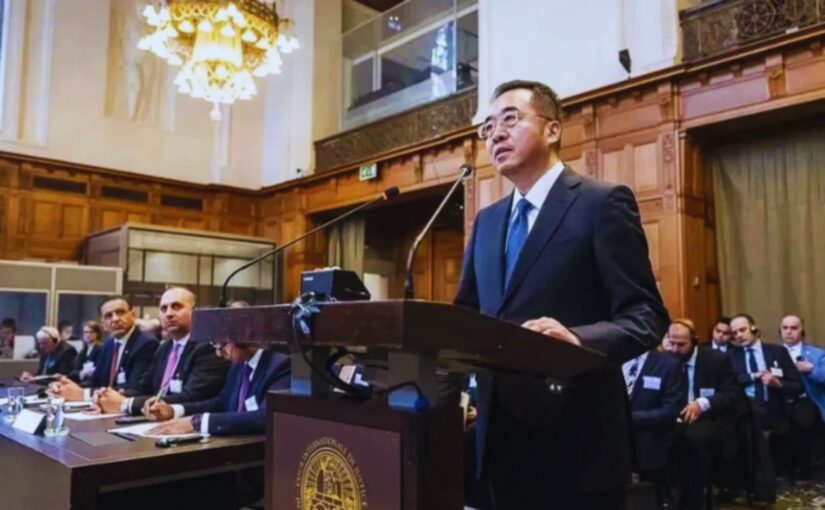
China has told the International Court of Justice (ICJ) that the humanitarian crisis in Gaza and the occupied Palestinian territory has reached “unprecedented” levels and called on the court to uphold international law and international justice.

Addressing week-long public hearings recently held by the court to assess Israel’s legal obligations for the provision of humanitarian aid and the Palestinian people’s right to self-determination, Chinese representative Ma Xinmin said:

“The situation grows more desperate. In Gaza and throughout the occupied territories, we are witnessing an unprecedented humanitarian crisis threatening to overwhelm an already suffering people.”

He stressed that Israel has a clear legal obligation to accept humanitarian assistance from third parties when the population is inadequately supplied: “This is not a discretionary choice. Refusing such assistance could constitute a denial of humane treatment of civilians or a form of collective punishment, both prohibited under international law.”

Despite the advisory opinion issued by the court last year, he emphasised: “Occupation continues and starvation persists.

“The desperate eyes of Gaza children pierce our conscience with two burning questions: Will international law surrender to brute force? Will the pillars of civilisation yield before the law of the jungle?”

The following article was originally published by Palestine Chronicle.

China told the International Court of Justice (ICJ) on Friday that the humanitarian crisis in Gaza and the occupied Palestinian territory has reached “unprecedented” levels, and called on the court to uphold international law and international justice, the Anadolu news agency reported.

“The situation grows more desperate. In Gaza and throughout the occupied territories, we are witnessing an unprecedented humanitarian crisis threatening to overwhelm an already suffering people,” said Ma Xinmin, representing China.

He stressed that Israel has a clear legal obligation to accept humanitarian assistance from third parties when the population is inadequately supplied.

“This is not a discretionary choice. Refusing such assistance could constitute a denial of humane treatment of civilians or a form of collective punishment, both prohibited under international law,” he said.

The week-long public hearings began on Monday to assess Israel’s legal obligations for the provision of humanitarian aid and the Palestinian people’s right to self-determination, following a request from the UN General Assembly.

Aid Workers

Beijing also expressed deep concern over casualties among humanitarian workers in the occupied Palestinian territory, stressing that Israel must ensure the privileges and immunities of UN agencies and bodies.

China reaffirms, the representative said, that the UN should play a “central and unique role” in leading and coordinating humanitarian assistance and called on all states to cooperate to provide relief to the Palestinian people. He reiterated that the fundamental solution lies in implementing a two-state solution.

Despite the advisory opinion of the court last year, he emphasized, “Occupation continues and starvation persists.”

“The desperate eyes of Gaza children pierce our conscience with two burning questions: Will international law surrender to brute force? Will the pillars of civilization yield before the law of the jungle?” he asked.

China also urged the court to issue an advisory opinion that would uphold the integrity of international law and “stir the conscience of the international community” to safeguard fairness, justice, and the rule of law.

Blockade ‘Unacceptable’ – UK

On Thursday, the United Kingdom told the ICJ that Israel must lift its restrictions on humanitarian assistance to Gaza, ensure civilian protection, and fully comply with international humanitarian law, Anadolu reported.

“It is unacceptable that Israel has blocked humanitarian support from entering Gaza for nearly two months, meaning that Palestinian civilians, including one million children, are facing starvation, disease, and death,” said UK representative Sally Langrish, recalling the UK Foreign Office Minister David Lammy’s recent statement to the UN Security Council in which he urged a return to the ceasefire “to end the relentless death and destruction that Palestinians face daily.”

Langrish emphasized the UK’s consistent call on Israel to allow humanitarian access and noted the UK’s suspension of certain arms export licenses to Israel in September 2024, citing “the clear risk that certain military exports to Israel might be used in violation of international humanitarian law.”

UNRWA an ‘Impartial’ Body

Michael Wood, also speaking for the UK, underlined Israel’s obligations under the UN Charter, the 1946 Convention on the Privileges and Immunities of the UN, and international humanitarian law. He said Israel must respect the legal capacities, privileges, and immunities of the UN and its agencies, including UNRWA.

Langrish explained that under Article 59 of the Fourth Geneva Convention, Israel must agree to and facilitate relief efforts when the population is undersupplied. Refusing would be a violation of international law, she said.

She affirmed that the UK regards UNRWA as an “impartial humanitarian organization” and supports its mandate, while stressing the need for the agency to uphold strict neutrality and investigate any allegations of misconduct, noting that such investigations are already underway.

US Defends Israel

The US has stood nearly alone in defending Israel’s restrictions on UNRWA at the hearings.

Josh Simmons, of the US State Department legal team, argued that Israel “has ample grounds  to question UNRWA’s impartiality.”

He cited Israel’s allegations that Hamas “has used UNRWA facilities and that UNRWA staff participated in the 7 October terrorist attack against Israel.”

“In sum, there is no legal requirement that an occupying power permit a specific third state or international organization to conduct activities in occupied territory that would compromise its security interests,” he stated.

Simmons said the US supports the flow of humanitarian aid into Gaza, “with the safeguards to ensure it is not looted or misused by terrorist groups.”

Rising Death Toll

Representatives from 40 countries and four international organizations are presenting oral submissions during the proceedings, including Türkiye, Malaysia, South Africa, China, Russia, Spain, Ireland, Brazil, Qatar, Saudi Arabia, and Egypt.

Key organizations, including the UN, the Organization of Islamic Cooperation, and the Arab League, will also contribute.

Israel, which is among the countries that submitted written statements, will not make an oral submission during the hearings.

Israel also faces a genocide case at the ICJ for its war on the Gaza Strip, which, since October 2023, has killed more than 52,000 Palestinians and reduced much of Gaza to rubble.

The International Criminal Court issued arrest warrants last November for Netanyahu and his former Defense Minister, Yoav Gallant, for war crimes and crimes against humanity in Gaza.

Breaking the silence on Palestinian armed struggle: a call for legal clarity

The following article by Ramzy Baroud and Romana Rubeo, reposted from Palestine Chronicle, addresses the Palestinian people’s right to armed struggle against colonial occupation – recognised under international law but widely ignored by Israel and its supporters.

The authors highlight the significance of the February 2024 testimony at the International Court of Justice (ICJ) by Ma Xinmin, legal advisor to China’s Foreign Ministry, articulating the Chinese position on this conflictive issue, a topic that “even Palestine’s closest allies in the Middle East and Global South dare not touch”.

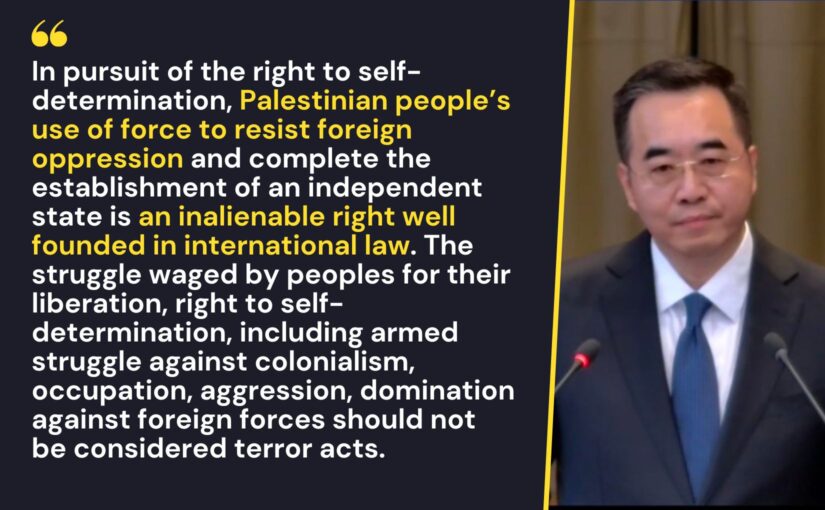
Palestinian people’s use of force to resist foreign oppression and complete the establishment of an independent state is an inalienable right… The struggle waged by peoples for their liberation, right to self-determination, including armed struggle against colonialism, occupation, aggression, domination against foreign forces should not be considered terror acts.

The article cites Professor Richard Falk, a leading scholar of international law and former UN special rapporteur for Palestine, strongly supporting this position. Addressing the events of 7 October 2023, Falk states: “To the extent that there is real evidence of atrocities accompanying the October 7 attack, those would constitute violations, but the attack itself is something that, in context, appears entirely justifiable and long overdue.”

These points are hugely important in that they affirm the legal and moral legitimacy of Palestinian resistance, and counter the relentless attempts to delegitimise the Palestinian struggle. As such, China’s clearly-stated position is a valuable contribution to the pursuit of Palestinian national rights.

On February 22, 2024, Ma Xinmin, China’s Representative at the International Court of Justice (ICJ), uttered the unexpected.

His testimony, like that of a number of others, was meant to help the International Court of Justice (ICJ) formulate a critical and long-overdue legal opinion on the legal consequences of Israel’s occupation of Palestine. 

Ma Xinmin articulated the Chinese position, which, unlike the American envoy’s testimony, was entirely aligned with international and humanitarian laws.

But he delved into a tabooed subject—one that even Palestine’s closest allies in the Middle East and Global South dared not touch: the right to use armed struggle.

 “Palestinian people’s use of force to resist foreign oppression and complete the establishment of an independent state is an inalienable right,” the Chinese Ambassador said, insisting that “the struggle waged by peoples for their liberation, right to self-determination, including armed struggle against colonialism, occupation, aggression, domination against foreign forces should not be considered terror acts”.

Continue reading Breaking the silence on Palestinian armed struggle: a call for legal clarity

China: Israel must renounce its obsession with the use of force and immediately cease military operations in Gaza

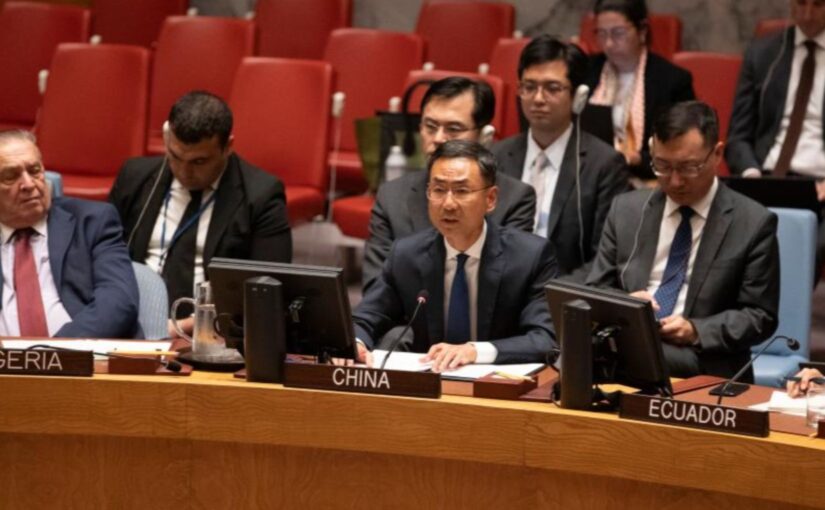
Speaking at a briefing meeting of the United Nations Security Council (UNSC), called by non-permanent members Algeria and Somalia, China has strongly condemned Israel for its breach of the ceasefire and its new crimes committed against the civilian population of Gaza, which have seen hundreds killed, a huge number of them children, in a single day.

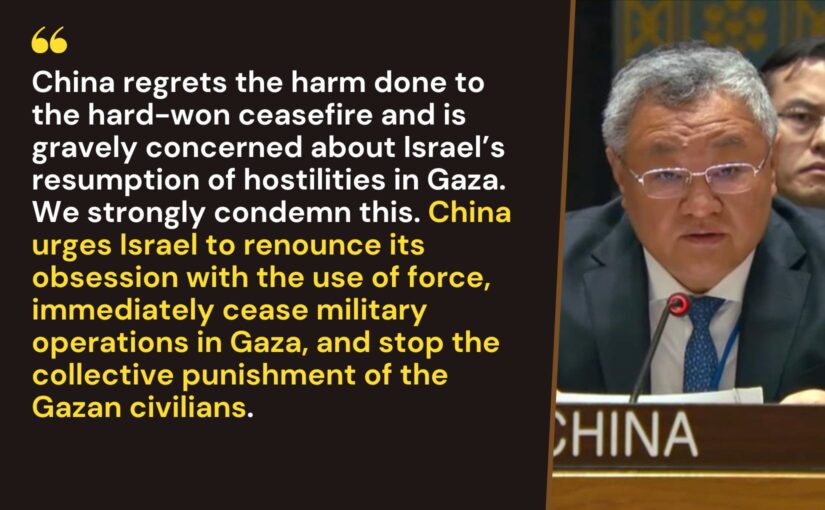
At the March 18 meeting, Ambassador Fu Cong said: “With the implementation of the ceasefire on January 19, people in Gaza had a long-awaited respite, and the humanitarian disaster was relieved to some extent… In spite of the strong calls from the international community to extend the Gaza ceasefire and the strong desire of the Gaza population for the resumption of peace and tranquility, the situation has moved in the opposite direction. On March 2, Israel announced the decision to halt the entry of humanitarian aid to Gaza. On March 9, it cut off the supply of power to Gaza. Just yesterday, Israel launched large-scale airstrikes against Gaza, causing hundreds of civilian casualties. China regrets the harm done to the hard-won ceasefire and is gravely concerned about Israel’s resumption of hostilities in Gaza. We strongly condemn this.” 

China, he continued, urged Israel, “to renounce its obsession with the use of force, immediately cease military operations in Gaza, and stop the collective punishment of the Gazan civilians,” adding:

“We strongly oppose the weaponisation and politicisation of humanitarian aid. As of today, for 17 consecutive days, no humanitarian supplies were allowed into Gaza, and the loss of power disabled a desalinisation plant, worsening the water shortage crisis. The use of humanitarian aid as a bargaining chip is in violation of international law, especially international humanitarian law. China condemns such practice.”

China supports, “the Gaza recovery and reconstruction plan jointly initiated by Egypt and other Arab states and supports an early launch of reconstruction underpinned by the principle of Palestinians governing Palestine, whereby the Palestinian people can rebuild their homes in their own territory.”

The following is the full text of Ambassador Fu Cong’s remarks. It was originally published on the website of China’s Permanent Mission to the United Nations.

President, 

I thank Algeria and Somalia for initiating today’s meeting, and thank Under-Secretary-General Tom Fletcher for the briefing. 

With the implementation of the ceasefire on January 19, people in Gaza had a long-awaited respite, and the humanitarian disaster was relieved to some extent. However, as the first phase of the ceasefire expired on March 1, the ceasefire agreement failed to enter the second phase. In spite of the strong calls from the international community to extend the Gaza ceasefire and the strong desire of the Gaza population for the resumption of peace and tranquility, the situation has moved in the opposite direction. On March 2, Israel announced the decision to halt the entry of humanitarian aid to Gaza. On March 9, it cut off the supply of power to Gaza. Just yesterday, Israel launched large-scale airstrikes against Gaza, causing hundreds of civilian casualties. China regrets the harm done to the hard-won ceasefire, and is gravely concerned about Israel’s resumption of hostilities in Gaza. We strongly condemn this. 

We strongly urge the abandonment of the logic of supremacy of force. Military means is not the way to solve the Palestinian-Israeli issue. The stark contrast between 15 months of bloody conflict and 42 days of ceasefire clear shows that the indiscriminate use of force is not the right way to bring back hostages and may even put them at greater risks. China urges Israel to renounce its obsession with the use of force, immediately cease military operations in Gaza, and stop the collective punishment of the Gazan civilians. 

We strongly demand a permanent ceasefire in Gaza. Since the ceasefire agreement was reached, it should be fully and seriously implemented in good faith, and no attempt should be made to alter or undermine it midway. China calls on the parties to implement the ceasefire agreement fully and continuously, and expects the ceasefire guarantors to adopt a fair and responsible approach to facilitate the continuous implementation of the three-phase agreement and ensure the realization of a permanent ceasefire in Gaza. 

We strongly oppose the weaponization and politicization of humanitarian aid. As of today, for 17 consecutive days, no humanitarian supplies were allowed into Gaza, and the loss of power disabled a desalinization plant, worsening the water shortage crisis. The use of humanitarian aid as a bargaining chip is in violation of international law, especially international humanitarian law. China condemns such practice. We urge Israel to fulfill its obligations as the occupying power under international humanitarian law and immediately restore full humanitarian access to Gaza. 

We strongly call for the revitalization of the political prospects of the two-State solution. The implementation of the two-State solution is the only viable way to resolve the question of Palestine. Gaza and the West Bank, including East Jerusalem, are all inseparable parts of the Palestinian state. We support the Gaza recovery and reconstruction plan jointly initiated by Egypt and other Arab states, and support an early launch of reconstruction underpinned by the principle of Palestinians governing Palestine, whereby the Palestinian people can rebuild their homes in their own territory. The international community should step up its efforts to advance the political process of the two-State solution and provide necessary support to this end. 

President, 

For some time now, we have witnessed a dangerous sign in the Middle East. As the international rule of law and international order are violated and undermined, the law of the jungle seems to reign. This is worrisome and concerning. The Security Council, as the primary body for maintaining international peace and security, should put a prompt end to such chaos. We support further actions by the Council to bring about a permanent ceasefire in Gaza, restore peace in the Middle East, and achieve a comprehensive, just, and lasting solution to the Palestinian question. 

Thank you, President.

Wang Yi: China will always be a trustworthy and reliable friend and partner of South Africa

Whilst attending the G20 Foreign Ministers meeting in Johannesburg, South Africa, Chinese Foreign Minister Wang Yi held meetings on the sidelines with South African President Cyril Ramaphosa, Ngozi Okonjo-Iweala, Director-General of the World Trade Organisation (WTO), along with his counterparts from a number of countries.

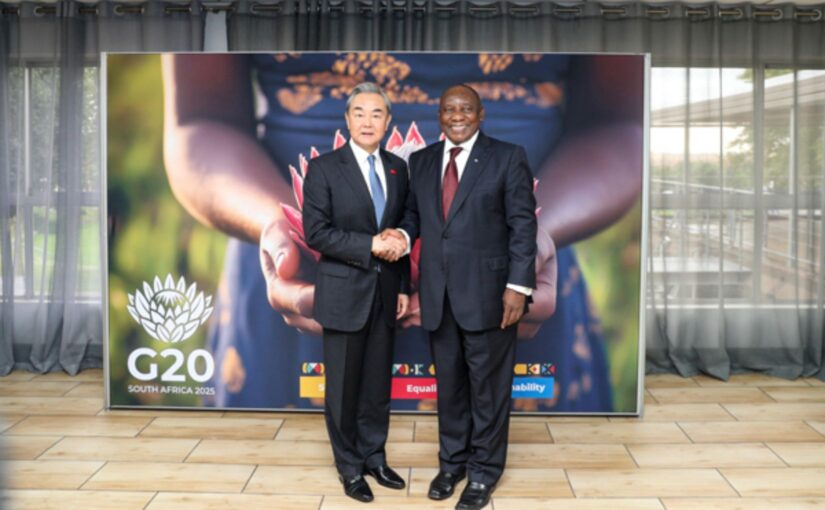
Wang met with President Ramaphosa on February 20.

Cyril Ramaphosa asked Wang Yi to convey his sincere greetings to President Xi Jinping and expressed his heartfelt thanks to China for its firm support for South Africa’s struggle for national independence and its valuable help in accelerating national development. South Africa cherishes the high-level mutual trust between the two countries, regards China as a reliable friend, and will continue to firmly pursue the one-China policy.

Wang Yi conveyed the cordial greetings from President Xi Jinping, saying that China and South Africa have always understood and supported each other and carried out close exchanges, communication and coordination, which demonstrates the high level of bilateral relations. In the process of South Africa’s development and revitalisation, China will always be a trustworthy and reliable friend and partner of South Africa and is willing to continue to provide assistance within its capacity.

The next day he met with his South African counterpart Ronald Lamola.

Wang said, by assuming the G20 presidency, South Africa represents Africa in making a strong voice on the global stage, which demonstrates the historic shifts in international political and economic landscapes and holds great symbolic significance. As multilateralism faces threats amid the rise of unilateral bullying and protectionism, the foreign ministers’ meeting under the theme ‘Solidarity, Equality, Sustainability’ has reflected the common aspirations of most countries, especially those from the Global South.

Ronald Lamola thanked China for its strong support for South Africa’s G20 presidency. In the face of a volatile international situation, South Africa remains committed to strengthening close coordination and cooperation with China to safeguard the common interests of the Global South countries.

In her meeting with Wang, World Trade Organisation Director-General Ngozi Okonjo-Iweala said that amid the chaos in the world, China has moved in the right direction, achieved the UN poverty reduction target ahead of schedule, advanced industrialisation rapidly and made remarkable achievements in education. China’s success has set an example and provided references for other developing countries.

One of Wang’s first meetings on arriving in South Africa was with Russian Foreign Minister Sergei Lavrov, who had come direct from talks on the Ukraine issue with US Secretary of State Marco Rubio, held in Saudi Arabia.

Wang Yi said that the China-Russia comprehensive strategic partnership of coordination for a new era is advancing to a higher level and broader dimensions. The two sides have maintained steady progress in mutually beneficial cooperation and engaged in close and effective strategic coordination, playing a crucial role in safeguarding the common interests of both countries and their peoples and advancing the multipolarity in the world.

This year, he continued, marks the 80th anniversary of the victory of the World Anti-Fascist War and the founding of the United Nations, which is of great historic significance. During that arduous struggle, the peoples of China and Russia fought valiantly on both the Eastern and Western fronts, enduring tremendous national sacrifices and making significant historical contributions in the effort to save their nations from the brink of destruction and strive for world peace. China and Russia, as major victorious nations of World War II and permanent members of the United Nations Security Council, jointly bear the crucial responsibility of safeguarding the victorious results of World War II and maintaining the post-war international order. No matter how the situation evolves, the foundation of China-Russia friendship remains unshakable. Both sides should take the opportunity of jointly commemorating the 80th anniversary to deepen China-Russia strategic coordination, actively promote the correct view on World War II, firmly defend the international system with the United Nations at its core and safeguard the legitimate rights and interests of Global South countries.

Sergei Lavrov said, President Vladimir Putin and President Xi Jinping charted the course for Russia-China relations and strategic coordination. Russia is also willing to work with China to hold a series of events to commemorate the 80th anniversary of the victory of World War II. Russia also highly recognises the global initiatives put forward by China, highly values the high-level mutual trust between the two countries and is willing to continue to strengthen communication and coordination with China within the BRICS mechanism, the Shanghai Cooperation Organisation, the United Nations, the G20, and other frameworks.

Sergei Lavrov also introduced the latest developments in the Ukraine crisis and Russia’s considerations, saying that his country focuses on solving the root causes of the crisis and is committed to seeking a fair and sustainable plan for peace in line with the UN Charter. Russia attaches importance to China’s objective and just position, and the ‘Friends for Peace’ group China initiated with Brazil and other countries, and is willing to maintain communication with China and strengthen cooperation with the countries of the South.

Wang Yi met with Turkish Minister of Foreign Affairs Hakan Fidan at the latter’s request.

Continue reading Wang Yi: China will always be a trustworthy and reliable friend and partner of South Africa

China: ‘Palestinians governing Palestine’ is an important principle that must be upheld

Following his visit to New York, where he chaired the high-level United Nations Security Council meeting on ‘Practicing Multilateralism, Reforming and Improving Global Governance’, Chinese Foreign Minister Wang Yi flew to South Africa to attend the Johannesburg meeting of G20 foreign ministers, the first such gathering to be held on African soil.

In a deeply racist and hegemonic move, the meeting was boycotted by the United States Secretary of State Marco Rubio, with the US citing South Africa’s tentative moves in land reform aimed to redress the iniquities of the erstwhile racist apartheid system and the legacy of colonial rule as well as the host country highlighting the issues of diversity, equality and tackling climate change, all of which are in the crosshairs of the Trump administration. Trump is also determined to punish South Africa for its courageous and principled leading role in unmasking and opposing Israeli genocide against the Palestinian people. It should further be noted that plutocratic capitalists with intimate ties to Trump, such as Elon Musk and Peter Thiel, have deep ties to the old racist system in South Africa. The US retreat into unilateralism, and attempts at bullying, only served to highlight the unique role of China as the major power putting forward constructive strategies and proposals in the common interest of the vast majority of humanity.

In his speech delivered on February 20, the first day of the conference, Wang Yi said that China would work with all other parties in the following areas:

  • Acting as the guardians of world peace. Countries should respect each other’s sovereignty and territorial integrity and respect the development paths and social systems independently chosen by each other. Countries should persevere with dialogue and negotiation and seek peaceful settlements to differences and political solutions to international and regional hotspot issues. The Five Principles of Peaceful Coexistence, initiated by China and some other Global South countries 70 years ago, remain as relevant as ever under current circumstances.
  • Acting as the builders of universal security. Humanity is a community with a shared future. It is also an indivisible community of shared security. A country must not pursue its own security at the expense of the security of other countries, and the legitimate security concerns of all countries should be taken seriously.
  • Acting as the defenders of multilateralism. This year marks the 80th anniversary of the United Nations. It is also the 80th anniversary of the victory of the World Anti-Fascist War.  

Noting that previous speakers had all spoken about the Ukraine crisis, Wang Yi said: “Although the parties have different positions and it is hard to find simple solutions to complex issues, dialogue is always better than confrontation and peace talks better than fighting… Acting on the wishes of the relevant parties and keeping in mind the concerns of the international community, especially those of the Global South, China will continue playing a constructive role in the political settlement of the crisis.”

And turning to the question of Palestine, he remarked: “The conflict in Gaza has caused an unprecedented humanitarian disaster. The flames of war must not be reignited, and the ceasefire agreement must be implemented in a continuous and effective manner. Gaza and the West Bank are the homeland of the Palestinian people. ‘The Palestinians governing Palestine’ is an important principle that must be upheld in the post-conflict governance of Gaza… The historical injustice on the Palestinian question has remained unaddressed for over seven decades. The issue should not be marginalised once again.”

Wang Yi noted that: “This year represents an ‘African moment’ at the G20. After welcoming the African Union as a full member, the G20 is going to have a summit on the African continent for the first time. We must listen to what Africa has to say, take Africa’s concerns seriously, support Africa’s actions, and work for peace and development in Africa, so as to leave a distinct African mark on the Johannesburg Summit. China firmly supports the African people in independently resolving African problems and opposes external interference in the internal affairs of African countries.”

And in concluding he invoked the words of Nelson Mandela: “It is so easy to break down and destroy. The heroes are those who make peace and build.”

Wang Yi made a further speech the next day, saying, “China is ready to join all sides in embracing the theme of ‘Solidarity, Equality, Sustainability’ proposed by South Africa, ushering in a new chapter of G20 cooperation, and working together for a just world of common development” in the following ways:

  • Through Solidarity we will cement the foundation of G20 cooperation. President Ramaphosa noted that, cooperation has been one of the key markers of human development, which is what the G20 was established for. We should seek common ground, set aside and overcome differences whenever possible, avoid division and discord, and reject bloc confrontation. Major countries should play a leading role in advancing reform of the global economic governance system and improving the representation and voice of the Global South.
  • Through Equality we will empower the G20 on the way forward. In today’s world, technological revolution is progressing apace, presenting us with both opportunities and risks. China supports South Africa’s establishment of an Artificial Intelligence (AI) task force and supports the Global AI Summit on Africa. China also welcomes you all to attend the 2025 World Artificial Intelligence Conference. Together with Brazil, South Africa and the African Union, we have jointly launched an Initiative on International Cooperation in Open Science, and we look forward to more countries and international organisations coming aboard.
  • Through Sustainability we will open up new prospects for the G20. China will take an active part in the two newly established task forces on “Inclusive Economic Growth” and “Food Security” set up by South Africa, and support cooperation in priority areas such as disaster relief, debt sustainability, fair energy transition and key minerals.

He further noted that: “Africa is experiencing a new awakening. The G20 should make the most of South Africa’s Presidency, mobilise more development resources, promote synergy in global development actions, and partner with Africa in industrialisation, infrastructure, green minerals and other areas, to accelerate the continent’s advance toward modernisation.”

The following articles were originally published on the website of the Chinese Foreign Ministry. Additionally, the welcoming speech to the conference by South African President Cyril Ramaphosa may be read here.

Continue reading China: ‘Palestinians governing Palestine’ is an important principle that must be upheld

Ghassan Kanafani, China, and the global struggle against imperialism

We republish below a book review by Friends of Socialist China co-editor Carlos Martinez of Ghassan Kanafani — Selected Political Writings, recently released by Pluto Press.

Best known for his literary works, Ghassan Kanafani was also a leading member and spokesperson of the Popular Front for the Liberation of Palestine (PFLP) and co-author of its program, Strategy for the Liberation of Palestine. Carlos comments: “A powerful and consistent advocate of armed struggle against colonial occupation, and of the centrality of the working class and peasantry in the struggle for national liberation, Kanafani was deeply influenced by the ideas of Lenin, Ho Chi Minh, Mao Zedong and Fidel Castro, and situated the Palestinian liberation struggle within the broader global struggle against imperialism and for socialism. His two visits to China (in 1965 and 66) left a profound mark on his thinking.”

The review further notes that Kanafani “took tremendous inspiration from the construction of ‘actually existing socialism’ and the revolutionary anti-colonial struggles waging around the world, and situated the Palestinian struggle within a global united front against imperialism.”

Carlos concludes:

As Kanafani wrote, “the Palestinian cause is not a cause for Palestinians only, but a cause for every revolutionary, wherever they are, as a cause of the exploited and oppressed masses in our era”. As such, Selected Political Writings deserves to be widely read. The editors have performed a most valuable service in making Kanafani’s political contributions available for readers of English.

This review first appeared in the Morning Star.

This new volume from Pluto Press, edited by Louis Brehony and Tahrir Hamdi, brings together some of the most important essays, manifestos and journalistic reports by the revered Palestinian writer and activist Ghassan Kanafani.

Kanafani is best known for his literary works, all of which are deeply imbued with the spirit of anti-colonial resistance. His novels, short stories and essays, such as Men in the Sun (1962) and Returning to Haifa (1969), vividly depict the experiences of exile, dispossession and resilience, giving voice to the Palestinian collective memory.

Rashid Khalidi, in The Hundred Years’ War on Palestine observes that, “among the literary figures whose ideas and images played a major role in the revival of Palestinian identity, Kanafani was perhaps the most prominent prose writer and the most widely translated”.

Kanafani also made important contributions as a journalist, theorist and political activist. Indeed, the editors of Selected Political Writings consider that he was “Palestine’s greatest Marxist thinker. His ideas – forged in the firepit of war, crisis and armed resistance – are flammable materials, rich in the lessons of the revolutionary sparks which ignited his era.”

Kanafani was spokesperson of the Popular Front for the Liberation of Palestine (PFLP – a Marxist-Leninist organisation that forms part of the resistance front in Gaza today) from the time of its formation in 1969, and co-authored its program, Strategy for the Liberation of Palestine.

A powerful and consistent advocate of armed struggle against colonial occupation, and of the centrality of the working class and peasantry in the struggle for national liberation, Kanafani was deeply influenced by the ideas of Lenin, Ho Chi Minh, Mao Zedong and Fidel Castro, and situated the Palestinian liberation struggle within the broader global struggle against imperialism and for socialism. His two visits to China (in 1965 and 66) “left a comparably profound mark on his thinking”.

Indeed, on page 113 of Selected Political Writings, in an extract from Strategy for the Liberation of Palestine, we find: “The Palestinian and Arab liberation movement in alliance with national liberation movements in all undeveloped and poor countries will, in facing world imperialism led by the USA, find a strong ally to back its forces and augment its power of resistance. This ally is the People’s Republic of China.”

Continue reading Ghassan Kanafani, China, and the global struggle against imperialism

China: Gaza belongs to Palestinians and is an inseparable part of Palestinian territory

As the world continues to react to Donald Trump’s illegal and genocidal threats to seize control of the Gaza Strip and to forcibly expel the Palestinian population, the Arab diplomatic corps in China met on February 7 with Vice Foreign Minister Chen Xiaodong at their request. Chen has considerable experience and expertise in Middle Eastern affairs. Among his previous responsibilities, he served as the Director-General of the Foreign Ministry’s Department of West Asian and North African Affairs, as well as Ambassador to Iraq and as a diplomat in Saudi Arabia, Jordan and Egypt.

Chen Xiaodong said that Gaza belongs to Palestinians and is an inseparable part of Palestinian territory. Any arrangements concerning the future of Gaza must respect the will of the Palestinian people, and any post-conflict governance plan for Gaza must follow the principle of “the Palestinians governing Palestine”. President Xi Jinping has repeatedly stressed that China supports the just position of Palestine. China always firmly supports the legitimate national rights of the Palestinian people.

The diplomatic envoys of Arab states to China said that Gaza has been the territory of the Palestinian people since ancient times, and the Arab countries firmly oppose the policy of “cleaning out” Gaza, which seriously violates international law and international humanitarian law and also violates relevant resolutions of the United Nations. The Arab side appreciates China’s consistent and just position on the Palestinian question and expects China to continue to play a constructive role in safeguarding international fairness and justice and supporting Palestine’s legitimate national rights.

The following article originally appeared on the website of the Chinese Foreign Ministry.

On February 7, 2025, Vice Foreign Minister Chen Xiaodong had a group meeting with diplomatic envoys of Arab states to China at the latter’s request. The two sides had an exchange of views on the Palestinian question.

Chen Xiaodong said that Gaza belongs to Palestinians and is an inseparable part of Palestinian territory. Any arrangements concerning the future of Gaza must respect the will of the Palestinian people, and any post-conflict governance plan for Gaza must follow the principle of “the Palestinians governing Palestine”. President Xi Jinping has repeatedly stressed that China supports the just position of Palestine. China always firmly supports the legitimate national rights of the Palestinian people, supports the effective jurisdiction of the Palestinian National Authority over all Palestinian territories including Gaza and the West Bank, and supports the two-State solution as the fundamental way out to work for an early and just political settlement of the Palestinian question. In other words, China firmly supports the establishment of an independent State of Palestine that enjoys full sovereignty based on the 1967 borders and with East Jerusalem as its capital. China is ready to continue to maintain close communication and coordination with Arab states on the Palestinian question.

The diplomatic envoys of Arab states to China said that Gaza has been the territory of the Palestinian people since ancient times, and the Arab countries firmly oppose the policy of “cleaning out” Gaza, which seriously violates international law and international humanitarian law and also violates relevant resolutions of the United Nations. The legitimate rights of the Palestinian people are not to be deprived of, and the fairness and justice of the international community brook no infringement. The Arab side appreciates China’s consistent and just position on the Palestinian question and expects China to continue to play a constructive role in safeguarding international fairness and justice and supporting Palestine’s legitimate national rights.

China opposes forced displacement of the people of Gaza

China has promptly joined the widespread international condemnation of US President Trump’s threats to expel the Palestinian people from Gaza and take control of the territory.

At the foreign ministry press conference on February 6, spokesperson Guo Jiakun said that Gaza belongs to the Palestinian people. It is an inalienable part of the territory of Palestine, not a bargaining chip for political games, still less a prey of the strong.

“China firmly supports the legitimate national rights of the Palestinian people, believes that ‘the Palestinians governing Palestine’ is an important principle that must be upheld in the post-conflict governance of Gaza, and opposes the forced displacement of the people of Gaza.”

The following article was originally published by the Xinhua News Agency.

BEIJING, Feb. 6 (Xinhua) — Gaza is an inalienable part of the territory of Palestine, and China opposes the forced displacement of the people of Gaza, a Chinese foreign ministry spokesperson said on Thursday.

Spokesperson Guo Jiakun made the remarks at a regular press briefing when asked to comment on U.S. President Donald Trump’s proposal to “clear out” and take over Gaza.

Guo said that Gaza belongs to the Palestinian people. It is an inalienable part of the territory of Palestine, not a bargaining chip for political games, still less a prey of the strong.

The war has already left Gaza in devastation and suffering. The international community, major countries in particular, should join hands to make Gaza better, rather than worse, by providing humanitarian assistance and helping with its reconstruction, he said.

“China firmly supports the legitimate national rights of the Palestinian people, believes that ‘the Palestinians governing Palestine’ is an important principle that must be upheld in the post-conflict governance of Gaza, and opposes the forced displacement of the people of Gaza,” he said.

China stands ready to work with the rest of the world for the realization of the two-state solution as the fundamental way forward, and for an early, just political settlement of the Palestinian question, namely, the establishment of an independent State of Palestine that enjoys full sovereignty based on the 1967 border and with east Jerusalem as its capital, Guo added. 

China and Iran call for an end to Israeli occupation, an immediate ceasefire, and full troop withdrawal

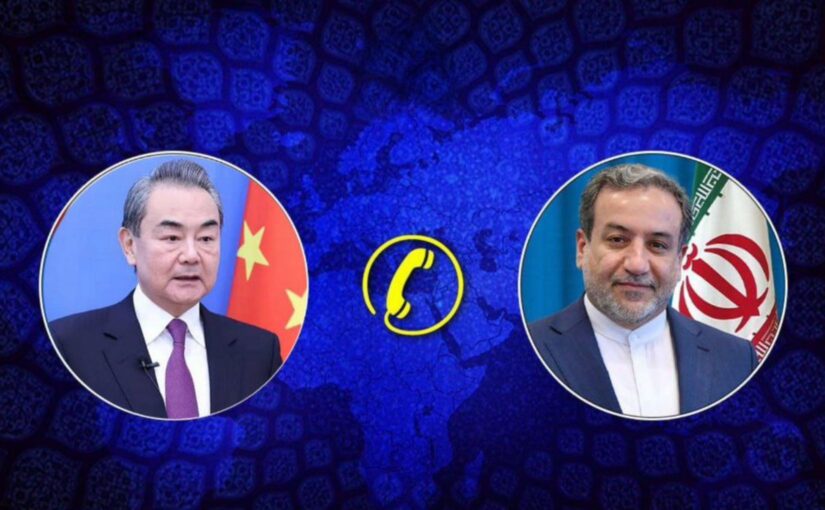
One of the last high level diplomatic visitors to China in 2024 was Iranian Foreign Minister Seyyed Abbas Araghchi, who held talks in Beijing with his Chinese counterpart Wang Yi on December 28.

The timing of this important visit is surely not coincidental, coming at the end of a tumultuous year in the West Asia region, with the continuing genocide in Gaza, spreading conflict involving Lebanon, Yemen and other states, exchanges of missile fire between Iran and Israel and, earlier in December, the overthrow of the legitimate Syrian government of Bashar al-Assad by extremist terrorist forces massively backed by outside powers.

At their meeting, Wang said that China  called on the international community to respect the sovereignty and territorial integrity of countries in the Middle East, respect the legitimate and reasonable concerns of those countries, respect the independent choices made by the people of the Middle East, and respect the historical and cultural traditions of countries in that region.

Noting that the Middle East belongs to the people of the Middle East, he added that it is not an arena for major-power rivalry, nor should it be the victim of geopolitical competition among countries outside the region.

According to the Xinhua News Agency, the Chinese Foreign Minister went on to say that the successful meeting between the two heads of state during the 16th BRICS Summit, held in Kazan, Russia, provided strategic guidance for deepening China-Iran relations.

Noting the time-honoured China-Iran relations and the traditional friendship between the two peoples, Wang said that enhanced coordination and cooperation between China and Iran will not only benefit the two peoples, but also contribute to regional and world peace, stability and development. The two sides should continue to support each other on issues concerning their core interests, steadily promote practical cooperation and enhance cooperation in multilateral fields.

He called for closer coordination and cooperation within the Shanghai Cooperation Organisation (SCO) framework and for the upgrading and strengthening of BRICS cooperation, to better safeguard the common interests of the Global South.

In the face of instability and uncertainty in today’s world, Wang emphasised that China and Iran must stay focused and strengthen solidarity and cooperation, jointly advocate and practice genuine multilateralism, and work for a more just and equitable global governance system.

Araghchi said that developing and deepening the comprehensive strategic partnership between Iran and China is the priority of Iran’s foreign policy, and Iran attaches great importance to China’s important role in upholding justice in international affairs.

The Palestine Chronicle reported that the top diplomats from China and Iran called for the restoration of Palestinian rights and the termination of Israel’s occupation, emphasising the need for an immediate ceasefire, full troop withdrawal, and humanitarian aid.

In a joint statement, it quoted the Anadolu news agency as reporting, the foreign ministers of China and Iran stressed the urgent need to address the Palestinian issue through the restoration of the Palestinian people’s legitimate rights and the end of Israel’s occupation,

The Palestine Chronicle report continued: “This visit marked Foreign Minister Araghchi’s first official trip to China since taking office. During the discussions, the two sides also addressed the situation in Lebanon, urging the effective implementation of the ceasefire agreements, and reiterating their commitment to respecting Syria’s sovereignty, independence, and territorial integrity.

Continue reading China and Iran call for an end to Israeli occupation, an immediate ceasefire, and full troop withdrawal

Ambassador Fu Cong condemns Israel’s continuing war crimes in Gaza

At the start of the new year, China’s Ambassador to the United Nations Fu Cong has condemned Israel’s continuing war crimes in Gaza and especially the attack on the Kamal Adwan Hospital.

Speaking at a January 3 Security Council Briefing on the Situation in the Middle East, including the Palestinian Question, called by Algeria, which this month holds the rotating presidency of the council, Fu Cong said:

“As the new year begins, people all expect everything to take on a fresh look. Yet in Gaza, death continues to cast its shadow, and the bombings and attacks by Israel do not cease even for a moment. For the people in Gaza, they were not counting down to the happy celebration of the new year, but the next bombing that could happen anytime.”

He added that, “Right before the new year, a heinous tragedy took place in northern Gaza.” Israel had attacked the Kamal Adwan Hospital, “the only remaining comprehensive medical service institution in northern Gaza, forcibly detaining medical and care personnel, forcibly transferring innocent patients, causing the deaths of a large number of people, and plunging the hospital into a sea of fire. This act seriously violates international law, in particular international humanitarian law. It is appalling and China strongly condemns this.”

Moreover: “It is not the first time that Kamal Adwan Hospital has been attacked, nor is it the only hospital in Gaza that has been attacked. According to the OHCHR [the Office of the [UN} High Commissioner for Human Rights] report, by June 2024, at least 27 hospitals and 12 medical institutions in Gaza have been subject to 136 attacks, which claimed the lives of over 500 medical personnel… There is also analysis indicating that the lethal attacks launched by Israel against the medical institutions in Gaza to bring the medical system in Gaza to the brink of collapse are part of the systematic strategy to make Gaza uninhabitable.”

He urged Israel to “stop turning hospitals into battlefields, stop launching attacks on medical facilities, ensure the safety of medical institutions and personnel, and release all medical personnel detained.”

We reprint below the full text of Ambassador Fu Cong’s remarks. They were originally published on the website of China’s Permanent Mission to the UN.

President.

At the outset, I wish to congratulate Algeria on assuming the Presidency of the Security Council for this month. I welcome Denmark, Greece, Pakistan, Panama, and Somalia to officially take part in the Council’s work. China looks forward to working with all Council members for the Security Council to effectively fulfill its mandate under the UN Charter in 2025. 

I thank Algeria for the initiative to hold today’s meeting. I thank High Commissioner for Human Rights Mr. Volker Türk, Dr. Richard Peeperkorn, and Dr. Tanya Haj Hassan for their briefings. 

As the new year begins, people all expect everything to take on a fresh look. Yet in Gaza, death continues to cast its shadow, and the bombings and attacks by Israel do not cease even for a moment. For the people in Gaza, they were not counting down to the happy celebration of the new year, but the next bombing that could happen anytime. 

Right before the new year, a heinous tragedy took place in northern Gaza. The Israeli force launched an attack on Kamal Adwan Hospital, the only remaining comprehensive medical service institution in northern Gaza, forcibly detaining medical and care personnel, forcibly transferring innocent patients, causing the deaths of a large number of people, and plunging the hospital into a sea of fire. This act seriously violates international law, in particular international humanitarian law. It is appalling, and China strongly condemns this. 

Continue reading Ambassador Fu Cong condemns Israel’s continuing war crimes in Gaza

Palestinian rescuers see China’s Blue Sky amid the bomb blasts of Israel-Gaza war

The following article, by Cyril Ip, which was first published in the Hong Kong daily South China Morning Post, is a vivid story of practical people-to-people solidarity and friendship between China and Palestine.

It relates how six Palestinians spent two weeks in China being trained being trained by a team from China’s Blue Sky Rescue in urban search and rescue operations. They were taught how to shore up collapsed buildings, cut through walls, search for victims and safely evacuate survivors.

According to Cyril: “It is over a year since the Israel-Gaza war began, and in that time more than 44,000 Palestinians – including at least 88 of the search and rescue team’s colleagues – have been killed. So, when they were invited to send a delegation for training in China, they jumped at the chance to help save more lives.

“The search and rescue team of the Palestinian Civil Defence first met China’s Blue Sky rescuers back in February 2023, amid the rubble of Malatya, Turkey, as they worked side by side to find survivors after a devastating 7.8 magnitude earthquake hit eastern Turkey and Syria. China sent more than 200 members of its grass-roots rescue organisation to assist in the wake of the disaster.”

Speaking from its headquarters in Ramallah, Raed Qazmouz, director of central operations in the Palestinian Civil Defence, said:

“China has the kindest and most hospitable people. I had known they were a polite and respectful people, but not to this extent.”

One of the Chinese rescuers who coordinated the exchange, whose name is given only as Ming, said it was his own visit to Palestine in June that really opened his eyes to what the search and rescue team is dealing with over there. He described what he saw as a “man-made earthquake”.

“I was mentally prepared for a very difficult situation as a war was taking place, and after going there and seeing the situation in refugee camps, it confirmed my belief that they need international help.

“China was one of the first countries to recognise Palestine as a state and as a country. So, this kind of relationship, especially at the civil level, complements what the government is doing, and we are using our expertise to enable and equip our friends on the front line to save more lives.”

He noted a “strong passion” from many in China to help: “A lot of people have donated to the Palestinian embassy in China, and they are always looking for platforms where they can see direct impact.”

Qazmouz, who first met Ming in the aftermath of the earthquake in Turkey last year, said he was a “very brave man” to have visited areas that had been devastated by Israeli attacks, despite his warnings.  “I told him, ‘It’s not safe for you to visit; it’s a very risky area,’ but he said, ‘I will go to the affected area,’ so he was the first of the Civil Defence’s guests to do that.”

In the eastern city of Changshu, six Palestinians have spent two weeks being trained by a team from China’s Blue Sky Rescue in urban search and rescue operations.

They were taught how to shore up collapsed buildings, cut through walls, search for victims and safely evacuate survivors.

It is over a year since the Israel-Gaza war began, and in that time more than 44,000 Palestinians – including at least 88 of the search and rescue team’s colleagues – have been killed. So when they were invited to send a delegation for training in China, they jumped at the chance to help save more lives.

The search and rescue team of the Palestinian Civil Defence first met China’s Blue Sky rescuers back in February 2023, amid the rubble of Malatya, Turkey, as they worked side by side to find survivors after a devastating 7.8 magnitude earthquake hit eastern Turkey and Syria. China sent more than 200 members of its grass-roots rescue organisation to assist in the wake of the disaster.

That shared experience has led to a growing relationship between the two teams.

“China has the kindest and most hospitable people,” said Raed Qazmouz, director of central operations in the Palestinian Civil Defence, from his headquarters in Ramallah. “I had known they were a polite and respectful people, but not to this extent.”

Invited by Blue Sky Rescue and the local Changshu emergency volunteer association – and facilitated by the United Nations International Search and Rescue Advisory Group (INSARAG) – the Palestinian officers spent their time in China benefiting from Blue Sky’s knowledge.

“There are international standards and guidelines for urban search and rescue operations, and we learned from China how to do that,” Qazmouz said.

Founded in 2007, Blue Sky Rescue is China’s largest non-governmental humanitarian organisation. It provides vital help in natural disaster rescue efforts, both in China and beyond, including during the catastrophic magnitude 8 earthquake in Sichuan in 2008, which killed 69,000 people.

While the Palestinian search and rescue workers are not dealing with natural disasters, there are stark similarities between rescue efforts in earthquakes and those in bombings. Both involve survivors trapped in unknown locations and conditions.

Since the war began on October 7, 2023, the Israeli military has dropped more than 85,000 tonnes of bombs inside the besieged Gaza Strip, according to a statement by the Palestinian Environment Quality Authority in November.

With nearly two decades of experience dealing with floods, quakes and typhoons, Blue Sky instructed the Palestinian team in the use of sensors in rescue operations.

“The techniques were very helpful to our daily missions after any attack, as each intervention dealing with the consequences of an attack takes us at least 10 to 24 hours,” Qazmouz said. “We were amazed at the high capabilities of the Chinese civil defence and civil protection.”

An international rescuer named Ming who coordinated the exchange, said it was his own visit to Palestine in June that really opened his eyes to what the search and rescue team is dealing with over there. He described what he saw as a “man-made earthquake”.

“I was mentally prepared for a very difficult situation as a war was taking place, and after going there and seeing the situation in refugee camps, it confirmed my belief that they need international help,” he said.

“China was one of the first countries to recognise Palestine as a state and as a country. So this kind of relationship, especially at the civil level, complements what the government is doing, and we are using our expertise to enable and equip our friends on the front line to save more lives.”

Qazmouz first met Ming in the aftermath of the earthquake in Turkey last year. He said Ming was a “very brave man” to have visited areas that had been devastated by Israeli attacks, despite his warnings. Ming, who recently assisted with the UN’s evacuation efforts in Beirut, Lebanon, is a firm believer that “actions speak louder than words”.

“I told him, ‘It’s not safe for you to visit; it’s a very risky area,’ but he said, ‘I will go to the affected area,’ so he was the first of the Civil Defence’s guests to do that,” Qazmouz said.

“He went to the affected area in our camps in the north, he walked on the destroyed streets, he heard the sound of the drones, he was inside collapsed buildings – he saw everything there.”

After the 1967 Arab-Israeli War, Israeli military authorities consolidated complete power over all water resources and water-related infrastructure in the Occupied Palestinian Territories. Israel continues to control and restrict Palestinian access to water.

According to Qazmouz, fire engines and water tanks have been shot at by Israeli forces, and there has been very strict control on the availability of water and especially on water tanks – essential to fire and rescue situations. The process of getting replacements for parts has also been challenging.

“After each attack or during the attack, in addition to fire and rescue services, we as Civil Defence are responsible for providing water to hospitals, critical facilities and the population,” he said.

Qazmouz said water supply trucks were an “urgent need”, especially for when Israel cut off water supplies. He also stressed the need for diggers, bulldozers, cutting machines and fire rescue vehicles.

“Some of them are damaged, completely damaged; some of them are consumed and getting out of service,” he said.

Qazmouz added that there was “no problem” for those resources to be received from donors and international organisations through the West Bank.

Ming has noted a “strong passion” from many in China to help, and said there would be opportunities for them to do so in the future.

“There is a strong willingness from the donors to contribute – they just lack the right channels and platforms to do that,” Ming said.

“A lot of people have donated to the Palestinian embassy in China, and they are always looking for platforms where they can see direct impact.”

To round off their two-week visit, the delegation visited nearby Shanghai and Hangzhou, two of China’s most scenic and innovative cities. For the Palestinian delegates, an act as simple as a leisurely stroll along Shanghai’s Bund or Hangzhou’s West Lake was something to savour.

“Most importantly, it is a very safe country … You are safe everywhere you go,” Qazmouz said.

China-facilitated reconciliation between Saudi Arabia and Iran continues to make progress

The reconciliation between Saudi Arabia and Iran, which was facilitated by China last year, continues to make progress despite imperialist attempts to derail it, which would see Saudi Arabia return to the tawdry path of the ‘Abraham Accords’, recognise Israel and also return to confrontation with Tehran and other contingents of the ‘Axis of Resistance’.

In a significant step, with important regional ramifications, the second meeting of the China-Saudi Arabia-Iran Trilateral Joint Committee was held in the Saudi city of Riyadh on November 19, 2024, to follow up on the implementation of the Beijing Agreement of April 2023. All three countries were represented at deputy foreign minister level.

Saudi Arabia and Iran reaffirmed their commitment to all provisions of the Beijing Agreement as well as their continued efforts to consolidate good-neighbourly and friendly relations between the two countries by adhering to the United Nations Charter, the Charter of the Organisation of Islamic Cooperation and international law, including respecting national sovereignty, independence and security. Saudi Arabia and Iran welcomed the continued positive role of China and held that China’s support and follow-up to the implementation of the Beijing Agreement is of great importance.

They noted that the current escalation of regional tensions will have serious consequences for regional and global security. Against this backdrop, it is very important for senior officials from Saudi Arabia and Iran to engage in contacts, meetings, and mutual visits. The participating parties appreciated the progress made in consular services between Saudi Arabia and Iran, which enabled more than 87,000 Iranian pilgrims to perform Hajj, and more than 25,000 Iranian pilgrims to perform Umrah rituals with ease and security in the first ten months of 2024. (Hajj is the annual pilgrimage to Mecca [the most sacred city in Islam], Saudi Arabia, which all Muslims are required to perform at least once in their lives if they are able. It takes place in a ten-day period, starting on 1 and ending on 10 Dhu al-Hijjah, the twelfth and last month of the Islamic [lunar] calendar. The Umrah is also a pilgrimage to Mecca but, unlike Hajj, may be undertaken at any time of the year.)

The three countries also called for an immediate end to the Israeli military operations in both Palestine and Lebanon, condemn the Israeli attack and its violation of the sovereignty and territorial integrity of Iran, and call for ensuring the unimpeded flow of humanitarian and relief aid to Palestine and Lebanon. And they reaffirmed their support for a comprehensive political solution to the Yemeni issue in accordance with internationally recognised principles and under the auspices of the United Nations.

The following article was originally published on the website of the Chinese Foreign Ministry.

The second meeting of the China-Saudi Arabia-Iran Trilateral Joint Committee was held in Riyadh on November 19, 2024, to follow up on the implementation of the Beijing Agreement. The meeting was chaired by Deputy Minister of Foreign Affairs of the Kingdom of Saudi Arabia, Eng. Waleed bin Abdulkarim Al-Khuraiji, with the participation of the Chinese delegation headed by Vice Foreign Minister of the People’s Republic of China Deng Li and the Iranian delegation headed by Deputy Foreign Minister for Political Affairs of the Islamic Republic of Iran for Political Affairs Majid Takht Ravanchi.

Saudi Arabia and Iran reaffirmed their commitment to all provisions of the Beijing Agreement, and their continued efforts to consolidate good-neighborly and friendly relations between the two countries by adhering to the United Nations Charter, the Charter of the Organization of Islamic Cooperation and international law, including respecting national sovereignty, independence and security. Saudi Arabia and Iran welcomed the continued positive role of China and held that China’s support and follow-up to the implementation of the Beijing Agreement is of great importance.

China stressed its readiness to continue to support and encourage the steps taken by Saudi Arabia and Iran towards developing their relations in various fields.

The three countries welcomed the continuous progress in Saudi Arabia-Iran relations, which provides opportunities for direct exchanges between the two countries at all levels and across all sectors. The current escalation of regional tensions will have serious consequences for regional and global security. Against this backdrop, it is very important for senior officials from Saudi Arabia and Iran to engage in contacts, meetings, and mutual visits. The participating parties appreciated the progress made in consular services between Saudi Arabia and Iran, which enabled more than 87,000 Iranian pilgrims to perform Hajj, and more than 25,000 Iranian pilgrims to perform Umrah rituals with ease and security in the first ten months of 2024. They also appreciated the convening of the first meeting of the Saudi-Iranian Joint Media Committee, and the signing of a memorandum of understanding between the Prince Saud Al-Faisal Institute for Diplomatic Studies and the Institute of Political and International Studies of the Iranian Ministry of Foreign Affairs. Saudi Arabia and Iran also expressed their readiness to sign a Double Taxation Avoidance Agreement, and the three countries look forward to expanding trilateral cooperation in economic, political and other fields.

The three countries call for an immediate end to the Israeli military operations in both Palestine and Lebanon, condemn the Israeli attack and its violation of the sovereignty and territorial integrity of Iran, and call for ensuring the unimpeded flow of humanitarian and relief aid to Palestine and Lebanon. The three countries hold that the ongoing cycle of violence and escalation poses a serious threat to the security of the region and the world, including maritime security.

The three countries reaffirm their support for a comprehensive political solution to the Yemeni issue in accordance with internationally recognized principles under the auspices of the United Nations.

Fu Cong: Can the deaths of 44,000 people not win even a little bit of sympathy from the US?

In a move that underlined both its shameful and criminal support for the genocide of the Palestinian people, as well as its increasing isolation in the international community, on November 20, the United States yet again vetoed a resolution in the United Nations Security Council (UNSC) calling for a ceasefire in Gaza.

The resolution was jointly presented by the current ten non-permanent UNSC members: Algeria, Ecuador, Guyana, Japan, Malta, Mozambique, Republic of [South] Korea, Sierra Leone, Slovenia and Switzerland. Four of the five permanent members – Britain, China, France and Russia – also voted in favour of the resolution. It failed to pass due to the single vote of the United States, which, along with the other permanent members, holds the power of veto.

In a heartfelt and eloquent statement following the vote, Chinese Ambassador Fu Cong stated:

“The US single use of veto has shattered the Gazan people’s hope for survival and pushed them further into darkness and desperation… We cannot imagine how the vote today, as well as the Council’s failure to respond to the Gaza conflict over the past 13 months, can escape the harsh judgment of history.”

He continued:

“In the future, when looking back, people will find it hard to believe… Now, nearly 44,000 people have been killed in Gaza, and the US still do not hesitate to use its veto. 44,000. This is not just a number. Behind it could be a child, a nursing mother, or a breadwinner of a family. The loss of each and every one of them means eternal pain for the surviving relatives. People cannot help but ask: do Palestinian lives mean nothing? Can the deaths of 44,000 people not win even a little bit of sympathy from the United States?…

“In the future, when looking back, people will surely feel indignant. Israel has flagrantly breached every red line of international humanitarian law, with its actions causing an unprecedented humanitarian disaster. But even as a famine is about to break out in Gaza, the United States always seems to be able to find justification to defend Israel… People never knew before how low one could stoop in terms of double standard. No wonder people feel angry.”

The next day, the UNSC held a briefing on Syria. Chinese Ambassador Geng Shuang noted:

“Over the past month, Israel has continued to carry out air strikes against Syria, causing heavy casualties. The actions by Israel gravely violate the sovereignty and territorial integrity of Syria. China expresses its strong condemnation… China calls on the parties concerned to effectively respect the sovereignty, security, and territorial integrity of Syria and immediately cease their illegal military actions against Syria.”

He continued: “The rising tensions in Lebanon recently have caused an influx of more than 500,000 refugees into Syria, further exacerbating the already dire humanitarian situation there. China applauds the positive actions taken by the UN agencies in their efforts to provide emergency humanitarian assistance to those in need. We welcome the Syrian Government’s decision to extend the authorisation for the relevant border crossings and commend the Government’s efforts in making proper arrangements to host refugees… China reiterates that the unilateral sanctions imposed against Syria by certain countries should be lifted without delay, and the illegal plundering of Syrian resources [principally of Syrian oil by the United States] should stop forthwith, in order to create favourable conditions for the Syrian economy to recover and develop.”

Geng Shuang concluded: “China firmly supports the Syrian Government in its efforts to fight terrorism. We call on the international community to reject double standard in accordance with international law and Council resolutions and join hands in the spirit of zero tolerance to support the Syrian Government in combating terrorist forces within its borders.”

Earlier, at a UNSC meeting prior to the vote on the Gaza resolution, held on November 18, Ambassador Fu Cong had stated:

“Over the past 13 months, the conflict in Gaza and the situation in the Middle East have continued to take the most prominent place on the Security Council’s agenda. We considered the issue frequently, yet the situation continued to worsen. We adopted resolutions requesting an immediate ceasefire, yet a ceasefire remains elusive to this day. Instead, the fighting has only intensified. We unanimously requested the protection of civilians, yet we saw that international humanitarian law seemed to exist in name only, with tens of thousands of Palestinian civilians deprived of their lives in collective punishment. Time and again, we requested expanding humanitarian assistance, yet Israel repeatedly cut off humanitarian supplies and attacked humanitarian assistance personnel. We made countless warnings against the spillover of the conflict, yet we saw reckless adventurism and the constantly spreading flames of war. We have to painfully admit that on the Palestinian question, the Security Council has failed to effectively discharge its duties and has failed to respond to the expectations of the international community, which one can say is most disappointing.

“However, it needs to be pointed out that the unsatisfactory performance of the Security Council is not caused by differences between some countries and some others, but rather due to the fact that one permanent member has been on the opposite side of the international community. Had it not been for the repeated exercise of the veto by the US or its claim that Security Council resolutions are not binding, the Security Council would not have been so weak and incompetent. Had it not been for the continued provision of weapons by the US, the war would not have lasted for so long and would not have caused such massive destruction.”

China’s representative further expressed “grave concerns over reports that Israel is seeking to station its military in Gaza for the long term, build its so-called buffer zone, and even rebuild settlements. We reiterate that any acts to change the population or territory of Gaza are unacceptable. The future governance arrangement for Gaza should be determined independently by the Palestinian people. The illegal settlements in the West Bank erode the foundation for establishing an independent state of Palestine. The dangerous attempts to annex the West Bank will completely bury the prospects of peace in the Middle East. The international community must firmly reject them.”

An article by columnist Alex Lo, published in the South China Morning Post on November 22, carried the subtitle, “Disgraceful veto of draft ceasefire resolution by US coincides with arrest warrants by International Criminal Court for Israeli pair [Prime Minister Netanyahu and former Defence Minister Gallant] on war crimes.”

Continue reading Fu Cong: Can the deaths of 44,000 people not win even a little bit of sympathy from the US?

China condemns acts that violate Iran’s sovereignty and territorial integrity

China’s Ambassador to the United Nations Fu Cong addressed the UN Security Council Briefing on the Situation in the Middle East, Including the Palestinian Question on successive days, October 28 and 29.

The first meeting was called at the request of Iran, Algeria, China and Russia following the brazen aerial attack on Iran by Israel. Ambassador Fu told the Security Council:

“China condemns acts that violate Iran’s sovereignty and territorial integrity and opposes acts of destruction that threaten regional peace and security… We are gravely concerned about the escalation caused by Israel’s actions and urge Israel to effectively cease all provocative acts.”

He added: “It must be pointed out that the fundamental reason for the continued worsening of tensions in the Middle East is that the ceasefire in Gaza has remained elusive. The fact that a number of Council resolutions calling for a ceasefire have been shelved undermines the Council’s own authority and is not conducive to a fundamental solution to the conflict. China is of the view that under the current circumstances, the Council should utilise all the means available to it under the Charter to ensure the implementation of its relevant resolutions. We call on the country with significant influence on Israel [namely the United States] to put saving lives and preventing war in the first place, abandon any other political calculations, and support the Council in taking further actions on the current situation, so as to push for an immediate ceasefire in Gaza and de-escalation of the situation in Lebanon and to effectively curb the expansion and spread of the conflict.”

Further derails of this Security Council Briefing were reported by the Palestine Chronicle.

The following day, Fu Cong made six points as follows:

  • An immediate and permanent ceasefire is the prerequisite for saving lives and preventing further deterioration of the situation. There is no justification for any delay. The United States has announced that it would reinvigorate ceasefire negotiations. We hope that the negotiations will not fall into the weird cycle of marking time as we saw in the past several months. Nor should they become a pretext for prolonging and expanding the fighting.
  • Gaza has been bombarded into a living hell, and Northern Gaza is turning into the hell of the hell. Humanitarian supplies have been cut off. Relief operations have been denied. Civilians in Jabalia camp are evacuated at gunpoint. And patients and doctors at the Kamal Adwan Hospital are subjected to inhumane treatment. The bottom line of international humanitarian law has been trampled upon time and again. This is a stain on the conscience of humanity and should not be tolerated at all. Israel must comply with its obligations under international humanitarian law. No double standards should be allowed in this regard.
  • UNRWA [The United Nations Relief and Works Agency for Palestine Refugees in the Near East] has been providing relief in accordance with its mandate from the General Assembly. It is the backbone of humanitarian assistance in Gaza. The Israeli Knesset [parliament], in total disregard of the strong opposition of the international community, passed two bills in an attempt to restrict and close UNRWA. China expresses strong condemnation.
  • Certain countries [referring primarily to the United States but also including a handful of others, such as Britain and Germany] are continuing their massive supply of weapons to Israel. The GA [General Assembly] emergency special session has adopted a resolution urging all states to stop supplying weapons and equipment that might be used in the occupied Palestinian territory. China recently joined the joint letter initiated by Türkiye calling for the implementation of the demand from this GA resolution. We hope that the countries concerned will take seriously the grave consequence of their massive supply of weapons and stop fueling the flames of military adventurism.
  • While the flames of war have been raging on in Gaza over the past year, the situation in the West Bank has also been deteriorating. Illegal settlements have been expanding, with more than 1,700 Palestinian houses confiscated by force or demolished, and thousands of Palestinians displaced. The occupying power has also frequently conducted violence against the Palestinian people and used various means to suppress and restrict the governance of the Palestinian National Authority.
  • An all-out war in the region is looming. The recent Israeli invasion into Lebanon, its continuous indiscriminate bombardment, and multiple airstrikes against Iran and Syria have violated the sovereignty and territorial integrity of the relevant countries and further destabilised the region. We urge Israel to abandon its obsession with force, so as to prevent the region from being plunged into a larger disaster.

We reprint below the full texts of Fu Cong’s remarks. They were originally published on the website of China’s Permanent Mission to the UN.

Remarks by Ambassador Fu Cong at the UN Security Council Briefing on the Situation in the Middle East, Including the Palestinian Question

President, 

I thank you for convening this meeting at the request of Iran, Algeria, China, and Russia. I also thank Assistant Secretary-General Khaled Khiari for his briefing. 

On October 26, Israel launched rounds of air strikes against several sites in Iran, causing damage to facilities and casualties on the Iranian side. China condemns acts that violate Iran’s sovereignty and territorial integrity and opposes acts of destruction that threaten regional peace and security. At present, the Iranian-Israeli relations and the situation of the region are on the edge. We are gravely concerned about the escalation caused by Israel’s actions, and urge Israel to effectively cease all provocative acts. At the same time, we call on all parties to exercise calm and restraint, jointly abide by the UN Charter and the principles of international law, and return to the right track of resolving disputes by political and diplomatic means. 

At present, with the Gaza conflict still dragging on, a new conflict in Lebanon breaking out, and continued tensions between Syria and Israel and in the Red Sea, the situation in the Middle East has long been precarious. At this critical moment, all parties should heed the overwhelming call of the international community for a ceasefire and an end to the fighting, fully implement Council resolutions, and make unremitting efforts to deescalate the situation and restore peace and tranquility in the region. Any reckless provocation or military adventurism to expand the fighting is irresponsible and is highly likely to lead to miscalculation and disastrous consequences. 

It must be pointed out that the fundamental reason for the continued worsening of tensions in the Middle East is that the ceasefire in Gaza has remained elusive. The fact that a number of Council resolutions calling for a ceasefire have been shelved undermines the Council’s own authority and is not conducive to a fundamental solution to the conflict. China is of the view that under the current circumstances, the Council should utilize all the means available to it under the Charter to ensure the implementation of its relevant resolutions. We call on the country with significant influence on Israel to put saving lives and preventing war in the first place, abandon any other political calculations, and support the Council in taking further actions on the current situation, so as to push for an immediate ceasefire in Gaza and deescalation of the situation in Lebanon and to effectively curb the expansion and spread of the conflict. 

I thank you, President.


Remarks by Ambassador Fu Cong at the UN Security Council Briefing on the Situation in the Middle East, Including the Palestinian Question

President, 

I thank you for presiding over this meeting. I would also like to thank Special Coordinator Tor Wennesland for the briefing today. 

As the Council is again considering the situation in the Middle East, what is unfolding before our eyes is that Gaza and the Middle East as a whole are experiencing worsening situation, elusive peace prospects, and a looming all-out war. The Council should act immediately on the pressing issues, with a view to promoting a ceasefire, saving lives, and restoring peace, I wish to stress the following points.

First, an immediate and permanent ceasefire is the prerequisite for saving lives and preventing further deterioration of the situation. There is no justification for any delay. The United States has announced that it would reinvigorate ceasefire negotiations. We hope that the negotiations will not fall into the weird cycle of marking time as we saw in the past several months. Nor should they become a pretext for prolonging and expanding the fighting. The relevant diplomatic efforts should not be used as an excuse to obstruct Council actions. We support the Council in using all the options in its toolbox and take further actions towards a ceasefire.

Second, Gaza has been bombarded into a living hell, and Northern Gaza is turning into the hell of the hell. Humanitarian supplies have been cut off. Relief operations have been denied. Civilians in Jabalia camp are evacuated at gunpoint. And patients and doctors at the Kamal Adwan Hospital are subjected to inhumane treatment. The bottom line of international humanitarian law has been trampled upon time and again. This is a stain on the conscience of humanity and should not be tolerated at all. Israel must comply with its obligations under international humanitarian law. No double standards should be allowed in this regard.

Third, UNRWA has been providing relief in accordance with its mandate from the General Assembly. It is the backbone of humanitarian assistance in Gaza. The Israeli Knesset, in total disregard of the strong opposition of the international community, passed two bills in an attempt to restrict and close UNRWA. China expresses strong condemnation. Closing the Agency would be a new round of collective punishment of millions of Palestinian refugees in the region, and would severely affect the humanitarian situation, security, and stability in the region. We call on Israel to hold and revoke the relevant bills to ensure the dignity, safety, and facilitation for the work of UN humanitarian agencies, including UNRWA.

Fourth, in the current context, certain countries are continuing their massive supply of weapons to Israel. Whether such acts would contribute to achieving the objectives contained in the Council resolutions is a matter that must be taken seriously. The GA emergency special session has adopted a resolution urging all states to stop supplying weapons and equipment that might be used in the occupied Palestinian territory. China recently joined the joint letter initiated by Türkiye calling for the implementation of the demand from this GA resolution. We hope that the countries concerned will take seriously the grave consequence of their massive supply of weapons and stop fueling the flames of military adventurism.

Fifth, while the flames of war have been raging on in Gaza over the past year, the situation in the West Bank has also been deteriorating. Illegal settlements have been expanding, with more than 1,700 Palestinian houses confiscated by force or demolished, and thousands of Palestinians displaced. The occupying power has also frequently conducted violence against the Palestinian people and used various means to suppress and restrict the governance of the Palestinian National Authority. Such practices are creating a new reality and undermining the conditions on which the realization of the two-State solution is based. Preventing the further erosion of the basis of the two-State solution by unilateral actions should be a priority for the international community in advancing Palestinian-Israeli peace in the next phase. 

Sixth, an all-out war in the region is looming. The recent Israeli invasion into Lebanon, its continuous indiscriminate bombardment, and multiple airstrikes against Iran and Syria have violated the sovereignty and territorial integrity of the relevant countries and further destabilized the region. The situation is hanging by a thread. Any irresponsible adventurism would be extremely dangerous and might lead to catastrophic consequences. We urge Israel to abandon its obsession with force, so as to prevent the region from being plunged into a larger disaster. We also call on all parties to exercise maximum restraint, jointly abide by the UN Charter and the principles of international law, and return to the right track of seeking political and diplomatic solutions to disputes.

Thank you, President.

China at the UN: It is unacceptable to allow the tragedy in Gaza to continue

Chinese Permanent Representative to the United Nations Fu Cong has again strongly condemned the atrocities being committed against the Palestinian people in Gaza and reiterated China’s strong call for peace.

Speaking at the UN Security Council Briefing on the Situation in the Middle East, Including the Palestinian Question, on October 16, in a meeting initiated by Algeria, and in words that have lost none of their cogency, poignancy or urgency in the subsequent days, Fu said:

“The situation in Gaza is not showing any sign of stabilisation but has continued to deteriorate. In the past two weeks, Israel has not relented its military operations in Gaza at all, but has constantly attacked and bombed schools and hospitals, completely cut off the access of humanitarian supplies into northern Gaza, and once again forcibly ordered emergency evacuation of hundreds of thousands of people. In the sea of fire caused by Israel’s bombing, some displaced Palestinian civilians were burnt to their death. They are all human beings like us. Why, when born in Gaza, do they have to suffer like this? Two million people have been struggling on the verge of death for more than a year. How long will it take before they can see any hope of survival? The Security Council shoulders the responsibility to maintain peace. We have held repeated discussions, expressed sympathy, voiced positions, and expressed concerns. But these are not enough. It is unacceptable to allow the tragedy in Gaza to continue, and it is also unacceptable for the Security Council as a collective to continue to be paralysed.”

Noting that using starvation as a weapon of war is a serious war crime, he went on to note that the Council has adopted a number of resolutions regarding the situation in Gaza, explicitly calling for a ceasefire. But none of them has been effectively implemented. This has dealt a serious blow to the credibility of the entire UN system. “In this respect, we particularly hope that the United States will respond to the strong call of the international community and support further actions by the Council to bring about an immediate ceasefire. It needs to be pointed out that, according to reports, since last October, the US has provided Israel with more than 17 billion US dollars’ worth of military aid.”

We publish below the full text of Fu Cong’s remarks. They were originally published on the website of the Chinese Foreign Ministry.

President

I thank Algeria for the initiating this meeting, and thank Acting Under-Secretary-General Joyce Msuya for her briefing.

The sudden escalation of the situation between Lebanon and Israel in the past few days has caused widespread concerns and worries in the international community. At the same time, the situation in Gaza is not showing any sign of stabilization, but has continued to deteriorate. In the past two weeks, Israel has not relented its military operations in Gaza at all, but has constantly attacked and bombed schools and hospitals, completely cut off the access of humanitarian supplies into northern Gaza, and once again forcibly ordered emergent evacuation of hundreds of thousands of people. In the sea of fire caused by Israel’s bombing, some displaced Palestinian civilians were burnt to their death. They are all human beings like us. Why, when born in Gaza, do they have to suffer like this? Two million people have been struggling on the verge of death for more than a year. How long will it take before they can see any hope of survival? The Security Council shoulders the responsibility to maintain peace. We have held repeated discussions, expressed sympathy, voiced positions, and expressed concerns. But these are not enough. It is unacceptable to allow the tragedy in Gaza to continue, and it is also unacceptable for the Security Council as a collective to continue to be paralyzed.

We must uphold and revitalize the authority of international humanitarian law. Using starvation as a weapon of war is a serious war crime. Humanitarian organizations are the lifeline for Gaza. It is intolerable to see them face suppression, restriction, and even security threats. Israel must fulfill its obligations under international humanitarian law, immediately lift the blockade and restrictions on humanitarian access to the entire Gaza, and cooperate fully with the UN and other humanitarian entities to facilitate and ensure the safety of humanitarian operations such as transportation of humanitarian supplies and polio vaccination. UNRWA is the backbone of humanitarian assistance in Gaza. China firmly opposes any smearing and suppression of the Agency.

We must uphold and revitalize the effectiveness of Security Council resolutions. The Council has adopted a number of resolutions regarding the situation in Gaza, explicitly calling for a ceasefire. But none of them has been effectively implemented. This has dealt a serious blow to the credibility of the entire UN system. Council resolutions are binding for all states and must be implemented. We support the Council in using all the options in its toolbox to ensure the implementation of its resolutions. Every member has the responsibility to safeguard the effectiveness of Council resolutions. In this respect, we particularly hope that the United States will respond to the strong call of the international community and support further actions by the Council to bringing about an immediate ceasefire. It needs to be pointed out that, according to reports, since last October, the US has provided Israel with more than 17 billion US dollars worth of military aids. Under the current circumstances, does such a large scale supply of weapons help realize the objectives of Security Council resolutions? This is a question that needs serious consideration.

We must uphold and revitalize the political prospects for the two-State solution. The implementation of the two-State solution and the establishment of an independent Palestinian state is the only viable way to resolve the Palestinian question. Gaza and the West Bank, including East Jerusalem, are all inseparable parts of the state of Palestine. The future governance arrangements for Gaza should be predicated on a full withdrawal of Israeli troops, and should be decide by consultations among the Palestinian people. The implementation of the two-State solution requires the political will of both parties. Israel must stop eroding and jeopardizing the foundations of the two-State solution and return to the right track of the two-State solution. The international community has the responsibility of providing international guarantee for the implementation of the two-State solution. China is ready to continue to play a constructive role and make unremitting efforts to end the fighting as soon as possible and realize peace in the region.

Thank you, President.

Fu Cong: The tragedy in Gaza is unimaginable and unbelievable in the 21st century

Within the first ten days of October, Chinese Ambassador Fu Cong has spoken out strongly in the United Nations Security Council (UNSC) against the criminal behaviour, war crimes and atrocities of the Israeli regime as well as against the support, connivance and protection afforded to it by the United States.

On October 10, speaking at the UNSC Briefing on the Lebanese-Israeli Situation, Ambassador Fu stated:

“A few hours ago, the IDF [“Israeli ‘Defence’ Force”] attacked UNIFIL [UN peace keepers] positions and an observation tower, causing injuries to UNIFIL personnel. China expresses grave concerns and strong condemnation. UNIFIL carries out its peacekeeping tasks under the mandate from the Security Council resolution. Any deliberate attacks on peacekeepers constitute a severe violation of international humanitarian law and Security Council Resolution 1701.”

He went on to make three points:

First, since October last year, the series of destabilising events that have taken place in the Middle East have resulted in more than 100,000 civilian casualties and left millions of people displaced. The cleanup work will take a decade or so. What’s more, the trauma brought by conflicts will be a lingering nightmare for generations to come. The Middle East cannot afford a full-scale war.

Second, achieving a ceasefire must be an overarching priority. We note that all parties in Lebanon have already made a unanimous call for an immediate ceasefire. The Arab League has also issued an explicit appeal. It is clear who holds the key to ending this crisis.

Third, there is no time to lose for the Council to act. Clearly referring to the United States. he said: “We urge a certain country to stop its passive procrastination, cover-up, and connivance. Instead, it should act responsibly and play a constructive role in order to prevent further destabilisation of the situation.”

The previous day, during the UNSC Briefing on the Humanitarian Situation in Gaza, he noted:

Two million people in Gaza are struggling under the blockade and fire, and one out of every fifty people has suffered violent death. The authority of international law seems to exist in name only for certain states, and the bottom line of international humanitarian law has been repeatedly shattered. The tragedy in Gaza is unimaginable and unbelievable in the 21st century. Like many Council members, China is shocked, disappointed, and outraged. However, we do not believe that the Palestinian people are destined to suffer. Nor do we believe that the Council as a collective body has exhausted all efforts to maintain peace.

We cannot accept that death and hunger have become the new normal in Gaza. Gaza is already an inferno on Earth. For the people there, humanitarian aid is the hope for survival. The role of UNRWA [the United Nations Relief and Works Agency for Palestine Refugees in the Near East] is indispensable and irreplaceable. China firmly opposes Israel’s smearing and suppression of UNRWA and is gravely concerned about the relevant Knesset [Israeli parliament] bills targeting the Agency.

We cannot allow the conflict to drag on and expand. We cannot just sit back and watch the entire Middle East plunging into an all-out war. The harsh reality has proved that winning a war does not necessarily mean having peace, military might alone cannot guarantee lasting security, and the obsession with force only creates more killings and hatred. Israel must cease all military operations in Gaza and put an end to the collective punishment of the people in Gaza. The intensified settlement activities and violence in the West Bank were a de-facto obliteration of the foundation of the two-State solution, and must stop immediately. Lebanon must not become the next Gaza.

We cannot ignore the marginalisation of the Council. There is broad consensus among the vast majority of Council members on the Palestinian-Israeli issue. After repeated vetoes of the Council’s demand for an immediate ceasefire, the US put forward a ceasefire initiative last May, claiming that Israel had accepted it and requesting the Council’s support for an agreement through diplomatic talks. However, over the past five months, the so-called diplomatic efforts seemed to be going in circles, and more time and patience have led to greater civilian casualties and more reckless military adventurism.

Days earlier, on October 2, Ambassador Fu addressed a previous UNSC Briefing on the Lebanese-Israeli Situation. He said: “I would like to reiterate China’s resolute support for the Secretary-General’s work, and we oppose Israel’s groundless accusations against him,” and continued:

“Following the remotely operated and simultaneous detonation of thousands of communications devices in Lebanon, Israel carried out several rounds of large-scale airstrikes in southern and eastern Lebanon, and launched ground offensive and military incursion into Lebanon yesterday. Israel also intensified airstrikes against Syria.”

He then carefully and precisely added: “Iran has concluded a series of military attacks on the military and security targets of Israel, and sent correspondence to the Security Council explaining its position”, and noted that China condemns “all violence and attacks against civilians.” [Emphasis added by us.]

“Gaza has become a hell on Earth. In the meantime, in Lebanon, there has been massive destruction of civilian facilities, thousands of casualties, and more than one million people displaced from their homes, including a large number of Palestinian refugees.”

Finally, he addressed himself to the United States, as well as a tiny number of other countries, including Britain: “With the current situation hanging by a thread, any passive procrastination would be irresponsible, and any rhetoric of condoning further military adventurism would send a wrong message and could cause serious consequences. We hope major countries with influence will adopt a sincere and responsible attitude and earnestly play a constructive role to avoid further escalation of the situation.”

Continue reading Fu Cong: The tragedy in Gaza is unimaginable and unbelievable in the 21st century