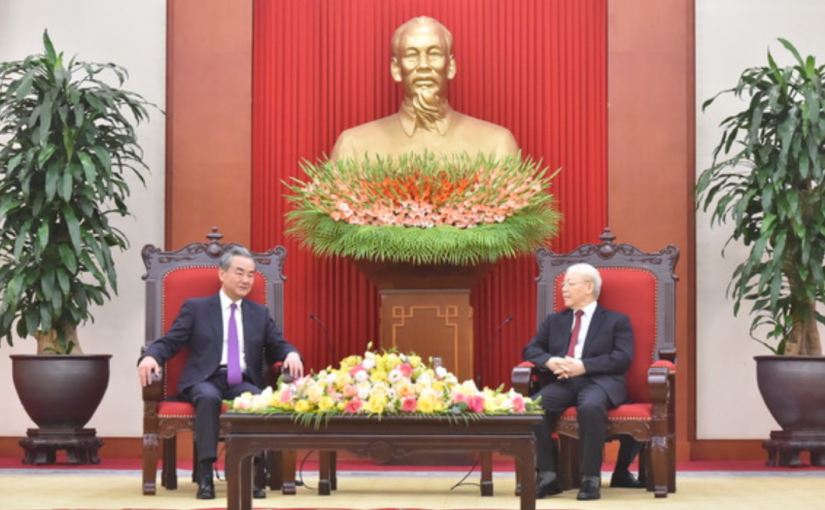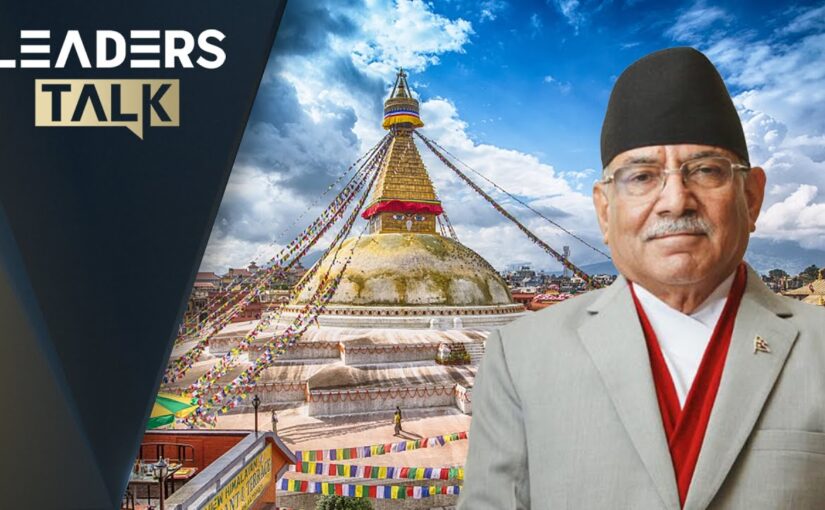
Prachanda: China’s successes building socialism provide great encouragement to the peoples of the world

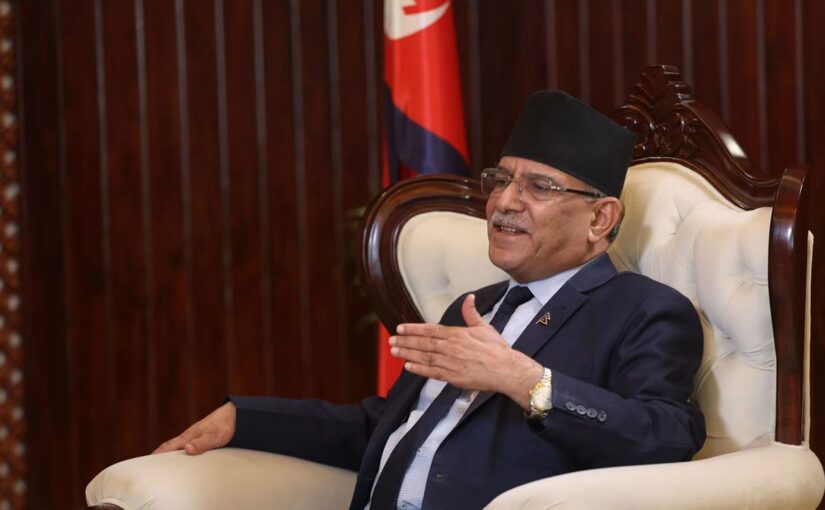
In this episode of the CGTN series Leaders Talk, recorded on September 25, two days after the opening of the Asian Games in Hangzhou, Li Tongtong interviews Pushpa Kamal Dahal, the Prime Minister of Nepal, known as Prachanda.

Noting that Prachanda is now serving his third term as Prime Minister, Li notes that the first of his many visits to China was to attend the closing ceremony of the 2008 Beijing Olympics during his first term. Now, 15 years later, he is in China for the opening of the Asian Games, having moved up his speaking slot at the United Nations General Assembly session in New York to be present. Nepal set a record with more than 250 of its athletes competing in the games this time and Prachanda observes that the 2008 Olympics showcased China’s progress to the world. And now the Asian Games show that China has taken another leap forward. 

Prachanda says that he has met President Xi Jinping five times and finds him a very sincere and visionary leader. Topics he had discussed with him this time included the common interests of the two countries, how to better facilitate China’s support and help to Nepal, for example in aviation, railway, road and transmission line connectivity, as well as climate change, poverty reduction and friendly relations between the two peoples.

The Nepalese Prime Minister, who is also the leader of the Communist Party of Nepal (Maoist Centre), says that the glorious history of the Communist Party of China (CPC), since its founding in 1921, has seen it amass a wealth of experience. As a result, it has achieved a great success in building a new model of socialism, namely socialism with Chinese characteristics. This has provided great encouragement to and made a positive impact on communist parties and people who want development and social justice around the world. They all want to learn from China’s experience.

The friendship between Nepal and China, Prachanda observes, has deep roots and one example of their special relations is that Nepal is the only country to have diplomatic representation in Xizang (Tibet), which Prachanda went on to visit as the last stop of his visit. Its consulate in Lhasa is one of five Nepali consulates in China, more than it has in any other country. 

Whilst the number of people engaged in agricultural production in Nepal is gradually decreasing, Prachanda explains that his country is still primarily an agricultural one. So China’s experience and assistance in the agricultural field is very meaningful and important for Nepal. He always aim to study agricultural matters each time he visits China and this time he is focusing on how Nepal can enhance its agricultural production through the adoption of modern technologies.

Turning Nepal from a landlocked to a land-linked country is another key priority and in this respect Chinese experts are now engaged in active feasibility studies for the construction of a China/Nepal railway. Prachanda dismisses allegations of a ‘debt trap’ or the idea that a rail link could somehow pose a a security threat to other countries as baseless.

Irrespective of international, regional or domestic changes, he insists, his country’s position on relations with China will not change or be allowed to change. Nepal has always pursued a foreign policy of independence and non-alignment. It is resolute in defending its national sovereignty, territorial integrity and independence. Nepal has never wavered or capitulated under pressure and it never will.

Guided by the United Nations Charter and the Five Principles of Peaceful Coexistence, Nepal firmly believes that all countries are equal, that no country should be allowed to interfere in the internal affairs of others, and that all countries have the right to decide on their own affairs.

Asked finally about his use of the name Prachanda, he said he adopted it when he was leading the revolutionary struggle. But he also used it during the peace process. He is more recognised by this name than by his original name and he will continue to use it as it symbolises both revolution and peace.

The full interview is embedded below.

Pakistani, Kazakh and Nepalese leaders conclude successful China visits

Pakistan Prime Minister Anwaar-ul-Haq Kakar and Kazakhstan President Kassym-Jomart Tokayev concluded their recent visits to China, to attend the Third Belt and Road Forum for International Cooperation, with visits to Urumqi, the capital of the Xinjiang Uyghur Autonomous Region, prior to their returning home. Both leaders met with Ma Xingrui, a Political Bureau member of the Communist Party of China (CPC) Central Committee as well as party secretary for the autonomous region.

The Pakistan Prime Minister offered the Friday prayers at the historic Hang Yang Grand Bazaar Mosque in Urumqi and prayed for the progress and prosperity of the country as well as the Muslim Ummah. He specially prayed for the oppressed people of Gaza and for their deliverance from suffering. Kakar also addressed students and faculty at Xinjiang University in Urumqi, saying:

“In Pakistan, we say a good neighbour is a treasure. In this regard, we are very fortunate to have China as a good brother, good neighbour, good partner, and good friend.”

In his discussions, Kazakh President Tokayev focused on the economic ties between the four border regions of Kazakhstan and Xinjiang. The share of Xinjiang exceeds 40% of the total trade volume between Kazakhstan and China. In six months this year, the trade turnover between Kazakhstan and Xinjiang increased by 87%, reaching US$8.5 billion, he noted.

“We will encourage Kazakh tourists to travel to China to explore natural beauty and your achievements in socio-economic development,” he said, adding:

“Since ancient times, Xinjiang has been famous for its substantial cultural development. Local creative teams deservedly enjoy international recognition. We support the full development of creative exchanges and mutual tours, which will undoubtedly help strengthen the ties of good neighbourliness and friendship.”

These visits underscore the growing importance attached by China to both neighbourhood and subnational diplomacy. They also highlight the fact that the leaders of neighbouring countries reject the western propaganda falsely alleging religious persecution and denial of national rights in China’s border regions.

In similar vein, Nepalese Prime Minister Prachanda concluded his eight-day official visit to China in September, which began with attending the opening of the Asian Games in Hangzhou, with a visit to the Tibetan Autonomous Region, also known as Xizang. After visits to the ancient Potala Palace and Jokhang Temple in the capital Lhasa, Prachanda visited visited Mount Kailash and Mansarovar Lake, which are considered holy by Hindus. He told the Nepali national news agency RSS that provisions would be made for pilgrims and tourists from Nepal, India and other countries to visit Kailash and Manasarovar through the Nepali route. 

The following articles were originally published by the Pakistani newspaper The News, Kazakhstan’s Astana Times and the Press Trust of India (PTI, reprinted by various Indian newspapers).

PM in rare visit to Xinjiang in China

ISLAMABAD: Caretaker Prime Minister Anwaar-ul-Haq Kakar Friday departed for Pakistan on the completion of his five-day visit to China. At the Urumqi International Airport, the prime minister was seen off by the Standing Member of Communist Party of China Illizat Ahmetjan, and senior officers of the Chinese government and Pakistan’s Embassy. On the last leg of the visit, the prime minister visited Urumqi and met Member Politburo of CPC’s Central Committee Ma Xingrui, besides addressing the students at Xinjiang University.

The prime minister offered the Friday prayers at the historic Hang Yang Grand Bazaar Mosque in Urumqi and prayed for the progress and prosperity of the country as well as the Muslim Ummah. He specially prayed for the oppressed people of Gaza and for their deliverance from suffering. Kakar also addressed students and faculty at Xinjiang University in Urumqi.

“In Pakistan, we say a good neighbor is a treasure. In this regard, we are very fortunate to have China as a good brother, good neighbor, good partner, and good friend.

Meanwhile, President Xi Jinping has extended support to Pakistan and urged a secure environment for Chinese institutions and personnel.

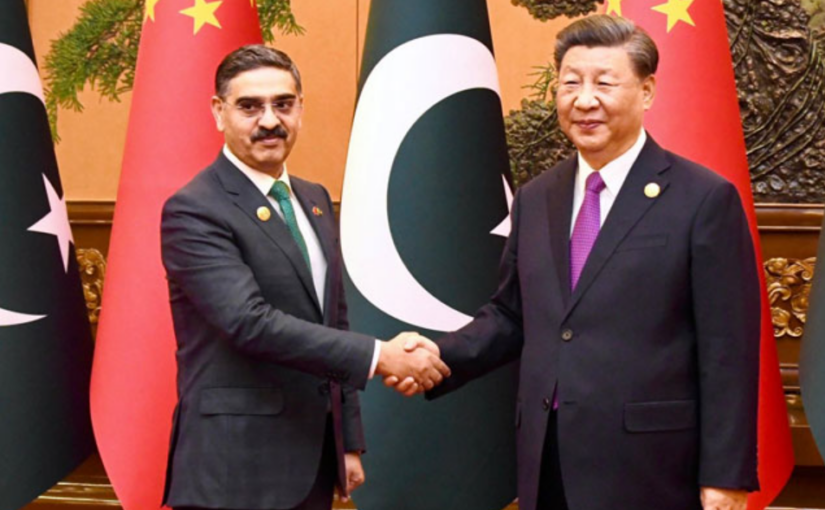
During a meeting with Pakistan’s Prime Minister Anwaar-ul-Haq Kakar on the sidelines of the Third Belt and Road Forum in Beijing on Thursday, Xi said, “It is hoped that Pakistan will ensure the safety of Chinese institutions and personnel in Pakistan.” The longtime allies reaffirmed their “unwavering” partnership, vowing to further strengthen strategic communication and bilateral cooperation, reports the international media.

Continue reading Pakistani, Kazakh and Nepalese leaders conclude successful China visits

China aims to establish diplomatic relations with Bhutan soon

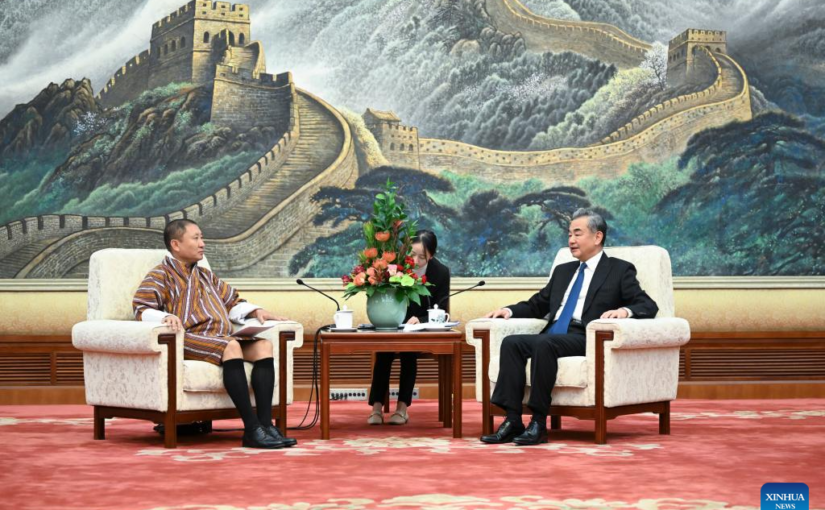
Considerable progress has been made towards the establishment of diplomatic relations between China and Bhutan following a visit to Beijing by Bhutanese Foreign Minister Tandi Dorji.

Bhutan is a small Himalayan kingdom bordering both China and India, with a population of a little over 727,000 and a territory of 14,824 square miles. Its border with China is undelineated and the purpose of Dorji’s visit was for boundary talks. This, however, is not the reason for the failure to establish diplomatic relations to date. Despite the unresolved territorial issue, China and Bhutan concluded an agreement in 1998 on border peace and tranquillity, the first bilateral agreement between the two countries. Rather, the issue has been that India long maintained an effective protectorate, or in effect a neo-colonial relationship, with regard to Bhutan’s foreign relations. India, in turn, acquired this jurisdiction from British colonialism on obtaining its own independence. Thus, it was only in 1968 that Bhutan established its first diplomatic relations with any country – with India, followed by Bangladesh in 1973. It only began the process of establishing further diplomatic relations with other countries in 1983 and still does not have formal relations with any of the five permanent members of the United Nations Security Council.

It was only in 2007 that India finally made a move towards formally recognising Bhutan’s right to independently develop its foreign relations.  In February 2007, the “Indo-Bhutan Friendship Treaty” was revised. Whereas the Treaty of 1949, in Article 2 stated: “The Government of India undertakes to exercise no interference in the internal administration of Bhutan. On its part the Government of Bhutan agrees to be guided by the advice of the Government of India in regard to its external relations,” the revised treaty states, “In keeping with the abiding ties of close friendship and cooperation between Bhutan and India, the Government of the Kingdom of Bhutan and the Government of the Republic of India shall cooperate closely with each other on issues relating to their national interests. Neither government shall allow the use of its territory for activities harmful to the national security and interest of the other.”  Given India’s complex regional alignments, this can still function as a pretext for Indian interference and a constraint on Bhutanese independence and sovereignty.

During Foreign Minister Tandi Dorji’s visit, his Chinese counterpart, Wang Yi, in an October 25 meeting, told him that, China is ready to conclude boundary negotiations and establish diplomatic relations with Bhutan as soon as possible. Wang said China and Bhutan are linked by mountains and rivers and enjoy a profound traditional friendship, adding that the conclusion of boundary negotiations and the establishment of diplomatic relations between the two countries fully serves the long-term and fundamental interests of Bhutan.

He also said that China has always placed neighborhood diplomacy at the top of its overall diplomatic architecture, and China respects the sovereignty, independence and territorial integrity of all countries.

Tandi Dorji thanked China for its strong support and assistance to Bhutan, saying that Bhutan firmly upholds the one-China principle.

The following day, Dorji met with Chinese Vice President Han Zheng, who said that although the two countries have not yet established diplomatic relations, they have long maintained friendly exchanges.

“China always respects Bhutan’s independence, sovereignty and territorial integrity, and is willing to strengthen exchanges at all levels and in all fields, expand practical cooperation on the economy, trade, culture and tourism, and accelerate the boundary demarcation process and the establishment of diplomatic relations with Bhutan to bring more benefits to the two countries and the two peoples,” he added.

Tandi Dorji said that both sides have firm determination and a sincere desire to demarcate their boundaries and establish diplomatic relations at an early date. Bhutan is willing to maintain the sound momentum of cooperation with China in all fields and push for the greater development of bilateral ties.

The following articles were originally published by the Xinhua News Agency.

China aims to establish diplomatic relations with Bhutan soon: FM

BEIJING, Oct. 23 (Xinhua) — China is ready to conclude boundary negotiations and establish diplomatic relations with Bhutan as soon as possible, Chinese Foreign Minister Wang Yi said Monday.

Wang, also member of the Political Bureau of the Communist Party of China Central Committee, made the remarks when meeting with Bhutanese Foreign Minister Tandi Dorji who is in China for boundary talks.

Wang said China and Bhutan are linked by mountains and rivers and enjoy a profound traditional friendship, adding that the conclusion of boundary negotiations and the establishment of diplomatic relations between the two countries fully serves the long-term and fundamental interests of Bhutan.

“The two sides should seize historical opportunities, complete the important process as soon as possible, and designate and develop the friendly relations between the two countries in legal form,” said Wang.

Wang also said that China has always placed neighborhood diplomacy at the top of its overall diplomacy architecture, and China respects the sovereignty, independence and territorial integrity of all countries.

Tandi Dorji thanked China for its strong support and assistance to Bhutan, saying that Bhutan firmly upholds the one-China principle.

He said, “Bhutan is willing to work with China to strive for an early settlement of the boundary question and advance the political process of establishing diplomatic ties.”

He said that Bhutan greatly appreciates and supports the China-proposed global initiatives — the Global Development Initiative (GDI), the Global Security Initiative (GSI), and the Global Civilization Initiative (GCI) — which bring benefits to all parties, especially neighboring countries, including Bhutan. 


Chinese vice president meets Bhutan’s foreign minister

BEIJING, Oct. 24 (Xinhua) — Chinese Vice President Han Zheng on Tuesday met with visiting Bhutanese Foreign Minister Tandi Dorji in Beijing. Both sides agreed to accelerate the boundary demarcation process and the establishment of diplomatic relations between the two countries.

Han said that China and Bhutan are friendly neighbors sharing mountains and rivers. He said that although the two countries have not yet established diplomatic relations, they have long maintained friendly exchanges.

He said the two countries have promoted positive progress in bilateral ties in recent years, following the resumption of boundary negotiations. Strengthening that friendship and expanding cooperation are in the fundamental interests of the two countries and in the expectations of the two peoples.

“China always respects Bhutan’s independence, sovereignty and territorial integrity, and is willing to strengthen exchanges at all levels and in all fields, expand practical cooperation on the economy, trade, culture and tourism, and accelerate the boundary demarcation process and the establishment of diplomatic relations with Bhutan to bring more benefits to the two countries and the two peoples,” Han said.

Tandi Dorji said that the Bhutanese government attaches great importance to the development of relations with China and abides firmly by the one-China principle. Both sides have firm determination and a sincere desire to demarcate their boundaries and establish diplomatic relations at an early date. Bhutan is willing to maintain the sound momentum of cooperation with China in all fields and push for the greater development of bilateral ties. 

Senator Mushahid Hussain honoured with Silk Road award at BRI forum

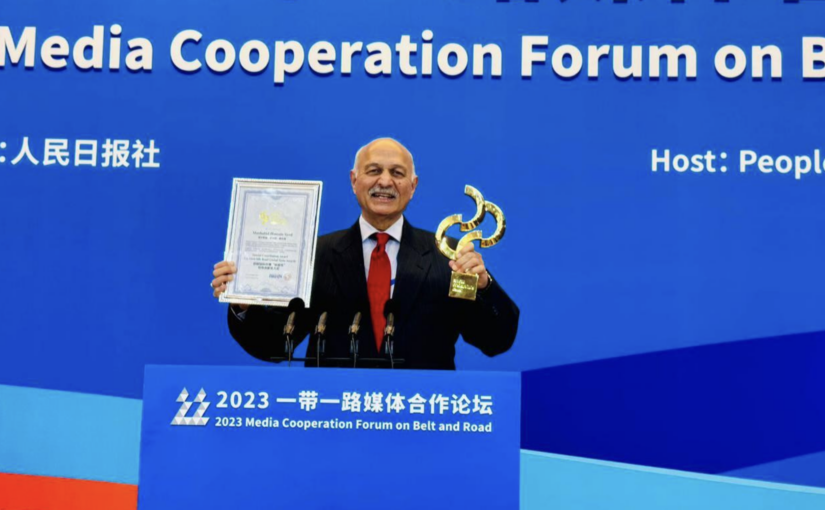
Pakistan Senator Mushahid Hussain was one of three recipients, the others coming from Uganda and Russia, of the inaugural Silk Road News Award. The presentations were made on October 19, during the Media Cooperation Forum of the Third Belt and Road Forum for International Cooperation, held in Beijing. The award was presented in recognition of his work to promote the China Pakistan Economic Corridor (CPEC).

In his acceptance speech, Mushahid, who currently chairs the Defence Committee in the Pakistan Senate, quoted Chairman Mao, that “an idea becomes a material force when it is grasped by millions and millions of people.” He also took the opportunity to refer to the situation in Gaza, which he denounced as genocide, adding that the western powers were complicit in Israel’s crimes.

Senator Mushahid, who also chairs the Pakistan-China Institute and is a member of our advisory group, has devoted his life to the promotion of Pakistan-China friendship, since first visiting the country as a teenager in 1970. He will be a speaker at our forthcoming webinar on ten years of the Belt and Road Initiative on Saturday November 4.

We take this opportunity to congratulate him on this well-deserved recognition and award.

The following article originally appeared in the Pakistani daily newspaper Express Tribune.

Senator Mushahid Hussain on Thursday was awarded the Silk Road Award during the Media Cooperation Forum on the Belt & Road Initiative (BRI) in Beijing. The recognition was for his contributions to the China-Pakistan Economic Corridor (CPEC).

The award ceremony took place on the sidelines of the 3rd Belt and Road Forum and was presented by Information and Communication of the Communist Party of China Chief of Media Li Shulei, who is also a member of the party’s top policymaking political bureau.

In his acceptance speech, Senator Mushahid said he was honoured to receive the first-ever ‘Silk Road News Award.’ He extended the achievement to the people of Pakistan. Two other recipients of this prestigious award were from Uganda and Russia. They were chosen from among 4,485 participants representing 80 countries.

The senator acknowledged China’s enduring support and consistent investment in projects like CPEC. Furthermore, he also highlighted the importance of BRI, stating that it represents a new platform for international economic cooperation and is the most significant development and diplomatic initiative of the 21st century.

The core of such an initiative, he added, is people-to-people connectivity and Pakistan-China relations, especially the role of media, think tanks, academia, youth, and NGOs, working towards a more ‘open, inclusive, and interconnected world’.

Quoting Chairman Mao, Senator Hussain said, “An idea becomes a material force when it is grasped by millions and millions of people,” referring to BRI as a “material force in the world,” bringing benefits and opportunities to a global audience.

Middle East situation

While addressing the international atmosphere in Gaza, the senator expressed his concerns about the Middle East and referred to it as ‘genocide in Gaza,’ where the West’s support of Israel’s crimes is complicit in the ongoing conflict. He criticised the West’s stance on human rights and democracy, calling it ‘double standards’.

Mushahid showed his solidarity with the oppressed Palestinians, terming the situation as a ‘struggle between the oppressed and oppressors’. BRI is a path forward, based on connectivity and cooperation, with CPEC serving as a guarantor for a better future for Pakistan and its people, he added. He encouraged taking ownership of CPEC to ensure its successful conclusion.

Challenge of fake news

Hussain concluded by addressing the challenge of fake news, falsehoods, and fiction, describing them as the most significant threats to the BRI. He called for a collective and cooperative approach among BRI countries on the media front, emphasizing that a “collective voice” would be a potent force multiplier.

The ceremony was attended by Vice Ministers for International Communication from the Publicity and International Departments of the Communist Party of China. It was hosted by ‘People’s Daily’ at its headquarters and attended by the President and Editor-in-Chief of ‘People’s Daily,’ the official organ of the Communist Party of China, along with 200 journalists from over 60 countries.

China supports Bangladesh in safeguarding national sovereignty, independence and territorial integrity

China has declared its full support for Bangladesh in protecting national sovereignty, independence, territorial integrity and averting external interference.

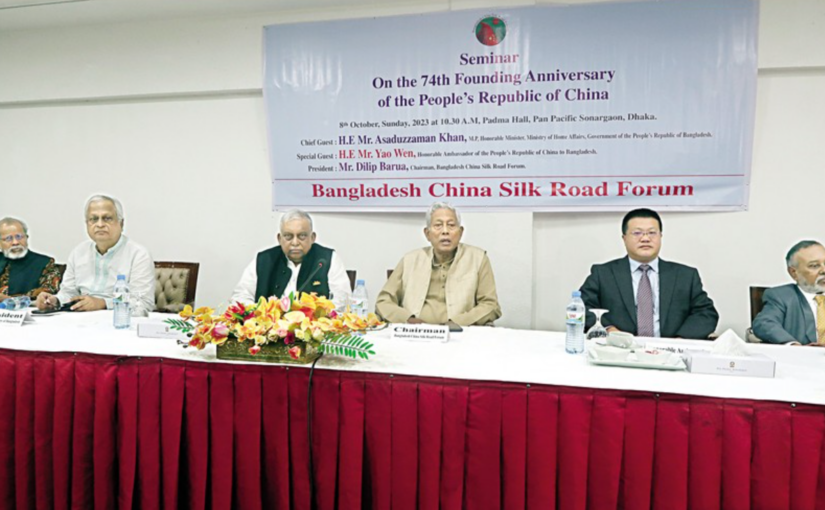
The pledge came from Beijing’s Ambassador to the South Asian country Yao Wen, speaking at a recent function in the capital Dhaka, organised by the Bangladesh-China Silk Road Forum to celebrate the 74th anniversary of the founding of the People’s Republic of China, which fell on October 1st.

“China supports Bangladesh in safeguarding national sovereignty, independence and territorial integrity, and in opposing external interference so that the country can maintain domestic unity and stability and achieve development and revitalisation,” the Ambassador said.

In his welcoming speech, Dilip Barua, the chairman of the Forum, who is also the General Secretary of the Communist Party of Bangladesh (Marxist-Leninist) and a former government minister, said that China does not interfere in the internal affairs of any country. He added that a country requires stability and continuity for long-term development and that Prime Minister Sheikh Hasina should remain in power for the long-term development of Bangladesh.

Citing the growing US pressure for regime change in his country, Barua noted that: “A crisis is brewing up in our country and we will counteract it with the help of China.” With the rise of China, western sanctions against Bangladesh will not be effective, he added.

Speaking as the chief guest, Home Minister Asaduzzaman Khan Kamal said that the recent meeting between Prime Minister Sheikh Hasina and Chinese President Xi Jinping at August’s BRICS summit in South Africa had underlined the importance of cooperation in infrastructure development, information technology, new energy and the agriculture sector between the two countries.

The following article originally appeared in the Financial Express, one of Bangladesh’s leading English language daily newspapers.

China supports Bangladesh in protecting national sovereignty, independence, territorial integrity and averting external interference, according to the Chinese envoy in Dhaka, as a veteran Bangladeshi politician talked about preventing “Western meddling” with Beijing’s help.

“A crisis is brewing up in our country and we will counteract it with the help of China,” Communist Party of Bangladesh (Marxist-Leninist) General Secretary Dilip Barua told a seminar in Dhaka on Sunday.

At the programme, organised to celebrate the 74th founding anniversary of the People’s Republic of China, Chinese Ambassador to Bangladesh Yao Wen commented that the future of Bangladesh can only be determined by the people of Bangladesh.

“China supports Bangladesh in safeguarding national sovereignty, independence and territorial integrity, and in opposing external interference so that the country can maintain domestic unity and stability and achieve development and revitalisation,” said Chinese Ambassador Yao Wen.

The envoy said he has full confidence in the bright future of Bangladesh and China-Bangladesh relations. The ambassador expressed his optimism that the cultural ties between the two countries will grow stronger.

He also expressed satisfaction over the support of the political parties and people of Bangladesh.

The programme was organised by the Bangladesh-China Silk Road Forum.

Chairman of the forum Dilip Barua, in his welcome speech, said that China doesn’t interfere in the internal affairs of any country. He said a country requires stability and continuity for long-term development.

Mr Barua, a former minister, commented that Prime Minister Sheikh Hasina should be in power for the long-term development of Bangladesh.

He said the Western force is decaying and Eastern countries under the leadership of China are rising. “So Western sanction against Bangladesh will not be effective.”

Speaking as the chief guest, Home Minister Asaduzzaman Khan Kamal said Bangladesh is always satisfied with the steady mutual trust between China and Bangladesh.

China-Bangladesh relations were upgraded to a strategic partnership of cooperation in 2016 and strengthened further in 2019 through the visit of top Chinese and Bangladeshi leaders.

Asaduzzaman Khan said the recent meeting between Prime Minister Sheikh Hasina and Chinese President Xi Jinping at the BRICS summit emphasised the importance of cooperation in infrastructure development, information technology, new energy and the agriculture sector of the two countries.

Former Bangladesh ambassador to China Munshi Faiz Ahmed said the China-Bangladesh relationship will last for many more years due to its importance. He said China has made significant contributions to the infrastructural development of Bangladesh. Dhaka University Professor Imtiaz Ahmed requested the Chinese envoy to include Bangladesh in the Shanghai Cooperation, saying Bangladesh could be a valuable contributor to the alliance.

Prachanda: China’s socialism offers Nepal valuable insights for improving the lives of the disadvantaged

Prime Minister Pushpa Kamal Dahal Prachanda, Prime Minister of Nepal, who is also the leader of the Communist Party of Nepal (Maoist Centre), visited China from September 23-30, with his first engagement being to attend the opening of the 19th Asian Games in Hangzhou and to meet there with Chinese President Xi Jinping. Prachanda has visited China many times, but this was the first visit of his current third term as Prime Minister.

During his visit, Prachanda gave an exclusive interview to the Chinese newspaper, Global Times.

In its preamble, the newspaper described the Nepalese leader as having witnessed abject poverty in his youth and therefore, becoming “determined to change his country’s corruption and a ruling exploitative class, Prachanda embarked on a revolutionary path to transform Nepal’s destiny.” It added: “As a staunch socialist and a long-time member of the Communist Party, Prachanda has deep ties to China.”

The interview features a detailed overview of the economic situation in Nepal and the current stage and prospects of the country’s relations with China in the economic and social fields. Prachanda tells his interviewers that:

“Nepal urgently requires to create more jobs in order to address the unemployment problem, enhance productivity, expand the output of exportable goods and services, explore new markets for export, control inflation, and maintain trade balance. These objectives stand as my foremost priorities.”

He then adds: “China has ascended to become the world’s second-largest economy, showcasing remarkable achievements in the socio-economic transformation of its society. Notably, China serves as a significant pillar of economic support for Nepal. Since the establishment of diplomatic relations between Nepal and China in 1955, China has played an important role in assisting Nepal’s infrastructure and development endeavours. Many of these projects hold immense importance for our nation’s progress. As China continues to advance, its support and investment in Nepal are continuously growing. Nepal views China’s development trajectory as an opportunity, with the BRI [Belt and Road Initiative] serving as a suitable platform for enhancing trans-Himalayan multidimensional connectivity.”

One key element of the two countries’ cooperation, which holds the potential to be transformatory for the Nepalese economy, is a planned railway link. On this, Prachanda notes:

“The primary concern associated with this project is how quickly we can bring it to fruition. You must be aware that the construction of this project requires a substantial amount of resources that Nepal alone cannot afford. In such a situation, we have no choice but to rely on external funding. However, we also share concerns that the size of the loan for this project and terms and conditions should be manageable for the Nepali economy.”

Asked whether he believes that socialism is still relevant in Nepal, the veteran communist leader replies:

“Nepal’s constitution defines Nepal as a socialism-oriented state. In my view, socialism and Chairman Mao’s ideas and teachings remain relevant to transform Nepal into a socialist country.

“Under the socialism and the leadership of Mao, the Communist Party of China (CPC) established the People’s Republic of China. The CPC developed its unique path to socialism with Chinese characteristics.

“Similarly, Nepal will determine its own path as a socialism-oriented country that suits its historical political development and current geopolitical realities. It’s not about Nepal imitating China’s socialism and Chairman Mao Zedong. China’s socialism and Mao’s ideas offer us valuable insights to improve the socio-economic status of the oppressed and economically disadvantaged class of people.”

He is also asked whether he believes he has realised the dreams and goals he had when he first fought in the revolution, drawing this reply:

“I should say our dreams have been partially realised. Politically, the country has overthrown a centuries-old monarchy and has been transformed into a republic. This would not have been possible without our ‘People’s War.’ Now, in the eyes of the constitution and laws, all citizens are equal. The country has adopted inclusive policies protecting the basic rights of people from all walks of life. From the highest level such as parliament and other constitutional bodies to the lowest level of political representations such as ward committees, from government institutions to cooperatives, from recruitments in government jobs to student admissions in colleges, certain reservations have been ensured for people from marginalised groups like women, the economically poor, and the underprivileged classes. This remarkable achievement was institutionalised through the constitution promulgated in 2015.

“Despite achievements made in several areas, I must admit that much remains to be done in the economic sector. Economic, technical, and educational advancements take a longer time to show visible results. To achieve progress in these sectors, we need consistent, long-term efforts, and most importantly national consensus.”

We reprint below the full text of Comrade Prachanda’s interview.

We also reprint the full text of the joint statement between China and Nepal, which was released following Prachanda’s talks with his Chinese counterpart, Premier Li Qiang, in Beijing on September 26.

The statement notes that both countries agreed that, “since the establishment of diplomatic relations between the two countries in 1955, China and Nepal have withstood changes of the international situation, always upheld mutual respect, equality, solidarity, mutual assistance and win-win cooperation, setting a fine example of friendly interaction between countries with different social systems and of different sizes… China firmly supports Nepal in upholding its independence, sovereignty and territorial integrity, and respects and supports Nepal’s independent choice of social system and development path that suits its national conditions.”

The statement reviews in detail all areas of bilateral cooperation and addresses ways to advance them in a smoother and more expeditious manner. It adds:

“The two sides commended their mutual support in fighting COVID-19 together. The two sides expressed satisfaction over the completion and handover of the China-aided project of upgrading and renovating the Civil Service Hospital in Nepal and are ready to further strengthen health and medical cooperation, including expediting the installation of a Bone Marrow Transplant Service at the B.P. Koirala Memorial Cancer Hospital in Nepal.”

China and Nepal also stressed “the importance to uphold true multilateralism, promote greater democracy in international relations, and make global governance more just and equitable. The two sides agreed to strengthen cooperation within the framework of the United Nations and other multilateral mechanisms to uphold the common interest of developing countries. The two sides support the multilateral trading system and oppose protectionism. They will work together to make economic globalisation more open, inclusive, balanced and beneficial for all, promote global and regional peace, security, development and prosperity, and build a community with a shared future for humanity.”

The following articles were originally published by Global Times and the Xinhua News Agency.

Nepal to maintain non-aligned policy in friendly relations with neighbors, hopes China’s strengths will help bolster economy: Nepalese PM

At the invitation of Chinese Premier Li Qiang, Nepalese Prime Minister Pushpa Kamal Dahal Prachanda commenced his five-day state visit to China from September 23 to 30, his first visit to China since the start of his third term as the Prime Minister of Nepal. The 69-year-old is a legendary figure in Nepal. Born in a poor Brahmin farming family in Pokhara in 1954, he witnessed abject poverty in his youth. Determined to change his country’s corruption and a ruling exploitative class, Prachanda embarked on a revolutionary path to transform Nepal’s destiny. In 2008, he became the first prime minister of Nepal after the abolition of the monarchy. In 2016, he assumed the office of prime minister for a second term, and in November 2022, this veteran of Nepalese politics made a comeback for a third term. As a staunch socialist and a long-time member of the Communist Party, Prachanda has deep ties to China. After assuming office as the first term as prime minister of Nepal, the first country he visited was China. In 2008, he also came to Beijing to attend the opening ceremony of the Beijing 2008 Olympic Games.

Continue reading Prachanda: China’s socialism offers Nepal valuable insights for improving the lives of the disadvantaged

Timor-Leste PM: Chinese modernisation creates new paths for developing countries

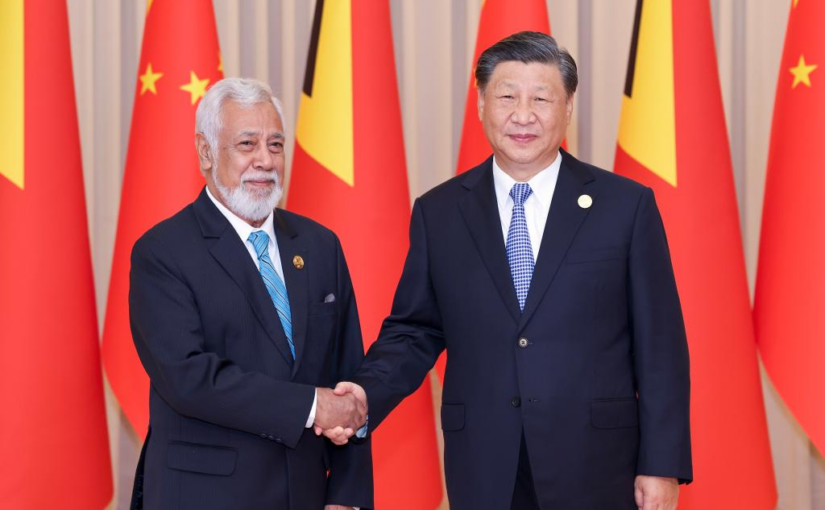
China and the Democratic Republic of Timor-Leste have jointly announced the elevation of their bilateral relations to a comprehensive strategic partnership. This move came as President Xi Jinping met with Timor-Leste Prime Minister Xanana Gusmão at the opening of the 19th Asian Games in Hangzhou.

Meeting the Timorese leader, Xi said that China is willing to join hands with Timor-Leste on the journey of modernisation to bring more benefits to the two peoples. The two countries should strengthen cooperative efforts in the four key areas, namely industrial revitalistion, infrastructure development, food self-sufficiency and livelihood improvement.

In the joint statement announcing their comprehensive strategic partnership, both nations share the view that since their establishment of diplomatic 21 years ago, the two countries have acted with mutual respect and treated each other as equals, with their friendship continuing to deepen.

Timor-Leste believes that Chinese modernisation presents a new paradigm, which broadens paths and options for developing countries to achieve modernisation and provides a Chinese solution for humanity to pursue a better social system.

Regarding industrial revitalisation, Timor-Leste expressed appreciation to the Chinese government for granting zero-tariff treatment to 98 percent of Timor-Leste exports to China. China will continue to render help in technology training on coffee growing and support Timor-Leste in exporting coffee to China to support revitalising the Timor-Leste coffee industry.

On infrastructure development, China will focus on the policy priorities of the government of Timor-Leste, guide enterprises to ensure sound operation and maintenance of the national grid in Timor-Leste and conduct cooperation with Timor-Leste on communication infrastructure. China expressed its willingness to encourage its enterprises to actively participate in the development of infrastructure, including roads, bridges and ports.

On food self-sufficiency, the two nations will implement agricultural projects to help Timor-Leste achieve food self-sufficiency and modernisation of agriculture.

Regarding the improvement of people’s livelihood, the Chinese government will continue to send medical teams to Timor-Leste, providing medical services for the Timorese people and will ensure sound implementation of projects including the National Imaging Centre of Timor-Leste. The two nations will also accelerate cooperation on the China-Timor-Leste Friendship Hospital.

The statement noted that China and Timor-Leste share common interests and similar positions in international affairs, support the United Nations (UN) in playing a central role in maintaining world peace, promoting common development and advancing international cooperation, and will strengthen mutual support in international affairs, including upholding the UN-centered international system. Both nations agreed to jointly maintain the unity and cooperation of the international community, oppose hegemonism and power politics, uphold true multilateralism, and promote humanity’s common values of peace, development, equity, justice, democracy and freedom.

Prime Minister Gusmão was a key leader of the armed struggle that secured his country’s independence against almost impossible odds. Indonesia invaded the country in December 1975, nine days after it had declared its independence from Portuguese colonialism. In the initial days of the struggle Gusmão walked from village to village to gain support and recruits. Finally captured in November 1982, he was sentenced to life imprisonment in May 1993, commuted to twenty years in August 1993. He was released in late 1999, as the struggle moved towards victory, following the toppling of the brutal Suharto dictatorship in May 1998. Gusmão had continued to lead the resistance from prison with the courageous help of his Australian wife Kirsty Sword.

The following articles were originally published by the Xinhua News Agency.

China, Timor-Leste elevate ties to comprehensive strategic partnership

HANGZHOU, Sept. 23 (Xinhua) — Chinese President Xi Jinping and Prime Minister Xanana Gusmao of Timor-Leste on Saturday jointly announced the elevation of bilateral relations to a comprehensive strategic partnership.

They met in Hangzhou, capital city of east China’s Zhejiang Province, ahead of the opening of the 19th Asian Games scheduled for Saturday.

The elevation of bilateral ties is a practical necessity for the two countries to advance their cooperation, and a shared expectation of the two peoples, Xi said.

China is willing to join hands with Timor-Leste on the journey of modernization to bring more benefits to the two peoples, Xi added.

Xi emphasized that being staunch supporters for each other’s core interests and major concerns serves as an important political foundation for the continuous upgrading of bilateral relations.

The two sides should continue to promote Belt and Road cooperation and strengthen cooperative efforts in the four key areas, namely industry revitalization, infrastructure development, food self-sufficiency and livelihood improvement, Xi said, adding that China supports Timor-Leste in better integrating into the regional development.

The Timor-Leste prime minister said he is glad that bilateral relations have continuously achieved positive results in recent years, and the people of Timor-Leste will always remember Chinese government’s timely and tremendous help during Timor-Leste’s fight against COVID-19.

He welcomed Chinese enterprises to invest in Timor-Leste and help the country with its development. He expressed the hope to work with China to usher bilateral ties into the new phase of a comprehensive strategic partnership.

The two sides issued a joint statement on the establishment of the comprehensive strategic partnership.

Senior Chinese leaders including Cai Qi, Ding Xuexiang, Wang Yi, and Shen Yiqin attended the meeting. 

Continue reading Timor-Leste PM: Chinese modernisation creates new paths for developing countries

China and Syria announce establishment of a strategic partnership

President Bashar al-Assad of the Syrian Arab Republic, accompanied by First Lady Mrs. Asma al-Assad and a large government delegation, visited China from September 21-26, beginning with attending the opening of the 19th Asian Games in Hangzhou.

This was President Assad’s second visit to China, the first being in 2004. Syria was one of the first Arab countries to establish diplomatic relations with China, on August 1, 1956, preceded by Egypt on May 30, 1956.

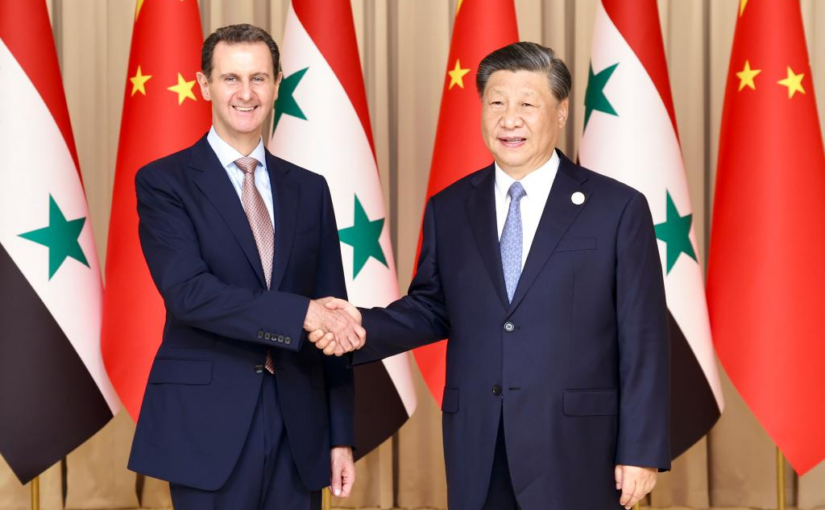
Meeting his Chinese counterpart Xi Jinping on September 22, the two leaders jointly announced the establishment of a China-Syria strategic partnership. Xi Jinping said that over the 67 years since the establishment of diplomatic relations between the two countries, the China-Syria relationship has stood the test of changes in the international situation, and their friendship has grown stronger over time, and went on to note that the establishment of the strategic partnership will be an important milestone in the history of bilateral ties.

Xi emphasised that China will continue to work with Syria to firmly support each other on issues concerning the two sides’ respective core interests and major concerns, safeguard the common interests of both countries and other developing countries, and uphold international fairness and justice.

China supports Syria in opposing foreign interference, rejecting unilateralism and bullying, and safeguarding national independence, sovereignty and territorial integrity, he said.

Assad said that in international affairs, China has always aligned itself with international fairness and justice, and upheld international law and humanitarianism, playing an important and constructive role.

The Syrian side thanks the Chinese government for its invaluable support to the Syrian people, firmly opposes any act of interference in China’s internal affairs and is willing to be China’s long-term and staunch friend and partner.

In the joint statement announcing their establishment of a strategic partnership, Syria affirmed its adherence to the one-China principle and expressed support for China’s positions with regard to Taiwan, Hong Kong and Xinjiang affairs.

In turn: “China firmly supports Syria in safeguarding national independence, sovereignty, unity and territorial integrity, supports the Syrian people in following a development path suited to its national conditions, supports the policies and measures adopted by the Syrian government aimed at safeguarding national security, stability and development, opposes interference by external forces in Syria’s internal affairs and undermining of Syria’s security and stability, opposes the illegal military presence in Syria, the launching of illegal military operations and the illegal plundering of Syria’s natural resources, and urges relevant countries to immediately lift all illegal unilateral sanctions against Syria.”

The two sides expressed willingness to deepen exchanges and cooperation between political parties, parliaments and local governments of the two countries and to strengthen the exchange of experience in governance. They will also strengthen friendly cooperation in various fields, such as economy and trade, agriculture, culture, youth work and journalism. China will continue to provide assistance to Syria within its capacity to support it in its reconstruction and restoration. The Syrian side thanks China for its political support and selfless help, as well as for speaking out for Syria at the UN Security Council. The two countries agreed to continue to strengthen counterterrorism and security cooperation and to work together to combat terrorism.

China supports and welcomes Syria’s return to the League of Arab States, supports Syria in improving its relations with other Arab countries, and supports Arab countries in the region, including Syria, in unity and self-strengthening.

China and Syria will strengthen coordination and cooperation in regional and international affairs, jointly adhere to true multilateralism, defend the international system with the United Nations at its core, the international order based on international law, and the basic norms governing international relations based on the purposes and principles of the UN Charter, resolutely oppose all forms of hegemonism and power politics, including the imposition of illegal unilateral sanctions and restrictive measures against other countries, and promote the building of a new type of international relations, and work together to build a community with a shared future for humanity.

From Hangzhou, President Assad and his party continued to Beijing, where they met with Premier Li Qiang and Zhao Leji, Chairman of the Standing Committee of the National People’s Congress.

Premier Li said that China and Syria have shared a time-honoured friendship and are true friends who stand together through thick and thin.

He added that China will continue to firmly support Syria in safeguarding its national independence, sovereignty, and territorial integrity, in following a development path suited to its national conditions, and firmly opposes external interference in Syria’s internal affairs.

China welcomes Syria’s participation in the Belt and Road Initiative, will continue to support Syria’s reconstruction, recovery, and development, and is willing to expand bilateral economic and trade exchanges with Syria, and strengthen people-to-people exchanges and cooperation.

The Chinese Premier told President Assad: “Friendship is a tree whose roots are loyalty and whose branches are kindness. You, Your Excellency, are an old and dear friend of the people of China.”

President Assad thanked the Chinese government for providing support to Syria in its war against terrorism and in dealing with the aftermath of the earthquake that hit the country last February.

He pointed out that friendship and trust between Syria and China are based on a similar history and fixed principles, and these principles are the same ones from which we can move towards the future.

Meeting Zhao Leji, President Assad said that the transition from the old world, which depends on force, to the new world, which is based on morals, must start from the role of China, which follows an ethical policy and development and presents initiatives to the whole world.

He said that China stood by Syria politically, based on the Chinese policy that rejects interference in the internal affairs of countries, respects the policies of countries, and rejects terrorism and added that China also supported Syria on the economic and humanitarian fronts, helping the Syrian people to mitigate the effects of the siege.

For his part, Zhao Leji said that: “Syria and China are working together and will continue to exchange support regarding the core interests of both sides in order to strengthen friendship between the two countries and enhance understanding between the two peoples.”

He added that: “China will continue to be on the right side of history to promote development for all humanity.”

The following reports were originally published by the Xinhua News Agency, the website of the Chinese Foreign Ministry and the Syrian Arab News Agency (SANA). The text of the joint statement was machine translated from Chinese and lightly edited by us.

Xi, Assad jointly announce China-Syria strategic partnership

HANGZHOU, Sept. 22 (Xinhua) — Chinese President Xi Jinping and Syrian President Bashar al-Assad on Friday jointly announced the establishment of a China-Syria strategic partnership.

The two presidents met in the eastern Chinese city of Hangzhou, Zhejiang Province, ahead of the opening of the 19th Asian Games scheduled for Saturday.

Syria was one of the first Arab countries that established diplomatic relations with the People’s Republic of China, and was one of the countries that co-sponsored the resolution to restore the lawful seat of the People’s Republic of China in the United Nations, Xi said.

Over the 67 years since the establishment of diplomatic relations between the two countries, the China-Syria relationship has stood the test of changes in the international situation, and their friendship has grown stronger over time, he said.

Xi noted that the establishment of the strategic partnership will be an important milestone in the history of bilateral ties.

China is willing to work with Syria to enrich their relationship and continuously advance the China-Syria strategic partnership, Xi said.

Xi emphasized that China will continue to work with Syria to firmly support each other on issues concerning the two sides’ respective core interests and major concerns, safeguard the common interests of both countries and other developing countries, and uphold international fairness and justice.

China supports Syria in opposing foreign interference, rejecting unilateralism and bullying, and safeguarding national independence, sovereignty and territorial integrity, he said.

China supports Syria in conducting reconstruction, enhancing counter-terrorism capacity building, and promoting a political settlement of the Syrian issue following the “Syrian-led, Syrian-owned” principle, Xi said.

China also supports Syria in improving its relations with other Arab countries and playing a greater role in international and regional affairs, he added.

China is willing to strengthen Belt and Road cooperation with Syria, increase the import of high-quality agricultural products from Syria, and jointly implement the Global Development Initiative, the Global Security Initiative and the Global Civilization Initiative to make active contributions to regional and global peace and development.

Assad said that in international affairs, China has always aligned itself with international fairness and justice, and upheld international law and humanitarianism, playing an important and constructive role.

Syria highly appreciates and firmly supports the Belt and Road Initiative, the Global Development Initiative, the Global Security Initiative and the Global Civilization Initiative, and will actively participate in them, Assad added.

The Syrian side thanks the Chinese government for its invaluable support to the Syrian people, firmly opposes any act of interference in China’s internal affairs, and is willing to be China’s long-term and staunch friend and partner, he said.

Assad said Syria will take the establishment of the Syria-China strategic partnership as an opportunity to strengthen bilateral friendly cooperation and step up their communication and coordination in international and regional affairs.

After the talks, the two heads of state witnessed the signing of bilateral cooperation documents in areas including Belt and Road cooperation, and economic and technological cooperation.

The two sides issued a joint statement on the establishment of the strategic partnership.

Senior Chinese leaders including Cai Qi, Ding Xuexiang, Wang Yi and Shen Yiqin attended the activities. 

Continue reading China and Syria announce establishment of a strategic partnership

Building a Cambodia-China community with a shared future

King Norodom Sihamoni of Cambodia was among the friendly foreign leaders to attend the September 23 opening of the 19th Asian Games in Hangzhou, the capital city of China’s Zhejiang province, as a guest of President Xi Jinping.

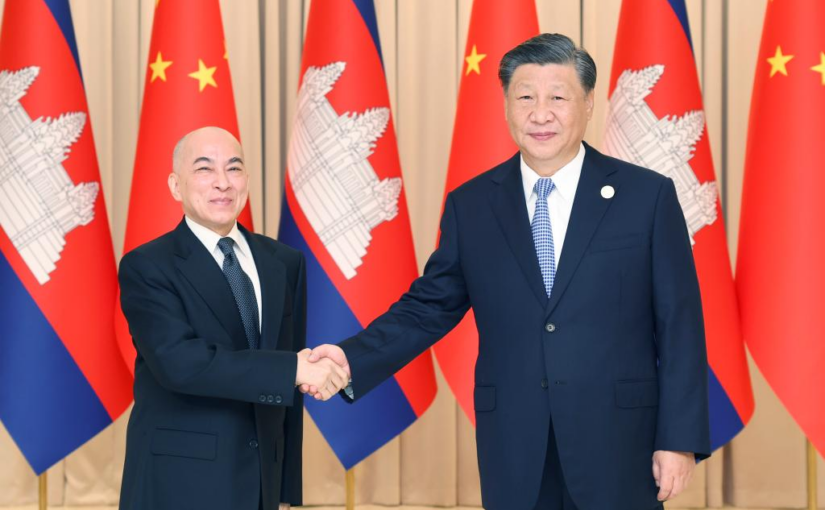
Meeting Sihamoni, Xi said that China stands ready to work with Cambodia to achieve solid progress in building the China-Cambodia community with a shared future. Noting that this year marks the 65th anniversary of the establishment of China-Cambodia diplomatic ties and the Year of China-Cambodia Friendship, he added that China cherishes the friendship with the Cambodian royal family and attaches great importance to the development of ties with Cambodia.

He also stressed that China supports Cambodia in taking a development path that suits its national conditions, maintaining stability and development, and playing an important role on the international and regional stage.

Cambodia will always remember the brotherly ties forged by King Father Norodom Sihanouk with Chinese leaders and cherish the ironclad friendship with China, the Cambodian king said, adding that his country stands ready to work with China on Belt and Road cooperation and to build a Cambodia-China community with a shared future.

Like his late father and his mother, Queen Mother Norodom Monineath Sihanouk, King Sihamoni enjoys a particular friendship with China and visits the country frequently, including for regular medical checkups, together with the Queen Mother.

The following article was originally published by the Xinhua News Agency.

Xi meets Cambodian king

HANGZHOU, Sept. 23 (Xinhua) — Chinese President Xi Jinping said Saturday China stands ready to work with Cambodia to achieve solid progress in building the China-Cambodia community with a shared future.

Xi made the remarks when meeting with Cambodian King Norodom Sihamoni, who is in Hangzhou, capital city of east China’s Zhejiang Province, to attend the opening ceremony of the 19th Asian Games.

Noting that this year marks the 65th anniversary of the establishment of China-Cambodia diplomatic ties and the Year of China-Cambodia Friendship, Xi said China cherishes the friendship with the Cambodian royal family and attaches great importance to the development of ties with Cambodia.

Xi said relations between China and Cambodia epitomize the diplomatic principle of amity, sincerity, mutual benefit, and inclusiveness, which he proposed a decade ago.

He stressed that China supports Cambodia in taking a development path that suits its national conditions, maintaining stability and development, and playing an important role on the international and regional stage.

The two countries should maintain high-level exchanges and deepen mutually-beneficial cooperation, he said.

Noting that China has successfully hosted two Asian Games, Norodom Sihamoni said he believes that China, under the strong leadership of President Xi, will deliver a spectacular sports event again and make new contributions to promoting solidarity and friendship among the people of Asia.

Cambodia will always remember the brotherly ties forged by King Father Norodom Sihanouk with Chinese leaders and cherish the ironclad friendship with China, the Cambodian king said, adding that the country stands ready to work with China on Belt and Road cooperation and build a Cambodia-China community with a shared future.

Senior Chinese leaders including Cai Qi, Ding Xuexiang, Wang Yi and Shen Yiqin attended the meeting. 

China and Nepal an example of equal treatment between big and small countries

The 19th Asian Games (Asiad) were officially opened in the Chinese city of Hangzhou by President Xi Jinping at a spectacular ceremony on the evening of Saturday September 23. With the participation of all 45 members of the Olympic Council of Asia (OCA) and more than 12,000 athletes, it is the largest Asiad to date.

A number of leaders of friendly countries paid visits to China on this occasion and attended the ceremony. They included President Bashar al-Assad of Syria, King Norodom Sihamoni of Cambodia, Prime Minister Pushpa Kamal Dahal Prachanda of Nepal and Prime Minister Xanana Gusmão of Timor-Leste.

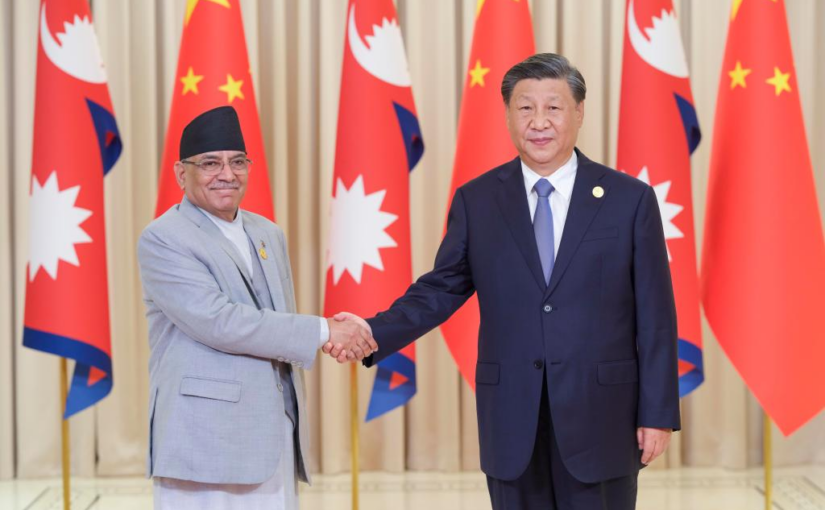
Meeting with the Nepalese Prime Minister, President Xi Jinping said that China and Nepal have set an example of equal treatment and win-win cooperation between big and small countries. The two countries are partners and opportunities for each other on their way to national development and prosperity.

Noting that the two countries have made progress in Belt and Road cooperation, and the Trans-Himalayan Multi-Dimensional Connectivity Network has taken shape, Xi urged efforts from both sides to promote infrastructure connectivity and expand transit transportation cooperation to help Nepal transform itself from a landlocked country to a land-linked country at an early date.

Prachanda, who is also the leader of the Communist Party of Nepal (Maoist Centre), said that Xi is a visionary global leader and a good friend of all Nepalese people. Hailing Nepal and China as friends and partners who can understand, rely on, and support each other, he reiterated Nepal’s firm adherence to the one-China policy.

Prachanda further noted that Nepal will actively participate in Belt and Road cooperation and will also promote the construction of the Trans-Himalayan Multi-Dimensional Connectivity Network.

Following the opening of the Asian Games, Prachanda continued his official visit to China in the capital, Beijing. Meeting his counterpart, Premier Li Qiang on September 25, he said that Nepal-China relations are based on the Five Principles of Peaceful Coexistence and have stood the test of the changing international situation.

Premier Li noted that China and Nepal have always respected, trusted and supported each other since the establishment of diplomatic ties nearly 70 years ago and said that their bilateral relations have enjoyed sound and steady development, and that cooperation in various fields has constantly scored new achievements, setting a good example of equality and mutual benefit between countries.

China is willing to work with Nepal to implement the important consensus reached by the leaders of the two countries, enhance development strategy synergies, consolidate and expand practical cooperation, push China-Nepal relations to a higher level, and jointly create a better future for the two countries, he added. China will, as always, firmly support Nepal in safeguarding national independence, sovereignty and territorial integrity and taking a development path that suits its national conditions.

After the talks, Li and Prachanda witnessed the signing of over 10 bilateral cooperation documents in economy and trade, agriculture, science and technology, culture, publishing, digital economy, green and low-carbon industry, inspection and quarantine, and development assistance.

Prior to the visit, at a regular Chinese Foreign Ministry Press Conference on September 21, spokesperson Mao Ning noted that, “Prime Minister Prachanda has visited China many times and made an important contribution to the growth of China-Nepal relations.”

She added: “China and Nepal are traditional friends, neighbours and strategic cooperative partners. Since our two countries established diplomatic relations 68 years ago, no matter how the international or regional situations have evolved, China-Nepal relations have maintained sound and steady progress. Our two countries have given each other understanding and support on issues concerning our respective core interests.”

The following articles were originally published by the Xinhua News Agency.

Xi meets Nepalese prime minister

HANGZHOU, Sept. 23 (Xinhua) — Chinese President Xi Jinping on Saturday met with Nepalese Prime Minister Pushpa Kamal Dahal Prachanda in Hangzhou, capital city of east China’s Zhejiang Province.

China and Nepal have set an example of equal treatment and win-win cooperation between big and small countries. The two countries are partners and opportunities for each other on their way to national development and prosperity, Xi said.

The two sides should always understand and support each other on issues concerning each other’s core interests and major concerns, and constantly consolidate the political foundation of bilateral relations, Xi said.

Noting that the two countries have made progress in Belt and Road cooperation and the Trans-Himalayan Multi-Dimensional Connectivity Network has taken shape, Xi urged efforts from both sides to promote infrastructure connectivity and expand transit transportation cooperation to help Nepal transform itself from a landlocked country to a land-linked country at an early date.

China is willing to strengthen multilateral coordination with Nepal, safeguard the common interests of the two countries and other developing countries, and promote the building of a community with a shared future for humanity, Xi said.

Prachanda said Xi is a visionary global leader and a good friend of all Nepalese people.

Continue reading China and Nepal an example of equal treatment between big and small countries

Vietnamese PM Pham Minh Chinh: Vietnam and China are comrades and brothers

The 20th China-ASEAN (Association of South East Asian Nations) Expo opened on September 16 in Nanning, the capital city of the Guangxi Zhuang Autonomous Region, in southern China. Some 2,000 enterprises participated.

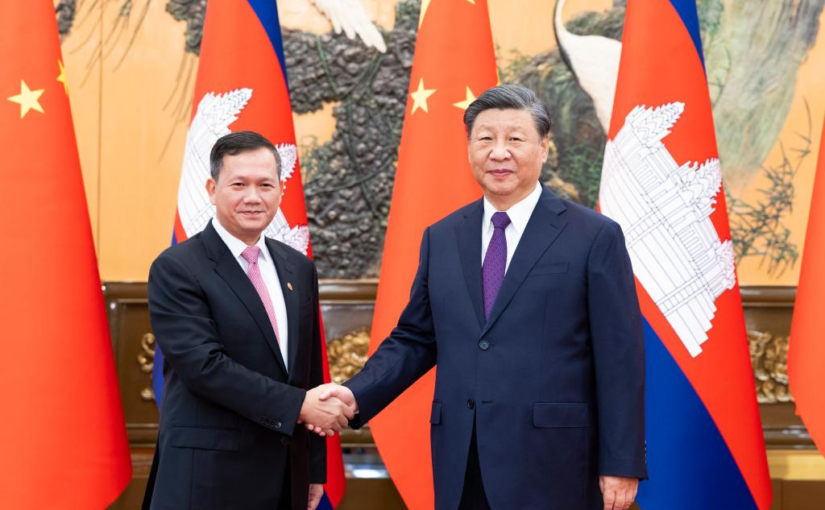
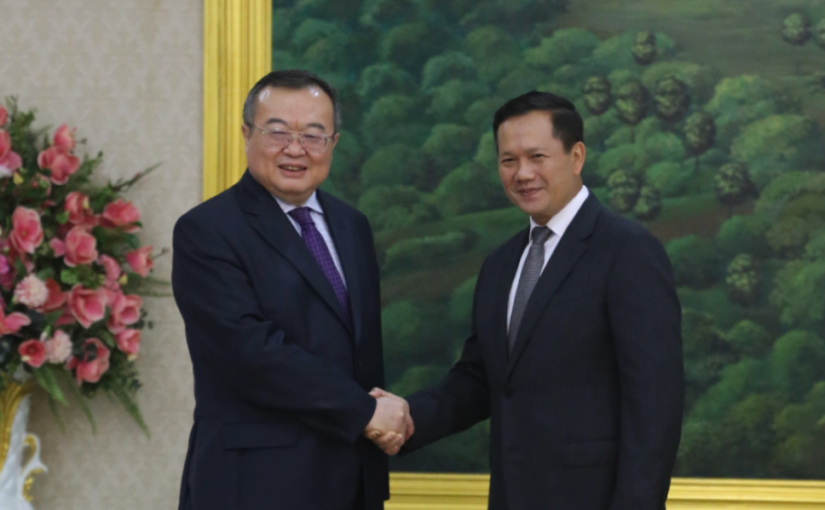
With a high-level political attendance, speeches were made at the opening ceremony by Chinese Premier Li Qiang, Vietnamese Prime Minister Pham Minh Chinh, Laotian Prime Minister Sonexay Siphandone, Cambodian Prime Minister Hun Manet (who had concluded an official visit to China, his first bilateral visit since assuming office, just the previous day), Malaysian Prime Minister Anwar Ibrahim, and Thai Deputy Prime Minister and Commerce Minister Phumtan Wechayachai.

Among the bilateral meetings held by Premier Li Qiang were those with his counterparts from China’s two socialist neighbours, Vietnam and Laos.

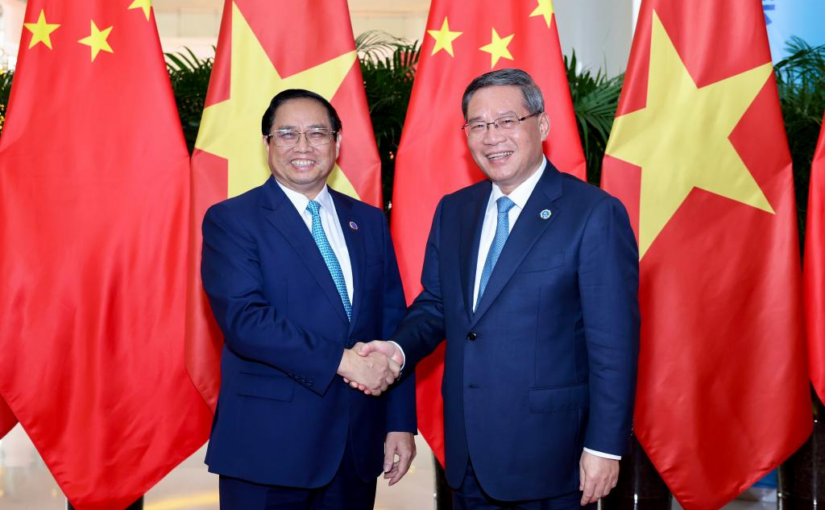
Meeting his Vietnamese counterpart, Li Qiang said that China and Vietnam are friendly socialist neighbours and the two countries are working to build a community with a shared future with strategic significance, adding that under the guidance of the top leaders of two parties, the relations between the two parties and countries have maintained a sound momentum of development.

Li emphasised that China regards relations with Vietnam as a priority in its neighbourhood diplomacy, and will work with Vietnam to implement the important consensus reached by the top leaders of the two parties, strengthen high-level guidance, support each other, safeguard common strategic interests and bring bilateral relations to a new level.

Noting that Vietnam and China are comrades and brothers, and the Vietnam-China comprehensive strategic cooperative partnership is Vietnam’s earliest and most valued foreign relationship at the highest level, Pham Minh Chinh said it has always been the objective requirement, top priority and strategic choice of Vietnam’s foreign relations to continuously deepen the relations between the two parties and the two countries. The development of Vietnam’s foreign relations will not harm the interests of any third party, he added.

Meeting his Laotian counterpart, Premier Li said that the China-Laos community with a shared future has been continuously advanced, adding that China has always viewed relations with Laos from a strategic perspective.

China is ready to work with Laos to implement the important consensus reached by the top leaders of the two parties and countries, strengthen the synergy of development strategies, deepen cooperation in various fields, and share opportunities and jointly promote development, to deliver benefits to the two peoples and contribute to regional peace.

China supports Laos in assuming the rotating presidency of ASEAN next year.

For his part, Sonexay Siphandone said that Laos is willing to strengthen exchanges of experience in party and state governance, promote pragmatic cooperation in such fields as the Belt and Road, economy, trade, investment and people-to-people exchanges, strengthen coordination and cooperation in international and regional affairs, jointly safeguard strategic interests, and promote the upgrading of China-Laos community with a shared future.

We reprint below reports on these two meetings. They were originally carried by the Xinhua News Agency.

Chinese premier meets Vietnamese PM in Nanning

NANNING, Sept. 16 (Xinhua) — Chinese Premier Li Qiang met with Vietnamese Prime Minister Pham Minh Chinh on Saturday in Nanning, the capital of south China’s Guangxi Zhuang Autonomous Region, pledging to bring bilateral ties to a new level.

Noting that China and Vietnam are friendly socialist neighbors and the two countries are working to build a community with a shared future with strategic significance, Li said that under the guidance of the top leaders of two parties, the relations between the two parties and countries have maintained a sound momentum of development.

Li said China regards relations with Vietnam as a priority in its neighborhood diplomacy, and will work with Vietnam to implement the important consensus reached by the top leaders of the two parties, strengthen high-level guidance, support each other, safeguard common strategic interests and bring bilateral relations to a new level.

Li pointed out that China is willing to expand mutually beneficial cooperation with Vietnam and import more marketable quality Vietnamese products, explore port opening and upgrading, accelerate the construction of smart ports to provide more convenience for bilateral trade, and strengthen cooperation on railway connectivity, key minerals and other fields to jointly build a mutually beneficial, stable and unimpeded industrial chain and supply chain system.

He also said China wishes to expand exchanges and cooperation on youth, education, medical tourism and other fields to promote mutual understanding and amity between the two peoples.

Continue reading Vietnamese PM Pham Minh Chinh: Vietnam and China are comrades and brothers

China is proud to be part of the development of Bangladesh

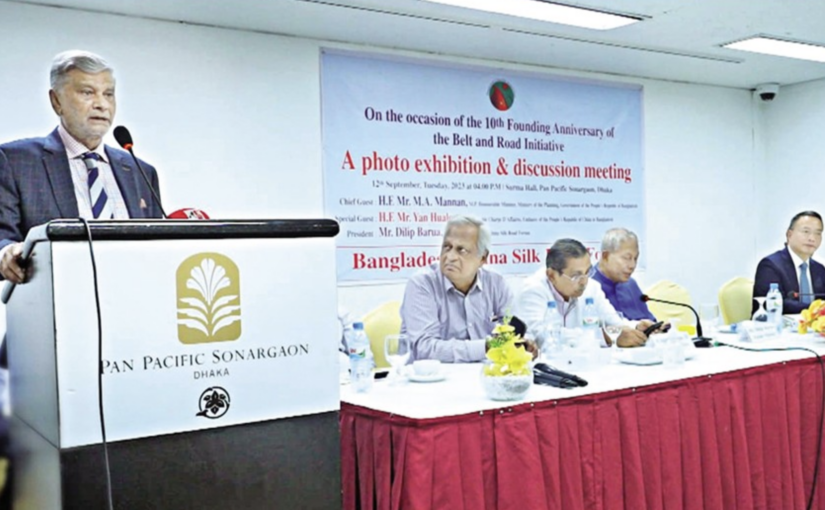
The Bangladesh China Silk Road Forum organised a photo exhibition and discussion meeting in a hotel in the capital Dhaka on September 12 to mark the tenth anniversary of the Belt and Road Initiative (BRI).

Attracting support from a broad range of progressive forces in Bangladesh, the meeting was chaired by Dilip Barua, Chairman of the Bangladesh China Silk Road Forum, General Secretary of the Communist Party of Bangladesh (Marxist-Leninist) and former minister. The Chief Guest was MA Mannan MP, Bangladesh’s Minister of Planning and member of parliament from the Awami League, while the Special Guest was Yan Hualong, Chargé d’affaires of the Chinese Embassy in Dhaka.

Speakers were: Rasheed Khan Menon MP, President of the Workers’ Party of Bangladesh and former minister; Hasanul Haque Inu MP, President of the Jatiyo Samajtantrik Dal (JSD – National Socialist Party) and former minister; Shah Alam, President of the Communist Party of Bangladesh; and Munshi Faiz Ahmed, former Bangladeshi Ambassador to China.

Dilip Barua noted how the aborted Bangladesh-China-India-Myanmar Economic Corridor (BCIM), which had been one of the first routes proposed under the BRI, could have brought much prosperity for the region had it materialised. (India has refused to participate in the BRI citing the existence of projects under the China Pakistan Economic Corridor in Pakistan-administered Azad Kashmir, which India also claims.)

Planning Minister Abdul Mannan said Bangladesh has received loans from China on good conditions and through amicable negotiations. Saying that China is a leading Asian neighbour of Bangladesh, he added: “China has been there for thousands of years. Now, we see a rejuvenated China… We don’t have enmity or favour for any country, we decide projects based on our benefits and needs.”

As Bangladesh lags behind in the infrastructure sector, including rail, road and power, he said, “we revamped them with Chinese loans.” Bangladesh can benefit more by sharing technology from China.

Former Bangladesh Ambassador to China Munshi Faiz Ahmed said: “BRI is a Chinese idea but China doesn’t own it alone, all the participating countries own it.”

The following report was first published by the Financial Express, which is the second largest English language newspaper in Bangladesh.

The aborted Bangladesh-China-India-Myanmar Economic Corridor (BCIM) under the Belt and Road Initiative (BRI) could have brought much prosperity for the region if materialised, former industries minister Dilip Barua said.

The project did not see the light of day as a neighbour quit it, he told a photo exhibition and discussion on the 10th founding anniversary of BRI on Tuesday.

“BRI has various infrastructure projects and we had economic corridor under BRI. But our neighbour withdrew itself from the project,” added Mr Barua, also general secretary of the Communist Party of Bangladesh (Marxist-Leninist).

The Bangladesh China Silk Road Forum organised the event at a city hotel with Dilip Barua, who is the chairman of the forum, in the chair.

Indicating the India-Middle East-Europe Economic Corridor (IMEC), which was initiated through signing a MoU during the 2023 G20 New Delhi Summit, he said India is now initiating another economic corridor.

BCIM is a proposed corridor connecting India and China through Myanmar and Bangladesh while IMEC will connect India, the United States, the UAE, Saudi Arabia, France, Germany, Italy and the EU.

IMEC is a counter to BRI, commented Mr Barua.

Speaking as the chief guest, planning minister Abdul Mannan said Bangladesh has received loans from China on good conditions and through amicable negotiations.

Citing that China is a leading Asian neighbour of Bangladesh, he said: “China has been there for thousands of years. Now, we see a rejuvenated China.”

“We don’t have enmity or favour for any country, we decide projects based on our benefits and needs.”

Mr Mannan said Bangladesh has diverse projects and collaboration based on mutual respect and trust with China.

As Bangladesh lags behind in the infrastructure sector, including rail, road and power, he said, “We revamped them with Chinese loans.” Bangladesh can be benefited more by sharing technology from China.

“We have deficit in technology. So, we want collaboration in that area,” said the minister, adding that both countries have so many things to give and take.

Speaking as the special guest, Chargé d’Affaires of Chinese Embassy in Bangladesh Yan Hualong said China would continue to assist Bangladesh in its development.

“China is proud to be part of the development of Bangladesh,” he added.

Former Bangladesh high commissioner to China Munshi Faiz Ahmed said the mission of BRI is to establish connectivity, infrastructure and shared prosperity.

“BRI is a Chinese idea but China doesn’t own it alone, all the participating countries own it,” he added.

At both the G20 and in Vietnam, US hegemony looks ever more perilous

In this article, which was originally published by People’s World, Amiad Horowitz makes an assessment of US President Joe Biden’s recent visit to Asia, which saw him first attend the G20 summit meeting in the Indian capital New Delhi and then continue to Vietnam.

Horowitz notes that Biden used the G20 Summit to announce an international infrastructure development program which seeks to compete with China’s very successful Belt and Road Initiative, called the India-Middle East-Europe Economic Corridor (IMEC). He adds:

“One cannot help but notice the irony that the Biden administration is so eager to invest in infrastructure abroad to counter China while repeatedly failing to invest in the crumbling US infrastructure at home. This is opposed to China, whose government has completed countless major infrastructure programs both at home and abroad.”

Turning to Biden’s visit to the Vietnamese capital Hanoi, Horowitz observes that the US has long sought to use the country to ‘encircle and contain’ its neighbour China:

“Leading up to this trip, many so-called experts claimed that the goal of this trip was to up the pressure on Vietnam to join the US anti-China coalition. If that was Biden’s goal, he failed.

“In the days leading up to his arrival, high-level Vietnamese officials met with their Chinese counterparts, and both sides assured each other about their continued friendship. China remains Vietnam’s biggest economic partner, and both countries cooperate in all fields—from defense, to culture, to their shared goals of building socialism in their respective countries.”

Noting that the US and Vietnam agreed to upgrade their bilateral diplomatic relations from a comprehensive partnership to a comprehensive strategic partnership, the author goes on to note that, in his speech in Hanoi, Biden made a number of errors in this regard, specifically he, “incorrectly claimed that a ‘comprehensive strategic partnership’ was the highest level of bilateral relations in Vietnam’s foreign policy. In actuality, ‘special strategic partnership’ is the highest level. Vietnam’s relationships with China, Cuba, Laos, Cambodia, and the Democratic People’s Republic of Korea are rated at this level.”

The author is a long-term resident of Vietnam.

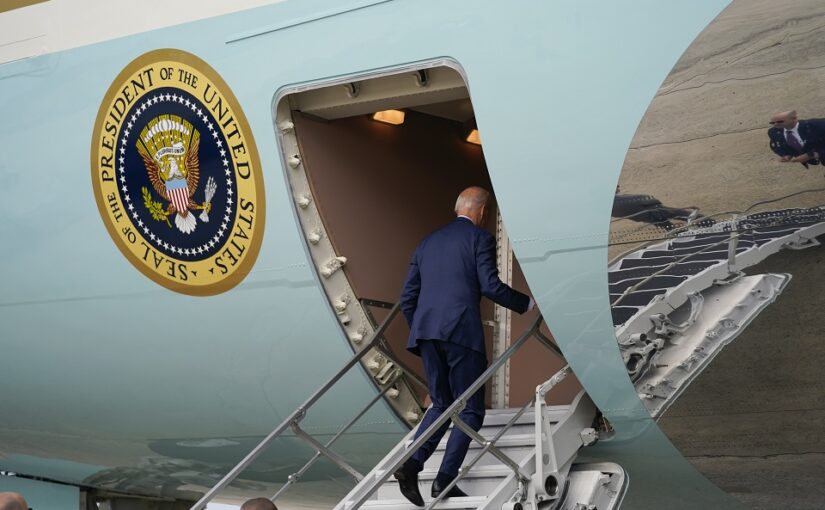
President Joe Biden just finished a major trip to Asia for the G20 Summit in India, with an important stopover in Hanoi, Vietnam. The trip saw a mix of successes and setbacks for the Biden administration.

This year’s G20 Summit took place from September 9 to 10 in the Indian capital of New Delhi. It was the first G20 meeting since last month’s major expansion of BRICS and was seen by many watchers as a forum for the U.S. and its allies to maintain their current waning dominance over the global economy. Another goal of the meeting, of course, was to reaffirm the pro-NATO narrative that Russia is economically and politically isolated.

Some of the highlights of the gathering included the inclusion of the African Union as a permanent member of the economic group and a push for greener economic initiatives, such as the Global Biofuel Alliance.

Biden also used the summit to announce an international infrastructure development program which seeks to compete with China’s very successful Belt and Road Initiative, called the India-Middle East-Europe Economic Corridor (IMEC). Biden repeated the often-debunked claim that China’s Belt and Road program uses economic coercion to get countries to sign on.

Meanwhile, his government claims that despite decades of U.S.-led predatory international trade and investment programs through the World Bank and the International Monetary Fund, that this new program would be better.

One cannot help but notice the irony that the Biden administration is so eager to invest in infrastructure abroad to counter China while repeatedly failing to invest in the crumbling U.S. infrastructure at home. This is opposed to China, whose government has completed countless major infrastructure programs both at home and abroad.

One major setback for Biden’s agenda at the G20 was the summit’s final statement. The U.S. failed to get the other participants to accept language condemning Putin and the war in Ukraine. After hundreds of hours of negotiations and many drafts, the final statement made no mention of Russia and simply called for all countries to settle their differences through negotiations. The final language is being seen as a Biden defeat and a victory for Indian President Narendra Modi, whose government maintains friendly relations with Russia.

Despite all evidence to the contrary, Biden ally and French President Emmanuel Macron claimed that the G20 Summit somehow proves that the U.S.-led attempt to isolate Russia has succeeded.

After the summit concluded, Biden moved on to Hanoi. Vietnam has one of the quickest growing economies in the world and is a major leader in the Association of Southeast Asian Nations (ASEAN). The country also shares a border with China, and the U.S. has repeatedly sought to use Vietnam to further “encircle and contain” China.

Leading up to this trip, many so-called experts claimed that the goal of this trip was to up the pressure on Vietnam to join the U.S. anti-China coalition. If that was Biden’s goal, he failed.

In the days leading up to his arrival, high-level Vietnamese officials met with their Chinese counterparts, and both sides assured each other about their continued friendship. China remains Vietnam’s biggest economic partner, and both countries cooperate in all fields—from defense, to culture, to their shared goals of building socialism in their respective countries.

The highlight of Biden’s side trip was the signing of an agreement between the U.S. and Vietnam to raise the bilateral diplomatic relationship from a “comprehensive partnership” to that of a “comprehensive strategic partnership.” This upgrade in diplomatic ties offers a lot of potential economic and trade benefits for both countries and is generally seen as a win-win for Washington and Hanoi.

However, Biden’s speech in Vietnam featured a number of errors of fact. First, Biden incorrectly claimed that a “comprehensive strategic partnership” was the highest level of bilateral relations in Vietnam’s foreign policy. In actuality, “special strategic partnership” is the highest level. Vietnam’s relationships with China, Cuba, Laos, Cambodia, and the Democratic People’s Republic of Korea are rated at this level.

Later in his remarks to the media, Biden began to drift from the pre-press conference plan and had to be abruptly interrupted by White House Press Secretary Karine Jean-Pierre. Even after she called an end to the press conference, however, the president continued to inaudibly answer another question that was shouted from the press pool.

After this trip, it is becoming increasingly apparent that the U.S.’ international influence is continuing to decline as the world speeds further toward a new multipolar reality. India was able to prevent the U.S. from forcing its anti-Russia language into the G20 summit’s final statement, and Vietnam was able to upgrade its bilateral relationship with the U.S. while avoiding having to join the U.S. led anti-China coalition, and in fact, maintaining its close and friendship relationship with Beijing.

Hun Manet visit consolidates China-Cambodia friendship

The new Prime Minister of Cambodia, Hun Manet paid an official visit to China from September 14-16. Hun Manet chose China for his first bilateral foreign visit since assuming office in a sign of the close relations between the two countries.

President Xi Jinping met with him on September 15. He noted that the Cambodian leader’s choice of China fully demonstrates the great importance the new Cambodian government attaches to consolidating and developing China-Cambodia friendship.

China and Cambodia are ironclad friends, Xi said, adding that over the past 65 years since the establishment of diplomatic ties, the two sides have always maintained a high degree of mutual trust, treated each other as equals, achieved win-win results, and firmly supported each other in safeguarding national sovereignty, security and development interests.

Xi stressed that China firmly supports Cambodia in exploring a development path suited to its national conditions and stands ready to maintain regular strategic communication with Cambodia and deepen the exchange of governance experience.

The Chinese President pointed out that no matter how the international and regional situation may change, China is always Cambodia’s most reliable friend and staunch supporter, and that China stands ready to join hands with Cambodia to uphold international fairness and justice and safeguard the legitimate rights and interests of developing countries.

Hun Manet said that he chose China as the destination for his first official visit to show that the new Cambodian government will continue to firmly pursue a friendly policy toward China and further carry forward the ironclad friendship between Cambodia and China.

The prime minister added that Cambodia will abide by the one-China principle, firmly support China in safeguarding its core interests, and support the Global Development Initiative, the Global Security Initiative and the Global Civilisation Initiative proposed by President Xi.

Cambodia appreciates China’s long-term strong support and assistance for Cambodia’s economic and social development and is willing to work with China to implement the important consensus reached by the leaders of the two countries, deepen Belt and Road cooperation, and push for further development of bilateral cooperation in industry, agriculture, investment, culture and other fields.

When meeting his Cambodian counterpart on the same day, Chinese Premier Li Qiang said that China and Cambodia have always stood together through thick and thin and helped each other since establishing diplomatic ties 65 years ago and the two countries have set an example of equality and mutual benefit between countries.

Li pointed out that China firmly supports the Cambodian side in safeguarding national sovereignty, security, and development interests and in exploring a development path suited to its national conditions.

Hun Manet hailed the ironclad friendship with China, stressing that the new Cambodian government maintains no change in promoting this friendship and intends to work with China to carry forward the traditional relationship between the two countries.

Cambodia abides by the one-China principle, resolutely opposes external forces interfering in China’s internal affairs, and supports the significant initiatives put forward by China, he added.

The two countries released a joint communiqué in which they speak highly of the substantial development of the China-Cambodia relationship, which has been carefully nurtured by generations of leaders of both countries and has been constantly growing from strength to strength in the last 65 years since the establishment of diplomatic ties. Both sides emphasise that no matter how the international situation changes, they will unswervingly develop their ever-lasting friendship and deepen cooperation for mutual benefits, with a view to promoting the building of a high-quality, high-level and high-standard China-Cambodia Community with a Shared Future in the new era as a showcase for a community with a shared future for humanity.

Both sides reaffirm their respect and support for each other’s choice of development path that suits their respective national conditions. The Cambodian side speaks highly of China’s great achievements in the decade of the new era and of Chinese modernisation that offers an alternative modernisation for humanity and fresh opportunities for Cambodia. It trusts that China will achieve its second centenary goal of building a great modern socialist country in all aspects towards great national rejuvenation through Chinese modernisation. The Chinese side speaks highly of Cambodia’s economic and social achievements.

The Chinese side reaffirms resolute support to Cambodia’s endeavours to safeguard national sovereignty, security, and development interests while expressing firm opposition to any foreign interference in Cambodia’s internal affairs. And both express firm opposition to politicisation of human rights, double standards and interference in other countries’ internal affairs under the guise of human rights or democracy. Both sides agree to strengthen cooperation against interference and ‘Colour Revolutions’.

In recent years, Cambodia has experienced increasing external pressure in this regard due to its maintaining an independent and non-aligned posture regionally and internationally and its rejection of outside interference in its internal affairs. For example, the US House of Representatives passed a Cambodia Sanctions Bill in September 2021 and the US government tightened export controls to the country in December of the same year.

Surveying economic cooperation, the communiqué laid stress on the development of Cambodia’s Special Economic Zone along with the areas of agro-industries, transportation infrastructure, electricity, energy and manufacturing, in particular.

They further agreed to enhance cooperation in hydropower, photovoltaics, and other clean energy sources, to explore green, stable and reliable energy cooperation solutions, promote establishment of a China-Cambodia Low-Carbon Demonstration Zone Project of South-South Cooperation on Climate Change in Preah Sihanouk Province, and to carry out cooperation in policy dialogue, joint research and capacity building, with a focus on climate change, pollution management and circular economy; as well as to conduct cooperation in such areas of shared interests as comprehensive water resources management, flood and drought disaster prevention, and drinking water safety in rural areas.

As noted, this year marks the 65th anniversary of the establishment of diplomatic relations between Cambodia and China under the guidance of King Father Norodom Sihanouk, Chairman Mao Zedong and Premier Zhou Enlai. The anniversary has been marked by diverse exchanges and reciprocal visits. China’s top diplomat, Foreign Minister Wang Yi visited Cambodia in August and Minister Liu Jianchao of the Communist Party of China’s International Department visited in September.

Hun Manet succeeded his father, the long-serving Hun Sen, as Prime Minister on August 22, following general elections on July 23, when their Cambodian People’s Party again won a decisive victory.

The following reports were originally carried by the Xinhua News Agency.

Xi meets Cambodian prime minister

BEIJING, Sept. 15 (Xinhua) — Chinese President Xi Jinping met with Cambodian Prime Minister Hun Manet at the Great Hall of the People on Friday.

Xi pointed out that Prime Minister Hun Manet chose China as the destination for his first bilateral visit after taking office, which fully demonstrates the great importance the new Cambodian government attaches to consolidating and developing China-Cambodia friendship.

China and Cambodia are ironclad friends, Xi said, adding that over the past 65 years since the establishment of diplomatic ties, the two sides have always maintained a high degree of mutual trust, treated each other as equals, achieved win-win results, and firmly supported each other in safeguarding national sovereignty, security and development interests.

Xi stressed that China firmly supports Cambodia in exploring a development path suited to its national conditions, and stands ready to maintain regular strategic communication with Cambodia and deepen the exchange of governance experience.

He said the two sides should make good use of the mechanism of the intergovernmental coordinating committee and implement the new action plan for building a China-Cambodia community with a shared future.

Continue reading Hun Manet visit consolidates China-Cambodia friendship

Liu Jianchao visits Cambodia, Vietnam and Laos

In the first week of September, Minister Liu Jianchao of the International Department of the Central Committee of the Communist Party of China (IDCPC), paid visits to the southeast Asian countries of Cambodia, Vietnam and Laos. Vietnam and Laos are fraternal socialist countries of China and the contemporary relations between all four countries are deeply rooted in their common struggle against the US imperialist war of aggression for national independence and salvation.

Minister Liu travelled first to Cambodia and on September 3 met with Hun Manet, who assumed office as his country’s new Prime Minister on August 23, shortly after a general election saw another resounding victory for the Cambodian People’s Party (CPP). Hun Manet asked Liu to convey his sincere greetings to General Secretary Xi Jinping and Premier Li Qiang. He said, the victory of the Cambodian People’s Party (CPP) in Cambodia’s seventh general election reflects the Cambodian people’s high recognition of the CPP’s governance and their expectations for the new government. The new government will continue to firmly adhere to the CPP’s friendly policies towards China and make the relationship between Cambodia and China even better. I will choose China as my first official outbound visit after taking office as Prime Minister, he said. On September 11 it was announced that that visit will take place, September 14-16.

The following day, Minister Liu met with Hun Sen, President of the CPP, who served as Prime Minister from November 1998 to August 2023. Hun Sen said that his party’s victory in the July 23 general elections also reflects the satisfaction and support of the Cambodian people for the achievements in the development of China-Cambodia relations. The Cambodian side appreciates the Chinese side’s long-standing support and assistance to Cambodia’s national development and is willing to strengthen strategic alignment with the Chinese side, deepen practical cooperation in various fields, closely coordinate and cooperate in multilateral affairs, and jointly safeguard regional and global stability and development.

Liu also met with Norodom Chakravuth, President of the FUNCINPEC party, which is generally described as Cambodia’s royalist party. Chakravuth affirmed that FUNCINPEC has long upheld King Father Norodom Sihanouk’s friendly policy towards China, always considering the CPC as a good and true friend. FUNCINPEC is ready to contribute to the building of the Cambodia-China community with a shared future. His party expressed gratitude for the long-term support from the CPC and the Chinese government to the Cambodian royal family, and its commitment to deepening friendly exchanges and cooperation with the CPC. Since the time of Norodom Sihanouk, the Cambodian royal family has maintained a close relationship with the Asian socialist countries and their ruling communist parties.

Continuing to Vietnam, on September 5, Minister Liu met with Nguyen Phu Trong, General Secretary of the Central Committee of the Communist Party of Vietnam (CPV).

Nguyen Phu Trong asked Liu to convey his warm greetings and best wishes to General Secretary Xi Jinping. He said, as the first foreign leader to visit China after the 20th CPC National Congress, held in October 2022, I received a warm and friendly reception from the CPC and the Chinese people. In particular, General Secretary Xi Jinping had in-depth and friendly exchanges with me. I sincerely welcome and look forward to General Secretary Xi Jinping’s visit to Vietnam again at an early date to discuss plans for the development of relations between the two Parties and the two countries under the new situation, and to lead Vietnam-China relations for new and greater development.

The Vietnamese leader added that the Vietnam-China relationship has a long history and has become stronger over time. Just as President Ho Chi Minh remarked, China and Vietnam enjoy comradely and brotherly friendship. The Vietnamese side will always remember the great support and assistance provided by the CPC and the Chinese people for the Vietnamese side in all historical periods, and always regard developing relations with the CPC, the Chinese government and people as a top priority.

Liu said, in the face of complex and volatile international and regional situations, China and Vietnam should further strengthen unity and cooperation, implement the important consensus reached by the general secretaries of the two parties, work together to deal with various risks and challenges on the way forward, effectively promote the respective national development and socialist causes, and promote the building of a community with a shared future for humanity. If the two Parties, countries and peoples stay united, the friendship between China and Vietnam will grow deeper.

He also held talks with Le Hoai Trung, Head of the Commission for External Relations of the Central Committee of the Communist Party of Vietnam.

Speaking highly of China’s great achievements in the past ten years since it entered the new era, Le Hoai Trung believed that under the leadership of the CPC Central Committee with Comrade Xi Jinping at its core, Chinese comrades will certainly achieve the second centenary goal. The Vietnamese side firmly supports socialist China in growing stronger and making greater contributions to the development of the world and the region. The Vietnamese side insists on giving top priority to developing its relations with China.

While meeting with representatives of all walks of life of Vietnam including think tanks, media, and friendly organisations, Vietnamese comrades told Liu that, as socialist countries led by communist parties, the two sides should take the 15th anniversary of the establishment of the China-Vietnam comprehensive strategic cooperative partnership as an opportunity to strengthen high-level exchanges, deepen exchanges and mutual learning in state governance and administration, firmly establish a common direction of progress, solve the problems of the times, and promote the causes of socialism of our two countries for continuous development.

Liu also led a CPC delegation to pay respect to the leader of the Vietnamese revolution, Ho Chi Minh at his mausoleum.

The final stop of Minister Liu’s regional tour was in Laos, where, on September 8, he met with Thongloun Sisoulith, General Secretary of the Lao People’s Revolutionary Party (LPRP) Central Committee and Lao President.

Thongloun asked Liu to convey his sincere greetings and best wishes to General Secretary Xi Jinping. Thongloun said, at the end of last year, I paid a successful state visit to China upon invitation, during which General Secretary Xi Jinping and I reached important consensus on the relations between the two parties and the two countries, and vigorously led and promoted the construction of the Laos-China community with a shared future.

He added that the Lao side sincerely thanks the Chinese side for its long-term and huge support to Laos’ socialist cause, and is willing to strengthen cooperation and exchanges with the Chinese side to better promote the development of Laos’ socialist construction.

Among his other engagements in the country, Minister Liu gave a briefing to some 300 Lao cadres and also visited the museum built in honour of the founding leader of the Lao socialist state, Kaysone Phomvihane and presented a floral tribute there. The museum was built with fraternal aid from the Democratic People’s Republic of Korea (DPRK).

The following reports were originally published on the website of the IDCPC.

Hun Manet, Cambodian Prime Minister, Meets with Liu Jianchao

Phnom Penh, September 3rd— Hun Manet, Cambodian Prime Minister, met here today with Liu Jianchao, Minister of the International Department of the CPC Central Committee.

Hun Manet asked Liu to convey his sincere greetings to General Secretary Xi Jinping and Premier Li Qiang. He said, the victory of the Cambodian People’s Party (CPP) in Cambodia’s 7th general election reflects the Cambodian people’s high recognition of the CPP’s governance and their expectations for the new government. Political parties are the source of the country’s formulation of domestic and foreign policies. The new government will continue to firmly adhere to the CPP’s friendly policies towards China and make the relationship between Cambodia and China even better. I will choose China as my first official outbound visit after taking office as Prime Minister. The Cambodian side is willing to implement the important consensus reached by the leaders of the two countries, promote the construction of the “diamond hexagon” cooperation framework, effectively promote the construction of the “Industrial Development Corridor” and the “Fish and Rice Corridor”, and promote the construction of a Cambodia-China community of shared future in the new era. As the head of the CPP’s Youth Wing, I will support the good use of the Youth House for Cambodia-China Friendship, and efforts to strengthen friendly exchanges between the youth of the two Parties. Taiwan, Xinjiang and Hong Kong affairs are all China’s internal affairs. The Cambodian side will continue to firmly adhere to the One-China principle, firmly supports and actively participates in the Belt and Road Initiative and the three major global initiatives proposed by the Chinese side, and is willing to strengthen coordination and cooperation with the Chinese side in international and regional affairs to jointly maintain regional peace, stability, development and prosperity.

Continue reading Liu Jianchao visits Cambodia, Vietnam and Laos

Release of Fukushima wastewater threatens workers

We reprint below an article by Otis Grotewohl, originally published in Workers World, about the Japanese government’s release of wastewater from the Fukushima nuclear disaster into the Pacific Ocean.

Otis notes that, while the government in Tokyo has claimed the process is safe, many people are skeptical, including the Japanese opposition parties, fishermen, local residents and environmental campaigners. Greenpeace Japan states that Tokyo’s decision “disregards scientific evidence, violates the human rights of communities in Japan and the Pacific region, and is non-compliant with international maritime law.”

The Chinese government has announced a ban on imports of Japanese seafood in response to the discharge. Japan, in league with the US and other imperialist powers, is now criticizing China for this ban and for spreading disinformation. “Just as the Japanese government and its Western enablers accuse China of ‘disinformation,’ the capitalist rulers of Washington and Tokyo are waging a major public relations campaign to convince people in the region that seafood from the Pacific Ocean will still be safe to consume after the release of wastewater.”

As Otis points out, the Japanese government’s action is a threat to the health and safety of people in the region, and is being carried out solely in accordance with “the material needs and desires of the employing class.” China meanwhile has taken a clear lead on renewable energy and biodiversity, and is advocating for the interests of ordinary people both in China and throughout the region.

“Anyone concerned with the well-being of humanity and our ecosystem should defend China and stand in solidarity with workers in the Asia-Pacific region who are being threatened with a polluted ocean, poisoned water and contaminated seafood.”

The Japanese government began releasing wastewater from the Fukushima nuclear plant into the Pacific Ocean on Aug. 24. The controversial move has angered workers throughout the region, sparking numerous protests in South Korea, China and Japan.

Following the Tōhoku earthquake and tsunami on March 11, 2011 — which destroyed the Fukushima nuclear plant, resulting in three nuclear meltdowns, three hydrogen explosions and a release of radioactive contaminants — the nuclear company Tepco started pumping in water to cool down the reactors’ fuel rods. 

Radioactive wastewater has been added to tanks every day since then, and more than 1,000 tanks have been filled. The government of Tokyo argues the process is “no longer sustainable” to maintain and promises people that “after treatment and dilution the ‘water is safe to release.’” (BBC, Aug. 24) Many people in the area are understandably skeptical.

More than a million metric tonnes of water stored at the nuclear plant is expected to be discharged over the next 30 years, and there are mixed feelings among scientists about this. Among those who are most supportive of Japan’s plan is the United Nations nuclear “watchdog” known as the International Atomic Energy Agency. Many more people oppose the plan, especially environmentalists and workers in the fishing industry who are familiar with the Pacific Ocean.

Continue reading Release of Fukushima wastewater threatens workers

Camp David summit outlines military alliance against China

The following article by Sara Flounders, originally posted on Workers World, provides a critical analysis of US President Joe Biden’s diplomatic “victory” at Camp David, in which he brought together Japan and South Korea to form a security pact with the US. Sara observes that this pact has nothing to do with the maintenance of peace, but is directed towards upgrading the US’s military threat against China and the DPRK, as well as blocking China’s development and regional trade.

The article notes the enormous US military infrastructure which already exists in the region: “US troops have occupied both Japan and South Korea since 1945. There are still 53,700 US troops in Japan on 120 military bases — more bases than in any other country. Some 26,400 US troops are stationed on 73 bases in South Korea, including Fort Humphreys, the largest overseas US military base. This overwhelming US military presence exerts extreme political pressure.” This is on top of the recent creation of AUKUS and the revival and upgrading of the QUAD.

As such, the agreement at Camp David is simply “a further step in Washington’s strategy of inserting tensions, instability and continuing provocations in the region in an attempt to block China’s development and its growing regional trade with its neighbors.”

Sara points out that the US’s anti-China strategy of sanctions and tariffs is actually punishing South Korea and Japan more than China. “By expanding sanctions on China affecting chip technology, software and equipment, Washington disrupts global supply chains and damages the economies of South Korea, Japan and Taiwan.” Indeed the US economy will suffer too. But as far as US strategists are concerned, China’s suffering is a higher priority than US prosperity. Unfortunately for Washington’s cold warriors, however, “though China will feel the impact of sanctions, its economy is larger than those of its Asian neighbors, and its many global trading partners may give it a greater capacity to adjust, including by reinforcing its domestic economy.”

August 22 — U.S. war threats against China heightened this week. On Aug. 18, President Joe Biden framed an aggressive military alliance, with South Korean President Yoon Suk Yeol and Japanese Prime Minister Fumio Kishida dutifully attending, at an ominous summit at Camp David. This trilateral military pact of the United States, South Korea and Japan is directly aimed at China and at the Democratic People’s Republic of Korea (North Korea).

Both U.S. and Chinese, as well as other international media, all described the meeting as a confirmation of a new Cold War against China.

The military pact of South Korea and Japan with the U.S. intentionally damages both the South Korean and Japanese economies, as China has been the major trading partner of both countries. However, right-wing militarists in office in each country seem willing to act against their own people’s interests.

Continue reading Camp David summit outlines military alliance against China

Azerbaijani president: Belt and Road an important contribution to Central Asia’s development

In this recent episode of the CGTN series, Leaders Talk, Wang Guan, travels to the Azerbaijani capital, Baku, to sit down with President Ilham Aliyev.

He notes that this year is the 100th birth anniversary of the current president’s father, former President Heydar Aliyev, who is, it is noted, not only the founding father of independent Azerbaijan, but also of China-Azerbaijan friendship. 

President Aliyev emphasises that his father created a framework for cooperation with China based on mutual respect and friendship. And, as illustrated in photos shown by Wang Guan, during his China visits, Heydar Aliyev also took particular care to visit ordinary Chinese families and to learn about their daily lives. 

President Aliyev noted that his father was already well aware of developments in China from the time when he served in the Soviet government. In the history of the Communist Party of the Soviet Union (CPSU), Heydar Aliyev held the highest position ever attained by someone of Muslim heritage.

The current president considers the relations between China and Azerbaijan to be on a long journey of strategic cooperation. They are based on an alignment of major positions in international relations, for example with regard to sovereignty, territorial integrity and non-interference in internal affairs.

All this also helps to create a favourable backdrop for economic cooperation, particularly within the framework of the Belt and Road Initiative (BRI), which, in turn, contributes to regional security, stability and development. The progress of the BRI enables Azerbaijan to leverage its geographical location to its advantage, through the development of both the Caspian seaport and international rail links. 

Noting that he has met President Xi Jinping on many occasions, both in China and at international gatherings, Aliyev describes his Chinese counterpart as a person of vision and intelligence. This, he notes, contributes to the fact that the number of international friends of China is growing year by year. 

Aliyev also praises China for the assistance it provides to other countries, particularly when other countries refuse to do so. For example, China was the only country to supply Covid-19 vaccines to Azerbaijan when they were first developed. His letter to President Xi drew an immediate response, making Azerbaijan one of the first countries to start a vaccination programme during the global pandemic.

With regard to the question of Taiwan, he said that Azerbaijan always supports China’s territorial integrity and reunification. HIs country’s support for the one-China principle is absolutely unchanged and will never be changed.

Turning to negative western perceptions of developing countries like China and Azerbaijan, Aliyev says that the basic reason is his country’s pursuit of independent policies based on the national interest. Besides the western media, President Aliyev also excoriated the role played by supposedly independent NGOs such as Human Rights Watch and Amnesty International, noting that their agendas did not diverge from those of their funders.

The full interview with President Aliyev is embedded below.

Celebrating the first decade of the China Pakistan Economic Corridor

As the tenth anniversary of Chinese President Xi Jinping’s first speeches proposing the Belt and Road Initiative (BRI) approaches, China and Pakistan have celebrated the first decade of what is widely considered its flagship project, namely the China Pakistan Economic Corridor (CPEC), which links the port of Gwadar, in Pakistan’s Balochistan province, with Kashgar in China’s Xinjiang Uygur Autonomous Region, and which highlights energy, transport and industrial cooperation, in particular.

In a July 31 letter to a celebration event held in the Pakistani capital, Islamabad, President Xi said that China will work with Pakistan to aim for high-standard, sustainable, and livelihood-enhancing outcomes and further build CPEC into an exemplary project of high-quality Belt and Road cooperation.

CPEC, he continued, has added new impetus to the economic and social development of Pakistan and laid a good foundation for regional connectivity and integration, adding that it is a vivid testament to the all-weather friendship between China and Pakistan, and provides an important underpinning for building an even closer China-Pakistan community with a shared future in the new era.

Stressing that China and Pakistan will continue to improve overall planning and expand and deepen cooperation, Xi said that no matter how the international landscape may change, China will always stand firmly with Pakistan.

Chinese Vice Premier He Lifeng participated in the Islamabad celebration, held on August 1, as Xi’s special representative. As well as reading the Chinese President’s letter, he delivered a speech, calling for an upgrading of CPEC to better promote a closer China-Pakistan community with a shared future.

In his speech, Pakistani Prime Minister Shahbaz Sharif said that the remarkable achievements of CPEC’s construction have profoundly transformed Pakistan’s economic and social landscape. Pakistan is willing to learn from China’s development experience, deepen cooperation with China in various fields, and pursue a path of self-reliance and strength, so as to better benefit the peoples of both countries.

Meanwhile, in an August 4 telephone conversation between the two countries’ foreign ministers, Wang Yi said that, no matter how the international situation and Pakistan’s domestic situation change, China will, as always, firmly support Pakistan in defending national sovereignty, independence and territorial integrity, firmly support Pakistan in maintaining unity and stability, in realizing revitalization and development, and will firmly support Pakistan to play a bigger and more active role in international and regional affairs.

His Pakistani counterpart, Bilawal Bhutto Zardari said that the Pakistan-China friendship has been passed down from generation to generation and is unshakable and full of vitality.

The following articles were originally published by the Xinhua News Agency.

Xi says China to work with Pakistan to build CPEC into exemplary project of high-quality B&R cooperation

BEIJING, July 31 (Xinhua) — Chinese President Xi Jinping said Monday China will work with Pakistan to aim for high-standard, sustainable and livelihood-enhancing outcomes and further build the China-Pakistan Economic Corridor (CPEC) into an exemplary project of high-quality Belt and Road cooperation.

Xi made the remarks in a congratulatory message to the Decade of China-Pakistan Economic Corridor celebration event held in Islamabad, Pakistan.

Xi pointed out that CPEC is an important pioneering project of the Belt and Road cooperation. Since its launch in 2013, China and Pakistan have been advancing CPEC under the principle of extensive consultation, joint contribution and shared benefits, and have achieved a number of early harvests.

Continue reading Celebrating the first decade of the China Pakistan Economic Corridor

Wang Yi trip serves to strengthen bonds of Global South solidarity

China’s top diplomat, Wang Yi, visited South Africa in mid-July to attend the 13th Meeting of BRICS National Security Advisers and High Representatives on National Security, which was held in Johannesburg. This was one of the important political gatherings to be held in South Africa in the run up to the country hosting the main BRICS Summit later in August. It was also attended by representatives from a number of other countries seeking to adhere to the BRICS mechanism. Wang Yi also visited Kenya and Türkiye on the same trip.

First making a stopover in Ethiopia, Wang Yi held talks with Deputy Prime Minister and Minister of Foreign Affairs Demeke Mekonnen Hassen in Addis Ababa.

Wang Yi said that China and Ethiopia are good brothers sharing weal and woe, good friends supporting each other, and good partners pursuing common development. China has stood with the Ethiopian people at a critical time when Ethiopia safeguards national peace and stability and will continue to stand with the Ethiopian people as the country enters a new stage of restoration of peace and national reconstruction.

Demeke said Ethiopia-China relations enjoy a long history, and Ethiopia is firmly committed to strengthening cooperation with China at the bilateral, regional and multilateral levels. Ethiopia thanks China for providing assistance to the country’s efforts to safeguard national security and stability, expects China to support Ethiopia in consolidating peace, conducting reconstruction and revitalizing the economy, and supports the Global Development Initiative, the Global Security Initiative and the Global Civilization Initiative proposed by China.

Wang Yi met with Kenyan President William Ruto on July 22 in Nairobi.

Noting that Kenya-China relations have been developing smoothly since the establishment of diplomatic ties 60 years ago, Ruto said strengthening friendly cooperation with China has become a consensus shared by all sectors in the country.

Ruto highly praised China’s efforts in growing relations with Kenya based on the principle of mutual respect. Kenya is firmly committed to deepening the comprehensive strategic cooperative partnership with China, and is willing to strengthen inter-party exchanges, deepen cooperation in such fields as railway, highway, water conservancy, aviation, and renewable energy under the frameworks of Belt and Road cooperation and the Forum on China-Africa Cooperation, in order to promote connectivity and regional integration in Africa and achieve win-win results, Ruto said.

Wang Yi said that China approaches relations with Kenya from a strategic perspective, and is willing to work with Kenya to take the 60th anniversary of the establishment of diplomatic relations as a new starting point to align their strategies for revitalization with a focus on development and cooperation, and push their comprehensive strategic cooperative partnership to a new level in the new era.

Continue reading Wang Yi trip serves to strengthen bonds of Global South solidarity