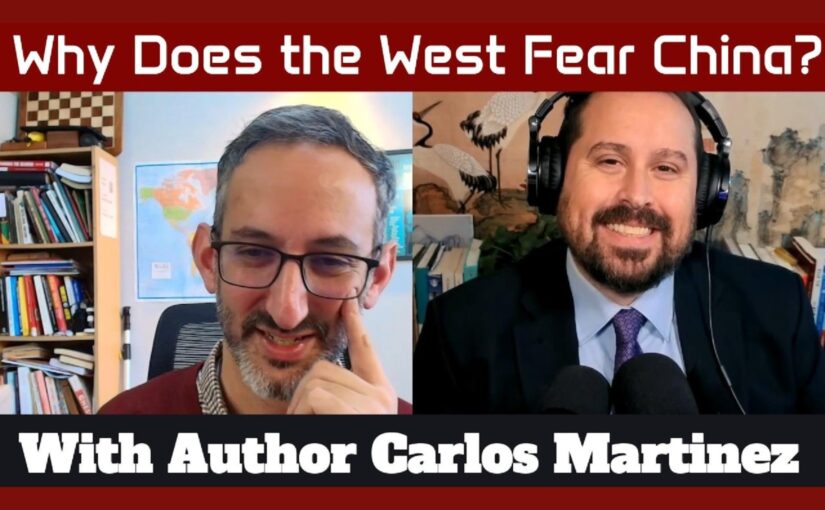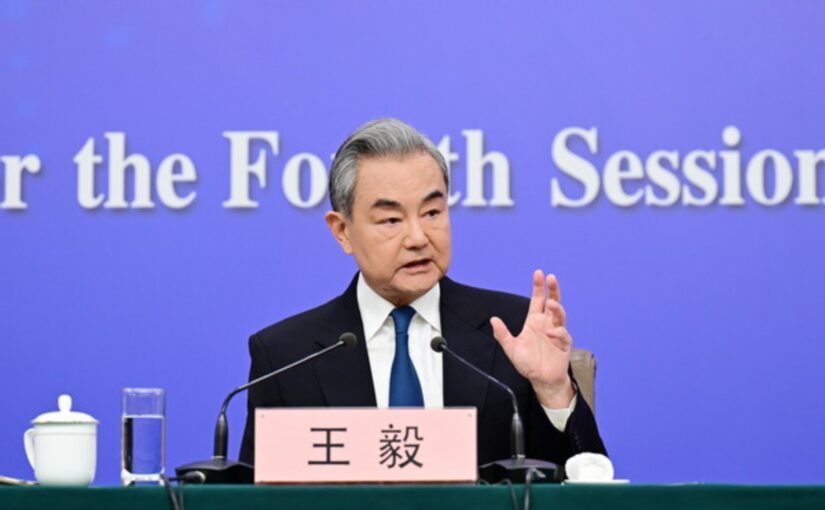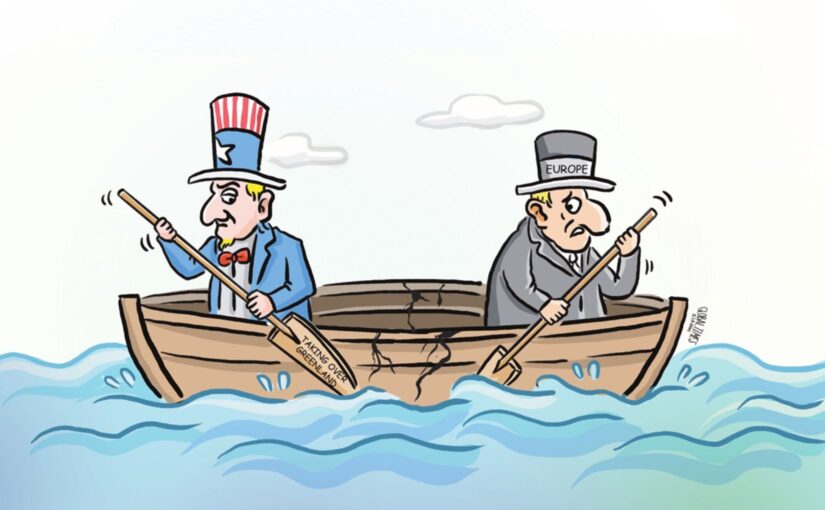
In the video embedded below, Jyotishman Mudiar of the popular India and Global Left channel interviews Friends of Socialist China co-editor Carlos Martinez on a range of topics related to China and global political economy, including: the dimensions of China’s economic progress since 1949; the differences between the first three decades of socialist construction and the Reform and Opening Up period; the differences between Socialism with Chinese Characteristics and capitalism; the definition of socialism; the political system that enables China’s unprecedented progress on poverty alleviation and green energy; the nature of multipolarity; the differences between today’s emerging multipolarity and the inter-imperialist rivalry of the early 20th century; how multipolarity opens a path for advance to socialism; the nature of the current long crisis of capitalism; and the meaning of “changes unseen in a century”.
Category: Interviews
Martin Jacques and Carlos Martinez discuss Western misconceptions of China
In this episode of Wave Media’s Roughly Chinese podcast, hosted by Mimi Zhu and recorded live in Shanghai in October 2025, Martin Jacques (British academic and author of the bestselling When China Rules the World) and Carlos Martinez (co-editor of Friends of Socialist China and author of The East is Still Red) discuss their motivations for researching and writing about China; the trajectory of Britain-China relations; changing perceptions of China in the West; the long-term crisis of capitalism and its manifestation in an ascendant far-right in Britain; and more.
Interview: Is China capitalist, socialist or communist?
On 16 October 2025, Friends of Socialist China co-editor Carlos Martinez joined Shanghai-based journalist Andy Boreham for a wide-ranging discussion on the topics of anti-China propaganda, China’s record under Mao Zedong, China’s political and economic system since 1978, whether China is socialist, the differences between socialism and communism, and much more.
The video of the conversation is embedded below, and can also be found on the Reports on China YouTube channel.
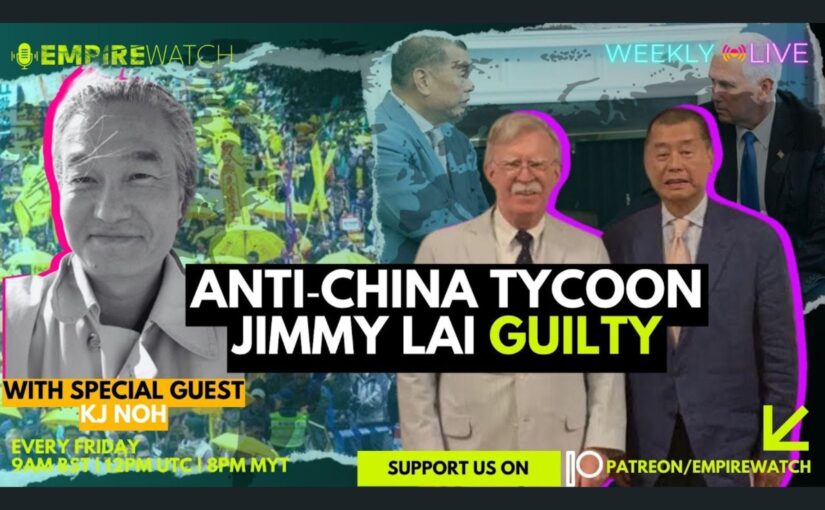
KJ Noh: Washington has been preparing for war with China for over a decade
This wide-ranging interview with political analyst KJ Noh on India and Global Left centres on China’s geopolitical role, the US’s evolving imperial strategy, and the urgent need for solidarity among the nations of the Global South.
KJ begins by responding to the criticism that China is not doing enough to end the genocide in Palestine. He states bluntly: “let’s be clear – no country is doing enough. We are witnessing a live-streamed genocide – children are starving, journalists and doctors are being killed, and an entire population is being besieged and starved. This cannot and should not be tolerated.”
Nonetheless, he contends that blaming third parties such as China diverts responsibility from the Western powers funding, arming and shielding Israel. “In reality, this is not just an Israeli genocide — it is a US-led imperial genocide, with Israel acting as the subcontractor. The project of colonisation and control of West Asia’s resources is part of a larger imperial strategy.”
Regarding China’s position, KJ notes that China was one of the first countries to recognise the State of Palestine, and has long supported its liberation struggle. China last year hosted reconciliation talks among 14 Palestinian factions and has explicitly backed the right of occupied peoples to armed resistance. He further argues that China’s approach is constrained by international structures it cannot unilaterally override.
Turning to US policy and the unfolding New Cold War, KJ asserts that Washington has been preparing for war with China since at least 2009, when the “Air-Sea Battle” doctrine was formulated — a continuation of its “Shock and Awe” strategy of pre-emptive decapitation. He describes a three-stage process of escalation: information warfare, military positioning and provocation, warning that the US now considers tactical nuclear weapons usable. The US, he argues, seeks proxies such as Taiwan Province, the Philippines and South Korea to wage a regional war that could quickly turn nuclear.
To avoid becoming proxy battlegrounds, KJ urges that countries of the Global South build sovereignty — digital, financial, energy, and territorial — and strengthen mutual alliances such as BRICS and the Shanghai Cooperation Organisation.
Decarbonising the planet: China leads the way out of the climate crisis
In the video below, KJ Noh interviews Carlos Martinez about China’s role in humanity’s common struggle against climate breakdown. In particular, the two discuss the new comprehensive review by global energy think tank Ember of China’s clean energy progress and its implications for the rest of the world.
KJ and Carlos go into some depth regarding China’s commitment to renewable energy and environmental protection, and the reason China has emerged as the undisputed global leader in clean technology while the US administration is doubling down on fossil fuel and the military-industrial complex.
The two discuss the geopolitics of the climate crisis, concluding that, for much of the US ruling class, a strategy of suppressing China’s rise is a significantly higher priority than saving the planet; “better dead than red” for the 21st century. KJ and Carlos also cover the global significance of China’s innovation, investment and economies of scale, noting that thanks to China’s efforts, there’s been a dramatic cost reduction in green tech around the world, allowing many countries of the Global South to leapfrog fossil fuel-based development.
The interview was originally recorded and broadcast on BreakThrough News on 30 September 2025.
Interview: China’s successes are based on socialism
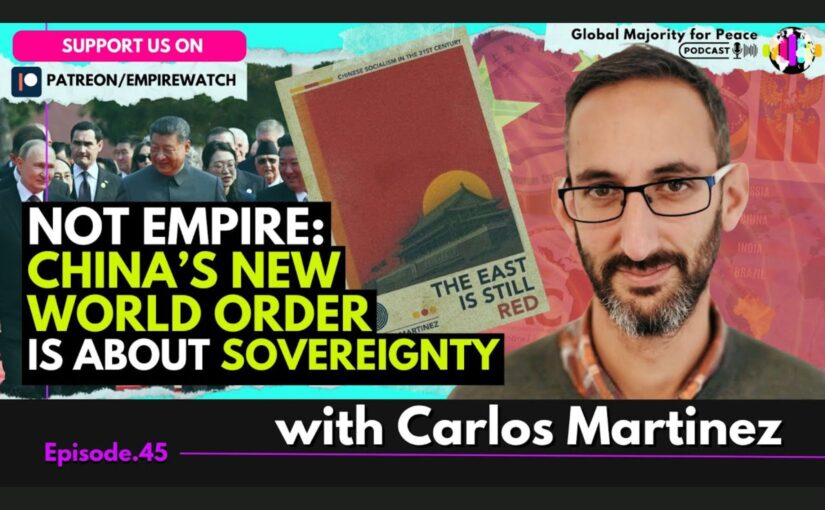
On the Global Majority for Peace podcast, Ileana Chan talks with Friends of Socialist China co-editor Carlos Martinez about why so much of the Western left doesn’t support China; what the differences are between Socialism with Chinese Characteristics and capitalism; the nature of the Shanghai Cooperation Organisation and the aims of the multipolar project; whether China’s engagement with the world can be considered “imperialist”; the nature of China’s relationship with the Democratic Republic of Congo; the state of the semiconductor wars; and China’s remarkable progress in green energy.
The first half hour of the interview is embedded below. Readers are also welcome to access the full 53-minute video, which is currently unlisted.
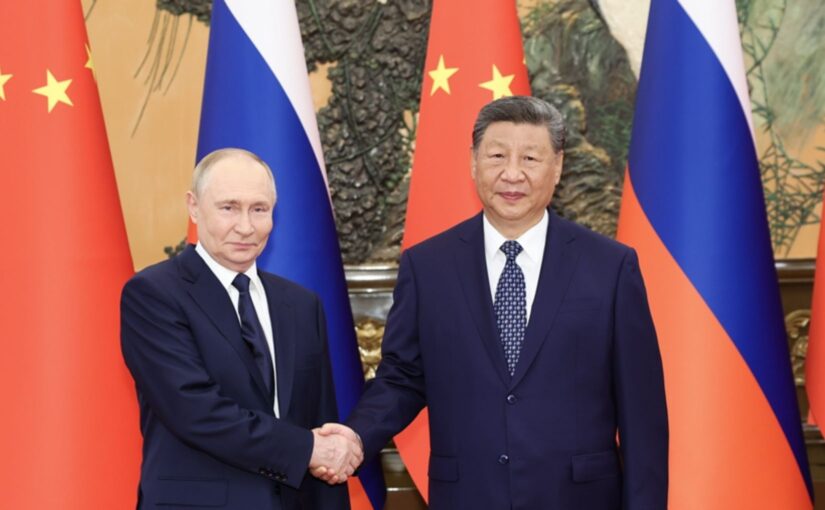
Putin: Russia and China are united in our vision of building a just, multipolar world order, with a focus on the nations of the Global Majority
We are pleased to republish below the full text of Russian President Vladimir Putin’s interview with Xinhua News Agency, conducted on the eve of his visit to China to attend the Shanghai Cooperation Organisation (SCO) Tianjin Summit and the commemorations in Beijing for the 80th anniversary of China’s victory in the War of Resistance against Japanese Aggression.
The interview touches on a wide range of important issues, including Russia-China relations, the global balance of power, the significance of the SCO, and the lessons to be learned from the Second World War.
On the issue of the Global Anti-Fascist War, Putin notes:
The peoples of the Soviet Union and China bore the brunt of the fighting and suffered the heaviest losses. It was our citizens who endured the greatest hardships in the struggle against the invaders and played a decisive role in defeating Nazism and militarism. Through those severe trials, the finest traditions of friendship and mutual assistance were forged and strengthened – traditions that today form a solid foundation for Russian–Chinese relations.
I would remind you that even before the full-scale outbreak of the Second World War, in the 1930s, when Japan treacherously launched a war of aggression against China, the Soviet Union extended a helping hand to the Chinese people. Thousands of our career officers served as military advisers, assisting in strengthening the Chinese army and providing guidance in combat operations. Soviet pilots also fought bravely alongside their Chinese brothers-in-arms.
He adds:
The historical record leaves no doubt as to the scale and ferocity of those battles. We remember the great significance of the famous Hundred Regiments Offensive, when Chinese Communist forces liberated a territory with a population of five million from Japanese occupation. We also recall the unparalleled feats of Soviet troops and commanders in their clashes with Japan at Lake Khasan and the Khalkhin Gol River. In the summer of 1939, our legendary commander Georgy Zhukov won his first major victory in the Mongolian steppes, which in effect foreshadowed the later defeat of the Berlin–Tokyo–Rome Axis. In 1945, the Manchurian Strategic Offensive Operation played a decisive role in liberating northeast China, dramatically altering the situation in the Far East and making the capitulation of militarist Japan inevitable.
And, correctly remembering the crucial role played by China in the defeat of fascism and militarism and the birth of the modern international order, he states:
In Russia, we will never forget that China’s heroic resistance was one of the crucial factors that prevented Japan from stabbing the Soviet Union in the back during the darkest months of 1941–1942. This enabled the Red Army to concentrate its efforts on crushing Nazism and liberating Europe. Close cooperation between our two countries was also an important element in forming the anti-Hitler coalition, strengthening China as a great power, and in the constructive discussions that shaped the post-war settlement and helped to reinvigorate the anti-colonial movement.
Putin observes that, in the West, there are ceaseless attempts to rewrite the history of the Second World War, to downplay the role of the Soviet Union and China in the victory over fascism, and to whitewash the crimes of fascism and militarism. “Historical truth is being distorted and suppressed to suit their current political agendas. Japanese militarism is being revived under the pretext of imaginary Russian or Chinese threats, while in Europe, including Germany, steps are being taken towards the re-militarisation of the continent, with little regard for historical parallels.”
Continue reading Putin: Russia and China are united in our vision of building a just, multipolar world order, with a focus on the nations of the Global MajorityInterview: China shows socialism is the future
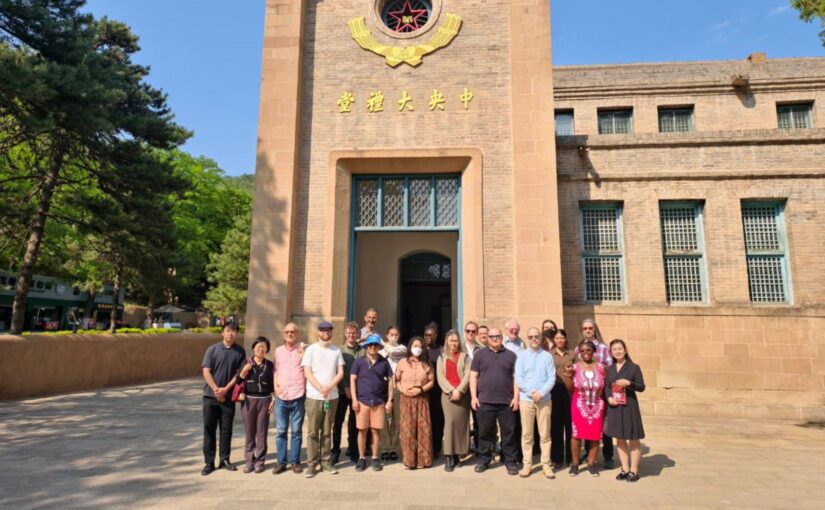
Sydney Loving, a Central Committee member of the Freedom Road Socialist Organization, joined the 2025 Friends of Socialist China delegation on a ten-day visit to Xi’an, Yan’an, Dunhuang, Jiayuguan, and Shanghai. The trip, hosted by the China NGO Network for International Exchanges, aimed to deepen solidarity, build understanding of the Global Civilisation Initiative, and counter Western Cold War lies about China.
In the interview below, originally published in FightBack News, Sydney emphasises that China’s achievements must be seen in the context of its pre-1949 poverty, war, and foreign domination. Visiting Yan’an, the cradle of the revolution, underscored how the Communist Party of China (CPC) grounded itself in the masses. Today, after 76 years of socialist construction, China has lifted hundreds of millions out of extreme poverty, raised life expectancy to over 79 years, and built a high-tech, increasingly green economy.
Daily life in China, Sydney observes, contrasts sharply with US cities: clean, walkable streets, safety for pedestrians, abundant public spaces, and virtually no homelessness. Historical and cultural heritage is actively preserved and made accessible. In poorer Gansu Province, projects like the JISCO steel complex, solar power plants, and ecological greening of desert areas illustrate the link between poverty alleviation and environmental sustainability.
Sydney stresses the CPC’s visible role in daily life, from free medical checkups to street sanitation, with leadership positions earned by serving the people rather than by spending money on marketing. She argues that socialism’s central planning and mass mobilisation achieve outcomes capitalism simply cannot.
For US revolutionaries, the lesson is twofold: socialism works, and the main obstacle to global peace and dignity is US imperialism. While China’s path cannot be copied directly, its example shows that a people-centred, revolutionary movement is possible.
Fight Back!: How did you go to China? What was the purpose of the trip?
Sydney Loving: The delegation was organized by Friends of Socialist China, a political project aiming to strengthen understanding and support for China on the basis of solidarity and truth. I repped Freedom Road Socialist Organization, and the delegation included folks from Black Alliance for Peace, Workers World, Progressive International, Communist Party of Britain Young Communist League, Black Liberation Alliance, Qiao Collective, Iskra Books, and others.
We were invited by the China NGO Network for International Exchanges, and over ten days we visited Xi’an, Yan’an, Dunhuang, Jiayuguan, and Shanghai.
Traveling to a range of areas, we got to investigate how China is building socialism, the incredible advances they’ve made in 76 years of socialist construction, and we had awesome dialogues about how we can better counter the negative narratives and Cold War-type lies we’re bombarded with in the West. Ultimately what we found was a country led by a forward-thinking political party, with a purpose that’s carving out a better future for everybody.
Continue reading Interview: China shows socialism is the futureJean-Luc Mélenchon discusses China with Tariq Ali
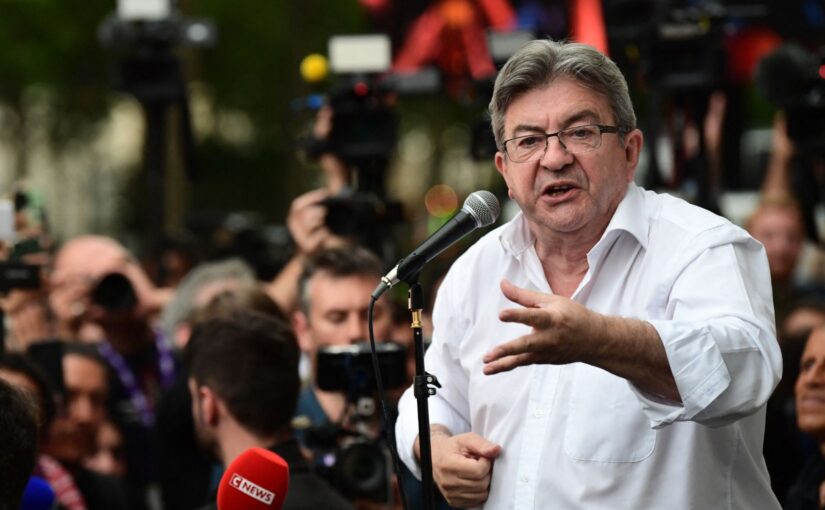
The following is an extensive interview with the French left-wing leader Jean-Luc Mélenchon that was conducted by Tariq Ali, the veteran writer and activist, and that was originally published on Sidecar, the blog published by New Left Review.
In their wide-ranging discussion Mélenchon makes a number of important comments about China – to which he has consistently advocated a position of friendship – which are especially significant coming from probably the most important leader of the contemporary European left.
Asked by Ali about the significance of the recent conflict between Iran and Israel, and specifically the role played by the United States, Mélenchon responds:
“We must try to understand the rationale of these Western states. It’s not simply that Trump is crazy or that the Europeans are cowards; maybe they are those things, but what they are doing is nonetheless based on a long-term plan, one that has failed in the past but is now in the process of being realized. The plan is, first, to reorganize the entire Middle East to secure access to oil for the countries of the Global North; and, second, to create the conditions for war with China.”
This theme is further developed in the two men’s conversation, with Tariq Ali positing:
“You mentioned that the second part of America’s plan is conflict with China. A lot of liberals and left-liberals are now finally recoiling from the events in Middle East and saying that our real target should be China. But what they don’t realize is that the real target is China, because, as you say, if the United States controls all the region’s oil – as it would if Iran were to fall – then they would control the flow of this basic commodity. They could force Beijing to beg for it, which would help to keep it in check. So the US strategy in the Middle East might seem completely crazy – and it is crazy on various levels – but there is also a deep logic behind it: that it’s better to fight China in this way than to go to war with it. This has already started to create huge problems across the East. I noticed that the leaders of Japan nor South Korea, two countries that have major US military bases, abruptly cancelled plans to attend the NATO summit in June.”
Mélenchon replies: “The conflict between the US and China is over trade and resource networks, and in some respects the Chinese have already won, because they produce almost everything the world consumes. They have no interest in fighting a war because they are already satisfied with their global influence. Yet this is both a strength and a weakness. When 90% of Iranian oil goes to China, for instance, blocking the Strait of Hormuz would cut off crucial supply chains and bring a large part of Chinese production to a halt. So China is vulnerable on that front. You are right to say that some in the West would prefer a cold war to a hot war, encirclement and containment rather than direct conflict. But these are nuances, and in reality it is easy to move from one to the other. One of [former US President] Biden’s top economic advisors said that there is no ‘commercial solution’ to the problem of competition with China, which means there can only be a military one.
“The point about Japan and Korea is also significant. Not only them, but also many other powers in the region, are now strengthening ties with China. Vietnam was supposed to be in the US bloc, but they’ve signed agreements with the Chinese. So has India, despite the tensions between the two countries. The backdrop here is that, throughout much of Asia, capitalism is still defined by dynamic forces of trade and production, whereas in the US it has assumed a predatory and tributary character.”
He recalls that: “I once had an interesting conversation with a Chinese leader. When I said to him that China was flooding the European market with its overproduction of electric cars, he replied, ‘Mr. Mélenchon, do you think there are too many electric cars in the world?’ Of course I had to answer ‘no’. Then he said: ‘We’re not forcing you to buy our products; it’s up to you whether you want to purchase them.’ Here was a Communist explaining to me the benefits of free trade.
Continue reading Jean-Luc Mélenchon discusses China with Tariq AliInside China: Why they’re opening 1,000 new Schools of Marxism
In this wide-ranging conversation on The Socialist Program, historian and China scholar Professor Ken Hammond discusses recent developments in China following a visit in July 2025. He emphasises both the remarkable economic progress as well as the challenges China faces as it pursues further socialist development and modernisation.
Ken notes the absence of extreme poverty and homelessness in urban China, contrasting it with Western cities. Yet he also highlights discussions that are taking place in China as to how best to restrict the influence of big capital and to maintain the core role of the state in directing the economy.
One significant development mentioned is the establishment of over a thousand Schools of Marxism across Chinese universities, reflecting a reassertion of the importance of Marxist ideology and a renewed public discourse around socialism under Xi Jinping’s leadership.
Ken and host Brian Becker discuss the historical rationale behind China’s use of markets, viewing it as a pragmatic strategy to gain technology, expertise and capital from the advanced capitalist countries. Contrary to US expectations, this has not led to a capitalist counterrevolution. Instead, with a remarkable improvement in their living conditions, Chinese people have considerable confidence in their social system.
Ken and Brian also analyse China’s approach to international relations, based not on exporting its model but promoting multipolarity and cultural respect through initiatives like the Global Civilisation Initiative. As Ken puts it, socialism with Chinese characteristics is still very much a work in progress.
Interview: Lessons from China
The video below features a discussion between KJ Noh and Carlos Martinez, originally aired on BreakThrough News on 9 July 2025, about China’s development and its role in the world.
KJ and Carlos discuss the recent Friends of Socialist China delegation to China; the US and China’s contrasting visions for the world (‘clash of civilisations’ vs the Global Civilisation Initiative); living standards in China and the West; increasing poverty, repression, racism and xenophobia in Britain and the US; the reasons for US hostility towards China; China’s world-historic successes in tackling extreme poverty and building renewable energy and advanced infrastructure; the relationship between capital and political power in China and the West; and the relationship between the US-Israeli criminal war on Iran and the ongoing campaign to encircle and contain the People’s Republic of China.
Interview: Lessons from China’s Ascent
Embedded below is an interview with Friends of Socialist China co-editor Carlos Martinez on the CGTN Radio podcast The Bridge, hosted by Jason Smith.
Carlos and Jason have a detailed discussion on the role of China’s state-owned enterprises; the rationale behind the Belt and Road Initiative; what lessons the Western left can learn from China; the impact of China’s rise on the West’s ideological, economic and political hegemony; China’s approach to Israel’s war on Iran; the uprisings in Los Angeles; the emerging threat of fascism; and more.
Chinese modernisation offers a new option for others
The annual meetings of China’s National People’s Congress (NPC) and the Chinese People’s Political Consultative Conference (CPPCC), collectively known as the ‘two sessions’, opened in Beijing on March 5 and March 4 respectively.
Prefiguring this, our co-editor Keith Bennett was interviewed by Wang Zixuan of Global Times regarding his expectations for the meetings and the global significance of Chinese modernisation.
Keith notes that this year, the two sessions take place against a background of an internationally volatile and unstable situation, which poses challenges not only to China, but to other countries and the global economy as a whole. Faced with the unpredictable behavior of the US, even other developed economies will more deeply appreciate that China is a steady, reliable and trustworthy partner.
Referring to the third plenary session of the 20th Communist Party of China (CPC) Central Committee held in July last year, Keith notes that now China’s reform and opening up is no longer simply a matter of making foreign things serve China, but it is also about what China contributes to the world.
“What recently caught the world’s attention was the sudden emergence of DeepSeek. In relation to this, I expect to see the ‘two sessions’ making an affirmation of the important role of the private sector within the broader system of socialism with Chinese characteristics. President Xi’s recent meeting with entrepreneurs sent a strong signal in this regard. It was notable in that meeting that the attention was given to areas including high-tech and AI. I think this shows that the emphasis is being placed not only on the real economy but also on sustainability and developments that offer benefits to all humanity.”
Outlining the key features of Chinese modernisation, he concludes: “With its distinct features, Chinese modernisation demonstrates that modernisation no longer means Westernisation. Chinese modernisation and its suitability and efficacy for the majority of humanity will be expressed both quantitatively – by the largest number of people living in modernised conditions – and qualitatively, as it represents a better form of modernisation that benefits all in society. It doesn’t rely on oppressing other nations or peoples and avoids polarisation.”
He adds that: “Some people in the West are blaming China for their own problems, but the West is responsible for its own issues. It’s been a kind of political trick in capitalist societies to find an external enemy to explain internal problems. In fact, China’s rapid development has greatly benefitted the West on a number of levels… The significance of Chinese modernisation to the world is that it offers a new option for other countries who want to speed up development while preserving independence.”
We reprint the text of Keith’s interview below.
GT: The third session of the 14th National People’s Congress and the third session of the 14th National Committee of the Chinese People’s Political Consultative Conference, or “two sessions” in short, will convene in Beijing on Wednesday and Tuesday respectively. What are your expectations about this event?
Bennett: I think that there’s going to be more international attention on the “two sessions” than usual this year. The reason for this is the background against which they will take place in an internationally volatile and unstable situation, which poses challenges not only to China, but to other countries and the global economy as a whole.
How China responds will affect not just China, but the world economy as a whole. So, obviously, China will have to take the current situation into account and make necessary policy adjustments. However, I think the main thing that we will see is that China is prepared for any challenge. And if China continues on a long course of steady, measured and high-quality development, it can rely on the vast potential of its internal market which has been highlighted by the dual circulation strategy. Faced with the unpredictable behavior of the US, even other developed economies will more deeply appreciate that China is a steady, reliable and trustworthy partner.
Continue reading Chinese modernisation offers a new option for othersPresident Dissanayake: Learning from China’s development model is essential for Sri Lanka
Anura Kumara Dissanayake, (popularly known as AKD), who was elected President of Sri Lanka in September 2024, and whose party, the National People’s Power (NPP), whose main component is the Janatha Vimukthi Peramuna (JVP or People’s Liberation Front), Sri Lanka’s largest Marxist party, and of which AKD is also the leader, and who then went on to win a supermajority in November 2024 parliamentary elections, paid a state visit to China from January 14-17 at the invitation of his Chinese counterpart Xi Jinping.
During his visit, Sri Lanka’s head of state gave a customarily wide-ranging interview to He Yanke for the CGTN program Leaders Talk.
Asked about his talks with President Xi Jinping, which had been held earlier that day, President Dissanayake said that Xi had emphasised that China’s achievements today are not just the result of the last two decades but also the outcome of the blood, toil, sweat and hard work of the Chinese people. This had made a deep impression on him.
On the relations between China and Sri Lanka, he said that whenever China draws up plans or programs, it always puts the people first. Similarly, the current Sri Lankan government is committed to the principle of serving the people in everything it does. As a result, the friendship between China and Sri Lanka, which has deep historical roots stretching back 1,000 years, will now enter a new stage.
China’s victory over poverty, the Sri Lankan leader continued, is inseparable from President Xi’s unwavering conviction and decisive leadership. He is a leader who always puts the people first, genuinely works for their welfare, spares no effort in safeguarding their interests and remains deeply connected to them.
Noting that his first visit to China was in 2004, when he served as Sri Lanka’s Minister of Agriculture, Dissanayake noted that China had made extraordinary achievements in the ensuing two decades. Asked what he had drawn from his visit to the Museum on the history of the Communist Party of China (CPC), he said that behind all China’s achievements lies a history of relentless struggle, unwavering belief and refusal to give up. These lessons are applicable to the development of all countries.
Sri Lanka also wished to learn and benefit from China’s technological expertise and related investment in the field of renewable energy, where it had become the global leader.
Likewise, China’s pivotal role in the global fight against poverty was setting an extraordinary example for countries and peoples worldwide. Sri Lanka will research and learn from this example and he wishes to personally visit China’s rural areas to see their development first hand.
Starting from the famous rubber-rice pact of 1952, today China is Sri Lanka’s most trusted economic partner. One of the first countries to sign up to the Belt and Road Initiative (BRI), it has become very important to Sri Lanka’s economic development, with increasing and diversifying exports to China and developing large scale industrial parks to complement the existing major infrastructure projects high on the agenda.
Studying and learning from China’s development model, he stressed, was essential for Sri Lanka. A key lesson is that every country must find its own way to modernisation and adopt a development model suited to its own conditions, rather than blindly copying the development experiences of others.
Regarding the well-known initiatives put forward by Xi Jinping, Dissanayake said that the Global Development Initiative means that the benefits of human progress and development can reach every individual; the Global Security Initiative offers inclusiveness and universal benefits; and the Global Civilisation Initiative respects and integrates unique civilisations and cultures, and the shared values of all countries.
Asked about how his government is facing challenges and implementing change, the Sri Lankan leader first noted that his government had been formed when the national economy was in tatters and the country had been forced to declare bankruptcy. Therefore, its immediate priorities were to pull out of the crisis, ensure economic stability and drive forward development through well structured planning and decisive action.
The political system also needs major reforms, with the entrenched issues of corruption and waste needing to be addressed.
CGTN’s full interview with President Dissanayake is embedded below.
Ken Hammond: In China the interests of the working class are at the heart of everything
In the latest episode of The China Report, embedded below, hosts Amanda Yee and KJ Noh interview Professor Ken Hammond about his new book, China and the World. The three have a wide-ranging discussion about the trajectory of China’s foreign policy over the last half-century, as well as interrogating the dominant narratives about China in the West and exploring the nature of China’s economic development.
Ken details how the rapprochement between the US and China in the early 1970s, starting with the visits by Henry Kissinger in 1971 and Richard Nixon in 1972, opened a path for “China being able to open up to a broader range of outside engagements”, and in many ways enabled the Reform and Opening Up process that began in 1978. While improved relations with the US came at a not-insignificant cost to China’s role in promoting socialist and national liberation revolutions – contributing to some confusion in the West and elsewhere as to China’s political trajectory – “China was pursuing what could be described as a deep game, taking a long-term perspective that required making certain compromises or accommodations in the short term to achieve fundamental objectives in the long term”.
The three talk about China’s economic reforms and how, while they introduced serious contradictions and imbalances into Chinese society, they ultimately enabled China to overcome poverty and underdevelopment. Ken points out that the country achieved an average of 10 percent GDP growth for several decades and that “this growth didn’t just benefit the wealthy; it flowed directly to the people”. On this topic, KJ recounts discussions with Chinese officials in the late 1990s and early 2000s, who described market reforms as “like getting onto a wild horse – but we believe we can contain this horse”. The record shows that they have indeed been able to do so.
Talking about China’s whole-process socialist democracy and its extremely high levels of public consciousness and engagement, Ken describes China as “a state in which the interests of the working class are at the heart of everything that goes on”, and contrasts this with the money-driven politics of the US in which the interests of the capitalist class are at the heart of everything.
China and the World is available to pre-order from 1804 Books.
Interview: Socialism holds its ground and grows stronger with China’s contribution
In a recent interview with the Global Times, Friends of Socialist China co-editor Carlos Martinez discusses China’s development over the past 75 years and the role it plays in the world today.
The interview discusses the forthcoming Chinese translation of Carlos’s book The East is Still Red – Chinese Socialism in the 21st Century, and its significance for Chinese readers:
I hope Chinese readers will feel encouraged to know that there are people in the UK, Europe and the US that oppose the new cold war; that oppose the campaign of containment and encirclement against China; that stand for peace and multipolarity; and that want to see close cooperation in pursuit of peace, prosperity, ecological conservation and a sustainable future for our shared planet. The concepts of “common prosperity” and “building a community with a shared future for mankind” have relevance and resonance among progressive circles in the West.
In response to the question of what the Western left can learn from China, Carlos notes that “China is taking extraordinary, unprecedented steps forward on poverty alleviation, renewable energy, biodiversity protection and more”. These are successes of the global socialist movement, and the Western left can learn and take inspiration from them.
Addressing the “China threat” theory, Carlos points out that China’s record is remarkably peaceful:
China has not been at war for many decades. It does not maintain a global infrastructure of hegemony, unlike the US, which has over 800 overseas military bases, in addition to troop and weapons deployments around the world… On the global stage, China stands consistently and firmly for peace. It has put forward detailed and viable proposals for peace in Ukraine and Gaza. So where is the threat?
Editor’s Note: Recently, an English-language collection of essays, People’s China at 75 – The Flag Stays Red, was launched to examine China’s trajectory since 1949. British author and independent political commentator Carlos Martinez (Martinez) was one of its co-editors. Martinez has been trying to help Western people better understand China’s development in its different phases and aspects. In a recent interview with Global Times (GT) reporters Xia Wenxin and Xu Jiatong, Martinez shared his view on China’s marvellous successes over the past 75 years, as well as its contributions to the world, including to the socialist movement.
GT: When we interviewed you last year, your book The East is Still Red – Chinese Socialism in the 21st Century (hereafter, The East is Still Red) had just come out and gained international attention. Now, the Chinese version of the book is about to come out. How do you feel about this? What do you hope Chinese readers can grasp from this book?
Martinez: I’m very excited and honored that The East is Still Red will be published in Chinese. Although the book was written primarily for the Western audience so that they could come to understand modern China better, I hope it will be useful for some Chinese people to see how Marxists in the West view China and how Chinese socialism becomes an inspiration to the global socialist movement.
I think the analysis of the West’s vicious anti-China propaganda will be interesting for Chinese readers, who may struggle to understand the reasons for the West’s hostility and its slander campaign in relation to Xinjiang, Tibet (Xizang), Hong Kong and other affairs.
And I hope Chinese readers will feel encouraged to know that there are people in the UK, Europe and the US that oppose the new cold war; that oppose the campaign of containment and encirclement against China; that stand for peace and multipolarity; and that want to see close cooperation in pursuit of peace, prosperity, ecological conservation and a sustainable future for our shared planet. The concepts of “common prosperity” and “building a community with a shared future for mankind” have relevance and resonance among progressive circles in the West.
GT: This year marks the 75th founding anniversary of the People’s Republic of China (PRC). Which aspect of China’s development during this period has impressed you the most? How do you view China’s contribution to the world in the past 75 years?
Martinez: The founding of the PRC constituted a profound turning point for the Chinese people after thousands of years of feudalism and then a century of invasion, domination, unequal treaties, chaos, warlord rule and intense poverty. Living standards have risen continuously since 1949. Life expectancy has risen from around 35 to 78 – several years above the global average.
China has advanced from being a very poor and technologically backward country to being a global leader in science and technology. It has eliminated extreme poverty. It is making by far the greatest contribution to the struggle against climate breakdown. It has leaped from a “low” Human Development Index (HDI) 30 years ago to a “high” HDI today and is on the cusp of moving into the “very high” group. It is building its own path to modernization.
Looking at the global scale, China has provided crucial support to national liberation movements and countries in the Global South. The Five Principles of Peaceful Coexistence continue to provide a framework for relations between countries, particularly developing countries. Via the Belt and Road Initiative and other initiatives, China is sharing its infrastructure development expertise and providing a means for the countries of Africa, Central Asia, Southeast Asia, Latin America, the Middle East, the Caribbean and the Pacific to break out of underdevelopment.
And, of course, China is a force for peace. Its foreign policy is based on negotiated solutions to problems, the pursuit of peace, mutual benefit and global friendship. This is a very important contribution to the world.
GT: In a recent article, you urged the Western left to “learn a great deal from China” and “take a great deal of inspiration from it.” Could you please elaborate on this?
Martinez: China, along with the other socialist countries, is building socialism. So, people around the world who support the process of building socialism should seek to learn from China. The people of China are “taking part in the practice of changing reality,” and they are the trailblazers of the left globally, so we should learn from them.
Furthermore, China is taking extraordinary, unprecedented steps forward on poverty alleviation, renewable energy, biodiversity protection and more. In my view, the successes in those areas are successes of the global socialist movement, and the Western left could take inspiration from them.
In 1989, Deng Xiaoping said that “so long as socialism does not collapse in China, it will always hold its ground in the world.” Thirty-five years later, socialism is still holding its ground in the world, and growing in strength, thanks in no small part to China.
GT: What are the common misunderstandings about China and its development in the West? Why could China’s development lead some in the West to the sense of being “threatened”?
Martinez: The notion of China as a threat to some people in the West is patently absurd. Unlike the NATO countries, China’s record is remarkably peaceful. China has not been at war for many decades. It does not maintain a global infrastructure of hegemony, unlike the US, which has over 800 overseas military bases, in addition to troop and weapons deployments around the world. Of the nuclear powers, China is the only one to maintain a consistent policy of no first use and to pledge never to use – or threaten to use – nuclear weapons against a non-nuclear state.
China is accused of aggression in the South China Sea, and yet there is not a single instance of China preventing normal, non-military navigation. Regarding the Taiwan question, China’s position of working toward peaceful reunification has not meaningfully changed in many decades, and the one-China principle is recognized by the majority of the world’s countries.
On the global stage, China stands consistently and firmly for peace. It has put forward detailed and viable proposals for peace in Ukraine and Gaza. So where is the threat? This “threat” seems to be unacceptable to those working toward a Project for a New American Century, and therefore, they slander China and wage a propaganda war against it.
GT: You have been introducing the real China to your audience in the West. What do you think is an effective narrative for China to tell its story to the world?
Martinez: On the basis that “actions speak louder than words,” I think China should continue what it’s doing.
Its progress on environmental issues – becoming the world’s first renewable energy superpower and blazing a trail on biodiversity protection and water management – is very inspiring to people around the world who are concerned with preventing climate breakdown.
China’s successes in poverty alleviation and improving the living standards of its people are also drawing admiration. And China’s orientation toward peace and its principled positions in international relations are opening people’s eyes.
Increasingly, people are coming to reject the relentless anti-China propaganda they’re fed.
Podcast: Keith Bennett on the past, present and future of the People’s Republic of China
We embed below an interview with our co-editor Keith Bennett produced by Spectre – a Scottish-based communist podcast.
In conversation with Nathan Hennebry, recorded on November 20, 2024, Keith outlines the origins of his own interest in China and how Friends of Socialist China has developed over the last three years. They go on to discuss a range of topics, including the history of the Chinese revolution, how socialist democracy is practiced in China and the relationship of ‘yellow peril’ Sinophobia to the new Cold War.
Keith’s interview, and Spectre’s other podcasts, can also be listened to across a variety of media.
Richard Wolff: US shifts blame onto China because it cannot address capitalism’s flaws
In the following video interview with Global Times, prominent Marxist economist Richard Wolff explains the central contradiction in the US ruling class with respect to its relationship with China.
On the one hand, the US business community is eager to maintain good economic relations with China, which represents an important market, trading partner, avenue for investment, and source of investment. US companies “want to be able to produce in China, and even more, they want to sell into the Chinese market, which is one of the fastest-growing and largest markets in the world.”
On the other hand, the US political establishment is increasingly hostile to China. This hostility is driven to a significant degree by the fact that China is challenging the US’s global hegemony. “The last century has been the century of the American Empire, and it now sees its role in the world economy – financially, in export and import, and in other areas – being challenged above all by the People’s Republic of China.”
Meanwhile the US is facing a deepening crisis of capitalism, with growing inequality, economic instability, and a shrinking middle class. Politicians have identified two convenient scapegoats for these problems: 1) immigrants from Latin America; 2) China. Wolff points out: “Capitalism has always moved in this way. But because our politics are controlled by big business, politicians can never blame capitalism. They cannot blame the big businesses that fund them. So, who do they blame? China.”
Wolff conjectures that it may be possible to use this division in the US ruling class to pursue an agenda of peace and cooperation; that the peace movement may be able to work together with the business community to prevent a war with China.
Zhang Weiwei: NATO is a relic of history that should have been disbanded long ago
In the video embedded below, Friends of Socialist China co-founder Danny Haiphong interviews Professor Zhang Weiwei, a Chinese professor of international relations at Fudan University and the director of its China Institute. The interview covers a wide range of topics, including the Western media portrayal of China as aggressive, the concept of the civilizational state, China’s preference for a peaceful approach to international relations, the conflict in Ukraine, China’s diplomatic breakthroughs in the Middle East, and the changing global balance of power.
Zhang Weiwei notes that, while the US and its allies insist on describing China as a threat to regional and global peace, China’s record of peaceful development speaks for itself. China has not fired a single shot in over 40 years, and is the only nuclear power to have a consistent policy of no first use of nuclear weapons. When the US was economically ascendant, it was already waging wars around the world. China however is now the world’s largest economy in purchasing power parity (PPP) terms, and yet it maintains a powerful commitment to peace and to solving problems through negotiations. Zhang highlights China’s diplomatic breakthroughs this year with regard to Middle East politics, including its mediation of the rapprochement between Iran and Saudi Arabia, and its role in bringing together 14 Palestinian factions.
Professor Zhang points out that the conflict in Ukraine is mainly the result of US policy and the insistence on NATO expansion, stating that most Chinese feel that NATO is a relic of history that should have been disbanded long ago. China will be resolute in opposing NATO’s expansion into Asia.
Discussing the concept of “changes unseen in a century”, Zhang Weiwei highlights the emergence of a credible alternative for the Global South in the form of the BRICS grouping – whose GDP is already larger than that of the G7 – along with the Belt and Road Initiative, the economic emergence of several countries, and the failure of the US’s tech war against China.
Counselling the US to adopt a more peaceful approach to international relations, Zhang Weiwei notes that the Biden administration’s nuclear strategy is based on the concept of mutually assured destructions, when what the world needs is mutually assured prosperity.
Professor Zhang is providing a video contribution to our events to mark the 75th anniversary of the Chinese Revolution, in London and New York City.


Antiguan PM: China-Antigua relationship is one of the closest in the world between a big and a small country
Gaston Browne, the Prime Minister of Antigua and Barbuda, a small island state in the Eastern Caribbean, paid an official visit to China from January 22-28, becoming the first leader from the region to visit China in 2024.
During his visit he was interviewed by Wang Guan for the CGTN series Leaders Talk.
Prime Minister Browne noted how small island states are extremely vulnerable in today’s world, citing as contributory factors, climate shocks, the COVID pandemic, the impact of conflicts and wars, limited resource endowments and the debt burden.
He sees the relationship with China as crucial to Antigua’s ability to meet these challenges. His country was one of the earliest in the Eastern Caribbean region to establish diplomatic relations with the People’s Republic, 41 years ago.
Today he says that their bilateral relationship is one of the closest in the world between a big and a small country. Antigua has a population of less than 100,000.
China’s contribution to global peace and prosperity, the Prime Minister says, is unmatched. He sees it as being driven by President Xi Jinping’s philosophy and noble vision of a shared future for all. He describes President Xi as easily the most powerful and respected leader on the planet. Antigua and Barbuda is a beneficiary of China’s benevolence in many aspects of its development, not least in poverty alleviation.
In 2018, Antigua became the first country in the Eastern Caribbean to sign up to the Belt and Road Initiative (BRI). This has had a beneficial impact on many aspects of the country’s development, for example in the renovation and extension of the port in the capital, St. John’s. Funding for this could not be obtained from the World Bank or the IMF and Browne categorically rejects any suggestion of a Chinese ‘debt trap’. Rather, he views China as the most benevolent country on the planet, adding that this and other projects could not have been accomplished without its concessional loans and aid.
Another example he cites is that of agricultural cooperation. This is aimed at taking steps towards food security. At present, some 80% of the food consumed in Antigua is imported, mostly from the United States, with contributory factors being the lack of a sufficient labour force and the exacerbation of the county’s natural aridity due to the impact of climate change. China’s assistance in modernising and replacing the country’s water supply infrastructure is playing a key role here.
With regard to Taiwan, Browne says that his country is a consistent supporter of the one-China principle. This will not change under his leadership or that of the Antigua and Barbuda Labour Party, which he leads.
The full interview with Prime Minister Gaston Browne is embedded below.