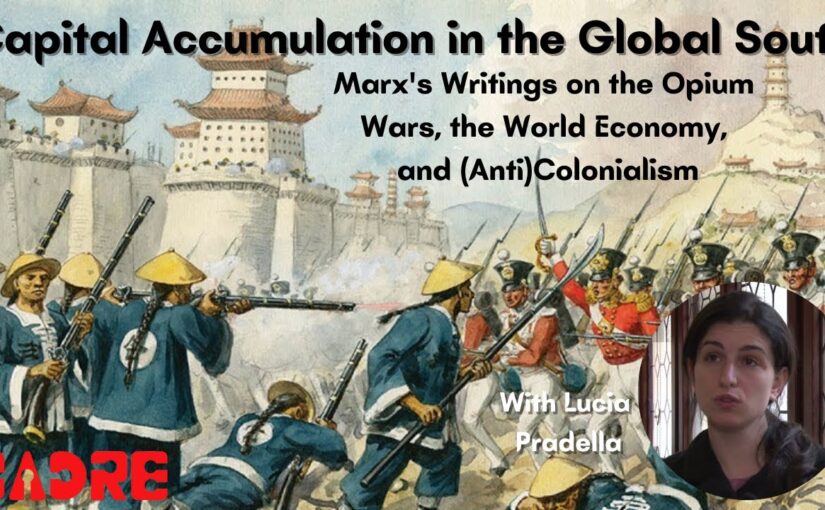
In the interview below, Lucia Pradella engages with Joseph Mullen of The Cadre Journal on the subject of Karl Marx’s understanding of colonialism and capital accumulation in the Global South, with particular reference to China.
Dr. Pradella is a Senior Lecturer in International Political Economy at King’s College London and the author of ‘Globalization and the critique of political economy: New insights from Marx’s writings’, published as part of the Routledge Frontiers of Political Economy series. The Cadre Journal is a student-run journal and podcast on anti-imperialism and communism.
Lucia explains how in her study for her master’s and PhD degrees, as well as a period spent working on the major project to publish the Complete Works of Marx and Engels, she acquired greater understanding of the breadth and depth of Marx’s studies of pre-capitalist societies and of the central role played by colonialism, and not least the Opium Wars, in primitive capital accumulation and his value theory. Whilst greater attention has tended to be paid to Marx’s writings on India, it is significant that Marx’s positive attention to, and appraisal of, the first stages of the Taiping Revolution essentially coincides with the defeat suffered by the European revolutions of 1848. Arising from his study of the Taipings, Marx postulated the possibility of a republican revolution in China.
In the Communist Manifesto, she notes, Marx and Engels proceeded from the premise that the industrial proletariat of Europe constituted the agency of the international revolutionary process, but developments post-1848 created two possible paths to revolution, on the part of the industrial proletariat and on the part of the colonised peoples. However, she contends that Marx did not abandon his view that a developed capitalism was necessary for there to be a socialist revolution.
The views and contributions of a range of people, including Rosa Luxemburg, David Harvey, Immanuel Wallerstein, Giovanni Arrighi, Andre Gunder Frank and Samir Amin are touched on, with Lucia arguing that the dependency theorists and proponents of world systems theory overlooked some aspects of Marx’s Capital. Asked for her views on the theory of combined and uneven development, and its applicability, she expresses the view that Trotsky did not understand the centrality of colonialism in Marx’s analysis.
Noting Marx’s acuity with regards to the potential impact of developments in China on the world economy, she says that some of the developments we see today are processes that Marx already analysed at a very abstract level in Capital Volume One.
The full interview is embedded below.
Category: Interviews
Interview with Hun Sen: No one can replace China
In this edition of the CGTN series Leaders Talk, Zou Yun travels to the Cambodian capital Phnom Penh to interview Prime Minister Hun Sen just prior to his recent visit to China.
Noting that he will be the first foreign leader to visit China following the Spring Festival, and that he was the first to visit China three years ago during the Covid pandemic, Hun Sen recalls that at that time he, “felt the need to stand in solidarity with the Chinese people” and also to reassure Cambodians living and studying in China.
His expectations this time were particularly focused on deepening economic cooperation, not least through the free trade agreements of both Cambodia and the ASEAN regional bloc with China as well as the Regional Comprehensive Economic Partnership (RCEP).
Lauding China’s comprehensive contribution to Cambodia’s infrastructural development, Hun Sen firmly stands by his earlier statement, “who can I rely on if not on China?” “I have made it clear and will continue to say it…Who can replace China? They [Cambodia’s critics] do nothing, but question us instead.”
China’s development, he points out, “brings benefits to the whole world.” Some countries, he notes, press Cambodia to follow their political path, but he refuses this. “Though poor and underdeveloped, Cambodia has its dignity…Some countries threaten and impose sanctions on us, but I am confident that China will never do such a thing to us.”
Describing President Xi Jinping as a great leader, Hun Sen says that the Chinese leader’s concepts of a Global Development Initiative (GDI) and a Global Security Initiative (GSI) are “truly visionary.” If they were to be universally adopted, the world will “become a harmonious community without fear of war.”
The full interview is embedded below.
War fever: after Ukraine, Taiwan?
The text below is the English translation of an interview with Dirk Nimmegeers, co-editor of ChinaSquare.be and Friends of Socialist China advisory group member, originally published in De Wereld Morgen.
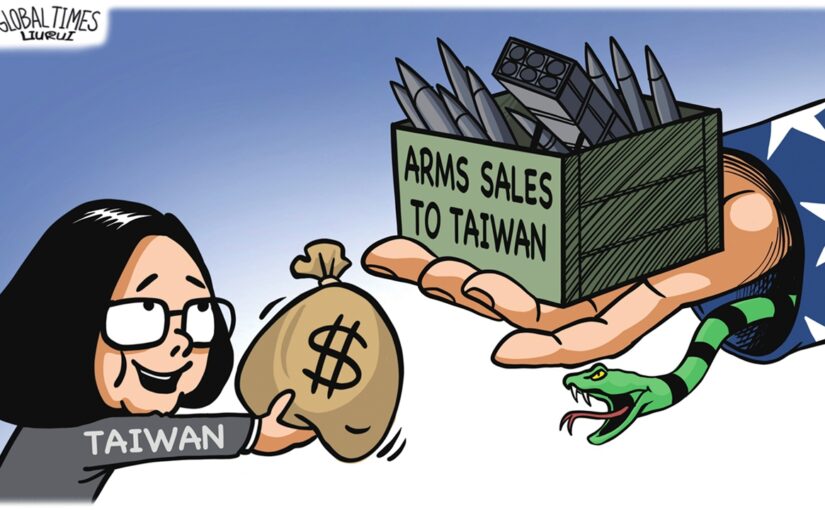
The interview focuses on the prospects for peace across the Taiwan Strait, particularly in the light of the recent comment by US General Mike Minihan that “my gut tells me” there will be a war over Taiwan in 2025. Dirk gives a summary of Taiwan’s 20th century history and the evolution of US policy in relation to the province, which since the signing of the Shanghai Communiqué in 1972 has officially been that “the United States acknowledges that all Chinese on either side of the Taiwan Strait maintain there is but one China and that Taiwan is a part of China.” Dirk notes that, in spite of this official adherence to the One China policy, the US has been encouraging “the most reckless separatist and militaristic politicians on Taiwan” and increasing arms sales to the province. Furthermore President Biden has repeatedly (and unilaterally) stated that the US would would intervene militarily if the People’s Republic attempted to change the status quo by force.
With China and Russia in particular in the crosshairs, Washington is boosting its ‘defence’ spending, modernising its nuclear arsenal, and escalating its militarisation of the Pacific – via AUKUS, its encouragement of Japan’s remilitarisation, the Pacific Deterrence Initiative, and more. “It is clear, and Washington does not deny it, that all this is primarily directed against China.” As part of this overall campaign of China encirclement, “one could argue that Taiwan has been assigned the role of a kind of military base by the US”. Additionally, Dirk opines that US strategists seem determined to use Taiwan against China in much the same way as they are using Ukraine against Russia, stoking conflict in order to weaken the emerging powers and thereby protect US hegemony.
Dirk concludes with a call for the peace movement in the West to make its voice heard loud and clear in forceful opposition to the US policy of escalating tensions over Taiwan. While the media presents the issue as one of Chinese bellicosity, the truth is that China’s position on the Taiwan question has not changed for many decades: “China is aiming at a peaceful reunification. But it also wants past agreements to be respected.” However, China will naturally defend its sovereignty against rising provocations. Peace can only be guaranteed if the US and its allies cease their provocations and return to a framework of cooperation, respect for international law, and respect for China’s sovereignty.
To fully understand what exactly is going on, it is important to grasp Taiwan’s special status. Can you explain that status a bit?
Taiwan does have its own government and parliament, but it is not a sovereign or independent state because it is part of China. Almost every state in the world, including the US, recognises that. Taiwan, for instance, has no seat in the UN.
There is only one China, with its government based in Beijing. The Taiwanese political entity was installed in 1949 by the losing side in the Chinese civil war, whose leaders fled to Taiwan.
Legally, the island has been part of China for centuries – like Flanders is part of Belgium, or Friesland is part of the Netherlands. In a way you can see Taiwan as a rebellious province.
What is China’s relationship towards this ‘rebellious province’?
China’s policy has been unchanging for decades: Taiwan should be reunited peacefully with the rest of the country. Beijing would like to see economic ties between the mainland and the island province restored to the same level as they were until recently. More social and cultural contacts would also be beneficial.
However, Beijing has always warned – and does so every time it is gravely provoked – that any declaration of Taiwanese independence or serious moves towards it would lead to a military response. Essentially, the ‘Taiwan issue’ is a domestic one, which the Chinese on both sides of the Taiwan Strait will settle between themselves.
Continue reading War fever: after Ukraine, Taiwan?
President of Guyana: Sino-Guyanese relations are imperishable, based on shared ties of blood and history
In this edition of the CGTN series Leaders Talk, Wang Guan interviews Dr. Mohamed Irfaan Ali, President of Guyana. The only English-speaking country in the South American mainland, for reasons of historical and cultural background, Guyana is also considered a part of the Caribbean. In 1972, Guyana became the first country in the English-speaking Caribbean to establish diplomatic relations with China. And in 2018, it became the first country in South America to join China’s Belt and Road Initiative (BRI).
But whilst China and Guyana have enjoyed just over 50 years of diplomatic relations, the Chinese presence in Guyana dates back to 1853, which leads President Ali to describe Sino-Guyanese relations as imperishable ones, based on shared ties of blood and history. The Chinese, he says, are part of our country and its diversity and bloodline. This finds expression in a line of the Guyanese national anthem: One land of six peoples, united and free.
Indeed, the first President of Guyana, Arthur Chung, was himself of Chinese heritage, serving between 1970-1980 and visiting China in 1977, five years after the establishment of diplomatic relations. Opening the Arthur Chung Convention Centre in 2015, then President David A. Granger said: “I would like the first President in this country to be remembered… This is the 45th anniversary year of becoming a Republic and Mr. Chung was the first person of Chinese descent who was President in a non-Asian country and it was historic.”
With the recent discovery of massive oil reserves, Guyana has been registering exponential rates of economic growth. President Ali reveals that by 2027-28, Guyana is expecting to produce close to one million barrels of oil per day (bpd). He wants to use this to give the people the best possible education and health care, develop and diversify agriculture, enhance manufacturing and industry, bring down energy costs, meet the housing needs of every single family, and establish proper institutional mechanisms to protect revenues, thereby ensuring that the country enjoys a ‘resource blessing’ rather than a ‘resource curse’.
China is already involved in his country’s oil consortium, but besides welcoming further bids and tenders from Chinese companies, going forward Dr. Ali is particularly keen to see China become Guyana’s most important partner on a path of low carbon development, with gas playing a transitional role, but also focusing on hydro, solar and wind, to fast track green energy development.
President Ali stresses that his country respects the One China Principle and the One China Policy, seeing them as a key plank of international peace and security, just like the regional demand for the Caribbean to be a Zone of Peace. Referencing conflicts such as the ongoing one in Ukraine, he notes that it is the developing world and the poorest countries, who, as a result, face the worst crises in, for example, food and fuel price inflation.
China’s ‘thought leadership’, as expressed, for example, in the Global Security Initiative and the Global Development Initiative, as well as the BRI, can, in the president’s view, contribute especially to the resolution of four key global crises – of inequality, climate change, food security, and energy security. The developing countries, he notes, did not cause these crises, but suffer the most from them.
Stressing that both countries are committed to growing their relations, President Ali says that this work should put people at the centre. If there is investment in the future generations, knowledge and technology transfers, and cultural exchanges, the bilateral ties can only get stronger.
The full interview is embedded below.
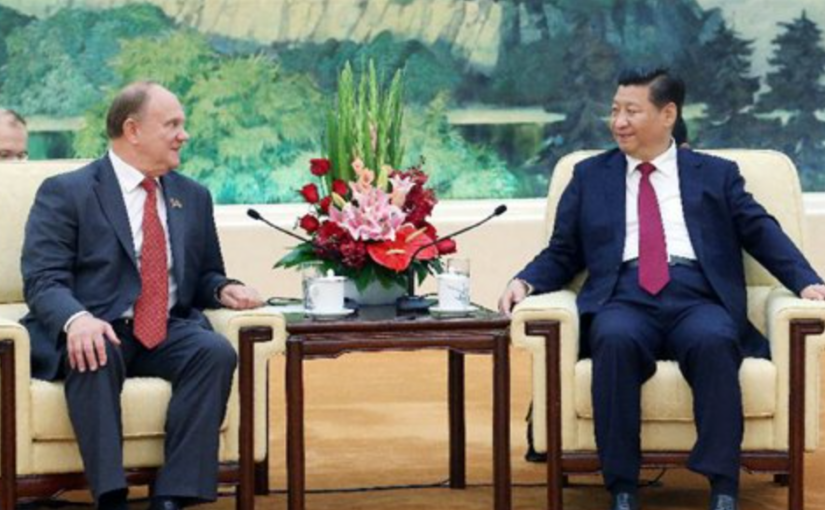
Interview with Gennady Zyuganov on Chinese socialism
The recently concluded 20th National Congress of the Communist Party of China (CPC) attracted the close attention of communist and progressive forces around the world.
In that regard, shortly before the opening of the Congress, Comrade Gennady Zyuganov, Chairman of the Central Committee of the Communist Party of the Russian Federation (CPRF), gave an extensive interview to the leading Chinese newspaper, Guangming Ribao.
Acclaiming the CPC’s century of struggle, the Russian communist leader noted that: “Over the past hundred years the CPC dramatically changed the destiny of the Chinese people. It liberated them from the shackles of semi-colonial dependence, national humiliation and economic enslavement and made the people masters of their land and their destiny. Under the leadership of the CPC the working people of China have driven out foreign invaders, established and consolidated their power and built a middle-income society.”
Speaking of his Chinese counterpart, Zyuganov said: “Xi Jinping is flesh of the flesh of the great Chinese people.” He further noted that the Chinese leader’s father, Comrade Xi Zhongxun, is “a representative of the first generation of Chinese revolutionaries. He was among the founders and leaders of the revolutionary base in the liberated regions of the Shanxi and Gansu provinces and organizers of political work in the People’s Liberation Army of China.”
Noting that the ideas contained in Xi Jinping Thought on Socialism with Chinese Characteristics for a New Era are “universal in character,” and that they “constitute a major innovative contribution to the development of the Marxist theory”, Zyuganov continued: “Writing about socialist society in 1890, Friedrich Engels pointed out that it is not ‘something given once and for all.’ And the great thinker stressed: ‘Like any other social system it should be seen as subject to constant changes and transformations’ … Marx, Engels and Lenin have repeatedly stressed that the characteristics of the socialist social and economic system manifest themselves in the practice of socialist construction in each individual country. Life has vindicated these theoretical premises: a socio-economic system cannot be created according to a single template. Historical experience shows that transition to socialism calls for a combination of the fundamental ideas of Marxism-Leninism and the real state of affairs.”
After speaking about the present situation regarding relations between Russia and China, and such related topics as the conflict in Ukraine, the heightened imperialist hostility and threats to both Russia and China, and the related moves to rehabilitate and revive fascism and militarism and reverse the correct verdicts passed in 1945, Comrade Zyuganov concludes:
“The CPRF is preparing to mark the centenary of the formation of the USSR. Moving along the path of building socialism our country has achieved great successes which have an intransient significance for the whole human race. In 1917 Russia was the first to breach the international front of imperialism and embark on the building of a new society. Following this path under the leadership of the Communist Party the Soviet people have created the most advanced economy for that time, raised living standards, developed science and culture, vanquished fascism and conquered outer space. In the 21st century the relay of victories and accomplishments has been confidently taken from the USSR by socialist China…
“It is only by working persistently to strengthen the unity of the Russian and Chinese people and build up our joint efforts in the struggle against the West’s neo-colonial aspirations that we can uphold the sovereignty of our countries. As Stalin would have said in a similar situation, we will either do it quickly, or we will be crushed.”
We are pleased to republish the full text of this important interview. It was originally published in English on the website of the CPRF.
Speaking at the International Forum of the CPC and Marxist Parties organized by the Communist Party of China you noted that the centenary of the CPC which was marked a year ago was an outstanding milestone in the history of the Chinese people which had great resonance in many countries. How do you assess the successes achieved by the Chinese people under the leadership of the Communist Party of China during the 101 years of revolutionary development?
During its more than a century-long existence the Communist Party of China has traversed a glorious path of creative endeavor. Following its initial goal and fulfilling its mission of social restructuring it managed to unite the popular masses and launch the struggle for a great resurgence of the country on the basis of the values of peace, labor, justice, humanism and progress. In this struggle it has achieved outstanding historic results. Over the past hundred years the CPC dramatically changed the destiny of the Chinese people. It liberated them from the shackles of semi-colonial dependence, national humiliation and economic enslavement and made the people masters of their land and their destiny. Under the leadership of the CPC the working people of China have driven out foreign invaders, established and consolidated their power and built a middle-income society. Today the Chinese look to the future with complete confidence and are making the history of their great Motherland in the new era. Within a historically brief space of time a massive leap has been made toward creating a high-tech industry and dramatically raising people’s living standards. Along with dynamic economic growth long-term stability of the Chinese society has been ensured. This is extremely important for the country as a whole and for each concrete individual. Socialist China is an indisputable leader on many key parameters.
Continue reading Interview with Gennady Zyuganov on Chinese socialism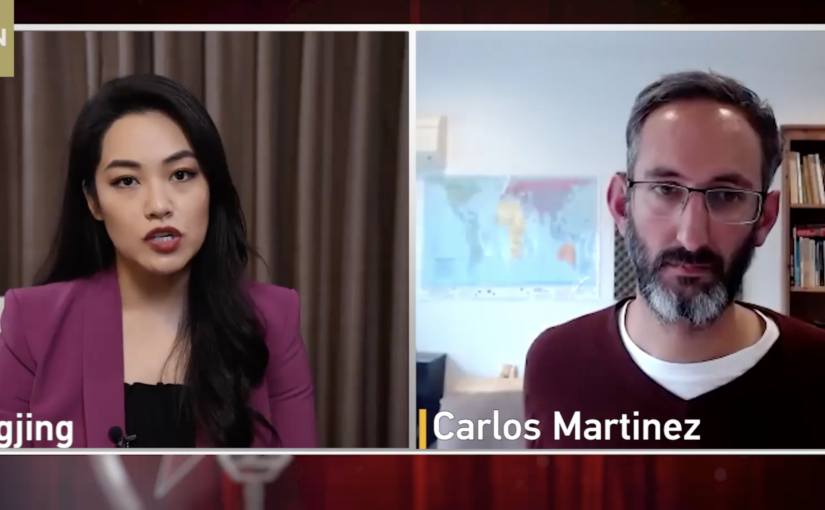
Video: China’s socialist development model speaks for itself
In the video below, originally carried on CGTN, Li Jingjing interviews Carlos Martinez about the recently-concluded 20th National Congress of the CPC – in particular its focus on common prosperity – as well as the successes of China’s development model.
Carlos outlines the core principles of common prosperity – reducing poverty, reducing inequality, improving distribution, and increased regulation of capital. He highlights in particular the measures that have already been taken in support of workers in the ‘gig economy’, including recent legislation supporting and encouraging unionisation, and mandating that all workers have proper contracts and full insurance entitlement. These measures compare very favourably with the situation in the West, where casual workers face terrible working conditions, zero-hour contracts and anti-union policies.
Discussing China’s development model of Socialism with Chinese Characteristics, Carlos points out that the successes of this model speak for themselves. It is a model that has been able to eliminate extreme poverty in a huge country of 1.4 billion people – an unprecedented achievement. “Anyone saying it’s a bad model is saying that it’s bad for people who used to face famines to now live comfortable lives.”
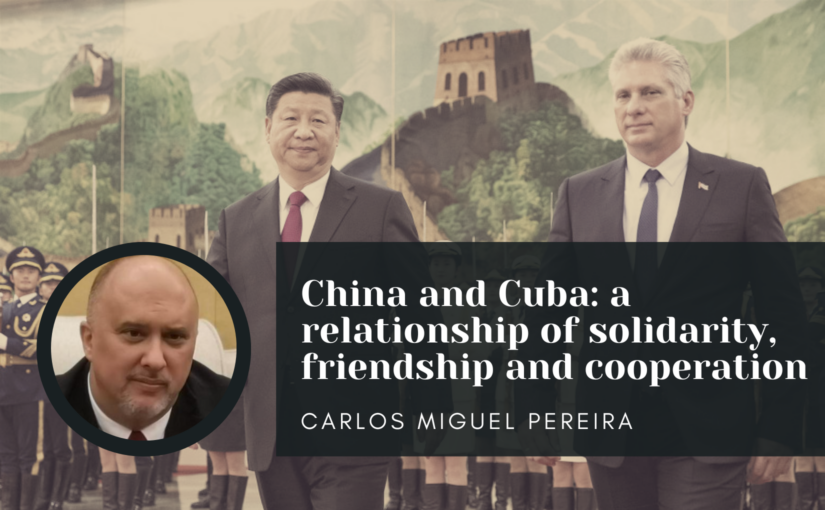
China and Cuba: a relationship of solidarity, friendship and cooperation
We are very pleased to publish below an interview with Carlos Miguel Pereira Hernández, Cuba’s ambassador to China, conducted by People’s Daily and published in Chinese on 13 October. The unabridged English translation has been provided to us by the Cuban Embassy in Beijing.
Timed to coincide with the 62nd anniversary of the establishment of diplomatic relations between the Republic of Cuba and the People’s Republic of China, the interview gives an overview of the history and contemporary reality of relations between the two countries.
Noting that revolutionary Cuba was the first country in the Western hemisphere to extend diplomatic recognition to the People’s Republic of China – in 1960, just a year after the 26th of July Movement came to power – Pereira references the role played by Chinese immigrants in Cuba’s independence struggle. He points out that Cuba and China consider themselves “mutual referents in the construction of socialism with our own characteristics” and notes that President Miguel Díaz-Canel describes Cuba-China ties as “paradigmatic”, and President Xi Jinping describes them as those of “good friends, good comrades and good brothers”.
Describing the cooperation between China and Cuba fields in a vast array of fields, Comrade Pereira expresses confidence that the relationship will continue to deepen.
This year marks the 62nd anniversary of the establishment of diplomatic relations between China and Cuba, how do you assess the fraternal friendship between the two countries? What are your specific plans to further promote economic, trade and people-to-people exchanges between the two countries?
Relations between Cuba and China were made official on September 28, 1960, a formal step after the announcement by Commander in Chief Fidel Castro a few days earlier in front of more than a million Cubans, in the context of the historic First Declaration of Havana, to recognize the New China and rescind ties with Taiwan. That just decision was born of the political and popular will that have accompanied our relations throughout these 62 years.
The nascent Cuban Revolution definitively broke with the Monroe Doctrine and blind obedience to Washington, allowing Cuba to become the first country in the entire Western Hemisphere to establish ties with New China. We are honored to have made that modest contribution as one of the first manifestations of independence from our foreign policy.
The historical foundations and deep bonds of friendship between our peoples go back to the arrival of those first Chinese immigrants 175 years ago, who also had an outstanding and glorious participation in our struggles for independence.
Throughout these years of uninterrupted relations, Cuba has had the historic privilege of always being in the front row in promoting exchanges with China. Our relations represent a model of cooperation based on equality, respect and mutual benefit. We consider ourselves mutual referents in the construction of socialism with our own characteristics and on that basis, we carry out a broad and systematic exchange of experiences.
Continue reading China and Cuba: a relationship of solidarity, friendship and cooperation
Capitalism’s senility and socialism’s vigor are increasingly apparent to world
We are pleased to republish this important interview with Professor Radhika Desai, Convenor of the International Manifesto Group and member of our advisory group, originally published by Global Times. The focus of the interview is the ever more stark demarcation between stagnating western capitalism and booming socialist China.
Analysing the turn to neo-liberalism, particularly in the wake of the 2008 global financial crisis, Radhika asserts: “Liberal democracy is a contradiction in terms… Capitalism is not in the interests of the vast majority of working people.”
Questioned on the premise of earlier Western engagement with China, and its expectation that it would lead to the demise of socialism, Radhika notes: “China’s development is entirely attributed to the country’s adherence to socialism, both in the early period under Mao and in the later reform and opening-up period… After reform and opening-up, the US stepped up economic engagement with China and the idea, particularly after the end of the Soviet Union in 1991, was that such engagement would also make China more or less capitalist, even neoliberal. However, for China this engagement was only another means to advance socialism… Capitalism’s senility and socialism’s vigor are increasingly apparent.”
For the Chinese people, the past decade has been epic and inspirational. The country, under the leadership of the CPC Central Committee with Comrade Xi Jinping at the core, has made great endeavors in boosting its economy, deepening reforms, improving the rights of its people and acting as a responsible power globally.
The world has been increasingly turbulent in recent years due to multiple crises triggered by the US-led West, while there is an obvious tendency that the West is more and more difficult to maintain its development momentum like in the last century. After the 2008 financial crisis, economic growth in Western countries has remained low, in stark contrast to China’s boom. Global Times (GT) reporter Yan Yuzhu talked to Radhika Desai (Desai), convenor of International Manifesto Group and professor of political studies at the University of Manitoba in Canada, about her opinion toward the weakness of capitalism, the adverse consequences of neoliberalism for Western development, as well as China’s role in making a way to pluripolarity.
This is the 25th of the series about this special decade.
GT: After the 2008 financial crisis, especially in the last decade, economic growth in the West has remained very low and the crisis of their domestic political system has been highlighted time and again. In contrast, China has maintained a relatively stable momentum of development, and the gap between China and the US has gradually narrowed. What do you think are the reasons for this difference?
Desai: The low economic growth of major capitalist countries since 2008 is the result of the turn to neoliberalism. It never managed to restore the growth of the 1970s. It occurred because production had outstripped demand and, rather than solving the demand problem, neoliberalism only made it worse. Its attack on organized labor and social spending restricted consumption demand while its encouragement towards financial and rentier activity reduced investment demand, siphoning away funds into speculation and predatory activity. The attempt to compensate for low demand, low growth and low government revenues by extending credit to consumers and governments has only led to mountains of debt and asset bubbles that have regularly burst, weakening economies further.
This process has been ongoing for more than four decades. At the start, the major capitalist countries were much healthier thanks to their “golden age” of robust growth and the broad-based distribution of incomes. But over time, the disastrous effects of neoliberal policies were assailing ever weaker economies.
Continue reading Capitalism’s senility and socialism’s vigor are increasingly apparent to world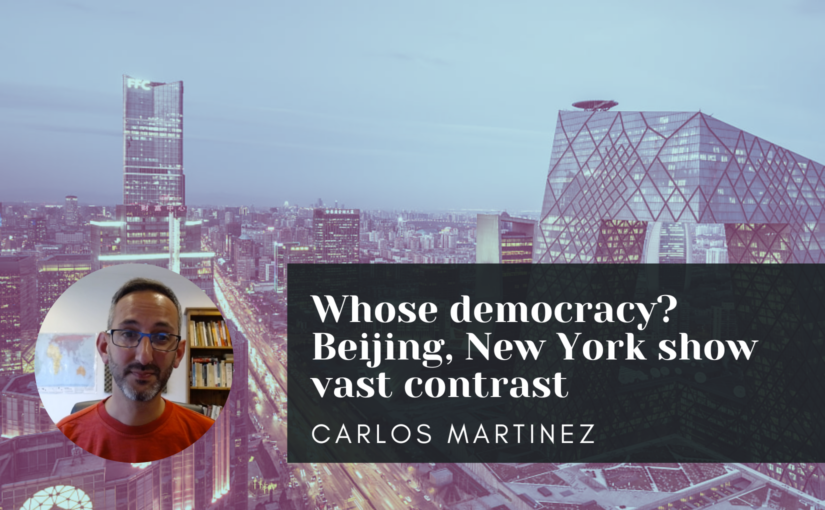
Video: Whose democracy? Beijing, New York show vast contrast
The video embedded below is the last in a three-part series on democracy made by China Daily, based on an interview with Friends of Socialist China co-editor Carlos Martinez. In this segment, Carlos talks about visiting both New York City and Beijing for the first time in 2019, and the stark contrast between the two cities. New York, in spite of being a major centre of wealth, contains terrible levels of poverty, inequality, homelessness and discrimination, and its infrastructure is collapsing. Beijing on the other hand is modern, efficient, clean and well-organised, and the fundamental human rights of all its citizens are guaranteed. What this small example reflects is the difference between Western democracy – a democracy for the elite – and Chinese socialist democracy, which works for the masses of the people.
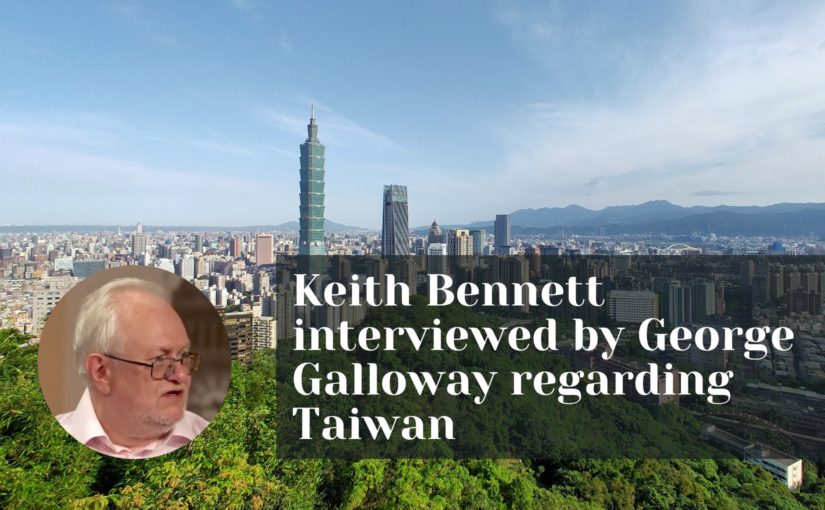
Keith Bennett interviewed by George Galloway regarding Taiwan
Friends of Socialist China co-editor Keith Bennett was one of the panellists on a recent episode of Kalima Horra, a discussion programme hosted by George Galloway on Al Mayadeen television, discussing the current situation on Taiwan, the prospects for cross straits relations between the island and the mainland, and between China and the United States. The programme, recorded on August 13 but first broadcast on August 29, was occasioned by the provocative visit to Taiwan by US Speaker Nancy Pelosi at the beginning of that month.
Keith emphasised that whilst China would do everything possible to prevent war, its absolute determination to complete the cause of national reunification should not be underestimated. The United States was engaged in ‘salami slicing’ the One China principle, to which it had committed itself in three joint communiques, and China could no longer stand idly by.
We reproduce here Keith’s two main contributions to the discussion. The full programme, which also includes some valuable interventions from Professor Michael Dutton of Goldsmith’s, University of London and Beijing Capital Normal University, who stressed that both the Taiwan and Hong Kong issues are unresolved problems of colonialism, can be viewed here.
China’s development an inspiration for people around the world, an alternative to capitalist exploitation
Reproduced below is an important interview with Ken Hammond, professor of East Asian history at the New Mexico State University, originally published in the Global Times. Ken provides a concise and valuable description of Socialism with Chinese Characteristics, outlining China’s political trajectory in recent decades, including some of the problems and contradictions emerging from its extraordinary development.
Ken highlights the key themes of the last decade – “The lifting of hundreds of millions of people out of absolute poverty, the ongoing work to suppress corruption and promote a socialist ethical order, the vital struggle to solve environmental problems and address the global concern of climate change, and the program of outreach to other developing countries and people around the world through the BRI and other initiatives” – and discusses how China’s successes have prompted a dangerous and negative response from the US.
Beyond China’s economic rise, Professor Hammond also notes that China’s socialist nature and Marxist orientation constitute a particularly acute challenge to Western ideological hegemony. “Socialism as an alternative to capitalism is seen as a threat, although in fact it offers the only path to social and economic justice, and indeed to saving the planet from ecological catastrophe.”
GT: Last year, you mentioned in an article on the 100th anniversary of the founding of the CPC that under Xi’s leadership, China has not succumbed to the wished-for transformation of its political and economic systems. How do you understand the political and economic systems of China?
Hammond: I see China as working to develop a system of political economy with public, social ownership and control of the basic economic resources of the country, a socialist system in which the wealth produced by working people is distributed based upon the contribution they make through their labor. China is not yet at the point of having reached this, but this is the goal toward which the Party and the government and the people are working. To reach this objective China has chosen to utilize market mechanisms to pursue the rapid development of the economy, raise the overall level of production both in terms of quantity and quality, and enhance the material conditions of life for the people. Great successes have been achieved in these areas.
The process of development, especially with the use of markets, has also generated contradictions and challenges which China has to face, including corruption, increased inequality, and environmental stresses such as pollution and the rising dangers of climate change. These contradictions are recognized and acknowledged, and China is making serious efforts to address them. This, too, is an ongoing process, and the outcome is not predetermined. This is why the leadership of the Party is so critical, to ensure that the original mission of the revolution, the creation of a just, equitable, socialist society, with the eventual goal of a communist system, remains the guiding vision and the practical program.
GT: In the past 10 years, which policy or practice initiated by the CPC impressed you the most?
Hammond: The decade since Xi Jinping assumed the leadership of the Party and the presidency of the PRC has been one of dramatic changes in China. The project of development, the movement toward a system of socialism with Chinese characteristics, has begun to yield significant positive results. The lifting of hundreds of millions of people out of absolute poverty, the ongoing work to suppress corruption and promote a socialist ethical order, the vital struggle to solve environmental problems and address the global concern of climate change, and the program of outreach to other developing countries and people around the world through the BRI and other initiatives, have all achieved important advances. In conjunction with these, China has also been re-emerging as a significant participant in global affairs.
Continue reading China’s development an inspiration for people around the world, an alternative to capitalist exploitation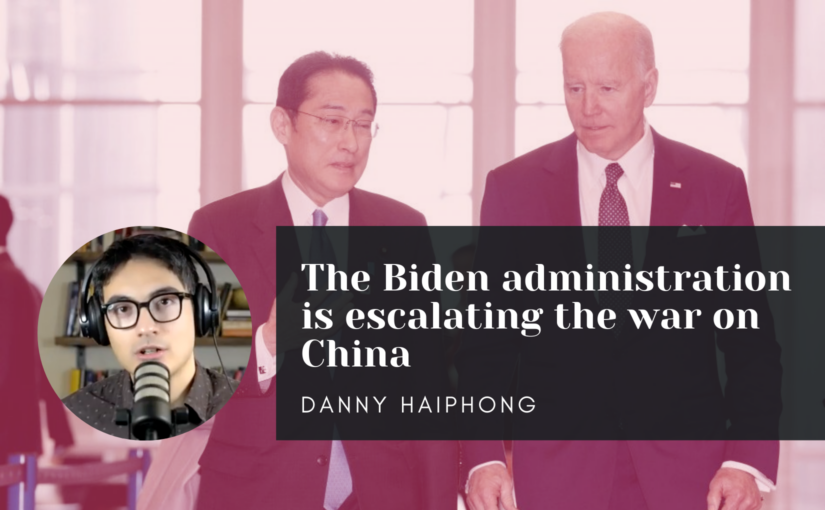
Danny Haiphong: The Biden administration is escalating the war on China
Friends of Socialist China co-editor Danny Haiphong joined peace activist Margaret Flowers for an episode of Clearing the Fog to discuss the Biden administration’s escalating New Cold War against China. A particular focus was US president Joe Biden’s recent statement expressing a commitment to military intervention in Taiwan during his first trip as president to Asia, and the underlying motivations of the New Cold War being rooted in the US’s fear of China as a good example of stability, sovereignty, and a commitment to socialism that runs counter to the aims of US imperialism.
Arnold August: BRICS expansion in the context of rising multipolarity
We are pleased to reproduce extracts from the May 21st edition of the Spotlight programme of Iran’s Press TV, in which Canadian activist and political analyst, focused on Latin America and China, Arnold August assesses the significance of the May 19th virtual meeting of the foreign ministers of the BRICS powers (Brazil, Russia, India, China and South Africa) which backed a Chinese proposal to expand the group’s membership to other emerging economies and developing countries. This will be the first such expansion since South Africa joined the original group in December 2010. August outlines the significance of this move, specifically in terms of building opposition to the new cold war and promoting multipolarity. He also contrasts this inclusive approach to the US moves to exclude such countries as Cuba, Venezuela and Nicaragua from the proposed Summit of the Americas scheduled for next month.
Interview: Comparing human rights in China and the West
We are very pleased to republish this interview given by our Co-Editor Danny Haiphong to Global Times. In his interview Danny compares the very different approaches to human rights in China and the US. He notes how the US constantly raises generally spurious charges regarding the state of human rights in other countries, especially in China, in an attempt to distract attention from its own abhorrent human rights record. This can especially be seen in the contrasting approaches around Covid-19. In China, people and saving human lives come first whereas in the richest country on earth millions are without health care.
To help understand China’s progress in the past decade, the Global Times (GT) has launched a weekly series of interviews with scholars from home and abroad, presenting a holistic view of China’s governance philosophy. The following is an interview with Danny Haiphong (Haiphong), an independent journalist in the US and co-editor of Friends of Socialist China as well as a founding member of the No Cold War international campaign, on how China has made human rights protection a priority and how it has taken human rights moral high grounds.
GT: The US Department of State issued the 2021 Country Reports on Human Rights Practices on April 12, of which 90 pages are used to criticize China’s human rights conditions. At the same time, 2021 was considered to be the US’ most fatal year in history with more than 460,000 Americans killed by the coronavirus last year. Why does the US care more about human rights of China and other countries than its own record?
Haiphong: The US has politicized human rights for several reasons, none of which have anything to do with genuine concerns about the wellbeing of people. Constant speculation about human rights elsewhere provides a distraction from the shortcomings of the US’ own political and economic system. The US possesses an abhorrent human rights record. An average of three Americans per day are killed by US law enforcement. Nearly one million Americans have died of COVID-19. US wars abroad have taken the lives of millions and destabilized entire regions.
Human rights are also an integral component of US foreign policy. Any nation deemed a threat to US hegemony is condemned for human rights violations. Often, the allegations are unfounded. This is certainly the case in relation to China. The US has spread insidious lies about the so-called human rights violations in China’s Xinjiang Uygur Autonomous Region and Hong Kong Special Administration Region (HKSAR) to justify sanctions and military encirclement. The US’ politicization of human rights is not only hypocritical, but a true danger to humanity.
Continue reading Interview: Comparing human rights in China and the West
The China Initiative and the New McCarthyism
In this detailed video interview, Professor Ken Hammond talks with Danny Haiphong about the China Initiative and associated programs attacking Chinese academics in the US. Ken observes that, while the program is ostensibly based on protecting US intellectual property and strengthening its IT security systems, the vast majority of cases have been about individual researchers’ supposed association with the Chinese state, and in particular the People’s Liberation Army. These connections are tenuous at best. Most Chinese universities have some relationship with the People’s Liberation Army, in the same way that most US universities have some relationship with the Department of Defense. If something like the China Initiative were applied around the world, practically no US scholar would be able to engage in joint research with any institution abroad. Meanwhile, in spite of the Biden administration claiming to have shut the program down, several thousands cases are ongoing. The reality of the China Initiative and associated programs is that they are are part of a broader campaign to demonize China and contribute to public support for a New Cold War.
Interview: is China an imperialist force in Latin America?
Interviewed by Sean Blackmon and Jacquie Luqman for Sputnik’s By Any Means Necessary radio show, Friends of Socialist China co-editor Carlos Martinez discusses the recent expansion of the China-led Belt and Road Initiative in Latin America and the Caribbean. He specifically addresses the issue of whether China’s relationship with the region is exploitative, and compares and contrasts it with the behaviour of the US and the international financial institutions.
The full show can be found on Sputnik News.

Lee Camp interviews Li Jingjing on Western misconceptions about China
Comedian and activist Lee Camp interviewed CGTN journalist and vlogger Li Jingjing on his program Redacted Tonight about common Western misconceptions about China. Highlighted in the interview is the importance of Chinese voices in countering the propaganda war and how these voices have been silenced and ignored by Western media.
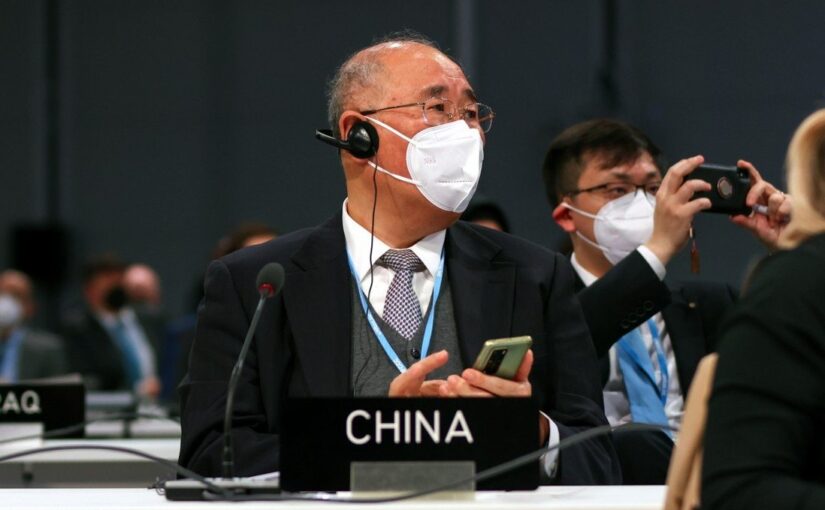
Carlos Martinez: Shifting blame onto China means the West not taking its own responsibilities seriously
We republish below an interview with Friends of Socialist China co-editor Carlos Martinez in Xinhua about the attempts by the US and its allies to shift responsibility for the climate crisis onto China. The interview was first published on 9 November 2021 in English and Chinese.
China has made remarkable progress on climate issues and will continue to do so, so the West’s shifting blame onto China just means they are not taking their own responsibilities seriously, Carlos Martinez, a British author and political commentator, told Xinhua in a recent interview.
Martinez greatly appreciated the fact that China met its target for 2020 ahead of schedule, elaborating on a wide range of progress that China has made on the environment.
Continue reading Carlos Martinez: Shifting blame onto China means the West not taking its own responsibilities seriously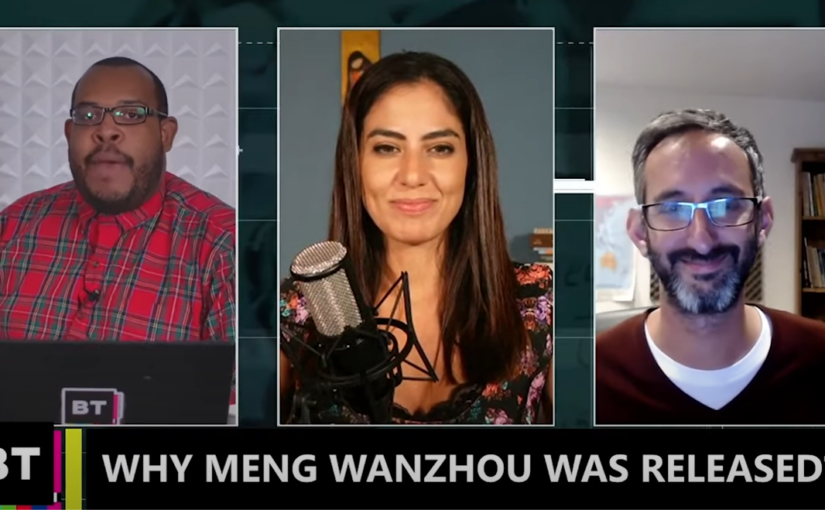
Carlos Martinez: Meng Wanzhou’s release is a victory for the peoples of the world
On Thursday 30 September, Carlos Martinez was interviewed by Rania Khalek and Eugene Puryear on BreakThrough News. They discuss the global significance of Meng Wanzhou’s release, parallels with the kidnappings of Venezuelan diplomat Alex Saab and North Korean entrepreneur Mun Chol-myong, Taiwan, the militarisation of the Pacific, and the need for multipolarity.
Interview with Carlos Martinez on the propaganda war against China
On 25 September, Friends of Socialist China co-editor Carlos Martinez was interviewed on the Rebirth of Communism YouTube channel about China: what is the nature of the propaganda war being waged against it? What’s really happening in Xinjiang? Why does much of the Western left support this propaganda war? What are the reasons for the different levels of economic and social progress in India and China since the late 1940s? Will China suffer the fate of the Soviet Union? What does China’s project of being a ‘great modern socialist country’ by 2049 entail?