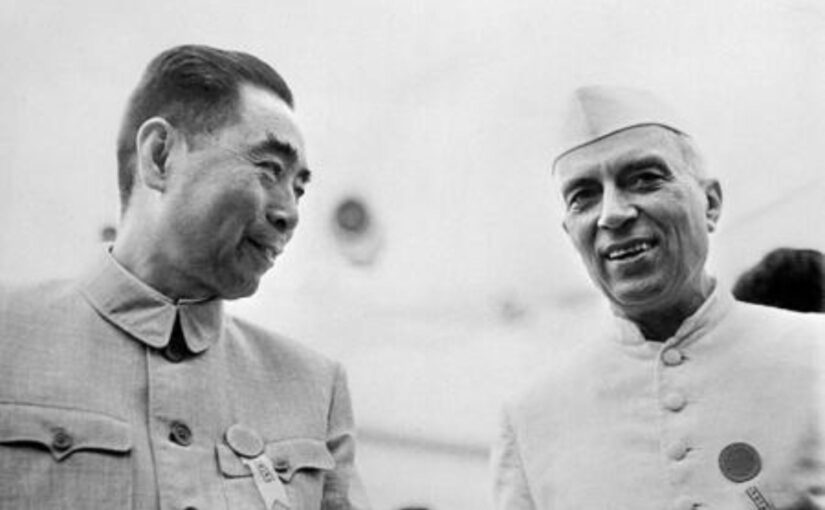
In the following article, Mayukh Biswas argues that India and China, in spite of ongoing tensions, have deep historical, cultural, and economic ties that position them as key actors in reshaping the global order, with much to gain from friendship and cooperation.
The article opens by noting Indian Prime Minister Narendra Modi’s embrace of Trump and the US’s long-term strategy to leverage India against China. The US side disrupted this process recently by imposing punitive tariffs on Indian imports, thereby exposing the limits of US–India alignment.
Globally, Mayukh situates India–China relations within wider shifts: Brazil’s leftward turn under Lula, Africa’s escalating resistance to neo-colonialism, and growing anger around the world at Western sanctions and militarism. BRICS and the other institutions of an emerging multipolarity offer a counterweight to US hegemony.
Tracing two millennia of exchange, the author highlights how Buddhism, science, mathematics, art, and trade linked India and China peacefully. From the Bandung Conference and Panchsheela to today’s BRICS, cooperation between the two countries has also made an important contribution to the construction of the Global South.
Yet political contradictions remain. The BJP’s ideological base fuels anti-China rhetoric, while Western powers exploit tensions through forums like the Quad, seeking to draw India into the US-led strategy of China containment. Despite this, India and China share overlapping interests: strengthening the Global South, addressing climate change, and resisting Western dominance.
Mayukh concludes that the “elephant and dragon” should choose the path of greater cooperation, helping to guide a more multipolar and peaceful global future.
Colonial “divide and rule” only breeds conflict. Long before Europe’s rise, India and China traded and exchanged culture. In the 21st century, this cooperation is vital for global peace.
Mayukh Biswas is former All India General Secretary of the Students’ Federation of India, current Communist Party of India (Marxist) West Bengal state committee member, and a researcher in International Relations at Jadavpur University.
The Modi government had left no stone unturned in praising Trump – from “Namaste Trump” to “Howdy Modi.” Not long ago, far-right Hindutva groups celebrated Trump’s birthday and even performed rituals for his victory. But despite all the theatrics, Trump has imposed a 50% tariff on Indian goods, the highest in Asia. This import duty, applied as “punishment” for buying cheap oil from Russia, will severely impact India’s leather, textiles, IT, and agriculture sectors, risking millions of jobs.
The Rashtriya Swayamsevak Sangh (RSS), which is the ideological lodestar of the ruling BJP, had supported Trump’s anti-Muslim policies, seeing his divisive moves align with their communal agenda; they thought Trump was their ‘long-lost brother.’ Now, Modi is in a deep dilemma. Meanwhile, despite their cold relations, China has made its stance clear. Chinese Ambassador Zhu Feihong tweeted in support of New Delhi: “Give the bully an inch, he will take a mile.” He highlighted how the U.S. weaponizes tariffs, violating UN and WTO rules to suppress other nations, destabilizing the world.
The World is Changing Fast
Brazil, South America’s top economy, has returned to the leftist path. Trump-Modi ally Bolsonaro lost, while leftist trade union leader Lula da Silva reclaimed the presidency through mass movements. Lula now criticizes the U.S. and strengthens ties with China and Russia. Meanwhile, Dilma Rousseff, Brazil’s former leftist president, heads the BRICS Bank – an alternative to the IMF and World Bank. Western powers, cozy with the U.S., are losing sleep over this.
In 1990, a year before the USSR collapsed, U.S. Secretary of State James Baker promised Russia that NATO would not expand “an inch eastward” if Russia agreed to German reunification. That promise was broken. Today, NATO reaches Ukraine (though Ukraine is not NATO member, but is weaponised by NATO), right at Russia’s border, fuelling the current conflict. NATO was meant to counter the Soviets, but even after the USSR’s fall, it bombed Afghanistan and Libya. Putin pointed out that Russia has never deployed missiles near the U.S. border, while American weapons sit at its doorstep. That’s why they demand security guarantees.
For 500 years, Western powers like Portugal, France, Britain and Belgium sucked Africa dry. But now, the tide is turning! Countries like Mali, Niger and Burkina Faso are expelling old colonizers. Africa demands accountability for how Europe and the U.S. looted gold and uranium under the guise of “peacekeeping.” France is even shutting embassies there.
Though apartheid ended in South Africa, whites still own most land. Calls for land reform grow louder. Defying Western threats, South Africa stands with Palestine, challenging Israel’s brutality at the International Court of Justice. This courage has Trump and co seething! But Africa is no longer alone: BRICS (Brazil, Russia, India, China, South Africa) is its powerful ally.
Western bullying has sparked global anger. The U.S. and its allies impose sanctions or military strikes if others disobey; Libya was destroyed because, among other things, Gaddafi rejected the petrodollar. Six decades of embargo on Cuba, blocking Iran’s oil sales, threatening India for buying Russian oil – all are examples of Western hegemonism. BRICS isn’t just an economic bloc; it can be a platform for true global equality.
Elephant and Dragon
India and China, both BRICS founders, share a 3,800 km border and have a combined population of 2.88 billion people. Both countries inherit thousands of years of civilisation. Around 200 BCE, China first learned of India through Central Asian tribes, and direct ties began by 200 CE. China called India Shendu (from Sindhu) and Tianzhu (Land of Heavenly Bamboo). India gifted the world the important mathematical concepts including zero and decimal numbers. Baudhayana calculated π (pi) in the 6th century. Meanwhile, China, known as Serica (Land of Silk), pioneered paper, gunpowder, the compass, printing, abacus, and binomial theory. Pliny noted that Chinese iron was prized in Rome. For 2,000 years, China’s production technology outpaced the West. Marco Polo marvelled at China’s paper currency.
Buddhism, which originates in the Indian sub-continent, deepened ties between two civilisations. Art in Ajanta and Dunhuang reflects cultural fusion. In the 8th century, Indian astronomer Gautama Siddhartha headed China’s astronomy bureau. Beyond religion, the exchange encompassed goods like Indian spices, pearls, for Chinese porcelain, paper, silk as well as science (Indian mathematics, astronomy, medicinal knowledge) and technology. Chinese pilgrims like Faxian and Xuanzang came for Buddhist texts, while Bengali scholar Atisa Dipankara preached in China. During the Song era (1000–1300 CE), China was Buddhism’s heart. Even as Buddhism declined in India, many still travelled to China – the land of Maitreya, Manjushri, and Amitabha. Due to Mongol attacks via land, maritime trade boomed, enriching the Chola and Rashtrakuta empires. Chinese influence is seen in Kerala’s Zamorin elections and still now in Cochin’s fishing nets. Even in 1440, China mediated Bengal-Jaunpur conflicts. The most famous symbol of this connection was the Silk Road, which was not just a conduit for silk and spices, but a bridge for Buddhism, art, and technology.
Both countries suffered under European colonialism. The Opium Wars literally looted China. Later, Chinese communist leader Zhu De sought Nehru’s help against Japan, and Indian freedom fighters sent a medical mission, of which Dr. Dwarkanath Kotnis remains a symbol of friendship (Mao called him “an emblem of solidarity”). In 1915, Communist Party co-founder Chen Duxiu translated Rabindranath Tagore’s Gitanjali – the work in Chinese that earned Tagore the first Nobel Prize in Literature for an Asian. For centuries, the two ancient neighbours shared conflict-free cultural exchanges, engaged not through conquest, but through the silent yet powerful routes of trade and ideas.
From Bandung to BRICS
Soon after the founding of the People’s Republic in 1949, India offered friendship to New China, leading to the Bandung Conference and adoption of the Five Principles of Peaceful Coexistence (Panchsheela). But colonial distortions sowed seeds of border clashes. Communist Party of India (Marxist) has always urged dialogue to resolve disputes and strengthen millennia-old ties – yet they are branded by the Indian bourgeoisie as “Chinese agents.” Meanwhile, Chinese investors bypass Indian restrictions via Singapore or partnerships like Reliance.
Present day China dominates industries like a black hole, sucking in global production. 30% of India’s exports go to China. Despite the 2020 border clash, trade grew (43% and 8.6% in 2020-21 and 2021–22 respectively). In 2020, bilateral trade hit $88 billion. Chinese firms thrive in India – from smartphones to infrastructure (even the Reserve Bank of India approved Bank of China). Politically, the RSS calls for boycotts of Chinese products, but the BJP maintains trade ties. Chinese firms build tunnels in Uttar Pradesh’s Meerut and Gujarat’s Statue of Unity.
The reality is that India and China share many common interests: expanding the influence of the Global South, addressing environmental crisis, strengthening BRICS and jointly resisting Western pressure. No Indian government can deny this. But the RSS needs anti-communist hate for their own narrow political purposes. Ironically, Modi has visited China more than ten times, and RSS leaders tour there often also.
Meanwhile the West exploits India-China tensions, pushing India into the Quad – a tool of imperialist control over the Global South – to contain China. This tests Modi’s credibility within BRICS. India buys Pegasus from Israel to spy on opposition leaders or its critics, shifts arms imports from Russia to Israel, and bonds with Zionists over anti-Muslim extremism.
In colonial times, the Indian Ocean was a “British lake.” Post-WWII, it became a Cold War battleground, reaching peak tension during Bangladesh’s liberation war. Today, the U.S. sees it as strategic, deploying its navy there. In 1976, Britain leased Diego Garcia to the U.S. to counter the USSR. But now, India and China’s rise reshapes the region. For India, the Persian Gulf to Malacca Strait is vital; for China, these sea lanes secure energy and trade. The U.S. pushes the Quad to counter China’s “String of Pearls” and Belt and Road Initiative (BRI), while weakening BRICS. So, this region is now a global power hub.
The Need for Cooperation
A Buddhist temple in Quanzhou, China, bears Indian influences – proof of ancient maritime trade from Malabar to Malacca. Lion motifs (native to neither South India nor China) symbolize royalty in both cultures, inspiring Sri Lanka (Sinhala, “Lion People”) and Singapore (“Lion City”). These prove that ideas travel with trade and they evolve.
India-China economic ties are transforming. Asia’s two largest populations must rethink relations. Resolving border issues would reduce U.S. influence in Asia, letting these ancient civilizations guide the world beyond Eurocentrism. Colonial “divide and rule” only breeds conflict. Long before Europe’s rise, India and China traded and exchanged culture. In the 21st century, this cooperation is vital for global peace.





