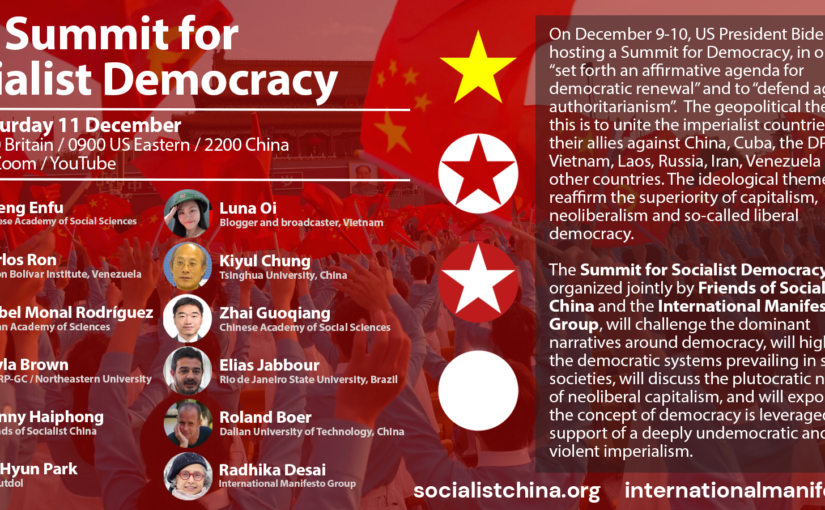
The following article, written by Danny Haiphong and Carlos Martinez, has been accepted for publication in the journal International Critical Thought, where it will appear in early 2022. We have permission to publish the draft on this website, since the subject matter is particularly pertinent to current debates on the question of democracy.
The word democracy is connected to a large and diverse body of meaning. In the broadest sense, it simply refers to the exercise of power – directly or indirectly – by the people. However, in the leading capitalist countries, its meaning is much more specific: it has become synonymous with the system of ‘liberal democracy’, characterized by a multi-party parliament, universal suffrage, the separation of powers, and a strong emphasis on the protection of private property.
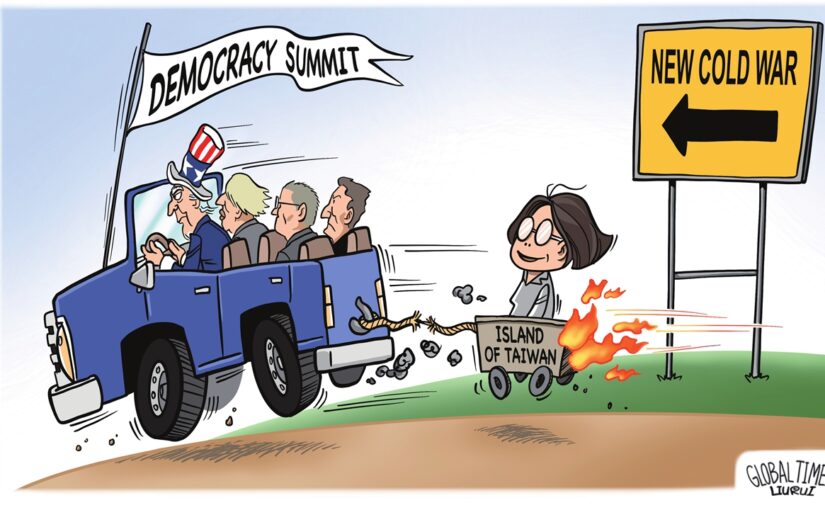
This narrow definition is widely considered in the West as a universal and absolute truth. Indeed, in the dominant Western narrative, adherence to the principles of liberal democracy constitutes the fundamental dividing line in global politics. On one side there is a group of ‘democracies’ (including the US, Canada, Australia, New Zealand, most of Europe, Japan, India and South Korea) and on the other side a group of ‘non-democracies’ or ‘authoritarian regimes’ (including the People’s Republic of China, the Democratic People’s Republic of Korea, Vietnam, Laos, Cuba, Iran, Russia, Venezuela, and most of the countries of Asia, Africa and Latin America).
Continue reading The universalization of ‘liberal democracy’