As previously reported by us, an international forum on the theme of Multipolarity and Chinese Modernisation, hosted by the Shanghai University of Finance and Economics (SUFE), was held on 13 December 2025 in Shanghai. This conference brought together numerous scholars, authors and researchers from around the world to explore pathways toward a prosperous and multipolar future for humanity.
We print below the text of the speech to the conference by Friends of Socialist China co-editor Keith Bennett, which was delivered by video recording.
Keith’s speech stresses the interrelationship of multipolarity and Chinese modernisation in the context of President Xi Jinping’s thesis that the world is presently seeing changes unseen in a century.
Proceeding from Lenin’s 1923 observation that, “In the last analysis, the outcome of the struggle will be determined by the fact that Russia, India, China, etc., account for the overwhelming majority of the population of the globe. And during the past few years it is this majority that has been drawn into the struggle for emancipation with extraordinary rapidity… In this sense, the complete victory of socialism is fully and absolutely assured,” Keith notes how the progress of humanity over the ensuing century has conformed to that essential paradigm, such that quantitative increase is leading to qualitative change. “We are indeed witnessing the sun setting in the west and rising in the east and south.”
With bodies such as BRICS+ and the Shanghai Cooperation Organisation (SCO) in the forefront, “it is socialist China that is today the indispensable nation in driving the changes unseen in a century.”
Until now, Keith notes, modernisation has only been achieved by a minority of, overwhelmingly majority white, nations. In terms of scale alone, therefore, as China is home to some 22 per cent of the world’s population, China’s modernisation will more than double the percentage of humanity living in modernised societies. As such, it will profoundly change, and indeed revolutionise, global society, economy and culture, and hence the prospects and possibilities for those nations and peoples still facing the tasks of development and modernisation.
Therefore, socialism with Chinese characteristics offers a new option for other countries and nations who want to speed up their development while preserving their independence.
I would like to express my thanks to the Shanghai University of Finance and Economics for their kind invitation to participate in this important international forum and regret not being able to join you in person.
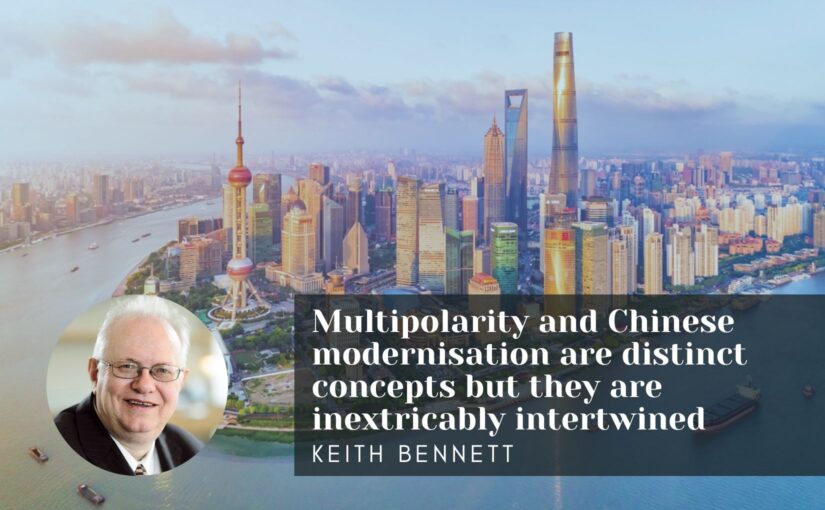
Multipolarity and Chinese moderniation are distinct concepts but they are inextricably intertwined.
General Secretary Xi Jinping often reminds us that we are living in a moment of history where we are witnessing changes unseen in a century.
This statement has applicability and relevance across a range of events and numerous spheres of human endeavour. But perhaps it does not express itself quite so cogently, or with such profound import, as it does with regard to both the tectonic changes in the world’s geopolitical configuration, and the accompanying evolution and reform of global governance, and the long march of more than 1.4 billion Chinese people towards a modernisation of their own style.
In his last published article, ‘Better Fewer, But Better’, Lenin insisted that:
“In the last analysis, the outcome of the struggle will be determined by the fact that Russia, India, China, etc., account for the overwhelming majority of the population of the globe. And during the past few years it is this majority that has been drawn into the struggle for emancipation with extraordinary rapidity, so that in this respect there cannot be the slightest doubt what the final outcome of the world struggle will be. In this sense, the complete victory of socialism is fully and absolutely assured.”
The ensuing century since Lenin wrote these words has seen a whole number of momentous events and trends that include the Chinese people’s victory in the war of resistance against Japanese aggression, the world peoples’ victory in the global anti-fascist war, the founding of the United Nations, the triumph of the Chinese revolution and the founding of the People’s Republic, and the independence of India and the other countries of South Asia.
The victories over US imperialism by the peoples of Korea, Vietnam, Laos and Cambodia and their exploration of the socialist road, the formulation and broad acceptance of the Five Principles of Peaceful Coexistence, the Asia-Africa Bandung Conference with its Bandung Principles and enduring Bandung Spirit, the formation of the Non-Aligned Movement (NAM), and the triumph of the Cuban revolution.
The almost complete, if not total, collapse of the old-line colonial empires and the call by the countries of the Third World for a New International Economic Order.
The consolidation and development of regional and continental bodies throughout the Global South and especially the steady growth and enhanced role of the Shanghai Cooperation Organisation (SCO) and BRICS Plus.
Why then is it correct to speak in this instance of changes unseen in a century? It is because nothing emerges from a vacuum or a void. Rather, quantitative increase leads to qualitative change. And that is precisely what we are now witnessing.
As far back as 1957, Mao Zedong said that the east wind prevailed over the west wind. It may have been an over optimistic assessment at that time, but in terms of historical foresight and vision it confirms him as second to none. That the GDP of the BRICS nations has now surpassed that of the G7 is just one indicator, albeit a significant one, of the veracity and acuity of Xi Jinping’s assessment that today we are indeed witnessing the sun setting in the west and rising in the east and south.
A key form this takes is a developing, interconnected and overlapping set of multilateral bodies of which the most significant are the SCO and BRICS Plus. And whilst all participants in these structures are equal, it is clear that it is only China that can cohere and lead this development, whether in theoretical terms or on a practical level. This is not simply due to China’s size and strength although these are important factors. But fundamentally it is because of China’s socialist system, which provides both the secret of its phenomenal economic development, the greatest in human history, as well as its theoretical underpinnings and understanding from which it can evolve practical solutions to the existential issues facing humanity, and, in the words of Dr. Sun Yat-sen, unite in common struggle with all those who treat us as equals.
It is Socialist China that is today the indispensable nation in driving the changes unseen in a century. That is to say that the collective rise of the Global South, the prospects for an inclusive and equitable globalization and a progressive reform of global governance, for poverty alleviation, development and the prevention of climate catastrophe, rest not least on the progress and prospects of Chinese modernisation.
This is because Chinese modernisation differs fundamentally from the modernisation historically pursued by the western capitalist powers and Japan.
As Xi Jinping pointed out at the 20th National Congress of the Communist Party of China in October 2022, Chinese modernisation is:
- The modernisation of a huge population.
- The modernisation of common prosperity for all.
- The modernisation of material and cultural-ethical advancement.
- The modernisation of harmony between humanity and nature; and
- The modernisation of peaceful development.
Until now, modernisation has only been achieved by a minority of, overwhelmingly majority white, nations. In terms of scale alone, therefore, as China is home to some 22 per cent of the world’s population, China’s modernisation will more than double the percentage of humanity living in modernised societies. As such, it will profoundly change, and indeed revolutionise, global society, economy and culture, and hence the prospects and possibilities for those nations and peoples still facing the tasks of development and modernisation.
As Xi Jinping put it, on February 7, 2023, speaking to newly-elected members and alternate members of the CPC Central Committee and other senior party officials following the party congress, “today, only more than 20 countries around the world, with a combined population of around one billion, have achieved modernisation. China is working to achieve modernisation for more than 1.4 billion people, more than the combined population of the world’s developed countries. This will largely reshape the landscape of global modernisation. Chinese modernisation is unprecedented in human history in terms of both scale and difficulty.”
Already, China’s elimination of extreme poverty represents by far the greatest contribution to the United Nations’ Millennium Development Goals (MDG). As Xi Jinping put it in his report to the 19th Party Congress in 2017, socialism with Chinese characteristics “offers a new option for other countries and nations who want to speed up their development while preserving their independence.”
On a global scale, the fact that China’s modernisation is modernisation of peaceful development is the most fundamental point of all and provides the starkest contrast with the capitalist road to modernisation. The basis for this latter was poignantly and succinctly summarised by the key founder of scientific socialism in the nineteenth century. In Chapter 31 of Volume One of his most seminal work, Capital: A Critique of Political Economy, Karl Marx wrote:
“The discovery of gold and silver in America, the extirpation, enslavement and entombment in mines of the aboriginal population, the beginning of the conquest and looting of the East Indies, the turning of Africa into a warren for the commercial hunting of black-skins, signalised the rosy dawn of the era of capitalist production. These idyllic proceedings are the chief momenta of primitive accumulation.”
Directly counterposed to this, when outlining China’s line of march to modernisation at the 20th Party Congress, Xi Jinping stressed: “In pursuing modernisation, China will not tread the old path of war, colonisation, and plunder taken by some countries. That brutal and blood-stained path of enrichment at the expense of others caused great suffering for the people of developing countries. We will stand firmly on the right side of history and on the side of human progress.”
It is on this basis that China’s template for modernisation at home equally informs its foreign policy and its consistent pursuit of ‘win win’ cooperation and equality and mutual benefit, not only offering a point of reference for other countries and nations who want to speed up their development while preserving their independence, but also a trustworthy, sincere and reliable partner and fellow traveller on this same road.
Speaking at the opening ceremony of the third Belt and Road Forum for International Cooperation on October 18, 2023, Xi Jinping said:
“Our achievements in the past decade are truly remarkable, and there is so much we can draw from them. We have learned that humankind is a community with a shared future. China can only do well when the world is doing well. When China does well, the world will get even better.”
Surely there could not be a greater or more stark contrast with the outright bullying, the gangster-like contempt for international law, norms and agreements, the weaponisation of tariffs, the ‘beggar thy neighbour’ approach of ‘winner takes all’, most crudely and brazenly embodied in the present occupant of the White House, with his determination to ‘make robber baron capitalism great again’.
In summary therefore, Chinese modernisation is a fundamental pillar on which multipolarity rests and which helps chart its course. Together they point out humanity’s path towards a community of shared future.