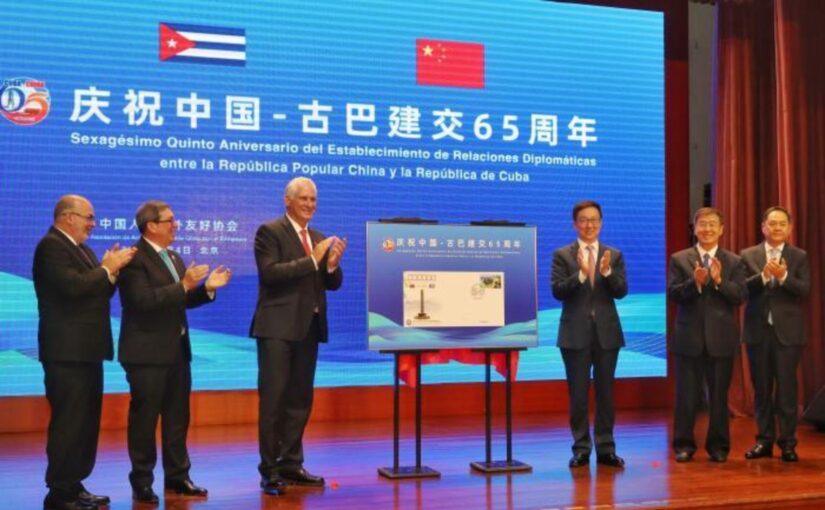
The leaders of China and Cuba exchanged messages on September 28, marking the 65th anniversary of the diplomatic relations between the two socialist countries.
In his message to Miguel Diaz-Canel, First Secretary of the Central Committee of the Communist Party of Cuba and Cuban President, General Secretary and President Xi Jinping noted that 65 years ago, Cuba took the lead among Western Hemisphere countries in establishing diplomatic relations with New China, opening a new chapter in China-Cuba relations. Over the past 65 years, China-Cuba relations have continued to deepen, becoming a model of solidarity and cooperation between socialist countries as well as a model of sincere mutual assistance among developing countries.
Xi also recalled that not long ago, Diaz-Canel came to China to attend the commemorations marking the 80th anniversary of the victory in the Chinese People’s War of Resistance against Japanese Aggression and the World Anti-Fascist War. They met again and reached an important consensus on building a closer China-Cuba community with a shared future.
A joint congratulatory message by Diaz-Canel and General Raul Castro, leader of the Cuban Revolution, noted that for more than 60 years, Cuba-China relations have stood the test of time and continued to grow, with the two sides enjoying deep political mutual trust, close exchanges on socialist development, and a continually strengthened traditional brotherhood and friendly cooperation.
In a September 29 article, Granma, the official voice of the Cuban Communist Party (PCC), referenced the long history of friendship and solidarity between the two peoples, dating back to the wars of independence fought by the Cuban people in the latter part of the 19th century:
“On the century-long journey that unites the peoples of the two countries, the bonds have grown stronger and stronger: ‘There was not a single Cuban Chinese traitor, there was not a single Cuban Chinese deserter,’ reads the monument built in Havana in memory of those who fought for Cuba’s independence.
“The phrase on the metal plaque is still relevant today. In a sense, it can be interpreted as a prediction of the ties that were forged, and which have led to this friendship being described as ‘ironclad.’”
Granma further notes that, alongside the establishment of diplomatic relations in 1960:
“Ernesto Che Guevara’s visit to the Asian giant that same year was a key moment in the history of Chinese-Cuban ties and contributed to the development of a strategic relationship.
“In 1993, President Jiang Zemin would be the only head of state to visit the island, in a crucial context, after the collapse of the socialist camp… Years later, the Cuban government described the visit as ‘an invaluable gesture of brotherhood and confidence in our country’s capacity.’
“The images of Fidel on the Great Wall of China in 1995 are a fundamental part of the shared history. On December 1st, he walked 500 metres of the colossal structure, becoming the international head of state who had reached the highest point.”
In August 2014, Fidel Castro described Xi Jinping as “one of the most steadfast and capable revolutionary leaders I have ever known in my life.”
The article concludes: “Distance does not matter when it comes to a friendship that weathered storms: if you say in Beijing that you come from Havana, and vice versa, in both cases you will be welcomed with a smile.
“It is a beautiful expression of what Cuba and China have built over 65 years, and will continue to build, as good friends, good comrades, and good brothers. Two nations that, each time, join forces to advance the aspiration of a shared future between their peoples.”
The following articles were originally published by the Xinhua News Agency and by Granma.
Xi, Cuban leader exchange congratulations on 65th anniversary of diplomatic ties
BEIJING, Sept. 28 (Xinhua) — Xi Jinping, general secretary of the Communist Party of China Central Committee and Chinese president, and Miguel Diaz-Canel, first secretary of the Central Committee of the Communist Party of Cuba and Cuban president, on Sunday exchanged congratulations on the 65th anniversary of diplomatic ties between the two countries.
Xi pointed out that 65 years ago, Cuba took the lead among Western Hemisphere countries in establishing diplomatic relations with New China, opening a new chapter in China-Cuba relations.
Over the past 65 years, China-Cuba relations have continued to deepen, becoming a model of solidarity and cooperation between socialist countries as well as a model of sincere mutual assistance among developing countries, Xi said.
Xi noted that in recent years, the two leaders have maintained close communication and guided relations between the two parties and two countries to new heights. Xi also recalled that not long ago, Diaz-Canel came to China to attend the commemorations marking the 80th anniversary of the victory in the Chinese People’s War of Resistance against Japanese Aggression and the World Anti-Fascist War. They met again and reached an important consensus on building a closer China-Cuba community with a shared future, Xi said.
The Chinese president stressed that he attaches great importance to the development of China-Cuba relations and is ready to work with Diaz-Canel to take the 65th anniversary of diplomatic ties as a new starting point to carry forward the traditional friendship, deepen high-level political mutual trust, systematically advance development cooperation, strengthen all-round strategic coordination, jointly safeguard international fairness and justice, and continuously achieve new outcomes in building a China-Cuba community with a shared future.
A joint congratulatory message by Diaz-Canel and General Raul Castro, leader of the Cuban Revolution, noted that for more than 60 years, Cuba-China relations have stood the test of time and continued to grow, with the two sides enjoying deep political mutual trust, close exchanges on socialist development, and a continually strengthened traditional brotherhood and friendly cooperation.
Cuba firmly adheres to the one-China principle, opposes external interference in China’s internal affairs, and remains committed to advancing the building of a Cuba-China community with a shared future and opposing hegemonism, said the message.
On the same day, Chinese Premier Li Qiang and Cuban Prime Minister Manuel Marrero also exchanged congratulatory messages. Li said that he is ready to maintain close communication with Marrero and take the 65th anniversary of diplomatic ties as an opportunity to implement the important consensus reached by the two heads of state, continuously translating high-level political mutual trust into tangible cooperation results and steadily enriching the content of the China-Cuba community with a shared future.
For his part, Marrero said that he is ready to work with Li to effectively implement the consensus reached by the two countries’ top leaders and to deepen bilateral cooperation in various areas of mutual interest.
Cuba-China diplomatic relations: 65 years from history to the future
September 29 (Granma) – On September 28, Cuba and China celebrated 65 years of diplomatic relations. The steps that both nations have taken on the sovereign path of building socialism reflect their mutual desire for respect, understanding, and support.
Each meeting, visit, and agreement has been an expression of a deep friendship, based on the common values of social justice, and with the guidance of the Communist Party of China (CPC) and the Communist Party of Cuba (PCC).
On the century-long journey that unites the peoples of the two countries, the bonds have grown stronger and stronger: “There was not a single Cuban Chinese traitor, there was not a single Cuban Chinese deserter,” reads the monument built in Havana in memory of those who fought for Cuba’s independence.
The phrase on the metal plaque is still relevant today. In a sense, it can be interpreted as a prediction of the ties that were forged, and which have led to this friendship being described as “ironclad.”
SIGNIFICANT PAGES
Sovereignty and self-determination were powerful motivations behind the decision announced on September 2nd, 1960, in the First Declaration of Havana, to establish diplomatic relations with China. To this day, it remains a unique moment in history, with Fidel taking center stage before the people in the iconic Revolution Square.
On September 28th, a Joint Communiqué was signed. Cuba thus became the first country in the Western Hemisphere to establish diplomatic relations with the People’s Republic of China, led by President Mao Zedong.
Ernesto Che Guevara’s visit to the Asian giant that same year was a key moment in the history of Chinese-Cuban ties and contributed to the development of a strategic relationship.
In 1993, President Jiang Zemin would be the only head of state to visit the island, in a crucial context, after the collapse of the socialist camp. For his merits, the president was awarded the José Martí Order and years later, the Cuban government described the visit as “an invaluable gesture of brotherhood and confidence in our country’s capacity.”
The images of Fidel on the Great Wall of China in 1995 are a fundamental part of the shared history. On December 1st, he walked 500 meters of the colossal structure, becoming the international head of state who had reached the highest point. The Commander-in-Chief’s confident stride and his ascent of the monument would be a prelude to new bilateral ties.
This was acknowledged in July 2014 by President Xi Jinping: “You are the founder of the causes of the revolution (…) and also of the China-Cuba relationship,” he told Fidel during their meeting in Havana. For his part, in a reflection signed in August of the same year, the Commander-in-Chief described the Chinese leader as “one of the most steadfast and capable revolutionary leaders I have ever known in my life.”
In 2019, China awarded Army General Raúl Castro Ruz the Medal of Friendship. His three visits to that nation, in 1997, 2005, and 2012, strengthened the bilateral agenda and led to new agreements, consolidating ties in key areas for development and opening new chapters in the friendship between the two countries.
CONSENSUS FOR A COMMUNITY OF SHARED FUTURE
In 2022, Presidents Miguel Díaz-Canel Bermúdez and Xi Jinping reached important agreements to build a community of shared future between Cuba and China, the first such agreement with a Latin American country.
The recent Joint Declaration on Accelerating the Construction of a Community with a Shared Future between Cuba and China, approved in early September, promotes this path of bilateral work and ties, described as “at their best moment in history.”
The document reaffirms Cuba’s “unrestricted and unwavering commitment to the One China principle” and the Asian giant’s support for “the Cuban people in their struggle to defend their national sovereignty against the economic, commercial, and financial blockade imposed by the United States.”
It was also agreed to strengthen ties between the PCC and the CPC, “as the cornerstone of relations.”
Likewise, it was approved to “expand practical cooperation in the economic, commercial, financial, investment, aid projects, and scientific-technical fields,” as well as to deepen cooperation in science, education, and sports, among other areas.
In addition, the Cuban side welcomes the Global Governance Initiative recently proposed by Xi and reiterates its support for the president’s other global initiatives: the Belt and Road, as well as those on Development, Security, Civilization, and Governance.
The Declaration reaffirms the willingness to move towards new goals and provides a framework for joint work, based on the consensus reached and the desire to build a sincere friendship that bridges distances.
DIPLOMATIC RELATIONS, FRIENDSHIP BETWEEN PEOPLES
Anywhere in Cuba, a Yutong bus travels down an avenue, while in the most unexpected place in China, you can hear a song with unmistakable Cuban rhythms.
The commemoration of the 65th anniversary transcends its own sphere to become a reason for reflection and confirmation of the certainty of daily embrace in science, energy, education, industry, mining, and many other areas.
Distance does not matter when it comes to a friendship that weathered storms: if you say in Beijing that you come from Havana, and vice versa, in both cases you will be welcomed with a smile.
It is a beautiful expression of what Cuba and China have built over 65 years, and will continue to build, as good friends, good comrades, and good brothers. Two nations that, each time, join forces to advance the aspiration of a shared future between their peoples.