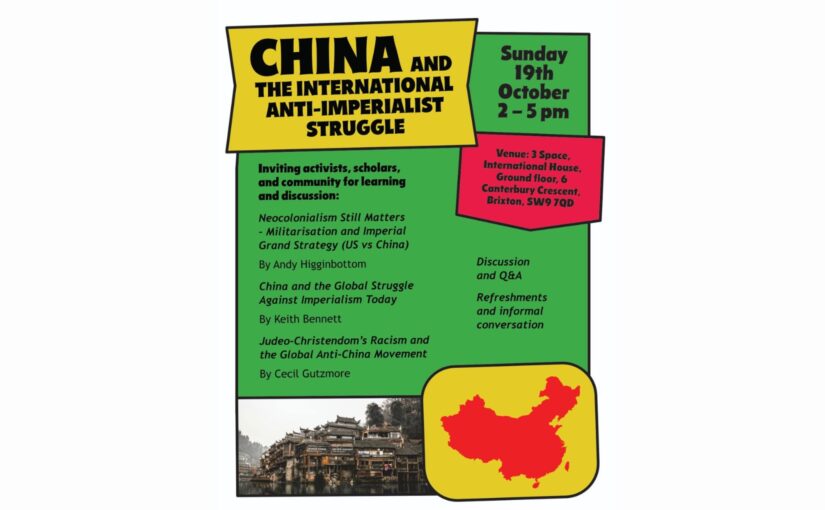
On Sunday October 19 the Free Mumia Abu Jamal Campaign UK organised a discussion meeting on the theme of China and the international anti-imperialist struggle at International House in Brixton, south London.
Chaired by Sarah Mudd and introduced by Wilf Dixon of the Free Mumia Campaign, the meeting heard three presentations expressing differing views within a common overall anti-imperialist perspective:
- Our Co-editor Keith Bennett spoke on ‘China and the global struggle against imperialism today’;
- Cecil Gutzmore, Chair of the Free Mumia Campaign and veteran revolutionary Pan-Africanist, spoke on ‘Judeo-Christendom’s racism and the global anti-China movement’; and
- Andy Higginbottom, former Assistant Professor at Kingston University, London, and a long-standing anti-imperialist activist and Marxist scholar, spoke on ‘Neo-colonialism still matters – Militarisation and Imperial Grand Strategy (US v. China)’.
The presentations were followed by a lively discussion and informal networking. We embed below a video of the three speeches, followed by the text of Keith Bennett’s presentation.
I’d like to thank the Free Mumia Abu Jamal Campaign UK for their initiative in organising this discussion on China and the international anti-imperialist struggle and for inviting me to speak.
Some might ask why a campaign such as yours might wish to address such a topic. But such a view could be said to not fully take account of why you have – correctly in my view – placed such importance on Mumia’s case and on the necessity to win the freedom of this revolutionary fighter who has endured some 43 years of incarceration in the hell hole conditions of the US prison system without losing his revolutionary faith and will or his original aspiration.
Whether before or throughout his long imprisonment, Mumia’s writings have expressed unwavering solidarity with the struggles of peoples throughout the world against imperialism. In his early teens, he joined the Black Panther Party. Many things distinguished the Panthers, of course – from armed self-defence to free breakfast programs for children to clinics to treat sickle cell anaemia. But equally distinctive was the strong solidarity the party expressed, and the inspiration it drew from, the Asian socialist countries – from China, Vietnam and the Democratic People’s Republic of Korea (DPRK). From their long-standing, protracted struggles against imperialism. And from their revolutionary standpoint and their creative application and development of Marxism-Leninism from the standpoint of the oppressed.
In turn, these countries strongly supported the struggle of the Black Panther Party and highly valued the presence of such an ally, engaged in a common struggle from within the ‘belly of the beast’. During the Panthers’ heyday, almost every issue of the party’s newspaper carried articles in support of the struggle of the Chinese people and those of other revolutionary socialist countries – Vietnam, the DPRK, Cuba and Albania. In his autobiography, ‘Revolutionary Suicide’, Huey P Newton, writing of his 1971 visit to the People’s Republic of China, described it as the first time in his life that he felt truly free. Kathleen Cleaver chose to give birth in the DPRK capital Pyongyang and gave her child a Korean name.
Mumia’s Wikipedia entry notes: “Abu-Jamal has described being ‘kicked … into the Black Panther Party’ as a teenager of 14, after suffering a beating from ‘white racists’ and a policeman for trying to disrupt a 1968 rally for Independent [presidential] candidate George Wallace, former governor of Alabama, who was running on a racist platform. From then, he helped form the Philadelphia branch of the Black Panther Party with Defense Captain Reggie Schell, and other Panthers. He was appointed as the chapter’s ‘Lieutenant of Information,’ responsible for writing information and news communications. In an interview in the early years, Abu-Jamal quoted Mao Zedong, saying, ‘Political power grows out of the barrel of a gun’. That same year, he dropped out of Benjamin Franklin High School and began living at the branch’s headquarters.”
All this is what I believe makes today’s discussion so fitting and appropriate.
To speak about China and the global struggle against imperialism today, as I have committed to try to do, is to approach a topic that has various aspects and component parts. Basically, there is China’s role. And there is the nature, character and stage of the struggle against imperialism today.
These are by no means unchanging and immutable. If anything, the opposite is the case. As far back as 1847, in Chapter 2 of the Communist Manifesto, Marx and Engels referred to, “the various stages of development which the struggle of the working class against the bourgeoisie has to pass through.”
So, whilst the various aspects of our topic are distinct, they are also deeply and profoundly interconnected. They not only impact and influence one another. Each changes the other and in turn is changed by the other in a constant process. Whilst this might be held to be the case with all interconnected phenomena, it can be said to apply with particular cogency in this instance, one in which China is playing an ever-greater role in international affairs and steadily advancing to the centre of the world stage. You can find reflections of this every day in the media – whether it be the relatively serious publications like the Financial Times or the Economist or their more comic competitors such as the Telegraph or the Mail.
But in however partial, malign or distorted a way, this reflects the rise of China – or what the Chinese communists refer to as the great rejuvenation of the Chinese nation.
To take just a few random examples; there could be countless others:
- China is one of the five permanent members of the United Nations Security Council.
- It is the global leader in the fight against climate catastrophe – on both the diplomatic and economic fronts.
- It is the world’s second largest economy – the largest if viewed in terms of Purchasing Power Priority (PPP).
- It is the major trading partner of the overwhelming majority of the world’s nations and the ‘world’s factory’ in terms of production.
- Its universities graduate millions of students in STEM subjects every year. The largest number of the world’s peer reviewed academic papers annually are produced by Chinese scholars.
- It is the first country to land a space vehicle and explore the dark side of the moon.
- The entire country was covered in by far the world’s largest network of high-speed rail in a matter of just a few years.
- As the dramatic emergence of Deepseek showed, China is a global leader in the emerging field of AI.
China is also at the heart of a series of new emerging structures that are reconfiguring the international landscape to reflect the growing weight of the Global South – the majority of hitherto downtrodden and oppressed humanity. Foremost among these are the BRICS Plus mechanism and the Shanghai Cooperation Organisation (SCO), along with a range of other bodies such as the Forum on China-Africa Cooperation (FOCAC) and the China-CELEC (Community of Latin American and Caribbean States) Forum.
Together these represent the majority of both the world’s population and of its GDP. It is this interlocking and overlapping emerging structure of alliances, networks and institutions that, with all its contradictions, ambiguities and shortcomings, is nevertheless creating the building blocks and stepping-stones towards a reformed international order based on the global majority, rather than on the hegemonic diktat of a handful of (with one exception) white imperial powers. That is to finally reversing the inequitable division of the world identified by Lenin as that between a handful of oppressor nations on the one hand and a great mass of oppressed nations on the other.
All this was on vivid display in China at the end of August and the beginning of September when the now 27-member SCO family gathered in Tianjin for the largest ever gathering in their quarter century history, followed immediately by the leaders of China, Russia and the DPRK being joined by the heads of state and government from 24 other members of the Global South as they took centre stage at the Beijing commemoration of the 80th anniversary of victory in the Chinese People’s War of Resistance Against Japanese Aggression and the World Anti-Fascist War. A commemoration that showed that whilst China seeks peace not war, if war should be forced upon it, the country is prepared not simply to fight but to win.
Most fundamentally, all this and more rests on what is arguably the greatest, most profound, most thoroughgoing revolution in human history. It seems somewhat ironic that sections of the left, and even the communist movement, in the west should seek to credit the greatest ever contributions to human well-being, development and happiness to capitalism rather than socialism.
In contrast, in his last published article, ‘Better Fewer, But Better’, Lenin wrote:
“In the last analysis, the outcome of the struggle will be determined by the fact that Russia, India, China, etc., account for the overwhelming majority of the population of the globe. And during the past few years it is this majority that has been drawn into the struggle for emancipation with extraordinary rapidity, so that in this respect there cannot be the slightest doubt what the final outcome of the world struggle will be. In this sense, the complete victory of socialism is fully and absolutely assured.”
The Chinese revolution, that led to the founding of the People’s Republic of China in October 1949, 76 years ago this month, indeed changed the global balance of power. It created a socialist camp that stretched from Berlin to Shanghai.
The victorious Chinese revolution played a major role in checking and reversing US imperialism’s advance in Asia, first in Korea and then in Vietnam, Laos and Cambodia.
It inspired and supported national liberation movements, many of them socialist-oriented, throughout Asia, Africa and Latin America.
The 1955 Africa Asia Conference held in the Indonesian city of Bandung adopted the Five Principles of Peaceful Coexistence that China’s Premier Zhou Enlai had first articulated in 1953 and then advanced jointly with the leaders of India and Myanmar the following year.
Today’s geopolitical initiatives spearheaded by China, including the Global Security Initiative, the Global Development Initiative, the Global Civilisation Initiative, and most recently the Global Governance Initiative, are to a great extent the logical continuation and development of the Bandung Spirit.
Of course, there are some good comrades today who say that the spirit of Bandung is dead. That Bandung was political, but the BRICS are merely economic and have yet to rise to the position of being political. And so on.
This school of thought strikes me as somewhat odd.
First, it is generally accepted in the Marxist movement that politics is the most concentrated expression of economics – as Lenin put it, for example in his 1920 speech, ‘The Trade Unions, the present situation, and Trotsky’s mistakes’.
So, the alleged dichotomy seems a somewhat false one. Are not the present ‘tariff wars’ and ‘chip wars’ economic in form but entirely political in essence?
Secondly, Bandung occurred at the height of the anti-colonial revolution. The very purpose of that revolution was to enable and empower countries and peoples to embark on the road of building a new society, developing their independent national economies and improving their people’s livelihood.
Now that colonialism, in its classic form, has very largely, if not entirely, as the genocide in Gaza so graphically highlights, been extirpated from the face of the earth, it should scarcely be surprising that the focus of attention should turn increasingly to economic matters.
The idea of a revolutionary Bandung but a reformist at best, sub-imperialist at worst, BRICS is further belied by looking at who actually gathered in the Indonesian city.
Yes, Ho Chi Minh’s Democratic Republic of Vietnam was there. But so was the puppet regime in Saigon.
So were the Kingdom of Saudi Arabia and the Shah’s Iran.
Even Japan was there. Today, no gathering specifically of the Global South would set a place at the table for Japan.
In his November 10, 1963, ‘Message to the Grass Roots’, Malcolm X summed up Bandung as follows:
“In Bandung… was the first unity meeting in centuries of black people. And once you study what happened at the Bandung conference, and the results of the Bandung conference, it actually serves as a model for the same procedure you and I can use to get our problems solved. At Bandung all the nations came together, the dark nations from Africa and Asia. Some of them were Buddhists, some of them were Muslims, some of them were Christians, some were Confucianists, some were atheists. Despite their religious differences, they came together. Some were communists, some were socialists, some were capitalists – despite their economic and political differences, they came together.”
There seems to me no reason to suppose that Malcolm would not describe today’s BRICS and other Global South initiatives pioneered by China in similarly forthright, succinct and pithy terms were he in a position to do so.
It is not for nothing that the most prestigious leaders of the contemporary global struggle against imperialism and for socialism are near unanimous in their positive evaluation of the role played by China.
To take just a very few examples, Fidel Castro said: “But if you want to talk about socialism, you must not forget what socialism has done in China. Once it was a country of hunger, poverty, disasters — today there is none of that. Today China feeds, clothes, cares for, and educates 1.2 billion people.
“I think China is a socialist country, and Vietnam is a socialist country as well. And they insist that they’ve introduced all the necessary reforms, precisely to stimulate development and to continue advancing towards the objectives of socialism.”
He further said that: “China has objectively become the most promising hope and the best example for all Third World countries.”
Speaking of the Chinese leader, he said: “Xi Jinping is one of the strongest and most capable revolutionary leaders I have met in my life.”
Nicaraguan President Daniel Ortega has said: “The People’s Republic of China has brought progress, benefits, development to peoples who were colonised, and later became independent, but who were then subjugated under the boot of the interests of the powers that had colonised them, leaving those peoples in poverty, with people in misery, people going hungry, people in illiteracy, with infant mortality, in Africa, in Asia. And the People’s Republic of China has been developing a policy bringing benefits to developing countries, without setting any conditions…The powers that have been colonialists and neocolonialists, like the US, like Europe… have not stopped being colonialists. They still are neocolonialists. They have not stopped being criminals. They still are criminals. They still are killers.”
Venezuela’s Hugo Chavez regarded alliance with China as a bulwark against imperialism — a “Great Wall against American hegemonism… China is large but it’s not an empire. China doesn’t trample on anyone, it hasn’t invaded anyone, it doesn’t go around dropping bombs on anyone.”
His successor Nicolas Maduro has said that: “Between China and Venezuela there is a model relationship, a model of what should be the relationship between a superpower like China, the great superpower of the 21st century, and an emerging, heroic, revolutionary and socialist country like Venezuela… China has inaugurated a new era of the emergence of non-colonialist, non-imperialist, non-hegemonic superpowers.”
In summary, China’s role, actions, policies, and stands, and simply its objective reality and weight, certainly exercise influence and impact on the international situation and the global reality and hence inevitably on the anti-imperialist struggle.
But at the same time, all this is in turn impacted and conditioned by the actually existing, objective situation.
Yes, China is certainly changing the world. But China did not create the world which presently exists and in which it has to operate.
That said, China is, of course, not a passive observer. Rather, the way in which it operates in the world is profoundly influenced, indeed characterised by, the nature of its ongoing, long revolution, and the theory, practice, strategy and tactics developed in this course.
These, in turn, have been molded by the creative and dynamic interaction, integration and cross fertilisation of China’s reality, along with its millennia of history, culture, science and civilisation on the one hand, and the communist movement’s evolving and developing theory and practice, especially with regard to the anti-imperialist struggle and the revolution in the oppressed nations, including in a large semi-colonial, semi-feudal country, as was pre-liberation China, on the other.
The first great development in the long march of Marxism, the science of human liberation, to the east and south from its birthplace in the heart of the emergence of modern capitalism comes with Marx and Engels’ developing views on the significance of Ireland and the Irish question.
In 1869, Marx made the profoundly brilliant observation, which could today be extrapolated to characterise the world struggle between Global North and Global South as a whole, that:
“For a long time, I believed that it would be possible to overthrow the Irish regime by English working-class ascendancy… Deeper study has now convinced me of the opposite. The English working class will never accomplish anything until it has got rid of Ireland.”
In his, ‘The Right of Nations to Self-Determination’, Lenin refers to this statement of Marx and adds: “It is impossible to estimate beforehand all the possible relations between the bourgeois liberation movements of the oppressed nations and the proletarian emancipation movement of the oppressor nation… The bourgeois liberation movement in Ireland grew stronger and assumed revolutionary forms.”
Writing on the significance of Dublin’s 1916 Easter Rising, in ‘The Discussion on Self-Determination Summed Up’, Lenin defended the Irish revolutionaries against their socialist critics in terms that carry direct meaning for China’s global strategy and tactics today:
“So, one army lines up in one place and says, ‘We are for socialism’, and another, somewhere else and says, ‘We are for imperialism’, and that will be a social revolution!”
Describing this as “a ridiculously pedantic view”, Lenin continues: “Whoever expects a ‘pure’ social revolution will never live to see it. Such a person pays lip-service to revolution without understanding what revolution is.”
Just as Lenin had observed that it was impossible to estimate beforehand all the possible relations between the bourgeois liberation movements of the oppressed nations and the proletarian emancipation movement, it was in keeping with this materialist standpoint that it took the Great October Revolution, the “ten days that shook the world”, to begin the work of establishing the correct relationship between the socialist forces and the struggle against imperialism in an all-round, comprehensive and scientific way.
In his ‘Draft Theses on the National and Colonial Questions’, prepared for the Second Congress of the Communist International (Comintern) in 1920, Lenin insisted that: “All communist parties must assist the bourgeois-democratic liberation movement in these [oppressed] countries.”
The previous year, in his ‘Address to the Second All-Russia Congress of Communist Organisations of the Peoples of the East’, Lenin had explained:
“The socialist revolution will not be solely, or chiefly, a struggle of the revolutionary proletarians in each country against their bourgeoisie – no, it will be a struggle of all the imperialist-oppressed colonies and countries, of all dependent countries, against international imperialism.”
The ‘Theses on the Eastern Question’, adopted by the Comintern’s fourth congress in December 1922, explained: “The refusal of communists … to take part in the fight against imperialist tyranny, on the pretext of their supposed ‘defence’ of independent class interests, is the worst kind of opportunism and can only discredit the proletarian revolution in the east.”
As Stalin explained in his 1924 work, ‘Foundations of Leninism’, in words that stand in direct refutation of any number of contemporary ‘leftist’ attacks on China’s policies of uniting with the broadest possible range of forces, particularly in the Global South:
“The revolutionary character of a national movement under the conditions of imperialist oppression does not necessarily presuppose the existence of proletarian elements in the movement, the existence of a revolutionary or a republican program of the movement, the existence of a democratic basis of the movement. The struggle that the Emir of Afghanistan is waging for the independence of Afghanistan is objectively a revolutionary struggle, despite the monarchist views of the Emir and his associates, for it weakens, disintegrates and undermines imperialism… For the same reasons, the struggle that the Egyptian merchants and bourgeois intellectuals are waging for the independence of Egypt is objectively a revolutionary struggle, despite the bourgeois origin and bourgeois title of the leaders of the Egyptian national movement, despite the fact that they are opposed to socialism.”
It was this leap in revolutionary theory, occasioned by the leap in revolutionary practice manifested in the founding of the world’s first workers state, that led directly to the founding of the communist movement in China.
As Mao Zedong put it: “The salvoes of the October Revolution brought us Marxism-Leninism. The October Revolution helped progressives in China, as throughout the world, to adopt the proletarian world outlook as the instrument for studying a nation’s destiny and considering anew their own problems.”
The October Revolution also changed the world outlook of Dr. Sun Yat-sen, the leader of China’s bourgeois democratic revolution, who revised his Three People’s Principles, to embrace cooperation with the Communist Party, alliance with Soviet Russia and support for the workers and peasants, thereby creating the conditions for the formation in 1924 of the first united front between the Communist Party and the nationalist Kuomintang, until the murderous betrayal in 1927 by Chiang Kai-Shek, Dr. Sun’s successor following his untimely death.
In one of his poems, Mao Zedong wrote:
Bitter sacrifice strengthens bold resolve
Which dares to make sun and moon shine in new skies.
From the brutal decimation of the young Communist Party of China in the terrible massacres in Shanghai and elsewhere, Mao Zedong went on to advance perhaps his single greatest contribution to Marxism, namely his thesis that, in a country such as China, while the working class remained the leading force of the revolution, the peasantry could constitute the main force, and on this basis it was possible to build stable revolutionary base areas, wage a protracted people’s war, surround the cities from the countryside and ultimately seize nationwide political power by armed force.
It was on the basis of the strong independent power and mass foundations thus created that the CPC was able to establish and sustain the second united front during the period of the war of resistance against Japanese aggression, thereby helping to create a distinctly Chinese Marxism first known as Mao Zedong Thought.
Mao further applied his understanding and practice of the united front to matters of international policy and not least to how to handle the relationships between the various imperialist powers.
In his 1940 article, ‘On Policy’, he wrote:
“The Communist Party opposes all imperialism, but we make a distinction between Japanese imperialism which is now committing aggression against China and the imperialist powers which are not doing so now, between German and Italian imperialism which are allies of Japan and have recognised ‘Manchukuo’ and British and US imperialism which are opposed to Japan, and between the Britain and the United States of yesterday which followed a Munich policy in the Far East and undermined China’s resistance to Japan, and the Britain and the United States of today which have abandoned this policy and are now in favour of China’s resistance. Our tactics are guided by one and the same principle: to make use of contradictions, win over the many oppose the few and crush our enemies one by one.”
Mao was to consistently apply this framework to his understanding of international affairs. A typical example of his theory of the intermediate zone may be found in his August 1964 interview with Japanese socialists:
“The United States rules over Europe; it rules over Canada; it rules over Latin America, except for Cuba. Its hands reach all the way to Africa.
“All the nations of Asia, Africa, and Latin America are rising against imperialism; even Europe, Canada, and other countries are rising against imperialism. Imperialists are even rising against imperialists. Isn’t that what de Gaulle is doing?
“At the present time, there exist two intermediate zones in the world. Asia, Africa, and Latin America constitute the first intermediate zone. Europe, Northern America, and Oceania constitute the second. Japanese monopoly capital belongs to the second intermediate zone, but even it is discontented with the United States, and some of its representatives are openly rising against the United States. Though Japanese monopoly capital now is dependent on the United States, the time will come when it too will shake off the American yoke.”
He applied the same methodological framework when he advanced his Theory of the Three Worlds in the 1970s.
And today, China proceeds from the same premise in building the broadest possible unity against US hegemonism, including wherever possible with the countries of Europe and others, such as Australia and New Zealand, “even though this path is strewn not with roses but with thorns”, to quote an authoritative 1977 exposition of the Theory of Three Worlds.
Key to a proper understanding of the philosophical underpinnings of all this is Mao Zedong’s work on contradiction, which constitutes his principal contribution to dialectics. In his 1937 work of that title, written in the heat of battle against Japan, he notes:
“There are still two points in the problem of the particularity of contradiction which must be singled out for analysis, namely, the principal contradiction and the principal aspect of a contradiction.
“There are many contradictions in the process of development of a complex thing, and one of them is necessarily the principal contradiction whose existence and development determine or influence the existence and development of the other contradictions… Hence, if in any process there are a number of contradictions, one of them must be the principal contradiction playing the leading and decisive role, while the rest occupy a secondary and subordinate position. Therefore, in studying any complex process in which there are two or more contradictions, we must devote every effort to finding its principal contradiction. Once this principal contradiction is grasped, all problems can be readily solved.”
From this we can understand some of the theoretical conclusions that inform China’s international practice. For example:
- The united front. Unite the many; defeat the few. Unite all who can be united against the main enemy.
- Distinguish between greater and lesser enemies; immediate and longer-term enemies.
- Distinguish between antagonistic and non-antagnostic contradictions; Between contradictions between the people and the enemy and contradictions among the people.
On this basis, we can understand how China’s strategy of uniting the Global South, through BRICS, the SCO and so on, embodies Mao’s principle of surrounding the city from the countryside, extended, developed and applied to the global geopolitical stage. In a sense it is not dissimilar in its thinking to that of Lin Biao’s 1965 article, ‘Long Live the Victory of People’s War!’, albeit that one reflects a period when wars of national liberation were raging across the tricontinent, and the other a context where the principal focus, at least so long as a major global war does not break out, has shifted to the struggle for economic independence and for development.
The China scholar and anti-war campaigner Jenny Clegg has theorised this as an international new democracy. She explains:
“As China now directs its efforts towards encouraging an international anti-imperialist movement among states of the Global South, with the BRICS as a significant group, the concept of New Democracy can shed light on the thinking behind this. There are three key points to highlight: an understanding that world revolution develops through stages; an analysis of the national bourgeoisie which recognises their potential to resist imperialist subordination and take part in independent development; and the assessment of the overall international situation given the existence of a major socialist state.
“Anti-imperialism and socialism are… not the same but they are inter-related: in the ebb and flow of the international situation the BRICS may swing this way and that, but what does make a difference to the anti-imperialist struggle in its international dimension is the solidity of China’s socialism.
“As a socialist country China is the most firm in its anti-imperialist stance: it has the strength, unity and manoeuvrability to stand up to and resist US pressure; it has its past experience to draw lessons from, failures as well as successes; it can stabilise the vacillations of the BRICS members to foster the group’s collective focus; it has the commitment and the sense of direction for the future to open the way ahead for the wider Global South in its struggle against imperialism.
“Through its own development, China is able to offer an enabling environment for other developing countries to remove those obstacles still constraining their national development.”
Of course, there are many objections to all this, so when discussing developments such as the BRICS it is important to be clear as to what they are and what they are not. We are not talking about the stage of socialism, and it is necessary to draw clear lines of demarcation both with those who misrepresent such bodies as socialist and with those who denounce them on the grounds that they are not something that they have ever claimed to be. A classic example of what Zhou Enlai once described as “one tendency covering another”.
We are talking here about processes and structures that are full of contradictions; that are often partial, tentative, fragile and emerging. The position and role of India within both the SCO and BRICS is perhaps the clearest such example.
The situation is in fact precisely as described by the Korean revolutionary leader Kim Il Sung, in the article he wrote commemorating the first anniversary of the death of Che Guevara, in words that have lost none of their relevance and cogency after 57 years:
“True, there may be various categories of people among those who oppose imperialism. Some may be active against imperialism, others may vacillate in the anti-imperialist struggle, and still others may join in the anti-imperialist struggle reluctantly under the pressure from their own people and the peoples of the world. But, whatever their motives, it is necessary to enlist all these forces except the henchmen of imperialism in the anti-US joint struggle. If more forces, though inconsistent and unsteady, are drawn into the anti-US joint struggle to isolate US imperialism to the largest possible extent and deal blows to it by joint action, that will be a good thing and by no means a bad thing. Those who avoid the anti-imperialist struggle should be induced to turn out in the struggle against imperialism and those who are passive encouraged to be active in the anti-imperialist struggle.”
This is the process in which today China objectively stands at the head. As Xi Jinping has said, socialism with Chinese characteristics offers a new option for those countries that wish to rapidly develop their economies while maintaining their independence.
This is not just a matter of words but of deeds. Some 150 countries have signed up to the Belt and Road Initiative (BRI), first proposed by China in 2013. Its focus on connectivity and infrastructure embodies the key prerequisites for modernisation, while enabling developing countries to more readily trade and cooperate among themselves, rather than just seeing their raw materials flow to the Global North. The more recent emphasis on ‘small but beautiful’ projects ensures more immediate and tangible benefits for grassroots communities, and particularly women and marginalised groups. Just this August, China signed a US$55 million agreement with Zimbabwe to promote socio-economic development, enhance food security, and support targeted projects intended to improve the livelihoods of vulnerable communities.
So far, the BRI has directly created some half a million jobs and lifted some 40 million people out of poverty, in what is developing into a generalisation and internationalisation of China’s own development strategy, which has succeeded in completely eliminating absolute poverty for the first time ever in the country’s long history.
This is the real reason why the United States, the European Union and the western press, foolishly joined by some on the left, attack and malign the BRI, with such malicious accusations as that of “debt trap diplomacy”. This is nothing but holding a mirror to their own face. Does anyone seriously believe that creatures like Marco Rubio or Ursula von der Leyen actually give a damn for the countries and peoples of the Global South, and especially for their poor, indigenous and marginalised communities, when they warn, cajole and threaten with regard to the supposed dangers of engaging with the BRI.
So, China’s current international strategy is not a program for socialism, and it is certainly not an attempt to foist China’s system on others.
But by enhancing independence and promoting development, it does provide necessary and better conditions for countries and peoples to embark on the socialist road if they so choose. And if they do so choose, as examples such as Venezuela and Nicaragua highlight, they will have no stronger backer and friend than China.