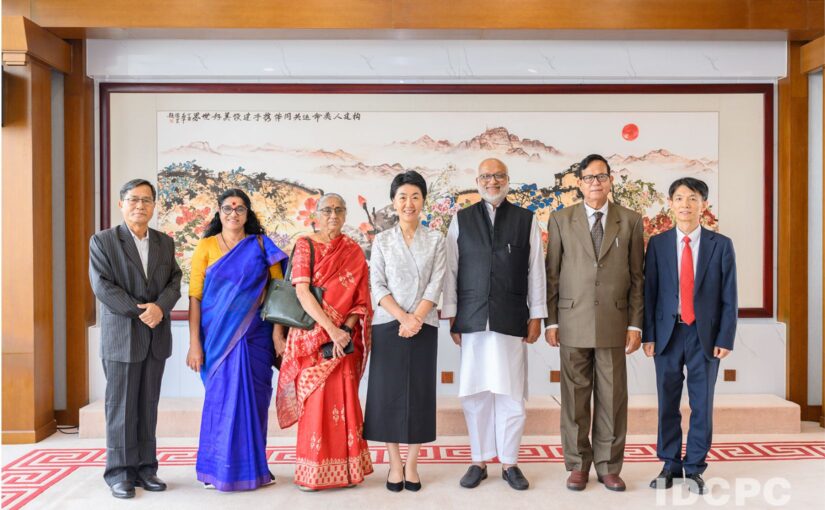
Between September 23-30, a six-person delegation from the Communist Party of India (Marxist) (CPIM), India’s biggest communist party, led by General Secretary MA Baby, visited China. Besides Beijing, the delegation visited the provinces of Hubei and Zhejiang.
Baby first visited China in 1985, but this was his first visit since he assumed the leadership of the party following the untimely death of Sitaram Yechury. He recounted the visit in two articles for People’s Democracy, the CPI(M)’s English language weekly. Indicating a key lesson that Indian communists have learned from their Chinese comrades, he writes:
“China lifted 800 million people above the poverty line as defined by the World Bank. Incidentally, it needs to be mentioned that taking inspiration from this example, and in an effort to address the material circumstances of the state, the CPI(M)-led Left Democratic Front government in Kerala has taken up a progressive initiative to eradicate extreme poverty. By November, Kerala will become the first Indian state to do so.”
He also marvelled at the Museum of the History of the Communist Party of China (CPC), opened in July 2021 to mark the party’s centenary:
“The museum is a prime example of how a nation’s and a party’s history can be presented using cutting-edge science and technology. In the museum, the story of the CPC’s century-long journey, from its formation to modern-day achievements, is presented with the help of digital and immersive tools.”
On the substantive business of the visit, Baby reports:
“Several bilateral discussions were held during the visit. The most prominent among them was the discussion with a delegation of the CPC leadership, led by their Polit Bureau member Li Shulei. That meeting reaffirmed the deep and long-standing ties between the CPC and the CPI(M). Both parties recognise that the US State, under President Donald Trump, is trying to impose a unipolar world under its dominance. ‘Countries of the South’ — developing nations — need to stand together to resist this. In this context, the Indian Prime Minister Narendra Modi’s participation in the Shanghai Cooperation Organisation’s (SCO) 2025 Summit in Tianjin was particularly taken note of.
“This year marks the 75th anniversary of the establishment of diplomatic ties between India and China. Beyond cooperation within the SCO, both countries are playing their roles within BRICS as well. In the coming years, India and China are both set to hold the BRICS chairmanship, taking turns. The discussions stressed that India and China must resolve the issues between them through dialogue. Improving India-China relations would not only benefit both countries but also contribute to global peace and progress. Therefore, both sides must make patient and focused efforts toward de-escalating tensions along the border. It is serendipitous that during our visit certain significant developments were taking place towards this, such as the resumption of direct flights between India and China.”
He also describes the delegation’s visit to the Chairman Mao Memorial Hall as “a deeply moving experience… The courage of the Chinese comrades who were led by Mao Zedong and others, is an everlasting source of inspiration for all those who hold the red flag high and fight for a world free from exploitation.”
Writing on the delegation’s visit to Zhejiang, a province that has produced companies such as Alibaba and DeepSeek, he notes:
“In China, the private sector operates under strong supervision of the public sector. Entrepreneurs are not only expected to generate employment and contribute taxes to the exchequer, but also to play an active role in advancing the nation’s overall development. The Chinese President and CPC’s General Secretary Xi Jinping emphasises that this approach corresponds to the specific conditions of socialism’s primary stage.”
The website of the CPC International Department (IDCPC) reported on the delegation’s September 25 meeting with its Vice Minister Sun Haiyan.
And on October 15, it reported her meeting with Annie Raja, a member of the National Secretariat of the Communist Party of India (CPI).
Sun said that China is willing to strengthen communication and exchanges with Indian political parties, including the CPI, to enhance political mutual trust and correct public understanding, and contribute to the continuous, healthy and stable development of bilateral relations.
Annie Raja warmly congratulated the CPC on leading China to achieve tremendous development achievements. She said, the CPI supports strengthening friendly cooperation between India and China, looks forward to maintaining close ties with the CPC, deepening exchanges and mutual learning, and contributing to the improvement and development of bilateral relations.
The following articles were originally published by People’s Democracy and the website of the IDCPC.
World Notes the Emergence of China
October 12 (People’s Democracy) – A delegation of the CPI(M) visited China at a time when both, the world and China, are experiencing extraordinary scenes. Our six-member team visited Beijing and the provinces of Hubei and Zhejiang, from September 23 to 30.
I first visited China forty years ago, in 1985, to participate in an international youth gathering. Returning again in the first decade of this century, the changes I witnessed were astonishing. The underground cultural complex at Beijing’s Tiananmen Square — National Center for the Performing Arts, the largest theatre complex in Asia, colloquially known as the Giant Egg – with its remarkable architectural finesse and spacious facilities capable of hosting four or five events simultaneously, showcased China’s capacity for innovation in infrastructure development and cultural vibrancy. During that visit, I merely walked around and observed the Centre. However, this time around, we could enjoy an exquisite violin-guitar music recital there.
2021 marked the centenary of the formation of the Communist Party of China (CPC). As part of the celebrations, a major public welfare program was implemented under CPC’s decision, drawing global attention. China lifted 800 million people above the poverty line as defined by the World Bank. Incidentally, it needs to be mentioned, that taking inspiration from this example, and in an effort to address the material circumstances of the state, the CPI(M)-led Left Democratic Front government in Kerala has taken up a progressive initiative to eradicate extreme poverty. By November, Kerala will become the first Indian state to do so.
In the centenary year, a Museum of the Communist Party of China was opened on July 15, in Beijing. The museum is a prime example of how a nation’s and a party’s history can be presented using cutting-edge science and technology. In the museum, the story of the CPC’s century-long journey, from its formation to modern-day achievements, is presented with the help of digital and immersive tools.
The CPC’s struggles to liberate the country from imperialist and colonial powers, as well as the strategic and tactical measures adopted across different periods, right from its inception, are illustrated. It highlights the leadership era of Mao Zedong, the alliance with Kuomintang, the split and struggles since 1927, the Long March, victory of the revolution through great sacrifices and struggles, the modernisation initiatives under Deng Xiaoping and later leadership by Jiang Zemin and Hu Jintao. It culminates in Xi Jinping’s current phase of leadership to the Party and the country since 2012.
The museum features 4,548 exhibits. Among these are Karl Marx’s Brussels notebook, the coat and cap worn by Mao Zedong when proclaiming the founding of the People’s Republic of China, Mao’s handwritten manuscripts, Chen Wangdao’s Chinese translation of the Communist Manifesto, belts used during the Long March, and the captured flag of the US Army’s 31st Infantry Regiment which was defeated by Chinese forces.
Several bilateral discussions were held during the visit. The most prominent among them was the discussion with a delegation of the CPC leadership, led by their Polit Bureau member Li Shulei. That meeting reaffirmed the deep and long-standing ties between the CPC and the CPI(M). Both parties recognise that the US State, under President Donald Trump, is trying to impose a unipolar world under its dominance. ‘Countries of the South’ — developing nations — need to stand together to resist this. In this context, the Indian Prime Minister Narendra Modi’s participation in the Shanghai Cooperation Organisation’s (SCO) 2025 Summit in Tianjin was particularly taken note of.
This year marks the 75th anniversary of the establishment of diplomatic ties between India and China. Beyond cooperation within the SCO, both countries are playing their roles within BRICS as well. In the coming years, India and China are both set to hold the BRICS chairmanship, taking turns. The discussions stressed that India and China must resolve the issues between them through dialogue. Improving India-China relations would not only benefit both countries but also contribute to global peace and progress. Therefore, both sides must make patient and focused efforts toward de-escalating tensions along the border. It is serendipitous that during our visit certain significant developments were taking place towards this, such as the resumption of direct flights between India and China.
When the US President Donald Trump is attacking and issuing threats to almost all nations around the globe through ‘Tariff Terrorism’, China was unflinching in its resistance and stood firm against it. It was based on the strength acquired by the Chinese economy and the CPC’s political vision. Apart from international relations, the discussions covered regional situation, where both India and China are major economies.
A memorable episode was our visit to the Mausoleum of Mao Zedong — where his embalmed body has been preserved without decay — to pay our respects. Scribbling down a few lines in the official visitor’s book there, on behalf of the CPI(M), was a deeply moving experience. The courage of the Chinese comrades who were led by Mao Zedong and others, is an everlasting source of inspiration for all those who hold the red flag high and fight for a world free from exploitation.
Strengthening the Party for the Advancement of China
October 19 (People’s Democracy) – Our visit to the province of Hubei province of China was very rewarding. The world’s largest hydroelectric project, the Three Gorges Dam, has been built on the Yangtze River in the Hubei province. Its primary goals are to prevent the floods that regularly trouble riverside communities, to generate electricity on a massive scale, and to facilitate the passage of large ships along the river, apart from other benefits. The astonishing sight of massive cargo vessels and passenger ships crossing the dam is a major attraction, drawing tourists from all corners of the globe. Widely regarded as an engineering marvel, the dam features an extraordinary ship lock and escalator system, which lifts vessels in stages across five levels from the lower to the upper side of the dam by raising the water level. Another remarkable achievement to be noted here was the smooth resettlement of about 10 lakh people displaced from areas converted to reservoirs, without significant grievances. We were able to visit some of these resettled villages and speak with the locals. After this enlightening and educational experience, we traveled by high-speed train to Wuhan, Hubei’s capital.
HISTORIC WUHAN
In Wuhan’s Wuchang district, the Central Peasant Movement Training Institute stands as testimony to historical revolutionary movements. It can be considered to be at par with the Museum of the Communist Party of China, in Beijing, opened to mark the centenary of the formation of the Communist Party of China (CPC). The only difference is that in Beijing, modern science and technology is made use of extensively. The Wuhan Revolution Museum, which is housed in a school building from the Qing dynasty, commemorates a defining moment in China’s revolutionary history. During the period of cooperation between the Communist Party and the Kuomintang, the institute was co-established by the two, while Comrade Mao Zedong served as Secretary of the CPC’s Farmers’ Committee. Training and education programmes were jointly conducted to prepare new cadre and develop the farmers’ movement. The center maintained strict discipline, with seven types of punishments for violations: warning, reprimand, standing motionless with a rifle, canceling Sunday holidays, compulsory physical labour, mandatory guard duty, and expulsion from study programmes and party membership. This shows how serious and disciplined the education and training programmes were in those days of revolutionary upsurge.
It was during this period that Mao Zedong wrote his renowned thesis, ‘Report on an Investigation of the Peasant Movement in Hunan’. Not far from there was the residence in which Mao lived, sometimes with his family, sometimes alone.
From April 27 to May 9, 1927, the historic Fifth Congress of the CPC was held nearby. Just weeks before the Congress, on April 12, the right-wing faction of the Kuomintang under the leadership of General Chiang Kai-shek and his National (Counter)-Revolutionary Army, had massacred around ten thousand comrades and Communist sympathisers in what became known as the Shanghai Massacre. This deepened the divide between the right wing and left wing within the Kuomintang. The Communist Party’s ensuing struggles against Kuomintang’s counter-revolutionary policies, marked by events such as the Long March, remain some of the most momentous chapters in the history of revolutionary movements the world over.
We also visited a State-owned, ultra-modern automobile exhibition center. Vehicles like the distinctive M-Hero 917 — a full-size luxury SUV — equipped with artificial intelligence, showcased China’s technological capability and excellence in this sector. It features independent steering on all four wheels and can accelerate rapidly within seconds. The fascinating experience of riding in a driverless car through a busy public street in Beijing also comes to mind now.
POVERTY ERADICATION
The final leg of our visit brought us to Zhejiang Province. Located near Shanghai and Jiangxi, Zhejiang is famed for entrepreneurs like Jack Ma and companies such as DeepSeek. Xi Jinping, current President of China and General Secretary of the CPC, served here as provincial secretary for five years from 2002 to 2007. While in office, he introduced the idea of Common Prosperity for discussion and eventual adoption within the Party.
We visited several centers that provide various public services to the people. One of the most notable among them was in Shangcheng district. Here, Party services, neighborhood services, government services, and public services are all provided efficiently and on time. In addition to availing services, people can also gather here to socialise and for leisure. The center offers everything from haircuts, tailoring, and umbrella mending to fixing household appliances — no service was unavailable there.
Our delegation also had the chance to directly understand the poverty eradication programmes, which are meticulously planned and implemented. Villages were developed into tourist destinations, improving the economic conditions of farmers and marginalised communities there. Similar diverse initiatives are implemented in various regions, tailored to local potential. The CPI(M)-led LDF government in Kerala too is trying to implement similar rural tourism development efforts.
ECONOMIC GROWTH
The Chinese economy is currently functioning as one of the principal engines of the world economy. A major factor behind this sustained prominence lies in the distinctive economic and political policies pursued by the country. In 2022, the year when the 20th Congress of the CPC was held, China’s Gross Domestic Product (GDP) stood at 114 trillion Yuan. By 2025, that figure had risen to 137.36 trillion Yuan. China holds the first position globally in grain production, and in manufacturing too China is in the forefront, underscoring its reputation as the ‘factory of the world’. China’s annual per capita income is 26,920 US dollars, while India’s is less than half of that, at around 11,000 US dollars.
Another factor that drives China’s advancement is its focus on education, especially in the fields of science and technology. Earlier, Germany was considered as a leader in innovation. But, according to a new global ranking of 139 economies published by the World Intellectual Property Organisation (WIPO), Germany is no longer among the ten most innovative countries in the world. China has displaced it, and this shift is a well-established trend. In 2023, China had 5 million patents in force — more than any other country. China’s patent activity grew by 18.5% compared to the previous year. China is now considered one of the world’s most innovative countries by volume, largely driven by state-backed investment in R&D.
In China, the private sector operates under strong supervision of the public sector. Entrepreneurs are not only expected to generate employment and contribute taxes to the exchequer, but also to play an active role in advancing the nation’s overall development. The Chinese President and CPC’s General Secretary Xi Jinping emphasises that this approach corresponds to the specific conditions of socialism’s primary stage. Significantly, even independent Marxist thinker David Harvey, who was once a critic of certain policies of China, has expressed considerable appreciation for these new directions.
As a Marxist–Leninist party, the CPC places emphasis on three main priorities. First, it strives to reduce economic disparities between regions and among citizens. Second, it seeks to firmly curb corruption within the government, the Party, and society at large. Third, it devotes focused attention to ecological balance and environmental protection. It has been declared that the robust interventions to tackle inequality will continue with renewed vigour in the forthcoming Fifteenth Five-Year Plan as well.
TWO-STEP STRATEGIC PLAN
As part of the CPC’s journey into its bicentenary, it has outlined a two-step strategic plan. The first phase, from 2020 to 2035, aims at achieving socialist modernisation. The second phase extends from 2035 to 2049 – marking the centenary of the founding of the People’s Republic of China — during which China seeks to become a great modern socialist nation. Ultimately, the vision is of a prosperous, powerful, democratic, culturally advanced, harmonious, and beautiful China.
The CPC has adopted extraordinarily strict corrective measures to combat corruption. When we visited China, the head of the Party’s International Department was under investigation for corruption charges and was consequently required to step down. On our return, we got to know that the allegations were substantiated, leading to disciplinary action against him. Between two Party Congresses, as a result of interventions by the Central Commission for Discipline Inspection, 74,000 individual party members at different levels were convicted of corruption. Since 2015, similar action has also been taken against businesses run by relatives of 4,700 individual party officials.
IMPROVING WORK, CONDUCT & DISCIPLINE
To improve work, conduct and discipline in both the Party and government, the Polit Bureau (PB) and the Central Committee (CC) have issued eight key directives:
- Conduct thorough research at the grassroots level to understand actual conditions.
- Ensure that meetings are well-prepared and efficiently organised.
- Write official documents and reports concisely and clearly.
- Follow standardised procedures for foreign visits.
- Strengthen security systems and improve engagement with the public.
- Enhance the quality and presentation of news reports.
- Enforce strict regulations on publishing articles.
- Maintain integrity and simplicity in Party and government affairs, avoid corruption and extravagance.
The Chinese Communist Party has also taken a firm stance against ostentatious lifestyles and public alcohol consumption. In the past, banquets hosted for delegations often featured wine or spirit offerings as part of the speeches and ceremonies. This practice has now been completely abolished. The CPC’s policy strongly discourages drinking habit, creating a favorable image of the Party among large segments of the populace. When discussing this with Chinese comrades, they remarked that widespread vodka addiction had also played a significant role in the Soviet Union’s decay and disintegration.
In his online address at the United Nations Climate Summit in New York, President Xi Jinping reaffirmed China’s sincere and active participation in collective efforts to combat climate change. Compared to many other nations, the urban and rural environments in China appeared distinctly improved — lush green cities and residential areas were visible everywhere. Cleanliness and hygiene also stood out as a defining feature. Public order was exemplary, and not even a single stray dog could be seen anywhere.
The rigorous Party education programme implemented in China was also a very informative experience. The progress that China has achieved in various fields of technology, industry, agriculture, infrastructure development and improving the life of the people in order to progress as a strong and harmoniously developed socialist country, by the time of the centenary celebration of the establishment of the People’s Republic of China in 2049, could be experienced in person.
The visiting delegation consisted of comrades Mohd. Salim, Jitendra Chaudhury, R. Arun Kumar, K. Hemalata and C. S. Sujatha. We were provided with excellent hospitality throughout. In short, the eight-day visit of the delegation helped us to strengthen bilateral relationship between the two countries, two people and two parties.
Sun Haiyan Meets with a Delegation of the CPI-M
Beijing, September 25th (IDCPC) – Sun Haiyan, Vice-minister of the International Department of the CPC Central Committee (IDCPC), met here today on the morning with a delegation of the Communist Party of India-Marxist (CPI-M) led by M.A. Baby, General Secretary of the CPI-M.
Sun welcomed General Secretary M.A. Baby and his delegation to visit China. She said, President Xi Jinping and Prime Minister Narendra Modi met during the 2025 Shanghai Cooperation Organization Summit and reached important consensus, charting the course for the improvement and development of bilateral relations. The CPC is willing to strengthen exchanges and cooperation with Indian political parties, including the CPI-M, to enhance mutual understanding and friendship between the two peoples and promote the sustained, sound and stable development of China-India relations.
M.A. Baby said, the CPI-M admires the great achievements of the CPC in governance and its successful experience in party building and state governance. It hopes to strengthen exchanges and mutual learning, and make positive contributions to promoting the development of bilateral relations and maintaining regional peace, stability and common prosperity.
Sun Haiyan Meets with Leader of the CPI
Beijing, October 15th (IDCPC) – Sun Haiyan, Vice-minister of the International Department of the CPC Central Committee (IDCPC), met here today with Annie Raja, a member of the National Secretariat of the Communist Party of India (CPI).
Sun said, President Xi Jinping and Prime Minister Narendra Modi have reached important consensus on bilateral relations, which has charted the course for promoting friendly and cooperative relations between the two countries. China is willing to strengthen communication and exchanges with Indian political parties, including the CPI, to enhance political mutual trust and correct public understanding, and contribute to the continuous, healthy and stable development of bilateral relations.
Annie Raja warmly congratulated the CPC on leading China to achieve tremendous development achievements. She said, the CPI supports strengthening friendly cooperation between India and China, looks forward to maintaining close ties with the CPC, deepening exchanges and mutual learning, and contributing to the improvement and development of bilateral relations.






One thought on “Indian communists visit China”