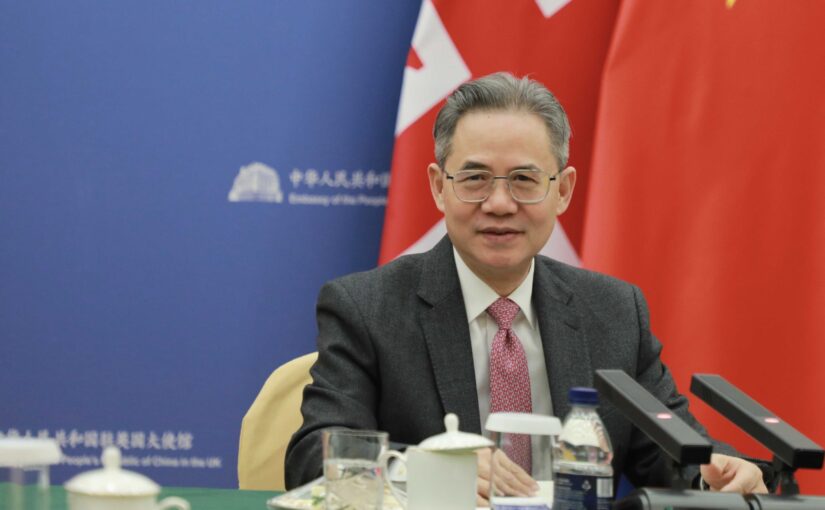
The Chinese Embassy in London hosted a symposium on March 19 for Ambassador Zheng Zeguang to brief on the recently concluded annual ‘Two Sessions’ – of the National People’s Congress (NPC) and the Chinese People’s Political Consultative Conference (CPPCC) – held in Beijing, which he had attended as a CPPCC member, and to exchange views in this regard with British friends from various walks of life.
He began, however, with remarks concerning current events in West Asia, which he correctly noted is an issue with which everyone is concerned. The US-Israeli war of aggression against Iran is, he noted, a war that should never happened and Iran had been attacked while negotiations were ongoing; it is a war that does no good to anyone, that had no authorisation from the UN, and that violates international law.
The Ambassador further outlined the ongoing diplomatic efforts to restore peace being undertaken by Foreign Minister Wang Yi as well as by Zhai Jun, special envoy of the Chinese government on the Middle East issue, who was still in the region at time of speaking.
Ambassador Zheng noted that the Two Sessions reviewed and adopted the Government Work Report and the Outline of the 15th Five-Year Plan, setting key priorities for China’s economic and social development in 2026, and providing top-level design for development over the next five years.
They are, he explained, a vivid example of whole-process people’s democracy under the leadership of the Communist Party of China. During the Two Sessions, deputies to the National People’s Congress and members of the National Committee of the Chinese People’s Political Consultative Conference gather in Beijing to deliberate on state affairs. Both the Government Work Report and the Outline of the 15th Five-Year Plan were formulated after extensive consultation with all sectors of society, bringing together the broadest possible wisdom and consensus, and reflecting the shared will of the Chinese people.
Ambassador Zheng identified the scientific formulation and implementation of Five-Year Plans as an important governance experience of the Party and a distinctive political advantage of socialism with Chinese characteristics. Through successive Five-Year Plans, China has worked with perseverance to translate its blueprint into reality, creating the twin miracles of rapid economic growth and long-term social stability. By implementing the 15th Five-Year Plan, China will continue to write new chapters in these two miracles and provide stability and positive energy to the world.
He also pointed out that the world is undergoing growing transformation and volatility. Unilateralism and acts of bullying are on the rise, regional conflicts persist, and the international order is facing serious challenges. The more turbulent the world becomes, the greater the need to promote dialogue and cooperation. China always stands on the side of international fairness and justice and on the right side of history. China stands ready to strengthen cooperation with all countries in implementing the Global Development Initiative, the Global Security Initiative, the Global Civilisation Initiative, and the Global Governance Initiative, with a view to a community with a shared future for humanity.
Following the Ambassador’s keynote report, remarks were made in the following order:
- Alex Gordon, General Secretary of the Communist Party of Britain (CPB)
- Andy Brooks, General Secretary of the New Communist Party of Britain (NCP)
- Joti Brar, Chair of the Communist Party of Great Britain (Marxist-Leninist) (CPGBML)
- Stephen Perry, Honorary President of the 48 Group
- Keith Bennett, Co-editor of Friends of Socialist China
- Sir Vince Cable, former Leader of the Liberal Democrats and former Secretary of State for Business, Innovation and Skills and former President of the Board of Trade
- Martin Jacques, visiting Professor at Chinese universities and author of the best-selling ‘When China Rules the World: The End of the Western World and the Birth of a New Global Order’
- Martin Albrow, Fellow of the British Academy of Social Sciences and former President of the British Sociological Association
- Oliver Shiell, Co-Founder and Chief Executive of the UK National Committee on China
- Carlos Martinez, Co-editor of Friends of Socialist China
- Robert Griffiths, former General Secretary of the CPB
- Daniel O’Brien, Vice Chair of the CPGBML
- Francisco Dominguez, Britain Committee member of Friends of Socialist China
- Wang Zilan, Director of Cam Rivers Publishing Company
The symposium was moderated by Minister Zhao Fei from the embassy.
We reprint below the report that was originally published on the website of the Chinese Embassy in London followed by the contributions made to the discussion by Keith, Carlos and Francisco.
The Chinese Embassy in the UK Holds Symposium to Present the Key Messages of the Two Sessions
On 19 March 2026, the Chinese Embassy in the UK hosted a symposium to present the key messages of China’s Two Sessions. Chinese Ambassador to the UK Zheng Zeguang delivered a keynote speech. Participants from the UK’s political, business and academic circles joined the discussions.
Ambassador Zheng said that this year’s Two Sessions hold special significance. The Two Sessions reviewed and adopted the Government Work Report and the Outline of the 15th Five-Year Plan, setting key priorities for China’s economic and social development in 2026, and providing top-level design for development over the next five years. In 2026, the opening year of the 15th Five-Year Plan period, China will focus on the targets set in the Government Work Report and make solid progress in key tasks, including building a strong domestic market, fostering new growth drivers, achieving greater self-reliance and strength in science and technology, deepening reform in key areas, expanding high-standard opening up, taking stronger measures to ensure and improve the people’s well-being, and accelerating the green transition, thus ensuring a good start to the implementation of the Plan.
Ambassador Zheng noted that the Two Sessions are a vivid example of whole-process people’s democracy under the leadership of the Communist Party of China. During the Two Sessions, deputies to the National People’s Congress and members of the National Committee of the Chinese People’s Political Consultative Conference gather in Beijing to deliberate on state affairs. Both the Government Work Report and the Outline of the 15th Five-Year Plan were formulated after extensive consultation with all sectors of society, bringing together the broadest possible wisdom and consensus, and reflecting the shared will of the Chinese people.
Ambassador Zheng identified the scientific formulation and implementation of Five-Year Plans as an important governance experience of the Party and a distinctive political advantage of socialism with Chinese characteristics. Through successive Five-Year Plans, China has worked with perseverance to translate its blueprint into reality, creating the twin miracles of rapid economic growth and long-term social stability. By implementing the 15th Five-Year Plan, China will continue to write new chapters in these two miracles and provide stability and positive energy to the world.
Ambassador Zheng pointed out that the world is undergoing growing transformation and volatility. Unilateralism and acts of bullying are on the rise, regional conflicts persist, and the international order is facing serious challenges. The more turbulent the world becomes, the greater the need to promote dialogue and cooperation. China always stands on the side of international fairness and justice and on the right side of history. China stands ready to strengthen cooperation with all countries in implementing the Global Development Initiative, the Global Security Initiative, the Global Civilization Initiative, and the Global Governance Initiative, with a view to a community with a shared future for humanity.
Ambassador Zheng highlighted that the implementation of the 15th Five-Year Plan will bring new opportunities for the development of other countries and open up new prospects for China-UK cooperation. China will work with the UK in the same direction to follow through on the important common understandings reached between the leaders of the two countries and the outcomes of Prime Minister Keir Starmer’s visit to China. It is important that China and the UK strengthen exchanges at all levels, expand practical cooperation, properly manage differences, and continue to enrich the long-term and consistent comprehensive strategic partnership, in order to deliver greater benefits to the two peoples and make due contributions to world peace, stability and prosperity.
The British participants congratulated China on the important outcomes of the Two Sessions. They held the view that the 15th Five-Year Plan will bring more opportunities for the development of countries around the world, and that the formulation and implementation of Five-Year Plans is a valuable experience for other countries. The world is undergoing profound changes unseen in a century. China’s efforts to promote peace talks in regional conflicts, including in the Middle East, are acts of justice. By championing true multilateralism and a community with a shared future for humanity, China has demonstrated the responsibility of a major country. They expressed their readiness to continue working actively for greater mutual understanding between the British and Chinese peoples and for the steady development of bilateral relations.
Remarks by Keith Bennett
Your Excellency Ambassador Zheng Zeguang
Colleagues and Friends
First, on behalf of Friends of Socialist China, I’d like to thank you for your kind invitation to this important symposium.
We have heard a comprehensive and thorough exposition of this year’s Two Sessions and their significance from the Ambassador as well as enlightening insights from other friends in their contributions to our deliberations.
In the few minutes at my disposal, I’d like to make some observations on China’s growth trajectory and situate these in the comparative framework of the situation facing us in our own country.
As we have heard and read, China’s GDP growth rate last year was 5%. And the target set for 2026, the first year of the 15th Five Year Plan, is within the range of 4.5-5%.
Predictably, this has given a fresh impetus to the ‘China collapse’ industry. Perhaps one of the few growth industries still left in the West, its share price boosted by an appropriate front cover of the Economist, about once every four months on average.
Thus, on 5 March, the BBC reported:
“China has cut its annual economic growth target to a range of 4.5%-5%, the lowest expansion goal since 1991 as it grapples with challenges both at home and abroad.
“Beijing aims to reshape its economy as it faces issues like weak consumption, a shrinking population, an ongoing property crisis, global trade tensions and an energy crunch due to the Iran war.”
I feel pretty confident in asserting that one could find an equivalent quote for any year over the last three or more decades.
And the BBC is at the relatively sober end of the scale.
After all, we still have one Gordon Chang presented to us as a China expert. The man who wrote in the introduction to his book, ‘The Coming Collapse of China’, published in 2001:
“The end of the modern Chinese state is near. The People’s Republic has five years, perhaps ten, before it falls.”
Ten years later he acknowledged that his timing had been out – but only by one year.
He is scheduled to make doubtless the same prediction, yet again, as a renowned expert, at the Conservative Political Action Conference (CPAC) in Texas next week.
Looking more seriously at China’s growth and the targets set it is true of course that the years of stellar annual growth in double figures now lie in China’s past.
There are many reasons for this, but I think two of the most important are first that the more an economy grows in size, the more it becomes both more difficult and less necessary to attain high rates of growth, not least in terms of measuring the actual amount of growth in absolute terms.
Secondly, relatedly and above all more profoundly, as President Xi Jinping has repeatedly made clear, the new stage of China’s development does not principally rest on absolute growth but rather on green and sustainable growth, the growth of new high quality productive forces, on enhancing self-reliance, not least in innovation and R&D, and on meeting the increasing needs and aspirations of the majority of the people.
But in assessing China’s growth and the prospects for its economy, it is not inappropriate, not least given the claims and assertions of our media and the observations of many so-called experts, to make some comparison with our own situation.
After all, the British Prime Minister’s website declares:
“Economic growth is the number one mission of the government. Growth will fund our public services, enable investment in our hospitals and schools, and, most importantly, raise living standards for everyone.”
So, how do we compare?
On February 2, EY predicted that UK growth in 2026 would be 0.9%.
On December 30, 2025, PwC put it at 1.2%.
While, on December 1, 2025, KPMG had put it at 1%.
On February 12, the Office of National Statistics reported that the growth rate for Q4 2025 had been 0.1%.
As already mentioned, the more an economy grows, the more one can expect the rate of growth to decline.
However, Georank figures, updated on January 3 this year, list China as the world’s second-largest economy, with a total value of $18.7 trillion. And the UK as the sixth-largest, with a total value of $3.69 trillion.
Perhaps we should, therefore, be a bit less disparaging of China’s achievements and prospects and a bit more modest regarding our own.
Perhaps we should even concede that we have something to learn from China.
It must also be pointed out that all the above projections for UK economic growth predate the February 28 unprovoked launch of the brutal US-Israeli war of aggression against Iran. A war that is already wreaking havoc on the global economy.
The full impact of this on the UK’s prospects remains to be assessed but can only be negative.
After all, a 28 October 2025 press release from HM Treasury stated:
“British business and jobs are set to benefit from a £6.4 billion boost after Chancellor Rachel Reeves helped secure a major two-way trade and investment package during a landmark visit to Saudi Arabia.
“Deepening ties between the two countries in this way will open up more opportunities for businesses, create new jobs and kickstart economic growth that will boost living standards for British people.”
Reeves herself was quoted as saying: “The £6.4 billion package of new two-way trade, business, and investment commitments will turbocharge business opportunity and create thousands of jobs at home – key ingredients for kickstarting economic growth.”
Perhaps not so much now.
What we can see from the calm and measured confidence represented by China’s Two Sessions on the one hand, and our flailing and stumbling from one crisis to another on the other hand, is the veracity and farsightedness of these two observations by Deng Xiaoping, the first from November 1979 and the second from June 1984.
“We believe that socialism is superior to capitalism. This superiority should be demonstrated in that socialism provides more favourable conditions for expanding the productive forces than capitalism does.”
“The fundamental task for the socialist stage is to develop the productive forces. The superiority of the socialist system is demonstrated, in the final analysis, by faster and greater development of those forces than under the capitalist system.”
Thank you for your attention.
Remarks by Carlos Martinez
I would like to begin by thanking His Excellency Ambassador Zheng Zeguang for his informative and inspiring presentation on the Two Sessions, and especially for his detailed remarks about the 15th Five-Year Plan, which is a remarkable document. Its key themes — innovation, sustainability, self-reliance and people-centred development — represent not merely a set of policy priorities but a coherent and ambitious vision of what a modern socialist society can look like.
The plan commits to deep investment across the full spectrum of human development: science and technology, education, healthcare, social welfare, green energy and infrastructure. It targets the frontiers of the coming era — artificial intelligence, quantum computing, robotics, 6G networks, brain-computer interfaces, new energy systems — while simultaneously attending to the everyday needs of ordinary people through integrated urban-rural development, improved public services and a serious programme of green transition.
It is important to understand that the Five-Year Plan does not exist in isolation. China plans on multiple timescales simultaneously, and the 15th Plan is a single step on a much longer journey. By 2035, China aims to have basically achieved socialist modernisation — with per-capita GDP on a par with moderately developed countries, a world-leading science and technology sector, and equitable access to public services for all citizens. By 2049, the centenary of the founding of the People’s Republic, the goal is to have built a great modern socialist country: prosperous, strong, democratic, culturally advanced, harmonious and beautiful.
This kind of long-range, multi-generational planning is itself a profound expression of socialist governance — and stands in the sharpest possible contrast to the short-termism that paralyses political life in the West, where the horizon rarely extends beyond the next electoral cycle or quarterly report.
We must also retain a historical perspective. When the People’s Republic was founded in 1949, China was emerging from a century of humiliation — impoverished, colonised, torn apart by war, and profoundly backward in science and technology. In the decades since, it has been transformed beyond recognition. Today, China is a global leader in renewable energy, electric vehicles, forestation and pollution control. It has lifted hundreds of millions of people out of poverty. It has become one of the world’s foremost centres of scientific innovation. And it has achieved all of this within a framework of peaceful development — without colonies, without overseas military bases, without wars of aggression.
No capitalist country has ever achieved a comparable level of development without recourse to colonialism, imperialism and the violent plunder of other peoples. This, as Deng Xiaoping said more than four decades ago, is how the superiority of socialism ultimately demonstrates itself — through faster and greater development of the productive forces.
And yet we must be clear-eyed about the world in which this development is taking place. Xi Jinping speaks often of “changes unseen in a century”, and those changes include two sharply diverging roads. On one road: the United States and its allies, mired in economic stagnation and political dysfunction, increasingly abandoning even the pretence of an international rules-based order, and resorting instead to military adventurism, unilateral sanctions, tariff wars and outright criminality. We have seen this with devastating clarity in recent weeks and months — from the invasion of Caracas and the kidnapping of President Maduro, to the US-Israeli war of aggression against Iran.
On the other road: China’s ambitious, peaceful, people-centred vision of modernisation — extending its hand to the Global South, building infrastructure rather than military bases, offering partnership rather than coercion.
These two trajectories are not simply parallel lines. They exist in a unity of opposites, interacting and colliding in complex ways, as the old order resists the emergence of the new.
Mao Zedong once spoke of an East wind and a West wind. Today, the East wind is the wind of multipolarity, peace, people-centred development, socialism and ecological civilisation. The West wind is the wind of war, unilateralism, inequality, decadence and environmental destruction. With China’s leadership, and with the inspiring example of socialist construction that the 15th Five-Year Plan embodies, let us work together — and let the East wind prevail over the West wind.
Remarks by Francisco Dominguez
Thank you very much Your Excellency Ambassador Zheng Zeguang, for inviting me to this important meeting and for your comprehensive report on the results of the 14th Five-year Plan of the People’s Republic of China and your outline of the !5th Plan.
My first observation is the impressive level of sophistication of the CPC to navigate the complexities involved in the period of socialist transition through 14 Five-Year Plans that have brought about a much better society. The complexities are associated with the combination of Plan and Market, so successful that China has performed an achievement unaparalelled in the history of humanity, namely, high levels of modernisation (socially, economically, technologically and environmentally) with no colonies in a historically very short period of time: less than a century. In contrast, economically advanced Western societies, did so in at least four centuries through colonialist exploitation, military domination, and the pillage of the Global South’s natural resources.
My second observation is about the global moral projection of the Chinese Revolution that manifests itself in the building of a multipolar world through multilateral institutions (BRICS, BRI, SCO, etc.) that preferentially and systematically benefits the Global South.
I will end by asking a question. The decline and aggressiveness of the United States through its efforts to stop and roll back multipolarity through unilateralism, coercive measures and military aggression, is the defining crisis issue in today’s world. This crisis manifests itself in the US aggression in the Western Hemisphere (against Venezuela, Cuba and other Latin American countries) and in the current war against Iran in the Middle East. So, what initiatives can China undertake to reduce the existing tensions that may contribute to the peaceful solution of these crises?