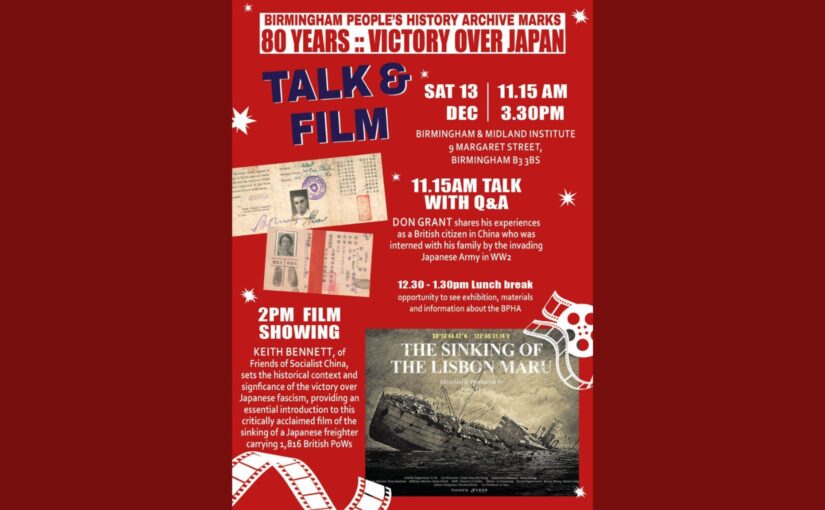
The Birmingham People’s History Archive (BPHA) organised a day of speeches and film on Saturday December 13 to mark the 80th anniversary of the victory over Japanese fascism.
Held in the Birmingham and Midland Institute, which houses the archive, it was attended by over 50 people, including academics, trades unionists and members of the city’s Asian community. The day’s proceedings were chaired by Pete Higgins, a trustee of the archive, who first welcomed BPHA patron Andy Hudd, who is also Vice President of the train driver’s union ASLEF, to make opening remarks.
Pete then facilitated a fascinating conversation with Don Grant. Don is a mentally and physically agile 97-year-old who held the audience enthralled and spellbound with his at times harrowing, but always matter-of-fact account of life as a teenage prisoner of the Japanese in 1940s China.
Don was born in Shanghai in 1928. His father had first moved to China to work in 1910, having previously been a fireman on the railways, and returned to Shanghai in 1919, following service in World War I.
To give a small flavour of his account:
“It was while at the playing fields that I witnessed another awful event. It was in the summer of 1941 … They ringed the city and controlled the amount and flow of rice allowed in … A number of people had been caught by a Jap patrol including men, women and several children, and were being herded along by the soldiers with their rifles, but one poor fellow was being dragged along with his hands tied behind him and a rope around his neck … Then one of the soldiers took a trenching tool and went behind the mound where the man lay and killed him, the rest were led away and later their bodies were laid in the road on our side of the boundary. All of them were shot as a warning to others…
“We witnessed on many occasions small columns of similar groups … who had managed to cross the line only to be shot openly in the street by the Kempetei [Japanese Gestapo].”
BPHA hopes to publish Don’s full memoir in 2026 and are seeking support to help make this possible. It is an entirely voluntary organisation and you can email birminghampha@gmail.com if you’d like to help.
Following a ‘Birmingham seasonal’ lunch of samosas and mulled wine, Keith Bennett, on behalf of Friends of Socialist China, delivered a talk highlighting some key aspects of the war against Japanese militarism.
First picking up on a point made by Don, he noted that December 13 was the 88th anniversary of the start of the Nanjing Massacre, as well as China’s 12th National Memorial Day. In the course of just six weeks the Japanese slaughtered some 300,000 civilians in that city. In a long period of world war marked by countless atrocities this stands out as one of the most egregious.
He noted that the Second World War did not begin in 1939 in Europe but in 1931 in China and highlighted the key roles played by the Chinese people, led by the Communist Party, as well as by the Soviet Union.
Keith said that “had not the Chinese people tied down millions of Japanese troops, thereby preventing them from opening up a second front against the USSR, the consequences could well have been calamitous, and not least for Western Europe and for this country as well.
“In other words, when we faced the most existential threat to our country and people, China and Russia, and their peoples, were not our enemies. They were our indispensable, vital, sincere, loyal and good friends, allies and comrades-in-arms,” adding that, “we absolutely cannot separate the march to war against the very countries that saved us from fascism from the march towards fascism here and in almost all the imperialist countries.”
Finally, he introduced the film, ‘The Sinking of the Lisbon Maru’, which depicts the heroism of a Chinese fishing community who risked everything to rescue British POWs, who had been left to drown by the Japanese.
Keith was followed by Philip Harris, from the Lisbon Maru Memorial Association. Philip’s father-in-law was among the rescued POWs and was sheltered and cared for by Chinese fishermen and their families for three months.
After he left the army, Philip’s father-in-law became a post man. Having been denied the award due to him for long service on a technicality, the local council then took away his beloved allotment, whereupon he became the gardener and porter for his local community hospital. He died from pancreatic cancer three days after his retirement party.
Interestingly, Don Grant’s story also served to illustrate the ruling class contempt for working class people. When he and his family were finally released from internment and repatriated to Britain they were presented with a bill for their Red Cross parcels.
The event concluded with a showing of ‘The Sinking of the Lisbon Maru’, followed by a social.
The media were represented by China’s CCTV television and BBC Midlands Today television.
The following is the text of Keith’s speech.
I’d like to thank the Birmingham People’s History Archive for organising this important event and for inviting me. It’s an honour to be here.
I want first to pick up on a point that Don made during the Q&A part of his presentation. He referred to the book, ‘The Rape of Nanking’ and to the terrible atrocity committed by the Japanese in that city.
Today is the 88th anniversary of the start of the Nanjing Massacre. And it is also China’s 12th National Memorial Day established in that connection. In the course of just six weeks the Japanese slaughtered some 300,000 civilians in that city. In a long period of world war marked by countless atrocities this stands out as one of the most egregious. There are now just 24 recognised survivors and sadly the laws of nature dictate that they grow fewer with each passing year.
Earlier this year the Chinese feature film, ‘Dead to Rights’ was released, depicting the massacre. It is beyond doubt the most emotionally traumatic film I have ever watched. But it needs to be seen not least to help prevent such crimes from occurring in the future – something that grows more urgent with each passing day.
On May 8, 1945, people in Britain celebrated VE Day. Six years of all-out war in Europe against Nazi and fascist tyranny had come to a victorious conclusion.
But whilst the nation struggled with a collective hangover the next day, it did so with the knowledge that the war in East and Southeast Asia, and in the Pacific, continued. And, at that point, nobody could be sure for how long.
Given the circumstances of the time, the war in the East may have seemed remote to many. But not to those whose loved ones were fighting in Burma or elsewhere or worse still were enduring the dreadful cruelty that characterised being a Japanese Prisoner of War, as Don has so graphically outlined.
While, as events transpired, the war in Asia-Pacific was to last just a few more months – due not least to the decisive intervention of the Soviet Red Army rather than to the criminal bombing of Hiroshima and Nagasaki – this does serve to underline that the world anti-fascist war began first in the East, specifically in China, and that it lasted the longest.
Conventional British history would have us believe that the war began on September 3, 1939. Although it may not have seemed that way to the peoples of Spain, whose courageous fight against fascism began in 1936. Or to the people of Ethiopia – their country invaded by fascist Italy the previous year.
But the Chinese people’s war of resistance against Japanese aggression began in 1931, after Japan rigged up the puppet state of Manchukuo in northeast China.
This in turn became a nationwide war of resistance in 1937, with the Marco Polo Bridge Incident heralding Japan’s all out invasion.
At that time, while progressive people around the world rallied to the support of China, the only state to take a clear stand in support of the Chinese people’s resistance was the USSR. And this clearly impacted on the entire geopolitical pattern in the region.
The Soviet contribution to the defeat of Japanese militarism did not begin with the declaration of war on August 8, 1945, the date agreed between the USSR, the United States and Britain at Yalta.
A key front was opened more than ten years previously in the Mongolian People’s Republic, with hundreds of clashes on the border with the so-called Manchukuo starting from January 1935.
As tensions mounted, it clearly became a matter of when not if a major confrontation would take place between Soviet and Japanese forces in or adjacent to Mongolia. The stakes would be high. A decisive Soviet defeat would likely prompt a full-scale Japanese invasion of the Soviet Union, with the equal likelihood that this would prompt a further attack on the Soviet Union from the West, whereas a decisive Soviet victory would contain the Japanese threat for a considerable period and allow the Soviet Union relative freedom to devote its attentions to preparing to meet an attack from the West.
That major confrontation was to take place from May to September 1939. Known as the Battle of Khalkhin Gol, after the river of the same name, this little-known conflict actually deserves to be known as a key battle that shaped the entire subsequent course of the Second World War.
Just one day after the Red Army forces, commanded by Marshal Zhukov, won a decisive victory in Mongolia, Hitler invaded Poland.
One western military historian has described the significance of the Battle of Khalkhin Gol as follows:
“Although this engagement is little-known in the West, it had profound implications on the conduct of World War II. It may be said to be the first decisive battle of World War II, because it determined that the two principal Axis powers, Germany and Japan, would never geographically link up their areas of control through Russia… The Japanese would never make an offensive movement towards Russia again.”
Two factors were crucial in this. Besides the clear-cut Soviet victory at Khalkin Gol, what must be acknowledged above all is the Chinese people’s heroic resistance. Alongside the Great Patriotic War of the Soviet peoples, it was the Chinese people who shouldered the greatest burden and made the greatest national sacrifice in the world people’s struggle against fascism.
It was with the strong leadership of the Communist Party of China, which called for nationwide resistance by the whole Chinese nation and people first and most consistently, and with a national united front that would not have been created or sustained without the party’s consistent, persevering, skillful, tenacious and self-sacrificing efforts, that, in the words of former Chinese leader Hu Jintao: “For a long time, we Chinese contained and pinned down the main forces of Japanese militarism in the China theatre and annihilated more than 1.5 million Japanese troops. This played a decisive role in the total defeat of the Japanese aggressors. The war of resistance lent a strategic support to battles of China’s allies, assisted the strategic operations in the Europe and Pacific theatres, and restrained and disrupted the attempt of Japanese, German and Italian fascists to coordinate their strategic operations.”
Of course, within the overall context of the anti-fascist war, different forces had different class natures and hence different war aims and strategies.
Hence, just as bourgeois governments in Europe, from France to Norway to Greece, folded in the face of Nazi aggression, so supposed British colonial strongholds and fortresses, like Hong Kong and Singapore, fell to the advancing Japanese forces like skittles in a bowling alley.
Throughout the region, it was the communists and the communist-led forces who led the resistance, fighting a protracted people’s war, tying down the Japanese Imperial Army, surrounding them and ultimately defeating them. In China, Korea, Vietnam, Burma, Malaya, Indonesia, the Philippines and elsewhere.
Viewed in this light we can understand – although the western powers and western media either could not or would not – why, on the rostrum of Beijing’s Tienanmen Square, on the 80th anniversary of the September 3rd victory, President Xi Jinping was flanked by Russia’s Vladimir Putin and the Democratic People’s Republic of Korea’s Kim Jong Un, whose grandfather had fought the Japanese in north east China alongside his Chinese comrades, joined by 24 other heads of state or government as well as senior leaders from many more countries.
That the leaders of the United States, Britain and the other imperialist powers chose to absent themselves not only shows who truly carried the main burden of the anti-fascist struggle but also who remains committed to upholding the truth and a correct understanding of World War II and its outcome and hence to standing against fascism and war today. And, of course, the same might be said of the western boycott of the Moscow victory commemoration in May.
As I indicated at the start of my remarks, the war in Europe was all too obvious to every person in Britain. If nothing else, Hitler’s Luftwaffe had seen to that. But the war in the East – less so.
But there were of course exceptions.
There were those who had organised to support the Chinese people and to boycott Japanese goods, right from when Japan had launched its all-out war of aggression, and who were mainly organised by the China Campaign Committee, which campaigned the length and breadth of the country, supported principally by the Communist Party, but uniting all who could be united from every walk of life.
And, as mentioned, there were those whose loved ones – sons, grandsons, brothers, husbands, fiancés – were fighting in the Far East or held as PoWs or slave labourers.
Such freedoms as we still enjoy in Britain today, we owe to those often-forgotten heroes, but also to all the peoples who united to fight fascism and for liberty and democracy, and above all to the Chinese and Soviet peoples, who gave tens of millions of lives.
Winston Churchill, no lover of socialism to put it mildly, acknowledged that it was the Red Army that, in his own words, tore the guts out of the Nazi war machine.
And had not the Chinese people tied down millions of Japanese troops, thereby preventing them from opening up a second front against the USSR, the consequences could well have been calamitous, and not least for Western Europe and for this country as well.
In other words, when we faced the most existential threat to our country and people, China and Russia, and their peoples, were not our enemies. They were our indispensable, vital, sincere, loyal and good friends, allies and comrades-in-arms.
This is something we have to remember.
Today, China has stood up, her people are becoming moderately well off and the country is becoming strong.
China is the world’s second biggest economy and the largest trading partner of three quarters of the world’s countries. It is a hub of scientific and technological innovation.
Britain, China and Russia all have so much positive to offer each other. In science, technology, education, culture, sports, mutually beneficial business, investment and trade, and so on.
But far from their remembering who were our real friends and allies when we needed them most, we have a political class, across Labour, the Conservatives, Liberal Democrats, Reform, and even sections of the Scottish National Party, who have turned this on its head.
We are living in a time of madness. Dangerous madness:
- A time when we are perhaps just one more dangerously irresponsible provocation against Russia away from a terrible war. When sections of the British ruling class effectively claim that we are already at war with Russia. If we look at the events of just the last week, we’ve had the latest instalment of the Skripal political pantomime; the three stooges, Starmer, Macron and Merz, huddling in Downing Street with Zelensky, the world’s only beggar to commute by private jet, frantically plotting to derail the peace process in Ukraine and prolong the bloodshed; Yvette Cooper, the latest imbecilic occupant of the post of Foreign Secretary, claiming that we are “under attack from Putin’s cyber army”; and then Starmer announcing the death of a serving member of the British armed forces in Ukraine. Do you remember it being democratically debated and decided that we would put boots on the ground in Ukraine? No, neither do I.
- A time when normally faceless spooks break cover to tell us that we must be prepared to shortly be at war simultaneously with Russia, China and Iran. And rather than then say, ‘what can we possibly do to prevent this and ensure peace’, say ‘bring it on’, like children in a nuclear playground.
- A time when the liberators of Auschwitz are banned from commemorating the anniversary while the chief perpetrator of today’s holocaust in Gaza gets a waiver from his International Criminal Court arrest warrant to be an honoured guest.
- A time when John Healey, our hitherto unknown Defence Secretary, can go to Australia and say that Britain and Australia will fight China together over Taiwan. Without even thinking or bothering to consult with the Australian government before dropping this almost literal bombshell.
- A time when some non-entity of a Labour MP in this city calls for the reintroduction of conscription. And anyone who thinks this is just an idle threat should look at what’s happening today in Germany. Fortunately, the German youth are coming out in their thousands to protest this militarist madness.
- A time when Mark Rutte, an unimpressive former Dutch Prime Minister, who evidently feels no sense of embarrassment or shame in addressing Donald Trump as Daddy, now hopelessly over-promoted to the post of Secretary General of NATO, can say this week, in Berlin of all cities, that we must be prepared for conflict with Russia, “on the scale of war our grandparents and great-grandparents endured”.
- And a time when Rutte’s blood-curdling remarks were promptly echoed by Al Carns, Armed Forces Minister and another MP for this city, who warned us that the UK is rapidly developing plans to prepare the whole country for the possible outbreak of war.
And we absolutely cannot separate the march to war against the very countries that saved us from fascism from the march towards fascism here and in almost all the imperialist countries.
The generation that fought fascism, the grandparents and great-grandparents who Rutte so wickedly invokes, did not do so in order that their descendants could be plunged into a third, quite possibly final, world war. They did not do so in order that thousands of people, many of them in their 80s or even 90s, retired vicars and magistrates, blind, leaning on walking sticks, or in wheelchairs, could be arrested as terrorists for peacefully holding seven-word placards expressing opposition to genocide. They did not do so in order that a Labour government could, barring a dramatic development, sit back and allow their heroic great grandchildren to die on hunger strike as they are effectively interned without trial for the crime of opposing today’s Palestinian holocaust. They did not do so in order that a seven-times elected member of parliament, one of this country’s most well-known political figures, should effectively be forced into exile to protect himself and his family.
However, if the British state forgets how we fought fascism together with China and Russia – China and Russia do not. No matter the state of relations at government level at any particular time.
Despite all the restrictions placed on their lives and work here, especially in the most recent period, Russian diplomats go as far as the north of Scotland to remember the heroic members of the Arctic Convoys who brought much needed aid to Murmansk.
China’s 80th victory celebrations may have been boycotted by the British government but family members of people who helped China in the war years were there as honoured guests, including the relatives of George Hogg, who died aged just 30, just weeks before the war victory, having given the last seven years of his tragically short life to the cause of the Chinese people’s liberation. Despite being played by Jonathan Rhys Meyers in a 2008 feature film, Hogg is almost completely unknown in Britain, except perhaps at St. George’s, the school he attended in Harpenden, and where he was head boy. He is, however, a national hero in China.
And that brings me to the film we are about to see. The story of the Lisbon Maru is again almost unknown in Britain. But it was President Xi Jinping who replied personally to Ms Denise Wynne, an ordinary English lady, who happens to be the daughter of Dennis Morley, who became the last of the Lisbon Maru survivors, after she wrote to him, conveying her late father’s wish that a memorial be erected in China to honour the fishermen who had risked their lives to rescue him and his comrades.
I could quote much about this from the website of the Chinese Embassy or the Chinese media, but instead I’ll quote from an all too rare decent article from the BBC.
In February 2023, Denise told BBC Radio Gloucestershire of her surprise at receiving a letter from the Chinese President.
The BBC report explains: “On 1 October 1942 the Japanese ship Lisbon Maru was sunk by a torpedo fired by an American submarine, USS Grouper, which had been unaware there were more than 1,800 British POWs on board.
“During the 24 hours it took for the ship to sink, Mr Morley said Japanese troops and crew were evacuated to safety, but POWs were left to force their way out, with many having no option but to jump in the sea. More than 800 people died.
“Mr Morley, then a 22-year-old in the Royal Scots regiment, settled in Stroud after the war and was among the men rescued from the water by Chinese fishermen. He died two years ago at the age of 101.
“Ms Wynn contacted a friend of her father’s in Hong Kong and he helped her write a letter to the Chinese president.
“‘I wasn’t really expecting a reply but a few weeks later I got a reply from the president agreeing to look into the matter and things are moving on from there.
“‘The Chinese ambassador’s secretary contacted me asking if we could set a date for the ambassador to come and deliver the letter in person to me and he did. I was quite shocked and humbled.’”
Denise explained that her father wanted there to be a memorial in China, “to show what heroes they were, so that they’ll be remembered for eternity and their family and friends can look at the memorial and be proud of them.”
She said she only found out the full details about what had happened to her father in the five or six years before he died, believing he was trying to protect her from the terror he faced.
“My dad always said if it wasn’t for those Chinese fishermen doing that heroic deed then he wouldn’t have been alive. He wouldn’t have met his wife, had me or had a family.”
That memorial was unveiled on May 20 this year. It bears the inscription “Love knows no boundary; Friendship transcends time.”
Eighteen descendants of the rescued POWs attended the unveiling and Denise said: “Establishing this memorial was my father’s wish, shared by all surviving British POWs.”
As the Chinese newspaper Global Times reported, she “also noted that the monument not only preserves history but also honours the enduring friendship between Chinese and British peoples.”
The film we’re about to see is a documentary and speaks for itself. It’s focused on telling the British story. There’s also a feature film, ‘Dongji Rescue’, which tells the story more from the vantage point of the Chinese fishing community.
And, yes, they were motivated to risk everything, because they knew that these were people who were helping them to fight the Japanese.
But there was something else, too, in my opinion. It’s also a story about how communities who for generations have earned their living from the sea also know how capricious and cruel it can be at times. What it can mean for families to wait to see if a boat will return from a storm. And, therefore, if someone is at peril at sea, it’s your duty to do whatever you can to try to save them, no matter who they are or where they come from.
It’s a story of the basic solidarity and compassion that makes us human.
This can be an emotionally heart-rending film. It doesn’t pull any punches. But still, it should be enjoyed. As an inspiration to never stop fighting for peace against war and for lasting friendship among peoples.
Thank you again for inviting me.