Xi Jinping: China will not slow down its climate actions or reduce its support for international cooperation

In an alarming international context in which the Trump administration has withdrawn from the Paris Climate Agreement and is generally “walking away from global climate action“, China has reiterated its firm commitment to green development and global cooperation to prevent climate breakdown.

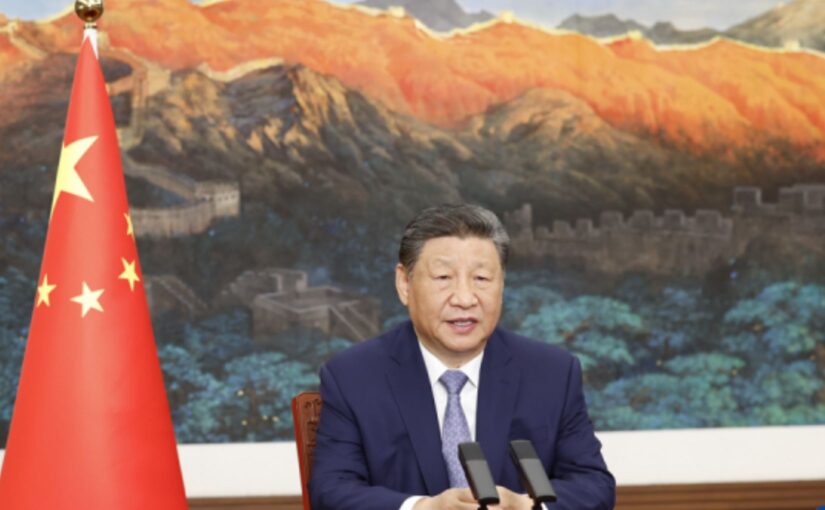
The following remarks by President Xi Jinping to the Leaders’ Meeting on Climate and the Just Transition on 23 April 2025 outline China’s vision for advancing global climate governance. Xi notes that, although “global climate governance has gone through winds and rains, green and low-carbon development has eventually become a trend of our times”.

Obviously referencing the United States, he points out that “some major country’s persistent pursuit of unilateralism and protectionism has seriously impacted international rules and the international order”. This presents a significant challenge. Nonetheless, “we will overcome the headwinds and steadily move forward global climate governance and all progressive endeavours of the world”.

China has been implementing a Green Belt and Road Initiative at an impressive pace, and is involved in renewable energy projects with countries throughout the Global South. This will continue. “As a member of the Global South, China will vigorously deepen South-South cooperation and continue to provide help for fellow developing countries to the best of its capability.”

Xi details some of China’s remarkably achievements in environmental sustainability in recent years: “Since I announced China’s goals for carbon peaking and carbon neutrality five years ago, we have built the world’s largest and fastest-growing renewable energy system as well as the largest and most complete new energy industrial chain. China also leads the world in the speed and scale of ‘greening, contributing a quarter of the world’s newly-added area of afforestation.”

He concludes by promising that “China will not slow down its climate actions” and will play its part in the building of a clean, beautiful, and sustainable world.

The text of the speech was first published on the website of the Ministry of Foreign Affairs of the People’s Republic of China.

Your Excellency Secretary General António Guterres,
Your Excellency President Luiz Inácio Lula da Silva,
Colleagues,

It is a great pleasure to join you virtually at the Leaders Meeting on Climate and the Just Transition.

This year marks the 10th anniversary of the Paris Agreement. Over the past decade, global climate governance has gone through winds and rains, but green and low-carbon development has eventually become a trend of our times. This year also marks the 80th anniversary of the founding of the United Nations. As unprecedented global changes unfold at a faster pace, humanity has come to a new crossroads. Although some major country’s persistent pursuit of unilateralism and protectionism has seriously impacted international rules and the international order, history will, as always, move forward through twists and turns. As long as we enhance confidence, solidarity and cooperation, we will overcome the headwinds and steadily move forward global climate governance and all progressive endeavors of the world. Let me share four points with you in this regard.

First, we must adhere to multilateralism. The more volatile and turbulent the international situation becomes, the greater the need for us to firmly safeguard the U.N.-centered international system and the international order underpinned by international law, and firmly safeguard international fairness and justice. The U.N. Framework Convention on Climate Change and its Paris Agreement are the legal cornerstone of international climate cooperation. It is important for all countries to champion the rule of law, honor commitments, prioritize green and low-carbon development, and jointly respond to the climate crisis through multilateral governance.

Second, we must deepen international cooperation. Solidarity and cooperation are needed more than ever as the world faces multiple, compounded challenges. We should rise above estrangement and conflict with openness and inclusiveness, boost technological innovation and industrial transformation through cooperation, and facilitate the free flow of quality green technologies and products, so that they can be accessible, affordable and beneficial for all countries, especially the developing ones. As a member of the Global South, China will vigorously deepen South-South cooperation and continue to provide help for fellow developing countries to the best of its capability.

Third, we must accelerate the just transition. Clear waters and green mountains are just as valuable as gold and silver. Green transformation is not only the essential way to address climate change, but also a new engine for economic and social development. Such transformation must be people-centered and pursued in a way that advances the well-being of people and climate governance in tandem, and strike a balance between multiple goals including environmental protection, economic growth, job creation, and poverty alleviation. Developed countries are obliged to extend assistance and support to developing countries, help drive the global shift toward green and low-carbon development, and contribute to the common and long-term well-being of people of all countries.

Fourth, we must strengthen results-oriented actions. Instead of talking the talk, we must walk the walk. We must turn our goals into tangible results through systematic policies and concrete measures. All parties should do their utmost to formulate and implement their program of action for nationally determined contributions (NDCs) while coordinating economic development and energy transition. China will announce its 2035 NDCs covering all economic sectors and all greenhouse gases before the United Nations Climate Change Conference in Belém.

Colleagues,

Harmony between man and nature is a defining feature of Chinese modernization. China is a steadfast actor and major contributor in promoting global green development. Since I announced China’s goals for carbon peaking and carbon neutrality five years ago, we have built the world’s largest and fastest-growing renewable energy system as well as the largest and most complete new energy industrial chain. China also leads the world in the speed and scale of “greening,” contributing a quarter of the world’s newly-added area of afforestation.

However the world may change, China will not slow down its climate actions, will not reduce its support for international cooperation, and will not cease its efforts to build a community with a shared future for mankind. With the future of humanity and the well-being of our people in mind, let’s earnestly honor the principle of common but differentiated responsibilities, do our utmost respectively and collectively, and build a clean, beautiful, and sustainable world together.

Thank you.
Chinese Ambassador: Haiti’s future should not be sacrificed to US strategic interests

China has launched a sharp attack on the role of the United States in creating and perpetuating the political chaos and humanitarian disaster gripping the Caribbean state of Haiti and in the immiseration of its people.

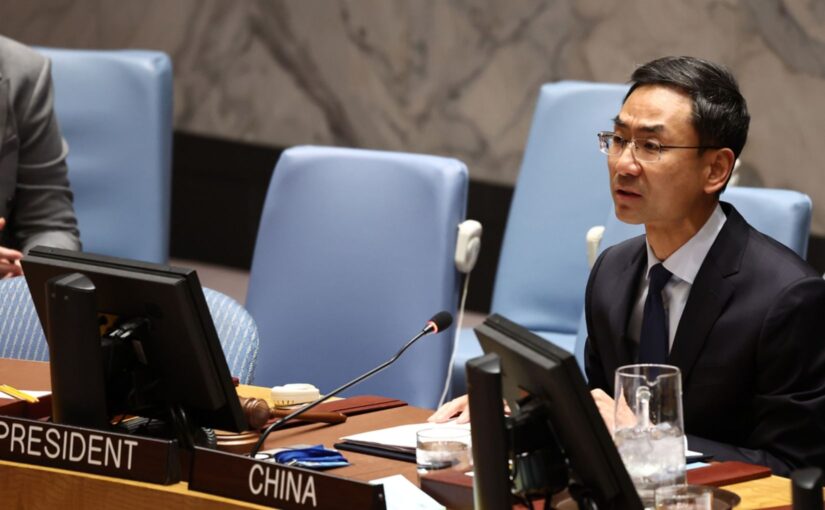
Addressing a meeting of the United Nations Security Council in New York, called to hear briefings on the work of BINUH (the United Nations Integrated Office in Haiti) on April 21, Chinese Ambassador Geng Shuang made three points:

  • First, Haiti must shoulder its own responsibility. As a sovereign state, Haiti bears the primary responsibility of governance. “We call on all parties in Haiti to prioritise the interest of the nation and its people, enhance dialogue and consultation, demonstrate flexibility, and work together to advance a political process that is Haitian-led and Haitian-owned, with the goal of establishing a legitimate, effective, and responsible government at an early date.”
  • Second, external support must be effective. “On the political process, we need to support CARICOM [the Caribbean Community] and BINUH in continuing their good offices to accelerate the implementation of a transitional arrangement that is aligned with the realities of Haiti and is widely recognised… On humanitarian assistance, it is necessary to mobilise the resources of the international community and encourage all parties to continue to provide more assistance to the Haitian people to alleviate their sufferings.”

However, by far his strongest and most substantive comments addressed the role and responsibility of the United States:

“Third, the instigator of the crisis must shoulder its responsibility. Haiti was the first Latin American country to declare independence. However, it has then suffered many hardships due to a long period of military occupation, external interference, and economic exploitation. Throughout this process, the United States has been the greatest external factor affecting Haiti’s security, stability, and development. 

“The US has always been the mastermind behind the political landscape in Haiti. For over a century, it has blatantly deployed troops, installed puppet governments, and manipulated Haiti’s constitution, entrenching itself in Haiti’s political affairs.”

He went on to say that the United States has always been a major source of interference in Haiti’s development. While it claims to support the Haitian people, it has significantly cut foreign aid and continued deporting Haitian immigrants on the pretext of national priorities precisely when Haiti is in dire need of support. What is even more shocking is that not long ago, while the US defied world opinion by imposing sweeping tariffs on all trade partners, it also extended its so-called baseline tariff of 10% to Haiti, one of the world’s least developed countries as defined by the UN. This display of unilateralism, protectionism, and economic bullying is not just aimed at the so-called competitors like China. It has also inflicted damage on a nation teetering on the edge of collapse, such as a fragile country like Haiti, where the people are in dire straits. This is not only cruel and absurd, but also profoundly heartbreaking. 

“We hope that the US will reflect on all of the above. Haiti’s future should not be sacrificed to the US pursuit of its own strategic interests, nor should ‘being too close to the US’ become a curse for Haiti.”

Reporting on the meeting, Peoples Dispatch quoted Maria Isabel Salvador, Special Representative of the United Nations Secretary General for Haiti and Head of BINUH, as saying that, in February and March alone, 1,086 people were killed, 383 were injured, and more than 60,000 were forcibly displaced. Since December of last year, one million people have been displaced.

“The humanitarian crisis in Haiti has reached critical levels… Cholera outbreaks and gender-based violence – especially in places of displacement – are widespread; insecurity has closed 39 health facilities and more than 900 schools in [the capital] Port-au-Prince,” she told the meeting.

Haiti has yet to establish diplomatic relations with the People’s Republic of China. However, the two countries maintain representative and trade offices in their respective capitals.

The following articles were originally published on the website of China’s Permanent Mission to the UN and by Peoples Dispatch. The Peoples Dispatch article was first published by Brasil de Fato in Portuguese.

Remarks on BINUH by Ambassador Geng Shuang at the UN Security Council Briefing

President, 

I thank Special Representative Maria Isabel Salvador and National Security Advisor Monica Juma for their briefings. I welcome the representatives of Haiti and the Dominican Republic at today’s meeting. I have also listened carefully to the statement made by the civil society representative. 

Continue reading Chinese Ambassador: Haiti’s future should not be sacrificed to US strategic interests

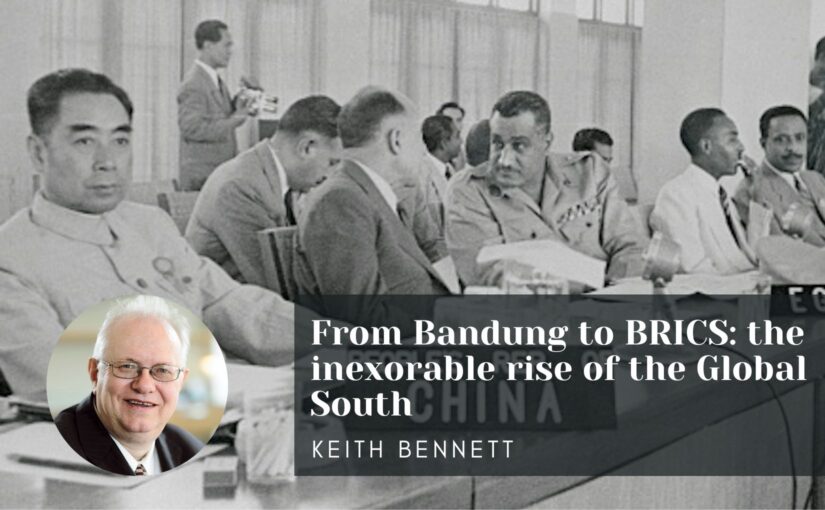
From Bandung to BRICS: the inexorable rise of the Global South

The following is the text of the speech given by our co-editor Keith Bennett to the webinar jointly organised by Friends of Socialist China and the International Manifesto Group on Sunday 27 April, 2025, marking the 70th anniversary of the historic Africa Asia Conference held in the Indonesian city of Bandung.

In his speech, Keith outlined the historic significance of the Bandung Conference, linking it both to its antecedents as well as to the later institutions of the Global South that it inspired, such as the Non-Aligned Movement (NAM) and the BRICS cooperation mechanism.

He pays particular attention to the key role played by Chinese Premier Zhou Enlai at the conference and cites Malcolm X, who highlighted the broad unity that Bandung embodied.

We called this meeting to celebrate the 70th anniversary of the Bandung Conference and to affirm its continued relevance.

What do I mean by that?

It was a key moment in the evolution and development of the international situation post-World War 2.

It came at the cusp of the anti-imperialist national liberation movement:

  • Just after the liberation of China, itself preceded by the independence of India, Pakistan, Ceylon (now Sri Lanka) and Burma (now Myanmar).
  • When Korea and Indochina were at the forefront of the global diplomatic agenda – this being the year after the 1954 Geneva Conference.
  • Just prior to the great wave of decolonisation in Africa, to begin with the independence of Ghana from British colonial rule, under the leadership of Osagyefo Dr. Kwame Nkrumah in March 1957, followed by the independence of Guinea from French colonial rule, under the leadership of Ahmed Sekou Toure, in October 1958.
  • And with the world waking up to the full iniquity of the apartheid regime being progressively consolidated – with newly independent India having been the first country to raise the question at the United Nations.

It was against this backdrop that Bandung established a distinct and common Africa Asia identity as a political concept and geopolitical reality.

Of course, there were antecedents, to a great extent related to the international communist movement and to actually existing socialism:

  • The Communist International had convened the Baku Congress of the Peoples of the East in September 1920.
  • In 1927, again at the instigation of the Communist International, delegates including Jawaharlal Nehru of India, Song Qingling (Mme. Sun Yat-Sen) from China, and indeed Fenner Brockway from Britain’s Independent Labour Party, had gathered in Brussels to found the League Against Imperialism.
  • And in 1945, Manchester hosted the fifth Pan African Congress, attended by three future African heads of state – Kwame Nkrumah, Jomo Kenyatta of Kenya and Hastings Banda of Malawi – along with the African-American scholar and revolutionary Dr. WEB Du Bois, who had attended the first congress in Paris in 1919, and Amy Ashwood Garvey, the widow of Marcus Garvey.

But Bandung occurred at a qualitatively different historical moment in that it was an initiative of independent sovereign states – and in the main of newly independent sovereign states that had just set out on the road of building a new society. They therefore represented what both Indonesian President Sukarno, the host of the conference, and Korean leader Kim Il Sung referred to as the new emerging forces.

Continue reading From Bandung to BRICS: the inexorable rise of the Global South

Vietnam celebrates 50th anniversary of the victory of the war of resistance against US aggression

Massive celebrations were held in Ho Chi Minh City (formerly Saigon) on April 30 marking the 50th anniversary of the victory of the Vietnamese people’s war of resistance against US aggression, the liberation of the south and national reunification.

A grand parade also featured military contingents from China, Laos and Cambodia, representing the revolutionary fraternity with neighbouring  countries forged during the war.

On April 28, Vietnamese Prime Minister Pham Minh Chinh met with Pei Jinjia, Minister of Veterans Affairs, who was leading a Chinese party and government delegation to attend the celebrations.

Chinh expressed his appreciation for the Chinese party and government sending Minister Pei to attend and the Chinese People’s Liberation Army personnel to join Vietnam’s grand parade at the celebration, describing the move as a vivid demonstration of China’s support for the important political event of Vietnam and of the high level of the Vietnam-China friendship.

He thanked China for its valuable support during Vietnam’s struggle for independence and national reunification, noting specific historical contributions, including the Yucai schools in Guilin and Nanning, which trained thousands of outstanding Vietnamese students, and the Nan Xishan Hospital in Guilin, which gave treatment to over 5,400 wounded Vietnamese soldiers. He also acknowledged China’s assistance in building major projects including the Ho Chi Minh National Academy of Politics, the Thuy loi University, the Ministry of Planning and Investment headquarters, and the Viet Tri Bridge.

Pei, for his part, congratulated Vietnam on its 50th reunification anniversary while expressing appreciation for the support that generations of Vietnamese revolutionary leaders have provided for China’s revolutionary cause.

Numerous other high-level delegations from around the world also attended the celebrations. They included:

  • General Secretary of the Lao People’s Revolutionary Party (LPRP) and President of Laos Thongloun Sisoulith
  • Hun Sen, President of the Cambodian People’s Party and President of the Cambodian Senate
  • Politburo member Bensalem Mohamed of the National Liberation Front (FLN) of Algeria and Algeria’s Minister of Mujahedeen and Rights Holders Laid Rebiga
  • Vice Chairman of the House of Representatives of the National Assembly of Belarus Ipatau Vadzim

General Secretary of the Central Committee of the Communist Party of Vietnam (CPV) To Lam delivered an address at the national celebration. He described the 50th anniversary as “the most brilliant milestone in the history of building and defending the country; marking the glorious end of the 30-year resilient struggle for independence, freedom, and reunification of the Fatherland; putting an end to the more-than-a-century domination of old and new colonialism; and bringing the country into a new era – the era of national independence and socialism.”

“In this sacred moment, we respectfully remember and express our boundless gratitude for the great contributions of beloved President Ho Chi Minh – the genius Leader of our Party and nation, the great teacher of the Vietnamese revolution, a hero of national liberation, a great man of culture, an outstanding soldier of the international communist and workers’ movements – with the burning desire to liberate the South and reunify the nation, with the faith in victory that ‘No matter how difficult or arduous, our people will definitely win. Our Fatherland will definitely be reunified. Compatriots of the North and the South will definitely be reunited under one roof’… We sincerely thank our brothers, comrades and international friends, progressive forces and peace-loving people around the world for their great, valuable, wholehearted, loyal, and steadfast support and assistance to the Vietnamese people’s cause of national liberation and reunification.”

To Lam noted that immediately after the success of the August Revolution in 1945 and the birth of the Democratic Republic of Vietnam, “our people had to enter two long resistance wars to protect the country’s independence and unification. The resistance war against the French colonialists ended, and like many nations around the world, the Vietnamese people wished for a peaceful, independent and free life. However, the US imperialists quickly replaced the French colonialists, intervening in Vietnam, carrying out the plot to divide our country, and turning the South of our country into a new type of colony and an outpost to prevent communism in Southeast Asia and other progressive forces in the world. During the war of aggression against Vietnam, the US imperialists deployed a large number of soldiers with the most modern and sophisticated weapons, implemented many dangerous war strategies; carried out two brutal destructive wars against the North, causing a lot of pains and losses to the people in both regions of the country; and the consequences of the war still linger today.

Continue reading Vietnam celebrates 50th anniversary of the victory of the war of resistance against US aggression