The Chinese scholars keeping the memory of Japanese sexual slavery alive

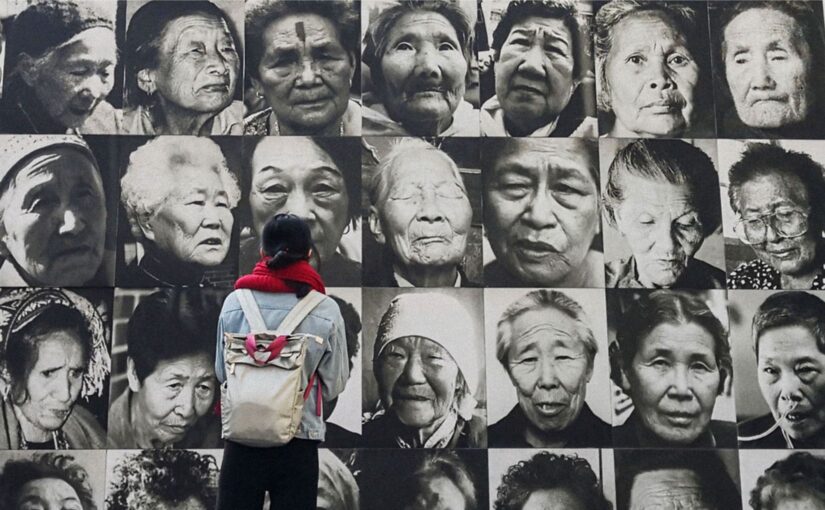
The following article, which was originally published on Sixth Tone, highlights the work of Su Zhiliang and Chen Lifei, a husband and wife team who are China’s foremost scholar activists researching the Japanese militarists’ heinous ‘comfort women’ system, an insitutionalised practice of mass sexual slavery inflicted on women in China, Korea and elsewhere in Asia during Japanese imperialism’s war of aggression.

This year the couple have published two books: “A Comprehensive History of the Japanese Military ‘Comfort Women’ System,” offers an in-depth analysis of wartime female slavery and is considered the most comprehensive, systematic, and authoritative multi-volume study of its kind to date. The other, “The Search: ‘Comfort Woman’ Park Yong-sim and Her Sisters,” is a revised edition setting out Park Yong-sim’s personal narrative as she was taken from her hometown of Nampo, in what is now the Democratic People’s Republic of Korea, to Nanjing, capital of China’s eastern Jiangsu province, and forced into sexual slavery at the age of 17.

Since they began their research and fieldwork in the 1990s, the couple have identified 358 comfort women survivors in the Chinese mainland, nearly tripling previous estimates. Now, there are only seven remaining survivors – the youngest of whom is 95 years old.

Wu Haiyun interviewed Su Zhiliang ahead of this year’s International Memorial Day for Comfort Women, which falls on August 14.

Explaining how the issue came to be hidden for so long, Su said: “After WWII, the Japanese government knew this was a shameful crime and systematically destroyed archival materials related to the ‘comfort women’ system, so the issue only came to international attention in 1991, when a 67-year-old Korean woman, Kim Hak-sun, courageously came forward to testify that she had been forced into sexual slavery by the Japanese military in China and to file a lawsuit against the Japanese government.”

There were also further obstacles, especially in the early years: “Local officials in China were often uncooperative, as if this history was something to be ashamed of. This resistance began to ease a bit after 2000 (as more survivors sought litigation and public awareness increased), but the survivors themselves would sometimes still decline interviews. For example, we had once arranged for a Shanghai TV crew to travel with us to northern Shanxi province’s capital, Taiyuan, to interview a survivor. Everything was in place, but just before we departed, she called to say she no longer wished to speak on camera. All I could say was that we understood. It’s incredibly painful to recount the most traumatic experiences of your life to strangers.”

He adds: “The history of ‘comfort women’ represents one of the most horrific, systematic violations of women’s rights in modern history. Our research shows that in China alone, the Japanese military established more than 2,100 ‘comfort stations.’  Throughout the entire war, between 360,000 and 410,000 women were forced into sexual slavery by the Japanese military. Many died during their captivity.”

He also sounds a warning that the Japanese government’s stance towards these crimes is now only getting worse:

“In the 1990s, Japanese school textbooks still included references to the ‘comfort women’ system. Now, such content is becoming increasingly rare. One major reason is the decline of left-leaning historians and the weakening of progressive forces, while nationalist and right-wing voices grow stronger. As a result, Japan’s current attitude toward the issue is even more regressive than it was 30 years ago. We must remain vigilant about this… The ‘comfort women’ system and the [Nazi] Holocaust represent two distinct but equally heinous forms of fascist violence… Both were state-sponsored crimes against humanity, and both epitomise the brutality of fascism and militarism.”

This year, China’s core scholars on “comfort women” — women and girls forced into sexual slavery by the Japanese army in World War II — published two career-defining books.

One, “A Comprehensive History of the Japanese Military ‘Comfort Women’ System,” offers an in-depth analysis of wartime female slavery and is considered the most comprehensive, systematic, and authoritative multi-volume study of its kind to date. The other, “The Search: ‘Comfort Woman’ Park Yong-sim and Her Sisters,” is a revised edition about Park Yong-sim’s personal narrative as she was taken from her hometown of Nampo, Korea, to Nanjing, capital of China’s eastern Jiangsu province, and forced into sexual slavery at the age of 17.

In many ways, the works are a fitting capstone to Su Zhiliang and Chen Lifei’s decadeslong scholarship and advocacy, as the husband-and-wife pair, now nearing their 70s, consider stepping back. Taken together, the books encapsulate the dual approach that has defined the Shanghai Normal University scholars’ foundational work to document and identify survivors of the wartime female slavery system.

However, as the couple contemplate the future of their research, challenges remain. Since they began their research and fieldwork in the 1990s, they have identified 358 comfort women survivors in the Chinese mainland, nearly tripling previous estimates. Now, there are only seven remaining survivors — the youngest of whom is 95 years old.

Continue reading The Chinese scholars keeping the memory of Japanese sexual slavery alive
Chen Weihua: Marx’s legacy still relevant in Europe

Brussels says farewell to Chen Weihua

Chen Weihua, correspondent for the Chinese newspaper China Daily in Brussels for the past seven years, returned home on August 4. He recently turned 62 and thus worked two years longer than the retirement age for most Chinese men. 

During his time as bureau chief for his newspaper, he wrote numerous articles about the European Union – his main assignment – but also about Belgium. Among other things, he wrote an interesting piece about Karl Marx’s stay in Brussels, which we reproduce below.

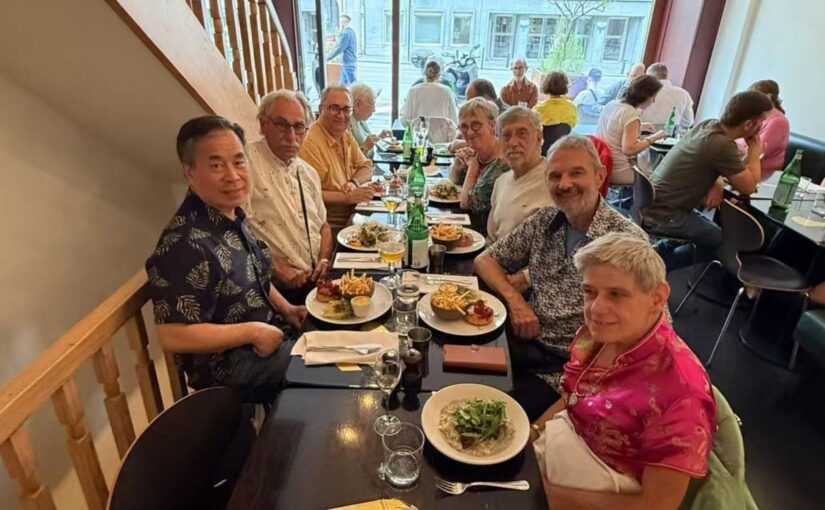
Of course, he also made many local friends, most of whom are professionally interested in China. During a pleasant dinner at the Bozarcafé in Brussels on August 1, a few local friends said farewell to him. Sitting at the table next to Chen (left) are Frank Willems, co-editor of the website Chinasquare.be. In front of him: Marc Vandepitte, co-editor of the alternative news website De Wereld Morgen. Other Belgian fellow editors and journalists complete the picture.

Chen has returned to his home city of Shanghai, where he will continue to write columns in addition to numerous planned trips within his own country. “I have worked as a journalist all my life and cannot simply leave all that knowledge and experience behind me. I will continue to write commentaries in my ‘sea of free time’, as retirement is sometimes described. You are not rid of me yet…”

Jan Reyniers


As one of his last journalistic assignments in Brussels, Chen Weihua wrote an interesting and important article, Marx’s legacy still relevant in Europe,which was published by China Daily on June 20.

Chen writes that, after having been forced to leave Germany and France: “ Marx lived in several different places in Brussels. I have visited the one at 42 Rue d’Orleans, now 50 Rue Jean d’Ardenne. It is the only place with a commemorative plaque, which indicates that the family lived here from 1846 to 1848. It was in Brussels that Marx’s wife, Jenny von Westphalen, Marx’s childhood sweetheart and lifelong companion, gave birth to their son Edgar and daughter Laura.”

He adds: “Belgian historian Edward de Maesschalck, who wrote a book on Marx in Brussels, said that Brussels marked a turning point in Marx’s life and from there, he initiated a revolution that would radically transform the world.

“Brussels was then a city with a rich upper class and a large number of poor people. There was the Potato Famine of 1846 and grain shortages in 1847. Poverty in Belgium reached an all-time high, reinforcing Marx’s belief that revolution could not be long in coming.”

Maesschalck also wrote that Marx arrived as a socially committed scholar, seeking clarity and finding the key to a better understanding of human history. In Brussels, Marx emerged as a revolutionary with a mission. It was in Brussels, too, that his views of historical materialism were formed, and in Brussels… that he and Friedrich Engels wrote the Communist Manifesto.

Chen notes that, in contrast to his stature in China, Marx is not especially popular in contemporary Europe, for example among the social democratic parties that were originally founded as Marxist parties. However, he contends that the increase in workers’ strikes in recent years vindicates Marx’s analysis.

According to Bart Peeters of the Workers’ Party of Belgium (PTB/PDVA): “Without a thorough scientific understanding of the mechanics of capitalism and its domination of the state apparatus, the struggle cannot be successful. Fortunately, more and more workers are beginning to understand this.”

Marx’s legacy still relevant in Europe

June 20 (China Daily) – The Grand Place is the most famous and photographed tourist attraction in Brussels and was described by Victor Hugo as the most beautiful in the world. Encircled by buildings of Baroque, Gothic and Louis XIV architectural styles and gilded with gold detailing, it is known to Chinese tourists as Golden Grand Square or huangjin da guangchang.

Continue reading Chen Weihua: Marx’s legacy still relevant in Europe

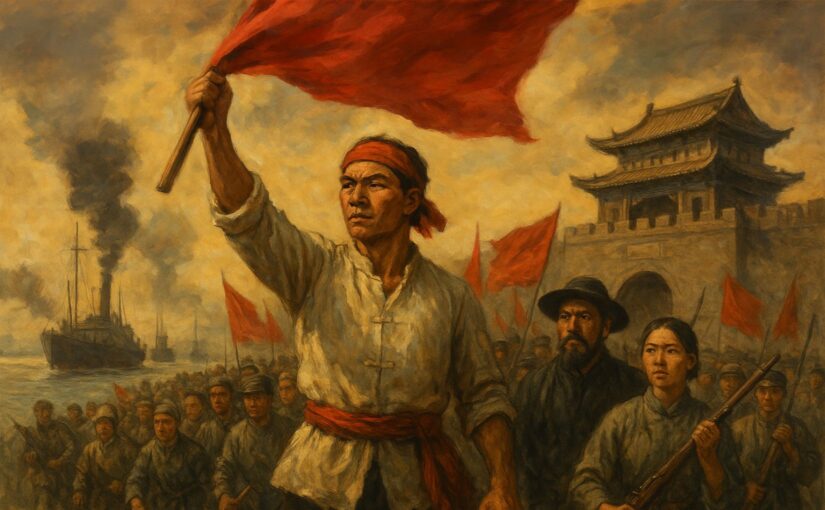
The Taiping Rebellion and the spectre of peasant communism

In the following article, originally published on his website Weaponized Information, Prince Kapone gives an acute analysis and mounts a trenchant defence of China’s Taiping Rebellion (1850-1864), generally regarded as one of the greatest peasant rebellions, as well as bloodiest conflicts, in human history.

Describing it as the “spectre of peasant communism”, Kapone situates the rebellion against the background of the stagnation and decline of China’s feudal system, of the Qing dynasty in particular, and the way this opened up the country to imperialist depredations, most notably the British Opium Wars (1839-1842; 1856-1860).

He explains: “The opium-induced decomposition of Chinese society was no accident; it was policy. This narcotic primitive accumulation did not represent the entry of capitalism through ‘natural’ development, but its violent imposition through military discipline. As in India, Ireland, and Egypt, the arrival of the capitalist world market meant the annihilation of local metabolic rationality in favour of cash crop logic, debt servitude, and currency crisis. The Qing state, no matter its robes or rituals, had become a tributary of London finance.

“It is within this furnace of contradiction that the Taiping Rebellion arose – not as an aberration, nor a reactionary nostalgia for a vanished harmony, but as the spontaneous combustion of a people compressed between imperial plunder and domestic parasitism. In this sense, the Taiping were the dialectical consequence of a global contradiction: the fusion of foreign capital’s devastation with the internal bankruptcy of a feudal order. What followed was not simply rebellion, but the premature birth of a proletarian-peasant war in the belly of a still-feudal dragon.”

He goes on to outline the form and essence of peasant revolt: “When the peasantry takes up arms, it does not quote Hegel – it dreams. But the dream, far from being false, is the condensed expression of real suffering, organised into symbolic form. The bourgeois mind, unable to see beyond its own secular fetishisms, calls this ‘madness,’ ‘fanaticism,’ ‘superstition.’ Yet just as the commodity hides labour beneath its surface, so too does ideology conceal class. The gods of the Taiping did not descend from heaven – they rose from the rice paddies.

“Hong Xiuquan, the failed scholar who declared himself the younger brother of Christ, has been mocked by European scribes as a deluded zealot. But what is delusion in a world where imperial capital arrives by gunship? In the dream of paradise, in the vision of a Heavenly Kingdom on earth, the Chinese peasantry gave voice to their deepest material yearnings: land, bread, justice, revenge. That this expression wore the garb of biblical apocalypse is no stranger than the French Revolution quoting Rome or the English Levellers citing scripture. The form is borrowed; the content is real…

“This was a weaponised syncretism: a theology forged in the crucible of examination failure, landlord extortion, opium hunger, and state decay. Christ, repurposed by Hong, was not a redeemer of souls but a hammer of kings. The Taiping gospel was less a catechism than a call to arms, less sermon than strategy.”

Continue reading The Taiping Rebellion and the spectre of peasant communism

When it comes to clean energy, the empire sees China’s dominance and decides the race isn’t worth running

The following post from veteran educator and activist Mike Klonsky discusses the Trump administration’s relentless attack on green energy and its doubling down on fossil fuel production. Mike notes that Trump has “axed renewable energy tax credits, grants, and loans provided by the Biden administration. He has also made it more difficult to obtain authorisations for wind and solar projects and imposed restrictions on companies whose supply chains are heavily reliant on Chinese companies.”

Klonsky surmises that the reason for the US’s abandonment of even the pretence of trying to avoid climate breakdown is the fact that China is so far ahead in renewable energy and other sustainable technologies.

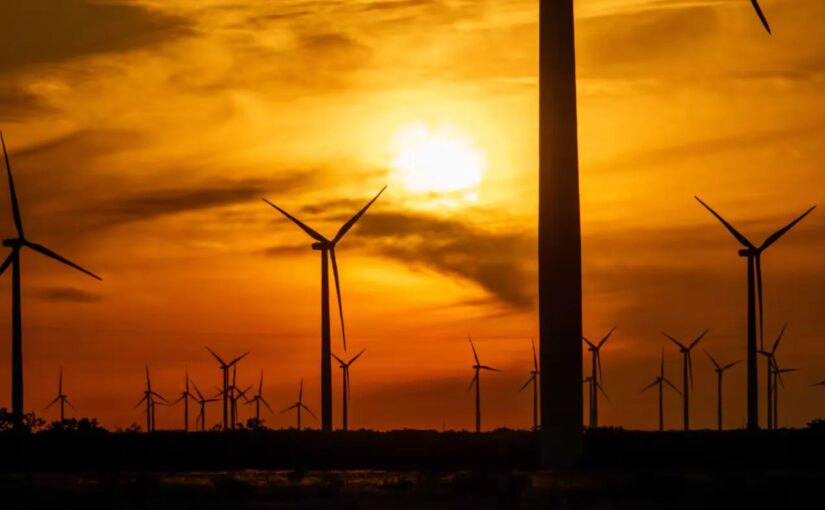
China is sprinting ahead in the clean, renewable energy race—installing more solar in a single month than the US does in a year. By mid-2025, it had added nearly 200 GW of renewables in five months. The US? Mired in rollback threats, tariffs, fossil subsidies, and culture war distractions…

The empire sees China’s dominance and decides the race isn’t worth running. So it torches the track, poisons the crowd, and calls it patriotism.

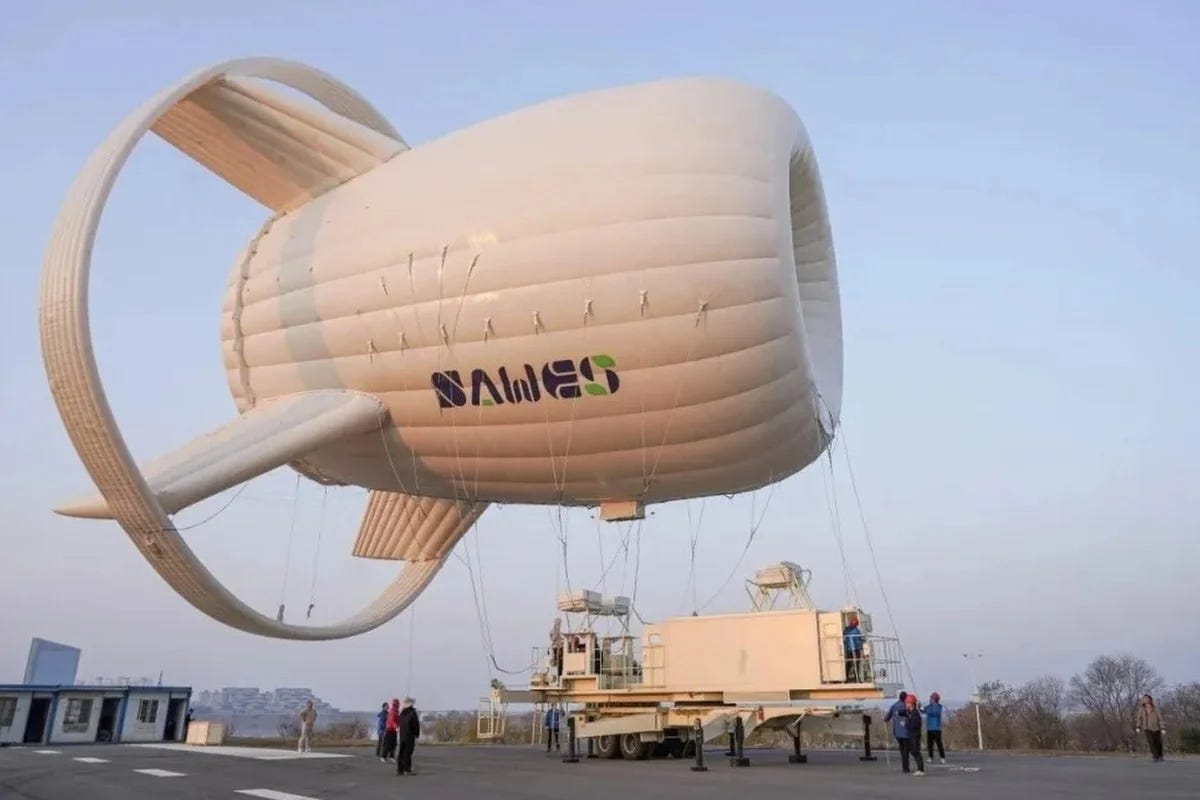
The article concludes with an interesting note about how China is pioneering paradigm-shifting technology: an airborne wind turbine capable of generating one megawatt at 1,500 metres altitude, offering huge potential for providing energy to remote and disaster-stricken areas.

While the US debates conspiracy theories about whales and rolls back clean energy incentives, China is deploying floating megawatt turbines that could power disaster zones and leapfrog traditional grid limitations.

AI won’t solve our energy crisis. In many ways, it makes things worse. Right now, it’s a double-edged blade. The race to build more data centers is triggering regional energy shortages, particularly in hubs like Northern Virginia, which now consumes electricity equivalent to that of 800,000 homes.

Meanwhile, AI—sold as the savior of everything—is quietly devouring the grid. Data centers now rival cities in terms of electricity use, and their exponential growth is driven by fossil-fuel-heavy infrastructure. The irony? Wind and solar could stabilize that demand. But Trump’s fossil-first agenda ensures AI’s expansion deepens the crisis it claims to solve.

“We don’t allow windmills,” Trump said. “We’re not allowing any windmills to go up unless there’s a legal situation where somebody committed to it a long time ago.”

Trump’s bizarre obsession with the supposed evils of windmills has expanded into an assault on renewable energy unlike anything we have seen before from even the most conservative Republican administrations; according to one estimate, his policies have led to the cancellation of $19 billion in clean energy projects this year. (Financial Times)

He’s axed renewable energy tax credits, grants, and loans provided by the Biden administration. He has also made it more difficult to obtain authorizations for wind and solar projects and imposed restrictions on companies whose supply chains are heavily reliant on Chinese companies.

His muse in all this is none other than his know-nothing U.S. Health and Human Services Secretary RFK Jr., Trump’s number-one ass kisser, who claims that wind power is too expensive and kills whales.

RFK Jr. wants you to believe offshore wind farms are slaughtering whales and bankrupting the grid. The numbers? He claims that 160 dead whales have been found in two years. The culprit? Renewable energy. But NOAA—the actual scientists tracking marine deaths—say there’s zero evidence linking wind development to whale deaths. The real threats? Ship strikes, fishing gear, and climate-driven prey shifts. But those don’t fit the anti-renewable narrative.

As for wind being “the most expensive energy”? Offshore wind is more expensive to build than onshore wind, but it offers higher capacity factors and more consistent energy output. And wind’s price is dropping fast, especially with federal backing and tech gains.

This isn’t an environmental concern—it’s Don Quixote syndrome.

His perceived number one competitor, China, is so far ahead in the clean energy race that Trump has given up.

When the Empire Can’t Win the Future, It Sabotages It.

China is sprinting ahead in the clean, renewable energy race—installing more solar in a single month than the U.S. does in a year. By mid-2025, it had added nearly 200 GW of renewables in five months. The U.S.? Mired in rollback threats, tariffs, fossil subsidies, and culture war distractions.

Trump’s camp isn’t trying to catch up. They’ve pivoted to sabotage—gutting clean energy incentives, reviving oil leases, and weaponizing environmental rhetoric to stall offshore wind. RFK Jr.’s whale hysteria isn’t about marine life; it’s a proxy war against progress. When the facts don’t favor fossil fuels, they manufacture fear.

This isn’t about good policy—it’s about narrative warfare. The empire sees China’s dominance and decides the race isn’t worth running. So it torches the track, poisons the crowd, and calls it patriotism.

Latest news out of China

Chinese scientists, led by Beijing SAWES Energy Technology Company in collaboration with Tsinghua University and the Aerospace Information Research Institute, are preparing to flight-test the world’s first megawatt-level airborne wind turbine system.

Design: It looks like an airship but acts like a windmill—using a helium-filled aerostat to lift lightweight power generation equipment to altitudes around 1,500 meters.

Power Output: The S1500 system is expected to generate 1 megawatt, over 30 times more powerful than previous airborne systems.

Efficiency: At high altitudes, wind speeds are up to three times faster, producing up to 27 times more power than ground-level turbines.

Use Cases: Ideal for disaster relief, remote islands, and off-grid oilfields, where conventional infrastructure is impractical.

That’s not just a breakthrough—it’s a paradigm shift in wind energy. While the U.S. debates conspiracy theories about whales and rolls back clean energy incentives, China is deploying floating megawatt turbines that could power disaster zones and leapfrog traditional grid limitations.

Hong Lei warns of the continued danger of Japanese militarism as China prepares for key anniversary

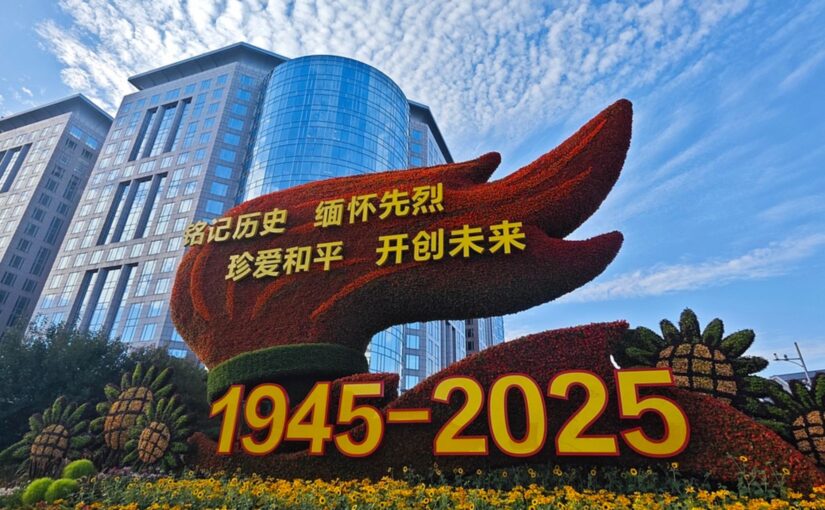
We previously reported on the 26 foreign heads of state or government who will attend China’s September 3 commemoration of the 80th anniversary of victory in  the Chinese People’s War of Resistance Against Japanese Aggression and the World Anti-Fascist War at the invitation of President Xi Jinping.

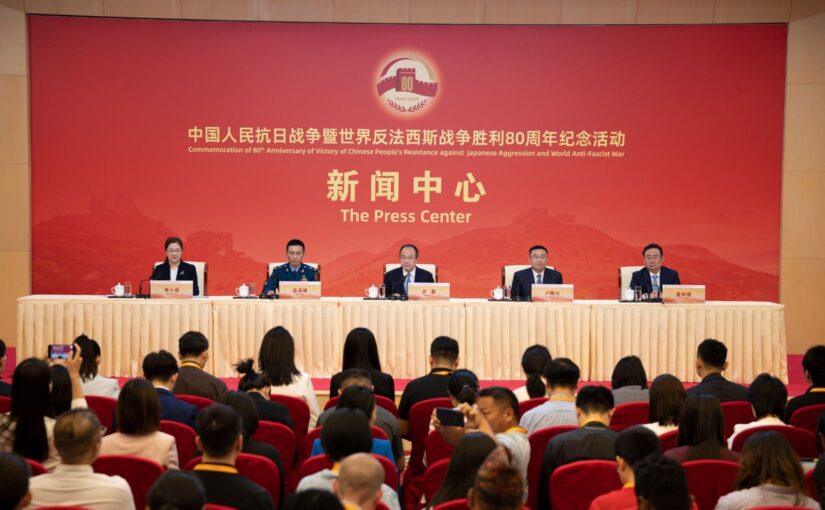
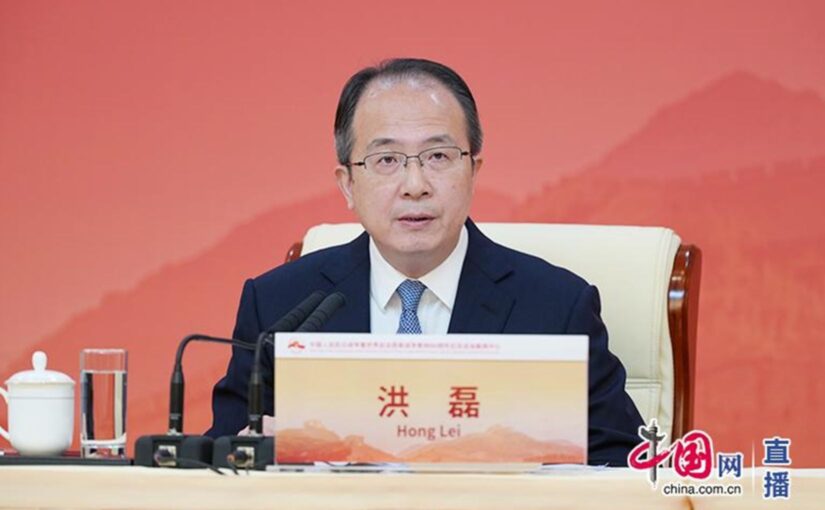
At his press conference, given on August 28, Chinese Assistant Foreign Minister Hong Lei also gave details of some other high-ranking persons who will participate, noteworthy among whom are:

  • Speaker of the National Parliament of Timor Leste Maria Fernanda Lay
  • President of the National Assembly of Venezuela Jorge Rodriguez Gómez
  • Chairman of the Bulgarian Socialist Party and Deputy Prime Minister of Bulgaria Atanas Zafirov
  • Speaker of the National Assembly of the Republic of Korea (ROK) Woo Won-Shik
  • Chief Adviser to the Brazilian President Celso Amorim
  • Representative of the Nicaraguan Government and Presidential Adviser Laureano Ortega Murillo
  • Minister of War Veterans and Rights Holders of Algeria Laid Rebiga
  • President of the New Development Bank (and former Brazilian President) Dilma Rousseff
  • Former Prime Minister of Japan Yukio Hatoyama
  • Former Prime Minister of Greece George Papandreou
  • Former Prime Ministers of New Zealand Helen Clark and John Key
  • Former Foreign Minister of Australia Robert (Bob) Carr

Also, in addition to his comments regarding the participation of Russian President Vladimir Putin and leader of the Democratic People’s Republic of Korea (DPRK) Kim Jong Un, as well as on the significance of the broad representation from the Global South, which we previously reported, Hong also touched on a number of other questions, including the present situation regarding Japan, where he commented:

“Within Japan, there have all along been some forces that try to deny and glorify aggression, distort history, and even honour the war criminals and justify their crimes. This constitutes a challenge to the post-war international order, a challenge to human conscience and a challenge to all peace-loving people. In recent years, Japan has also drastically adjusted its security policy, increased its defence budget year by year and continued to ease restrictions on arms exports, seeking a breakthrough in military development. Naturally, this arouses the strong scepticism of its Asian neighbours and the international community, as to whether Japan is genuinely committed to an exclusively defence-oriented policy and to peaceful development.”

The following is the full text of the press conference. It was originally published on the website of the Chinese Foreign Ministry.

Head of the press center for the events commemorating the 80th anniversary of the victory in the Chinese People’s War of Resistance Against Japanese Aggression and the World Anti-Fascist War Shou Xiaoli: Ladies and gentlemen, good morning. Welcome to the first press conference hosted by the Press Center for the events commemorating the 80th anniversary of the victory of the Chinese People’s War of Resistance Against Japanese Aggression and the World Anti-Fascist War.

Continue reading Hong Lei warns of the continued danger of Japanese militarism as China prepares for key anniversary

China’s victory in the war against Japanese aggression inspired the oppressed people of the Global South

Chinese Assistant Foreign Minister Hong Lei has stated that the victory in the Chinese People’s War of Resistance against Japanese Aggression was the first complete victory in China’s modern national liberation struggle and added that this greatly inspired the people of colonised and semi-colonised countries around the world that had suffered from aggression and oppression.

He was speaking at an August 28 press conference where he introduced the 26 heads of state or government who will attend Beijing’s September 3 commemoration of the 80th anniversary of victory in the War of Resistance Against Japanese Aggression and the World Anti-Fascist War at the invitation of President Xi Jinping.

Responding to a comment regarding the heavy representation of leaders from the Global South, Hong added that China’s victory had given the oppressed nations confidence and courage to fight for national independence and liberation and had exerted a profound influence on their eventual triumph.

Eighty years later, the era when a handful of countries dominated the destinies of others, monopolised international affairs and held exclusive advantages in development has become a thing of the past. The collective rise of the Global South is fundamentally reshaping the global landscape. No longer the “silent majority” or a “vast backward bloc,” the Global South now represents an awakened new force and new source of hope in changes unseen in a century, Hong noted. The following article was originally published by Global Times.

When asked to comment that among the foreign guests and dignitaries attending China’s V-Day commemorations in Beijing, many are leaders from Global South countries, Assistant Foreign Minister Hong Lei stated that the victory in the Chinese People’s War of Resistance against Japanese Aggression was the first complete victory in China’s modern national liberation struggle, greatly inspiring colonized and semi-colonized countries around the world that had suffered from aggression and oppression.

It gave them the confidence and courage to fight for national independence and liberation, exerting a profound influence on their eventual triumph, said Hong.

Eighty years later, the era when a handful of countries dominated the destinies of others, monopolized international affairs and held exclusive advantages in development has become a thing of the past. The collective rise of the Global South is fundamentally reshaping the global landscape.

Over the past 40 years, the share of Global South countries in global GDP has risen from 24 percent to over 40 percent, and in the past 20 years they have contributed as much as 80 percent of global economic growth. Increasingly, Global South countries are hosting BRICS, APEC and G20 summits, making their voices heard and leaving a clear imprint, said Hong.

No longer the “silent majority” or a “vast backward bloc,” the Global South now represents an awakened new force and new source of hope in changes unseen in a century, Hong noted.

More than 80 years ago, in that life-and-death struggle between justice and evil, peace-loving people around the world united to form a broad anti-fascist front, defeating brutal aggressors, creating world peace and laying an important foundation for the postwar international order. Today, China stands ready to work together with Global South countries and others to promote a more equal and orderly multipolar world, advance inclusive and beneficial economic globalization and jointly contribute to the just cause of world peace, development and progress, Hong said.

London concert honours China’s victory over fascism

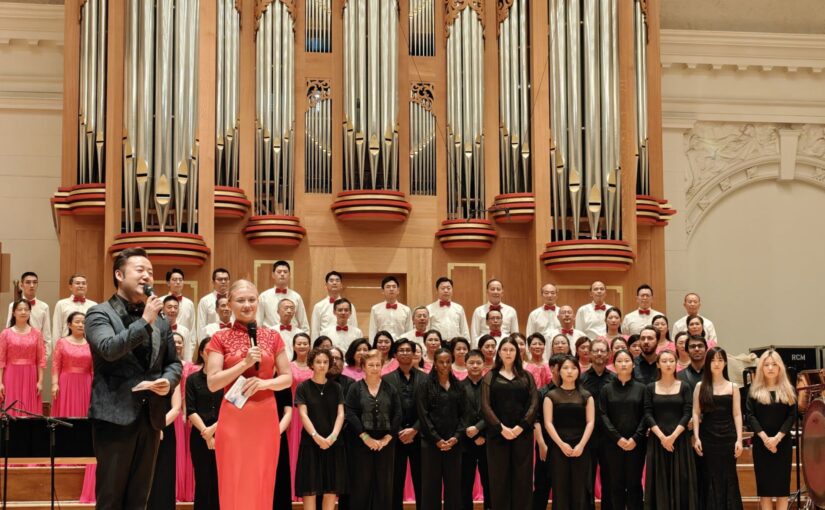
More than 300 people gathered at the Royal College of Music in London’s Kensington district on the evening of August 28 for a concert arranged by the Chinese Embassy in commemoration of the 80th anniversary of the victory in the Chinese People’s War of Resistance against Japanese aggression and the World Anti-Fascist War.

With the theme, Honour History for a Better Future, the concert featured ten pieces of Chinese and Western music presented by the Hunan Provincial Song and Dance Theatre and New Elements Music.

Founded in 1953, the Hunan Provincial Song and Dance Theatre is one of China’s most prestigious performing arts groups.  New Elements Music was founded in London in 2019 and is dedicated to building bridges between Chinese and global music cultures. There were also guest performers from the London City Orchestra and the Camden Philharmonia Orchestra.

Opening with the Ode to the Red Flag, a classic of revolutionary Chinese music composed by Lü Qiming in 1965, the program featured Chinese modern folk music from the period of war and revolution along with contemporary work inspired by the vision of building a community of shared future for humanity. Western pieces included Sir Edward Elgar’s Nimrod.

Particularly poignant for a number of people in the audience was Long Way from Home, the theme song from the documentary film The Sinking of the Lisbon Maru, performed live by Elly O’Keeffe, the London-based Irish singer, who also sings it in the film, accompanied by clips from the film.

A stirring finale was provided by the piano solo Ode to the Yellow River, performed by Di Xiao, Professor at the Royal Birmingham Conservatoire, followed by the choral singing of Defend the Yellow River and My Motherland.

Defend the Yellow River is the last movement of the Yellow River Piano Cantata composed by Xian Xinghai during the war against Japanese aggression. In 1970, it was also adapted into the Yellow River Piano Concerto, which incorporates phrases from The East is Red and the Internationale.

The mixed choir was formed by members of the Choir of the Chinese Embassy in London, the London Chinese Philharmonic Choir and a team from the London Branch of the Bank of China.

Special mention should also be made of the evening’s conductors, Ray Lin from New Elements Music and Thomas Payne, Musical Director of the London City Orchestra.

The event was sponsored by the London Branch of the Bank of China.

Among the distinguished friends of China present were Labour member of the House of Lords, Lord Davidson of Glen Cova; Mrs Denise Wynne, daughter of Lisbon Maru survivor Dennis Morley; former President of the British Sociological Association Martin Albrow; and Jack Perry, Chairman of the 48 Group Club. Friends of Socialist China was represented by our co-editors Carlos Martinez and Keith Bennett.

A short report of the evening was carried by the Xinhua News Agency.

World leaders to gather in China to mark victory in anti-fascist war

China will stage a massive military parade on September 3 to commemorate the 80th anniversary of the victory in the Chinese People’s War of Resistance Against Japanese Aggression and the World Anti-Fascist War and 26 heads of state or government will attend on the invitation of President Xi Jinping.

This was announced by Chinese Assistant Foreign Minister Hong Lei on August 28.

China’s official listing foregrounds Russian President Vladimir Putin and Democratic People’s Republic of Korea (DPRK) top leader Kim Jong Un. With Kim also being joined by the Presidents of Vietnam, Laos and Cuba, this represents an unprecedented gathering of the heads of state of all five presently existing socialist countries.

The presidents of all five of China’s Central Asian neighbours – Kazakhstan, Kyrgyzstan, Uzbekistan, Tajikistan and Turkmenistan – will also attend, as will the leaders of Belarus, Armenia and Azerbaijan, meaning that nine of the 15 former republics of the USSR, who collectively waged the Great Patriotic War against Nazism, will be represented at top level. Other national leaders from countries with a long and significant history of friendship with China, include those from Cambodia, Mongolia, Nepal, Zimbabwe, the Republic of Congo, Iran, Serbia and Slovakia, the last mentioned being the only member of the European Union and NATO to be represented at top level.

Besides those mentioned above, China’s southeast Asian neigbours will also be represented by Indonesia, Malaysia and Myanmar (meaning that six of the ten members of the Association of South East Asian Nations, ASEAN, will be represented at top level), while Pakistan and the Maldives join Nepal in representing China’s South Asian neighbours.

In addition, at the invitation of the Chinese government, heads of parliaments, deputy prime ministers and high-level representatives from various countries, heads of international organisations, and former political dignitaries will also attend the V-Day commemorations.

Announcing the participation of Kim Jong Un, Hong Lei said that China and the DPRK are traditional friendly neighbours. He noted that during the arduous years of war, the Chinese and DPRK people supported each other and fought side by side against Japanese aggression, making important contributions to the victory of the World Anti-Fascist War and humanity’s just cause. He further said that safeguarding, consolidating and developing China-DPRK relations is the firm stance of the Communist Party of China and the Chinese government, adding that China stands ready to continue working with the DPRK to enhance exchanges and cooperation, and advance socialist development.

The Korean Central News Agency (KCNA) also announced Kim’s China visit.

Hong also said that President Putin’s attendance at the commemoration events further highlights the high level of the China-Russia comprehensive strategic partnership of coordination for a new era and underscores their unity in safeguarding the victorious outcome of World War II. He stressed that China and the Soviet Union, as the main battlefields of World War II in Asia and Europe, respectively, served as pillars in the fight against militarism and fascism 80 years ago and made immense national sacrifices.

Continue reading World leaders to gather in China to mark victory in anti-fascist war

Chinese scholar says Vietnamese socialism is a new theoretical model for global socialism and a reference for developing countries

As the Socialist Republic of Vietnam gears up for massive celebrations marking the 80th anniversary of the August Revolution and the September 2nd proclamation of the then Democratic Republic of Vietnam by President Ho Chi Minh, a Chinese Marxist scholar has said that the country exemplifies the successful fusion of socialism and a market economy.

Speaking to Vietnam News Agency (VNA) correspondents in Beijing, Professor Dr. Pan Jin’e from the Research Institute of Marxism under the Chinese Academy of Social Sciences, noted that since embarking on reforms in 1986, Vietnam has gradually built a “socialist-oriented market economy,” shifting from a planned to an open economy. As a result:

  • In 2024, GDP reached 476.3 billion USD and per capita GDP exceeded 4,700 USD.
  • The World Bank recognises Vietnam as a “model for poverty reduction among developing countries.”
  • With renewable energy accounting for 8% of the energy mix by 2024, the country’s target of reaching carbon neutrality by 2050 is drawing global attention.

The country has established the theory of a socialist rule-of-law state “of the people, by the people, and for the people,” blending Marxism with local realities to balance political stability and social vitality, a breakthrough in Marxist theory on proletarian state power.

Additionally, Vietnam pursues “development for the people,” making strides in education, healthcare, employment, and social security. Education is free from preschool to public high school; primary school enrolment reached 99.7% in 2024, with a target of 35% university enrolment by 2030. Healthcare insurance coverage reached 93.35% in 2024, nearing universal health coverage, with life expectancy rising from 40 years in 1945 to 75.8 years today.

The interview notes: “These successes stem from decades of struggle against colonialism and invasion. Vietnam’s history is a heroic example for developing countries overcoming backwardness through socialist leadership, the regime’s strengths, and the unity and resilience of its people, supported by international solidarity and proletarian internationalism.”

Regarding Vietnam’s development of and contributions to global socialism, the Chinese scholar described the country’s accomplishments as offering a “Vietnamese solution” to the world socialist movement. Vietnam presents a new theoretical model and developmental path for socialism globally, serving as a reference for developing countries.

Pan concluded that Vietnam’s achievements in building socialism confirm Marx’s view on diverse development paths. She emphasised that Vietnam’s experience revitalises the global socialist movement and opens “another possibility” for developing countries to explore the path of modernisation. “Socialism is not an abstract doctrine, but a creative practice rooted in the country and responsive to the era’s needs,” making this Vietnam’s most valuable contribution to the global socialist movement.

The following article was originally published by Nhân Dân.

Viet Nam, a country that has steadfastly pursued socialism, has gained remarkable achievements in a wide scope of sectors that includes the economy, politics, society, and culture, according to a Chinese expert on Vietnamese affairs.

Economically, Viet Nam exemplifies the successful fusion of socialism and a market economy, Prof., Dr. Pan Jin’e from the Research Institute of Marxism under the Chinese Academy of Social Sciences, said in an interview with Viet Nam News Agency correspondents in Beijing.

Continue reading Chinese scholar says Vietnamese socialism is a new theoretical model for global socialism and a reference for developing countries

The unlikely global rise of Chinese rapper Lanlao

The following article from Sixth Tone profiles the unexpected global breakthrough of Lanlao (aka SKAI ISYOURGOD), a 27-year-old rapper from Huizhou, Guangdong. Emerging in 2023 with Stacks from All Sides/Karma Codes, a track critiquing inequality, Lanlao first went viral on Douyin (the Chinese version of TikTok) before crossing over to TikTok, YouTube, and Spotify, where he recently surpassed Jay Chou as the most-streamed Mandarin-speaking artist. His songs, mixing trap-influenced beats with vividly local storytelling, have resonated across languages and borders, inspiring memes and dance routines, and generating more than 1.7 billion Douyin views.

Unlike some earlier Chinese rappers who imitated US-centric themes, Lanlao localises hip-hop with characters drawn from Guangdong life. His lyrics reflect the region’s wealth disparities and cultural diversity, as well as depicting everyday reality for a variety of social groups.

Lanlao also embodies Guangdong’s cultural heterogeneity. Blending Mandarin with Hakka, Cantonese, and Teochew, his linguistic palette echoes the speech patterns of overseas Chinese communities, particularly in Southeast Asia. This, coupled with themes of migration, helps to explain his strong diaspora following. International listeners, meanwhile, connect to the familiar cadence of Southern US rap, an influence Lanlao openly acknowledges.

His meteoric rise — celebrated by fans, state media, and even his hometown government — highlights how locally rooted, culturally hybrid Chinese hip-hop can achieve global reach.

Over the past year, Lanlao, a hip-hop artist from a low-profile city in southern China who raps in complex, accented Mandarin and whose videos abound with niche cultural references, has become one of the most successful Chinese musicians internationally.

The artist, who also goes by the name SKAI ISYOURGOD, saw his unlikely rise begin with the release of “Stacks from All Sides/Karma Codes” in summer last year. The song, a commentary on wealth and inequality, first took off in China on Douyin, before gaining traction among overseas Chinese on its international sister app TikTok. Later, it spread to non-Chinese-speaking foreign audiences, with 26 million views on YouTube and with comments such as, “Understanding 0%, Vibing 100%.”

Lanlao would go on to prove to be more than a one-hit wonder, with subsequent songs, such as “Blueprint Supreme,” spawning new waves of fans from different countries, generations, and backgrounds posting videos of themselves on social media reinterpreting the track through quirky dance routines. Last month, he surpassed Mandopop legend Jay Chou as the most-streamed Mandarin musician on Spotify, approaching 5 million monthly listeners.

Continue reading The unlikely global rise of Chinese rapper Lanlao

China and DPRK jointly celebrate the 80th anniversary of victory over Japanese imperialism

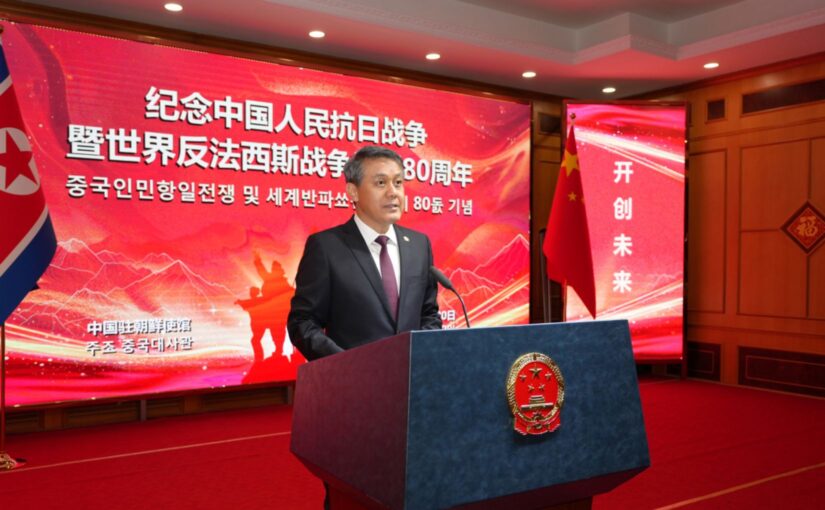
China and the Democratic People’s Republic of Korea (DPRK) have jointly marked the 80th anniversary of the victory of the war to resist aggression and the world anti-fascist war with a number of events.

The Chinese Embassy in the DPRK capital Pyongyang organised a reception on August 20. The Xinhua News Agency reported that among the guests present were Choe Ryong Hae, member of the Presidium of the Political Bureau of the Central Committee of the Workers’ Party of Korea (WPK), First Vice-President of the State Affairs Commission of the DPRK, and Chairman of the Standing Committee of the Supreme People’s Assembly of the DPRK, and DPRK Culture Minister Sung Jong Gyu.

Reporting the speech delivered by Chinese Ambassador Wang Yajun, the Korean Central News Agency (KCNA) said that he noted that, “the China-DPRK friendship was provided in the flames of the bloody revolutionary struggle, [and] stressed that Comrade Kim Il Sung, the great leader of the Korean people and a close friend of the Chinese people, made a great contribution to the victory of the Chinese People’s War of Resistance against Japanese Aggression by waging a death-defying struggle with the Japanese aggressors, together with the Northeast Anti-Japanese Allied Army.

“It is the steadfast policy of the Chinese party and government to successfully defend, consolidate and develop the traditional China-DPRK friendship at all times, he said, expressing the readiness to thoroughly implement the important common understanding made by the top leaders of China and the DPRK and thus advance the socialist cause of the two countries and to make contribution to the happiness of the peoples of the two countries and global peace and stability.”

His speech was followed by that from DPRK Culture Minister Sung Jong Gyu, who paid high tribute to the forerunners of the two countries who sacrificed their youth and lives without hesitation in the sacred anti-Japanese war, and said that the victory in the anti-Japanese war was a world historic event that brought to a close the Second World War with the victory of the world anti-fascist democratic forces and made a great contribution to form a main current with independence and peace in international relations.

He said that the DPRK will make joint efforts together with the Chinese comrades to steadily develop the friendly and cooperative relations forged on the road of accomplishing the cause of anti-imperialist independence and socialism true to the noble intention of the top leaders of the two parties and the two countries.

The website of the Chinese Embassy in Pyongyang carried the full text of both speeches.

It quoted Ambassador Wang Yajun as stating:

“The traditional friendship between China and the DPRK was forged in the revolutionary struggle of blood and fire. More than 80 years ago, the military and civilians of the two countries shared the same hatred and dealt a heavy blow to the Japanese invaders. Many people with lofty ideals in Korea went to China to carry out the anti-Japanese struggle, which received strong support from the Chinese people and inspired the fighting spirit of the Chinese people. In particular, Comrade Kim Il Sung, the great leader of the Korean people and a close friend of the Chinese people, fought to the death against the Japanese invaders together with the Northeast Anti-Japanese Allied Army of China, not only making immortal contributions to the liberation of Korea, but also making important contributions to the victory of the Chinese People’s War of Resistance Against Japanese Aggression. Comrade Kim Il Sung once fondly recalled the days when he was with his comrades-in-arms of the Northeast Anti-Japanese Alliance, saying that he had ‘stablished a deep friendship’ and that ‘the scene of that year is still fresh in his memory’.

“I would like to reiterate that safeguarding, consolidating and developing the traditional friendship between China and the DPRK has always been the unswerving policy of the Chinese Party and government. China is willing to work with the DPRK to resolutely implement the important consensus reached by the top leaders of the two parties and two countries, develop the traditional friendly and cooperative relations between China and the DPRK, promote the steady and far-reaching socialist cause of the two countries, benefit the two peoples, and promote regional and world peace and stability.”

Continue reading China and DPRK jointly celebrate the 80th anniversary of victory over Japanese imperialism

Friendship with Pakistan is cornerstone of China’s regional diplomacy

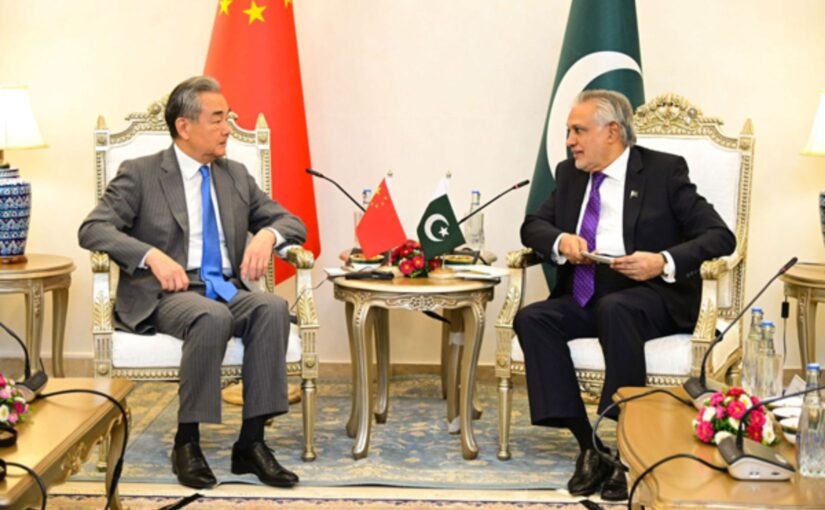
Following his visits to India and Afghanistan, Chinese Foreign Minister Wang Yi concluded his regional tour of South Asian countries, with a series of important meetings in the Pakistani capital Islamabad on August 21.

Co-chairing the Sixth Round of China-Pakistan Foreign Ministers’ Strategic Dialogue with Pakistani Deputy Prime Minister and Foreign Minister Mohammad Ishaq Dar, Wang Yi said that China and Pakistan are devoted friends tested by adversity and are also trustworthy and reliable ironclad friends. China will continue to prioritise Pakistan in its neighbourhood diplomacy, and will, as always, firmly support Pakistan in safeguarding its national independence, sovereignty and territorial integrity, countering terrorism, achieving unity and stability, accelerating development and revitalisation, and playing a greater role in international and regional affairs. Wang Yi congratulated Pakistan on assuming the rotating presidency of the United Nations Security Council for July, upholding justice for developing countries and enhancing Pakistan’s international standing and influence.

He added that China is working with neighbouring countries to promote the building of a neighbourhood community with a shared future. China is ready to make joint efforts with Pakistan to fully implement the important common understandings reached between President Xi Jinping and Pakistani leaders, make good preparations for high-level exchanges in the second half of the year, ensure that the building of a China-Pakistan community with a shared future continues to take the lead in the building of a neighbourhood community with a shared future, better benefit the people of both countries, and play a demonstrative role in safeguarding regional peace, stability, development and prosperity. China is ready to work with Pakistan to create an upgraded Version 2.0 of the China-Pakistan Economic Corridor (CPEC), strive to build a growth corridor, a livelihood-enhancing corridor, an innovation corridor, a green corridor and an open corridor, focus on the three key sectors of industry, agriculture, and mining, build and operate the Gwadar Port well, ensure the smooth passage of the Karakoram Highway, and promote the CPEC into a new stage of high-quality development. China is ready to deepen cooperation with Pakistan in areas such as information technology, cybersecurity, and people-to-people and cultural exchanges.

Mohammad Ishaq Dar thanked China for its steadfast support to Pakistan over the years, saying that as the international situation is undergoing profound changes, the strategic dialogue between the foreign ministers of Pakistan and China is timely and a concrete embodiment of the ironclad friendship between the two countries. Pakistan and China have strong political mutual trust, and bilateral relations have reached new heights, becoming a model for state-to-state relations. Friendship with China is the cornerstone of Pakistan’s foreign policy and a consensus shared throughout the nation. Pakistan upholds the one-China principle and firmly supports China without hesitation on all issues concerning China’s core interests.

Following their dialogue, the two Foreign Ministers jointly met the press.

Wang Yi said that South Asian countries have a long history, splendid civilisation, large population, and huge development potential. They are China’s close neighbours linked by mountains and rivers, and also an important direction for China to build a community with a shared future in its neighbourhood. Stressing that he felt the immense development potential and resilience of South Asia following this visit to India, Afghanistan and Pakistan, Wang Yi said the 21st century should be an era of accelerated development and revitalisation for Asia, especially South Asia.

He added that although India, Afghanistan and Pakistan have different national conditions, they all recognise that development is the top priority and the broadest consensus among them, as well as among all countries in the region. A peaceful, stable and prosperous South Asia serves the common interests of all parties and meets the aspirations of the people of all countries. In the face of pressure from unilateral and bullying acts, the three countries all believe that they should adhere to multilateralism, safeguard their legitimate rights and interests, and strive to promote an equal and orderly multipolar world and universally beneficial and inclusive economic globalisation.

Wang Yi emphasised that China pursues a policy to foster an amicable, secure and prosperous neighbourhood, adheres to the principle of amity, sincerity, mutual benefit and inclusiveness, and upholds the vision of a shared future. China has always been committed to fostering mutual respect, mutual understanding, and mutual trust with South Asian countries, and helping each other succeed. China and South Asian countries are natural partners, with broad space for cooperation. Despite ups and downs, China-India relations have a long history and increasingly demonstrate a clear historical logic. The China-Pakistan friendship has withstood the test of time, become as strong as steel, and gained stronger internal impetus. The relationships between China and Pakistan, China and India, as well as China and other neighbouring countries, are not directed against any third party and are not subject to any third-party influence. The building of a China-Pakistan community with a shared future is at the forefront of China’s building a community with a shared future with neighbouring countries, setting an important example. The building of the China-Pakistan Economic Corridor will not only benefit the people of the two countries but also extend to Afghanistan and other countries.

Continue reading Friendship with Pakistan is cornerstone of China’s regional diplomacy

China extends a hand of friendship to Afghanistan

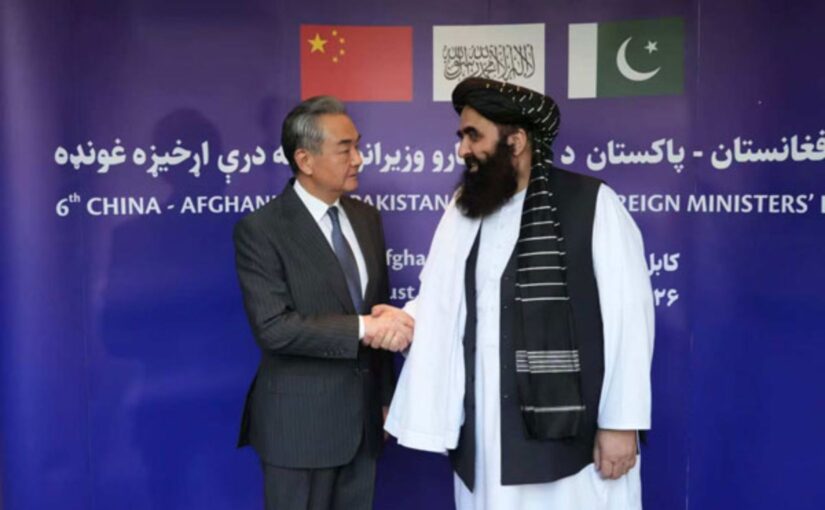
Following his successful visit to India, Chinese Foreign Minister Wang Yi flew to Kabul, Afghanistan, for a series of meetings on August 20.

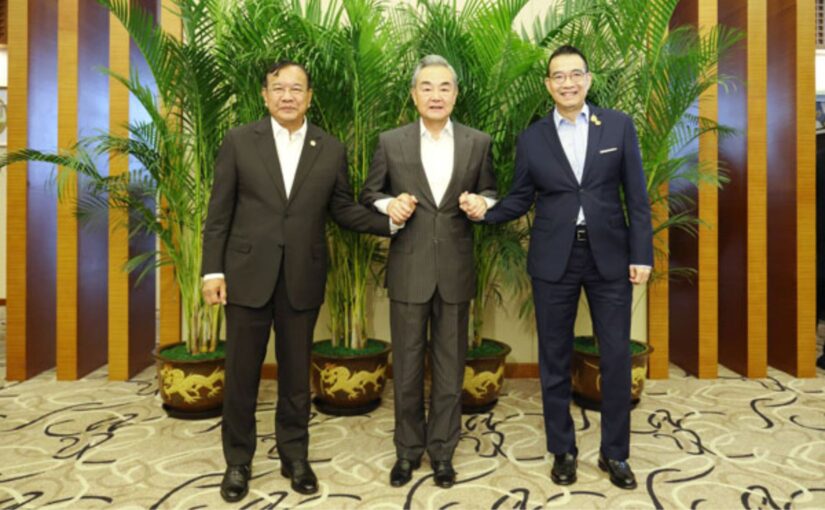
Wang Yi participated in the Sixth China-Afghanistan-Pakistan Trilateral Foreign Ministers’ Dialogue together with Afghan Foreign Minister Mawlawi Amir Khan Muttaqi and Pakistani Deputy Prime Minister and Foreign Minister Mohammad Ishaq Dar.

Wang Yi said that since the trilateral foreign ministers’ dialogue mechanism was resumed in Tunxi, Anhui Province in 2022, the three sides, based on the principles of mutual respect, equal-footed consultation and mutual benefit, have continuously advanced cooperation in the fields of politics, development and security, safeguarded regional peace and tranquility, and responded to various risks and challenges. He added that China is ready to work with Afghanistan and Pakistan to deepen good-neighbourliness and mutual trust, render mutual understanding and support on issues concerning each other’s core interests, and firmly oppose interference by any external forces in the region, as well as any organisation or individual engaging in acts within their countries that undermine the national sovereignty, security and territorial integrity of the other sides.

He noted that China and Pakistan have been at the forefront of the international community and regional neighbours in helping Afghanistan restabilise and rebuild the country and expand its foreign exchanges. China will continue to uphold justice for Afghanistan on multilateral occasions, encourage the international community to engage with Afghanistan in a constructive manner, and support Afghanistan in advancing the normalisation of its diplomatic relations. The three sides should expand development cooperation, increase trade and investment exchanges, strengthen the building of connectivity networks, and enhance people-to-people bonds. And they should improve the security dialogue mechanism, deepen law enforcement and security cooperation, intensify efforts to combat transnational terrorist activities, and eradicate the breeding ground of terrorism by addressing both symptoms and root causes on the basis of consensus. It is important to uphold the principle of indivisible security, respect each other’s legitimate security concerns, and blaze a path of cooperative and common security.

 Mawlawi Amir Khan Muttaqi welcomed the attendance of the Chinese and Pakistani foreign ministers at the dialogue and thanked China and Pakistan for their steadfast support for Afghanistan on the international stage. He said that given the profound changes in the current international and regional situation, Afghanistan hopes to take this meeting as an opportunity to deepen friendly relations, strengthen coordination and collaboration, and work for greater development of trilateral cooperation.

Mohammad Ishaq Dar said that Pakistan, China and Afghanistan share close historical, cultural and economic ties, and that trilateral cooperation enjoys great potential. The three sides should jointly advance their partnership, and enhance cooperation in trade, the Belt and Road Initiative, connectivity, counter-terrorism and other areas to achieve common development. As a neighbouring country of Afghanistan, Pakistan is willing to make greater contributions to the peace process in Afghanistan and to improving the livelihood of the Afghan people. Pakistan also called for the unfreezing of Afghanistan’s overseas assets.

Meeting with Wang Yi, Afghan Prime Minister Mullah Mohammad Hassan Akhund asked him to convey his cordial greetings to Chinese leaders. He said that the Chinese government and people have always held a friendly and positive attitude towards Afghanistan, and thanked China for speaking up for Afghanistan on the international stage. China is a force for justice in the world and is consistently committed to friendly cooperation with Afghanistan and other countries for common development and progress. History has shown that those countries attempting to interfere in other nations’ affairs will only suffer the consequences, while those pursuing friendly policies will achieve success. This is China’s unique strength. Afghanistan does not wish to and will not create trouble for other countries. Afghanistan looks forward to strengthening cooperation with China to advance a positive and sustainable friendly relationship. Afghanistan will never allow any force to use its territory to threaten China and will always stand firmly with China.

Wang Yi conveyed the kind greetings of the Chinese leaders and said that China-Afghanistan exchanges have spanned thousands of years, and the two countries have always maintained friendly relations. He noted that throughout history, imperialists, colonialists and hegemonists have all attempted to invade Afghanistan but all have failed, and such schemes will not succeed in the future. The world should not be one where the rich get richer and the poor get poorer. Every country, including Afghanistan, has the right to achieve development and revitalisation.

Continue reading China extends a hand of friendship to Afghanistan

Dongji Rescue: An inspiring blockbuster of courage, resistance and shared humanity

Friends of Socialist China (FOSC) was grateful to be invited to the European premiere of the film Dongji Rescue by the Chinese Embassy. The screening took place in the Odeon Luxe in Leicester Square, a grand venue fit for the opening of such a blockbuster film, attended by some of China’s biggest acting stars. The premiere took place on the 15th of August, the 80th anniversary of VJ day, commemorating the allied victory over imperial Japan in World War Two, the most appropriate date for a film examining the shared Chinese and British fight against fascism.

We are very pleased to publish the following review by FOSC Britain Committee member Alfie Howis and hope that as many as possible of our readers take the opportunity to see this inspiring and moving film.

Dongji Rescue is effectively a follow up to the documentary The Sinking of the Lisbon Maru which was released earlier this year. The documentary was a groundbreaking study of the sinking of a Japanese ship off China in 1942 by a US submarine, killing over 800 British POWs onboard who had been captured in Hong Kong, with 384 others rescued from the water by Chinese villagers from the nearby island. The film follows the story of the people on Dongji Island defying their Japanese occupiers and setting sail to rescue, and fight alongside, the drowning British soldiers at the shipwreck. The film was made possible as part of an initiative by the Chinese government to promote media about the Chinese People’s War of Resistance Against Japanese Aggression and the World Anti-fascist War, to maintain accurate memory of Japanese imperialism and learn lessons from the successful fight against it.

“At the darkest hour of the Second World War, China and the UK fought on different fronts but shared a common mission: to defend humanity against fascism and aggression. Fighting side by side, the peoples of our two countries forged a deep friendship,” said Chinese Ambassador Zheng Zeguang at the premiere. Public awareness of China’s role in WW2 is deeply lacking in Britain, and even where there is knowledge of it, the scale of China’s contribution, even beyond their own fight for national liberation, is lost on most. Dongji Rescue, which is now on general release across UK cinemas, will go some way to rectifying that and may help contribute to a deepening  of the understanding of this topic.

Dongji Rescue is a film about heroism, solidarity, and anti-fascism, but above all it shows the power of collective, militant struggle to resist oppression and take the most just course of action. Throughout the film there are individual heroes, but the central junction of the narrative is the collective decision of the islanders, after wavering on the part of some, to rise up against the Japanese occupation, take to their boats, and risk death together in order to save the soldiers. This would not have been possible without all of the boats taking to the seas as one in a unified action, able to overwhelm the Japanese forces on the sinking ship and provide enough space to rescue hundreds of POWs. The sense of solidarity that the villagers embody as they liberated themselves, however briefly, from occupation is extended to the British men as they share the same struggle in that one moment, both fighting for their lives under attack from the same seemingly overwhelming force, in the end blunted by their collective bravery and resistance. Even the regimented and rank subordinated POWs can only succeed through self-organised collective efforts. Whether freeing themselves from the locked hold or flipping Japanese motorboats, the reactive instinct of the men goes beyond the orders from their commanders and is more akin to the spirit embodied by the islanders, which ultimately saves many of their lives.

Continue reading Dongji Rescue: An inspiring blockbuster of courage, resistance and shared humanity

80 years since the end of World War II – Japanese militarism has not changed its spots

In the following contributed article, Stephen Chang of People’s Forum Ltd. (UK) outlines how, far from uprooting the soil in which Japanese militarism and fascism had bred, the United States, as the occupying power following Japan’s surrender 80 years ago, pressed leading war criminals from Emperor Hirohito himself down into the service of its own hegemonic project. As a result, the USA, along with its client state Japan, remains today the greatest threat to peace in the Asia Pacific region. Vigilance is needed.

As we commemorate Japan’s unconditional surrender 80 years ago, on 15 August 1945, which ended WWII in Asia Pacific, we must remain vigilant.

Hirohito, the war time emperor of Japan, was a war criminal who escaped punishment on the insistence of the US.  Hirohito was directly and personally involved in the conduct of Japan’s invasion of sovereign nations and the death and atrocities inflicted on millions of civilians during WWII in Asia Pacific. Hirohito’s surrender speech is full of lies, half-truths and distortion of facts about Japan’s declaration, conduct and even surrender of its barbaric war against the people of the Asia Pacific region.

Hirohito, in his surrender speech, referred to Japan’s four years of war in Asia Pacific.  This is a blatant lie. Japan invaded and occupied part of northern China, namely the Manchurian region, on 18 September in 1931, attacked and bombed Shanghai in 1932, and expanded its war on the rest of China in 1937.  The reference to four years by Hirohito (1941-1945) is a deliberate attempt on the part of fascist Japan to exclude and ignore its invasion and occupation of part of China from 1931 and the atrocities committed in China like the massacre of 300,000 Chinese civilians, men, women and children, in Nanjing in 1937.

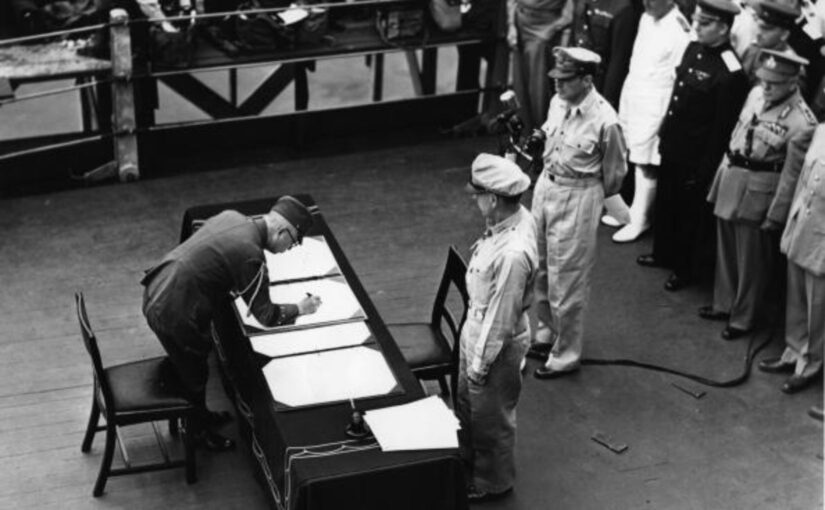
Fascist Japan announced its unconditional surrender to the Allied powers (China, Soviet Union, UK and USA) on 15 August 1945 and formally surrendered on 2 September 1945.   China declared the end of the Chinese people’s war against the Japanese invaders on 3 September 1945, and the formal ceremony of Japan’s surrender to China took place on 9 September 1945.  So, WWII in Asia lasted 14 years, not four years as claimed by war criminal Hirohito, as China forms a large part of Asia and suffered most severely from Japan’s war crimes and atrocities.

Why was Hirohito not tried as a war criminal?  Because the USA wanted a fascist puppet regime in the Asia Pacific region to further its post WWII global imperial domination.  Hirohito remained emperor of Japan until his death in 1989.  In 1971, the UK, a subservient nation to the US, accorded this war criminal the highest honour of an official State Visit.  Under Hirohito, and Japan’s post war constitution drafted by the US, Japan became an effective puppet state of the US from the end of WWII to the present time.

We should know that Nobusuke Kishi, Prime Minister of Japan from 1957 to 1960, was the mastermind of Japan exploitative economic and industrial policies in the Manchurian region of China from 1932 following its invasion in 1931, enslaving millions of Chinese for the benefit of Japan.  This is also where Japan’s Unit 731, the secret Japanese military testing facility (on live Chinese, Korean, Russian and other men, women and children) for biological warfare was based – in Harbin.

None of the leaders of Unit 731 were prosecuted for war crimes at the insistence of the US, in exchange for full disclosure to the US by Japan of the findings and results of its biological warfare experiments. (Only the Soviet government set up a special military tribunal at Khabarovsk in December 1949 to hold a joint trial of 12 former Japanese army officers on criminal charges relating to Unit 731’s wartime activities.) Unit 731 commanding officer Surgeon General Shiro Ishii, who commanded bubonic plague attacks on the Chinese cities of Changde and Ningbo, was awarded a special service medal by war criminal Hirohito and was granted immunity from war crimes against humanity by the US in 1948.  He was subsequently hired by the US to lecture US officers at Fort Detrick on the use of bioweapons and the findings made by Unit 731.

General Dr Masaji Kitano was the second commander of Unit 731 from 1942.  He too was granted immunity from war crimes prosecution and released as a POW and repatriated to Japan in 1946.   Using his biological warfare knowledge, in 1950 Kitano was a founder of Green Cross Corporation, which became one of Japan’s premier pharmaceutical companies, now known as Mitsubishi Pharma Corporation.  Murray Sanders, the US officer who led the US cover-up of Japanese war crimes, became a consultant to Green Cross.

In 1941 Kishi became a member of Japan’s WWII cabinet.  He was arrested to face trial as a Class A war criminal on Japan’s surrender.  However, the US released him without charges in 1948 and groomed him to be a leader of post war Japan.  This war criminal was elected to Japan’s parliament (National Diet) in 1953. With US support, he consolidated Japanese conservatives so as to counter the influence of Japan’s Socialist and Communist parties.  In 1955 he was instrumental in the establishment of the Liberal Democratic Party.  He was also key to setting up the “1955 System” that provided the basis for the LDP to remain Japan’s dominant party.

Kishi’s (the war criminal turned prime minister of Japan) younger brother, Eisaku Sato, was Japan’s prime minister from 1964 to 1972.   Kishi’s grandson, Shinzo Abe, was Japan’s prime minister from 2012 (the start of the Obama/Clinton “Pivot to Asia Pacific” designed to contain China) to 2020.

We should know that today:

  • Japan’s military is the fifth largest in the world and based on its current military budget is projected to become the third largest after the US and China.
  • The US has 120 active military bases and 55,000 military personnel in Japan.
  • Japan is home to the US’ largest and most heavily armed overseas military base.
  • The US military is the main and greatest beneficiary from the Japanese WWII Unit 731 biowarfare research on live human beings.

The US, the leader of the “free world” since WWII, self-styled beacon of democracy and human rights, and party to Japan’s war crimes against humanity, is today, together with its puppet client state Japan, the greatest threat to peace in the Asia Pacific region and globally.

While we commemorate the end of WWII 80 years ago, we must remember that the US is the main country in the world that has waged covert and overt wars against sovereign nations in most if not all of the 80 years since the end of WWII.

Wang Yi’s visit turns the corner on relations with India

As we recently noted, relations between China and India have lately been seeing significant improvement. This process has now been qualitatively accelerated with the August 18-20 New Delhi visit by Chinese Foreign Minister Wang Yi.

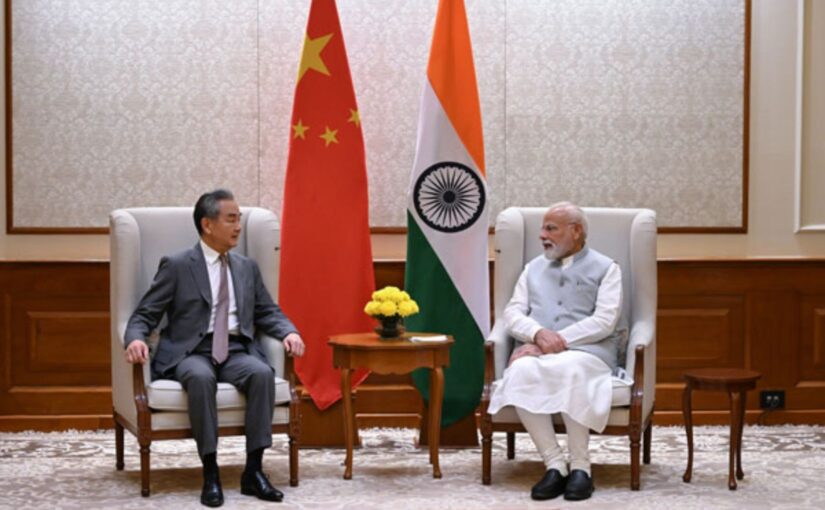
On August 19, Wang Yi met with Indian Prime Minister Narendra Modi.

Prime Minister Modi asked Wang Yi to convey his cordial greetings to President Xi Jinping and Premier Li Qiang and expressed his anticipation of visiting China to attend the Shanghai Cooperation Organisation (SCO) Tianjin Summit, to be held end August, and meet with President Xi Jinping. (This will be Modi’s first visit to China in seven years.) India will fully support China’s work as the rotating chair of the SCO to ensure the complete success of the Summit.

The Prime Minister said that both India and China are ancient civilisations, and they have enjoyed a long history of friendly exchanges. The meeting between the leaders of the two countries at the BRICS Summit in Kazan, Russia, last October marked a turning point for the improvement and development of bilateral relations. India and China are partners, not rivals, and are facing the common task of accelerating development. The two sides should also properly manage and settle boundary questions, so that differences will not evolve into disputes.

Modi added that that this year marks the 75th anniversary of the establishment of diplomatic relations between India and China. Both sides should view bilateral relations from a long-term perspective. India-China cooperation is indispensable for the advent of an Asian century. Working hand in hand, the two sides will contribute to world development and benefit all humanity.

Wang Yi said that the successful meeting between the leaders of the two countries in Kazan last October has provided guidance for the resumption and a new start for China-India relations. This has not come by easily and should be cherished. He added that his visit to India, upon invitation, to attend the Talks Between the Special Representatives of China and India on the Boundary Question also serves to prepare for high-level exchanges between the two countries. Through comprehensive and in-depth communication, in terms of bilateral relations, the two sides have agreed on restarting dialogue mechanisms across various fields, deepening mutually beneficial cooperation, upholding multilateralism, jointly addressing global challenges, and opposing unilateralism and bullying acts. On boundary questions, the two sides reached new consensus on conducting normalised management and control, maintaining peace and tranquility in the border areas, properly handling sensitive issues, and initiating boundary delimitation negotiations in areas where the conditions are met.

Continue reading Wang Yi’s visit turns the corner on relations with India

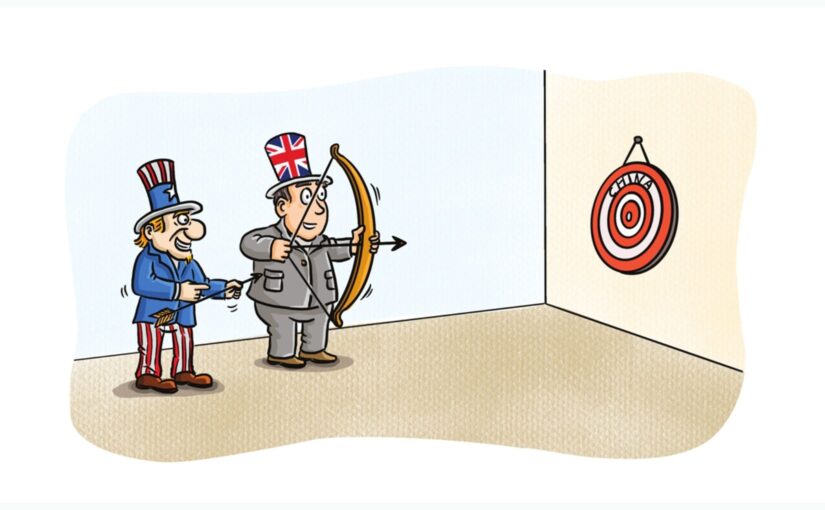
The real reason the West is warmongering against China

In the opinion piece below, originally published in Al Jazeera, Jason Hickel and Dylan Sullivan argue that Western hostility towards China is not driven by serious concerns over China’s putative threat to the “international rules-based order” but rather by its very real challenge to the imperial economic order. Over the past two decades, US policy has shifted from cooperation to confrontation, with sanctions, trade restrictions and military build-up. The authors write: “Washington wants people to believe that China poses a threat. China’s rise indeed threatens US interests, but not in the way the US political elite seeks to frame it.”

The article situates US-China tensions in the framework of the capitalist world system, where the core imperialist states rely on cheap labour and resources from the Global South. For decades, China provided low-cost but skilled labour for Western supply chains. However, wages in China have risen from under $1 an hour in the early 2000s to over $8 today, undermining Western firms’ profits and reducing the West’s ability to extract value through unequal exchange. Strengthened public services and state intervention over the last two decades have further empowered Chinese workers.

At the same time, China is putting an end to the West’s monopoly in advanced technology, and now leads in sectors like renewable energy, electric vehicles, AI, and high-speed rail. This gives developing countries alternative suppliers and threatens the West’s strategy of maintaining dependency. The authors observe that this “poses a fundamental challenge to the imperial arrangement.”

Beijing has used industrial policy to prioritise technological development in strategic sectors over the past decade, and has achieved remarkable progress. It now has the world’s largest high-speed rail network, manufactures its own commercial aircraft, leads the world on renewable energy technology and electric vehicles, and enjoys advanced medical technology, smartphone technology, microchip production, artificial intelligence, etc. The tech news coming out of China has been dizzying. These are achievements that we only expect from high-income countries, and China is doing it with almost 80 percent less GDP per capita than the average “advanced economy”. It is unprecedented.

This poses a problem for the core states because one of the main pillars of the imperial arrangement is that they need to maintain a monopoly over necessary technologies like capital goods, medicines, computers, aircraft and so on. This forces the “Global South” into a position of dependency, so they are forced to export large quantities of their cheapened resources in order to obtain these necessary technologies. This is what sustains the core’s net-appropriation through unequal exchange.

China’s technological development is now breaking Western monopolies, and may give other developing countries alternative suppliers for necessary goods at more affordable prices. This poses a fundamental challenge to the imperial arrangement and unequal exchange.

In response, the US has turned to sanctions and escalating military rhetoric, presenting China as a threat to global security. But this is transparent propaganda.

The material facts tell a fundamentally different story. In fact, China’s military spending per capita is less than the global average, and 1/10th that of the US alone. Yes, China has a big population, but even in absolute terms, the US-aligned military bloc spends over seven times more on military power than China does. The US controls eight nuclear weapons for every one that China has…

Furthermore, China has not fired a single bullet in international warfare in over 40 years, while during this time the US has invaded, bombed or carried out regime-change operations in over a dozen Global South countries. If there is any state that poses a known threat to world peace and security, it is the US.

The authors conclude that the real reason for Western warmongering is that “China is achieving sovereign development and this is undermining the imperial arrangement on which Western capital accumulation depends”. That is, China’s rise, its alignment with the countries of the Global South and its promotion of multipolarity are posing an existential threat to the imperialist world system.

Over the past two decades, the posture of the United States towards China has evolved from economic cooperation to outright antagonism. US media outlets and politicians have engaged in persistent anti-China rhetoric, while the US government has imposed trade restrictions and sanctions on China and pursued military build-up close to Chinese territory. Washington wants people to believe that China poses a threat.

Continue reading The real reason the West is warmongering against China

Myanmar peace and reconciliation discussed in four-party talks

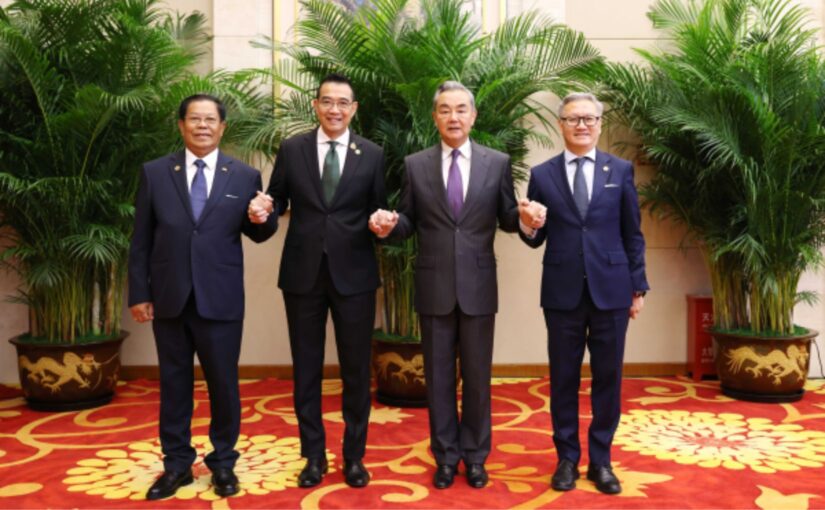
During the tenth Lancang-Mekong Cooperation (LMC) Foreign Ministers’ Meeting, which was held in Anning, in China’s southwestern Yunnan province, on August 15 Chinese Foreign Minister Wang Yi also held an important quadrilateral meeting on the sidelines, together with Lao Foreign Minister Thongsavanh Phomvihane, Myanmar Foreign Minister Than Swe, and Thai Foreign Minister Maris Sangiampongsa, which was focused on the situation in Myanmar and its implications for the country’s immediate neighbours.

Wang Yi said that China, Laos, and Thailand, as friendly neighbours of Myanmar, have a better understanding of Myanmar’s unique national conditions and are more eager to see Myanmar restore stability, achieve national reconciliation, hold an open and fair general election, and pursue a development path suited to its national conditions and supported by its people. Since the first quadrilateral meeting last year, the situation in Myanmar has generally stabilised, and efforts are underway to advance post-earthquake reconstruction and safeguard its sovereignty, independence and national stability. He called for adhering to a “Myanmar-led, Myanmar-owned” approach, supporting the choices of the Myanmar people, and resolving differences through dialogue. The Chinese Foreign Minister also stressed the importance of mediation by ASEAN (the Association of South East Asian Nations) and assistance from neighbouring countries, with ASEAN serving as the main channel, while also giving full play to mechanisms like the Informal Discussion between the Foreign Ministers of China, Laos, Myanmar and Thailand and the Foreign Ministers’ Meeting among the Neighbouring Countries of Myanmar. He further urged prioritising people’s livelihoods and development, supporting Myanmar in improving people’s well-being and post-earthquake reconstruction, and promoting cooperation in various fields for people’s benefit, while warning against improper interference by external forces that could undermine regional stability.

The Myanmar side expressed gratitude for the support and assistance provided by China, Laos and Thailand, as friendly neighbouring countries, in addressing challenges. It reiterated its commitment to advancing the domestic peace and reconciliation process through political dialogue and stated that it is actively preparing for an open and transparent general election at the end of the year to return power to the people.

The Lao side expressed its support for a “Myanmar-led, Myanmar-owned” political process and for Myanmar’s general election to achieve peace, stability and national reconciliation.

The Thai side stated that the Myanmar issue is an internal affair of the country, and the international community should respect the choices of the Myanmar people.

The following article was originally published on the website of the Chinese Foreign Ministry.

On August 15, 2025, China, Laos, Myanmar and Thailand held an informal discussion between foreign ministers in Anning, Yunnan. Member of the Political Bureau of the CPC Central Committee and Foreign Minister Wang Yi, Lao Foreign Minister Thongsavanh Phomvihane, Foreign Minister of Myanmar Than Swe, and Thai Foreign Minister Maris Sangiampongsa were present.

Wang Yi said that China, Laos, and Thailand, as friendly neighbors of Myanmar, have a better understanding of Myanmar’s unique national conditions and are more eager to see Myanmar restore stability, achieve national reconciliation, hold an open and fair general election, and pursue a development path suited to its national conditions and supported by its people. Since the first quadrilateral meeting last year, the situation in Myanmar has generally stabilized, and efforts are underway to advance post-earthquake reconstruction and safeguard its sovereignty, independence and national stability. Wang Yi called for adhering to a “Myanmar-led, Myanmar-owned” approach, supporting the choices of the Myanmar people, and resolving differences through dialogue. Wang Yi stressed the importance of mediation by ASEAN and assistance from neighboring countries, with ASEAN serving as the main channel, while also giving full play to mechanisms like the Informal Discussion between the Foreign Ministers of China, Laos, Myanmar and Thailand and the Foreign Ministers’ Meeting among the Neighboring Countries of Myanmar. He also urged prioritizing people’s livelihoods and development, supporting Myanmar in improving people’s well-being and post-earthquake reconstruction, and promoting cooperation in various fields for people’s benefit, while warning against improper interference by external forces that could undermine regional stability.

The Myanmar side briefed on the domestic situation and preparations for the upcoming general election, stating that since the last meeting, the domestic situation in Myanmar has generally deescalated and stabilized. The Myanmar side expressed gratitude for the support and assistance provided by China, Laos and Thailand, as friendly neighboring countries, in addressing challenges. The Myanmar side reiterated its commitment to advancing domestic peace and reconciliation process through political dialogue, and stated that it is actively preparing for an open and transparent general election at the end of the year to return power to the people.

The Lao side expressed its support for a “Myanmar-led, Myanmar-owned” political process and for Myanmar’s general election to achieve peace, stability and national reconciliation.

The Thai side stated that the Myanmar issue is an internal affair of the country, and the international community should respect the choices of the Myanmar people. The general election is an important step in Myanmar’s political transition. Thailand is willing to work with other ASEAN countries to provide support and assistance for the smooth progress of Myanmar’s general election based on the principle of non-interference in internal affairs.

The four foreign ministers exchanged views on joint efforts to combat cross-border crimes. Wang Yi pointed out that combating cross-border crimes bears on the well-being and safety of the people, represents a common concern of the four countries, and requires coordinated action. Since the last meeting, the four parties have closely cooperated, strengthened border control, and achieved notable results in jointly combating cross-border crimes. However, the regional security situation is still not optimistic, requiring continued coordinated efforts. First, strengthen conceptual guidance and institutional building to implement the Global Security Initiative. Second, strengthen joint operations and border control to block any attempt by lawbreakers to commit cross-border crimes. Third, strengthen capacity building and judicial coordination, and enhance publicity, education, and law enforcement training. Fourth, strengthen transformation development and social governance, coordinate security and development, continuously improve local socioeconomic conditions, and eradicate the breeding ground for illicit and gray industries.

The four parties agreed to continue to strengthen law enforcement and security cooperation, step up efforts to combat cross-border crimes, including online gambling, telecom fraud, drug and weapon trafficking, and human trafficking, and jointly safeguard regional peace and stability.

Britain is sinking into ‘yellow peril’ hysteria on China

In the article below, written for the Morning Star, Carlos Martinez discusses Britain’s intensifying Sinophobia, describing it as a new McCarthyism aimed at preparing public opinion for confrontation with China. He argues that recent media stories – about Chinese students being pressured to spy on their classmates, Hong Kong separatists facing legal action, and opposition to China’s proposed new embassy in Tower Hamlets – are part of a broader hybrid war being led by the US and followed by Britain.

Underlying this torrent of anti-China stories is a geopolitical reality of the US applying pressure on Britain to downgrade its cooperation and trade with China. As Jenny Clegg has written, “the US elite has convinced itself that China is intent on taking over the world, just as Fu Manchu threatened to disintegrate Western civilisation back in 1912.” Carlos observes that, “in the current geopolitical conjuncture, where the US goes, Britain almost invariably follows.”

The article concludes that ordinary people in Britain have nothing to gain from hostility towards China.

This new McCarthyism and “yellow peril” fear-mongering serve to build public support for the project of waging a new cold war — and potentially a hot war — against the People’s Republic of China. By corollary, it also seeks to demonise and isolate those of us who oppose the new cold war and who are working towards a future of peace, friendship and co-operation.

The British working class has nothing to gain by falling for this nonsense. China’s proposal is for mutual respect and non-interference; an economic relationship based on mutual benefit; and for close co-operation on the central issues of our era: climate change, pandemics, peace and development.

A spectre is haunting Britain: the spectre of the Communist Party of China. The last couple of weeks have witnessed a flurry of news reports reminding the good people of this country about the imminent threat posed to their way of life by Xi Jinping and his henchmen.

Continue reading Britain is sinking into ‘yellow peril’ hysteria on China

Mekong Foreign Ministers meet in China’s city of peace and harmony

On August 15, 2025, the tenth Lancang-Mekong Cooperation (LMC) Foreign Ministers’ Meeting was held in Anning, in China’s southwestern Yunnan province.

The LMC is a cooperation mechanism, founded a decade ago, that groups China with five of its close southeast Asian neighbours who all share the Mekong River.

Following the meeting, Chinese Foreign Wang Yi and his Thai counterpart, Maris Sangiampongsa, as co-chairs of the gathering, jointly met the press to brief on its outcome.

Wang Yi said that over the past decade, the building of the Lancang-Mekong Cooperation Economic Development Belt has made a smooth start. Trade between China and the five Mekong countries has reached 437 billion US dollars, an increase of 125 percent. Both hard and soft connectivity of regional infrastructure have been strengthened, industrial and supply chain cooperation has deepened, and the Innovation Corridor has become a new highlight of development.

He added that the six Lancang-Mekong countries, as a natural community with a shared future, have gained invaluable experience from a decade of cooperation. In the face of multiple international and regional challenges, the key to the robust growth of the LMC lies in adherence to four principles: first, uphold good-neighbourliness, friendship and a shared future; second, focus on development and pragmatic cooperation; third, ensure benefits for the people and remain open and inclusive; fourth, pursue innovation as the driving force and implement pilot projects.

As the day also marked the 80th anniversary of Japan’s unconditional surrender in World War Two, Wang Yi further said that he would like to state clearly China’s position on this very day. Eighty years ago today, Japan was defeated, accepted the Potsdam Proclamation and announced its unconditional surrender. The war of aggression waged by Japanese militarists at that time inflicted catastrophes not only on the people of China and other Asian countries, but also on the people of Japan. A series of international documents, including the Cairo Declaration and the Potsdam Proclamation, clearly defined Japan’s responsibility for the war and required that Japan return all the territories it had stolen from China, including Taiwan. This is an indisputable outcome of the victory in the World Anti-Fascist War and constitutes an important part of the post-war international order. Yet to this day, certain forces in Japan are still trying to whitewash or deny the aggression, distort or falsify history, and even honour the war criminals and justify their crimes. Such despicable and disgraceful actions bring shame upon themselves, and challenge the United Nations Charter, the post-war international order, human conscience, and all the people of the victorious countries. Only by facing up to history can respect be earned; only by drawing lessons from history can a future be forged; only by remembering the past can straying onto the wrong path again be avoided.

The previous day, Wang Yi had held a trilateral gathering as well as bilateral exchanges with all five of his counterparts.

He held a ‘tea chat’ with Cambodian Deputy Prime Minister and Minister of Foreign Affairs and International Cooperation Prak Sokhonn and Thai Foreign Minister Maris Sangiampongsa, providing an opportunity to discuss the current Thai-Cambodian border dispute in a friendly and candid way.

‘Tea chats’ are playing an increasing role as an arm of Chinese diplomacy as ‘tea culture’ is deeply embedded not only in Chinese society but also in many other countries in east and southeast Asia.

Wang Yi stated that neither Cambodia nor Thailand wants the border conflict to continue, and both are willing to resume dialogue and improve relations. The Lancang-Mekong Cooperation Foreign Ministers’ Meeting held in Anning has provided an opportunity for this. The name “Anning” signifies peace, harmony, and amity, which is also the way neighbours should get along.

The Chinese side is ready, in line with the wishes of Cambodia and Thailand, to provide support and assistance for the clearing of mines and other activities in the border areas of the two countries. As an old Chinese saying goes, “Brothers may quarrel within the family, but they stand together against outside threats.”

The Chinese Foreign Ministry reported five outcomes from the chat, including that:

  • Cambodia and Thailand have expressed their commitment to strengthening engagement and communication, resuming normal exchanges at the earliest time, and rebuilding and enhancing mutual trust. 
  • Cambodia and Thailand are encouraged to build up conditions for returning to normality in the border areas, so as to live up to the expectations of the people living there.
  • Based on the wishes of Cambodia and Thailand, China stands ready to continue its constructive role, including providing support and assistance for de-mining in the border areas agreed by both Cambodia and Thailand.

Meeting with Deputy Prime Minister and Foreign Minister of Vietnam Bui Thanh Son, Wang Yi stated that this year marks the 80th anniversary of the victory of the Chinese People’s War of Resistance Against Japanese Aggression and the founding of the United Nations, as well as the 80th anniversary of the founding of Vietnam and the 50th anniversary of the liberation of the South. During the years of pursuing national independence and liberation, China and Vietnam treated each other with sincerity and stood together to provide mutual assistance, forging a deep friendship featuring the spirit of being both “comrades and brothers”. In the course of China’s reform and opening up, as well as Viet Nam’s Doi Moi reforms, the two countries have supported each other and moved forward hand in hand, blazing socialist paths towards modernisation suited to their respective national conditions. Facing profound changes unseen in a century, China is ready to work with Vietnam to carry forward traditional friendship, strengthen strategic mutual trust, implement the outcomes of General Secretary and President Xi Jinping’s state visit to Vietnam, jointly build a China-Vietnam community with a shared future that carries strategic significance, ensure that China-Vietnam mutually beneficial cooperation brings greater benefits to the peoples of both countries, and make due contributions to regional peace and stability.

Continue reading Mekong Foreign Ministers meet in China’s city of peace and harmony