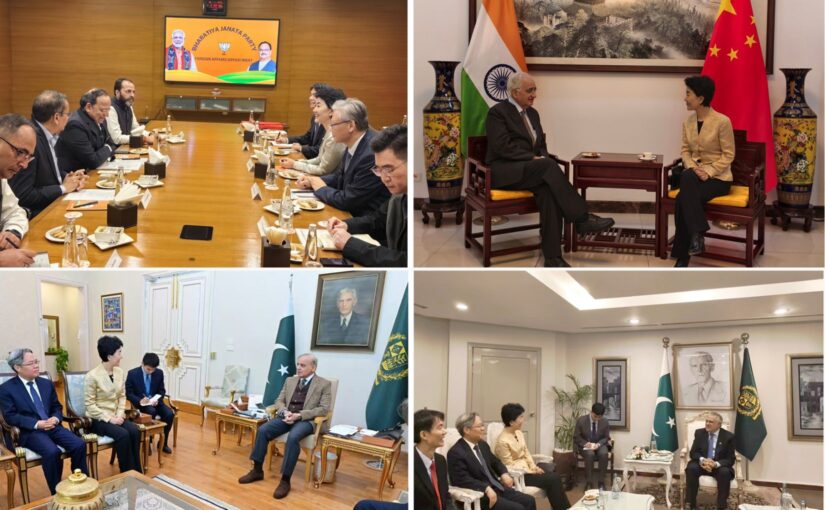
Sun Haiyan, Vice-Minister of the International Department of the Communist Party of China (CPC) Central Committee (IDCPC), led a party delegation to visit India, January 12-14, and then visited Pakistan on January 15.
In India, the delegation met respectively with Vikram Misri, Indian Foreign Secretary, Arun Singh, National General Secretary of the Bharatiya Janata Party (BJP), and Salman Khurshid, Chairman of the Foreign Affairs Department of the Indian National Congress (INC) and former Minister of External Affairs of India, and held collective exchanges with Indian left-wing leaders including D. Raja, General Secretary of the Communist Party of India (CPI), G. Devarajan, General Secretary of All India Forward Bloc, and Arun Kumar, Member of the Political Bureau of the Communist Party of India (Marxist) (CPIM).
Vikram Misri said that under the joint guidance of the leaders of both countries, India-China relations have developed steadily, and exchanges and cooperation have made positive progress. India hopes to work with China to take positive measures to promote closer exchanges and cooperation in various fields and jointly create a favorable atmosphere. The website of India’s Ministry of External Affairs added that: “The discussions covered the progress made in stabilising and rebuilding bilateral ties with priority on business and people-centric engagements, and ways to take bilateral engagement forward in the new year. The Chinese side congratulated the Indian side on assuming the BRICS chairship this year and expressed its strong support for a successful BRICS Summit in India.”
Arun Singh said that the BJP hopes to strengthen dialogue with the CPC to enhance understanding and mutual trust and contribute to the development of relations between the two countries. For his part, Salman Khurshid said that the INC had made important contributions to promoting India-China friendship in history and believes that under the new circumstances, both sides should strengthen exchanges to jointly improve the well-being of the people of both countries.
Indian left-wing leaders expressed their firm support for India-China friendship and their hope of further strengthening inter-party relations and deepening exchanges and mutual learning with the CPC. Representatives from Indian think tanks, media, youth, and other sectors expressed their willingness to actively participate in and promote people-to-people and cultural exchanges between the two countries, as well as play a part in forming an objective and positive mutual understanding between the people of both countries.
The day after its meeting with the BJP, the CPC delegation also held a brief meeting with the leaders of the Rashtriya Swayamsevak Sangh (RSS), which is considered to be the ideological progenitor of the BJP and other organisations based on Hindu communalism. This, in turn, triggered a verbal spat between the BJP and INC, initiated by the latter, in which each sought to impugn the integrity of the other party’s engagements with China and specifically with the CPC. A summary of the dispute, which reflects the continued sensitivity and fragility of China-India relations, as reported in the Hindustan Times, may be read here.
Reflecting the qualitative difference in the bilateral relations between China and Pakistan, the second leg of Sun’s visit was free of such controversy.
During her visit, Shahbaz Sharif, Pakistani Prime Minister, and Ishaq Dar, Deputy Prime Minister and Foreign Minister of Pakistan, met with the delegation. It also held meetings and discussions with the leaders of nine major ruling and opposition political parties in Pakistan and gave a detailed introduction to the spirit of the fourth plenary session of the 20th CPC Central Committee, along with the development opportunities of the 15th Five-Year Plan period (2026-2030).
The nine parties, who joined think tanks, media and academics for the briefing hosted by the Chinese Embassy in Islamabad were:
- Pakistan People’s Party (PPP)
- Pakistan Tehreek-e-Insaf (PTI)
- Pakistan Muslim League (Nawaz) (PML(N))
- Muttahida Qaumi Movement (MQM)
- Balochistan Awami Party (BAP)
- National Democratic Movement (NDM)
- Jamiat Ulema-e-Islam (Fazl) (JUI-F)
- Jamaat-e-Islami Pakistan (JIP)
- National Awami Party (NAP)
Sun said, this year marks the 75th anniversary of the establishment of diplomatic relations between China and Pakistan. Over the past 75 years, the two countries have forged an ironclad friendship through numerous historical tests, always respecting and supporting each other. In recent years, under the strategic guidance of President Xi Jinping and Pakistani leaders, China and Pakistan have kept bilateral relations at a high level, and the building of the China-Pakistan community with a shared future has made solid progress. As an important part of China-Pakistan relations, the CPC has maintained long-term friendly exchanges with various political parties in Pakistan, which has helped to expand practical cooperation and deepened the ironclad friendship between the two countries. Under the new circumstances, China is willing to further strengthen inter-party exchanges with Pakistan and jointly implement the important consensus reached by the leaders of the two countries.
In his meeting, Prime Minister Shahbaz said, no force can shake the ironclad friendship between Pakistan and China. Pakistan firmly adheres to the one-China policy and will always firmly support China on issues concerning China’s core interests. Deputy Prime Minister and Foreign Minister Dar said, having friendly relations with China is the cornerstone of Pakistan’s foreign policy. He hopes to deepen cooperation with China in industry, agriculture, mining and other fields to jointly build the “2.0 upgraded version” of the China-Pakistan Economic Corridor (CPEC). Pakistan will fully support the holding of the China-Pakistan Political Parties Forum and the CPEC Political Parties Joint Consultation Mechanism. Leaders of Pakistani political parties all expressed that having friendly relations with China is a consensus of both ruling and opposition political parties in Pakistan and look forward to close exchanges and cooperation with the CPC to contribute to the greater development of Pakistan-China relations.
The following articles were originally published on the website of the IDCPC.
IDCPC Delegation Visits India
January 20 (IDCPC) – From January 12th to 14th, Sun Haiyan, Vice-minister of the International Department of the CPC Central Committee (IDCPC), led an IDCPC delegation to visit India. The delegation met respectively with Vikram Misri, Indian Foreign Secretary, Arun Singh, National General Secretary of the Bharatiya Janata Party (BJP), and Salman Khurshid, Chairman of the Foreign Affairs Department of the Indian National Congress (INC) and former Minister of External Affairs of India, and held collective exchanges with Indian left-wing leaders including D Raja, General Secretary of the Communist Party of India (CPI), G. Devarajan, General Secretary of All India Forward Bloc, and Arun Kumar, Member of the Political Bureau of the Communist Party of India-Marxist (CPI-M). The delegation also held discussions and exchanges with representatives from Indian think tanks, media, social organizations, and youth on “establishing correct understanding to promote China-India friendship.” Xu Feihong, Chinese Ambassador to India, participated in the relevant activities.
Sun said, under the strategic guidance of President Xi Jinping and Prime Minister Narendra Modi, China-India relations have moved from the phase of “restart” to renewed advancement,” with positive progress made in exchanges and interactions across various fields. Inter-party exchanges are an important component of bilateral relations. The CPC is willing to strengthen exchanges and interactions with Indian political parties and all sectors of society, jointly implement the important consensus reached by the leaders of the two countries, and contribute to the sustained and healthy development of China-India relations. The fourth plenary session of the 20th CPC Central Committee outlined China’s development blueprint for the 2026-2030 period and will also provide important opportunities for strengthening mutually beneficial cooperation between China and India.
Speaking positively of the improvement of bilateral relations, the Indian side said, India and China, the two ancient civilizations of the East and the world’s most populous countries, are both currently at the crucial stage of development and revitalization, and therefore strengthening friendly cooperation is the right choice for both sides. Vikram Misri said, under the joint guidance of the leaders of both countries, India-China relations have developed steadily, and exchanges and cooperation have made positive progress. India hopes to work with China to take positive measures to promote closer exchanges and cooperation in various fields and jointly create a favorable atmosphere. Arun Singh said, the BJP hopes to strengthen dialogue with the CPC to enhance understanding and mutual trust and contribute to the development of relations between the two countries. Salman Khurshid said, the INC had made important contributions to promoting India-China friendship in history and believes that under the new circumstances, both sides should strengthen exchanges to jointly improve the well-being of the people of both countries. Indian left-wing leaders expressed their firm support for India-China friendship and their hope of further strengthening inter-party relations and deepening exchanges and mutual learning with the CPC. Representatives from Indian think tanks, media, youth, and other sectors expressed their willingness to actively participate in and promote people-to-people and cultural exchanges between the two countries, as well as play a part in forming an objective and positive mutual understanding between the people of both countries.
An IDCPC Delegation Visits Pakistan
January 20 (IDCPC) – On January 15th, Sun Haiyan, Vice-minister of the International Department of the CPC Central Committee (IDCPC), led an IDCPC delegation to visit Pakistan. During the visit, Shahbaz Sharif, Pakistani Prime Minister, and Ishaq Dar, Deputy Prime Minister and Foreign Minister of Pakistan met with the delegation. The delegation held meetings and discussions with the leaders of nine major ruling and opposition political parties in Pakistan, and gave a detailed introduction to the spirit of the fourth plenary session of the 20th CPC Central Committee to various sectors including political parties, the government, think tanks, and the media in Pakistan. Jiang Zaidong, Chinese Ambassador to Pakistan, was present.
Sun said, this year marks the 75th anniversary of the establishment of diplomatic relations between China and Pakistan. Over the past 75 years, the two countries have forged an ironclad friendship through numerous historical tests, always respecting and supporting each other. In recent years, under the strategic guidance of President Xi Jinping and Pakistani leaders, China and Pakistan have kept bilateral relations at a high level, and the building of the China-Pakistan community with a shared future has made solid progress. At the beginning of the new year, both sides have launched a series of celebration activities. As an important part of China-Pakistan relations, the CPC has maintained long-term friendly exchanges with various political parties in Pakistan, making contributions of the political parties to consolidating strategic mutual trust, expanding practical cooperation, and deepening the ironclad friendship between the two countries. Under the new circumstances, China is willing to further strengthen inter-party exchanges with Pakistan and jointly implement the important consensus reached by the leaders of the two countries. Sun introduced the spirit of the fourth plenary session of the 20th CPC Central Committee in light of the issues of interest to Pakistan, emphasizing that China is willing to strengthen the alignment of development strategies with Pakistan and share the development opportunities of the 15th Five-Year Plan period (2026-2030).
The Pakistani side expressed gratitude for the long-term strong support and assistance provided by China, highly appreciated the concept of a community with a shared future for mankind and the four global initiatives proposed by President Xi Jinping, and emphasized that a prosperous China is a key force for maintaining world peace and stability. Shahbaz said, no force can shake the ironclad friendship between Pakistan and China. Pakistan firmly adheres to the one-China policy and will always firmly support China on issues concerning China’s core interests. Dar said, having friendly relations with China is the cornerstone of Pakistan’s foreign policy. He hopes to deepen cooperation with China in industries, agriculture, mining and other fields to jointly build the “2.0 upgraded version” of the China-Pakistan Economic Corridor (CPEC). Pakistan will fully support the holding of the China-Pakistan Political Parties Forum and the CPEC Political Parties Joint Consultation Mechanism. Leaders of Pakistani political parties all expressed that having friendly relations with China is a consensus of both ruling and opposition political parties in Pakistan and look forward to close exchanges and cooperation with the CPC to contribute to the greater development of Pakistan-China relations.