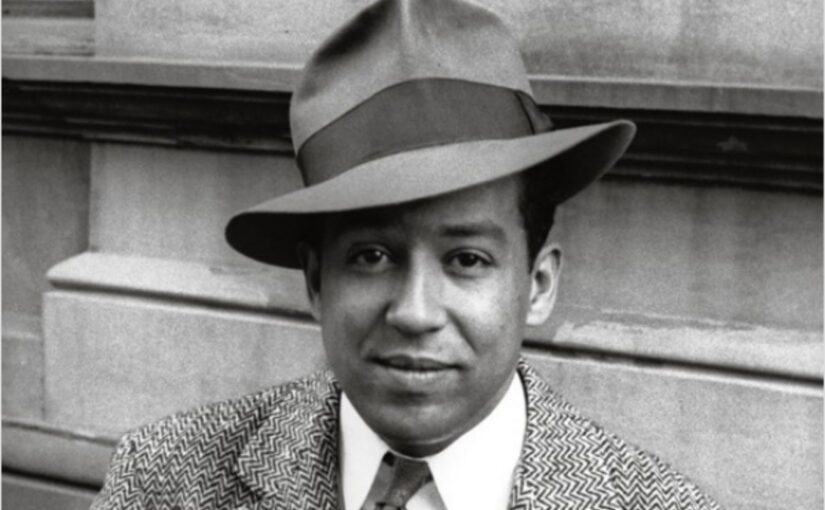
February is celebrated as Black History Month in a number of countries, including the United States and Canada, and February 1st 2026 was the 125th anniversary of the birth of Langston Hughes, the great African-American jazz poet, social activist, novelist, playwright, and columnist, who is widely considered to have been the key leader of the Harlem Renaissance in the 1930s.
Marking these anniversaries, the Historic Shanghai website, noting that the city “has a fascinating, hidden history of Black American poets, activists, and musicians” carried an article on the three months that Hughes spent there in the summer of 1933, during which he met with Soong Ching Ling, the widow of China’s first president Dr. Sun Yat-sen and later the Honorary President of the People’s Republic of China, as well as with the great revolutionary writer Lu Xun.
The article notes: “With barbed wire and guards separating the International Settlement and French Concession from the Chinese sections of Shanghai, and with American race laws (i.e. segregation) often applied in the International Settlement, the parallels between segregated Shanghai and segregated America were all too stark… As a Black American, Langston Hughes was not permitted to enter the Cathay Hotel or the Foreign YMCA, which he called the Whites’ YMCA.”
However, this was also “the era of Shanghai jazz, when Black Americans who had limited performing opportunities at home took their talent to the world, and Shanghai, said Hughes, ‘seemed to have a weakness for American Negro performers.’ There was the ‘sparkling’ Nora Holt at the Little Club, the radio singer Midge Williams, and Valaida Snow, who Louis Armstrong called the ‘second greatest trumpeter’ – after himself, of course!”
What Langston Hughes saw in Shanghai, the “cruelty and violence, corruption and graft” — and “the impudence of white foreigners in drawing a color line against the Chinese in China itself,” inspired him to write a call to arms for his Chinese brethren in his anti-colonial poem, “Roar, China!”, which concludes:
Smash the iron gates of the Concessions!
Smash the pious doors of the missionary houses!
Smash the revolving doors of the Jim Crow Y.M.C.As.
Crush the enemies of land and bread and freedom!
Stand up and roar, China!
You know what you want!
The only way to get it is
To take it!
Roar, China!
We reprint the article from Historic Shanghai below. Yunxiang Gao’s excellent book, Arise Africa, Roar China is recommended for those who wish to dig deeper into this subject. An interview with the author may be read here. And her’s and other contributions to our webinar on ‘Black Liberation and People’s China – Rediscovering a History of Transcontinental Solidarity’ can be viewed here.
Langston Hughes, the poet laureate of the Harlem Renaissance, spent three months in Shanghai in the blazing summer of 1933. He ate red-hearted watermelons from street vendors, visited child workers at a textile factory, and hung out with stride pianist Teddy Weatherford at the jazz clubs. He met Soong Ching Ling and the writer Lu Xun, and in some ways, found it not unlike his home country.
With barbed wire and guards separating the International Settlement and French Concession from the Chinese sections of Shanghai, and with American race laws (i.e. segregation) often applied in the International Settlement, the parallels between segregated Shanghai and segregated America were all too stark.
In his autobiography, I Wonder as I Wander, Hughes describes being warned to be careful when going into the Chinese sections of Shanghai, and of crafty Orientals who were likely to swindle him. The reality he found to be very different:
“I found the Chinese in Shanghai to be a very jolly people, much like colored folks at home. To tell the truth, I was more afraid of going into the world-famous Cathay Hotel [today the Peace Hotel] than I was of going into any public place in the Chinese quarters. Colored people are not welcomed at the Cathay [or the Foreign YMCA]. But beyond the gates of the International Settlement, color was no barrier. I could go anywhere.”-Langston Hughes, I Wonder as I Wander
The summer before, in 1932, Hughes had spent time in Moscow, where had been part of a film about U.S. race relations, and become romantically involved with dancer Sylvia Si-lan Chen. Chen was the mixed-race daughter of Trinidadian-Chinese Eugene Chen, Sun Yat-sen’s Foreign Minister, and Agatha Alphosin Ganteaume, who was French Creole. It was through Sylvia’s connections that Hughes acquired introductions to Soong Ching Ling, Sun’s widow and other Shanghai luminaries.
Upon his arrival, riding along the Bund in his rickshaw, Hughes was surprised to spot a fellow “Harlemite” in another rickshaw – for of course, Hughes was not the only Black American in Shanghai. This was the era of Shanghai jazz, when Black Americans who had limited performing opportunities at home took their talent to the world, and Shanghai, said Hughes, “seemed to have a weakness for American Negro performers.”
There was the “sparkling” Nora Holt at the Little Club, the radio singer Midge Williams, and Valaida Snow, who Louis Armstrong called the “second greatest trumpeter”–after himself, of course! And there was Earl Whaley, Buck Clayton, and Teddy Weatherford.
Most performed in the French Concession nightclubs like the Canidrome – the French generally didn’t apply color bars in their Concession establishments. That summer, Hughes spent a lot of time with Teddy Weatherford, who headed “the best American jazz band in the Orient”. He reflected that were he a performer like Teddy, he would “never go home at all”, but alas, Shanghai was too expensive a place for a mere writer to linger.
Langston Hughes couldn’t stay, but what he saw — “cruelty and violence, corruption and graft” — and “the impudence of white foreigners in drawing a color line against the Chinese in China itself,” inspired him to write a call to arms for his Chinese brethren in his anti-colonial poem, “Roar, China!”
“Roar, China!
Roar, old lion of the East!
Snort fire, yellow dragon of the Orient,
Tired at last of being bothered.
Since when did you ever steal anything
From anybody,
Sleepy wise old beast
Known as the porcelain-maker,
Known as the poem-maker,
Known as maker of firecrackers?
A long time since you cared
About taking other people’s lands
Away from them.
THEY must’ve thought you didn’t care
About your own land either—
So THEY came with gunboats,
Set up Concessions,
Zones of influence,
International Settlements,
Missionary houses,
Banks,
And Jim Crow Y.M.C.As.
THEY beat you with malacca canes
And dared you to raise your head—
Except to cut it off.
Even the yellow men came
To take what the white men
Hadn’t already taken.
The yellow men dropped bombs on Chapei.
The yellow men called you the same names
The white men did:
Dog! Dog! Dog!
Coolie dog!
Red! . . . Lousy red!
Red coolie dog!
And in the end you had no place
To make your porcelain,
Write your poems,
Or shoot your firecrackers on holidays.
In the end you had no peace
Or calm left at all.
PRESIDENT, KING, MIKADO
Thought you really were a dog.
THEY kicked you daily
Via radiophone, via cablegram,
Via gunboats in her harbor,
Via malacca canes.
THEY thought you were a tame lion.
A sleepy, easy, tame old lion!
Ha! Ha!
Haaa-aa-a! . . . Ha!
Laugh, little coolie boy on the docks of Shanghai, laugh!
You’re no tame lion.
Laugh, red generals in the hills of Sian-kiang, laugh!
You’re no tame lion.
Laugh, child slaves in the factories of the foreigners!
You’re no tame lion.
Laugh—and roar, China! Time to spit fire!
Open your mouth, old dragon of the East.
To swallow up the gunboats in the Yangtse!
Swallow up the foreign planes in your sky!
Eat bullets, old maker of firecrackers—
And spit out freedom in the face of your enemies!
Break the chains of the East,
Little coolie boy!
Break the chains of the East,
Red generals!
Break the chains of the East,
Child slaves in the factories!
Smash the iron gates of the Concessions!
Smash the pious doors of the missionary houses!
Smash the revolving doors of the Jim Crow Y.M.C.As.
Crush the enemies of land and bread and freedom!
Stand up and roar, China!
You know what you want!
The only way to get it is
To take it!
Roar, China!”
First published September 1937, in Volunteer for Liberty (Madrid)






This poem by Langston Hughes is wonderful!