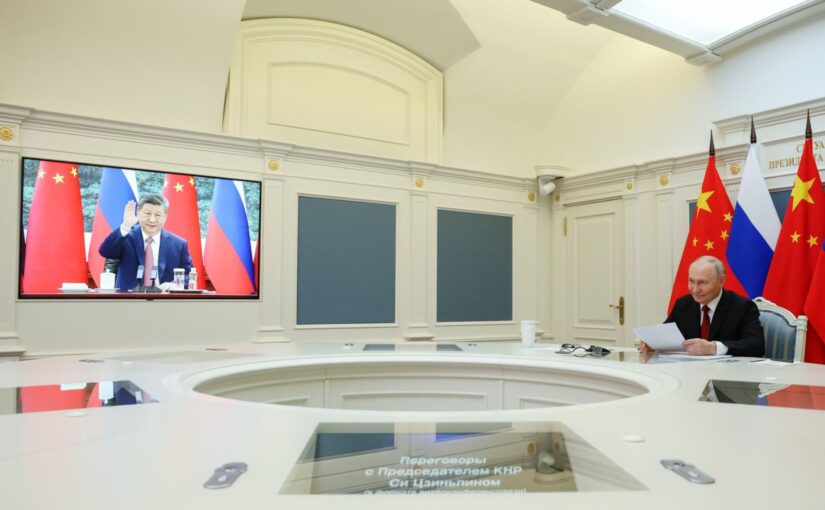
In an unusual diplomatic coincidence, Chinese President Xi Jinping held separate conversations with Russian President Vladimir Putin and US President Donald Trump on February 4.
Xi Jinping first met with President Putin by videoconference.
The readout published by the Chinese Foreign Ministry said that President Xi extended sincere Spring Festival greetings to President Putin and the Russian people, and noted that today is the Beginning of Spring, one of the solar terms in the Chinese lunar calendar. It means the return of spring and signals a new start. He added that that over the past year, we met twice and steered China-Russia relations into a new stage of development. The two countries solemnly commemorated the 80th anniversary of the victory of the World Anti-Fascist War, demonstrating a firm resolve to defend the victorious outcomes of WWII and international fairness and justice. The Shanghai Cooperation Organisation (SCO) Tianjin Summit and the 24th meeting of the Council of Heads of Government of Member States were successfully held in China and Russia respectively. The two sides have increased multilateral coordination and stayed committed to building a more just and equitable global governance system.
President Xi noted that the first few weeks of the year have witnessed increasing turbulence around the world. As responsible major countries and permanent members of the UN Security Council, China and Russia are duty-bound to pool global efforts to firmly uphold fairness and justice, firmly defend the victorious outcomes of WWII, firmly safeguard the UN-centred international system and the basic norms of international law, and jointly maintain global strategic stability.
President Putin said that over the past year, Russia and China jointly commemorated the 80th anniversary of the victory of WWII, firmly safeguarded world peace secured with great sacrifice by the people of both countries and defended historical truth. Cooperation between the two countries in areas such as trade, energy, science and technology, and agriculture has deepened and achieved tangible results. People-to-people exchanges have grown closer, the China-Russia Years of Culture concluded successfully, and mutual visa exemption has facilitated travel between the two peoples. Looking ahead to the new year, Russia has full confidence in the bilateral relationship.
For its part, the website of the President of Russia released the text of the opening remarks of both leaders.
President Putin said: “I would like to personally wish Happy New Year 2026 to you and through you to the entire friendly Chinese nation. Please also accept my greetings on the Spring Festival, which will signal the beginning of the Year of the Fire Horse. As far as we know, this horse stands out by its strength, energy and determination to move ahead. This is also what makes the relations between our two countries so special.”
He added: “I believe that we properly celebrated the 80th anniversary of victory in World War II in Moscow in May and in Beijing in September. The fact that we did this together has demonstrated to the world our solidarity and Russia and China’s readiness to uphold historical truth and carefully preserve the memory of the heroism of our countries’ people, who sacrificed tens of millions of lives to restore peace on the planet.”
Xi Jinping said, among other things: “I would like to thank you for sending Comrade (Sergei) Shoigu to Beijing recently for consultations with Comrade Wang Yi on international and regional issues in preparation for our meeting. He has briefed me on the content of their discussions.” [See below.]
The Russian Presidency also released a commentary on the conversation by Presidential Aide Yury Ushakov.
He also noted that: “Consultations were held on February 1 in Beijing between Secretary of the Russian Security Council Sergei Shoigu and Director of the Office of the Central Commission for Foreign Affairs of the Communist Party of China Central Committee, Minister of Foreign Affairs of China Wang Yi. The heads of state discussed the information received following these consultations,” and added:
“I would like to emphasise that Xi Jinping was the principal guest in Moscow at the Victory Day Parade on May 9, while Vladimir Putin was the principal guest at the commemorative events in Beijing on September 3. Both Russia and China intend to continue upholding historical truth and preserving the memory of the heroism of our fathers and grandfathers in those harsh years.”
Ushakov also noted that: “During the conversation, President Xi Jinping invited Vladimir Putin to pay an official visit to China in the first half of this year. The invitation was accepted with gratitude, and the dates and details will be agreed separately.
“The Chinese leader also invited the President of Russia to take part in the Asia-Pacific Economic Cooperation (APEC) Leaders’ Meeting, to be held in November in the southern Chinese city of Shenzhen. Russia supports the work of China’s APEC chairmanship, and our President will, of course, be ready to attend the meeting in Shenzhen.
“Incidentally, there are plans to hold bilateral meetings during other international events, in particular, those held by the SCO and BRICS…
“Overall, Moscow and Beijing have been working in coordination with each other on the international stage. It was pointed out that the sides’ positions on the overwhelming majority of international issues are similar or fully coincide. Of course, Vladimir Putin and Xi Jinping also exchanged views on their countries’ relations with the United States. Their approaches almost fully coincide, which is evident from their attitude to the US President’s initiative for creating the Board of Peace…
“The President noted that the Treaty on Measures for the Further Reduction and Limitation of Strategic Offensive Arms is due to expire tomorrow, February 5. As you know, on September 22, 2025, we suggested extending the key quantitative limits for one year on a voluntary basis. However, there was no official response from the United States. Vladimir Putin emphasised that in this situation, we will act in a balanced and responsible manner based on a careful analysis of the overall security environment. Russia remains open to finding a way to ensure strategic stability through negotiations.
“The leaders were informed about the contacts our countries had with the Donald Trump administration and believe that there is a window of opportunity in this regard. In particular, the President of China voiced his support for the ongoing talks in Abu Dhabi within the trilateral working group on security matters. President Vladimir Putin shared his latest assessments of the efforts to reach a peaceful settlement in the Ukraine conflict.
“As I have noted, the agenda covered many other international matters too, with a special emphasis on the tense situation surrounding Iran. Vladimir Putin informed his counterpart about the January 30 meeting at the Kremlin with Secretary of Iran’s Supreme National Security Council Ali Larijani.
“The leaders also sought to coordinate their approaches regarding the situation with Venezuela and Cuba and spoke in favour of ensuring that our countries maintain cooperation with Caracas and Havana at the current level.
“On regional topics, the leaders exchanged views on the situation in the Asia-Pacific. The President of China talked about Beijing’s relations with Tokyo, while President Vladimir Putin once again spoke out in support of China’s principled position regarding Taiwan, reaffirming Russia’s commitment to the One China policy.
“Overall, this was a direct and trust-based conversation, which offered the two leaders an opportunity to reaffirm their strategic and principled priorities for working together during the upcoming cycle.
“Cooperation between Moscow and Beijing operates as a powerful, constructive and stabilising factor in the world, while the Russia-China nexus effectively enhances global security, and benefits the Global Majority, as well as the people of both Russia and China.
“I would like to emphasise on a special note that the conversation between Vladimir Putin and Xi Jinping took place in a genuinely friendly atmosphere.”
As noted above, on February 1, Member of the Political Bureau of the Communist Party of China (CPC) Central Committee and Director of the Office of the Central Commission for Foreign Affairs Wang Yi met with Secretary of the Russian Federation Security Council Sergei Shoigu in Beijing for what was officially described as a strategic communication.
Wang Yi noted that the world today is undergoing increasing changes and turbulence, with the post-war international order and norms governing international relations severely impacted, and the world faces a real risk of regressing to the law of the jungle. As major countries and permanent members of the United Nations Security Council, China and Russia have the responsibility and obligation to practice true multilateralism, safeguard the international system with the UN at its core, advocate an equal and orderly multipolar world and universally beneficial and inclusive economic globalisation, and work to build a more just and equitable global governance system.
Sergei Shoigu noted that since the start of the year, the global landscape has been volatile, with frequent flare-ups of security and hotspot issues. Russia consistently upholds the one-China principle, closely follows the moves of hostile forces to undermine stability across the Taiwan Strait, and firmly opposes Japan’s attempts to accelerate remilitarisation. The Russian side is willing to work with the Chinese side to continue firm mutual support, enhance bilateral cooperation, strengthen coordination within multilateral mechanisms such as the UN, the Shanghai Cooperation Organization, and BRICS, jointly maintain the high-level development momentum of Russia-China relations, and work to build a more just and equitable multipolar world and an indivisible security architecture on the Eurasian continent.
Following his videoconference with Putin earlier in the day, Xi Jinping had a telephone conversation with Donald Trump in the evening.
According to the Chinese Foreign Ministry, Xi said: “In the new year, I hope to work with you to steer the giant ship of China-US relations steadily forward through winds and storms and accomplish more big things and good things. Just as the US has its concerns, China for its part also has concerns. China always means what it says and matches its words with actions and results. If the two sides work in the same direction in the spirit of equality, respect and mutual benefit, we can surely find ways to address each other’s concerns… The two sides should follow the common understandings we have reached, enhance dialogue and communication, manage differences properly, and expand practical cooperation. It is always right to do a good thing, however small, and always wrong to do a bad thing, however small.
President Xi emphasised that the Taiwan question is the most important issue in China-US relations. Taiwan is China’s territory. China must safeguard its own sovereignty and territorial integrity and will never allow Taiwan to be separated. The US must handle the issue of arms sales to Taiwan with prudence.
The following articles were originally published on the websites of the Chinese Foreign Ministry and the President of Russia.
President Xi Jinping Has Virtual Meeting with Russian President Vladimir Putin
February 4 (MFA) – On the afternoon of February 4, President Xi Jinping had a virtual meeting with Russian President Vladimir Putin in Beijing at the Great Hall of the People.
President Xi extended sincere Spring Festival greetings to President Putin and the Russian people, and noted that today is the Beginning of Spring, one of the solar terms in the Chinese lunar calendar. It means the return of spring and signals a new start. President Xi expressed his readiness to work with President Putin on this auspicious day to draw a new blueprint for China-Russia relations. President Putin noted that the start of spring brings renewal, and Russia-China relations will keep growing with great vitality. He wished President Xi and the Chinese people a happy Spring Festival as well as vigor and all the success in the Year of the Horse.
President Xi said that over the past year, we met twice and steered China-Russia relations into a new stage of development. The two countries solemnly commemorated the 80th anniversary of the victory of the World Anti-Fascist War, demonstrating a firm resolve to defend the victorious outcomes of WWII and international fairness and justice. Bilateral economic and trade exchanges have maintained a sound momentum. The China-Russia Years of Culture successfully concluded, bringing our cultural exchanges and cooperation to new heights and people-to-people ties closer. The SCO Tianjin Summit and the 24th meeting of the Council of Heads of Government of Member States were successfully held in China and Russia respectively. The two sides have increased multilateral coordination and stayed committed to building a more just and equitable global governance system.
President Xi highlighted that this year marks the beginning of China’s 15th Five-Year Plan. China will expand high-standard opening up in a more proactive manner and share new development opportunities with all countries including Russia. This year also marks the 30th anniversary of the establishment of the China-Russia strategic partnership of coordination, the 25th anniversary of the signing of the China-Russia Treaty of Good-Neighborliness and Friendly Cooperation, and the beginning of the China-Russia Years of Education. The two sides should seize these historic opportunities to carry out closer high-level exchanges, strengthen practical cooperation across the board, deepen strategic coordination, actively shoulder responsibilities as major countries, and ensure continued development of China-Russia relations along the right track.
President Xi noted that the first few weeks of the year have witnessed increasing turbulence around the world. As responsible major countries and permanent members of the U.N. Security Council, China and Russia are duty-bound to pool global efforts to firmly uphold fairness and justice, firmly defend the victorious outcomes of WWII, firmly safeguard the U.N.-centered international system and the basic norms of international law, and jointly maintain global strategic stability.
President Putin said that over the past year, Russia and China jointly commemorated the 80th anniversary of the victory of WWII, firmly safeguarded world peace secured with great sacrifice by the people of both countries and defended historical truth. Cooperation between the two countries in areas such as trade, energy, science and technology, and agriculture has deepened and achieved tangible results. People-to-people exchanges have grown closer, the China-Russia Years of Culture concluded successfully, and mutual visa exemption has facilitated travel between the two peoples. Looking ahead to the new year, Russia has full confidence in the bilateral relationship. The two sides should continue to firmly support each other in their efforts to safeguard respective national sovereignty and security, achieve economic and social development and prosperity, and promote people-to-people exchanges in areas such as education and culture for the benefit of the two peoples. Facing a complex and fluid international landscape, Russia stands ready to increase strategic coordination with China on multilateral platforms such as the U.N., the SCO and BRICS, and inject positive energy into international affairs. Russia will actively support China in hosting the APEC Economic Leaders’ Meeting in Shenzhen.
The two presidents also had an in-depth exchange of views on international and regional hotspot issues of mutual interest.
Wang Yi was present at the meeting.
Videoconference with President of China Xi Jinping
February 4 (Kremlin) – Beginning of the videoconference with President of People’s Republic of China Xi Jinping
President of Russia Vladimir Putin: Mr President, my dear friend.
I am delighted that the good tradition we have established – to hold face-to-face conversations at the beginning of the year – carries on. This offers us an opportunity to sum up the results of the preceding period and outline our plans. Moreover, we are having this conversation on a symbolic day. According to the Chinese calendar, today is Lichun, which signifies the beginning of spring. This is when cold weather starts receding, and nature enters the renewal and awakening phase. But in terms of Russia-China relations, it can be argued with complete certainty that spring continues throughout the year, no matter the season.
I would like to personally wish Happy New Year 2026 to you and through you to the entire friendly Chinese nation. Please also accept my greetings on the Spring Festival, which will signal the beginning of the Year of the Fire Horse. As far as we know, this horse stands out by its strength, energy and determination to move ahead. This is also what makes the relations between our two countries so special. I am confident that they will remain resilient and will continue to steadily develop across all sectors regardless of momentary international developments.
Russia and China have forged an exemplary comprehensive partnership and strategic cooperation. This year, we will be marking the 25th anniversary of the Treaty of Good-Neighbourliness and Friendly Cooperation. Of course, efforts to fulfil its provisions meet the core interests of our two nations and help enhance the comprehensive and truly inclusive cooperation between Russia and China. Importantly, they help improve the wellbeing of our people.
Taking this opportunity, I would like to reaffirm our resolute support for all our joint efforts to ensure the sovereignty and security of our two countries, their social and economic prosperity, and the right to choose their own development path.
I would like to say a few words about the results of last year. I believe that we properly celebrated the 80th anniversary of victory in World War II in Moscow in May and in Beijing in September. The fact that we did this together has demonstrated to the world our solidarity and Russia and China’s readiness to uphold historical truth and carefully preserve the memory of the heroism of our countries’ people, who sacrificed tens of millions of lives to restore peace on the planet. China’s Presidency of the Shanghai Cooperation Organisation, which culminated in the Tianjin summit, produced significant practical results.
During our talks in Moscow and Beijing, we held detailed discussions on the main spheres of our relations and mapped out ambitious tasks for the further deepening of bilateral cooperation. Our governments are working energetically every day to implement these agreements.
Economic cooperation continued to develop steadily in 2025. Despite a minor decline, which I would describe as an adjustment of indicators, our bilateral trade has been considerably above $200 billion for three years in a row.
Russia is the leading supplier of energy resources to the People’s Republic of China. Our energy partnership is mutually beneficial and truly strategic. We maintain an active dialogue in peaceful nuclear research and are promoting high-tech projects, including in industry and space exploration. According to our data, agricultural trade has increased by over 20 percent.
We are satisfied with the growth of our humanitarian exchanges. The cross years of culture were a success, and the more than 400 vibrant events held within their framework gained widespread attention among our people. We have not stopped there, of course. In particular, in the next few days, the Chinese New Year will be widely celebrated in Moscow and other Russian cities, which has become a good tradition here, while the residents and guests of Beijing will learn more about Russian traditions of seeing off winter during the Moscow Maslenitsa (Pancake Week) festival.
The cross-years of education have begun. Currently, over 56,000 Chinese students are studying in Russia and over 21,000 Russian students in China. There are dozens of Russian-Chinese educational institutions and university associations. We also maintain significant potential for further expansion in this area – especially since the age of innovation and advanced information technologies dictates the need for training experts in new and cutting-edge specialisations.
Visa-free travel certainly promotes growing business and humanitarian contacts. I appreciate your efforts regarding this initiative, which we eagerly supported. As far as I know, the relevant authorities have not had any considerable issues since visas were abolished.
Regarding international affairs, the ties between Moscow and Beijing in foreign policy remain an important stabilising factor amidst growing turbulence in the world. We are ready to continue the closest coordination on global and regional agendas, both bilaterally and within all the multilateral frameworks: the UN, BRICS, the Shanghai Cooperation Organisation, and others, where the Russian-Chinese tandem plays an essential role. We wish our Chinese friends success and promise all necessary support during China’s chairmanship of the Asia-Pacific [Economic] Cooperation forum.
My dear friend, once again, Happy New Year and Happy Spring Festival! I wish you personally good health, prosperity and “success in tens of thousands of undertakings,” and to the friendly Chinese nation peace and prosperity.
Thank you.
President of the People’s Republic of China Xi Jinping (retranslated): President Putin, my old and dear friend! It is a great pleasure to meet with you once again, even if by videoconference, at the start of this new year.
I note that today, according to the lunar calendar, is Lichun – the beginning of spring. As you rightly mentioned, this first of the 24 solar terms heralds the return of spring and symbolises new beginnings and hope. It is therefore a most fitting and symbolic day for our discussion, as we look to chart an ambitious new course for the advancement of our bilateral relations.
I would like to thank you for sending Comrade Shoigu to Beijing recently for consultations with Comrade Wang Yi on international and regional issues in preparation for our meeting. He has briefed me on the content of their discussions. Today, I look forward to a thorough exchange of views with you on our major strategic priorities.
Over the past year, our two meetings have helped steer China-Russia relations into a new phase of development. We solemnly commemorated the 80th anniversary of the victory of the global anti-fascist coalition, reaffirming our shared resolve to uphold the outcomes of World War II and the principles of international justice.
Our bilateral trade is growing both dynamically and steadily, while collaboration in new frontier sectors is accelerating.
The successful Years of Chinese and Russian Culture have taken our cultural and humanitarian ties to new heights, and people-to-people exchanges are more vibrant than ever.
Furthermore, through the SCO Summit in Tianjin and the SCO Heads of Government Council meeting in Moscow, we have strengthened our multilateral coordination. This allows us to continue our vital work in fostering a multipolar world order and a more just and equitable system of global governance.
The year 2026 marks the first year of China’s 15th Five-Year Plan. China is committed to further expanding high-standard opening-up and stands ready to share the fresh opportunities of its new development stage with all countries, including Russia.
This year also marks the 30th anniversary of our strategic partnership, the 25th anniversary of the signing of the Treaty of Good-Neighbourliness and Friendly Cooperation, and the commencement of the China-Russia years of education.
It is therefore imperative that we seize this historic opportunity. By continually deepening our strategic coordination and jointly shouldering our responsibilities as major countries, we can ensure that China-Russia relations continue their steady and sustained advancement on the correct long-term trajectory.
Commentary by Presidential Aide Yury Ushakov following Vladimir Putin’s videoconference with President of China Xi Jinping
February 4 (Kremlin) – Presidential Aide Yury Ushakov: Friends, I would like to brief you on the substantive negotiations between President of Russia Vladimir Putin and President of the People’s Republic of China Xi Jinping, held via videoconference.
These negotiations took place today and concluded just over an hour and a half ago. In recent years, such contacts have become a well-established tradition of communication between the heads of state. This marks the sixth such conversation, which traditionally occurs at the beginning of the year, ahead of the Lunar New Year, or, as it is known in China, the Spring Festival.
The discussion lasted one hour and twenty-five minutes. Simultaneous interpretation was provided, of course, and the leaders, in a friendly and trusting manner, summarised the outcomes of the past year and thoroughly discussed plans for the development of Russia-China relations in the current year. Significant attention was also paid to the most pressing international issues, particularly given the extremely tense and volatile situation that has emerged in a number of regions across the world.
In this context, Vladimir Putin and Xi Jinping agreed that it is necessary to maintain permanent bilateral consultation mechanisms across all channels – the security councils, foreign ministries, and defence agencies – to complement their personal communication, that is, the direct dialogue between the leaders. This pertains to the swift alignment and coordination of approaches on current matters, including sensitive ones, to ensure timely responses to emerging challenges and threats.
It was agreed to intensify such professional dialogue. In this vein, incidentally, consultations were held on February 1 in Beijing between Secretary of the Russian Security Council Sergei Shoigu and Director of the Office of the Central Commission for Foreign Affairs of the Communist Party of China Central Committee, Minister of Foreign Affairs of China Wang Yi. The heads of state discussed the information received following these consultations.
Vladimir Putin and Xi Jinping once again noted that the comprehensive partnership and strategic cooperation between our two countries are at an unprecedented level, are based on equality and mutual benefit, are not directed against any third parties, and are not subject to short-term political considerations.
We support each other on key issues affecting our national interests. In the face of external challenges, our countries act, as our Chinese friends put it, back to back, and can rely on one another.
The leaders expressed satisfaction that last year Russia and China fittingly marked the anniversaries of Victory in the Great Patriotic War and in the War of Resistance against Japanese Aggression.
I would like to emphasise that Xi Jinping was the principal guest in Moscow at the Victory Day Parade on May 9, while Vladimir Putin was the principal guest at the commemorative events in Beijing on September 3. Both Russia and China intend to continue upholding historical truth and preserving the memory of the heroism of our fathers and grandfathers in those harsh years.
Overall, in 2025 the leaders of the two countries maintained frequent and productive contacts, and such interactions – personal contacts in particular – will naturally continue, and with no lesser intensity.
I would also note that on July 16, Russia and China will mark an important date: the 25th anniversary of the Treaty of Good-Neighbourliness and Friendly Cooperation between the Russian Federation and the People’s Republic of China. This foundational document for international relations, which remains fully relevant and in tune with the spirit of the times, has been automatically extended for a further five-year period.
During the conversation, President Xi Jinping invited Vladimir Putin to pay an official visit to China in the first half of this year. The invitation was accepted with gratitude, and the dates and details will be agreed separately.
The Chinese leader also invited the President of Russia to take part in the Asia-Pacific Economic Cooperation (APEC) Leaders’ Meeting, to be held in November in the southern Chinese city of Shenzhen. Russia supports the work of China’s APEC chairmanship, and our President will, of course, be ready to attend the meeting in Shenzhen.
Incidentally, there are plans to hold bilateral meetings during other international events, in particular, those held by the SCO and BRICS.
Plans for this year also include numerous contacts at other high levels, including between our governments, parliaments, the Presidential Executive Office and the Secretariat of the Central Committee of the Communist Party of China, security councils, ministries, departments and political parties.
During their conversation, the leaders paid considerable attention to trade and economic cooperation. It was also mentioned that despite a minor decline due to a number of objective and subjective factors, bilateral trade has been considerably above $200 billion for three years in a row. It is common knowledge that China remains our leading foreign trade partner, while Russia holds fifth place among China’s trade partners.
During the conversation, the leaders formulated the task of working to further develop trade and economic ties, in particular, in energy. Russia is the leading supplier of oil and pipeline gas to China.
It is noteworthy that the leaders emphasised the importance of working in innovative spheres, including those associated with artificial intelligence. We supported China’s initiative for creating a World Artificial Intelligence Cooperation Organisation.
Both sides expressed high appreciation for the Chinese idea of a visa-free regime, which Russia supported. They noted with satisfaction that 2026 and 2027 have been declared the Cross Years of Cooperation in Education.
Overall, the humanitarian track of bilateral cooperation is developing very energetically to the benefit of our countries and is promoting rapprochement between them.
Regarding foreign policy issues, the President of Russia and the President of China emphasised the importance of Russian-Chinese cooperation at multilateral platforms, such as the UN, the SCO, BRICS, APEC and G20.
The sides reaffirmed the common course for creating a just multilateral world order based on international law.
Overall, Moscow and Beijing have been working in coordination with each other on the international stage. It was pointed out that the sides’ positions on the overwhelming majority of international issues are similar or fully coincide. Of course, Vladimir Putin and Xi Jinping also exchanged views on their countries’ relations with the United States. Their approaches almost fully coincide, which is evident from their attitude to the US President’s initiative for creating the Board of Peace.
Russia and China stand for equal and mutually beneficial cooperation based on the principles of international law and the UN Charter.
The President noted that the Treaty on Measures for the Further Reduction and Limitation of Strategic Offensive Arms is due to expire tomorrow, February 5. As you know, on September 22, 2025, we suggested extending the key quantitative limits for one year on a voluntary basis. However, there was no official response from the United States. Vladimir Putin emphasised that in this situation, we will act in a balanced and responsible manner based on a careful analysis of the overall security environment. Russia remains open to finding a way to ensure strategic stability through negotiations.
The leaders were informed about the contacts our countries had with the Donald Trump administration and believe that there is a window of opportunity in this regard. In particular, the President of China voiced his support for the ongoing talks in Abu Dhabi within the trilateral working group on security matters. President Vladimir Putin shared his latest assessments of the efforts to reach a peaceful settlement in the Ukraine conflict.
As I have noted, the agenda covered many other international matters too, with a special emphasis on the tense situation surrounding Iran. Vladimir Putin informed his counterparts about the January 30 meeting at the Kremlin with Secretary of Iran’s Supreme National Security Council Ali Larijani.
The leaders also sought to coordinate their approaches regarding the situation with Venezuela and Cuba and spoke in favour of ensuring that our countries maintain cooperation with Caracas and Havana at the current level.
On regional topics, the leaders exchanged views on the situation in the Asia-Pacific. The President of China talked about Beijing’s relations with Tokyo, while President Vladimir Putin once again spoke out in support of China’s principled position regarding Taiwan, reaffirming Russia’s commitment to the One China policy.
Overall, this was a direct and trust-based conversation, which offered the two leaders an opportunity to reaffirm their strategic and principled priorities for working together during the upcoming cycle.
Cooperation between Moscow and Beijing operates as a powerful, constructive and stabilising factor in the world, while the Russia-China nexus effectively enhances global security, and benefits the Global Majority, as well as the people of both Russia and China.
I would like to emphasise on a special note that the conversation between Vladimir Putin and Xi Jinping took place in a genuinely friendly atmosphere. They ended the conversation by wishing each other every success, happiness, and wellbeing in the coming year.
Wang Yi and Secretary of the Russian Federation Security Council Sergei Shoigu Hold Strategic Communication
February 1 (MFA) – On February 1, 2026, Member of the Political Bureau of the CPC Central Committee and Director of the Office of the Central Commission for Foreign Affairs Wang Yi met with Secretary of the Russian Federation Security Council Sergei Shoigu in Beijing.
Wang Yi welcomed Sergei Shoigu’s visit to China for the strategic communication as designated by President Vladimir Putin. Wang Yi noted that the world today is undergoing increasing changes and turbulence, with the post-war international order and norms governing international relations severely impacted, and the world faces a real risk of regressing to the law of the jungle. As major countries and permanent members of the United Nations (UN) Security Council, China and Russia have the responsibility and obligation to practice true multilateralism, safeguard the international system with the UN at its core, advocate an equal and orderly multipolar world and universally beneficial and inclusive economic globalization, and work to build a more just and equitable global governance system.
Noting that China and Russia are each other’s largest neighbors and comprehensive strategic partners of coordination for a new era, Wang Yi said the two countries should maintain close communication on major issues concerning bilateral relations, step up mutual support on issues bearing on each other’s core interests, and safeguard their respective and common interests. Highlighting that head-of-state guidance is the greatest advantage of and fundamental guarantee for the high-level development of China-Russia relations, Wang Yi stated that China is ready to work with Russia to fully implement the important common understandings reached by the two heads of state, enhance strategic communication, deepen strategic coordination, and open up new prospects for China-Russia relations in the new year.
Sergei Shoigu extended early Spring Festival greetings to the Chinese people for a happy Year of the Horse. He said that this year marks the 25th anniversary of the signing of the Russia-China Treaty of Good-Neighborliness and Friendly Cooperation, and that bilateral relations are underpinned by mutual respect, mutual trust, equality and mutual benefit. He noted that since the start of the year, the global landscape has been volatile, with frequent flare-ups of security and hotspot issues. Russia consistently upholds the one-China principle, closely follows the moves of hostile forces to undermine stability across the Taiwan Strait, and firmly opposes Japan’s attempts to accelerate remilitarization. The Russian side is willing to work with the Chinese side to continue firm mutual support, enhance bilateral cooperation, strengthen coordination within multilateral mechanisms such as the UN, the Shanghai Cooperation Organization, and BRICS, jointly maintain the high-level development momentum of Russia-China relations, and work to build a more just and equitable multipolar world and an indivisible security architecture on the Eurasian continent.
The two sides also conducted in-depth strategic communication on various international and regional issues of mutual concern.
President Xi Jinping Speaks with U.S. President Donald J. Trump on the Phone
February 4 (MFA) – On the evening of February 4, 2026, President Xi Jinping spoke with U.S. President Donald J. Trump on the phone.
President Xi noted that over the past year, we have enjoyed sound communication, and had a successful meeting in Busan, charting the direction and course for China-U.S. relations. This has been welcomed by the people of both countries and the broader international community. I attach great importance to this relationship. In the new year, I hope to work with you to steer the giant ship of China-U.S. relations steadily forward through winds and storms, and accomplish more big things and good things. Just as the U.S. has its concerns, China for its part also has concerns. China always means what it says and matches its words with actions and results. If the two sides work in the same direction in the spirit of equality, respect and mutual benefit, we can surely find ways to address each other’s concerns. Both China and the U.S. have important items on our agenda this year. China will kick off its 15th Five-Year Plan, and the U.S. will celebrate the 250th anniversary of its independence. China will host the APEC Economic Leaders’ Meeting, and the U.S., the G20 Summit. The two sides should follow the common understandings we have reached, enhance dialogue and communication, manage differences properly, and expand practical cooperation. It is always right to do a good thing, however small, and always wrong to do a bad thing, however small. We should make progress step by step to build mutual trust, find the right way to get along, and make 2026 a year where our two major countries advance toward mutual respect, peaceful coexistence, and win-win cooperation.
President Xi emphasized that the Taiwan question is the most important issue in China-U.S. relations. Taiwan is China’s territory. China must safeguard its own sovereignty and territorial integrity, and will never allow Taiwan to be separated. The U.S. must handle the issue of arms sales to Taiwan with prudence.
President Trump said that both the U.S. and China are great countries, and the U.S.-China relationship is by far the most important in the world. I have a great relationship with President Xi, and a lot of respect for President Xi. Under our leadership, the U.S. and China are doing well in economy and trade. I want to see China succeed. The U.S. would like to work with China and make more progress in bilateral ties. I understand how China feels about the Taiwan question. I would like the two sides to continue talking to each other and keep the relationship in good shape during my presidency.