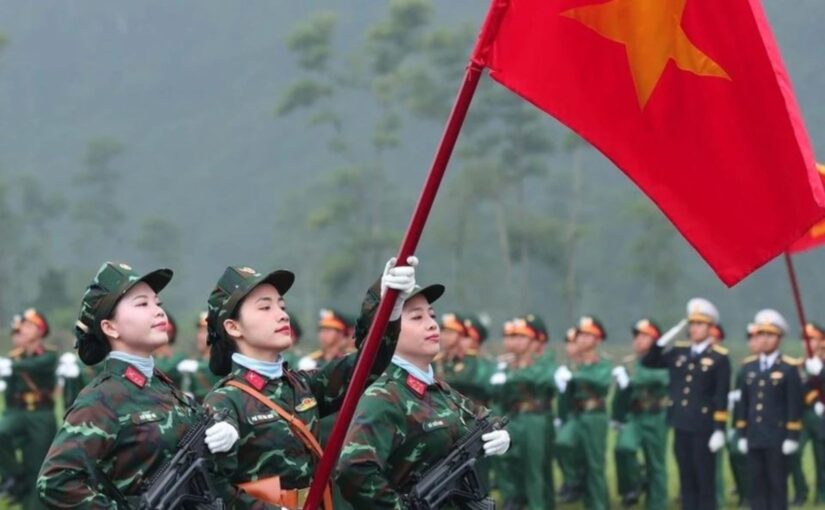
China and Vietnam marching together on the journey of socialist modernisation

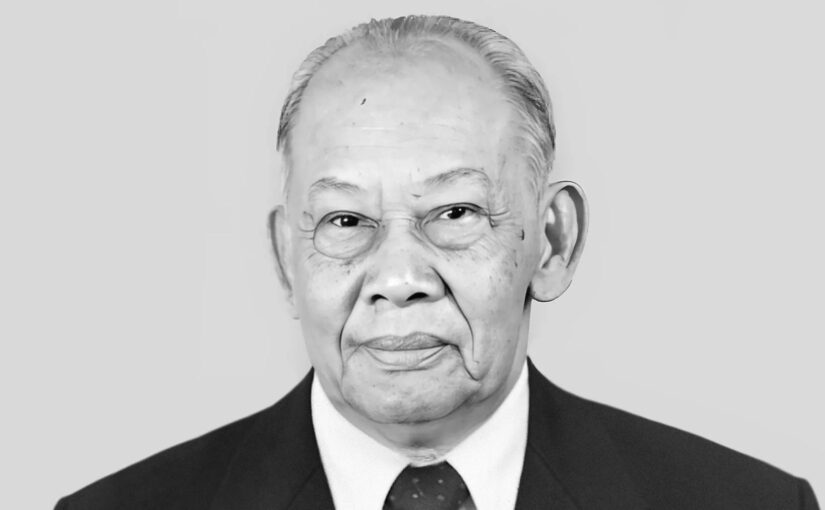
The Communist Party of Vietnam (CPV) recently celebrated its 95th founding anniversary. Founded as the Communist Party of Indochina (CPI) on February 3, 1930 in Hong Kong, the CPI may also be considered as the root of the ruling Lao People’s Revolutionary Party (LPRP) and Cambodian People’s Party (CPP).

Greeting the anniversary, the Central Committee of the Communist Party of China (CPC) wrote to its Vietnamese counterpart that: “In the past 95 years, the CPV has united and led the Vietnamese people in successfully realising national unification and liberation with remarkable achievements in the cause of the country’s socialist construction and transformation.

“The CPC and the CPV share a long-standing revolutionary friendship and amicable partnership. Under the personal guidance and careful nurturing of the leaders of previous generations including Mao Zedong and Ho Chi Minh, the two peoples have supported each other in revolutionary struggles, marching together in socialist construction, in the drive of reform and opening up and on the journey of socialist modernisation.

“The CPC is willing to work with the CPV to implement the important consensus reached by the top leaders of the two parties, uphold the 16-word guideline of ‘long-term stability, future orientation, good-neighbourly friendship and comprehensive cooperation’ and the spirit of ‘good neighbours, good friends, good comrades and good partners,’… and push for more progress in building a China-Vietnam community with a shared future to bring greater benefits to both peoples and contribute further to the cause of peace and progress for humanity.”

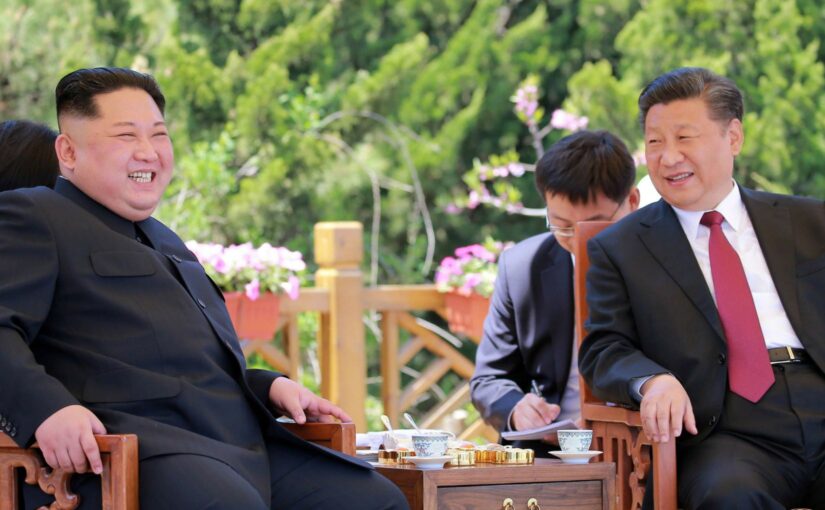
At time of writing, the CPV newspaper Nhân Dân is continuing to publish a series of articles highlighting the greetings received from fraternal and friendly parties on the anniversary. The first such article was devoted to those parties with which the CPV maintains historic special relations and, besides that from the CPC, reported greetings from the Central Committee of the LPRP, President of the CPP Hun Sen, First Secretary of the Communist Party of Cuba and President of Cuba Miguel Díaz-Canel Bermúdez and Leader of the Cuban Revolution General Raúl Castro Ruz, and General Secretary of the Workers’ Party of Korea Kim Jong Un.

The message from the LPRP Central Committee underlined that over the past 95 years, the CPV, founded and led by President Ho Chi Minh, with its sound, skilful and creative policies has led the Vietnamese people to many glorious victories in the struggle for national liberation and reunification.

“We firmly believe that by upholding its glorious revolutionary tradition and building upon these great and comprehensive achievements, the Party, State, and people of Vietnam will continue to reap new and even greater successes in implementing the Resolution of the 13th National Congress of the CPV and preparing for the upcoming Party congresses at all levels, leading to the successful organisation of the 14th National Congress of the CPV, ” the message read.

On this occasion, the LPRP would like to express its profound gratitude for the Party, State, and people of Vietnam for their invaluable, effective, and timely support for the revolutionary cause of Laos over the years. The Party, State, and people of Laos will continue to stand side by side with the Party, State, and people of Vietnam to do their utmost to preserve and promote the rare and cherished relationship for the common interests of both nations, contributing to peace, stability, cooperation, and development in the region and the world.

The message from the Cuban leaders reaffirmed Cuba’s commitment to deepening the friendship, solidarity and cooperation between the two nations, based on the legacy of Commander-in-Chief Fidel Castro Ruz, the historic leader of the Cuban Revolution, and beloved President Ho Chi Minh.

Kim Jong Un wrote that he was delighted to see that under the leadership of the CPV, the Vietnamese people have made remarkable progress in developing a prosperous and strong nation. He expressed his belief that the traditional friendship between the two Parties will continue to grow in the common struggle to safeguard and preserve the socialist cause.

Nhân Dân also reported that Belarus President Aleksandr Lukashenko wrote that the CPV members are always examples of true patriots who have pioneered in the political and socio-economic development of the fatherland to build a strong sovereign country. Today, the CPV is continuing the cause of socialism building and promoting Vietnam’s role and prestige in the region and the world. He added that Belarus and Vietnam have been faithful friends and responsible partners whose relationship is based on the principle of mutual respect and assistance.

At a meeting of Sri Lankan political parties in the capital Colombo, Deputy Minister of Foreign Affairs and Foreign Employment Arun Hemachandra, on behalf of the People’s Liberation Front (Janatha Vimukthi Peramuna – JVP), highlighted Vietnam’s development achievements under the CPV’s leadership in recent years. He emphasised that the CPV’s steadfast and sound leadership is a crucial factor in the struggle for national liberation and reunification of Vietnam, as well as in its current economic development and poverty reduction efforts.

Continue reading China and Vietnam marching together on the journey of socialist modernisation

President Dissanayake: Learning from China’s development model is essential for Sri Lanka

Anura Kumara Dissanayake, (popularly known as AKD), who was elected President of Sri Lanka in September 2024, and whose party, the National People’s Power (NPP), whose main component is the Janatha Vimukthi Peramuna (JVP or People’s Liberation Front), Sri Lanka’s largest Marxist party, and of which AKD is also the leader, and who then went on to win a supermajority in November 2024 parliamentary elections, paid a state visit to China from January 14-17 at the invitation of his Chinese counterpart Xi Jinping.

During his visit, Sri Lanka’s head of state gave a customarily wide-ranging interview to He Yanke for the CGTN program Leaders Talk.

Asked about his talks with President Xi Jinping, which had been held earlier that day, President Dissanayake said that Xi had emphasised  that China’s achievements today are not just the result of the last two decades but also the outcome of the blood, toil, sweat and hard work of the Chinese people. This had made a deep impression on him.

On the relations between China and Sri Lanka, he said that whenever China draws up plans or programs, it always puts the people first. Similarly, the current Sri Lankan government is committed to the principle of serving the people in everything it does. As a result, the friendship between China and Sri Lanka, which has deep historical roots stretching back 1,000 years, will now enter a new stage.

China’s victory over poverty, the Sri Lankan leader continued, is inseparable from President Xi’s unwavering conviction and decisive leadership. He is a leader who always puts the people first, genuinely works for their welfare, spares no effort in safeguarding their interests and remains deeply connected to them.

Noting that his first visit to China was in 2004, when he served as Sri Lanka’s Minister of Agriculture, Dissanayake noted that China had made extraordinary achievements in the ensuing two decades. Asked what he had drawn from his visit to the Museum on the history of the Communist Party of China (CPC), he said that behind all China’s achievements lies a history of relentless struggle, unwavering belief and refusal to give up. These lessons are applicable to the development of all countries.

Sri Lanka also wished to learn and benefit from China’s technological expertise and related investment in the field of renewable energy, where it had become the global leader.

Likewise, China’s pivotal role in the global fight against poverty was setting an extraordinary example for countries and peoples worldwide. Sri Lanka will research and learn from this example and he wishes to personally visit China’s rural areas to see their development first hand.

Starting from the famous rubber-rice pact of 1952, today China is Sri Lanka’s most trusted economic partner. One of the first countries to sign up to the Belt and Road Initiative (BRI), it has become very important to Sri Lanka’s economic development, with increasing and diversifying exports to China and developing large scale industrial parks to complement the existing major infrastructure projects high on the agenda.

Studying and learning from China’s development model, he stressed, was essential for Sri Lanka. A key lesson is that every country must find its own way to modernisation and adopt a development model suited to its own conditions, rather than blindly copying the development experiences of others.

Regarding the well-known initiatives put forward by Xi Jinping, Dissanayake said that the Global Development Initiative means that the benefits of human progress and development can reach every individual; the Global Security Initiative offers inclusiveness and universal benefits; and the Global Civilisation Initiative respects and integrates unique civilisations and cultures, and the shared values of all countries.

Asked about how his government is facing challenges and implementing change, the Sri Lankan leader first noted that his government had been formed when the national economy was in tatters and the country had been forced to declare bankruptcy. Therefore, its immediate priorities were to pull out of the crisis, ensure economic stability and drive forward development through well structured planning and decisive action.

The political system also needs major reforms, with the entrenched issues of corruption and waste needing to be addressed.

CGTN’s full interview with President Dissanayake is embedded below.

Trump, tariffs and the working class

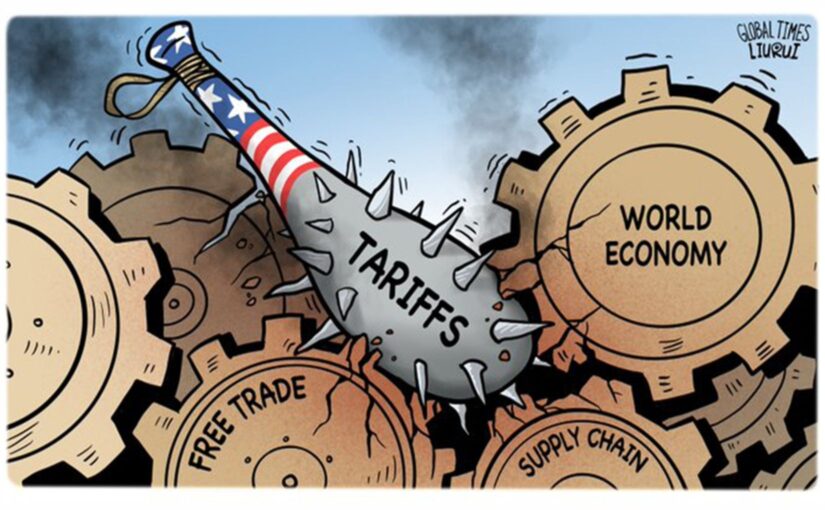
The two articles below address the tariffs recently announced by the US against China, Canada and Mexico.

The first article, written by Friends of Socialist China advisory group member and International Manifesto Group convenor Radhika Desai, republished from CGTN, points to the cynical economic motives for these tariffs: to rob from the poor to pay the rich. Since the cost of tariffs is passed on to consumers, they constitute a stealth tax on ordinary Americans, and will help make up for the loss of revenue resulting from the Trump regime’s tax cuts for the super-rich.

The cost of the tariffs will be paid by ordinary US consumers. And they will pay in order that the richest US taxpayers can enjoy greater tax cuts, which is the key reason why Trump needs the tariff revenues.

Tariffs will also drive up inflation, further impacting living conditions of the working class.

The putative aim of the tariffs is to bolster US manufacturing. However, “for US capital, given its decades-long reluctance to invest productively at home, it’s going to take a lot more than tariffs. US capital needs to be turned away from the unproductive, predatory and speculative financial ventures in which it is engaged and towards serious productive investment.”

The second article, republished from Workers World, details the likely negative impact of the tariffs on the US economy, and denounces the Trump administration’s threats against the BRICS countries.

Attacks against BRICS are detrimental to workers in G7 countries… BRICS countries are displaying self-sufficiency and independence from Western imperialism and settler colonialism. Relations between China and Russia have also strengthened because of BRICS. Many countries in the Global South have less of a need to trade with the U.S. than they did in previous decades, and therefore they have more leverage to maintain sovereignty.

The article concludes:

Trump’s promotion of tariffs is harmful to workers all over the globe. Imperialist protectionism and isolationism are an obstacle to working-class unity, and they should be opposed. International solidarity is necessary in resisting anti-worker tariffs and defeating the racist, xenophobic “America First” agenda. Workers and oppressed peoples of the world, unite!

Trump’s empty tariff brinkmanship

After days of keeping the world guessing whether he would commit to such a disastrous course, U.S. President Donald Trump has started his trade wars against his country’s three most important trade partners, Canada, Mexico and China.

In announcing the tariffs on exports from these countries, Trump was self-contradictory, claiming they were a negotiating tool designed to deal with U.S. trade deficits, and then that they were not. Their true extent remains unclear: From the apparently blanket tariffs of 25 percent on Canada and Mexico and 10 percent on China, he has already reduced tariffs on oil, natural gas and electricity from Canada to 10 percent, and uncertainty prevails over exactly which goods they will hit, how, and by how much.

The Financial Times called it “a trade war on steroids” while the Washington Post declared it “the dumbest trade war in history.” Many others said these sky-high tariffs could not be expected to last forever.

So, as the world tightens its seatbelt for a bumpy ride through the Trump quadrennial, let’s parse the real wheat from the rhetorical chaff so we can better anticipate the course of the trade wars Trump has started. The key is that Trump’s tariffs are incoherent in conception and applied for the wrong reasons.

Trump is certainly using them as negotiating tools. He claims they are superior to sanctions, which scare other countries from the dollar system he wishes to save. Exactly how adding the weaponization of trade to the weaponization of the dollar is going to help the U.S. is anyone’s guess.

Continue reading Trump, tariffs and the working class

Is DeepSeek China’s Sputnik moment?

In the article below, reprinted from People’s World, CJ Atkins examines the geopolitical significance of the success of China’s DeepSeek R1 model, which has been taking the world by storm in recent weeks, and which was responsible for chip manufacturer Nvidia suffering the biggest ever fall in share price in a single day.

Atkins notes that the Biden administration’s export ban on the most sophisticated microchips has clearly backfired. “The export bans simply spurred Chinese developers to get creative, pushing them to come up with cheaper and more efficient ways of using the older chips they already had access to. They discovered means to train and operate AI models using less memory and less computing power. This resulted in a model that was cheaper to build and less damaging for the planet to operate than those developed by the U.S. tech monopolies.”

Importantly, DeepSeek’s developers made their model open source, allowing anyone to use it for free. “That means they showed their work for the world to see and adapt for further development. Other scientists and coders can build on DeepSeek-R1 to create their own AI models.” The article cites Liang Wenfeng, the founder of DeepSeek, as saying that “our starting point is not the opportunity to make a quick profit, but rather to reach the technical frontier and drive the development of the entire ecosystem”.

The stunning success of DeepSeek’s model highlights the fact that China is now a major player in the global tech industry, and is increasingly setting the pace in terms of innovation. This is testament to the effectiveness of China’s economic model, and calls to mind Deng Xiaoping’s 1984 comment that “the superiority of the socialist system is demonstrated, in the final analysis, by faster and greater development of those forces than under the capitalist system”.

Atkins warns that the DeepSeek phenomenon will likely trigger a deepening of the US’s trade war against China, along with an expansion of its campaign of containment and encirclement. “We can expect a ramping up of military tensions over the long term. The weapons dealers and neocon warhawks will seize the moment to beat the drums of a real war against China. There will be a tightening of U.S. imperialism’s military encirclement of China, and a propaganda onslaught warning of the ‘China threat’ will wash over the American people. Anti-Asian racism will figure prominently, just as it did during the pandemic.”

The article concludes by noting that China’s consistent call is for peaceful coexistence and international cooperation between countries with different social systems. The US and China could and should be working together to push science and technology forward in the service of humanity, but the US ruling class cannot be expected to pursue such a path in the absence of mass pressure. “The tech monopolists will do anything to protect their own profits and power, even if it means keeping the world divided and holding back shared progress.”

In 1978, just months before China initiated the reform and opening up of its economy, Communist Party leader Deng Xiaoping told a meeting of researchers:

“Our science and technology have made enormous progress since the founding of New China…. But we must be clear-sighted and recognize that there is still an enormous gap between our level and that of the most advanced countries and that our scientific and technical forces are still too meager.”

If he were alive to witness the events of the last few days, would Deng be shocked?

The release of the DeepSeek-R1 chatbot, a Chinese-developed large language model (LLM), threw the global artificial intelligence industry into chaos and wiped a trillion dollars off the values of some of the biggest tech corporations on the New York Stock Exchange—overnight.

Is this China’s “Sputnik moment,” comparable in historic significance to the Soviet Union’s inauguration of the space age with the launch of the first artificial satellite in 1957?

Back then, U.S. capitalism made the mistake of assuming that blockading the socialist half of the world via trade walls and embargoes would keep it technologically backward forever. The same error is being made again with China.

No chips for China

Export bans on the most sophisticated microchips that power advanced AI applications, along with chip-making equipment and software, were imposed by the Biden administration in 2022, using “national security” as a justification.

With Trump campaigning last year to go even further, Biden toughened his restrictions in December. The graphics processing units (GPUs) that are the go-to for training AIs like ChatGPT and DeepSeek were put on an export blacklist, forbidden from being shipped to China or companies in third countries that do business with the People’s Republic.

But the U.S.’ economic aggression now appears to have backfired. The export bans simply spurred Chinese developers to get creative, pushing them to come up with cheaper and more efficient ways of using the older chips they already had access to.

They discovered means to train and operate AI models using less memory and less computing power. This resulted in a model that was cheaper to build and less damaging for the planet to operate than those developed by the U.S. tech monopolies.

Continue reading Is DeepSeek China’s Sputnik moment?

Sino-British Concert: East-West Dialogue, Spring Sequence of New Sounds

On February 2, 2025 the ‘Sino-British Concert: East-West Dialogue, Spring Sequence of New Sounds’ was held at London’s Royal Academy of Music. David Peat, Secretary of Friends of Socialist China (FoSC) Britain Committee, attended the event on invitation. The following is his report.

On Sunday 2nd February, visitors to London’s central Shaftesbury Avenue and surrounding streets were able to take part in Chinese New Year (CNY) celebrations. The breadth of China’s historic culture and modern development were all displayed: exuberant traditional ‘Lion Dances’ took place next to China’s cutting-edge high-tech electric BYD vehicles. People could purchase good fortune souvenirs, and enjoy street snacks and the sounds of firecrackers, all along the temporarily pedestrianised thoroughfare. Each year London’s main Chinese New Year celebration, which expanded beyond the bounds of Chinatown proper since the mayoralty of Ken Livingstone, can be enjoyed by both tourists and residents of the capital city. With the recent viral success of the Xiaohongshu [Red Note] app, western users have been able to witness the amazing CNY celebrations that take place all over China, so no doubt some attendees were keen to enjoy that closer to home.

To the west of Chinatown proper, another event was held, which was a stunning display of musical skill and proof that artistic cultures – and cultures in general – benefit from sharing traditions and influence across borders. This event was the Sino-British Concert: East-West Dialogue, Spring Sequence of New Sounds, hosted by the Sino-British Ensemble, the Society for Anglo-Chinese Understanding (SACU), and the UK Beijing Arts Centre.

In attendance at the event was Chinese Ambassador Zheng Zeguang and his wife Counsellor Hua Mei, along with Minister Zhao Fei. Among others present were representatives of organisations that have sought to build connections and understanding between China and the UK, including Special Guest Michael David Wood, historian and SACU President, who is especially known for his book and BBC documentary on China’s iconic Tang dynasty poet Du Fu. Prior to the performances, Professor Wood gave a brief talk outlining the history of musical exchanges between the west and the east and highlighted the ongoing potential for artistic collaboration to build bridges between nations and peoples.

This sold-out event was held in the beautiful Duke’s Hall of the Royal Academy of Music. The program was expansive and diverse, with more than 80 musicians performing 10 ‘dialogues’, in which one piece of music from the western tradition and one from the eastern were performed alternately, or even directly in conversation with one another. The Sino-British orchestra features musicians from China, the UK, India, Germany, Italy, Romania and other countries, and also foregrounded pieces and musical styles from China’s ethnic minority musical traditions.

Chinese President Xi Jinping has highlighted how China in its history has long cherished the notion of “harmony without uniformity.” In a speech at UNESCO headquarters in 2015 titled ‘Exchanges and Mutual Learning Make Civilizations Richer and More Colorful’, President Xi quoted Yan Zi, prime minister of the State of Qi during the Spring and Autumn Period (770-476 BC), who is recorded as observing: “Only by combining the texture, length, rhythm, mood, tone, pitch and style adequately and executing them properly can you produce an excellent melody… Who can tolerate the same tone played again and again with one instrument?”[1] This observation matches the purpose of the concert: appreciating the new connections and possibilities that can be created when diverse musical traditions and peoples are brought into contact. As the enormous interest in apps like RedNote has shown, people in both East and West are intensely curious to make connections with one another, and the results are ‘win-win’ when they do. Events like the Sino-British concert are a wonderful way to establish and strengthen these sorts of links.

For those interested in similar events in future, check SACU’s website at Home – Society for Anglo-Chinese Understanding (SACU)


[1] Xi Jinping, The Governance of China Vol 1, pp. 283 – 289.

China and Nicaragua share experiences and concepts in fighting against imperialism, colonialism and hegemony

The strong fraternal relations between the Communist Party of China (CPC) and the Sandinista National Liberation Front (FSLN) of Nicaragua were underlined in a January 13 meeting in Beijing between Liu Jianchao, Minister of the International Department of the CPC Central Committee (IDCPC), and a delegation led by Fidel Antonio Moreno Briones, Secretary General of the Managua Mayor’s Office and Organisation Secretary of the FSLN.

Liu said, under the strategic guidance and personal promotion of President Xi Jinping and President Daniel Ortega, China and Nicaragua have seen strong development in bilateral relations, and officially established a strategic partnership in 2023, continuously releasing the dividends of the resumption of diplomatic relations. He said, despite different scales, the CPC and the FSLN have always treated each other as equals and respected each other. The two parties have similar experiences and shared concepts in fighting against imperialism, colonialism and hegemony.

Moreno said, since the resumption of diplomatic relations between the two countries fruitful results have been achieved in practical cooperation in various fields, bringing tangible benefits to the Nicaraguan people. The delivery and operation of buses produced in China have boosted the development of Nicaragua’s public transportation system. Nicaragua is willing to continue to strengthen practical cooperation with China in economy, trade, transportation, humanities and other fields. The CPC, a century-old party, has led the Chinese people to make great achievements in poverty alleviation, environmental protection and economic development, providing important inspiration and reference for the FSLN.

Earlier, on January 8, Ma Hui, Vice-Minister of the IDCPC met with a delegation led by Enrique Santiago, Secretary General of the Communist Party of Spain (PCE).

Ma spoke positively of the relations between the two parties and countries, saying that the CPC is willing to deepen traditional friendship with the PCE, strengthen exchanges and mutual learning on state and party governance, enhance political mutual trust between China and Spain and deepen pragmatic cooperation between the two countries through inter-party channels, and promote mutual understanding between the two peoples.

Santiago said, the PCE appreciates the economic and social achievements made by the Chinese people under the leadership of the CPC and is willing to further strengthen inter-party exchanges and cooperation with the CPC, continuously deepen China-Spain comprehensive strategic partnership and jointly contribute to world peace and stability.

The following articles were originally published on the website of the IDCPC.

Liu Jianchao Meets with a Delegation of the Sandinista National Liberation Front (FSLN) of Nicaragua

Beijing, January 13th (IDCPC) — Liu Jianchao, Minister of the International Department of the CPC Central Committee (IDCPC), met here today with a delegation led by Fidel Antonio Moreno Briones, Secretary General of the Managua Mayor’s Office and Organization Secretary of the Sandinista National Liberation Front (FSLN) of Nicaragua.

Continue reading China and Nicaragua share experiences and concepts in fighting against imperialism, colonialism and hegemony

Xi congratulates Lukashenko on re-election as Belarusian president

Presidential elections were held in Belarus on January 26. Alexandr Lukashenko, who has held office since 1994, was re-elected to serve a further five-year term. With a turnout of 82%, Lukashenko received 87.48% of votes cast.

Chinese President Xi Jinping was among the first foreign leaders to congratulate his Belarussian counterpart.

Noting that he has maintained close contact with Lukashenko in recent years, Xi said they have jointly chartered the course for and led the development of China-Belarus relations and pushed bilateral ties to an all-weather comprehensive strategic partnership of all time high.

“I attach great importance to the development of China-Belarus relations. I am ready to join efforts with you to continue the traditional friendship between China and Belarus, deepen bilateral mutually beneficial cooperation, and promote the progressive development of the Chinese-Belarusian relations for the benefit of the peoples of the two countries,” the Chinese president emphasised.

Xi Jinping wished good health and success in his work to Aleksandr Lukashenko, prosperity and strength to friendly Belarus, and happiness and well-being to the Belarusian people.

The Belarusian Telegraph Agency (BelTA) has also been reporting numerous congratulatory messages from other foreign leaders.

Russian President Putin wrote: “Your convincing victory in the election clearly demonstrates your high political authority and the unconditional support of the people for the state course of Belarus…  You are always a welcome and dear guest in Russia. As we agreed, we will soon meet in Moscow.”

Vietnamese President Luong Cuong said: “Vietnam always follows and observes with satisfaction the accomplishments secured by the Belarusian nation under your leadership in terms of social and economic development and the enhancement of the international positions of the country. Vietnam attaches great importance to strengthening and developing the traditional friendship with Belarus.”

Nicaraguan President Daniel Ortega and Vice President Rosario Murillo jointly wrote: ““We are happy about and proud of our close, fraternal and revolutionary relations. We have common aspirations, goals and commitment to achieve peace, well-being and prosperity. We congratulate you on this historic triumph. Your courageous people have elected you to continue to lead the struggle for a new, multipolar world based on the principles of justice, brotherhood and respect.”

Serbian President Vucic said: “I would like to express my gratitude for the principled position and unwavering support of the Republic of Belarus and you personally on the issue of territorial integrity and sovereignty of the Republic of Serbia.”

The day after receiving congratulations from Xi Jinping, the Belarus leader wrote to congratulate his Chinese counterpart on the occasion of the Spring Festival (Chinese New Year):

“The past year was marked by significant accomplishments on the part of the People’s Republic of China, which remains a reference point and an example to follow,” the congratulatory message reads. “As a result of the third plenary session of the 20th Central Committee of the Communist Party of China we witnessed further development of China’s responsible foreign policy, which reflects the country’s role in the world and is consonant with modern challenges… Our country has been, is, and will be a reliable partner of the People’s Republic of China in the course of achieving all the set goals. There is no doubt that in 2025 we will continue progressively and systemically bolstering the all-weather and all-round strategic partnership while our friendship will be a reference point for the entire world.”

On January 26, Lukashenko spoke with Chinese journalists after casting his vote.

Continue reading Xi congratulates Lukashenko on re-election as Belarusian president

China’s DeepSeek AI scores important victory against US tech hegemony

We republish below three articles about the recent release of DeepSeek R1, an artificial intelligence (AI) model that performs as well as – or better than – its major US-based competitors, but at a fraction of the cost and using relatively low-grade semiconductors.

The first article, by Marxist economist Michael Roberts, notes that DeepSeek R1 is fully open source, meaning that the code behind it is fully visible to programmers around the world and can be freely used and adapted. “This is a real blow to the ‘proprietary’ secrets that OpenAI or Google’s Gemini lock away in a ‘black box’ in order to maximise profits. The analogy here is with branded and generic pharmaceuticals.” Indeed, the whole orientation of DeepSeek is towards scientific research and the production of social goods, rather than the relentless pursuit of profit at all costs.

Michael observes that DeepSeek has caused unprecedented losses to US technology stocks – “chipmaker Nvidia and so-called ‘hyperscalers’ Alphabet, Amazon, Microsoft and Meta Platforms collectively shed almost $750bn of their stock market value in one day” – as it became apparent that the tech giants’ spending of billions of dollars on scaling their computing power is essentially unnecessary. These companies have put all their eggs in the hardware basket, but a small team of researchers in China have shown that the mathematical/algorithmic component is at least as important.

Meanwhile, the DeepSeek phenomenon is a powerful demonstration that the US “chip wars” are not having the desired effect:

What must enrage the tech oligarchs sucking up to Trump is that US sanctions on Chinese companies and bans on chip exports have not stopped China making yet more advances in the tech and chip war with the US. China is managing to make technological leaps in AI despite export controls introduced by the Biden administration intended to deprive it of both the most powerful chips and the advanced tools needed to make them.

Michael further points to the political economy of the situation, noting that “state-led planned investment into technology and tech skills by China works so much better than relying on huge private tech giants led by moguls.” He quotes billionaire tech investor Ray Dalio: “In our system, by and large, we are moving to a more industrial-complex- type of policy in which there is going to be government-mandated and government-influenced activity, because it is so important… Capitalism alone — the profit motive alone — cannot win this battle.”

The second article, by Gary Wilson in Struggle La Lucha, provides a broad overview of the geopolitics of the “chip wars” and the significance of DeepSeek’s success.

DeepSeek’s model outperformed OpenAI’s best, using less data, less computing power, and a fraction of the cost. Even more remarkable, DeepSeek’s model is open-source, meaning anyone can use, modify, and build on it. This stands in stark contrast to OpenAI’s closed, profit-driven approach.

Gary’s article continues to contrast DeepSeek’s business model – and China’s overall approach to AI – with that of the US tech giants:

Corporate rulers want AI to monitor workers, lower wages, bust unions, or shift work to machines altogether, leading to cutbacks and layoffs. The World Economic Forum famously predicted that AI would replace millions of “useless” human workers by 2030. Unlike US tech companies seeking monopoly control, DeepSeek treats AI like electricity or the Internet — a basic tool that should be accessible to everyone… AI, as a public utility, can be used to complement human labor, improve safety, reduce drudgery, and create better-paying jobs rather than eliminate them.

This touches on the broader question of the role of technology in society. Under capitalism, AI is used to maximise profits, which often means replacing human labour with algorithms, thereby deepening unemployment and, ultimately, impacting the long-term viability of the entire system by reducing the rate of profit. Under working class leadership on the other hand, technology can be used to improve the quality of life for all.

An editorial in the Morning Star on 28 January reiterates the blowback effect of US’s tech sanctions on China. “In placing sanctions on microchip exports to China, it forced developers in that country to use their chips more efficiently.”

Furthermore, DeepSeek is indicative of China’s emergence as a technology superpower. “The days are gone when Chinese economic advance largely relied on technical innovations developed elsewhere.” As such, “this week’s events are a landmark in the decline of US hegemony, and in the development of global multipolarity. With all its contradictions and contestations, that can only be welcome.”

AI going DeepSeek

Most readers will know the news by now. DeepSeek, a Chinese AI company, released an AI model called R1 that is comparable in ability to the best models from companies such as OpenAI, Anthropic and Meta, but was trained at a radically lower cost and using less than state-of-the art GPU chips. DeepSeek also made public enough of the details of the model that others can run it on their own computers without charge.

DeepSeek is a torpedo that has hit the Magnificent Seven US hi-tech companies below the water line. DeepSeek did not use the latest and best Nvidia’s chips and software; it did not require huge spending on training its AI model unlike its American rivals; and it offers just as many useful applications.

Continue reading China’s DeepSeek AI scores important victory against US tech hegemony

Friends of Socialist China stand with the Bolivarian Revolution and a multipolar world

Nicolás Maduro was inaugurated as President of Venezuela for a third term on January 10.

Wang Dongming, a vice chairperson of the Standing Committee of the National People’s Congress (NPC) attended the inauguration as the Special Envoy of Chinese President Xi Jinping. He was among many senior political figures to participate, including the Presidents of Cuba and Nicaragua, the Prime Minister of Saint Vincent and the Grenadines, the former President of Honduras, the Special Envoy of the Russian President, the General Secretary of the South African Communist Party (SACP), and official representatives from Bolivia, Algeria, the Sahrawi Arab Democratic Republic, Serbia, Antigua and Barbuda, Grenada and Saint Lucia among others.

Meeting with Maduro after his inauguration, Wang said that, in September 2023, Xi and Maduro jointly announced the elevation of China-Venezuela relations to an all-weather strategic partnership, leading bilateral relations into a new era. Last year, the two sides solemnly celebrated the 50th anniversary of the establishment of diplomatic ties, and the friendship between the two countries has become more deeply rooted in the hearts of the two peoples.

Maduro asked Wang to convey his highest respect and sincere greetings to Xi and extended his gratitude to him for sending a special envoy to attend the inauguration ceremony of his new term.

Venezuela, he said, attaches great importance to developing the China-Venezuela all-weather strategic partnership and firmly supports China in safeguarding its core interests. Venezuela stands ready to join hands with China to advance practical cooperation in various fields, strengthen the exchange of governance experience, and lift bilateral ties to a new level.

Earlier, on January 7, another Special Envoy of President Xi, Hao Mingjin, also a vice chairperson of the NPC Standing Committee, attended the inauguration of Ghanaian President John Dramani Mahama in the capital Accra.

Meeting Mahama after the inauguration, Hao said that China deeply values its traditional friendship with Ghana and remains committed to fostering China-Ghana relations from a strategic and long-term perspective. This year marks the 65th anniversary of the establishment of diplomatic relations between the two countries. China is ready to take this opportunity to enhance communication with Ghana within the frameworks of the Belt and Road Initiative (BRI) and the Forum on China-Africa Cooperation (FOCAC), aiming to elevate the China-Ghana strategic partnership to new heights.

An analysis of the significance of Mahama’s electoral victory may be read here.

In Venezuela, the high-level delegations were joined by representatives of progressive and popular movements from around 120 countries. Friends of Socialist China was honoured to send a delegation to Venezuela on this occasion.

We publish below the report and reflections of one of our delegates, Russel Harland, a fulltime trade union official and member of our Britain Committee. The other articles below were originally published by the Xinhua News Agency.

Three other articles by our comrades David Peat and Fiona Sim were published in the Morning Star.

Friends of Socialist China is also among the sponsors of a webinar, ‘Defending the Bolivarian Revolution: Delegates report back from Venezuela’ being organised by the International Manifesto Group (IMG) on Saturday February 1. You can register here.

Xi’s special envoy attends Venezuelan president’s inauguration

CARACAS, Jan. 11 (Xinhua) — Chinese President Xi Jinping’s special envoy Wang Dongming attended here the inauguration of Venezuelan President Nicolas Maduro at the invitation of the Venezuelan government on Friday.

Maduro met with Wang, also vice chairperson of the Standing Committee of the National People’s Congress, at the presidential palace after the inauguration.

Wang conveyed cordial greetings and good wishes from Xi to Maduro and congratulated him on his re-election as president of Venezuela.

Wang said that in September 2023, Xi and Maduro jointly announced the elevation of China-Venezuela relations to an all-weather strategic partnership, leading bilateral relations into a new era.

Last year, the two sides solemnly celebrated the 50th anniversary of the establishment of diplomatic ties, and the friendship between the two countries has been more deeply rooted in the hearts of the two peoples, Wang said.

China is willing to work with Venezuela to continue to implement the important consensus reached by the two heads of state, consolidate and develop the traditional friendship, and push forward bilateral relations for the benefit of the two peoples, Wang said.

Maduro asked Wang to convey his highest respect and sincere greetings to Xi, and extended his gratitude to Xi for sending a special envoy to attend the inauguration ceremony of his new term.

Venezuela attaches great importance to developing China-Venezuela all-weather strategic partnership, and firmly supports China in safeguarding its core interests, Maduro said, adding that Venezuela stands ready to join hands with China to advance practical cooperation in various fields, strengthen the exchange of governance experience, and lift bilateral ties to a new level.

Continue reading Friends of Socialist China stand with the Bolivarian Revolution and a multipolar world

A major milestone in socialist history – a review of People’s China at 75: The Flag Stays Red

We are very pleased to republish below a comprehensive review by Gabriel Rockhill of “People’s China at 75: The Flag Stays Red”, edited by Keith Bennett and Carlos Martinez, the co-editors of this website, and published by Praxis Press.

Recalling how Lenin rejoiced when the October Revolution outlasted the Paris Commune, Gabriel notes: “Karl Marx, writing on these events at the time, celebrated the unprecedented advances of the workers’ movement while lucidly identifying its principal limitation: it had not crushed the bourgeois state and founded a proletarian state capable of defending its interests. This is a lesson that Vladimir Lenin had taken to heart, and his reputed dance in the snow feted the practical success of a correct theoretical assessment.”

On October 1st, 2024, for which anniversary this book was published, the People’s Republic of China eclipsed the longevity of the Soviet state.

How should those “who support the struggle for a more egalitarian and ecologically sustainable world” respond?

Gabriel notes that the book “seeks to respond to these questions and others through rigorous materialist analysis and a coherent theoretical framing of the PRC’s place in world history. Comprised of eleven incisive analyses framed by a capacious introduction, the book serves as a useful guide to anyone interested in a crash course on China by some of the world’s leading experts on the question. Given its readability, with concise essays and a total length of just under 150 pages, it is particularly well suited for full-time organisers and a broad readership outside of academic circles. Since it covers so much terrain and tackles many pressing questions head-on, it is, in many ways, a perfect primer on China. At the same time, it is packed with empirical details, extensive references, and insightful analyses that will be of interest to those with a strong working knowledge of the PRC.”

He goes on to argue that every socialist project has had to chart new territory in its own unique circumstances and explore ways of eking out an existence in a hostile, imperialist world intent on destroying it. Implicit in the book’s argument is the rejection of the idealist approach to the question of socialism, which consists in defining it in the abstract and then dismissing anything in the real world that does not live up to this speculative abstraction. Instead, Bennett and Martinez invite us to approach the issue of socialism from a dialectical materialist vantage point. This means recognising that it is a process that takes on specific forms in different material circumstances, and we, therefore need to analyse the complexities of practical reality rather than simply relying on theoretical definitions from the sidelines of history.

Outlining some of China’s achievements, as presented in the book, he writes that:

“Since many of these facts are undeniable and even admitted by the imperialist powers, there has been an attempt to attribute China’s meteoric rise to its supposed embrace of capitalism in the post-Mao era. Many analysts, including self-proclaimed Marxists, embrace a schematic and reductivist version of history that simply juxtaposes a socialist age under Mao to a capitalist epoch begun with Deng Xiaoping. One of the many strengths of this book is its dialectical and materialist approach to the history of the People’s Republic, which provides a fine-grained elucidation of the concrete realities of the PRC’s developmental strategy rather than falling prey to metaphysical ‘all or nothing’ assumptions.”

Echoing the conclusion of Deng Xiaoping’s November 1989 talk with Julius Nyerere, the founding president of Tanzania, Gabriel summates:

“As long as China remains on the socialist path, approximately one sixth of the world’s population will be living under socialism and striving – against great odds – to chart uncharted territory. As one of the longest lasting and largest socialist experiments on planet Earth, there is much to learn from it. This book is an indispensable guide to understanding the PRC and appreciating its impressive accomplishments in only seventy-five years of existence.”

Gabriel Rockhill is the Founding Director of the Critical Theory Workshop / Atelier de Théorie Critique and Professor of Philosophy at Villanova University, USA.

“People’s China at 75: The Flag Stays Red” can be purchased from the publishers in paperback and digital formats.

This review was originally published by Black Agenda Report. It has also been republished by Popular Resistance and Internationalist 360°. An abbreviated version was published by the Morning Star.

One of the most legendary scenes of revolutionary joy in the history of the world socialist movement is said to have occurred when Vladimir Lenin reportedly went out to dance in the snow in order to celebrate the fact that the recently minted Soviet Republic had outlasted the Paris Commune. The workers who had taken over the French capital in 1871 and launched a collective project of self-governance were able to hold out for seventy-two days before the ruling class trounced this experiment in a more egalitarian world. Karl Marx, writing on these events at the time, celebrated the unprecedented advances of the workers’ movement while lucidly identifying its principal limitation: it had not crushed the bourgeois state and founded a proletarian state capable of defending its interests. This is a lesson that Vladimir Lenin had taken to heart, and his reputed dance in the snow feted the practical success of a correct theoretical assessment.

The Soviet Union lasted for seventy-four years if one includes the five years of the Russian Soviet Federative Socialist Republic (1917-1922). The People’s Republic of China (PRC) recently outstripped it by celebrating its seventy-fifth birthday (1949-2024). Measured in years rather than days, the celebration organized in the Great Hall of the People was much more sober than Lenin’s purported frolic in the snow. It included a balanced appraisal of what has been accomplished thus far and what remains to be done. President Xi Jinping delivered a speech that stressed how the Communist Party of China (CPC) “has united and led the Chinese people of all ethnic groups in working tirelessly to bring about the two miracles of rapid economic growth and enduring social stability.”[1] Reactions in the imperial core, known for its histrionics regarding China’s imminent collapse, were markedly different. The title of one of the Associated Press’s articles directly contradicted Xi Jinping’s claim: “China marks 75 years of Communist Party rule as economic challenges and security threats linger.”[2]

Continue reading A major milestone in socialist history – a review of People’s China at 75: The Flag Stays Red

The US seeks to reverse China’s progress and bring it to heel

The International Manifesto Group (IMG) organised a webinar on ‘Trump’s Presidency and the Prospects for Peace in 2025’ on Sunday 19 January, the day before the US presidential inauguration.

The speakers were:

  • Ramzy Baroud (Palestine Chronicle)
  • Jacquie Luqman (Black Alliance for Peace)
  • Andrew Murray (Stop the War Coalition)
  • Gabriel Rockhill (Critical Theory Workshop)
  • Keith Bennett (Friends of Socialist China); and
  • Sara Flounders (International Action Center)

The event was moderated and introduced by Radhika Desai on behalf of the IMG and was also sponsored and supported by Friends of Socialist China, Palestine Chronicle, Critical Theory Workshop and the International Action Center.

Building for the event, the IMG wrote: “Given that the US is usually the prime instigator of our world’s conflicts and given that Trump sometimes spoke on the campaign trail about ending at least some of them, we ask what prospects the incoming Trump administration offers for peace. Will Trump’s second term be more or less aggressive than his first? Will he honour his campaign promise to end the war in Ukraine? Will he double down on his enthusiastic support for Israeli genocide? Will he escalate the New Cold War on China or attempt another ‘deal’? Will opportunities for peace in Korea and Iran be seized or squandered? What to make of Trump’s bellicose rhetoric in relation to Central America? How will the new administration affect humanity’s trajectory towards peace and multipolarity?”

Keith’s contribution focused on China and Korea and we reproduce his remarks below. Videos of all the contributions can be viewed on the IMG’s YouTube channel.

Meeting on the theme of Trump’s Presidency and the Prospects for Peace in 2025, it is natural we look especially at the war raging in Ukraine for nearly three years and at the situation in West Asia, as a tentative ceasefire emerges after more than 15 months of unrelenting genocide in Gaza. With so many thousands of lives being lost is it self-indulgence or overreach to also turn our attention to the Asia Pacific region?

But today, no bilateral relationship is more important, more strategic and more fraught with dangers of global conflict than that between the United States and China.

Faced with the peaceful rise of China, a rise unparalleled in human history, it has essentially become a consensus among the otherwise contending wings of the US ruling class that the preservation of US global hegemony necessitates taking China as Washington’s principal adversary. From Greenland to the South Pacific. And from semiconductors to social media.

As with Cold War One and the Soviet Union, the US seeks to reverse China’s progress and, at best, bring it to heel, through a combination of a debilitating arms race, ideological subversion and economic and technological strangulation. A key difference is that not only has China drawn lessons from the collapse of the Soviet Union. Whereas the USA and the USSR were essentially economically insulated from one another, China has spent the best part of half a century integrating itself into the global economy, creating such facts on the ground in the process as ever more complex global supply chains, and with China accounting for some 11% of US foreign trade.

So, what does Trump’s return mean for China/US relations?

First, Trump revels in his role as Disruptor-in-Chief, so the first thing we should expect is the unexpected. Certainly, if he carries through on even a fraction of his recent threats regarding tariffs, not only will China face an economic challenge. The entire global economy, in a parlous enough state as it is, and not least the US economy itself, will be plunged into crisis.

But overall, there seems little reason to anticipate a fundamental change of direction. When Biden assumed the presidency, many had hopes for a return to a more rational and constructive China policy in Washington. This did not materialise. Far from reversing Trump’s anti-China measures, the Biden administration ratcheted them up substantially, especially in terms of trying to restrict China’s access to computer chips and other advanced technology.

To the extent there was change under Biden, it came essentially in two areas:

•       His administration largely eschewed the openly racist rhetoric of Trump (kung flu, Chinese virus, etc.), which undoubtedly made life somewhat more tolerable for many Chinese and other Asian and Pacific Islander Americans.

•       Whereas Trump was an ‘equal opportunities bully’ when it came to insulting and threatening allies and adversaries alike, Biden’s team worked hard, and with a considerable degree of success, to reinforce cohesion in NATO, get the EU onside, and reinvigorate and reinforce old alliances, such as those with Japan, South Korea and the Philippines, all with a view to confronting China, along with Russia, the Democratic People’s Republic of Korea (DPRK) and other states in Washington’s crosshairs.

So, even if Trump ups the ante with China, it will not break the essential continuum established by Barack Obama and Hilary Clinton with their 2011 ‘pivot to Asia’.

Continue reading The US seeks to reverse China’s progress and bring it to heel

From TikTok to the Little Red Book

The following article by Joe Scholten takes a look at the Chinese social media app RedNote (小红书/xiaohongshu – the direct translation of which is Little Red Book), to which millions of “TikTok refugees” migrated after the Biden regime banned TikTok.

Joe notes that the sudden appearance of millions of US users on RedNote has led to an unprecedented (and unpredicted) cultural exchange between particularly young people in China and the US – in spite of the best efforts of the US government to prevent such exchanges. “What stunned me most was that for the first time in a very long time I had seen Americans critically engaging with a fundamental truth regarding China that I thought would take Americans decades to understand: that at the end of the day we have collectively been lied to about China.”

The article describes how people in the US were able to see for the first time how people in China really live, and how many were shocked that ordinary Chinese people find it far easier to afford dignified housing, good quality healthcare and nutritious food than their US counterparts. What’s more, the “TikTok refugees” were surprised to find that the Chinese people they encountered online were able to express themselves freely on a wide range of topics. “For example, they seemed surprised that there was a plethora of LGBTQ content, or the account of a Uighur medical student talking about how much she liked the nightlife in her college city, or just how unifying cat taxes and tongue-in-cheek memes about China stealing data were.”

Joe concludes:

This moment with RedNote is a historic one. I sincerely hope that Americans will go to Little Red Book and see how their own lives could be better. I want Americans to see how we can build a better world, a socialist world, and how we can learn from the things China does well and apply those lessons to the betterment of the world.

The incoming Trump administration has given TikTok a 75-day reprieve, so it remains to be seen whether US users will be able to continue on the app going forward. Regardless, the cultural exchange that has opened up via RedNote is a positive example of grassroots people-to-people relations that can help to counter the New Cold War propaganda and build towards a future of peace and cooperation between the US and China.

Joe Scholten is a writer and activist from St Louis, Missouri.

As news has come forth that the United States Supreme Court has upheld a proposed TikTok ban following months of lawsuits against the ban, a somewhat strange phenomenon has emerged, with millions of American users fleeing to a Chinese Social Media app 小红书 (literally “Little Red Book”, but usually known in English as RedNote). As of the penning of this article roughly 3.4 million American users have downloaded the app as per Reuters; I suspect however that number is an underestimate given my own experiences on the app.

The app’s user base is largely made up of women, with about 300 million users. By US standards this is a large user base, but WeChat has roughly 1 billion more active users. Despite such a large user base Americans, and anglophone internet users in general, are likely unfamiliar with the Chinese internet. Sites like BIlibili, Youku, Weibo, etc aren’t household names in most anglophone countries outside of largely immigrant and ethnically Chinese communities within said countries. The large influx of users to RedNote has been one of the more unexpected events of the last few years, though I suppose this may be a week when decades happen.

Before penning an analysis of this application, I wanted to understand it by engaging with it, and although I have had plenty of thoroughly eye opening experiences, I will discuss these later.  I would like to first begin this section by detailing how American audiences have reacted to these events. Millions of views have been garnered on platforms like TikTok describing how Americans have been lied to about China. Upon seeing how people in China can afford groceries, how housing is affordable, how the government prevents homelessness, and how the social credit system doesn’t exist, many Americans express the sentiment that they have been lied to by their government. By all accounts they have been lied to, seeing posts from Chinese audiences confused by the concept of “social credit” has exposed millions of Americans to a fundamental truth: much of the information they have received about China has been false. From a historical standpoint this has been an enormous paradigm shift.

During the Cold War, a strength of the American system was how ubiquitous and global US products were – things like Coca Cola, Hollywood, popular music and so on were globally recognizable brands. Even in the USSR you could find teenagers who wanted to emulate US culture (stilyagi). Arguably to this day the same can be said in relation to these  brands. Tools like social media are often headquartered in the US and have ties to US intelligence agencies. Yet for presumably the first time in history, US users are flocking in the millions to an app headquartered in a socialist country. What’s more, Americans are beginning to understand that they themselves have been consuming US capitalist propaganda from the apps they consume. The hegemony of US social media is being broken.  

Continue reading From TikTok to the Little Red Book

Xi Jinping and Vladimir Putin affirm stability and resilience of China-Russia relations

Chinese President Xi Jinping and his Russian counterpart Vladimir Putin met by video link on January 21, with the Chinese leader saying that he is willing to continue with their joint work of guiding bilateral relations towards a new height in the new year and coping with uncertainties of the external environment through the stability and resilience of China-Russia relations, jointly promoting the development and revitalisation of the two countries, and upholding international fairness and justice. The two heads of state also exchanged festive greetings for the upcoming Chinese Lunar New Year.

Xi recalled the three meetings he had with Putin last year, which led to a range of important common understandings. He also said last year marked the 75th anniversary of the China-Russia diplomatic relations, which feature permanent good-neighbourly friendship, comprehensive strategic coordination and mutually beneficial cooperation, and have become increasingly dynamic. The close coordination between the two countries on multilateral platforms such as the United Nations (UN), the Shanghai Cooperation Organisation (SCO) and BRICS has provided more positive energy for the reform and development of the global governance system.

He noted that this year marks the 80th anniversary of the victories of the Chinese People’s War of Resistance against Japanese Aggression, the Soviet Union’s Great Patriotic War and the World Anti-Fascist War, as well as the 80th anniversary of the founding of the UN.

China and Russia should take this as an opportunity to jointly defend the UN-centred international system and the outcomes of victory in World War II, promote all countries’ adherence to the purposes and principles of the UN Charter, uphold the universally recognised basic norms governing international relations, and practice true multilateralism, Xi stressed. As the rotating chair of the SCO, China is willing to work with Russia and other member states to usher in a new phase of the organisation’s life featuring higher-quality development and greater responsibility.

Xi also called on the two countries to jointly advance greater BRICS cooperation and write a new chapter of unity and self-improvement for the Global South.

President Putin expressed satisfaction with the sustained positive momentum in bilateral trade and energy cooperation, the constant increase in mutual visits by people of the two countries, and the close communication and collaboration between the two sides on multilateral arenas. He noted that 80 years ago, the Russian and Chinese people resisted aggressors with their blood and lives, safeguarding their national sovereignty and dignity. He said that this year, the two sides will jointly commemorate the 80th anniversary of the victory of the World Anti-Fascist War and defend the outcomes of World War II.

Responding to Xi he said: “I agree with you that cooperation between Moscow and Beijing is based on common national interests in many spheres and shared views on what relations between major powers should be like. We are developing our ties on the basis of friendship, mutual trust and support, equality and mutual benefit. These ties are self-sufficient, as they do not depend on any domestic political factors or the current global situation. Their all-round strengthening fully meets the goals of the comprehensive development of Russia and China and the improvement of our peoples’ well-being.

“We coordinate our actions across various multilateral institutions, including the United Nations and its Security Council, the SCO, the G20 and APEC. We stand united in advocating for a more just multipolar world order and work to ensure indivisible security both in the Eurasian space and globally. It can be said confidently that our foreign policy ties and Russia and China’s joint efforts objectively play a major stabilising role in international affairs.

“China is the largest consumer of Russian energy resources. We hold the first place in terms of oil exports to the country. Five years ago, we launched the Power of Siberia gas pipeline together, and today, Russia has become the leading supplier of natural gas to China. In December 2024, we signed a roadmap for a comprehensive programme of cooperation on fast neutron reactors and closing the nuclear fuel cycle, which is the nuclear power technology of the future.

“This year we are preparing to solemnly celebrate the 80th anniversary of the Great Victory. Its memory is sacred for both our nations, which fought deadly battles against the aggressors and defeated the enemy at the cost of numerous lives. The ideology of fascism, Nazism and militarism must not be allowed to rear its head again. It is important to cherish and defend the historical truth together with other nations that are guided by the same belief.”

The Russian News Agency TASS quoted Russian Presidential Aide Yury Ushakov as saying that Russia has invited Xi Jinping to attend celebrations of the 80th anniversary of victory over Nazi Germany in Moscow on May 9, 2025.

“Russia and China will have broad celebrations on that day. We invited many heads of states to the Victory Day celebrations in Moscow on May 9, and, of course, we have invited the Chinese president,” the Kremlin official said.

In turn, China has invited Russian President Vladimir Putin to commemorative events marking the 80th anniversary of victory over Japan and the formal end of World War Two, due in Beijing in September 2025, Ushakov told reporters.

“The Chinese side will organise events to mark the 80th anniversary of victory over Japan and the end of World War Two. These events are scheduled to take place in Beijing on September 3, and the Russian leader was also invited to take part,” he said.

The following articles were originally published by the Xinhua News Agency, the official website of the President of Russia and the Russian News Agency TASS.

Xi speaks with Putin, calling on China, Russia to uphold int’l fairness, justice

BEIJING, Jan. 21 (Xinhua) — Chinese President Xi Jinping on Tuesday said he is willing to work with Russian President Vladimir Putin to continue guiding bilateral relations towards a new height in the new year.

Speaking with Putin in a video meeting, Xi called for coping with uncertainties of the external environment with the stability and resilience of China-Russia relations, jointly promoting the development and revitalization of the two countries, and upholding international fairness and justice.

The two heads of state exchanged festive greetings for the upcoming Chinese Lunar New Year.

Xi recalled the three meetings he had with Putin last year, which led to a range of important common understandings. He also said last year marked the 75th anniversary of the China-Russia diplomatic relations, which feature permanent good-neighborly friendship, comprehensive strategic coordination and mutually beneficial cooperation, and have become increasingly dynamic.

Xi also mentioned various activities held as part of the China-Russia Years of Culture, as well as steadily progressing pragmatic cooperation and growing bilateral trade.

The close coordination between the two countries on multilateral platforms such as the United Nations (UN), the Shanghai Cooperation Organization (SCO) and BRICS has provided more positive energy for the reform and development of the global governance system, Xi said.

Continue reading Xi Jinping and Vladimir Putin affirm stability and resilience of China-Russia relations

China and Vietnam mark 75th anniversary of diplomatic relations

Friendly relations between the two socialist neighbours of China and Vietnam have got off to a flying start in 2025 with a focus on the 75th anniversary of their diplomatic relations. On January 18, 1950, just some three months after its own foundation, the People’s Republic of China became the very first country to establish diplomatic relations with the Democratic Republic of Vietnam (now the Socialist Republic of Vietnam), which had been founded by Ho Chi Minh on September 2, 1945.

Chinese President Xi Jinping, who is also the General Secretary of the Communist Party of China (CPC) Central Committee, exchanged congratulatory messages with General Secretary of the Communist Party of Vietnam (CPV) Central Committee To Lam and Vietnamese President Luong Cuong on the anniversary day.

Xi said that China and Vietnam, two friendly socialist neighbours, represent a community with a shared future that carries strategic significance. Since the establishment of diplomatic ties 75 years ago, the two sides have fought side by side and supported each other in their struggle for national independence and liberation, Xi said, adding that “So profound is the friendship between Vietnam and China, because we are both comrades and brothers” has become the most vivid portrayal of the relations between the two parties and countries.

 In advancing socialism, the two sides have learned from each other and forged ahead hand in hand, thereby deepening their comprehensive strategic cooperation, he said, adding that China and Vietnam share the same ideals and pursue a shared future, which is the most striking feature of the relations between the two parties and countries.

As changes of the world, of the times and of history are unfolding in unprecedented ways, China and Vietnam continuing to follow in good faith the path of socialism has a bearing on the future of the two parties and countries as well as the future of the global socialist cause, and is of great significance to the peace, stability, development and prosperity of the region and the world at large.

Xi added that he attaches great importance to the growth of bilateral relations and is willing to work with Vietnamese leaders to take the opportunity of the 75th anniversary of diplomatic ties and the China-Vietnam Year of People-to-People Exchanges, keep in mind the original mission and forge ahead on the new journey toward socialist modernisation, so as to deliver more benefits to the two peoples and make important contributions to revitalising the world socialist cause as well as pushing for human development and progress.

For his part, To Lam said that over the past 75 years, the two parties and countries have gone hand in hand and have forged a deep traditional friendship described as “So profound is the friendship between Vietnam and China, because we are both comrades and brothers.” [The significance of both leaders employing this same phrase is that it is a line of poetry from Ho Chi Minh.]

Against the backdrop of profound and complex changes in the international and regional situation, with the socialist cause of the two countries entering a critical stage, top leaders of the two parties and countries have agreed to build a Vietnam-China community with a shared future that carries strategic significance, noted To Lam.

Luong Cuong said that experiences over the last 75 years have proved that the consolidation of bilateral traditional friendship is in line with the fundamental aspirations and long-term interests of the two peoples, and will contribute to regional and world peace, stability, cooperation and development.

He expressed the belief that under the strong leadership of the CPC Central Committee with Comrade Xi Jinping at its core and under the guidance of Xi Jinping Thought on Socialism with Chinese Characteristics for a New Era, China will achieve the goals and tasks set forth at the 20th CPC National Congress and build China into a great modern socialist country that is prosperous, strong, democratic, culturally advanced, harmonious and beautiful.

Other Chinese leaders also exchanged messages with their Vietnamese counterparts for the anniversary.

Earlier, Xi Jinping and To Lam had held a phone call on January 15.

The year 2025 marks the conclusion of China’s 14th Five-Year Plan period, and a key year for the preparation of the 14th National Congress of the CPV, Xi said, noting it is a year of great significance for both countries that serves as both a point of continuity and a new starting point. The two sides should continue to rejuvenate and strengthen the two parties, deepen exchanges of socialist theory and practical experience, and promote the development of the socialist cause amid great changes unseen in a century.

He added that the two sides should carry out warm and down to earth people-to-people and cultural exchanges that connect people’s hearts, and strengthen exchanges and cooperation in areas such as media, culture and tourism, as well as between the youths of the two nations and at the sub-national level, creating more projects that win the hearts of the people.

Xi pointed out that since the 13th National Congress of the CPV, the party has united and led all the Vietnamese people to overcome various difficulties and challenges and make new achievements in the cause of socialist construction and renovation.

To Lam said that with the goal of preparing for the 14th National Congress of the CPV, Vietnam is set to embark on a new era of development, which envisions a prosperous, powerful, democratic, equitable, and civilised nation. In this process, Vietnam will learn from China’s development experience as much as possible, especially the new theoretical and practical innovation of Xi Jinping Thought on Socialism with Chinese Characteristics for a New Era.

He added that Vietnam will continue to give top priority to developing Vietnam-China relations in its foreign policy, strengthen strategic communication between the two parties and two countries, enhance policy alignment with China, jointly host the celebration of the 75th anniversary of the establishment of diplomatic ties, properly manage and resolve differences, and push forward the building of a Vietnam-China community with a shared future of strategic significance.

Vietnamese Permanent Deputy Foreign Minister Nguyen Minh Vu gave a media briefing on the occasion.

He said that since the beginning of 2024, the two nations’ key leaders have held over 20 meetings during bilateral visits and on the sidelines of multilateral events. Mechanisms for bilateral exchange and cooperation have become increasingly comprehensive and diverse, reflecting a high level of mutual trust.

At the same time, trade, investment, and tourism cooperation have seen positive growth. In the first 11 months of 2024, bilateral trade reached 185.6 billion USD, an 18.9% increase. Notably, Vietnam’s key agricultural exports saw substantial gains, with durian exports to China exceeding USD 3.5 billion, a 50% rise compared to the previous year. Chinese tourist arrivals to Vietnam surpassed 3.3 million, a remarkable 222% increase.

Celebrations of the anniversary were held in both the Vietnamese capital Hanoi and in the country’s economic powerhouse Ho Chi Minh City.

CPV Politburo member, President of the Ho Chi Minh National Academy of Politics (HCMA) and Chairman of the Central Theory Council Nguyen Xuan Thang attended a banquet hosted by the Chinese Embassy in Vietnam on January 17.

Addressing the event, Thang reflected on the history of Vietnam-China relations, acknowledging periods of ups and downs but emphasising that solidarity, friendship, and cooperation have remained the primary trajectory.

He expressed his confidence that under the leadership of the two countries’ leaders, along with efforts of ministries, sectors, localities and people, the comprehensive strategic cooperative partnership between the two nations and the Vietnam-China community with a shared future that carries strategic significance will thrive in a deep, stable and sustainable manner for the happiness of both countries’ people as well as for peace and progress of humankind.

For his part, Chinese Ambassador to Vietnam He Wei praised the historic achievements of the Vietnam-China relationship over the past 75 years. He highlighted the enduring friendship of being both comrades and brothers initiated by Chairman Mao Zedong and President Ho Chi Minh as the firm political foundation for the two countries’ strong ties.

At the Ho Chi Minh City event, held on January 20, Permanent Vice Chairman of the Ho Chi Minh City People’s Committee Duong Ngoc Hai reflected on the long-standing relationship between the two countries.

He emphasised that over the past 75 years, the governments and people of Vietnam and China have deeply valued the importance of nurturing and strengthening their traditional friendship. This relationship, initiated and cultivated by President Ho Chi Minh and Chairman Mao Zedong, has laid a strong foundation for the continuous development of the bilateral relations.

The Chinese Ambassador, reflecting on the 75-year history,  acknowledged that despite challenges, the relations between Vietnam and China have flourished and reaped positive outcomes in multiple sectors, including politics, defence, trade, tourism, and people-to-people exchanges. He expressed optimism that Ho Chi Minh City, as Vietnam’s economic engine and a pioneer in the country’s reforms, will benefit from the positive development of Vietnam-China relations.

In an interview with the Vietnam News Agency, Vietnamese Ambassador to China Pham Thanh Binh said that over the 75-year journey, the bilateral relationship has experienced ups and downs, but the two Parties, governments, and peoples have stood shoulder to shoulder, offering immense and invaluable support to one another, contributing to the success of national liberation and construction and the development of each country. The friendship of being both comrades and brothers, built and nurtured by President Ho Chi Minh and Chairman Mao Zedong, along with generations of the two countries’ leaders, has become a valuable asset of both nations.

Especially since the normalisation of relations in 1991, the relationship between the two Parties and two countries has been continuously promoted to new heights, registering important achievements and milestones.

In politics, the leaders of the party, state, government, parliament and united front of the two countries regularly meet to promote traditional friendship, strengthen political trust and deepen cooperation across various fields while well controlling disagreements, orienting and promoting the healthy and long-term stable development of Vietnam-China relations.

The economic and trade ties between Vietnam and China have seen robust development. China remains Vietnam’s largest trading partner, its top import market, and its second-largest export market. In 2024, the first year of the two countries implementing agreements and common perceptions after the upgrade of bilateral ties, bilateral trade surpassed 200 billion USD. Vietnam is currently China’s fourth-largest trading partner globally.

Since the normalisation of relations in 1991, bilateral trade has increased more than 6,400 times, from 32 million USD to 200 billion USD. In terms of investment, China has become Vietnam’s third-largest foreign investor, with total registered capital amounting to 31.8 billion USD. This figure marks significant growth from 2014, when China ranked ninth, with cumulative registered capital of about 8 billion USD.

The two countries have resolved two of their three border and territorial issues with the signing of the Land Border Agreement in 1999 and completing the land border demarcation work in 2008, and signing the agreement on the demarcation of the Gulf of Tonkin in 2000. Regarding maritime disputes, senior leaders of the two Parties and countries have reached significant common perceptions on well managing disagreements and maintaining peace and stability at sea.

The following articles were originally published by the Xinhua News Agency and Nhân Dân.

Xi says ready to push for building China-Vietnam community with a shared future

BEIJING, Jan. 18 (Xinhua) — Chinese President Xi Jinping said on Saturday that he is ready to work with Vietnamese leaders to deepen strategic mutual trust, strengthen practical cooperation, and push for new achievements in building a China-Vietnam community with a shared future that carries strategic significance.

Xi, also general secretary of the Communist Party of China (CPC) Central Committee, made the remarks when exchanging congratulations with General Secretary of the Communist Party of Vietnam Central Committee To Lam and Vietnamese President Luong Cuong over the 75th anniversary of diplomatic ties.

Xi said that China and Vietnam, two friendly socialist neighbors, represent a community with a shared future that carries strategic significance.

Since the establishment of diplomatic ties 75 years ago, the two sides have fought side by side and supported each other in their struggle for national independence and liberation, Xi said, adding that “So profound is the friendship between Vietnam and China, because we are both comrades and brothers” has become the most vivid portrayal of the relations between the two parties and countries.

In advancing socialism, the two sides have learned from each other and forged ahead hand in hand, thereby deepening their comprehensive strategic cooperation, he said, adding that China and Vietnam share the same ideals and pursue a shared future, which is the most striking feature of the relations between the two parties and countries.

Recalling his successful visit to Vietnam in 2023, Xi said that the two sides pledged to work for a China-Vietnam community with a shared future that carries strategic significance, raising up the relations between the two parties and countries to a new stage.

As changes of the world, of the times and of history are unfolding in unprecedented ways, Xi said, China and Vietnam continuing to follow in good faith the path of socialism has a bearing on the future of the two parties and countries as well as the future of the global socialist cause, and is of great significance to the peace, stability, development and prosperity of the region and the world at large.

Xi said that he attaches great importance to the growth of bilateral relations and is willing to work with Vietnamese leaders to take the opportunity of the 75th anniversary of diplomatic ties and the China-Vietnam Year of People-to-People Exchanges, keep in mind the original mission and forge ahead on the new journey toward socialist modernization, so as to deliver more benefits to the two peoples and make important contributions to revitalizing the world socialist cause as well as pushing for human development and progress.

For his part, To Lam said that over the past 75 years, the two parties and countries have gone hand in hand and have forged a deep traditional friendship described as “So profound is the friendship between Vietnam and China, because we are both comrades and brothers.”

He noted that the Vietnamese party, government and people have always taken developing good relations with China as a consistent stand and top priority in Vietnam’s foreign policy.

Against the backdrop of profound and complex changes in the international and regional situation, with the socialist cause of the two countries entering a critical stage, top leaders of the two parties and countries have agreed to build a Vietnam-China community with a shared future that carries strategic significance, noted To Lam.

He expressed his firm belief that under the personal attention and guidance of leaders of the two parties and countries, various departments of the two sides will work closely together to push the building of a Vietnam-China community with a shared future to a new level.

Luong Cuong said that experiences over the last 75 years have proved that the consolidation of bilateral traditional friendship is in line with the fundamental aspirations and long-term interests of the two peoples, and will contribute to regional and world peace, stability, cooperation and development.

Vietnam is willing to work with China to continuously deepen their comprehensive strategic cooperation and promote the building of a Vietnam-China community with a shared future that carries strategic significance, he said.

He expressed the belief that under the strong leadership of the CPC Central Committee with Comrade Xi Jinping at its core and under the guidance of Xi Jinping Thought on Socialism with Chinese Characteristics for a New Era, China will achieve the goals and tasks set forth at the 20th CPC National Congress and build China into a great modern socialist country that is prosperous, strong, democratic, culturally advanced, harmonious and beautiful.

On the same day, Chinese Premier Li Qiang exchanged congratulatory messages with Vietnamese Prime Minister Pham Minh Chinh.

Li said that he is willing to work with Pham Minh Chinh to earnestly implement the important consensus reached by the top leaders of the two parties and countries, and push the development of bilateral relations and bilateral cooperation in various fields to a new level.

Pham Minh Chinh pledged Vietnam’s readiness to work with China to strengthen supervision and guidance to various departments and localities, so as to speed up the implementation of important cooperation plans and promote the implementation of the consensus on six major goals reached by leaders of the two parties and countries.


Vietnam, China exchange congratulatory messages on 75th anniversary of diplomatic ties

Jan. 18 (Nhân Dân) — Top Vietnamese and Chinese leaders have exchanged their messages of congratulations on the occasion of the 75th anniversary of diplomatic relations between the two countries (January 18, 1950 – 2025).

General Secretary of the Communist Party of Vietnam Central Committee To Lam, State President Luong Cuong, Prime Minister Pham Minh Chinh, Chairman of the National Assembly Tran Thanh Man, President of the Vietnam Fatherland Front Central Committee Do Van Chien exchanged congratulatory messages with General Secretary of the Communist Party of China Central Committee and President of China Xi Jinping, Premier Li Qiang, Chairman of the Standing Committee of the National People’s Congress of China Zhao Leji and Chairman of the Chinese People’s Political Consultative Conference National Committee Wang Huning.

In their messages, the Vietnamese leaders highlighted that over the past 75 years, the traditional friendship between Vietnam and China has maintained stable development. Political trust has been increasingly consolidated, the bonds of friendship between both nations’ people have been stronger, and cooperation in various fields has deepened and become more substantive, bringing tangible benefits to the two countries’ people, contributing to peace, stability, and prosperity in the region and the world.

The Party, State, and people of Vietnam value and remember the invaluable and effective cooperation and support given by the Party, State, and people of China in historical periods. Developing the traditional friendship and comprehensive cooperation with China remains a consistent policy and a top priority in Vietnam’s foreign policy of independence, self-reliance, and diversification and multilateralisation of relations.

In the context of profound changes in the global and regional landscape, and as the socialist cause in each country enters a pivotal stage, the top leaders of the two Parties and nations have agreed to further strengthen the comprehensive strategic cooperative partnership, promote the building of the Vietnam-China community with a shared future that carries strategic significance, for the happiness of the people of both countries and for peace and progress for humanity. This is both a responsibility and an objective necessity, aligning with the aspirations and interests of the two Parties and peoples.

Meanwhile, the congratulatory messages from Chinese leaders said that China and Vietnam, two friendly socialist neighbours, represents a community with a shared future that carries strategic significance.

Since the establishment of diplomatic ties 75 years ago, the two sides have fought side by side and supported each other in their struggle for national independence and liberation. The Vietnam-China friendship of being both comrades and brothers has become the most vivid symbol of the relations between the two parties and countries.

In advancing socialism, the two sides have learned from each other and forged ahead hand in hand, thereby deepening their comprehensive strategic cooperation.

On this occasion, Secretary of the Party Central Committee and Head of the its Commission for External Relations Le Hoai Trung and Deputy Prime Minister and Minister of Foreign Affairs Bui Thanh Son exchanged congratulatory messages with Head of the International Department of the Communist Party of China Central Committee Liu Jianchao and Director of the Office of the Central Commission for Foreign Affairs and Minister of Foreign Affairs Wang Yi.


Xi urges China, Vietnam to step up connectivity, new quality productive forces cooperation

BEIJING, Jan. 15 (Xinhua) — Chinese President Xi Jinping on Wednesday called on China and Vietnam to step up connectivity, jointly build frontier platform for new quality productive forces cooperation, and build stable and smooth cross-border industrial and supply chains.

Xi, also general secretary of the Communist Party of China (CPC) Central Committee, made the remarks during his phone talks with General Secretary of the Communist Party of Vietnam (CPV) Central Committee To Lam.

Xi said he is glad to hold phone talks with To Lam at the turn of the year and on the occasion of the 75th anniversary of the establishment of bilateral diplomatic ties, recalling that during To Lam’s state visit to China last August, the two leaders had in-depth exchanges and reached broad consensus on deepening relations between the two parties and the two countries, as well as jointly promoting the development of socialist cause.

Over the past six months, the two sides have been active in implementation of the consensus, and the cooperation issues the two leaders agreed on have achieved positive progress, Xi said.

The year 2025 marks the conclusion of China’s 14th Five-Year Plan period, and a key year for the preparation of 14th National Congress of the CPV, Xi said, noting it is a year of great significance for both countries that serves as both a point of continuity and a new starting point.

The two sides should continue to rejuvenate and strengthen the two parties, deepen exchanges of socialist theory and practical experience, and promote the development of the socialist cause amid great changes unseen in a century, said Xi.

It is necessary to fully leverage the political guidance of high-level exchanges and continue to maintain close exchanges, Xi said, adding the two countries should push for more results in mutually beneficial cooperation.

The two sides should carry out warm and down to earth people-to-people and cultural exchanges that connect people’s hearts, and strengthen exchanges and cooperation in areas such as media, culture and tourism, as well as between the youths of the two nations and at the sub-national level, creating more projects that win the hearts of the people, Xi said.

The two countries should also strengthen international and regional coordination, safeguard international fairness and justice, and jointly build a community with a shared future for mankind, he added.

Xi pointed out that since the 13th National Congress of the CPV, the CPV has united and led all the Vietnamese people to overcome various difficulties and challenges and make new achievements in the cause of socialist construction and renovation.

It is believed that under the leadership of the Central Committee of the CPV headed by Comrade To Lam, the party, the state and the people of Vietnam will focus on ensuring the 14th National Congress a success, and firmly advance toward Vietnam’s two centennial goals, Xi said.

For his part, To Lam first extended sincere condolences over the heavy loss of life and property caused by the earthquake in China’s Xizang Autonomous Region, expressing confidence that under the leadership of the CPC Central Committee with Xi at its core, China will overcome the damage caused by the earthquake at an early date.

The Vietnamese side sincerely admires the tremendous development achievements made by the Chinese people under the leadership of the CPC, and believes that China will leverage its advantages in economic scale and development of new quality productive forces and continue to make greater achievements in development, To Lam said.

He added that Vietnam actively supports the three major global initiatives proposed by Xi and is willing to strengthen cooperation with China within this framework.

To Lam noted that over the past year, Vietnam has united the whole party and nation to overcome many difficulties and challenges, achieving significant new results in economic and social development.

To Lam said that with the goal of preparing for the 14th National Congress of the CPV, Vietnam is set to embark on a new era of development, which envisions a prosperous, powerful, democratic, equitable, and civilized nation.

In this process, Vietnam will learn from China’s development experience as much as possible, especially the new theoretical and practical innovation of Xi Jinping Thought on Socialism with Chinese Characteristics for a New Era, he added.

To Lam said that Vietnam will continue to give top priority to developing Vietnam-China relations in its foreign policy, strengthen strategic communication between the two parties and two countries, enhance policy alignment with China, jointly host the celebration of the 75th anniversary of the establishment of diplomatic ties, properly manage and resolve differences, and push forward the building of a Vietnam-China community with a shared future of strategic significance.

Xi and To Lam jointly announced the official launch of the China-Vietnam Year of People-to-People Exchanges, and exchanged New Year greetings, wishing the two peoples good luck and well-being.


Vietnam, China prioritise strengthening bilateral ties

Jan. 15 (Nhân Dân) — General Secretary of the Communist Party of Vietnam (CPV) Central Committee To Lam and General Secretary of the Communist Party of China (CPC) Central Committee and President of China Xi Jinping talked over the phone on January 15, during which both leaders affirmed commitments to prioritising the enhancement of relations between the two countries.

The talks took place on the occasion of the 75th founding anniversary of Vietnam-China diplomatic relations (January 18, 1950 – 2025), and in the context that the two nations are preparing for the Lunar New Year Festival.

The two leaders noted the significance of the phone talks, viewing it as an important and positive start for the Year of Vietnam-China Humanistic Exchange. They said it reflects the high regard and top priority each side places on the relations between the two Parties and countries, setting the direction for their effective cooperation in 2025 and the years to come.

As the Year of the Snake is approaching, the two leaders wished for greater achievements in the socialist building of each country, for prosperity and well-being for the people of both nations, and for the continued healthy and stable development of the relations between the two Parties and countries, contributing to peace, stability, and development in the region and the world at large.

The two leaders praised the traditional Vietnam-China friendship over the past 75 years, saying it has maintained the positive development trend, reaped multiple achievements, and brought tangible benefits to the two countries’ people.

In 2024, high-level exchanges took place frequently, fostering a spirit of friendship and effective cooperation across various levels, sectors, and communities. Many agreements and high-level common perceptions, including the Vietnam-China joint statement issued in August 2024, are being actively implemented.

Lam expressed his sympathy with the families of the victims and to all those affected by the recent devastating earthquake in Tibet. The Vietnamese leader noted confidence that under the timely leadership and guidance of the CPC Central Committee, the Chinese people would quickly overcome the aftermath and stabilise their lives.

He also congratulated China on the significant achievements it has made under the leadership of the CPC, with Xi at its core, and expressed his belief that China will grow stronger and contribute more to peace, stability, and development in the region and the world.

For his part, Xi extended his warm congratulations to the CPV and Lam on the occasion of the 95th founding anniversary of the CPV (February 3, 1930 – 2025).

He lauded the comprehensive achievements Vietnam has recorded in recent years and hoped that the CPV, led by Lam, will continue to guide the Vietnamese people to successfully implement the Resolution of the 13th National Party Congress, successfully organise the 14th National Party Congress, and achieve the centennial goals to celebrate the Party’s and the nation’s founding.

The Chinese top leader said he believed that Vietnam will steadfastly progress toward the new era of the nation’s rise on the path to socialism.

Lam emphasised that the Party, State, and people of Vietnam treasure the valuable support from their Chinese counterparts during historical periods, affirming that Vietnam always considers developing the bilateral relations a top priority in its foreign policy of independence, self-reliance, multilateralisation, and diversification.

In reply, Xi also affirmed that the Party and State of China prioritise developing relations with Vietnam in its neighbourhood diplomacy.

On this occasion, the leaders jointly announced the launch of the the Year of Vietnam-China Humanistic Exchange 2025. They also agreed to effectively coordinate in organising activities to celebrate the 75th founding anniversary of the diplomatic relations and the Year of Vietnam-China Humanistic Exchange 2025; and in raising public awareness, especially among younger generations, of the traditional friendship between the two countries.

They consented to strengthen strategic exchanges between the two Parties and countries, especially high-level exchanges that hold strategic orientation significance for the overall bilateral relations; improve the effectiveness of cooperation mechanisms on the channels of Party, Government, National Assembly/National People’s Congress, and Vietnam Fatherland Front/Chinese People’s Political Consultative Conference; promote defence and security cooperation as an important pillar of the bilateral relationship; create new breakthroughs in economic cooperation, accelerating the connection of three standard gauge railway lines between the two countries; and expand trade and investment cooperation in emerging fields.

Xi welcomed Vietnam’s efforts to better quality and expand the consumption of its high-quality agricultural products in the Chinese market.

The two leaders exchanged information about the situation of each Party and country, agreeing to intensify the exchanges of experience and theory discussions on socialism building, and coordinate on international and regional issues to contribute to promoting peace, stability, and development in the region and the world.

The Vietnamese Party chief suggested the two sides direct their sectors to seek effective methods and solutions to better manage and resolve differences, and to enhance cooperation in accordance with the scope of the bilateral relations, and on the basis of the UN Charter and international law, including the 1982 United Nations Convention on the Law of the Sea (UNCLOS).

He invited the Chinese leader and his spouse to soon visit Vietnam again this year. Xi accepted the invitation with pleasure.


Realisation of Vietnam-China common perceptions on right track: Official

Jan. 18 (Nhân Dân) — Vietnam and China have effectively implemented the common perceptions reached by top leaders of the two countries, Permanent Deputy Foreign Minister Nguyen Minh Vu told the media on the occasion of the 75th anniversary of the Vietnam-China diplomatic relations (January 18, 1950-2025).

Vu said that during the China visit by Party General Secretary To Lam, who also acted as the State President of Vietnam then, in August, 2024, leaders of the two Parties and States outlined six major orientations comprising stronger political trust, more substantial cooperation in defence-security, deeper and more practical cooperation, more solid social foundation, closer multilateral coordination, and better management and settlement of differences.

These important orientations have been seriously implemented by authorities at all levels, as well as sectors and localities of both countries, yielding highly specific and remarkable results. Strategic exchanges and high-level contacts have been significantly enhanced through diverse formats and an unprecedented frequency.

Since the beginning of 2024, the two nations’ key leaders have held over 20 meetings during bilateral visits and on the sidelines of multilateral events. Mechanisms for bilateral exchange and cooperation have become increasingly comprehensive and diverse, reflecting a high level of mutual trust, he stated.

At the same time, trade, investment, and tourism cooperation have seen positive growth. In the first 11 months of 2024, bilateral trade reached 185.6 billion USD, an 18.9% increase. Notably, Vietnam’s key agricultural exports saw substantial gains, with durian exports to China exceeding USD 3.5 billion, a 50% rise compared to the previous year. Chinese tourist arrivals to Vietnam surpassed 3.3 million, a remarkable 222% increase.

He said that in 2025, on the occasion of the 75th anniversary of diplomatic relations, both sides will continue to comprehensively implement high-level common perceptions and enhance the effectiveness of exchanges and cooperation across various fields. These efforts will focus on strengthening three key pillars – political, material, and social foundations.

Regarding political foundation, the official underlined the need for boosting high-level and multi-tier exchanges, maximising the effectiveness of Party, Government, parliamentary, front, and local cooperation mechanisms, especially among key agencies such as foreign affairs, defence, and public security.

On the material foundation, he said that the two sides will strive for breakthroughs in economic and trade collaboration, prioritising major projects such as three railway connections, while expanding into potential areas where China excels and Vietnam requires support, including technology, innovation, digital transformation, green transition, and clean energy.

For social foundation, he pointed to the need for deepening people-to-people exchange, particularly among the youngsters, along with organising activities to mark the 75th anniversary of bilateral diplomatic ties and the Year of Vietnam-China Humanistic Exchange, while effectively managing and properly settling maritime issues in accordance with international law, including the 1982 UN Convention on the Law of the Sea (UNCLOS), contributing to regional peace, cooperation, and development.

Highlighting the implementation of the Year of Vietnam-China Humanistic Exchange, Deputy FM Vu said that friendship, trust, and mutual understanding among nations’ people form a vital foundation for sustainable political relations and economic cooperation.

Recognising the importance of people-to-people diplomacy, leaders of Vietnam and China have identified “stronger social foundations” as one of the six pillars of the “six major orientations,” he said.

To realise this shared vision, the top leaders of the two countries initiated the Year of Vietnam-China Humanistic Exchange in 2025 during their recent telephone talks, aiming to commemorate the 75th anniversary of bilateral diplomatic ties.

Specific activities to be conducted during the year including promoting high-level delegation exchanges between leaders of the two Parties and nations, enhancing collaboration between central Party agencies, ministries, National Assembly bodies, and mass organisations, as well as the Vietnam Union of Friendship Organisations, through diverse, practical people-to-people diplomacy activities. These include cultural, artistic, and sports exchanges, as well as exhibitions, competitions on cultural and linguistic understanding, and engagement with former Chinese experts and advisors who supported Vietnam in the past.

The two sides will focus on organising cultural and friendship events in border provinces to strengthen ties between local communities, and fostering tourism cooperation by facilitating travel, enabling citizens to experience the culture and friendship between the two countries more directly, he stated.

He expressed his confidence that the diverse and meaningful activities in 2025 will strengthen understanding between the two peoples, particularly the younger generation, and solidify the social foundation for the bilateral comprehensive strategic cooperative partnership and the building of the Vietnam-China community with a shared future that carries strategic significance.


Vietnam-China 75-year ties celebrated in Hanoi

Jan. 18 (Nhân Dân) — Politburo member, President of the Ho Chi Minh National Academy of Politics (HCMA) and Chairman of the Central Theory Council Nguyen Xuan Thang attended a banquet hosted by the Chinese Embassy in Vietnam on January 17 to celebrate the 75th anniversary of the Vietnam-China diplomatic relations (January 18, 1950-2025).

Addressing the event, Thang reflected on the history of Vietnam-China relations, acknowledging periods of ups and downs but emphasising that solidarity, friendship, and cooperation have remained the primary trajectory. He affirmed that developing ties with China is a strategic choice and a top priority in Vietnam’s foreign policy of independence, self-reliance, multilateralisation and diversification.

Stable and sustainable ties between the two nations, he noted, align with the interests of their people and contribute to regional and global development and prosperity.

Thang highlighted the achievements of the comprehensive strategic cooperative partnership between Vietnam and China in 2024. He attributed the outcomes to the strategic orientation and close coordination between the two countries’ Party and State leaders.

He noted progress in political trust, security and defence collaboration, robust economic, trade, and investment partnerships, and vibrant people-to-people exchanges.

The Politburo member expressed his confidence that under the leadership of the two countries’ leaders, along with efforts of ministries, sectors, localities and people, the comprehensive strategic cooperative partnership between the two nations and the Vietnam-China community with a shared future that carries strategic significance will thrive in a deep, stable and sustainable manner for the happiness of both countries’ people as well as for peace and progress of humankind.

Thang extended wishes for the Lunar New Year of the Snake to the people of Vietnam and China.

For his part, Chinese Ambassador to Vietnam He Wei praised the historic achievements of the Vietnam-China relationship over the past 75 years. He highlighted the enduring friendship of being both comrades and brothers initiated by Chairman Mao Zedong and President Ho Chi Minh as the firm political foundation for the two countries’ strong ties.

He affirmed that the Party and Government of China attach great importance to developing relations with the Party and State of Vietnam, and are ready to work with Vietnam to build on past achievements, deepen practical cooperation, and strengthen the comprehensive strategic cooperative partnership between the two countries as well as the Vietnam-China community with a shared future that carries strategic significance, making bilateral relationship a model for peaceful, friendly, and mutually beneficial neighbourly relations, advancing the well-being of both nations and contributing to regional and global stability, cooperation and development.


HCM City marks 75th anniversary of Vietnam-China diplomatic ties

Jan. 20 (Nhân Dân) — A ceremony was held in Ho Chi Minh City on January 20 to celebrate the 75th founding anniversary of diplomatic relations between Vietnam and China (January 18, 1950 – 2025).

At the event, Permanent Vice Chairman of the Ho Chi Minh City People’s Committee Duong Ngoc Hai reflected on the long-standing relationship between the two countries.

He emphasised that over the past 75 years, the governments and people of Vietnam and China have deeply valued the importance of nurturing and strengthening their traditional friendship. This relationship, initiated and cultivated by President Ho Chi Minh and Chairman Mao Zedong, has laid a strong foundation for the continuous development of the bilateral relations.

In recent years, leaders of the two Parties and States have paid mutual high-level visits, and agreed to elevate the bilateral relationship to a Comprehensive Strategic Cooperative Partnership and build a Vietnam-China community with a shared future, bringing about positive results in various areas, including politics, diplomacy, trade, culture, and people-to-people exchanges, Hai said.

Additionally, cooperation between localities, ministries, and sectors of both countries has flourished, significantly boosting bilateral trade.

Hai emphasised Ho Chi Minh City’s role as the economic powerhouse of Vietnam, highlighting the city’s ongoing commitment to enhancing cooperation with Chinese ministries, localities, and agencies.

He reaffirmed that strengthening economic ties and facilitating exchanges between local administrations are key priorities to further deepen the Comprehensive strategic cooperative partnership.

The Vice Chairman also pledged that the city would continue promoting the traditional friendship with China, focusing on encouraging younger generations to understand and support the Vietnam-China Comprehensive Strategic Cooperative Partnership.

For his part, Chinese Ambassador to Vietnam He Wei said the hosting of the celebration showed that HCM City has attached importance to strengthening bilateral ties. He expressed his hope that the celebration will inspire Chinese businesses to invest and do business in the city.

Reflecting on the 75-year history, He acknowledged that despite challenges, the relations between Vietnam and China have flourished and reaped positive outcomes in multiple sectors, including politics, defence, trade, tourism, and people-to-people exchanges.

He expressed optimism that Ho Chi Minh City, as Vietnam’s economic engine and a pioneer in the country’s reforms, will benefit from the positive development of Vietnam-China relations.

The Ambassador also hoped that the city and Chinese localities will continue to step up cooperation and strengthen economic, trade, and investment ties while enhancing people-to-people exchanges.


Vietnam-China bilateral relations promoted to new height

Jan. 18 (Nhân Dân) — Vietnamese Ambassador to China Pham Thanh Binh speaks to the Vietnam News Agency’s correspondents in Beijing about the outstanding achievements in bilateral relations and expectations for future cooperation on the occasion of the 75th anniversary of diplomatic ties between the two nations (January 18, 1950 –2025) and the Year of Vietnam-China Humanistic Exchange.

Reporter: 2025 marks a significant milestone as Vietnam and China are celebrating the 75th anniversary of diplomatic relations. What are the prominent achievements in the relationship between the two countries over the past 75 years?

Ambassador Pham Thanh Binh: China was the first country in the world to establish diplomatic relations with the Democratic Republic of Vietnam (now the Socialist Republic of Vietnam) on January 18, 1950, marking an important milestone in the history of the two countries’ relations.

Over the 75-year journey, the bilateral relationship has experienced ups and downs, but the two Parties, governments, and people of the two countries have stood shoulder to shoulder, offering immense and invaluable support to one another, contributing to the success of national liberation and construction and development of each country. The friendship of being both comrades and brothers, built and nurtured by President Ho Chi Minh and Chairman Mao Zedong, along with generations of the two countries’ leaders, has become a valuable asset of both nations.

Especially since the normalisation of relations in 1991, the relationship between the two Parties and two countries has been continuously promoted to new heights, obtaining important achievements and milestones.

On politics, the leaders of the Party, State, Government, National Assembly and Fatherland Front of the two countries regularly meet to promote traditional friendship, strengthen political trust and deepen cooperation across various fields while well controlling disagreements, orienting and promoting the healthy and long-term stable development of Vietnam-China relations.

The two sides have determined to develop bilateral relations with the motto of friendly neighbourliness, comprehensive cooperation, long-term stability and looking toward the future (1999) and the spirit of good neighbours, good friends, good comrades, good partners (2005), and agreed to establish the Vietnam-China comprehensive strategic cooperative partnership (2008) – the highest cooperation framework in Vietnam’s relations with countries around the world.

Following General Secretary of the Communist Party of Vietnam Central Committee Nguyen Phu Trong’s official visit to China in October 2022, during the state visit to Vietnam by General Secretary of the Communist Party of China (CPC) Central Committee and President of China Xi Jinping in December 2023, both sides agreed to continue deepening and elevating the comprehensive strategic partnership between the two countries, and building a Vietnam-China community with a shared future that carries strategic significance. They outlined six major orientations comprising stronger political trust, more substantial cooperation in defence-security, deeper and more practical cooperation, more solid social foundation, closer multilateral coordination, and better management and settlement of differences, for the well-being of the people of both countries and for peace and progress of humankind.

During the successful state visit to China by Party General Secretary and State President To Lam in August 2024, the the two countries’s leaders continued to affirm that developing bilateral relations is a priority in each country’s foreign policy, and agreed to further strengthen the Vietnam-China comprehensive strategic cooperative partnership.

The economic and trade ties between Vietnam and China have seen robust development. China remains Vietnam’s largest trading partner, its top import market, and its second-largest export market. In 2024, the first year of the two countries implementing agreements and common perceptions after the upgrade of bilateral ties, bilateral trade surpassed 200 billion USD. Vietnam is currently China’s fourth-largest trading partner globally.

Since the normalisation of relations in 1991, bilateral trade has increased more than 6,400 times, from 32 million USD to 200 billion USD. In terms of investment, China has become Vietnam’s third-largest foreign investor, with total registered capital amounting to 31.8 billion USD. This figure marks significant growth from 2014, when China ranked ninth, with cumulative registered capital of about 8 billion USD.

People-to-people, cultural, educational, and tourism exchanges between the two countries have also gained notable attainments. Over 23,000 Vietnamese students are currently living and studying in China. Chinese tourist arrivals to Vietnam have been on a steady rise. In 2019, before the COVID-19 pandemic broke out, Vietnam welcomed 5.8 million Chinese visitors, accounting for 30% of all international tourist arrivals. In 2024, Vietnam accommodated approximately 3.7 million Chinese tourists, up 214.4% increase from 2023, making China Vietnam’s second-largest source of tourists after the Republic Korea.

The two countries have resolved two of the three border and territorial issues with the signing of the Land Border Agreement in 1999 and completing the land border demarcation work in 2008, and signing the agreement on the demarcation of the Gulf of Tonkin in 2000.

Regarding maritime disputes, senior leaders of the two Parties and countries have reached significant common perceptions on well managing disagreements and maintaining peace and stability in the East Sea.

The two sides signed an agreement on basic principles guiding the settlement of sea-related issues between Vietnam and China (2011), established and maintained the government-level negotiation mechanism on border and territorial issues as well as three expert-level mechanisms on the area off the mouth of the Tonkin Gulf and on cooperation in less sensitive areas at sea and cooperation for joint development at sea.

The valuable lessons learned from the negotiations to settle border issues on land and the delimitation of the Gulf of Tonkin, along with the agreement on basic principles guiding the settlement of sea-related issues and the common perceptions reached by the two countries’ senior leaders, will serve as a foundation and source of trust for both sides to continue negotiations for peaceful settlement of the East Sea issue, based on friendly relations, mutual respect for each other’s legitimate rights and interests, and in line with international law, particularly the 1982 United Nations Convention on the Law of the Sea (UNCLOS) and the Declaration on the Conduct of Parties in the East Sea (DOC) signed between the Association of Southeast Asian Nations (ASEAN) and China.

It can be said that the ongoing emphasis on fostering, expanding, and deepening bilateral relations reflects the strategic vision of leaders of both Parties and countries. This approach has brought significant practical benefits to both nations’ people, while creating a peaceful and stable environment conducive to mutual development, contributing to peace, stability, and development in the region and the world.

Reporter: In your opinion, where should Vietnam and China focus their cooperation as they enter a new phase of development? What are your expectations for the future development of bilateral relations?

Ambassador Pham Thanh Binh: This is an opportune moment to advance the relations between the two countries to a higher, deeper, and more substantive level. Both sides should focus on implementing and concretising the high-level common perceptions aimed at deepening and elevating the comprehensive strategic partnership, and building the Vietnam-China aommunity with a shared future that carries strategic significance following the “six major orientations,” focusing following specific tasks:

First, the two sides should coordinate effectively to prepare for future high-level exchanges and meetings.

Second, they should continue deepening cooperation across various sectors to achieve tangible results. This includes boosting investment, trade, and expanding the import of goods, especially Vietnamese agricultural products, along with implementing major projects that are the symbol of the growing Vietnam-China cooperation, and broadening cooperation in areas that China has strength and Vietnam has demand such as science and technology, innovation, digital transformation, green growth, and clean energy.

Third, Vietnam and China should enhance people-to-people exchange, reinforcing the social foundation for bilateral ties. The year 2025 has been chosen as the Year of Vietnam – China Humanistic Exchange, and this should be seen as an opportunity to strengthen people-to-people exchange and promote friendship, encourage tourism recovery, and make effective use of revolutionary landmarks to educate the younger generations in both countries about the traditional friendship between the two Parties and two nations. We should also effectively implement the Vietnam-China Cultural and Tourism Cooperation Plan for the 2023-2027 period.

Fourth, the two countries should coordinate closely in managing the land border, enhance exchanges, and seek solutions to promote cooperation and development, while strengthening infrastructure connections, especially railway connections between the two countries, turning the border into an area of peace, stability, cooperation, and development. It is also essential to control maritime disagreements effectively, promote negotiation mechanisms, and respect each other’s legitimate rights and interests in accordance with international law, particularly UNCLOS 1982 and DOC.

I am confident that when both sides work together to implement the important common perceptions reached by the two countries’ senior leaders, and focus on these key areas of cooperation, Vietnam-China relations will continue to strengthen and develop comprehensively and practically, bringing tangible benefits to both countries’ people.

Reporter: Could you please outline activities and events that the Vietnamese Embassy in China plans to implement during the Year of Vietnam – China Humanistic Exchange to promote friendship and enhance people-to-people exchange?

Ambassador Pham Thanh Binh: In 2025, both countries will commemorate the 75th anniversary of the establishment of diplomatic relations. This year will also be designated the Year of Vietnam – China Humanistic Exchange. It is an occasion for both sides to organise meaningful activities, including cultural, artistic, and people-to-people exchanges, aimed at enhancing mutual understanding, fostering and promoting the traditional friendship between the people of our two countries, particularly among the younger generations.

Currently, the embassy is actively coordinating with relevant agencies from both sides to organise humanistic exchange activities as part of a banquet marking the 75th anniversary of the establishment of diplomatic relations between Vietnam and China in the host country. The event is expected to feature distinguished individuals from various sectors in China, along with a variety of meaningful and special events, such as photo exhibitions promoting the image of Vietnam and its people, presentations on Vietnamese culture and tourism, performances by artists from both countries, and stalls showcasing Vietnamese cuisine and agricultural products.

I am confident that these activities will further strengthen the friendship between our two countries and open up new opportunities for cooperation in the future.

Reporter: Thank you very much!

International symposium debunks anti-China propaganda about ‘slave labour’ in Xinjiang

The following article is a brief report by R Islam, a Yorkshire-based anti-war activist who recently represented Friends of Socialist China on a delegation to the Xinjiang Uygur Autonomous Region, China, organised by the Xinjiang government.

The symposium was also reported in Xinhua and China Daily.

The International Symposium on Employment and Social Security was held in Urumqi on December 16, 2024. The context underpinning the event was the US sanctions imposed on companies in Xinjiang in recent years based on allegations of ‘slave labour’. The symposium was preceded by site visits to various manufacturing companies currently subject to US sanctions; these visits provided delegates the opportunity to form their own perspective on the validity of the allegations made by the USA against China. In attendance were diplomats from Palestine, Pakistan, Senegal, Yemen, Azerbaijan, Indonesia, Iraq, Türkiye, Hungary and elsewhere; journalists from CGTN, Radio France, the Irish Times, the Associated Press of Pakistan and several other outlets; representatives from the Shanghai Cooperation Organisation, the Organisation of Islamic Cooperation and the Central Asia Regional Economic Cooperation Institute; and delegates from around the world, including well-known media personalities Li Jingjing, Andy Boreham and Daniel Dumbrill.

Sanctioned companies

Delegates were transported to the sites of two manufacturing companies sanctioned by the USA.

The first was Changji Esquel Textile Co. Ltd., a textile manufacturer. Prior to the sanctions, the company operated three branches in Xinjiang. However, after the sanctions, this number was reduced to just one. As a result, the company had to cut its workforce in half, dropping from 50,000 to 25,000 employees across its four sites, leaving many workers facing significant hardship due to redundancy. This firsthand account shed light on the tangible and punitive effects of sanctions, not just on company owners but also on the livelihoods of thousands of people. It was also evident from the site visits that the vast amount of advanced machinery introduced in recent years has significantly reduced the need for a large low-skilled workforce, thereby undermining the ‘slavery’ charges levelled by the USA. Despite these challenges, the company demonstrated a strong commitment to minimizing the environmental impact of textile production, and boasted of their ability to use just 10 percent of the water required by comparable processes.

The second company we visited, Baowu Group Xinjiang Bayi Iron and Steel Co. Ltd., is a steel and mill factory whose products, valued at billions of dollars, have been denied entry into the US—a measure that can only be interpreted as punitive. Similar to its textile counterpart, the steel mill strives to minimise its environmental footprint and enforces stringent health and safety protocols to prevent workplace accidents. These efforts challenge claims that workers endure harsh or exploitative conditions. The mill’s highly mechanised operations, including the use of massive agricultural tractors capable of performing the work of over a hundred people in a single hour, further contradict allegations of “slave labour” within the facility.

Symposium

The trip concluded with a day-long political conference addressing various aspects of working conditions in Xinjiang and the United States’ political agenda in making unfounded accusations of forced labour. Delegates heard firsthand testimonies from workers who had been made redundant at the textile factory, sharing the anxieties and hardships they endured as a result. However, they expressed gratitude for the local and national government’s intervention, which helped them secure new employment opportunities and rebuild their lives. Diplomats underscored the priorities of the United States—providing arms and funding for an unnecessary war in Ukraine and supporting and financing genocide  in Palestine, all while levelling unfounded accusations of human rights abuses against China.

Conclusion

The examples of decisive leadership by local and national arms of the Chinese government in stepping in to safeguard people’s lives and livelihoods stand in stark contrast to the United States, where forced prison labour is widely exploited, most recently deploying inmates as firefighters to combat California’s wildfires—typically for wages far below the minimum standard, if they are compensated at all. Moreover, it is crucial to highlight that sanctions not only inflict significant hardship on the Chinese population but also harm people in the US. Imposing or increasing tariffs on imported goods contributes to raising the everyday cost of living for Americans, adding financial strain to households. Furthermore, Xinjiang is the heart of China’s solar energy industry – sanctions on Chinese solar panels, polysilicon and other components are directly impacting the US’s purported green energy goals.

The United States imposes sanctions unilaterally (and illegally), opting not to collaborate with the global community to address shared challenges. Adopting a more cooperative approach and learning from China and other nations would benefit the international community as a whole. With the recent shift of US users from TikTok to RedNote (Xiaohongshu / Little Red Book), we may witness tangible changes at the grassroots level—areas where such progress is critically needed but generally absent in the nation’s political leadership.

Grenadian PM: China’s people-centred development an inspiration for humanity

Prime Minister of Grenada Dickon Mitchell paid an official visit to China, January 11-17, becoming the first head of government to visit in 2025. The visit, which took in Beijing, Shanghai and Zhejiang province, also celebrated the 20th anniversary of the resumption of diplomatic relations between the two countries.

Announcing the visit at a January 9 press conference of the Chinese Foreign Ministry, spokesperson Guo Jiakun said that Grenada is an important country in the Caribbean region and an important partner of China in the region, adding that since the resumption of diplomatic ties, China and Grenada have always respected each other and treated each other as equals, understood and supported each other on issues concerning each other’s core interests and major concerns, and maintained sound and steady development of bilateral relations.

Prime Minister Mitchell met with the senior leaders of China on January 13.

President Xi Jinping said that China is willing to provide assistance for Grenada’s economic and social development within the framework of South-South cooperation. The two countries should foster new highlights of cooperation in fields such as new energy, green and low-carbon development, and digital economy.

Xi noted that in recent years, China-Grenada relations have developed steadily, with the two sides treating each other with mutual respect and equality, consolidating political mutual trust, achieving fruitful results in practical cooperation in various fields, and deepening the friendship between the two peoples.

China supports Grenada in independently exploring a development path suited to its national conditions, and stands ready to strengthen exchanges of governance experience.

Xi added that China also supports Grenada in enhancing its capacity in climate change response and disaster prevention and mitigation, and will continue to raise international awareness of small island countries’ concerns over climate change and their demands. China has always attached great importance to its relations with Caribbean countries and will continue to provide assistance within its capacity for the economic and social development of regional countries.

Mitchell expressed appreciation for China’s timely assistance after Grenada was hit by a devastating hurricane in July last year. Over the past 20 years, the Grenada-China relations have been continuously deepened, and Grenada firmly abides by the one-China principle and believes that China’s sovereignty and territorial integrity must be respected, he added.

He said Grenada, having benefited a lot from its relations with China, will continuously strengthen cooperation with China and learn from China’s experience in governance.

Continue reading Grenadian PM: China’s people-centred development an inspiration for humanity

Anura Kumara Dissanayake: China has always been a reliable friend and partner of Sri Lanka

Anura Kumara Dissanayake, (popularly known as AKD), who was elected President of Sri Lanka in September 2024, and whose party, the National People’s Power (NPP), whose main component is the Janatha Vimukthi Peramuna (JVP or People’s Liberation Front), Sri Lanka’s biggest Marxist party, then went on to win a supermajority in November 2024 parliamentary elections, paid a state visit to China from January 14-17 at the invitation of his Chinese counterpart Xi Jinping. Although it is his first visit as head of state, Dissanayake is an old friend of China.

Announcing the visit at a January 10 press conference, Chinese Foreign Ministry spokesperson, Hua Chunying noted that China and Sri Lanka are traditional friendly neighbours. Since the establishment of diplomatic ties in 1957, China-Sri Lanka relations have stood the test of the changing international landscape and maintained sound and steady development, setting a good example of friendly coexistence and mutually beneficial cooperation.

President Dissanayake met with Xi Jinping on January 15. The Chinese leader said that China will actively support Sri Lanka in focusing on economic development and the two countries should jointly foster new highlights in high-quality Belt and Road cooperation, as well as cooperation in modern agriculture, digital economy and marine economy.

With joint efforts, he continued, China and Sri Lanka have continuously promoted strategic cooperative partnership featuring mutual assistance and ever-lasting friendship. High-quality Belt and Road cooperation and cooperation in various fields have achieved fruitful results, bringing tangible benefits to the two peoples.

Noting that China takes Sri Lanka as a priority in its neighbourhood diplomacy, Xi said that the country will continue to support Sri Lanka in maintaining its national independence, sovereignty and territorial integrity. China supports Sri Lanka in exploring a development path suitable for its national conditions, and is willing to deepen political mutual trust, exchange governance experience, and enhance dialogue and communication between various departments of the two countries. He further called for pooling the joint efforts of the Global South for solidarity and development, contributing to regional peace, stability and prosperity.

Noting that Sri Lanka admires China’s great development achievements in economy, science and technology, and infrastructure, Dissanayake said China has always been a reliable friend and partner of Sri Lanka, and Sri Lanka attaches great importance to its relations with China.

Sri Lanka firmly abides by the one-China principle, and appreciates China’s invaluable support in safeguarding Sri Lanka’s independence, sovereignty and legitimate rights and interests, he added.

Sri Lanka is committed to enhancing regional connectivity through the Belt and Road cooperation and welcomes more Chinese enterprises to invest and do business in the country, Dissanayake said, adding that Sri Lanka is willing to strengthen cooperation with China in infrastructure, energy, agriculture, finance, poverty reduction, digital transformation, tourism, marine industry and personnel training.

China plays a significant leading role in the Global South, as well as a constructive role in international affairs, he added. The Sri Lankan side is willing to continue strengthening coordination and mutual support with China on multilateral occasions to safeguard common interests.

The next day, Dissanayake met with Chinese Premier Li Qiang.

During the meeting, Li emphasised the enduring friendship between China and Sri Lanka, which has lasted for over a thousand years. “Over the past 68 years since the establishment of diplomatic relations, the relationship between the two countries has withstood the test of international changes and has maintained a steady and healthy pace of development.”

China is willing to import more high-quality products from Sri Lanka, and encourages capable Chinese enterprises to invest in Sri Lanka and  hopes Sri Lanka will continue to optimise its business environment and provide more convenience and security for Chinese enterprises.

Dissanayake said that the Chinese government attaches great importance to the well-being of the people, has made remarkable achievements in economic and social development, and has fostered state-to-state relations based on mutual respect and mutually beneficial cooperation.

Continue reading Anura Kumara Dissanayake: China has always been a reliable friend and partner of Sri Lanka

Rosa Luxemburg’s Chinese career

January 15 marked the anniversary of the 1919 murder of Rosa Luxemburg. A fearless practical revolutionary leader and organiser, the co-founder with Karl Liebknecht of the Communist Party of Germany (KPD), Rosa Luxemburg stands out as one of the greatest and most original theoreticians of Marxism and of the international working-class movement. Together with Liebknecht, she was one of the few prominent leaders of the working class to join VI Lenin and the Bolshevik Party in resolute opposition to the inter-imperialist slaughter of the First World War. Luxemburg and Liebknecht were murdered on the same day by the Freikorps, right-wing mercenary militia, acting on the orders of social democrat leader Friedrich Ebert.

Marking this year’s anniversary, the Rosa Luxemburg Foundation published an article by Wang Junyan, a project manager in their Beijing office, outlining Luxemburg’s influence on a century of revolution in China.

Wang notes that Luxemburg’s brutal murder was reported at the time in the Chinese magazine Jin Hua. Shortly after, Li Da, a founding member of the Communist Party of China (CPC) and one of its leading early intellectuals, published several articles about Luxemburg in the Republican Daily News, a radical newspaper aligned with the New Culture Movement. In these articles, he briefly introduced some of her key works, including The Accumulation of Capital, widely considered to be her theoretical masterpiece.

“Published in 1913, The Accumulation of Capital was one of the first Marxist works to explore why capitalist countries competed for colonies and control over underdeveloped, non-capitalist countries. She wrote: ‘Capitalism is the first mode of economy with the weapon of propaganda, a mode which tends to engulf the entire globe and to stamp out all other economies, tolerating no rival at its side. Yet at the same time it is also the first mode of economy which is unable to exist by itself, which needs other economic systems as a medium and soil.’”

According to Wang: “She [Luxemburg] initiated a paradigm shift in the social sciences, switching the focus from the dominant capitalist states to colonial and dependent states, and from developed Europe and the Americas to the Global South — a shift Lenin himself would undertake at the Second World Congress of the Communist International in 1920.” (For a summary of Lenin’s criticism of Luxemburg’s position on the national question, specifically on the right of nations to self-determination, see Chapter 4 of The Right of Nations to Self-Determination.)

Wang’s article notes that, “Rosa Luxemburg was commemorated by the CPC throughout the Chinese revolution. For instance, when the party suffered a major defeat in 1927, it invoked Luxemburg as a fearless fighter against revisionism. In 1937, during the war against Japanese occupation, the party held her up as an ‘internationalist vanguard’ role model to encourage the Chinese people in their fight against Japanese imperialism.”

After the founding of the People’s Republic, some of her key works were translated and published in Chinese from the 1950s, but a willingness to explore some of her more controversial ideas only began in 1981. This was followed by the publication of two volumes of her Selected Works in 1984 and 1990. The Chinese translation of Rosa Luxemburg’s Complete Works, which were first issued in German in the 1970s and are currently being translated into English, was initiated in 2014. (The English edition of the Complete Works is being published by Verso.)

Relating Luxemburg’s contribution to the path of the Chinese revolution, Wang Junyan argues that: “Rosa Luxemburg witnessed the birth of the first socialist country in history, the Soviet Union, and embraced it whole-heartedly, even while expressing measured criticisms of it… In the mid-1950s, Chairman Mao began to see the defects and limitations of centralised planning and initiated de-centralisation reforms by delegating more power to local regions and promoting economic democracy in the industrial sector… [Later], China began to develop an interest in reforms taking place in Eastern Europe, with high-level delegations travelling to Yugoslavia and Romania in the 1970s to conduct more thorough studies of the debates around economic accounting, the law of value, and market mechanisms being held there… As President Xi Jinping remarked in his report to the Twentieth National Congress of the CPC, as China works to build a ‘great, modern socialist country’ by 2050, considerable obstacles persist in the form of formalism, bureaucratisation, and privilege-seeking. Here, Luxemburg also has illuminating insights to take into account.”

Luxemburg’s last known words, written on the evening of her murder, strongly echo the concept of the mass line, which has long occupied a central place in Chinese Marxism:

The contradiction between the powerful, decisive, aggressive offensive of the Berlin masses on the one hand and the indecisive, half-hearted vacillation of the Berlin leadership on the other is the mark of this latest episode. The leadership failed. But a new leadership can and must be created by the masses and from the masses. The masses are the crucial factor. They are the rock on which the ultimate victory of the revolution will be built. The masses were up to the challenge, and out of this ‘defeat’ they have forged a link in the chain of historic defeats, which is the pride and strength of international socialism. That is why future victories will spring from this ‘defeat’. ‘Order prevails in Berlin!’ You foolish lackeys! Your ‘order’ is built on sand. Tomorrow the revolution will ‘rise up again, clashing its weapons,’ and to your horror it will proclaim with trumpets blazing: I was, I am, I shall be!

Wang’s article concludes:

As China moves forward in its social and political development, Rosa Luxemburg’s thought will continue to accompany and inform that development — now more than ever, as her work successively becomes available through the Chinese edition of her Complete Works.

We reprint the article below.

In January 1919, the Chinese magazine Jin Hua reported on the brutal murder of German Marxist revolutionary Rosa Luxemburg in Berlin soon after it happened. The report may have been one of the first times that Luxemburg showed up on the radar of a Chinese audience, but it certainly would not be the last. Since then, she has been a fixture of the country’s political and intellectual horizon.

Li Da, a founding member of the Communist Party of China (CPC) and one of its leading early intellectuals, published several articles about Luxemburg in the Republican Daily News, a radical newspaper aligned with the New Culture Movement in the early 1920s. He also briefly introduced some of her main works to Chinese readers, including Reform or RevolutionThe Industrial Development of PolandThe Crisis of German Social Democracy, and her crowning achievement, The Accumulation of Capital.

Published in 1913, The Accumulation of Capital was one of the first Marxist works to explore why capitalist countries competed for colonies and control over underdeveloped, non-capitalist countries. She wrote: “Capitalism is the first mode of economy with the weapon of propaganda, a mode which tends to engulf the entire globe and to stamp out all other economies, tolerating no rival at its side. Yet at the same time it is also the first mode of economy which is unable to exist by itself, which needs other economic systems as a medium and soil.” Lenin echoed her argument in his 1916 study, Imperialism, the Highest Stage of Capitalism.

Continue reading Rosa Luxemburg’s Chinese career

Pragmatism not ideology should define Britain’s relationship with China

In the following article, which was originally published in the Morning Star, our co-editor Keith Bennett assesses the recent China visit by UK Chancellor Rachel Reeves, the highest profile British visit to the country since Theresa May visited as Prime Minister in January-February 2018.

Keith notes that the visit, “restarted the Economic and Financial Dialogue (EFD) between the two countries, delivered limited but definite gains for the British economy, and was mired in domestic political controversy.”

Outlining the hesitant and partial nature of the Labour government’s re-engagement with China, and the backlash that even such tentative moves have engendered, he concludes:

The moves by the Labour government to reengage positively with China, limited and partial as they are, need to be welcomed. But the labour and trade union movement should press for them to go much further if Britain is to secure the jobs and investment we need and if we are to work constructively to tackle global challenges. This, in turn, will require standing up to the most reactionary sections of the ruling class and doubtless also to the incoming Trump administration across the Atlantic.

Chancellor Rachel Reeves returned to London on Monday January 13, following a three-day visit to China that took her to Beijing and Shanghai.

This first visit by a British Chancellor to the Asian economic giant in more than five years restarted the Economic and Financial Dialogue (EFD) between the two countries, delivered limited but definite gains for the British economy, and was mired in domestic political controversy.

In protocol terms, the high point of Reeves’s visit was her meeting with Chinese Vice-President Han Zheng.

According to the Xinhua News Agency, Han said that China and Britain are both major economies and financial heavyweights in the world, adding that strengthening economic and financial co-operation in the spirit of strategic partnership is of great significance to promoting economic growth, improving people’s lives and encouraging green development in the two countries.

China, he added, is willing to continue to expand openness and exchanges with Britain, enhance mutual understanding and trust, and deepen mutually beneficial co-operation to bring more benefits to the two countries and the world.

The news agency quoted Reeves as replying that the British side attaches importance to developing relations with China and is willing to strengthen candid dialogue and mutually beneficial co-operation to promote the economic development of each country.

The Economic and Financial Dialogue was co-chaired by Reeves and Vice-Premier He Lifeng. According to the British side, the total value of what was agreed is worth £600 million over the next five years for the British economy.

A briefing paper released by HM Treasury added: “Overall, this government’s re-engagement with China already sets us on course to deliver up to £1 billion of value for the UK economy.”

However, details of how the latter figure, in particular, was arrived at remain scant to non-existent.

Regarding the former figure, a Treasury factsheet drew particular attention to financial services, asserting that financial markets play an important role “in tackling shared global issues — whether climate change, biodiversity loss or ageing populations — and in delivering growth and prosperity” and welcoming China’s decision to grant new commercial licences and quota allocations for British firms, its commitment to issuing an inaugural offshore sovereign green bond in Britain in 2025, and Bank of China London branch’s intention to issue new dual currency sustainability related bonds in Britain in 2025.

Continue reading Pragmatism not ideology should define Britain’s relationship with China

China will remain a reliable friend and partner to the Republic of Congo

Following his visit to Namibia, Chinese Foreign Minister Wang Yi next visited the Republic of Congo as the second leg of his Africa visit this January. In the 35th consecutive year that China’s foreign minister made Africa his first overseas destination, Wang also visited Chad and Nigeria.

The Republic of Congo (also widely known as Congo Brazzaville to distinguish it from the Democratic Republic of Congo or Congo Kinshasha) is one of China’s oldest and staunchest friends on the continent of Africa. The two countries established diplomatic relations on 22 February 1964.

Wang Yi met with Congo President Denis Sassou Nguesso on January 7.

Recalling that President Xi Jinping chose Africa for his first overseas trip as Chinese president in 2013, during which he made a historic visit to the Republic of Congo, Sassou said this visit remains vivid in his memory. The Chinese president, he continued, proposed 10 partnership action plans at the Summit of the Forum on China-Africa Cooperation (FOCAC) held in Beijing in September 2024, which cover all areas of China-Africa cooperation, focus on tackling Africa’s pressing challenges, and meet Africa’s needs.

Noting that this year marks the start of implementing the outcomes of the FOCAC Beijing Summit, Sassou said the Republic of Congo, as the FOCAC’s co-chair, will spare no effort in advancing the 10 partnership action plans and will strive for greater progress in China-Africa cooperation. (The Republic of Congo replaced Senegal as Africa’s rotating co-chair at the Beijing summit and will hold the position for three years.)

For his part Wang Yi said that Sassou is a renowned African politician and one of the African leaders who have visited China the most and met with President Xi the most, adding that the deep friendship between the two leaders serves as a vital political guarantee for China-Congo and China-Africa relations.

Calling the Republic of Congo a staunch friend and important partner of China, Wang praised the country’s vibrant development under Sassou’s leadership. China will remain the country’s most reliable friend and partner during its development and revitalisation journey, he said, adding that the Republic of Congo’s role as the FOCAC’s co-chair reflects Africa’s confidence in the country.

Speaking after their meeting, Wang said that China and the Republic of Congo had agreed to set an example for building an all-weather China-Africa community with a shared future for the new era. Noting that both sides agreed to continue upholding international fairness and justice, he said that the Chinese side appreciates the Republic of Congo’s unique role in international affairs and is willing to work closely with the country to support Africa in achieving peace and stability, addressing “climate injustice,” advocating for a balanced and orderly multipolar world, and promoting inclusive economic globalisation, so as to jointly build a community with a shared future for humanity.

In a press interview, when asked about the plans for China and the Republic of Congo, as FOCAC co-chairs, to implement the outcomes of the Beijing Summit, Wang said that FOCAC has played an important role in promoting Africa’s development and improving the livelihood of the African people. It has become a symbol of China-Africa solidarity and cooperation, a banner of South-South cooperation, and a model for leading international cooperation with Africa.

Over the 25 years since the forum’s establishment, China has helped Africa build 100,000 km of roads, more than 10,000 km of railways, nearly 1,000 bridges, and almost 100 ports. In the past three years alone, China has created more than one million jobs in Africa.

The forum has also launched numerous livelihood projects in Africa, including initiatives focused on food, water supply, and education, benefiting people across the continent. His current visit aims to collaborate with the Congolese side to build consensus on enhancing and upgrading cooperation within the forum. Together, he explained, China and the Republic of Congo have formulated a “timetable” and “roadmap” for the development of the forum over the next three years.

This year, the focus will be on holding a ministerial-level meeting to coordinate and accelerate the implementation of the forum’s outcomes to deliver more “early harvests.” Next year, the two sides will jointly mark the 70th anniversary of China-Africa diplomatic relations and “the China-Africa Year of People-to-People Exchanges” through joint events. The 18th senior officials’ meeting will accelerate the mid-term implementation of summit outcomes. In 2027, preparations for the 10th ministerial conference will serve as a driving force to ensure the comprehensive implementation and conclusion of summit outcomes.

Congo will host the 2027 FOCAC Summit.

The South China Morning Post noted that among the agreements reached at the last FOCAC Summit were measures to boost trade, economic and diplomatic relations, as well as military cooperation and strengthening of party-to-party relations, in addition to Xi’s funding commitment for the continent. These included zero tariffs on 100 per cent of goods from Africa’s least developed countries, as well as major land and sea connectivity projects.

Wang Yi also said that China will work with African countries to build the “Africa Solar Belt” program and help Africa truly embark on the path of green and low-carbon development.

When asked about how China and Africa jointly address climate change, Wang said that President Sassou’s high attention to the issue of climate change reflects the foresight of African leaders, adding that China has always supported Africa in achieving green development as the installed capacity of photovoltaic power plants built jointly has exceeded 1.5 GW, lighting up thousands of homes across the continent. China will also join hands with Africa to promote international climate governance, he added.

Noting that fair and common but differentiated responsibilities should be adhered to, Wang called on developed countries to face up to their historical responsibilities, earnestly fulfil their obligations, and provide financial, technical and capacity-building support to developing countries, especially African countries.

Wang Yi also held talks with his Congolese counterpart, Foreign Minister Jean-Claude Gakosso, pledging to implement the outcomes of the Beijing FOCAC Summit.

Describing the Republic of Congo as a steadfast friend of China, Wang said that the two countries have shared an unbreakable bond for more than 60 years since the establishment of diplomatic ties, which is characterised by consistent mutual understanding and support in the face of challenges.

As co-chair of FOCAC, the Republic of Congo reflects the high-level partnership between the two nations and embodies the aspirations of the African continent, Wang said, expressing his confidence in the Republic of Congo’s active fulfilment of its responsibilities as chair, contributing to the implementation of the FOCAC Beijing Summit’s outcomes and advancing China-Africa cooperation. These efforts, he added, will not only strengthen the Republic of  Congo’s development but also enhance its international influence.

The South China Morning Post reported that Foreign Minister  Gakosso has said Chinese funding could rehabilitate the country’s electricity infrastructure and upgrade the 512km (318 miles) Congo–Ocean Railway linking the Atlantic port of Pointe-Noire with the capital Brazzaville.

The following articles were originally published by the Xinhua News Agency.

We also embed a short extract from a CGTN Leaders Talk interview with President Sassou Nguesso, recorded in Brazzaville on February 23 last year, one day after the 60th anniversary of diplomatic relations.

Asked for the reasons behind his country’s long-lasting relations with China, Sassou says that both the Chinese and Congolese peoples have suffered from oppression and colonisation in the past and both have fought for liberation. “Our shared aspirations for freedom and development unite us. Initially it was about shaking off colonial rule and occupation and later it was about building a future of peace, freedom and development together.”

Continue reading China will remain a reliable friend and partner to the Republic of Congo