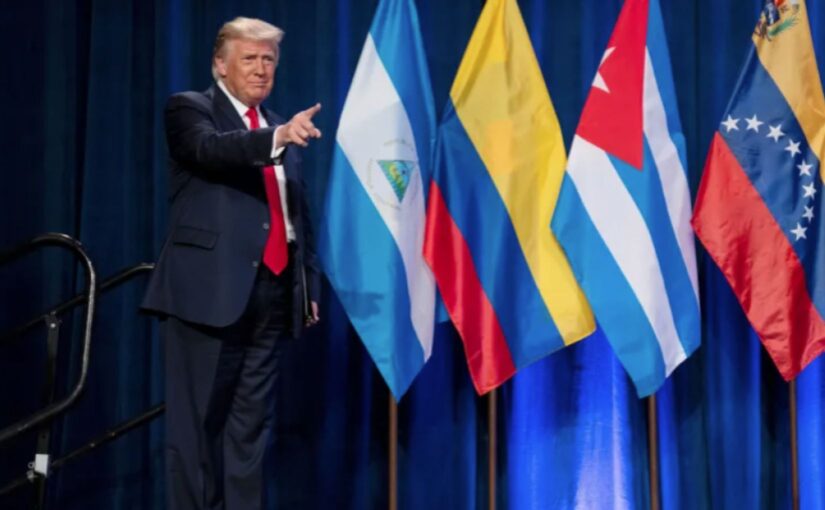
Trump presidency threatens us all

What follows is a blog post by Sophie Bolt, the new General Secretary of the Campaign for Nuclear Disarmament (CND), on the threat posed by the Trump presidency to global peace.

Sophie notes that Trump has promised to “stop wars, not start them”, and yet he has already nominated several notorious warmongers to his cabinet, including Marco Rubio as Secretary of State, Michael Waltz as National Security Adviser, and John Ratcliffe as CIA director. Marco Rubio is an anti-China fanatic, who stands for more tariffs, more sanctions, more slander, more support for Taiwanese separatism, more weapons to Taipei, more provocations in the South China Sea, and more destabilisation in Hong Kong and Xinjiang. Waltz has long pushed for closer military cooperation with India, Japan, Australia and other countries in the region in preparation for war against China. Ratcliffe refers to China as “the top threat to US interests and the rest of the free world”.

The article points out that the incoming administration is likely to escalate the US-led New Cold War against China, as well as continuing the drive towards hot war:

As well as intensifying Trump’s protectionist ‘America First’ policy, by increasing tariffs on Chinese goods, a key focus will be racheting up a military confrontation with China. A military build up across the Asia Pacific has been underway for more than a decade, supported by 400 US military bases encircling China and the AUKUS nuclear alliance with Britain and Australia.

Meanwhile Trump’s climate denialism will be another major setback to global cooperation around the climate crisis.

This article was first posted on the CND website.

In Trump’s victory speech, he said he was going to stop wars, not start them. Excuse me if I’m not reassured. Based on his track record and the ultra-hawks he’s putting in the State Department, the threat of war and nuclear confrontation looks higher than ever.

Last time he was President, the US bombed Syria, Afghanistan and Iraq, carried out extra-judicial killings and developed ‘useable’ nuclear weapons. Under his leadership, the US withdrew from landmark nuclear arms control treaties including the Intermediate Nuclear Forces Treaty, the Open Skies Treaty, and the Joint Comprehensive Plan of Action (JCPoA). And it withdrew from the Paris Climate Agreement.

Trump’s new team for the State Department includes ultra China and Iran hawks, Marco Rubio, expected to be nominated for Secretary of State, and Mike Waltz, appointed National Security Advisor.  Certainly Trump’s victory and open support for annexing the West Bank has already emboldened Netanyahu’s genocidal expansionism. This increases the risk of an all-out war on Iran.

As well as intensifying Trump’s protectionist ‘America First’ policy, by increasing tariffs on Chinese goods, a key focus will be racheting up a military confrontation with China. A military build up across the Asia Pacific has been underway for more than a decade, supported by 400 US military bases encircling China and the AUKUS nuclear alliance with Britain and Australia. Richard O’Brien, former security advisor to Trump, laid out in Foreign Affairs what to expect next. ‘As China seeks to undermine American economic and military strength,’ O’Brien argues, ‘Washington should return the favor—just as it did during the Cold War, when it worked to weaken the Soviet economy.’  This prospect of a new cold war is truly horrifying , when we remember how the nuclear arms race in the 1980s, lead to a permanent state of nuclear danger.  

With speculation about what Trump will do in Ukraine, the new British government doesn’t want to take any chances of de-escalation. Starmer has again pressed Biden to agree to Ukraine’s use of its long-range Storm Shadow missiles, which could strike deep into Russian territory. He knows full well that Russia has changed its nuclear use policy in response to such an attack. This only reinforces the need for an urgent negotiated settlement.

NATO membership of Ukraine remains a key factor in the conflict and Ukrainian neutrality will be critical for de-escalating the crisis. But there is absolutely no evidence to back up concerns amongst NATO hawks that Trump will abandon the world’s most powerful nuclear alliance. On the contrary, Trump has called on NATO states to increase defence spending to 3% of GDP. So, continuing to push the burden of funding onto the populations of NATO states. This means the toxic combination of increased militarism, nuclear dangers and austerity policies will continue across Europe.

Trump’s election will strengthen the far right and fascists globally. In Britain, Farage and Tommy Robinson will be emboldened further to whip up hatred, justifying greater military spending for another world war.  

And, as the US is one of the world’s largest polluters, Trump’s decision to pull out of Paris Climate Accord again, is another major set-back for climate action and investment in green technologies.

This shows more starkly than ever how war, racism, austerity, climate breakdown and nuclear annihilation are increasingly interlinked. We can’t allow this recklessly dangerous leader to drag the world towards annihilation. This is why CND is working with all those who oppose Trump to help build the broadest alliance possible for peace, justice and a sustainable, nuclear-free future.

China-Slovakia relations elevated to strategic partnership

Prime Minister of the Slovak Republic Robert Fico paid an official visit to China, October 31-November 5.

He met with Chinese President Xi Jinping on November 1.

Noting that this year marks the 75th anniversary of the establishment of diplomatic relations between China and Slovakia, Xi said that after three-quarters of a century of development, the traditional friendship between the two countries is full of vitality, and the cooperation in various fields has yielded fruitful results, bringing tangible benefits to the people of both countries.

“We have decided to elevate China-Slovakia relations to a strategic partnership, which meets the future development needs of both countries and will inject new and powerful momentum into bilateral cooperation,” Xi said, adding that China is willing to work together with Slovakia to open a new chapter in bilateral relations and lift their ties to a higher level.

In order to expand pragmatic cooperation, Xi said the two countries should make good use of the newly established inter-governmental cooperation committee to strengthen synergy in new energy, transportation and logistics, infrastructure construction and water resources management. China encourages its enterprises to invest in Slovakia and welcomes Slovak enterprises to explore the market in China, he added.

Xi noted that the two countries need to strengthen international cooperation. In a complex and rapidly changing world, both sides should uphold true multilateralism, firmly safeguard the international system with the United Nations at its core and the international order based on international law, advocate for an equal and orderly multipolar world and universally beneficial and inclusive economic globalisation, embrace a vision of global governance featuring extensive consultation, joint contribution and shared benefits, and promote the building of a community with a shared future for humanity.

China attaches great importance to China-EU relations, Xi said, adding that next year marks the 50th anniversary of the establishment of diplomatic relations between China and the EU, and China-EU relations should demonstrate due maturity and stability.

The Chinese leader expressed the hope that the new EU institutions will adhere to the orientation of the China-EU partnership, adopt a positive and pragmatic approach, properly manage differences, and refrain from politicising economic and trade issues.

Fico said Slovakia firmly adheres to the one-China policy and recognises the government of the People’s Republic of China as the only legitimate government representing all of China. Slovakia opposes any interference in other countries’ internal affairs and advocates for respecting each country’s choice of development path.

Slovakia appreciates the three major global initiatives put forward by President Xi and is willing to strengthen exchanges with China on state governance experience and actively promote the EU’s commitment to handling differences through dialogue and consultations.

The two sides also exchanged views on the Ukraine crisis. Xi expounded on China’s consistent principle and position, commending Slovakia for adopting an objective, rational and impartial stance. He welcomed Slovakia, as well as more like-minded countries, to play a positive role in promoting peace talks.

Fico met with Chinese Premier Li Qiang the same day.

Li said that both countries should give full play to the role of the joint economic committee and the science and technology cooperation committee and promote cooperation in various fields including the China-Europe Railway Express, connectivity, and infrastructure construction.

For his part, Fico mentioned that China’s development accomplishments in recent years have set an example for countries around the world. He said Slovakia supports the global initiatives proposed by China.

The prime minister added that Slovakia opposes the extra tariffs imposed by the EU on Chinese electric vehicles, adding that the EU and China should seek a proper solution through dialogue and consultation. He said that Slovakia is willing to strengthen exchanges and coordination with China in international affairs to jointly tackle global challenges.

After their talks, Li and Fico witnessed the signing of multiple documents on bilateral cooperation in the fields of transportation, economy and trade, culture, tourism, and green and low-carbon development.

Also on November 1, Fico met with Zhao Leji, Chairman of the National People’s Congress (NPC) Standing Committee.

Zhao said that China is ready to work with Slovakia to implement the important consensus reached by the leaders of the two countries, consolidate the political foundation, expand the Belt and Road cooperation and China-Central and Eastern European Countries (CEEC) cooperation, strengthen people-to-people exchanges, and take China-Slovakia relations to a higher level.

China and Slovakia issued a detailed joint statement on their establishment of a strategic partnership.

It noted that: “The participants accept that they do not have any significant open questions or unresolved issues between them. Friendship and cooperation have always been the mainstream of the bilateral relations and are in line with the common and long-term interests of the two peoples.”

Continue reading China-Slovakia relations elevated to strategic partnership

China and Cuba continue deepening their special, friendly bilateral relations

The close fraternal relations between China and Cuba were underlined and reinforced by the November 6-12 China visit of Esteban Lazo Hernandez, the President of Cuba’s National Assembly of People’s Power, at the invitation of his counterpart, Zhao Leji, Chairman of the Standing Committee of the National People’s Congress (NPC).

The two men met on November 7.

Noting that next year marks the 65th anniversary of diplomatic ties between China and Cuba, Zhao said that China is willing to work with Cuba to implement the important consensus reached by the two countries’ heads of state, continue deepening the special, friendly bilateral relations in the new era, and promote the steady, far-reaching construction of a community with a shared future between China and Cuba. He added that China has always placed Cuba in a special position in its external relations and is willing to deepen political mutual trust and strategic coordination with the country.

Zhao thanked Cuba for its firm support on the Taiwan question and other issues concerning China’s core interests. He said China supports Cuba firmly in its just struggle against sanctions, blockades and external interference, and will continue providing Cuba with assistance and support within its own capacity. China is ready to strengthen practical cooperation with Cuba in various fields, make good use of coordination mechanisms under the Belt and Road, and deepen cooperation in such fields as agriculture, tourism, sports, biotechnology, clean energy, and information and communication.

He called on both sides to strengthen coordination and speak with one voice on safeguarding each other’s core and major interests, and to undertake dialogue and exchange in the areas of socialist-democracy and rule-of-law development, poverty reduction and public security. The two nations should also promote exchange in the fields of education, culture, youth and media, and consolidate the popular public support for China-Cuba friendship.

Noting that China’s rapid development is a growing force for world peace and has brought development opportunities to Latin America and the Caribbean, Lazo said the National Assembly of People’s Power is willing to strengthen its friendly exchange with China’s NPC, advance exchange and mutual learning in rule-of-law development and other areas, and give play to the positive role of legislative bodies in enhancing the bilateral friendship.

On the same day, Lazo also met with Wang Huning, Chairman of the Chinese People’s Political Consultative Conference (CPPCC) National Committee.

Wang said that China is willing to work with Cuba to implement the important consensus reached by the two heads of state and jointly build a China-Cuba community with a shared future.

Lazo congratulated the 75th anniversary of the founding of the People’s Republic of China and the success of the third plenary session of the 20th Communist Party of China Central Committee, noting that Cuba firmly upholds the one-China principle and firmly supports China’s core interests and its major concerns.

Prior to his China visit, Lazo visited the Socialist Republic of Vietnam, November 2-3, and the Lao People’s Democratic Republic, November 3-6.

The following articles were originally published by the Xinhua News Agency.

China, Cuba vow to strengthen exchange in rule-of-law development

BEIJING, Nov. 7 (Xinhua) — Zhao Leji, China’s top legislator, and Esteban Lazo Hernandez, president of Cuba’s National Assembly of People’s Power, held talks on Thursday in Beijing, vowing to strengthen exchange in the area of rule-of-law development.

Noting that next year marks the 65th anniversary of diplomatic ties between China and Cuba, Zhao, chairman of the National People’s Congress (NPC) Standing Committee, said China is willing to work with Cuba to implement the important consensus reached by the two countries’ heads of state, continue deepening the special, friendly bilateral relations in the new era, and promote the steady, far-reaching construction of a community with a shared future between China and Cuba.

Zhao said China has always placed Cuba in a special position in its external relations, and is willing to deepen political mutual trust and strategic coordination with the country.

Zhao thanked Cuba for its firm support on the Taiwan question and other issues concerning China’s core interests. He said China supports Cuba firmly in its just struggle against sanctions, blockades and external interference, and will continue providing Cuba with assistance and support within its own capacity.

China is ready to strengthen practical cooperation with Cuba in various fields, make good use of coordination mechanisms under the Belt and Road, and deepen cooperation in such fields as agriculture, tourism, sports, biotechnology, clean energy, and information and communication, Zhao said. China is also prepared to translate the high-level political mutual trust between the two countries into further practical cooperation results, he added.

The NPC of China is willing to work with Cuba’s National Assembly of People’s Power to implement the cooperation agreement between the legislative bodies of the two countries, he said. He called on both sides to strengthen coordination and speak with one voice on safeguarding each other’s core and major interests, and to undertake dialogue and exchange in the areas of socialist-democracy and rule-of-law development, poverty reduction and public security. The two nations should also promote exchange in the fields of education, culture, youth and media, and consolidate the popular public support for the China-Cuba friendship.

Zhao also said that the legislatures of the two countries can promote the exchange of experience in strengthening key legislation areas and improving the quality of legislation.

Lazo said that Cuba adheres firmly to the one-China principle, supports the Global Development Initiative, the Global Security Initiative and the Global Civilization Initiative, and is willing to learn from China’s experience in reform and opening-up, as well as in party construction.

Noting that China’s rapid development is a growing force for world peace and has brought development opportunities to Latin America and the Caribbean, Lazo said the National Assembly of People’s Power is willing to strengthen its friendly exchange with China’s NPC, advance exchange and mutual learning in rule-of-law development and other areas, and give play to the positive role of legislative bodies in enhancing bilateral friendships.

Zhao and Lazo signed a cooperation agreement between their two legislative bodies following their meeting.


China’s top political advisor meets president of Cuba’s National Assembly of People’s Power

BEIJING, Nov. 7 (Xinhua) — China’s top political advisor Wang Huning met with Esteban Lazo Hernandez, president of Cuba’s National Assembly of People’s Power, in Beijing on Thursday.

Wang, chairman of the Chinese People’s Political Consultative Conference (CPPCC) National Committee, said China is willing to work with Cuba to implement the important consensus reached by the two heads of state and jointly build a China-Cuba community with a shared future.

The CPPCC National Committee is ready to strengthen exchanges and cooperation with Cuba and push the friendly exchanges and cooperation between the two parties, countries and peoples to a higher level, Wang said.

Lazo congratulated the 75th anniversary of the founding of the People’s Republic of China and the success of the third plenary session of the 20th Communist Party of China Central Committee, noting that Cuba firmly upholds the one-China principle and firmly supports China’s core interests and its major concerns.

Cuba stands ready to work with China to implement the important consensus reached by the two heads of state, strengthen bilateral exchanges and cooperation in various fields such as economy and party building, jointly build a community with a shared future between the two sides, and safeguard international fairness and justice, Lazo said.

China, multipolarity and the rise of the Global South

We are pleased to publish below an article by Francisco Domínguez, secretary of the Venezuela Solidarity Campaign (Britain) and Friends of Socialist China advisory group member, based on a speech he delivered to our September 28 conference celebrating the 75th anniversary of the founding of the People’s Republic of China.

The article begins by highlighting some of the parallels between the Chinese Revolution and the 20th century revolutionary movement in Latin America, particularly with regard to the role of the peasantry and the relative weight of the struggle against colonialism and imperialism. Francisco draws in particular on the work of Peruvian Marxist, José Carlos Mariátegui, in the 1920s.

Francisco goes on to outline the impact of Hugo Chávez’s strategy of regional integration and its complementarity with the global strategy of multipolarity – in which China plays a key role – as well as the blossoming economic and diplomatic relationship between Latin America and the People’s Republic of China.

The article concludes: “The rise of Latin America with the Pink Tide as a dynamic and active component of the Global South is a clear manifestation both of multipolarity and the region’s desire to play an leading role in building a Global Community of Shared Future.”

Introduction

The Chinese Revolution has reached 75 years and its extraordinary economic development has turned into the second largest economy in the world on the basis of impressive technological advances and becoming a highly beneficial hub to the Global South, which is the current manifestation of multipolarity. We examine how Latin America embarked on a process of progressive transformation and regional integration (known as the Pink Tide) leading, since about 1999, to enter into a growing collaborative and multifaceted relationship with the People’s Republic of China.

Significance of the Chinese Revolution

In 1957 Mao Zedong identified three key forces on a world scale: US imperialism engaged in policies and wars of aggression; other developed capitalist countries; and countries fighting for national independence and national liberation movements in Asia, Africa and Latin America. […] As for the oppressed nations’ liberation movements and countries fighting to gain national independence, the Party advocated giving them active support and developing extensive friendly relations with them. Regarding capitalist countries other than the U.S., the Party’s view was that China should also win them over and develop friendly relations with them. As to the United States, the Party advocated determined opposition to U.S. armed aggression and threats to China, on the one hand, while still striving for peaceful co-existence with the it and settling disputes between the two countries through peaceful consultation, on the other.[1]

The novelty of the Chinese Revolution, already a feature of the Russian Revolution, was an immense peasant base in a country where in 1949 there was hardly a working class. Well over 85% of the country was made of peasants and where the working-class movement had been destroyed by a combination of the Kuomintang’s brutal repression in 1925-1927, followed by the Japanese invasion (1931-1949). The proletariat had almost disappeared.

Thus, the Chinese Communist Party mobilised the peasantry endowing that mobilization with proletariat leadership and revolutionary dynamic, which, by demolishing its feudal structures, would lead to the accomplishment of the democratic tasks of the revolution. However, its consolidation required to move simultaneously to the undertaking of the socialist tasks by primarily start the construction of a proletarian state that rested on the power of the People’s Liberation Army under the leadership of the CCP. The latter gave the revolution its socialist character.

In this regard in 1959, Lui Shaoqi, a leader of the Revolution said, the Chinese revolution exerts a formidable “attraction for the peoples of backward countries that have suffered, or are suffering imperialist oppression. They feel that they should also be able to do what the Chinese have done.”[2]

A similar strategy had been put forward in Latin America by Peruvian Marxist, José Carlos Mariátegui as early as 1928.[3] He argued that due to its backward nature, the nations in Latin America had a weak, small and dependent bourgeoisie, subordinated to the landed oligarchy and imperialism, therefore, unable and unwilling to undertake the carrying out of the national democratic tasks to modernise society to fully develop capitalism. Thus, the only way to carry through the national democratic tasks was by a socialist revolution led by the proletariat enjoying hegemony over the majority peasantry for land reform as the sine qua non condition of its success.

Continue reading China, multipolarity and the rise of the Global South

Defense of China is solidarity with Palestine

The following is the text of the talk given by Larry Holmes, First Secretary of the Workers World Party (WWP), at the September 29 meeting held in New York City to celebrate the 75th anniversary of the founding of the People’s Republic of China, which was initiated by Friends of Socialist China, together with WWP.

Larry begins by extending fraternal greetings to the Communist Party of China. on behalf of the WWP Central Committee, on the 75th anniversary.

After briefly reviewing the current situation in Palestine and Lebanon, he notes that this is part of a wider war against anti-imperialist forces around the world, including China, and explains:

“It’s against China… Why is this? Is it because China supports the Palestinians? That’s part of it. But that’s a small reason. China has, on a number of occasions, brought the Palestinian people together to try to help them forge unity… But the bigger reason… is because China is so powerful now. It’s so powerful and so developed as people are rising up and this has changed the balance of forces in the world. But we need to be very clear about something. China does not want war. China wants peace. It wants to continue its development in peace. It wants to help the world develop in peace, especially the people of the Global South who have been the big victims of imperialism and colonialism. It wants to help them, but US imperialism does not want peace. It doesn’t want China to develop in peace. It doesn’t want the world that it does not control to develop, and this is the problem.”

The text of Larry’s talk was originally published by Workers World.

First, on behalf of the Central Committee of Workers World Party, we would like to extend our fraternal greetings to the Communist Party of China on this historic occasion.

I think it’s relevant, even though our event is about China, to ask ourselves what we should make out of the assassination of the leader of Hezbollah two days ago.

This was so important to them — I’m not forgetting the genocide of Gaza — but this event, coming at this time — they dropped eight bombs on a neighborhood in Beirut. 2,000-pound bombs. One of these military analysts said the only thing bigger they could have dropped would have been a tactical nuclear weapon. These 2,000-pound bombs were given to Israel by who? The U.S. gave them thousands of them. I forget the exact number, but thousands of them.

I do not buy for a second this idea that, well we didn’t know about this, and they didn’t tell the secretary of war here. That’s BS. If they weren’t down with it, they could have stopped it. The message was just not from Netanyahu. It was from Washington, D.C. It was from the Pentagon.

And I’ll tell you why it’s relevant to China and the whole world. Everything in the world’s struggle is connected. Everything is dots all together. They wanted to let the world know that you don’t have to speculate about a wider war. You don’t have to lie to us about “why we don’t want one, and we have all this diplomacy trying to stop it.” That’s not what’s really going on.

The wider war is already here, and it’s not just against the Palestinians, although they are the main target, just as are the Lebanese, you know, the resistance forces of West Asia and, of course, Iran. It’s against People’s Korea, Cuba, Venezuela, the struggling people of West Africa, who, as you might notice recently, have been throwing the colonialists and the imperialists out.

And it’s against Russia through Ukraine, and ultimately, it’s against China.

It’s against China. Wow. Why is this? Is it because China supports the Palestinians? That’s part of it. But that’s a small reason. China has, on a number of occasions, brought the Palestinian people together to try to help them forge unity. Very, very important.

But the bigger reason, the bigger reason, is because China is so powerful now. It’s so powerful and so developed as people are rising up, and this has changed the balance of forces in the world. But we need to be very clear about something.

China does not want war. China wants peace. It wants to continue its development in peace. It wants to help the world develop in peace, especially the people of the Global South who have been the big victims of imperialism and colonialism. It wants to help them, but U.S. imperialism does not want peace. It doesn’t want China to develop in peace. It doesn’t want the world that it does not control to develop, and this is the problem.

And what this murder in Beirut tells us – and there have been almost 1,000 people who have been murdered in Lebanon over the past couple of weeks – and the genocide in Gaza, what it tells us is that U.S. imperialism is willing to go to almost any length, unimaginable lengths of violence and terror to maintain its empire, which is crumbling.

They are willing to flirt with World War Three, which could mean the end of all life on the planet Earth. And you know, when an empire is crumbling, that’s when it’s most desperate and dangerous. That’s when it’s most likely to resort to violence. And this is what we are witnessing, comrades.

There are some in the ruling class here who are afraid of war, a wider war, a world war. They don’t think the U.S. will win. As a matter of fact they think it would hasten the demise of U.S. imperialism. And we think that they are right about that, and they’d like to maintain U.S. hegemony by other means. But whatever that is for the ruling class, they are losing. They’re not in the driver’s seat.

It’s the warmongers who are in the driver’s seat. So we see the people rising up all over the world against the empire. We see the people demonstrating in the streets over the murder of the leader of Hezbollah. Actually, as I was leaving home, I saw on social media that there was a demonstration of thousands of people in Baghdad. They had entered the Green Zone and were trying to get into the U.S. Embassy.

There are people demonstrating everywhere, around the world and particularly in West Asia. It shows you that — this is a hunch — they’re not going to take it by lying down. As a matter of fact, it’s going to wave off the mere resistance and, of course, the countries that are under attack, in particular China, that are in the crosshairs of U.S. imperialism, are going to fight back to defend themselves. They can defend themselves.

But we have to ask ourselves this. Are we going to just leave it up to people in other places, to China, they’re willing to do it, they’ll do what they have to do, but are we just going to leave it up to them? Especially those of us who happen to be at the center of world imperialism, particularly here in the U.S. which they used to call the belly of the beast. We can’t do that. That’s not right.

We have to seriously consider what our responsibilities as anti-imperialist revolutionaries are, and we have to show them those responsibilities, and then we gotta, we gotta do whatever it takes. You see, the people of the world, they’re demanding this of us. History is demanding us. Save this planet if it could talk, is demanding this of us, that we do whatever is necessary, however we need to do it. However long it takes, and it doesn’t have to take too long for the anti-war and anti-imperialist forces to get so big and so strong that we can shut the world down to stop war. What real choice do we have?

We’ve got to get away from complacency if that’s an issue. I know that there are those of us who do whatever we are doing on a day-to-day basis, whenever we can. We’ve got to get away from our routine — what they call routinism. It’s almost like a semi-conscious feeling that, yes, that needs to be done, but somebody else can do it.

Sometimes, I think we have a partial kind of disconnect, a partial, you know, denial of what’s happening. Perhaps we can feel somewhat powerless, but all things we’ve got to push aside now, we got to push them aside, and we got to figure out what we are going to do.

I think, I’m not sure, that comrade Maduro in Venezuela, a couple of months ago, called for an international united front against imperialism. Not sure if it’s just something that he floated, or whether it’s real and how he’s following up on that. But I’ll tell you comrades, if there was ever a time for that, and I’m not talking about just a name — he seems to have a name — I’m talking about something flesh and blood and strength and power that’s real. If there was ever a time for that, it’s now.

I’m thinking about our own plan. The BRICS countries are meeting in Russia in the last week of October. And that’s good. People have talked about … and we can talk about that. But again we can’t just leave it up to the BRICS to push imperialism back, to marginalize it, to diminish its hegemony. We’ve got to do something! The masses have to do something. The working class has to do something decisive. And a lot of us are convinced that they can. And those who are not convinced, better get with it.

Long live the People’s Republic of China!
Long live the struggle for socialism! Defend China!

China-South Africa relations a model of solidarity and cooperation for developing countries

The “special and close relationship” between South Africa and China was underlined by the November 5-7 official goodwill visit to South Africa by Li Xi, a member of the Standing Committee of the Political Bureau of the Communist Party of China (CPC) Central Committee and Secretary of the CPC Central Commission for Discipline Inspection, at the invitation of the African National Congress (ANC).

Li held talks with South African President and ANC President Cyril Ramaphosa in Cape Town. He also met with Speaker of the National Assembly and ANC National Executive Committee member Thokozile Didiza, as well as ANC Secretary-General Fikile Mbalula, in Pretoria.

In his meeting with Ramaphosa, Li said China and South Africa have forged deep-rooted friendship, and their relations have entered a “golden era” in recent years under the guidance of the two heads of state.

China will fully support South Africa’s presidency of the G-20 in 2025, and deepen coordination and cooperation on international and regional issues with South Africa so that they might together play a leading role in the modernisation of the Global South and promote the building of a community with a shared future for humanity.

Underlining the special and close relationship between South Africa and China, Ramaphosa said the two heads of state have recently elevated bilateral relations to an all-round strategic cooperative partnership in the new era, a move that is bound to deepen bilateral cooperation in various fields.

South Africa applauds China’s openness to South Africa and Africa, viewing it as an important opportunity, he said, noting that South Africa’s Government of National Unity will maintain continuity in his country’s policy toward China, strengthen friendly cooperation and enhance coordination and cooperation through multilateral international mechanisms.

During talks with Didiza, Li said that since the establishment of diplomatic relations 26 years ago, China-South Africa relations have made enormous strides and set a model of solidarity and cooperation for developing countries.

Didiza thanked China for its valuable support during South Africa’s struggle for national independence and in its nation-building process. She expressed readiness to utilise the regular exchange mechanism between the two countries’ legislative bodies to enhance exchanges at all levels, strengthen ties between the two peoples, and foster cooperation in various fields to jointly uphold the interests of developing countries.

In his talks with Mbalula, Li said that the ANC is a major African political party with a fine tradition and extensive influence, and the relationship between the CPC and the ANC is a vital cornerstone of China-South Africa relations.

Mbalula said the ANC and the CPC have forged profound friendship through their long-term exchanges. He applauded the achievements of the CPC as a century-old party that has been pursuing reform and innovation and leading China’s development.

He added that the ANC is willing to learn from the CPC’s experiences in economic development, full and rigorous Party self-governance and anti-corruption efforts to better address internal and external challenges and foster new developments in South-South cooperation and China-South Africa relations.

During the visit, Li noted that the source of the overwhelming victory and comprehensive consolidation of China’s anti-corruption campaign lies fundamentally in the centralised and unified leadership of the CPC Central Committee with Xi Jinping at its core and with the adherence to the people-centered development philosophy.

This victory, he explained, was also achieved through China’s sustained high-pressure approach to fighting corruption, reinforced discipline and conduct, and coordinated measures that tackle corruption at all levels. China is ready to enhance anti-corruption exchanges and cooperation with South Africa.

Continue reading China-South Africa relations a model of solidarity and cooperation for developing countries

Trump’s return – the critical issue for Britain remains disengaging from the US war chariot

In this insightful article for Stop the War Coalition, Andrew Murray discusses the implications of Trump’s return to the presidency for the anti-war movement in Britain.

Andrew notes that the collapse in the Democrat vote “is surely in part attributable to the Biden-Harris administration’s sustained and unqualified support for Israel’s genocide of the Palestinian people”. While there is little prospect of a Trump administration being any better on this issue, the Democrats’ utter failure to stand up against the Gaza genocide has clearly lost them support among progressive voters.

In relation to China, while many had high hopes that Biden would adopt a less confrontational approach than Trump, in reality “Biden’s rhetoric and actions have been the most aggressive of any president since the 1960s”. Under the incoming Trump administration, “continuity in escalating confrontation is most likely”.

Andrew writes that, for the anti-war movement, “our fight is against imperialism” and, in Britain specifically, “the critical issue remains disengaging from the US war chariot”, regardless of whether it is driven by a Democrat or a Republican; regardless of whether its character is “centrist liberal war-mongering” or “populist chauvinist war-mongering”.

Andrew Murray is the political correspondent of the Morning Star. He has served as the Chair of the Stop the War Coalition, Chief of Staff at Unite the union, and as an adviser to Jeremy Corbyn MP when he was Leader of the Labour Party. The author of several books, he has contributed a chapter to the recently-released volume People’s China at 75 – The Flag Stays Red.

Donald Trump’s unexpectedly emphatic election victory clearly poses new challenges for the anti-war movement in Britain and globally, and calls for sober analysis.

Trump appears to have won the support of most working-class people who bothered to vote, including millions of Muslim Americans and larger minorities of African-Americans and Hispanic Americans than a Republican can usually expect.

Many issues obviously contributed to this, including the state of the US economy and cultural questions, broadly defined. However, war and peace impacted in two ways.

First, the huge collapse in the Democrat vote from 2020 (Trump’s poll also declined, but by much less) is surely in part attributable to the Biden-Harris administration’s sustained and unqualified support for Israel’s genocide of the Palestinian people.

This made the idea of supporting Kamala Harris quite impossible for millions, who may instead have voted for Green candidate Jill Stein, other progressive candidates where they made the ballot, or simply have sat the election out. There is an analogy here to the masses who refused to back Keir Starmer’s Labour in July because of its support for Israel.

Second, part of Trump’s base lies in sections of the working class sick of the “forever wars” in which a liberal-neoconservative elite send ordinary Americans to die for US hegemony. The Biden administration has sat squarely in that imperialist tradition.

To those voters can be added a larger number who are receptive to the position advanced by Trump, and more stridently by his vice-president J D Vance, that the vast sums being sent in military and economic aid to Ukraine to prolong the war with Russia would be better spent on other things, or not at all.

Trump’s own record and rhetoric on world issues is reactionary without doubt. However, he has made much of not starting any fresh wars when last in office, and of trying to extricate the US from direct engagement in those that he inherits, or at least diminishing its involvement.

Continue reading Trump’s return – the critical issue for Britain remains disengaging from the US war chariot

Imperialism fails to quash China’s EV revolution

The following article by Chris Fry, a retired autoworker who worked as an assembler at Chrysler’s Lynch Road Assembly in Detroit until the company closed the plant in 1980, addresses the crisis facing the car manufacturing industry in the US and Europe, noting that many of the largest car manufacturers are shedding thousands of jobs and closing plants.

Chris notes that car manufacturers in the West have failed to invest seriously in electric vehicles, and industrial policy has been shaped to a significant degree by the interests of the fossil fuel industry. Meanwhile, “China, due in large part to its socialist economic and social system and its social ownership of much of its production and its scientific planning, has developed the infrastructure of EV production in a vast scale capable of producing emission-free vehicles of high quality at an affordable price for working class consumers”.

Rather than develop a coherent industrial policy, successive administrations in the US have turned to protectionism, imposing tariffs on Chinese EVs “designed to deny workers in the U.S. affordable emissions-free vehicles, notwithstanding all the supposed ‘concern’ from Washington over global warming”.

Chris concludes: “The accomplishments by the Chinese workers and their workers’ government represent a pathway to victory for ourselves and our families for an empowered and prosperous future.”

This article was originally published in Fighting Words.

On October 18 tens of thousands of Italian auto workers held a nationwide strike and marched through the streets of Rome. Organized by three unions, this action was led by workers from the Italian-based conglomerate Stellantis, composed also by the French company Peugeot as well as the U.S. Chrysler Corporation.

Stellantis is the world’s fourth largest automaker. It is projected to end the year with a loss of $11.2 billion.

The worker’s militant action not only targeted the company, but also was against the right-wing Italian government. The unions are demanding incentives to allow workers to be able to afford electric cars.

This was the first such militant worker action in Rome in 20 years.

UAW lines up to confront Stellantis

On October 3, the UAW, led by President Shawn Fain, held a rally and march to the Michigan Sterling Heights Stellantis Stamping plant:

Outside the UAW Local 1264, about 400 UAW members listened to speeches from UAW leadership, including UAW President Shawn Fain, and chanted, “Keep the promise” and “Fire Tavares” (Carlos Tavares is the CEO of Stellantis, the automaker that owns the Jeep, Ram, Chrysler, Dodge and Fiat brands). They then marched about a half mile to Stellantis’ Sterling Stamping Plant.

“Are you ready to do whatever we have to do to save American jobs,” Fain asked the crowd. “This is our generation’s defining moment. Over this last year, we moved a lot of mountains, but we’ve got more mountains to move.”

The union is demanding that the company live up to the 2023 contract and reopen the Belvidere Assembly Plant, converted to an EV battery plant in Illinois and keep Dodge Durango production in Detroit.

The week before the company had announced plans for indefinite layoffs “across its footprint” and the firing of its “supplemental workers” but refused to give specifics.

It has already laid off 1,100 workers at its Warren Assembly plant.

The UAW action comes after an announcement by the union that it would hold a company-wide strike vote by Stellantis workers demanding that the company abide by the contract won last year after a six-week strike.

Of course, the auto company executives and their government minions blame Socialist China and its so-called “over capacity” for these massive job losses and broken promises.

EV crisis at capitalist auto companies.

It’s not just Stellantis that is facing this deepening crisis.

In September, the German company Volkswagen announced plans to lay off 30,000 of its 300,000 workers. VW’s software subsidiary is laying off 2,000 workers over the next two years.

Mercedes Benz is laying off workers in Seattle, Washington and London. ZF Friedrichshafen, a major parts supplier to 55 auto brands, announced it would lay off 12,000 of its workers, while another supplier, Bosch, announced that it was cutting 1,200 jobs.

Continue reading Imperialism fails to quash China’s EV revolution

Chen Weihua: China’s peaceful rise is a miracle unprecedented in human history

We are pleased to reprint below the speech delivered by Chen Weihua to our September 28 conference celebrating the 75th anniversary of the founding of the People’s Republic of China.

Chen describes the founding of the People’s Republic as a turning point in Chinese history: “Chairman Mao’s declaration 75 years ago that the Chinese people have stood up made Chinese extremely proud of being Chinese, after the nation had suffered a century of humiliation inflicted upon by imperial and colonial powers.”

China’s progress since then – lifting hundreds of millions out of poverty, developing universal healthcare and education, massively improving living standards, and becoming a global leader in green technology – has been remarkable, but has also raised alarm in Washington, which sees China’s rise as a threat to its strategy of hegemony.

This is the context for the trade war, for the US’s unilateral sanctions on China, and for the escalating military encirclement campaign. It also provides the context for a relentless propaganda war, in which China is demonised and labeled a threat to peace and democracy. “The US often portrays China as a major threat to global peace. The truth is that China has one of the best records for peace. The US has been engaged in constant wars and regime changes, from Afghanistan to Iraq to Libya, just to name a few.”

Chen points out that, in an interconnected world, “it is more important than ever for the world to come together to tackle common global challenges from climate change, nuclear proliferation and pandemic to economic growth and global governance”, and concludes by calling for a coordinated struggle against the New Cold War.

Chen Weihua is a prominent Chinese journalist and EU bureau chief of China Daily.

It’s a great honor for me to speak to you in my personal capacity at this important event marking the 75th anniversary of the founding of the People’s Republic of China.

I want to express my appreciation for Friends of Socialist China for your good work in advocating world peace and justice and in supporting China against the US new Cold War and its reckless smearing campaigns against China.

Chairman Mao’s declaration 75 years ago that the Chinese people have stood up made Chinese extremely proud of being Chinese, after the nation had suffered a century of humiliation inflicted upon by imperial and colonial powers.

China’s rapid peaceful rise, especially since the reform and opening up in the late 1970s, is a miracle and unprecedented in human history. China has lifted 800 million people out of poverty, greatly raised the living standards of its people, advanced its capacity in education, public health, science and technology. And China has become a global manufacturing powerhouse, including in renewable energy and other clean industries.

China has been playing an important and responsible role on the world stage and as a permanent member of the UN Security Council and as a voice for the developing world.

It’s exactly such China’s independent foreign policy, unique development path and rapid peaceful rise that have made many in Washington feel threatened in sustaining US global hegemony. That is why the US has been going all-out to contain China’s development.

The US has been waging trade wars and tariff wars against China. It has put hundreds of Chinese tech companies on its notorious Entity List of export control. The US has been forcing countries to choose sides in its bid to divide the world into Cold War type political blocs.

Continue reading Chen Weihua: China’s peaceful rise is a miracle unprecedented in human history

From despair to revolution: the Bronx’s path to defeating addiction

The following article by the Bronx [New York] Anti-War Coalition, which was originally published by Workers World, reports on their October 11 screening of the documentary film, ‘Dope is Death’. The event included a Q&A session with Walter Bosque, an acupuncturist and former Young Lord. 

The Young Lords were a youth organisation of the Puerto Rican national minority in the United States, who took up revolutionary organising and the study of Marxism-Leninism and who supported and forged links with socialist China. 

‘Dope is Death’ highlights the late Dr. Mutulu Shakur’s transformative work with the Young Lords and the Black Panther Party, who used acupuncture to combat drug dependency. Their efforts not only rescued individuals from addiction but also empowered the community to rebuild, laying the groundwork for revolutionary change. [Mutulu Shakur was a political prisoner and member of the Black Liberation Army and other revolutionary organisations as well as the stepfather of the rapper Tupac Shakur.]

Having drawn attention to the ‘Opium Wars’ waged by British imperialism against China in the 19th century, the article notes:

After the 1949 revolution, the People’s Republic of China swiftly eradicated opium production and consumption through revolutionary social reform… Mao Zedong’s landmark 1965 health-care speech and his June 26 directive emphasised accessible health care in rural areas, leading to the ‘barefoot doctors’ program. This initiative trained community health workers to provide basic medical services in rural areas, blending modern and traditional medicine to meet the needs of under-served communities. By 1968, this program became a key component of national health policy.

As we celebrate 75 years of the Chinese Revolution, China’s achievements in eradicating addiction, reducing poverty and advancing public health testify to the transformative potential of revolutionary movements. Ultimately, China’s rise as a global power signifies the rise of the Global South, as it extends a helping hand to nations historically oppressed by the US empire and sanctions.

It goes on to outline how the Palestinian resistance had created Muslim youth associations, community clubs and Islamic social gatherings to combat drug trafficking, help individuals overcome addiction and strengthen social cohesion and concludes:

“This history of social resilience and organized resistance across the Bronx, the People’s Republic of China and Gaza highlights the power of community-led healing in the face of systemic oppression.”

A synopsis of the film can be read here

The Bronx Anti-War Coalition hosted a film screening on Oct. 11 of the documentary “Dope is Death” as part of our guerrilla cinema series. The widely attended event featured a Q&A session with former Young Lord and acupuncturist Walter Bosque, where community members engaged in a lively discussion about continuing and expanding the revolutionary movement of healing.

In recent years, the Bronx, a predominantly Black, Brown and working-class borough in one of the most densely populated areas of Turtle Island, has experienced a sharp rise in opioid use, including oxycodone, street fentanyl and heroin. 

We recognize that drug use, particularly opioids, is not merely a personal struggle but a symptom of systemic issues rooted in capitalism and government neglect. This crisis profoundly harms our community. Those most affected by poverty, alienation and exploitation often turn to drugs for temporary relief from oppressive daily conditions. Addiction burdens those already suffering from state-imposed violence and capitalist exploitation.

Rather than supporting and uplifting working-class communities, capitalist society allows drugs like fentanyl, heroin and crack to infiltrate and erode social bonds, deteriorate health and stifle revolutionary potential. Addiction acts as a tool of oppression, weakening communities and diverting energy away from organizing and resistance.

Continue reading From despair to revolution: the Bronx’s path to defeating addiction

Margaret Kimberley: The importance of China for Africa and its diaspora

We are pleased to publish below the text of the speech given by Margaret Kimberley to the meeting, ‘China at 75: Changes Unseen in a Century’, initiated by Friends of Socialist China and held in New York City on September 29.

Margaret, who is the Executive Editor of Black Agenda Report, began her remarks with a strong condemnation of recent and ongoing Israeli war crimes against the peoples of Palestine, Lebanon and the entire region, and continued:

“But this is connected. We understand that this effort, imperialist effort to wage war on the entire region of Western Asia, makes this commemoration all the more important. We’re not just commemorating a successful revolution, but also the beginnings of changes in power relationships around the world, which coincided with the post war stirrings for independence across the Global South.”

Contextualising her remarks, Margaret said:

“This year, I had an amazing opportunity to visit China as part of a Friends of Socialist China delegation, as guests of the China NGO Network for International Exchanges, visiting Beijing, Zhejiang and Jilin. I saw for myself why China has leapfrogged over the rest of the world in its economic development, the dedication to the principles of socialism and a commitment to worldwide cooperation that has made relations with China attractive to the entire continent of Africa.”

Margaret reviewed the Forum on China-Africa Cooperation (FOCAC) that had been held in the Chinese capital Beijing earlier in the month, including drawing attention to some of the contradictions inherent in such a diverse gathering. She made special mention of Eritrea as “the one [African] country that has maintained its commitment to socialism, which is why it’s always under attack.” She mentioned that Chinese companies have agreed to invest up to $7 billion in infrastructure projects as part of their mining agreements in the Democratic Republic of Congo (DRC).

She concluded:

“I think it’s important to mention not just the nations of the African continent, but the relations of the African diaspora. Dr. [Gerald] Horne referred to Shirley Graham DuBois, and there has been constant, on the part of revolutionaries, this urge to connect with China, to see China as this example. Which is why, in general, anti-Chinese propaganda is so dangerous. It’s an effort to indoctrinate. It’s an effort to stop revolutionary activity. And so, WEB DuBois visited China, and Paul Robeson reached out to China, and Huey Newton visited China. It’s all connected, and tells you how important it is that African people maintain these relationships, see China for ourselves and judge for ourselves, and the fact that that is something that is condemned so strongly, tells us quite a lot.”

Thank you all again for being here as we’re just two days away from the 75th anniversary of the founding of the People’s Republic of China. And I would be remiss if I did not speak of what’s happening in Lebanon with the continuation of Israeli and US war crimes, the assassination of Hassan Nasrallah, the deaths of, as I said, nearly 200,000 people. But this is connected. We understand that this effort, imperialist effort to wage war on the entire region of Western Asia, makes this commemoration all the more important. We’re not just commemorating a successful revolution, but also the beginnings of changes in power relationships around the world, which coincided with the post war stirrings for independence across the Global South. 

I’m going to talk about Africa and its relationships with the People’s Republic of China, which began first as China was an example of the possibility of freedom from the capitalist, imperialist world. This year, I had an amazing opportunity to visit China as part of a Friends of Socialist China delegation, as guests of the China NGO Network for International Exchanges, visiting Beijing, Zhejiang and Jilin. 

Continue reading Margaret Kimberley: The importance of China for Africa and its diaspora

Top DPRK leader sends wreath to China-DPRK Friendship Tower

On October 25, the top leader of the Democratic People’s Republic of Korea (DPRK), Kim Jong Un, General Secretary of the Workers’ Party of Korea (WPK) and President of the State Affairs of the DPRK, sent a wreath to the Friendship Tower in Pyongyang marking the 74th anniversary of the Chinese People’s Volunteers (CPV) entering the DPRK to fight in the War to Resist US Aggression and Aid Korea, the Korean Central News Agency (KCNA) reported. The words, “We will remember the martyrs of the Chinese People’s Volunteers forever” were written on the wreath’s ribbon.

KCNA further reported that wreaths were also presented in the name of leading state and government bodies both at the Friendship Tower as well as at the cemeteries and graves of CPV martyrs in various parts of the country.

Wreaths were also laid by the Chinese Ambassador and members of his staff. 

The Friendship Tower was built to remember the Chinese People’s Volunteers who fell in the war of 1950-53. It is situated in the heart of the DPRK capital Pyongyang, on a hill overlooking the Chinese Embassy.

DPRK diplomats paid similar tributes at martyrs’ cemeteries in Shenyang and Dandong, in China’s Liaoning province.

The following articles were originally published by the Xinhua News Agency and KCNA.

Top DPRK leader sends wreath to China-DPRK Friendship Tower

The top leader of the Democratic People’s Republic of Korea (DPRK) on Friday sent a wreath to the China-DPRK Friendship Tower in Pyongyang on the occasion of the 74th anniversary of the Chinese People’s Volunteers entering the DPRK to fight in the War to Resist U.S. Aggression and Aid Korea, the DPRK’s official Korean Central News Agency reported on Saturday.

The words “We will remember the martyrs of the Chinese People’s Volunteers forever” were written on the ribbon of the wreath sent by Kim Jong Un, general secretary of the Workers’ Party of Korea (WPK) and president of the State Affairs of the DPRK.

Upon authorization, Ri Il Hwan, member of the Political Bureau and secretary of the WPK Central Committee, laid the wreath before the tower, the report said.


Wreaths Laid at Friendship Tower

Wreaths were laid at the Friendship Tower on October 25 to mark the 74th anniversary of the entry of the Chinese People’s Volunteers (CPV) into the Korean Front.

Seen standing before the tower was a wreath bearing the august name of the respected Comrade Kim Jong Un.

The guard of honor of the Korean People’s Army lined up there.

Present at the wreath-laying ceremony were Kang Yun Sok, vice-chairman of the Standing Committee of the Supreme People’s Assembly (SPA) of the DPRK, Mun Song Hyok, vice department director of the Central Committee of the Workers’ Party of Korea, Pak Myong Ho, vice-minister of Foreign Affairs, and officials concerned.

The national anthems of the People’s Republic of China and the Democratic People’s Republic of Korea were played.

Amid the playing of wreath-laying music, wreaths in the names of the SPA Standing Committee and the Cabinet of the DPRK were placed before the tower.

Also laid were wreaths in the names of the Foreign Ministry and the Ministry of Urban Management and a wreath in the joint name of the Pyongyang Municipal Committee of the WPK and the Pyongyang Municipal People’s Committee.

The participants paid silent tribute to the memory of the CPV martyrs before going round the tower.

On the same day, wreaths were placed at the cemeteries and graves of CPV fallen fighters in Hyongjesan District of Pyongyang Municipality, Anju City and Hoechang County of South Phyongan Province, Onsong County of North Hamgyong Province and Kaesong Municipality.

Xi meets with leaders of Russia, Laos, Iran, Egypt and Vietnam

Chinese President Xi Jinping held a number of bilateral meetings with fellow leaders in the margins of the BRICS Summit, which was held, October 22-24, in the Russian city of Kazan.

Xi met with his host, President Vladimir Putin on the day of his arrival. He said that China and Russia have found the right way for neighbouring major countries to get along with each other, which features non-alliance, non-confrontation and not targeting any third party.

Noting that this year marks the 75th anniversary of the establishment of diplomatic relations between China and Russia, Xi said that over the past years, the relationship between the two countries has weathered challenges.

Noting that the world today is facing momentous transformations unseen in a century, resulting in a fast-changing and turbulent international landscape, he expressed confidence that the profound and lasting friendship between China and Russia will not change, nor will their sense of responsibility as major countries for the world and for the people.

Despite complex and severe external challenges, bilateral cooperation in areas such as trade continues to advance, and large-scale joint projects remain stable in operation, he said, adding that both countries should further promote the alignment of the Belt and Road Initiative with the Eurasian Economic Union to support their respective high-quality economic development.

Next year marks the 80th anniversary of the founding of the United Nations and the victory of the World Anti-Fascist War, Xi stressed. China and Russia, both permanent members of the UN Security Council and major countries in the world, should deepen comprehensive strategic coordination, strengthen communication and coordination within multilateral frameworks such as the United Nations and the Shanghai Cooperation Organisation, promote a correct view of World War II history, firmly uphold the UN-centred international system, and jointly safeguard global strategic stability along with international fairness and justice.

President Vladimir Putin said that thanks to joint efforts from both sides, the Russia-China cooperation, based on equality, mutual respect, and mutual benefit, continues to advance, and the activities of the Russia-China Years of Culture have been successfully held, adding that Russia stands ready to further deepen cooperation with China and boost the development and revitalisation of both countries.

Noting that next year marks the 80th anniversary of the end of World War II, Putin said that both Russia and China made tremendous sacrifices for victory in the World Anti-Fascist War, and that Russia is willing to commemorate this important milestone together with China.

Also on October 22, Xi met with Thongloun Sisoulith, General Secretary of the Lao People’s Revolutionary Party (LPRP) Central Committee and President of the Lao People’s Democratic Republic (LPDR), saying that the two sides should continue to strengthen the development of the China-Laos Railway and promote the construction of the China-Laos Economic Corridor.

As socialist comrades and brothers, the relations with Laos are of special importance in China’s neighbourhood diplomacy, and the two countries have always stayed at the forefront of building a community with a shared future, Xi said, adding that regardless of how the international situation changes, China will always be a trustworthy friend and partner of Laos.

Congratulating Laos on successfully hosting the East Asian Leaders’ meetings on cooperation, the Chinese President said he welcomes Laos’ active participation in BRICS cooperation.

Thongloun Sisoulith said that he went to China last year to attend the third Belt and Road Forum for International Cooperation and signed with Xi a new version of the action plan for building a China-Laos community with a shared future, which is being implemented effectively at present.

Laos-China relations are at their best in history, with bilateral cooperation expanding in depth and breadth, he added.

The following day, Xi met with the new Iranian President Masoud Pezeshkian and said that no matter how the international and regional situations change, China will unswervingly develop friendly cooperation with Iran.

Continue reading Xi meets with leaders of Russia, Laos, Iran, Egypt and Vietnam

Forum defends anti-imperialist Marxism and People’s China

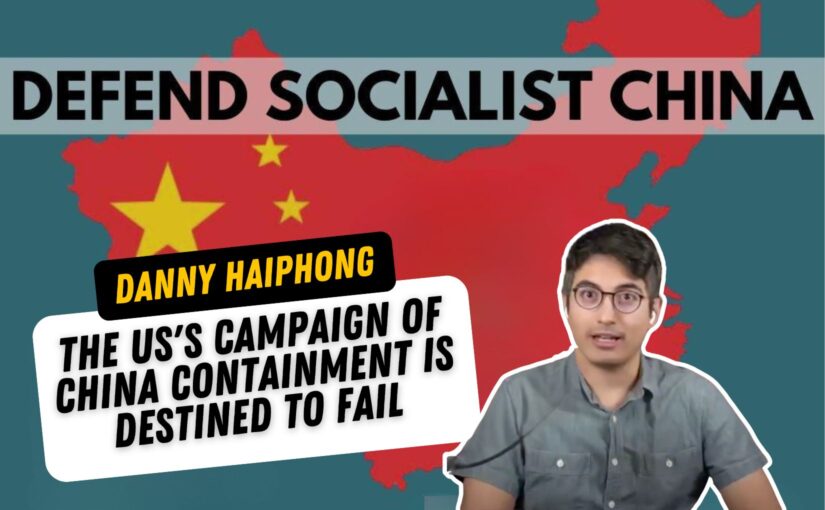
As we reported on 28 October, Friends of Socialist China recently participated in an event in New York City to celebrate the release of two revolutionary books: People’s China at 75: The Flag Stays Red, and Western Marxism by Domenico Losurdo, translated into English for the first time.

The article below is a write-up of that event by Sue Harris for Workers World.

Summarising the remarks made by the panelists (Gabriel Rockhill, Danny Haiphong and Carlos Martinez) and the chair (Sara Flounders), Sue notes that “the panelists agreed on the usefulness of Marxist theory in pursuing the struggle of the exploited classes against their exploiters and of oppressed nations against imperialism, which they considered the centre of today’s class struggle”.

Further: “The imperialist ruling class is trying to mobilize the population to consider People’s China their enemy. The speakers eloquently combatted these lies, which are delivered incessantly with the ruling class’s massive propaganda machine.”

Beneath the article you can find a video of the event, which was live-streamed on Danny Haiphong’s YouTube channel.

On Oct. 24, 2024, in New York City, Friends of Socialist China celebrated the release of two revolutionary books:  “People’s China at 75: The Flag Stays Red,” edited by Carlos Martinez and Keith Bennett, and “Western Marxism,” a collection of essays by the Italian Marxist-Leninist Domenico Losurdo, translated into English for the first time, with an introduction co-written by Jennifer Ponce de León and the editor, Gabriel Rockhill.

The meeting, which united Marxists working in different areas in defense of China against U.S. imperialism, was held at the Workers World Party office in midtown Manhattan in New York. The office, called the Solidarity Center, is used by groups joined in the working-class struggle, including workers at Amazon, Laundry Workers, student encampments for Palestine and the Venceremos Brigade for socialist Cuba.

Broadcast on several different media platforms, the meeting was carried on independent journalist Danny Haiphong’s YouTube channel, was on Zoom and was made into a podcast. A link to the meeting’s video will be available at workers.org and iacenter.org.

On the panel at the book launch were Haiphong, Gabriel Rockhill, Martinez and Sara Flounders, all known for their knowledge of developments in the People’s Republic of China and their ability to get this knowledge across in Zoom broadcasts, videos, articles and books.

It was in keeping with the anti-imperialist and struggle orientation of the speakers that Flounders, who chaired the meeting, opened with a salute to the revolutionary Yahya Sinwar, chair of the Political Bureau of the Hamas Islamic Resistance Movement. Sinwar was an organizer in Gaza of the October 7 Al-Aqsa Flood Battle, a martyr in battle against Zionism and U.S. imperialism.

Flounders said, referring to Sinwar, “Resistance does not die with the martyrdom of leaders. Resistance lives on, driven by the hunger of millions for liberation and justice.”

A multipolar world

Haiphong helped found Friends of Socialist China, is co-author of “American Exceptionalism and American Innocence” and a contributor to Black Agenda Report. His well-attended broadcasts cover geopolitics relating to China, West Asia, the Ukraine war and how the development of a multipolar world — as opposed to a unipolar world dominated by U.S. imperialism — can aid the liberation of the bulk of humanity.

Rockhill is Founding Director of the Critical Theory Workshop and professor of Philosophy at Villanova University. He has had many books published, with one set for publication in 2025, “Who Paid the Pipers of Western Marxism?” He is editor-in-chief of the World Marxist Review and a co-director of Anti-Imperialist Marxism, a book series with Iskra.

Martinez is a researcher and political activist living in London. His first book, “The End of the Beginning: Lessons of the Soviet Collapse,” was published in 2019 by LeftWord Books. His recent book, “The East Is Still Red – Chinese Socialism in the 21st Century,” was published in 2023 by Praxis Press and reviewed in Workers World. (workers.org/2023/07/72231/) He is a co-editor of Friends of Socialist China.

The panelists agreed on the usefulness of Marxist theory in pursuing the struggle of the exploited classes against their exploiters and of oppressed nations against imperialism, which they considered the center of today’s class struggle.

The imperialist ruling class is trying to mobilize the population to consider People’s China their enemy. The speakers eloquently combatted these lies, which are delivered incessantly with the ruling class’s massive propaganda machine.

With their exposure of what they call “Western Marxism,” the speakers also refuted those academic Marxists who might have strong critiques of capitalist society but who never side with existing socialist countries, and they also undervalue the role of national liberation struggles.

They discussed how theory must be applied dialectically, taking into account the challenges of building socialism or even building a national economy in a world still dominated by imperialism. As Martinez put it, “Karl Marx and Friedrich Engels didn’t have the opportunity to view a socialist country over a long period of time.”

Flounders took up the same question, saying it is our responsibility to combat the ideas of the “housebroken, tamed Marxists in the predatory, capitalist centers, those who strip Marxism of its revolutionary character, the academic Marxists who find ways to support their own imperialist governments against the rising anti-colonial and revolutionary struggles of the Global South.”

In the presentations and in a lively Q&A, the panelists had an opportunity to develop their ideas and introduce their works.

China and Cuba: Advancing the socialist cause and building a shared future

The close fraternal friendship between China and Cuba was reaffirmed in a recent visit of a delegation of the Communist Party of China (CPC) to the socialist Caribbean island, led Li Shulei, member of the Political Bureau of the CPC Central Committee and head of the Central Committee’s Publicity Department.  The delegation was in Cuba to attend the sixth joint theoretical seminar between the CPC and the Communist Party of Cuba (PCC), which was held on October 23, with the theme, “Advancing the Socialist Cause and Building a Shared Future.”

The previous day, Li had met with Miguel Díaz-Canel Bermúdez, First Secretary of the Central Committee of the PCC and President of the Republic of Cuba.

Li said China is ready to work with Cuba to implement the important consensus reached by the two top leaders, deepen traditional ties, expand friendly cooperation, and support each other on issues concerning each other’s core interests, while collaborating closely on international and regional issues and jointly building a China-Cuba community with a shared future.

Having received the greetings of his Chinese counterpart Xi Jinping, Díaz-Canel asked Li to convey his best wishes to Xi and spoke highly of the special friendship between the two parties and countries.

Li also met with Esteban Lazo Hernández, a member of the Political Bureau of the PCC Central Committee, President of Cuba’s National Assembly of People’s Power and President of Cuba’s Council of State, held talks with Roberto Morales Ojeda, member of the Political Bureau and Secretary of Organisation of the PCC Central Committee, and visited General Raúl Castro, leader of the Cuban Revolution.

Granma, the official organ of the PCC, quoted Díaz-Canel as telling Li, with unmistakable reference to the severe economic crisis currently being faced by Cuba, characterised not least by repeated nationwide power outages: “This visit, at the moment Cuba is living, is one more proof of the indestructible bonds of friendship that exist between our peoples, parties and governments.”

He added that he was looking forward to meeting again with Xi Jinping at the upcoming BRICS Summit in the Russian city of Kazan. However, Díaz-Canel later cancelled his visit due to the domestic economic situation.

Similar sentiments to those expressed by Díaz-Canel were echoed by Esteban Lazo Hernández, who told the Chinese comrades:

“A visit, in the midst of this situation, is one more expression of the deep ties of unbreakable friendship that exist between the Communist Party of China and that of Cuba and, likewise, between our peoples.”

He further underlined the relevance of the seminar held in Havana, saying: “I want to reiterate the importance and usefulness of the theoretical seminars to exchange experiences on the construction of socialism on the tenth anniversary of the beginning of this inter-party practice.”

The following articles were originally published by the Xinhua News Agency and Granma.

Cuba’s top leader meets senior Chinese official

HAVANA, Oct. 25 (Xinhua) — Miguel Diaz-Canel, first secretary of the Central Committee of the Communist Party of Cuba (PCC) and Cuban president, met on Tuesday with Li Shulei, member of the Political Bureau of the Communist Party of China (CPC) Central Committee and head of the Publicity Department of the CPC Central Committee, who led a CPC delegation to Cuba and attended the sixth theoretical seminar of the two parties.

Li conveyed warm greetings from Chinese President Xi Jinping, also general secretary of the CPC Central Committee, to Diaz-Canel, noting that Xi and Diaz-Canel have reached important consensuses on the development of party-to-party and state-to-state relations, charting a clear course for the longstanding friendship between China and Cuba.

Continue reading China and Cuba: Advancing the socialist cause and building a shared future

Report back from Xinjiang: A first-hand account of innovation and diversity

Date Tuesday 19 November 2024
Time6:30pm Britain / 1:30pm US Eastern
VenueMarx Memorial Library
London EC1R 0DU
And Zoom

Speakers

  • Roger McKenzie – Foreign Editor, Morning Star
  • Ali Al-Assam – Friends of Socialist China; Director, Mushtarek
  • David Peat – Editor, Iskra Books; Secretary, Friends of Socialist China Britain committee
  • Chair: Fiona S – Friends of Socialist China

Information

While much of the global narrative surrounding Xinjiang has focused on accusations of human rights abuses, it’s crucial to ask whether these claims are rooted in fact or driven by geopolitical motives. What does the West truly know about Xinjiang, beyond the allegations?

Rather than accept unverified accusations at face value, it is important to explore the real story: Xinjiang’s tremendous achievements in areas like clean energy, robotics, and transport, which the West could learn from. How has the region embraced such rich cultural and religious diversity, including the celebration of Uyghur traditions and the region’s harmonious multicultural coexistence?

Xinjiang is not only a hub of technological advancement but also plays a pivotal role in China’s Belt and Road Initiative—a global trade and infrastructure project with significant implications for the future of international cooperation. What lessons can be drawn from Xinjiang’s success as the economic and strategic heart of this initiative, especially in cities like Kashgar, a crucial link between East and West?

Join us for an in-person event at Marx Memorial Library, where Roger McKenzieAli Al-Assam and David Peat will share their firsthand experiences from their recent visits to Xinjiang. Through their insights, we can explore what the world might learn from Xinjiang’s advancements and how it challenges the prevailing narrative in the West.

Organisers

This event is organised by Friends of Socialist China and supported by the Morning Star and the International Manifesto Group.

China condemns acts that violate Iran’s sovereignty and territorial integrity

China’s Ambassador to the United Nations Fu Cong addressed the UN Security Council Briefing on the Situation in the Middle East, Including the Palestinian Question on successive days, October 28 and 29.

The first meeting was called at the request of Iran, Algeria, China and Russia following the brazen aerial attack on Iran by Israel. Ambassador Fu told the Security Council:

“China condemns acts that violate Iran’s sovereignty and territorial integrity and opposes acts of destruction that threaten regional peace and security… We are gravely concerned about the escalation caused by Israel’s actions and urge Israel to effectively cease all provocative acts.”

He added: “It must be pointed out that the fundamental reason for the continued worsening of tensions in the Middle East is that the ceasefire in Gaza has remained elusive. The fact that a number of Council resolutions calling for a ceasefire have been shelved undermines the Council’s own authority and is not conducive to a fundamental solution to the conflict. China is of the view that under the current circumstances, the Council should utilise all the means available to it under the Charter to ensure the implementation of its relevant resolutions. We call on the country with significant influence on Israel [namely the United States] to put saving lives and preventing war in the first place, abandon any other political calculations, and support the Council in taking further actions on the current situation, so as to push for an immediate ceasefire in Gaza and de-escalation of the situation in Lebanon and to effectively curb the expansion and spread of the conflict.”

Further derails of this Security Council Briefing were reported by the Palestine Chronicle.

The following day, Fu Cong made six points as follows:

  • An immediate and permanent ceasefire is the prerequisite for saving lives and preventing further deterioration of the situation. There is no justification for any delay. The United States has announced that it would reinvigorate ceasefire negotiations. We hope that the negotiations will not fall into the weird cycle of marking time as we saw in the past several months. Nor should they become a pretext for prolonging and expanding the fighting.
  • Gaza has been bombarded into a living hell, and Northern Gaza is turning into the hell of the hell. Humanitarian supplies have been cut off. Relief operations have been denied. Civilians in Jabalia camp are evacuated at gunpoint. And patients and doctors at the Kamal Adwan Hospital are subjected to inhumane treatment. The bottom line of international humanitarian law has been trampled upon time and again. This is a stain on the conscience of humanity and should not be tolerated at all. Israel must comply with its obligations under international humanitarian law. No double standards should be allowed in this regard.
  • UNRWA [The United Nations Relief and Works Agency for Palestine Refugees in the Near East] has been providing relief in accordance with its mandate from the General Assembly. It is the backbone of humanitarian assistance in Gaza. The Israeli Knesset [parliament], in total disregard of the strong opposition of the international community, passed two bills in an attempt to restrict and close UNRWA. China expresses strong condemnation.
  • Certain countries [referring primarily to the United States but also including a handful of others, such as Britain and Germany] are continuing their massive supply of weapons to Israel. The GA [General Assembly] emergency special session has adopted a resolution urging all states to stop supplying weapons and equipment that might be used in the occupied Palestinian territory. China recently joined the joint letter initiated by Türkiye calling for the implementation of the demand from this GA resolution. We hope that the countries concerned will take seriously the grave consequence of their massive supply of weapons and stop fueling the flames of military adventurism.
  • While the flames of war have been raging on in Gaza over the past year, the situation in the West Bank has also been deteriorating. Illegal settlements have been expanding, with more than 1,700 Palestinian houses confiscated by force or demolished, and thousands of Palestinians displaced. The occupying power has also frequently conducted violence against the Palestinian people and used various means to suppress and restrict the governance of the Palestinian National Authority.
  • An all-out war in the region is looming. The recent Israeli invasion into Lebanon, its continuous indiscriminate bombardment, and multiple airstrikes against Iran and Syria have violated the sovereignty and territorial integrity of the relevant countries and further destabilised the region. We urge Israel to abandon its obsession with force, so as to prevent the region from being plunged into a larger disaster.

We reprint below the full texts of Fu Cong’s remarks. They were originally published on the website of China’s Permanent Mission to the UN.

Remarks by Ambassador Fu Cong at the UN Security Council Briefing on the Situation in the Middle East, Including the Palestinian Question

President, 

I thank you for convening this meeting at the request of Iran, Algeria, China, and Russia. I also thank Assistant Secretary-General Khaled Khiari for his briefing. 

On October 26, Israel launched rounds of air strikes against several sites in Iran, causing damage to facilities and casualties on the Iranian side. China condemns acts that violate Iran’s sovereignty and territorial integrity and opposes acts of destruction that threaten regional peace and security. At present, the Iranian-Israeli relations and the situation of the region are on the edge. We are gravely concerned about the escalation caused by Israel’s actions, and urge Israel to effectively cease all provocative acts. At the same time, we call on all parties to exercise calm and restraint, jointly abide by the UN Charter and the principles of international law, and return to the right track of resolving disputes by political and diplomatic means. 

At present, with the Gaza conflict still dragging on, a new conflict in Lebanon breaking out, and continued tensions between Syria and Israel and in the Red Sea, the situation in the Middle East has long been precarious. At this critical moment, all parties should heed the overwhelming call of the international community for a ceasefire and an end to the fighting, fully implement Council resolutions, and make unremitting efforts to deescalate the situation and restore peace and tranquility in the region. Any reckless provocation or military adventurism to expand the fighting is irresponsible and is highly likely to lead to miscalculation and disastrous consequences. 

It must be pointed out that the fundamental reason for the continued worsening of tensions in the Middle East is that the ceasefire in Gaza has remained elusive. The fact that a number of Council resolutions calling for a ceasefire have been shelved undermines the Council’s own authority and is not conducive to a fundamental solution to the conflict. China is of the view that under the current circumstances, the Council should utilize all the means available to it under the Charter to ensure the implementation of its relevant resolutions. We call on the country with significant influence on Israel to put saving lives and preventing war in the first place, abandon any other political calculations, and support the Council in taking further actions on the current situation, so as to push for an immediate ceasefire in Gaza and deescalation of the situation in Lebanon and to effectively curb the expansion and spread of the conflict. 

I thank you, President.


Remarks by Ambassador Fu Cong at the UN Security Council Briefing on the Situation in the Middle East, Including the Palestinian Question

President, 

I thank you for presiding over this meeting. I would also like to thank Special Coordinator Tor Wennesland for the briefing today. 

As the Council is again considering the situation in the Middle East, what is unfolding before our eyes is that Gaza and the Middle East as a whole are experiencing worsening situation, elusive peace prospects, and a looming all-out war. The Council should act immediately on the pressing issues, with a view to promoting a ceasefire, saving lives, and restoring peace, I wish to stress the following points.

First, an immediate and permanent ceasefire is the prerequisite for saving lives and preventing further deterioration of the situation. There is no justification for any delay. The United States has announced that it would reinvigorate ceasefire negotiations. We hope that the negotiations will not fall into the weird cycle of marking time as we saw in the past several months. Nor should they become a pretext for prolonging and expanding the fighting. The relevant diplomatic efforts should not be used as an excuse to obstruct Council actions. We support the Council in using all the options in its toolbox and take further actions towards a ceasefire.

Second, Gaza has been bombarded into a living hell, and Northern Gaza is turning into the hell of the hell. Humanitarian supplies have been cut off. Relief operations have been denied. Civilians in Jabalia camp are evacuated at gunpoint. And patients and doctors at the Kamal Adwan Hospital are subjected to inhumane treatment. The bottom line of international humanitarian law has been trampled upon time and again. This is a stain on the conscience of humanity and should not be tolerated at all. Israel must comply with its obligations under international humanitarian law. No double standards should be allowed in this regard.

Third, UNRWA has been providing relief in accordance with its mandate from the General Assembly. It is the backbone of humanitarian assistance in Gaza. The Israeli Knesset, in total disregard of the strong opposition of the international community, passed two bills in an attempt to restrict and close UNRWA. China expresses strong condemnation. Closing the Agency would be a new round of collective punishment of millions of Palestinian refugees in the region, and would severely affect the humanitarian situation, security, and stability in the region. We call on Israel to hold and revoke the relevant bills to ensure the dignity, safety, and facilitation for the work of UN humanitarian agencies, including UNRWA.

Fourth, in the current context, certain countries are continuing their massive supply of weapons to Israel. Whether such acts would contribute to achieving the objectives contained in the Council resolutions is a matter that must be taken seriously. The GA emergency special session has adopted a resolution urging all states to stop supplying weapons and equipment that might be used in the occupied Palestinian territory. China recently joined the joint letter initiated by Türkiye calling for the implementation of the demand from this GA resolution. We hope that the countries concerned will take seriously the grave consequence of their massive supply of weapons and stop fueling the flames of military adventurism.

Fifth, while the flames of war have been raging on in Gaza over the past year, the situation in the West Bank has also been deteriorating. Illegal settlements have been expanding, with more than 1,700 Palestinian houses confiscated by force or demolished, and thousands of Palestinians displaced. The occupying power has also frequently conducted violence against the Palestinian people and used various means to suppress and restrict the governance of the Palestinian National Authority. Such practices are creating a new reality and undermining the conditions on which the realization of the two-State solution is based. Preventing the further erosion of the basis of the two-State solution by unilateral actions should be a priority for the international community in advancing Palestinian-Israeli peace in the next phase. 

Sixth, an all-out war in the region is looming. The recent Israeli invasion into Lebanon, its continuous indiscriminate bombardment, and multiple airstrikes against Iran and Syria have violated the sovereignty and territorial integrity of the relevant countries and further destabilized the region. The situation is hanging by a thread. Any irresponsible adventurism would be extremely dangerous and might lead to catastrophic consequences. We urge Israel to abandon its obsession with force, so as to prevent the region from being plunged into a larger disaster. We also call on all parties to exercise maximum restraint, jointly abide by the UN Charter and the principles of international law, and return to the right track of seeking political and diplomatic solutions to disputes.

Thank you, President.

President Xi urges China and India to strengthen communication and cooperation

During his recent visit to the Russian city of Kazan, where he attended the October 22-24 summit meeting of the BRICS cooperation mechanism, Chinese President Xi Jinping also held a number of important meetings on the sidelines.

Among the most significant was his October 23 meeting with Indian Prime Minister Narendra Modi, the two men’s first formal talks since October 2019. Clashes on the two countries’ disputed border (an issue left over from the days of British colonialism) in the Galwan Valley in 2020 had led to a sharp deterioration in bilateral relations. Two days before the Kazan meeting, the Indian Foreign Ministry had announced that an agreement had been reached on patrolling arrangements, which had been the immediate cause of the clash.

At the meeting, President Xi urged China and India to strengthen communication and cooperation, enhance strategic mutual trust, and facilitate each other’s pursuit of their development aspirations. He pointed out that as time-honoured civilisations, large developing countries and important members of the Global South, China and India both stand at a crucial phase of their respective modernisation endeavours.

It is in the fundamental interest of the two countries and two peoples to keep to the trend of history and the right direction of bilateral relations, he said, urging the two sides to shoulder their international responsibility, set an example in boosting the strength and unity of developing countries, and contribute to promoting a multipolar world and greater democracy in international relations.

For his part, Prime Minister Modi noted that maintaining the steady growth of India-China relations is critical to the two countries and peoples. It not only concerns the well-being and future of 2.8 billion people, but also carries great significance for peace and stability of the region and even the world at large.

Against a complex international landscape, cooperation between India and China, two ancient civilisations and engines of economic growth, can help drive economic recovery and promote multipolarity in the world.

The two leaders commended the important progress the two sides had recently made through intensive communication on resolving the relevant issues in the border areas. Modi made suggestions on improving and developing the relationship, which Xi agreed to in principle.

Stressing the need to ensure peace and tranquillity in the border areas and find a fair and reasonable settlement, they agreed on holding talks between their foreign ministers and officials at various levels to bring the relationship back to sound and steady development at an early date.

They further agreed to strengthen communication and cooperation in multilateral fora to safeguard the common interests of developing countries and were of the view that their meeting was constructive and carries great significance. They agreed to view and handle China-India relations from a strategic height and long-term perspective, prevent specific disagreements from affecting the overall relationship, and contribute to maintaining regional and global peace and prosperity and to advancing multipolarity in the world.

India’s main communist parties were quick to voice their support for the meeting and its outcome.

People’s Democracy, the newspaper of the Communist Party of India (Marxist) (CPI(M)) wrote that:

“The economic problems confronting the Indian bourgeoisie have forced them to lobby for easing the ability to do business with China. According to the data of the Ministry of Commerce, China has emerged as India’s top import source with 56.29 billion dollars’ worth of inbound shipments during the April-September period of this fiscal year. In a globalised economic world order, it is increasingly recognised that it is beneficial for both countries to increase economic cooperation. Certain industries for the production of goods like electric vehicles (EVs), smartphones, solar panels and medicine have been identified by the Indian government to transform the country into a manufacturing hub. Most of these industries require the restoration of economic relations with China.”

Continue reading President Xi urges China and India to strengthen communication and cooperation

Kazan Declaration: Strengthening multilateralism for just global development and security

The BRICS cooperation mechanism of Emerging Markets and Developing Countries took a major step forward at its 16th Summit held in the Russian city of Kazan, October 22-24. Following decisions taken at last year’s summit in South Africa, a total of nine countries took part as full members for the first time, with Ethiopia, Egypt, the United Arab Emirates (UAE) and Iran joining Brazil, Russia, India, China and South Africa. A total of 36 countries and subnational entities participated at a high level, along with the leaders of six international organisations. A new category of Partner countries was formally initiated and is seen by many as a steppingstone to possible future full membership for the several dozen countries that have already expressed such an interest. An initial tranche of 13 countries were granted partner status in Kazan. The list of countries is yet to be officially released, but numerous reports have identified them as:

  • Algeria
  • Belarus
  • Bolivia
  • Cuba
  • Indonesia
  • Kazakhstan
  • Malaysia
  • Nigeria
  • Thailand
  • Türkiye
  • Uganda
  • Uzbekistan
  • Vietnam

On October 23, the nine full members adopted the Kazan Declaration, entitled ”Strengthening Multilateralism for Just Global Development and Security”. Running to a little over 13,300 words, and with 134 clauses, the declaration covers a vast number of subjects and itself reflects and reinforces the growing – although not without challenges – cohesiveness of key players in the Global South. It states:

“As we build upon 16 years of BRICS Summits, we further commit ourselves to strengthening cooperation in the expanded BRICS under the three pillars of political and security, economic and financial, cultural and people-to-people cooperation and to enhancing our strategic partnership for the benefit of our people through the promotion of peace, a more representative, fairer international order, a reinvigorated and reformed multilateral system, sustainable development and inclusive growth.”

It further notes the emergence of new centres of power, policy decision-making and economic growth, which can pave the way for a more equitable, just, democratic and balanced multipolar world order.

The declaration reaffirms support for a comprehensive reform of the United Nations, including its Security Council, with a view to making it more democratic, representative, effective and efficient, and to increase the representation of developing countries in the Council’s memberships so that it can adequately respond to prevailing global challenges and support the legitimate aspirations of emerging and developing countries from Africa, Asia and Latin America, including BRICS countries, to play a greater role in international affairs, in particular in the United Nations, including its Security Council, adding:

“We are deeply concerned about the disruptive effect of unlawful unilateral coercive measures, including illegal sanctions, on the world economy, international trade, and the achievement of the sustainable development goals. Such measures undermine the UN Charter, the multilateral trading system, the sustainable development and environmental agreements. They also negatively impact economic growth, energy, health and food security, exacerbating poverty and environmental challenges.”

It recalls the 2001 Durban Declaration and Programme of Action (DDPA) and the Outcome Document of the 2009 Durban Review Conference and acknowledges the need to intensify the fight against racism, racial discrimination, xenophobia and related intolerance as well as discrimination based on religion, faith or belief, and all their contemporary forms around the world including the alarming trends of rising hate speech, and acknowledge the annual UNGA resolution on “Combating glorification of Nazism, neo-Nazism, and other practices that contribute to fuelling contemporary forms of racism, racial discrimination, xenophobia and related intolerance”.

Continue reading Kazan Declaration: Strengthening multilateralism for just global development and security

People’s China at 75: “Anyone who wants to understand socialism in China should read this book”

We recently launched People’s China at 75 – The Flag Stays Red, a collection edited by Keith Bennett and Carlos Martinez, bringing together different perspectives and understandings of the trajectory of Chinese socialism over the past 75 years.

We are pleased to publish below the first review, from Fight Back!, published on 25 October 2024.

After summarising the book’s contents, the review concludes:

Everyone interested in socialism should study the experience of China, and People’s China at 75: The Flag Stays Red stands out as an extraordinary collection of important writings on China’s achievements, struggles, and contributions to the world revolutionary movement. 

The book can be purchased on the Praxis Press website in paperback and digital formats.

Marking the 75th anniversary of the founding of the People’s Republic of China, Praxis Press, together with Friends of Socialist China, has released an excellent new book, People’s China at 75: The Flag Stays Red. This book is edited by Keith Bennett and Carlos Martinez, and compiles articles by China experts from all over the world explaining and defending Chinese socialism. Anyone who wants to understand socialism in China, from 1949 to today, should read this book.

The articles in the book cover a number of important topics. We can’t cover them all here, but we can look at some highlights. For example, Jenny Clegg’s article “China’s transition to socialism: 1949-1956” explains the period during which China laid the foundations of socialism. She discusses China’s post-war rehabilitation, New Democracy, and how it ensured that China would progress along the socialist road. The article examines the practical, economic elements of this transition, such as the development of Agricultural Producers Cooperatives, together with the political and ideological debates of the period. As Clegg writes in her conclusion, 

A careful handling of class relations allowed the people’s struggles against capitalism to unfold in sequenced steps, workers and peasants discussing and educating themselves as they engaged in policy implementation. Grassroots cadres, learning on the job, built broad support as the dynamics of class struggle exposed the inherent contradictions at each step. 

Leading Chinese scholars Cheng Enfu and Chen Jian, in the article “The significance of China’s fulfilment of its Second Centenary Goal by 2049,” explain and analyze the Communist Party of China’s “goal of building China into a modern socialist country that is prosperous, strong, democratic, culturally advanced, harmonious and beautiful by the centenary of the People’s Republic of China.”

The book also includes a short article by Roland Boer titled “China’s socialist democracy” which addresses the principle that “socialist democracy strengthens the leadership of the Communist Party, and the leadership of the Communist Party strengthens socialist democracy.” Boer is explaining a dialectical relationship at the core of the socialist system. “In other words, the leadership of the Communist Party ensures that the people are masters of the country, and the robust exercise of socialist democracy ensures that the Communist Party continues its role of legitimate leadership.”

J. Sykes, author of The Revolutionary Science of Marxism-Leninism, contributes the article “Mao, China, and the development of Marxism-Leninism.” In this article Sykes explains Mao’s contributions to Marxist theory. He breaks down Mao’s contributions to dialectical and historical materialism, revolutionary strategy, problems of socialist construction, and the defense of Marxism-Leninism against modern revisionism. While concisely explaining Mao’s contributions in each of these areas, Sykes makes the point that “Mao’s contributions to revolutionary theory are not limited to the Chinese context,” but are universal. “The theory-practice dialectic in fact goes both ways. By applying Marxism-Leninism to the concrete conditions of China, Marxism-Leninism itself was further developed and enriched.” 

In the article “Building socialism, building the ecological civilization,” Efe Can Gürcan explains how China is leading the way in environmental sustainability. This article does well to highlight how China is working to develop green technology in a world increasingly put at risk by the perils of climate change. 

Finally, the collection ends with an excellent article from Carlos Martinez: “How China survived the end of history.” Martinez examines how China survived the wave of counter-revolution that swept the socialist world between 1989 and 1991 to continue on the socialist road when so many other countries didn’t. 

Everyone interested in socialism should study the experience of China, and People’s China at 75: The Flag Stays Red stands out as an extraordinary collection of important writings on China’s achievements, struggles, and contributions to the world revolutionary movement.