Xi Jinping congratulates To Lam on his election as General Secretary of the Communist Party of Vietnam

On August 3, the Central Committee of the Communist Party of Vietnam unanimously elected State President To Lam as its General Secretary following the recent death of General Secretary Nguyen Phu Trong.

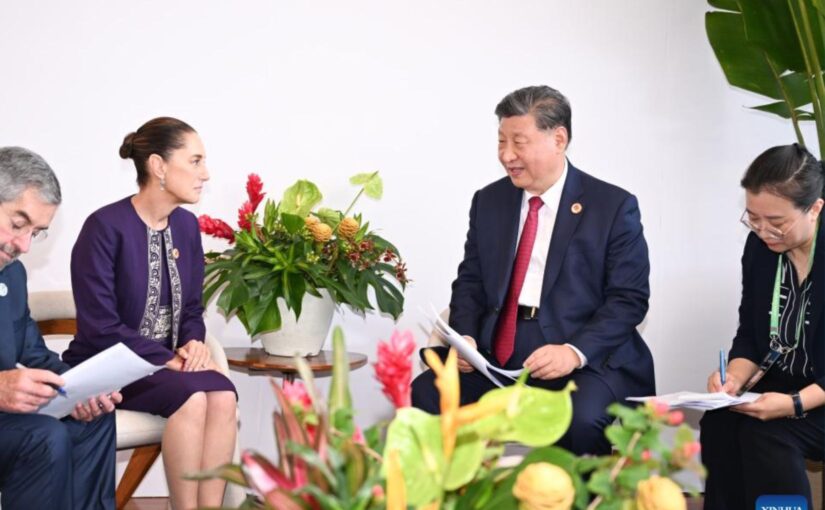
The same day, his Chinese counterpart Xi Jinping sent a warm congratulatory message to To Lam, in which he reiterated that, “China and Vietnam are socialist neighbours linked by mountains and rivers… I am ready to join Comrade General Secretary To Lam in leading the building of an increasingly substantial and in-depth China-Vietnam community with a shared future, jointly promoting the traditional friendship, consolidating political trust, deepening strategic exchanges, boosting substantive cooperation, bringing more happiness to the peoples of the two countries, and actively contributing to the cause of peace and progress of humanity.”

The text of the message was published by the Vietnamese newspaper Nhân Dân and is reprinted below. In its initial reports, Nhân Dân also highlighted the messages from the leaders of Laos, Cambodia, the Democratic People’s Republic of Korea, Russia, Cuba, Venezuela and Nicaragua, among others.

General Secretary of the Communist Party of China (CPC) and Chinese President Xi Jinping has sent congratulations to State President To Lam on his election as General Secretary of the Communist Party of Vietnam (CPV)’s Central Committee.

The message reads:

“I am very delighted to learn that you have been elected to the position of General Secretary of the Central Committee of the CPV. On behalf of the Central Committee of the Communist Party of China and in my own name, I would like to extend my warm congratulations to you.

“Over the recent years, the CPV has thoroughly implemented the spirit of the 13th National Party Congress’s Resolution, focusing on promoting the Party building, and reaping new achievements in boosting the building of socialism and the renewal and open-door cause.

“We believe that, under the steadfast leadership of the CPV Central Committee, the entire Party and people of Vietnam will successfully realise the objectives and tasks set forth by the CPV’s 13th National Congress, steadily promoting the preparations for the 14th National Congress, and continuously moving towards the “two 100-year goals” of the Party and the country’s founding.

“China and Vietnam are socialist neighbours linked by mountains and rivers. Last December, I paid a state visit to Vietnam, during which both sides announced the building of a China-Vietnam Community with a shared future that carries strategic significance, opening a new journey and a new chapter in the relationship between the two Parties and the two countries. I am ready to join Comrade General Secretary To Lam in leading the building of an increasingly substantial and in-depth China-Vietnam Community with a shared future, jointly promoting the traditional friendship, consolidating political trust, deepening strategic exchanges, boosting substantive cooperation, bringing more happiness to the peoples of the two countries, and actively contributing to the cause of peace and progress of the mankind.

“Wish you new achievements in your noble position”.

Timor-Leste President: If China can help our people, then China is my hero

At the invitation of President Xi Jinping, Dr. José Ramos-Horta, the President of the Democratic Republic of Timor-Leste, paid a state visit to China from July 28-31.

It was Ramos-Horta’s first visit to China since he took office in 2022, but he has visited China many times in the past, the first occasion being in early 1976, as part of a delegation from the Revolutionary Front for an Independent East Timor (FRETILIN). With the collapse of Portuguese colonialism, Timor-Leste had declared its independence on November 28, 1975. However, Indonesia invaded and occupied the newly independent country just nine days later. Ramos-Horta had left the country three days before the invasion to present its case to the United Nations and remained in exile for 24 years, leading the work to gain international support and solidarity for Timor’s liberation struggle, which finally triumphed over overwhelming odds.

In a July 2006 article, the right-wing US thinktank Jamestown noted:

“When the Frente Revolucionária de Timor-Leste Independente (FRETILIN) Party declared outright independence from Portugal in November 1975, the PRC [People’s Republic of China] supported the declaration…  Following Indonesia’s annexation of East Timor, the PRC acted as FRETILIN’s primary patron. China argued East Timor’s case at the UN, provided financial support to its government in exile in Mozambique and was prepared to furnish anti-Indonesian guerilla fighters with sufficient military equipment to arm a light division of approximately 8,000 troops… At the stroke of midnight on May 20, 2002, East Timor became fully independent after three years under UN tutelage. The PRC became the first country to formally establish diplomatic relations with the world’s newest country.”

Meeting his Timorese counterpart on July 29, Xi Jinping said that President Ramos-Horta is the founding father of Timor-Leste and the founder of China-Timor-Leste friendship. China and Timor-Leste enjoy a long-standing traditional friendship, with China being the first country to recognise Timor-Leste’s independence and establish diplomatic ties with Timor-Leste.

He added that China firmly supports Timor-Leste’s efforts to safeguard national unity and social stability and stands ready to deepen strategic coordination and cooperation with Timor-Leste in an all-round way, safeguard the sovereignty and security interests of the two countries, and move toward the general direction of building a community with a shared future. He also called on both countries to take the signing of the Belt and Road cooperation plan as an opportunity to synergise their development strategies, share experience and technology in water conservancy construction, water-saving irrigation, disaster prevention and reduction, implement agricultural cooperation such as in rice cultivation, advance cooperation in terms of fisheries and poverty reduction, and help Timor-Leste develop its economy independently and in diversified ways, and continued:

“We should jointly promote the development of the Global South, carry out multilateral cooperation at a higher level, carry forward the spirit of the Five Principles of Peaceful Coexistence, strengthen coordination and cooperation in the United Nations, the World Trade Organisation and other multilateral platforms, jointly advocate an equal and orderly multipolar world and an economic globalisation that benefits all, and promote the building of a community with a shared future for humanity.”

Ramos-Horta said that he has visited China many times since 1976 and witnessed with his own eyes the earth-shaking changes that have taken place in China. He added that under the leadership of President Xi, China has eliminated absolute poverty, which is a miracle of humanity.

He added that in the face of profound changes in the international situation, China has firmly upheld multilateralism, and proposed the Belt and Road Initiative and a series of other important global initiatives. China has also facilitated reconciliation between Saudi Arabia and Iran, as well as among Palestinian factions, making significant contributions to regional and global peace and development, thereby demonstrating China’s role and influence as a peaceful and responsible major country in today’s world.

He also thanked China for its long-term valuable support for Timor-Leste’s economic and social development and his country’s response to the COVID-19 pandemic, adding that Timor-Leste hopes to further consolidate and develop the comprehensive strategic partnership with China, and strengthen cooperation in food security, infrastructure construction and other fields.

Timor-Leste firmly adheres to the one-China principle, believes that Taiwan is an inalienable part of the Chinese territory, opposes “Taiwan independence” and interference by external forces, and supports all efforts by China to safeguard national sovereignty and territorial integrity.

After the talks, the two heads of state witnessed the signing of the Belt and Road cooperation plan and multiple bilateral cooperation documents in the fields of agriculture, green development, digital economy and air transport. They also issued a joint statement on strengthening their comprehensive strategic partnership.

The previous day, Ramos-Horta had met with Chinese Premier Li Qiang. Li said that that since the establishment of diplomatic ties 22 years ago, no matter how the international landscape has evolved, China and Timor-Leste have always understood and supported each other, deepened political mutual trust and achieved fruitful results in practical cooperation. China is willing to work with Timor-Leste to further carry forward their traditional friendship, strengthen mutually beneficial cooperation and achieve more results to better benefit the two peoples.

Ramos-Horta also met with Zhao Leji, Chairman of the National People’s Congress (NPC) Standing Committee on July 29. 

In their joint statement, both nations shared the view that since the establishment of diplomatic relations between China and Timor-Leste 22 years ago, the two countries have acted with mutual respect and treated each other as equals, with the friendship continuing to deepen, and set a fine example of unity and cooperation between countries of different sizes.

Timor-Leste extended warm congratulations on the 75th anniversary of the founding of the People’s Republic of China, and the great success of convening the Third Plenary Session of the 20th Central Committee of the Communist Party of China. Timor-Leste commends the impressive achievements China made in the First Decade of the New Era and believes that Chinese modernisation presents a new paradigm, which broadens paths and options for developing countries to achieve modernisation. Timor-Leste trusts that the Communist Party of China will lead all Chinese people of all ethnic groups in a concerted effort to realise the Second Centenary Goal of building a great modern socialist country in all aspects, and to advance the rejuvenation of the Chinese nation on all fronts through a Chinese path to modernisation.

Continue reading Timor-Leste President: If China can help our people, then China is my hero

Wang Yi to Blinken: the US should return to a rational and pragmatic China policy

On July 27, Chinese Foreign Minister Wang Yi met in Vientiane with US Secretary of State Antony Blinken at the latter’s request. The two men were both attending various international meetings held under the auspices of the Association of South East Asian Nations (ASEAN) in the Laotian capital. Laos currently holds the rotating chair of ASEAN.

China’s official report of the meeting clearly indicates the grave situation in which the two countries’ bilateral relationship continues to finds itself.

Wang Yi said that in the past three months, the diplomatic, financial, law enforcement, and climate teams of the two governments and the two militaries have maintained communication, and people-to-people exchanges have been on the rise. However, he continued, it must be pointed out that the US has not stopped, but rather doubled down on its containment and suppression of China. The risks facing China-US relations are still building and the challenges are rising.

He added that China’s policy towards the United States is consistent, and the US side should earnestly implement the commitments made by President Biden (at his meeting with Chinese President Xi Jinping in California in November 2023) and return to a rational and pragmatic China policy. The US, Wang Yi pointed out, holds a wrong perception of China, always seeing China with its own hegemonic mindset.

The Chinese Foreign Minister added that Taiwan is part of China, and it never has been and never will be a country. “Taiwan independence” and cross-Strait peace are as irreconcilable as fire and water. “We will keep reducing the space for ‘Taiwan independence’ and work toward the goal of complete reunification.”

Wang Yi also said that China’s position on the Ukraine issue is fair and transparent. The US should stop abusing unilateral sanctions and long-arm jurisdiction. China rejects false accusations and will not succumb to pressure or blackmail. China will take resolute and robust measures to protect its major interests and legitimate rights.

From Laos, Blinken went on to visit Vietnam, Japan, the Philippines, Singapore and Mongolia, his main purpose being to try to rig up anti-China alliances, attempt to encircle China and thereby prepare for and heighten the risk of a catastrophic war. While this found expression in the conclusion of new military agreements with Japan and the Philippines, Vietnam, Mongolia and Singapore displayed no interest in disturbing their friendly and mutually beneficial relations with China or in being drawn into US schemes.

The following article was originally published on the website of the Chinese Foreign Ministry.

On July 27, 2024 local time, Member of the Political Bureau of the CPC Central Committee and Minister of Foreign Affairs Wang Yi met with U.S. Secretary of State Antony Blinken in Vientiane at the latter’s request. The two sides exchanged views on current China-U.S. relations, and agreed to maintain communication at all levels and further implement the important common understandings reached by their Presidents at the San Francisco meeting.

Wang Yi said that in the past three months, the diplomatic, financial, law enforcement, and climate teams of the two governments and the two militaries have maintained communication, and people-to-people exchanges have been on the rise. However it must be pointed out that the U.S. has not stopped, but rather doubled down on its containment and suppression of China. The risks facing China-U.S. relations are still building, and the challenges rising. The relationship remains at a critical juncture of deescalation and stabilization. We need to continue to recalibrate the direction, manage risks, properly address differences, remove interference, and advance cooperation.

Wang Yi said that China’s U.S. policy is consistent, and adheres to the principles of mutual respect, peaceful coexistence and win-win cooperation. The U.S. side should earnestly implement the commitments made by President Biden, and return to a rational and pragmatic China policy. The two sides need to work together for a stable, healthy, and sustainable China-U.S. relationship.

Wang Yi pointed out that the U.S. side holds a wrong perception of China, always seeing China with its own hegemonic mindset. China is not the United States, nor does China want to become like the United States. China does not pursue hegemony, or practice power politics. China has the best record on peace and security among all major countries. The third Plenary Session of the 20th CPC Central Committee adopted a major resolution on further deepening reform comprehensively to advance Chinese modernization. We will stay committed to our founding aspiration, and focus on seeking happiness for the Chinese people, and rejuvenation for the Chinese nation. China will stay on the path of peaceful development, and promote the building of a community with a shared future for mankind. It is hoped that the U.S. side will better understand the CPC as well as China’s present and future through this resolution.

Wang Yi said that Taiwan is part of China, and it never has been and never will be a country. “Taiwan independence” and cross-Strait peace are as irreconcilable as fire and water. Each time “Taiwan independence” forces make provocation, we will definitely take countermeasures. We will keep reducing the space for “Taiwan independence” and work toward the goal of complete reunification.

Wang Yi reiterated the ins and outs of the Ren’ai Jiao (Reef) issue. Now that China has agreed on a provisional arrangement with the Philippines on managing the situation, the Philippine side should honor its commitment, and not ship construction materials any more. The U.S. side should not take any more action to fan the flames, stir up trouble, or undermine maritime stability.

Wang Yi said that China’s position on the Ukraine issue is fair and transparent, and China will continue to encourage and promote peace talks. The U.S. side should stop abusing unilateral sanctions and long-arm jurisdiction. China rejects false accusations, and will not succumb to pressure or blackmail. China will take resolute and robust measures to protect its major interests and legitimate rights.

Blinken said that the United States is strongly committed to stabilizing U.S.-China relations and continues to follow the one-China policy. The U.S. side looks forward to keeping in regular communication with the Chinese side and continuing the cooperation in such areas as counternarcotics and artificial intelligence. The U.S. would like to manage differences between the two sides and avoid misunderstanding and miscalculation.

The two sides also exchanged views on the situation concerning Gaza and the Korean Peninsula, and the question of Myanmar, among other matters.

China using AI in support of peace, progress and human rights

On 7 July 2024, the Chinese Permanent Mission to the United Nations office at Geneva, along with several other international organisations, held an event on the theme of “science and technology enabling human rights protection” at the Palais des Nations in Geneva. Nearly a hundred experts from around the world attended.

Ali Al-Assam, representing Friends of Socialist China, contributed to the event at the invitation of the Chinese Association for International Understanding (CAFIU). In his presentation, Ali highlighted the potential benefits and risks of artificial intelligence (AI) for human rights protection, and the importance of international cooperation in the field of AI development. He also introduced China’s practices and approaches in the field of AI development and regulation, and drew attention to the Global AI Governance Initiative proposed by China, which seeks to foster international collaboration on AI development, to ensure that AI technologies respect and promote human rights, and to leverage AI to address global challenges.

Embedded below is a video of Ali’s speech, followed by the detailed notes of his presentation.

The event was reported in the China News Service website.

Thank you for inviting me to this meeting dealing with such a key topic: how to make AI work for the people

I am Ali Al-Assam, member of Friends of Socialist China, and also founder of the tech cooperative NewsSocial, that is engaged now in extensive use of AI for community wealth building and Inter-cooperation for the cooperative movement.

AI and Human Rights: A Double-Edged Sword

Promises of AI

• Generative AI is part of the fourth industrial revolution, synthetic biology mobility and energy
• AI is used in B2B and B2C, fuelling huge demand for wafers and connectivity.
• AI is not like other breaking-ground technology such as the steam engine revolution. It is rather a meta-technology that is driving many other technological revolutions and will change modes of production in fundamental ways.
• Artificial general intelligence (AGI) is the point at which an AI can perform all human cognitive skills better than the smartest humans.
• The human brain is said to contain around 100 billion neurons with 100 trillion connections between them. China’s Alibaba announced that they have reached 30 trillion connections in their AI system, so things are developing very quickly.
• AI has the potential to create new economies and lift millions out of poverty by driving innovation and efficiency. It offers solutions to some of society’s most challenging problems, such as advancements in healthcare and education.
• It can help people, organizations and countries to deliberate in a rational manner and solve problems peacefully. It is capable of rational thoughts.

Risks of AI

• However, AI can also pose risks to human rights, such as enabling aggression and war – one clear example is what’s happening in Gaza, where the Israelis are using AI-powered systems to enable their genocide.
• Ethical concerns include privacy issues and the lack of transparency and accountability in AI systems.
• Expanding the gap between the rich and the poor.
• The main danger of AI is that it is being driven by uncontrolled interests of financial capital in Western countries where extreme wealth for the few is the norm.

China’s Approach

• China is actively developing AI technologies to drive economic growth and societal benefits. According to China’s State Council dated 6 April, ‘China aims to become the world’s major AI innovation center by 2030, with the scale of its AI core industry exceeding 1 trillion yuan (about 140.9 billion U.S. dollars), and the scale of related industries exceeding 10 trillion yuan.”
• In China, these emerging technologies are subjected to far more regulation than in the West.
• According to the MacroPolo thinktank, nearly half of the world’s top AI researchers come from China, up from about 33 percent three years ago, while only around 18 percent come from US.
• The government supports AI innovation through comprehensive policies and strategic frameworks.
• China has also established ethical guidelines to ensure responsible AI development and usage.
• Initiated the Global AI Governance Initiative was announced last year by President Xi Jinping with a view to fostering international collaboration on AI development and promote inclusivity in AI.

Global AI Initiative – AI for the People

• On October 18 2023, the Global AI Governance Initiative was announced at the opening ceremony of the third Belt and Road Forum for International Cooperation. The proposal put forward an open, fair and efficient approach to the development, security and governance of AI, intending to harness the transformative technologies for the benefit of humanity.

Objectives

• The Global AI Governance Initiative aims to foster international collaboration on AI development.
• It seeks to ensure that AI technologies respect and promote human rights.
• The initiative addresses global challenges by leveraging AI innovation.

Implementation

• Implementation involves multilateral agreements and partnerships among various countries.
• Ethical AI standards and regulations are established to guide AI development.
• The initiative promotes inclusive AI development to avoid biases and discrimination.

Conclusion

• Embrace and implement ethical guidelines and international cooperation in AI development.
• Focus on inclusive AI practices to ensure benefits reach all sectors of society.
• Promote the responsible use of AI technologies to uphold and advance human rights.
• Perhaps cooperate to build multi-lingual Humanity Generative AI engine used a global resource for aid with problem solving and peaceful path for humanity development.

China strongly condemns murder of Ismail Haniyeh

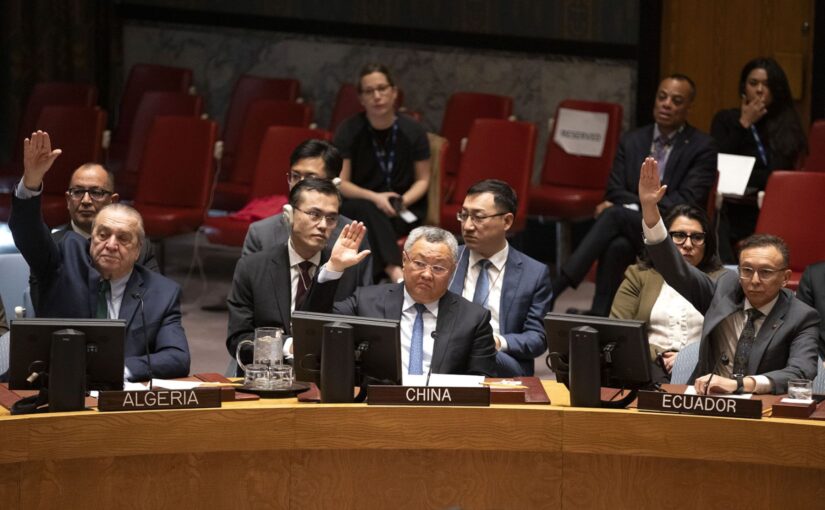
China’s Permanent Representative to the United Nations Fu Cong has reiterated his country’s firm opposition to and strong condemnation of the murder of Ismail Haniyeh, the political leader of the Islamic Resistance Movement Hamas. Haniyeh and his bodyguard were murdered in a brazen act of Israeli aggression whilst they were in the Iranian capital Tehran to attend the inauguration of President Masoud Pezeshkian as state guests.

Fu was speaking at a July 31 emergency meeting of the UN Security Council (UNSC), called in response to Haniyeh’s murder, by the Russian Federation, which currently holds the rotating chair of the UNSC, and at the request of Algeria and China.

Denouncing the act as a blatant attempt to sabotage peace efforts and one of wantonly trampling on the fundamental UN Charter principle of respect for sovereignty and territorial integrity of all states, Fu said China is deeply worried about an exacerbation of the upheaval in the region that this incident may trigger.

He further noted that: “We strongly object to and condemn the recent irresponsible acts, including Israel’s attack on Southern Beirut [in which Israel murdered Fuad Shukr, a senior commander of the Hezbollah resistance movement].”

The continued deterioration of the Middle East situation is directly attributable to the continuous failure to implement a ceasefire in Gaza, he noted, adding:

“We urge Israel to implement council resolutions in full, immediately halt all its military operations in Gaza, and immediately stop its collective punishment of the people in Gaza.”

Earlier, at the regular Foreign Ministry press conference in Beijing, spokesperson Lin Jian had also condemned the murder of Haniyeh.

A summary of the debate posted on the UN website summarises a number of the contributions to the meeting, including those of the UN Under-Secretary-General for Political Affairs, Algeria, Iran, Palestine, Syria and Lebanon, as well as the United States and Israel, but not those of several others, including China, Russia and Guyana, as well as Britain and South Korea.

The following article was originally published by the Xinhua News Agency.

UNITED NATIONS, July 31 (Xinhua) — A Chinese envoy on Wednesday called on the parties concerned to take tangible actions to push for deescalation and the restoration of peace and tranquility in the Middle East region.

China firmly opposes and strongly condemns the assassination of Hamas political leader Ismail Haniyeh that took place in Iran’s capital Tehran, said Fu Cong, China’s permanent representative to the United Nations, in remarks at the UN Security Council briefing on the situation in the Middle East, including the Palestinian question.

Denouncing the act as a blatant attempt to sabotage peace efforts and wantonly trampled on the fundamental UN Charter principle of respect for sovereignty and territorial integrity of all states, Fu said China is deeply worried about an exacerbation of the upheaval in the region that this incident may trigger.

He expressed disappointment over the ceasefire negotiations. “Over two months ago, the council adopted Resolution 2735. As of now, however, ceasefire negotiations have yet to yield any progress, while the spillover effects of this conflict are increasingly visible, with the tensions between Lebanon and Israel, between Syria and Israel, and in the Red Sea sounding the alarm frequently.”

“The Middle East situation is hanging by a thread, much to the concern of the international community,” he warned,

“Given the severity of the situation, the parties concerned must heed the international calls for a ceasefire and cessation of fighting,” said the ambassador, urging the parties to implement Security Council resolutions fully, actively coordinate with and support international good offices, and take tangible actions to push for deescalation and the restoration of peace and tranquility in the region.

“They must not act singlemindedly and repeatedly take provocative or risky actions to stoke escalations,” he said. “We strongly object to and condemn the recent irresponsible acts, including Israel’s attack on Southern Beirut.”

Emphasizing that “military means and abuse of force offer no solution and will only lead to a bigger crisis,” Fu said the continued deterioration of the Middle East situation is directly attributable to the continuous failure to implement a ceasefire in Gaza.

He called on all parties to comply with the overwhelming international consensus and work jointly for an immediate ceasefire to save lives, mitigate the impact of the havoc, and contain any spillovers. “We urge Israel to implement council resolutions in full, immediately halt all its military operations in Gaza, and immediately stop its collective punishment of the people in Gaza.”

Fu also urged countries with major influence to put more pressure and work more vigorously on the parties concerned and make tangible good-faith efforts to put out the flames of war in Gaza. 

China, Russia, Laos pledge concerted efforts to safeguard common interests

From July 25-27, Chinese Foreign Minister Wang Yi paid an official visit to Laos, where he also attended a number of international meetings principally connected to the Association of South East Asian Nations (ASEAN) and related cooperation mechanisms, along with bilateral dialogues with his counterparts from many countries.

In a round of engagements on July 25, Wang met with General Secretary of the Lao People’s Revolutionary Party (LPRP) Central Committee and Lao President Thongloun Sisoulith.

During the meeting, Thongloun said that the important conclusions and innovative achievements of the recently held third plenary session of the 20th Communist Party of China (CPC) Central Committee have provided important references for Laos to promote the socialist cause.

He thanked China for providing valuable support for Laos’ economic and social development over the years, saying that the Laos-China Railway has helped the Lao people realise their dreams and is a precious symbol of friendship between the people of the two countries.

Laos is willing to deepen cooperation with China, speed up comprehensive development along the Laos-China Railway, and build landmark projects of high-quality Belt and Road cooperation that carry forward the Laos-China traditional friendship, Thongloun said, adding that Laos welcomes more investments by Chinese enterprises to help the country enhance its capacity for independent development. He also noted that Laos will never allow anyone to undermine its friendship and practical cooperation with China

Wang responded that China firmly supports Laos in exploring a development path suited to its own conditions and in safeguarding its national sovereignty and dignity, is willing to deepen all-round cooperation with Laos, to strengthen comprehensive development along the China-Laos Railway and to promote connectivity to boost Laos’ economic development

The same day, Wang Yi also held talks with Lao Deputy Prime Minister and Foreign Minister Saleumxay Kommasith

He said that China has always prioritised the development of China-Laos relations in its neighbourhood diplomacy and supported Laos in taking the path of socialism which suits its national conditions, and in promoting the cause of innovation and opening-up,

China is willing to introduce the guiding principles of the third plenary session of the 20th CPC Central Committee and the new measures to further deepen reforms comprehensively, share reform and development experiences in a timely manner, jointly improve the ability of governance, and join hands to promote the cause of socialism.

The two sides should implement the action plan for building the community with a shared future signed by the leaders of the two parties and countries.  Based on the construction of the China-Laos Railway, they should give full play to the ‘first-mover’ advantage, build the China-Laos Economic Corridor, and help Laos enhance its capacity for independent development and achieve economic revitalisation. China will continue to provide all possible support for the economic and social development of Laos, deepen practical cooperation in energy, minerals and other fields, and import more high-quality Lao agricultural products to bring more benefits to the Lao people.

The two sides also exchanged views on regional cooperation, saying that they will work together to resist the interference and infiltration of external forces, jointly safeguard the ASEAN-centred regional architecture, and jointly promote regional peace, stability and prosperity. (This and similar subsequent references in this introduction to the interference and infiltration of external forces refers above all to moves by NATO to advance into the East Asian region along with related moves by the United States to further tighten military alignments with Japan and some other countries.)

Wang said China will continue to fully support Laos in fulfilling its responsibilities as the rotating chair of ASEAN and in playing a greater role in international and regional affairs.

Also on July 25, in the first such meeting of its kind, China, Russia and Laos jointly pledged to enhance cooperation to safeguard the common interests of the three countries, thereby contributing to regional stability and prosperity and a proper response to risks and challenges. Chinese Foreign Minister Wang Yi, Russian Foreign Minister Sergey Lavrov and Lao Deputy Prime Minister and Foreign Minister Saleumxay Kommasith all underlined these points in the course of their trilateral meeting.

Continue reading China, Russia, Laos pledge concerted efforts to safeguard common interests

Peace Mission to Philippines exposes US militarism’s harm to population

The article below, originally published in Workers World, details a recent peace mission to the Philippines by a group of US anti-war activists, aimed at opposing US militarism in the Pacific and the escalating campaign to encircle and contain China.

The article notes that the Philippines has been key to the US’s ‘Pivot to Asia’, and that a deal signed by then-president Obama in 2014 allows the US to rotate troops into the Philippines for extended days. “It also allows the US to build and operate facilities. There are now nine such bases scattered in the Philippines, most of them aimed at China.”

The US military infrastructure in the Philippines is deeply unpopular, not least because its construction often involves the displacement of local communities, which are forced into deep poverty. Meanwhile the US military bolsters the local state forces in their repression of those groups, communities and activists that are fighting for housing, clean water, land, education and food.

The article closes by noting that, “despite the pressure and direct impact of rising militarization and economic plunder, communities continue to fight back for their land, livelihoods and other human rights.”

As the Pentagon dangerously increases its military presence in nations close to China in preparation for another imperialist war, a group of U.S. anti-war activists participated in a Peace Mission to the Philippines May 14-29 to expose and oppose U.S. militarism in the Philippines.

Organized by BAYAN USA, it included 28 militants from across the United States. Filipino activists, military veterans, anti-war advocates, labor unionists, women’s rights defenders, students, filmmakers and others participated, representing BAYAN USA and other groups including NODUTDOL, Malaya, Gabriela, United Auto Workers, Dissenters, Palestinian Youth Movement and Workers World Party.

They spent the first few days in the National Capital Region of Manila, a city of 15 million residents in a country of 120 million people. They heard presentations on BAYAN’s history, labor, student activism, women’s and LGBTQ2+ movement developments and visited historical sites.

The Philippines was a Spanish colony from 1565 to 1898. Revolutionaries were on the brink of defeating their Spanish colonizers when the U.S. stepped in to forcefully re-colonize the populated islands but not before perpetrating a genocide against almost 1 million Filipino people in order to subdue them. The Philippines finally gained formal independence in 1946, but remains closely tied to the U.S. economically, culturally and especially militarily.

Three of the Peace Mission participants — Nina Macapinlac of BAYAN USA and Resist NATO, Patrick Nevada of Anakbayan NY and Joe Piette of Workers World Party — recounted their experiences at a June 28 report-back meeting in Philadelphia.

The three activists were part of a group sent to Cebu — the oldest city in the Philippines with over 1 million residents.

Leaving the airport, they passed by the Mactan Economic Zone — a tax-free, low- regulation center where more than 200 foreign companies exploit over 50,000 workers — the second largest Economic Zone in the Philippines.

At Cendet — an institution with a long and well=known history that provides services to workers, urban poor, farmers and fisherfolks in the Visayas — some background to Cebu’s struggles for justice was given by Jaime Paglinawan Sr. He is one of 27 activists who was recently charged for supposedly violating the Terrorism Financing Prevention and Suppression Act of 2012 by the Department of Justice’s Terror Task Force and the Central Command of the Armed Forces of the Philippines. It would be like the Pentagon charging community activists with terrorism.

The 27 defendants released a statement demanding that the government drop the phony charges and stop “its anti-poor and anti-people policies that conspire with the imperialists, huge local business owners and landlords to generate more wealth in their pockets”.

Fight to remove U.S. military bases

Paglinawan explained how the people succeeded in removing all the U.S. military bases in 1991, after decades of opposition. However, politicians got around the law in 1999 with the Visiting Forces Agreement, which allows U.S. military aircraft and ships access to 22 ports and waived Philippine jurisdiction over any crimes committed by U.S. military personnel.

In 2014, during a visit by President Barack Obama to the Philippines, the Enhanced Defence Cooperation Agreement (EDCA) was signed, allowing the U.S. to rotate troops into the Philippines for extended stays. It also allows the U.S. to build and operate facilities. There are now nine EDCA bases scattered in the Philippines, most of them aimed at China.

The Peace Delegation drove by the entrance to one of the EDCA sites at Mactan-Benito Ebuen Air Base located in Lapu-Lapu City, on Mactan Island in Cebu. Lapu-Lapu City ironically is the location where Ferdinand Magellan, the Spanish explorer, famous as the first European to circumnavigate the earth, was killed in 1521 by the resistance forces of Mactan chief Lapu-Lapu.

The airbase shares runway facilities with the Mactan-Cebu International Airport next door. The U.S. recently paid $2.7 million for a 40,000-gallon fuel storage facility there, which was completed last fall. Its intended use is for Lockheed-Martin’s C130 military Air Transport, Osprey and other military planes.

We visited a Lapu-Lapu City neighborhood where the extremely impoverished community’s homes were demolished without warning, violating residents’ human right to housing. Developers desire the property, located on a major road not far from the Cebu airport and military base. Residents noticed the military was monitoring their neighborhood during the initial notices of demolition.

Copper, gold, silver and sulfur mines are located in Cebu and in addition a quarrying site next to a peasant community we visited is taking away sandy soil for a reclamation project in Cebu’s harbor and other places. Many of the community members’ homes have developed cracks, and residents worry about their safety as the quarry machines continue to dig away at the hill their mountain village stands on.

A fishing community in Minglanilla is next door to where developers have already built McMansions for wealthy foreigners. Organized fisherfolk are fighting to keep their land and community together despite a 250-acre shore reclamation project that threatens to displace hundreds of families and wreak havoc on the livelihood of the fisherfolk. Some of their leaders have experienced red-tagging (accusing someone of being communist and a terrorist) and harassment from state forces.

The Carbon Market Street Vendors association is an organization representing up to 6,000 vendors fighting developers trying to remove them in favor of a modernization project. Thousands of vendors will be affected by the demolitions, and those left will experience an increase in rent, utilities and other fees. The Carbon Market in Cebu has existed for more than 100 years.

After a suspicious fire burned down their community in 2019, members of the Tipolo Residence Association were placed temporarily in the parking lot of the dilapidated Cebu International Convention Center, which was built for the twelfth ASEAN Summit and the East Asia Summit in 2007. An earthquake and super-typhoon Yolanda in 2013 caused the poorly constructed building to partly collapse.

Since 2019, with little support from city officials, the displaced residents have been forced to live in makeshift homes of scrap wood under overlapping roof panels made of corrugated iron sheets. Despite red-tagging of their leaders, residents are still fighting after five years to return to their properties. Residents suspect officials want to replace their former homes with commercial development.

At the University of the Philippines – CEBU, members of the PISTON transport union, Coca-Cola workers, furniture workers and other workers explained their struggles for better working conditions despite red-tagging and other pressure tactics.

Members of Anakbayan Cebu, Alliance of Concerned Teachers and students in Nagkahiusang Kusog sa Estudyante (NKE UP Cebu) described their struggle for better education. NKE UP Cebu is an organization at the University of the Philippines Cebu which aims to provide a “nationalist, scientific and mass-oriented education as an alternative to the existing colonial, commercialized and fascist system of education.”

Conclusions after three days in Cebu

The courts, elected officials and the Philippine military (with close ties to the U.S. Pentagon) all work together in counterinsurgency efforts to impede the human rights of the Filipino people for housing, clean water, land, education and food.

The military is a key tool in the suppression of any organization that is fighting for the basic livelihood of Filipino working people, from NGOs to grassroots organizations.

The military is active in counter-organizing where poor people are fighting back, with bribes of rice and other commodities if they turn in their leaders. The promises of rice and so on are most often not followed through.

Where bribes don’t work, the state uses the accusation of red-tagging, a fear tactic which can lead to arrest, disappearance or even death. It’s often used against community organizers simply fighting against displacement or other human rights.

Despite the pressure and direct impact of rising militarization and economic plunder, communities continue to fight back for their land, livelihoods and other human rights.

China congratulates Maduro on election as Venezuelan president

Chinese President Xi Jinping has congratulated Nicolás Maduro on his victory in the Venezuelan presidential election held on 28 July.

In his message, Xi said that Maduro has led the Venezuelan government and people in pursuing a development path suited to their own national conditions, making remarkable achievements in national construction and that China and Venezuela are good friends that trust each other, adding that China will, as always, firmly support Venezuela’s efforts to safeguard national sovereignty, national dignity and social stability, as well as Venezuela’s just cause of opposing external interference.

The following article was originally published by the Xinhua News Agency.

BEIJING, July 30 (Xinhua) — Chinese President Xi Jinping on Tuesday sent a message to Nicolas Maduro, congratulating him on re-election as president of the Bolivarian Republic of Venezuela.

Since taking office, President Maduro has led the Venezuelan government and people in pursuing a development path suited to their own national conditions, making remarkable achievements in national construction, Xi said.

China and Venezuela are good friends that trust each other and good partners for common development, Xi said, adding that China will, as always, firmly support Venezuela’s efforts to safeguard national sovereignty, national dignity and social stability, as well as Venezuela’s just cause of opposing external interference.

Xi said that he highly values the development of China-Venezuela relations and is willing to work with President Maduro to continue guiding the all-weather strategic partnership between China and Venezuela to new heights, so as to benefit the people of both countries. 

China champions peace in Middle East through concrete actions

Following the July 23 signing of the Beijing Declaration on Ending Division and Strengthening Palestinian National Unity by 14 Palestinian resistance movements, the Xinhua News Agency released a commentary on July 26, affirming that China champions peace in the region through concrete actions. 

According to correspondent Zhao Wencai: “As witnessed by their Chinese friends, once-bitter rivals among the Palestinians, notably Hamas and Fatah, have decided to bury the hatchet and join forces.”

He goes on to note that during the reconciliation talks, Mustafa Barghouti, Secretary-General of the Palestinian National Initiative, was asked why different factions could resolve their differences in Beijing.

“After thinking for a while, he replied, ‘Because China is decent and honest and wants to help us without interfering in our internal affairs, (and) to support our struggle by enhancing Palestinian unity and enabling Palestinians to achieve what they deserve, which is their freedom, their independence, their rights to sovereignty.'”

The current war in Gaza has, the commentary notes, highlighted for Palestinians the detrimental impact of internal divisions on their goal of establishing a state. There is a growing recognition that a unified voice will amplify their calls for justice, and only by standing together can they advance their cause for national liberation.

“China’s drive for an early, comprehensive, just and lasting resolution to the Palestinian-Israeli conflict stems not from self-serving geopolitical motives, but from a profound empathy for the Palestinian people and an earnest aspiration for peace and prosperity in the Middle East.

“Unlike some Western countries that have often overlooked the suffering in Gaza, China’s historical experience with Western interference has given its people a unique perspective on the hardships faced by those in the Middle East, who long for peace and stability amidst the turmoil of war.”

Meanwhile, in his weekly blog, published on belfastmedia.com, former Sinn Féin President Gerry Adams has welcomed the Beijing agreement. He writes: “In a very welcome move Hamas and Fatah and 12 other Palestinian groups signed a ‘national unity’ agreement in Beijing aimed at maintaining Palestinian control over the Gaza Strip once Israel’s genocidal war on the besieged territory ends. The agreement calls for [an] ‘interim national reconciliation government’ to govern Gaza.

“Israel and its allies have sought to dictate the terms of any governance arrangement for the Gaza Strip in any post war situation, including Israel maintaining control of the territory. All of these have been predicated on limiting the democratic rights of the Palestinian people to choose their own representatives and government. This cannot be allowed. The Palestinian people have the right to self-determination.”

The following article was originally published by the Xinhua News Agency.

CAIRO, July 26 (Xinhua) — As the Palestinian-Israeli conflict in Gaza stretches into its 10th month, there was a bid for peace and unity from Beijing this week: Under China’s mediation, senior representatives from 14 Palestinian factions signed the Beijing Declaration on Ending Division and Strengthening Palestinian National Unity.

According to the declaration, the Palestinian factions have agreed to establish an interim national reconciliation government, carry out reconstruction in Gaza and prepare and hold a general election as soon as possible in keeping with the adopted election laws.

As witnessed by their Chinese friends, once-bitter rivals among the Palestinians, notably Hamas and Fatah, have decided to bury the hatchet and join forces. They are setting their sights on establishing an independent State of Palestine with Jerusalem as the capital, based on relevant United Nations (UN) resolutions and ensuring the integrity of Palestinian territory, including the West Bank, Jerusalem, and Gaza.

During the reconciliation talks, Mustafa Barghouti, secretary-general of the Palestinian National Initiative, was asked why different factions could resolve their differences in Beijing.

After thinking for a while, he replied, “Because China is decent and honest and wants to help us without interfering in our internal affairs, (and) to support our struggle by enhancing Palestinian unity and enabling Palestinians to achieve what they deserve, which is their freedom, their independence, their rights to sovereignty.”

Barghouti’s remarks offered a compelling elucidation of China’s sincerity and continual progress in assisting the Middle East in achieving peace.

The Palestinian question has always been the core issue in the Middle East, and achieving internal reconciliation within Palestine is an important step toward resolving the issue and achieving peace and stability in the region.

China has long been committed to promoting reconciliation within Palestine, a goal shared by other Arab nations including Egypt and Jordan.

However, efforts have previously stalled due to an unfavorable international environment, particularly interference from the United States.

The recent round of conflicts in Gaza has highlighted for Palestinians the detrimental impact of internal divisions on their goal of establishing a state. There is a growing recognition that a unified voice will amplify their calls for justice, and only by standing together can they advance their cause for national liberation. This has spurred a renewed desire for reconciliation among Palestinian factions.

Meanwhile, the international community has increasingly recognized that the establishment of a Palestinian state is the key to resolving the Palestinian question. Inspired by China’s successful mediation between Saudi Arabia and Iran, the world and the Palestinian leaders in particular are hopeful that China will play a significant role in addressing the thorny issue.

The most urgent task now is to achieve a comprehensive, lasting and sustainable ceasefire in the Gaza Strip as soon as possible, and ensure access to humanitarian aid and rescue on the ground. China has engaged in close communication and coordination with relevant parties since the outbreak of recent hostilities.

Deeply concerned about the humanitarian situation in Gaza, China has provided significant amounts of humanitarian aid through various channels. It has also actively facilitated the UN Security Council’s adoption of a resolution calling for a ceasefire in Gaza.

In the Position Paper of the People’s Republic of China on Resolving the Palestinian-Israeli Conflict released last November, China calls for Palestine’s full membership in the UN and a more authoritative and effective international peace conference to work out a timetable and road map for the two-state solution.

China’s drive for an early, comprehensive, just and lasting resolution to the Palestinian-Israeli conflict stems not from self-serving geopolitical motives, but from a profound empathy for the Palestinian people and an earnest aspiration for peace and prosperity in the Middle East.

Unlike some Western countries that have often overlooked the suffering in Gaza, China’s historical experience with Western interference has given its people a unique perspective on the hardships faced by those in the Middle East, who long for peace and stability amidst the turmoil of war.

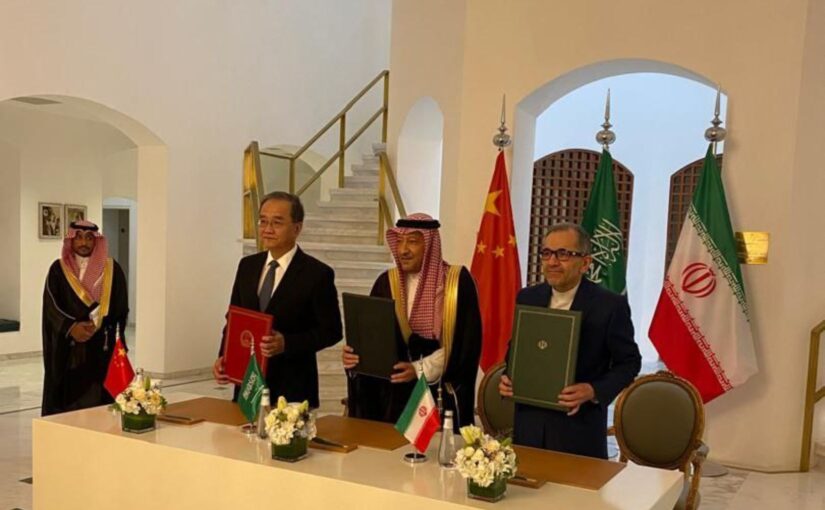
China’s efforts to promote peace in the region are underscored by its role in facilitating the reconciliation between Saudi Arabia and Iran in 2023, ending seven years of diplomatic deadlock. The current Beijing Declaration further exemplifies China’s concrete steps to bridge regional divides and lay the foundation for a peaceful Middle East.

On their journey toward lasting peace and prosperity, all parties involved in the Middle East conflict will find in China a true advocate committed to peace and justice in the region.

Nguyen Phu Trong made unforgettable contributions to Vietnam–China relations

Since Nguyen Phu Trong, General Secretary of the Central Committee of the Communist Party of Vietnam (CPV), passed away on July 19, the Vietnamese party newspaper Nhân Dân has carried many articles extolling the late leader’s great contributions to the friendly relationship between Vietnam and China, which has socialism at its core.

On July 20, it carried an interview with Chinese Ambassador to Vietnam Xiong Bo who said: “Party General Secretary Nguyen Phu Trong is a person who persisted in Marxism and a great leader of the Communist Party of Vietnam and the Vietnamese people.”

He added that: “Nguyen Phu Trong attached special importance to the strengthening of the corruption fight and party building and rectification. Especially after the 13th Congress of the Party, the Central Committee of the Communist Party of Vietnam headed by Party General Secretary Nguyen Phu Trong has pushed up the corruption fight with a spirit of ‘no off-limits zones’ and reaped many important results, firmly ensuring the maintenance of social order and security and the following of the way to socialism suitable to the situation in the country.”

He described Trong’s well-known strategy of ‘bamboo diplomacy’ as “underlining that sturdy root means consistently following the CPV leadership and the path to socialism. At the same time, it is necessary to be flexible in terms of strategy on the basis of firmly maintaining independence and self-mastery, and actively developing friendly relations with countries in the world. Under the leadership of the CPV Central Committee headed by General Secretary Nguyen Phu Trong, Vietnamese diplomacy has gained many important achievements as described by the CPV leader that Vietnam ‘has never enjoyed such fortune, power, international standing and prestige as it does today.’”

Moreover, “Party General Secretary Nguyen Phu Trong is a close comrade and a sincere friend of the Communist Party of China and the Chinese people. He was the one who inherited and developed the traditional friendship of ‘comradeship and brotherhood’ between the two parties and countries of China and Vietnam, forming a passionate friendship with the Communist Party of China and Chinese leaders.”

Recalling his personal relationship and friendship with Trong, the Ambassador said:

“The event that left the deepest impression on me took place on August 25 last year. At the invitation of Party General Secretary Nguyen Phu Trong, I accompanied him in the visit to the Huu Nghi International Border Gate in the northern province of Lang Son, which is located at the border between the two countries. Party General Secretary Nguyen Phu Trong repeatedly emphasised that the Vietnam-China Friendship border gate is unique in the world, sending out an important message to the people of both countries and the international community on the traditional friendship between China and Vietnam. 

“Together with Party General Secretary Nguyen Phu Trong, I planted the Vietnam-China friendship tree. The party leader affectionately said: ‘This friendship tree has strong roots like the Vietnam-China relationship. With the care of the people of the two countries, this friendship tree will surely grow strong and healthy.’ That Party General Secretary Nguyen Phu Trong himself promoted the traditional relations of friendship between the two countries made me feel extremely touched.”

On July 23, the paper reported Li Minghan, a Hong Kong-based scholar on Vietnam and President Ho Chi Minh, as saying that he is extremely saddened by Trong’s passing. It added that:

“Observing and studying Vietnam’s development for more than a decade, Li realised that General Secretary Trong had good and noble virtues of a leader like President Ho Chi Minh. Vietnam’s achievements have had a profound impact on all socialist countries in the world, especially its anti-corruption results in recent years. General Secretary Trong looked small and simple but he was so strong-willed to order the stringent settlement of corrupt officials strictly, even those holding high positions in the party and state leadership.”

Trong also left  an extremely good impression of his integrity and simplicity during his whole life devoted to the party, the nation and the people.

Noting that the General Secretary used only an old car for about 20 years while working in various positions, including three terms as the leader of the Communist Party of Vietnam, Li shared that to effectively fight against corruption and negative phenomena, leaders themselves must set good examples first.

Li, who is 80 years old, said that both he and his wife used to learn Vietnamese at Beijing Foreign Studies University. His father-in-law had the honour to prepare a meal for President Ho Chi Minh when he worked at the Chinese Embassy in Hanoi. That inspired his interest in studying Vietnam in general and President Ho Chi Minh in particular.

Regarding Vietnam-China relations, Li said that one of the bilateral ties’ highlights under Trong’s leadership is an appropriate and effective foreign policy in harmonising Vietnam’s relations with major countries, as well as strengthening and developing connections with socialist countries and communist parties.

The following articles were originally published by Nhân Dân.

Ambassador Xiong Bo: Contributions by Party General Secretary Nguyen Phu Trong to Vietnam – China remain unforgettable

July 20 (Nhân Dân) — General Secretary of the Communist Party of Vietnam Central Committee Nguyen Phu Trong passed away on July 19 afternoon at the age of 80, according to the board of health protection and care for central officials. Chinese Ambassador to Vietnam Xiong Bo expressed his sentiment and ideas on the late leader following the event.

Reporter: In the great loss of the Vietnamese Party, State and people, how do you assess the role and contributions by Party General Secretary Nguyen Phu Trong to the revolutionary cause of Vietnam?

Ambassador Xiong Bo: First of all, I am deeply grieved and would like to express the deepest condolences on the passing away of Party General Secretary Nguyen Phu Trong, the Central Committee of the Communist Party of China immediately sent its message of condolences to the Central Committee of the Communist Party of Vietnam, respectfully commemorating Party General Secretary Nguyen Phu Trong. Party General Secretary Nguyen Phu Trong is a person who persisted Marxism and a great leader of the Communist Party of Vietnam and the Vietnamese people. He was elected as General Secretary of the Central Committee of the Communist Party of Vietnam at the Party’s 11th, 12th, and 13th Congresses, and supported and loved by the Vietnamese people. Over the past more than 10 years, he has led the Party, Government, and people of Vietnam in recording many important development achievements. Party General Nguyen Phu Trong is an outstanding politician who has profound perception on the maintenance of the Party’s leadership and the persistence of the way to socialism, leaving deep imprints on me.

Party General Secretary Nguyen Phu Trong attached special importance to the strengthening of the corruption fight and Party building and rectification, especially after the 13th Congress of the Party, the Central Committee of the Communist Party of Vietnam headed by Party General Secretary Nguyen Phu Trong has pushed up the corruption fight with a spirit of “no off-limits zones” and reaped many important results, firmly ensuring the maintenance of social order and security and the following of the way to socialism suitable to the situation in the country.

Reporter: Over the recent years, Vietnam has pushed up the implementation of the “bamboo diplomacy” featuring strong roots, solid stems, and flexible branches. How do you assess the role of Party General Secretary Nguyen Phu Trong in shaping and developing this diplomatic policy?

Ambassador Xiong Bo: Party General Secretary Nguyen Phu Trong initiated the persistent implementation of the “bamboo diplomacy”, underlining that sturdy root means consistently following the CPV leadership and the path to socialism. At the same time, it is necessary to be flexible in terms of strategy on the basis of firmly maintaining independence and self-mastery, and actively developing friendly relations with countries in the world. Under the leadership of the CPV Central Committee headed by General Secretary Nguyen Phu Trong, Vietnamese diplomacy has gained many important achievements as described by the CPV leader that Vietnam “has never enjoyed such fortune, power, international standing and prestige as it does today.”

We found that Vietnam’s diplomacy underscores the priority to developing relations with neighbours and world powers as well as partners sharing traditional friendship. At the same time, Vietnam has persistently supported true multilateralism, attached importance to the protection of international equality and justice, and opposed the interference in internal affairs of other states. China highly evaluates this.

Reporter: What are your comments on the imprints that Party General Secretary Nguyen Phu Trong has left in the Vietnam-China overall relations? During the Vietnam visit by General Secretary of the Communist Party of China and Chinese President Xi Jinping in late 2023, the two sides established a “new positioning” for bilateral relations, elevating the comprehensive strategic cooperative partnership, and building a Vietnam-China community with a shared future that carries strategic significance. How do you assess Party General Secretary Nguyen Phu Trong’s contributions to this event?

Ambassador Xiong Bo: Party General Secretary Nguyen Phu Trong is a close comrade and a sincere friend of the Communist Party of China and the Chinese people. He was the one who inherited and developed the traditional friendship of “comradeship and brotherhood” between the two Parties and countries of China and Vietnam, forming a passionate friendship with the Communist Party of China and Chinese leaders. Since taking office as the General Secretary of the CPV, comrade Nguyen Phu Trong had made considerable contributions to promoting the development of relations between the two Parties and the two countries, especially through the exchange of three historic visits with General Secretary Xi Jinping, during which they oriented the development of relations between the two Parties and countries of China and Vietnam in the new era together.

In the past two years, Party General Secretary Nguyen Phu Trong visited China right after the 20th National Congress of the Communist Party of China, and warmly welcomed General Secretary Xi Jinping last year. The two leaders announced the building of a Vietnam-China community with a shared future that carries strategic significance, defining a new positioning of the ties between the two countries in the new era, elevating the relations between the two Parties and countries to a new historical height. We recognise, highly appreciate and will never forget this.

Reporter: Could share your impressions on Party General Secretary Nguyen Phu Trong? What is the deepest impression the Party General Secretary has left on you?

Ambassador Xiong Bo: I have been the Chinese Ambassador to Vietnam for more than five years, and my work has received great assistance and help from Party General Secretary Nguyen Phu Trong. After taking office in 2018, I was very honoured to present my credentials to General Secretary and President Nguyen Phu Trong. This was the first time the Party leader received a foreign ambassador presenting credentials after he had assumed the position of the State President. Since then, I have met with the Party leader many times and had opportunities to listen to his important and profound ideas on developing the relationship between the Parties and countries of Vietnam and China, which has left deep impression on me.

The event that left the deepest impression on me took place on August 25 last year. At the invitation of Party General Secretary Nguyen Phu Trong, I accompanied him in the visit to the Huu Nghi International Border Gate in the northern province of Lang Son, which is located at the border between the two countries. Party General Secretary Nguyen Phu Trong repeatedly emphasised that the Vietnam – China Friendship border gate is unique in the world, sending out an important message to the people of both countries and the international community on the traditional friendship between China and Vietnam. Together with Party General Secretary Nguyen Phu Trong, I planted the Vietnam – China friendship tree. The Party leader affectionately said: “This friendship tree has strong roots like the Vietnam-China relationship. With the care of the people of the two countries, this friendship tree will surely grow strong and healthy.” That Party General Secretary Nguyen Phu Trong himself promoted the traditional relations of friendship between the two countries made me feel extremely touched.

Thank you for your conversation!


Vietnamese Party chief makes life-long dedication to nation: Chinese scholars

23 July (Nhân Dân) — The passing of Party General Secretary Nguyen Phu Trong is a huge loss to not only the Party, State and people of Vietnam but also international friends, including Chinese scholars who have spent years studying Vietnam.

Li Minghan, a Hong Kong-based scholar on Vietnam and President Ho Chi Minh, said that he is extremely saddened by the passing of the communist, who is one of respectable Vietnamese leaders.

Observing and studying Vietnam’s development for more than a decade, Li realised that General Secretary Trong had good and noble virtues of a leader like President Ho Chi Minh. Under his leadership, the country has achieved outstanding progress in politics, economy, defence and security, and secured increasing prosperity and happiness for its people.

Li said that Vietnam’s achievements have had a profound impact on all socialist countries in the world, especially its anti-corruption results in recent years. General Secretary Trong looked small and simple but he was so strong-willed to order the stringent settlement of corrupt officials strictly, even those holding high positions in the Party and State leadership.

The leader also left extremely good impression of his integrity and simplicity during his whole life devoted to the Party, the nation and the people.

Noting the General Secretary used only an old car for about 20 years working in various positions, including three terms as the leader of the Communist Party of Vietnam, Li shared that to effectively fight against corruption and negative phenomena, leaders themselves must set good examples first.

Li, who is 80 years old, said that both he and his wife used to learn Vietnamese at Beijing Foreign Studies University. His father-in-law had the honour to prepare a meal for President Ho Chi Minh when he worked at the Chinese Embassy in Hanoi. That inspired his interest in studying Vietnam in general and President Ho Chi Minh in particular.

The scholar found that General Secretary Trong learned and applied much of the style, virtues and ethics of President Ho Chi Minh, especially the loyalty and dedication to the Party, the State and the people of Vietnam.

Mourning the Vietnamese Party chief, Li was so moved that he made a poem to share with his Vietnamese friends and people in Hong Kong. He held that the General Secretary deserves to be one of President Ho Chi Minh’s excellent disciples.

Regarding Vietnam-China relations, Li said that one of the bilateral ties’ highlights under Trong’s leadership is an appropriate and effective foreign policy in harmonising Vietnam’s relations with major countries, as well as strengthening and developing connections with socialist countries and communist parties. Vietnam has not only stabilised relations with the US and Russia, but also promoted relations with China to a new level.

Meanwhile, Wang Feng who is a former reporter of the Xinhua News Agency, said that she felt down to hear about Trong’s passing. The leader dedicated his entire life to the development of Vietnam as well as the friendship in all fields between the two countries.

Wang shared that she met Trong once and felt that he was very friendly, smart and flexible. There are not many leaders like him.

Researching many works by the General Secretary, she perceived that Trong was a person with a deep theoretical foundation, in terms of both politics and economics. He applied Marxism-Leninism into practice, made great contributions to anti-corruption efforts and economic and cultural development in Vietnam, and promoted the two countries’ exchanges and cooperation.

Under Trong’s leadership, the China – Vietnam relationship has achieved many highly positive results in various fields, especially people-to-people exchanges, Wang added.

Chinese FM warns Philippines over US intermediate missile system deployment

From July 25-27, Chinese Foreign Minister Wang Yi paid an official visit to Laos, where he also attended the ASEAN (Association of South East Asian Nations)-China Foreign Ministers’ Meeting, the ASEAN Plus Three (China, Japan, the Republic of Korea) Foreign Ministers’ Meeting, the East Asia Summit Foreign Ministers’ Meeting and the ASEAN Regional Forum Foreign Ministers’ Meeting, as well as holding a considerable number of bilateral meetings with his counterparts from around the world and the first trilateral meeting of the foreign ministers of China, Russia and Laos.

As part of his program, on July 26, Wang Yi met with his Philippine counterpart, Foreign Secretary Enrique Manalo, in which meeting he warned the Philippine side over the question of US intermediate missile system deployment. 

Wang said that China and the Philippines are close neighbours across the sea, and good neighbourliness, mutually beneficial cooperation and common development are in the fundamental interests of the two countries.

He noted that the positive and negative lessons of China-Philippines relations in recent years have proved time and again that it is not easy to build good relations, but it is easy to destroy them. At present, he continued, China-Philippines relations are facing serious difficulties and challenges, which are rooted in the fact that the Philippine side has repeatedly violated the consensus of the two sides and its own commitments.

He added that if the Philippines introduces the US intermediate missile system, it will create regional tension and confrontation, triggering an arms race, which is totally not in line with the interests and aspirations of the Filipino people.

Wang pointed out that China-Philippines relations are now at a crossroads and there is no way out of conflict and confrontation, except for dialogue and consultation. He expressed the hope that the Philippine side will seriously think about the future of China-Philippines relations and work with China to push bilateral relations back on the right track at an early date.

Manalo said that despite the difficulties and challenges faced by the two sides due to maritime issues, the Philippines is committed to easing the situation through dialogue and consultation and dealing with differences constructively. He noted that next year is the 50th anniversary of the establishment of diplomatic relations between the Philippines and China, and the Philippines is willing to strengthen communication with China in a sincere and pragmatic manner to enhance mutual trust and improve bilateral relations.

In related developments, on July 8, the International Information Office of the National Democratic Front (NDF) of the Philippines issued a statement describing the recently signed Japan-Philippines Reciprocal Access Agreement (RAA) as another step in US imperialism’s march towards war, adding that it, “betrays the victims of Japanese war crimes against the Filipino people during World War II and dangerously positions the country on the front lines of war. By allowing the deployment of Japanese soldiers on Philippine soil for so-called joint military exercises, the [President] Marcos Jr. and [Prime Minister] Kishida administrations are shameless puppets in the elaborate war preparations orchestrated by the US in its march toward an armed confrontation with China.

“The RAA with Japan comes at the heels of US overtures to strengthen military alliances in the Indo-Pacific region in its continuing ‘first island chain strategy’ to encircle China. The RAA with Japan allows Japanese military to freely enter and exit the Philippines for combat training including live-fire drills – akin to the lopsided Visiting Forces Agreement (VFA) of the Philippines with the US government, which the latter has been using to justify its provocative sabre rattling against China.

“The Japan-Philippines Reciprocal Access Agreement marks a dangerous precedent, undermining prospects for a peaceful resolution of territorial conflicts in the region while stoking the flames of war. The path to lasting peace lies not in the buildup of military personnel and materiel that serve US war designs against China.”

Further, on July 22, in a statement issued by Marco Valbuena, its Chief Information Officer, the Communist Party of the Philippines (CPP) accused President Ferdinand Marcos Jr. of speaking, “from a fantasy bubble, completely detached from the realities of oppression and exploitation facing the majority of the Filipino people” in his third State of the Nation Address (SONA) and ignoring and obscuring, “the stark social realities confronting millions of peasants and workers, fisherfolk, national minorities, unemployed people, urban poor, students and young people, women, and other toiling sectors.”

The CPP statement added: “Marcos falsely depicted himself as a patriot for purportedly asserting Philippine sovereignty and echoing the line ‘atin ang [we’re the] West Philippine Sea,’ blurring the fact that he has completely yielded to the dictates of his US imperialist master to turn the country into an American military base, to station their troops, preposition their weapons, and drag the country into its conflict with China.”

The following articles were originally published by the Xinhua News Agency and Philippine Revolution Web Central.

Chinese FM warns Philippines over U.S. intermediate missile system deployment

VIENTIANE, July 27 (Xinhua) — Chinese Foreign Minister Wang Yi met with Philippine Foreign Secretary Enrique Manalo here on Friday, warning the Philippine side over the U.S. intermediate missile system deployment.

Wang, also a member of the Political Bureau of the Communist Party of China Central Committee, said that China and the Philippines are close neighbors across the sea, and good neighborliness, mutually beneficial cooperation and common development are in the fundamental interests of the two countries.

He noted that the positive and negative lessons of China-Philippines relations in recent years have proved time and again that it is not easy to build good relations, but it is easy to destroy them.

At present, Wang said, China-Philippines relations are facing serious difficulties and challenges, which are rooted in the fact that the Philippine side has repeatedly violated the consensus of the two sides and its own commitments, continuously pushed the infringement of rights at sea and magnified the speculation of public opinion.

China is gravely concerned about and firmly opposes it, Wang said.

He added that if the Philippines introduces the U.S. intermediate missile system, it will create regional tension and confrontation, triggering an arms race, which is totally not in line with the interests and aspirations of the Filipino people.

Continue reading Chinese FM warns Philippines over US intermediate missile system deployment

Chinese FM meets head of Fatah delegation

Following the conclusion of talks in Beijing between representatives of 14 Palestinian resistance groups, which resulted in the signing of the Beijing Declaration on Ending Division and Strengthening Palestinian National Unity, on July 23, Chinese Foreign Minister Wang Yi met with the head of the Fatah delegation Mahmoud al-Aloul.

Wang stressed that a top priority now is to proceed from the fundamental interests of all the Palestinian people, seize the opportunity and seek common ground while shelving differences, so that unity and reconciliation among the various factions could be realised.

Mahmoud al-Aloul, who is also deputy leader of Fatah, thanked China for its efforts to promote reconciliation among Palestinian factions and for its support and assistance to Palestine over the past decades, calling China a true friend and brother of the Palestinian people.

The following report was first published by the Xinhua News Agency.

BEIJING, July 24 (Xinhua) — Chinese Foreign Minister Wang Yi met with the head of the Fatah delegation Mahmoud al-Aloul in Beijing on Tuesday.

Wang, also a member of the Political Bureau of the Communist Party of China Central Committee, stressed that no matter how the international situation changes, China will always firmly support the just cause of the Palestinian people.

Noting that the conflict in Gaza has caused a huge humanitarian disaster, Wang said to resolve this historical injustice, the principle of “Palestinian-owned, Palestinian-led and Palestinian-ruled” must be upheld.

Wang said the top priority now is to proceed from the fundamental interests of all the Palestinian people, seize the opportunity and seek common ground while shelving differences, so that unity and reconciliation among the various factions could be realized, and they could form a unified position, define a common goal, and create necessary conditions for a permanent ceasefire in Gaza, the realization of an independent state and the implementation of the two-state solution.

Mahmoud al-Aloul, also deputy chief of the Fatah Movement, thanked China for its efforts to promote reconciliation among Palestinian factions and its support and assistance to Palestine over the past decades, calling China a true friend and brother of the Palestinian people.

The Fatah Movement will do its utmost to promote reconciliation and unity among Palestinian factions and contribute to a thorough settlement of the Palestinian issue. 

Xi’s special representative mourns passing of Nguyen Phu Trong in Vietnam

Funeral and memorial services for the late Comrade Nguyen Phu Trong, General Secretary of the Central Committee of the Communist Party of Vietnam (CPV), who passed away on July 19, were held in the capital, Hanoi over July 25-26.

Wang Huning, a member of the Standing Committee of the Political Bureau of the Communist Party of China (CPC) Central Committee and Chairman of the National Committee of the Chinese People’s Political Consultative Conference (CPPCC), as the Special Representative of General Secretary Xi Jinping, led a CPC delegation to participate in the mourning activities.

Paying his respects at the National Funeral Hall, on behalf of Xi and the CPC Central Committee, and in the name of Xi’s special representative, Wang laid a wreath, paused to observe a moment of silence before bowing three times to Trong’s coffin, conveyed sincere condolences from Xi and his wife Peng Liyuan to Trong’s widow Ngo Thi Man, and left a message in the condolence book.

Meeting with Vietnamese President To Lam and Prime Minister Pham Minh Chinh, Wang expressed deep grief over the passing of Comrade Nguyen Phu Trong, saying that after learning the sad news, Xi went to the Embassy of Vietnam in Beijing to pay tribute to the late leader and the CPC Central Committee sent condolences to the CPV Central Committee.

Appointing Wang as Xi’s special representative to lead a CPC delegation for the mourning shows once again the heartfelt grief and sincere condolences of Xi and the CPC Central Committee to the CPV Central Committee and Trong’s family. At this special moment, the party and people of China stand firmly with the party and people of Vietnam, Wang said.

Wang noted that Trong is a staunch Marxist, a great leader of the CPV and the Vietnamese people, and a great friend of the Chinese people. His death is a great loss to the cause of socialism in Vietnam and to the cause of peace and progress of humanity.

The Vietnamese leaders said that Vietnam is more determined to follow the national development path established by the older generation of leaders and Trong, stressing that China is the only country that has all the priority factors in Vietnam’s foreign policy.

Vietnam will keep in mind Trong’s entrustment that “so profound is the friendship between Vietnam and China, because we are both comrades and brothers,” always give top priority to the development of relations with China, and firmly promote the building of a Vietnam-China community with a shared future that carries strategic significance in accordance with the important consensus reached between Trong and Xi.

During his stay in Hanoi, Wang also met with Esteban Lazo Hernandez, a member of the Political Bureau of the Communist Party of Cuba Central Committee and President of Cuba’s National Assembly of People’s Power, who led the Cuban delegation to the condolence activities.

Besides the representatives from China and Cuba, high-level delegations from many parts of the world came to Hanoi to mourn Trong. Those representing other countries with a deep historic connection to the Vietnamese revolution included General Secretary of the Lao People’s Revolutionary Party (LPRP) and President of the Lao People’s Democratic Republic (LPDR) Thongloun Sisoulith, President of the Cambodian People’s Party (CPP) and President of the Cambodian Senate Hun Sen, Deputy Chairman of Russia’s State Duma Petr Olegovich Tolstoy, Vice Chairman of the Council of the Republic of Belarus Siarhei Khamenka, Minister of War Veterans and Rights Holders of Algeria Laid Rebiga, and Secretary of State for International Cooperation of Guinea-Bissau Nancy Raisa Cardoso.

On behalf of Friends of Socialist China, our co-editor Keith Bennett visited the Vietnamese Embassy in London to participate in the mourning activities and expressed condolences to Ambassador Do Minh Hung.

The following article was originally published by the Xinhua News Agency.

HANOI, July 25 (Xinhua) — As General Secretary of the Communist Party of China (CPC) Central Committee Xi Jinping’s Special Representative, China’s top political advisor Wang Huning led a CPC delegation to Hanoi to mourn the passing of Nguyen Phu Trong, general secretary of the Central Committee of the Communist Party of Vietnam (CPV), on Thursday.

Wang, a member of the Standing Committee of the Political Bureau of the CPC Central Committee and chairman of the National Committee of the Chinese People’s Political Consultative Conference, also met with Vietnamese President To Lam and Vietnamese Prime Minister Pham Minh Chinh.

Continue reading Xi’s special representative mourns passing of Nguyen Phu Trong in Vietnam

AUKUS submarine deal will damage Australia’s interests

In the following article, Richard Cullen dissects the AUKUS nuclear submarine agreement between Australia, Britain and the United States, which was first unveiled in September 2021.

Cullen draws on the recently published book, ‘Nuked: The Submarine Fiasco that Sank Australia’s Sovereignty’ by Andrew Fowler, an award-winning investigative journalist and former reporter with the Australian Broadcasting Corporation (ABC).

Fowler argues the AUKUS fiasco will, in particular, haunt the current Australian Labor Party (ALP) government for years to come. He claims that the ALP displayed unalloyed folly when it made zero effort to contain its reckless impulse to endorse then Prime Minister Scott Morrison’s first AUKUS announcement, lest the ALP be seen to be soft on defence.

In March 2023, the former ALP prime minister Paul Keating said that the endorsement of the AUKUS plan by the ALP government of Anthony Albanese, who assumed office in May 2022, was “the worst international decision” by an ALP government in over 100 years. He noted that, “China has never threatened to attack us”, yet the ALP had now “screwed into place the last shackle in the long chain which the Americans have laid out to contain China.” China’s “great sin”, Keating added, was to build an economy equal to the size of that in the US, suggesting that “Americans would have preferred” that 20 percent of the world’s population remain in poverty.

Cullen concludes: “Fowler’s exposition confirms that, just when the ALP should have stood back and acutely considered Australia’s sovereign interests, it manifestly failed to do so.”

The article was originally published in China Daily.

The now-notorious AUKUS agreement was secretly conceived between Australia, the United Kingdom and the United States prior to being publicly announced in September 2021 by the Morrison government in Canberra. It was aimed at eventually allowing Australia to acquire at least eight nuclear-powered submarines at an exceptionally high, initial estimated cost of up to A$368 billion ($249.1 billion), with the joint assistance of the US and the UK.

The existing contract, dating from 2016, for the Royal Australian Navy to acquire 12 conventionally powered submarines from France at an estimated cost of A$90 billion, was canceled virtually overnight. Shortly after this, President Emmanuel Macron of France was asked whether he thought then-Australian prime minister Scott Morrison had lied to him by not revealing Australia’s dialogue with the UK and the US over the acquisition of nuclear submarines. Macron replied, “I don’t think, I know.”

Andrew Fowler, an award-winning investigative journalist and former reporter with the Australian Broadcasting Corp, has just published a new book titled Nuked: The Submarine Fiasco that Sank Australia’s Sovereignty. Based on discussions with a range of global sources, this book “pieces together the plot to sink the French and switch to a nuclear-powered US submarine”, adding that this “botched operation compromised Australia’s ability to defend itself”.

Fowler argues the AUKUS fiasco will, in particular, haunt the current Australian Labor Party (ALP) government for years to come, and he is surely right about this. The ALP displayed unalloyed folly in 2021, when it made zero effort to contain its reckless impulse to endorse Morrison’s first AUKUS announcement, lest the ALP be seen to be soft on defense.

Apart from the colossal cost estimate, a range of other crucial aspects make this project look like it was holed below the waterline from day one. First, just consider who is going to supply these new submarines and when.

After the announcement, it became clear, according to The Guardian newspaper, that the first three to five submarines were to be acquired from the US in about a decade — as secondhand Virginia-class submarines.

A senior American congressman said, in 2023, that the US would not be foisting secondhand “clunkers” on Australia. Somewhat reassuring — but the delayed supply of sometimes outmoded American weapons to other allies at high cost is less reassuring.

Meanwhile, other senior American politicians have raised questions about whether the US can hand over any submarines to Australian control given the manifest lack of building-capacity in the US to meet American needs; and because of the risk to American national security in sharing submarine technology with Australia.

Then there is the UK, which is meant to work with Australia with a view to supplying a further five nuclear submarines. In February, The Daily Telegraph, in England, highlighted how Britain’s two newest aircraft carriers “aren’t fit for purpose”. The HMS Prince of Wales and the HMS Queen Elizabeth were both beset with significant operational faults that prevented or delayed their participation in a major NATO exercise.

And what about Australia? In 2014, the Australian defense minister said that he would not trust the government-owned Australian Submarine Corp “to build a canoe”, such was its low level of ship-building competence. The defense minister subsequently found he had to resign as a consequence of his candidness. But a huge question remains as to how Australia could possibly develop the very large, highly expert workforce needed to undertake major aspects of building a series of extremely complex nuclear submarines.

One argued advantage of nuclear-powered submarines is that their comparative operational silence presently makes them hard to detect once submerged. However, experts say that this advantage is already fading, and by the time that Australia might possibly have a full fleet of nuclear submarines over two decades from now, any such advantage is unlikely to apply. The Australian Strategic Policy Institute said, in March 2023, that their analysis showed the new AUKUS submarines “might be so easily detected (by the 2050s) they could become billion-dollar coffins”.

Then there is the question as to whether these will actually be Australian submarines — or American-controlled and partly manned submarines allowed to fly an Australian flag — all paid for by Canberra. In May, The Guardian ran a lead story claiming that the “US won’t guarantee that Australia will have complete control of AUKUS submarines”, in which they quoted US Deputy Secretary of State Kurt Campbell as saying that “when submarines are provided from the United States to Australia, it’s not like they’re lost — they will just be deployed by the closest possible allied force”.

Penetrating criticism of the AUKUS project has also been offered by a number of respected experts in Australia.

Sam Roggeveen of the Lowy Institute argues that AUKUS “is a project of vaulting ambition that is out of step with Australian tradition as a middle military power, wildly at odds with our international status and, most importantly, a wasteful expenditure of public money that will make Australia less safe”.

Hugh White, professor emeritus of strategic studies at the Australian National University and one of Australia’s principal defense commentators, published a withering essay in the journal Australian Foreign Affairs in February titled Dead in the Water: The AUKUS Delusion. White began by asking if Australia needs nuclear-powered submarines. His answer was a flat no. He argued that the likelihood of the plan unfolding effectively “is extremely low”, adding that “outright failure is a real possibility”. Reviewing White’s essay, another commentator, Nick Deane, highlighted how the UK end of the project has encountered major problems stretching back decades (see above), while in Australia, “long delays and cost overruns are certain”.

Bear in mind, too, that primary transatlantic media outlets like The New York Times and The Economist, and many other leading commentators, are now stridently telling the world that neither of the presumptive candidates (Joe Biden and Donald Trump) set to seek election as the next US president in November is fit to be appointed to that office.

In March 2023, the former ALP prime minister Paul Keating said that the AUKUS plan was “the worst international decision” by an ALP government in over 100 years. He noted that “China has never threatened to attack us”, yet the ALP had now “screwed into place the last shackle in the long chain which the Americans have laid out to contain China”. China’s “great sin”, Keating added, was to build an economy equal to the size of that in the US, suggesting that “Americans would have preferred” that 20 percent of the world’s population remain in poverty.

In his new book, Fowler provides a devastating critique of the entire AUKUS project based on extensive research, which ratifies the blistering evaluation of AUKUS offered by Keating in March last year. Fowler’s exposition confirms that, just when the ALP should have stood back and acutely considered Australia’s sovereign interests, it manifestly failed to do so.

Marcus Garvey, Mao and Gandhi: Notes on Black-Asian solidarity in times of Cold War politics and neoliberal fragmentation

In this interesting piece for People’s Dispatch, Eugene Puryear reflects on the century-long history of solidarity between the Black liberation struggle in the US and the revolutionary movements in China and India.

He notes that, as early as 1927, Black newspapers and colleges in the US were reporting on the Chinese Revolution and opposing US intervention. The article also references the famous 1934 visit to China by the great poet, playwright and activist Langston Hughes, who was inspired by the anti-imperialist struggle of the Chinese people. In 1937, “People’s Voice – a joint project of the Communists and civil rights leader Adam Clayton Powell – read by 40,000-50,000 Black New Yorkers a week, often used the slogan ‘Free India, Free China, Free Africa!'”

Following the victory of the Chinese Revolution in 1949, the Chinese people consistently showed solidarity with oppressed communities in North America. For example, following Mao’s Statement in Support of the Afro-American Struggle Against Violent Repression in 1968, people gathered in workplaces, schools and neighborhoods throughout China. “Chants like ‘Oppressed nations and peoples of the world, unite! Down with the reactionaries of all countries! Support our Black brothers and sisters!’ rang out.”

Eugene points to the continuing relevance of these historical connections:

Recovering stories from an earlier time, underpinned by a more liberatory vision, helps us find reference points for our movements and parties to conduct the radical course corrections needed to save humanity.

These themes are explored in some depth in our webinar Black Liberation and People’s China: Rediscovering a History of Transcontinental Solidarity.

The movements that gave us modern India, China, and Black America were, for a time, deeply conversant with one another. Jawaharal Nehru was a lifetime member of the NAACP, whose founder, W.E.B. Du Bois was on friendly terms with Mao Tse-Tung. James Lawson, a Black Methodist Minister, who refused to fight in Korea, traveled to India, studied Gandhi, and later brought his teachings to the Civil Rights Movement. China would name Paul Robeson the Chairman of its relief efforts in World War Two. He would then go on to publish a newspaper in the heart of McCarthyism tying these strands together.

Amidst the rise of the “Asian Century” and the era of Black Presidents, the legacies of those movements are in danger. Risking being turned into a caricature by the Cold War politics, a fascistic upsurge, and the fragmentation of the world into a poorer, hungrier, more dangerous, and less livable place; recovering stories from an earlier time, underpinned by a more liberatory vision, helps us find reference points for our movements and parties to conduct the radical course corrections needed to save humanity.

Haryana to Harlem

In 1948, a journalist traveling in India reported:

“When I asked some farmers in a village in West Bengal how they felt about American assistance to “raise the standard of living/of people in underdeveloped areas such as India, one elderly farmer replied: “We will believe in America’s altruistic motives after we see the American government raise the living standard of the Negroes and extend to them full justice and equality.”[1]

This consciousness of Jim Crow policies was rooted in a long history of interaction between the Indian freedom movement and Black America. A 1922 report from US Naval Intelligence noted with concern: “the present Hindu revolutionary movement has definite connection with the Negro agitation in America.” They took note of the African Blood Brotherhood, whose leader, Cyril Briggs, noted the Indian Freedom Movement as one of a few “factors” that “help us here, right here in Harlem.”[2]

Continue reading Marcus Garvey, Mao and Gandhi: Notes on Black-Asian solidarity in times of Cold War politics and neoliberal fragmentation

Starmer should develop balanced strategy

In the following article, Grenville Cross dissects the likely foreign policy trajectory and options of Britain’s new Labour government which took office following the July 4 general election. 

Regarding the manifesto on which the Labour Party fought the election, he notes that its references to foreign policy are relatively sparse, but that it committed the party to “working with the US, supporting NATO, enhancing the AUKUS pact, and backing Ukraine in its conflict with Russia, so no surprises there. They mirrored the policies of Rishi Sunak’s Conservative government, and [now Prime Minister Sir Keir] Starmer was trying to steal its clothes,” adding that he had also thrown in some Cold War rhetoric of his own:

“This will have delighted the US and its military-industrial complex, even though it is the long-suffering Ukrainian people who will pay the price of their bellicosity.”

Having noted that the manifesto promised that “Labour will bring a long-term and strategic approach to managing our relations” [with China] and committed to an “audit of our bilateral relationship” to  “understand and respond to the challenges and opportunities China poses,” Cross observes, “If Starmer can be more principled on the world stage, this will be welcome, although the early signs are less than reassuring,” adding:

“On July 7, his new foreign secretary, David Lammy, eager to make a splash on his second day in office, said he hoped China would not become involved in the Ukraine conflict. He warned that Beijing had to be ‘very careful’ about ‘deepening its partnerships with Russia, Iran and North Korea’. As China has remained neutral in the conflict, has not supplied weapons to either side, and is pressing for a ceasefire, Lammy should have congratulated it upon its continuing role as an honest broker. Unfortunately, years of instinctive prejudice toward Beijing have taken their toll on British foreign policy.”

However, as China was Britain’s fifth-largest trading partner in 2023, the last thing the UK needs is a political neophyte like Lammy trying to worsen relations. Citing Chinese Premier Li Qiang’s congratulatory message to Starmer on his election, where he expressed his willingness “to work with the new UK government to consolidate mutual political trust and expand mutually beneficial cooperation”, Cross opines that it is regrettable that Lammy did not respond in kind.

He argues that: “The hypocrisy that was the hallmark of Sunak’s administration in other areas is again rearing its ugly head and suggests the two governments have more in common than people realised. After a Russian air raid (accidentally, according to Putin) hit a children’s hospital in Kyiv, killing 22 people, Starmer, on July 9, accused him of ‘the most depraved of actions’. However, his words came back to bite him.

“The former First Minister of Scotland, Humza Yousaf, whose relatives have suffered in Gaza, immediately took Starmer to task. He compared Putin’s invasion of Ukraine with Israeli Prime Minister Benjamin Netanyahu’s bombardment of Gaza. Writing on X, Yousaf told Starmer that if he condemned Russia for killing children but continued ‘to sell arms to Israel, who have killed over 14,000 children (and counting) and destroyed Gaza’s hospitals with impunity, then you are a hypocrite.”

The author argues that: “Starmer would do well to heed Yousaf’s words. If he wishes to be taken seriously, he cannot slavishly follow his predecessor’s policy of condemning Putin’s actions in Ukraine while allowing Netanyahu to get away with blue murder in Gaza. In the general election on July 4, pro-Palestinian candidates became effectively the sixth-largest party in parliament when five independents opposed to the Gaza massacres were elected, and they will undoubtedly hold Starmer’s feet to the fire.”

Grenville Cross is a senior counsel and law professor and was previously Hong Kong’s Director of Public Prosecutions.

The article originally appeared in China Daily Hong Kong edition.

On June 13, when the UK Labour Party issued its manifesto for the general election on July 4, its focus was domestic issues. This was understandable, as elections are won and lost on bread-and-butter issues. There were, however, some references to foreign policy, albeit nothing too beefy. Signed by the Labour Party leader (now prime minister), Sir Keir Starmer, the manifesto committed the party to working with the US, supporting NATO, enhancing the AUKUS pact, and backing Ukraine in its conflict with Russia, so no surprises there. They mirrored the policies of Rishi Sunak’s Conservative government, and Starmer was trying to steal its clothes.

He also threw in some Cold War rhetoric of his own, claiming that the Russian president, Vladimir Putin, was “attempting to break European security with his full-scale invasion of Ukraine”. If nothing else, this showed that he, like Sunak, favored turning an eastern European territorial dispute into a “forever war”. This will have delighted the US and its military-industrial complex, even though it is the long-suffering Ukrainian people who will pay the price of their bellicosity.

However, despite the similarities, Starmer insisted his party would “end the chaotic approach to foreign affairs”. The UK would “once again stand strong on the world stage”, which sounded fine. A new approach to UK-China relations was also foreshadowed, and time alone will tell if this is serious.

The manifesto declared, “After 14 years of damaging Conservative inconsistency over China, Labour will bring a long-term and strategic approach to managing our relations.” This meant “we will cooperate where we can, compete where we need to, and challenge where we must,” all very nice sound bites. Moreover, an “audit of our bilateral relationship” was also envisaged for improving the UK’s ability to “understand and respond to the challenges and opportunities China poses”.

As Sunak cynically enfranchised the estimated 140,000 BN(O) passport holders who have relocated to the UK since 2021, hoping they would then vote Conservative in gratitude, Starmer decided he better go after their votes. His manifesto said the Labour Party would “stand with and support members of the Hong Kong community who have relocated to the UK”, and many undoubtedly voted for Labour.

If nothing else, Starmer was right about the inconsistencies of successive Conservative governments in their policies toward Beijing. Whereas then-prime minister David Cameron (2010-16) saw the development of UK-China relations as heralding a “golden era”, his successors, notably Boris Johnson and Liz Truss (2019-22), switched to confrontation (albeit under US pressure).

Not only did Johnson join the US in imposing hostile measures upon Hong Kong when China acted decisively to end the insurrection that sought to wreck the “one country, two systems” policy in 2019, but he also hoodwinked China in 2020. Having granted Huawei a 35 percent stake in the UK’s 5G network in January 2020, he then, at US insistence, reneged on the agreement six months later. If Starmer can be more principled on the world stage, this will be welcome, although the early signs are less than reassuring.

On July 7, his new foreign secretary, David Lammy, eager to make a splash on his second day in office, said he hoped China would not become involved in the Ukraine conflict. He warned that Beijing had to be “very careful” about “deepening its partnerships with Russia, Iran and North Korea”. As China has remained neutral in the conflict, has not supplied weapons to either side, and is pressing for a cease-fire, Lammy should have congratulated it upon its continuing role as an honest broker. Unfortunately, years of instinctive prejudice toward Beijing have taken their toll on British foreign policy.

However, as China was Britain’s fifth-largest trading partner in 2023, the last thing the UK needs is a political neophyte like Lammy trying to worsen relations. When the Chinese premier, Li Qiang, congratulated Starmer on his election, he said China was “willing to work with the new UK government to consolidate mutual political trust and expand mutually beneficial cooperation”, and it is regrettable that Lammy has not responded in kind.

However, while Lammy was busy stoking tensions, the peacemakers were at work. The Hungarian prime minister, Viktor Orban, having discussed the conflict over several days with both the Russian and Ukrainian presidents, met with President Xi Jinping in Beijing on July 8, in what he described on X (formerly Twitter) as “Peace mission 3.0”. Although Hungary currently holds the rotating presidency of the European Union, the EU, which is pouring cash and arms into the conflict, distanced itself from Orban’s initiative. Instead of wishing Orban well, the European Commission president, Ursula von der Leyen, announced that “appeasement will not stop” the Russian president, Vladimir Putin, which was music to the ears of the warmongers.

However, Orban refused to be deterred, given that peace in Ukraine benefits not only Europe but also mankind. He said China was a “key power in creating the conditions for peace,” which was “why I came to meet with President Xi”. He described China as a stabilizing force during global turbulence and praised its “constructive and important” peace initiatives. These included China’s six-point peace plan, which it issued with Brazil on May 23 and which the West downplayed.

It is a pity that Starmer has yet to take a leaf out of Orban’s book, although hope springs eternal.

According to CCTV, Xi said, “Only when all major powers exert positive energy rather than negative energy can the conflict see the dawn of a cease-fire as soon as possible,” and Lammy was hopefully listening. However, it was not only the EU that was unhappy with the peace talks. The US National Security Council spokesman, John Kirby, also weighed in. He said the Xi-Orban meeting was “concerning” for the US and did not hold any promise “of trying to get things done in Ukraine”.

It is, moreover, not only with Ukraine that the new Labour government has been found wanting. The hypocrisy that was the hallmark of Sunak’s administration in other areas is again rearing its ugly head, and suggests the two governments have more in common than people realized. After a Russian air raid (accidentally, according to Putin) hit a children’s hospital in Kyiv, killing 22 people, Starmer, on July 9, accused him of “the most depraved of actions”. However, his words came back to bite him.

The former first minister of Scotland, Humza Yousaf, whose relatives have suffered in Gaza, immediately took Starmer to task. He compared Putin’s invasion of Ukraine with Israeli Prime Minister Benjamin Netanyahu’s bombardment of Gaza. Writing on X, Yousaf told Starmer that if he condemned Russia for killing children but continued “to sell arms to Israel, who have killed over 14,000 children (and counting) and destroyed Gaza’s hospitals with impunity, then you are a hypocrite”.

Given his background as a human rights lawyer, Starmer would do well to heed Yousaf’s words. If he wishes to be taken seriously, he cannot slavishly follow his predecessor’s policy of condemning Putin’s actions in Ukraine while allowing Netanyahu to get away with blue murder in Gaza. In the general election on July 4, pro-Palestinian candidates became effectively the sixth-largest party in Parliament when five independents opposed to the Gaza massacres were elected, and they will undoubtedly hold Starmer’s feet to the fire.

On July 10, moreover, when at least 29 Palestinians were killed and dozens injured in an Israeli air strike on a camp for displaced people outside the al-Awda school in southern Gaza, it was immediately condemned by the European Union. It was the fourth attack on or near schools sheltering displaced people in four days, and the German Foreign Ministry, in a statement on X, said, “The repeated attacks on schools must stop and an investigation must come quickly.” However, there were no such words of condemnation from Starmer (or Lammy), and his silence cannot be explained away by his absence abroad.

If, as seems likely, the International Criminal Court issues arrest warrants shortly against Netanyahu, Starmer must give it his full support. The warrants have been sought by Karim Khan KC, the ICC’s British chief prosecutor. Like Starmer, Khan made his mark as a human rights lawyer, and Starmer must stand with him, even if it upsets the US. He must also immediately end arms sales to Israel, as the UK can no longer be a party to Netanyahu’s crimes against humanity.

On July 10, Starmer arrived in the US for the NATO summit hosted by the US president, Joe Biden. Like his predecessors, he decided that some tough talking at China’s expense would not go amiss. He declared he would be “robust” with Beijing, and willing to challenge China about human rights and security concerns.

Although this undoubtedly pleased Biden, he must have been ecstatic when Starmer announced that, although he plans to force members of the UK’s House of Lords to retire at 80, it did not mean that Biden was too old to carry on serving as president at the age of 81 (and beyond).

If Starmer imagined this type of sycophancy could advance the so-called “special relationship” between the UK and the US, so be it. He will have to learn the hard way that all the US is really concerned about is British subservience, including unquestioning support of its hegemonistic policies around the world.

Biden would also have been relieved that Starmer’s concern for human rights in China did not extend to Gaza, where Israel, with US connivance, is committing human rights violations on an industrial scale on an almost daily basis.

Although it is still early days, the Labour government has already misstepped on foreign policy. While its ministers are on a learning curve, they must quickly master their briefs and make a clean break from the past. If they can stop kowtowing to the US, build a constructive relationship with China, support the peacemakers, and plow an independent furrow, a new dawn is still possible.

In his manifesto, Starmer declared “This election is about change,” and this must encompass foreign affairs. He needs to develop global strategies that are honest, pragmatic and balanced. If he can achieve this, he will not only undo much of the harm caused by his predecessors, but also promote the UK’s best interests and those of humanity.

China’s Third Plenum directed towards quality growth and improved living standards

The following analysis of the Third Plenum of the CPC Central Committee, written by British Marxist economist Michael Roberts, counters the “China collapse” narrative that continues to pervade Western media coverage.

Roberts observes that “Western media and economists argue for a ‘rebalancing’, by which they mean a switch to a consumer-led, private sector-led economy from the current investment-led, export oriented, state directed one.” Essentially, they want to see an economy more akin to that of the US and Europe – deregulated, privatised, and directed towards the interests of shareholders. In contrast, the Third Plenum communique indicates that China will continue to focus on planning, regulation, improving living standards, developing new productive forces and placing ecological issues at the heart of its economic decision-making.

“China is fast developing a ‘new economy’ based on high value-added tech sectors. These sectors have significantly outpaced headline GDP growth in recent years.” Furthermore, “far from shifting towards a more Western-style economy, “the Third Plenum release reminds us that China still has planning, not the centralized one of the Soviet Union, but ‘indicative planning’ with targets set for many sectors”.

China’s economists probably don’t need to take advice from their Western counterparts, given that “China’s economy is still expanding at around 5 percent a year, more than twice as fast as the US economy, the best performing of the top seven capitalist economies.”

Roberts cites another useful recent piece in Asia Times:

Do we really want tech billionaires or do we really want tech? Value is not being destroyed; it’s accruing to consumers ins lower prices, higher quality and/or more innovative products and services… What is economic success, what is value creation? Maybe, just maybe, it’s the approach that delivers the most tangible improvements in people’s lives, instead of trillion-dollar companies and billionaire CEOs.”

NB the article refers to China as a “one-party state”. While the CPC is the leading party in the government, there are eight other political parties represented in the National People’s Congress and the Chinese People’s Political Consultative Conference.

The Third Plenum of the Communist Party of China ended last week.  The Third Plenum is a meeting of China’s Communist Party Central Committee composed of 364 members which discusses China’s economic policy for the next several years.  As China is a one-party state, in effect this sets out the policies of the government and, in particular, that of President Xi.

What did we learn from the Third Plenum about China’s economic policies?  Not very much that we did not already know. According to the state media release, the Plenum agreed that economic policy should concentrate on achieving a new round of “scientific and technological revolution and industrial transformation,” Chinese-style. In the next decade, “education, science and technology, and talents are the basic and strategic support for China’s modernization.”

So it appears that the CPC leaders are looking to sustain economic growth and meet all their proclaimed social objectives through what they have called ‘quality growth’.  The expansion of the economy mainly through using plentiful labour from the countryside coming into the cities to work in manufacturing, property development and infrastructure is over.  It has been over for some time.  Urbanisation is slowing.

Continue reading China’s Third Plenum directed towards quality growth and improved living standards

Palestinian factions sign Beijing Declaration on ending division and strengthening Palestinian national unity

Three days of intensive talks in the Chinese capital Beijing between 14 Palestinian resistance organisations culminated on July 23, 2024, with the signing of the Beijing Declaration on Ending Division and Strengthening Palestinian National Unity by the movements represented.

Chinese Foreign Minister Wang Yi, who is also a member of the Political Bureau of the Central Committee of the Communist Party of China (CPC) Central Committee, attended the closing ceremony and witnessed the signing.

According to the website of the Chinese Foreign Ministry, in his remarks at the closing ceremony, Wang Yi noted that, 14 Palestinian factions are gathering in Beijing with the greater good of their nation in mind. This is an important historical moment in the Palestinian liberation cause. China commends the reconciliation efforts made by all the factions and congratulates them on the success of the Beijing dialogue and the signing of the Beijing Declaration.

Wang Yi pointed out that only when Palestinian factions speak as one can the voice of justice be loud and clear, and only when they join hands and march forward shoulder to shoulder can they succeed in their national liberation cause. The most important consensus from the Beijing talks is to achieve the reconciliation and unity among the 14 factions; the core outcome is the affirmation of the Palestine Liberation Organisation (PLO) as the sole legitimate representative of all Palestinian people; the biggest highlight is the agreement on establishing an interim government of national reconciliation focusing on the post-conflict reconstruction of Gaza; and the strongest call is for truly establishing an independent State of Palestine in accordance with relevant UN resolutions. The key to the Palestinian reconciliation process is to bolster confidence, keep to the right direction, and make incremental progress. Only by making continuous efforts to build consensus and put it into practice can the reconciliation process yield more and more substantive progress and greater unity. Reconciliation is the internal affair of Palestinian factions and cannot happen without international support. On the path toward reconciliation, China shares the same direction and destination with Arab and Islamic countries.

The Chinese Foreign Minister further noted that the Palestinian question is at the core of the Middle East issue. China never has any selfish interests on the Palestinian question. China was among the first countries to recognise the PLO and the State of Palestine. China all along firmly supports the Palestinian people in restoring their legitimate national rights. We value fairness and advocate for justice.

To help get out of the current conflict and predicament, China proposes a three-step initiative:

  • First is to achieve a comprehensive, lasting and sustainable ceasefire in the Gaza Strip as soon as possible, and ensure access to humanitarian aid and rescue on the ground.
  • Second is to make joint efforts toward post-conflict governance of Gaza under the principle of “Palestinians governing Palestine.”
  • Third is to help Palestine become a full member state of the UN and get down to implementing the two-State solution.

Wang Yi said that intra-Palestinian reconciliation will bring hope and a future to the Palestinian people. It is an important step toward resolving the Palestinian question and achieving peace and stability in the Middle East. Unwavering efforts must be continually made in this direction. China sincerely hopes that Palestinian factions will achieve reconciliation and, on that basis, realise independent statehood at an early date.

Head of the Fatah delegation Mahmoud al-Aloul and head of the Hamas delegation Musa Abu Marzouk delivered remarks on behalf of the Palestinian factions. They noted that China holds an important place in the heart of Palestinian people, and expressed sincere appreciation for President Xi Jinping and China’s unchanging, firm support and selfless assistance to Palestine over a long period of time. They expressed deep appreciation for China’s strong support for intra-Palestinian dialogue and reconciliation. 

Diplomatic envoys from Egypt, Algeria, Saudi Arabia, Qatar, Jordan, Syria, Lebanon, Russia and Türkiye also attended the closing ceremony.

Speaking to Al Jazeera from Beijing, Mustafa Barghouti, Secretary-General of the Palestinian National Initiative, one of the 14 factions to sign the accord, said that the agreement goes “much further” than any other reached in recent years.

He said its four main elements are the establishment of an interim national unity government, the formation of unified Palestinian leadership ahead of future elections, the free election of a new Palestinian National Council, and a general declaration of unity in the face of ongoing Israeli attacks.

The move towards a unity government is especially important, he said, because it “blocks Israeli efforts to create some sort of collaborative structure against Palestinian interests.”

Barghouti said the war in Gaza was the “main factor” motivating the Palestinian sides to set aside their differences. “There is no other way now but for Palestinians to be unified and struggle together against this terrible injustice… The most important thing now is to not only sign the agreement, but to implement it.”

Addressing the Beijing meeting, Jamil Mezher, Deputy Secretary-General of the Popular Front for the Liberation of Palestine (PFLP) said in part that:

China has proven, through its long history, its steadfast support for the Palestinian cause, through its political and diplomatic stances and its support for the Palestinian people in international forums.

What is required today is a unified Palestinian stance that clearly declares that we are all united behind the goals of our people in achieving freedom, self-determination, the return of refugees, and realising the dream of a Palestinian state with Al-Quds [Jerusalem] as its capital.

It is essential to announce the restoration of Palestinian national unity, uniting our forces and people and the Palestine Liberation Organisation as the sole legitimate representative of the Palestinian people, through the convening of a unifying Palestinian National Council with the participation and representation of all Palestinian forces.

Today, our people are not only facing a genocide war but also the consequences of decades of comprehensive political failure and deficiency, as well as the price of international bias led by the United States and supported by all governments and tools of the dominant colonial system in this world.

Our urgent and pressing demand is not only to end and stop the genocide but to secure our people’s rights to freedom, self-determination, the return of refugees, and the establishment of an independent state with Al-Quds as its capital.

Peoples have never achieved their rights through blame, contention, and disputes over descriptions and conflicting wills; rather, by uniting around major national goals, deeply understanding the meaning of historical responsibility, and having leadership capable of bearing responsibility and translating popular will. This is our duty today… Is there a stronger and more precious incentive than 40,000 Palestinian martyrs?

Being united in the face of this aggression is the only guarantee to achieve our major national goals. Let us work with all our strength and sincerity to achieve this goal, knowing that history will not forgive the complacent, and our people will not forgive those who fail in their national and humanitarian duty.

Let us pledge today, before our people and the martyrs of this nation, that this moment will be the beginning of a journey towards freedom, independence, the state, and the return of refugees, and let our unity be the strongest weapon in facing this oppressive enemy.

Majida Al-Masri, Deputy Secretary-General of the Democratic Front for the Liberation of Palestine (DFLP) said in her speech:

Continue reading Palestinian factions sign Beijing Declaration on ending division and strengthening Palestinian national unity

History has amply proved that wherever NATO’s hand extends, turmoil and chaos will ensue

On July 16, the United Nations Security Council held an Open Debate on ‘Multilateral Cooperation in the Interest of a More Just, Democratic and Sustainable World Order’. The meeting was convened on the initiative of the Russian Federation and chaired by Russian Foreign Minister Sergey Lavrov.

In his speech during the debate, China’s UN Ambassador Fu Cong, noted that the world body had been founded in 1945, to “save succeeding generations from the scourge of war” and continued:

“Since then, a large number of countries have emerged from waves of national independence and liberation.” Seventy years ago, “the Chinese leaders put forward the five principles of peaceful coexistence, namely, mutual respect for sovereignty and territorial integrity, mutual non-aggression, mutual non-interference in each other’s internal affairs, equality and mutual benefits, and peaceful coexistence. The five principles of peaceful coexistence embody the spirit of the [UN] Charter.”

Now, President Xi Jinping’s proposal of building a community with a shared future for humanity has been put forward with the aim of carrying forward the purposes and principles of the UN Charter and the five principles of peaceful coexistence under the new circumstances.

Fu Cong went on to say that today, “some obvious truths [are] being willfully distorted, while certain specious arguments gaining currency.” Responding to this, he continued, making pointed reference to a number of imperialist countries, principally the United States and Britain:

“We often hear the talk about a rules-based international order by some countries. But what kind of rules are they talking about? And who are the rule makers? No one has given us a clear and precise answer. In fact, the so-called rules-based international order advocated by some is really intended to create another system outside the existing system of international law and to seek legitimacy for double standards and exceptionalism. I would like to emphasise that there is only one order in the world, that is the international order based on international law. There is only one set of rules, and they are the basic norms governing international relations based on the purposes and principles of the UN Charter.”

And, while many peace-loving countries and people are working tirelessly to achieve peace in response to the conflicts in Ukraine and Palestine:

“NATO, a regional military bloc left over from the Cold War, has been seeking to expand its sphere of influence, stopping at nothing to create false narratives, pouring oil on the fire wherever they go, stirring up confrontation between camps, and even shifting the blame to countries outside the region to frame them on the issue of Ukraine.”

This last comment clearly refers to accusations levelled against China at NATO’s Washington Summit earlier in July, when China was ludicrously described as being a “decisive enabler” of Russia’s Special Military Operation. 

Doubtless with such wars of aggression as those waged against Afghanistan and the former Yugoslavia in mind, Fu Cong went on to say that: “History has amply proved that wherever NATO’s hand extends, turmoil and chaos will ensue. China hereby advises NATO and certain countries to conduct some soul-searching and stop being the troublemakers who jeopardise common security at the expense of others.”

He also said that common development and common security are mutually reinforcing. A just and equitable international order cannot be built on the basis of developed countries getting ever richer while developing countries remain locked in poverty and the lack of development.

We reprint below the full text of Ambassador Fu Cong’s remarks. They were originally published on the website of China’s Permanent Mission to the UN.

President.

China appreciates Russia’s initiative to convene this open debate. I welcome Foreign Minister Sergey Lavrov presiding over today’s meeting. 

To build a just, democratic, and sustainable international order is the joint pursuit of humanity. In 1945, to “save succeeding generations from the scourge of war”, our forefathers, upholding the spirit of multilateralism, established on the ruins of the Second World War the most universal, representative, and authoritative international organization, that is, the United Nations. The UN Charter, laying down the cornerstone of the modern international order and establishing the basic norms of contemporary international relations, is an embodiment of our noble ideal of working towards a just and equitable international order. 

Continue reading History has amply proved that wherever NATO’s hand extends, turmoil and chaos will ensue

Wang Yi: The historic step from peaceful coexistence to a shared future for humanity

With China having recently celebrated the 70th anniversary of the Five Principles of Peaceful Coexistence, on July 17, Foreign Minister Wang Yi published an important article outlining the historical progression from the Five Principles to President Xi Jinping’s vision of a shared future for humanity and their interrelationship of continuity, inheritance, application and development.

Wang points out that this occurs against the backdrop of accelerated global transformation not seen in a century and profound adjustment of the international landscape and that it sends a powerful message of the Global South working together with people across all countries working together for a better future.

He expounds on the relevance of championing the essence of the Five Principles of Peaceful Coexistence under the new circumstances from historical, realistic, theoretical and practical perspectives:

  • From a historical perspective, it is an inevitable development of the trend toward multipolarity and greater democracy in international relations. Born at a time when national independence and liberation movements were sweeping across Asia, Africa and Latin America, the Five Principles embodied the legitimate aspiration of newly independent countries to safeguard their sovereignty and grow their national economy, provided a powerful rallying force behind the efforts of developing countries to pursue cooperation and self-strength through unity, and pushed forward the historic process of reforming and improving the international order. In the new century, the collective rise of emerging market and developing countries is unstoppable. The Global South stands out with a strong momentum, and groupings such as BRICS and the Shanghai Cooperation Organisation have gained notably stronger influence. The trend toward multipolarity and greater democracy in international relations is irreversible. Championing the essence of the Five Principles under the new circumstances is a crucial step to fully capture the political and economic reality of today’s world and move toward a more just and equitable international order.
  • From a realistic perspective, it is a response to the urgent call for uniting all progressive forces across the world and tackling global challenges together.  Championing the essence of the Five Principles under the new circumstances is an inevitable choice for enhancing solidarity and cooperation among all countries to meet challenges and build a better future together.
  • From a theoretical perspective, it is an important cornerstone for building a new type of international relations.As the first systematic theory of international relations proposed by developing countries, the Five Principles stress the importance of mutuality and equality in handling state-to-state relations and highlight the essence of international rule of law. Replacing power politics, bullying and the law of the jungle with respect for sovereignty, equality and mutual benefit, the Five Principles have served as the prime guidance for the establishment and development of relations between countries with different social systems, and set an important benchmark for international relations and international rule of law. Facing the various practices of unilateralism, protectionism, power politics and bullying, humanity must make a historic choice between peace and war, prosperity and recession, and unity and confrontation.
  • From a practical perspective, it offers a path to upholding the UN Charter and international rule of law.The Five Principles are highly consistent with the purposes and principles of the UN Charter. Shortly after their debut in Asia, the Five Principles soon ascended to the world stage, forming the basis for the ten principles outlined at the 1955 Bandung Conference and becoming the guiding principles of the Non-Aligned Movement that rose in the 1960s.

Regarding the need to sustain, promote and upgrade the Five Principles under the new circumstances, Wang Yi notes that:

“General Secretary Xi Jinping pointed out that the baton of history is passed from generation to generation, and the cause of human progress moves forward from one era to another as humanity seek answers to the questions of the times. Seven decades ago, leaders of China, India and Myanmar jointly advocated the Five Principles of Peaceful Coexistence, giving the answer of their times to the major question of how to handle state-to-state relations. Seven decades on, bearing in mind the common and fundamental interests of people around the world, General Secretary Xi Jinping put forward the important Vision of Building a Community with a Shared Future for Humanity, the response of our times to the question of ‘what kind of world to build and how to build it.’ The Vision both carries forward and renews the spirit of the Five Principles… This is a new historical step forward in the progressive cause of humanity.”

Explaining the Vision of Building a Community with a Shared Future for Humanity, he explains that the world today has become a community with a shared future, i.e. the future of all countries is bound more closely together for good or ill by common challenges, common interests and common responsibilities. Living in such an era, we need to take more proactive steps to pursue win-win cooperation under the principles of equality and mutual benefit and take peaceful coexistence to the higher level of harmony and shared prosperity.

“The building of a community with a shared future for humanity meets the prevailing aspiration of people around the world, points the direction for the progress of world civilisation, and underscores the Communist Party of China’s commitment to pursuing not only happiness for the Chinese people and rejuvenation for the Chinese nation but also human progress and world harmony.”

The article stresses the need for the Global South to achieve greater strength through unity.

“China is always a member of the Global South and always stands with all countries of the South through thick and thin. China will accelerate the implementation of the eight measures in support of Global South cooperation, ensure the success of the upcoming Beijing Summit of the Forum on China-Africa Cooperation, develop the ‘five cooperation frameworks’ in concert with Arab states, upgrade its relations with countries in Latin America and the Caribbean, and deepen cooperation with Pacific Island countries. China will stay committed to the development and revitalisation of the Global South and walk side by side with other Global South countries in our common pursuit of modernisation.”

Writing on China’s proposals for better global governance, Wang Yi says that China will take an active part in the reform and improvement of the global governance system, support the Summit of the Future in adopting a Pact for the Future that reflects the trend of our times and the aspirations of people around the world, actively participate in international cooperation on climate change, build greater consensus on the Global AI Governance Initiative, and work for improving the governance rules for such new frontiers as deep sea, polar regions, outer space and cyberspace. It is important to deepen cooperation under the expanded BRICS and the Shanghai Cooperation Organisation, support Brazil and Peru in hosting G20 and APEC meetings respectively and augment the strength of the South in global governance.

In conclusion, he writes that:

“The implementation of the Five Principles of Peaceful Coexistence is an ongoing process. So is the building of a community with a shared future for humanity. Taking the 70th anniversary of the Five Principles of Peaceful Coexistence as a new starting point, China will work with all countries to draw wisdom from history, undertake the responsibility for our times, and keep striving for the great goal of building a community with a shared future for humanity.”

We reprint below the full text of Wang Yi’s article. It was originally published on the website of the Chinese Foreign Ministry.

The year 2024 marks the 70th anniversary of the Five Principles of Peaceful Coexistence. On June 28, General Secretary Xi Jinping attended and delivered an important address at the conference marking the occasion. This is a major home-court diplomatic event held by the CPC Central Committee with Comrade Xi Jinping at its core, against the backdrop of accelerated global transformation not seen in a century and profound adjustment of the international landscape and with both domestic and international imperatives in mind, to promote international solidarity and cooperation and humanity’s cause of peace and development.

Continue reading Wang Yi: The historic step from peaceful coexistence to a shared future for humanity