China ready to consolidate friendship and deepen cooperation with Albania

As part of a regional tour, Special Representative of the Chinese Government on European Affairs Wu Hongbo recently visited Albania, where he met with Prime Minister Edi Rama and Minister for Europe and Foreign Affairs Igli Hasani on July 1st.

Wu spoke highly of China-Albania traditional friendship, saying that China will not forget its old friends and is ready to continue to carry forward the Five Principles of Peaceful Coexistence, consolidate friendship and deepen cooperation with Albania, and take the 75th anniversary of the establishment of diplomatic relations between the two countries this year as an opportunity to push for new progress in China-Albania relations in the new era.

Although the relations between the two countries soured in the second half of the 1970s, for a considerable period the erstwhile People’s Socialist Republic of Albania (PSRA) was China’s closest political and ideological ally.

Prime Minister Edi Rama also leads the Socialist Party of Albania, the principal descendant of the former Party of Labour of Albania, which led the building of socialism in that country, although the party has long since abandoned Marxism. 

The following article was originally published on the website of the Chinese Foreign Ministry.

On July 1, 2024, Special Representative of the Chinese Government on European Affairs Wu Hongbo met respectively with Prime Minister Edi Rama and Minister for Europe and Foreign Affairs Igli Hasani in Albania. The two sides had in-depth exchanges on bilateral relations.

Wu spoke highly of China-Albania traditional friendship, saying that China will not forget its old friends and is ready to continue to carry forward the Five Principles of Peaceful Coexistence, consolidate friendship and deepen cooperation with Albania, and take the 75th anniversary of the establishment of diplomatic relations between the two countries this year as an opportunity to push for new progress in China-Albania relations in the new era. The Albanian side said that it adheres to the one-China principle and is willing to strengthen practical cooperation with China in various fields to achieve mutual benefit and win-win results. More Chinese tourists are welcome to Albania and Chinese companies are also welcome to invest and do business in Albania.

The two sides also had an exchange of views on regional hotspot issues of mutual interest.

The heroic Palestinian people are helping to bring about the defeat of imperialism

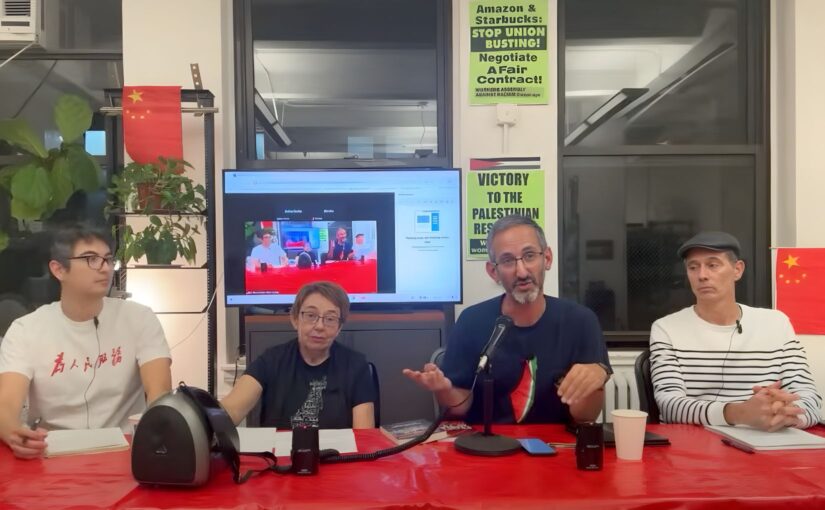
On Saturday 29 June 2024, the International Manifesto Group and Friends of Socialist China co-organised a webinar on the topic Changes unseen in a century – Gaza, the shifting balance of forces and the rise of multipolarity, bringing together leading analysts of global politics to explore the unfolding geopolitical consequences of Zionism’s genocidal assault on the Palestinian people.

The speakers included Seyed Mohammad Marandi (University of Tehran), Lowkey (Political campaigner and hip-hop artist), Ramzy Baroud (Editor, Palestine Chronicle), Faoud Bakr (Democratic Front for the Liberation of Palestine), Sara Flounders (International Action Center) and Bikrum Gill (International relations expert).

Embedded below is the full video of the event, followed by the text of the remarks given by Friends of Socialist China co-editors Carlos Martinez and Keith Bennett.

Carlos Martinez: The heroic Palestinian people are in the vanguard of the struggle for a better world

Thank you very much everyone for joining this webinar today, and thanks especially to the speakers.

The speakers are all a great deal more knowledgeable than I am on the subject matter, so I’m going to keep these introductory remarks brief.

I just wanted to explain a little bit about the theme of the event; the rationale for holding it.

The title references “Changes unseen in a century”, which is an expression that’s often been used by Chinese President Xi Jinping over the course of the last five years to describe the global political shift that’s taking place.

What does “changes unseen in a century” mean? And what were the big changes that happened a century ago?

What happened a century ago, in 1917, is that a revolution took place in Russia, which was the start of humanity’s transition from the era of capitalism to the era of socialism. The October Revolution led to the formation of the Soviet Union, which contributed to the building of socialism in China, Cuba, Korea, Vietnam, Laos, Nicaragua, and the people’s democracies of Eastern Europe.

It also gave an important impetus to the anti-colonial movement and national liberation struggles around the world – in Africa, in Asia, in Latin America, in the Caribbean, in the Pacific.

It was the first major breach in the imperialist world system, and it hastened the demise of colonialism. It changed the world forever.

Of course, a lot has happened in the intervening period, and not all of it good. A lot of countries won their liberation, but the Soviet Union and many other socialist countries don’t exist any more. We’ve witnessed the rise of neoliberalism and neocolonialism. We’ve lived through the supposed “end of history”.

But times are changing once again. These are the changes unseen in a century. The so-called post-war rules-based international order – that is, US hegemony – is breaking down.

The “end of history” narrative isn’t convincing any more.

Neoliberalism has run out of road.

The countries of the Global South are rising. China is stronger than it’s ever been. Iran is stronger than it’s ever been. Several countries of Latin America and the Caribbean have thrown off the neocolonial shackles and are pursuing sovereign development and explicitly aligning themselves with the forces resistance of worldwide.

Africa is recovering from the period of structural adjustment and moving towards unity and development. BRICS is becoming increasingly important – and has overtaken the G7 in population size, economic size, and global influence.

The US and its allies can no longer impose their will on the world.

They pummelled Afghanistan for 20 years and ended up handing it back to the very same forces that they claimed to be going after in the first place.

Continue reading The heroic Palestinian people are helping to bring about the defeat of imperialism

Developed countries must prioritise climate cooperation over China containment

The article below, republished from Global Times, reports on the high number of abnormal weather events this spring and summer, including unusually high temperatures in Northern China, heavy rainfall in Southern China, Hurricane Beryl in the Americas, and a series of droughts, floods and heatwaves elsewhere. “These scenes once again sound the alarm on climate issues for all of humanity.”

The author observes that “people generally hope that governments worldwide can work together to address the frequent occurrences of extreme weather globally”; that is, ordinary people expect their governments to pursue intense cooperation with countries around the world in order to tackle this existential issue. However, in spite of talking a good game on environmental questions, “developed countries such as the US and Europe have failed to fulfill their commitments in actual implementation”. Alarmingly, these issues seem to be increasingly sidelined in the US. The article cites Jeff Goodell, author of the book The Heat Will Kill You First: Life and Death on a Scorched Planet, remarking on the recent presidential debate between Trump and Biden: “More time discussing golf than climate. What a world we are living in.”

Meanwhile, as China races ahead in renewable energy and other green technologies, the US and Europe are imposing tariffs and sanctions on Chinese EVs and solar power materials, the objective of which is to suppress China’s rise.

The author concludes:

Global climate change is a common enemy of all humanity. Countries around the world must work together, share responsibilities and take positive and effective actions. This is not only to protect our planet but also for the well-being of future generations. Only through global cooperation can we make substantial progress in addressing climate change, which especially requires developed countries to broaden their mind and take pragmatic actions.

Abnormal climate and frequent severe weather events have been a common experience for many people this summer. Recently, northern China has experienced prolonged high temperatures, while southern China has been hit by frequent heavy rains. Floods exceeding warning levels have occurred in 98 rivers in the Yangtze River Basin, the Xijiang River in the Pearl River Basin and the Taihu Basin, said the Ministry of Water Resources on June 30. On a global scale, since the beginning of this year, extreme weather events such as heavy rains, floods, heatwaves and droughts have frequently occurred in many places. Hurricane Beryl has intensified into a Category 3 storm and is making landfall in the Americas, while “deadly heatwaves are scorching cities across four continents.” These scenes once again sound the alarm on climate issues for all of humanity.

The latest Global Risks Report released by the World Economic Forum warns that in the next decade, the primary global risk will not be armed conflicts or social division but extreme weather events. For this reason, people generally hope that governments worldwide can work together to address the frequent occurrences of extreme weather globally. A survey report released by the UN Development Programme on June 20 shows that 80 percent of respondents globally hope for a stronger climate action.

Addressing climate change requires the full co-operation of the international community and both developed and developing countries need to fulfill their respective responsibilities and obligations. As early as 1992, the UN Framework Convention on Climate Change enshrined the principles of equity, common but differentiated responsibilities and respective capabilities, recognizing the historical responsibility of developed countries for their emissions. However, developed countries such as the US and Europe have failed to fulfill their commitments in actual implementation despite having shown a positive attitude in international negotiations on global climate governance. This has directly slowed down the process of global green and low-carbon transformation.

As the largest global economy and most advanced developed country, the US plays a crucial role in the process of global climate governance. Especially, the commitments and actions of the US not only set an example for other developed countries but also bring expectations and confidence to the international community as a whole. Unfortunately, the US is the only signatory that has withdrawn from the Paris Agreement to date, showing significant regression in its stance on addressing global climate change, which has severely undermined the confidence in international cooperation on global climate governance. Although the Biden administration announced US’ return to the Paris Agreement in 2021, it is hard to hide the wobbly nature of US climate policy, especially under the highly politicalized landscape of bipartisan competition, where climate issues are not purely scientific topics but highly politicized ones.

It is worth noting that the importance of climate issues ranks far lower on the US political spectrum than economic, diplomatic, or even China-related issues. The recent first televised debate among candidates for the 2024 US presidential election was a prime example. Despite the New York Times emphasizing beforehand that “no election has more potential to affect the planet’s warming climate than the rematch between Joe Biden and Donald Trump,” the two candidates only devoted a very short amount of time to climate issues. Author Jeff Goodell, of the book The Heat Will Kill You First: Life and Death on a Scorched Planet, expressed frustration on social media, perhaps representing the thoughts of most Americans: “More time discussing golf than climate. What a world we are living in.”

As an important player in the global arena, Europe also has room for improvement in its approaches to addressing global climate change. The EU has initiated several anti-subsidy investigations against Chinese new energy companies and recently, the European Commission announced plans to impose tariffs on pure electric vehicles imported from China starting in July. British scholar Martin Jacques recently warned in the Global Times, “What compromise will it finally reach between protecting European carmakers and prioritizing its commitment to decarbonization? Or, to put it another way, what role does it see Chinese EVs playing in Europe’s fight against global warming?” Such reminders not only question European decision-makers but also question Europe’s sincerity and determination in promoting global climate governance.

To push forward global climate governance, China has always been a firm activist. We are not only promoting sustainable development at home but also actively cooperating with all parties, continuously injecting stable momentum into global climate governance. China has exceeded its 2020 climate action targets ahead of schedule and will realize carbon neutrality from carbon peaking in the shortest time in global history. The green and low-carbon transformation that China promotes is not just a transformation at the technological and energy levels but involves the transformation of the entire social system, as well as the economy, culture, finance and other aspects. This is an important strategic decision and action statement made by China in response to global climate change.

Global climate change is a common enemy of all humanity. Countries around the world must work together, share responsibilities and take positive and effective actions. This is not only to protect our planet but also for the well-being of future generations. Only through global cooperation can we make substantial progress in addressing climate change, which especially requires developed countries to broaden their mind and take pragmatic actions.

Silence! On décolonise

We are very pleased that our article. ‘Quiet Please! We’re decolonising’, written by Dr. Sahidi Bilan and Rob Lemkin, which outlines the long history of internationalist support for the revolution in Niger on the part of the People’s Republic of China, has been translated into French and printed in Le Sahel Dimanche, one of the country’s leading newspapers, which is published by the state-owned press agency, Office National d’Édition et de Press (ONEP).

We reprint the French language version, as published by Le Sahel Dimanche, for the benefit of our French-speaking readers.

Lorsque le gouvernement militaire du Niger a expulsé, l’année dernière, les troupes et les diplomates de l’ancienne puissance colonisatrice française, certains Nigériens y ont vu la reprise d’un processus brutalement interrompu en septembre 1958, Il y a de cela soixante-six ans, à la veille de l’indépendance, le premier gouvernement africain du Niger. Le conseil était dirigé par le parti Sawaba (Sawaba signifie « libération » et « bien-être » dans la langue principale du Niger, le haoussa ) et son Premier ministre était un syndicaliste décolonial charismatique appelé Djibo Bakary.

Le renversement du Sawaba par la France en 1958 fut le premier coup d’État moderne en Afrique. En peu de temps, le parti fut proscrit et contraint à la clandestinité ; il a ensuite créé un mouvement de résistance avec le soutien d’États anti-impérialistes africains comme le Ghana et l’Algérie et a développé un important programme de formation à la guérilla avec l’aide du bloc socialiste, notamment de la République populaire de Chine.

‘’Silence ! On décolonise !’’ est le titre du grand livre de Djibo Bakary à la fois autobiographie et manifeste du programme radical de décolonisation dont il était l’un des principaux concepteurs. Nous utilisons son titre pour explorer une meilleure compréhension du coup d’État militaire du 26 juillet 2023 survenu au Niger suivi d’une rupture unilatérale des accords militaires avec la France, puis avec les États-Unis d’Amérique. Il est essentiel de se demander pourquoi aucun coup d’État militaire dans l’histoire post-indépendance du Niger (et il y en a eu huit, dont cinq ont réussi) n’a bénéficié d’un tel soutien populaire que celui du CNSP (Conseil national pour la sauvegarde de la patrie).

Cet article donne d’abord une brève introduction à l’histoire et à la vision du Sawaba pour le Niger ; nous nous concentrons ensuite sur les liens avec la Chine, en particulier sur son rôle et son influence sur la tentative remarquablement ambitieuse mais désastreuse d’envahir le Niger du Sawaba en 1964; nous décrivons ensuite la répression intense qui a suivi et concluons en ramenant l’histoire au présent.

Les questions d’aujourd’hui sont les suivantes : dans quelle mesure les dirigeants actuels du Niger sont-ils conscients du projet décolonial radical de Bakary et du Sawaba ? Les récentes expulsions des forces militaires occidentales font-elles partie d’une véritable politique anti-impérialiste ou sont-elles simplement une mesure populiste du gouvernement militaire ? Les présences militaires américaines et françaises (italiennes et allemandes également) avaient été justifiées par la nécessité de lutter contre l’insurrection. Mais les attaques terroristes se sont multipliées au cours de la dernière décennie. Le gouvernement se tourne désormais vers la Russie et certains partenaires comme la Turquie pour obtenir une assistance militaire.

« J’estime que notre devoir est de dire aux représentants de la France ce que veut et ce que pense l’immense majorité des populations que nous prétendons représenter. Servir la cause du plus grand nombre et non pas nous en servir comme tremplin pour assouvir des ambitions de jouissance et de puissance. Pour cela, il nous faut connaître nos problèmes par nous-mêmes et pour nous-mêmes et avoir la volonté de les résoudre par nos propres moyens d’abord, avec l’aide des autres ensuite, mais toujours en tenant compte de nos réalités africaines (…).

Pour notre part, nous l’avons dit et répété : nous avons été, nous sommes et demeurerons toujours pour et avec le «talaka» (paysan) nigérien »

Djibo Bakary

Éditorial dans le Démocrate du 4 février 1956

De nos jours, l’histoire du Sawaba est peu connue ou peu évoquée au Niger. En fait, ce n’est qu’en 1991, après la fin de la guerre froide, que la liste complète des prisonniers politiques sawabistes morts en détention dans les années 1960 et 1970 a pu être publiée. Selon Mounkaila Sanda, neveu de Djibo Bakary et futur dirigeant du Sawaba, il y a eu depuis longtemps un effort concerté pour effacer de la conscience nationale le souvenir de la lutte du Sawaba ainsi que la répression systématique de ses membres.

Comme c’était différent dans les années 1950 ! Le Sawaba, alors sous son nom d’origine Union Démocratique Nigérienne (UDN), était le principal véhicule de changement anticolonial au Niger. Son fondateur, Djibo Bakary, avait connu son premier éveil politique alors qu’il était écolier dans les rues de la capitale Niamey. Dans son autobiographie de 1992 Silence ! On décolonise, Bakary se souvient qu’il rentrait de l’école primaire en rentrant chez lui et qu’il avait croisé son père alors âgé de près de 60 ans cassant des pierres dans une équipe de réparateurs de routes enrôlés – une partie du système colonial de travail forcé (la corvée) qui restait en vigueur dans les colonies françaises jusqu’après la Seconde Guerre mondiale. Le jeune Bakary était furieux contre un système qui violait les notions communautaires de respect des aînés et de l’autorité traditionnelle (son père, bien que pauvre, était un chef de village local).

Continue reading Silence! On décolonise

China and Vietnam deepen cooperation and enhance political mutual trust

A high-level delegation of the Communist Party of Vietnam (CPV), led by Nguyen Trong Nghia, Politburo member and Secretary of the CPV Central Committee and Chairman of the CPV Central Committee’s Commission for Information and Education, paid a working visit to China from June 11-15, as part of the intensive diplomatic and political exchanges between the two socialist neighbours.

In Beijing, the delegation had meetings with Wang Huning, a member of the Standing Committee of the Political Bureau of the Communist Party of China (CPC) Central Committee and Chairman of the National Committee of the Chinese People’s Political Consultative Conference (CPPCC), and Li Shulei, a member of the Political Bureau of the CPC Central Committee and head of the Publicity Department of the CPC Central Committee.

In his meeting with Wang Huning, Nghia said that Vietnam sincerely appreciates China’s valuable support for its revolution and construction, adheres to the spirit and principle of “comrades-plus-brothers” and “top priority” to advance the relations between the two parties and two countries, and firmly pushes forward the building of a community of shared future that carries strategic significance between Vietnam and China.

Wang said the CPC is ready to foster cooperation and sharing of experience in party building and country management with the CPV, adding it believed that the 14th National Congress of the CPV will be successful.

He held that cooperation between the two parties and the two countries have entered a new stage with a new level defined after the mutual visits by the two parties’ General Secretaries. The development of party-to-party ties will give orientations and be a solid guarantee for the two countries’ cooperation in various fields to grow healthily and sustainably.

Agreeing with Nghia’s opinions about the direction for promoting the two parties and two countries’ cooperation in the coming period, Wang suggested the two sides step up the sharing of experience in theory research and review of experience, properly carry out ideological work and coordinate to build a defence line against sabotage and imperialist plot of peaceful evolution (from socialism to capitalism) and ‘colour revolutions’.

Meeting Li Shulei, Nghia said  Vietnam is willing to strengthen high-level exchanges with China, enhance political mutual trust, deepen cooperation between corresponding government departments, promote publicity related to the Vietnam-China friendship, and promote the continuous development of the relationship between the two parties and two countries, as well as the socialist cause.

Li and Nghia agreed that the two sides also need to work together to effectively manage and control information about complicated and sensitive issues as well as differences so as not to let hostile and reactionary forces take advantage of them to distort or drive a wedge into the relations between the two parties and countries.

Following his meetings in Beijing, Nghia visited the southern Chinese province of Guangdong. He noted that Guangdong always pays attention to preserving the relics and historical sites connected to President Ho Chi Minh and other Vietnamese revolutionaries in the locality, particularly the Vietnamese Revolutionary Youth League relic site and the grave of Martyr Pham Hong Thai.

Nghia paid tribute to Martyr Pham Hong Thai at his tomb and visited the Vietnamese Revolutionary Youth League relic site on June 15.

Pham Hong Thai (1896–1924) was a Vietnamese patriot and a member of Dong Du, an early revolutionary nationalist organisation. He was responsible for the assassination attempt on Martial Merlin, the governor-general of ‘French Indochina’ (Vietnam, Laos and Cambodia), when he was on a visit to Guangzhou, capital of Guangdong province.

Disguised as a journalist at the party given in Merlin’s honour, Pham Hong Thai detonated an explosive device but failed to kill Merlin. Pursued by the authorities, he chose to drown himself in the Pearl River rather than be captured.  He was buried in the Huanghuagang Cemetery in Guangzhou, next to 72 Chinese revolutionaries who fell in the Second Guangzhou Uprising against the Qing dynasty in April 1911.

The following articles were originally published by the Xinhua News Agency and Nhân Dân.

China’s top political advisor meets CPV delegation

BEIJING, June 13 (Xinhua) — China’s top political advisor Wang Huning met with a delegation of the Communist Party of Vietnam (CPV) led by Nguyen Trong Nghia, member of the Political Bureau and secretariat of the CPV Central Committee, as well as head of the CPV Central Committee’s Commission for Information and Education in Beijing on Thursday.

Wang, a member of the Standing Committee of the Political Bureau of the Communist Party of China (CPC) Central Committee and chairman of the National Committee of the Chinese People’s Political Consultative Conference (CPPCC), urged China and Vietnam to adhere to the strategic guidance of the general secretaries of the two parties and promote the building of a China-Vietnam community with a shared future.

He noted that the CPPCC is ready to contribute positively to this end.

Continue reading China and Vietnam deepen cooperation and enhance political mutual trust

EU tariffs on China: a script written in Washington

The following article by Carlos Martinez, first published in the Morning Star, comments on the European Union’s recent decision to impose tariffs of up to 38 percent on Chinese electric vehicles (EVs). The only enthusiastic supporter (and presumably instigator) of these tariffs is the US, which is embarked on an escalating New Cold War against China.

Carlos describes the negative reaction to the tariffs not just in China but within much of the European business community and among environmentalists. Ultimately, aside from likely inspiring reciprocal tariffs from China, the move will have the effect of “making the EU’s transition slower and more expensive” – in the words of a Chatham House article.

Carlos further notes that “imposing tariffs on the basis of Chinese public investment creates a precedent that any such central investment in sustainable development is unacceptable”, and as such, “would render any sort of green new deal out of the question”.

The article concludes: “For the sake of peace, development and the habitability of the planet, Europe must change course.”

Last week the EU notified Beijing that, following a nine-month investigation into alleged unfair state subsidies, it will impose new tariffs of up to 38 per cent on Chinese electric vehicles (EVs).

Given the existing 10 per cent tariff on car imports, this will mean Chinese EVs will be hit with tariffs of up to 48 per cent. These new tariffs are due to kick in on July 4.

Germany, Sweden and Hungary have been vocal in opposing the move, with German Chancellor Olaf Scholz stating the obvious: “Isolation and illegal customs barriers ultimately just makes everything more expensive, and everyone poorer.”

Of course, this reflects the importance of the Chinese market for German car manufacturers, who will be hoping beyond hope that the authorities in Beijing haven’t been studying the Book of Exodus and thus are not minded to apply the principle of “an eye for an eye.”

BMW CEO Oliver Zipse commented: “The decision for additional import duties is the wrong way to go. The EU Commission is thus harming European companies and European interests.”

This sentiment was echoed by a spokesperson for Volkswagen: “The negative effects of this decision outweigh any potential benefits for the European and especially the German automotive industry.”

Indeed there seems to be little enthusiasm for these tariffs anywhere outside the White House. The Bloomberg editorial board argues that “tariffs won’t bring the EU prosperity” and that the increased price of EVs will decelerate Europe’s green transition.

Similarly, an article for Chatham House — titled “Imposing tariffs on Chinese electric vehicles will make the EU’s transition slower and more expensive” — notes that the EU has a legally binding target of reaching net-zero greenhouse gas emissions by 2050.

Meanwhile “decarbonisation technologies like solar panels, wind turbines and electric vehicles share a characteristic that sets them apart from other traded goods: when swapped for fossil fuel alternatives, they reduce the quantity of planet-warming gases being pumped into the atmosphere.” Such technologies “are needed in vast quantities, and in very short order, to give any chance of avoiding the worst impacts of climate change.”

It is noteworthy — and presumably not entirely coincidental — that the EU’s announcement came just a month after the Biden administration announced tariffs on Chinese EVs of 100 per cent.

In the case of the US, the material impact of these tariffs is virtually non-existent, given that Chinese-made models constitute just 2 per cent of all EV sales; and this in a market where EVs only make up 8 per cent of all car registrations (compared with almost 50 per cent in China).

The US tariff increase is simply an attempt by Biden to appear “tough on China” in the run-up to the presidential election. Donald Trump, not to be outdone on such matters, has promised tariffs of 200 per cent. As such, what we’re talking about is yet another component in the US-led new cold war on China, for which there is bipartisan consensus.

So it would appear the EU is acting in accordance with the strong recommendations (instructions) of Washington.

This certainly wouldn’t be the first time Europe has compromised its climate commitments and economic stability in order to participate in the US’s pursuit of 21st century hegemony.

In 2022, in order to punish Russia and to generate profits for the US’s domestic fossil fuel industry, the Biden administration heavily promoted sanctions on Russian natural gas. The result has been a major increase in US exports of fracked shale gas to Europe.

To get this gas from North America to Europe, it has to be liquified, stored at minus 70°C, and transported by ship. This whole process is extremely costly in both financial and ecological terms, certainly much more so than using existing pipelines running from Russia through Europe.

The European working class and progressive movement should oppose these tariffs on Chinese EVs and should resist the ongoing attempts by sections of the bourgeoisie to align Europe with Washington’s reckless foreign policy.

As noted in these pages in August last year, “major problems facing humanity require international co-operation — and China’s leading position in green technology makes co-operation in this field essential.”

China has raced ahead in renewable energy and electric transport because it has identified those sectors as being absolutely crucial for the future of not only China but the world.

As such, it has built environmental considerations into the core of its planning system and has targeted public investment accordingly. Rather than complaining about China’s investment in new productive forces, Europe should be following its example.

Imposing tariffs on the basis of Chinese public investment creates a precedent that any such central investment in sustainable development is unacceptable. This precedent would render any sort of green new deal out of the question.

Even the Economist acknowledges that “the potential gains to the West from a ready supply of cheap, green vehicles are simply enormous.” And, momentarily overcoming its Eurocentric instincts, it admits that Chinese cars “are not only cheap; they are better-quality, particularly with respect to the smart features in EVs that are made possible by internet connectivity.”

The article concludes that “if China wants to spend taxpayers’ money subsidising global consumers and speeding up the energy transition, the best response is to welcome it.”

Inasmuch as there’s such a thing as a sane bourgeois perspective, this is what it looks like.

In the words of former undersecretary-general of the UN and former executive director of the UN Environment Programme Erik Solheim: “China is now the indispensable country for everything green … And all historical experiences show that if you create closed-down markets and separate markets from different parts of the world, we will all be poorer.”

For the sake of peace, development and the habitability of the planet, Europe must change course.

Chinese defence minister holds talks with Mozambican counterpart

Chinese Defence Minister Admiral Dong Jun held talks with his visiting counterpart from Mozambique Cristóvão Artur Chume in Beijing on June 27.

Admiral Dong said that the friendship between China and Mozambique boasts a long history and is growing steadily. Under the strategic guidance of President Xi Jinping and President Filipe Nyusi, the comprehensive strategic cooperative partnership between the two countries has been further deepened.

Minister Chume also affirmed that the friendship between the Mozambican and Chinese militaries has a long history and he thanked China for its long-term valuable support and assistance to Mozambique’s national defence.

The timing of the visit is noteworthy in that Mozambique celebrated its 49th independence anniversary on June 25. China had strongly supported the liberation struggle led by FRELIMO since the 1960s and the two countries established diplomatic relations the same day.

The following article was originally published by China Military.

BEIJING, June 27 — Chinese Defense Minister Admiral Dong Jun held talks with visiting Mozambican Defense Minister Cristóvão Artur Chume in Beijing on Thursday.

Admiral Dong said that the friendship between China and Mozambique boasts a long history and is growing steadily. Under the strategic guidance of President Xi Jinping and President Filipe Nyusi, the comprehensive strategic cooperative partnership between the two countries has been further deepened. In recent years, exchanges between the two militaries have become increasingly close and the cooperation has yielded fruitful results. Deepening mil-to-mil cooperation between the two countries is of strategic significance to achieving common development and maintaining regional stability.

The Chinese defense minister also noted that China attaches great importance to the friendly cooperation with the Mozambican military and is willing to work with the Mozambican side to implement the consensus reached by the two heads of state, strengthen practical cooperation in such fields as stability maintenance and counter-terrorism, maritime security, and personnel training, and constantly push the relations between the two militaries to a new level.

Defense Minister Chume said that Mozambique firmly upholds the one-China principle and firmly supports China in safeguarding its national sovereignty and territorial integrity. The friendship between the Mozambican and Chinese militaries has a long history. He thanked China for its long-term valuable support and assistance to the national defense construction of Mozambique. He hoped that the two sides will continue to strengthen friendly exchanges and create new highlights of cooperation.

Prior to the talks, Admiral Dong held a welcome ceremony for Defense Minister Chume and accompanied him to review the Guard of Honor of the Chinese People’s Liberation Army.

Xi Jinping: China and Vietnam demonstrate the strengths of socialism

As a highpoint in the continued development of close cooperative and comradely relations between China and Vietnam, Vietnamese Prime Minister Pham Minh Chinh paid a working visit to China, June 24-27, at the invitation of his Chinese counterpart, Premier Li Qiang.

The main purpose of Chinh’s latest visit, his third working visit to China in the space of a year, was to attend the 15th Annual Meeting of the World Economic Forum (WEF), popularly known as the ‘Summer Davos’, held in Dalian, in China’s north-east Liaoning province.  He was one of just two heads of state or government invited to attend, the other being President Andrzej Duda of Poland.

On June 26, having concluded his program in Dalian, Chinh met with Chinese President Xi Jinping in Beijing.

Xi asked Chinh to convey his cordial greetings to Nguyen Phu Trong, General Secretary of the Communist Party of Vietnam Central Committee, and to Vietnamese President To Lam. He said that during his visit to Vietnam at the end of last year, he and Trong had announced the building of a China-Vietnam community with a shared future that carries strategic significance, ushering bilateral relations into a new stage. Over the past half a year, the two parties and the two countries have enjoyed close exchanges among high-ranking officials and smooth cooperation in various fields, bringing tangible benefits to the two peoples, he added.

Noting that the world today is going through changes unseen in a century, Xi said both China and Vietnam have maintained rapid economic development and long-term social stability, demonstrating the strengths of the socialist system. The building of a China-Vietnam community with a shared future that carries strategic significance is in line with the modernisation needs of the two countries and is conducive to maintaining regional peace and stability and to promoting the development of the global socialist cause. China is willing to work with Vietnam to maintain solidarity and friendship, consolidate mutual support, and deepen mutually beneficial cooperation, Xi said, adding that China also stands ready to join hands with Vietnam to march toward modernisation and make greater contributions to world peace, stability, development and prosperity.

Chinh conveyed cordial greetings from General Secretary Nguyen Phu Trong and President To Lam to Xi. He said that Vietnam and China, both as socialist countries led by the communist party, have a tradition of good-neighbourliness and friendship. Vietnam hopes to learn from China’s new theories, practices and achievements in party and state governance, and to stick to the path of socialism along with China to achieve common development.

Noting that Vietnam supports China’s position on the Taiwan question and firmly adheres to the one-China principle, Chinh said that it is the top priority and strategic choice of Vietnam’s foreign policy, which will not be disrupted by external interference, to deepen strategic mutual trust and pragmatic cooperation with China and build a Vietnam-China community with a shared future that carries strategic significance.

On the same day, Chinh also met with Wang Huning, a member of the Standing Committee of the Communist Party of China (CPC) Central Committee’s Political Bureau and Chairman of the Chinese People’s Political Consultative Conference (CPPCC) National Committee.

Chinh stated that Vietnam and China are close neighbours bound by shared mountains and rivers as well as many similarities in political systems, development paths, and socio-cultural characteristics. The Vietnamese party, state, and people always remember the significant and valuable support of their Chinese counterparts during Vietnam’s past struggle for independence and current process of national construction and development.

He affirmed that strengthening and fostering the traditional friendship and comprehensive cooperation with China is an objective requirement, a strategic choice, and a top priority in Vietnam’s foreign policy of independence, self-reliance, and diversification of relations.

Concurring with Chinh’s views on the relationship between the two parties and countries, Wang stated that China always prioritises its relationship with Vietnam in its neighbourhood diplomacy, and consistently supports it in advancing its Doi Moi (renewal) policy under the leadership of the Communist Party of Vietnam toward industrialisation, modernisation, and increasing prestige and heightened position on the international stage. Lauding Vietnam’s significant theoretical achievements, he noted the need for both sides to enhance theoretical exchanges, thereby making contributions to the cause of building socialism in their respective countries.

Vietnamese Foreign Minister Bui Thanh Son, as a member of Chinh’s delegation, met separately with his Chinese counterpart Wang Yi on June 26. 

Wang, also a member of the Political Bureau of the CPC Central Committee, said that the close high-level exchanges between China and Vietnam fully demonstrate the special friendship between the two parties and countries, as well as the high level of their mutual trust and cooperation.

Son said that Vietnam is willing to work with China to strengthen exchanges at all levels and cooperation in various fields, and jointly advance the cause of socialist construction, adding that Vietnam is willing to actively participate in a series of global initiatives proposed by China.

The following articles were originally published by the Xinhua News Agency and Nhân Dân.

Xi meets Vietnamese PM

BEIJING, June 26 (Xinhua) — Chinese President Xi Jinping met with Prime Minister of Vietnam Pham Minh Chinh in Beijing on Wednesday. Chinh is in China to attend the 2024 Summer Davos.

Xi asked Chinh to convey his cordial greetings to Nguyen Phu Trong, general secretary of the Communist Party of Vietnam Central Committee, and to Vietnamese President To Lam.

Xi said that during his visit to Vietnam at the end of last year, he and Trong announced the building of a China-Vietnam community with a shared future that carries strategic significance, ushering bilateral relations into a new stage.

Over the past half a year, the two parties and the two countries have enjoyed close exchanges among high-ranking officials and smooth cooperation in various fields, bringing tangible benefits to the two peoples, he said.

Continue reading Xi Jinping: China and Vietnam demonstrate the strengths of socialism

Xi Jinping: Five Principles of Peaceful Coexistence a groundbreaking achievement in the history of international relations

A conference marking the 70th anniversary of the Five Principles of Peaceful Coexistence, a cornerstone of Chinese foreign policy, was held in Beijing on June 28. With guests from around the world, including former political leaders from some 20 countries, President Xi Jinping made an important speech, and the event was moderated by Premier Li Qiang.

In his speech, President Xi said that the five principles, “marked a groundbreaking and epoch-making achievement in the history of international relations.”

He noted:

“The Five Principles of Peaceful Coexistence answered the call of the times, and its initiation was an inevitable historic development. In the wake of the Second World War, national independence and liberation movements swept across the globe, and the colonial system around the world crumbled and collapsed. At the same time, the world was overshadowed by the dark clouds of the Cold War.”

Meanwhile, newly independent countries aspired to safeguard their sovereignty and grow their national economy. New China followed the principle of independence, actively sought peaceful coexistence with all countries, and endeavoured to improve its external environment, especially in its neighbourhood.

Having been endorsed in joint statements with India and Myanmar, in 1955, “more than 20 Asian and African countries attended the Bandung Conference. They proposed ten principles for handling state-to-state relations on the basis of the Five Principles, and advocated the Bandung spirit of solidarity, friendship and cooperation. The Non-Aligned Movement that rose in the 1960s adopted the Five Principles as its guiding principles. The Declaration on Principles of International Law adopted at the 25th Session of the United Nations General Assembly (UNGA) in 1970 and the Declaration on the Establishment of the New International Economic Order adopted at the Sixth Special UNGA Session in 1974 both endorsed the Five Principles.”

Xi Jinping went on to note that:

  • The principles fully conform with the purposes and principles of the UN Charter, with the evolving trend of international relations of our times, and with the fundamental interests of all nations.
  • When following the Five Principles, even countries that differ from each other in social system, ideology, history, culture, faith, development stage, and size can build a relationship of mutual trust, friendship and cooperation.
  • Inspired and encouraged by the Five Principles, more and more countries in Asia, Africa and Latin America have voiced and extended support to each other, stood up against foreign interference, and embarked on an independent path of development. The Five Principles have also boosted South-South cooperation and improved and further developed North-South relations.
  • The Five Principles were initiated with the purpose of protecting the interests and pursuits of small and weak countries from power politics. They categorically oppose imperialism, colonialism and hegemonism, and reject belligerent and bullying practices of the law of the jungle.

Seventy years ago, the Chinese leader continued, “our forefathers, who experienced the scourge of hot wars and the confrontation of the Cold War, concluded that the Five Principles of Peaceful Coexistence were the crucial way to safeguard peace and sovereignty. This answer has withstood the test of international vicissitudes and has become more appealing rather than obsolete. Seventy years later today, challenged by the historic question of ‘what kind of world to build and how to build it,’ China has answered the call of the times by proposing a community with a shared future for humanity.”

Xi went on to say that both the five principles and the concept of a community with a shared future for humanity “demonstrate the broad vision of the Communist Party of China to contribute more to humanity.”

“Looking at the past and future at this critical moment in history, we believe our exploration for the betterment of human civilisation will not end, and our efforts for a better world will not end. No matter how the world evolves, one basic fact will not change. There is only one Planet Earth in the universe, and the whole humanity have one common home.”

On this basis, Xi set out a number of imperatives:

  • We need to uphold the principle of sovereign equality.

The five principles reject the big subduing the small, the strong bullying the weak, and the rich exploiting the poor.

  • We need to cement the foundation of mutual respect.

We must jointly uphold the “golden rule” of non-interference, and jointly oppose acts of imposing one’s will on others, stoking bloc confrontation, creating small circles, and forcing others to pick sides.

  • We need to turn the vision for peace and security into reality.

All countries must work together to seek peace, safeguard peace, and enjoy peace. In today’s interdependent world, absolute security and exclusive security are just not viable.

  • We need to unite all forces to achieve prosperity.

Here Xi invokes a Latin American proverb: “The only way to be profitably national is to be generously universal.”

  • We need to commit to fairness and justice.

China believes in true multilateralism. Our goal is that international rules should be made and observed by all countries. World affairs should be handled through extensive consultation, not dictated by those with more muscles.

  • We need to embrace an open and inclusive mindset.

All countries are on board the same giant ship. It carries on it not only aspirations for peace, economic prosperity and technological advancement, but also the diversity of civilisations and the continuation of the human species.

Whilst the Five Principles are intended to address the full spectrum of international relations, Xi emphasised that:

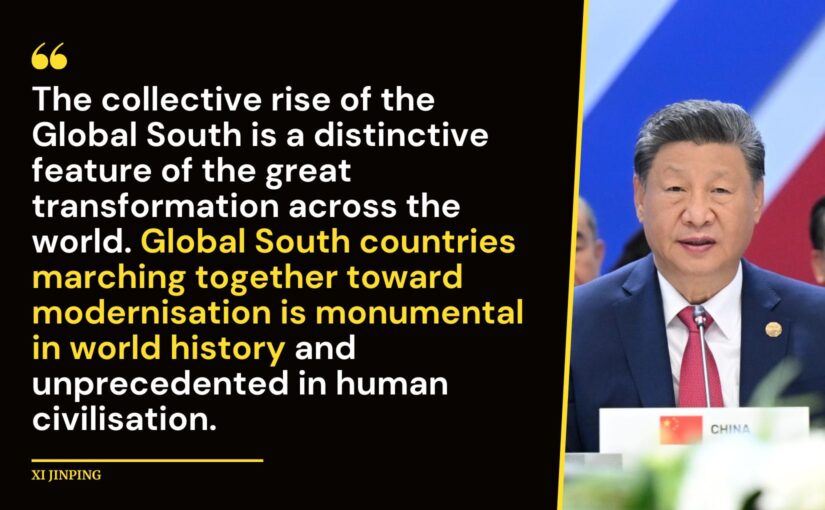
“Of all the forces in the world, the Global South stands out with a strong momentum, playing a vital role in promoting human progress. Standing at a new historical starting point, the Global South should be more open and more inclusive and join hands together to take the lead in building a community with a shared future for humanity.”

Addressing the Global South, he made the following calls:

  • Together, we should be the staunch force for peace.
  • Together, we should be the core driving force for open development.
  • Together, we should be the construction team of global governance.
  • Together, we should be the advocates for exchange among civilisations.

He continued by outlining a series of concrete measures that China will take to better support Global South cooperation.

Noting that, “the Five Principles of Peaceful Coexistence has been written into China’s Constitution long before,” Xi said that:

“China’s resolve to stay on the path of peaceful development will not change. We will never take the trodden path of colonial plundering, or the wrong path of seeking hegemony when one becomes strong. We will stay on the right path of peaceful development. Among the world’s major countries, China has the best track record with respect to peace and security. It has been exploring for a distinctly Chinese approach to resolving hotspot issues. It has been playing a constructive role in the Ukraine crisis, the Palestinian-Israeli conflict, and issues relating to the Korean peninsula, Iran, Myanmar, and Afghanistan. Every increase of China’s strength is an increase of the prospects of world peace.”

The conference also adopted a Beijing Declaration, summarising key viewpoints of the participants.

We reprint below the full text of President Xi Jinping’s speech and of the Beijing Declaration. They were originally published on the website of the Chinese Foreign Ministry.

Continue reading Xi Jinping: Five Principles of Peaceful Coexistence a groundbreaking achievement in the history of international relations

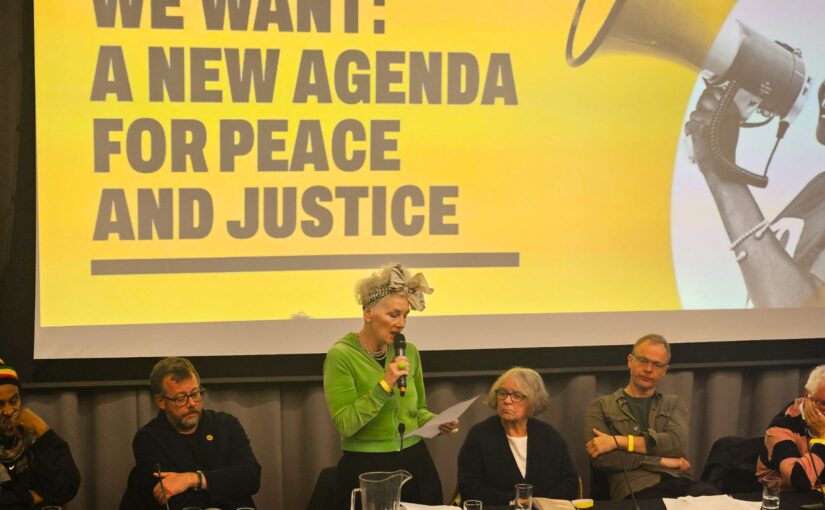
Webinar: Changes unseen in a century – Gaza, the shifting balance of forces and the rise of multipolarity

Friends of Socialist China is pleased to be co-organising (with the International Manifesto Group) this webinar on Saturday 29 June 2024, which will bring together leading analysts of global politics to explore the unfolding geopolitical consequences of Zionism’s genocidal assault on the Palestinian people.

Date: Saturday 29 June 2024

Time: 11am US Eastern / 8am US Pacific / 4pm London / 11pm Beijing

Panelists

  • Seyed Mohammad Marandi (University of Tehran)
  • Lowkey (Political campaigner and hip-hop artist)
  • Ramzy Baroud (Editor, Palestine Chronicle)
  • Faoud Bakr (Democratic Front for the Liberation of Palestine)
  • Sara Flounders (International Action Center)
  • Camila Escalante (Kawsachun News)
  • Bikrum Gill (International relations expert)
  • Keith Bennett (Friends of Socialist China, International Manifesto Group)
  • Moderator: Carlos Martinez (Friends of Socialist China, International Manifesto Group)

Details

This webinar will bring together leading analysts of global politics to explore the unfolding geopolitical consequences of Zionism’s genocidal assault on the Palestinian people. Following on from the Ukraine crisis of recent years, the hypocrisy and blatant double standards of the major western powers have united the countries and peoples of the Global South to an unprecedented degree, and on both the diplomatic and mass popular level, rendering US imperialism and its Zionist shock troops increasingly isolated, as significant European powers at last recognise a Palestinian state, people from all walks of life mobilise, and young people in the imperialist heartlands start to be drawn into struggle in a way not seen since the Vietnam War. Together, the global majority are starting to drive changes unseen in a century. The webinar will examine such key topics as the relationship between the Palestinian people’s struggle and the overall multipolar process; the importance of Israel to the perpetuation of the US-led world order; and the potential for China and Russia to play a leading role in bringing about a lasting and just resolution to the Palestinian question.

Xi Jinping, Nicolás Maduro exchange congratulations on 50th anniversary of ties

Chinese President Xi Jinping and his Venezuelan counterpart Nicolás Maduro exchanged congratulations on June 28, marking 50 years since the establishment of their bilateral diplomatic relations.

Noting that China and Venezuela are good partners of mutual trust and common development, Xi said that since the establishment of diplomatic ties half a century ago, the two sides have supported each other in the changing international landscape, worked together to defend international fairness and justice as well as the legitimate rights and interests of developing countries, and forged an “iron-clad” friendship.

For his part, President Maduro said that Venezuela firmly supports China in safeguarding national sovereignty and opposes any attempt to contain China. He added that Venezuela firmly believes that under the wise leadership of Xi, the great rejuvenation of the Chinese nation will surely be achieved.

The following article was originally published by the Xinhua News Agency.

BEIJING, June 28 (Xinhua) — Chinese President Xi Jinping and Venezuelan President Nicolas Maduro on Friday exchanged congratulations on the 50th anniversary of the establishment of diplomatic ties between the two countries.

Noting that China and Venezuela are good partners of mutual trust and common development, Xi said that since the establishment of diplomatic ties half a century ago, the two sides have supported each other in the changing international landscape, worked together to defend international fairness and justice as well as the legitimate rights and interests of developing countries, and forged an “iron-clad” friendship.

Xi noted that during President Maduro’s successful state visit to China last September, they jointly announced the elevation of the China-Venezuela relationship to an all-weather strategic partnership, ushering bilateral relations into a new era.

China is ready to work with Venezuela to uphold the original aspiration of establishing diplomatic ties, continue the traditional friendship, and take the 50th anniversary of diplomatic ties as a new starting point, to continuously enrich the connotation of the China-Venezuela all-weather strategic partnership, make a greater contribution to world peace and development, and jointly promote the building of a community with a shared future for mankind, Xi said.

For his part, Maduro said since the establishment of diplomatic relations between Venezuela and China 50 years ago, bilateral ties have made considerable progress, adding in particular, the establishment of an all-weather strategic partnership between Venezuela and China is of historic significance.

Venezuela firmly supports China in safeguarding national sovereignty, opposes any attempt to contain China, and is willing to actively participate in the implementation of the Belt and Road cooperation and the three major global initiatives proposed by President Xi, continue to firmly promote Venezuela-China friendship and deepen bilateral cooperation and multilateral coordination, he noted.

He added that Venezuela firmly believes that under the wise leadership of Xi, China will surely achieve the great rejuvenation of the Chinese nation. 

Antiguan PM: China-Antigua relationship is one of the closest in the world between a big and a small country

Gaston Browne, the Prime Minister of Antigua and Barbuda, a small island state in the Eastern Caribbean, paid an official visit to China from January 22-28, becoming the first leader from the region to visit China in 2024.

During his visit he was interviewed by Wang Guan for the CGTN series Leaders Talk. 

Prime Minister Browne noted how small island states are extremely vulnerable in today’s world, citing as contributory factors, climate shocks, the COVID pandemic, the impact of conflicts and wars, limited resource endowments and the debt burden.

He sees the relationship with China as crucial to Antigua’s ability to meet these challenges. His country was one of the earliest in the Eastern Caribbean region to establish diplomatic relations with the People’s Republic, 41 years ago. 

Today he says that their bilateral relationship is one of the closest in the world between a big and a small country. Antigua has a population of less than 100,000. 

China’s contribution to global peace and prosperity, the Prime Minister says, is unmatched. He sees it as being driven by President Xi Jinping’s philosophy and noble vision of a shared future for all. He describes President Xi as easily the most powerful and respected leader on the planet. Antigua and Barbuda is a beneficiary of China’s benevolence in many aspects of its development, not least in poverty alleviation.

In 2018, Antigua became the first country in the Eastern Caribbean to sign up to the Belt and Road Initiative (BRI). This has had a beneficial impact on many aspects of the country’s development, for example in the renovation and extension of the port in the capital, St. John’s. Funding for this could not be obtained from the World Bank or the IMF and Browne categorically rejects any suggestion of a Chinese ‘debt trap’. Rather, he views China as the most benevolent country on the planet, adding that this and other projects could not have been accomplished without its concessional loans and aid.

Another example he cites is that of agricultural cooperation. This is aimed at taking steps towards food security. At present, some 80% of the food consumed in Antigua is imported, mostly from the United States, with contributory factors being the lack of a sufficient labour force and the exacerbation of the county’s natural aridity due to the impact of climate change. China’s assistance in modernising and replacing the country’s water supply infrastructure is playing a key role here.

With regard to Taiwan,  Browne says that his country is a consistent supporter of the one-China principle. This will not change under his leadership or that of the Antigua and Barbuda Labour Party, which he leads.

The full interview with Prime Minister Gaston Browne is embedded below.

Witnessing Xizang: Serfdom to socialism with Chinese characteristics

The following article by Arnold August, originally published on CGTN, details Arnold’s 2023 tour of Xizang/Tibet, and contrasts the situation today – with extreme poverty having been eliminated and cutting edge infrastructure helping to solve some of the development problems presented by the province’s vast and rugged terrain – with that prevailing under the serf system in place until the late 1950s.

Arnold writes: “Under the thumb of a feudal theocracy, about 5 percent of the population of Xizang were serf-owners, while at least 95 percent were serfs. I can never forget the images of a grandmother, mother and small child who were born in the cowshed of a serf-owner, where they lived. This was the fourth generation to endure these conditions.”

Not everybody was happy with the dismantling of serfdom and the liberation of the masses. Some “opposed democratic reforms and, on March 10, 1959, along with the Dalai Lama, organised a US-led armed revolt. The insurrection was ultimately defeated, causing the Dalai Lama and his close followers to retreat to India.”

Such are the roots of the so-called Free Tibet movement, backed to the hilt (always with money and propaganda support, and at times with weapons) by the CIA. This is a movement for freedom of the oppressors and for the destabilisation and undermining of People’s China.

Arnold August is the author of five books on international issues and is on the editorial board of the International Manifesto Group.

Some argue that 73 years ago today, in 1951, Xizang experienced a historic leap in its social system with its peaceful liberation. But is the term “historic leap” an exaggeration? To address this, we need to consider the conditions from which Xizang emerged.

As a participant in a tour of Xizang in 2023, I had access to Xizang’s historical film footage. The evidence, based on video and still photographs, captures the reality of ancient Xizang’s serfdom before 1951. The scenes, narratives and interviews then fast-forward through the years leading to 1959 to 1960, when democratic reforms began in earnest. During the tour, these visuals were supplemented by on-the-spot discussions with people in Xizang, who provided additional information and figures.

What are the facts? Consider a stark reality typical of the centuries before that watershed year of 1951, when, under the thumb of a feudal theocracy, about 5 percent of the population of Xizang were serf-owners, while at least 95 percent were serfs. I can never forget the images of a grandmother, mother and small child who were born in the cowshed of a serf-owner, where they lived. This was the fourth generation to endure these conditions.

Many commentators focus on the post-1959 reforms, but other data are crucial. From 1950, even before the formal declaration of peaceful liberation in 1951, the People’s Liberation Army (PLA) was building infrastructure. Most notably, the 1,947-kilometer highway between Xining, the capital of neighboring Qinghai Province, and Lhasa, was completed in 1954, replacing travel by foot or yak. By April 1956, a total of 4,300-km railway lines had been built.

So instead of a three-hour flight from Xining to Lhasa, our hosts planned a train trip for our 2023 tour. The 22-hour journey across the Qinghai-Tibet Plateau allowed us to see firsthand how the vast, rugged, high-altitude, cold region is one of the enormous challenges to Xizang’s modernization.

Despite such achievements as the rapid development of transportation infrastructure and the abolition of serfdom on March 28, 1959, some in the Xizang’s ruling circles saw the writing on the wall and resisted change in order to maintain the serf system. They opposed democratic reforms and, on March 10, 1959, along with the Dalai Lama, organized a U.S.-led armed revolt. The insurrection was ultimately defeated, causing the Dalai Lama and his close followers to retreat to India.

While they abandoned the ship, China nevertheless surged forward. According to local people, the government involved close to 10 activist/advisors-committees by sending them to the grassroots more than 190,000 times. This took place from 2012 to 2020. Their task: flesh out the plan to eradicate extreme poverty. This goal was achieved in 2020, a marvel for Xizang.

The fundamental reasons for the “historic leap” in Xizang’s social system, which I believe to be true based on facts, may challenge the preconceived notions held by much of the West. China’s development since October 1, 1949, shows that, despite inevitable twists and turns, the government, together with the people at the grassroots, is fully committed to modernizing the country.

In the process, they are developing a new kind of socialism that is in line with China’s realities, reflects the will of the Chinese people, and meets the requirements of the times. From this altruistic perspective, it was only natural that Xizang should receive the same benefits. Why? Because historically, Xizang has always been part of China and has been under China’s administrative rule for nearly a thousand years.

The Lhasa high-tech zone innovation and entrepreneurship service platform is an excellent model of “socialism with Chinese characteristics.” This term, in the Chinese context, refers to the ongoing efforts of socialist nations to effectively balance the needs of the individual with those of the collective. As for the high-tech institute, our hosts explained that all the students require is to bring their computer and their ideas. Then, free of charge, the students are connected to the most advanced facilities to realize their concepts.

We were also given a brief introduction to their Chinese-English bilingual website. After the tour, I continued to explore the website. I learned that the requirements for admission to the program include adherence to the Constitution of the People’s Republic of China and support for the leadership of the CPC and the socialist system. Although membership in the CPC is not required for acceptance into the program, individuals who have been expelled from the CPC are not accepted.

Do these requirements conflict with individual initiative? To Westerners blinded by U.S.-centered prejudices against socialism, they may seem contradictory. But for the Chinese, these imperatives are normal because socialism with Chinese characteristics is deeply embedded in their values. This is not just a top-down approach; as seen in the high-tech center, everyone is part of the process.

Class character of People’s China: interview with research economist

The following text is the English translation of an interview with Rémy Herrera, a research analyst at the National Center for Scientific Research (CNRS) at the Sorbonne in Paris. The interview was first published in the magazine Harici (Istanbul, Türkiye), and the newspaper Cumhuriyet (Istanbul) in May 2024. The original French has been translated by John Catalinotto for Workers World.

Herrera, who has co-authored a book by Long Zhiming called Dynamics of China’s Economy: Growth, Cycles and Crises from 1949 to the Present Day, makes several important points about the nature, history and trajectory of China’s socialist market economy. First, contrary to Western neoclassical economists who see China’s emergence as a function exclusively of its adoption of market mechanisms and its integration into the global capitalist economy, Herrera argues that “accelerated growth was made possible only by the efforts and achievements of the Maoist period.” When opening up was introduced, it was “firmly and continuously controlled by the Chinese authorities, and it is under this condition that it can be considered as having contributed to the country’s indisputable economic successes”.

China has engaged with the process of globalisation, but the crucial condition for the success of this experiment has been subjecting it “to the constraints of satisfying internal objectives and domestic needs, … fully integrated within a coherent development strategy”. Engaging with the global economy is not by itself a solution to all problems; after all, “for more than a century before the victory of the Revolution in October 1949, ‘opening up’ had meant above all submission, devastation, exploitation, humiliation, decadence and chaos for the Chinese people”.

Herrera also discusses the nature of China’s state-owned enterprises (SOEs). These “are not managed in the same way as Western transnational corporations”; their primary goal is not the pursuit of shareholder profit at all costs. Rather, they are duty bound “to stimulate the rest of the domestic economy, and go beyond a vision of immediate profitability when higher strategic, long-term or national interests so dictate”.

On the underlying socialist basis of China’s economic system, Herrera makes the fundamental point that, in China, “the state controls capitalism, not the other way around”. For example, China’s authorities have “successfully confronted the power of the financial markets”, building a “great monetary wall” to defend the national currency. “Powerful strategic planning, whose techniques have been relaxed, modernized and adapted to today’s requirements — which is what makes it so effective — is a distinctive feature of a socialist approach. State control of the currency and all the major banks is an absolute requirement, as is close monitoring of the activities of financial institutions and the behavior of foreign firms operating on national territory.”

He continues:

The coexistence of public and private activities, stimulated by each other within a mixed, hybrid system, is the means chosen to develop the country’s productive forces to the maximum − including by attracting foreign capital and importing advanced technologies − and thus raising its level of development, with the stated aim of improving the population’s living conditions, and doing this not by abandoning socialism, but by deepening the socialist transition process that began in 1949.

Herrera also addresses the ongoing crisis of neoliberalism and its manifestation in an increasingly aggressive New Cold War on China. “All the conditions are in place for the system’s contradictions to become even more pronounced, especially as few reforms have been carried out since the 2008 crisis”. All progressive and peace-loving forces must unite in opposition to the US and its allies’ escalations. “The defence of peace is the priority”.

Q: Let’s begin with your books on China. Based on your research and observations during your visits to China, how do you interpret the Chinese miracle that everyone is discussing?

RH: Many commentators on the very high rate of growth in China’s gross domestic product (GDP), which has been observed for several decades now, use the term “miracle” to describe this phenomenon. I, for one, believe that this is no miracle, but rather the result of a development strategy that has been patiently conceived and effectively implemented by the country’s leaders and senior officials in successive governments, under the authority of the Communist Party.

We read and hear everywhere, in academic circles and the mainstream media, that the “take-off” of the Chinese economy is due solely to its “openness” to globalization. In my view, it’s necessary to add that such accelerated growth was made possible only by the efforts and achievements of the Maoist period. This opening up was firmly and continuously controlled by the Chinese authorities, and it is under this condition that it can be considered as having contributed to the country’s indisputable economic successes. It is because it has been subject to the constraints of satisfying internal objectives and domestic needs, and fully integrated within a coherent development strategy, that this opening up to globalization has been able to produce such positive long-term effects for China.

Let’s be clear: without the elaboration of such a development strategy, which is clearly the work of the Chinese Communist Party — let’s not forget that — and without the energy deployed by the Chinese people to implement it during the revolutionary process, the country’s insertion into the capitalist world system would inevitably have led to the destructuring of the national economy, or even its destruction altogether, as is happening in so many other countries in the South, or in the East. One fundamental point must be borne in mind: for more than a century before the victory of the Revolution in October 1949, “opening up” had meant above all submission, devastation, exploitation, humiliation, decadence and chaos for the Chinese people.

Q: How does China’s success differ from Western development models?

RH: The success of the Chinese government’s development strategy and the many benefits it has brought to the country’s people contrast sharply with the failure of neoliberal economic policy measures applied in Western countries, which have had catastrophic consequences for workers in the North, whether in economic, social, or even moral and cultural terms.

Let me give you a specific example. One explanation for the strength of Chinese state-owned enterprises (SOEs) is that they are not managed in the same way as Western transnational corporations. The Western ones — listed on the stock exchange and oriented towards the logic of shareholder value which demands the maximization of dividends paid to their private owners, shareholder value and rapid returns on investment — operate by squeezing a chain of subcontractors, whether local or relocated abroad. Chinese state-owned groups don’t behave like this. If they were to behave in such a rapacious manner, they would be acting to the detriment of local small and medium-sized enterprises and, more broadly, of the entire national industrial fabric. But this is clearly not the case. 

Most of China’s large state-owned enterprises are (or have become) profitable again because their guiding compass is not the enrichment of private shareholders, but the priority given to productive investment and customer service. In the final analysis, it doesn’t matter if their profits turn out to be lower than those of their Western competitors as long as they serve, at least in part, to stimulate the rest of the domestic economy, and go beyond a vision of immediate profitability when higher strategic, long-term or national interests so dictate.

Q: Can this model be defined in terms of the neo-classical or neo-Marxist model?

RH: First of all, I don’t think the Chinese see their development strategy as a “model.” Nor do they seek to impose or export it. They simply believe that certain lessons can be learned by the peoples of the world, but that it is up to them to define the objectives and means of their own development in their own specific historical, social and cultural conditions. This also differs markedly from the Western vision, which would like its “model” to be followed by every country in the world.

Neoclassical models have no application in China. If you’ll allow me, I’d like to add that neoclassical economics, which today constitutes the hegemonic or mainstream current in economics, basically serves no other purpose than to attempt to provide a theoretical and supposedly scientific justification for neoliberal political practices whose ideology is situated at the opposite end of the spectrum from measures for social justice and the development of public services. In reality, neoclassical economics is not a science, but science fiction or, as I put it in a recent book (“Confronting Mainstream Economics for Overcoming Capitalism,” Palgrave Macmillan), an ideology with scientific pretensions.

I am convinced, on the other hand, that Marxism has not yet been scientifically overtaken. Today, it has no serious competitor. It remains relevant, not least because we still live in a world where the capitalist system remains dominant on a global scale, even if its changes have been substantial, and need to be carefully accounted for. Despite the many attacks on Marxism since its foundation, and the repeated announcements of its death, it is enduring, resilient, “indestructible” dare I say, and the indispensable theoretical benchmark for anyone thinking about the ways and conditions of a better world. 

Despite the demise of the USSR and the Soviet bloc, within which it had all too often become dogmatized and sometimes turned against itself, Marxism remains indispensable today, an irreplaceable point of reference for those fighting for socialism. So it’s hardly surprising that it is still an important theoretical reference for China. 

Continue reading Class character of People’s China: interview with research economist

China’s movement to end poverty

We are pleased to reproduce this detailed and useful analysis by the US-based University of the Poor of China’s long war on poverty.

The article makes the important point that poverty alleviation did not start with the targeted program from 2013 onwards, but is in fact core to the whole Chinese revolutionary project, starting with the liberated territories in the 1930s and 40s, continuing with socialist construction in the 1950s and 60s, and expanding again with the Reform and Opening Up process from 1978.

The targeted program, initiated by Xi Jinping in 2013, “set and achieved the goal of lifting all 98.99 million out of poverty before the end of 2020.” This was achieved through the most incredible mobilisation: “approximately 10 million cadres participated for periods of one to three years, often living in very harsh conditions”. In addition to ensuring a minimum income, the program made sure that people had secure access to food, clothing, safe housing, clean water, electricity, and health and education services.

To guarantee this baseline living standard in a developing country of 1.4 billion people is an astonishing achievement, made possible to a large degree by China’s political system – in particular the leadership of the CPC – which “enables the state apparatus to be wielded for strategic organizing campaigns like the campaign to eradicate extreme poverty and also the current Common Prosperity campaign”. It’s a state apparatus “that can meet the needs of a huge diversity of people, with a particular focus on the poor”.

The article also includes an interesting section on housing, comparing the policies of the US and Chinese governments. “In 2008, the US government responded to the housing crisis largely by bailing out the large banks that had created the problem.” Meanwhile in China, “the government has intervened in the housing market to curb speculation, moderate growth, and avoid a housing crash”.

During his 2017 CPC National Congress address, Xi Jinping declared, “Housing is for living in, not for speculation.” This principle has been the guide for PRC policy which has since served to rein in speculation and investor profiteering in the housing sector, which is fundamentally for providing housing.

The authors make clear that the working class and progressive forces in the US should under no circumstances support the US ruling class’s escalating New Cold War on China. After all, this is the same US ruling class “whose violence and threat of violence is our fundamental obstacle in our pursuit of power for poor people”. Ultimately, “the scapegoating and propaganda on China from our ruling class is a clear divide and conquer strategy for keeping the global poor and dispossessed disorganized”.

Rather than participating in an attack on China, or swallowing anti-China propaganda, “our movement to end poverty in the US can draw inspiration and many lessons from this campaign in China.”

As we build the movement to end poverty in the United States, this example in China can help to illustrate what is concretely possible when state power is taken, held and wielded by the poor and dispossessed. This campaign that centered the revolutionary social force was both made possible and developed by party cadre 100 years after the founding of the CPC. The power of this example and the other policies focused on the poor of China also shed light on what is at stake for the ruling class in the US State’s “strategic competition” with China. We anticipate redbaiting and misinformation around China will escalate as our crises deepen in the US, so our cadre must understand anti-China propaganda as a “divide and conquer” tactic of our ruling class.

Introduction

The UPoor Think Tank’s China Task Force was established to study the Chinese revolutionary process to identify lessons for our struggle. Many things about the Chinese situation are extremely different from our context in the US, but we can draw lessons from their cadres’ use of strategy and tactics. China’s revolutionary process is at a very different stage from our own, and it started from a very different material situation than what we are experiencing in the United States. At the same time, the Chinese Communist Party (CPC) is in escalating conflict with the same US State, which is the primary state power wielded in service of the global capitalist class. This is also the same US State whose violence and threat of violence is our fundamental obstacle in our pursuit of power for poor people.

The Reform and Opening Period initiated by Deng Xiaoping in 1978 focused on using foreign direct investment to develop the forces of production in China. This helped to grow and develop the Chinese economy and raised 770 million rural residents out of extreme poverty. This also increased income and wealth inequality in China. When Xi Jinping, the current general secretary of the CPC and President of the People’s Republic of China (PRC) came into office in 2012, there were still 98.99 million people living in absolute poverty in China, out of a total population of about 1.4 billion. These were commonly in isolated and undeveloped rural areas and regions that faced the most extreme challenges. This population was the focus of the successful Extreme Poverty alleviation project, which set and achieved the goal of lifting all 98.99 million out of poverty before the end of 2020.

This article will focus on the recent work of the CPC to continue the revolutionary process in China, especially during Xi’s tenure since 2012. We see the Campaign to Eradicate Extreme Poverty as having multiple goals, including the strategic development of party cadre with the clarity, connectedness, commitment, and competence to continue their revolutionary process forward across generations and also to continually develop a state apparatus that can meet the needs of a huge diversity of people, with a particular focus on the poor. There are many lessons we can draw from this campaign in both of these areas, which we identify as areas for future study.

Example of the Chinese and US State’s relationship with the Poor

There is a notable and rare consensus of the Democratic and Republican parties of the United States that China is a threat. Both parties see it as a source, albeit in different forms, of diverting attention away or at times scapegoating domestic issues to ‘foreign enemies.’ In the U.S. our culture of pragmatism prevents us from seeing this integral relationship between domestic and foreign policy ‘issues,’ and is made to believe they are separate when in fact it is the very same U.S. state purporting and implementing these policies with overlapping goals. The scapegoating and propaganda on China from our ruling class is a clear divide and conquer strategy for keeping the global poor and dispossessed disorganized. The specific points of criticism made on China, especially on domestic issues impacting the poor, parallels points of weakness for our ruling class.  

Continue reading China’s movement to end poverty

From Wagner to Alex Ho: new musical territory

We are pleased to republish the below review of a May 21 piano recital by Aidan Chan, which originally appeared in the Morning Star and was written by the paper’s classical music correspondent Simon Duff.

Aidan is a brilliant young Irish Chinese pianist whose work is often described as “fearless, courageous and ambitious.” A campaigner against racism, and a member of the FOSC Britain Committee, Aidan explores the relationship of music to revolution and of identity and social structures to performance. 

His concert, held at the 1901 Arts Club in London’s Waterloo, a hidden gem of the London cultural scene, focused on the work of Wagner, along with the London premiere of a new work by the up and coming British Chinese composer Alex Ho. Aidan describes this piece as being “a response to Puccini’s opera Turandot, in particular its Orientalist portrayal of Chinese cultures and people.”

The concert also featured a video and poetry piece by Aidan entitled ‘What Light Shines There?’, inspired by the interdisciplinary work of the late Korean American author and artist Theresa Hak Kyung Cha, who was tragically murdered in 1982, during which he read a poem while images portrayed the nuclear ‘doomsday clock’, intertwined with montage of a US air strike on Syria.

AIDAN CHAN is an Irish Chinese pianist whose work favours an exploration of identity and social structures through performance. He has an affinity for Chopin and Mozart. In short he is fearless, courageous and ambitious.

For his London May concert Chan chose to focus on the work of Wagner and emerging British-Chinese composer Alex Ho.

The concert opened with Wagner’s Prelude from Tristan und Isolde arranged for piano by Zoltan Kocsis. Opening with a delicate two-note harmonic suspension opening it gives way to clusters of build-up chords. Dark and menacing clouds complete the soundscape before moving into lighter tones and moods of brief optimism, before Wagner’s full dynamic range explores his notions of God and revolutionary zeal.

Under Chan’s cool flexible and light playing, the piece flowed and the rhythmic intensity worked with poetic touches.

The passion and commitment continued through the next piece by Wagner’s Feierlicher Marsch from Parsifal, arranged by Liszt. Playing on the 1901’s Steinway Model C grand piano, the tonal clarity shone out.

Speaking ahead of the concert Chan explained what drew him to perform Wagner: “I’m particularly interested in his legacy as a cultural zeitgeist. There is a hauntological element to it that keeps finding its way into social and political discourse. Last year I read Paradoxes and Parallels, a collection of conversations between Daniel Barenboim and Edward Said and that pushed forward my thinking about my position as a performer of Western classical music in the context of today’s world.”

Wanting to create a piece which further contextualised some themes common to the Wagner’s works, a section of the concert was given over to a video and poetry piece by Chan entitled Light What Light Shines Through, inspired by the interdisciplinary work of Korean American author and artist Theresa Hak Kyung Cha. This pointed towards the transience of time and death/rebirth as a cycle, and also consumer alienation and apathy. Chan read a poem and the images, over silence, were of a doomsday clock intertwined with montage of a US air strike on Syria.

Contemporary composer Alex Ho’s work is deeply admired by Chan. His new work — premiered at the concert — is called Torn, to the ground, exhausted, sobbing. It begins with slow minimal notation with Chan singing a lullaby-like series of high notes as he played a high note melodic note cluster, before moving on to Copeland-inspired fast-paced sections, and then into area of modern Chinese jazz.

On the Steinway the overall intention and effect was stunning. Ho is moving into new important territory.

Chan adds: “The piece is a response to Puccini’s opera Turandot, in particular its Orientalist portrayal of Chinese cultures and people. As a performer it always broadens my horizons to work with him as he actively encourages dialogue between performer and composer and leaves much space for his music to be communicated through the performance itself.”

The final piece was a return to Wagner and Liszt in the form of the Isoldens Liebestod from Tristan und Isolde. Slow builds into further grand operatic chordal gestures.

At the end of the evening the audience knew that they had witnessed a special concert. Some 12 hours later the general election was called. Hope for a brighter future ahead, indeed.

The story of Chinese doctors overseas

On 29 December, 2023, Chinese President Xi Jinping met with people attending an event marking the 60th anniversary of China dispatching its first international medical aid team.

In its second issue for 2024, Qiushi, an important journal of the Communist Party of China, published an article outlining the six decades of historical experience that lay behind the celebration of this anniversary. 

In December 1962, China’s Ministry of Health received a special letter from the government of Algeria through the International Red Cross; the North African country, which had just won its independence through a bloody war against French colonialism, had issued an urgent appeal to the world for medical assistance. The Chinese government was the first to respond, announcing that it would set up a medical aid team of outstanding doctors. On April 6, 1963, China’s first overseas medical aid team left Beijing for Algeria.

The article, full of inspiring and touching examples drawn from various countries, notes that: “For more than six decades, over 30,000 medical aid team members have carried on this mission, providing care to almost 300 million patients across 76 countries and regions… Dispatching medical teams to developing countries was a great initiative pioneered by the older generation of Chinese leaders, represented by Mao Zedong and Zhou Enlai. It has since become a golden practice of China’s international diplomacy and cooperation.”

It introduces the story of Xu Changzhen, who first went to Algeria thirty years after the original mission and has since returned three times, spending almost eight years in the country. When she first arrived, Algeria was convulsed by war and one day the hospital where she was working was attacked by terrorists. Refusing to take shelter, she returned to the operating theatre, a local midwife sheltering her from stray gunfire with her own body as they went. Recalling the incident, Xu says: “A doctor is a special calling. Like a soldier going to battle, there are times when you must step up.”

The article adds: “It is no wonder that in Algeria, she is endearingly referred to as ‘Mother Xu.’ For over six decades, wave after wave of ‘Chinese mothers’ like her have collectively delivered more than 2.07 million newborns in Algeria. Of these, over 10,000 were named ‘Sinova,’ meaning ‘Chinese.'”

In 2021, Roosevelt Skerrit, Prime Minister of the Caribbean island nation of Dominica, took to his personal Facebook page to announce the establishment of the country’s first cardiovascular department at the Dominica-China Friendship Hospital, made possible with the help of a Chinese medical team. Dr. Wu Dexi, born in the 1980s, played a pivotal role in this achievement. Joining the second medical aid team to Dominica in 2019, Wu extended his stay in the country twice during the height of the Covid-19 crisis. Remaining on the front lines, he managed to save numerous critically ill patients. 

The article explains that: “President Xi Jinping’s proposal to build a global community of health for all stems from the Chinese cultural view of the world as one family, while also exemplifying China’s sense of mission as a responsible major country in the new era.”

It illustrates the point with reference to China’s response to the outbreak of Ebola in West Africa:

“As one often quoted saying puts it, ‘While others fled in the face of Ebola, the Chinese came because of it.’ For Chinese doctors, this is the highest praise they could receive. In 2014, an Ebola outbreak hit West Africa, with the mortality rate exceeding 60%. When many nations were evacuating their personnel and the world was speaking of Ebola in dread, 16 Chinese medical teams consisting of over 1,200 medical personnel marched against the tide to the front lines. They treated upwards of 800 patients, provided public health training to over 13,000 participants, and came to be recognised as true friends by their host nations.”

(A similar internationalist spirit was also displayed by doctors from socialist Cuba.)

It concludes:

“Today, Chinese medical teams are operating in 115 medical facilities across 56 countries and regions around the world. Almost half of them are stationed in remote and challenging areas. Perhaps the local people in those places do not know the faces behind the masks of those who treat them, but they clearly recognise the five-star red flag emblazoned on their medical coats. What’s more, they know that these are Chinese doctors and that they are part of a force known simply as the Chinese medical team.”

We reprint the full text of the article below.

In December 1962, China’s Ministry of Health received a special letter from the government of Algeria through the International Red Cross; the newly independent country had sent an urgent appeal to the world for medical assistance. The Chinese government was the first to respond, announcing that it would set up a medical aid team of outstanding doctors to assist African friends. On April 6, 1963, China’s first overseas medical aid team left Beijing for Algeria. For China, this marked the start of a great international medical assistance endeavor, which has since transcended national borders, ethnicity, and skin color. For more than six decades, over 30,000 medical aid team members have carried on this mission, providing care to almost 300 million patients across 76 countries and regions. Their compassion and medical expertise have brought great benefits to local populations, and their concrete actions have effectively conveyed China’s story to the world. Earning high acclaim from governments and citizens of host countries, they have made an important contribution to the development of a global community of health for all.

I. Courage in adversity: enduring legacy of Chinese doctors

Dispatching medical teams to developing countries was a great initiative pioneered by the older generation of Chinese leaders, represented by Mao Zedong and Zhou Enlai. It has since become a golden practice of China’s international diplomacy and cooperation. For more than six decades, Chinese medical aid teams have braved harsh and complex conditions, confronting perilous challenges such as infectious diseases, wars, and natural disasters. With an unyielding spirit, indomitable will, and tremendous sacrifice and courage, they have created one after another inspirational achievements in lands far from home.

On April 16, 1963, after a 10-day journey, China’s first medical aid team eventually arrived in Saida, a small city on the edge of the Algerian desert. The arid city suffered from water scarcity. With summer temperatures of over 40 degrees Celsius and snow depth of up to one meter in winter, diseases were widespread, and the living environment was harsh. In spite of these conditions, the medical team did everything it could to serve the local community. They resourcefully fashioned their own instruments when equipment was lacking and prepared their own reagents when testing kits were unavailable. Qiu Yuehua, a member of the team, made the following note on the back of a photograph featuring a one-month-old baby, “This is one of the newborns I helped to bring into the world. The mother had tuberculosis, so the child was left in our care for feeding. It’s been almost a month now.” That year, Qiu was just 24 years old. Born in Zhenjiang, Jiangsu Province, she had never traveled further than the provincial capital of Nanjing before going to Algeria. Nevertheless, she did not hesitate when she received her mission.

Continue reading The story of Chinese doctors overseas

China and Malaysia issue joint statement on deepening their comprehensive strategic partnership

Chinese Premier Li Qiang visited Malaysia from June 18-20 at the invitation of his counterpart Prime Minister Anwar Ibrahim. This visit was the final leg of an overseas tour that took Li first to New Zealand and then to Australia. The visit to Malaysia acquired special significance as it marked the 50th anniversary of the establishment of bilateral diplomatic relations on May 31, 1974.

The two countries issued a Joint Statement on Deepening the Comprehensive Strategic Partnership towards a China-Malaysia Community with a Shared Future, which also reflected a consensus of views on a number of regional and international issues.

Among the key points contained in the joint statement are:

  • Both leaders agreed that the world is undergoing profound changes and has entered a new period of instability and transformation. Both countries are important representatives of developing countries in Asia and emerging economies. The strategic significance of bilateral relations has been further highlighted, which is crucial to not only their peoples but also the future of the region, enhancing the unity and cooperation of the Global South. The two leaders will commit to promoting an equal and orderly multipolar world and a universally beneficial and inclusive economic globalisation.
  • Both sides agreed to strengthen rail transportation and infrastructure cooperation and contribute to the realisation of the Pan-Asian Railway vision.
  • The Chinese side is willing to import more high-quality agricultural, electrical and electronic, halal and green products from Malaysia,
  • China is willing to share with Malaysia its experience in poverty reduction and rural revitalisation and provide assistance within its capacity to improve the wellbeing of the Malaysian people.
  • Taking the 50th anniversary of diplomatic relations as an opportunity, the two sides agree to carry out programs in the fields of culture, tourism, religion, youth and locality, promote interactions at all levels in all areas, and further deepen exchanges and mutual learning between Chinese and Islamic civilisations.
  • The two countries agreed to work together on the multinational nomination to inscribe the element of lion dance on the UNESCO Representative List of Intangible Cultural Heritage (ICH) of Humanity. Both sides celebrate lion dance as a form of shared history and jointly promote the safeguarding of the shared heritage.
  • China welcomes Malaysia taking on the role of country coordinator for ASEAN-China Dialogue Relations in 2024, and firmly supports Malaysia in assuming the chairmanship of ASEAN in 2025. 
  • Both countries will continue to promote the high-quality implementation of the Regional Comprehensive Economic Partnership (RCEP) agreement, and look forward to accelerating the ASEAN-China Free Trade Area 3.0 Upgrade Negotiations towards conclusion as soon as possible
  • The two countries emphasised the importance of maintaining peace, security and stability in the South China Sea, agreed to resolve disputes by peaceful means, through friendly consultations and negotiations, in accordance with the universally recognised principles of international law, including the 1982 United Nations Convention on the Law of the Sea.
  • The two sides will work together with other ASEAN countries to fully and effectively implement the Declaration on the Conduct of Parties in the South China Sea (DOC) in its entirety and look forward to the early conclusion of an effective and substantive Code of Conduct in the South China Sea (COC).
  • The two countries agreed that for 70 years, the Five Principles of Peaceful Coexistence have become the basic norms governing international relations as well as basic principles of international law, contributing the wisdom of Asia to properly handling state-to-state relations. The two sides agreed to follow the spirit of the Five Principles of Peaceful Coexistence, carry forward the Asian values featuring peace, cooperation, inclusiveness and integration, adhere to the Asian development path of mutual benefit, openness and cooperation, and uphold the Bandung Spirit of solidarity, friendship and cooperation to contribute to stability and progress in Asia.
  • The two countries agreed to support efforts to preserve Southeast Asia as a region free from nuclear weapons and other weapons of mass destruction, while contributing to global efforts on disarmament, non-proliferation and peaceful uses of nuclear energy, in line with the Treaty on the Southeast Asia Nuclear Weapon-Free Zone (SEANWFZ).
  • Both leaders expressed grave concern with the ongoing war in Gaza, the dire and rapidly deteriorating humanitarian situation and its grave impact on the civilian population. Both sides emphasised that civilians in Gaza must be protected, in accordance with international law, and urged for an immediate and permanent ceasefire, unimpeded humanitarian assistance and protection of humanitarian relief and medical personnel. The two sides reaffirmed the right of the Palestinian people to self-determination, including the right to their independent State of Palestine and urged the UN Security Council to reconsider Palestine’s application for full membership, in line with Resolution A/RES/ES-10/23 adopted by the UN General Assembly on 10 May 2024, and expressed full support for the resumption of the political settlement process on the basis of the two-state solution, and promoting comprehensive, just and lasting settlement of the Palestinian question at an early date.

The following is the full text of the joint statement. It was originally published by the Xinhua News Agency.

On the occasion of the 50th anniversary of the establishment of China-Malaysia diplomatic relations and at the invitation of His Excellency Anwar Ibrahim, Prime Minister of Malaysia, His Excellency Li Qiang, Premier of the State Council of the People’s Republic of China, paid an official visit to Malaysia from 18 to 20 June 2024. During the visit, Premier Li had an audience with His Majesty Sultan Ibrahim, King of Malaysia, held talks with Prime Minister Anwar and attended the celebration of the 50th anniversary of establishing diplomatic relations between China and Malaysia. The two sides had in-depth exchanges of views on deepening the Comprehensive Strategic Partnership, jointly building the China-Malaysia Community with a Shared Future as well as regional and international issues of mutual interest, and reached a broad consensus.

Both leaders agreed that the two countries have been good neighbours for hundreds of years, true friends with sincerity and partners of win-win cooperation. Since the establishment of diplomatic relations on 31 May 1974, especially the establishment of the Comprehensive Strategic Partnership in 2013, the bilateral relations have been continuously improved, delivered important benefits to its peoples and provided an impetus for their development and stability. Such a friendship has witnessed profound changes over half a century and shown renewed vigor and vitality. The two leaders are committed to upholding strategic independence, pursuing common development, maintaining mutual trust, safeguarding fairness and justice, and embarking on cooperation for mutual benefits.

Both leaders agreed that the world is undergoing profound changes and has entered a new period of instability and transformation. Both countries are important representatives of developing countries in Asia and emerging economies. The strategic significance of bilateral relations has been further highlighted, which is crucial to not only their peoples but also the future of this region, enhancing the unity and cooperation of the “Global South”. The two leaders will commit to promoting an equal and orderly multipolar world and a universally beneficial and inclusive economic globalization. Malaysia highly commends that President Xi Jinping put forward the concept of building the Community of Shared Future for Mankind, the Belt and Road Initiative, the Principle of Amity, Sincerity, Mutual Benefit and Inclusiveness in Neighbourhood Diplomacy, the Global Development Initiative, the Global Security Initiative and the Global Civilization Initiative. China also supports the fundamental principles of “Malaysia MADANI”, advocating and promoting innovation, care and compassion, inclusiveness as well as mutual respect.

 Both countries reached an important consensus on building a China-Malaysia Community with a Shared Future in 2023, and remain steadfast to strengthen and deepen the bilateral cooperation in taking it to even greater heights.

Continue reading China and Malaysia issue joint statement on deepening their comprehensive strategic partnership

BRICS and the reconfiguration of the world order

The 37th annual dinner of Third World Solidarity, an organisation that enjoys a close working relationship with Friends of Socialist China, was held on June 4, at the Royal Nawab Restaurant in the west London suburb of Perivale.

Among the guests were Councillor Tariq Dar MBE, Mayor of the London Borough of Brent, Councillor Shakeel Akram, Deputy Mayor of the London Borough of Hounslow, Nisar Malik, prospective parliamentary candidate for Brentford and Isleworth for the Workers’ Party of Britain (WPB), veteran journalist Shafi Naqi Jamie, and many others, from the embassy of Kazakhstan, local government, community activism, the arts, business and other walks of life, including members and friends of Friends of Socialist China from Britain, Luxembourg and Malaysia.

The 135 guests were greeted by Evie Hill of the Znaniye Foundation and its Russian School, who introduced the host, Honorary Alderman Mushtaq Lasharie CBE, the founder and Chairman of Third World Solidarity.

With the ongoing genocidal war of aggression against the Palestinian people in Gaza, and with June 14 marking the seventh anniversary of the Grenfell fire, which claimed the lives of 72 people, the first speakers were Palestinian activist for women’s rights, Ahlam Akram, the founder of Basira (British Arabs Supporting Universal Women’s Rights), and Emma O’Connor, a disabled resident on Grenfell’s 20th floor.

The main speaker was Keith Bennett, Co-editor of Friends of Socialist China, who spoke on the BRICS cooperation mechanism and its role in the evolution of a new global order.

A video message of greetings was received from Dave Anderson, former miner, care worker, Labour MP and shadow minister under Jeremy Corbyn, who is now the Chair of Marras – the Friends of the Durham Miners Gala, who was unable to be present.

Following the speeches, Hugh Goodacre sang a song marking the 40th anniversary of the miners’ great strike and this was followed by a virtuoso performance from singer and musician Mubarak Ali to round off the evening.

Keith began his speech by thanking all those who had made the evening possible, especially Mushtaq Lasharie, highlighting his decades of tireless activism and public service.

Referring to the two previous speakers, he expressed solidarity with the struggles of the Palestinian people and the Grenfell community. In the 1960s and 1970s, hundreds of thousands of people in India and Pakistan had taken to the streets raising the slogan, “My name, your name, Vietnam”. Today, for people around the world, their rallying cry has become, “In our thousands, in our millions, we are all Palestinians.”

Grenfell was one of those events where people will remember where they were and what they were doing when they first heard about it. It was an entirely avoidable tragedy, an act of social murder in the memorable words of Friedrich Engels. The council, the government and the companies concerned, knew that the building’s cladding, like that of other residential buildings still standing, was flammable and lethal. The building was known to be a death trap. The fire was one more manifestation, like the Hillsborough football stadium disaster, the Post Office Horizon scandal, the contaminated blood scandal, and the treatment of the Windrush generation, among others, of the ruling class’s contempt for working people. But the multinational working class community of Grenfell, like the others mentioned, is a community that has refused to be silenced and which has courageously persisted in the struggle for justice.

The following is the text of the main body of Keith’s speech.

I’ve been asked to speak this evening about the BRICS and their growing role in the reconfiguration of the world order.

But like a good novel, it takes a while, and there are a few plot twists before things start to fall into place. So please bear with me for a bit.

Let’s start with the origins of our host organization, Third World Solidarity. What world were we living in? What was happening?

The key event that led to the formation of Third World Solidarity was the US bombing, with the support of the Thatcher government here, of Libya on April 15, 1986 – an act of state terrorism in which the adopted baby daughter of head of state Colonel Gaddafi was among those killed.

This was the period when Ronald Reagan and Margaret Thatcher were turning the cold war hot throughout the Global South. (Or Third World as it was then generally called and from which we derive our name.) This was the case from Afghanistan to Nicaragua to Angola. And from Ethiopia to Cambodia.

It was also, although we did not realise it at the time, the period when the Soviet Union, and its allied socialist countries in central and Eastern Europe, were entering their final days.

Their demise also triggered the collapse, or the retreat, of many socialist experiments throughout the Third World.

Although five socialist countries survived, most notably China, elsewhere, attempts to build socialism, or just to pursue independent development, were often replaced by IMF/World Bank Structural Adjustment Programs (SAPs), the downgrading of the role of the state, and the decimation of social programs and basic services, including in the vital areas of health and education. Neoliberalism acquired a practically religious aura. In the words of Margaret Thatcher, we were repeatedly told: “There is no alternative.” And for good measure, she added that there was, “no such thing as society, only individuals and their families.”

This neoliberal ideological hegemony was such that US political theorist Francis Fukuyama even proclaimed the end of history. And was catapulted from relative obscurity to intellectual rock star and guru status for his banal observation.

This apparently and now obviously ridiculous claim that history had come to an end meant that the evolution of human society was considered to have reached the destination of its journey with the hegemony of liberal democracy and the free market.

Although if democracy is to have any relationship to people having some measure of actual control over their own lives, and collectively over the evolution and running of their state and society, for hundreds of millions there was plenty of neoliberalism, plenty of economic impoverishment, but precious little democracy.

With the end of history there was also supposed to be a peace dividend. No more wars. And the Soviet Union was effectively persuaded to surrender with US promises that its NATO military alliance would not move one inch further east from a reunified Germany.

Of course, NATO marched inexorably eastwards. Slowly but surely laying the groundwork for today’s Ukraine tragedy.

As for no more wars, even to utter the phrase now can only draw a bitter laugh as we recall Yugoslavia, Iraq, Afghanistan, Somalia, Libya, Syria, Ukraine, Palestine and so many other conflicts, together claiming the lives of millions of innocent children, women and men.

Continue reading BRICS and the reconfiguration of the world order

Ronnie O’Sullivan: Building a bridge of snooker between China and Britain

Ronnie O’Sullivan is the world’s most recognisable snooker player and one of the most accomplished in the history of the sport, having won the World Snooker Championship seven times among a galaxy of other accomplishments.

However, with a UK general election being held on July 4, he has been in the news for other reasons. On June 17, the Mirror and other newspapers reported that he had thrown his backing behind Faiza Shaheen, a young Muslim woman and socialist, who is standing as an independent candidate in his local area of Chingford and Wood Green. The present incumbent is former leader of the Conservative Party Iain Duncan Smith, one of the most rabid and reactionary anti-China voices in British politics. As the Labour candidate, Faiza reduced Duncan Smith’s majority to 1,262 at the 2019 general election but has now resigned from the Labour Party to stand as an independent after she was summarily removed as a Labour candidate as part of party leader Keir Starmer’s purge of the left. Ronnie, who announced in 2017 that he had joined the Labour Party to support Jeremy Corbyn, has now released a video saying:

“I think it’s really important we have a local person as our MP, someone who knows this community, someone who has roots here and wants the best for us. And I think Faiza is that person. I know life isn’t great for everyone. People are struggling and they think that a lot of politicians don’t understand how tough life is for them.

“Faiza has bundles of passion. She is well respected here, people know her, they see her in the café or in the supermarket. She’s one of us. When I heard she was standing, I got in touch to give her my support. To me, it’s a no-brainer. I’ll be voting for Faiza and, over the next couple of weeks, I’ll be helping to encourage people to get behind her too.”

As a snooker world champion, Ronnie has visited China many times and knows all the sport’s key Chinese players. He has a huge fan base in China and is himself a good friend of China.

On November 18, 2022, the English language online edition of China’s leading newspaper, People’s Daily published an interview with him where he recalled:

“The first time I went to China was in 1997 and we played in a snooker club out there. I think that it was very different from what China is now. China’s development in all aspects is very rapid, and people’s attention to sports has also been greatly improved.

“As far as development, I think China has done a good job of nurturing young snooker players in recent years… When I first started playing snooker, there were lots of opportunities, lots of competitions, and lots of people for me to learn from, however, that isn’t so much the case now in the UK. But China realized that and they’ve made sure that the people, the youngsters, should be involved in an environment where they can learn and try to get better, when they start to play.”

He added: “I like Chinese culture. I come from an Italian background, and my mother is Italian. I love the traditional culture that Chinese people value family very much, which is very similar to the cultural background of Italy. The family sitting together and sharing food makes me feel extra warm and relaxed. I also like Chinese food. The dim sum in Guangzhou and Shanghai and the hot pot in Chengdu are all my favourites.”

He concludes: “It’s a blessing to play for the Chinese fans, and I always want to be better for them. Every time I go to China, I want to give them the best performance I can. Thanks again to all the Chinese snooker fans who supported me. I can’t wait to go back to meet you all as soon as possible.”

We reprint the interview below and also embed the accompanying video.

On the evening of May 2, 2022, the world-famous snooker player Ronnie O’Sullivan played in his veteran style in the last frame of the 2022 World Snooker Championships final. He eventually won the match 18:13, claiming the seventh World Snooker Championship trophy of his career. It was 2 a.m. in China, but messages of congratulation flooded Chinese social media from the fans who had stayed up all night to watch the live broadcast, sending their best wishes to this snooker icon.

As a popular British snooker player in China, O’Sullivan is affectionately nicknamed Rocket because of his high-speed and smooth style of playing. The reason that O’Sullivan has such a huge number of fans, in addition to his excellent skills, is his promotion of the sport of snooker and the cultivation of talents. His love for the sport and his extraordinary personal charm were felt throughout People’s Daily Online’s conversation with him.

People’s Daily Online: You have been to China many times before. Compared with your first visit, what do you think is different in China now?

Ronnie O’Sullivan: The first time I went to China was in 1997 and we played in a snooker club out there. I think that it was very different from what China is now. China’s development in all aspects is very rapid, and people’s attention to sports has also been greatly improved.

Continue reading Ronnie O’Sullivan: Building a bridge of snooker between China and Britain