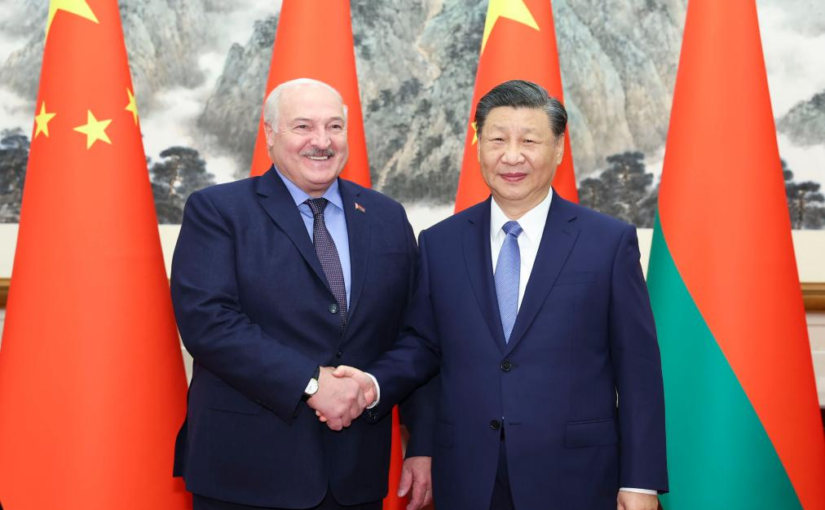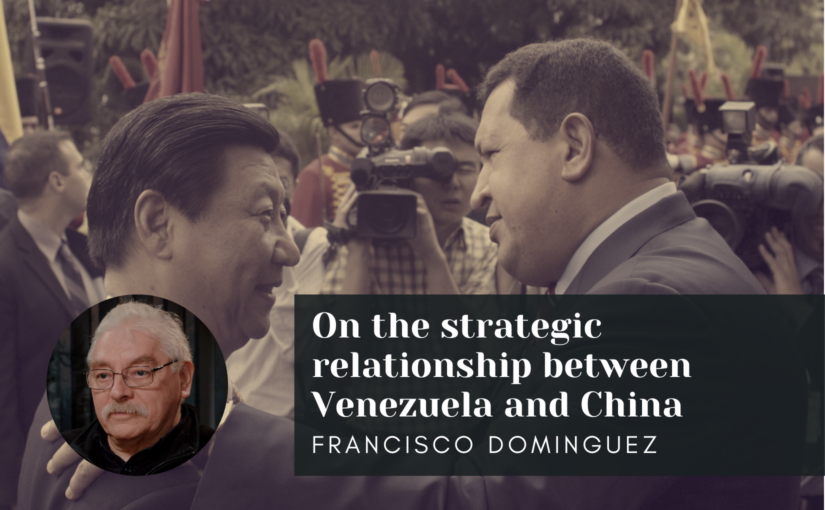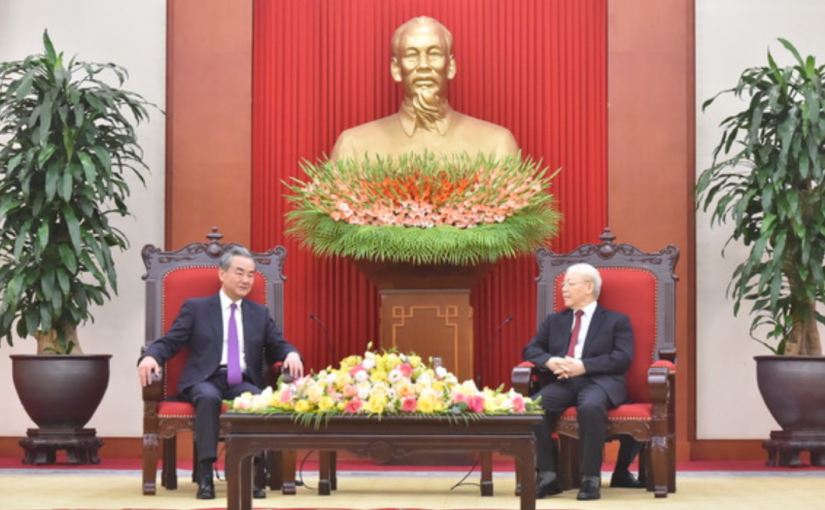
Xi Jinping meets with national leaders of Cuba, Ethiopia, Senegal and Bangladesh

During his recent visit to South Africa, Chinese President Xi Jinping held bilateral meetings on the sidelines of the BRICS Summit with a number of national leaders.

On August 23, he met with Cuban President Miguel Diaz-Canel, Ethiopian Prime Minister Abiy Ahmed, Senegalese President Macky Sall and Bangladeshi Prime Minister Sheikh Hasina.

Meeting his Cuban counterpart, Xi said that China will continue to firmly support Cuba in defending national sovereignty and opposing external interference and blockade. China will also try its best to provide support for Cuba’s economic and social development.

The Chinese President added that his country will work with Cuba to continue deepening political mutual trust, expanding practical cooperation, strengthening strategic coordination, and pushing for progress in the special friendly relationship between the two parties and the two countries. China praises Cuba’s steadfast support for China in issues concerning its core interests.

Xi stressed that the Group of 77 and China is an important platform for cooperation among developing countries, adding that Cuba, as the current chair of the Group of 77 and China, has made positive contributions to strengthening the unity of developing countries.

China attaches great importance to and supports Cuba in successfully holding the Group of 77 and China Summit next month, Xi noted. China is willing to work with Cuba and other members of the Group of 77 to better safeguard the common interests and development rights of developing countries, he added.

For his part, Diaz-Canel spoke of his successful state visit to China last November, saying that both sides are earnestly implementing the important consensus reached by the two leaders.

He said the current Cuba-China relations are at a historical peak, adding that the Cuban people deeply admire President Xi and are grateful for China’s understanding and invaluable support for Cuba’s just cause.

Cuba is ready to work with China to deepen Belt and Road cooperation, build a Cuba-China community with a shared future, and advance on their paths of socialism with their respective characteristics.

Meeting Prime Minister Abiy Ahmad, Xi said that China is a reliable friend and a true partner of Ethiopia.

China attaches great importance to its relations with Ethiopia and supports its domestic peace process, development, and revitalization, he said, adding that China stands ready to work with Ethiopia to promote bilateral exchanges and to expand all-round cooperation, so that bilateral friendship can enjoy greater popular support and the China-Ethiopia comprehensive strategic cooperative partnership can witness further development.

The friendship between Ethiopia and China is profound and the relations between the two countries have maintained good development momentum, said Ahmed, extending his sincere appreciation for the massive and valuable support China has offered for a long time.

Thanks to the help from and cooperation with China, Ethiopia has achieved significant development and transformations in recent years, said the Ethiopian Prime Minister, noting that the two countries share similar experiences and have common stands on many major issues.

Meeting with President Macky Sall, Xi noted that Senegal is an important partner of China in Africa, adding that, with joint efforts in recent years, the two countries have enjoyed ever-deepening political mutual trust and fruitful cooperation in various fields. He said that China supports the African Union in joining the Group of 20 and stands ready to share with African brothers its development experience and opportunities, and push for the joint pursuit of a China-Africa community with a shared future in the new era, by continuously upholding the principles of sincerity, real results, amity and good faith and pursuing the greater good and shared interests.

As co-chairs of the Forum on China-Africa Cooperation (FOCAC), China and Senegal have supported and cooperated with each other and successfully held a series of important events including the Extraordinary China-Africa Summit on Solidarity against COVID-19, he said.

President Sall thanked China for taking the lead in publicly supporting the AU’s G20 membership, saying that his country, as a co-chair of FOCAC, will continue to closely communicate and work with China to promote the further development of Africa-China relations.

Meeting Bangladesh Prime Minister Sheikh Hasina, Xi said that China and Bangladesh enjoy traditional friendship, adding that the two sides upgraded bilateral ties in 2016 to a strategic cooperative partnership, which has indicated the direction for deepening their cooperation.

At present, both China and Bangladesh are at a critical stage of their own development and revitalization, and the Chinese side is willing to strengthen the synergy of development strategies with Bangladesh, deepen practical cooperation in various fields, push the bilateral strategic cooperative partnership to a new level, and better benefit the people of the two countries.

Xi also said that China supports Bangladesh in safeguarding national sovereignty, independence, and territorial integrity, and in opposing external interference, so that the country can maintain domestic unity and stability and achieve development and revitalization.

He extended congratulations to the prime minister on her country’s joining the New Development Bank, saying that China is willing to strengthen coordination and cooperation with Bangladesh in multilateral affairs and to safeguard international equity and justice as well as the shared interests of developing countries.

Hasina noted that Xi’s state visit to Bangladesh in 2016 has become a milestone in bilateral ties. She added that the sound Bangladesh-China relationship is based on mutual respect and non-interference in each other’s internal affairs. Bangladesh, she said, firmly adheres to the one-China policy and appreciates China’s important role in promoting regional peace and stability, adding that her country is ready to deepen ties with China and to strengthen cooperation in multilateral mechanisms such as BRICS.

It is believed that the development of the BRICS mechanism will bring new development opportunities to developing countries, she added.

The following articles were originally carried by the Xinhua News Agency.

Xi pledges China’s continuous support for Cuba in opposing interference

JOHANNESBURG, Aug. 23 (Xinhua) — Chinese President Xi Jinping said here on Wednesday that China will continue to firmly support Cuba in defending national sovereignty and opposing external interference and blockade.

China will also try its best to provide support for Cuba’s economic and social development, said Xi in a meeting with Cuban President Miguel Diaz-Canel on the sidelines of the 15th BRICS Summit.

Xi recalled that President Diaz-Canel paid a successful state visit to China last November, when they reached a broad consensus on further deepening China-Cuba ties in the new era and agreed to work together to build a China-Cuba community with a shared future.

Continue reading Xi Jinping meets with national leaders of Cuba, Ethiopia, Senegal and Bangladesh

China: socialist or capitalist?

This presentation by Friends of Socialist China co-editor Carlos Martinez was given to the Communist Party USA on 20 August 2023 as part of its Marxist Classes series.

Introducing his book, The East is Still Red – Chinese Socialism in the 21st Century, Carlos goes into detail as to the class character of China today.

The book is available in paperback and ePub formats from Praxis Press, and is also available for Kindle. The voucher code ‘Carlos’ provides a site-wide 10 percent discount on Praxis Press.

Xi Jinping at 15th BRICS Summit: Cold War mentality is still haunting our world

Chinese President Xi Jinping delivered a speech to the 15th BRICS Summit, held in Johannesburg, South Africa, on August 23.

Aptly titled, ‘Seeking Development Through Solidarity and Cooperation and Shouldering Our Responsibility for Peace’, and noting that BRICS is an important force in shaping the international landscape, the Chinese leader said early in his speech that:

“We [the BRICS countries] choose our development paths independently, jointly defend our right to development, and march in tandem toward modernisation. This represents the direction of the advancement of human society, and will profoundly impact the development process of the world.”

Making a series of practical proposals, the Chinese leader called for deepening business and financial cooperation to boost economic growth. Development, he noted, is an inalienable right of all countries, not a privilege reserved for a few. “We BRICS countries should be fellow companions on the journey of development and revitalisation, and oppose decoupling and supply chains disruption as well as economic coercion. We should focus on practical cooperation, particularly in such fields as digital economy, green development, and supply chain, and bolster economic, trade and financial exchanges.”

He also called for expanding political and security cooperation to uphold peace and tranquility.

“The Cold War mentality is still haunting our world, and the geopolitical situation is getting tense. All nations long for a sound security environment. International security is indivisible. Attempts to seek absolute security at the expense of others will eventually backfire.”

Regarding the Ukraine crisis, he said that it had “evolved to where it is today because of complex reasons. What is pressing now is to encourage peace talks, promote de-escalation, end the fighting, and realise peace. No one should add fuel to the fire to worsen the situation.”

Turning to the talk of the so-called ‘rules based international order’ touted by a handful of countries, Xi said that:

“International rules must be written and upheld jointly by all countries based on the purposes and principles of the UN Charter, rather than dictated by those with the strongest muscles or the loudest voice. Ganging up to form exclusive groups and packaging their own rules as international norms are even more unacceptable.”

The following is the full text of President Xi’s speech. It was originally published by the Xinhua News Agency.

Your Excellency President Matamela Cyril Ramaphosa,

Your Excellency President Luiz Inacio Lula da Silva,

Your Excellency President Vladimir Putin,

Your Excellency Prime Minister Narendra Modi,

I am very pleased to join you in Johannesburg for the important discussions on BRICS cooperation and development. It is especially significant that the BRICS Summit is held in Africa for the third time. I wish to thank President Ramaphosa and the South African government for the thoughtful arrangements.

We gather at a time when the world has entered a new period of turbulence and transformation. It is undergoing major shifts, division and regrouping, leading to more uncertain, unstable and unpredictable developments.

BRICS is an important force in shaping the international landscape. We choose our development paths independently, jointly defend our right to development, and march in tandem toward modernization. This represents the direction of the advancement of human society, and will profoundly impact the development process of the world. Our track record shows that we have consistently acted on the BRICS spirit of openness, inclusiveness and win-win cooperation, and taken BRICS cooperation to new heights in support of our five countries’ development. We have upheld fairness and justice in international affairs, stood up for what is right on major international and regional issues, and enhanced the voice and influence of emerging markets and developing countries. BRICS countries invariably advocate and practice independent foreign policies. We always address major international issues based on their merits, making fair remarks and taking fair actions. We do not barter away principles, succumb to external pressure, or act as vassals of others. We BRICS countries share extensive consensus and common goals. No matter how the international situation changes, our commitment to cooperation since the very beginning and our common aspiration will not change.

Continue reading Xi Jinping at 15th BRICS Summit: Cold War mentality is still haunting our world

Xi Jinping: ​Enhancing solidarity and cooperation to overcome risks and challenges and jointly build a better world

Prior to the opening of the main BRICS Summit in Johannesburg, South Africa, a BRICS Business Forum was held on August 22, marking ten years since the birth of the BRICS Business Council, also in South Africa. 

In an address to the forum’s closing ceremony, which was read on his behalf by Chinese Commerce Minister Wang Wentao, President Xi Jinping, noting that, “changes in the world, in our times and in history are unfolding in ways like never before, bringing human society to a critical juncture”, posed the following questions:

“Should we pursue cooperation and integration, or just succumb to division and confrontation? Should we work together to maintain peace and stability, or just sleepwalk into the abyss of a new Cold War? Should we embrace prosperity, openness and inclusiveness, or allow hegemonic and bullying acts to throw us into depression? Should we deepen mutual trust through exchanges and mutual learning, or allow hubris and prejudice to blind conscience? The course of history will be shaped by the choices we make.”

The Chinese leader noted that humanity has “achieved notable economic development and social progress over the past decades, and that is because we have drawn lessons from the two world wars and the Cold War… and embarked on the right path of openness and development for win-win cooperation… What people in various countries long for is definitely not a new Cold War or a small exclusive bloc; what they want is an open, inclusive, clean and beautiful world that enjoys enduring peace, universal security and common prosperity.”

Stressing the need to promote development and prosperity for all, President Xi continued: “Many emerging markets and developing countries (EMDCs) have come to what they are today after shaking off the yoke of colonialism. With perseverance, hard work and huge sacrifices, we succeeded in gaining independence and have been exploring development paths suited to our national conditions. Everything we do is to deliver better lives to our people. But some country, obsessed with maintaining its hegemony, has gone out of its way to cripple the EMDCs. Whoever is developing fast becomes its target of containment; whoever is catching up becomes its target of obstruction. But this is futile, as I have said more than once that blowing out others’ lamp will not bring light to oneself.

“Every country has the right to development, and the people in every country have the freedom to pursue a happy life. With that in mind, I have proposed the Global Development Initiative, with the goal of promoting development for all by the international community and boosting the UN 2030 Agenda for Sustainable Development.”

Highlighting the increasing role of the BRICS countries in the global economy, the Chinese leader noted: “The collective rise of EMDCs represented by BRICS is fundamentally changing the global landscape. EMDCs have contributed as high as 80 percent of global growth in the past 20 years, and their share in the global GDP has increased from 24 percent 40 years ago to more than 40 percent.”

Xi again expressed China’s support for more countries to join the BRICS mechanism, while noting that this is not a matter of pressing countries to take sides or fomenting confrontation:

“The gathering between BRICS countries and more than 50 other countries in South Africa today is not an exercise of asking countries to take sides, nor an exercise of creating bloc confrontation. Rather, it is an endeavor to expand the architecture of peace and development. I am glad to note that over 20 countries are knocking on the door of BRICS. China hopes to see more joining the BRICS cooperation mechanism.”

We reprint below the full text of President Xi’s speech. It was originally carried on the website of the Chinese Foreign Ministry.

Your Excellency President Matamela Cyril Ramaphosa,
Members of the Business Community,
Ladies and Gentlemen,
Friends,

I wish to extend my warm congratulations on the success of the BRICS Business Forum in South Africa!

Ten years ago here in South Africa, we BRICS leaders witnessed the birth of the BRICS Business Council. Since then, the Council has stayed true to its founding mission. It has seized opportunities to deepen cooperation, contributing to economic and social development of BRICS countries and helping sustain global economic growth.

Continue reading Xi Jinping: ​Enhancing solidarity and cooperation to overcome risks and challenges and jointly build a better world

South Africa and China have an unbreakable bond

Chinese President Xi Jinping paid his fourth state visit to the Republic of South Africa immediately before the country hosted the BRICS Summit.

Meeting his South African counterpart Cyril Ramaphosa in the capital Pretoria on August 22, the two leaders agreed to work together to take the China-South Africa comprehensive strategic partnership to new heights and to build a high-quality China-South Africa community with a shared future.

To this end, President Xi made four proposals:

  • China and South Africa should be strategic partners with a high degree of mutual trust. Comradeship and brotherhood are inherent to the bilateral relationship.
  • China and South Africa should be development partners making progress together. Mutual benefits and win-win are defining features of their cooperation.
  • China and South Africa should be friendly partners enjoying mutual understanding. Close ties between the two peoples are a vivid example of amity between the two countries.
  • China and South Africa should be global partners with a commitment to justice. Independence is a principle upheld by both countries.

President Ramaphosa noted that it is a great pleasure to receive President Xi Jinping for his fourth state visit to South Africa. China lent precious support to South Africa during its struggles for national independence and liberation and in its pursuit of national development. China gave South Africa much-needed support in difficult times such as during the COVID-19 pandemic. China is a true friend, brother, and partner of South Africa.

The South African leader went on to say that the world today is faced with geopolitical challenges, energy crises and many other serious and complex issues. He fully agrees with President Xi Jinping’s proposal for win-win cooperation. South Africa and other countries in the Global South all hope to strengthen solidarity and cooperation with China to better meet challenges together, and promote an international order that is more egalitarian, just, and equitable.

Following their talks, President Ramaphosa awarded Xi the Order of South Africa, his country’s highest honour for heads of state of friendly countries. The two leaders also witnessed the signing of various bilateral cooperation agreements, and the two sides also agreed a 15-point Joint Statement.

In a related report, the Xinhua News Agency, noted that: “Amidst Western media’s distorted reports accusing China of ‘colonising’ African nations, including South Africa, it is notable that South Africans describe their relationship with China as one of ‘comradeship’ and ‘brotherly friendship’.”

This sense of unity stems from China’s support to the South African people in fighting apartheid, and standing with the African National Congress (ANC) as comrades and friends, according to ANC Secretary-General Fikile Mbalula. Apart from strong economic links, “it is a relationship that is formed by ties of anti-imperialism,” he said in an interview on the eve of the Chinese President’s visit.

President Xi’s visit is one of comradeship between the two presidents in strengthening this important relationship, which spans decades and decades, between the African National Congress and the Communist Party of China, he added.

Sifiso Mahlangu, editor-in-chief of South Africa’s leading newspaper, The Star, said that South Africa and China have an unbreakable bond:

“Our history dictates that China has been our friend. The Chinese people, the People’s Republic of China, and the Communist Party of China have been the friends of the South African people.”

The following articles were originally carried on the websites of the Chinese Foreign Ministry and the Xinhua News Agency.

President Xi Jinping Held Talks with President of South Africa Matamela Cyril Ramaphosa

Ministry of Foreign Affairs, 23 August 2023

On the morning of August 22 local time, President Xi Jinping held talks with President of South Africa Matamela Cyril Ramaphosa at the Union Buildings in Pretoria during his state visit to the country. The two heads of state had an in-depth exchange of views on the development of China-South Africa relations in the new era and international and regional issues of mutual interest, and they reached important common understandings. They agreed to work together to take the China-South Africa comprehensive strategic partnership to new heights and build a high-quality China-South Africa community with a shared future.

Under a bright sky in August in Pretoria, flowers at the square of the Union Buildings were in blossom, while national flags of China and South Africa were waving in the gentle breeze. President Xi Jinping arrived at the Union Buildings in the presidential motorcade, and was warmly greeted by President Ramaphosa when getting off the limousine. As the two heads of state stepped onto the stand, a guard of honor saluted with rifles. The military band played the national anthems of China and South Africa, and a 21-gun salute was fired. President Xi Jinping reviewed the guard of honor of South Africa. The two presidents shook hands with senior members of the delegations.

The two heads of state held talks after the welcoming ceremony.

President Xi Jinping noted that it was his fourth visit to South Africa as Chinese President. He said that he has personally experienced the robust growth of China-South Africa relations over the past decade. The key to the strong relationship and profound friendship lies in the mutual support by the two countries and the two political parties in pursuit of their respective development. China is advancing the great rejuvenation of the Chinese nation on all fronts through a Chinese path to modernization, while South Africa is exploring a path toward modernization that suits its own national conditions. China is ready to work with South Africa to carry forward the friendship, deepen cooperation, and strengthen coordination, in an effort to take the China-South Africa comprehensive strategic partnership to new heights and build a high-quality China-South Africa community with a shared future.

In this connection, President Xi Jinping made four proposals.

First, China and South Africa should be strategic partners with a high degree of mutual trust. Comradeship and brotherhood are inherent to the bilateral relationship. The two sides need to step up exchange and cooperation between legislatures, political parties, the military and subnational governments, and continue to support each other on issues concerning their respective core interests and key concerns. China is ready to step up exchanges between political parties and cooperation on training, and will do its best to help the African National Congress develop the African Leadership Academy. 

Continue reading South Africa and China have an unbreakable bond

Delegation report: On the path of China’s modernisation

We are pleased to republish below a detailed report by Rob Griffiths, general secretary of the Communist Party of Britain, of a recent delegation to China organised by the CPC’s International Department. Rob was the leader of the delegation, which included three delegates from Friends of Socialist China.

Originally published in four parts in the Morning Star, the report is republished here in full. It adds some valuable detail to our report, elaborating in particular on the themes of common prosperity and China’s path to socialist modernisation.

Rob mentions the delegation’s field trips to KingMed Diagnostics and Guangzhou Automobile Company (GAC) in Guangzhou, and reflects on what the delegates learned in relation to people-centred development and the relationship between the private and state sectors of the economy. He notes that KingMed, although a private company, works symbiotically with the state; this was evident in the struggle against Covid-19, with KingMed establishing 670 testing facilities in remote countryside areas. GAC is focusing increasingly on the design and production of electric cars, in line with the country’s overall orientation towards sustainable development. “Its operations in China illustrate how industry is pursuing the course of socialist modernisation set by President Xi Jinping and the CPC, based on consumer-driven, high-quality and eco-friendly development.”

Rob also recalls the delegation’s visit to the National Big Data Exchange and Experience Centre in Guiyang, Guizhou – “just one of several ultra-modern, hi-tech projects that demonstrate the CPC’s commitment to balanced development across China.” Guizhou has long been one of the poorest provinces of China, but it is experiencing rapid advances since being selected to take the lead on big data and artificial intelligence. Rob writes that the centre “indicates how cutting-edge technology can be used to improve traffic flows, protect the environment, enhance the distribution of medicines and even make tax collection more efficient.”

Writing about the delegation’s exchange with the All-China Federation of Trades Unions (ACFTU), Rob describes the role played by the ACFTU in organising 300 million workers across various sectors: “its roles include collective bargaining, workers’ rights protection, lobbying, and offering financial and skill-training support to members.” He mentions that the union has successfully lobbied for a number of important policy changes, including improving rights of migrant workers and supporting those workers negatively affected by the Covid-19 pandemic.

The author recalls that, at the CPC Central Committee Party School in Beijing, he asked Professor Guo Qiang a question about the absence of women in the top leadership of the CPC – “only 10 of 205 central committee members elected at the 20th party congress last October are women, although they comprise almost one-third of the CPC membership.” Professor Guo responded that this deficit is a topic of discussion inside the party. “Many in the CPC leadership are over 60 and attended university 40 years ago when there were very few female students — itself the result of bad and reactionary elements in traditional Chinese culture, he explained. Huge changes are under way in education, with women filling more than half of all university and college places.”

The delegation was hugely valuable and memorable, and served to significantly deepen delegates’ understanding of the progress of Chinese socialism in the 21st century.

On the path of China’s modernisation

Morning Star, 5 August 2023

FROM June 24 until July 4, the international department of the Communist Party of China (CPC) hosted a delegation representing 11 communist parties and a friendship society from Britain, Ireland, Denmark, Sweden, Finland, Norway, the US, Canada and Australia.

I had the honour of leading the delegation at the invitation of the CPC as we visited the provinces of Guangdong and Guizhou as well as the capital city, Beijing.

Our hosts’ intention was to explain China’s path of “socialist modernisation” and demonstrate the achievements of their country’s system of “socialism with Chinese characteristics.”

Guangdong borders Hong Kong and is China’s most populous province with more than 127 million inhabitants.

Situated at the delta of the Pearl River, the provincial capital Guangzhou was the starting point of the famous maritime “Silk Road.”

Its working class and intelligentsia played a major part in the national democratic revolution of 1911, led by Sun Yat Sen, who remains a revered figure for the Chinese people and the CPC.

Today, this city of 16 million people is a major international port and trading centre, having pioneered China’s “reform and opening up” strategy initiated by former CPC leader Deng Xiaoping in 1978.

Continue reading Delegation report: On the path of China’s modernisation

US warships provoke in South China Sea, but don’t help fight fires in Hawaii

In this editorial the Chinese newspaper Global Times addresses the prolonged wildfires that have ravaged Hawaii’s Maui Island, which, as of Thursday August 17, had claimed the lives  of 99 people, with more than 1,000 missing. 

Global Times contrasts the US’ response to such disasters, citing also that to Hurricane Katrina in 2005 as well as the recent East Palestine train derailment, with its ability to project military power around the world, with its network of over 800 foreign military bases. It quotes a US internet user as observing:

“Our warships can provoke China in the South China Sea, they can shadow China in Alaska, but they can’t come to Hawaii to help Americans.” 

Global Times comments: “While the wildfires were raging in Hawaii, what was Washington busy with? It was occupied with imposing investment restrictions on China, preparing for the Camp David summit with Japan and South Korea, and announcing $200 million in new military aid to Ukraine. However, the specific amount of assistance provided by the FEMA [Federal Emergency Management Agency] for the Hawaii wildfires, as announced to date, is a payment of $700 per household… The US government prefers to hype harmless balloon accidents as major security threats, but remains ‘calm’ about the tragic disasters causing significant casualties right in front of it.”

After a week of fierce wildfires in parts of Hawaii’s Maui Island in the US, the death toll continues to rise. As of Tuesday noon local time, 99 people have died and over 1,000 remain missing. This has been labeled by the US media as the deadliest wildfires in the country in a century. The dire situation in the affected areas has inflicted immense psychological shock upon the American people. Reports said local residents have “lost everything,” with some even being “forced to jump into the Pacific Ocean to escape the smoke and fire conditions.” Criticisms of failures in warnings, inadequate disaster relief efforts, and inaction from the stationed US military in Hawaii have fueled “growing anger.”

Such a large number of casualties would be a major disaster in any country, and it is even more shocking when it occurs in the world’s most developed country. The US is prone to natural disasters such as wildfires and hurricanes. However, the country’s patchy response when dealing with these disasters is perplexing. The US has always proclaimed itself as a “world leader” and claims to be capable of responding rapidly to security threats around the globe. It possesses over 800 military bases overseas and projects its military power with aircraft carriers worldwide. But when it comes to domestic disasters or public safety incidents within the US, its response is slow and its ability to cope seems inadequate.

Although Hawaii is not located on the continental US, it remains one of the most critical military bases for the country. Hawaii serves as the headquarters of the US Indo-Pacific Command. The Indo-Pacific Command claims to “govern” over 50 percent of the world’s surface area, but ironically remains indifferent to the disasters that occur in its own location. What has fueled anger among the local community is the fact that the initial relief work was largely organized by residents themselves, with little presence from the National Guard, Federal Emergency Management Agency (FEMA), state government, or local authorities. An American internet user sarcastically remarked, “Our warships can provoke China in the South China Sea, they can shadow China in Alaska, but they can’t come to Hawaii to help Americans.” This aptly illustrates the hierarchy of decision-making in the US.

US sluggish and indifferent response to its domestic catastrophic incidents sharply contrasts with its fervent resource mobilization in “competition” with other nations. Leaving a deep impression on us, there was the Hurricane “Katrina” in 2005 that resulted in the loss of 1,836 lives, and the train derailment in East Palestine earlier this year carrying hazardous chemicals. There was also the Florida building collapse in 2021 that claimed 98 lives, and the slow rescue efforts during that time were referred to as “archaeological-style rescue.” A foreign netizen said, “The ‘American-style rescue’ in Hollywood movies is nowhere to be seen, with no American rescue heroes or high-tech equipment.” This observation seems to be perfectly fitting for every disaster in America, including the current Hawaii wildfires.

While the wildfires were raging in Hawaii, what was Washington busy with? It was occupied with imposing investment restrictions on China, preparing for the Camp David summit with Japan and South Korea, and announcing $200 million in new military aid to Ukraine. However, the specific amount of assistance provided by the FEMA for the Hawaii wildfires, as announced to date, is a payment of $700 per household. The few discussions about the wildfires mostly serve as the latest pretext for mutual attacks between the two parties. The American media, which has always emphasized “supervision,” seems to consider all of this as a matter of course, leading to the repetition of the same events without any profound reflection.

The US actively exercises hegemony in its foreign affairs, and its internal mechanisms are very backward, failing to take the protection of citizens’ security as the starting point and foundation of national security. Specifically, the US wastes a large amount of resources meaninglessly in fighting against “imaginary external opponents,” while ignoring the life-threatening threats faced by its domestic population. The US focuses its investment in military power and military-related technological fields in terms of national security, while investing inadequately in domestic infrastructure construction, disaster reduction, and relief efforts that concern people’s wellbeing and national security.

The problems exposed by the deadly wildfires in Hawaii belong to the entire US. We can see that from the “9/11” attacks to the present, the US has witnessed numerous major events related to citizens’ security. However, there has been almost no obvious improvement in the construction of institutional mechanisms for responding to domestic disasters and accidents by the US government. The US government prefers to hype harmless balloon accidents as major security threats, but remains “calm” about the tragic disasters causing significant casualties right in front of it. When the next disaster strikes, the performance of the US government is unlikely to be any better. Every disaster is a reminder to the US, using innocent lives to remind it who its real enemies and challenges are. The US’ disregard for this reminder is the greatest desecration of the lives lost.

Xi Jinping: What the world needs today is peace, not conflict

Chinese President Xi Jinping left Beijing on August 21 to attend the 15th BRICS Summit in Johannesburg and to pay a state visit to South Africa. On the day of his departure, a signed article by the Chinese president was published in leading South African media, prefiguring his visit.

Acclaiming South Africa as the home of the “great statesman Nelson Mandela”, President Xi noted that this will be his sixth visit to the “rainbow nation” and added:

“Each of my visits to South Africa gave me new impressions. But the deepest is invariably the brotherly sentiments we have toward each other. Our friendship has traversed a long span of time. As early as in the mid-20th century, the newly founded People’s Republic of China lent firm support to the South African people in fighting apartheid, and stood with the African National Congress as comrades and friends. Our friendship has defied the obstacles of mountains and oceans.”

South Africa, he pointed out, was the first African country to sign a Belt and Road cooperation document with China and it has been China’s biggest trading partner in Africa for 13 consecutive years. 

Noting that the two countries share the same ideals, Xi said they should “firmly  support each other in independently exploring a path to modernization that suits our respective national conditions. We should fear no hegemony, and work with each other as real partners to push forward our relations amid the changing international landscape…

“China and South Africa should be champions of our common interests. What the world needs today is peace, not conflict; what the world wants is coordination, not confrontation. China and South Africa, as natural members of the Global South, should all the more work together to appeal for the greater voice and influence of developing countries in international affairs, promote accelerated reform of international financial institutions, and oppose unilateral sanctions and the ‘small yard, high fence’ approach [referring to a concept advanced by US President Joe Biden].”

Xi wrote that he still has vivid memories of the BRICS Summit in the Chinese resort of Sanya 12 years ago, when South Africa was first admitted to the cooperation mechanism:

“Now more and more countries are knocking on the door of BRICS, aspiring to join our cooperation. This is a testament to [its] vitality and influence.”

He noted that, together with South African President Cyril Ramaphosa, he will convene a China-Africa Leaders’ Dialogue during his visit, adding that China will continue to work for substantive progress in the African Union’s joining of the G20 this year.The below article was originally carried by the Xinhua News Agency.

Sailing the Giant Ship of China-South Africa Friendship and Cooperation Toward Greater Success

Xi Jinping
President of the People’s Republic of China

At the invitation of President Matamela Cyril Ramaphosa, I will soon make a state visit to the Republic of South Africa and attend the 15th BRICS Summit. It will be my sixth visit to the promising land of the “rainbow nation”. South Africa is home to the great statesman Nelson Mandela, and it boasts the richest tourist resources, the longest road network, the biggest securities exchange, and the busiest airports and harbors in Africa. The country exudes unique charm with the perfect amalgam of the ancient and the modern, and of nature and culture.

Each of my visits to South Africa gave me new impressions. But the deepest is invariably the brotherly sentiments we have toward each other. Our friendship has traversed a long span of time. As early as in the mid-20th century, the newly founded People’s Republic of China lent firm support to the South African people in fighting apartheid, and stood with the African National Congress as comrades and friends. Our friendship has defied the obstacles of mountains and oceans. Facing the sudden onslaught of COVID-19, China was among the first to provide anti-pandemic supplies to South Africa, reaffirming our special brotherhood. More recently, China also provided to the country emergency power equipment. Over the past 25 years since the establishment of diplomatic ties, our relationship has achieved leapfrog development–from a partnership to a strategic partnership, and then to a comprehensive strategic partnership. It is one of the most vibrant bilateral relations in the developing world. Our relationship has entered a “golden era”, enjoying broad prospects and a promising future.

In recent years, President Ramaphosa and I have maintained close communication through visits, meetings, phone calls and letters. We jointly explore cooperation opportunities, pursue development, and stand up to common challenges. Our strategic mutual trust has been deepening steadily. We give each other firm support on issues involving our respective core interests and major concerns, and maintain coordination on major international and regional issues. We work together to practice true multilateralism and push for the building of a more just and equitable international order.

South Africa was the first African country to sign the Belt and Road cooperation document with China. It has been China’s biggest trading partner in Africa for 13 years in a row, as well as one of the African countries with the largest stock of Chinese investment. The pie of bilateral cooperation is getting bigger. South Africa’s wines, rooibos tea, and aloe vera gels are trending products in China. Many Chinese companies are expanding their operation and at the same time taking more social responsibilities in South Africa. Automobiles and home appliances with Chinese brands yet made in South Africa are very popular among local consumers, and are now owned by numerous South African households. South African companies are also racing to invest in the Chinese market to seize the abundant business opportunities, and they have made important contribution to China’s economic growth.

South Africa’s Ubuntu philosophy advocates compassion and sharing. It resonates well with the values of Confucianism–“love the people and all beings and seek harmony among all nations”. In 2015, I participated in the Year of China activities in South Africa, and witnessed the gratifying achievements of our Year of China/South Africa programs. Last April, the faculty and students of the Confucius Institute at Durban University of Technology wrote me a letter in Chinese, expressing their fondness for the Chinese culture and thanking China for the valuable opportunities provided to young Africans chasing their dreams. I find it very heart-warming. Indeed, these vibrant people-to-people exchanges enhance the empathy between our peoples, and enable our friendship to be passed down from generation to generation.

The China-South Africa relationship is standing at a new historical starting point. It has gone beyond the bilateral scope and carries increasingly important global influence. During my forthcoming visit, I look forward to working with President Ramaphosa to chart the plan for a new chapter of our comprehensive strategic partnership.

China and South Africa should be fellow companions sharing the same ideals. As an ancient Chinese saying goes, “A partnership forged with the right approach defies distance; it is thicker than glue and stronger than metal and rock.” We need to increase our experience sharing on governance, and firmly support each other in independently exploring a path to modernization that suits our respective national conditions. We should fear no hegemony, and work with each other as real partners to push forward our relations amid the changing international landscape.

China and South Africa should be pacesetters for solidarity and cooperation. We will succeed because of our biggest strengths in high economic complementarity and the solid foundation for cooperation. We need to further synergize development strategies, promote stronger cooperation in infrastructure, digital economy, scientific and technological innovation and energy transition, and ensure that more people of our two countries will benefit from the development outcomes. China welcomes more South African products to its market, and encourages more Chinese companies to invest and do business in South Africa as an effort of support for South Africa’s target to double its inbound investment over the next five-year period.

China and South Africa should be inheritors of China-Africa friendship. We need to leverage the all-round, multi-tiered and institutionalized mechanisms for people-to-people exchanges between our two countries, and continue to advance exchanges and cooperation in culture, tourism, education, sports, media, universities, sub-national governments and the youth. We must keep the spirit of China-Africa friendship and cooperation as alive and strong as ever across the vast lands of China and Africa.

Continue reading Xi Jinping: What the world needs today is peace, not conflict

Friendship Medal awardee Isabel Crook dies in Beijing at 108

Our dear friend, comrade and mentor Isabel Crook passed away peacefully in Beijing on August 20 at the age of 107 (108 according to the Chinese method of calculation).

Isabel was born on December 15, 1915 in Chengdu, the daughter of Canadian missionaries. From her early years she identified with the Chinese people, especially the rural poor, in their struggle for dignity and liberation. Following studies in Canada, she made her way to Britain, where she met and married David Crook, a member of the Communist Party of Great Britain (CPGB), who had been a member of the International Brigades in Spain. Isabel, too, joined the CPGB in 1943 and devoted the rest of her life wholeheartedly to the cause of communism.

She and David traveled to the liberated areas of China in 1948 and the country became their home for the rest of their lives. They shared the destiny of the Chinese people and the Chinese revolution, whether in good times or bad, but never lost their faith in the Communist Party of China and the bright future of China’s revolution, nor their passionate commitment to the liberation of working and oppressed people everywhere, but particularly in those countries groaning under the iron heel of imperialism, colonialism and hegemonism. In 2019, President Xi Jinping personally presented Isabel with the Friendship Award, China’s highest honour for foreigners.

Isabel was, and will remain, an inspiration to us and to everyone else who was privileged to know her. We extend our deepest condolences and sympathies to her sons, Michael, Carl and Paul, and to her whole extended family, and many comrades and friends.

The following article, which was originally published in the Chinese newspaper, Global Times, gives a small but poignant flavour of her extraordinary life and of the love rightly cherished for her by the people of China.

On Sunday, Isabel Crook, recipient of the Friendship Medal of China, pioneer in English teaching in China, and International Communist fighter and advisor of Beijing Bailie University, China’s earliest private university, died in Beijing at the age of 108, Beijing Bailie University reported.

Isabel Crook, a Canadian, was born in Chengdu, Southwest China’s Sichuan Province on December 15, 1915. During the War of Resistance against Japanese Aggression (1931-45), she plunged into China’s rural development. Later, she went to Britain and married David Crook (1910-2000), who was a member of the Communist Part of Great Britain, and took part in the international anti-Fascist war. She joined in the Communist Party of Great Britain in 1943, and came to China to observe and study the land reform in the Liberated Area of Shanxi, Hebei, Shandong and Henan provinces. 

In 1948, Isabel (as her Chinese friends always call her) was invited to teach at the Central Foreign Affairs School (the forerunner Beijing Foreign Studies University, BFSU) in Nanhaishan village, North China’s Hebei Province in 1948 at the invitation of the Communist Party of China. After the People’s Republic of China was founded in 1949, Isabel had taught in BFSU for more than 70 years, and trained a great number of scholars and diplomats for China.

As a scholar in anthropology and sociology, she wrote several books, including Revolution in a Chinese Village: Ten Mile Inn, and Xinglong Chang:Field Notes of a Village Called Prosperity 1940-1942, in which she observed and recorded the Chinese revolution and development through her own eyes and in her own way to the West and the whole world at large, making an outstanding contribution to China’s foreign friendly exchanges with other countries.

In 2007, she was awarded the title of “Tenured professor emeritus” by Beijing Foreign Studies University, and honorary doctoral degree by Toronto University. She also received other honors such as “One of the Top Ten Meritorious Foreign Teachers” by the Chinese government and the “the Most Influential Foreign Experts at the 40th Anniversary of China’s Reform and Opening-up” in 2016 and 2018 respectively. In September 2019, she won the Friendship Award of the People’s Republic of China, the highest medal of honor in China for foreigners. 

Isabel had shown great concern to China’s rural development and dedicated herself to English teaching with numerous students. She died peacefully with her faith for the international Communist cause, and the love for the Communist Party of China and the Chinese people. According to her own will, no funeral will be conducted and her body will be donated for medical research. Our beloved Isabel is immortal!

NYT publishes hit job on anti-war activists; solidarity must be the answer

In the following article, published by Workers World, John Catalinotto exposes the agenda behind the now notorious August 5 article carried by the New York Times purportedly exposing a number of organisations in the United States and elsewhere that stand for peace, against the new cold war, and for constructive relations with China, as agents of the Chinese state and communist party.

Many of these organisations have apparently been funded by Roy Singham, former owner of a software consultancy, who has evidently been following a well-trodden path of wealthy Americans, namely devoting a portion of his fortune to bodies and institutions that share his personal convictions and interests. The only thing that is exceptional, and to the ruling class unacceptable, is that Roy’s personal convictions and interests happen to be those of peace, anti-imperialism and socialism.

Following the publication of the Times story, Marco Rubio, the arch-reactionary Florida senator and a leading contender for the Republican presidential nomination, has written to US Attorney General Merrick Garland demanding that the Department of Justice investigate whether Roy and nine named organisations are complying with the terms of the Foreign Agents Registration Act (FARA), an anti-democratic law that has historically been used to target a range of progressive people, including leading figures struggling for African-American liberation and Irish freedom.

In his Workers World article, John explains how, over decades, the New York Times, a house journal of the US ruling class that grandiloquently claims to be the repository of “all the news that’s fit to print”, has, liberal pretentions notwithstanding, touted for every US act of aggression, from Vietnam through Yugoslavia, Iraq, Libya and others, to Ukraine and China today. 

John makes the important point that the attack triggered by the New York Times article is but the latest salvo in a neo-McCarthyite wave that has already targeted others, from the African People’s Socialist Party (APSP), its Chairman Omali Yeshitela, and the organisations that work in the white community under its leadership, the African People’s Solidarity Committee and the Uhuru Solidarity Movement, to numerous Chinese Americans, from prominent academics and scientists to a Boston hotel worker and union activist. As John notes:

“It’s important to include all these attacks, because the movement must respond in a united way. An attack on one is an attack on all.”

Once in a while, the New York Times runs an article that reveals what this media conglomerate really represents.

People often call the Times “liberal.” That’s because it seems to oppose some of the most reactionary politicians, like president #45, and gives ample opinion space to diverse voices.

When Washington mobilizes for war, however, the Times doffs its liberal cloak and exposes itself as a loudspeaker for U.S. imperialist interests. That’s what it did Aug. 5, running a front page hit job on progressive organizations and on a donor to these causes. The verbal attack replayed 1950s McCarthyism.

Though the article had clear political goals and lacked hard evidence, the Times disguised it as investigative journalism. Four Times’ reporters produced propaganda aimed at repressing voices that oppose Washington’s preparation for war, in this case war with China. It’s important in the context of the Aug. 5 article to be conscious of the fact that the Times pays these journalists to write —  and to follow editorial “guidelines.”

Continue reading NYT publishes hit job on anti-war activists; solidarity must be the answer

US steps up effort to drive a wedge between Vietnam and China

In this article, which was originally carried in People’s World, Amiad Horowitz takes up a recent off-handed comment by US President Joe Biden, that he intends to travel to Vietnam shortly, noting that CNN described it as another attempt to “counter China’s influence.” Amiad further identified this as “part of the US’ new Cold War aimed at China and other socialist and progressive states, [with] leaders in Washington [hoping] to drive a wedge between China and Vietnam.”

Amiad notes that Washington has now been pursuing this policy for years, but with little success. Going along with this, he explains, “would go against the established tenets and guidelines of Vietnam’s foreign policy.”

The US has remained undeterred, but as “the Biden administration amps up the tensions in Asia, the Chinese and Vietnamese governments have chosen to pursue a path of cooperation and peace.”

To illustrate his argument, Amiad refers to high-level diplomatic meetings between the two socialist countries on August 9 and 10 as well as to other recent encounters:

“In fact, as the two largest socialist countries, their relationship takes on a special significance, a relationship of ‘brothers plus comrades’, as a joint statement put it in November last year.”

Immediately following the original publication of this article, on August 16, China’s top diplomat, Foreign Minister Wang Yi met in Kunming the provincial capital of Yunnan, with Vietnamese Deputy Prime Minister Tran Luu Quang.

Wang Yi told his visitor that, as neighbouring countries sharing the same ideology, “the two sides should prepare for the next stage of high-level exchanges.” They should also, Wang added, jointly uphold the ideals and beliefs of the communist party and the cause of socialism.

Tran was attending the Seventh China-South Asia Expo, along with other senior leaders from countries in the region, including Laos, Nepal, and Sri Lanka.

Amiad Horowitz studied at the Academy of Journalism and Communications at Vietnam’s Ho Chi Minh National Academy of Politics. He lives in the Vietnamese capital, Hanoi.

Last Tuesday, in an offhanded remark, President Joe Biden mentioned that he intends to travel to Vietnam “shortly” as part of an effort “to change our relationship” with the country. While no official plan, agenda, or timeline was given, CNN was quick to report that the Biden administration continues to hope it will be able bring Vietnam into the campaign to “counter China’s influence in the Indo-Pacific region.”

As part of the U.S.’ new Cold War aimed at China and other socialist and progressive states, leaders in Washington hope to drive a wedge between China and Vietnam. The two socialist states share a border, and it appears U.S. imperialism is determined to integrate Vietnam into its strategy of encircling China from all sides.

While the United States has pursued this wedge policy toward Vietnam for years, it hasn’t met with much success so far. Any explicitly anti-China agreement with the U.S. would go against the established tenets and guidelines of Vietnam’s foreign policy, which include peaceful coexistence with all states, avoiding entanglement in any military alliances, and never using the threat of violence against another country.

Washington remains undeterred in its effort to draw Vietnam in, however. As the Biden administration amps up the tensions in Asia, the Chinese and Vietnamese governments have chosen to pursue a path of cooperation and peace.

Continue reading US steps up effort to drive a wedge between Vietnam and China

China and South Africa join hands to build a high-level community with a shared future

The annual BRICS Summit will be held in the Republic of South Africa in late August and coinciding with this, Chinese President Xi Jinping has also been invited to pay a state visit by his South African counterpart, Cyril Ramaphosa.

As these events draw near, China’s Ambassador to South Africa, Chen Xiaodong, contributed an article, which we reprint below, to IOL (Independent Online), a leading South African news website.

Ambassador Chen states that: “As developing countries with significant influence in the world, China and South Africa share a special bond of ‘comradeship plus brotherhood’. Our friendship was forged during the fight against imperialism, colonialism and racism, and has deepened in the process of win-win cooperation and common development.”

Noting that this year marks the 25th anniversary of the establishment of formal diplomatic ties between the two countries, Chen observes that their relations have become a model for China-Africa relations and South-South cooperation.

China has been South Africa’s largest trading partner for 14 consecutive years, and South Africa is one of the largest investment destinations for Chinese enterprises in Africa, with Chinese investment so far totaling more than 25 billion dollars and creating over 400,000 jobs.

China, Ambassador Chen writes, “feels for the pain of South African people as they suffer from power shortages. It has provided South Africa with emergency power equipment, and organised the China-South Africa New Energy Investment and Co-operation Conference to expand new energy investment and cooperation between the two sides.”

Cultural and people-to-people exchanges between the two countries are also thriving. Now that China has resumed outbound group travel since the beginning of the year, a a large number of Chinese tourists have come to South Africa to enjoy the country’s beautiful scenery. And South Africa has incorporated the Chinese language into its national education system.

In May, the Chinese national table tennis team came to Durban to participate in the World Table Tennis Championships Finals and achieved great results, which set off a ‘table tennis craze’ in South Africa.

Chen Xiaodong was an Assistant Foreign Minister before taking up his present appointment. His previous postings include as Ambassador to Singapore and Iraq and as Minister at the Chinese Embassy in London.

As developing countries with significant influence in the world, China and South Africa share a special bond of “comradeship plus brotherhood”. Our friendship was forged during the fight against imperialism, colonialism and racism, and has deepened in the process of win-win cooperation and common development.

This year marks the 25th anniversary of the diplomatic ties between China and South Africa. Over the past 25 years, our relations have made a significant leap from partnership to strategic partnership and to comprehensive strategic partnership, and have become a model for China-Africa relations and South-South cooperation.

In recent years, under the leadership of President Xi Jinping and President Ramaphosa, our comprehensive strategic partnership has continued to move forward with higher quality, in a wider range and at a deeper level.

With the two heads of state steering the ship, strategic mutual trust has continued to deepen.

President Xi Jinping and President Ramaphosa have met, spoke on phone and exchanged letters dozens of times.

They have jointly attended multilateral meetings such as the BRICS Summit, the G20 Summit, and the CPC in Dialogue with World Political Parties High-level Meeting. They have co-chaired the Beijing Summit of the Forum on China-Africa Cooperation and the Extraordinary China-Africa Summit on Solidarity against Covid-19, and have reached broad consensus on deepening the China-South Africa and China-Africa relations, as well as the solidarity and cooperation among developing countries.

Continue reading China and South Africa join hands to build a high-level community with a shared future

Azerbaijani president: Belt and Road an important contribution to Central Asia’s development

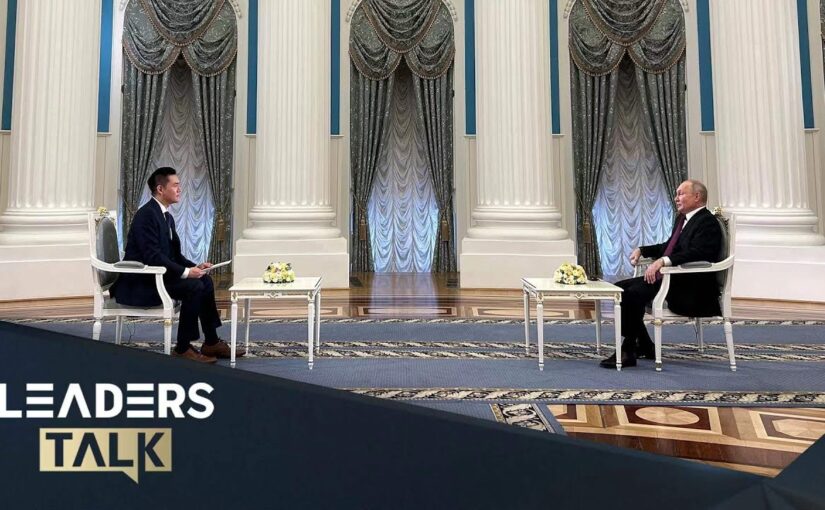
In this recent episode of the CGTN series, Leaders Talk, Wang Guan, travels to the Azerbaijani capital, Baku, to sit down with President Ilham Aliyev.

He notes that this year is the 100th birth anniversary of the current president’s father, former President Heydar Aliyev, who is, it is noted, not only the founding father of independent Azerbaijan, but also of China-Azerbaijan friendship. 

President Aliyev emphasises that his father created a framework for cooperation with China based on mutual respect and friendship. And, as illustrated in photos shown by Wang Guan, during his China visits, Heydar Aliyev also took particular care to visit ordinary Chinese families and to learn about their daily lives. 

President Aliyev noted that his father was already well aware of developments in China from the time when he served in the Soviet government. In the history of the Communist Party of the Soviet Union (CPSU), Heydar Aliyev held the highest position ever attained by someone of Muslim heritage.

The current president considers the relations between China and Azerbaijan to be on a long journey of strategic cooperation. They are based on an alignment of major positions in international relations, for example with regard to sovereignty, territorial integrity and non-interference in internal affairs.

All this also helps to create a favourable backdrop for economic cooperation, particularly within the framework of the Belt and Road Initiative (BRI), which, in turn, contributes to regional security, stability and development. The progress of the BRI enables Azerbaijan to leverage its geographical location to its advantage, through the development of both the Caspian seaport and international rail links. 

Noting that he has met President Xi Jinping on many occasions, both in China and at international gatherings, Aliyev describes his Chinese counterpart as a person of vision and intelligence. This, he notes, contributes to the fact that the number of international friends of China is growing year by year. 

Aliyev also praises China for the assistance it provides to other countries, particularly when other countries refuse to do so. For example, China was the only country to supply Covid-19 vaccines to Azerbaijan when they were first developed. His letter to President Xi drew an immediate response, making Azerbaijan one of the first countries to start a vaccination programme during the global pandemic.

With regard to the question of Taiwan, he said that Azerbaijan always supports China’s territorial integrity and reunification. HIs country’s support for the one-China principle is absolutely unchanged and will never be changed.

Turning to negative western perceptions of developing countries like China and Azerbaijan, Aliyev says that the basic reason is his country’s pursuit of independent policies based on the national interest. Besides the western media, President Aliyev also excoriated the role played by supposedly independent NGOs such as Human Rights Watch and Amnesty International, noting that their agendas did not diverge from those of their funders.

The full interview with President Aliyev is embedded below.

A transformative period in world history

This article by Irish journalist and former hunger striker Tommy McKearney, first published in Socialist Voice, assesses the deepening economic and political crisis of global capitalism – a crisis which is evolving into a full-blown crisis of legitimacy, given a powerful new factor: “the presence of a viable alternative in the east, that is, the People’s Republic of China.”

McKearney describes China’s growing weight in international relations, writing that it “has now become a leading influence in three of the world’s most important regions, and has done so without the use of military expansionism.” China’s multipolar strategy, and its consistent adherence to the principles of non-interference and win-win cooperation, have earned it the trust and support of much of the Global South. As far as the imperialist ruling classes are concerned, this constitutes more than just an economic problem: “A deeper concern is that the Communist Party of China has overseen the development of an economic template that is much more successful than that promoted by free-marketeers.”

The imperialists’ response to this crisis is the initiation of a reckless New Cold War – a strategy of hegemonism and hybrid warfare which is now more-or-less a consensus position in the corridors of power in Washington and London.

Referring to some of the Western left’s previous criticisms and misunderstandings of Chinese socialism, McKearney concludes his article with a significant comment: “Whatever view we took in the past about the Chinese path to socialism, it is incumbent upon us now to give adequate consideration to developments in that amazing country where the East is still glowing red.”

Over the past few months the public, or at least a section of it, has been watching with interest the trials and tribulations of two high-profile political demagogues. We refer, of course, to the arraignment of Donald Trump and the British House of Commons voting to censure Boris Johnson.

Yet in spite of what appeared to be damning indictments against both men, they have not been completely ostracised. Mainstream conservatives in both the United States and Britain have deliberately avoided outright condemnation of their actions. It is important to analyse the reason for this reluctance, as it casts a light on significant developments internationally.

The capitalist ruling class, led from the United States and embedded in Western Europe, has had more than two centuries to perfect techniques for retaining power. For the most part they prefer to create the appearance of governing by consensus. They do, after all, control the means of production, giving them enormous influence over employment, thereby facilitating the divide-and-rule strategy used to split working-class communities.

Moreover, ownership of the mass media allows for the creation of a self-justifying narrative. Granting the people a vote every few years lends the appearance of legitimacy to all of this.

Continue reading A transformative period in world history

Mao Zedong’s ‘A Critique of Soviet Economics’: bringing the ‘political’ back into ‘economy’

We are very pleased to republish this important article by Dr. Joe Pateman, which originally appeared in the World Review of Political Economy (Volume 13 Issue 4).

In his article, Joe presents a detailed analysis of Mao Zedong’s ‘A Critique of Soviet Economics’, which was published in unofficial translation by Monthly Review Press in 1977.

The author argues that, since its inception, Marxism has showcased the scientific superiority of political economy over economics. Mao Zedong, he notes, played an important role in demonstrating this superiority. In ‘A Critique of Soviet Economics’, the Chinese revolutionary leader criticised Soviet political economy for its economic focus, which underestimated the importance of politics and ideology. Mao’s critique addressed both Soviet leader JV Stalin’s 1951 work, ‘Economic Problems of Socialism in the USSR’ as well as a more substantial early post-Stalin Soviet textbook on political economy, reserving considerably more stringent criticism for the latter.

It was essential, Mao argued, to explore how the political and ideological superstructure affects the economic base. Only then can political economy scientifically understand the processes of socio-economic development, most notably the socialist revolution and period of socialist construction. Joe’s article further contends that Mao’s arguments retain key insights for the study and development of Marxist political economy today. They remain especially important in the People’s Republic of China. By upholding and enriching Mao’s insights into the critical role of politics and ideology under socialism, the Communist Party of China has ensured the successful development of socialism with Chinese characteristics.

Developing his arguments, the author begins by outlining the historical context, contents, and ideological perspective of Mao’s argument. He then examines the work itself, focusing on Mao’s theses concerning the relationship between the economic base and the political–ideological superstructure in the study of political economy, specifically as they relate to the processes of social change, socialist revolution, and socialist construction. Finally, the article argues that Mao’s analysis provides contemporary insights into the theory and study of political economy, the socialist revolution, and the successful construction of socialism in modern China.

Giving a historical context, Joe notes that the approach adopted by Mao can be traced at least as far back as the Yan’an period (late 1935 to early 1947), citing, in particular, the Chinese leader’s articles, ‘On Practice’ and ‘On Contradiction’, along with his lecture notes on dialectical materialism, all of which were written in 1937. He further tackles such issues as the role of politics and ideology in the socialist revolution, that socialist revolutions are more likely to occur in economically backward countries, the role of politics and ideology under socialism, the law of value under socialism, the relationship between industry and ideology, between economic and political rights, between economic and ideological incentives, and the role of politics and ideology in the Great Leap Forward.

Regarding the thesis that socialist revolutions are more likely to occur in economically backward countries, Joe notes that Mao referenced a quotation from Lenin claiming that the socialist revolution would be more difficult for the more backward countries. Although, according to Mao, this view was correct when Lenin expounded it in the late nineteenth and early twentieth centuries, it had become obsolete by the mid-twentieth century. In fact, the opposite proposition was now true.

“In connection with this, Mao supported Lenin’s [later] view that the socialist revolution will occur in the countries constituting the weakest links of the imperialist chain, not the strongest ones. In making this point, he emphasised that revolutions sometimes begin in the political and ideological superstructure before extending to the economic base. For the most part, this principle remains true. Most socialist revolutions have occurred in countries with relatively low levels of economic development and/or weak superstructures. Today, the developed Western capitalist countries are the countries least likely to undergo socialist transitions, precisely because they have developed pervasive capitalist ideologies and resilient political systems. The socialist movements are at their weakest in these countries, since many of the workers support capitalist ideology, and because the political systems are durable. By contrast, the socialist movement has been stronger and more successful in Latin America, where the living standards are lower due to slower economic growth, and where the political systems are fragile and corrupt. In these countries, the masses have been more supportive of socialist ideologies.

“Accordingly, when examining the prospects of socialist revolutions in the near future, political economists should focus their attention upon the countries with slow economic growth and weak superstructures, and not the countries of the developed capitalist world. In the short term, the future spread of socialism will occur first in the developing Global South, rather than the developed Global North. Mao Zedong was a leading proponent of this idea.”

Turning to the contemporary relevance of Mao’s work, Joe notes that his critique encouraged the Chinese party to depart from the Soviet approach more completely, and thereby develop an independent Marxist approach to political economy. Upon the basis of Mao’s insights, and under his leadership, the CPC was able to chart its own course of economic development, one that more accurately reflected the application of Marxism-Leninism to China’s unique circumstances.

After Khrushchev took office, Joe continues, the CPSU began to weaken its leading role in society, and it neglected the tasks of party building. This also resulted in the party’s distancing and alienation from the masses. When the CPSU lost its leading role, the Soviet Union collapsed instantaneously. However:

“The remaining socialist states—China, Cuba, Vietnam, Laos, and North Korea—have survived the Soviet collapse and have flourished precisely because they have not underestimated the role of politics and ideology in the process of socialist and communist construction. Whilst recognising the importance of economic factors, including the productive forces and relations of production, these countries have also sought to develop strong and stable political systems, whilst imbuing the people with socialist ideology. These two factors—politics and ideology—have been key to the successful functioning and development of the modern socialist states. They have developed their economic systems not in isolation from the political and ideological superstructure, but instead under the close guidance of this superstructure. Once again, this is something that economic analyses have failed to recognise.”

Specifically regarding China, the CPC has consistently maintained Mao’s principles of “politics in command” and the “mass line” as core characteristics of socialism with Chinese characteristics. Since Mao’s death, the CPC has taken seriously the tasks of party building, as well as the principle of enhancing the party’s leading role in every sphere of society. The CPC’s emphasis on developing its leadership capacity is rooted in Mao’s legacy. During every moment of economic development, and at every stage of the gradual reform and opening of China’s economic system, the CPC has led the process, and has retained total oversight over the structural economic development of Chinese socialism. At no point has the CPC decided that economic forces should dominate the political ones in the stabilisation and growth of its socio-economic system.

Hence the author contends that, if Soviet society had managed to preserve a powerful willpower factor associated with the political superstructure, as happened in China, then the economic difficulties of the 1980s would not in themselves have posed a mortal threat to the Soviet system. The Chinese experience of economic reforms shows that in the presence of political will, a socialist society, in principle, is capable of successfully solving any economic problems. He adds:

“Mao’s ‘A Critique of Soviet Economics’ also illuminates the essence of socialism and communism. In contrast to the Soviets, who viewed economic factors as the primary indicators of socialism, Mao argued that the political factors are just as essential. This insight remains relevant today. Since Deng Xiaoping began China’s economic reforms, Western analysts have accused China of abandoning socialism for capitalism. They claim that China is a capitalist country, rather than a socialist one, because it contains private enterprise and markets. This widespread perspective is founded upon the erroneous tendency to define socialism in purely economic terms. As Mao established, however, socialism is not a purely economic phenomenon.

Socialism is also fundamentally a political phenomenon. It entails the political supremacy of the working class, in addition to its economic supremacy. Once the political aspect is considered, it becomes evident that China is in fact a socialist country, since supreme political power is in the hands of one class, the working class, with the Communist Party of China as its leading representative. In China, the working class wields supreme political power, and it uses this political power to regulate and direct the economic sphere of society. As such, there is no basis for the view that China has abandoned socialism for capitalism. This claim is false in both the economic and political senses.”

However, Joe argues that, as well as offering contemporary insights, Mao’s arguments concerning the role of politics and ideology under socialism also contain limitations. “Like Soviet political economy, Mao’s one-sided analysis underestimated the importance of socialist commodity–production relations…Mao’s approach and Soviet policy shared the same fundamental error—they both underestimated the importance of commodity–production relations. In the Soviet case, this error had grave consequences. It contributed to economic stagnation and the collapse of socialism. In the case of China, Mao’s error was not fatal to socialism, though it was a factor in the Great Leap Forward’s failure to advance China’s economy as successfully as possible…Thankfully, however, Deng Xiaoping corrected Mao’s errors when he took office. Whilst upholding Mao’s achievements, Deng showed a greater appreciation for the importance of objective factors in the development of socialist society associated with the dialectics of productive forces and production relations. And now, in a new era of socialism with Chinese characteristics, China clearly demonstrates the creative synthesis of Mao Zedong’s ideas aimed at strengthening political power, and Deng Xiaoping’s ideas related to the conscious use of commodity–production relations for the development of the productive forces of a socialist society.”

In conclusion, Joe writes that: “Mao defended his ‘A Critique of Soviet Economics’ not with abstract principles, but by advancing a concrete analysis of modern society, and by pointing to the actual historical experience of socialism, especially the development of socialism in China. His defence of political economy has been vindicated by the success of the Communist Party of China, which has managed to produce the most rapid economic growth in human history. The CPC achieved this growth by retaining the principle of politics in command, by relying on the masses, and by utilising the power of socialist ideology to solve the tasks of communist construction. These principles of political economy draw directly upon Mao’s intellectual labours; and will guarantee the future prosperity and success of China.”

Joe Pateman is currently a Teaching Associate at Sheffield University in the UK. His key research interests include Marxism-Leninism, the politics of the Democratic People’s Republic of Korea (DPRK), and the black liberation struggle, as well as their interrelationship. He is the co-author of two books and the author of numerous articles published in academic and scholarly journals.

World Review of Political Economy (WRPE) is a quarterly, peer-reviewed journal, published by Pluto Journals as the official publication of the World Association for Political Economy (WAPE). The WAPE Secretariat is based at the Shanghai University of Finance and Economics and the WRPE Editorial Office is located at the Academy of Marxism, Chinese Academy of Social Sciences, in Beijing.

Abstract

Since its inception, Marxism has showcased the scientific superiority of political economy over economics. This article argues that Mao Zedong played an important role in demonstrating this superiority. In his A Critique of Soviet Economics, Mao criticised Soviet political economy for its economic focus, which underestimated the importance of politics and ideology. It was essential, Mao argued, to explore how the political and ideological superstructure affects the economic base. Only then can political economy scientifically understand the processes of socio-economic development, most notably the socialist revolution and period of socialist construction. This article argues that Mao’s arguments retain key insights for the study and development of Marxist political economy today. They remain especially important in the People’s Republic of China. By upholding and enriching Mao’s insights into the critical role of politics and ideology under socialism, the Communist Party of China has ensured the successful development of socialism with Chinese characteristics.

Continue reading Mao Zedong’s ‘A Critique of Soviet Economics’: bringing the ‘political’ back into ‘economy’

Report: Online launch of The East is Still Red

On Sunday 13 August 2023, Friends of Socialist China, the International Manifesto Group, Midwestern Marx and Critical Theory Workshop jointly held an online book launch for Carlos Martinez’s The East is Still Red: Chinese Socialism in the 21st Century.

Speakers included Carlos Martinez, Ben Chacko (editor of the Morning Star), Chen Weihua (China Daily EU bureau chief), Amanda Yee (writer and podcaster), Dan Kovalik (author of NICARAGUA: A History of US Intervention and Resistance), Sara Flounders (author of SANCTIONS – A Wrecking Ball in a Global Economy) and Charles Xu of Qiao Collective. The event was chaired by Professor Radhika Desai.

In Carlos’s introduction, he focused on debunking the notion that China has become an imperialist country, describing this as a powerfully demobilising idea at a time when we should be uniting the broadest possible forces against the US-led New Cold War. Carlos posed the following questions about China: Does it seek to dominate foreign markets, land, labour and resources? Does it use its economic strength to dictate policy or assert hegemony over poorer countries? Does it go to war in pursuit of its economic interests? Does it engage in regime change, destabilisation, unilateral sanctions and economic coercion, in pursuit of its economic interests?

Carlos argued that the answer to all these questions is a resounding no. He pointed out that China has not been involved in a war in over four decades, and does not have a global infrastructure of military bases or troop deployments. He also pointed out that China does not engage in regime change, destabilisation or unilateral sanctions, and has never used its economic strength to dictate policy or assert hegemony over poorer countries. He contrasted this with the record of the US and its allies – a record of military, economic and political imperialism.

Ben Chacko pointed out that it is crucial to develop a better understanding of China at the current time, in the context of rising US hostility and an emerging New Cold War. Highlighting the Biden regime’s extreme inconsistency in its China policy – on the one hand saying that it wants a cooperative relationship, and on the other hand undermining the One China Principle and escalating attempts at containment and encirclement – Ben noted that the US isn’t at all sure of its ability to actually win a Cold War against China. As such, it is making preparations for a potential hot war on China, which would clearly be disastrous for humanity.

Continue reading Report: Online launch of The East is Still Red

Engels’ influence from Eastbourne to Beijing

In the following article, which was originally carried by the Morning Star, John Pateman reports on the ‘Engels in Eastbourne’ international conference, which was held in the English seaside resort that was the favourite holiday destination of the co-founder of scientific socialism for many years and from where his ashes were scattered into the sea.

John gives particular attention to the prominent role played by Chinese scholars in the deliberations, with the opening session being on Chinese Perspectives on Engels and Marxism. He notes:

“It is clear that adapting Marxism to the Chinese context will play a crucial role in promoting the modernisation of China. As [Professor Xia] Wei [of Fudan University] observed, ‘Modernisation will be the most likely path to end the absolute power of capital and create a new form of human civilisation.'”

The article also highlights contributions from British Marxist academics, Terrel Carver (University of Bristol), Lindsey German (University of Hertfordshire), Derek Wall (Goldsmiths University London) and Joe Pateman (University of Sheffield), along with Helena Sheehan from Ireland’s Dublin City University and Palle Rasmussen from Denmark’s Aalborg University.

A previous report on this conference may be read here.

“ENGELS in Eastbourne” was an international conference to celebrate the 175th anniversary of The Communist Manifesto, organised by the University of Brighton and the International Association of Marx and Engels Humanities Studies (MEIA), held at the View Hotel, Eastbourne, from June 1-3 2023.

During the last 15 years or so of his life Engels adopted Eastbourne as his favourite go-to English seaside town.

Whenever he had time to spare, he would hurry down to the south coast, usually accompanied by a member of Marx’s family and close friends.

His favourite walk was along the seafront and over the downs to Beachy Head, where his ashes were scattered after his death in 1895.

The opening session of the conference was Chinese Perspectives on Engels and Marxism and included the topics Marxism and Chinese-style Modernisation from Professor Wang Binglin, of Beijing Normal University, Interpretation of the Materialistic-Historical View of Chinese-style Modernisation from Professor Xia Wei, of Fudan University, and On the Outlook of Nature in Engels and Its Contemporary Significance from Professor Wang Xinyan, of Wuhan University.

It was interesting to hear how Engels’ ideas are being used by the current political leadership in China to reinvigorate Marxism in line with the recent 20th congress of the Communist Party of China.

Continue reading Engels’ influence from Eastbourne to Beijing

China’s ecological civilization a profound contribution to humanity

In this opinion piece for the Global Times, Carlos Martinez describes the extraordinary progress made by China over the past two decades, emerging as a world leader in renewable energy, electric vehicles, green public transport and biodiversity protection. That China rather than the advanced capitalist countries has made such progress is “a reflection of China’s socialist system, which is structured in such a way that political and economic priorities are determined not by capital’s drive for constant expansion but by the needs and aspirations of the people.”

The West on the other hand, more interested in protecting its global hegemony than preventing climate breakdown, is moving in the opposite direction. The US’s proxy war on Russia has led to a huge increase in US exports of fracked shale gas to Europe; a rise in coal consumption in Europe; and ramped up oil drilling in the North Sea. Meanwhile the US and Britain have both recently announced major new drilling projects. And rather than cooperating with China, these countries impose sanctions on its renewable energy industry.

However, the countries of the Global South are enthusiastically cooperating with China and benefitting from its experience, support and investment. “Environmentalists in the West should draw the appropriate lessons, resolutely reject anti-China hysteria, oppose decoupling, oppose the new cold war, and promote maximum global cooperation to save the planet.”

Tuesday, August 15, marks China’s first National Ecology Day. On August 15, 2005, 18 years ago, Xi Jinping, then Secretary of the Zhejiang Provincial Committee of the Communist Party of China (CPC), first put forward the concept that green mountains are themselves gold mountains, when he visited Yucun, a village in Zhejiang Province.

At a national conference on ecological and environmental protection in July 2023, Chinese President Xi Jinping said China should support high-quality development with a high-quality ecological environment and promote the modernization featuring the harmonious co-existence between human and nature. 

Over the past decades, China has made extraordinary progress, emerging as a world leader in renewable energy, electric vehicles, green public transport and biodiversity protection.

A BBC News article of June 29 noted that, of the half a trillion US dollars spent worldwide on wind and solar last year, China accounted for 55 percent. China’s solar capacity is now greater than that of the rest of the world combined. Indeed, it can reasonably be considered as the first “renewable energy superpower.”

Around 99 percent of the world’s electric buses are in China, along with 70 percent of the world’s high-speed rail. China is carrying out the largest reforestation project in the world, with forest coverage having doubled from 12 percent in 1980 to 24 percent last year.

And China’s commitment to green development is only deepening. Environmental sustainability is a central theme at all levels of government, and the nation’s ambitious goals to achieve peak carbon emissions by 2030 and carbon neutrality by 2060 are actively informing China’s economic strategy.

Continue reading China’s ecological civilization a profound contribution to humanity

Algerian President: No matter how the world changes, our friendship with China will remain unchanged

Algerian President Abdelmadjid Tebboune paid a state visit to China, from July 17-21 2023. During this visit, shortly after his meeting with President Xi Jinping, he sat down with CGTN’s Li Tongtong to record an episode of the channel’s Leaders Talk series.

The Algerian leader began by expressing his people’s “sincere admiration for the great nation of China.” Algeria and China, he noted, share a similar history of development. Both of them started from scratch. Algeria endured 130 years of colonialism, but friendly countries like China helped both during the struggle for national liberation and when embarking on the road of development.

Li Tongtong noted the emotional way in which Xi Jinping had recalled how the two countries had stood together against imperialism and colonialism.

China was the first non-Arab country to recognise the Algerian provisional government, 65 years ago, at the height of the liberation war. China’s very first overseas medical team was sent to Algeria in 1963 – they were the first foreign doctors to reach the newly liberated country, which was then in dire need of medical assistance. In 1971, together with Albania, Algeria was the key sponsor of UN Resolution 2758, which restored China’s UN seat to its legitimate government.

President Tebboune said that China and Algeria had shared the same experiences. China had suffered from war, poverty and famine, but the indomitable Chinese people, under the leadership of revolutionaries like Chairman Mao Zedong, had fought hard for a better future and now China stands tall in the world.

Beijing’s action, in recognising the Algerian provisional government, he continued, had helped his country to win a complete victory in the war of liberation, and to embark on a new journey hand in hand with friends like China.

President Tebboune expressed great confidence in Xi Jinping, who he described as a wise leader. The weight on his shoulders is immense. China’s new path of development has implications for the whole world and many countries are looking to China. Algeria wholeheartedly supports him.

Algeria, which was the first Arab country to enter into a comprehensive strategic partnership with China, and which joined the Belt and Road Initiative (BRI) in 2018, is seeking to deepen its economic cooperation with China, which has long been its main partner in infrastructure development and other areas. One plan is for a railway to link the north and south of this vast country. Algeria’s first satellite, itself the first product of Sino-Algerian aerospace collaboration, is proudly featured on an Algerian banknote.

According to President Tebboune: “True friends step forward in times of adversity. So we are very clear about who our friends are and who are not. No matter how the world changes or what difficulties we face, our friendship with China will remain unchanged.”

Algeria, he noted, explaining the basis of his country’s regional and foreign policy, had struggled for national liberation, justice and freedom, and this had entered deep into the Algerian people’s subconscious. The Algerian people had paid a heavy price for these ideals. Fifteen percent of the total population at the time had sacrificed their lives in the national liberation war. So Algeria is very clear – it supports national liberation and rejects hegemonism of any kind. Some powers were now pursuing attempts at neo-colonialism, but the African peoples, he said, have awakened. 

Referring to last November’s reconciliation agreement between 14 Palestinian factions, including Fatah and Hamas, which was brokered in Algiers with his country’s mediation, President Tebboune said Algeria pursued no selfish interest in this. Palestine’s strength lies in unity. The older generation of his country’s leaders had said that Algeria’s independence would be incomplete without the independence of Palestine and his country always adhered to this.

Algeria is striving for a multipolar world together with China and looked forward to joining the BRICS cooperation mechanism and its New Development Bank. 

The full interview with President Tebboune is embedded below. Our previous report on his state visit to China can be read here

Fish and Chips: microchips and the nuclear contamination of seafoods

In this brief commentary submitted to us, James De Burghe, a British socialist who is a long-term resident in China, takes a look at two current areas of contention between China and the imperialist powers. Fish and chips have both become factors in international relations, but not, he argues without imposing costs on the United States and Japan.

The USA’s attempt to throttle Chinese economic growth by interfering with the supply chain of materials, equipment, and technologies, that are crucial to the development of microchips is a clear breach of both World Trade Organization (WTO) rules as well as of international law generally. It is yet another provocation aimed at China by the US and follows on from a list of other sanctions designed to hamper China’s economic growth. However, the impact of these sanctions has damaged US companies that were based in China developing advanced electronics. The US action went so far as to make it illegal for any US citizen to work in any Chinese company developing microchips. Now after a year of failed diplomacy China has hit back by restricting the sale to the US of rare earths needed to produce microchips. The results are predictable. Janet Yellen, the US Treasury Secretary, rushed to China and loudly declared the ban to be an unfair trading practise. These somewhat childish and certainly hypocritical outbursts by senior US politicians are becoming all too frequent as it finally registers wth the US that they are losing both the propaganda and economic war against China.

Seafood is a key part of the Chinese diet and the country has imported a great deal of fish and other aquatic products from Japan over the last two decades. A significant part of that trade is now in jeopardy as the Japanese government plans to dump radioactive wastewater into the Pacific Ocean. On July 4, the International Atomic Energy Agency (IAEA) published a report announcing that Japan’s dumping plan meets the IAEA’s safety standards.

Within days of the report being released, scepticism was mounting. And it sparked a strong backlash in countries in the Asia Pacific region that will be impacted by the scheduled dumping.

Chinese experts told the Global Times newspaper, that “the risks associated with the dumping of nuclear-contaminated wastewater from Fukushima are real. From the perspective of the interests of all humankind, there should have been better options considered, but Japan has disregarded them and chosen the most favourable approach for itself.

“Deng Ge, secretary general of the CAEA [China Atomic Energy Authority], noted that according to the IAEA report, the Advanced Liquid Processing System (ALPS) method used by Japan cannot remove all radioactive nuclides from the nuclear-contaminated wastewater. Based on previous operation results, it has been proven that the ALPS method is ineffective in removing radioactive nuclides such as tritium and carbon-14. The effectiveness of ALPS in removing other radioactive nuclides also requires further testing and verification through experiments and engineering.”

As Japan plans to release hundreds of tons of the wastewater into the Pacific Ocean over the next few years, it is inconceivable that these radioactive nuclides, with their known propensity to cause cancers and other major health hazards, will not enter the human food chain or indeed damage the ocean’s flora and fauna. The trouble is that by the time we find this out it will be too late to do anything about it.