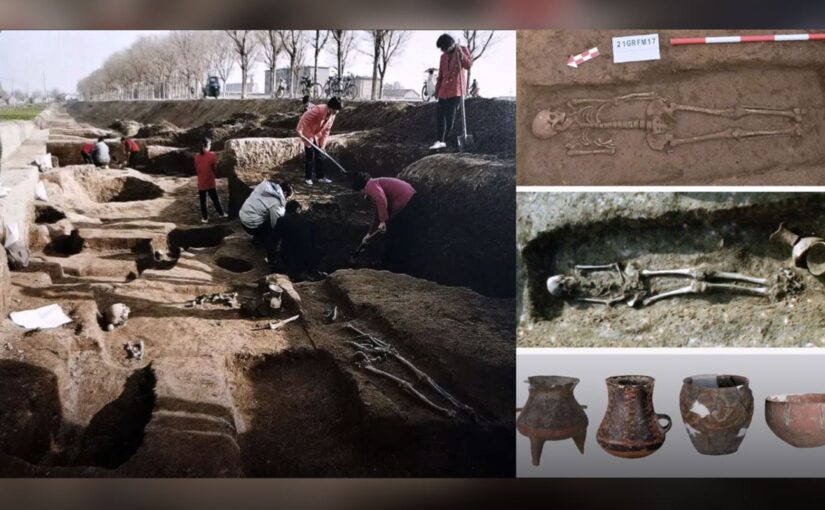
We are pleased to republish the following article by Ding Rui, originally published in the Chinese online magazine Sixth Tone, about a groundbreaking discovery at the Fujia archaeological site in Shandong, China.
The findings, published in Nature, provide the first genome-wide evidence of a prehistoric society organised around maternal lineage, dating back to 2750–2500 BCE.
Researchers from Peking University and the Shandong Provincial Institute of Cultural Relics and Archaeology analysed the remains of 60 individuals buried at two cemeteries linked to the Neolithic-era Dawenkou culture, known for advancements in pottery production. Through DNA analysis and radiocarbon dating, they found that while paternal Y-chromosome DNA varied significantly within burial groups, maternal mitochondrial DNA was nearly identical, strongly suggesting the communities centred on maternal ancestry.
Until now, the only confirmed ancient matrilineal society was the Chaco Canyon elite in North America (800–1300 AD). Fujia’s discovery significantly predates that and, according to Sun Bo, director of the Shandong Provincial Institute of Cultural Relics and Archaeology, it adds weight to the theories set forth in Friedrich Engels’ classic work, The Origin of the Family, Private Property and the State, written in 1884.
The discovery provides direct empirical evidence from East Asia for the theories proposed by (Lewis Henry) Morgan and (Friedrich) Engels. It holds great significance for understanding the roots of human civilisation.
Chinese scientists have uncovered the world’s first comprehensive genetic evidence of a prehistoric matrilineal society, offering fresh insight into the ongoing debate over whether fathers or mothers led early human civilizations.
Published Wednesday in the prestigious journal Nature, the study centers on the Fujia archaeological site in eastern China’s Shandong province, where researchers from the Shandong Provincial Institute of Cultural Relics and Archaeology and Peking University found that communities dating back more than 4,500 years were organized around maternal lineage.
“Previously, all reported ancient DNA studies indicated that prehistoric societies were organized based on patrilineal principles,” Ning Chao, an archaeologist at Peking University, told domestic media. “Genetic evidence for matrilineal societies could only be traced back as far as the Iron Age in Europe.”
However, the Nature article states that even evidence for matrilineality in these societies was suggestive, adding that “almost all genome-wide studies examining the Neolithic and Bronze Age periods to date have consistently supported patrilocality and patrilineality, and the existence and locations of matriliny in the remote or prehistoric past are still largely unknown.”
Continue reading Oldest matrilineal society unearthed in China