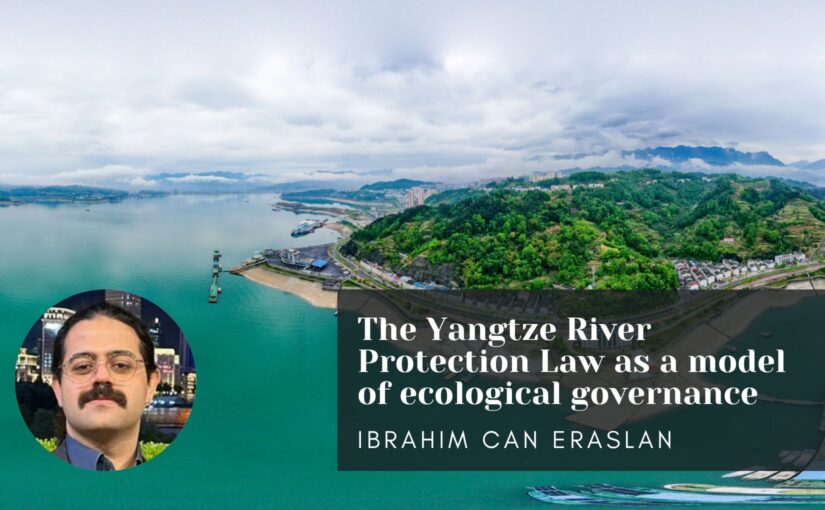
The Yangtze River Protection Law (YPL), enacted on March 1, 2021, is China’s first comprehensive river-specific legislation and a landmark in the country’s environmental governance.
The following article, submitted by İbrahim Can Eraslan, describes how, rooted in the concept of ecological civilisation and the principle of harmony between humanity and nature, the YPL seeks to balance economic growth with ecological protection. It addresses decades of industrial, agricultural, and developmental pressures that have degraded the Yangtze River Basin, aiming to integrate ecological restoration, sustainable resource use, and coordinated governance.
Key measures of the law include permanent fishing bans in critical waters, regulation of sand mining, navigation controls in sensitive zones, pollution control, and biodiversity restoration. The YPL also prohibits relocating polluting industries upstream, restricts hazardous chemical transport, and protects shoreline and wetland ecosystems.
As is increasingly the case in China, the YPL embeds environmental protection into economic and land-use planning. By combining detailed statutory provisions, cross-agency cooperation, public oversight and adaptive planning, the YPL creates a model of environmental governance which not only advances China’s ecological modernisation but also offers a potential blueprint for Global South nations confronting similar development–environment tensions.
The author is a Turkish socialist and postgraduate student of Chinese Law and Governance at Tongji University, Shanghai.
As stated in Xi Jinping’s article “Green Mountains and Clean Waters are also Gold and Silver Mountains”, while economic development and growth are prioritized, the environment should not be sacrificed for these goals[i]. Again, in Xi Jinping’s 2017 keynote speech at the opening ceremony of the Belt and Road Forum for International Cooperation, green development was emphasized[ii]. In the same speech, he called for strengthening cooperation in ecological and environmental protection and for building an ecological civilization while achieving the goals of the 2030 Agenda for Sustainable Development. Also in 2017, the Chinese government published the Guiding Opinions on Promoting Green Belt and Road Construction and the Belt and Road Ecological and Environmental Cooperation Plan. From all of these, it can be understood that while the Communist Party of China emphasizes development, the principle of “harmony between humans and nature” is adopted as a guiding concept in China’s path to modernization.[iii]
In terms of these principles, the Yangtze River carries significant importance. Following China’s economic reforms, the rapid development of industry and agricultural methods implemented to increase productivity have led to the pollution of the Yangtze. However, the Chinese government has taken significant protective steps in this regard, one of which is the Yangtze River Protection Law, a unique law exclusively dedicated to the protection of the Yangtze. In this sense, I believe that analyzing this law is important in terms of its potential to serve as a model for countries in the Global South.
There are seven laws related to the environment in China.[iv] Although the Constitution holds a different place within the legal hierarchy, special laws also have practical application in their respective areas. In essence, Article 26 of the Constitution of China directly mandates state action to protect and improve the living and ecological environment. It requires pollution control, afforestation, and forest protection. This is the most direct article in the Constitution concerning the environment and represents the principle of “ecological civilization.” On the other hand, Article 22 of the Constitution, by stipulating the protection of sites of scenic and historic importance, combines environmental and cultural elements under the umbrella of national identity. Articles 9 and 10 also form the constitutional backbone of environmental protection.
Continue reading The Yangtze River Protection Law as a model of ecological governance