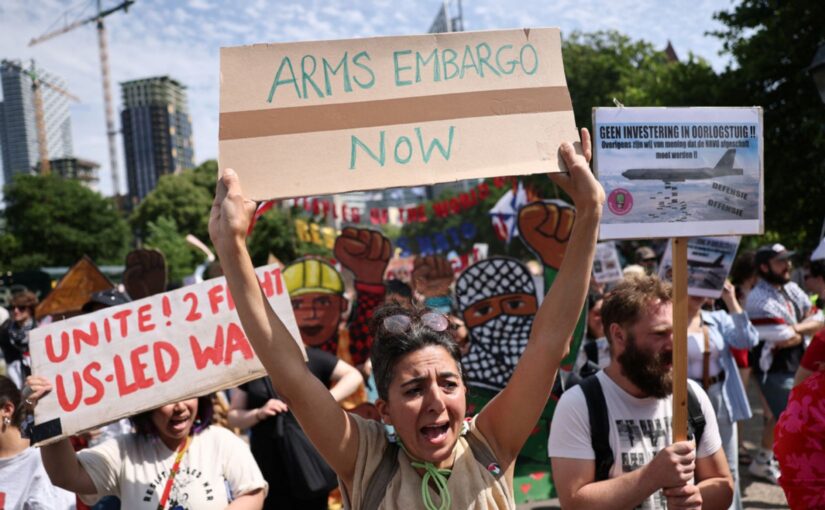
A nuclear free world is the answer to the war drive against China – Sophie Bolt

In the below article, which was originally published by China Daily on June 27, Sophie Bolt, the General Secretary of Britain’s Campaign for Nuclear Disarmament (CND), reports on the mood of the June 21-22 Hague summit, held to counter the 77th annual meeting of NATO, in which peace campaigners from over 17 countries participated.

Sophie notes that: “The NATO summit endorsed a higher defence spending of five percent of GDP in response to a demand made by US President Donald Trump. It is clear that all Trump is interested in is securing funding for his global war. As the largest security alliance in the world, NATO’s military spending amounted to $1,506 billion last year, which was 55 percent of the global military expenditure, according to the Stockholm International Peace Research Institute.”

Some key European members of NATO, including Britain, are recklessly whipping up international tensions to justify these huge spending hikes. The British government’s newly published Strategic Defence Review asserts a “landmark shift” in the UK’s nuclear weapons use and Britain has also reasserted its role within the trilateral AUKUS treaty with the US and Australia, pledging the construction of nuclear-powered submarines to be “shared” with non-nuclear weapons state Australia, which will only further increase tensions in the Asia Pacific.

According to Sophie: “Successive NATO Strategic Concepts characterise China as a strategic competitor and a threat to NATO’s interests, security and values. In short, European NATO states must pay for Trump’s global war drive against China… On the one hand, we face a future Europe bristling with even more nuclear weapons and the constant threat of nuclear confrontation with Russia. On the other hand, we see a global confrontation led by the US against China, which also risks nuclear conflict.”

Outlining the fightback, Sophie notes that: “Protests at US bases like RAF Lakenheath are growing in frequency, size and intensity. In April, hundreds of people from across the country, the US, Japan, the Republic of Korea and Europe took part in a debate and nonviolent protest at the base… The counter-summit in The Hague reflected this international solidarity and reasserted the need to build a nuclear-free world based on peace and global cooperation.”

Although it was billed as a demonstration against NATO’s “warmongering” and its huge military spending drive, the swelling opposition to Israel’s ongoing military operations in the Gaza Strip and to the bombing of Iran by Israel and the United States was clearly palpable.

A summit to counter the 77th annual meeting of NATO, a 32-nation security alliance, was held on Saturday and Sunday in The Hague, in which people from over 17 countries participated.

The NATO summit endorsed a higher defense spending of 5 percent of GDP in response to a demand made by US President Donald Trump. It is clear that all Trump is interested in is securing funding for his global war.

As the largest security alliance in the world, NATO’s military spending amounted to $1,506 billion last year, which was 55 percent of the global military expenditure, according to the Stockholm International Peace Research Institute.

Some European countries and key NATO members, like the United Kingdom, are recklessly whipping up international tensions to justify these huge spending hikes.

Over 800 billion euros ($928 billion) has reportedly been secured for a massive European rearmament program. New US B61-12″tactical” nuclear bombs — designed for use on the battlefield — are reported to be already forward-deployed to NATO bases across Europe.

Meanwhile, French President Emmanuel Macron’s nuclear deterrent proposal for Europe risks the deployment of Rafale jets armed with nuclear weapons in Poland — on Russia’s border.

UK’s Prime Minister Keir Starmer has put a NATO-first defense policy at the heart of his government’s political program.

The newly published Strategic Defence Review asserts a “landmark shift” in the UK’s nuclear weapons use “to war-fighting readiness to deter threats and strengthen security in the Euro Atlantic area”.

The UK reasserts its role within the trilateral AUKUS treaty with the US and Australia, pledging the construction of nuclear-powered submarines to be “shared” with nonnuclear weapons state Australia, which will only further increase tensions in the Asia Pacific.

The review also recommends “enhanced UK participation in NATO’s nuclear mission”. This reflects talks between Starmer and Trump regarding Britain’s purchase of nuclear-capable F-35A fighter jets, designed to launch the US B61-12 nuclear bombs. This increases the likelihood of these bombs being stationed at RAF Lakenheath in the UK, and also opens up the possibility of other US bases being upgraded.

While countries such as France and Germany have been trying to present the war drive as an alternative to Trump’s militarism, NATO Secretary-General Mark Rutte has made absolutely clear this is all about ensuring that US plans to shift toward Asia are “coordinated with European allies”. Successive NATO Strategic Concepts characterize China as a strategic competitor and a threat to NATO’s interests, security and values. In short, European NATO states must pay for Trump’s global war drive against China.

For those who participated in the debates at the counter-summit in The Hague over the weekend, there is great fear and outrage over the prospects of a possible nuclear war.

On the one hand, we face a future Europe bristling with even more nuclear weapons and the constant threat of nuclear confrontation with Russia. On the other hand, we see a global confrontation led by the US against China, which also risks nuclear conflict.

And Trump’s bombing of Iran indicates how dangerous the world can be under his leadership.

In response, there is an acceleration in the opposition to this disastrous direction. Hundreds of thousands of people took to the streets of Rome, Italy and the UK. It is estimated that some 300,000 took part in demonstrations — almost all supporting Palestine and voicing their concerns over strikes on Iran.

Alongside this growing opposition to the austerity accompanying militarism, there is also a rising opposition to Britain’s so-called special relationship with the US.

Polling shows an increasing opposition to US nuclear weapons being based in Britain — now at 61 percent of the population.

People rightly see the UK’s military alliance with the US as deeply dangerous that risks drawing us into more wars. At a time of heightened nuclear threats, stationing US nuclear weapons in Britain puts us all on the nuclear frontline.

There is also huge anger at the undemocratic nature of hosting US bases. There has been no debate in the British Parliament on whether the UK should host these nuclear bombs and absolutely no consultation with residents, who will be at immediate risk if there is a nuclear attack or nuclear accident.

Protests at US bases like RAF Lakenheath are growing in frequency, size and intensity. In April, hundreds of people from across the country, the US, Japan, the Republic of Korea and Europe took part in a debate and nonviolent protest at the base.

Certainly, the counter-summit in The Hague reflected this international solidarity and reasserted the need to build a nuclear-free world based on peace and global cooperation.
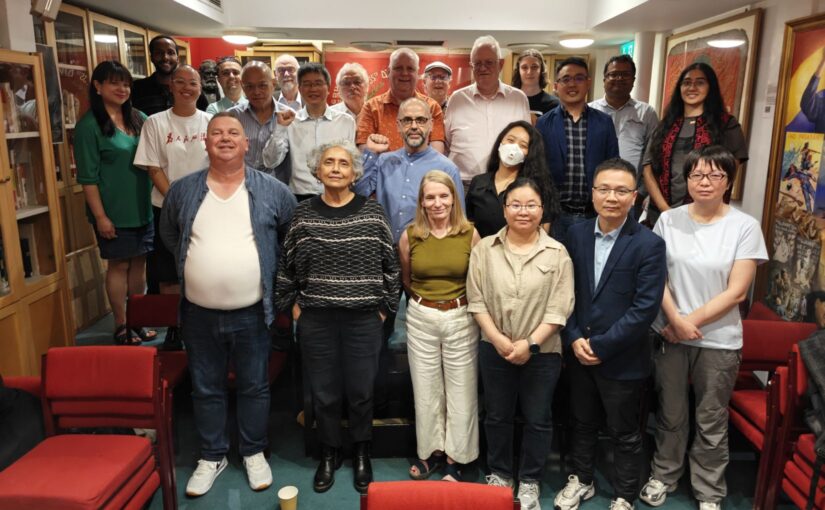
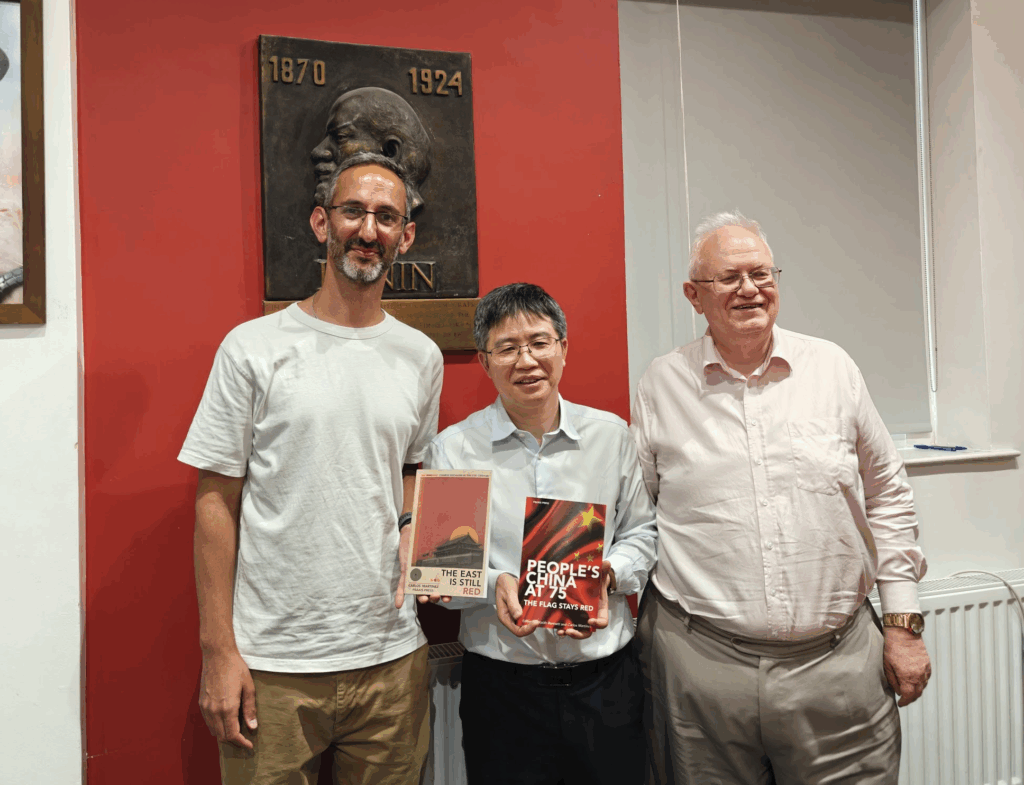
High-level delegation of Chinese Marxists visits London

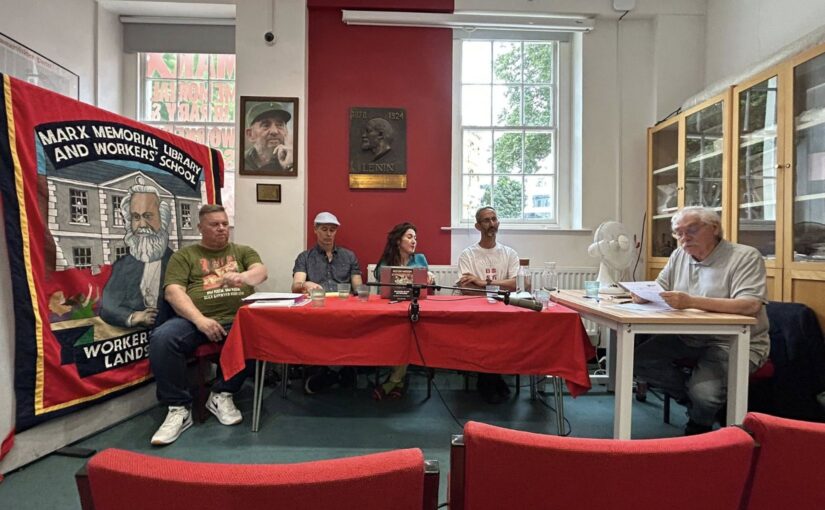
On 15 July 2025, Friends of Socialist China, in collaboration with the International Manifesto Group and the Communist Party of Britain, hosted a round-table discussion with a delegation from the Academy of Marxism at the Chinese Academy of Social Sciences (CASS) at London’s Marx Memorial Library.

Introducing the discussion, Friends of Socialist China co-editor Carlos Martinez noted that the Academy of Marxism is the leading Marxist think tank in China, and that it plays an important role in developing the ideological principles underpinning policymaking in China. He emphasised the importance of engaging with Chinese Marxists, who are making some of the most important contributions to the development of Marxism in the 21st century. Carlos also highlighted the need for people-to-people ties, at a time when Western governments are pursuing policies of containment, encirclement, decoupling and New Cold War.

The five delegates from CASS were led by Professor Chen Zhigang, Vice President of the Academy of Marxism, who gave a detailed presentation on the development of Chinese Marxism, stating that it’s because of Marxism that China has been able to achieve remarkable successes. Chen discussed the meaning and relevance of Xi Jinping Thought, as the latest development of Marxism in China; a Marxism adapted to the conditions prevailing in the 21st century and the array of new challenges that present themselves.

Professor Chen pointed to what should be a well-understood and obvious truth: that as society develops, theory must develop along with it. “If Marxism does not evolve, its vitality will be limited”. He also noted that Socialism with Chinese Characteristics has thrived by combining Marxist ideas with Chinese culture and traditions, hence Chinese people do not think of Marxism as a foreign phenomenon.

Regarding the global applicability of Xi Jinping Thought, Chen said that China seeks to offer Chinese wisdom towards the solution of problems of global governance. The concept of a Global Community of Shared Future, the Belt and Road Initiative, the Global Development Initiative, the Global Civilisation Initiative and the Global Security Initiative are all based on the principles of mutual learning, exchanges and dialogue, and all seek to promote peace, sustainability, development, cooperation and friendship.

The discussion then opened up to the 20 British participants. There was a rich and lively exchange of ideas, with contributions on topics including how to cultivate a new generation of Marxist thinkers; the need to overcome dollar hegemony; the significance of the concept of Common Prosperity; the relevance of China’s development model for the Global South; China’s foreign policy; the need to develop a more profound understanding of Chinese socialism in the West; and the reasons why socialist revolution has succeeded first in relatively underdeveloped countries rather than the advanced capitalist countries of Western Europe and North America.

Following the discussion, the CASS delegation was given a tour of the Marx Memorial Library, after which the delegates joined the British comrades for a dinner at Hiba Palestinian restaurant in London.

The following is a short report by Bhabani Shankar Nayak, who participated in the discussion.

An Evening with Chinese Comrades in London

As dusk settled over the cloudy British sky above London, summer humidity lingered in the air, clinging to the busy streets and concrete jungle of a decadent city shaped by colonial legacies, capitalist wealth and imperialist power. A few drops of rain brought a sense of calm to a mind otherwise clouded by the busyness of the day. Comrades gathered to reflect on developments in China, aiming to demystify the anti-Chinese propaganda that seeks to undermine the revolutionary achievements of the Chinese people and to expose the hypocrisy of Western capitalist development models, which prioritise profit over people.

The media trials and various forms of anti-Chinese propaganda reveal the racist, colonial, capitalist and imperialist character of American, British and European capitalism and their ruling elites. They prefer to see China as merely the world’s factory and the Chinese people as passive workers, incapable of developing revolutionary consciousness for their own emancipation. As a result, Western media and its backers promote fraudulent and illiberal visions of democracy, wrapped in the illusion of individual freedom and the delirium of the American Dream.  In contrast, the Chinese system promotes a form of decentralised working-class democracy that guides China’s unique path of democratic, socialist and peaceful development. At the heart of this system—led by the Communist Party of China—is the pursuit of human emancipation from poverty, hunger, homelessness, illiteracy, unemployment, insecurity, and everyday risks.

On 15th of July 2025, Friends of Socialist China in the UK, led by Comrade Carlos Martinez and Comrade Keith Bennett, organised a roundtable at the Marx Memorial Library in London. The event brought together comrades, researchers, and professors from the Institute of Marxism at the Chinese Academy of Social Sciences (CASS)—a research institution established by the Communist Party of China (CPC) in 2005. Comrade Professor Chen Zhigang, Vice President of the Institute, led the discussion, offering valuable insights into the workings of the CPC and its role in China’s development. He addressed the challenges facing rural development in China and elaborated on the concept of socialism with Chinese characteristics, the guiding principles of Xi Jinping thoughts, and its fundamental opposition to the Western model of globalisation and imperialist agendas. Professor Chen advocated for a model of inclusive globalisation that benefits all nations.

Throughout the discussion, he reiterated China’s commitment to building an ecological civilisation grounded in world peace and inclusive development. Comrade Han Dongjun translated Professor Chen’s remarks, while comrades Liu Yan, Fang Tao, and Zhuo Mingliang highlighted various achievements of China under the leadership of the CPC.

During the roundtable, comrades from the UK posed a range of ideological questions on various issues, which were thoughtfully addressed by the delegates from CASS. The discussion concluded with a shared commitment to developing and coordinating a new generation of Marxist thinkers, intellectuals, and organisations dedicated to the empowerment and emancipation of working people around the world. It was agreed that more such exchanges should be organised to help the Western left gain a deeper understanding of Chinese socialism and its revolutionary praxis.

The roundtable concluded at the Hiba Restaurant in Holborn, where the Chinese comrades shared their revolutionary praxis in a relaxed social setting over generous portions of Palestinian and Lebanese food, accompanied by Gaza Cola drinks, real ales, and a few bottles of white and red wine. The Chinese comrades represented a range of age groups and held various political and professional positions within their organisational hierarchy. Yet, there was absolutely no observable power distance among them. They interacted with one another as equals—with warmth, confidence, and camaraderie—sharing food and conversation as comrades and friends. This experience laid bare the hollowness of Hofstede’s cultural dimensions, which are widely taught in universities around the world. These frameworks are not only flawed but stem from a supercilious, Eurocentric misreading of Chinese society, politics, and culture. The revolutionary praxis of the Communist Party of China has transformed a historically feudal, unequal and poverty ridden society into one that is modern, progressive, prosperous, and fundamentally egalitarian.

This revolutionary praxis has enabled China to emerge as a bankable state for the working poor in both rural and urban areas, while offering emancipatory hope to working people around the world. From toys to supercomputers, from agricultural science to space technology, from needles to iPhones, and from modern medicine to traditional and alternative health practices, China’s development demonstrates that there is a viable alternative to capitalism, imperialism, and their hegemonic control over people and the planet. Yet, imperialist powers and their capitalist regimes remain determined and working actively every day to undermine China, its people, and their revolutionary achievements.

As the evening came to an end and we prepared to leave Hiba Restaurant, Comrade Professor Chen and Comrade Zhuo Mingliang warmly wished, “Goodbye, comrade,” followed by the words, “Long live Indo-China friendship.” This self-reflective, harmonious and memorable evening with Chinese comrades in London renewed the collective commitment to the revolutionary and emancipatory politics of the working class—and to the belief in its potential to offer a genuine alternative to racialised capitalism and its warmongering, imperialist hegemony, which undermine peace and disempower people. In contrast, China stands as a model of peaceful and progressive development, dedicated to the empowerment and emancipation of working people.

Vietnam to honour China and other traditional friends on 80th national day

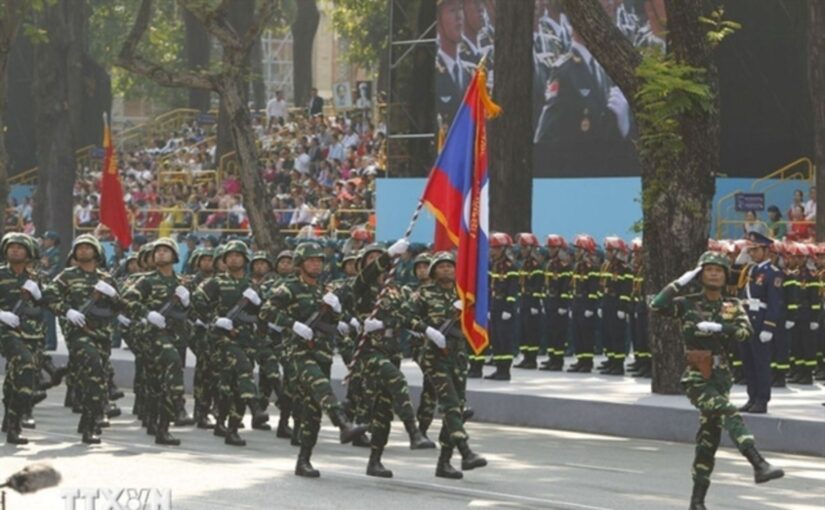
Vietnam’s National Defence Ministry has invited the military of five countries – Russia China, Laos, Cambodia, and Belarus – to join the parade in the ceremony marking the 80th August Revolution Day and the 80th National Day, to be held on September 2 in the capital Hanoi.

The ministry has also sent invitations to defence ministers of eight countries – Russia, China, Laos, Cambodia, Cuba, Belarus, Kazakhstan and Azerbaijan – to attend the ceremony, according to Deputy Minister, Senior Lieutenant General Hoang Xuan Chien.

The Vietnam News Service reported on July 10 that the invitation of military units to participate in the parade is a gesture of friendship, solidarity and the close bonds between the people and army of Vietnam and their traditional allies and further noted that on the occasion of the 50th anniversary of the liberation of the South and National Reunification (April 30 2025), the defence ministries of China, Laos and Cambodia sent military personnel to take part in the parade held in Ho Chi Minh City. This was the first time for Vietnam to invite foreign troops to participate in a national military parade.

Also on July 10, the defence ministry held a meeting with relevant bodies to expedite the construction of a monument dedicated to the soldiers from foreign countries who supported Vietnam during its resistance wars, to be located at the Vietnam Military History Museum.

The memorial complex will include a general symbol commemorating the support and sacrifices of foreign military experts, made of bronze and designed by Vietnam, as well as separate monuments honouring military experts from the Soviet Union/Russia, China, Laos, Cambodia and Cuba, also made of bronze, that will be either designed and constructed by the respective countries or by Vietnam upon request, and a greenstone relief designed and built by Vietnam.

The following article was originally published in Vietnam News.

HÀ NỘI — Việt Nam’s National Defence Ministry has invited the military of five countries – Russia, China, Laos, Cambodia, and Belarus – to join the parade in the ceremony marking the 80th August Revolution Day and National Day on September 2 in Hà Nội.

The ministry has also sent invitations to defence ministers of eight countries of Russia, China, Laos, Cambodia, Cuba, Belarus, Kazakhstan and Azerbaijan to attend the ceremony, according to Deputy Minister, Senior Lieutenant General Hoàng Xuân Chiến.

So far, Cuba has responded to the invitation, confirming that the Minister of the Revolutionary Armed Forces of Cuba will attend the ceremony.

Laos and Cambodia have also expressed their support for the initiative to send military forces to participate in the parade at the celebration, as per Việt Nam’s invitation.

The invitation of military units to participate in the parade is a gesture of friendship, solidarity and close bonds between the people and army of Việt Nam and its traditional allies.

The move also reaffirms Việt Nam’s foreign policy of independence, self-reliance, diversification and multilateralism — being a reliable partner and friend to all nations.

Previously, on the occasion of the 50th anniversary of the Liberation of the South and National Reunification (April 2025), the defence ministries of China, Laos and Cambodia sent military personnel to take part in Việt Nam’s military parade.

On the same day, the defence ministry held a meeting with agencies and units to implement the construction of a monument dedicated to the soldiers from foreign countries who supported Việt Nam during its resistance wars, to be located at the Việt Nam Military History Museum.

This commemorative project carries great significance, paying tribute to foreign military experts and soldiers who assisted Việt Nam in its wars of national liberation.

The memorial complex will include a general symbol commemorating the support and sacrifices of foreign military experts, made of bronze and designed by Việt Nam; separate monuments honouring military experts from the Soviet Union/Russia, China, Laos, Cambodia and Cuba, also made of bronze that will be either designed and constructed by the respective countries or by Việt Nam upon request; and a greenstone relief designed and built by Việt Nam.

The area surrounding the monument will be landscaped with trees and grass lawns.

Chiến has instructed that construction progress be expedited. The first group of statues must be completed before August 15, while the entrance and central exhibition area should be finished by August 10.

Interview: Lessons from China

The video below features a discussion between KJ Noh and Carlos Martinez, originally aired on BreakThrough News on 9 July 2025, about China’s development and its role in the world.

KJ and Carlos discuss the recent Friends of Socialist China delegation to China; the US and China’s contrasting visions for the world (‘clash of civilisations’ vs the Global Civilisation Initiative); living standards in China and the West; increasing poverty, repression, racism and xenophobia in Britain and the US; the reasons for US hostility towards China; China’s world-historic successes in tackling extreme poverty and building renewable energy and advanced infrastructure; the relationship between capital and political power in China and the West; and the relationship between the US-Israeli criminal war on Iran and the ongoing campaign to encircle and contain the People’s Republic of China.

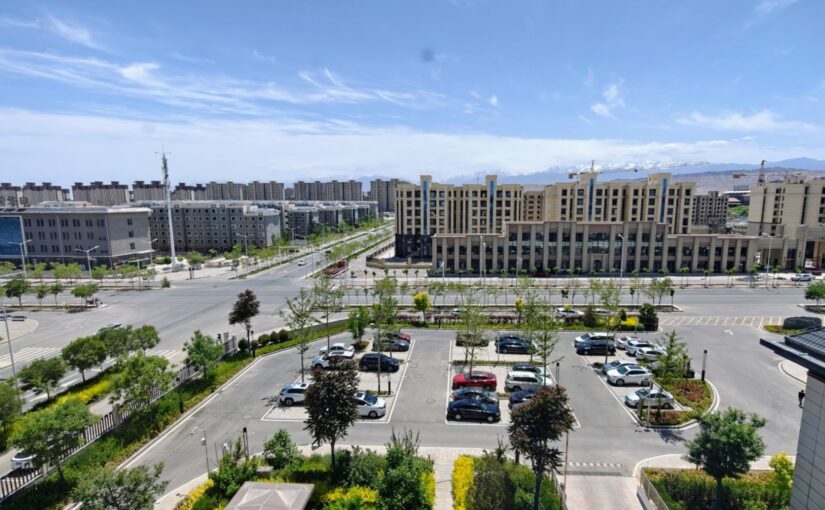
Jiayuguan – the socialist future today

In the following article, which was originally published in the Morning Star under the title ‘China’s socialism succeeds where Eastern European failed’, Pawel Wargan, Political Coordinator at the Progressive International, writes movingly about his recent visit to Jiayuguan, a ‘steel city’ in western China’s Gansu province, contrasting this prosperous and civilised socialist community to the dystopian fate of similarly conceived projects in his native Poland and other formerly socialist countries.

Pawel writes that, “those of us who were born on the ruins of the socialist Eastern Bloc know how purpose-built, industrial ‘monotowns’ are meant to look. Rusting steel mills, cracked and potholed roads, weathered sheets of corrugated metal strewn about. Thick smog and poisoned soil. Drunks passed out on the train platform. Emaciated stray dogs. A lone child skipping down the muddy path of a panel-block neighbourhood silenced by demographic blight.”

All this, he notes, serves to “beat down the idea that socialism can produce anything but misery. And they have become so firmly embedded in the popular imagination that, for many, it is difficult to believe otherwise.”

Yet Poland’s Nowa Huta, the sprawling Krakow neighbourhood built around the Vladimir Lenin Steelworks; Russia’s Magnitogorsk, built around its eponymous Iron and Steel Works; or Germany’s Eisenhuttenstadt, established by the socialist German Democratic Republic around a major steel mill, also served as a template for the dignified life that communism envisioned for all working people. However, capitalist restoration shattered their ambitions.

Pawel continues: “How might these cities look today had the process of socialist construction continued uninterrupted? I found one possible answer in Jiayuguan, a remote desert city in China’s Gansu Province built from the ground up around a steel plant.”

The Jiuquan Iron and Steel Corporation (JISCO) was founded in 1958 as part of revolutionary China’s ambitious drive to establish the basis of a modern, industrialised economy. “It was a gruelling effort… Workers who came to the region dug the earth with their hands, trudged through waist-high mud, and carried heavy equipment on their backs. They faced the desert’s biting cold and punishing heat.”

But now, where once there was desert stands China’s fourteenth-largest steel producer. It has an annual capacity of over 11 million tons of crude steel – double the total steel-making capacity of Britain. And the state-owned enterprise has expanded its activities far beyond metals, to agricultural products and industrial manufacturing equipment, packaging and logistics, housing and healthcare, education and even wine, boasting the largest wine cellar in Asia. JISCO also manages the city’s power grid. Its Smart Grid and Localised New Energy Consumption Demonstration Project, powered almost entirely by artificial intelligence, automatically distributes energy, optimising for consumption patterns in real-time, thereby decoupling growth from energy use.

Therefore, he concludes: “Jiayuguan offered proof that the images of decay and despair that many have come to associate with industrial cities in Eastern Europe were not products of their socialist past, but symptoms of their capitalist present.”

Pawel visited Jiayuguan as part of an international delegation organised by the China NGO Network for International Exchanges (CNIE) and Friends of Socialist China that visited China between 25 May and 5 June 2025.

Those of us who were born on the ruins of the socialist Eastern Bloc know how purpose-built, industrial “monotowns” are meant to look.

Rusting steel mills, cracked and potholed roads, weathered sheets of corrugated metal strewn about. Thick smog and poisoned soil. Drunks passed out on the train platform. Emaciated stray dogs. A lone child skipping down the muddy path of a panel-block neighbourhood silenced by demographic blight.

Continue reading Jiayuguan – the socialist future today

As Trump threatens BRICS, it grows stronger, resisting US dollar and Western imperialism

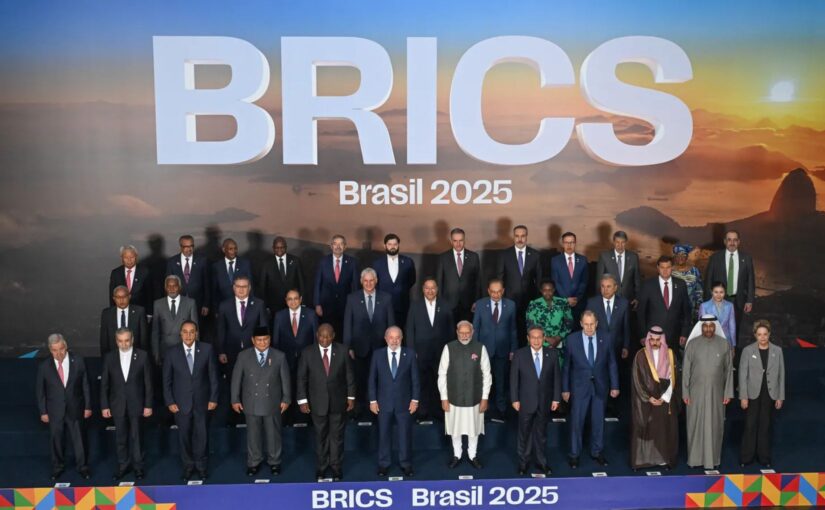
In the following article, which was originally published on his Geopolitical Economy website, Beijing-based US journalist and political analyst, Ben Norton assesses the impact and significance of the 17th BRICS Summit, which was held July 6-7 in the Brazilian city of Rio de Janeiro.

Ben notes that, among his daily plethora of crude threats to sovereign nations, US President Donald Trump had recently threatened to impose 100% tariffs on the members of BRICS and then claimed that the Global South economic cooperation mechanism was “dead” as a result.  However, it is growing, currently with 10 members and 10 partners, as well as a number of observers participating in the summit, where measured steps towards a process of ‘dedollarisation’ ranked high on the agenda.  

The Rio Summit was historic not least in the participation of socialist Vietnam and Cuba among the new category of formal partner countries. Ben observes: “This was symbolic, given that Cuba has suffered under illegal US sanctions and a devastating blockade for more than 60 years.”

He adds that, despite the country’s proximity to, and economic integration with, the United States: “Mexico’s progressive President Claudia Sheinbaum sent Foreign Secretary Juan Ramón de la Fuente to Brazil to participate, even though Mexico is not…  a member or partner of BRICS.”

The steady progress of BRICS (to paraphrase the US writer Mark Twain reports of its death were clearly exaggerated) again riled the short-fused US President, who threatened its members with an additional 10% in tariffs – for Trump watchers evidently something of a climbdown from the previously threatened 100%.

This new threat brought a stinging rebuke from Brazil’s President Lula: “The world has changed. We don’t want an emperor.”

Trump also bizarrely cited Spain as a “BRICS nation”, which, in this case, he threatened with 100% tariffs. Spain is neither a member nor a partner of BRICS, which is exclusively made up of members of the Global South. Indeed, it is a NATO ally of the United States. Its social democratic government has, however, enraged Trump by condemning the Israeli genocide in Gaza, being the sole NATO member to outright refuse Trump’s demand to increase defence spending to 5% of GDP and insisting on maintaining positive relations with China.

In the following days, Trump further escalated his feud with Brazil by leaping to the defence of his fascist friend, former President Jair Bolsonaro, who is facing trial on charges of attempting a coup following his 2022 election defeat, a case with certain echoes of the violent attempt to overturn the result of the 2020 presidential election in the United States.

Lula reacted furiously to Trump’s attempt to help his fellow putschist by threatening Brazil with additional tariffs at 50%. The financial news service Bloomberg reported:

“President Luiz Inacio Lula da Silva insisted Brazil can survive without trade with the US and will look to other partners to replace it, a sharp response to Donald Trump after the American leader threatened 50% tariffs against the nation.

“‘We’re going to have to look for other partners to buy our products. Brazil’s trade with the US represents 1.7% of its GDP,’ Lula said in a broadcast interview with Record TV… ‘It’s not like we can’t survive without the US.’

“The Brazilian also said countries like his are not obliged to continue using the dollar to trade, reiterating remarks he made at last weekend’s BRICS summit in Rio de Janeiro that he acknowledged ‘likely worried Trump.’

“‘We are interested in creating a trade currency among other countries,’ Lula said in the Record interview. ‘I’m not obligated to buy dollars to conduct trade with Venezuela, Bolivia, Chile, Sweden, the European Union, or China. We can trade in our own currencies.’”

Continue reading As Trump threatens BRICS, it grows stronger, resisting US dollar and Western imperialism

China and DPRK mark treaty anniversary

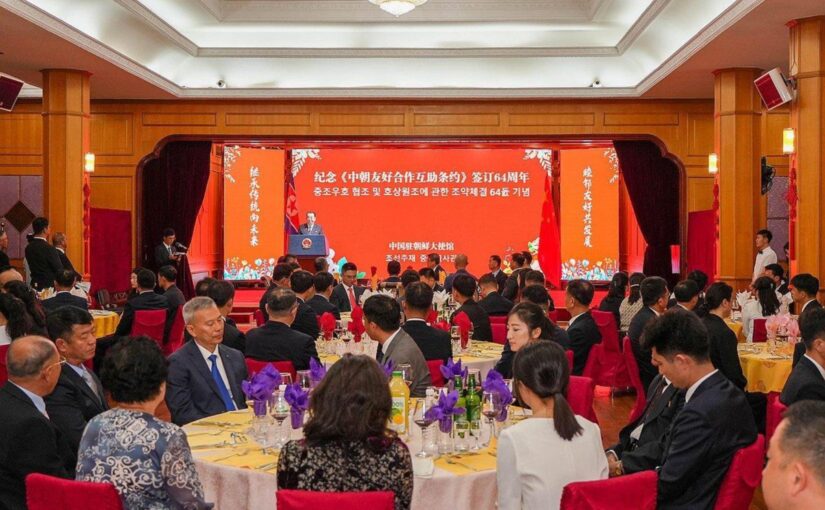
The 64th anniversary of the signing of the China-DPRK (Democratic People’s Republic of Korea) Treaty of Friendship, Cooperation and Mutual Assistance was celebrated in Pyongyang and Beijing on July 8th and 10th respectively.

The Xinhua News Agency reported that, addressing the reception held at his embassy, Chinese Ambassador to the DPRK Wang Yajun said that the treaty embodies the friendship the two peoples built with their blood in the process of resisting foreign aggression and striving for national independence and liberation and lays a solid legal and political foundation for the long-term development of bilateral relations.

He added that at the moment when changes in the global landscape unseen in a century are going deeper, highlighted by intertwined chaos and ever emerging risks and challenges, it is of great significance to well implement the spirit of the treaty and well develop bilateral ties.

In his address at the event, Kang Yun Sok, Vice Chairman of the Standing Committee of the Supreme People’s Assembly of the DPRK, said that the bilateral treaty lays a solid legal foundation for the continuous consolidation and development of the friendly and cooperative relations between the DPRK and China amid any changes and challenges.

The DPRK-China friendship was jointly forged by the two countries’ older generations of leadership in striving to fight imperialism, achieve independence and build socialism, he said, noting that it is the DPRK’s unwavering stance to pass on and deepen the friendship with China from generation to generation.

The Korean Central News Agency (KCNA) also carried a report on the reception.

China’s People’s Daily reported that Wang Dongming, Vice Chairman of the Standing Committee of the National People’s Congress (NPC), attended a reception on July 10 to commemorate the 64th anniversary of the signing of the treaty hosted by DPRK Ambassador to China Ri Yong Nam.

KCNA noted the large number of Chinese institutions who participated in the reception.

On July 11, People’s Daily carried a commentary saying that: “On July 11, 1961, Premier Zhou Enlai and Prime Minister Kim Il Sung jointly signed the Sino-DPRK Treaty of Friendship, Cooperation and Mutual Assistance in Beijing. This important document has laid a political and legal foundation for the development of friendly and cooperative relations between the two countries and embodies the common desire of the two sides to inherit and carry forward the traditional friendship and safeguard regional peace.

It added: “In recent years, General Secretary Xi Jinping and General Secretary Kim Jong Un have maintained close exchanges and interactions through various forms, leading and promoting the traditional friendly and cooperative relations between China and the DPRK into a new historical period. China and the DPRK have adhered to the original aspiration of friendship for generations, strengthened strategic communication, exchanges and cooperation, firmly supported each other, and safeguarded the common interests of the two countries, fully demonstrating the unbreakable and vigorous vitality of the traditional friendship between China and the DPRK.”

Under the leadership of the Workers’ Party of Korea (WPK) headed by General Secretary Kim Jong Un, it continued, the DPRK people have actively implemented the spirit of the previous plenary sessions of the Central Committee of the WPK and comprehensively promoted all work of socialist construction. As a good comrade and good neighbour, the Chinese side sincerely wishes that the fraternal DPRK people will continue to make new and greater achievements in the cause of socialist construction.

This year marks the 80th anniversary of the victory of the Chinese People’s War of Resistance Against Japanese Aggression and the World Anti-Fascist War. During the arduous war years, the peoples of China and the DPRK supported each other, fought side by side, and made important contributions to the just cause of humanity. It is the firm stand of the Chinese party and government to maintain, consolidate and develop China-DPRK relations.

The following articles were originally published by the Xinhua News Agency and People’s Daily. The People’s Daily commentary was published in Chinese and has been machine translated.

Chinese embassy marks 64th anniversary of signing of China-DPRK friendship treaty

PYONGYANG, July 10 (Xinhua) — The Chinese Embassy in Pyongyang on Wednesday held a reception to commemorate the 64th anniversary of the signing of the China-DPRK Treaty of Friendship, Cooperation and Mutual Assistance.

Over 130 diplomats and officials from both sides attended the event.

Addressing the reception, Chinese Ambassador to the DPRK Wang Yajun said the bilateral treaty is a document of historical significance as well as a monument marking the friendship between China and the DPRK.

Continue reading China and DPRK mark treaty anniversary

Panda progress: biodiversity protection and wildlife conservation in China

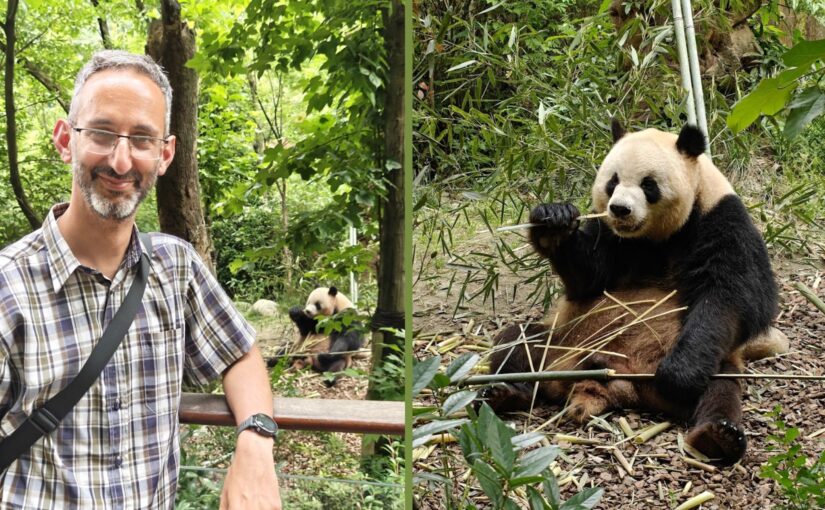
In the week before the start of our recent delegation, Carlos Martinez joined fellow Friends of Socialist China co-founder Danny Haiphong on a tour of Chongqing and Chengdu organised by Beijing Review. One of the visits organised by our hosts was to the Chengdu Research Base of Giant Panda Breeding.

In the article below, originally published in Beijing Review, Carlos reflects on the visit, and highlights how decades of conservation efforts – such as habitat protection, scientific breeding, and the creation of national parks – have led to a near doubling of the wild panda population, as a result of which their status has been upgraded from ‘endangered’ to ‘vulnerable’.

The article notes that China’s biodiversity efforts go well beyond pandas. The country has launched protection programs for other endangered species like the Tibetan antelope and Siberian tiger, while expanding afforestation on a massive scale. Forest coverage has doubled over the past 40 years, and projects like the Green Great Wall have successfully contained desertification, including surrounding the vast Taklimakan Desert with a 3,000-km green belt.

China’s ecological vision is grounded in both traditional philosophy and modern socialist governance. Its concept of ecological civilisation emphasises harmony between humans and nature, and has enabled large-scale environmental progress through the deployment of vast resources and people-centred economic planning.

China also promotes international cooperation on biodiversity protection. It supports Africa’s Great Green Wall, partners with Kenya on biodiversity research, and collaborates with Brazil on satellite monitoring of the Amazon, among other examples. At the 2024 G20 Summit, President Xi reaffirmed China’s commitment to helping developing nations pursue sustainable development, calling for the G20 “to support developing countries in adopting sustainable production and lifestyle, properly responding to challenges like climate change, biodiversity loss and environmental pollution, enhancing ecological conservation, and achieving harmony between human and nature.”

Carlos describes how China is leading the way in ecological conservation and proving that large-scale biodiversity protection is both achievable and essential.

On May 21, I visited the Chengdu Research Base of Giant Panda Breeding in Chengdu, capital of the southwestern Chinese province of Sichuan. The panda sanctuary was truly impressive: vast and lush. The pandas appear happy and healthy, enjoying a huge area in which to roam freely and consume the abundant bamboo supply. Staff are clearly very dedicated to the animals’ care.

China has emerged as a global leader in wildlife conservation. In 1979, the World Wildlife Fund became the first international conservation organization to sign a cooperation agreement with China. Since that time, China’s wild giant panda population has almost doubled (to just under 2,000), thanks to extensive breeding, conservation and reforestation efforts, along with scientific advancements. Additionally, the Giant Panda National Park, consisting of 67 nature reserves and covering a vast 27,134 square km, was opened in 2020 with the express purpose of protecting the panda population.

As a result of all these efforts, the giant panda’s status has been downgraded from “endangered” to “vulnerable” on the International Union for Conservation of Nature’s Red List of Threatened Species.

China has also in recent decades strengthened protection of several other endangered species—including the Siberian tiger, Amur leopard, Tibetan antelope and Hainan gibbon—through habitat protection, artificial breeding and cultivation, and reintroduction to nature. Former UNESCO Director General Irina Bokova has said that China’s efforts in ecological protection and restoration “echo profoundly with the concept of sustainable development embodied in the United Nations Agenda 2030 (Adopted in 2015, this is a global action plan to achieve 17 Sustainable Development Goals (SDGs) by 2030—Ed.), in whose implementation China is emerging as a leader.”

Importance of biodiversity

Action on wildlife conservation and biodiversity protection is essential for a healthy planet and for human wellbeing. Balanced, thriving ecosystems contribute to climate regulation, agricultural production, pollination, nutrient cycling, medicine development, disease control, pest control and much more. Healthy ecosystems are better placed to withstand stresses such as flooding, extreme heat and invasive species, and to adapt to environmental change. As prominent British data scientist Hannah Ritchie points out in her 2024 book Not the End of the World, “From the food we eat and the fresh water we drink to the regulation of the climate: we are dependent on the balance of species around us.”

Chinese President Xi Jinping, when visiting a wildlife sanctuary in Zimbabwe in December 2015, phrased it well, “Wildlife plays a crucial role in the intricate web of life on Earth, contributing substantially to the natural ecological system. The wellbeing of these creatures is intricately intertwined with the sustainable development of humanity.”

Unfortunately, biodiversity is under severe threat as a result of climate change, deforestation, habitat loss and pollution. Scientists estimate that species loss is occurring at over 1,000 times the rate it would without human activity. Therefore, the UN SDGs include a call for governments around the world to “take urgent and significant action to reduce the degradation of natural habitats, halt the loss of biodiversity and protect and prevent the extinction of threatened species.”

Continue reading Panda progress: biodiversity protection and wildlife conservation in China

Venezuela expo boosts development and friendship

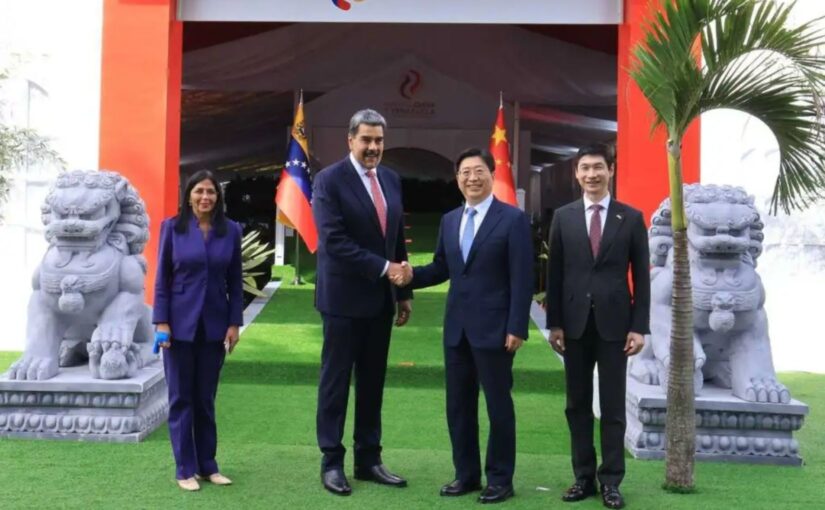
Venezuelan President Nicolás Maduro and Vice President Delcy Rodríguez visited the Great China-Venezuela Expo, held in La Carlota, Miranda state, on July 4.

The event, whose motto was “Building a Splendorous Future,” was held to coincide with the 51st anniversary of the establishment of diplomatic relations between Venezuela and China.

Three agreements were signed: On the delivery and reception of the donation of supplies for the protection of water resources granted by China to Venezuela; A technological cooperation agreement; and one with the China Development Bank.

President Maduro explained that significant investments were discussed with the China Development Bank “for the development of agriculture, agroindustry, aquaculture, and investments in the hydrocarbons sector for the production of oil, gas, and the development of petrochemicals and the refining industry.”

A memorandum of understanding was also signed with China’s iFlutek to jointly develop AI technology. iFlutek develops voice recognition and artificial intelligence technologies, and the agreement is expected to provide Venezuela with advanced solutions in key sectors such as education, health, agriculture, energy, and telecommunications.

President Maduro highlighted the importance of an agreement between “a world leader in technology and the Bolivarian Republic of Venezuela to develop Venezuelan artificial intelligence, sovereign, and at the highest level of the alliance with the People’s Republic of China.”

“This expo is one more step towards a future of shared prosperity,” he said, and pointed out that the relations with China are an example that another world is possible and that the first power in the world is now the People’s Republic of China.

The following article was first published in Spanish by Ultimas Noticias.  This English translation was originally carried by Orinoco Tribune.

Venezuela President Nicolás Maduro attended the Great China-Venezuela Expo being held in La Carlota, Miranda state. This event, whose motto is “Building a Splendorous Future,” is being held on the 51st anniversary of the establishment of diplomatic relations between Venezuela and China.

On Friday, July 4, three agreements were signed between the two countries. The first one was on the delivery and reception of the donation of supplies for the protection of water resources granted by China to Venezuela. The second one was a technological cooperation agreement, and the third one was with the China Development Bank.

Investment in the hydrocarbons sector

President Maduro explained that significant investments were discussed with the China Development Bank “for the development of agriculture, agroindustry, aquaculture, and investments in the hydrocarbons sector for the production of oil, gas, and the development of petrochemicals and the refining industry.”

He also reported that investments for the development of infrastructure for the electricity supply service, transportation, and science and technology were discussed.

Artificial intelligence

A memorandum of understanding was also signed with China’s iFlutek to jointly develop AI technology.

iFlutek develops voice recognition and artificial intelligence technologies, and the agreement is expected to provide Venezuela with advanced solutions in key sectors such as education, health, agriculture, energy, and telecommunications.

President Maduro highlighted the importance of an agreement between “a world leader in technology and the Bolivarian Republic of Venezuela to develop Venezuelan artificial intelligence, sovereign, and at the highest level of the alliance with the People’s Republic of China.”

“Venezuela enters through the front door in the vanguard in the development of artificial intelligence,” he emphasized.

He highlighted that China and Venezuela have built a relationship based on complementarity and mutual respect. “This expo is one more step towards a future of shared prosperity,” he said.

He stressed that it is a “great brotherhood in conditions of respect,” relations that have been strengthened with China.

At the event, President Maduro was accompanied by Vice President Delcy Rodríguez (who chairs the China-Venezuela High-Level Commission). They toured alongside the Chinese delegation various booths and halls where the agreements and alliances between the two nations were reviewed.

President Maduro pointed out that the relations with China are an example that another world is possible and that the first power in the world is now the People’s Republic of China.

Vice President Delcy Rodríguez highlighted the self-determination and sovereignty of both countries that maintain relations within the framework of respect.

“I thank President Xi Jinping for all his support, all his solidarity, for his constant encouragement at all junctures. I thank the President of the China Development Bank, Comrade Tang, for this visit, which marks a new beginning, a new start of a splendid relationship,” said President Maduro.

For his part, the Chinese ambassador to Venezuela, Lan Hu, said that it is necessary to expand pragmatic cooperation and further strengthen cultural and human ties.

He noted that the expo opens the opportunity to boost bilateral cooperation even further.

“For more than half a century, bilateral coordination has achieved significant development in all areas. Despite international adversities, we have supported each other, defending international equity and justice and the rights of the countries of the Global South,” he said.

“Understanding and respect for political systems and development philosophies have prevailed,” he said, asserting that over 50 Chinese companies from different sectors are present at the fair. “Products, materials, and services are exhibited, and the bilateral relationship is very dynamic,” he added.

The expo: Building a Splendorous Future

Those who visit the Great Expo will be able to appreciate commercial exhibitions of Venezuelan-Chinese products and services, business rounds to strengthen bilateral investment, and cultural presentations.

The Great China-Venezuela Expo “Building a Splendorous Future” aims to be a symbol of friendship and progress, laying the groundwork for new growth opportunities for the benefit of the peoples of both nations.

The main events will be held on July 5-6 at the Simón Bolívar Park in La Carlota. They will showcase the progress in bilateral cooperation and explore opportunities in key sectors such as technology, energy, trade, and infrastructure.

China and Brazil stress high quality cooperation

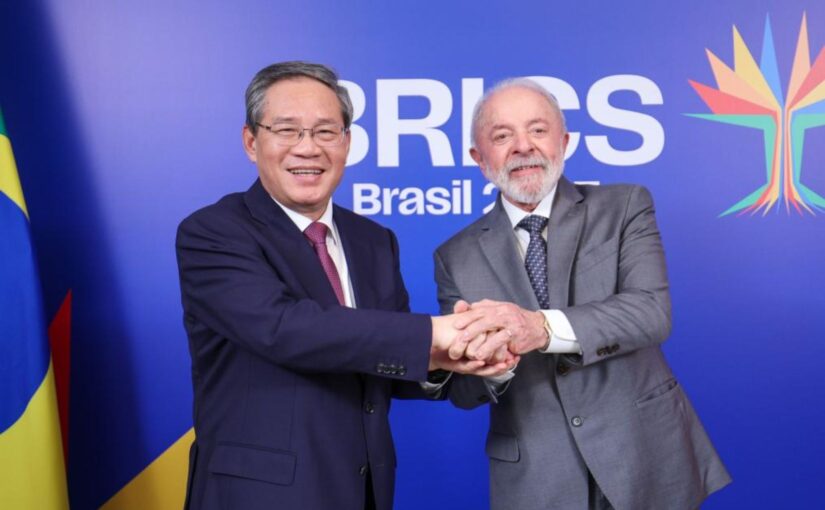
Chinese Premier Li Qiang met with Brazilian President Luiz Inacio Lula da Silva in Rio de Janeiro on July 5, the eve of the 17th BRICS Summit.

Li said that China is willing to work with Brazil to leverage each other’s complementary advantages and expand cooperation in such areas as digital economy, green economy, sci-tech innovation and aerospace. He conveyed Chinese President Xi Jinping’s warm greetings to Lula, noting that China-Brazil relations are in their best shape ever, with both sides working together to build a China-Brazil community with a shared future for a more just world and a more sustainable planet.

Li also urged both countries to jointly ensure the success of the China-Brazil Year of Culture in 2026, step up cooperation in education, youth, healthcare and other areas, further facilitate people-to-people exchanges and strengthen public support for China-Brazil friendship and cooperation, adding that China supports Brazil in hosting the UN Climate Change Conference in Belem (COP30) later this year.

Lula said that Brazil is ready to promote exchanges and cooperation with China in such areas as economy and trade, science and technology, finance, and aerospace, and also seeks to deepen collaboration with China in addressing climate change. Brazil welcomes China’s participation in the upcoming COP30.

The previous day, Li made a stopover on the Greek island of Rhodes on his way to Brazil.

Meeting with Greek Deputy Prime Minister Kostis Hatzidakis, Li said that China is willing to work with Greece to leverage complementary advantages, advance the implementation of the plan for the Port of Piraeus in a high-quality manner, and promote more optimised and balanced development of the bilateral trade.

He noted that President Xi Jinping met with Greek Prime Minister Kyriakos Mitsotakis during his visit to China in November 2023 and reached important consensus on deepening bilateral relations. Over the past two years, he added, China and Greece have actively implemented the outcomes of the visit and promoted high-quality development of the Belt and Road cooperation, delivering more benefits to the peoples of both countries.

China is also ready to work with Greece to enhance cooperation in such fields as clean energy, power transmission and transformation, and artificial intelligence (AI), and foster new drivers for economic growth. China also supports and encourages more capable Chinese enterprises to actively invest in Greece.

It is hoped that Greece will continue to play a constructive role in promoting the development of China-EU relations, he added.

For his part, Hatzidakis said that Greece and China are both ancient civilisations, and Greece attaches great importance to developing its relations with China.

China is a major country with significant international influence, he said, adding that Greece is ready to strengthen multilateral coordination with China, jointly uphold the purposes and principles of the UN Charter and address global challenges such as climate change. Greece is also willing to contribute to the development of EU-China relations.

The following articles were originally published by the Xinhua News Agency.

Chinese premier says to expand cooperation with Brazil in digital economy, aerospace

RIO DE JANEIRO, July 5 (Xinhua) — Chinese Premier Li Qiang said on Saturday that China is willing to work with Brazil to leverage each other’s complementary advantages and expand cooperation in such areas as digital economy, green economy, sci-tech innovation and aerospace.

Li made the remarks during his meeting with Brazilian President Luiz Inacio Lula da Silva. The Chinese premier arrived in Rio de Janeiro on Saturday to attend the 17th BRICS Summit.

Continue reading China and Brazil stress high quality cooperation

China’s energy transition is a world historical breakthrough

In the following article written for the Morning Star, Nick Matthews highlights a major breakthrough in the battle against climate catastrophe: China’s clean energy transition has led to a net reduction in carbon emissions, in spite of the fact that China’s economy and its energy demand continue to grow.

Drawing on data from the well-regarded Carbon Brief website, he reports that in the first quarter of 2025, China’s CO₂ emissions fell by 1.6 percent year-on-year, driven largely by a 5.8 percent drop in emissions from the power sector. This marks the first time China’s emissions have decreased due to expanded clean energy capacity, rather than reduced energy demand (as happened during the Covid-19 pandemic).

Nick notes that electrification of transport and heating is accelerating, with electricity demand from EV charging and battery swapping services growing by 78 percent in 2023 – 3.5 times more than the rest of the world combined. China now leads globally not only in electric cars, but also in electric vans, buses, two-wheelers and heat pumps.

This energy shift has taken many experts by surprise, and has a clear global impact. Nick cites the historian Adam Tooze as saying: “China’s huge surge in renewable energy, above all in solar power, actually puts us on track for the first time to meet these objectives”

Major challenges remain for China’s project of ecological civilisation – especially grid restructuring and balancing renewable supply – but reaching the goal of peak emissions several years ahead of the 2030 target can be considered a turning point. The country’s rapid clean energy development shows that with the political will – which is of course a function of a socialist political structure – a sustainable future is entirely possible.

While most news this year has been nothing short of bleak, we have had a piece of news that is of world historical significance. I am not sure how many Morning Star readers are regular readers of the Carbon Brief, a British website that covers the latest developments in climate science, climate policy and energy policy.

The news I am referring to not that the British output of solar energy this year has increased by 42 per cent due to the driest spring on record, welcome as that is. The even better news was: “For the first time, the growth in China’s clean power generation has caused the nation’s carbon dioxide (CO2) emissions to fall despite rapid power demand growth.

“The new analysis for Carbon Brief shows that China’s emissions were down 1.6 per cent year-on-year in the first quarter of 2025 and by 1 per cent in the latest 12 months. Electricity supply from new wind, solar and nuclear capacity was enough to cut coal-power output even as demand surged, whereas previous falls were due to weak growth.”

The reduction in China’s first-quarter CO2 emissions in 2025 was due to a 5.8 per cent drop in the power sector. While power demand grew by 2.5 per cent overall, there was a 4.7 per cent drop in thermal power generation, mainly coal and gas.

Increases in solar, wind and nuclear power generation, driven by investments in new generating capacity, more than covered the growth in demand. The increase in hydropower, which is more related to seasonal variation, helped push down fossil power generation.

This is not some small country making the clean energy transition. This is the world’s largest manufacturing economy.

China is way ahead in electrifying heating and transport, and building electrolyser capacity. In 2023, China’s electricity demand from the charging and battery swapping service industry grew by 78 per cent and added an estimated 56 TWh to China’s electricity demand, 3.5 times more than the rest of the world.

What that means is measured in terms of power consumed. China’s electrification of road transport is 3.5 times larger than that of the rest of the world put together.

It is this revolution that has Western governments and automakers in a panic. China accounts for 60 per cent of the world’s electric light-vehicle sales, but this segment represents only an estimated 18 TWh of the 56 TWh demand increase, with the rest coming from electric vans, trucks, buses and two-wheelers, which China dominates globally. It is also the largest heat pump market in the world, with more installations per year than any other country.

The significance of this news is hard to overestimate. At Cop28 in 2023, many countries around the world committed to tripling global renewable electricity capacity by 2030. If undertaken, this has the potential to almost halve power sector emissions by 2030, as coal-fired power generation will be replaced first. Furthermore, it will provide enough new electricity to drive forward the electrification of transport, home and industrial heating with a 32 per cent increase in electricity demand.

Many thought that this was something of a pipedream. But as leading economic historian Adam Tooze has said: “China’s huge surge in renewable energy, above all in solar power, actually puts us on track for the first time to meet these objectives.”

As the clean energy think tank Ember reports, it has taken experts around the world by surprise. What we are witnessing is the most rapid take-up of a significant energy technology in history.

It’s worth looking in detail at what China is achieving. The Carbon Brief report by Lauri Myllyvirta, lead analyst at the Centre for Research on Energy and Clean Air and senior fellow at the Asia Society Policy Institute, goes into a lot of detail and is well evidenced.

We are not quite on the road to a carbon-neutral world, as Ember points out, the drama of green electrification is only just beginning. It is one thing to replace dirty power generation for existing uses with solar and wind. It is another to build out the entire electricity system to meet the new demands for electricity in data-processing, transport, domestic and industrial uses.

The challenges of switching to renewables and the restructuring of energy grids have only just begun, and balancing supply across a myriad of renewable sources clearly represents a significant challenge. China’s example, however, shows that with political will, it is possible. So mark May 2025 in your calendar; thanks to China, we can now see the outline of what a carbon-free energy future looks like.

Xi Jinping – Champion of the Global South

The 17th Summit of the BRICS cooperation mechanism was held in the Brazilian city of Rio de Janeiro, July 6-7.

On this occasion, due to a scheduling clash, apparently related to the July 7 anniversary of the Marco Polo Bridge Incident, when Japan launched its full-scale invasion of China, an event that assumes greater significance in this year of the 80th anniversary of victory in the anti-fascist war, President Xi Jinping did not attend the summit, with China being represented by Premier Li Qiang.

However, prior to the summit, on July 3, the Xinhua News Agency published a detailed commentary highlighting Xi’s consistent commitment to BRICS and to the Global South more generally.

It quotes Xi as saying that “the collective rise of the Global South is a distinctive feature of the great transformation across the world,” when he addressed the “BRICS Plus” Dialogue held in Kazan, Russia, in October last year.

The article notes that much more than a pure geographical or economic term, the Global South refers to a community of emerging markets and developing countries that share similar historical experiences, development stages and goals, and political pursuits.

It adds: “The concept of ‘South’ was first coined in Antonio Gramsci’s work ‘The Southern Question’ written in 1926, in which the Italian Marxist philosopher highlighted the development gap between northern and southern Italy.”

The rise of the Global South, it continues, has been decades in the making. Back in 1955, the landmark Bandung Conference convened in Indonesia under the flag of solidarity, friendship and cooperation, marking the awakening of the Global South after centuries of Western colonial rule. In 1964, the Group of 77, a coalition of developing countries, was established in Geneva within the framework of the United Nations to promote South-South cooperation and work towards a new international economic order.

Through extensive cooperation, the countries of the Global South have emerged as a key driver of global growth. They have contributed as much as 80 percent over the past 20 years, with their share of global GDP increasing from 24 percent four decades ago to more than 40 percent today.

The article acknowledges that some Westerners have challenged China’s position that it is part of the Global South. It cites Xi in response:

“As a developing country and a member of the Global South, China breathes the same breath with other developing countries and pursues a shared future with them.”

Historically, China has suffered from Western colonialism and imperialism, much like other developing countries, according to Cavince Adhere, a Kenya-based international relations scholar.

“Even today, despite inordinate success by Beijing to rise from the backwaters of development to be the second-largest economy in the world, as well as the first developing country to eliminate extreme poverty, China still faces common development challenges and holds similar views regarding the current international order and global governance. Because of this, China has emerged as a strong champion for the legitimate rights and interests of many Global South countries.”

To boost common development in the Global South, Xi has been promoting practical cooperation through major infrastructure projects as part of the Belt and Road Initiative. During his foreign visits over the years, Xi would launch or visit major projects, such as the Chancay Port in Peru, the Dushanbe No. 2 power plant in Tajikistan and the Colombo Port City in Sri Lanka.

Continue reading Xi Jinping – Champion of the Global South

Ties with Bolivia and Ghana reaffirmed

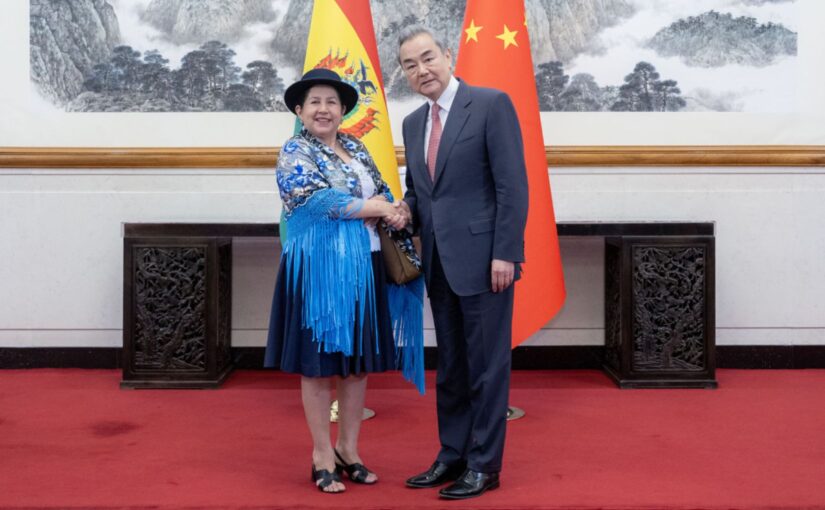
Chinese President Xi Jinping and Bolivian President Luis Arce exchanged congratulations on the 40th anniversary of diplomatic relations on July 9.

Noting that China and Bolivia are good friends and good brothers, Xi said that the two sides have firmly supported each other on issues concerning their core interests and major concerns, adding that the high-quality Belt and Road cooperation has yielded fruitful results, and the friendship has taken deeper roots in the hearts of the two peoples.

For his part, Arce said that the Bolivian side highly commends China’s support and assistance in areas such as infrastructure, technology, energy and healthcare, and applauds China’s leadership in uniting the Global South, promoting China-Latin America cooperation and working toward a more just, equitable and inclusive international order.

Earlier, on July 5, Chinese Foreign Minister Wang Yi exchanged congratulations with his Ghanaian counterpart, Samuel Okudzeto Ablakwa, on the 65th anniversary of diplomatic ties.

Wang noted that Ghana is one of the first Sub-Saharan African countries to establish diplomatic ties with China.

For his part, Ablakwa expressed his gratitude to China for its long-term valuable support and assistance to Ghana’s socio-economic development. The Ghanaian side looks forward to working with China to push for the continuous development of the Ghana-China strategic partnership.

The following articles were originally published by the Xinhua News Agency.

Xi, Bolivian president exchange congratulations on 40th anniversary of diplomatic ties

BEIJING, July 9 (Xinhua) — Chinese President Xi Jinping and Bolivian President Luis Arce exchanged congratulations on the 40th anniversary of diplomatic relations on Wednesday.

Noting that China and Bolivia are good friends and good brothers, Xi said that over the 40 years since the establishment of diplomatic ties, China-Bolivia relations have withstood the test of changing international circumstances and have always maintained a sound momentum for growth.

Continue reading Ties with Bolivia and Ghana reaffirmed

Li Qiang: The Global South should stand at the forefront of global governance reform

The 17th Summit of the BRICS cooperation mechanism was held in the Brazilian city of Rio de Janeiro, July 6-7.

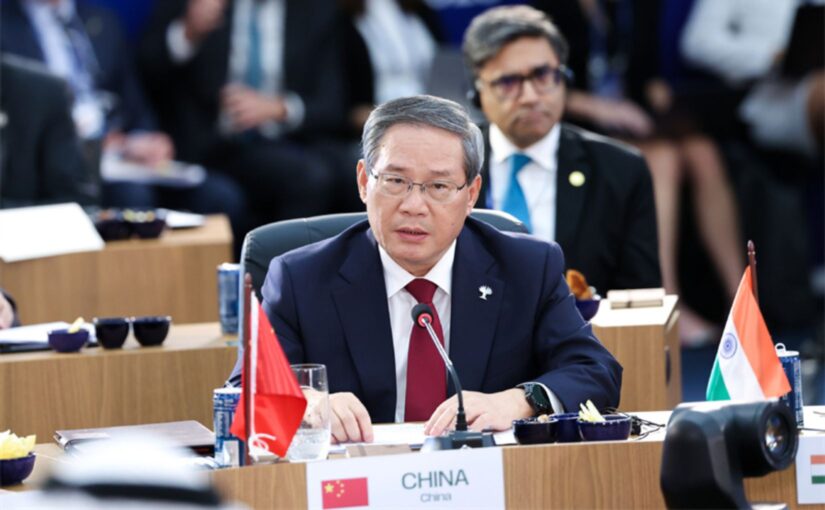
On July 6, Chinese Premier Li Qiang delivered a speech at the plenary session focused on the theme of Peace and Security and Reform of Global Governance.

He noted that: “Today, transformations unseen in a century are accelerating in the world. Geopolitical conflicts and economic and trade frictions keep emerging, flames of war continue to rage in some regions, international rules and order face serious challenges, and the authority and efficacy of multilateral mechanisms are weakening.”

Faced with the growing necessity and urgency to reform the global governance system, China believes that in this process, one must firmly safeguard the shared interests of the international community and always stand on the right side of history. This is the only way to avoid taking a wrong turn or backpedalling, and to march forward in big strides toward peace, security, prosperity and sustainable development.

“There should be less arrogance and prejudice, and more sincerity and understanding. We need to look for the best answer that serves the interests of all through friendly consultation conducted on the basis of equality… Humanity lives in the same global village, and countries have increasingly become one community with a shared future. Whether it is tackling global challenges or promoting long-term development, no country can do it alone. Only by standing together in solidarity and working in close collaboration can we build a better home for us all… Development should not be a zero-sum game where one profits at the expense of the other, but a win-win story where all can benefit through mutual assistance. Countries’ development ought to be opportunities, not threats to each other.”

Observing that over the years, Global South countries have grown stronger and become champions of and contributors to the reform and improvement of the global governance system, Li said that, “standing at the forefront of the Global South, we BRICS countries should uphold independence, act with a sense of responsibility, take bigger steps to build consensus and synergy, and strive to be the pioneering force in advancing global governance reform.”

To this end, he made three key points:

  • We should uphold justice and safeguard world peace and tranquillity. When international rules are being undermined and bullying practices are on the rise, we need to stand up for what is right and speak up for justice.
  • We should focus on development and bolster the driving forces of economic growth. China’s journey of reform and opening up shows that in solving all problems, development is the foundation and key. This year, China will establish the China-BRICS New Quality Productive Forces Research Centre and the BRICS New Industry Golden Egret Excellence Scholarships, which will help BRICS countries train talents in areas such as industry and telecommunication and pursue innovation-driven development.
  • We should uphold inclusiveness and promote exchange and mutual learning among civilisations. With rich histories and cultures, BRICS countries should be advocates of harmonious coexistence of civilisations. We need to call for respect for cultural diversity in the world, and work to ensure that different civilisations inspire each other and prosper together.

The following is the full text of the speech. It was originally published by the Xinhua News Agency.

The summit adopted a detailed declaration. The full text may be read here.

RIO DE JANEIRO, July 6 (Xinhua) — Chinese Premier Li Qiang delivered a speech on Sunday at the plenary session of “Peace and Security and Reform of Global Governance” of the 17th BRICS Summit.

Continue reading Li Qiang: The Global South should stand at the forefront of global governance reform

Oldest matrilineal society unearthed in China

We are pleased to republish the following article by Ding Rui, originally published in the Chinese online magazine Sixth Tone, about a groundbreaking discovery at the Fujia archaeological site in Shandong, China.

The findings, published in Nature, provide the first genome-wide evidence of a prehistoric society organised around maternal lineage, dating back to 2750–2500 BCE.

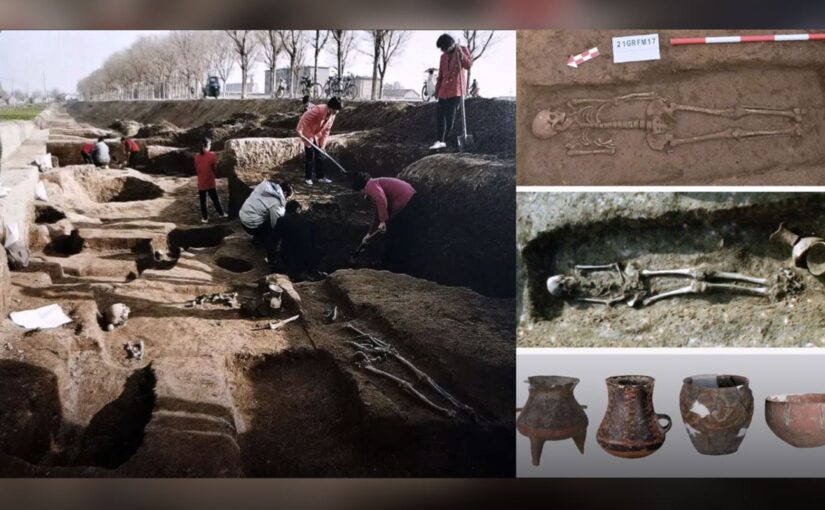
Researchers from Peking University and the Shandong Provincial Institute of Cultural Relics and Archaeology analysed the remains of 60 individuals buried at two cemeteries linked to the Neolithic-era Dawenkou culture, known for advancements in pottery production. Through DNA analysis and radiocarbon dating, they found that while paternal Y-chromosome DNA varied significantly within burial groups, maternal mitochondrial DNA was nearly identical, strongly suggesting the communities centred on maternal ancestry.

Until now, the only confirmed ancient matrilineal society was the Chaco Canyon elite in North America (800–1300 AD). Fujia’s discovery significantly predates that and, according to Sun Bo, director of the Shandong Provincial Institute of Cultural Relics and Archaeology, it adds weight to the theories set forth in Friedrich Engels’ classic work, The Origin of the Family, Private Property and the State, written in 1884.

The discovery provides direct empirical evidence from East Asia for the theories proposed by (Lewis Henry) Morgan and (Friedrich) Engels. It holds great significance for understanding the roots of human civilisation.

Chinese scientists have uncovered the world’s first comprehensive genetic evidence of a prehistoric matrilineal society, offering fresh insight into the ongoing debate over whether fathers or mothers led early human civilizations.

Published Wednesday in the prestigious journal Nature, the study centers on the Fujia archaeological site in eastern China’s Shandong province, where researchers from the Shandong Provincial Institute of Cultural Relics and Archaeology and Peking University found that communities dating back more than 4,500 years were organized around maternal lineage.

“Previously, all reported ancient DNA studies indicated that prehistoric societies were organized based on patrilineal principles,” Ning Chao, an archaeologist at Peking University, told domestic media. “Genetic evidence for matrilineal societies could only be traced back as far as the Iron Age in Europe.”

However, the Nature article states that even evidence for matrilineality in these societies was suggestive, adding that “almost all genome-wide studies examining the Neolithic and Bronze Age periods to date have consistently supported patrilocality and patrilineality, and the existence and locations of matriliny in the remote or prehistoric past are still largely unknown.”

Continue reading Oldest matrilineal society unearthed in China

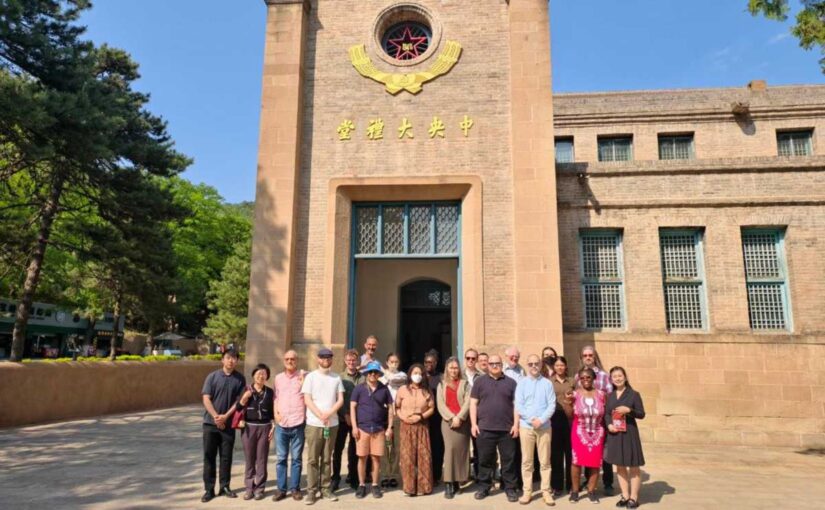
Report: Delegation to China, May-June 2025

As reported previously, between 25 May and 5 June 2025, an international delegation – organised by the China NGO Network for International Exchanges (CNIE) and Friends of Socialist China – visited Shaanxi, Gansu, and Shanghai to witness China’s ongoing socialist development.

Comprising activists from organisations including Friends of Socialist China, the Progressive International, Black Alliance for Peace, Freedom Road Socialist Organization, the Communist Party of Britain, the Black Liberation Alliance, Workers World Party and Bronx Anti-War, the group explored China’s revolutionary history, technological achievements, sustainable planning, and its commitment to peace and friendship among civilisations.

The trip affirmed for participants that China’s development model, rooted in socialist planning and common prosperity, has clearly become a powerful alternative to Western capitalism, and is a source of inspiration for global movements seeking a more just, peaceful, prosperous and sustainable world.

The detailed report below, which originally appeared on Progressive International, was prepared collectively by the participating organisations.

Between 25 May and 5 June, the China NGO Network for International Exchanges (CNIE), working in coordination with Friends of Socialist China, hosted an international delegation to three regions of China: Shaanxi province, Gansu province, and Shanghai.

The delegation included members of Friends of Socialist China, the Progressive International, the Black Alliance for Peace, Freedom Road Socialist Organization, the Communist Party of Britain, the Young Communist League – Britain, the Black Liberation Alliance, Workers World, Bronx Anti-War, and others.

Delegates attended the 4th Dialogue on Exchanges and Mutual Learning Among Civilisations, and visited a range of historic revolutionary sites, museums, and state-owned firms to witness and deliberate the rapid development made possible by the enduring project of Chinese socialism.

This report was prepared collectively by the participating organizations.

Overview

The delegation’s 10-day journey through China traced a remarkable arc of transformation — from the humble beginnings of revolutionary struggle to the latest achievements of contemporary socialist construction. The visit followed the Communist Party of China’s (CPC) evolution from a group of thirteen participants meeting in a small Shanghai room in 1921 to a governing force that has fundamentally reshaped not only the world’s most populous nation — but also the world beyond it.

The trip began with a journey from Xi’an to Yan’an — a quick trip by express train that less than a century ago would have taken days of travel along dangerous and ragged mountain roads. Yan’an is a cradle of Chinese socialism. It is where the Red Army concluded its heroic Long March in 1936. Here, living in yaodong cave dwellings and equipped with rudimentary arms and thin cotton uniforms, the fighters of the CPC crafted their victory over Japan, while Mao Zedong penned some of his most notable theoretical works in a simple mud-brick house.

The wide rift between these austere conditions — all just one lifetime ago — and the achievements of Chinese modernization today remained a theme throughout the visit. This gap illustrated the profound scale of China’s revolutionary transformation. In Yan’an, the delegation saw where the building blocks of Chinese socialism were laid. Here, the modern CPC developed its ideological foundations, established institutions like the Party School, and developed the prototypes for the first institutions of the socialist state.

The thread connecting revolutionary struggle to China’s contemporary advancements became clear as the delegation visited Gansu province, a vast region — among China’s poorest — between Inner Mongolia and Xinjiang. In Jiayuguan, a former desert outpost transformed into China’s fourteenth-largest steel producer, the delegation witnessed how strategic planning could reshape entire regions. The remote desert town, established in 1958 around around the Jiuquan Iron and Steel Corporation (JISCO), came to underpin a remarkable process of high-quality development that continues to this day. Delegates noted how the level of development in the city — with its clean streets, modern infrastructure, high-quality public housing, and abundant parks — easily surpassed that seen in most towns in the United States and United Kingdom.

In Gansu province, the delegation also witnessed the critical advancements in China’s green technology. The Dunhuang Molten Salt Tower plant, featuring 12,000 heliostats channeling desert sunlight into a groundbreaking technology that liquifies salt, enables solar power to continue generating electricity even at nighttime. The AI-powered Smart Grid and Localised New Energy Consumption Demonstration Project, developed by JISCO to manage energy distribution within Jiayuguan, has enabled decreasing energy consumption even as living standards and industrial outputs increased — an achievement of decoupling energy use from growth that many experts in the West have longed deemed impossible.

The delegation concluded its trip in Shanghai, where the CPC held its 1st National Congress. The contrast between the the modest room where thirteen revolutionaries held that first meeting and the sprawling metropolis outside it speaks to the scale of the transformation that China has seen in just a little over a century since the CPC was established. Delegates were impressed by the visible quality of that development — one that prioritizes the common good rather than individual profit, and builds cities that are green, affordable, walkable, and livable, in stark contrast to many of the cities that the delegation travelled from in their home countries. China offers a model of development that is attractive to people around the world, and demonstrates the continued vitality of socialist construction in the 21st century.

As a teacher from Jiayuguan told the delegation: “China not only learned from the experiences of the Soviet Union. China saved socialism. Looking at what has been achieved, I am satisfied, and I am proud.”

Continue reading Report: Delegation to China, May-June 2025

Reject Western Marxism, defend the socialist countries, and stand with the peoples of the world against imperialism

On Saturday 5 July 2025, Friends of Socialist China hosted – along with the Morning Star, the International Manifesto Group, Critical Theory Workshop and Iskra books – a discussion of Domenico Losurdo’s crucial book, Western Marxism: How it was Born, How it Died, How it can be Reborn, in which the legendary Italian philosopher charts the long and complex history of Marxism’s bifurcation into ‘Western’ and ‘Eastern’ – a division based primarily on the national question and the relative prioritisation of anti-colonial, anti-imperialist struggles.

The meeting was held in-person at Marx Memorial Library in London (and online via Zoom and YouTube), and the packed room was addressed by Gabriel Rockhill (Editor of the English edition), Jennifer Ponce de León (Co-author of the introduction to the English edition), Alex Gordon (Chair, Marx Memorial Library) and Carlos Martinez (Co-editor, Friends of Socialist China), and was chaired by Francisco Domínguez (National secretary, Venezuela Solidarity Campaign).

Embedded below is the video of the event, followed by the text of Carlos’s speech. Carlos describes the journey Marxism has taken since its inception around the world – “a journey to the East and South”, transforming it “from being a liberatory framework for the industrial proletariat in Western Europe and North America, to being a liberatory framework for the working and oppressed peoples around the world”.

He goes on to define academic Western Marxism on the basis of its rejection of this globalisation of class struggle, and explores the material and ideological reasons for this trend’s refusal to support the socialist states and to prioritise the struggle against colonialism and imperialism.

The speech concludes with a plan of action:

Reject dogmatism and purism, reject Eurocentrism and chauvinism, and get back to playing our part in a global united front composed of the socialist countries, the oppressed nations, and the working classes and progressive forces in the imperialist countries. That’s what will get us on the path to a socialist future.

I’ve been involved in the Marxist movement in the West in some way or another since I was a teenager, but thankfully have never got particularly close to Western Marxism.

The political tradition I grew up in emphasised the importance of supporting the socialist states, and always prioritised the struggle against imperialism, colonialism and racism. To support China, to support the DPRK, to support Cuba, to support the national liberation struggles of the Irish, Palestinian, Zimbabwean, Vietnamese and other peoples were very much part of that tradition.

So despite being a Marxist in the West, I haven’t had all that much exposure to the Western Marxist academics described by Losurdo, and haven’t had to go through that extremely difficult “unlearning” process that many others have. I’ve read a lot of Lenin; I’ve read very little Adorno, Zizek and Perry Anderson.

Nevertheless, Losurdo’s book was really clarifying for me, and helped me understand the ideological roots of some of the objectively reactionary positions that you come up against all the time. Because although Western Marxism exists mainly in an academic ivory tower, it seeps into the wider movement for revolutionary change, which it seems to find quite fertile soil.

Marxism moves East and South

Marxism is, obviously, Western by birth. The first line of the Communist Manifesto is after all: “A spectre is haunting Europe — the spectre of communism”.

The nascent communist movement was geographically limited to Europe and North America, and focused almost exclusively on the industrial working class.

But from the beginning, it’s been on a journey to the East and South, including in Marx’s own lifetime.

Continue reading Reject Western Marxism, defend the socialist countries, and stand with the peoples of the world against imperialism

Liberation movement ties recalled and carried forward

China’s diplomatic missions in South Africa and Tanzania have recently highlighted the historical legacy and continued relevance of the bonds of solidarity forged during the struggle for national liberation.

On 17 June, Pan Qingjiang, China’s Consul General in Johannesburg, published an article entitled “Driving Education Culture, Fostering Youth Friendship Between China and South Africa” in various major South African media outlets.

According to an article published by the South African Government News Agency: “In South Africa, Youth Month is celebrated every June following a declaration by our first democratic President, Tata Nelson Rolihlahla Mandela. It is a time when we collectively honour the pivotal role that young people played in the struggle against Apartheid and the historic Soweto Uprising of 1976. Every 16 June, as we mark National Youth Day, we not only remember the sacrifices and courage of those young people, but we also renew our commitment to equipping today’s youth for a vibrant future.”

Pan writes: “On the occasion of South Africa’s Youth Month, I wish to extend my sincere festive greetings to all our young friends. The youth are the future of nations and the future of China-South Africa friendship as well… Our nations, the People’s Republic of China and the Republic of South Africa, enjoy traditional friendship characterised by a strong ‘comradeship plus brotherhood’ bond…. The shared history and common future between China and South Africa are the solid foundation and driving force for the friendship among our youths.

“In June last year, the Consulate General of China in Johannesburg organised a themed short video competition for secondary school learners, encouraging the youth to reflect on both South Africa’s 1976 Soweto Uprising and China’s May Fourth Movement. More than one hundred participants from over twenty schools in Gauteng and the Free State submitted their creative entries in a variety of creative forms, including drama, speech, song, and dance, which vividly portrayed the heroic struggles of both countries against colonial oppression.

“Together, we paid tribute to, learned, and gained strength from the shared legacy of Chinese and South African youth in their pursuit of freedom, justice, and progress.”

The 1976 Soweto Uprising, led by the township youth, spread like a prairie fire across South Africa. Its brutal repression led thousands of young people to leave home and join the ranks of the African National Congress (ANC) and the other liberation movements waging armed struggle against the apartheid regime. It is considered a key turning point in the fight for a free South Africa.

China’s May Fourth Movement, a student-led anti-imperialist uprising, was sparked by the capitulation of the Chinese government to the humiliating terms imposed by the imperialist powers meeting at the 1919 Versailles peace conference. Together with the influence of the October Revolution in Russia, it played a major role in preparing for the founding of the Communist Party of China (CPC) two years later. Key founders of the CPC, Li Dazhao and Chen Duxiu were central leaders of the May Fourth Movement.

After detailing a number of current educational and cultural exchanges between South Africa and China, Pan’s article concludes:

“Like the rising sun, the youth brings brilliant prospects. China and South Africa are bound together by shared history, common developmental tasks and strategic interests. The youth serves as the vanguard in building a high-level China-South Africa community with a shared future and advancing our all-round strategic cooperative partnership in the new era.”

Earlier, on May 28, China’s Ambassador to Tanzania, Chen Mingjian visited the African Liberation Movement Freedom Fighters Kongwa Camp, together with officials from the Tanzanian government and the Chama Cha Mapinduzi (Revolutionary Party of Tanzania).

The two sides reflected on China’s contributions to Tanzania’s independence and the national liberation of southern Africa, and agreed to strengthen historical sites protection and inheritance, and to promote inter-party and sub-national cooperation between the two countries.

District Council Chairman White Zuberi, who witnessed the national liberation movement, showed Ambassador Chen around the camp and, together with her, recalled the glorious history of mutual support between China and Africa. The camp was built in 1964 and both Mozambique’s founding President Samora Machel and Namibia’s founding President Sam Nujoma were trained there.

The following articles were originally published on the websites of the Chinese Consulate General in Johannesburg and the Chinese Embassy in Tanzania. They are reproduced here from that of the Chinese Foreign Ministry.

Chinese Consul General in Johannesburg Pan Qingjiang Publishes Signed Article Titled Driving Education Culture, Fostering Youth Friendship Between China and South Africa

June 17 (MFA) — On 17 June, Consul General Pan Qingjiang published a signed article entitled “Driving Education Culture,Fostering Youth Friendship Between China and South Africa” in the mainstream media of South Africa, including the Star, the Mercury, the Cape Times and the IOL website. Full text below:

On the occasion of South Africa’s Youth Month, I wish to extend my sincere festive greetings to all our young friends. The youth are the future of nations and the future of China-South Africa friendship as well. I have been deeply impressed by the confidence, optimism, and ingenuity of the young South African people.

Our nations, the People’s Republic of China and the Republic of South Africa, enjoy traditional friendship characterized by a strong “comradeship plus brotherhood” bond.

Continue reading Liberation movement ties recalled and carried forward

Sports and culture promote Ireland-China people’s friendship

We previously reported the visit to China in March by members of two Gaelic Athletic Association (GAA) clubs in the north of Ireland,  St Johns GAA and Naomh Cholmaín Droím an Easa Drumaness GAC, led by Sinn Féin Member of Parliament for South Down, Chris Hazzard.

Following this very successful visit, the Chinese Consul General in Belfast, Li Nan organised a friendship gathering with Chris and members of the two clubs on June 12.

Li emphasised that culture and sports help bring people closer and foster mutual understanding. He expressed the hope that club members would actively serve as inheritors of the friendship between China and Northern Ireland, promoters of friendly cooperation, and builders of shared development.

Chris Hazzard shared his experiences from visiting China and expressed his desire to further expand dialogue, cooperation, and exchanges in areas such as culture, education, and sports. Club members also took turns sharing their thoughts and reflections from their time in China.

Meanwhile, on June 16, at the invitation of the James Joyce Centre, Chinese Ambassador to Ireland Zhao Xiyuan attended the Bloomsday celebration at Belvedere College S.J. in Dublin.

Bloomsday is an annual celebration held on June 16 to commemorate James Joyce’s novel Ulysses, which is set on that specific date in 1904. It is named after the novel’s central character, Leopold Bloom. Joyce’s experience studying at the Belvedere College informed much of the writing of the novel.  In 2012, President Xi Jinping, then Vice President of China, visited the Confucius Classroom at Belvedere College.

With the help of the Chinese Embassy in Ireland, the three Chinese versions of Ulysses that have been published, have been donated to the National Library of Ireland, the James Joyce Centre and the Museum of Literature Ireland for their collections.

Ulysses is widely considered to be one of the most complex and difficult works of world literature to translate. Translation into Chinese required many years of devoted effort and painstaking work. This comparative study of the three Chinese versions was published by the James Joyce Society of Korea.

The following articles were originally published on the websites of the Chinese Consulate General in Belfast and the Chinese Embassy in Ireland and are republished here from that of the Chinese Foreign Ministry.

Chinese Consulate General in Belfast Holds GAA Club Visit to China Sharing Session and Consulate General Open Day

June 14 (MFA) — On 12 June, the Chinese Consulate General in Belfast hosted a sharing session following the GAA Club’s visit to China and the Consulate’s Open Day. Consul General Mr. Li Nan attended and delivered a speech. Over 50 guests participated in the event, including Mr. Christopher Hazzard MP; the President and members of Drumaness and St John’s Club; and Professor Yu Xiang, Vice President of Hubei Normal University.

Consul General Li welcomed all guests to the Consulate and highlighted China’s latest achievements in economic and social development. He noted that Chinese-style modernization is progressing steadily, and a prosperous, open, and friendly China is creating new opportunities for the world. Mr. Li emphasized that culture and sports help bring people closer and foster mutual understanding. He expressed hope that club members would actively serve as inheritors of the friendship between China and Northern Ireland, promoters of friendly cooperation, and builders of shared development.

Mr. Hazzard shared his experiences from visiting China and expressed his desire to further expand dialogue, cooperation, and exchanges in areas such as culture, education, and sports. Club members also took turns sharing their thoughts and reflections from their time in China. The atmosphere was warm and engaging.


Chinese Ambassador to Ireland Zhao Xiyuan Attends the Bloomsday Celebration

June 18 (MFA) — On June 16th, at the invitation of the James Joyce Centre, Ambassador Zhao Xiyuan and Madam Li Yi, together with ambassadors from other countries to Ireland and officials from Dublin, attended the Bloomsday celebration at Belvedere College S.J. in Dublin.

Bloomsday is an annual celebration held on June 16th to commemorate James Joyce’s novel Ulysses, which is set on that specific date in 1904. It is named after the novel’s central character, Leopold Bloom. Joyce’s studying experience at the Belvedere College was applied many times in his writings. In 2012, President Xi Jinping, then Vice President of China, visited the Confucius Classroom at Belvedere College.

Every June 16th, literature lovers hold various festivities in Dublin, Ireland, and elsewhere including China, through readings, performances, and re-enactments of scenes from the book, often with participants dressed in Edwardian attire. With the coordination of the Embassy of the People’s Republic of China in Ireland, the three Chinese versions of Ulysses that have been published, were donated to the National Library of Ireland, the James Joyce Centre and the Museum of Literature Ireland for collection.

China and Vietnam jointly promote Red Tourism

The Vietnamese newspaper Nhân Dân recently reported that an exhibition on President Ho Chi Minh’s revolutionary career in China has been jointly organised by the Guangdong Museum of Revolutionary History of China and the Ho Chi Minh Museum of Viet Nam as part of the activities to celebrate the 75th anniversary of bilateral diplomatic relations and the Year of People-to-People Exchange between the two countries.

During his journey to seek a path for liberating the nation, the paper notes, President Ho Chi Minh spent many years in China, including an extremely important period in Guangzhou, Guangdong province from 1924-1927. During this time, he established the Vietnam Revolutionary Youth League, the predecessor of the Communist Party of Vietnam (CPV), and organised training courses to prepare cadres and build the organisational structure, creating the ideal conditions for the founding of the party.

The exhibition retraces the late Vietnamese leader’s 12 years of revolutionary activities in China and emphasises that, under the leadership of President Ho Chi Minh, Chairman Mao Zedong, and other pioneering leaders, the people of Vietnam and China stood together, enduring hardships in their struggles for independence and national liberation. The friendship as comrades plus brothers between Vietnam and China remains a valuable legacy for both nations and will endure for future generations.

Historical sites, it continues, associated with the revolutionary career of President Ho Chi Minh in China are evidence of his revolutionary journey and serve as important landmarks of Vietnam-China friendship. The Chinese government attaches great importance to preserving these sites, having restored and protected them to enhance their historical value. Today, they serve as “red addresses” – destinations for revolutionary education and people-to-people exchanges, especially among younger generations. The exhibition is scheduled to be held on a rotating basis at several museums in both Vietnam and China.

In a separate article, Nhân Dân reports on the mutual ‘red tourism’ by young people from the two socialist neighbours.

It writes that during her first visit to Vietnam to attend the Vietnam-China Youth Friendship Meeting in April, Huang Chenshen from the China Youth University for Political Studies had listened to speeches by Chinese Party General Secretary Xi Jinping and Vietnamese Party General Secretary To Lam, visited Quang Ninh and Ninh Binh provinces, and explored the local culture. What impressed her most was experiencing the cultural life of Vietnam’s ethnic minorities.

The “Red Study Tour” programme of visits to China was proposed by Xi during his April visit to Vietnam. It links together historical sites associated with President Ho Chi Minh and former Chinese leaders, serving as a “living history classroom” that fosters a spirit of solidarity and a shared sense of responsibility among young people for peace and development.

Nguyen Thi Phuong Hoa, former Deputy Director of the Institute for Chinese Studies and Deputy Editor-in-Chief of the Chinese Studies Journal, said that the content of youth exchanges has become increasingly diverse, shifting from general forums to more practical, thematic discussions closely tied to the role of young people in national development and innovation.

The first tour visited China’s Guangxi Zhuang Autonomous Region in May, with the theme, “Following President Ho Chi Minh’s Footsteps”. In addition to visiting historical sites, Guangxi also organised activities for the young delegates to experience artificial intelligence technology and the digital environment. Vietnamese participants were able to visit a robotics lab, experience high-speed train travel, and explore advanced technological applications.

The following articles were originally published by Nhân Dân.

Exhibition spotlights President Ho Chi Minh’s revolutionary career in China

June 30 (Nhân Dân) — An exhibition on President Ho Chi Minh’s revolutionary career in China has been jointly held by the Guangdong Museum of Revolutionary History of China and the Ho Chi Minh Museum of Viet Nam as part of activities to celebrate the 75th founding anniversary of diplomatic relations and the Year of Humanistic Exchange 2025 between the two nations.

Continue reading China and Vietnam jointly promote Red Tourism