Xi Jinping holds positive meeting with Donald Trump in Republic of Korea

Chinese President Xi Jinping met with US President Donald J. Trump in Busan, Republic of Korea, on October 30. It was the first meeting between the two leaders since President Trump returned to office.

Following the meeting, a read out was issued by the Chinese Foreign Ministry. It said that President Xi had noted that China and the United States should be partners and friends.

“This is what history has taught us and what reality needs. Given our different national conditions, we do not always see eye to eye with each other and it is normal for the two leading economies of the world to have frictions now and then… I am ready to continue working with you to build a solid foundation for China-US relations and create a sound atmosphere for the development of both countries.”

President Xi emphasised that there is a good momentum in China’s economic development. In the first three quarters of this year, China’s economy increased by 5.2 percent, and import and export trade in goods with the rest of the world expanded by 4 percent. This is not an easy accomplishment given the domestic and external difficulties. The Chinese economy is like a vast ocean, big, resilient and promising. We have the confidence and capability to navigate all kinds of risks and challenges.

At its fourth plenary session, the 20th CPC Central Committee deliberated over and adopted the recommendations for the economic and social development plan over the next five years. “Over the past seven decades and more, we have been working from generation to generation on the same blueprint to make it a reality. We have no intention to challenge or supplant anyone. Our focus has always been on managing China’s own affairs well, improving ourselves, and sharing development opportunities with all countries across the world. And that is an important secret to our success.”

President Xi noted that the two teams had an in-depth exchange of views on important economic and trade issues and reached consensus on solving various issues. They should work out and finalise the follow-up steps as soon as possible and ensure that the common understandings are effectively upheld and implemented, to inject confidence into the two countries as well as the global economy through solid deliverables.

President Trump said that it is a great honour to meet President Xi. China is a great country. President Xi is a well-respected great leader and has been my good friend for many years. 

Continue reading Xi Jinping holds positive meeting with Donald Trump in Republic of Korea

Key party meeting sets stage for China’s next five-year plan

The 20th Central Committee of the Communist Party of China (CPC) convened its fourth plenary session in Beijing from October 20 to 23, 2025, with its main business being to work on developing the country’s 15th Five-Year Plan for National Economic and Social Development, which will be formally adopted at next year’s annual parliamentary session of the National People’s Congress (NPC).

The communique released following the conclusion of the plenum noted that, “China is now on the verge of accomplishing the major objectives and tasks of the 14th Five-Year Plan. It was also noted that we had recently commemorated the 80th anniversary of the victory in the Chinese People’s War of Resistance against Japanese Aggression and the World Anti-Fascist War. This occasion has greatly lifted the national spirit, inspired a strong sense of patriotism among our people, and further pooled strength for our country’s collective endeavours.”

It added that: “In the face of a complicated international landscape and the challenging domestic tasks of advancing reform, promoting development, and ensuring stability, the CPC Central Committee with Comrade Xi Jinping at its core has united the entire Party and Chinese people of all ethnic groups and led them in meeting difficulties head-on and forging ahead with determination. This has allowed us to withstand the severe shocks from a once-in-a-century Covid-19 pandemic, respond effectively to many major risks and challenges, and secure significant new achievements in the cause of the Party and the country.”

According to some of the most salient points in the communique:

  • It was pointed out that socialist modernisation can only be realised through a historical process of gradual and ongoing development. It requires the unremitting hard work of one generation after another. The period covered by the 15th Five-Year Plan will be critical in this process as we work to reinforce the foundations and push ahead on all fronts toward basically achieving socialist modernisation by 2035. It will thus serve as a key link between the past and the future. In this period, China’s development environment will face profound and intricate changes.
  • At present, China remains in a phase of development where strategic opportunities exist alongside risks and challenges, while uncertainties and unforeseen factors are rising. Our economy is on solid foundations, demonstrating advantages in many areas, strong resilience, and great potential. The conditions and underlying trends supporting long-term growth remain unchanged. More and more, we are seeing the strengths of socialism with Chinese characteristics, China’s enormous market, its complete industrial system, and its abundant human resources all coming to the fore.
  • We must maintain strategic resolve and enhance our confidence of success. We must proactively identify, respond to, and steer changes, demonstrate the courage and competence to carry forward our struggle, and dare to brave high winds, choppy waters, and even dangerous storms. We must seize the historical initiative to overcome difficulties, combat risks, and confront challenges, focus on managing our own affairs, and write yet another chapter on the miracles of rapid economic growth and long-term social stability, opening up new horizons for Chinese modernisation.
  • We must continue to pursue economic development as our central task, with high-quality development as our main focus, reform and innovation as the fundamental driving force, meeting the people’s ever-growing needs for a better life as our fundamental goal, and full and rigorous Party self-governance as the fundamental underpinning for all our efforts. We must promote higher-quality economic growth while achieving an appropriate increase in economic output and make solid headway in promoting well-rounded personal development and common prosperity for all. All of this will allow us to secure decisive progress toward basically achieving socialist modernisation.
  • The Central Committee also set the following major objectives for the 15th Five-Year Plan period: significant achievements in high-quality development; substantial improvements in scientific and technological self-reliance and strength; fresh breakthroughs in further deepening reform comprehensively; notable cultural and ethical progress across society; further improvements in quality of life; major new strides in advancing the Beautiful China Initiative; and further advances in strengthening the national security shield. Building on this, we will work hard for a further five years to see that by the year 2035 China’s economic strength, scientific and technological capabilities, national defence capabilities, composite national strength, and international influence will all be markedly stronger, that its per capita GDP will be on a par with that of a mid-level developed country, that its people will live better and happier lives, and that socialist modernisation will be basically realised.
  • We should keep our focus on the real economy, continue to pursue smart, green, and integrated development, and work faster to boost China’s strength in manufacturing, product quality, aerospace, transportation, and cyberspace. The share of manufacturing in the national economy should be kept at an appropriate level, and a modernised industrial system should be developed with advanced manufacturing as the backbone.
  • We should achieve greater self-reliance and strength in science and technology and steer the development of new quality productive forces. We must seize the historic opportunity presented by the new round of technological revolution and industrial transformation to boost China’s strength in education, science and technology, and human resources in a well-coordinated manner. We should enhance the overall performance of China’s innovation system, raise our innovation capacity across the board, strive to take a leading position in scientific and technological development, and keep fostering new quality productive forces. We should promote advances in original innovation and breakthroughs in core technologies in key fields, facilitate full integration between technological and industrial innovation, pursue integrated development of education, science and technology, and talent, and advance the Digital China Initiative.
  • Guided by the strategy of expanding domestic demand, we should work toward improving living standards while increasing consumer spending and coordinate investments in physical assets and human capital. We should see that new demand drives new supply, that new supply helps create fresh demand, and that positive interactions are fostered between consumption and investment and between supply and demand.
  • We should accelerate agricultural and rural modernisation and take solid steps to advance all-around rural revitalisation. We must continue to place issues related to agriculture, rural areas, and rural residents at the top of our Party’s work agenda. We need to promote integrated urban-rural development, continue to consolidate and expand our achievements in poverty alleviation, basically ensure modern living conditions in rural areas, and secure faster progress in building up China’s strength in agriculture.
  • We should inspire the cultural creativity of our entire nation and foster a thriving socialist culture. We must uphold the guiding role of Marxism in the ideological domain, remain firmly rooted in the broad and rich Chinese culture, and follow the trends of information technology. On this basis, we should develop a socialist culture with Chinese characteristics for the new era that has the power to guide, unite, and inspire our people and enjoys strong international influence.
  • We should work harder to ensure and improve public wellbeing and promote common prosperity for all. In line with the principle of doing everything within our means, we must ensure that public services are inclusive, meet essential needs, and provide a cushion for those most in need, while working to resolve the pressing difficulties and problems that concern the people most… We should promote high-quality and full employment, refine the income distribution system, develop education that meets the people’s expectations, improve the social security system, and facilitate high-quality development of the real estate sector.
  • We should accelerate the green transition in all areas of economic and social development in an effort to build a Beautiful China. We must unwaveringly uphold the principle that lucid waters and lush mountains are invaluable assets and put it into concrete action. Guided by our goals of achieving peak carbon and carbon neutrality, we should make concerted efforts to cut carbon emissions, reduce pollution, pursue green development, and boost economic growth… We should press ahead with the critical battle against pollution and the drive to upgrade ecosystems, move faster to develop a new energy system, work actively and prudently toward peak carbon emissions, and accelerate the shift to eco-friendly production practices and lifestyles.
  • We should work for long-term prosperity and stability in Hong Kong and Macao, promote the peaceful development of relations across the Taiwan Strait and advance the cause of national reunification, and secure further progress in building a community with a shared future for humanity.
  • It was stressed that to run the country well, we must first run the Party well; only a Party that is thriving can make our country strong. The more effective our Party is in supervising and governing itself, the better it will be able to provide guarantees for our economic and social development. We must have the resolve and tenacity to persist in the always ongoing endeavour of Party self-governance. In exercising full and rigorous self-governance, we must firmly act on the Party’s requirements for self-reform, devote sustained and consistent efforts to improving conduct, and combat corruption resolutely, thereby providing a strong guarantee for fulfilling the major objectives for economic and social development in the 15th Five-Year Plan period.
  • We should ramp up efforts to address wage arrears, improve basic public services, and work harder to resolve the pressing difficulties and problems that concern the people most. We must do a good job in post-disaster recovery and reconstruction. Appropriate arrangements should be made for disaster victims to ensure that their basic living needs are met and that they have warm shelter for the winter.
  • We must ensure workplace safety and safeguard stability. We must make sure that all responsibilities concerning workplace safety are fulfilled and that oversight systems are rigorously implemented, and we must work with firm resolve to prevent and mitigate major and serious accidents. We should strengthen whole-of-chain supervision and administration of food and drug safety.

The meeting adopted the Recommendations of the Central Committee of the Communist Party of China for Formulating the 15th Five-Year Plan for National Economic and Social Development.

Comrade Xi Jinping, General Secretary of the CPC Central Committee, delivered an important explanatory speech.

He noted that: “Formulating medium- and long-term plans to guide economic and social development is an important means by which our Party governs the country… Throughout the drafting process, the Central Committee followed a democratic approach and drew on a vast pool of wisdom, conducting in-depth surveys and studies and seeking opinions from all quarters. On January 22, the Central Committee issued the Notice on Soliciting Opinions on Recommendations for the 15th Five-Year Plan to Be Studied at the Fourth Plenary Session of the 20th CPC Central Committee, in order to gather opinions from certain Party members and non-Party figures. In late February, the Central Committee organised six teams to conduct research projects in 12 provincial-level regions. Meanwhile, it requested certain central Party and state departments to conduct research on 35 key topics. On April 30, I presided over a symposium in Shanghai on economic and social development during the 15th Five-Year Plan period for certain provinces, autonomous regions, and municipalities directly under the central government. Thereafter, I entrusted Comrade Li Qiang with presiding over three separate symposiums for the economic community, the scientific and technological community, and representatives from the primary level. We also solicited opinions online, receiving more than three million comments, which were then sorted through and condensed into over 1,500 suggestions.”

He added that: “The general conclusion is that during the 15th Five-Year Plan period, China will face both strategic opportunities and risks and challenges in development, as well as increasing uncertainties and unforeseen factors. Nevertheless, the conditions for and underlying trends of long-term economic and social growth will remain unchanged.”

Further explaining the drafting process for the document, he continued: “On August 4, a draft document was issued to certain Party members, including some retired senior Party officials, for consultation. Opinions were also sought from the central committees of other political parties, leaders of the All-China Federation of Industry and Commerce, and prominent figures without party affiliation… Those consulted submitted many constructive opinions and suggestions on the draft. The drafting group worked through these one by one and incorporated as many of them as possible into the text. In total, we made 218 additions, revisions, and simplifications to the document based on 452 opinions and suggestions…  It is fair to say that the drafting work for this document is yet another vivid example of intra-Party democracy and whole-process people’s democracy in action.”

Speaking on several of the key issues related to the next Five-Year Plan, Xi said: “Socialist modernisation can only be realised through a historical process of gradual and ongoing development. It requires the unremitting hard work of one generation after another. The draft document points out that the 15th Five-Year Plan period will serve as a critical stage in building on past successes to break new ground for basically achieving socialist modernisation… It is important that we seize this window of opportunity to consolidate and build on our strengths, remove development bottlenecks, shore up areas of weakness, seize the strategic initiative amid intense international competition, and secure major breakthroughs in strategic tasks of overall importance to Chinese modernisation. All of this will allow us to secure decisive progress toward basically achieving socialist modernisation… An important benchmark for basically achieving socialist modernisation by 2035 is that China’s per capita GDP will be on a par with that of a mid-level developed country by that time. This dictates that we must maintain an appropriate rate of economic and social development during the 15th Five-Year Plan period. On the basis of thorough research and scientific analysis, the draft document puts forward a range of important objectives, such as ensuring the economy keeps growing within an appropriate range, realising steady gains in total factor productivity, fully unleashing the potential for growth, ensuring personal incomes increase in step with economic growth and remuneration rises in tandem with labour productivity increases, and continuing to expand the middle-income group.”

Continue reading Key party meeting sets stage for China’s next five-year plan

Kim Jong Un pays tribute to Chinese People’s Volunteers on 75th anniversary

The Democratic People’s Republic of Korea (DPRK) held solemn commemorations to mark the 75th anniversary of the entry of the Chinese People’s Volunteers (CPV) into the war known in China as the War to Resist US Aggression and Aid Korea and in the DPRK as the Fatherland Liberation War.

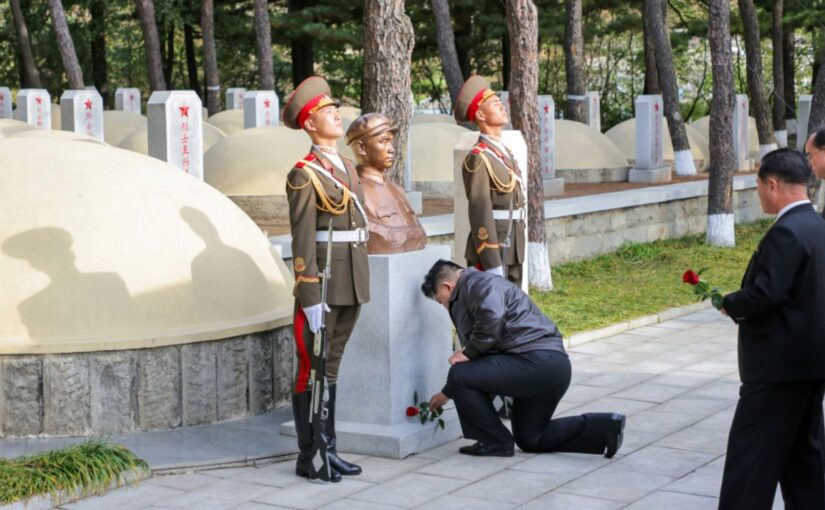
On October 24, Kim Jong Un, General Secretary of the Workers’ Party of Korea and President of the State Affairs of the Democratic People’s Republic of Korea, visited the Cemetery of the Fallen Soldiers of the Chinese People’s Volunteers in Hoechang County, South Phyongan Province and paid a high tribute to them.

Following the main ceremony, Kim Jong Un visited the grave of Mao Anying, the son of Comrade Mao Zedong, where he placed a flower and paid homage.

The Korean Central News Agency (KCNA) commented: “The faces of the CPV fallen soldiers, who assisted the revolutionary war of our people at the cost of their blood with the spirit of internationalism and the feeling of fraternal friendship, remain deep in the hearts of the peoples of the two countries as a symbol of valuable DPRK-China friendship.

“Our people will never forget the blood shed by the excellent sons and daughters of the Chinese people and their immortal feats even after a lapse of many years and the shift of generations.

“The DPRK-China friendship forged at the cost of blood would powerfully demonstrate its inexhaustible vitality in the sacred struggle to realise the cause of independence against imperialism, the socialist cause, in the future, too.”

Kim Jong Un’s visit was also reported by the Xinhua News Agency.

The following day a further ceremony was held at the Friendship Tower in downtown Pyongyang, which honours the CPV martyrs.

Earlier, on October 22, a ceremony for remodeling the cemetery of fallen fighters of the Chinese People’s Volunteers was held in Sinphyong County, North Hwanghae Province. Among those present were DPRK Vice-Minister of Urban Management Kang Chol Ho, joined by Wang Yajun, Chinese Ambassador to the DPRK, staff members of his embassy, the delegation of the veterans and families of martyrs of the CPV on a visit to the DPRK, Chinese guests staying in the DPRK, and Chinese students and residents in the DPRK.

A delegation of the Chinese People’s Liberation Army led by Xia Zhihe, Political Commissar of the National Defence University of the PLA also visited the DPRK from October 25 to October 28 to take part in commemorative functions

Functions were also held at the Chinese Embassy in Pyongyang and the DPRK Embassy in Beijing on October 25.

At the reception hosted in Pyongyang by Chinese Ambassador Wang Yajun, speakers referred to the historic significance of the CPV’s entry into the Korean front 75 years ago and the feats of the martyrs of the volunteers who devoted their precious lives to the revolutionary war of the Korean people.

They expressed the will to carry forward the glorious tradition and the great friendship under the strategic guidance of the top leaders of the two parties and two countries and thus open up a more beautiful future of the socialist cause of the two countries and the DPRK-China relations.

At the DPRK embassy in Beijing, speakers paid high tribute to the martyrs and veterans of the Chinese People’s Volunteers who entered the Korean front and fought shoulder to shoulder with the Korean people. They said that looking back on the history of 75 years ago is of great significance in remembering the forerunners and inheriting their spirit.

They expressed the will to promote the traditional DPRK-China friendship on the road of accomplishing the socialist cause, opposing the imperialists’ aggression and hegemony and defending regional peace and security, international fairness and justice.

Korean diplomatic staff also paid tribute at the cemeteries of CPV martyrs in the cities of Shenyang and Dandong, in China’s Liaoning Province.

The following articles were originally published on the website of KCNA. China’s People’s Daily also reported the commemorations.

Respected Comrade Kim Jong Un Visits Cemetery of CPV Fallen Soldiers on Occasion of 75th Anniversary of Entry of CPV into Korean Front

Pyongyang, October 25 (KCNA) — Kim Jong Un, general secretary of the Workers’ Party of Korea and president of the State Affairs of the Democratic People’s Republic of Korea, visited the Cemetery of the Fallen Soldiers of the Chinese People’s Volunteers in Hoechang County, South Phyongan Province and paid a high tribute to them on Oct. 24 on the occasion of the 75th anniversary of the entry of the CPV into the Korean front.

The respected Comrade Kim Jong Un was accompanied by Jo Yong Won, Pak Jong Chon and Kim Tok Hun, secretaries of the Central Committee of the WPK, and Choe Son Hui, foreign minister of the DPRK.

The guard of honor of the Korean People’s Army lined up at the cemetery.

The national anthems of the People’s Republic of China and the Democratic People’s Republic of Korea were played.

A flower basket in the name of Kim Jong Un and the flower baskets in the names of the Central Committee of the WPK and the State Affairs Commission of the DPRK were laid before the cemetery.

Kim Jong Un paid a silent tribute in memory of the CPV fallen soldiers.

Then, he visited the grave of Mao Anying at the cemetery.

He placed a flower before the grave and paid homage.

The faces of the CPV fallen soldiers, who assisted the revolutionary war of our people at the cost of their blood with the spirit of internationalism and the feeling of fraternal friendship, remain deep in the hearts of the peoples of the two countries as a symbol of valuable DPRK-China friendship.

Our people will never forget the blood shed by the excellent sons and daughters of the Chinese people and their immortal feats even after a lapse of many years and the shift of generations.

The DPRK-China friendship forged at the cost of blood would powerfully demonstrate its inexhaustible vitality in the sacred struggle to realize the cause of independence against imperialism, the socialist cause, in the future, too.


Continue reading Kim Jong Un pays tribute to Chinese People’s Volunteers on 75th anniversary

When a death in Brixton united the Irish and Chinese revolutions

On Sunday 26 October, the Irish community in London, together with friends, gathered outside Brixton Prison for the annual Terence MacSwiney Commemoration. This year’s gathering marked 105 years since the death of the Lord Mayor of Cork, after 74 days on hunger-strike, and was once again organised by the Terence MacSwiney Committee [London].

Committee Chair Frank Glynn welcomed the approximately 60 people gathered outside the south London prison. The day’s keynote speaker was Thomas Gould, Sinn Féin TD (member of the Irish parliament) for Cork North-Central, who delivered a powerful address that appealed to the solidarity and internationalism of those living in London to support the campaign to build a new and united Ireland.

Drawing inspiration from the example of Terence MacSwiney, Gould extended solidarity to the suffering people of Palestine amidst the ongoing occupation of their land and Israel’s genocidal war. He appealed for class unity at this time, noting that the establishment and those in power are desperately seeking to turn poor people against one another. He equally paid tribute to those Irishmen and women who were forced to leave their country over the past decades, assuring them that their sacrifice is not forgotten back home.

The commemoration also heard from Pat Reynolds of the Irish in Britain Representation Group (IBRG); Pam Blakelock, who spoke about her husband’s descendance from Muriel MacSwiney (Terence MacSwiney’s widow); and the Palestinian activist, Samar Maquishi, who spoke about the unwavering support of the Irish people for the cause of Palestine. As Samar observed, “Even if the whole world was quiet, the Irish won’t be silenced!”

Longstanding London-based Irish republican Denis Grace read the Proclamation of Easter Week 1916 on behalf of the Commemoration Committee. Music was provided by the stalwart London-Irish balladeer Seán Brady and Achill Island’s own Tom Lynch on the Uilleann Pipes. Special mention was also made of the election of Catherine Connolly as the next President of Ireland. There was overwhelming support expressed for Ms Connolly, whose campaign was supported by a broad range of left-wing and progressive forces in Ireland, particularly as a candidate who placed voting rights for Irish citizens outside of the twenty-six-county state and the ongoing struggle for Irish reunification at the centre of her election platform.

(The above is an edited version of the press statement issued by the Terence MacSwiney Committee [London].)

McSwiney’s 1920 death on hunger strike, during the 1919-1921 Irish war of independence, had a profound international impact, including on such leaders of the Indian freedom movement as Jawaharlal Nehru and Mahatma Gandhi. A young Ho Chi Minh, who was working in London at the time, was profoundly moved, saying: “He died for his country. How courageous! How heroic ! A nation which has such citizens will never surrender.”

But whilst Ho Chi Minh could see for himself the very public outpouring of grief on the part of London’s Irish community, another young progressive, who was later to become an important Asian communist leader, was following the news from Japan, where he was studying at the time.

That student was Guo Moro, who was to become a senior leader of the People’s Republic of China and a close comrade of Mao Zedong. He served as Chairman of both the Chinese Academy of Sciences and the China Federation of Literary and Art Circles from their inception after liberation in 1949 to his death in 1978.

In a 2020 article written for Raidió Teilifís Éireann (RTÉ, the Irish broadcasting service), Francis Kane, a lecturer at Ulster University, explains:

“In 1920, China was in chaos, a divided country dominated by foreigners and warlords, its ancient empire having finally collapsed in 1911. In his idealistic youth, the poet Guo Moruo cannot have known that one day he would become a man of enormous power and prestige… He died not long after his comrade and friend Chairman Mao, whom he praised relentlessly.”

Kane writes that Guo penned “an astonishing poem, an emotional ‘in real time’ commemoration of fellow writer MacSwiney in 1920, usually translated as ‘Victorious in Death’.”

Continue reading When a death in Brixton united the Irish and Chinese revolutions

Cuban culture celebrated in London

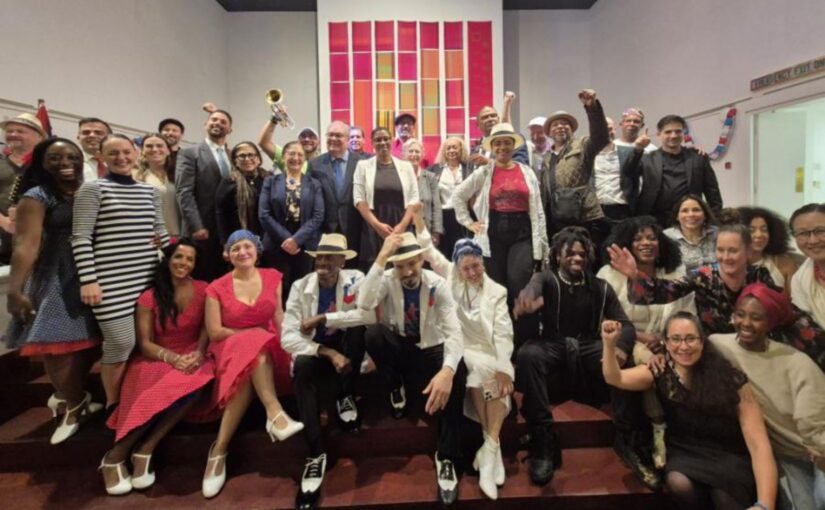
Friends of Socialist China co-editors Carlos Martinez and Keith Bennett were pleased to join a celebration of Cuban Culture Day on October 21. Held in a packed Bolivar Hall, the cultural premises of the Venezuelan Embassy in London, ‘Cuban Mosaic: A Night of Identity and Resilience’ brought together Cuban artists and friends of Cuba from cultural and artistic circles for a dazzling medley of music, dance and poetry that served to well illustrate the vibrancy and diversity of Cuban culture and the society it reflects.

Organised by the Cuban Embassy in London, with support from the Cuba Solidarity Campaign (CSC), the evening was presided over by Ambassador Ismara Mercedes Vargas Walter, who expressed her pride in the artistic quality and warmth of the gathering, which strengthened ties between Cuba and people in Britain. Friends of Cuba from all walks of life were present at the invitation-only gathering.

The following report was originally published on the website of the Cuban Foreign Ministry.

On 21 October, in London, the Cuban Embassy, with the support of the Campaign for Solidarity with Cuba (CSC), hosted an unforgettable gala in celebration of Cuban Culture Day. Entitled ‘Cuban Mosaic: A Night of Identity and Resilience,’ the event brought together Cuban artists and friends of the island in the United Kingdom to offer a broad and exciting sample of our music, dance and poetry. The result was a vibrant and emotional evening at the Bolívar Hall of the Venezuelan Embassy in the United Kingdom.

The programme combined virtuosity, tradition and contemporary creativity, with Cuban artists presenting a variety of performances and instruments, from classical pieces to modern compositions, allowing the audience to experience the cultural richness of Cuba and the celebrations that take place in our country during October.

At various points, classics from the Cuban tradition were revived alongside arrangements and performances that reflected the vitality and relevance of our culture. The evening was opened by pianist Eralys Fernández and clarinettist Lester Chío Alonso, who offered a highly lyrical start. Guitarist Nikos Baroutsakis captivated the audience with his repertoire, while Ramon Goose and John Woodham brought rhythm and flavour with guitar and congas. Singer and multi-instrumentalist Sergio Marciano shone with pieces that connected directly with the audience. Dance talent was represented by Damarys Farres & CSA Dance Company, who offered choreographic moments of great expressive power, and the London Lucumi Choir provided the voices needed to complete the evening’s sound palette.

The diverse and enthusiastic audience included British parliamentarians, members of the diplomatic corps, representatives of cultural, business, consular and academic institutions, as well as the CSC. They all joined in the celebration, enjoyed the displays of Cuban culture up close and learned more about the significance of Cuban Culture Day, which commemorates the identity, resilience and creativity of our people.

Ambassador Ismara Mercedes Vargas Walter presided over the evening and expressed her pride in the artistic quality and warmth of the gathering, which strengthened ties between Cuba and the British public. The presence of diplomats, cultural representatives and friends of Cuba underscored the international and dialogue-oriented nature of the event.

Ma Hui meets friends from Guyana and Mexico

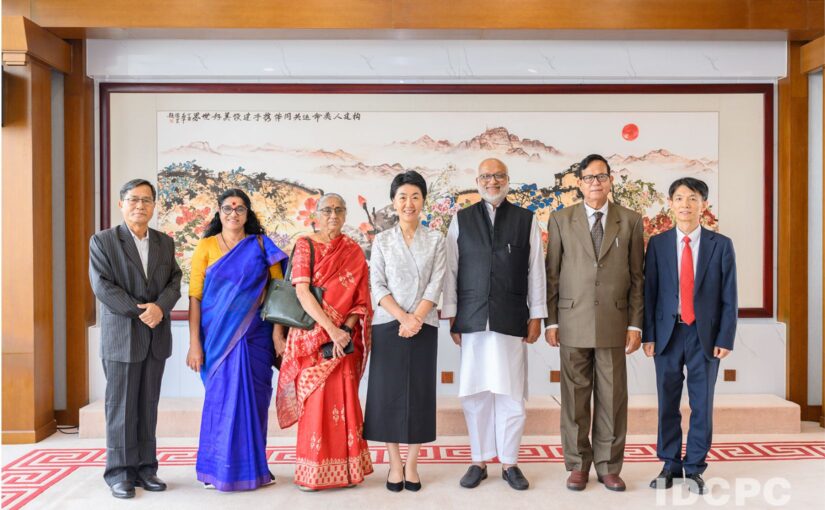
Vice-minister of the International Department of the Communist Party of China (CPC) Central Committee (IDCPC) Ma Hui recently met with visitors from Guyana and Mexico.

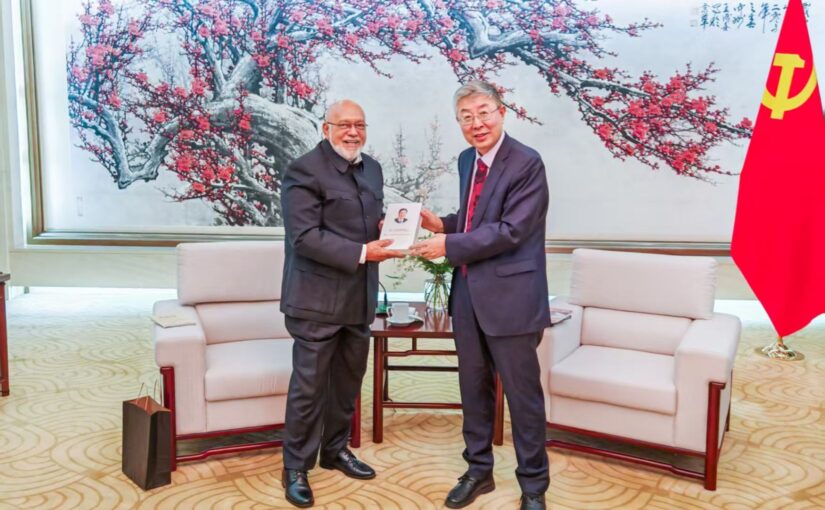
On October 15, he met with Donald Ramotar, Member of the Executive Committee of the People’s Progressive Party / Civic (PPP/C) and former President of Guyana, along with Clement Rohee, former Foreign Minister of Guyana.

Ma said that the CPC is willing to strengthen experience exchange in state governance and administration with the PPP/C and jointly build a new type of inter-party relationship featuring seeking common ground while reserving differences, mutual respect and mutual learning.

Ramotar thanked China for its valuable support for Guyana’s economic and social development and highly praised Xi Jinping Thought on Socialism with Chinese Characteristics in the New Era — the latest achievements of the adaptation of Marxism to the Chinese context and the needs of our times, and its global significance.

The Guyanese friends were visiting at the invitation of the Chinese People’s Institute of Foreign Affairs (CPIFA).

Two days previously, Ma had met with Alberto Anaya, President of the Labour Party (PT) of Mexico.

Ma said, China and Mexico are both important countries in the Global South. The CPC attaches great importance to friendly relations with all Mexican political parties, including the Labour Party, and is willing to strengthen inter-party exchanges and cooperation to promote the healthy development of the comprehensive strategic partnership between China and Mexico.

Anaya said, China’s development is rapid and its achievements are obvious to all. The rich experience of the CPC in party building and state governance is worth learning from. The Labour Party values its traditional friendship with the CPC and is willing to deepen exchanges and cooperation between the two parties to contribute to the development of Mexico-China relations and the building of a community with a shared future for humanity.

The PT is part of the progressive ruling coalition in Mexico. Anaya was in Beijing on his way home from the Democratic People’s Republic of Korea (DPRK) where he had participated in the 80th anniversary celebrations of the founding of the Workers’ Party of Korea (WPK).

The following articles were originally published on the website of the IDCPC.

Ma Hui Meets with Donald Ramotar, Member of the Executive Committee of the People’s Progressive Party / Civic (PPP/C) and Former President of Guyana

Beijing, October 15th (IDCPC) – Ma Hui, Vice-minister of the International Department of the CPC Central Committee, met here today Donald Ramotar, Member of the Executive Committee of the People’s Progressive Party / Civic (PPP/C) and former President of Guyana, who was visiting China at the invitation of the Chinese People’s Institute of Foreign Affairs.

Speaking highly of the PPP/C and Ramotar for their positive contributions to promoting China-Guyana relations and inter-party exchanges between the two countries, Ma said, China is willing to work with Guyana to implement the important consensus reached by the two heads of state and promote the continuous development of China-Guyana relations. The CPC is willing to strengthen experience exchange in state governance and administration with the PPP/C and jointly build a new type of inter-party relationship featuring seeking common ground while reserving differences, mutual respect and mutual learning.

Ramotar thanked China for its valuable support for Guyana’s economic and social development and highly praised Xi Jinping Thought on Socialism with Chinese Characteristics in the New Era—the latest achievements of the adaptation of Marxism to the Chinese context and the needs of our times, and its global significance. He said, the PPP/C is willing to strengthen exchanges of ideas and experience with the CPC and jointly promote the development of the global cause of justice.

Clement Rohee, former Foreign Minister of Guyana, was present.


Ma Hui Meets with Alberto Anaya, President of the Labor Party of Mexico

Beijing, October 13th (IDCPC) – Ma Hui, Vice-minister of the International Department of the CPC Central Committee, met here today with Alberto Anaya, President of the Labor Party of Mexico.

Ma said, China and Mexico are both important countries in the Global South. Win-win cooperation is in line with the fundamental interests of the two countries and the two peoples. The CPC attaches great importance to friendly relations with all Mexican political parties, including the Labor Party, and is willing to strengthen inter-party exchanges and cooperation to promote the healthy development of the comprehensive strategic partnership between China and Mexico.

Anaya said, China’s development is rapid and its achievements are obvious to all. The rich experience of the CPC in party building and state governance is worth learning from. The Labor Party values its traditional friendship with the CPC and is willing to deepen exchanges and cooperation between the two parties to contribute to the development of Mexico-China relations and the building of a community with a shared future for mankind.

JVP delegation visits China

A delegation of senior cadres from the Janatha Vimukthi Peramuna (JVP – People’s Liberation Front of Sri Lanka) recently visited China. The JVP is Sri Lanka’s largest Marxist party and currently the core party in its governing coalition. The delegation was led by Bimal Rathnayake, Member of the Political Bureau of the JVP and Minister of Transport, Highways, Ports and Civil Aviation of Sri Lanka.

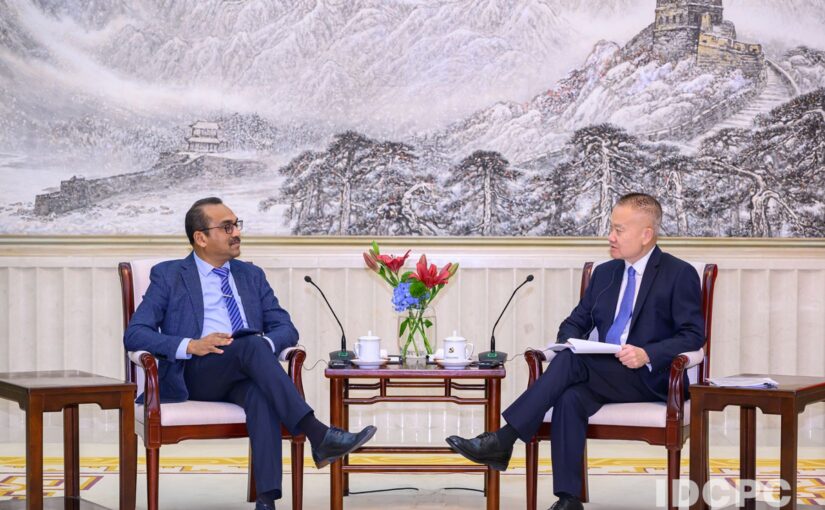
The Sri Lankan visitors met with Liu Haixing, Minister of the International Department of the Communist Party of China (CPC) Central Committee (IDCPC), on October 17.

Liu said, in January this year, President Xi Jinping held talks with visiting President Anura Kumara Dissanayake and reached important consensus on building a China-Sri Lanka community with a shared future and deepening exchanges of governance experience between the two countries’ ruling parties, charting the course for the development of the relations between the two countries and the two Parties. The CPC is willing to continue to strengthen high-level exchanges with the JVP and assist practical cooperation between the two countries and promote people-to-people bonds through the inter-party channel.

Rathnayake said, the JVP values the friendly exchanges with the CPC and thanks China for its valuable support for Sri Lanka’s economic and social development. Under the leadership of General Secretary Xi Jinping, China has achieved remarkable accomplishments in economic development, anti-corruption and other areas. The successful practice of the CPC has convinced Sri Lanka that strong party leadership is the key to a country’s development and progress. The JVP is committed to maintaining close high-level exchanges with the CPC, learning from its experience and practices in strengthening party building and promoting national development, and conducting in-depth exchanges and cooperation in areas such as cadre training, smart city construction, poverty reduction, and promoting ethnic unity, in order to enhance the JVP’s own governance capacities and work hand in hand with China to advance the modernisation process of the two countries.

The following article was first published on the website of the IDCPC.

Beijing, October 17th (IDCPC) – Liu Haixing, Minister of the International Department of the CPC Central Committee (IDCPC), met here today with a delegation of senior cadres of the Janatha Vimukthi Peramuna (JVP) from Sri Lanka led by Bimal Rathnayake, Member of the Political Bureau of the JVP and Minister of Transport, Highways, Ports and Civil Aviation of Sri Lanka.

Liu said, in January this year, President Xi Jinping held talks with visiting President Anura Kumara Dissanayake, and reached important consensus on building a China-Sri Lanka community with a shared future and deepening exchanges of governance experience between the two countries’ ruling parties, charting the course for the development of the relations between the two countries and the two Parties. The CPC is willing to continue to strengthen high-level exchanges with the JVP, and assist practical cooperation between the two countries and promote people-to-people bonds through the inter-party channel. Liu shared the great process and successful experience of the CPC in leading the advancement of Chinese modernization, and introduced the main agenda of the fourth plenary session of the 20th CPC Central Committee. He said, formulating and implementing national development plans is an important piece of governance experience of the CPC. The political parties of China and Sri Lanka can have in-depth exchanges on formulating medium-and long-term development plans and promoting national modernization, so as to promote better alignment of the two countries’ strategies and plans. 

Rathnayake said, the JVP values the friendly exchanges with the CPC and thanks China for its valuable support for Sri Lanka’s economic and social development. Under the leadership of General Secretary Xi Jinping, China has achieved remarkable accomplishments in economic development, anti-corruption and other areas. The successful practice of the CPC has convinced Sri Lanka that strong party leadership is the key to a country’s development and progress. The JVP is committed to maintaining close high-level exchanges with the CPC, learning from its experience and practices in strengthening party building and promoting national development, and conducting in-depth exchanges and cooperation in areas such as cadre training, smart city construction, poverty reduction, and promoting ethnic unity, in order to enhance JVP’s own governance capacities and work hand in hand with China to advance the modernization process of the two countries. 

Sun Haiyan, Vice-minister of the IDCPC, was present. 

Indian communists visit China

Between September 23-30, a six-person delegation from the Communist Party of India (Marxist) (CPIM), India’s biggest communist party, led by General Secretary MA Baby, visited China. Besides Beijing, the delegation visited the provinces of Hubei and Zhejiang.

Baby first visited China in 1985, but this was his first visit since he assumed the leadership of the party following the untimely death of Sitaram Yechury. He recounted the visit in two articles for People’s Democracy, the CPI(M)’s English language weekly. Indicating a key lesson that Indian communists have learned from their Chinese comrades, he writes:

“China lifted 800 million people above the poverty line as defined by the World Bank. Incidentally, it needs to be mentioned that taking inspiration from this example, and in an effort to address the material circumstances of the state, the CPI(M)-led Left Democratic Front government in Kerala has taken up a progressive initiative to eradicate extreme poverty. By November, Kerala will become the first Indian state to do so.”

He also marvelled at the Museum of the History of the Communist Party of China (CPC), opened in July 2021 to mark the party’s centenary:

“The museum is a prime example of how a nation’s and a party’s history can be presented using cutting-edge science and technology. In the museum, the story of the CPC’s century-long journey, from its formation to modern-day achievements, is presented with the help of digital and immersive tools.”

On the substantive business of the visit, Baby reports:

“Several bilateral discussions were held during the visit. The most prominent among them was the discussion with a delegation of the CPC leadership, led by their Polit Bureau member Li Shulei. That meeting reaffirmed the deep and long-standing ties between the CPC and the CPI(M). Both parties recognise that the US State, under President Donald Trump, is trying to impose a unipolar world under its dominance. ‘Countries of the South’ — developing nations — need to stand together to resist this. In this context, the Indian Prime Minister Narendra Modi’s participation in the Shanghai Cooperation Organisation’s (SCO) 2025 Summit in Tianjin was particularly taken note of.

“This year marks the 75th anniversary of the establishment of diplomatic ties between India and China. Beyond cooperation within the SCO, both countries are playing their roles within BRICS as well. In the coming years, India and China are both set to hold the BRICS chairmanship, taking turns. The discussions stressed that India and China must resolve the issues between them through dialogue. Improving India-China relations would not only benefit both countries but also contribute to global peace and progress. Therefore, both sides must make patient and focused efforts toward de-escalating tensions along the border. It is serendipitous that during our visit certain significant developments were taking place towards this, such as the resumption of direct flights between India and China.”

Continue reading Indian communists visit China

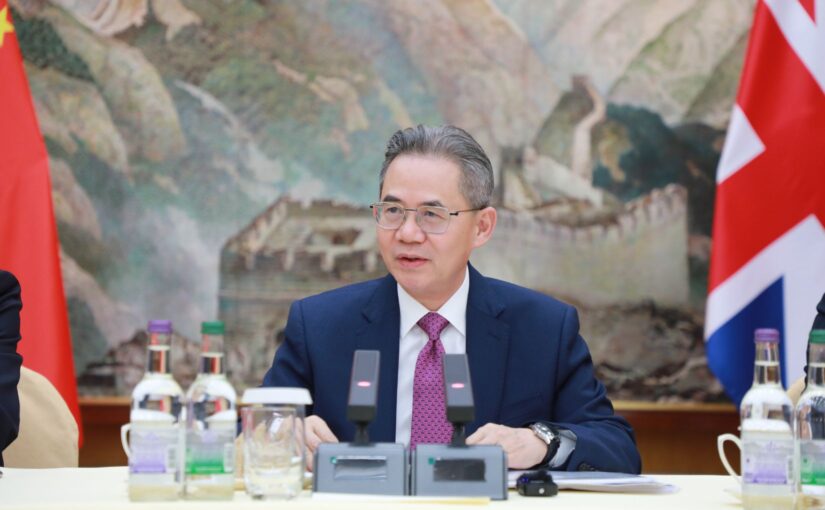
Symposium held in London: New Development of China, New Opportunities for the World

On Friday 24 October 2025, the Chinese Embassy in the UK organised a symposium on the topic New Development of China, New Opportunities for the World. The symposium was focused on the complex and ever-changing international situation; the challenges facing the United Nations and multilateralism; and China’s recently-proposed Global Governance Initiative, which addresses itself to the critical issue of “how to build a global governance system and how to reform and improve global governance”.

The event introduced by Minister Zhao Fei, followed by a keynote speech by Ambassador Zheng Zeguang. Counsellor Mu Yongpeng provided an introduction to the Global Governance Initiative, and Counsellor Kong Xiangwen introduced China’s position on the questions of Taiwan and UN Resolution 2758.

British participants were then invited to contribute remarks:

  1. Robert Griffiths, General Secretary of the Communist Party of Britain
  2. Andy Brooks, General Secretary of the New Communist Party of Britain
  3. Stephen Perry, Honorary President of the 48 Group Club
  4. Martin Albrow, Fellow of the British Academy of Social Sciences
  5. Kerry Brown, Director of the Lau China Institute at Kings College, London
  6. Ollie Shiell, CEO of UK National Committee on China
  7. Frances Wood, Sinologist
  8. Keith Bennett, Co-editor of Friends of Socialist China
  9. Hugh Goodacre, Managing Director of Xi Jinping Thought Study Group
  10. Max Browning, Schwarzman Scholar at Tsinghua University
  11. Janet St John-Austen, Director of Xi Jinping Thought Study Group
  12. Carlos Martinez, Co-editor of Friends of Socialist China
  13. George Korkovelos, Central Committee Member of the Communist Party of Great Britain (Marxist-Leninist)

We reproduce below the Embassy’s report of the event, followed by the contributions by Keith Bennett and Carlos Martinez.

Ambassador Zheng Zeguang Briefs Representatives of Different Sectors in the UK on the Fourth Plenary Session of the 20th CPC Central Committee

On 24 October 2025, the Chinese Embassy in the UK held a symposium on “New Development of China, New Opportunities for the World” to brief participants on the important decisions made by the Fourth Plenary Session of the 20th CPC Central Committee. Chinese Ambassador to the UK Zheng Zeguang delivered a keynote speech at the symposium. Representatives of several UK political parties and those from different sectors attended the symposium and joined in the discussions.

In his speech, Ambassador Zheng noted that the Fourth Plenary Session of the 20th CPC Central Committee comes at a time when China is marching towards the second Centenary Goal and represents a call to action for the entire country to seize the momentum and advance Chinese modernisation.

With this meeting, the CPC Central Committee with Comrade Xi Jinping at its core sets to unite and lead the Chinese people to write yet another chapter on the miracles of rapid economic growth and long-term social stability and to open up new horizons for Chinese modernisation.

Ambassador Zheng pointed out that the meeting has identified the critical role the next five years will play in China’s development. During the 14th Five-Year Plan period, China has achieved pioneering progress, breakthrough transformation, and historic accomplishments in its economic and social development. Over these five years, China has reached new heights in terms of economic, scientific and technological capabilities, and composite national strength. China’s economy will grow by about 4 trillion pounds.

carlosmartinez

Free Mumia Campaign discusses China and the international anti-imperialist struggle

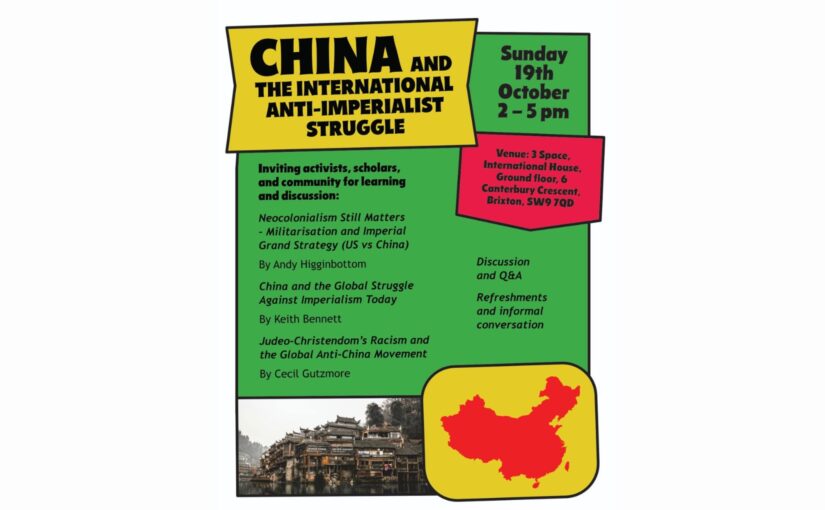
On Sunday October 19 the Free Mumia Abu Jamal Campaign UK organised a discussion meeting on the theme of China and the international anti-imperialist struggle at International House in Brixton, south London.

Chaired by Sarah Mudd and introduced by Wilf Dixon of the Free Mumia Campaign, the meeting heard three presentations expressing differing views within a common overall anti-imperialist perspective:

  • Our Co-editor Keith Bennett spoke on ‘China and the global struggle against imperialism today’;
  • Cecil Gutzmore, Chair of the Free Mumia Campaign and veteran revolutionary Pan-Africanist, spoke on ‘Judeo-Christendom’s racism and the global anti-China movement’; and
  • Andy Higginbottom, former Assistant Professor at Kingston University, London, and a long-standing anti-imperialist activist and Marxist scholar, spoke on ‘Neo-colonialism still matters – Militarisation and Imperial Grand Strategy (US v. China)’.

The presentations were followed by a lively discussion and informal networking. We embed below a video of the three speeches, followed by the text of Keith Bennett’s presentation.

I’d like to thank the Free Mumia Abu Jamal Campaign UK for their initiative in organising this discussion on China and the international anti-imperialist struggle and for inviting me to speak.

Some might ask why a campaign such as yours might wish to address such a topic. But such a view could be said to not fully take account of why you have – correctly in my view – placed such importance on Mumia’s case and on the necessity to win the freedom of this revolutionary fighter who has endured some 43 years of incarceration in the hell hole conditions of the US prison system without losing his revolutionary faith and will or his original aspiration.

Whether before or throughout his long imprisonment, Mumia’s writings have expressed unwavering solidarity with the struggles of peoples throughout the world against imperialism. In his early teens, he joined the Black Panther Party. Many things distinguished the Panthers, of course – from armed self-defence to free breakfast programs for children to clinics to treat sickle cell anaemia. But equally distinctive was the strong solidarity the party expressed, and the inspiration it drew from, the Asian socialist countries – from China, Vietnam and the Democratic People’s Republic of Korea (DPRK). From their long-standing, protracted struggles against imperialism. And from their revolutionary standpoint and their creative application and development of Marxism-Leninism from the standpoint of the oppressed.

Continue reading Free Mumia Campaign discusses China and the international anti-imperialist struggle

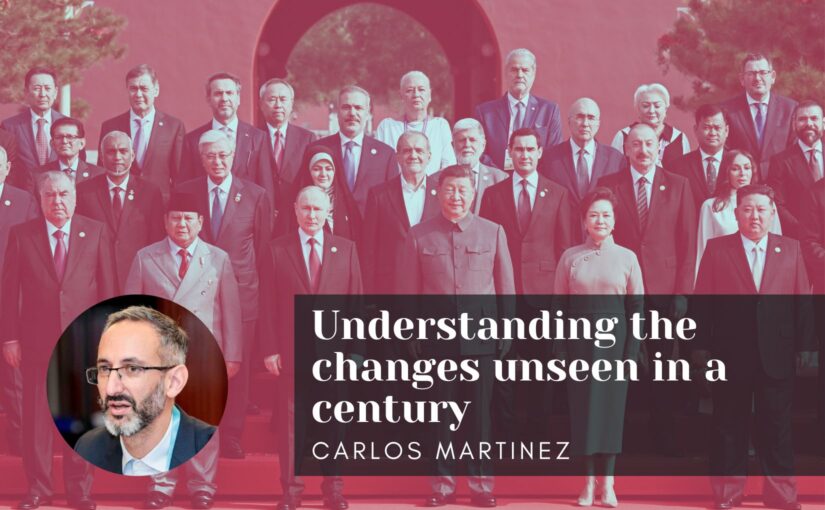
Understanding the changes unseen in a century

The following text is based on a presentation given by Friends of Socialist China co-editor Carlos Martinez at the Thinkers Forum, held at Fudan University, Shanghai, on 16 October 2025, which event brought together thinkers and scholars from around the world to discuss “Global Changes and the Reshaping of the World Order.”

Carlos explores the meaning of Xi Jinping’s observation that “the world is undergoing profound changes unseen in a century”, arguing that these changes reflect a historic shift from Western-led unipolar dominance toward a multipolar, post-imperialist global order. The article traces these changes back to the October Revolution of 1917, which opened a new era of socialist development and anti-colonial liberation.

After the setbacks of the 1980s and 1990s — including the collapse of the Soviet Union and the rise of neoliberal globalisation — Western commentators like Francis Fukuyama declared “the end of history”. Yet, as Deng Xiaoping noted, history advances through contradictions and reversals. The 2008 financial crisis, widening inequality and environmental collapse have since exposed the limits of neoliberal capitalism.

Meanwhile, a multipolar world is emerging. China stands at the centre of this process, advancing initiatives such as the Belt and Road, the Global Development Initiative, and the Global Governance Initiative — all based on sovereignty, non-interference, and mutual benefit. Such efforts are helping countries of the Global South break from dependency and pursue sustainable, sovereign development.

The US and its allies, meanwhile, cling to hegemony through wars, sanctions, economic coercion and destabilisation. Humanity faces a stark choice: socialism or barbarism, cooperation or confrontation. Carlos concludes by calling for a global united front of socialist, anti-imperialist, and progressive forces to ensure that this century’s transformations lead to peace, justice, and sustainable development.

Carlos’s presentation was summarised in the popular Chinese news website Guancha.

General Secretary Xi Jinping has observed several times that “the world is undergoing profound changes unseen in a century”. What are these changes, and what are their implications for the current global situation?

Before addressing the changes the world is experiencing today, it is worthwhile reflecting on the major changes that occurred a century ago, since the dramatic shifts of that time laid the foundations for the transformations we are witnessing now.

The October Revolution of 1917 was a watershed moment marking the beginning of humanity’s transition from capitalism to socialism. The revolution in Russia led to the formation of the world’s first socialist state – the Soviet Union – which became a revolutionary base area for the working class and oppressed peoples of the world. The Soviet Union provided crucial support for the liberation of, and construction of socialism in, Eastern Europe, China, Cuba, Korea, Vietnam and elsewhere.

The Soviet Union and China played the decisive role in the defeat of fascism in World War II. This victory gave tremendous impetus to the anti-colonial movement and national liberation struggles around the world – in Africa, in Asia, in Latin America, in the Caribbean and the Pacific. The colonial system was no longer viable.

As such, the October Revolution constituted the first major breach in the imperialist world system, thereby marking the start of the current era of human development.

Continue reading Understanding the changes unseen in a century

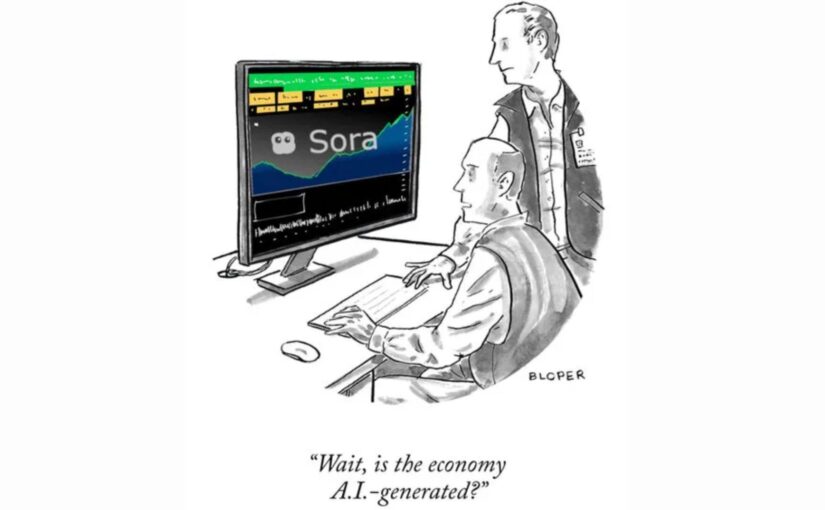
Intelligence artificial, profits fictitious

In the following article for Struggle La Lucha, Gary Wilson argues that the US economy’s apparent strength is illusory, sustained not by genuine productivity or innovation but by speculation — particularly around artificial intelligence. He describes the so-called AI revolution as a massive financial bubble: stock prices have soared far beyond the real value produced by technology or labour, echoing the speculative manias of the past.

The author observes that capitalism’s need for constant expansion drives investors to seek new frontiers when previous ones — such as smartphones and social media — stagnate. Artificial intelligence, and especially the dream of Artificial General Intelligence (AGI), has become the latest speculative frontier, attracting trillions in investment despite limited real-world returns. Big tech companies have seen valuations reach absurd levels, even as AI products remain unprofitable.

This “fictitious prosperity”, built on credit and hype, fuses finance capital with US imperial ambitions. The military, intelligence agencies and tech monopolies now form a military-tech-industrial complex, with AI development justified in terms of national security and global dominance. “Silicon Valley has metastasized into a merger of big capital, big tech, and big war. The empire’s newest weapon isn’t a missile — it’s the algorithm.”

In contrast, China treats AI as a practical tool for production — applying it to manufacturing, logistics, and energy — rather than a casino for speculative profit.

China, by contrast, is treating AI not as a casino chip but as a tool. Instead of betting on abstract intelligence for future profit, China applies AI to real sectors — manufacturing, logistics, energy, and urban planning… While the U.S. bankrolls hype, China retools for production. This isn’t just a tech race — it’s a clash between two systems: finance-driven capitalism versus planned development.

The author was among the speakers at our webinar on DeepSeek and the challenge to US technological hegemony, held in February 2025.

The U.S. economy isn’t booming — it’s levitating. What keeps it up isn’t productivity or innovation, but speculation.

The so-called “AI revolution,” hailed as a new industrial dawn, is in reality a massive bubble — a speculative fever driving stock prices far beyond what the technology can actually deliver.

The anatomy of a bubble

A speculative bubble forms when the price of something — like tech stocks — rises far beyond its real, sustainable value. 

That real value comes not from market hype or quick profits, but from workers’ labor power — their capacity to create more value than they’re paid for.

But in a bubble, prices rise not because real production or value creation is expanding, but because investors are chasing promises — each betting that someone else will pay even more for the same asset.

The pattern isn’t accidental. It’s built into capitalism itself.

Step one: Capital needs to expand

Capitalism runs on an “expand or die” engine. Every firm must grow constantly to survive — outspending, outproducing, and out-innovating its rivals.

When one wave of growth slows, capital hunts for another.

Continue reading Intelligence artificial, profits fictitious

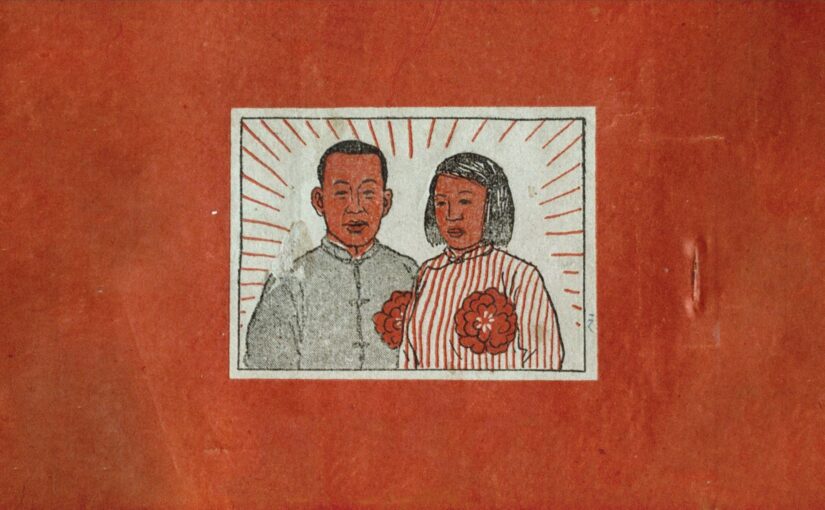
Inside the early push to revolutionise marriage in China

The following article, originally published in Sixth Tone, describes how, 75 years ago, the newly founded People’s Republic of China passed its first law — the 1950 Marriage Law — signalling the revolutionary state’s commitment to social transformation and gender equality. This law took priority because reforming marriage was seen as essential to dismantling feudal traditions that subordinated women and sustained patriarchal family structures. The new legislation enshrined freedom of marriage, monogamy, and gender equality, fundamentally redefining Chinese family life.

However, implementation of the law was predictably complicated. Deep-rooted conservative attitudes persisted, and early inspections revealed violent resistance to reform. Recognising the need for widespread education, the Communist Party launched China’s first national legal awareness campaign. Propaganda posters, songs, illustrated guides, and plays — including new versions of traditional stories like The Butterfly Lovers and Southeast Flies the Peacock — promoted the ideals of free marriage and women’s liberation in accessible, culturally resonant forms.

By 1953, the campaign reached its peak during the “Month of Promoting the Implementation of the Marriage Law,” with factories, schools, and workplaces across China holding lectures, exhibitions, and radio broadcasts.

Though the national campaign formally ended in 1953, its impact was enduring. The Marriage Law not only transformed Chinese social relations but also marked the beginning of a state-led effort to educate citizens in law and equality, embedding women’s rights in the foundations of the new China. While the road to equality and an end to discrimination is a long one, China continues to make impressive progress.

Seventy-five years ago, the People’s Republic of China issued its first law. It wasn’t the Constitution, nor was it the Civil Code — it was the Marriage Law.

This unique level of importance reflected the times. In revolutionary China, marriage reform was a major subject among early 20th-century intellectuals, who felt feudal concepts of family and marriage significantly stifled the individual freedoms of Chinese people — especially women — and hindered their participation in reshaping China. While choosing a partner to marry may be the status quo now, for centuries, families arranged marriages, divorce was rare, and women were subordinate to their husbands. As legal historian Qu Tongzu wrote in the book “Law and Society in Traditional China,” the main purpose of marriage in Imperial China was “to produce offspring to carry on ancestor worship” and was in no way concerned with the couple’s wishes.

Continue reading Inside the early push to revolutionise marriage in China

China’s technology infrastructure is blazing a trail for humanity

The following is the text of a speech given by Alessandro Zancan (a member of the Iskra Books editorial board and Friends of Socialist China Britain’s committee) at a China delegation report back meeting held in Brighton on 13 September 2025.

Ale reflects on China’s development over recent decades, arguing that its people-oriented use of technology is central to the country’s success in a number of fields. Platforms like WeChat and AliPay integrate public and private services efficiently and securely, while Huawei’s HarmonyOS NEXT exemplifies China’s push for seamless, cooperative, and non-exploitative tech ecosystems. This state-led coordination underpins achievements in pandemic control, renewable energy and poverty alleviation.

China’s poverty eradication, powered by data systems, digital infrastructure and rural electrification, is the fruit not of charity but of socialist planning and collective effort.

The article concludes that China’s dialectical approach to socialism — pragmatic, adaptive, and technologically advanced — offers lessons for Marxists worldwide: to study China’s experience, challenge Western narratives, and develop their own independent, cooperative platforms for knowledge building, dissemination and coordination.

Quick Rundown of Trip

At the end of May and through the beginning of June, delegates from various organisations, including Iskra Books, the Communist Party of Britain, the Young Communist League, Black Liberation Alliance, Qiao Collective, Freedom Road Socialist Organisation and Workers World Party went on a trip to China, as members of Friends of Socialist China’s Britain and US committees. We were graciously invited and hosted by the China NGO Network for International Exchanges (CNIE).

Shaanxi

Our first stop was in Xi’an, Shaanxi province, by way of a short layover in Shanghai. We saw the Terracotta Army in Emperor Qinshihuang’s Mausoleum Site Museum and we visited the Xi’an City Wall.

We wandered a bit on our own, and experienced the city as tourists, before moving on to Yan’an – the main centre of the Chinese Revolution from the conclusion of the Long March in 1935 until the late 1940s – where we visited the Revolutionary Memorial Hall and the CPC base. We actually got to enter Mao Zedong’s, Zhou Enlai’s and Liu Shaoqi’s cave houses, along with the 7th National Congress Hall.

Gansu

In Dunhuang, Gansu province, we attended a number of meetings and conferences, headlined by the Fourth Dialogue on Exchanges and Mutual Learning Among Civilisations, where we got to meet delegates from all over the world. We visited one of China’s biggest solar parks; we saw the stunning Mogao Caves; and attended the Dragon Boat Festival celebration in the Gobi Desert. It was truly breathtaking, and nothing else I have seen in my life can truly compare.

We then moved to Jiayuguan, where we visited a dairy farm and a number of museums; had a wine tasting from one of Asia’s largest wine producers; visited the JISCO Smart Grid and Localised New Energy Consumption Demonstration Project; and got to see the westernmost point of the Great Wall. Multiple projectors lined the walls, projecting animations of historical events, mapped to the structure of each fortress and individual wall.

Continue reading China’s technology infrastructure is blazing a trail for humanity

Support for government in China: is the data accurate?

A wide range of surveys consistently show that Chinese people express exceptionally high levels of trust and satisfaction with their government and political system—far higher than in most other countries. The World Values Survey (2018) found that 94.6% of Chinese respondents trusted their national government, while the Asian Barometer Survey (2015) reported 86.7%. Harvard’s Ash Center likewise recorded 93% satisfaction with the national government and 82% with provincial authorities. The Alliance for Democracies (2024) found that 91% of respondents in China believed the government serves the interests of most people, with 85% saying all people enjoy equal rights before the law, compared to much lower figures in Western nations.

Nonetheless, writes Jason Hickel on his Substack blog, “skeptics have questioned the data, saying that respondents may overstate support for their government if they live in a system where they are likely to fear repression for expressing political dissent”. To test this, researchers have used “list experiments”, which allow respondents to answer anonymously. These studies found somewhat lower but still very high levels of trust, ranging from 62% to 77%—well above the figures for the US (33%), France (31%) and Britain (29%).

Other methods, such as Implicit Association Tests, show that implicit and explicit trust levels in China are nearly identical, indicating that political fear does not explain the results. As such, the evidence suggests that Chinese people’s reported trust in their government is genuine. Hickel writes:

These studies point to an important reality that we must grapple with: the Chinese people have a much higher regard for their government, and much higher support for their political and economic system, than people in the West tend to assume.

The reasons for this level of popular support is explained in a previous post by Jason Hickel: that “most people in China believe their political system is democratic, fair, and serves the interests of the people”; and that “what matters most when it comes to people’s perceptions of democracy is not whether their country has Western-style elections, but whether they believe their government acts in the interest of most people”.

The full text of Hickel’s article is republished below.

A wide range of public opinion surveys and studies over the past years have demonstrated that people in China tend to express strikingly strong support for their government and their political-economic system, much higher than in most other countries.

For instance, the World Values Survey consistently shows that over 90% of people in China report “a great deal” or “quite a lot” of trust in the national government. In 2018, the most recent wave, trust was at 94.6%, one of the highest levels in the world. This result is supported by the Asian Barometer Survey, which in 2015 found 86.7% of respondents in China had “a great deal” or “quite a lot” of trust in the national government.

Similarly, Harvard’s Ash Center for Democratic Governance has conducted regular surveys on public opinion in China since 2003. It finds that, in the most recent year of data, satisfaction with the national government stood at 93%, having generally increased over time. Satisfaction with provincial governments was also high at 82%.

Next, the Danish NGO Alliance for Democracies publishes data on people’s perceptions of their political systems in over 50 countries. According to the most recent report (2024), people in China have positive views of their political system, with 91% saying that the government serves the interests of most people (rather than a small group), and 85% saying all people enjoy equal rights before the law, much higher than in the US, France and Britain.

Finally, a recent study published in the journal Political Psychology asked people in 42 countries whether they think their system is fair and just. They used the following questions: “In general, I find society to be fair”, “In general my country’s political system operates as it should”, “Everyone in my country has a fair shot at wealth and happiness”, and “My country’s society is set up so that people usually get what they deserve.” The results show that people in China are more likely to agree with these statements than any other country in the set.

These are all remarkable results. But skeptics have questioned the data, saying that respondents may overstate support for their government if they live in a system where they are likely to fear repression for expressing political dissent. In behavioural psychology, this is known as “strategic misreporting”. The Alliance for Democracies study is designed to avoid this bias, but other studies may be more vulnerable.

Continue reading Support for government in China: is the data accurate?

Xi Jinping meets with heads of state and government attending Global Leaders’ Meeting on Women

Following the 2025 Global Leaders’ Meeting on Women, which was held in Beijing on October 13, Chinese President Xi Jinping met the following day with the five heads of state or government – four of them women – who had attended.

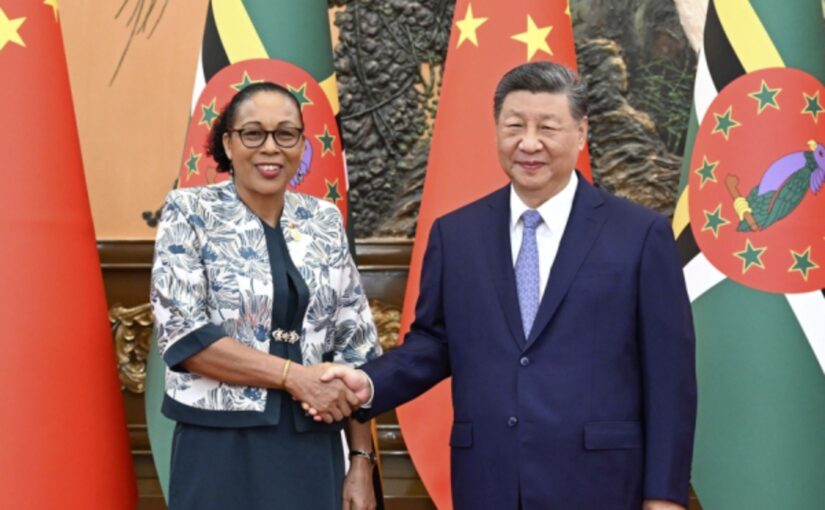
Meeting with President of Dominica Sylvanie Burton, President Xi noted that Dominica is China’s good friend and good partner in the Caribbean. Since the establishment of diplomatic ties more than 20 years ago, the two sides have always respected each other and treated each other as equals. With ever consolidating political mutual trust, growing exchanges and cooperation in various fields and deepening friendship between the people, China and Dominica set a good example of friendly cooperation between countries of different social systems and sizes. China will continue supporting Dominica in enhancing capabilities in climate action and disaster prevention and mitigation, strengthen cooperation in such areas as infrastructure, clean energy, healthcare, agriculture and empowerment of women, and enhance people-to-people exchanges in culture, education and tourism. Efforts should be made to implement the consensus reached at the Global Leaders’ Meeting on Women and deepen cooperation on women’s capacity building.

President Burton said that China is a great friend and highly valued partner of Dominica and appreciated China’s valuable support and sincere friendship. Dominica and China share common ideals and pursuits, and deepening bilateral relations will bring bright prospects for the people of Dominica. Dominica is steadfastly committed to the one-China principle. It will enhance cooperation with China in trade, agriculture, the green economy, new energy, healthcare, and climate response, among other areas, strengthen people-to-people exchanges, advance cooperation between Latin America and the Caribbean and China, and write a new chapter in bilateral relations. China is a crucial force for peace and stability in today’s world. Its vision of building a community with a shared future for humanity and commitment to sharing development opportunities with the world and promoting solidarity among the Global South is inspiring and is a beacon of hope for the world. Dominica stands ready to work closely with China to oppose unilateralism and hegemonism and safeguard the common interests of developing countries.

Meeting with Icelandic President Halla Tómasdóttir, President Xi noted that, over the past 54 years since the establishment of diplomatic ties, China and Iceland have respected each other and pursued win-win cooperation. The fruitful outcomes achieved in bilateral relations have fully shown that countries with different national conditions are fully capable of transcending differences in social system and other areas to achieve mutual benefit.

The two sides should deepen practical cooperation in such areas as economy and trade, geothermal energy and healthcare, and jointly promote green transition and address climate change. The two sides should also step up people-to-people exchanges in tourism, education and other fields to enhance friendship and mutual understanding between the two peoples. Both China and Iceland support multilateralism, the international system with the UN at its core and the international order underpinned by international law. The two sides should strengthen communication and coordination, commit to addressing international disputes through dialogue and consultation, and strive for a more just and equitable global governance system. It is important to build on the successful convening of the Global Leaders’ Meeting on Women to promote continued progress in the global cause of women.

President Tómasdóttir congratulated China on the successful hosting of the Global Leaders’ Meeting on Women and appreciated China for the warm reception and full respect shown to a small country like Iceland. Iceland highly appreciates China’s significant contributions to promoting the global women’s cause and will strengthen communication and cooperation with China to advance the all-round development of women worldwide. Iceland and China have enjoyed friendship over decades. The strong and robust bilateral relationship has yielded fruitful results in such areas as trade, geothermal energy and tourism.

Continue reading Xi Jinping meets with heads of state and government attending Global Leaders’ Meeting on Women

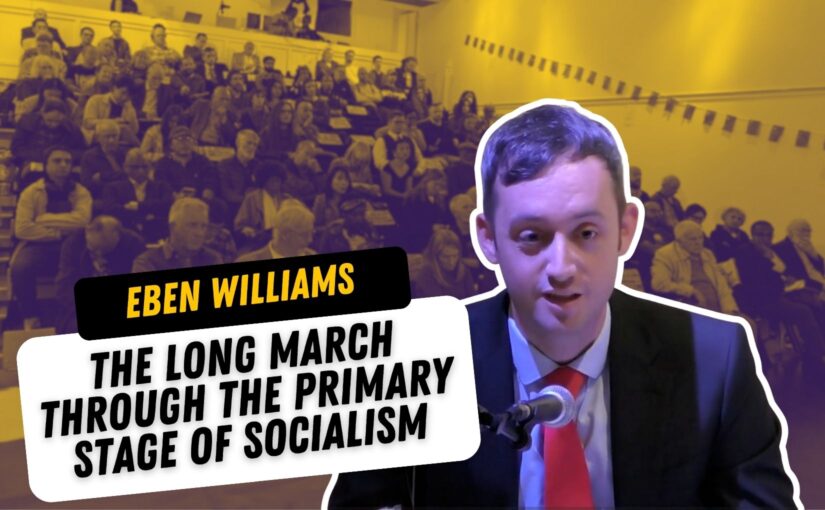
The long march through the primary stage of socialism

The following is the text of a speech given by Eben Dombay Williams, YCL Education Officer, at our second annual Socialist China Conference, held on Saturday, September 27.

Eben’s speech is based primarily on a text he has been translating, written by an academic at a Chinese Marxist Institute in Shanghai, analysing the theoretical aspects of what is known in China as the primary stage of socialism. The article observes that socialism in China did not emerge from fully developed capitalism, as envisioned by Marx and Engels, but from a revolutionary leap over the “Caudine Forks” of capitalism. Because of China’s relatively undeveloped productive forces at the time of revolution, it must spend an extended historical period completing the modernisation tasks that capitalism would otherwise have accomplished.

The “primary stage” theory, formally defined at the CPC’s 13th National Congress, recognises that class struggle persists but does not constitute the principal contradiction in society. Currently, “the primary task is to energetically expand the commodity economy, raise labour productivity and gradually achieve modernisation of industry, agriculture, national defence, science and technology”.

The text notes that, in the first decades of Reform and opening up, a level of ideological confusion crept in. “Some of the differences between socialism and capitalism were to a certain extent concealed under the banner of ‘modernisation,’ and a series of problems and phenomena that were clearly contrary to socialist principles emerged in society. But since the new era, the Central Committee of the CPC with Comrade Xi Jinping at its core has always emphasised the socialist nature of the Chinese road, continuing to follow the basic principles and core values of socialism in drawing up the strategy for China’s modernisation drive and always inserting socialist elements into this modernisation, leading the way to building a great modern socialist country in all respects and striving to promote an organic unity between socialism and modernisation.”

As it moves towards basic completion of the task of socialist modernisation by the middle of this century, China is breaking new ground in the development of Marxism. “The implications … are not only to provide another option for the path to modernisation for the vast number of developing countries, including other socialist countries, but also to present a new solution to the problems of modernity for the developed capitalist countries, that is, the socialist road out.”

The video of the speech is embedded below the text.

I’d first like to give a massive thank-you to Carlos, Keith and the whole team at Friends of Socialist China. It’s so encouraging to see that following on from the successful 75th anniversary celebrations last year, this has now become an annual conference. It’s no small feat to bring multiple socialist and communist organisations on the left together under one roof, but it’s so important that we reject petty sectarianism and unite to build an anti-imperialist united front in the face of attacks on socialist China and the multipolar world. Of course, solidarity with George Galloway and his wife Gayatri on their shameful detention.

In my day job, I work as a Chinese to English translator and it just so happened that when I was invited to speak on the subject of socialist construction in China, I was in the middle of translating an important text written by an academic at a Chinese Marxist Institute in Shanghai. This text focuses on the theoretical aspects of what the CPC has termed the “primary stage of socialism” and will hopefully be appearing in a future edition of Iskra Books’ theoretical journal, Peace, Land, and Bread next year. I wanted to share a small extract of the text because I found it very interesting and relevant:


Theoretically speaking, socialism is not being constructed in China on the exact same basis envisioned by Marx and Engels and fully expanded upon in Capital. Instead, it has been reached directly under conditions where capitalism has not fully developed, where political power was seized through revolution at the appropriate historical moment, and where the “Caudine Forks” of the capitalist system was leaped across,” with “Caudine Forks” being the term Marx used in his prophetic wisdom to describe the problem of a potential, future socialist society attempting to skip over the capitalist stage after a successful proletarian revolution.

Continue reading The long march through the primary stage of socialism

Red goes green: witnessing the truth of China’s ‘ecological civilisation’

The following article by Morning Star editor Ben Chacko describes the reality of China’s pursuit of ecological civilisation, witnessed during a recent trip to the southwestern province of Yunnan, and contrasts it with the West’s hypocrisy: talking up the need for climate mitigation and adaptation whilst predictably sacrificing environmental regulation for economic growth.

Ben notes that China’s environmental record is contested: once the subject of widespread criticism for the pollution and greenhouse gas emissions connected with its rapid industrialisation, it has over the last 15 years made sustainability a central goal, lowering growth targets and embedding ecological protection in its five-year plans. The slogan “clear waters and green mountains are as valuable as mountains of silver and gold” is now a guiding principle across the country.

Ben writes that, at Erhai Lake in Dali, a major clean-up project begun in 2018 has restored biodiversity and water quality through state-led coordination — something, he argues, that would be impossible under Britain’s privatised water system. Similarly, conservation initiatives like the Yangtze Finless Porpoise Research Centre and a 10-year fishing ban have reversed biodiversity decline along China’s largest river.

The article also highlights the integration of ecological awareness with social policy: cooperatives in Yunnan’s nut industry and flower farming partnerships with Shanghai institutions have increased incomes while protecting local ecosystems.

Ben contrasts China’s progress — cleaner cities, renewable energy, efficient public transport, flourishing greenery — with Britain’s deterioration in infrastructure and environment. His conclusion is that China’s ecological civilisation is not mere rhetoric but a genuine effort to demonstrate that economic development and environmental protection can advance together in a rational, publicly coordinated economy.

This article was first published in the Morning Star on 9 October 2025.

Sustainable development is one of the world’s biggest challenges — can we raise living standards while protecting the environment and reducing emissions?

In Britain as in the United States, the answer increasingly appears to be “no” — with environmental regulation sacrificed in the name of growth.

China’s environmental record is contested: some paint it as a global villain, with the world’s highest carbon emissions (a point often used on the right to argue that there is no point in Western countries addressing climate change) while others point to its world-leader status in developing green technology including wind and solar power, electric vehicles and emission-reducing high-speed rail as a form of mass transit.

A common accusation after China began “reform and opening up” in 1978 was that the country pursued industrialisation and urbanisation without regard for nature, causing serious environmental degradation and pollution.

The Xi Jinping governments from 2011 announced a changed approach, lowering growth targets and shifting the emphasis of five-year plans to sustainability, which involved social factors (strengthening the welfare state, reducing inequality and eliminating absolute poverty) but also a greater focus on protecting the environment.

This concept took formal shape with 2018’s announcement that China was building an “ecological civilisation” and Xi’s declaration that “clear waters and green mountains are as valuable as mountains of silver and gold” was something we saw posted on billboards and heard on the lips of local leaders throughout the Morning Star’s trip to the country’s south-western Yunnan province this month.

Is it rhetoric or is it real? Our experience suggested China continues to face huge challenges, but is — as in most policy fields — more innovative and more ambitious than Western governments.

Continue reading Red goes green: witnessing the truth of China’s ‘ecological civilisation’

Premier Li Qiang joins celebrations of the 80th anniversary of the Workers’ Party of Korea in Pyongyang

The Workers’ Party of Korea (WPK), the ruling party in the Democratic People’s Republic of Korea (DPRK), celebrated its 80th founding anniversary on October 10.

Congratulating his Korean counterpart Kim Jong Un, General Secretary of the WPK, Xi Jinping, General Secretary of the Communist Party of China (CPC), wrote that over the past 80 years, the WPK has united and led the people of the DPRK to forge ahead and overcome difficulties, making impressive achievements in advancing their socialist cause.

In recent years, Comrade General Secretary has led the Party and people of the DPRK to work relentlessly to strengthen party building, develop the economy and improve people’s livelihood, he said.

Xi wished that under the strong leadership of the WPK headed by Comrade General Secretary, the socialist cause of the DPRK will continue to achieve new accomplishments, and the country will greet the successful convening of the WPK’s 9th Congress.

Noting that both China and the DPRK are socialist countries led by communist parties, Xi said that in recent years, he has held multiple meetings with Kim to guide and steer the development of relations between the two parties and two countries, opening a new chapter in the China-DPRK friendship.

Xi also recalled Kim’s recent visit to China to attend the commemorations marking the 80th anniversary of the victory in the Chinese People’s War of Resistance against Japanese Aggression and the World Anti-Fascist War, during which the two leaders had in-depth discussions and charted the course for further developing the friendly and cooperative relations between China and the DPRK.

No matter how the international situation changes, it remains the unwavering policy of the CPC and the Chinese government to maintain, consolidate and develop China-DPRK relations, Xi noted.

Chinese Premier Li Qiang, who is also a member of the Standing Committee of the Political Bureau of the CPC Central Committee, led a delegation of the Chinese party and government to attend the celebrations in the DPRK capital Pyongyang.

Upon arrival on October 9, Li said that China and the DPRK, as socialist neighbours connected by mountains and rivers, enjoy a profound traditional friendship.

In recent years, under the strategic guidance and personal efforts of General Secretary Xi Jinping and General Secretary Kim Jong Un, China-DPRK relations have been brimming with new dynamism and vitality, he said.

In September, General Secretary Kim came to China to attend the commemorations marking the 80th anniversary of the victory in the Chinese People’s War of Resistance against Japanese Aggression and the World Anti-Fascist War and the top leaders of the two parties and the two countries held another successful meeting and reached a series of important consensus, charting the course for the development of bilateral relations.

Li Qiang met with Kim Jong Un the same day.

According to the Xinhua News Agency, the Chinese premier said that China is ready to work with the DPRK to further carry forward their traditional friendship, deepen practical cooperation, and closely coordinate and cooperate in international and regional affairs.

Li also called on the two sides to strengthen multilateral collaboration, firmly safeguard and practice multilateralism, and promote the development of the international order in a more just and equitable direction.

Kim asked Li to convey his sincere greetings and best wishes to General Secretary Xi and warmly welcomed the Chinese party and government delegation to the DPRK for the celebratory event, noting that under General Secretary Xi’s wise leadership, China has achieved tremendous accomplishments in socialist construction.

Continue reading Premier Li Qiang joins celebrations of the 80th anniversary of the Workers’ Party of Korea in Pyongyang

Sinister spy hysteria risks poisoning UK-China relations

The decision by Britain’s Crown Prosecution Service (CPS) to drop charges brought under the Official Secrets Act 1911 against Christopher Cash and Christopher Berry, far from drawing a line under the matter, has seen the country become engulfed in a wave of spy hysteria and mania redolent of the worst features of the US McCarthyite persecution in the 1950s. Whilst the script seems to owe more to Slow Horses than George Smiley, being rich in farcical ineptitude and improbable story lines, it is no less sinister for that.

For the unfortunate Cash and Berry, the always hypocritical claim that under the British justice system a person is ‘innocent until proven guilty’ has become a case of being ‘guilty despite being proven innocent’. Meanwhile, we see blatant acts of political interference by figures such as Ken McCallum, Director General of MI5, the Security Service, and blatant acts of political interference in the judicial process by figures in both the government and opposition parties. And whilst on the part of at least some players – certainly including the Conservative Party and the right wing press – the target of this campaign seems at times to be as much the Labour government as it is China, Starmer and members of his hapless and utterly mediocre administration are typically only capable of responding with a toxic cocktail of capitulation, disingenuity, incompetence, pusillanimity, counter-accusation and hypocrisy, serving only to perpetuate and compound their own deepening crisis, not to mention undermining the basis for stable, rational and mutually beneficial UK-China relations.

On October 16, the Spokesperson for the Chinese Embassy in London responded to what it described as the “hype” over the issue, specifically the release of three CPS “witness statements”, a highly unusual move occasioned by an all too usual Starmer ‘u-turn’, and the trading of accusations by the Labour and Conservative parties, emphasising that the statements “are nothing but sheer fabrications made out of thin air.” The spokesperson added that:

“The attempt by some British politicians to smear China is doomed to fail. We urge the relevant parties in the UK to stop making an issue of China at every turn, stop hyping up anti-China narratives, and stop undermining China-UK relations.”

The same day, at the regular Foreign Ministry press conference in Beijing, spokesperson Lin Jian was asked several questions related to China-UK relations and responded to one from Bloomberg by stating: “The accusations are nothing but smears. We urge relevant personnel in the UK to stop their vilification and stop this kind of political manipulation.”

In a further post on the Chinese Embassy website the same day, the spokesperson responded to the provocative remarks made by the head of MI5, stating: “China does not pose a threat to any country, and has neither the intention nor the interest to interfere in the UK’s internal affairs. The UK’s intelligence agencies should focus on real security threats facing their own country rather than concoct and spread disinformation about China for ulterior political motives. Such actions are irresponsible and unprofessional. They will only further damage the credibility of the UK’s intelligence agencies.”

Amidst this atmosphere of growing and irrational hysteria, it was almost inevitable that new Housing Minister Steve Reed would yet again postpone a decision on planning permission for the new site of the Chinese Embassy, something that has been a political football for a number of years now, from 21 October to 10 December.

The Embassy Spokesperson stated: “We strongly deplore the UK’s repeated postponement of the approval deadline for the new Chinese Embassy project.

“It is an international obligation of the host country to provide support and facilitation for the construction of diplomatic premises. Both China and the UK have plans to build new embassies in each other’s capitals, and both sides should facilitate each other’s efforts.”

At the October 17 Foreign Ministry press conference, Lin Jian responded, again to Bloomberg, with remarks that appear to, not unreasonably, indicate a growing exasperation on the part of China:

“China expresses strong concern and opposition to the UK’s latest decision on the new Chinese embassy project, which has been put off by the UK for seven years. In the recent rounds of communication between the two sides for the early approval of the project, China has shown utmost sincerity and patience, while the UK over the years has shown a total lack of the spirit of contract, credibility and ethics, and has repeatedly put off the approval of the project citing various excuses and linked the project with other issues, constantly complicating and politicising the matter. That goes entirely against the UK’s commitments and previous remarks about improving China-UK relations. We once again call on the UK to fulfill its obligation and honor its commitments at once, otherwise the consequences arising therefrom shall be borne by the UK side.”

In its editorial for October 15, the Morning Star described the whole affair as “a concocted controversy to shackle us to Trump” and noted that Cash and Berry, “have not even been afforded a trial by media: instead, the right-wing press, the Tory Party and even the Labour government have hurled themselves into a blame game in which their guilt is assumed and only the failure to jail them needs explaining.”

It adds: “The media storm is not really about the men in question. It is an attempt to derail any improvement in Britain-China relations, and is wholly political… This is a concerted political offensive designed to shackle Britain ever more closely to Donald Trump’s United States. Some hint at this openly, warning Labour that the White House will look askance if it hesitates to denounce Beijing.”

The same angle was also analysed in an article carried in the Chinese newspaper Global Times on 12 October, citing British media reports that, “the White House has sent a warning to UK Prime Minister Keir Starmer, claiming that Britain’s failure to prosecute the two alleged ‘China spies’ risks damaging their special relationship and jeopardising intelligence sharing between London and Washington.”

The paper quotes Cui Hongjian, a leading Chinese scholar of international relations, as pointing out that the US is forcing the UK to make a binary choice between the “special relationship with the US” and “improving relations with China,” which is, in essence, a threat to the UK’s policy autonomy.

Earlier, on 7 October, in his Opinion column in the South China Morning Post, Alex Lo analysed both the UK case and recent attacks on the Chinese community in Canada, writing:

“Both cases in the UK and Canada have many similarities. The security services in both countries pushed for them with flimsy evidence and went public with their allegations, effectively imputing guilt in the mind of the public. And anti-China politicians in both countries jumped on the bandwagon, thereby helping to build up momentum before anyone could or dare to challenge the basis of their charges or allegations.”

Regarding the British case, Alex notes: “The latest row over the case stems less from the alleged intelligence breach or its sudden collapse but more from the infighting between the Starmer cabinet and the Foreign, Commonwealth and Development Office on the one hand, and MI5 and the Home Office, both of which are under the Home Secretary.

“Without even bothering to hide it, officials from MI5 and/or the Home Office appear to be providing background briefings to such outlets as the Financial Times, Sunday Times and The Telegraph, among others.”

The following articles were originally published on the website of the Chinese Embassy in London and by the Morning Star, Global Times and the South China Morning Post. The latter is republished with the kind permission of the author.
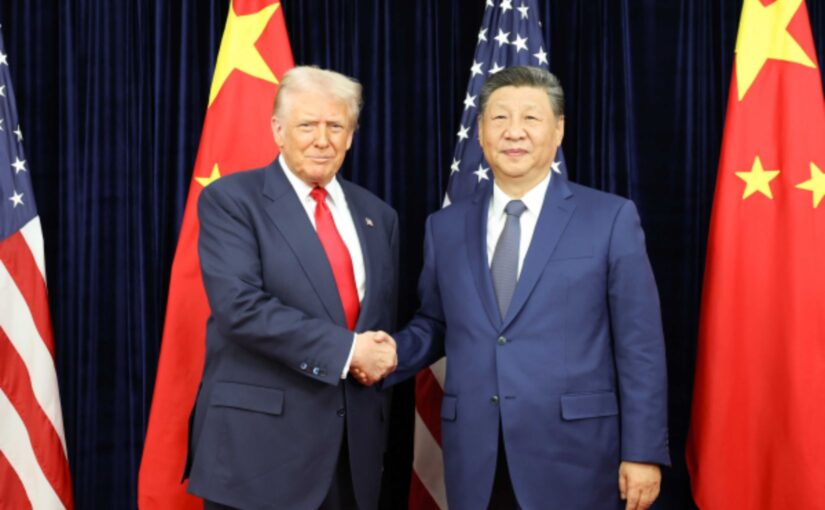
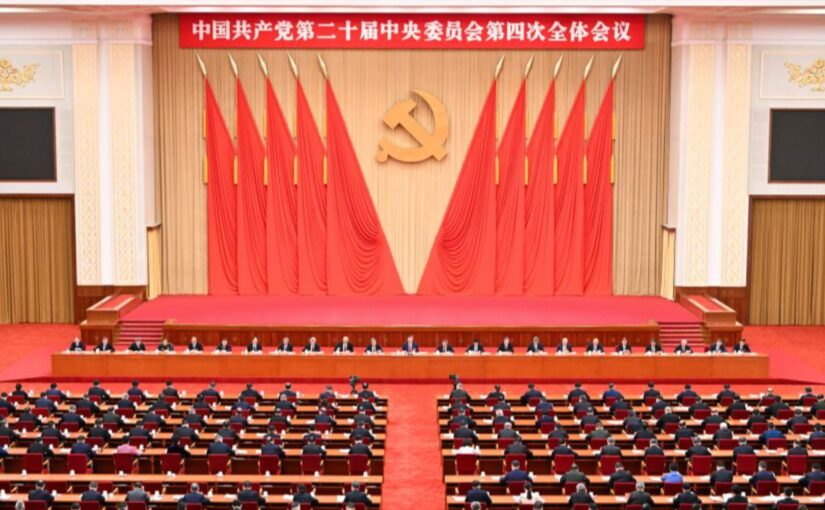
Embassy Spokesperson on the UK’s Hype over the So-called “China Spy Case”

October 16 (Embassy of China in the UK) – Question: For some time now, there has been repeated hype in the UK about the collapse of the so-called “China spy case”. The UK government said that it was disappointed by the CPS’ decision to drop the charges, and released three “witness statements” yesterday. There has also been finger-pointing between the government and opposition parties. What is your comment?

Embassy Spokesperson: We have emphasised from the outset that the allegation about China instructing the relevant British individuals to “steal British intelligence” is pure fabrication and malicious slander, which we firmly reject.

The so-called “witness statements” released after the CPS dropped the case are rife with unfounded accusations against China. They are nothing but sheer fabrications made out of thin air. We strongly condemn such acts.

Continue reading Sinister spy hysteria risks poisoning UK-China relations